
The main task of this website is to suggest a new,
Relative Scale
theory of gravity based on a hypothetical
Arrow of Space which springs from
God (Luke
17:21).
Its presentation with Maximal Set Theory is due in
2014.
The basics of Quantum Theory are spelled out
here,
starting from a well-known task, since 1929.
The latest entry is from 20 October 2013 at 20:05
GMT.
--------------------------------------------------
Indefinable
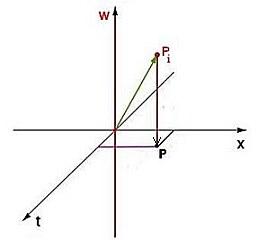
Boundary: Point I and Points II
Abstract
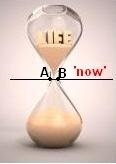
At every instant 'now' the spacetime
points are determined by matter, and
have dual structure: the spacetime it is
both irreversibly fixed in the past and
indefinable in the future. At every
instant 'now' points emerge, and have structure (FR = 1)
exhibited with Point I and Points II.
Every point is emerging --
one-at-a-time -- in the
Arrow of Space as dual
object: it is both irreversibly fixed in the past by
Points II and "open" (indefinable by
matter) in Point I (global mode of spacetime). The
"separator" between Point I and Points II is the
instant 'now'. The Cauchy limit is
the final endpoint C (Point I)
from which Points II emerge in the irreversible past as
perfect continuum (called local mode of spacetime) in
which dt/ds is effectively non-existent, while at
the same instant 'now' the initial Point I offers the
next 'open set' of
re-created Points II to
be chosen from the potential
future of the Arrow of Space in the
next elementary step dt/ds. Because every
point is dual object, it is also suggested that the logic
of propositions and truth statements must be YAIN (Yes
And neIN).
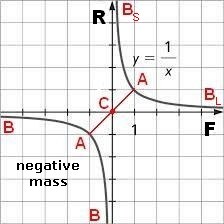
FR = 1
The Universe has indefinable boundary at
C .
No function can be defined on the very endpoint
C (Point I). In the
Cauchy limit Ansatz [ε(..........)ε] ,
the untraceable endpoint
C is excluded by using open
intervals only. Surely with actual infinity we can think
like bartenders and obtain the
physical Points II (always in plural), but never
the endpoint
C (Point I) itself.
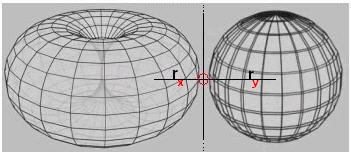
rx
ry = 1 (multiplicative
identity)
--- --->
C
<--- --->
C
<--- --- ---
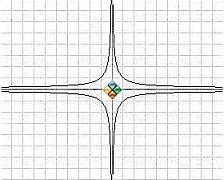
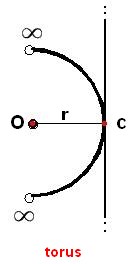
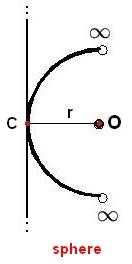
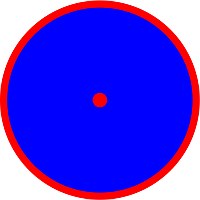
Perfectly smooth torus-sphere transition via endpoint
C in the
so-called global mode of spacetime of Point I (the
Universe as ONE).
The small red
circle contains the
Dedekind cut
C in the infinite, unphysical, and
non-Archimedean spacetime (Point I) of the loop
'now' (see
below), obtained with actual
infinity.
An asymptotically flat spacetime (called
flash or slice) corresponds
to the local (physical) mode of spacetime. It is made of
physical Points II which can be individuated with
matter (the Cheshire cat) and hence
obtain point-like numbers, included imprecise ones from
irrationals.
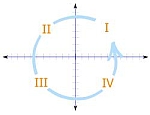
The four quadrants below are
mirror images
obtained by
replacing (t) with
(-t) and 'left' with
'right' (not shown). The atemporal loop 'now'
is nested within Point I (endpoint
C) in the
non-Archimedean global mode of spacetime.
Spacetime
quadrants in Relative Scale
gravity
(the favicon of this website is
inserted as decoration only)
Outline
In Relative Scale (RS) gravity, the
emergence of asymptotic boundaries of spacetime in
the Large (B) and the emergence of physical points in
the Small (B) are produced
en bloc by Point I ,
with Points II. We shall introduce Point I: a non-Archimedean, uncountably infinite,
purely
geometrical (a grin without the Cheshire cat),
and potential (yet-to-become physicalized) entity inhabiting the so-called global
mode of spacetime from which the Cauchy limit
and Dedekind Schnitt (C)
are projected in the local (physical) mode of spacetime by Points
II -- one-at-a-time
along the Arrow of Space. In RS gravity, the
whole local
(physical) mode of spacetime (called also flash)
is being re-created
en bloc in two directions, toward the Large (B)
and the Small (B), starting from
A (multiplicative
identity) in null "directions".
In a nutshell, our Ansatz explains the limit/cutoff (C)
by replacing the options 'either finite or zero' in
Archimedean geometry with emergence
(always with unit probability) of unique flashes
from the global mode of spacetime -- one-flash-at-a-time along the
Arrow of Space. With Archimedean geometry
only, the Cauchy limit and
Dedekind Schnitt (C)
bring two alternatives: either (i) always finite (hence never
zero)
dt/ds increments in spacetime, or (ii)
always
zero. The solution is to include non-Archimedean geometry as well,
and use the instant 'now' in the Arrow
of Space as separator: option (i)
belongs to 'potential reality' (Point I), while option
(ii) pertains to ever-increasing past
(Points II).
Stated differently, Point I
is yet-to-be-physicalized Macavity state (Adam
Helfer) of potential negative-positive mass pairs (Belletête
and Paranjape,
pp. 6-7),
called here pure
dark energy, while Points II are individuated
only by positive matter (Brill and Jang,
1980; Hans Ohanian).
Thus, the Universe
remains in indefinable ONE state at Point I, to allow
for its potential future, and at the same time
(Sic!) is fixed by Points II in its
ever-increasing past.
This is the only possible solution to the
problems of set theory and Continuum
Hypothesis: the "carrier" acting within
dt/ds has been set to zero (perfect
continuum) by the "speed" of light,
hence producing an ever-increasing past
by Points II,
while at the same time the potential, yet-to-become physical
state of the universe is presented with uncountably infinite
(no metric can be defined on null surfaces)
and purely geometrical Point I (the grin without the cat)
residing in the indefinable non-Archimedean global mode of spacetime.
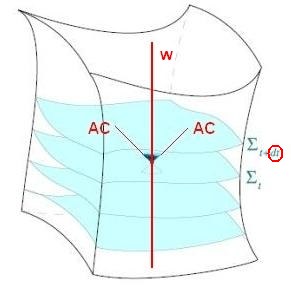
The Aristotelian Connection (AC)
along the w-axis of
the Arrow of Space
Taking the risk to be
terribly boring again, I will introduce an example for 'potential
reality' from General Relativity (GR): the
reference fluid and 'individuating
field'. For reasons which I haven't been able to understand in the
past 40 years, people frantically believe that GR were 'classical
theory'. But it isn't, because it can't. Surely GR is not
quantum theory, but is not classical theory either. In addition to
the arguments from Erich Kretschmann (Über den physikalischen Sinn
der Relativitätspostulate, Annalen der Physik 53
(1917) 575-614), in GR "fixation of a frame of reference and gauge
transformations are intertwined in a manner not encountered in any
other area of physics" (Peter
Bergmann, 1988), which brings insurmountable problems to the
reference fluid and 'individuating
field'. As John Stachel explained in 1993 (pp.
139-140), "there is no structure on the differentiable manifold
that is both independent of the metric tensor and able
to serve as an individuating field", in order to uniquely
identity "the points of the manifold by some property or
properties that characterize(s) each of the points."
So, where and how does
'potential reality' fit in this century old
debate?
As
Clifford
Will et al. put it, "the principle of general covariance,
upon which general relativity is built, implies that coordinates are
simply labels of spacetime events that can be assigned completely
arbitrarily (subject to some conditions of smoothness and
differentiability). The only quantities that have physical meaning –
the measurables – are those that are invariant under coordinate
transformations. One such invariant is the number of ticks on an
atomic clock giving the proper time between two events."
The first two
sentences from the excerpt above are clear: an object will remain
'the same' if we look at it from different directions, just as a
house remains invariant under different coordinates from different
maps, say. These are invariants. But are they 'observables'?
NB: Not in GR,
ladies and gentlemen. The invariant objects in GR resemble
Platonic ideas, which are UNspeakable
and physically indefinable. If we say, for example, 'when
it rains it pours', we apply particular "coordinates" (words) to
express an entity that can be equally well expressed with many
different "coordinates" (languages), because it will always remain
an invariant object, called here
'potential reality'.
In GR, the same phenomenon is called 'reference
fluid' and 'individuating field', thanks to which we have an
exact 'one meter' and exact 'one second' as invariant
objects. Just like Platonic ideas, these
invariants cannot be directly observed -- we can physically
observe only their "shadows" cast with different "coordinates", and
of course require that "coordinates are simply labels".
But look at the last
sentence in the excerpt above: "One such invariant is the number of
ticks on an atomic clock giving the proper time between two events."
I strongly disagree: the phenomenon which creates time as
dt cannot be temporal. Same tallies to space.
We can only try to
reproduce these invariants in metrology, and inevitably
use a
finite number of physical constituents. We cannot
use physical Points II cast from the invariant
'one second' residing as 'potential reality' at Point I. The
claim that an atomic clock "gives" the proper time is tantamount to
saying that your morning coffee is hot because it contains many tiny
little and very hot "particles".
These invariants
produce the physical spacetime of Points II (local
mode of spacetime). In Relative Scale gravity,
we further postulate that these invariants are dual.
Namely, they "expand" toward the Small (B)
and "contract" toward the Large (B),
starting from
A in null
"directions", yet a co-moving observer will always observe
one
and the same 'meter', be it an electron or a galaxy; see
below.
To cut the long story
short, gravity does not produce "curvature".
It only "shrinks" the invariant 'one meter', after which
bodies moves by the
principle of least action, and hence are "attracted"
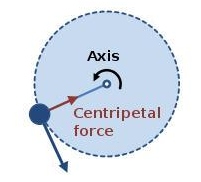
until they become neutralized by the opposite
centrifugal force: dynamical equilibrium. At scales larger than
our solar system we encounter gravitational
"dark" effect and further at Hubble scale its mirrored
effect, called "dark energy".
This is how gravity
builds up the physical universe. Simple, no?
D. Chakalov
August 6, 2013
Last updated:
7 October 2013, 12:37:00 GMT
Download printable copy,
Indefinable.pdf
http://www.god-does-not-play-dice.net/Indefinable.pdf
Read online at
http://www.god-does-not-play-dice.net/Indefinable.html
--------------------------------------------------
Whether you believe you can do a thing or believe you can't, you are right,
said
Henry Ford. Hence the only way to "predict"
the future is to create it;
see my first paper about biocausality from
January 1990.
Please follow the links
below, and feel free to ask questions.
Relative Scale (RS)
Theory of Gravity
Download PDF copy, Relative_Scale.pdf
(June 8, 2013, 13:25:26 GMT)
See for the record, 19 July 2013
The so-called Scale Relativity
Principle was announced on 21
September 2008; the main idea is to remove the background
structure in GR, introduced with 'metric of space', as explained on
25 January 2005.
Very briefly, the current model of 3-D space is based on absolute
relations such as 'inside vs. outside' and 'small vs. large volume
of space', which are not acceptable. We need to eliminate all
absolute notions pertaining to 'space', to match the absence of explicit "time parameter" in GR (Karel Kuchar),
and suggest a new metric theory of gravity, in which the spacetime
itself is an
emergent phenomenon
explicated
from a metaphysical pre-geometric quantum-gravitational "dough";
see the Kochen-Specker Theorem and
Wilson chamber.
To avoid confusion with
other theories, the terms have been changed to Relative Scale
Principle (RSP) viz. Relative Scale (RS) theory of gravity. It is a
theory of quantum gravity in which the "quantization" of spacetime
is introduced from the outset with two modes of spacetime,
local (physical) and global, and the "verdammten
Quantenspringerei" (Erwin
Schrödinger,
1926) are interpreted as artifacts of the macroscopic
measuring devices: Dead matter
makes quantum jumps; the living-and-quantum matter is
smarter.
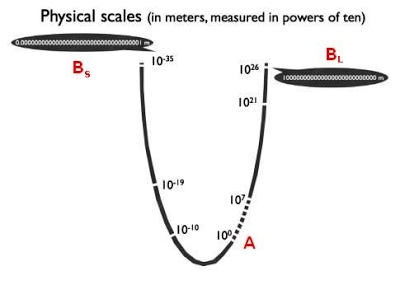
According to RSP, the
geometry of spacetime is effectively Archimedean only at macroscopic length
scale, at the lowest part from the drawing above (fixed observer A), while in
the directions toward
the two ends (10-35 m and 1026 m)
a special kind of
fusion (also known as 'mutual penetration of Small and Large') occurs,
relative to co-moving observers B.
Namely, a macroscopic table with length 1 m will be "shrunk"
or "expanded", relative to
a fixed observer A, along the
"opposite" directions toward the two ends, yet
the metric of spacetime will also change accordingly: relative to co-moving
observers B "travelling" toward the ends of the drawing, a table
with length 1 m will always keep its RS-size of 1 m, although
the same table will be observed by the fixed macroscopic observer
A as 'small like an electron' or 'large like a
galaxy'. That
is, relative to the fixed observer A at the length scale of tables
and chairs, the spacetime is indeed Archimedean,
while relative to the
co-moving
observers B the same spacetime
undergoes mutual fusion by keeping invariant length of all
objects toward the ends of the above drawing.
Who has 'the
right scale'? Nobody, according to RSP, because all contradictory
estimates of length, relative to observers A and B, are in
fact
correct -- the scale itself is dual. Namely, an
object at Hubble scale will indeed be "large" and an elementary
particle will be "small" to observer A and its Archimedean
geometry, while at the same time the "two" (in fact, one)
object(s) B will be entangled and will keep its invariant
RS-size 'one and the same' in their respective domains pertaining to
"two" (in fact, one) observer(s) B. In their respective domain(s)
'out there', an RS-large object does not contain many
RS-small objects: both a galaxy and an electron are made of one
and the same
uncountably infinite "number" of geometrical points (Georg
Cantor). Stated differently, the "two" RS-templates, cast in
opposite "directions" with respect only to observer A, are in
fact one entangled object with invariant RS "size". Hence the
universe itself does not change its size but its metric, and
evolves along the Arrow of Space as ONE bootstrapped
self-regulated entity endowed with self-acting faculty from
its
Aristotelian First Cause. The fact that we can
think
about our brain, by our brain, makes our brain
'self-acting'. Physically, we cannot observe our mind in
the brain -- just a self-acting brain. In the case of
'the universe as ONE brain', simply replace self-acting
brain with 'sufficient conditions for
spacetime'.
According to
Relative Scale (RS) theory of gravity,
there is one and only one
"direction" which begins at the macroscopic world with Archimedean
geometry (fixed observer A), with two dual
presentations toward the
Small and the Large,
cast in the local (physical) mode of spacetime. This dual
"direction" is denoted in the Arrow of Space
with
w-axis,
and is being nullified by the "speed"
of light -- one-instant-now-at-a-time. There is no
background resembling some "canvas" (John
Baez), but a re-created "back bone" of the whole universe
at all
length scales, made by matter
itself -- one-point-at-a-time.
The main applications
of RSP are to suggest two presentations of entanglement,
quantum and gravitational,
which do not occur in the spacetime of a fixed macroscopic observer
A
-- the underlying phenomenon of entanglement occurs in the fused spacetime with
non-Archimedean geometry toward the Small
and the Large, and the dual RS-distance controlled by entanglement remains
one and the same. And secondly, the fundamental object which
facilitates the entanglement is 'the universe as ONE',
as explained with Kochen-Specker Theorem and
Wilson chamber. Thus, the RS
theory of gravity explains the phenomenon of
curvature-and-rotation as alteration
of spacetime metric by 'the universe as ONE'
(cf. sufficient conditions for spacetime):
the so-called "dark matter" and "dark energy" are
interpreted as
tug-of-war and time-symmetric
presentations of RS gravity, corresponding to "shrinking" and
"expanding" of the metric with respect to a macroscopic
observer A, while the actual distance between all point in
the fused spacetime remains one and the same with
respect to observers B. Stated differently, the cases of
RS-shrunk or RS-expanded metric (viz. positive or negative
curvature-and-rotation) are explained without any localized
physical "dark matter" or "dark energy", just as in the case of 'spin'.
Bear in mind that the
current interpretation of gravity inevitably leads to
"the worst
theoretical prediction in the history of
physics!" (Wiki).
In particular, the radius of the universe “could not even reach to
the moon,” as calculated by
Wolfgang Pauli. To understand how we produced such staggering
reductio ad absurdum, recall the tacit idea 'only matter can
interact with matter'. Namely, if we observe "anomalous"
gravitational effects at length scales exceeding the size of our
Solar System, we claim that such effects can only be caused by
matter. Fine, but what matter, and how?
The
phenomenon of transience,
exhibited in the Heraclitean flow of
time (cf. option YAIN (iii) below), can
exist only and exclusively only in a
self-acting universe: it is produced by
'the universe as ONE' (cf. sufficient conditions
for spacetime), which acts on itself by virtue of the
Aristotelian
First Cause. In RS theory of gravity, this self-acting
action is called Aristotelian Connection, and is presented with an
infinitesimal "displacement"
dt in the
Arrow of Space. Its source (Luke
17:21) cannot be traced back from its physical effects, just
as we cannot detect the human mind in its brain -- physically, we
can only observe a self-acting brain. And because the
universe is modeled as 'ONE brain', its
self-action is facilitated by alteration of geometry and
topology of the whole universe, which affects the distribution and
dynamics of matter localized at all entangled
spacetime points, en bloc. Which is why the so-called "cold
dark matter" and "dark energy of (you-name-it)"
do not exist, just like the physical basis of 'spin'.
Such Machian effects may be caused by 'all matter in the whole
universe', but their quasi-local
implementation by 'the universe as ONE' is with
two purely geometrical cases of
curvature-and-rotation, such as RS-shrunk or
RS-expanded metric. We should just forget about
supermassive black holes, "280 million solar
masses per particle," etc., and focus our efforts on
Einstein's theory of 'total
field of as yet unknown structure'.
Last but not least, the alteration of spacetime metric,
according to RS theory of gravity, is an effortless
phenomenon, because it requires alteration of the phase of
gravitational waves. The energy release (e.g.,
1054 ergs/pulse in
GRBs)
is produced by the "engine" of the universe -- the
Arrow of Space. Similar to the "quantum
waves", the gravitational waves do not possess
intrinsic energy and can be manipulated
effortlessly, just like we drive our thoughts in our brains. The same
effortless action is performed jointly by 'the universe as a
brain' and its complementary (Wolfgang Pauli) Universal Mind (Henry
Margenau). As Max Planck
stated in
1944, "All matter originates and exists only by virtue of a
force. We must assume behind this force the existence of a conscious
and intelligent Mind. This Mind is the matrix of all matter". Or
simply “God's
thoughts,”
Albert Einstein.
D. Chakalov
Easter 2013, 17:50:34 EET
Online at
http://www.scribd.com/doc/139555217/Relative-Scale-Theory-of-Gravity
http://www.god-does-not-play-dice.net/#RS_gravity
PDF file (June 8, 2013, 13:25:26 GMT):
http://www.god-does-not-play-dice.net/Relative_Scale.pdf

Outline of RS
theory of gravity
1.
Introduction: The total field of Einstein
Albert Einstein: The
present
formulation of General Relativity (GR) is "merely
a makeshift in order to give the general principle of relativity a
preliminary closed-form expression. For it was essentially no more
than a theory of the gravitational field, which was isolated
somewhat artificially from a total field of as yet unknown
structure."
The main unsolved
task in Einstein's unfinished GR is the presentation of matter
("timber"):
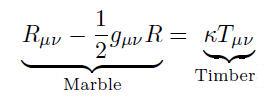
Firstly, the
density of matter in the energy-momentum tensor (Erik
Curiel; Babak and Grishchuk) is presented
with
some continuous "dough", ignoring its quantum
structure, which in turn
leads to
"the worst
theoretical prediction in the history of
physics!" (Wiki).
Secondly, in metric theory of gravity there is no physical
gravitational energy obeying conservation law (Jose
Geraldo Pereira): the conversion (Hans
Ohanian) of "marble" into
"timber" (Hermann Bondi)
must be presented in such way that only the "timber" can do
work, but not the "marble" itself. The latter must not
obey Newton's third law,
as
the inertial mass of an accelerating
particle is not "a back-reaction to its own gravitational
field" (Wolfgang Rindler,
p. 22). And thirdly, the
conversion between the "marble" and its
physicalized "timber" is a bi-directional
"talk" (cf. below), which makes matter ("timber") self-acting.
Why? Because the other party ("marble") is hidden
by the "speed" of light.
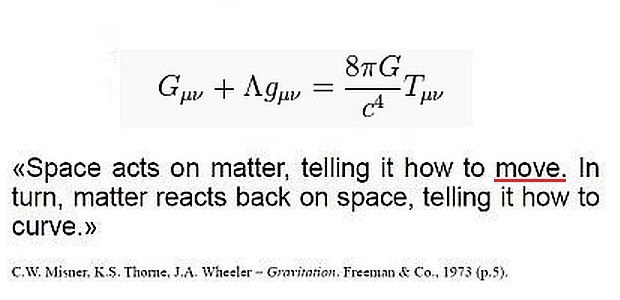
Yes, the gravitational waves are real, but
they do not transport energy or momentum.
They do not
obey Newton's third law,
cannot perform work, and must not be localizable (MTW,
p. 467). Just like
the pre-quantum Kochen-Specker "state"
(never in plural), the "marble" itself
must be
wegtransformierbar (cf. below). It
can only cast its "jackets" under "measurements"
-- one-at-a-time -- made by asymptotically flat spacetime, in terms
of "a parametrization of the
gravitational field and nothing else" (Günter
Scharf). What we call "marble" actually belongs to a wider form of reality: potential
reality, endowed with "pure"
and
intangible
(Hermann Bondi)
energy of 'the universe as ONE'.
NB: As
anticipated by Albert Einstein,
the solution to "marble-timber" relations can indeed be derived "from
a total field of as yet unknown structure": it
could be a hypothetical General Platonic Idea (GPI) field of the
joint phenomenon 'entanglement & flow of time', under the
stipulation that 'the universe as ONE' functions
as a brain as well.
Physically, we cannot observe the mind inside its brain -- just a self-acting brain.
In the case of
'the universe as ONE brain', we replace 'self-acting
brain' with 'sufficient conditions for
spacetime', to recover a holistic quantum-gravitational
phenomenon which determines -- one-at-a-time -- the quasi-local
mass of quasi-local fish, bootstrapped (Geoffrey
Chew) by their school of fish. The end
result from
'entanglement & flow of time' is a wave pattern of the
"timber", like the wave-like holomovement of
centipede's legs. That's how we see "waves"
without any physical source that would otherwise have to
jitter or pulsate in space, due to energy loss.
(Forget about
dimensionless "strain" h.)
Yes, the
gravitational waves and quantum waves are real, because they belong to
potential
reality, yet their physicalized "timber" can only display a
self-acting universe.
Which means that there
are no "carriers" of some biological "field",
no "physical basis" of spin, no "particles"
for gravity, and of course no "Higgs
boson".
NB: This
fundamental phenomenon is widely known from life
sciences; we simply translate it to the language of theoretical
physics with entanglement & flow of time --
Arrow of Space from
emergence of spacetime -- and suggest the
Relative Scale (RS) gravity.
To be specific:
1.1. GR has unlawful
background: absolute size of macroscopic objects viz. absolute
relations such as 'inside vs. outside' and 'small vs. large volume
of space'. An immediate problems comes from entanglement: if
Archimedean geometry were fundamental phenomenon, an EPR-like
correlations of quantum and
gravitational objects would imply, or even require
Geistfelder (spooky "fields"
devoid of tangible
energy) and various "ghost
fields" introduced from "the infinitesimal gauge transformations
of quantized gauge fields" (Günter Scharf,
p. 1).
1.2. Spacetime
topology is not fixed in current GR (Alan
Macdonald; MTW,
p. 837); the
Einstein-Hilbert action is derived from the "dynamics" of values
taken by the 3-metrics on a frozen (Robert Geroch)
"slice" with fixed spatial topology --
no explicit time variable. Solution:
Time requires dynamics of
spacetime topology in terms of Arrow of Space
--
an infinitesimal 'change of
space' (not coordinate change within space).
1.3. Ansatz:
Gravity is not quantum phenomenon, for the same reasons why quantum
entanglement is not producing "dark"
gravitational effects (rotation & curvature).
Instead, the underlying phenomenon is entanglement
& flow of time in Relative Scale (RS)
gravity.
2.
Entanglement & flow of time: Arrow of Space
2.1. The emergence
of spacetime (Isham & Butterfield) is made by
an Arrow of Space along
null "direction" (w-axis)
-- one-at-a-time (Phoenix Universe). Namely, a global,
atemporal, and non-Archimedean realm
of the universe (global mode of spacetime) is complemented by
a quasi-local, physical, and
teleological realm of the universe (local mode of spacetime). The
global, non-Archimedean mode keeps an intact
potential reality separated from its fleeting "jackets" (Plato),
while the local, Archimedean mode
is produced as
re-created "back bone" of the whole universe
at all
length scales, made by "measurements"
executed by the self-acting universe on
itself -- one-at-a-time.
The
instant 'now' separates the two modes of spacetime, which evolve
along null "direction": one-instant-now-at-a-time.
Hence the topological dimensions of spacetime are being accumulated
during the Arrow of Space, and because
all "dark gaps" of the global mode of spacetime are made
zero by
the "speed" of light, we observe a
perfect spacetime continuum and try to explain the dynamics
of spacetime with 'time read with a clock' due to change of
coordinates within spacetime. Hence Einstein's
total field and the 'thoughts
of the Universe' are completely missing in current GR and QM
textbooks.
3. Potential reality: Quantum,
astrophysical, and cosmological implications
3.1. Quantum form of
entanglement: The Kochen-Specker Theorem and
Wilson chamber.
3.2. Astrophysical
form of entanglement: No "dark" basis, just as in the case of 'spin'.
3.3. Quantum
cosmology: Dual age of the universe and
The Gospel.
4. Discussion of RS gravity and outlook
4.1. The theory is
indirectly falsifiable: every alternative theory of quantum
gravity must necessarily be wrong.
4.1.1. Specific
errors in alternative theories: localization
and "boundaries" of
spacetime.
4.2.
Outlook: Asymptotic "boundaries" of spacetime, creation of mass
one-at-a-time (elevator metaphor), and
atemporal "Macavity".
Frequently Asked Questions (FAQ)
Q1: "GR works
perfectly well and I can't agree with your ideas."
A1: This is a statement, not question. Recall that the
current version of GR is based on "miracles": you can't have any
geometry at Planck scale. There is nothing
resembling law and order in the "spacetime
foam" to raise a robust
Lorentzian metric within 10-30 seconds "after" the "big
bang" and inflation of universe's "size" (with respect to what?)
by a
factor of 1078, and keep
the Lorentzian metric for at least
13.77 billion years rooted on Planck length at which
"points" are fuzzy and locality has lost its meaning
13.77
billion years ago.
Q2: "What do you
intend
to achieve?"
A2: A model of bootstrapped universe, in which every geometrical
"point" is determined by states of mater ("jackets")
that are pre-correlated with 'the rest of the universe'.
Which will be impossible if Archimedean space were fundamental
phenomenon. Hence RSP. Notice that at
Planck scale the equation SL = 1 (Small is
denoted with S, Large with L), which holds
for observer A, is again valid, but
now it describes 'the non-Archimedean universe as
ONE' of observer(s) B. Then we use this
unique ONE entity as
Reichenbach's Third Cause to explain the
relational ontology produced by entanglement
during the flow of time (cf. Escher's drawing hands
below).
Q3: "How do you
explain the
mind-body problem?"
A3: With 'potential reality' in the
Arrow of Space; but please see first
Gottfried Leibniz, Wolfgang Pauli, and the
Eskimo metaphor. We
encounter two forms of potential reality: one explicated
under macroscopic conditions (BrainMonad),
and the GPI field of quantum-gravitational world (observer
B). The first interacts with the brain and the physical
world along the Arrow of Space, and can be metaphorically explained
as a 'steering wheel' of 'the car' (brain and 'the rest of the
universe'). Namely, the BrainMonad is
neither 'matter' nor 'mind', but a macroscopic form of
potential reality. One might suggest that it has a dual nature,
because it acts like a "filter" through which the Psyche can
enter spacetime, a bit like images displayed on a TV screen (not
located inside TV). So, if the BrainMonad
is a 'steering wheel', the 'driver' is the
human mind endowed with Free Will. We speculate that the GPI
field may also act as a "filter" for Universal Mind (Henry
Margenau), but cannot prove such claim. Point is, the 'driver'
(human mind) may have access to the joint 'steering wheel' (BrainMonad
& GPI field), and alter the propensities (not "probabilities") for
future potential events, almost like learning a new
motor skill. Math is a crucial issue, too.
The first off task here is to explain the physics of
binding phenomenon -- how all sensory
"data" are combined into a single experience, derived from their
joint amodal presentation (BrainMonad).
In my opinion, the only way to approach the challenge is to assume
that the whole universe as ONE works as a "brain".
Hence RS gravity.
Q4: "What is this all
about, Dimi?"
A4: Tough question. Actually, it's all about cat astrology. I'm also
selling cat food from my website, with special discounts for
theoretical physicists like you. Aren't you interested?
Feel free to submit your questions. Just please don't forget
that RS theory of gravity is an
alternative to all multidimensional theories in which gravity would
operate in some "extra dimensions" with some hypothetical "gravitons".
For example, people
try to bridge the "desert between the weak and Planck scales" with
"extra compact spatial dimensions" leading to "(4 + n) dimensional
theory" in which "particles cannot freely propagate in the extra n
dimension, but must be localized to a 4
dimensional submanifold", while "the only fields propagating in the
(4 + n) dimensional bulk are the (4 + n) dimensional graviton"
(N. Arkani-Hamed, S. Dimopoulos, and G. Dvali,
arXiv:hep-ph/9803315v1, p. 2). Then comes this (ibid., p.
3):
"As within any extension of the standard model at the weak scale,
some mechanism is needed in the theory above mEW to
forbid dangerous higher dimension operators (suppressed only by mEW)
which lead to proton decay, neutral meson mixing etc. In our case,
the theory above mEW is unknown, being whatever gives a
sensible quantum theory of gravity in (4 + n) dimensions! We
therefore simply assume that these dangerous operators are not
induced."
But every sensible
quantum theory of gravity should solve the most widely known
public secret in theoretical physics --
localization. First things first.
Then comes QM and GR, and
the new Quantum Geometry in which the
geometrical points possess quasi-local structure due to the
global mode of spacetime of 'the universe as ONE',
shown with red in the drawing
below.
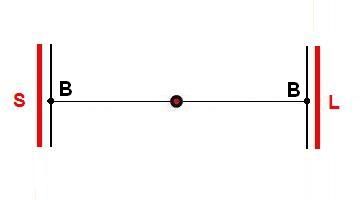
One can introduce "boundary" on
spacetime only and exclusively only with
RSP. This kind of "boundary" is the only possible
logical option for gravity. We are
macroscopic observers, and in the case of Archimedean geometry the
entanglement of space Espace , expressed
with "fusion" of Small and Large, is effectively zero, yet it takes
values in an open interval
Espace
Є (0, ∞).
Also, Baldy's Law, according to which “some of it plus the rest of
it is all of it,” is strictly valid only for an inanimate macroscopic world with Espace
effectively zero, but does not hold for
Quantum Gravity.
More in
A2 above.
D. Chakalov
May 7, 2013
Last updated: June 8, 2013,
13:25:26 GMT

Today, 14 March 2013, Albert Einstein (b.
1879) would be 134 year old.
My efforts to unravel his 'total
field of as yet unknown structure' and
the nature of gravitation and quantum entanglement are posted
here.
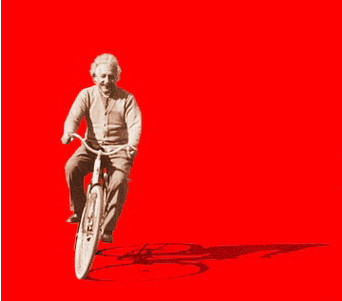
Happy Birthday, Albert!
The so-called 'God's thoughts' refer to a web of
correlations
of all physical systems, which occur in a hypothetical
'global mode of spacetime' produced by the
Arrow of Space.
Relative to a physical (inanimate) clock, the global mode
of time will inevitably look "frozen".
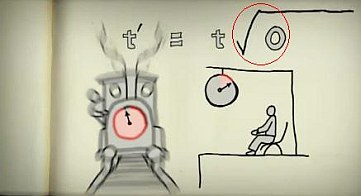
0.47-0.52: "Relative to the platform,
time on the train completely stops."
This "frozen" time pertains to 'the whole universe as ONE'
and to the so-called BrainMonad. The "speed" of gravity
is dual: both "instantaneous", in the global mode of
spacetime, and finite, in the local mode. The end
result is a quasi-local mass and quasi-instantaneous
correlations, resembling those in a school of fish.
Relative to the local mode of spacetime, the global mode
is at 'absolute rest', and serves as the reference fluid of
General Relativity. It is located ]between[ any two
neighboring "points" from the spacetime manifold, and
renders its local mode a perfect continuum: due to the
so-called speed of light, the "separation" of the spacetime
points (local mode of spacetime) is in fact zero.
There is no direct link between the local and global
modes of spacetime, i.e. between 'physical reality' and
'potential reality': the UNdecidable pre-quantum KS state
must not be included in the set of its color-able explications. The 3-D projection(s) of the global mode of spacetime are
both an infinitesimal "point" and 'the infinitely large universe'.
It is a dual object which wraps up the local (physical) mode
of spacetime, and produces finite 'templates' for spacetime. The cosmic vacuum/quantum aether, called here
global mode of spacetime, is an absolute reference
frame pertaining to the whole universe as ONE:
the physical world there is in absolute rest, in the
sense that its proper time is zero, as "seen" from
such luxonic reference frame.
Thanks to the Arrow of Space, 'the universe as ONE'
is not "frozen". In the quantum realm, it exists as
'potential reality' or UNdecidable pre-quantum KS state.
As to the current GR, 'the universe as ONE' is the
absolute reference frame in which space "expands".
It is also the atemporal medium for bootstrapping
the physical world and generation of Machian inertia. More on the errors in GR literature here.
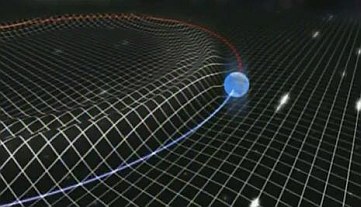
The current GW detectors are manifestly
blind and deaf to
the ripples of spacetime. Their proper detectors must
be endowed with the faculty of 'self-acting', resembling
the
human brain. Ditto for the so-called "dark energy".
LIGO tunnels should be converted to
wine cellars. Any other ideas?
Latest entries
on GW "astronomy":
http://www.god-does-not-play-dice.net/#Bondi
http://www.god-does-not-play-dice.net/#letter
"The representation of matter by a tensor was only a fill-in to make it possible to do something temporarily, a wooden nose in a snowman."
Albert Einstein's Last Lecture, Relativity Seminar, Room 307, Palmer Physical Laboratory, Princeton University, April 14, 1954
"In the first place, we entirely shun the vague word "space," of which, we must honestly acknowledge, we cannot form the slightest conception."
Albert Einstein, Relativity: The Special and General Theory, 1920
"According to the general theory of relativity space is endowed with physical qualities; in this sense, therefore, there exists an ether. But this ether may not be thought of as endowed with the quality characteristic of ponderable media, as consisting of parts which may be tracked through time."
A. Einstein, Äther und Relativitätstheorie, May 5, 1920
(Lisa M. Dolling et al., The Tests of Time: Readings in the Development of Physical Theory, Princeton University Press, Princeton, 2003, p. 346)
Panta rei conditio sine qua non est
Your Global Time is ZERO
It is suggested that the spacetime manifold is a dynamical entity re-created at every step of a hypothetical spacetime arrow; the latter is due to the "expansion" of space by the dynamic dark energy (DDE). Two modes of spacetime are postulated in this Phoenix Universe: local mode, in which we have point-like events cast on a perfect continuum, with a "carpe diem" unit probability (cf. the measurement problem in QM here), and a global atemporal mode, in which a Machian-type negotiation of every next step is being processed. The effects from the global mode of spacetime, which literally build up '3-D space', begin from the macro-scale of classical physics in two "directions": quantum effects toward the Small, and dark matter & dark energy effects toward the Large. Briefly, we model the universe as a huge brain which 'thinks' with its global-mode state by following the rule 'think globally, act locally'. The implications for quantum gravity are explained by revealing the two modes of spacetime in Quantum Theory and General Relativity, and by suggesting conceptual solutions to the problems and paradoxes hindering the quantum gravity of He Who Does Not Play Dice.
We haven't the money, so we've got to think!
Lord Rutherford, 1962 Brunel Lecture, 14 February 1962
Overfunded research is like heroin: It makes one addicted, weakens the mind and furthers prostitution.
Johann A. Makowsky, The Jerusalem Post 19.4.85

|
Does a fish need a bicycle?
|
Latest update: November 26, 2009
Printable copy (current version) from
Check out 'Quantum Mechanics 101' here, my detailed reproach upon wasting taxpayers' money with LIGO here, and my efforts toward quantum gravity here. Regarding Quantum Mechanics (QM), the aim is to avoid the incomprehensible paradoxes and artifacts in it (watch the double slit experiment here), which originate from its textbook interpretation (Niels Borh's belief that quantum world can only be "seen" through classical "glasses"). We can indeed understand the quantum world (but not the current QM textbooks; cf. Richard Feynman), by changing the "glasses" through which we "see" and construe the quantum world: the universe modeled as a brain. Regarding the artifacts in QM, we may be in a situation similar to an Eskimo trying very hard to comprehend the notion of "trunk". In our case, we encounter an incomprehensible wave-particle complementarity, which could be just an artifact from our wrong thinking, like the "nose-arm complementarity" in the case of the Eskimo observing elephant's trunk. Surely 'the quantum system' doesn't live in any relativistic space, so one should expect all sorts of headaches and artifacts (e.g., "diese verdammte Quantenspringerei", Erwin Schrödinger) from imposing wrong "glasses" onto the quantum world 'out there'. (A typical example is Franco Selleri's quest for detecting de Broglie waves.) The prerequisites for the interpretation of QM suggested here originate from Schrödinger. Back in 1935, Erwin Schrödinger stressed the following: "The rejection of realism has logical consequences. In general, a variable has no definite value before I measure it; then measuring it does not mean ascertaining the value that it has." And in a letter to Einstein dated 18 November 1950 (quoted after J. Bub, p. 115), he wrote (emphasis added): “It seems to me that the concept of probability is terribly mishandled these days. Probability surely has as its substance a statement as to whether something is or is not the case — an uncertain statement, to be sure. But nevertheless it has meaning only if one is indeed convinced that the something in question quite definitely is or is not the case. A probabilistic assertion presupposes the full reality of its subject.” We are obviously dealing with a new form of reality: a probabilistic assertion, and the Hilbert space itself, cannot accommodate the Kochen-Specker case in which "the something in question" is beyond an unequivocal "is or is not" state (cf. "an unequivocal true-false value" in Isham and Butterfield, p. 3; emphasis added):
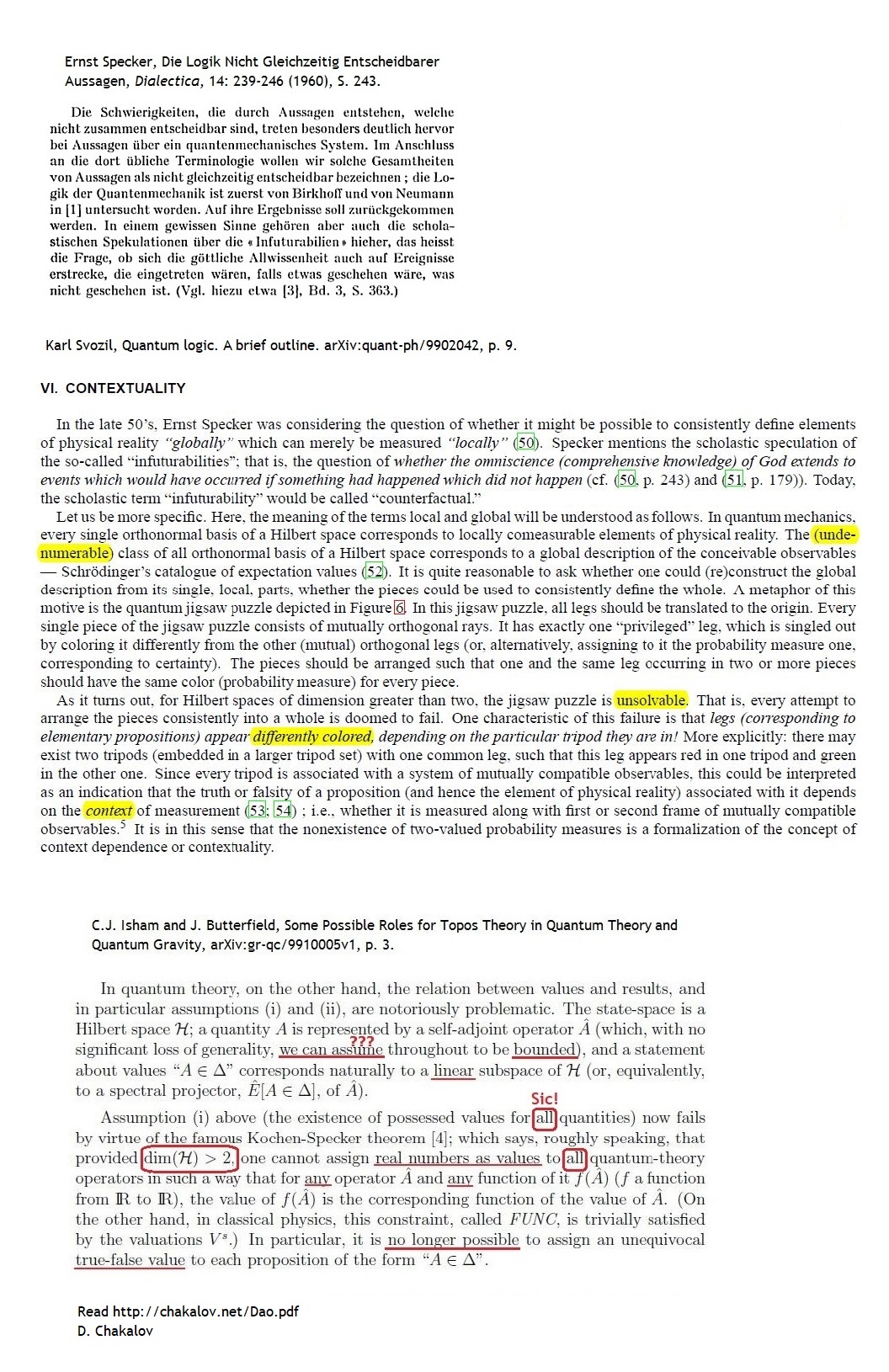
Check out the implications of KS Theorem to the Precise Value Principle (PVP) and the statistical interpretation of QM from R.I.G. Hughes, p. 164.
Going back to Ernst Specker's tripod, if there are states of the tripod in which one of its legs has UNdecidable color, then not just this particular leg, but the whole tripod will be UNdecidable. It's a package. The phrase "an incomplete Kochen-Specker colouring" (Helena Granström, p. 2) has no meaning whatsoever; it is the result from imposing wrong "glasses" onto the quantum world. And if you subscribe to the modern quantum mysticism -- "the quantum state is not a physical object, it is a representation of our state of knowledge, or belief" (Itamar Pitowsky, p. 28) -- your brain will wind up in a schizophrenic state of, say, 68% "knowledge" of the quantum state, and 32% of "[what da heck is that uncolored KS sphere?]". No mental concepts, such as 'knowledge' or 'imagination', are admissible in the ontology of quantum reality. We must never mix apples with oranges (Res Extensa and Res Cogitans). Karl Svozil refers to this UNdecidable faculty of the quantum world as "ambiguity" (p. 4), and stressed: "This ambiguity gets worse as the number of particles increases." If you think about the quantum world with classical concepts, it will get from bad to worse, until you end up with the (old) cosmological "constant" problem (more on that from Alan Guth). As Erwin Schrödinger might have said in 1935, the same "variable" that has had no definite value before you measured it will continue to keep its UNdecidable nature after you "measure" it as well. And you can't fit it in any Hilbert space, of course (what is the dim(H) for 32% "uncolored" and 68% colored KS sphere?). Let's give it a name: potential reality. In the quantum realm, it (i) offers its context-dependent explications (a.k.a. "observables"), (ii) keeps the sameness (Genidentität, Kurt Lewin) of particles of the same type, which MTW regard as "a central mystery of physics" (p. 1215), and (iii) facilitates the ultimate quantum phenomenon: entanglement. It may be difficult to grasp, but is much simpler to the juggling with the possible implications from Bell's inequality and their loopholes (e.g., Ghim and Zhang). As to quantum gravity (notice the opinion of an expert here), the 'potential reality' is introduced to revive the physical objectivity of spacetime "points", by making the spacetime manifold itself an emergent phenomenon: "The requirement of general covariance takes away from space and time the last remnant of physical objectivity" (A. Einstein, Grundlage der allgemeinen Relativitätstheorie, Annalen der Physik 49 (1916) 769-822). The current formulation of GR can only determine "the mutual relations that exist between the gravitational field and the matter fields (i.e. the value the gravitational field takes where the matter field takes such and such value)", but not "the proper time between spacetime points" (Wiki; more from Butterfield and Isham), and the field equations "cannot even uniquely determine the topology of a manifold" (Alan Macdonald, Einstein's Hole Argument, p. 4). How can we fix these problems? By introducing two connections, geometric (local mode) and torsion (global mode of spacetime). The torsion connection is completely vanished (Hehl and Obukhov) in the local mode, hence its effect are considered "dark" (see Alex Murphy).
Notice also that a hierarchy of 'potential reality' (never in plural), resembling the structure of cognitive concepts, is postulated (application here). In metaphysical terms, it supports the views of Aristotle and Spinoza: no "parts" of the infinite can exist, as the infinite Substance is indivisible. It's not like Russian dolls. In the case of a human brain (not mind or consciousness), the UNspeakable potential reality can be explicated with, for example, three (and many more) sayings, which produce "measurements" (if you prefer QM jargon) on it: 1. All are not hunters that blow the horn.
2. La robe ne fait pas le médecin.
3. Es ist nicht jeder ein Koch, der ein lang Messer trägt. None of these "measurements" can "collapse" the potential reality (Platonic idea) explicated with these sayings. And if our brain can work with 'potential reality', so can the universe modeled as a brain. Regarding the brain above your neck: its 'potential reality' is to its human self what EM radiation is to your subjective experience of 'color' -- no direct action of the human self on its brain is allowed in science. Hence it may be conceivable that the potential reality entwined with the human brain could be bridged to that of the quantum vacuum (BCCP). All you may need is an arrow of spacetime. (Notice, however, the 'two rules of success' here.)
Notice also that 'potential reality' is an intrinsically holistic phenomenon, so it will be very misleading to call it "dark", just because it is not possible to be traced back from any of its physical explications in the r.h.s. of Einstein field equation. Forget about "energy conservation in GR". It's an oxymoron (details from Denisov and Logunov). What kind of "time" is implied in the non-linear dynamical cancellation of the two "fluxes" (Merced Montesinos), such that the ether would not "come back"? Can your wristwatch read it? The sole "explanation" of this ultimate puzzle of GR, offered by Chris Isham, was that, "after all, general relativity does seem to work well as a theory, and yet I can certainly read the time on my wrist watch!" But your wristwatch should not be able to read more than one instant from this (global) non-linear "time". Complex problems have simple, easy-to-understand wrong answers (Murphy's Law No. 15). We need quantum gravity, to uncover "the proper time [tau] along spacetime trajectories" (Carlo Rovelli; drawings here) and the genuine 'time variable' associated with the expansion of space due to DDE. Once we achieve this formidable task, we will (hopefully) find out what -- if anything -- might remain unchanged/conserved in this particular (global mode of) time. In the current 'GR without DDE', the dynamics is "entirely generated by constraints. The dynamical data do not explicitly include a time variable" (Karel Kuchar), and one can only hope that "the energy momentum tensor which is the source of gravity" might be conserved "due to the Bianchi identities" (E. Guendelman, p. 9). Such hopes are (i) utterly murky even in the textbook GR, because any observable of the gravitational field is "necessarily quasi-local" (Laszlo Szabados) and (ii) not applicable to the new dynamics of GR due to DDE. For example, Noether's Theorem holds only for flat spacetime, and the Bianchi identities are applicable only for 'GR without DDE'. At this point, I got an emotional response from Eduardo Guendelman, saying that the Bianchi identity is a mathematical theorem, so there is no ambiguity involved here. Well, I'm just a psychologist, so let me quote Matt Visser, p. 3: "... the Einstein equations of general relativity are local equations, relating some aspects (notice the poetry -- D.C.) of the spacetime curvature at a point to the presence of stress-energy at that point. Additionally, one also has local chronology protection, inherited from the fact (Sic! -- D.C.) that the spacetime is locally Minkowski (the Einstein Equivalence Principle), and so “in the small” (that's the sole application of those 'twice-contracted Bianchi identities', cf. George F R Ellis and Henk van Elst, Eq. 2 -- D.C.) general relativity respects all of the causality constraints of special relativity.
"What general relativity does not do is to provide any natural way of imposing global constraints on the spacetime — certainly the Einstein equations provide no such nonlocal constraint." Which is precisely the missing element needed to address the 'global properties of spacetime' in the presence of DDE. As R. Rakhi and K. Indulekha acknowledged (p. 5): "Because this energy is a property of space itself, it would not be diluted as space expands. As more space comes into existence (the same phrase was used by Sean Carroll -- D.C.), more of this energy-of-space would appear. (...) So the mystery continues." And so does the confusion about it -- click here. The intrinsic dynamics of the phenomenon of 'more space comes into existence' could only be detected in a reference frame from which this phenomenon is excluded, like 'not acting there'. But because DDE acts on the whole 3-D space en bloc, without any irregularities, there is no place in the universe in which we could install a clock and say -- look, this clock does read the (global mode of) time pertaining to the omnipresent phenomenon of 'more space comes into existence'. It is the theory of relativity itself, which cannot "detect" it. Which is why some people call it "dark". Although the mathematical meaning of the phrase "more space comes into existence" is not clear, I don't think Kurt Gödel would have called the ultimate source of spacetime points "dark". Once we move from physics to geometry, it's a whole new world there. Pity Mike Turner called it "dark"; that's so wrong! One cannot insert the "dark" energy of X into its consequence -- accelerated expansion of space. The source X does not belong, and cannot be fitted into the same 3-D space (Cauchy hypersurface) which is being created by X . You can do this only in GR textbooks that deal with 'GR without DDE'. Capiche? Notice also that Matt Visser (see above) considers the metaphysical assumption that the spacetime were "locally Minkowski (the Einstein Equivalence Principle)" to represent a fact. But we only have a mathematical fact that locally , "over" a point, one can indeed eliminate the gravitational "field" by hand (Hermann Weyl). But because nobody has so far explained the resulting quasi-local nature of the gravitational field's observables (see Laszlo Szabados above), nor the origin and the mechanism of inertial reaction "forces", I think we should be very cautious and open-minded in interpreting such mathematical facts and theorems, like the above-mentioned Bianchi identity. If you are looking for a genuine quantum-gravitational measuring device, your wristwatch (as well as the one of Kip Thorne) fits the bill, because it reads an already-linearized (see the explanation of 'already' below) time variable obtained from the "the proper time [tau] along spacetime trajectories" (Carlo Rovelli) and the (global mode of) time associated with the expansion of space due to DDE.
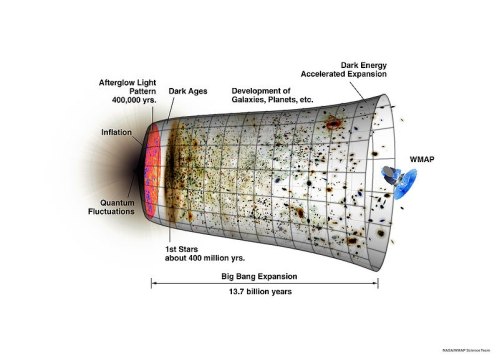
This is to me the ultimate puzzle in present-day GR. The sole "explanation" of Chris Isham was that, "after all, general relativity does seem to work well as a theory, and yet I can certainly read the time on my wrist watch!" I will desist to comment on C. Isham's observation, and will instead take the liberty of being (again) deadly boring, by explaining the difference between 'GR without DDE' vs 'GR with DDE'. First, a simple example from STR, with a trajectory of a Frisbee, on the fixed background of Minkowski spacetime: we can calculate the instantaneous state of the Frisbee at each point from the trajectory, and attach to this dimensionless point a well-defined vector. My teenage daughter couldn't understanding how it is possible to attach a vector to a "point", and I explained the puzzle by saying that the information from a finite interval from the history of this infinitesimal "point" is encapsulated in it -- we instruct this interval to shrink asymptotically toward zero -- so the vector is indeed well-defined. All this is possible under the premise of the fixed "grid" in STR. But once we move to 'GR without DDE', the "grid" is gone (Emilio Elizalde): at each and every "point" from the trajectory, the non-linear mutual determination of matter and space (John Wheeler) takes place. But in what time (see Chris Isham's wrist watch above)? There is no background grid or "ether" w.r.t.w. one can define the dynamics of 'GR without DDE'. Yet people don't ask such questions and prefer to just do calculations with the linearized approximation of 'GR without DDE'. As another expert explained to his undergraduates, "one begins by introducing the notion of a tangent vector to describe an infinitesimal displacement about a point p " (Bob Wald, p. 4). But again, in order to recover the true dynamics of 'GR without DDE', you need some "ether" or rather 'reference fluid' w.r.t.w. one can describe the fundamental phenomenon of transience (Abner Shimony): see the so-called Aristotelian Connection here. At this point, the 'GR with DDE' comes to rescue the Hamiltonian formulationof 'GR without DDE': we have a brand new, global degree of freedom of spacetime en bloc, hence can recover the transience of spacetime, as driven by the source of DDE, along the arrow of spacetime -- see above. To identify this same source in the quantum realm (called 'potential reality'), let's go back to the interpretation of QM here. In a nutshell, the so-called PR2 interpretation of QM offers a solution to the non-unitary "collapse" by replacing the alleged "U" and "R" processes with a new (at least to people like Ed Witten, Steven Weinberg and Gerardus 't Hooft) form of reality, known since Plato, called here 'potential reality'. Its quantum presentation is ubiquitous and has zero entropy; hence the familiar notion of time, which pertains to monotonic increase of entropy "in time", is not applicable to 'potential reality'. It may produce "shadows" in terms of 'quantum observables', yet these "shadows" cannot be traced back, to reveal any evidence of such events (or "quantum information") ever having emerged from 'potential reality'. It may act, yet not experience any backaction from its "shadows". Hence it is the ultimate "background" for QM and GR. It evolves along the arrow of spacetime (resembling the "memory" of the universe), by unfolding from 'the ideal monad without windows'. In the local mode of spacetime, every "point" is filled with an already explicated value of its 'potential reality', and as the latter evolves and becomes enriched, the "number" of its localized explications increases accordingly: more and more things come into existence in the universe. As John Wheeler put it, "Time is Nature's way to keep everything from happening all at once". Only with 'potential reality' there is no need nor place for any 'unitary dynamics' in the local mode of spacetime. This is the metaphysics of 'the universe modeled as a brain', viz. the interpretation of 'expansion of space' along the arrow of spacetime. From this perspective, if we follow the deflation time arrow in the local mode of spacetime, things will gradually fade away in a strictly non-unitary fashion, but will only approach asymptotically The Beginning, because it is logically impossible to reach It from/within the local mode of spacetime (cf. the paradox here). The solution is 'dual age cosmology'.
As M. Gell-Mann and J. B. Hartle have noticed, "quantum mechanics is best and most fundamentally understood in the framework of quantum cosmology" (quoted after Claus Kiefer, p. 1). And vice versa. The current situation with inflationary cosmology was presented by Alan H. Guth, the winner of the 2009 Isaac Newton medal, on 13 October 2009. He speculated that our galaxy could be an amplified "quantum fluctuation" (Part 2, 3:30 - 6:16),

... and then confessed his "Nightmare of Dark Energy" (Part 2, 11:36), on which the "eureka" of inflationary cosmology is grounded.

Perhaps Alan Guth should have entitled his talk 'The Dark Energy Nightmares of Inflationary Cosmology', as encapsulated in the [?] area in V. Mukhanov's paper:

With the so-called dual age cosmology, the "first" Plankian time "after" The Beginning is stretched toward infinity in the local mode of time. This is otherwise being explained as 'the universe started asymptotically from time zero'. In this local mode of time (read by your wristwatch), the universe is effectively eternal and its age is indecisive, while in the global mode of time it has a finite age. Another nice feature of dual age cosmology is that The Beginning is an atemporal phenomenon, and is always present (global mode of time) in the instant 'now'.
Let's go back to QM. Think of a trajectory of a Frisbee: at each "point" from the trajectory (the latter could be a perfect continuum of such "points"), the state of the Frisbee is a perfectly well defined fact, with a 'carpe diem' unit probability. I use this simple idea to introduce a new kind of cancellation mechanism, pertinent to 'potential reality', for removing the non-unitary "R" process (historical account from October 2002 here); hence the motto of this web site, since July 1997: Dead matter makes quantum jumps; the living-and-quantum matter is smarter. Notice that not only the "R" process is being removed (as did Hugh Everett III in his relative state interpretation of QM), but the alleged "U" process and Hilbert space as well. The established theoretical physics community, particularly Niels Bohr, ridiculed Everett's interpretation to the extent to which Hugh Everett left physics (and became millionaire). NB: Notice that if the PR2 interpretation of QM is correct, then all tentative solutions proposed for the measurement problem and the classical limit of QM, based on either probabilistic or "toposification" (Chris Isham), ‘neo-realist’ interpretation of QM (Cecilia Flori, p. 211), will necessarily be wrong. The next step is to elaborate on the continuum of such explicated quantum states (local mode of spacetime), which emerges from the back bone of the whole physical world (global mode). Here we enter quantum gravity, particularly the emergence of time and space from "something else" (Isham and Butterfield): check out the arrow of spacetime here, and think of 'the whole universe' as a huge brain which self-determines its consecutive quantum-gravitational states in line with the Bootstrap Principle of Geoffrey Chew. Also, the alleged quantum "fluctuations" are interpreted as flexibility of 'the quantum state' to offer potential states, one of which to be chosen (one by one) by 'everything else in the universe'. Hence the speculation about some "spacetime foam" and the insoluble problems from it (how do you tell apart spacelike from timelike at Planck scale?) are avoided from the outset. Possible practical implications are outlined here.
As in the case of Hugh Everett, many theoretical physicists jumped to play the role of Niels Bohr, chief among them was Britain's leading expert in quantum gravity, who declared seven years ago (Wed, 23 Oct 2002 19:24:15 +0100): "You do not know enough theoretical physics to help with any research in that area." To the best of my knowledge, nobody has so far offered some new cancellation mechanism as a joint solution to the measurement problem of QM and the cosmological "constant" problems. Such cancellation mechanism is built in the UNdecidable quantum state (quantum presentation of Platonic ideas) from the outset: instead of dealing with some |alive cat> & |dead cat> from the "U" process, we encounter an UNdecidable 'cat per se', so if we happen to observe an 'alive cat' as a fact, with unit probability, the 'dead cat' will happily live undisturbed in 'the UNdecidable quantum state'. No "collapse" nor dead cat doppelgänger à la Everett are needed.

The animated cat above is very deceptive, because its "evolution" prior to the "collapse" seems fully deterministic. If you think about the quantum "evolution" of such superposed states in terms of 'energy eigenstates', notice the imaginary unit in S. Carroll's essay, Eq. 4: "all of the time evolution is encoded in the phases [XXX]" (ibid., p. 6). But how do you encode 'time evolution' in complex phases (Chen Ning Yang)? Recall that, after you "collapse" the cat, the alleged "time parameter" in the Schrödinger equation turns into some non-relativistic [you-name-it], but the equation itself doesn't say anything whatsoever about the nature of this "time parameter" prior to the "collapse", as introduced by hand (along with the Born rule) in QM textbooks.
To understand the origin of this whole mess, read the second sentence from the excerpt below (R.I.G. Hughes, The structure and interpretation of quantum mechanics, p. 77):
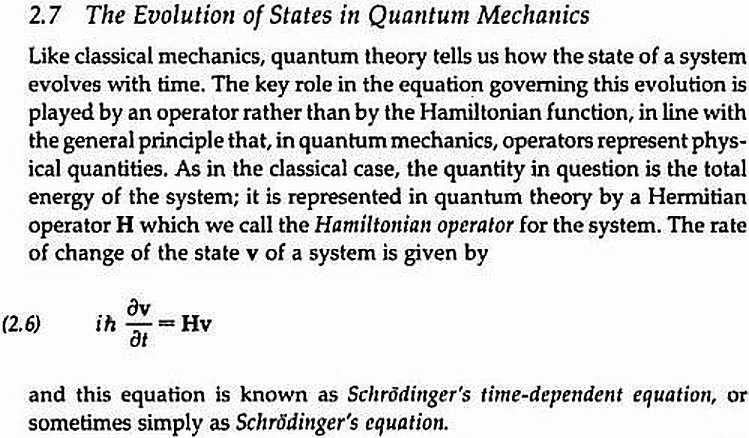
This "general principle", however, does not cover the case of UNdecidable, hence not-yet-physical, KS quantum state, as explained by R.I.G. Hughes here. One can hardly overestimate the enormous confusion from this huge blank spot in current QM textbooks -- just recall the ongoing quest for "quantum computing" and the alleged "decoherent histories" (J. Halliwell; cf. Franck Laloë, Sec. 6.4 and footnote 47 on p. 81).
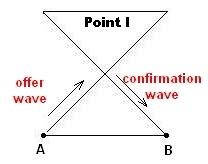
All these problems are resolved in the PR2 interpretation of QM from the outset. Moreover, the new cancellation mechanism is introduced to explain the ongoing, as-we-speak mechanism of 'the flatness problem' (asymptotically flat spacetime conjecture), producing an extremely precise balance between the two tug-of-war effects, CDM & DDE, of the geometry of spacetime at cosmological scales. Otherwise we have to inject up to 96% "dark stuff" (with all sorts of "ghosts") into the current theoretical physics, as calculated under the assumption that 'potential reality' doesn't exist. As Evalyn Gates put it (p. 196), the detection of DDE was "like finding an elephant on top of a table impeccably set with the finest china and silver (...). We stare in shock at the uninvited guest and demand to know where the elephant came from -- and how it got into (the) room." Regarding the arrow of spacetime: notice that the Frisbee-like sequence of explicated facts (local mode of spacetime) is inherently background-free, because the background (the reference fluid of GR and the UNdecidable quantum state) is 'not there', being placed ]between[ the "points" of the continuum of the local mode of spacetime. In other words, the "dark gaps" of the global mode are not like the real gaps between the tiles in R. Penrose's bathroom: regardless of how small tiles you choose, if you decrease the size of the tiles in a Fibonacci sequence, you will never ever reach the "gaps" from/within the local mode of spacetime (more on Fibonacci here). This proposal makes the local mode of spacetime a perfect 3-D continuum with dynamical topology of 'asymptotically flat spacetime'. The "dark" gaps of the postulated global mode of spacetime are completely sealed off by the arrow of spacetime -- the mechanism by which the "dark" gaps of the global mode are made nonexistent in the local mode is the same that makes the "speed" of light a fundamental constant (and also hides the mirror tachyonic world). This renders the Schlaefli conjecture (L. Schlaefli, Ann. di Mat. 5 (1873) 170), as well as all "branes" and other multidimensional superstitions in GR and string hypotheses (Lisa Randall; see also A. Vilenkin below) redundant, to say the least. In the context of GR, the global mode of spacetime is located "within" each and every point from spacelike hypersurfaces, as it "lives" exclusively on null hypersurfaces. (Unlike the geometry of spacelike hypersurfaces, the geometry of null hypersurfaces is not metric (D. C. Robinson), which leaves a challenging opportunity to introduce an additional, to the Christoffel connection, global torsion connection.) To be precise, the "duration" of the global mode, recorded with a physical clock (local mode), matches the "duration" of the atemporal "handshaking" transaction in Cramer's interpretation of QM: it has been already completed at each and every instant we "look" at it (see below). Hence in the local mode of spacetime, the dimensionless GW amplitude is zero, nonexistent, zilch. (Another case of reining a dimensionless amplitude, the mythical "quantum computing", is examined here.) Notice also that the hypothetical global mode of spacetime cannot be read by a physical clock (it will "stand still"). It is introduced to replace the "external time parameter" in H.-D. Zeh (p. 13) and the “auxiliary internal time” (cf. Macias and Quevedo, p. 8) by 'the reference fluid of GR'. The latter can "act" upon matter without being affected in turn by matter. In this unphysical "absolute" reference frame, an electromagnetic radiation field can indeed "stand still" (recall that EM radiation field cannot stand still with respect to any physical observer, Bahram Mashhoon, p. 14). The next metaphysical idea is straightforward: 'time' does not originate from 'change in space' but from 'change of space'. Only if you have the latter (global mode), you may introduce the former, as 'time read by a clock' (local mode). Why? Because one cannot insert the "dark" energy of X into its consequence: accelerated expansion of space. The dynamics of 'the change of space' is defined relative to the "omnipresent ether X " (global mode of spacetime). The latter is located "within" each and every point from the local mode of spacetime, and is wrapping the local mode by two (in fact, one) 'numerically finite but physically unattainable Aristotelian boundaries'. All we can physically observe is that the local mode of spacetime is being 'acting upon itself'. Such self-action will of course look "dark" to all local sub-systems (see Alex Murphy). Hence we can bridge QM and GR, and understand the origin of quantum and gravitational "waves": EPR-like correlations (global mode) will inevitably induce wave-like holomovement of physical stuff along the arrow of spacetime. Such wave-generation effects can be found in our brains and in many living organisms. Perhaps it determines the inertial reaction "forces" as well (don't bother to ask Criss Angel, he knows nothing about it). Recall what William Kingdon Clifford claimed in his paper ‘On the Space-Theory of Matter’, presented to the Cambridge Philosophical Society on February 21, 1870 (quoted after Domenico Giulini, p. 2):

I believe Clifford's idea in (2), about "the manner of a wave", is amended here with the proposed origin of quantum-and-gravitational "waves": the continuous passage of "curved or distorted" from one point (not "portion", as in (1) above) to the next one is what the arrow of spacetime does on the perfect continuum of the local mode of spacetime (the "dark" gaps of the passage are being completely sealed off by the arrow of spacetime).
But why 'arrow of spacetime'? Because our good old 3-D space is not like a huge static warehouse, in which we would notice some redshifted light from moving objects, receding from us in line with the Hubble Law (some balloon metaphors may be highly misleading). It is the other way around: distant galaxies are not "speeding up" with respect to us in some absolute static space, but the very metric of space is "expanding" (I firmly disapprove of this notion of "expansion", and have suggested the so-called 'relative
scale principle').
Hence the space itself is endowed with dynamics, but then we need some ether w.r.t.w. such 'global dynamics of 3-D space' can be formulated. Then the only possibility -- trust me, there is no other option -- is to place the omnipresent ether, as 'the source of the "dark" energy', in the global mode of spacetime. Otherwise you will have to define the dynamics of space w.r.t. itself, and will look like Baron Munchausen. That's why we need an arrow of spacetime, in my opinion (but notice the opinion of Chris Isham above). NB: If this is the case chosen by Nature, then any approach to quantum gravity, based on the "splitting" of spacetime (Brett Bolen), will necessarily be wrong.
The speculations of Roger Penrose will necessarily be wrong as well: "The fuzzy idea of where and what is infinity was clarified and made more specific by the work of Penrose [45, 46] with the introduction of the conformal compactification (via the rescaling of the metric) of spacetime, whereby infinity was added as a boundary and brought into a finite spacetime region." (Ted Newman et al.) Perhaps we may have to develop new mathematical theory of 'potential reality', such that the "state space" of Margenau's Onta (quantum presentation of Platonic ideas) would match the structure of cognitive concepts; notice that in the "cheating on 20 questions" the answer 'cloud' was explicated by a Baeysian learning rule (not the Born rule). For comparison, the categorification of Feynman diagrams requires "black boxes with many wires going in and many wires going out" (Baez and Lauda, p. 16), while in our case all wires are "instantaneously" (global mode of spacetime; see the Escher drawing below) keeping track of all virtual 'black boxes' as well (relational ontology), in order to dynamically adjust to the changing context of the game, until they jointly select the final, explicated 'black box': 'cloud' (see also the four dice here). NB: In the local mode of spacetime, the "duration" of the total negotiation with 'everything else in the universe' (relational ontology) is zero. Hence a wave pattern is being created, without any source of these "waves" being present in the local mode, and a new form of retarded causality (biocausality; see below) can be postulated -- a revitalization of Leibnitz' harmonia praestabilita, Jung's Synchronicity, and Einstein's Überkausalität. We definitely need mathematical theory of 'potential reality'. The task is highly non-trivial, but once we unravel the correct mathematical theory, the astonishing effectiveness of mathematics (Eugene Wigner) may drive us closer to the true quantum gravity of He Who Does Not Play Dice -- the world is not deterministic but flexible, and the 'chooser' of one possibility (one at a time) amongst infinitely many is 'the whole universe' in its state of ONE. All I've been getting so far is either dark silence or insults (some of them really harsh). Perhaps the situation will improve in 2010, after the sixth consecutive failure of LIGO Scientific Collaboration (LSC) to detect GWs with the so-called "enhanced LIGO". GW energy transfer is fundamentally non-linear phenomenon (Hermann Bondi), but is wiped out with the "linearized approximation" adopted by LSC. Also, GW energy is intrinsically quasi-local, in the sense that GWs do not propagate exclusively "in one direction only" (“when the waves are all moving in the same direction”, cf. P.A.M. Dirac, Ch. 33, p. 64), as they also have a holistic global component (atemporal "handshake"), which covers the whole 3-D space en bloc.
LIGO Scientific Collaboration (LSC) stubbornly refuse to acknowledge that there are no bans whatsoever on the dipole radiation, simply because
conservation of gravitational mass-energy and momentum, in a world dominated by an evolving cosmological "constant", is a wishful thinking. They fear to even mention the implications of DDE to their project, and have never tried to address the (old) cosmological "constant" problem, which inevitably occurs if you trust the unwarranted assumption that the "dark energy" from the quantum vacuum can only spring from Lorentz-invariant stuff with positive energy density. Is it possible to detect some 'elementary shift' of the expanding metric -- the "intrinsic time interval associated to any timelike displacement", T. Jacobson, pp. 18-19 -- due to the omnipresent and perfectly smooth DDE? In what reference frame? Notice that you're dealing with some "fluid" that "has zero inertial mass! It can be accelerated with no cost, no effort" (B. Schutz, p. 255) and "provides an all-pervading energy density and negative pressure that are the same to all observers, at all places, and at all times in the history of any universe model, even the expanding ones." (p. 257) Similar rhetoric questions apply to the dynamics of the metric, producing inflationary gravitational waves on the 3-D "balloon" hypersurface. It's a bundle.
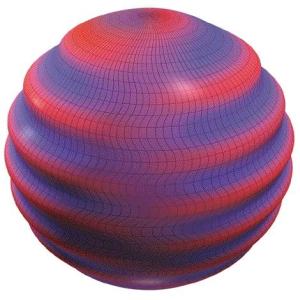
Yet the same kind of waves, only much "weaker", are expected to be detected by LIGO (see below).
Forget it. There is no need for "precise calibration" of a dead turkey. The insane efforts of LSC remind me of the old joke about a drunken man, who has lost his key somewhere in the dark, but is searching for it under the street lamp, simply because it is brighter there. Only LSC's "key" costs billions. Which is why I accused LSC members of aggressive professional negligence, and offered them to review my White Paper. They responded with dark silence, as usual.  Check out the communist censorship of Paul Ginsparg's "moderators" here. Check out the communist censorship of Paul Ginsparg's "moderators" here.
Since all this points to the unknown dynamics of GR, consider this: similar to the case of particle-wave duality, the splitting the spacetime into two "components" is allowed for educational purposes only. In fact, we are dealing with one object, as stressed by Hermann Minkowski (recall again the elephant's trunk). Hence if you split the spacetime into two "components", and let one of them ('time read by a clock') to "evolve" with respect to the other one (3-D space) -- as Paul Dirac and ADM did in the misfortunate Hamiltonian formulation of GR -- you will end up with a dead frozen snapshot of the arrow of spacetime, in which all GW effects (the positivity of mass and its inertial reaction "force") have already been completed by the "instantaneous" non-linear Machian-type negotiation (global mode of spacetime; see the Escher drawing below) with 'everything else in the universe' (the so-called biocausality).

To explain "already", let me quote from Thomas E. Phipps, Should Mach's Principle be taken seriously? Speculations in Science and Technology, 1(5) 499-508 (1978), p. 504:
"Gravity is a different beast from radiation of any kind. Being mediated by virtual
particles, which may be considered to be kept permanently virtual by the physical
non-existence of gravity shields or absorbers, gravity can act (nonlocally) with infinite speed -- in effect, with precognition. That is exactly what it does, if Mach's principle has any substance. The fixed stars "know" the subway is going to jerk, because they have sent their virtual spies forward in time to find out about it."
The crux of the idea of biocausality is well-known. Back in 1953, Wolfgang Pauli suggested that the concept of finality ("the end (telos), that for which a thing is done", Aristotle, Physics 194b33) should be considered as a complement to causality in deterministic and statistical laws. The stipulation here is that Aristotle's effective cause & final cause determinate jointly the next state of all material constituents of the universe relationally, in line with the bootstrap principle 'think globally, act locally' (global mode of spacetime; see the Escher drawing below), but in the local mode the resulting biocausality is retarded, along the arrow of spacetime. 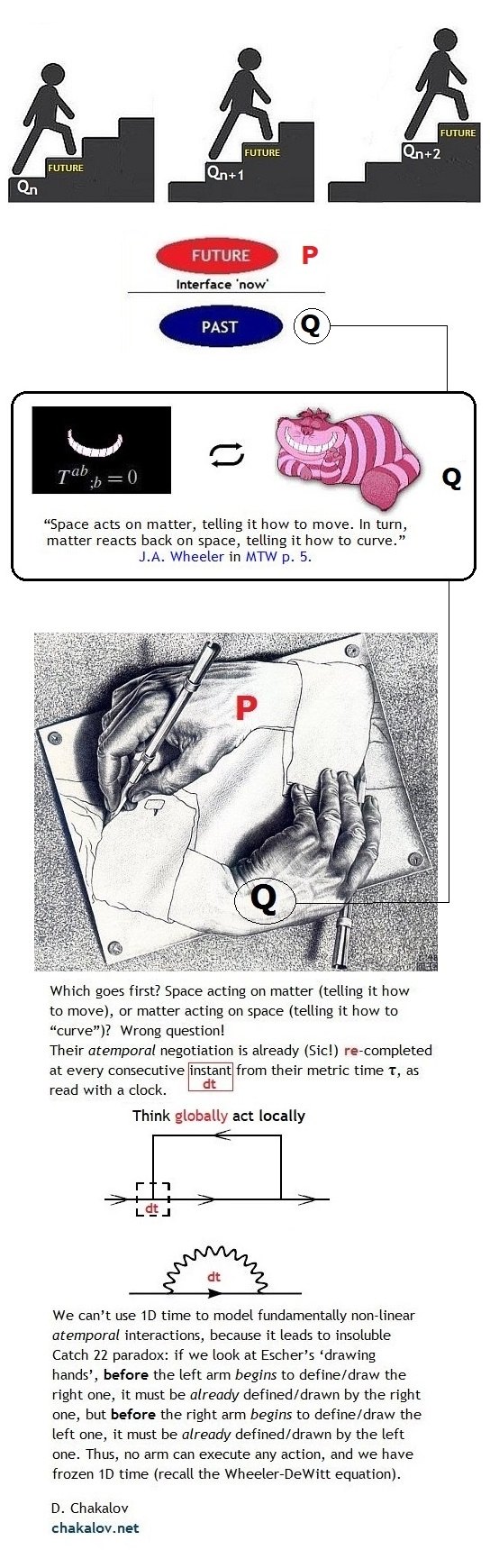
From this perspective, detecting GW effects requires "online" access to the global mode of spacetime, in which the dynamical determination of spacelike and timelike directions (hence Lorentzian metric) is being produced -- one-at-a-time, along the arrow of spacetime. In simple words, this means that the proper GW detectors must be endowed with the self-acting faculty of the human brain, to match the "interaction of spacetime with itself" (C. Kiefer, p. 2; cf. also J. G. Pereira et al., arXiv:0909.4408v1 [gr-qc], p. 10, Eq. 7.2). As of today, nobody cares. Nobody. I can take it. I'm psychologist, and don't need quantum gravity to practice PHI. Why would a fish need a bicycle?
D. Chakalov
Thursday, 26 November 2009
[click the image to enter the web site]
Some history of the project outlined above. In January 1972, shortly after my demobilization from BG army (age 19, with the lowest possible rank), I decided to study psychology and "sort out" the physics of the human brain, to explain and eventually explore its amazing latent abilities. It took me sixteen years to realize that the task is unfeasible with the established Weltbild, and on 22 May 1988, at 23:45 local time, I decided to try the project 'the other way around', namely, to develop a model of the universe as a 'brain', such that there will be a natural explanation of the physics of the (small) brain from the outset. After many trials and errors, the first (relatively) encouraging evidence appeared in July 1998, but the project is still far from being completed. I am trying to find any weak points or inconsistencies in it, just as I would do with a brand new parachute, which I would have to put on ultimate test by jumping from a helicopter. I do like the unfolding of the whole project, since it seems to me that all pieces of 'the bridge' snap to their places effortlessly. Yet there is no room for contention, and I never go into the mood of 'chi si contenta gode' (a contented mind is a perpetual feast; he who contents himself, enjoys).
Hopefully, if we join our efforts and knowledge (included at the level of our collective unconsciousness, cf. Jungian Kollektives Unbewusstes), some day we may succeed. Meanwhile, please keep in mind the prediction of Robert Millikan, Nobel Prize in Physics (1923): "There is no likelihood man can ever tap the power of the atom." This web site is my feedback to all people, who are helping me, one way or another, with improving the theory. Feel free to download it (app. 11.8MB) from http://www.god-does-not-play-dice.net/PHI_info.zip By unzipping PHI_info.zip, a new folder, !Einstein_PHI , will be created on your hard drive. Find there START.html.lnk and open it (it is linked to this front page (index.html) in the website folder). If, for some reason, you believe we don't need new approach to quantum gravity, try to understand Sean Carroll's speculations (448 pages, January 2010): "... wavefunctions appear to collapse in one direction of time but not the other is not an explanation for the arrow of time, but in fact a consequence of it. The low-entropy early universe was in something close to a pure state, which enabled countless "branchings" as it evolved into the future." Yet he acknowledged: "we can't, once again, define a conserved total energy in any reasonable way." Consequently, the main speculation of S. Carroll about some "low-entropy early universe" is just as unclear as is its gravitational energy which would evolve "into the future". (Also, there may be a critical low geometric entropy state of the 'extremely early' universe, which may blur the timelike and spacelike directions themselves, and turn them into some primordial quantum dough from which nothing could possibly "decohere", ever.) As one of his senior colleagues summarized, "the magnitude of the entropy of the universe as a function of time is a very interesting problem for cosmology, but to suggest that a law of physics depends on it is sheer nonsense."
... Alex Vilenkin's arXiv:0908.0721v1 ($63,000 FQXi Grant):

... Laura Mersini-Houghton's arXiv:0909.2330v1 [gr-qc] ($50,000 FQXi Grant):
"... when treated in a multiverse framework, fundamental time is directionless and consequently physical laws inherit its time-reversal symmetry. Despite that reversal symmetry is broken for the local time by the bubble nucleation, the bubble still inherits laws of physics at birth from the multiverse, without modification. Thus the emergent time’s arrow in the bubble does not affect the time-reversal symmetry imprinted onto the physical laws that the bubble inherits from birth in the multiverse. (...) An emerging time in the multiverse does not appear plausible since the emergence adds information on the multiverse that wasn’t there prior (... but we face the same kind of emergent non-unitary phenomenon with DDE -- an evolving cosmological "constant" that springs from the quantum vacuum - D.C.)."
... and the obstinate belief of Andrei Linde ($164,179 FQXi Grant):
"During the last 25 years a new scientific paradigm gradually emerged. (...) My main goal is to learn how to make scientific predictions in this complicated framework." Sure enough, Andrei Linde tried to answer the first off question of how many universes are in the "multiverse" (arXiv:0910.1589v2): 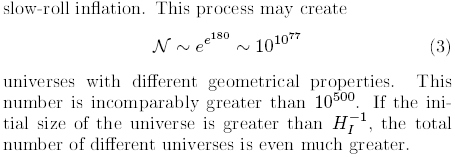
Coincidently or not, his calculation matches the number of angels (mostly blond) that can fit on the head of a pin, as suggested by A. Linde's medieval colleagues.
If these people were here in the 21st century, I suppose they would gladly join LIGO Scientific Collaboration (see above), and speculate that, shortly after the "big bang", the whole universe was still small enough to fit on the head of a pin, with strong ripples of the spacetime metric (see their picture above). They would love to feel again like an 'absolute observer' with an absolute clock paired with an absolute measuring rod, to tell the dimensions of the universe and its current cosmological age, as read by their absolute wristwatch. But instead of arguing about angels (either blond or not), they would certainly prefer to measure the "ripples of the metric" (albeit very weak), which again can only be seen from the same standpoint of 'absolute observer'. Needless to say, they will easily publish tons of articles on "GW astronomy", and will ignore any alternative viewpoint on what can be "seen" by such absolute observer: nothing but "gauge-dependent" stuff.
That's how 'potential reality' is being camouflaged in present-day GR, simply because if it were possible to detect the source of DDE as 'gauge invariant observable', the omnipresent and perfectly smooth ether (the source of DDE) will be exposed to direct physical observations, as 'spacetime acting upon itself'. Back in April 1986, Yakov Zel'dovich wrote in a letter the following (private communication): "Long time ago, there was a period of time during which there was still no time at all." Of course he was joking. Yet the 'global mode of time', pertaining to potential reality, cannot be read by any physical clock, because the poor inanimate clock will read it as 'stand still' or "no time at all", as Yakov Zel'dovich put it. Maybe The Beginning, which lives in "no time at all", is always with us (dual age cosmology).
Anyway. Perhaps in the next twenty-five years a new paradigm will emerge: the universe modeled as a brain. The driving force of its arrow of spacetime cannot spring entirely and exclusively from the "brain" itself, which brings us to Virgil's statement: Mens agitat molem (The Aeneid, Ch. 6, 727).
In German, it reads: Der Geist bewegt die Materie. Physically, Der Geist may look like 'the ideal monad without windows'. However, no scientific predictions can be made about it, or else we will conflate religion with science. Thank God, this is impossible.
D. Chakalov
October 31, 2009
Subject: "best of all possible worlds."
Date: Fri, 8 Oct 2010 21:09:20 +0300
From: Dimi Chakalov <[email protected]>
To: Robin G Jordan <[email protected]>
Dear Professor Jordan,
It was a great pleasure to read your essay on Newton vs. Leibniz,
http://courses.science.fau.edu/~rjordan/phy1931/NEWTON/newton.htm
"Leibniz thought the idea of God as an astronomical maintenance man as absurd. He believed that God had carefully chosen among an infinity of possible worlds, the one He felt the most suitable. So that although we may not have a perfect world, it was the
"best of all possible worlds."
I intend, Deo volente, to talk on a similar subject on 25 November 2015,
http://www.god-does-not-play-dice.net/#VGP
My web site isn't encrypted (like Newton's 6accdae13eff7i3l9n4o4qrr4s8t12ux), and if you have some spare time, I will highly appreciate your comments on my efforts.
Kindest regards,
Dimi Chakalov
============================
Subject: New limit on the mass of Father Christmas' beard (a.k.a. WIMPs)
Date: Fri, 8 Oct 2010 21:55:02 +0300
From: Dimi Chakalov <[email protected]>
To: Joe Silk <[email protected]>, [email protected]
Cc: M Angeles Perez-Garcia <[email protected]>,
Jirina R Stone <[email protected]>,
[email protected],
[email protected],
[email protected],
[email protected],
[email protected],
[email protected],
[email protected],
[email protected],
[email protected],
[email protected],
[email protected],
[email protected],
[email protected],
[email protected],
[email protected]
Dear Joe,
I am really surprised that you took part in the calculations of a new limit of WIMPs (arXiv:1007.1421v2; Phys. Rev. Lett. 105 (2010) 141101).
May I use this opportunity to invite you and your colleagues to my talk on quantum gravity,
http://www.god-does-not-play-dice.net/#VGP
All the best,
Dimi
----
How do we know that Father Christmas has a beard?
We know it, because snow falls when he shakes his beard.
Old Tanzanian saying
===================================
Subject: Spherical cows
Date: Wed, 12 May 2010 14:42:46 +0300
From: Dimi Chakalov <[email protected]>
To: Richard Gray <[email protected]>
Cc: Jim Hough <[email protected]>,
Sheila Rowan <[email protected]>,
Ralph Cordey <[email protected]>,
Keith Mason <[email protected]>,
[email protected]
Bcc: [snip]
RE: Largest scientific instrument ever built to prove Einstein's theory of general relativity, by Richard Gray. The Daily Telegraph, 8:30 AM BST, 09 May 2010,
http://www.telegraph.co.uk/science/space/7695994/Largest-scientific-instrument-ever-built-to-prove-Einsteins-theory-of-general-relativity.html
Dear Mr. Gray,
I trust you are familiar with the anecdotal story about a 'spherical cow',
http://en.wikipedia.org/wiki/Spherical_cow
Suppose someone claims that *the real cows are indeed round*, because cows might be approximated as spherical objects, and then ask your government to allocate a significant portion from your taxes for detecting the unique pattern of 'real spherical cows'.
Likewise, you were told by a number of people that, after applying their spherical-cow approximation to Einstein's theory of general relativity, they might eventually detect gravitational waves (GWs): "we haven't been able to detect them yet because they are very weak" (Jim Hough).
However, their persistent optimism is rooted on artifacts due to their spherical-cow (=linearized) approximation of GR,
http://www.god-does-not-play-dice.net/Szabados.html#SBG
I fact, they ignore all problems due to their approximation. For example, Hermann Weyl proved in 1944 that such spherical-cow approximation implies the existence of a tensor that, except for the trivial case of being precisely zero, does not otherwise exist,
http://www.sjcrothers.plasmaresources.com/weyl-1.pdf
Regarding Ralph Cordey at Astrium UK and the so-called LISA Pathfinder: How much this spherical cow will cost to UK taxpayers, I wonder.
Yours sincerely,
Dimi Chakalov
35 Sutherland St
SW1V 4JU
----------
Note: The failures to detect GWs were "explained" by Jim Hough with a very misleading statement: "we haven't been able to detect them yet because they are very weak". In fact, GWs are immensely powerful phenomena, but nobody -- Jim Hough and Sheila Rowan included -- can offer a non-linear theory of GWs. All they can do is to imagine that, by the time GWs reach LIGO or LISA, they will be "very weak", such that their spherical-cow approximation to Einstein's GR would be correct. But again, they don't have any non-linear theory of strong GWs, from
which some "weak limit" can be derived.
All they do is asking for more taxpayers' money for detecting spherical cows, instead of doing their homework first on paper, to demonstrate such "weak limit" to initially strong GWs. Pity nobody cares. D.C.
May 12, 2010
=========================================
Subject: arXiv:1005.1614v1 [gr-qc]
Date: Tue, 11 May 2010 05:14:25 +0300
From: Dimi Chakalov <[email protected]>
To: Robert Geroch <[email protected]>
Cc: Alexander Vlasov <[email protected]>, [email protected]
Robert Geroch, Faster Than Light? arXiv:1005.1614v1 [gr-qc]
http://arxiv.org/abs/1005.1614
R. Geroch: "I am not sure that this is the right perspective — or even whether “right” makes much sense in this context."
Bob, I think you can have your cake and eat it -- the key word is 'quasi-local',
http://www.god-does-not-play-dice.net/#topology
You and your Russian colleague are so good in math ...
D.
--------
Note: To explain quasi-local, and 'what is going on' in QM, check out Feynman [Ref. 1, 12-1]:
"The first question we have to answer is: What are the base states for the system? Now the question has been put incorrectly. There is no such thing as “the” base states, because, of course, the set of base states you may choose is not unique. New sets can always be made out of linear combinations of the old. There are always many choices for the base states, and among them, any choice is equally legitimate. So the question is not what is the base set, but what could a base set be? We can choose any one we wish for our own convenience. It is usually best to start with a base set which is physically the clearest. It may not be the solution to any problem, or may not have any direct importance, but it will generally make it easier to understand what is going on." There is such thing as “the” base state (never in plural) -- the UNdecidable KS state, as explained below. For example, in the case of two spin-half particles, everything you insert in brakets |1> = |++>, |2> = |+->, |3> = |-+>, |4> = |--> ... are just possible physical manifestations of “the” base state, much like the three sayings above, emanating from their UNspeakable potential-reality state of your brain. Thus, the system {“the” base state & |whatever>} evolves along the arrow of spacetime in a strictly quasi-local fashion: see Fig. 1 and Fig. 2 below. Feynman also stressed [Ref. 1, 12-2]: "That’s the question: How do the amplitudes change with time in a particular (fixed) base?" The amplitudes change along the global mode of time: see again Fig. 2 below. Don't be befuddled by the anti-relativistic "time parameter" in the Schrödinger equation, because you need “the” base state to eliminate the measurement "problem" in QM and reconcile QM with STR, as well as solve the puzzle of quantum vacuum and gravitation: “the” base state does not gravitate. It would be nice if Robert Geroch writes up a sequel to his 30-year old book General Relativity from A to B, entitled "General Relativity from A to A+ds", to elucidate the concept of 'interval' in GR -- professionally. But he wouldn't. Trying to discover new math is a tough challenge. The last time I heard from Robert Geroch was eight years ago, only to require his email to be removed from my web site. I will gladly do that, if only he writes a serious paper on GR, or at least reply professionally. Here are two questions: Do you believe that the "points" from the underlying manifold can be connected only and exclusively only by their physical content that is invariant under "active" diffeomorphisms? If your answer is 'no', what could be “the” base state in GR (a.k.a. the reference fluid of GR), which binds the "points" by one single unique bare UNdecidable matrix? If your answer to the first question is 'yes', you are ready to teach GR and enjoy its generic pathologies [Refs 2 and 3]. It is generally believed that (i) one can picture the spacetime in GR as a manifold that can be "locally modeled" on some fictitious flat Minkowski space, but (ii) this picture should break down at short distances of the order of the Planck length. Neither of these ideas are needed, however. There is no need for any limitation in the possible accuracy of localization of spacetime events either. Why is that? Because the so-called Planck length may possess an inner geometrical structure. Ignore it at your peril.
D.C.
May 12, 2010
Last update: May 14, 2010
[Ref. 1] Feynman Lectures on Physics. Volume III : Quantum Mechanics, Addison-Wesley, Reading, MA, 1965; ISBN: 9780201020144
[Ref. 2] José M.M. Senovilla, Singularity Theorems in General Relativity: Achievements and Open Questions, arXiv:physics/0605007v1
"The problem of the definition of the concept of singularity in General Relativity is very difficult indeed, as can be appreciated by reading on its historical development (Hawking and Ellis, 1973; Tipler, Clarke and Ellis, 1980). The intuitive ideas are clear: if any physical or geometrical quantity blows up, this signals a singularity. However, there are problems of two kinds:
• the singular points, by definition, do not belong to the space-time which is only constituted by regular points. Therefore, one cannot say, in principle, “when” or “where” is the singularity.
• characterizing the singularities is also difficult, because the divergences (say) of the curvature tensor can depend on a bad choice of basis, and even if one uses only curvature invariants, independent of the bases, it can happen that all of them vanish and still there are singularities.
"The second point is a genuine property of Lorentzian geometry, that is, of the existence of one axis of time of a different nature to the space axes.
...
"All in all, it seems reasonable to diagnose the existence of singularities whenever there are particles (be them real or hypothetical) which go to, or respectively come from, them and disappear unexpectedly or, respectively, subito come to existence.
"And this is the basic definition of singularity (Geroch, 1968; Hawking and Ellis,
1973), the existence of incomplete and inextensible curves. That is to say,
curves which cannot be extended in a regular manner within the space-time
and do not take all possible values of their canonical parameter.
...
"Singularities in the above sense clearly reach, or come from, the edge of space-time. This is some kind of boundary, or margin, which is not part of the space-time but that, somehow, it is accessible from within it."
[Ref. 3] Lars Andersson, The global existence problem in general relativity, arXiv:gr-qc/9911032v4
Footnote 1: "All manifolds are assumed to be Hausdorff, second countable and C∞ (maximal differentiable atlas, cf. Michael Spivak, Vol. 1, Ch. 2 - D.C.), and all fields are assumed to be C∞ unless otherwise stated." Id., Notes on Differential Geometry, 1, p. 8:
"A differentiable manifold is a topological manifold M together with a differentable structure, i.e. a way of defining differentiable functions on M. The natural way of doing this (forget about this "natural way" - D.C.) is to use the charts [X] to transfer the definition of differentiable functions from Rn to M." =================================== Subject: The global existence problem in general relativity,
arXiv:gr-qc/9911032v4
Date: Wed, 6 Apr 2011 03:54:55 +0300
From: Dimi Chakalov <[email protected]>
To: Lars Andersson <[email protected]>
Cc: [email protected], [email protected], [email protected],
[email protected], [email protected], [email protected],
[email protected], [email protected]
Dear Dr. Andersson,
I suppose if you (i) do not assume upfront some space-like Killing fields, (ii) don't confine your analysis to some hypothetical vacuum spacetimes, and (iii) wish to avoid poetry [Ref. 1], you may have to start from scratch,
http://www.god-does-not-play-dice.net/about.html#GR
http://www.god-does-not-play-dice.net/#Ruben
http://www.god-does-not-play-dice.net/#LIGO
Perhaps the tasks are strictly mathematical.
Yours sincerely,
Dimi Chakalov
------
[Ref. 1] José M.M. Senovilla, Singularity Theorems in General Relativity: Achievements and Open Questions, arXiv:physics/0605007v1
p. 6: "This is some kind of boundary, or margin, which is not part of the space-time but that, somehow (Sic! - D.C.), it is accessible from within it."
===================================
Subject: Positive-mass conjecture in the case of "more and more space appears" ?
Date: Wed, 2 Jun 2010 05:28:23 +0300
From: Dimi Chakalov <[email protected]>
To: Shing-Tung Yau <[email protected]>,
Richard M Schoen <[email protected]>,
Niall Ó Murchadha <[email protected]>,
Claus Gerhardt <[email protected]>,
Adam Helfer <[email protected]>
Dear colleagues,
As of April 2010, “over 2250 papers with the words ‘dark energy’ in the title have appeared on the archives since 1998, and nearly 1750 with the words ‘cosmological constant’ have appeared” (Shinji Tsujikawa, arXiv:1004.1493v1, p. 39).
I believe Michal Chodorowski explained, in arXiv:astro-ph/0610590v3, the meaning of "more and more space appears",
http://www.god-does-not-play-dice.net/#Blanchard4
It is totally unclear to me how one could define an isolated system in GR, in which "more and more space appears", to start thinking about some new positive-mass conjecture and the total energy in such "isolated system". Perhaps if one can demonstrate that _no_ asymptotically flat spacetime can be stable under the conditions of such (accelerated or not) "flux" of "more space", we will face a paradoxical situation similar to the ultraviolet catastrophe of late 19th century, after which some bright mathematician will sort out
this whole mess.
Please advise.
With kindest regards and admiration,
Dimi Chakalov
===================
Re: Positive-mass conjecture in the case of "more and more space appears" ?
Date: Mon, 25 Oct 2010 15:11:29 +0300
From: Dimi Chakalov <[email protected]>
To: Shing-Tung Yau <[email protected]>,
Shing-Tung Yau <[email protected]>
Cc: Chiu-Chu Melissa Liu <[email protected]>,
Mu-Tao Wang <[email protected]>,
Xiao Zhang <[email protected]>,
Lau Loi So <[email protected]>,
Hsin Chen <[email protected]>,
Fei-Hung Hoa <[email protected]>,
Chih-Hung Wang <[email protected]>,
Hwei-Jang Yo <[email protected]>
Dear Professor Yau,
I hope my email from Wed, 2 Jun 2010 05:28:23 +0300 has been safely received.
I believe some young and hungry grad student might crack the puzzle of quasi-local mass,
http://www.god-does-not-play-dice.net/#Hehl_final
If you and/or some of your colleagues know such person, please pass her/him the link above. The task is highly non-trivial and strictly mathematical, and also requires guidance from Shao Yong.
I also believe the future of new energy sources belongs to your country, but if you wish to extract energy from 3-D space, you should always follow the advice of Shao Yong. Since I haven't heard from you so far, it seems the latter turned out to be too difficult for you.
Yours sincerely,
Dimi Chakalov
-------
Examine the objects as they are and you will see their true nature; look at them from your own ego and you will see only your feelings; because nature is neutral, while your feelings are only prejudice and obscurity.
Shao Yong, 1011-1077
Fooling around with alternative current is juts a waste of time.
Nobody will use it, ever. Thomas Alva Edison, 1889 ====================================
Subject: arXiv:1107.1374v3 [math-ph] and arXiv:0912.2886v4 [math-ph]
Date: Fri, 29 Jul 2011 17:37:03 +0300
Message-ID:
<CAM7EkxkNe2NriAaNhSd60JnDeggcuqrUUQUmhqXnABtSZqANbQ@mail.gmail.com>
From: Dimi Chakalov <[email protected]>
To: Bert Schroer <[email protected]>, [email protected]
Cc: Carlos Perelman <[email protected]>,
Robert M Wald <[email protected]>,
Stefan Hollands <[email protected]>
Dear Bert,
You consider Haag's 1957 idea "of interpreting the spatial extend of a measuring device and the duration of its activation as an observable localized in the corresponding spacetime region fulfilling Einstein causality and an appropriately formulated causal propagation was (and still is) metaphoric if not to say naive" (arXiv:1107.1374v3 [math-ph], p. 8). His latest views are summarizer in [Ref. 1].
There is no such thing as "local covariance principle" (arXiv:0912.2886v4 [math-ph], Sec. 6 and p. 32).
Regarding the nonobservance of the holistic aspects of QFT (arXiv:1107.1374v3 [math-ph]), see a quasi-local approach to GR & QM at
http://www.god-does-not-play-dice.net/about.html#GR
http://www.god-does-not-play-dice.net/#shoal
I think the opposition to such proposals is not related to our current Zeitgeist. People just don't care. They live in total socialism and love to play with their hobbies.
Names? They're all at my web site.
All the best,
Dimi
[Ref. 1] Rudolf Haag, Questions in quantum physics: a personal view,
arXiv:hep-th/0001006v1
http://arxiv.org/abs/hep-th/0001006
"In simple cases the event may be regarded as the interaction process between a particle and a detector. But the notion of ‘particle’ does not correspond to that of an object existing in any ontological sense. It relates to the simplest type of global state and describes possibilities, not facts. The notion of ‘partial state’ demands in addition that we ignore all possible events outside some chosen region and thus ignore possible correlations with outside events."
=====================================

Subject: 260037 PR Spezialisierungsmodul Mathematische Physik und
Gravitationsphysik
Date: Sun, 26 Aug 2012 17:45:27 +0300
From: Dimi Chakalov <[email protected]>
To: [email protected],
[email protected],
[email protected],
[email protected],
[email protected],
[email protected],
[email protected],
[email protected],
Dear colleagues,
I learned that the Spezialisierungsmodul offers "guidance to
scientific research on open problems in mathematical physics and
general relativity", which I hope to discuss with you during the ESI
Workshop in December this year.
Meanwhile, please check out the Ansatz for 'necessary and sufficient
conditions for spacetime', which can (hopefully) eliminate 'dieser
verdammten Quantenspringerei',
http://www.god-does-not-play-dice.net/#Erlangen
As I mentioned in my email to Dr. Robert Beig (Sun, 8
Apr 2012 20:04:57 +0300), the task is strictly mathematical. I
will be happy to explain it under the roof of Erwin Schrödinger
Institute.
Kind regards,
Dimi Chakalov
------
Wenn es doch bei dieser verdammten Quantenspringerei bleiben soll,
dann bedauere ich, mich mit der Quantentheorie überhaupt beschäftigt
zu haben.
Erwin Schrödinger
===============================
Printable version is available from here;
mathematical details here.
FINITE INFINITY
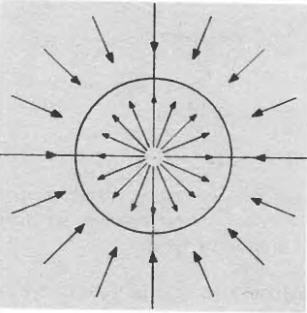 Space inversion
Finite 3-D space (depicted with circle) obtained by snapping the
inversion of points along the w axis (sphere-torus transitions, Fig. 5).
Space becomes both "infinite" (local mode of spacetime) and bounded
from S and L (global mode of spacetime). Abstract To introduce "boundaries" on the physical spacetime at all (timelike, spacelike, and null) directions, I will consider an ideal dimensionless point of 'pure geometry', and will postulate a structure of such point: a dual presentation of 'the universe as ONE', interpreted along an axis (w) as both 'an infinitesimal' (S) and 'arbitrarily large volume of 3-D space' (L). Then I will suggest topological transformations of points (called 'space inversion') in an infinite-dimensional Euclidean space to obtain a 'collapse over infinity'-reduction of this unphysical Euclidean space to 'asymptotically flat 4-D spacetime' endowed with "boundaries" placed at the dual object, 'the universe as ONE'. The spacetime of 'the universe as ONE' is called 'global mode of spacetime', with equation L = S = 1 (Eq. 2), while the equation of the Arrow of Space, generating perpetual emergence and re-creation of an asymptotically flat spacetime ('collapse over infinity'), is postulated as LS = 1 (Eq. 1), in line with Virgil's dictum Mens agitat molem or Der Geist bewegt die Materie.
I will also outline the so-called 'relative
scale principle' (RSP) aimed at removing an absolute structure of space known as 'size of objects': nobody has 'the right meter'. Relative to an observer placed at the macroscopic length scale (the "middle" of w ), objects in 3-D space would look like "large" in the direction toward L and "small" in the opposite direction toward S , while a co-moving observer will not notice any chance in her 'one meter and one second', and will always experience the same "speed of light". Since 'space' is interpreted as an emergent phenomenon along the Arrow of Space, I will introduce finite templates for 'size of objects', and will argue that their scale-dependent alteration resolves the paradox of the (accelerated) "expansion" of space toward L and the (non-accelerated) "shrinking" of space toward S , as seen by an observer placed at the macroscopic length scale (the "middle" of w ), while their local alteration recovers the correct geometrical manifestation of gravity (not "curvature"). Hence one can eliminate all "dark" effects of gravity such as "black holes", "cold dark matter", and "dynamical dark energy", and amend Einstein's General Relativity with the "total field of as yet unknown structure" from the Arrow of Space.
The quest for Finite Infinity has a long history, starting from Gunnar Nordström (Über die Möglichkeit, das elektromagnetische Feld und das Gravitationsfeld zu vereiningen, Phys. Z. 15 (1914) 504-506). It is an age-old problem of General Relativity. Nothing could be more important than understanding the topological manifold of the Universe, and its dynamics. Traditionally, experts in GR start with what I hope to derive at the end of this project: asymptotically flat spacetime with quasi-local positive mass. For example, Rick Schoen would presuppose a "smooth manifold", which has already been equipped with a "Lorentz signature metric", "asymptotic flatness", and "appropriate falloff" conditions, and then ask question like: 'why do we see positive mass only' ? A short answer: because we have an Arrow of Space. The detailed answer requires careful analysis of all initial presumptions in Rick Schoen's talk and in present-day GR textbooks.

A New Mean Curvature Proof of the Spacetime Positive Mass Theorem
By Richard Schoen, November 13, 2011, at
Celebrating Jim Isenberg's 60th birthday
Pacific Northwest Geometry Seminar, Corvallis, OR, November 12-13, 2011
A rigorous definition of 'isolated gravitating system', which would ensure an "asymptotic regime such that all gravitational effects are localized inside of it" (Adam Helfer) and proper boundary conditions, is still an unresolved task: there are no physically motivated boundary conditions in the case of the Einstein equations; for example, "we do not know how to build a mirror for gravitational waves" (A. Rendall), nor can we resolve the paradox of geodesic incompleteness and "black holes". Moreover, how can we define an 'isolated gravitating system' and its (obviously) positive mass if the space itself is endowed with a new, dynamical "dark" energy? The calculating machinery of ADM, suggested half a century ago, doesn't work anymore. Enter the Finite Infinity (FI). In a nutshell, the idea of FI is to suggest a mechanism for obtaining a finite volume of Archimedean 3-D space. The very notion of 'finite 3-D space' implies the existence of two distinguishable volumes of 3-D space, separated by a "trapped" surface (cf. lion's cage below), such that we can always define the notions of 'inside vs outside' (hence "large" vs "small") and 'left vs right'. (In order to eliminate the absolute structure of 'size', we will introduce later the so-called Relative
Scale Principle, RSP.) Now, how can we introduce some process and mechanism by which 'finite space' can be fixed at all length scales, in such way that 'physical space' will never actually reach zero nor infinity but will always remain 'finite' ? We will use an infinite-dimensional Euclidean space and will introduce smooth sphere-torus conversions in it, along a new axis w , such that these sphere-torus conversions snap and fix all Archimedean volumes of 3-D space from both "below" and "above" (cf. Fig. 5). Hence space becomes both "infinite" (local mode of spacetime) and bounded from S and L (global mode of spacetime). The latter is physically unobservable, because we're stuck in the Archimedean 3-D space and don't have access to 'actual infinity'. Only Chuck Norris has been there (twice). As in a good crime novel, all will become crystal clear at the end. Well, eventually. Some history. The notion of 'finite infinity' (Fi) was suggested by George F R Ellis in 1984; please see:
George F R Ellis, gr-qc/0102017v1, Sec. 5, "Finite Infinity and Local Physics",
http://arxiv.org/abs/gr-qc/0102017
"This led me some years ago to ask the question: ‘How far away is an effective ‘infinity’ to use in discussing boundary conditions for local physical systems of this kind?’ (...) Then incoming and outgoing radiation conditions can be imposed on that surface F, rather than at infinity or conformal infinity I as is usual [57]. (...) Furthermore the famous positive mass theorems [64] should also be generalized to this case.
...
"This may also be the best setting for numerical calculations for ‘isolated systems’, which often talk about ‘integrating to infinity’, but in most cases do nothing of the sort. As in the rest of theoretical physics, it would be advantageous to have a theoretical framework that corresponds more closely to actual calculations - namely an integration to a surface at a finite distance from the centre of coordinates. It is usual to make that surface a null surface; the suggestion here is that it would be better to make it timelike, corresponding to the region in the real universe where the exterior is physically separated from the local system.
"So the obvious proposal [54] is that we should put boundary conditions on all fields at that distance, rather than at infinity itself, leading to the concept of a 'finite infinity' FI ... "
--
[54] Ellis G F R, Relativistic Cosmology: Its Nature, Aims and Problems, in: General Relativity and Gravitation, Ed. B. Bertotti et al., Reidel, Dordrecht, 1984, pp. 215-288; cf. Sec. 5.2 and Fig. 11(c).
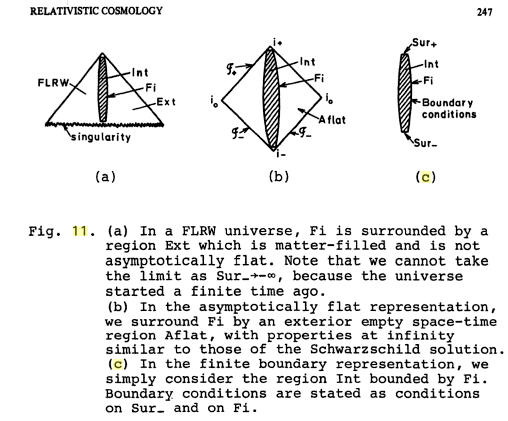
See also: Ehlers J (Ed) (1979). Isolated Gravitating Systems in General Relativity. Proc Int School Enrico Fermi Course LVII (Academic Press, New York).
http://www.directtextbook.com/prices/0444853294
-------------
By using exclusively the notion of 'potential infinity', Stephen Leacock posed the dilemma of 'infinite space' in the following fashion:
"We cannot imagine that the stars go on forever. It’s unthinkable. But we equally cannot imagine that they come to a stop and that beyond them is nothing, and then more nothing. Unending nothing is as incomprehensible as unending something."
In order to resolve the conundrum of 'ending something', notice that the nature of the local Archimedean mode of spacetime (cf. below) is determined by 'potential infinity': every step toward the Finite Infinity provides the necessary and sufficient condition for the next step, just as in the Thompson's lamp paradox. If we go in the "direction" toward 'the infinitesimal' (S), one can (with some luck) work out a cutoff and end-point, but it will belong, again and always, to the local ("colored") mode of spacetime (see the story about 'John's jackets' below). If we wish to work out a proper Finite Infinity, the obvious choice is to introduce a new 'cutoff and end-point' conjugated with the infinitesimal, S , and to employ the two forms of 'infinity': potential and actual. The latter is 'already completed', in the sense that (i) it does not entail any "dynamics" that can be recorded with a physical clock, and (ii) applies only to the global non-Archimedean mode of spacetime. We begin with postulating an uncountably infinite "number" of points packed in any finite -- arbitrarily "large" or arbitrarily "small" -- line segment, plane, or volume of space in the local (physical) mode of spacetime, in such way that 'there is nothing ]between[ these points'. Then we will "insert" the global mode of spacetime ]between[ the points from the local mode, and will make sure that the global mode is non-existent in the local mode, with the sole exception of the instant 'now' from the Arrow of Space, in which the two modes of spacetime coincide (cf. Fig. 1 below). Notice the crucial difference between the two modes of spacetime: in the local mode, a test particle equipped with a clock reading its proper time will need a finite Archimedean time interval to pass through a finite Archimedean volume of space, even if the test particle travels with the speed of light. It cannot pass through a finite volume of space for 'zero time', even if the volume of space is 'tending asymptotically toward zero', as in the case of the empty set (R). Thus, it will always need 'more Archimedean time' to pass through all uncountably infinite points from the perfectly smooth continuum of the local (physical) mode of spacetime. This is the essence of 'potential infinity', and it is valid only for the local mode of spacetime. Hence the interpretation of 'the infinitesimal' as the empty set (R): in the local mode of spacetime, it is and will always remain a finite entity, tending asymptotically toward zero, being comprised from uncountably infinite points. In the global mode, however, it is a purely geometrical, dimensionless point -- just one single geometrical point (Fig. 1). NB: This one single geometrical point cannot be reach from/within the local (physical) mode of spacetime, for any finite duration of time, as read with a physical clock. Why? Because its physical content (jacket) is UNdecidable, after the Thompson Lamp paradox. Thus, the empty set (R) is endowed with a structure, as hinted in Fig. 1 below, and with 'space inversion' (Fig. 1.1). It is the flashmob for the two modes of spacetime, at which they "coincide". It is also the instant 'now' (now-at-a-distance) from the Arrow of Space. And thanks to the so-called "speed of light", it has zero duration and zero spatial extension. Compared to the local mode, the global mode of spacetime is ontologically different: it is a non-Archimedean realm of 'potential reality' (GPIs), which can traverse any finite -- arbitrarily "large" or arbitrarily "small" -- line segment, plane, or volume of space from the local (physical) mode of spacetime for zero time, as it would have been read by the clock attached to a test particle from the local mode. Namely, the global mode is equipped with 'actual/completed infinity': it can traverse the uncountably infinite points of any finite object for zero time (as it would have been read by the clock attached to the test particle from the local mode), and endows the local mode with a web of "instantaneous" correlations (as they would have been read by an inanimate clock from the local mode). With the Arrow of Space, such kinematics gives rise to a new dynamics resembling a living organism: a 'school of fish'-type bootstrapping of physical systems in their quantum and gravitational regimes, and quasi-local geodesics, in line with the rule 'think globally act locally' (hence one can introduce a background-free, relational reality and Machian quantum gravity). The question of what kind of 'global time' runs in the global mode of spacetime, equipped with "instantaneous" actual infinity, can be answered by explaining its corresponding 'global space' and the non-Archimedean structure of the purely geometrical GPIs in it. In general, the quest for amending Finite Infinity with an Arrow of Space is highly non-trivial, because we should also consider the following tasks: 1. The two modes of spacetime are separated by the fleeting instant 'now' from the Arrow of Space, namely, the global mode is placed in the realm of 'potential reality' (GPIs residing in the potential future in the Arrow of Space), while the local mode refers to the irreversible world of explicated GPIs in terms of facts, placed in the steadily increasing 'irreversible past' from the Arrow of Space. Such 'ever-increasing past' is what makes an 'arrow', due to irreversible 'information gain': every instant 'now' pertains to an explicated physical universe, which contains more information that its immediate predecessor in the 'ever increasing past', and at the same instant 'now' the physical universe is offered an enriched spectrum of potential states to choose from for its next instant 'now', just as in the cognitive cycle of Ulric Neisser (Fig. 2 and Ch. 2 and 4). Metaphorically speaking, the Arrow of Space is depicted with the Dragon devouring its tail (Ouroboros), from the Chrysopoeia ('Gold Making') of Cleopatra during the Alexandrian Period in Egypt. The enclosed words mean 'The All is One.'
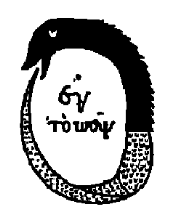

The ultimate source for such information gain is 'the true monad without windows' which remains at absolute rest within the instant 'now' (see below), depicted with Fig. 1 below.
1.1. The only "meeting point" of the two modes of spacetime is the instant 'now', in which they coincide (Fig. 1). The result is an already completed and already negotiated physical universe, spanned across the absolute instant 'now' from the Arrow of Space, with 3-D space and zero "thickness" along w (cf. below), in which “there’s energy in the gravitational field, but it’s negative, so it exactly cancels the energy you think is being gained in the matter fields” (Sean Carroll); check out the Photoshop layers metaphor below and the resulting non-linear dynamics here. 2. The unique "boundaries" on 3-D space in all (timelike, null, and spacelike) directions, introduced with Finite Infinity, should make the universe an 'isolated system', which (i) contains 'absolutely everything', included its Aristotelian First Cause, (ii) is self-enclosed (Albert Einstein), and (iii) is "bounded" by some ambient unphysical spacetime (called here 'global mode of spacetime') which is part and parcel from the same 'isolated system'. 2.1. To describe such 'universe as ONE' -- self-wrapped (cf. (iii) above) and endowed with the faculty of 'self-acting' due to its "gravitational field" -- one needs to place its source "inside" the instant 'now' from the Arrow of Space (Fig. 1), and make sure that the so-called "dark" energy of 'the universe as ONE' is unobservable in principle. 3. Last but not least, the ultimate source of 'the universe as ONE' should be interpreted as 'zero nothing', that is, a special kind of "zero" opposite to the mundane case of 'zero something'. Perhaps the only way we could grasp the notion of 'zero nothing' or 'the true monad without windows' is by recalling the relation between the content and volume of concepts: the larger the volume, the smaller the content; hence the source of 'absolutely everything, the unknown unknown included' should possess zero intrinsic content (cf. the undefinable matrix). I haven't been able to find suitable mathematical formalism to describe these widely known ideas. All I can offer is a simple (but incomplete) geometrical explanation of Finite Infinity. Firstly, there should exist a maximal volume of 3-D space (L), at which we place the Finite Infinity (FI), such that any finite volume of space, no matter how large, is identified as an Archimedean sub-volume smaller than the 'maximal space volume', L . Likewise, there should exist a minimal volume of 3-D space (S), at which we place the same Finite Infinity (FI), such that any finite volume of space, no matter how small, is identified as an Archimedean volume larger than 'the minimal space volume', S . Secondly, the two physical, finite, Archimedean volumes of space tend asymptotically toward L and S in the local (physical) mode of spacetime, but cannot reach them for any finite Archimedean duration of time due to the "structure" of the empty set (R) at which the global mode and the local mode coincide (Fig. 1). The 'no-go' axiom about the empty set (R) ("cannot reach them for any Archimedean duration of time") stems from our belief (not 'fact') that there exist, in the local mode of spacetime, an 'uncountably infinite' "number" of points between any finite Archimedean volumes of space and their "two" cutoffs, L and S : the empty set (R) cannot be bridged by any finite Archimedean system for any finite duration of time, even if it jumps over the points with the "speed of light". That is, in the local mode of spacetime the empty set (R) is 'finite' entity, and will always occupy a finite, albeit "very small", volume of space packed with 'uncountably infinite' points arranged by 'potential infinity'. On the other hand, the same empty set (R) is consumed/traversed instantaneously in the global mode of spacetime, which has non-Archimedean nature and is endowed with 'actual/completed' infinity. Thus, we shall place the "two" cutoffs, L and S , within the red point in Fig. 1 below, stressing again its UNdecidable nature (Thompson Lamp paradox) of 'potential reality': pre-quantum non-colorizable General Platonic Ideas (GPIs). FI Postulate: Due to the Thompson Lamp paradox, any finite, arbitrarily "large" or "small", Archimedean volume cannot physically reach L and S residing in the global mode of spacetime, equipped with actual infinity. A precise explanation of 'physically reach': in the local (physical) mode of spacetime, we always reach/nullify the empty set (R) at the point of '2 min', which is why the state of Thompson's lamp is always defined by the rules of 'bartenders', but it is just a fleeting "jacket" cast by John from the global mode of spacetime. The latter is endowed with actual infinity. In other words, in the global mode of spacetime the interval [0, 2] is closed, while in the local mode the same interval is open -- (0, 2). Thanks to the Arrow of Space, the 'large finite volume' will chase L in the local mode indefinitely; in the local mode of spacetime the empty set (R) can only tend asymptotically toward zero. The same holds for the opposite case of the separation of any arbitrarily small Archimedean volume of space from S by the same empty set (R): in the local mode, it would require an infinite -- actual infinity -- amount of time for the elimination of the empty set (R) and reducing it to zero, at which point the Arrow of Space would stop, and the universe would cease to exist. Notice that the FI Postulate introduces new structure of spacetime at the level of 'differentiable manifold' prior to any matter; example here. The very notion of 'space' requires that all physical objects acquire finite Archimedean size; a table with length 'one meter' fills in a template for 'one meter'. In the case of an one-meter template, we observe a finite table with length one meter, which is again a 'sub-volume of finite space'. The purpose of Finite Infinity (FI) is to define the largest template and the smallest template for all finite volumes of 3-D space.
The maximal volume of 3-D space, L , and minimal volume of 3-D space, S , belong to the global mode of spacetime for which the actual infinity holds ('already completed'), and are related by LS = 1 (Eq. 1).
Thanks to the empty set (R), no physical, Archimedean stuff can 'physically reach' L and hence go "beyond" L , and also no physical stuff can 'physically reach' S and hence go "below" S (compared it to the conformal recipe): L & S is ONE object which belongs to the non-Archimedean global mode of spacetime. In a nutshell, the modified Finite Infinity satisfied two conditions: in the local mode of spacetime the universe approaches asymptotically its causal boundary (cf. Eq. 1 above) within an open interval, while at the same time the universe is being (present continuous) permanently wrapped by itself in the global mode of spacetime. Hence 3-D space can be literally wrapped by itself, exactly as Albert Einstein required. Again, there is no path whatsoever to the global mode of spacetime from the local mode of spacetime; hence the FI Postulate above. The difference between S and L is that in the case of the former we can find some 'numerically finite but physically unattainable boundary/cut off' (the Planck length), but for L we have only an eternally expanding 'sub-volume of finite space', which can only chase L but can never physically reach it: L and S belong to the non-Archimedean global mode of spacetime. It is the Arrow of Space which creates such asymmetry in the treatment of L and S . We have a numerically finite but physically unattainable "bottom", while space "expands" in the local mode toward L indefinitely: at each and every instant 'now' from the Arrow of Space, the universe occupies a finite sub-volume, being literally wrapped from both "below" and "above" with Eq. 1 above. Depending on the direction we look at the edge of the universe in the local mode of spacetime, either toward L or toward S , we see "two" edges, while in the global mode they are ONE -- the universe as ONE, as stressed by Lucretius some 2060 years ago. We don't have such structure of spacetime in differential geometry textbooks. Notice that we face here a kind of 'logical infinity': no physical, Archimedean volume of space can reach L , because L & S belong to the 'the universe as ONE' (Eq. 1 above). In other words, one could logically reach something only if this "something" is 'not yet reached', while in our case it is logically impossible to "reach" something (L) which is being eternally residing "inside" us (S) from the outset. Thus, the notion of 'logical infinity' refers to the statement that if the Arrow of Space is terminated, the universe will cease to exist and will return to its initial state of pure light and cognition, known as [John 1:1]. Without the global mode of spacetime, the universe would be governed exclusively by Archimedean geometry, conformal recipes would have worked, tessellation of space with 3-D "tiles" would have been possible, and we would calculate the exact finite number of "atoms" filling a finite volume of space without any gaps from the empty set (R): we would hit an "end-point" beyond which "is nothing, and then more nothing" (S. Leacock). Thank God, this is impossible.
Again, we cannot physically "see" L & S , because we don't have access to 'actual infinity'. Only Chuck Norris has been there (twice).
---------- Now, let me try to explain geometrically the empty set (R), which would "point" to the "dimension" of space, denoted with w (from wunderbar, after Theodor Kaluza), of the postulated global mode of spacetime (pictured with red; local mode with black). The size of physical bodies along w are zero, because w lives only at the fleeting instant 'now' -- a purely geometrical "point" at which the two modes of spacetime, global and local, coincide. Attached to the same instant 'now' is a 'pocket of propensity states' in the global mode of spacetime, called General Platonic Ideas (GPIs); check out GPIs in the human brain (not "mind") here. First, the dimensionless instant 'now', at which the two modes of spacetime coincide:

Fig. 1
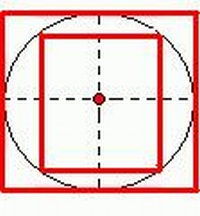
Fig. 1.1
Space inversion with respect to the instant 'now' (Fig. 1).
The so-called 'space symmetry' in the global mode of spacetime (pictured with red) is defined as two interchangeable and
simultaneous presentations of any finite volume of space from the local mode (pictured with black circle), such that a global
observer can monitor any finite volume of space in the two
directions of w simultaneously, as explained in Wiki: (i) from the
center of the circle (Fig. 1) "outside" in all radial directions, and
(ii) from "outside" the black circle (2-D trapped surface of lion's cage) toward the center of the circle along the same T-inverted radial directions (not shown). In 2-D space, the "trapped surface" is a circle; in 3-D space it is a sphere with radius r (Fig. 4.2). In order to derive the circumference of the black circle, consider the two red rectangles (sides n = 4), and start doubling their parameter n , after Archimedes. At the instant 'now' from the Arrow of Space (Fig. 1), n reaches actual/completed infinity and the inscribed and the circumscribed polygons shift to 'pure geometry' of 'the grin of the cat without the cat', as observed by Alice (in the LHS of Einstein field equation).

The sides of the polygons are converted into uncountably infinite "geometrical points", each of which can take a fleeting physical (colored) "jacket" in the local mode of spacetime (cf. the parable of John's jackets below). If we apply space inversion along the two "directions" in the drawing from Mark Armstrong below, we can grasp the notion of Finite Infinity: every volume of 3-D space is being snapped like the circumference of a circle, along the two "directions" of w (see Fig. 5 below), thanks to which it becomes a finite entity. Voila!
M.A. Armstrong, Basic Topology, Springer, 1997, p. 104
In the local mode of spacetime (pictured with black), we multiply the dimensionless point in Fig. 1 along one dimension in two opposite directions, to obtain 2-D spacetime. For the purpose of this presentation, the time direction will not be shown. Notice that 1-D space is endowed with T-invariance: we can flip all the points to the right with those to the left (Fig. 2.1), and vice versa, with respect to the initial point in the middle (Fig. 2.2).
Fig. 2.1

Fig. 2.2
The next step is constructing 2-D space from Fig. 2.2, by introducing a second spatial dimension, again with two directional degrees of freedom, and move all points from 1-D space, en bloc, in two opposite directions (Fig. 3.1).


Fig. 3.1 
Fig. 3.2 
Fig. 3.3
Notice that Fig. 3.2 is a Flatland universe (time dimension not shown) in which Flatlanders enjoy PT-invariance: swapping the points along the horizontal line (Fig. 3.2), with respect to the vertical line, will bring T-symmetry, while the vertical flip, with respect to the horizontal line, will produce a mirror image with 'right' and 'left' interchanged. If we try to apply Finite Infinity to such Flatland universe, the two spatial dimensions will be "bounded" by the non-physical (to Flatlanders) third spatial dimension in which their space would look extrinsically "curved", with "tangential surfaces" attached to one "point" but spanned in the third spatial dimension.
In the current GR textbooks and tutorials, the black and red points in Fig. 3.3 are fused with the rules of diff calculus, after Leibniz; then people claim that in "sufficiently small" (notice the poetry) neighborhood around such fused black/red point "it is possible to choose a "locally inertial coordinate system" such that, within a sufficiently small region of the point in question, the laws of nature take the same form as in unaccelerated Cartesian coordinate systems in the absence of gravitation" (cf. below). What a mess. Going back to the Flatland: we, as "global" observers, can "see" all points from Fig. 3.2 en bloc, while the Flatlanders will encounter obstructions from a line: it will be like an infinite 1-D wall which prevents them from seeing "behind" the wall. We can "see" all the points from Fig. 3.2 simultaneously, en bloc, which would translate to Flatlanders as 'keeping simultaneously two inverted images from their Flatland', one with T-symmetry and a second one with P-symmetry. Regarding their 'time', the Flatlanders will be totally puzzled by our ability to oversee en bloc their two paths from A to B in their (t+)-direction, and from B to A in their (t-)-direction. They don't have such clock, and will claim that our "time" is dead frozen (much like 3-D people do in canonical quantum gravity). It requires far more efforts to elaborate on the example from Wiki about an infinite 2-D plane in our 3-D space, which poses no restrictions to "observers" in the global mode along w , equipped with actual infinity and capable to "see" simultaneously all points from our 3-D space both en bloc and inverted with 'space inversion' (cf. Fig. 5). Notice that we have three such restrictive planes in 3-D space (xy, xz, and yz, cf. Fig. 4.2), and enjoy CTP-invariance upon "swapping" the points via the global mode of spacetime, as we did in Figs 2.1 and 3.1 above. The new symmetry, called 'space inversion', should eliminate all fixed relations in the Archimedean 3-D space, such as 'large vs small' or 'inside vs outside'. Otherwise our 3-D space will not be dynamical, but will impose a fixed background for the length scale in terms of absolute size of objects in 3-D space. Once we eliminate the absolute Newtonian time, we should eliminate all absolute structures from 3-D space as well. To elaborate on the example from Wiki, I suppose one could "see", from the global mode of spacetime, two superposed P-invariant images of "the lion", obtained after the inverted (w.r.t. the cage surface) 3-D space. Such symmetry is literally about inverting all the "points" trapped inside a finite volume of space approaching asymptotically S with all the "points" from the finite volume of space approaching asymptotically, in "opposite direction", L , which remain outside that "shrinking" finite volume of space (Fig. 1.1). The "number" of points in any finite volume of space is 'uncountably infinite', so there should be no obstacles to perform such 'space inversion'. Let's start with endowing the Flatland with a spatial dimension, by moving all the points from Fig. 3.2 en bloc along two opposite "directions", up (toward L) and down (toward S):
Fig 4.1 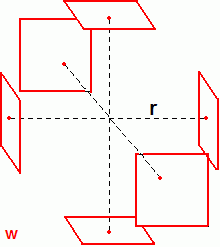
Fig. 4.2
The "expansion" of 3-D space (S < r < L)
The two opposite "directions" along w , inferred from Fig. 4.1, are absent in Fig. 4.2. One is toward the Small (S); the other runs in the opposite direction along w , toward the Large (L). In the instant 'now' (Fig. 1), these additional geometrical degrees of freedom are set to zero, as explained in the beginning of this exercise -- they are hidden within the empty set (R). The meaning of 'set to zero' corresponds to 'spontaneous broken symmetry' (cf. below): we end up with only one "charge" of mass, and the wunderbar (after Theodor Kaluza) dimension w is being literally eliminated, thanks to which we obtain the good old 3-D space of classical physics. It doesn't contain any trace from the "negative mass", but two worlds with inverted spacetime basis, material and tachyonic, separated by a luxonic "surface":
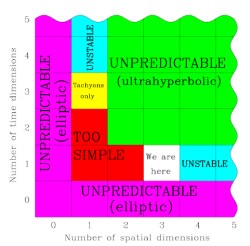
Max Tegmark, arXiv:gr-qc/9702052v2, Footnote 4: "The only remaining possibility is the rather contrived case where data is specified on a null hypersurface. To measure such data, an observer would need to "live on the light cone", i.e., travel with the speed of light, which means that it would subjectively not perceive any time at all (its proper time would stand still)."
Due to the 'spontaneous broken symmetry' (cf. below), we have two kinds of mass in the picture above, real and imaginary (tachyonic), safely separated by a timeless luxonic world of zero, or rather indifferent mass, which keeps the dimension w totally hidden. Notice that, in addition to the three planes in 3-D space (xy, xz, and yz) and their corresponding transformations or "swapping the points" (CPT-invariance), we have a new 'space inversion' symmetry, as mentioned in the discussion of Fig. 1.1 above.
NB: This exercise will be really tough. Try to imagine the "trapped circle" from Fig. 1.1 as "trapped 3-D space", that is, a 3-D "rubber glove" hypersurface which can be seen along the two directions of w as two simultaneous "gloves", right and left, corresponding to the unbroken symmetry of the GPI field (see below) inhabited by the unphysical, GPI states of negative & positive mass. You will have the unique freedom to "look" at the 3-D hypersurface simultaneously along the two directions of w : from 'inside-out' and from 'outside-inside' (cf. the drawing from Mark Armstrong below), corresponding to 'sphere' and 'torus' (cf. Fig. 5).
M.A. Armstrong, Basic Topology, Springer, 1997, p. 104
Such simultaneous viewpoint is impossible to imagine, as hinted in Wiki, but if we lower the dimensions of the physical space to 2-D spherical surface trapped by the six red planes in Fig. 4.2, the 'inside-out' view will display all points from the 2-D spherical surface, as seen from the center of Fig. 4.2 along all radial directions 'inside-out', and by executing 'space inversion' with respect to the 2-D spherical surface ("lion's cage") we will see again all points from the finite 2-D surface from 'outside-inside', along the inverted radial directions, keeping the two presentations of the 2-D "rubber glove" (left and right) simultaneously available to our w - inspection. However, we cannot "move" the unique object at the center of Fig. 4.2, shown with the red point in Fig. 1 above: it is in 'absolute rest' and is residing both inside every point from the physical 3-D space and outside the physical 3-D space, as The Beginning (see below) of the two viewpoints at the 3-D "rubber glove" hypersurface along w , from 'inside-out' and from 'outside-inside'.
Last but not least, the aim of the putative space inversion is to recover 'asymptotically flat spacetime' with the two 'viewpoints' along w . Look at Fig. 3.2 above, and picture it as a clock, such that Fig. 1 is placed at the center, and four red segments tangential to 12, 3, 6, and 9. Imagine one radius "connecting" (not quite: see Fig. 4.3) the center to 9, and blow up the circle by instructing the radius to reach infinity and pass "over" it. The conventional wisdom tells us that the circle will "degenerate", or rather "collapse", to 1-D Euclidean space presented with the vertical red line at 9 (Fig. 3.2) at the very instant at which its radius is exactly infinite, but at that same instant the two points in the orthogonal direction, 12 and 6, will ultimately break up. Once it passes "over" infinity, the object will regain its 2-D status, but will be converted into two finite cross-sections of a torus. Notice that at the instant of 'collapse over infinity' all points from the circle in Fig. 3.2 will be arranged in 1-D space, like those in Fig. 2.2 above. Now, if we keep the radius constant, such non-smooth topological transition will match a well-known screensaver in Windows 97, half of which is depicted with the drawing from D. DeCarlo and D. Metaxas (1996) below.
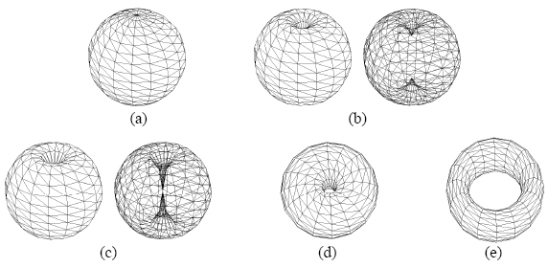
But our case is different, since we wish to recover the asymptotically flat spacetime "around" the critical 'collapse over infinity' instant, with positive and negative space curvature inherited from the circle and the torus. Namely, after passing through this critical instant, not just one but all "inflating" radial directions -- except for the center, see Fig. 1 -- will be inverted, as explained in the exercise above. If we wish to start by inflating the torus from 'case (e)' above, along the opposite direction in w , we will again pass through the same 'collapse over infinity' instant, "around" which we imagine some 'asymptotically flat spacetime', after which we will wind up in the "clock" case from Fig. 3.2, only this time its radius will be shrinking toward the center of the clock. Please keep these two invertible T-invariant images passing through 'asymptotically flat spacetime' in your mind. All we need now is to replace the circle/torus with the 3-D "rubber glove" hypersurface from the exercise above.
Again, the two opposite directions along w are totally hidden inside the luxonic world (cf. Max Tegmark above) with indifferent (zero) mass. Physically, the two directions of the circle/torus conversion in the global mode of spacetime, along w , are totally hidden, their duration is zero, and we can only imagine two atemporal waves, depicted with the Escher hands, by which all non-linear negotiations in 'the school of fish' are completed for zero time, as read with your wristwatch: we can never see Macavity.
Notice that I haven't tried so far to introduce any 'distance function'. I have only an uncountably-infinite 'points' ordered with the relation of intermediacy, [A (zero) B], which is interpreted as "zero is ]between[ A and B". The unique object with zero physical presence in the local (physical) mode of spacetime is The Aristotelian Connection of 'the universe as ONE' (cf. the red dot in Fig. 1). It is manifested by purely affine connection facilitating parallel transport of vectors in the local (physical) mode of spacetime, from one spacetime point to the nearest point, and is independent from the metric. It also captures the essence of the "speed" of light. Let me try to explain.
0.47-0.52: "Relative to the platform, time on the train completely stops."
The ill-defined expression " √0 " must be amended by a new mathematical object relevant exclusively to the non-Archimedean global mode of spacetime.
Relative to the passengers in the train (see the picture above), the local mode of their 'time on the train' does indeed "stop": you move into the luxonic world (cf. Max Tegmark above), and can "see" all the intermediate topological transformations of the Universe, not just its 'collapse over infinity'-state depicted in Fig. 5.
Consider again a finite chunk of space, say, one meter: it is comprised from uncountably-infinite 'points' ordered with the relation of intermediacy, [A (zero) B]. The Aristotelian Connection of 'the universe as ONE', [A (zero) B], passes the physical state at point A to its "neighboring" point B with particular "speed" which acquires an upper limit for any finite volume of space. The numerical value of the "speed of light" isn't interesting; just like the Planck length, it is a 'numerically finite but physically unattainable boundary of the local mode of spacetime'. We cannot define, even as a Gedankenexperiment, 'one second' as the product of [Planck time] x 1043. The universe as ONE (global mode) is a totally different world which shows up only with its Aristotelian Connection. What matters here is that The Aristotelian Connection operates in the global mode of spacetime: it "reads" all of the uncountably-infinite 'points' from any finite chunk of space en bloc . By an analogy with a movie reel, one could speculate that The Aristotelian Connection is "projecting" 3-D space as 'uncountably-infinite infinitesimal "frames" per second', meaning that every "frame" is the 'collapse over infinity'-state (cf. Fig. 5). Unless we encounter relativistic effects (watch the movie from NOVA below), this en bloc "reading" does not slow down (for comparison, watch a water drop here).
The unique "speed" of light, due to The Aristotelian Connection, is preventing us from taking even a glimpse at the global mode of spacetime: we can see only an already-completed physical world, in line with the idea about relativistic causality ("causal processes or signals can propagate only within the light-cone," Jeremy Butterfield).
Notice the precise meaning in GR of 'already-completed': all non-linear negotiations between the two sides of the Einstein field equations are being post factum completed for zero time, as read with your wristwatch. "All agree that in general relativity, the metric tensor gij is (or better: represents a field that is) dynamical: it acts and is (at the same instant - D.C.) acted on. They also agree that it is a special field since it couples to every other one, and also cannot vanish anywhere in spacetime. Many authors go on to say that the metric tensor represents geometry, or spacetime structure, so that geometry or spacetime structure acts and is (at the same instant - D.C.) acted on" (Jeremy Butterfield). More succinctly: "the metric is treated as a field which not only affects, but also is (at the same instant - D.C.) affected by, the other fields" (John Baez). This non-linear paradox is depicted with the Escher hands above, and can be resolved only with the two modes of spacetime, as argued previously. Michael Redhead argued in 1995 that the notion of 'localizable particle' makes sense only for a free particle, while I suggest a 'quasi-local' alternative in terms of Machian relational ontology with the rule 'with respect to everything else in the universe'. In short, the issue of relativistic causality is anything but trivial in GR. As stressed by Margaret Hawton, in quantum field theory probability density is defined at a fixed instant t , and it is by no means obvious how to "insert" in such fixed instant t the already-completed non-linear 'acting and at the same instant being acted upon' in GR. Thanks to The Aristotelian Connection [A (zero) B], there exists a bond between spacetime points, and the "speed" of light is its manifestation. If the "speed" were infinite or unlimited, there would be no difference between 'small' and 'large', and '3-D space' as the medium for 'finite things' would have not existed; if the "speed" of light were a finite entity, it would be surpassable, and then there would be no separation between the two worlds with inverted spacetime basis, material and tachyonic (cf. Max Tegmark above). Notice that 'space as the medium for finite things' is a very old idea, debated by Ernst Mach. The difference between 'small' and 'large' is not fixed in the local, Archimedean mode of spacetime, but in the global, non-Archimedean mode by 'finite invariant templates' (cf. below). NB: The alteration of these templates is the essence of gravity. We have 'finite invariant templates' for 'finite space', fixed by The Aristotelian Connection: it is the bond between spacetime points that determines 'the time it would take a photon to traverse a distance equal to a [finite volume of space]'. (As Erik Curiel explained, arXiv:0908.3322v3 [gr-qc], "in general relativity all the fundamental units one uses to define stress-energy, namely time, length and mass, can themselves be defined using only the unit of time; these are so-called geometrized units. (...) A unit of length is then defined as that in which light travels in vacuo in one time-unit.") Then a minuscule alteration of the bond between spacetime points can produce enormous change of 'the time it would take a photon', and subsequently of the 'finite invariant templates' (resembling "curvature", cf. Bill Unruh), leaving the deceitful impression of some "cold dark matter" or "supermassive black hole".  The effect is purely geometrical, according to the so-called
relative scale principle (RSP). Namely, an observer placed inside such altered (by 'the time it would take a photon') spacetime template will not notice any change of her ambient spacetime assembled by The Aristotelian Connection, in terms of her 'one meter and one second': she will always experience the same "speed of light", regardless of the extent to which her template has been altered with respect to an unaltered template of an observer placed at the length scale of tables and chairs. This is because the "number" of spacetime points in any finite volume of 3-D space, approaching asymptotically S and L , remains unchanged (Kurt Gödel), being a non-Archimedean phenomenon, and also because The Aristotelian Connection is endowed with 'actual infinity' and "reads" all uncountably-infinite 'points' from any finite chunk of space en bloc . The effect is purely geometrical, according to the so-called
relative scale principle (RSP). Namely, an observer placed inside such altered (by 'the time it would take a photon') spacetime template will not notice any change of her ambient spacetime assembled by The Aristotelian Connection, in terms of her 'one meter and one second': she will always experience the same "speed of light", regardless of the extent to which her template has been altered with respect to an unaltered template of an observer placed at the length scale of tables and chairs. This is because the "number" of spacetime points in any finite volume of 3-D space, approaching asymptotically S and L , remains unchanged (Kurt Gödel), being a non-Archimedean phenomenon, and also because The Aristotelian Connection is endowed with 'actual infinity' and "reads" all uncountably-infinite 'points' from any finite chunk of space en bloc . Notice that 'the time it would take a photon', which defines each and every 'finite volume of space' (see above), is the global (en bloc) mode of time. It is the background time code of the animation from John Walker below, and it must be totally hidden. 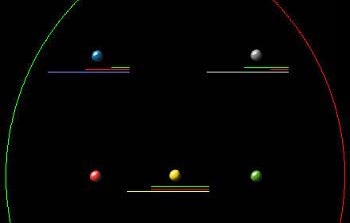
Again, the crux of the matter is the initial puzzle of 'one meter' and its treatment with the two manifestations of infinity. Namely, with the potential infinity operating in the local (physical) mode of spacetime, 'one meter' will be presented with "open sets" (James Dungundji), which do not include the crucial 'end points', ( 1m ), despite the fact that any such interval can be defined only with respect to a fixed point in The Beginning; with the actual/completed infinity operating in the global non-Archimedean mode of spacetime, the same 'one meter' will be presented as 'completed' en bloc interval [ 1m ]. The puzzle of 'the infinitesimal' was identified by Titus Lucretius Carus some 2070 years ago, yet people still seek 'the smoothest manifold' like bartenders, and of course cannot find 'the unmoved mover' in GR (Karel Kuchar). There is
a lot more to be said about the "speed" of light, as The Aristotelian Connection "happens" only post-factum, at null-surface. We cannot witness the alteration of these templates online, as it "happens", and we will always observe an already-assembled, by The Aristotelian Connection, spacetime in which we cannot reach the luxonic world. By going into the center of Milky Way, all we can post-factum observe is a finite volume of space in which our 'one meter and one second' has not been altered, hence we would claim that these 'spacetime templates' are "invariant to us", while a distant observer will see us "shrinking". Ditto to the "expansion" of space. There is no need to invoke any anomalous "dark" stuff with "positive energy density and negative pressure", as you may have heard from Ned Wright, say. More on SPR later; for now it suffices to say that the "speed" of light must be 'numerically finite but physically unattainable boundary' in order to provide for finite volumes of space and time intervals of the local mode of spacetime. First and foremost, I need to eliminate all absolute structures in 3-D space, such as 'absolute size', by allowing the 'templates for finite space' to shrink toward S and expand toward L , as viewed by an observer at the length scale of tables and chairs, and also providing invariant size of all object toward S and toward L , as seen by a co-moving observer. In other words, we need a dual, scale-dependent metric to define 'distances in 3-D space'. Then the "expansion of space" can be explained as an illusion observed only from the length scale of tables and chairs. Ditto to the "non-accelerated" shrinking of the "size" of objects toward S , in line with the so-called 'relative
scale principle' (RSP). The latter is an elaboration on the old idea about 'the mutual penetration of the Large and the Small'. Who has "the right meter"? Nobody. This is the essence of
RSP. Simple, no? NB: To explain the 'templates for finite space' and their "dark" influence on matter and fields, recall the operational definition of 'second': the total duration of 9,192,631,770 transitions between the two hyperfine levels of the ground state of the cesium 133 atom, provided the cesium atom is "at rest at a temperature of 0K, such that the ground state is defined at zero magnetic field" (reference here). In the local, Archimedean mode of spacetime, we imagine that the distance between every two neighboring dots from the drawing below refers to one transition between the two levels of the ground state of the cesium-133 atom, and that the total of such physical, Archimedean distances, comprising 'one second', is exactly 9,192,631,700:
{..............................................}
This is clearly an unfeasible Gedankenexperiment, which cannot be reproduced. Most importantly, the "intrinsic time interval associated to any timelike displacement" (Ted Jacobson, pp. 18-19), defined here as 'the elementary tick of time ]between[ two purely geometrical points ordered with the relation of intermediacy [A (zero) B]', can be defined only in the global, non-Archimedean mode of spacetime. These are 'invariant templates' for finite durations of time and finite volumes of space, which approach asymptotically L and S . NB: An objection to such 'finite templates' would be that they are merely mental, or epistemological constructs representing our "knowledge", hence we cannot grant them an ontological status of 'ideal geometrical reality'. Well, with Finite Infinity we can indeed suggest such 'finite templates' fixed by the topological transitions in the global mode of spacetime (cf. Fig. 5), hence resolve the underlying puzzle of 'extendable volumes of space', which allow us to "look around, and see as far as we can" (L. Smolin). This simple fact can be explained iff the spacetime "points" are perfect geometrical points ordered by The Aristotelian Connection as a perfect continuum (the current theory requires that "points become fuzzy and locality looses any precise meaning," cf. Sergio Doplicher). The alteration of these templates, relative to an observer at macroscopic length scale, produces purely geometrical effects (interpreted as "black holes" and "expanding space"), yet a co-moving observer will not notice any alteration of her intrinsic 'distance function'. Again, this is the well-known idea about 'the mutual penetration of the Large and the Small', which can start only from the macroscopic length scale in the two "directions" along w , toward L and toward S . With
RSP and its dual spacetime metric, one could alter the "distances" in 3-D space in such a way that a "reactionless" alien visiting craft (AVC) will travel with speed "one meter per second" (relative to the people in the AVC) to cover the size of a galaxy (relative to observers outside the AVC). You won't notice your "speeding", but you will notice that the space in front of you is running towards you, just like with the Alcubierre warp drive. In
RSP, the question of 'who has the right meter and the right second' is meaningless. In present-day GR, the question of 'who has the right meter' is answered with absolute size of objects in 3-D space, toward L and toward S , which is nothing but 'looking for a right answer to a wrong question'.
Fig. 4.3 below shows the main idea of Finite Infinity.
Fig. 4.3
The horizontal line shows the axis w in terms of two directions in 3-D space, toward S and L . The points denoted with
B (from ‘bartenders’) are the fleeting explications of GPIs in the local (physical) mode of spacetime: John’s jackets.
The black horizontal line (asymptotically flat 4-D spacetime, see Fig. 5 below) cannot reach the realm of S & L (Thompson Lamp paradox).
And finally, let's see how the w axis will look in the global mode of spacetime (Fig. 5), by combining Fig. 1 with the blow up of Fig. 3.2 at the point " 9 o'clock " (not shown).
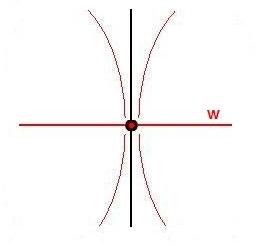
Fig. 5
The red/black point in Fig. 5 belongs to an asymptotically flat, physical, 4-D spacetime; the vertical black line is taken from Fig. 2.2. above. The right part from Fig. 5 shows the T-invariant (cf. the drawing from Mark Armstrong above) "blow up" of the circle from Fig. 3.2, by watching the point at "9 o'clock" (see above): at the critical 'collapse over actual infinity' instant, at which the radius of the circle in Fig. 3.2 is exactly infinite, we would have obtained an absolutely flat 4-D spacetime, which is why I talked, for the lack of better wording, about "around the critical 'collapse over infinity' instant". The left part from Fig. 5 shows a segment from a torus -- see the drawing from DeCarlo and Metaxas above, 'case (e)', and the explanation of 'space inversion', about the two simultaneous viewpoints at the 3-D "rubber glove" Cauchy hypersurface, from 'inside-out' (right part from Fig. 5) and from 'outside-inside' (left part from Fig. 5). The horizontal w axis is the one along which 'the mutual penetration of the Small and the Large' begins from the macroscopic length scale, as discussed above. Hence the only remnant from w in our asymptotically flat spacetime (called 'local mode of spacetime') is depicted with the two red lines in Fig. 4.3 above, placed at S and at L .
Notice that the horizontal w axis is not a 4th spatial dimension, because the new degrees of freedom to "look at" the 3-D "rubber glove" Cauchy hypersurface entail moving simultaneously along all directions in the local mode of spacetime, from any point in 3-D space, from both 'inside-out' toward L and its time-reverted direction toward S . This is impossible in 3-D space, as explained in Wiki below, but recall that these are the "directions" of the Arrow of Space: the elementary 'change of space' is nothing but the elementary increment of our physical time, as read with our clocks -- it isn't a "vector". Thus, the global mode of spacetime and the axis w of the Arrow of Space could only be perceived by us as "occurring" in some infinite-dimensional Euclidean space, much like a Flatlander (cf. Fig. 3.2) would be totally puzzled by our 3-D viewpoint, and would also have to imagine some higher-dimensional space to accommodate our 3-D viewpoints inside his Flatland. To visualize these smooth torus-sphere transitions over the 'collapse over infinity' instant 'now' (Fig. 1), hence the re-created 'asymptotically flat 3-D space', look carefully at the drawing below, from Eric Schechter (5 December 2009, emphasis added): "There are no points for plus or minus infinity on the line, but it is natural to attach those "numbers" to the endpoints of the semicircle."
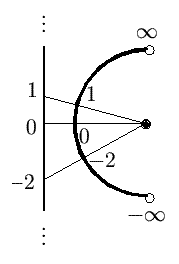
The point denoted with 'zero' from the vertical line corresponds to the point at "9 o'clock" in Fig. 3.2 above (not shown). Notice that every point from the circle in Fig. 3.2 above will pass over the 'collapse over infinity'-instant, and at this instant its two conjugated endpoints, from the direction orthogonal to the horizontal line segment pictured here, will "break up" the circle and will convert it into a (hyper?) torus. The 3-D space at the exact 'collapse over infinity' instant would be absolutely flat, and would contain just a bare red point from Fig. 1 above, known as [John 1:1]. Which is why I talked, for the lack of better wording, about "around the critical 'collapse over infinity' instant", to describe the asymptotically flat 3-D space, hence 4-D spacetime, of present-day GR.
But look at Eq. 1 above: in the global mode of spacetime, we can set L and S to take values of some dimensionless variable "measured" along w ; all we need is to ensure that L and S take reciprocal values, until they snap to L = S = 1 (Eq. 2).
Eq. 2 describes 'the whole universe as ONE' in its global mode of spacetime, inhabited only by GPIs. The Arrow of Space runs simultaneously along the two "opposite directions" from w , and at each and every instant 'now' (see Fig. 1) a newly-born physical universe is being re-created in the local mode of spacetime.
Namely, Eq. 2 reduces to Eq. 1 above, and the finite, Archimedean, 3-D space is born anew by the "spontaneous" broken symmetry, stacked along w like Photoshop layers. We cannot look at the "gaps" of re-creation: the local (physical) mode of spacetime is being re-created as a perfect continuum, thanks to the "speed of light".  Perhaps the global mode of spacetime can be presented with four segments (notice the favicon of my web site) in which two atemporal quantum-gravitational waves run against each other, re-creating asymptotically flat spacetime at the 'collapse over infinity' instant. Also, the fundamental phenomenon called "spin" should be explained as topological property of 3-D space. As Peter Rowlands suggested (arXiv:0912.3433v1, Sec. 3, p. 5), “Space and time are simply quaternions multiplied by i, and spin is simply a topological property of space (as Dirac knew), and not quantum or relativistic in origin.” Perhaps the global mode of spacetime can be presented with four segments (notice the favicon of my web site) in which two atemporal quantum-gravitational waves run against each other, re-creating asymptotically flat spacetime at the 'collapse over infinity' instant. Also, the fundamental phenomenon called "spin" should be explained as topological property of 3-D space. As Peter Rowlands suggested (arXiv:0912.3433v1, Sec. 3, p. 5), “Space and time are simply quaternions multiplied by i, and spin is simply a topological property of space (as Dirac knew), and not quantum or relativistic in origin.”
In the quantum-and-gravitational realm of the local (physical) mode of spacetime, physical objects gradually acquire increasing access to 'the whole universe as ONE'. They become bootstrapped by their "gravitational field", due to opening a "red window" to their GPIs residing in the global mode of spacetime. Which is why a quantum particle can be in a superposition of its GPI states (say, a superposition of |cat> and |dog>, Erich Joos), and all (not just "small") bodies follow quasi-local geodesics: at each point from such quasi-local geodesics we can install a local Lorentzian frame, by going into "freefall" at such quasi-local point, and imagine that the effects of gravity have re-disappeared. All this is a very brief and incomplete effort to amend the Finite Infinity, introduced by George F R Ellis. Needless to say, I will be happy to
elaborate. Details here.
D. Chakalov
October 28, 2010
Last updated: Saturday, 25 February 2012, 12:53:14 GMT

================================
Subject: The Cauchy problem in General Relativity, Proceedings of ICM, Vol. III, 421-442, 2006
Date: Tue, 3 Jan 2012 03:54:22 +0200
From: Dimi Chakalov <[email protected]>
To: Igor Rodnianski <[email protected]>, [email protected]
Cc: Henk van Elst <[email protected]>,
Hans Ohanian <[email protected]>,
Mark Burgin <[email protected]>,
Piotr T Chrusciel <[email protected]>,
Paul Tod <[email protected]>
Dear Dr. Rodnianski,
May I ask you and your colleagues for clarification of the meaning of "implies" (cf. attached) used on p. 422 (emphasis mine).
For comparison, please see an excerpt from Hans Ohanian's arXiv:1010.5557v1 [gr-qc] (cf. attached).
Kind regards,
Dimi Chakalov
http://tinyurl.com/Einstein-Prague
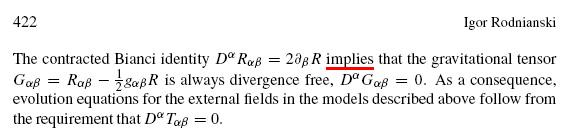
===============================
Subject: GR19 - 2010
Date: Thu, 3 Jun 2010 02:39:23 +0300
From: Dimi Chakalov <[email protected]>
To: Kei-Chi Maeda <[email protected]>,
Don Marolf <[email protected]>,
Malcolm MacCallum <[email protected]>,
Alan Rendall <[email protected]>,
Jose M M Senovilla <[email protected]>,
Miguel Alcubierre <[email protected]>,
Bernard Schutz <[email protected]>
Gentlemen:
I mentioned your gathering at
http://www.god-does-not-play-dice.net/#Blanchard
Four years ago, I proposed to convert LIGO tunnels to wine cellars. If you have a better idea, please do write me back.
Sincerely,
Dimi Chakalov
======================
Subject: GR19 - 2010
Date: Fri, 4 Jun 2010 01:49:18 +0300
From: Dimi Chakalov <[email protected]>
To: Gabriela González <[email protected]>
Cc: Jorge Pullin <[email protected]>,
[email protected],
[email protected]
Dear Professor González,
Regarding my email from June 8, 2005: I noticed your name at
http://www.gr19.com/scicom.php
Perhaps it will be a good idea if you blow the whistle at GR19 and expose the insurmountable problems of "GW astronomy",
http://www.god-does-not-play-dice.net/#Blanchard
The sooner, the better.
Should you have professional questions, please don't hesitate to write me back.
Yours sincerely,
Dimi Chakalov
---------
Subject: Re: LSC March 2005 and June 2005 Meetings
Date: Wed, 08 Jun 2005 20:08:12 +0300
From: Dimi Chakalov <[email protected]>
To: Gabriela González <[email protected]>
CC: Jorge Pullin <[email protected]>,
[email protected],
[email protected]
Dear Professor González,
I watched your movie "Gravity: Making Waves", with Ray Weiss and Mike Zucker, and would like to share my concerns regarding the "direction" of detecting gravitational waves
[snip]
-----
Note: Look at the "direction" of GW scattering in the animation below: you might be able to "see" these GWs iff you're a meta-observer capable of monitoring the whole spacetime en bloc. However, this same "direction" is assumed to exist inside the same 3-D space as well: check out the Mock LISA Data Challenge Taskforce and LIGO-Virgo Mock Data (custom made) Working Group, as explained eloquently in their arXiv:gr-qc/0701026v1: "The burst “repeater” source was placed at the center of the Galaxy and the performance modulation due to Earth’s rotation has been studied with 24 hours of simulated data." So, the direction of GW scattering 'from the center of the Galaxy toward Earth' matches the direction of the same GW scattering seen by the meta-observer. Do you smell a rat? If not, join LIGO Scientific Collaboration. D.C.
June 4, 2010
===================================
Subject: 8th International LISA Symposium, Stanford University, June 28, 2010 - July 02, 2010
Date: Mon, 7 Jun 2010 06:13:31 +0300
Message-ID:
<[email protected]>
From: Dimi Chakalov <[email protected]>
To: Vivian Drew <[email protected]>
Cc: Joan M Centrella <[email protected]>,
Warren Johnson <[email protected]>,
Stephen Merkowitz <[email protected]>,
Meredith Gibb <[email protected]>,
Karen Smale <[email protected]>,
[email protected], [email protected],
[email protected], [email protected],
[email protected], [email protected],
[email protected], [email protected],
[email protected], [email protected],
[email protected], [email protected],
[email protected], [email protected],
[email protected], Cliff <[email protected]>
Dear Dr. Drew,
The reason why LIGO, LISA, etc. will fail miserably is explained at
http://www.god-does-not-play-dice.net/#mantra
Hundreds of millions U.S. Dollars and Euro -- taxpayers' money -- have been wasted so far by LIGO Scientific Collaboration, and even more are scheduled to be wasted with the "enhanced" and "advanced" LIGO and LISA.
I seriously urge you and your colleagues to examine your problems professionally. Please feel free to pass this email to all participants of your 8th International LISA Symposium.
NB: Should you or any of your colleagues have *professional* questions, please do write me back. Notice I will not reply to insults nor to emotional statements.
Yours sincerely,
Dimi Chakalov
===================================
Subject: The Averaging Problem in GR
Date: Tue, 23 Mar 2010 13:48:51 +0200
Message-ID:
<[email protected]>
From: Dimi Chakalov <[email protected]>
To: Robert van den Hoogen <[email protected]>
Cc: Juliane Behrend <[email protected]>,
Masumi Kasai <[email protected]>,
Naoshi Sugiyama <[email protected]>,
Frank Steiner <[email protected]>,
Claus Gerhardt <[email protected]>,
Eduardo Guendelman <[email protected]>,
Thomas Buchert <[email protected]>,
Yi Zhang <[email protected]>,
Lau Loi So <[email protected]>,
Xiao Zhang <[email protected]>,
Marco Spaans <[email protected]>,
Sergio Doplicher <[email protected]>,
Volker Runde <[email protected]>,
Robert M Wald <[email protected]>,
Robert Geroch <[email protected]>,
Chris Isham <[email protected]>
Dear Professor van den Hoogen,
Your recent paper [Ref. 1] is a joy to read, and also a tough challenge to study. I haven't yet completed the second part, but since you acknowledged that Problem C (determining the gravitational correlation) is unresolved, may I offer some thoughts on the subject matter.
It seems to me that many physicists are unaware of the fundamental puzzle in differential calculus, as shown with the Thompson Lamp paradox,
http://en.wikipedia.org/wiki/Thomson's_lamp
They write textbooks and teach GR like a bartender [Ref. 2]. Other "bartenders" suggest various ad hoc solutions to the "dark" constituents of the universe in the following fashion:
Q: What is green, lives underground, has one eye, and eats stones?
A: The One-Eyed Green Underground Stone Eating Monster!
I believe both dark matter and dark energy are artefacts of our essentially incomplete presentation of 'the infinitesimal', which may in turn be resolved with some pre-geometric plenum "connecting" x' and x [Ref. 1] dynamically, along an 'arrow of spacetime',
http://www.god-does-not-play-dice.net/#quiz
http://www.god-does-not-play-dice.net/#Bahn
I also believe the Thompson Lamp paradox has a quantum version: the UNdecidable KS state,
http://www.god-does-not-play-dice.net/#KS
The latter may act as the 'pre-geometric plenum' mentioned above.
Your critical comments and suggestions, as well as the feedback from your colleagues, will be greatly appreciated.
May The Force be with the inhomogeneous cosmologists [Ref. 3].
With all good wishes,
Dimi Chakalov
---------
[Ref. 1] R. J. van den Hoogen, Averaging Spacetime: Where do we go from here? arXiv:1003.4020v1 [gr-qc], http://arxiv.org/abs/1003.4020
p. 1: "Can there be an alternative description for these observational effects that does not assume the existence of these mysterious dark quantities?
"One possibility is that both dark matter and dark energy are artefacts of some effective averaged theory of gravitation.
....
Problem A (How does one Average tensor fields on a manifold?)
Problem C (What is the nature of the gravitational Correlation , C_ab?)
....
p. 7: "3.2. Choice 1: Parallel Transport along Geodesic
"To begin, we must first select a unique curve that connects the points x and x' and a connection: for our purposes, we choose the geodesic and the Levi-Cevita connection. The geodesic is a “natural” choice as there are no other “natural” curves that connect x' and x. In Riemannian space, the geodesic is the shortest and straightest path connecting points x' and x. A weakness in this approach is the assumption that a unique geodesic exists connecting x' and x.
....
p. 8: "We have illustrated a covariant averaging procedure for tensor fields addressing problem A. We have not averaged the Einstein Field Equation’s of General Relativity, and therefore have not addressed problem C of determining the gravitational correlation, so much more work to do."
[Ref. 2]
http://www.math.ualberta.ca/~runde/jokes.html
An infinite crowd of mathematicians enters a bar. The first one orders a pint, the second one a half pint, the third one a quarter pint... "I understand", says the bartender - and pours two pints.
[Ref. 3] Masumi Kasai (23 June 2009): "May the Force be with the inhomogeneous cosmologists. May the Force be with us."
IPMU International Conference dark energy: lighting up the darkness!
June 22-26, 2009, http://web.ipmu.jp/seminar/darkenergy09/MKasai.pdf
==========================================
Subject: Request for opinion
Date: Wed, 31 Mar 2010 20:47:14 +0300
Message-ID:
<[email protected]>
From: Dimi Chakalov <[email protected]>
To: Helena Granström <[email protected]>
Dear Dr. Granström,
I am respectfully requesting your professional opinion on the interpretation of KS Theorem at
http://www.god-does-not-play-dice.net/#KS
http://www.god-does-not-play-dice.net/#KS_details
Kindest regards,
Dimi Chakalov
=====================================
Subject: arXiv:1005.3767v1 [quant-ph], Sec. 4
Date: Fri, 21 May 2010 05:06:16 +0300
Message-ID:
<[email protected]>
From: Dimi Chakalov <[email protected]>
To: Diederik Aerts <[email protected]>
Dear Diederik,
I wonder if your work overlaps with mine:
http://www.god-does-not-play-dice.net/#KS
Best regards,
Dimi
=====================================
Subject: arXiv:1006.1552v1 [gr-qc], dated: June 9, 2010
Date: Wed, 9 Jun 2010 04:06:55 +0300
From: Dimi Chakalov <[email protected]>
To: Naresh Dadhich <[email protected]>
Hi Naresh,
Regarding your idea that [lambda] "characterizes the matter free state": the "matter free state" has been discussed at
http://www.god-does-not-play-dice.net/#KS
http://www.god-does-not-play-dice.net/#Geroch_note
http://www.god-does-not-play-dice.net/#Blanchard
I very much look forward to reading your arXiv:1006.1552 v2 [gr-qc].
Regards,
Dimi
-------
Note: Check out N. Dadhich's arXiv:gr-qc/0405115v1, particularly the discussion of Eq. 4. He also posed the following question (arXiv:0802.3034v5 [gr-qc]): "It is remarkable that even classical dynamics of gravity asks for dimension > 4. As two and three dimensions were not big enough for free propagation of gravity, similarly four dimension is not big enough to fully accommodate self interaction dynamics of gravity. Then the most pertinent question is where does this chain end?" It ends at infinitely-dimensional spacetime -- see Fig. 2 below. Every infinitesimal "point" from the local mode is endowed with infinitely-many connections (global mode of spacetime) with 'the rest of points' in the local mode. And since the global mode is hidden by the so-called 'speed of light', the
bootstrapped local mode is "self-acting" upon itself along the arrow of spacetime. Not surprisingly, the origin of this "self-force" is not traceable, and some people consider it "dark".
This offers a new interpretation of the old idea of "breathing" (inhaling/exhaling) universe (common knowledge in India), only the duration of the "breathing" cycle is
exactly zero in the local mode of spacetime, rendering the latter a perfect continuum. That's the proposal for 'quantum principle for spacetime dynamics', after
Schrödinger and KS Theorem. Perhaps Naresh Dadhich would some day accidentally discover it. All he has to do is to forget about "branes" and other multidimensional superstitious. D.C.
June 12, 2010
=====================================

Subject: The raw potato, http://pirsa.org/09080013
Date: Thu, 27 May 2010 15:57:16 +0300
From: Dimi Chakalov <[email protected]>
To: Bob Coecke <[email protected]>
Cc: John Baez <[email protected]>
Hi Bob,
I trust all my email messages sent in the past three years have been received.
You declared your intentions to make "new models and axiom systems for quantum reasoning", and expressed hopes for "important steps towards quantum gravity",
http://www.comlab.ox.ac.uk/projects/NewQuantumFormalism/index.html
If this just a hobby? For if you were collecting stamps, while I was suggesting to switch to collecting paper napkins, I could understand your attitude of neglecting the underlying "raw potato" -- the UNdecidable KS state,
http://www.god-does-not-play-dice.net/#KS
Try it with your brain at
http://www.god-does-not-play-dice.net/#context
NB: Category theory cannot -- not even in principle -- model the "raw potato". You and John are wasting your time and FQXi donations: $89,981 for your efforts, and $131,865 for John's "Categorifying Fundamental Physics".
Now, if you (John won't respond) are serious about your business, please reply professionally, and I will elaborate.
If you're doing it as a hobby -- don't bother. Have a beer instead.
Take care,
Dimi
=====================================
Subject: Louis Crane, The category of spacetime regions
Date: Thu, 27 May 2010 17:03:45 +0300
From: Dimi Chakalov <[email protected]>
To: Louis Crane <[email protected]>
Cc: Kavita Rajanna <[email protected]>,
Bob Coecke <[email protected]>,
Prakash Panangaden <[email protected]>,
Peter Selinger <[email protected]>,
[email protected], [email protected],
[email protected], [email protected]
Dear Dr. Crane,
Regarding your talk at the 7th QPL workshop "Quantum Physics and Logic" and arXiv:gr-qc/0602120v2, and the $135,247 FQXi award, perhaps you may wish to see my recent email to Bob Coecke,
http://www.god-does-not-play-dice.net/#Coecke
I think $135,247 is a lot of money to be spend for a hobby. What do you think?
Sincerely,
Dimi Chakalov
=====================================
Subject: arXiv:0705.2908v2
Date: Sat, 22 May 2010 05:43:08 +0300
From: Dimi Chakalov <[email protected]>
To: Yi-Fang Chang <[email protected]>, Yi-Fang Chang <[email protected]>
Dear Dr. Chang,
I read with great interest your arXiv:0705.2908v2, but couldn't understand the following:
"When the positive and negative matters with the same mass meet, they will become a real vacuum." And also: "The positive and negative matters under some exceeding conditions may be created from nothing at the same time. They will also be main tests of the existence of negative matter."
What could be the ultimate source of positive and negative matters (called "nothing"), such that it can "meet" them as "a real vacuum"?
Kindest regards,
Dimi Chakalov
=====================================
Subject: Re: The shape of space
Date: Tue, 23 Mar 2010 15:05:42 +0200
From: Dimi Chakalov <[email protected]>
To: Graham Nerlich <[email protected]>
Dear Graham,
You said (Thu, 23 Dec 2004) that the affine structure "is a further primitive (not definable from mere differential structure) structure which you can postulate using some representation or other of it" -- please see
http://www.god-does-not-play-dice.net/#Force
I will appreciate your critical comments.
All the best,
Dimi
--------
Subject: Re: The shape of space
Date: Thu, 23 Dec 2004 12:38:15 +1030
From: Graham Nerlich <[email protected]>
To: Dimi Chakalov <[email protected]>
I meant something pretty simple by what I wrote in Shape of Space. Consider a space which has the structure only of a differential manifold. Then, so far, no affine structure, no geodesics, no curvature, no Christoffel tensor. The transition from this to affine structure is not given by or extruded from Christoffel symbols or the 3-tensors which they represent. The affine structure is a further primitive (not definable from mere differential structure) structure which you can postulate using some representation or other of it. You can postulate it as a covariant derivative, a connection, or a tensor which can be represented in coordinates by a Christoffel symbol. But that representation makes sense only if the affine structure is already there, so to speak. True, in GR, the fundamental equation
tells us (among other things) that the curvature and the "matter distribution" are co-determinate. That doesn't mean that the curvature is caused by the matter tensor. A simple analogy shows the catch in that way of thinking. The distance relations between London, New York and Sydney entail that the cities aren't on a flat surface. But the distances don't cause the shape of the surface. These places couldn't have those distances if the surface wasn't curved in the first place. The basic equation of GR places a mutual constraint on the tensors on
each side of it.
I guess you know that the tensor as represented by a Christoffel symbol isn't straightforwardly like other tensors. If you don't, B. Schutz A First Course in General Relativity sec. 5.5 gives a clear account of it.
Best wishes
Graham Nerlich
=======================================
Subject: Dreaming about LISA, arXiv:1011.2062v1 [gr-qc]
Date: Wed, 10 Nov 2010 04:07:11 +0200
Message-ID:
<[email protected]>
From: Dimi Chakalov <[email protected]>
To: Stanislav Babak <[email protected]>,
[email protected],
[email protected],
[email protected]
Cc: [email protected],
Beverly Berger <[email protected]>,
Tom Carruthers <[email protected]>,
Denise S Henry <[email protected]>,
Ramona Winkelbauer <[email protected]>,
LSC Spokesperson <[email protected]>
Dear Mr. Babak,
You wrote (p. 2): "we will use the fact that LISA will observe about 30 events per year..."
But it isn't a *fact*. The fact of the matter is that people are not stupid, and are fully aware of the errors in your hypotheses:
http://www.god-does-not-play-dice.net/ExplanatoryNote.pdf
It is manifestly pointless to dream about LISA, because you won't get it.
Sincerely,
D. Chakalov
------
Overfunded research is like heroin: It makes one addicted, weakens the mind and furthers prostitution.
Johann A. Makowsky, The Jerusalem Post, 19.4.1985
===============================
Subject: Pornography at the NSF and GW parapsychology
Date: Thu, 1 Oct 2009 14:34:37 +0300
From: Dimi Chakalov <[email protected]>
To: Carlos <[email protected]>
Cc: Beverly Berger <[email protected]>,
Tom Carruthers <[email protected]>,
Denise S Henry <[email protected]>,
Ramona Winkelbauer <[email protected]>,
Peggy Fischer <[email protected]>,
OIG <[email protected]>,
LSC Spokesperson <[email protected]>,
[email protected]
[snip]
Dear Carlos,
> I forgot about these funny news : 75% of the people who work at the National
> Science Foundation (NSF) have been found to be surfing at Porno in the web
Here's the link:
http://washingtontimes.com/news/2009/sep/29/workers-porn-surfing-rampant-at-federal-agency/
I've been trying to contact NSF since July last year, but the only response I got so far was from Mr Berger (email printed below).
The forthcoming scandal about LIGO will be enormous:
http://www.god-does-not-play-dice.net/Szabados.html#SBG
Nobody cares. NOBODY.
All the best,
Dimi
http://www.god-does-not-play-dice.net/#NB
=============
Re: LSC: Aggressive professional negligence
Date: Fri, 5 Sep 2008 12:51:16 -0400
Message-ID:
<[email protected]>
From: Berger, Beverly K. <[email protected]>
To: Dimi Chakalov <[email protected]>
I will be on vacation until Sept. 8 and will have no email contact for
most of that time. If you cannot wait until I return, please contact
Denise Henry ([email protected]) .
-----------

Note: At the age of 57, my hair is getting lily-white, and I may claim that it is sufficiently white to enjoy surfing at porno in the web, yet still sufficiently black to attract real blond girls. Likewise, LSC members deeply believe that GW strain, which might hit LIGO some day, would be sufficiently weak to be modeled with the linearized approximation of GR, yet sufficiently strong to be detected with the so-called Advanced LIGO (cf. J. G. Pereira et al., arXiv:0909.4408v1). But LSC can't have their cake and eat it. As Hermann Weyl demonstrated in 1944 (Hermann Weyl, How Far Can One Get With a Linear Field Theory of Gravitation in Flat Space-Time? American Journal of Mathematics, Vol. 66, No. 4 (Oct., 1944), pp. 591-604), the linearized approximation of GR is "a shadow without power". Notice that LSC cannot describe smooth bi-directional transitions from strong GWs to very weak GWs, as they approach asymptotically their sudden death at the stage of "a shadow without power". Joshua Goldberg is manifestly silent on this crucial problem, and Kip Thorne didn't even mention Hermann Weyl's article in his lecture "Gravitational waves in flat spacetime". Instead, he tried to defend the so-called "invariance angle" of LIGO's arms with an article by Eugene Winger, which he has read as a student "around 1960". Just look at the L-shaped tunnels of LIGO: isn't this 'graviton parapsychology'? The persistent "evolution" of the beliefs of LSC members is really amazing. Back in 1981 (cf. Daniel Kennefick, p. 1), Kip Thorne had no difficulty in "finding a taker for a wager that gravitational waves would be detected by the end of the last century. The wager was made with the astronomer Jeremiah Ostriker, one of the better-known critics of the large detectors then being proposed. Thorne was one of the chief movers behind the largest of the new detector projects, the half-billion-dollar Laser Interferometer Gravitational Wave Observatory, or LIGO. He lost the bet, of course." Now LSC members are effectively saying 'just gives us a couple of billion dollars more, and we gonna make it'. Exactly how much more? The Advanced LIGO Cost Estimating Plan (M990310-05.pdf, updated 05.27.2003) is here, but is hidden to 'mass society' taxpayers. Notice that LSC have already prepared 'Plan B', in case they fail miserably again. In their latest "science white paper", submitted to the Astro2010 Decadal Survey (Bernard F. Schutz et al., arXiv:0903.0100v1 [gr-qc], p. 3), they wrote:
"It is worth reminding ourselves why and where GR might fail." (...) "Any such failure of GR should point the way to new physics." Once the "Advanced LIGO" fails in 2015, they will celebrate the 100th anniversary of Einstein's GR with their "way to new physics", claiming that their total failure is actually of fundamental importance, like the negative result for the ether drift in the experiment of Michelson and Morley ... but with just a few billion dollars more for LISA and Einstein Telescope, everything will be just right. Are NSF officials going to risk a devastating embarrassment from their blind support of GW parapsychology?
D. Chakalov
October 2, 2009
Last update: October 26, 2009
==========================
Subject: Re: The schizophrenic behavior of gravity (SBG)
Date: Sat, 13 Mar 2010 15:45:13 +0200
Message-ID:
<[email protected]>
From: Dimi Chakalov <[email protected]>
To: Nikolai Mitskievich <[email protected]>
Cc: Ludvig Faddeev <[email protected]>, Viktor Denisov <[email protected]>, [email protected],
[email protected], LSC Spokesperson <[email protected]>,
Beverly Berger <[email protected]>, Tom Carruthers <[email protected]>, Denise S Henry <[email protected]>, Ramona Winkelbauer <[email protected]>, [email protected], Laszlo Szabados <[email protected]>, Adam Helfer <[email protected]>, [email protected],
[email protected], [email protected], [email protected],
Roger Blandford <[email protected]>, Lynne Hillenbrand <[email protected]>, Donald C Shapero <[email protected]>, Adam Riess <[email protected]>
Dear Dr. Mitskievich,
You wrote (arXiv:1002.1421v1): "I am regretful not to tell these considerations to Kip S. Thorne more than two decades ago, simply because of a kind of awkward modesty."
I think Kip Thorne should have been aware since mid-1980s that the whole idea of some "dimensionless GW amplitude" acting on physical objects is wishful thinking,
http://www.god-does-not-play-dice.net/#Jones
The rigorous proof was delivered by Denisov and Logunov in 1982; English translation in 1984,
http://www.springerlink.com/content/tr05r2853123/
?p=2f6d7ad5e83047baab73de519b1007f4&pi=0
Sec. 6, pp. 1728-1734,
http://www.springerlink.com/content/r4227857n075h92h/
?p=6191681b74ad428f9ebf0f883311fbcf&pi=6
Please notice that the crucial *asymptotic* expression r --> [infinity] at the link above is mathematically unclear, that is, pure poetry.
Physically, it is also totally unclear due to the so-called "dark" energy from empty space,
http://www.god-does-not-play-dice.net/#quiz
So, even if we assume that Kip Thorne has somehow missed the monograph by V. Denisov and A. Logunov, he is most certainly aware that the whole "GW astronomy" is in murky waters since the discovery of "dark" energy in 1997 by Adam Riess,
http://www.god-does-not-play-dice.net/#facts
How did he manage to drag so many people into this nonsense, I wonder.
Notice that LIGO Scientific Collaboration might have prepared 'Plan B', in case they fail miserably again. In their "science white paper", submitted to the Astro2010 Decadal Survey (Bernard F. Schutz et al., arXiv:0903.0100v1 [gr-qc], p. 3), they wrote:
"It is worth reminding ourselves why and where GR might fail." (...) "Any such failure of GR should point the way to new physics."
Once the "Advanced LIGO" fails in 2015, they will celebrate the 100th anniversary of Einstein's GR with their "way to new physics", claiming that their total failure is actually of fundamental importance, like the negative result for the ether drift in the experiment of Michelson and Morley ... but with just a few billion dollars more for LISA and Einstein Telescope, everything will be just right.
I am afraid NSF officials are indeed taking the risk of devastating embarrassment after their blind support of GW parapsychology. And they will get it:
http://www.god-does-not-play-dice.net/Szabados.html#SBG
Perhaps you can help your US colleagues. You know the work by Viktor Denisov, Anatol Logunov, and Ludvig Faddeev. I hope you have some spare time to write up a brief paper and post it on arxiv.org server, to prevent the abuse of Einstein's GR with the 'Plan B' above.
Nobody should blame GR for the forthcoming failures to detect GWs with some "enhanced" or "advanced" LIGO. Einstein's errors regarding energy transport by GWs were identified even before Kip Thorne was born. I will be happy to provide you the references.
Looking forward to hearing from you,
Yours sincerely,
Dimi Chakalov
-------------
Note: The staggering problem of "GW astronomy", encoded in the asymptotic expression r --> [infinity] , can perhaps be explained by an ancient Greek in the following fashion. Suppose Achilles is throwing his famous spear in one direction along the radius of the universe, r , starting from its center at Athens. He isn't familiar with the wisdom of present-day cosmology, but is a staunch relativist and knows that the universe is like an unbroken ring with no circumference, for the circumference is nowhere, and the "center" is everywhere. How can Achilles prove the 'no circumference' conjecture? Suppose that, at some advanced stage from his exercise, he finds out that cannot throw his spear anymore, because he has reached some (asymptotic) limit of being 'too far away from Athens'. Namely, the increasing distance (r) between Achilles and Athens somehow blocks his spear at r --> [infinity] , placing the circumference of the universe at some "effective infinity" from all "centers", Athens included. But because Achilles is smart relativist, he will be immediately puzzled by the privileged (if not absolute) location of Athens in the universe and its influence on his spear, such that he cannot replace Athens with some closer point from his path (say, just one point behind the last location of his spear) and throw his spear further, ad infinitum. This is very unclear, isn't it? As Adam Helfer put it (arXiv:0903.3016v1 [gr-qc]), the asymptotic spacelike regime is "less well understood mathematically at present". English translation: it's pure poetry, as stated above. The situation with the alleged null infinity isn't better either: "From a physical point of view, null infinity is very far away." (Bernard F. Schutz, Mathematical and Physical Perspectives on Gravitational Radiation, August 2, 2002) To paraphrase Woody Allen, infinity is very long, especially towards the end. People tend to indulge themselves with some "rescaling metric" recipe (Ted Newman), but it is totally unclear how to "rescale" the metric during its accelerated expansion, as driven by the "dark" energy from empty space.
In this gloomy situation, may I offer some optimistic speculations. John Stachel mentioned a seminal paper by Niels Bohr and Leon Rosenfeld, Zur Frage der Messbarkeit der elektromagnetischen Feldgrssen, published in 1933: Because EM charges "occur with two signs that can neutralize each other, a charge-current distribution acting as a source of an electromagnetic field can be manipulated by matter that is electrically neutral and so not acting as a source of a further electromagnetic field; and one can shield against the effects of a charge-current distribution." Then he added: "A glance at Bohr and Rosenfeld 1933 shows how important the possibility of neutralizing the charges on test
bodies is for measurement of the (averaged) components of the electric field with arbitrary accuracy, for example. This difference may well have important implications for the measurement of gravitational field quantities." So, we need some entity that is charge-neutral to the two signs of mass: potential reality. Also, because GWs are sheer coordinate effects, they might "propagate" with any velocity desired by the human imagination, included 'the speed of thought' (Arthur Eddington, The Propagation of Gravitational Waves, 1922). We have to stick to the full non-linear GR, because its linearized approximation is "a shadow without power" (Hermann Weyl; see above). Yes, GWs exist, and can be detected. All we may need is a "device" that can also detect quantum waves without any "collapse" whatsoever: a human brain. All this has been said many times at this web site; sorry for repeating it here. The only correction I need to make concerns my statement above: "Einstein's errors regarding energy transport by GWs were identified even before Kip Thorne was born." But I was wrong. Hermann Weyl's article was published in 1944, at the time when Kip Stephen Thorne was 4 year old. Sorry, I was wrong. Mea culpa. D. Chakalov
March 14, 2010
==========================
Subject: STRANGE MISCONCEPTIONS OF GENERAL RELATIVITY, by G. 't Hooft
Date: Tue, 16 Mar 2010 15:50:10 +0200
Message-ID:
<[email protected]>
From: Dimi Chakalov <[email protected]>
To: CEOFOP <[email protected]>,
"Szabados,L." <[email protected]>,
"Dupre, Maurice J" <[email protected]>,
Norbert Straumann <[email protected]>,
Domenico Giulini <[email protected]>,
Luca Bombelli <[email protected]>,
Adam Helfer <[email protected]>
Cc: Stephen Crothers <[email protected]>,
"C. Y. Lo" <[email protected]>,
Merced Montesinos Velásquez <[email protected]>,
Angelo Loinger <[email protected]>
On Tue, 2 Mar 2010 19:22:24 +0200, Dimi Chakalov <[email protected]> wrote:
>
> CEOFOP: All you need to prove me wrong is at
>
> http://www.god-does-not-play-dice.net/#Jones
>
> Go ahead Gerardus. Don't be shy. Make your best shot.
>
> D.
Dear Laszlo, Maurice, Norbert, Domenico, Luca, and Adam,
May I ask you to share your opinion on the following issues concerning GR.
Dr. G. 't Hooft, the Chief Editor of Foundations of Physics (CEOFOP), has posted a silver-tongued essay on what he calls "gravitating misconceptions":
http://www.phys.uu.nl/~thooft/
"Gravitating misconceptions: response on claims by a group of self proclaimed scientists concerning the validity of the theory of General Relativity."
These "gravitating misconceptions" are explained at
STRANGE MISCONCEPTIONS OF GENERAL RELATIVITY,
http://www.phys.uu.nl/~thooft/gravitating_misconceptions.html
Please note CEOFOP's claim that "a true, real stress-energy-momentum tensor for gravity does also exist!", provided "all of the metric is handled as "dynamical" " [Ref. 1]. The result is that "the energy in gravity and that in matter always balances out to zero" (ibid).
This reminds me of Merced Montesinos' paper [Ref. 2] on 'the right answer to the wrong question' (MTW p. 467).
NB: I wonder how you would comment on CEOFOP's "true, real stress-energy-momentum tensor for gravity", given his statement that "Einstein's equations are non-linear, and this is why gravitational fields can be the source of additional amount of gravity, so that a gravitational field can support itself." [Ref. 1]
Surely we don't see "the ether" coming back to GR textbooks [Ref. 2], but would you please explain your viewpoint on the above-mentioned "true, real stress-energy-momentum tensor for gravity" ?
Please also check out CEOFOP's interpretation of the "radial coordinate r " used in the Schwarzschild (actually, it is Hilbert-Droste-Weyl) solution [Ref. 1], and compare it with the interpretation offered by Angelo Loinger [Ref. 3].
A penny for your thoughts!
All the best,
Dimi
References
[Ref. 1] Excerpts from "STRANGE MISCONCEPTIONS OF GENERAL RELATIVITY",
by G. 't Hooft
http://www.phys.uu.nl/~thooft/gravitating_misconceptions.html
"What does L say about this? "I have proven that dynamical solutions do not exist, so your solution is wrong". What is wrong about it? First, he ignores the wave packets and focuses on the plane wave solutions. These have infinite extension in space and time and represent infinite energy. That, indeed, is problematic in gravity. If the energy in a given region with linear dimensions R exceeds R in natural units, a black hole is formed so that space-time undergoes a
subtle change in topology. This might arguably be called unacceptable. The problem is manifest in our explicit solutions, and this is why it is important to use wave packets instead. The wave packages are identical to the ones in Maxwell theory, and since they represent only finite amounts of energy (per unit of length in the z direction), these solutions are indeed legitimate. I showed L how to construct explicit, analytical examples of such wave packets."
.....
"Actually, a true, real stress-energy-momentum tensor for gravity does also exist! If all of the metric is handled as "dynamical" one finds that the Einstein tensor G_µv itself acts as the gravitational part of the energy-momentum. Adding this to the energy and momentum of matter one finds a quantity that is trivially conserved: the addition gives zero, according to Einstein's equations. Thus, the energy in gravity and that in matter always balances out to zero. In practice, this is not a very useful definition; it would imply that gravity carries a gigantic amount of energy, most of which is invisible, and no further physical information is obtained, but it is the matter of principle (Sic! - D.C.) that counts here. In practice, we may wish to ignore the large contribution from the background, and this is why a "pseudotensor" emerges. One can add to this that, by construction, the pseudotensor should only depend on first derivatives, whereas the "true tensor" G_µv contains second derivatives, which makes it physically counter intuitive."
.........
" "Black holes do not exist; they are solutions of the equation for the Ricci tensor R_µv = 0, so they cannot carry any mass. And what is usually called a "horizon" is actually a physical singularity."
"Mr. C. adds more claims to this: In our modern notation, a radial coordinate r is used to describe the Schwarzschild solution, the prototype of a black hole. "That's not a radial distance!", he shouts. "To get the radial distance you have to integrate the square root of the radial component grr of the metric!!" Now that happens to be right, but a non-issue; in practice we use r just because it is a more convenient coordinate, and every astrophysicist knows that an accurate
calculation of the radial distance, if needed, would be obtained by doing exactly that integral. "r is defined by the inverse of the Gaussian curvature", C continues, but this happens to be true only for the spherically symmetric case. For the Kerr and Kerr-Newman metric, this is no longer true. Moreover, the Gaussian curvature is not locally measurable so a bad definition indeed for a radial coordinate. And why should one need such a definition? We have invariance under coordinate transformations. If so desired, we can use any coordinate we like. The Kruskal-Szekeres coordinates are an example. The Finkelstein coordinates another. Look at the many different ways one can map the surface of the Earth on a flat surface. Is one mapping more fundamental than another?
"The horizon is a real singularity because at that spot the metric signature switches from (+,-,-,-) to (-,+,-,-)", C continues. This is wrong. The switch takes place when the usual Schwarzschild coordinates are used, but does not imply any singularity. The switch disappears in coordinates that are regular at the horizon, such as the Kruskal-Szekeres coordinates. That's why there is no physical singularity at the horizon.
"But where does the black hole mass come from? Where is the source of this mass? R_µv = 0 seems to imply that there is no matter at all, and yet the thing has mass! Here, both L and C suffer from the misconception that a gravitational field cannot have a mass of its own. But Einstein's equations are non-linear, and this is why gravitational fields can be the source of additional amount of gravity, so that a gravitational field can support itself. In particle theories (Sic! - D.C.), similar things can happen if fields obey non-linear equations, we call these solutions "solitons". A black hole looks like a soliton, but actually it is a bit more complicated than that.
"The truth is that gravitational energy plus material energy together obey the
energy conservation law. And now there is a thing that L and C fail to grasp: a black hole can be seen to be formed when matter implodes. Start with a regular, spherically symmetric (or approximately spherically symmetric) configuration of matter, such as a heavy star or a star cluster. Assume that it obeys an equation of state. If, according to this equation of state, the pressure stays sufficiently low, one can calculate that this ball of matter will contract under its own weight. The calculation is not hard and has been carried out many times; indeed, it is a useful exercise for students. According to Einstein's equations, the contraction continues until the pressure is sufficiently high to stop any further contraction. If that pressure is not high enough, the contraction continues and the result is well-known: a black hole forms. Matter travels onwards to the singularity at r = 0, and becomes invisible to the outside observer. All this is elementary exercise, and not in doubt by any serious researcher."
[Ref. 2] Merced Montesinos, The double role of Einstein's equations: as equations of motion and as vanishing energy-momentum tensor, arXiv:gr-qc/0311001v1, http://arxiv.org/abs/gr-qc/0311001, pp. 4-5.
"This means that for this type of observers, there is a balance between the 'content' of energy and momentum densities and stress associated with the matter fields [psi] (which is characterized in Tµv) and the 'content' of energy and momentum densities and stress associated with the gravitational field (which is characterized in [XXX])
--->--->--->--->
<---<---<---<--- (23)
in a precise form such that both fluxes cancel, and thus leading to a vanishing 'flux', i.e., tµv = 0. Once again, the vanishing property of tµv for the system of gravity coupled to matter fields is just a reflection of the fact that the background metric is dynamical.
"More precisely, tµv = 0 tells us that the 'reaction' of the dynamical background metric is such that it just cancels the effect of 'flux' associated with the matter fields. It is impossible (and makes no sense) to have a locally non-vanishing 'flux' in this situation. If this were the case, there would be no explanation for the origin of that non-vanishing 'flux'. Moreover, that hypothetic non-vanishing 'flux' would define privileged observers associated with it (the ether would come back!).
"It is important to emphasize that, in the case of having a dynamical background metric, the vanishing property of tµv = 0 is not interpreted here as a ‘problem’ that must be corrected somehow but exactly the other way around. In our opinion, there is nothing wrong with that property because it just reflects the double role that the equations of motion associated with the dynamical background play."
[Ref. 3] Angelo Loinger, Wrong "idees fixes" in GR, arXiv:physics/0403092v1 [physics.gen-ph],
http://arxiv.org/abs/physics/0403092
Idem, The Black Holes do not exist - "Also Sprach Karl Schwarzschild", arXiv:physics/0402088v1 [physics.gen-ph],
http://arxiv.org/abs/physics/0402088
===========================
Subject: Gerard Hooft 't, The Conformal Constraint in Canonical Quantum Gravity, arXiv:1011.0061v1 [gr-qc]
Date: Tue, 2 Nov 2010 05:41:05 +0200
From: Dimi Chakalov <[email protected]>
To: CEOFOP <[email protected]>
Cc: Masato Nozawa <[email protected]>,
Stephen Crothers <[email protected]>,
Thibault Damour <[email protected]>
Gerardus,
After some tantalizing assumptions (p. 4), you boldly declared (p. 11): "Matter and dilaton then join smoothly together in a perfectly conformally invariant theory."
But then you acknowledged (p. 12): "The author believes that quantum mechanics itself will have to be carefully reformulated before we can really address this problem."
Welcome aboard,
http://www.god-does-not-play-dice.net/#KS
There is no need to invent the wheel: check out Schrodinger at the link.
As I said six and a half years ago ("energy-momentum flows from matter
to grav. fields and back", see below), you can bring a horse to the water, but cannot make him drink.
Dimi
----
On Thu, 11 Mar 2004 08:17:00 +0100, "Hooft 't G." wrote:
>
> Let me briefly explain. Following the conventional Einstein
> equations, the matter-energy-momentum tensor is COVARIANTLY
> conserved; it is not conserved if you replace covariant derivatives
> by ordinary derivatives. This is how energy-momentum flows from
> matter to grav. fields and back.
-----
Note: Gerard 't Hooft has been generously "casting pearls to the swine" (exact quote -- see CEOFOP_1.pdf in CEOFOP_1.zip) at
http://www.phys.uu.nl/~thooft/gravitating_misconceptions.html Check out a snapshot (2.11.2010) from the page above, Gerardus_energy.jpg, and notice the splitting of "the metric gμν into a background part, goμν, for which we could take flat space-time, and a dynamical part: substitute in the Einstein-Hilbert action: gμν = goμν + g1μν . (...) Just require that the background metric goμν obeys the gravitational equations itself; one can then remove from the Lagrangian all terms linear in g1μν. This way, one gets an action that starts out with terms quadratic in g1μν, while all its indices are connected through the background field goμν." It is utter madness indeed. Notice that this person is Chief Editor of Foundations of Physics (CEOFOP), and maybe (hope not!) teaches GR. That's really scary. As to the latest note by Gerard 't Hooft, entitled "The plane gravitational wave for beginners" (Addendum 18/8/2010), he failed to mention that, for a pp-wave, all curvature invariants vanish (Hans Stephani and John Stewart, General Relativity, Cambridge University Press, 1982; section 15.3). That's 'for beginners'; I've said much more in ExplanatoryNote.pdf. Just a hint: the proper calculation of 'the self force' is not "miniscule" but shows the input of "dark energy" and the mechanism by which GWs transport energy and momentum; as Hermann Bondi stressed many years ago, "the question of the "reality" of the waves essentially concerned whether they transported energy. Such transport is a fundamentally nonlinear phenomenon." LIGO is manifestly blind and deaf to this inherently nonlinear phenomenon, and cannot measure anything related to
BMS group.
D.C.
November 3, 2010
======================================
Subject: Re: STRANGE MISCONCEPTIONS OF GENERAL RELATIVITY, by G. 't Hooft
Date: Sun, 21 Mar 2010 04:16:04 +0200
From: Dimi Chakalov <[email protected]>
To: [snip]
Cc: [snip]
P.S. Please try to reconcile CEOFOP's "true, real stress-energy-momentum tensor for gravity"
http://www.phys.uu.nl/~thooft/gravitating_misconceptions.html
with L. Landau and E. Lifshitz, The Classical Theory of Fields, Fourth Edition, 1980, Ch. 11, p. 301,
http://www.god-does-not-play-dice.net/p_301.jpg
If you succeed, please do write me back.
D.
2010/3/18 Dimi Chakalov <[email protected]>:
>
> Dear colleagues,
>
> If you wish to be removed from this thread, please say so.
>
> The whole issue about GR is very simple indeed; I managed to explain
> it even to my teenage daughter,
>
> http://www.god-does-not-play-dice.net/#Bahn
>
> All the best,
>
> Dimi
>
==========================
Subject: Re: STRANGE MISCONCEPTIONS OF GENERAL RELATIVITY, by G. 't Hooft
Date: Sun, 21 Mar 2010 13:01:24 +0200
From: Dimi Chakalov <[email protected]>
To: "C. Y. Lo" <[email protected]>
Cc: [snip]
Dear Lo,
> If you read my paper of 1995, you will know that 't Hooft is wrong.
Sure, I've read the Appendix. You also wrote (p. 422): "Note that E is unchanged if the Landau-Lifshitz "pseudotensor" is used in equation (3c)."
I have some comments on your Eq. 12a, but that's a different thread.
All the best,
Dimi
-------
Lo C. Y., Einstein's Radiation Formula and Modifications to the Einstein Equation, Astrophysical Journal 455, 421-428 (Dec. 20, 1995).
http://www.god-does-not-play-dice.net/Lo_Dec_20_1995.pdf
============
Subject: Re: STRANGE MISCONCEPTIONS OF GENERAL RELATIVITY, by G. 't Hooft
Date: Sun, 21 Mar 2010 20:39:34 +0200
From: Dimi Chakalov <[email protected]>
To: "C. Y. Lo" <[email protected]>
Cc: [snip]
Dear Lo,
> Your comments would be appreciated. Thank you.
I opened this thread on March 16th,
http://www.god-does-not-play-dice.net/#Gerardus
As I said below, my comments on your Eq. 12a will be a different thread, so I'd suggest to discuss it privately. If you find my opinion interesting, please reply to me only. Very briefly:
Firstly, you wrote (p. 421): "It seemed that only a covariant theory could be valid in physics (see Appendix)." But notice that the 'absolute structures in GR', after Anderson,
http://www.god-does-not-play-dice.net/#Brown
can show up in GR *only* as some disguised "gauge-dependent" objects,
http://www.god-does-not-play-dice.net/Greenberg.html#addendum
Secondly, you grounded your paper on the assumption that Einstein's quadrupole radiation formula might be correct, and tried to modify the filed equations instead (p. 425).
You wrote (p. 423): "In view of the fact that there is no existing gravity energy-stress tensor, it seems simple and natural to assume that the source tensor T_ab is zero in a vacuum."
Then you argued (ibid.) that "Einstein's radiation formula implies that his field equation must be modified so that the source tensor is nonzero in vacuum."
Why not have it both ways? Yes you can: T_ab (the energy momentum stress tensor of all matter and fields) can *completely* vanish/dissolve into the vacuum, and stay available there for any partial, full, or "over unity" recall, if and when needed. All you need is a new form of reality: see my note on the dynamics of GR at
http://www.god-does-not-play-dice.net/#Bahn
Again, all this will be a different thread, so please reply to me only.
All the best,
Dimi
============================
Subject: Re: STRANGE MISCONCEPTIONS OF GENERAL RELATIVITY, by G. 't Hooft
Date: Wed, 17 Mar 2010 19:25:27 +0200
From: Dimi Chakalov <[email protected]>
To: Stephen Crothers <[email protected]>
Cc: CEOFOP <[email protected]>,
"Szabados,L." <[email protected]>,
"Dupre, Maurice J" <[email protected]>,
Norbert Straumann <[email protected]>,
Domenico Giulini <[email protected]>,
Luca Bombelli <[email protected]>,
Adam Helfer <[email protected]>,
"C. Y. Lo" <[email protected]>,
Merced Montesinos Velásquez <[email protected]>,
Angelo Loinger <[email protected]>
Dear Stephen,
Thank you for your prompt reply from Wed, 17 Mar 2010 23:15:09 +1000.
[snip]
> Let's not forget that Einstein's pseudo-tensor is a meaningless concoction of
> mathematical symbols because it implies, by contraction, a linear
> invariant that depends solely upon the components of the metric tensor
> and their first derivatives. But G. Ricci-Curbastro and T. Levi-Civita
> proved in 1900 that such invariants do not exist. Mr. 't Hoof does not
> understand this.
The problem is that he is Chief Editor of Foundations of Physics, and also teaches GR. He can do a lot of damage, mostly to his students.
> Furthermore, 't Hooft concedes that the total energy
> of Einstein's gravitational field is always zero. This implies that
> the the field equations violate the usual conservation of energy and
> momentum so well-established by experiment.
Textbook-level details from Amir M. Abbassi and Saeed Mirshekari, Energy-Momentum Density of Gravitational Waves, arXiv:0908.0286v1 [gr-qc], p. 2,
http://www.god-does-not-play-dice.net/Gerard.html#Abbassi
I will limit our discussion to its absolute minimum, hoping that your colleagues will also respond professionally.
> Mr. C
Nice done, Mr. C :-) I hope to receive a paper by "Mr. L" soon. Stay tuned.
All the best,
Dimi
> ____________________________________________
>
> On 3/16/10, Dimi Chakalov <[email protected]> wrote:
>>
>> On Tue, 2 Mar 2010 19:22:24 +0200, Dimi Chakalov <[email protected]>
>> wrote:
>>>
>>> CEOFOP: All you need to prove me wrong is at
>>>
>>> http://www.god-does-not-play-dice.net/#Jones
>>>
>>> Go ahead Gerardus. Don't be shy. Make your best shot.
>>>
>>> D.
[snip]
=============================
Subject: Re: STRANGE MISCONCEPTIONS OF GENERAL RELATIVITY, by G. 't Hooft
Date: Fri, 19 Mar 2010 02:09:34 +0200
From: Dimi Chakalov <[email protected]>
To: "C. Y. Lo" <[email protected]>
Cc: CEOFOP <[email protected]>,
[snip]
Dear Lo,
Thank you very much for your reply from Thu, 18 Mar 2010 16:43:12 -0700 (PDT).
> I read your email and the attachments
Thank you. My initial email is also posted at
http://www.god-does-not-play-dice.net/#Gerardus
> He needs help.
Definitely yes.
> please see my paper attached.
Thank you very much. I posted the abstract from your paper at
http://www.god-does-not-play-dice.net/Eins_Hooft_Wave.pdf
If you prefer, I can replace it with your full paper, in .pdf format.
With all good wishes,
Dimi
---------
Note: Dr. C. Y. Lo kindly agreed (Fri, 19 Mar 2010 12:12:39 -0700 (PDT)) to replace the abstract with the full version of his paper; check out also ref. [20] therein. D.C.
============================= Subject: Re: STRANGE MISCONCEPTIONS OF GENERAL RELATIVITY, by G. 't Hooft
Date: Tue, 16 Mar 2010 16:39:50 +0200
From: Dimi Chakalov <[email protected]>
To: CEOFOP <[email protected]>,
"Szabados,L." <[email protected]>,
"Dupre, Maurice J" <[email protected]>,
Norbert Straumann <[email protected]>,
Domenico Giulini <[email protected]>,
Luca Bombelli <[email protected]>,
Adam Helfer <[email protected]>
Cc: Stephen Crothers <[email protected]>,
"C. Y. Lo" <[email protected]>,
Merced Montesinos Velásquez <[email protected]>,
Angelo Loinger <[email protected]>
P.S. CEOFOP also wrote at
http://www.phys.uu.nl/~thooft/gravitating_misconceptions.html
"A third player, DC, strongly supports L and C, and on the side asks me to seriously consider his theories about the 9-11 events: the two planes crashing into the Twin Towers have first been snatched by UFO's, their passengers were abducted, and the planes, without passengers and filled with explosives of an unknown type, were directed into the towers. All of this to explain why the towers collapsed in spite of their impeccable design. I can only try to guess who came up first with this theory, but I now use it to illustrate the level of my discussions with DC. "
To explain the level of my discussions with CEOFOP, I invite you to check out the facts at my 9/11 web page,
http://www.god-does-not-play-dice.net/9_11.html#Ward
http://www.god-does-not-play-dice.net/9_11.html#Ritter
D.C.
------- Note: The only truth in CEOFOP's statements above is that I have indeed asked him (along with Prof. Brian Josephson) to seriously consider my theory about the 9/11 events: see my email from Fri, 25 Dec 2009 printed below. All the rest -- "two planes crashing into the Twin Towers have first been snatched by UFO's, their passengers were abducted, and the planes, without passengers and filled with explosives of an unknown type, were directed into the towers" -- is untrue. Why did CEOFOP (G. 't Hooft) write all this crap at his web site, I wonder. He is fluent in English, so we have two alternatives. One explanation could be that he has somehow lost his intellect, but very selectively, only regarding my 9/11 web page. Another explanation would be that he had actually understood the simple text at my web page, but decided to lie about it, for unknown (to me) reasons. In simple terms: he is either a selective moron, or just a bold liar. But not both. I will leave the decision to his students in GR. If they come up with a third option, I will immediately post it here. Meanwhile, check out L. Landau and E. Lifshitz, The Classical Theory of Fields, Fourth Edition, 1980, Ch. 11, p. 301 (snapshot from p. 301 here), and compare it with CEOFOP's "true, real stress-energy-momentum tensor for gravity" above. D. Chakalov
March 17, 2010
----
Subject: Merry Christmas
Date: Fri, 25 Dec 2009 13:45:04 +0200
Message-ID:
<[email protected]>
From: Dimi Chakalov <[email protected]>
To: Brian <[email protected]>, Gerard <[email protected]>
Dear Brian and Gerard,
I wish you and your families a very merry Christmas and all the best for 2010 and beyond.
May I use this opportunity to invite you to save human lives by taking action on the 9/11 issue,
http://tinyurl.com/steel-evaporation
With God, everything is possible.
Cordially yours,
Dimi
==========================
Subject: Re: STRANGE MISCONCEPTIONS OF GENERAL RELATIVITY, by G. 't Hooft
Date: Fri, 19 Mar 2010 15:01:04 +0200
From: Dimi Chakalov <[email protected]>
To: Stephen Crothers <[email protected]>
Cc: [snip]
Dear Stephen,
> Mr. 't Hooft uses the linearised form of the field equations. He is
> evidently ignorant of the fact that Hermann Weyl proved, in 1944, that
> linearisation is inadmissible because it implies the existence of a tensor
> that, except for the trivial case of being precisely zero, does not
> otherwise exist.
Yes, many people ignore Hermann Weyl's 1944 article,
http://www.sjcrothers.plasmaresources.com/weyl-1.pdf
I quoted from it at
http://www.god-does-not-play-dice.net/Szabados.html#H6
http://www.god-does-not-play-dice.net/#SBG_new
Perhaps G. 't Hooft should refer to Hermann Weyl as "Mr. W".
All the best,
Dimi
=============================
Subject: Re: STRANGE MISCONCEPTIONS OF GENERAL RELATIVITY, by G. 't Hooft
Date: Fri, 19 Mar 2010 08:00:32 -0500
Message-ID: <[email protected]>
From: Adam Helfer <[email protected]>
Reply-To: [email protected]
To: Dimi Chakalov <[email protected]>
Dear Dimi,
Please remove me from this thread.
Thanks,
Adam Helfer
Dimi Chakalov wrote:
Dear colleagues,
If you wish to be removed from this thread, please say so.
The whole issue about GR is very simple indeed; I managed to explain
it even to my teenage daughter,
http://www.god-does-not-play-dice.net/#Bahn
All the best,
Dimi
--
Adam Helfer
Department of Mathematics
University of Missouri -- Columbia
Columbia, MO 65211
tel. (573) 882-7283
fax (573) 882-1869
==========================
Subject: Re: STRANGE MISCONCEPTIONS OF GENERAL RELATIVITY, by G. 't Hooft
Date: Fri, 19 Mar 2010 15:40:32 +0200
From: Dimi Chakalov <[email protected]>
To: Stephen Crothers <[email protected]>
Cc: "C. Y. Lo" <[email protected]>
Dear Stephen,
> Concerning the quantity 'r' in the "Schwarzschild solution", Mr. 't Hooft,
> in his lecture notes, calls it the shortest distance to the centre. He also
> calls it the radial coordinate or coordinate radius. He even told me once
> that it is a gauge choice that defines what 'r' is. It has never been
> correctly identified by any proponent of the black hole nonsense. All these
> concepts are false because it is irrefutably the inverse square root of the
> Gaussian curvature of the spherically symmetric geodesic surface in the
> spatial section and is thereby not even a distance in the related manifold.
> Here is my detailed analysis of this:
>
> http://www.ptep-online.com/index_files/2007/PP-09-14.PDF
>
> http://www.ptep-online.com/index_files/2008/PP-12-11.PDF
Unfortunately, Adam Helfer quits:
http://www.god-does-not-play-dice.net/#Helfer
Please remove his email address from this thread.
All good wishes,
Dimi ==========================
Subject: Stress-energy-momentum tensor for gravity: Casting pearls (G. 't Hooft) to the swine
Date: Sun, 15 Aug 2010 03:58:19 +0300
Message-ID:
<[email protected]>
From: Dimi Chakalov <[email protected]>
To: CEOFOP <[email protected]>,
Tobias Schwaibold <[email protected]>,
"Szabados,L." <[email protected]>,
"Dupre, Maurice J" <[email protected]>,
Norbert Straumann <[email protected]>,
Domenico Giulini <[email protected]>,
Luca Bombelli <[email protected]>,
Adam Helfer <[email protected]>,
Stephen Crothers <[email protected]>,
"C. Y. Lo" <[email protected]>,
Merced Montesinos Velásquez <[email protected]>,
Niall Ó Murchadha <[email protected]>,
Robert M Wald <[email protected]>,
Don Marolf <[email protected]>,
Malcolm MacCallum <[email protected]>,
Alan Rendall <[email protected]>,
Jose M M Senovilla <[email protected]>,
Jorge Pullin <[email protected]>,
Eduardo Guendelman <[email protected]>,
Sergio Doplicher <[email protected]>,
Richard Price <[email protected]>,
Chris Isham <[email protected]>,
John Stachel <[email protected]>
Dear Colleagues,
Regarding the stress-energy-momentum tensor for gravity, introduced by G. 't Hooft:
http://www.phys.uu.nl/~thooft/gravitating_misconceptions.html
"One way to see how this works, is to split the metric g_mv into a background part, [X], for which we could take flat space-time, and a dynamical part: [XX].
......
"The stress-energy-momentum tensor can then be obtained routinely by considering infinitesimal variations of the background part, just like one does for any other type of matter field; the infinitesimal change of the total action (the space-time integral of the Lagrange density) then yields the stress-energy-momentum tensor. Of course, one finds that the dynamical part of the metric indeed carries energy and momentum, just as one expects in a gravitational field. As hydro-electric plants and the daily tides show, there's lots of energy in gravity, and this agrees perfectly with Einstein's original equations."
Another quote from CEOFOP:
"Any doubts about these facts are removed once the existence and properties of the Green functions for the linearized theory have been established. These Green functions can then be used to study systematic expansions to obtain the solutions of the complete, non-linear theory, to any required accuracy. Good theoretical physicists completely control the proper use of Green functions. (...) I did construct them, and found that, provided due attention is paid to the gauge freedom in the use of coordinates, these functions are well-behaved."
It is "casting pearls to the swine", says CEOFOP (Chief Editor Of Foundations Of Physics).
This is not a joke: check out the link above. The PDF file from his web page is available, too.
Final quote: "A third player, DC, strongly supports L and C, but his claims are too opaque for me to even address."
My "opaque" claims can be read at
http://www.god-does-not-play-dice.net/#Alice
http://www.god-does-not-play-dice.net/ExplanatoryNote.pdf You'll be the judge.
Yours sincerely,
D. Chakalov
=======================
Note: URL of the web page at
http://www.phys.uu.nl/~thooft/gravitating_misconceptions.html Download "Strange Misconceptions of General Relativity", by Gerard ’t Hooft, version from January 4, 2010 (CEOFOP.zip) from
http://www.god-does-not-play-dice.net/CEOFOP.zip And version from August 15th (CEOFOP_1.zip) from
http://www.god-does-not-play-dice.net/CEOFOP_1.zip To get Gerard ’t Hooft's "pearls" of wisdom, all you need is to split the metric gmv into a "background part" (to obtain "flat space-time"), and a dynamical part that "carries energy and momentum", as "hydro-electric plants and the daily tides show". Just don't forget to use "well-behaved" Green functions. A colleague of mine offered only a brief comment: "It's madness, utter madness." Notice another essay by CEOFOP, entitled: "Will the Higgs be found?", http://www.god-does-not-play-dice.net/Gerardus_predictions.pdf He claims (May 12, 2010) that "theories without any Higgs particle are possible but ugly and have been practically ruled out by observations", but failed to comment on Howard Georgi's unparticles and my prediction from January 9, 2003.
As Howard Georgi explained, “there could be a scale-invariant world separate from our own that is hidden from us”. My comment: we can "see" this scale-invariant world with our brains only, as we know since Plato. LHC is deaf and blind to the scale-invariant world, hence will only "see" that the number of quarks is jumping to 8 and more, in a Fibonacci sequence.
Qui vivra, verra.
D.C.
August 16, 2010
Last update: August 22, 2010
================================================
Subject: STOP wasting taxpayers' money !
Date: Thu, 8 Oct 2009 18:20:21 +0100
From: Dimi Chakalov <[email protected]>
To: Roger Blandford <[email protected]>
Cc: Lynne Hillenbrand <[email protected]>,
Donald C Shapero <[email protected]>,
Caryn Knutsen <[email protected]>,
[email protected],
Tom Prince <[email protected]>
Roger:
I do hope my preceding email messages have been safely received.
I wonder if you have discussed my objections to LIGO funding at your latest meeting
http://sites.nationalacademies.org/BPA/BPA_049810#statement
Keep in mind that the forthcoming scandal about LIGO will be enormous:
http://www.god-does-not-play-dice.net/Szabados.html#SBG
http://www.god-does-not-play-dice.net/#NSF
Just don't keep quiet, and don't ever say you knew nothing about it.
Sincerely,
D. Chakalov
35 Sutherland St
London SW1V 4JU, U.K.
==========================
Subject: Astro2010 Survey Committee Meeting, January 25-27, 2010
Date: Thu, 22 Oct 2009 02:43:57 +0300
From: Dimi Chakalov <[email protected]>
To: Martha Haynes <[email protected]>,
Fiona Harrison <[email protected]>,
Marcia J Rieke <[email protected]>,
Lynne Hillenbrand <[email protected]>,
Caryn Knutsen <[email protected]>,
Lars Bildsten <[email protected]>,
John Carlstrom <[email protected]>,
Timothy Heckman <[email protected]>,
Jonathan Lunine <[email protected]>,
Juri Toomre <[email protected]>,
Scott Tremaine <[email protected]>,
John Huchra <[email protected]>,
Donald C Shapero <[email protected]>,
Roger Blandford <[email protected]>
Cc: Paulett C Liewer <[email protected]>,
Bruce Goldstein <[email protected]>,
NASA Official Thomas A Prince <[email protected]>,
8th International LISA Symposium <[email protected]>,
Curt Cutler <[email protected]>,
Michele Vallisneri <[email protected]>
Ladies and Gentlemen,
Please terminate the financial support for LIGO,
http://www.god-does-not-play-dice.net/Szabados.html#SBG
http://www.god-does-not-play-dice.net/#NSF
The sooner, the better.
Yours sincerely,
Dimi Chakalov
35 Sutherland St
London SW1V 4JU, U.K.
==========================
Subject: [Copy] Email sent to Living Reviews in Relativity
Date: Tue, 22 Sep 2009 04:08:26 +0200 (CEST)
From: [email protected]
Message-Id: <[email protected]>
To: [email protected]
Hello Dimi Chakalov,
This is a copy of the email you sent to Living Reviews in Relativity. If appropriate to your message, you should receive a response quickly. You successfully sent the following information:
Email: [email protected]
Phone:
Website: http://www.god-does-not-play-dice.net/#NB
Subject: To make a comment
Message:
Regarding GW parapsychology:
http://www.god-does-not-play-dice.net/Szabados.html#SBG
Please confirm the receipt of this email.
Yours faithfully,
Dimi Chakalov
--------------------------
Other Data and Information:
Time Stamp: Tuesday, September 22nd, 2009 at 4:08 am =========================
Subject: Re: "yes, I do understand GR, but cannot discuss that now."
Date: Tue, 20 Oct 2009 23:46:37 +0300
From: Dimi Chakalov <[email protected]>
To: Stanley Deser <[email protected]>
Cc: Joel Franklin <[email protected]>,
Richard Woodard <[email protected]>,
Andrew Waldron <[email protected]>,
Steven Carlip <[email protected]>,
John Baez <[email protected]>,
John W Barrett <[email protected]>
Stanley:
On 31 March 2006, you claimed that you "do understand GR, but cannot discuss that now."
If this is indeed the case, then you should be able to find at least one error in my proposal at
http://www.god-does-not-play-dice.net/#NB
Please demonstrate that you understand GR.
I extend this request to your colleagues as well.
Regards,
Dimi
----------
Subject: "yes, I do understand GR, but cannot discuss that now."
Date: Fri, 31 Mar 2006 15:54:26 +0300
From: Dimi Chakalov <[email protected]>
To: Deser <[email protected]>
No rush, take your time, I'm all yours.
D.C.
============================== Subject: Re: "yes, I do understand GR, but cannot discuss that now."
Date: Wed, 21 Oct 2009 01:32:35 +0300
From: Dimi Chakalov <[email protected]>
To: Stanley Deser <[email protected]>
Cc: Joel Franklin <[email protected]>,
Richard Woodard <[email protected]>,
Andrew Waldron <[email protected]>,
Steven Carlip <[email protected]>,
John Baez <[email protected]>,
John W Barrett <[email protected]>
On Wed, Oct 21, 2009 at 1:14 AM, Stanley Deser <[email protected]> wrote:
>
> Dear Sir,
> I cannot spare the time for your proposals; why not submit to a journal &
> see what happens? sd
Gladly.
Would you, or any of your colleagues, endorse the submission of my manuscript
http://arxiv.org/help/endorsement ?
The basic arguments are at
http://www.god-does-not-play-dice.net/Szabados.html#SBG
I will be happy to send you, or any of your colleagues, my manuscript, entitled: "A Taxpayer's Perspective On GW Astronomy".
Regards,
Dimi
============================
Subject: Re: "yes, I do understand GR, but cannot discuss that now."
Date: Wed, 21 Oct 2009 02:20:01 +0300
From: Dimi Chakalov <[email protected]>
To: Stanley Deser <[email protected]>
Cc: Joel Franklin <[email protected]>,
Richard Woodard <[email protected]>,
Andrew Waldron <[email protected]>,
Steven Carlip <[email protected]>,
John Baez <[email protected]>,
John W Barrett <[email protected]>
On Wed, Oct 21, 2009 at 1:47 AM, Stanley Deser <[email protected]> wrote:
>
> Not I!
>
> http://arxiv.org/help/endorsement ?
But didn't you say that you "do understand GR"? You're the right person.
Would you, or any of your colleagues, like to help U.S. National Science Foundation?
http://www.god-does-not-play-dice.net/#NSF
Again, the simple arguments are at
http://www.god-does-not-play-dice.net/Szabados.html#SBG
I can write up a polite (not frank) paper and send it to you or any of your colleagues -- you all are experts in GR. I only need endorsement of my manuscript.
BILLIONS of U.S. dollars -- all taxpayers' money -- will be wasted by your LIGO "colleagues".
Looking forward to hearing from you at your earliest convenience,
Yours faithfully,
Dimi Chakalov
=======================
Subject: Prince of darkness
Date: Fri, 16 Oct 2009 14:41:14 +0300
From: Dimi Chakalov <[email protected]>
To: Alex Murphy <[email protected]>
Cc: [email protected], [email protected],
[email protected], [email protected], [email protected], [email protected], [email protected], [email protected], [email protected], [email protected], [email protected], [email protected], [email protected], [email protected], [email protected]
Dear Dr Murphy,
I read with great interest your interview at
http://physicsworld.com/cws/article/indepth/40654
I wonder if your WIMP hypothesis can tackle the discrepancy between the generic formation of cusps of CDM
http://spacetelescope.org/videos/html/mov/320px/heic0701f.html
and the rotation curves, which seem to favor a constant density profile in the core (Blanchet and Le Tiec, arXiv:0901.3114v2).
Also, may I ask ask you and your colleagues to comment on John Barrow's explanation of the apparent "repulsive force associated with the cosmological constant",
Gravitational Force = -GMm/r^2 + m[lambda]r
http://plus.maths.org/issue51/features/lambda/index.html
It seems to me that his idea is a bona fide case of Murphy's Law No. 15. I suspect that CDM and DDE are due to spacetime acting upon itself, hence the "acting agent" cannot _in principle_ be traced back to any concrete physical stuff,
http://www.god-does-not-play-dice.net/#NB
BTW you said in your interview that have done a café scientifique in Moscow, "which was pretty scary". Did you meet
http://www.god-does-not-play-dice.net/russian.html ?
Kindest regards,
Dimi Chakalov
----
Murphy's Law No. 15: Complex problems have simple, easy-to-understand
wrong answers.
===========================
Subject: Re: Prince of darkness
Date: Fri, 15 Apr 2011 00:22:00 +0300
From: Dimi Chakalov <[email protected]>
To: Alex Murphy <[email protected]>
Cc: [email protected], [email protected],
[email protected], [email protected],
[email protected], [email protected], [email protected],
[email protected], [email protected],
[email protected], [email protected],
[email protected], [email protected], [email protected]
Hi Alex,
Did you really say, after the failure of XENON 100, that "a clear dark-matter signal could be just round the corner" ?
http://physicsworld.com/cws/article/news/45697
Would you like to learn why WIMPS are just an artifact from your essentially incomplete "standard model"?
The story begins with KS Theorem:
http://www.god-does-not-play-dice.net/#Specker_addendum
Shall I elaborate, or would you prefer to leave you waste your time with ZEPLIN III?
Dimi
=====================================
Subject: The Arrow of Time
Date: Mon, 2 Nov 2009 05:55:52 +0200
From: Dimi Chakalov <[email protected]>
To: Claus Kiefer <[email protected]>
Cc: Laura Mersini-Houghton <[email protected]>,
Ruediger Vaas <[email protected]>,
Pankaj S Joshi <[email protected]>,
H D Zeh <[email protected]>,
Alan H Guth <[email protected]>,
Jean-Pierre Luminet <[email protected]>,
Adam Helfer <[email protected]>,
Richard Lieu <[email protected]>
Dear Claus,
It seems to me that you are trying to explain one 'unknown' with another 'unknown'.
As you stated in [Ref. 1, p. 2], the topic of your essay -- the origin of the arrow of time -- is based on the singularity theorems of GR. Take Hawking-Penrose theorem, published in 1970. It presupposes some specific energy conditions [Refs. 2 and 3], which cannot hold in a world dominated by "dark energy"; see Rakhi and Indulekha at
http://www.god-does-not-play-dice.net/#GR
On top of everything, the hypothetical gravitational "collapse" is highly controversial in the first place [Ref. 4].
Perhaps it will be a good idea if you first sort out the unsolved mysteries in the basis of your essay [Ref. 1], as neither S. Hawking nor R. Penrose were anticipating some "dark energy" in 1970s.
I will appreciate your professional reply, as well as the comments from your colleagues.
Kindest regards,
Dimi
-----------
[Ref. 1] Claus Kiefer, Can the Arrow of Time be understood from Quantum Cosmology? arXiv:0910.5836v1 [gr-qc], to appear in "The Arrow of Time", ed. by L. Mersini-Houghton and R. Vaas, http://arxiv.org/abs/0910.5836
From the abstract: "Remarks are also made concerning (...) scenarios motivated by dark energy."
p. 2: "The question raised by the presence of all these arrows is whether a common master arrow of time is behind all of them.
...
"As indicated by the singularity theorems of general relativity, a consistent description of the Big Bang may require a new framework such as quantum gravity. The question then arises whether the origin of the arrow of time can be understood there. This is the topic of my essay.
...
p. 11: "Since our present Universe is dominated by dark energy, which for our purpose here can be approximated by a cosmological constant [lambda], ...
...
p. 12: "In the case of a non-vanishing cosmological constant ... "
[Ref. 2] Pankaj S. Joshi, On the genericity of spacetime singularities,
arXiv:gr-qc/0702116v1, http://arxiv.org/abs/gr-qc/0702116
[Ref. 3] Carlos Barcelo, Matt Visser, Twilight for the energy
conditions?
arXiv:gr-qc/0205066v1, http://arxiv.org/abs/gr-qc/0205066
p. 2: "If you believe the recent observational data regarding the accelerating universe, then the SEC is violated on cosmological scales right now!" See also: H. Epstein, V. Glaser and A. Jaffe, Nonpositivity of the energy density in quantized field theories, Nuovo Cim. 36(3) (1965) 1016-1022
[Ref. 4] Stephen J. Crothers, Geometric and Physical Defects in the Theory of Black Holes
http://www.sjcrothers.plasmaresources.com/MSAST-Crothers.pdf
----------
Note: Let's try to find out what we know that we don't know regarding 'The Arrow of Time'. 1. Claus Kiefer speculated extensively about 'entropy' [Ref. 1], but we "do not have a rigorous definition of entropy for systems coupled to gravity" [Ref. 5; see also the discussion of Eq. 1 on p. 7 therein]. 2. We are also conditioned to believe that, since the Einstein field equations are "local", it would be impossible that "the global topology of the spatial section of an FLRW universe could have an effect on that universe's dynamics" [Ref. 6]. But Einstein field equations themselves are totally inadequate for addressing the main puzzle of non-unitary emergence of 'energy from empty space' -- see above. This opens an opportunity to seek 'the arrow of time' in global topology changes, to at least gather some hints as to how the Einstein field equations should be modified to tackle the source of "dynamic dark energy". 3. If we look at the "expanding" FRW universe above, the first puzzle we should notice is that the cosmological time, as read by our wristwatch, should not be observable: while FRW equations describe the physical time evolution, the "observed" quantities are "not gauge invariant and therefore should not be observable in obvious contradiction to reality", cf. T. Thiemann [Ref. 7]. 3.1. Thomas Thiemann has argued that a tentative solution may be offered with some of those "scalar fields" introduced ad hoc [Ref. 7], to bypass the direct approach to the "dark energy" from the quantum vacuum. Unfortunately, all those "scalar fields" are red herring, firstly because there is no symmetry mechanism preventing their strong coupling -- see Sec. 2.2 in [Ref. 8]. 3.2. Thomas Thiemann offered an 'either - or' dilemma [Ref. 7], but the answer to the puzzle may be 'both': the new physics that we're missing does affect QED, and of course the predictions for LHC.
4. Notice that the "dark" effects from 'potential reality' have to be camouflaged in GR as "gauge-dependent". This should be expected, as present-day GR cannot handle 'absolute structures' such as the source of 'energy from empty space'. Surely "absolute structures carry no observable content" [Ref. 9]. Perfect!
Pity Claus Kiefer ignored my posting from Dec. 26, 2008 @ 17:01 GMT: the Hilbert space problem (C. Kiefer, Quantum geometrodynamics: whence, whither?", arXiv:0812.0295v1 [gr-qc]) may be solved along with the 'problem of time' en bloc, as it should be done.
D. Chakalov
November 2, 2009
References
[Ref. 5]
Sean M. Carroll, Is Our Universe Natural? arXiv:hep-th/0512148v1,
http://arxiv.org/abs/hep-th/0512148
[Ref. 6] Boudewijn F. Roukema, Some spaces are more equal than others, arXiv:0910.5837v1 [astro-ph.CO], http://arxiv.org/abs/0910.5837
[Ref. 7] Thomas Thiemann, Solving the Problem of Time in General Relativity and Cosmology with Phantoms and k -- Essence, arXiv:astro-ph/0607380v1,
http://arxiv.org/abs/astro-ph/0607380
"Either the mathematical formalism, which has been tested experimentally so excellently in other gauge theories such as QED, is inappropriate or we are missing some new physics."
[Ref. 8]
Sean M. Carroll, Dark Energy and the Preposterous Universe, arXiv:astro-ph/0107571v2, http://arxiv.org/abs/astro-ph/0107571
[Ref. 9] Domenico Giulini, Some remarks on the notions of general covariance and background independence, arXiv:gr-qc/0603087v1,
http://arxiv.org/abs/gr-qc/0603087
p. 4: "Transition functions relabel the points that constitute M, which for the time being we think of as recognizable entities, as mathematicians do. (For physicists these points are mere ‘potential events’ and do not have an obvious individuality beyond an actual, yet unknown, event that realizes this
potentiality.)
...
p. 11: "An absolute structure is a coordinate which takes the same range of values in each Diff(M) orbit and therefore cannot separate any two of them. If we regard Diff(M) as a gauge group, i.e. that Diff(M)-related configurations are physically indistinguishable, then absolute structures carry
no observable content."
===========================
Subject: How to quantize spacetime without affecting relativity
Date: Fri, 30 Oct 2009 10:25:10 +0200
From: Dimi Chakalov <[email protected]>
To: Giovanni Amelino-Camelia <[email protected]>
Cc: Richard Lieu <[email protected]>,
Jonathan Granot <[email protected]>
Hi Giovanni,
Regarding (i) you speculation from August 1998,
http://www.nature.com/nature/journal/v398/n6724/abs/398216a0.html
(ii) my email messages sent in the past three years (no reply from you), and (iii) the latest confirmation of Lieu & Hillman's direct evidence against Planck-scale fluctuations in spacetime by Jonathan Granot,
http://www.nature.com/news/2009/091028/full/news.2009.1044.html
see
http://www.god-does-not-play-dice.net/#NB
Please don't ever say you knew nothing about it.
Dimi
=================
Subject: Re: How to quantize spacetime without affecting relativity
Date: Fri, 30 Oct 2009 12:13:16 +0200
From: Dimi Chakalov <[email protected]>
To: [email protected]
Cc: Richard Lieu <[email protected]>, Jonathan Granot <[email protected]>,
Hi Giovanni,
> the first point is that you describe the recent
> Fermi-telescope result as a test of "Planck-scale
> fluctuations in spacetime"
Nope. The common issue is the end result from two very different approaches, by Richard and Jonathan. That is what matters.
If you wish to say something, first read the story at
http://www.god-does-not-play-dice.net/#NB
> I repeat: I shall be happy to offer more help
> if the requests are respectful and reflect a serious
> investment in the relevant literature
Please go ahead. The refuter of your speculations is one click away.
Take care,
Dimi
============
Subject: Re: How to quantize spacetime without affecting relativity
Date: Fri, 30 Oct 2009 16:59:10 +0200
From: Dimi Chakalov <[email protected]>
To: Richard Lieu <[email protected]>
Cc: [email protected], [email protected],
"Kouveliotou, Chryssa (MSFC-VP62)" <[email protected]>,
"[email protected]" <[email protected]>,
"[email protected]" <[email protected]>,
"[email protected]" <[email protected]>, [email protected],
James A Miller <[email protected]>, [email protected], Rob Preece <[email protected]>, Jonathan Granot <[email protected]>
Dear Richard,
> I am truly grateful to all of you who wish to vindicate our 2003 work,
> but note also that our paper was six years ago and times were
> different. The Fermi limit is indeed unique, as they tested
> systematic rather than random 1st order Planck scale effect. Giovanni
> is right - the Fermi test was not about fluctuations, but real
> dispersion.
Of course. What I did say in my preceding email was: "The common issue is the end result from two very different approaches, by Richard and Jonathan. That is what matters."
Maybe I should have added 'that is what matters to the question in the subject line'.
Regrettably, Giovanni can't see the forest for the trees. Details about 'the forest' at
http://www.god-does-not-play-dice.net/#NB
Kindest regards,
Dimi
================================
Subject: On the density perturbations of pre-inflationary red herrings
Date: Fri, 14 Dec 2012 05:38:56 +0200
From: Dimi Chakalov <[email protected]>
To: Dick <[email protected]>, Tom <[email protected]>
Cc: [email protected],
[email protected],
[email protected],
[email protected],
[email protected],
[email protected],
[email protected],
[email protected],
[email protected]
Dick and Tom,
Regarding your
arXiv:1212.3290v1 [astro-ph.CO], check out some simple facts at
http://www.god-does-not-play-dice.net/#red_herring
http://www.god-does-not-play-dice.net/#KS_Mott
http://www.god-does-not-play-dice.net/#Maia
Any comments?
Dimi
=========================================
Subject: "Specifically, because of the Kocken-Specher theorem, ..." (arXiv:0911.2135v1 [gr-qc], p. 187)
Date: Thu, 12 Nov 2009 05:57:44 +0200
From: Dimi Chakalov <[email protected]>
To: Cecilia Flori <[email protected]>
Cc: Jan Plefka <[email protected]>,
Steven Vickers <[email protected]>
Dear Dr. Flori,
I've been reading your Ph.D. Thesis in the past three hours, and am truly amazed by your professional approach and perfectionism. You are a treasure.
Regarding KS Theorem, I think one can argue that the truth value of the propositions should be YAIN (Chris Isham
disagrees, for unknown to me reasons). In your spare time, please see an outline at
http://www.god-does-not-play-dice.net/#NB
I will appreciate your professional opinion, as well as the feedback from your distinguished colleagues.
With all good wishes,
Dimi Chakalov
------
Note: Watch Cecilia Flori's lecture "Topos formulation of Consistent Histories", 14.01.2009, http://pirsa.org/09010017. She handles the topos theory and the ice hockey stick with agility and unmatched precision.
========================
Subject: Re: When are you going to respond professionally?
Date: Sat, 24 Oct 2009 10:47:42 +0300
From: Dimi Chakalov <[email protected]>
To: Christian Corda <[email protected]>
Cc: [email protected], [email protected], [email protected]
On Fri, 23 Oct 2009 20:24:45 +0200, Christian Corda <[email protected]> wrote:
[snip]
> YOU DO NOT NOT UNDERSTAND GRAVITATION.
Prove it. My SBG argument is at the link below.
Sincerely,
D. Chakalov
On Fri, 23 Oct 2009 12:49:14 +0300, Dimi Chakalov <[email protected]> wrote:
>
>> Gentlemen:
>>
>> I mentioned your names and recent papers at
>>
>> http://www.god-does-not-play-dice.net/Szabados.html#SBG
[snip]
=========================
Subject: Taxpayer's perspective on GW astronomy
Date: Mon, 26 Oct 2009 12:44:06 +0200
From: Dimi Chakalov <[email protected]>
To: Laszlo Szabados <[email protected]>,
Robert M Wald <[email protected]>,
Joel Franklin <[email protected]>,
Richard Woodard <[email protected]>,
Andrew Waldron <[email protected]>,
Steven Carlip <[email protected]>,
John Baez <[email protected]>,
John W Barrett <[email protected]>,
Chris Isham <[email protected]>
Dear colleagues,
I wonder if you would agree to endorse the submission of my manuscript to [gr-qc],
http://arxiv.org/help/endorsement
The basic arguments are at
http://www.god-does-not-play-dice.net/Szabados.html#SBG
I will be happy to send you my manuscript, entitled: "Taxpayer's perspective on GW astronomy". Will be brief and utterly polite (not frank, as at my web site).
Kindest regards,
Dimi Chakalov
-------------
Note: Excerpts from http://arxiv.org/help/endorsement : "The endorsement process is not peer review. You should know the person that you endorse or you should see the paper that the person intends to submit. We don't expect you to read the paper in detail, or verify that the work is correct, but you should check that the paper is appropriate for the subject area. You should not endorse the author if the author is unfamiliar with the basic facts of the field, or if the work is entirely disconnected with current work in the area." Stanley Deser refused to even consider endorsing my manuscript. I do hope some of his colleagues will agree. If you, my dear reader, have papers "that have been submitted between three months and five years ago" to [gr-qc] or [astro-ph] domains, and would agree to endorse the submission of my manuscript, please contact me by email as soon as possible, and I will send you my manuscript.
D. Chakalov
October 27, 2009
==========================
Subject: Re: Taxpayer's perspective on GW astronomy
Date: Tue, 3 Nov 2009 23:24:06 +0200
From: Dimi Chakalov <[email protected]>
To: Jonathan Thornburg <[email protected]>
Cc: Jim Isenberg <[email protected]>
Hi Jonathan,
Thanks for your reply. I regret that you refused to endorse the submission of my manuscript to [gr-qc]. As you put it in lrr-2007-3,
"The event horizon is a global property of an entire spacetime and is defined nonlocally in time: The event horizon in a slice is defined in terms of (and cannot be computed without knowing) the full future development of that slice."
... provided we know the source of DDE,
http://www.god-does-not-play-dice.net/#GR
Take care,
Dimi
>> I wonder if you would agree to endorse the submission of my manuscript
>> to [gr-qc] or [astro-ph],
>>
>> http://arxiv.org/help/endorsement
>>
>> The basic arguments are at
>>
>> http://www.god-does-not-play-dice.net/Szabados.html#SBG
---------
Note: Forty years have passed since Roger Penrose suggested the so-called Cosmic Censorship Conjecture (CCC), and people continue to ground their efforts on it (cf. Jonathan Thornburg and Michael I. Cohen et al., p. 2) and offer bets and drawings of "quantum horizon geometry".
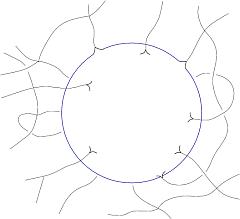
Notice that the methods for finding an accurate history of the so-called event horizon (you need the "event horizon" (EH) in order to speculate about "black holes" viz. "binary black hole mergers" as "one of the most astrophysically common sources of gravitational radiation for detectors such as LIGO", cf. Mike Cohen et al.) require complete knowledge of "the full future evolution of the spacetime before the EH can be determined exactly" (ibid.).
Which is why you need to address the global dynamics of spacetime: the increasing emergence of energy-of-empty-space due to DDE. Just one "closed timelike curve" (CTC) or "time-like naked singularity" in the past 13.7B years would have destroyed everything, and since there are no strict bans on such catastrophic events (they simply have never happened, just like the ultraviolet catastrophe), "prohibited" only by people's belief in the current "dynamics" of GR and CCC in particular, recall that those "famous" singularity theorems are from 1970s, when nobody was aware of the flux of DDE. Two examples: Geroch's theorem regarding CTCs (Robert Geroch, Topology in general relativity, J. Math. Phys. 8, 782-786 (1967)) and Tipler's theorem, which stipulates that, given the (obvious) possitiveness of the energy-momentum tensor, there can be no changes in the topology of spacetime, hence the causal structure of spacetime is secured (Frank J. Tipler, Singularities and causality violation, Ann. Phys. 108, 1-36 (1977)), are from the old days of GR without DDE. As Alan Rendall stated (p. 14), "The study of these matters is still in a state of flux." Which is why I requested endorsement of my manuscript. So far two physicists have replied (J. Thornburg and S. Deser), the rest (73) have not even confirmed the receipt of my email (sent between October 26th
and October 28th). Same story in September 2008. I'm talking to a brick wall.
D. Chakalov
November 4, 2009
Last update: April 6, 2011
==========================
Subject: Re: GR17, Session D1
Date: Mon, 2 Nov 2009 19:08:46 +0200
From: Dimi Chakalov <[email protected]>
To: Thomas Thiemann <[email protected]>,
[email protected]
Cc: [email protected],
[email protected],
[email protected]
Thomas,
I quoted from your astro-ph/0607380 at
http://www.god-does-not-play-dice.net/#note
Five years ago, you decided to bury my report into an evening poster session, and granted Lee Smolin three oral presentations: on Monday, July 19th ("Background independent approach to M theory", D2), on Tuesday, July 20th ("The low energy behavior of loop quantum gravity", D1), and finally on Friday, July 23rd ("Inflation in loop quantum gravity", B2i).
What you did to me was bloody unfair. Typical for a DDR communist.
Dimi
----------
Subject: Re: GR17, Session D1
From: Dimi Chakalov <[email protected]>
Date: Sun, 06 Jun 2004 22:59:15 +0300
To: tthiemann <[email protected]>
CC: [email protected], [email protected]
Dear Thomas,
Please inform me about possible upgrade of my poster presentation to talk. I'm encountering tremendous difficulties in transforming my GR17 paper to poster. Feel like having my mouth shut with duck tape.
Best - Dimi
===========================
Subject: A fourth road to quantum gravity
Date: Fri, 6 Nov 2009 16:10:45 +0200
From: Dimi Chakalov <[email protected]>
To: Mark Buchanan <[email protected]>
Cc: Didier Sornette <[email protected]>,
Lee Smolin <[email protected]>,
Chris Isham <[email protected]>
Dear Dr. Buchanan,
I would like to make two comments on your online article "In search of the black swans" [Ref. 1].
I'm interested in proactive management of emerging risks, type "black swans". With the benefit of hindsight, it seems to me that the event of 9/11 could not have been predicted, for reasons entire different than Max Planck's discovery; please see
http://tinyurl.com/steel-evaporation
The second comment pertains to the subject of this email: I believe Lee Smolin [Refs. 2 and 3], and all of his colleagues, have completely missed a fourth road to quantum gravity, from Erwin Schrödinger,
http://www.god-does-not-play-dice.net/#NB
Please feel free to pass this email to 'whomever it may be concerned'. The direct link:
http://www.god-does-not-play-dice.net/#Buchanan
Kindest regards,
Dimi Chakalov
35 Sutherland St
London SW1V 4JU, U.K.
----
[Ref. 1] Mark Buchanan (April 1, 2009), In search of the black swans
http://physicsworld.com/cws/article/indepth/38468
"In 1890 an electricity company enticed the German physicist Max Planck to help it in its efforts to make more efficient light bulbs. Planck, as a theorist, naturally started with the fundamentals and soon became enmeshed in the thorny problem of explaining the spectrum of black-body radiation, which he eventually did by introducing the idea — a “purely formal” assumption, as he then considered it — that electromagnetic energy can only be emitted or absorbed in discrete quanta. The rest is history. Electric light bulbs and mathematical necessity led Planck to discover quantum theory and to kick start the most significant scientific revolution of the 20th century.
....
"... it is not the normal events, the mundane and expected “white swans” that matter the most, but the outliers, the completely unexpected “black swans”. In the context of history, think 11 September 2001 or the invention of the Web."
[Ref. 2] Lee Smolin, (June 2, 2009), The unique universe
http://physicsworld.com/cws/article/indepth/39306
"Time in the Newtonian schema is a parameter used to label points on a trajectory describing the system evolving in configuration space. When the system is small and isolated, this time parameter refers to the reading of a clock on the wall of the observer’s laboratory, which is not a property of the system. When we try to apply this notion to the universe as a whole, the time parameter must disappear (see John Baez - D.C.). Some have attempted to argue that this means that time itself does not exist at a cosmological scale, but that is the wrong conclusion. What disappears is not time, but the clock outside of the system -- which would be an absurd object since the system is the whole universe."
[Ref. 3] Lee Smolin, Three Roads to Quantum Gravity, Phoenix, 2000;
Ch. 14, What chooses the laws of nature?,
p. 205: "One of the biggest mysteries is that we live in a world in which it is possible to look around, and see as far as we like."
p. 206: "God is nothing but the power of the universe as a whole to organize itself."
---------- Note: Nothing from the text above is original. The legacy of Erwin Schrödinger and Henry Margenau is anything but some unpredictable "black swan". For comparison, if someone has been offering the guiding principles for HTTP protocol to the people at CERN, but they were refusing to develop it, the invention of the Web [Ref. 1] would have never happened. One can only hope that the upcoming sixth consecutive failure of LSC to detect GWs with the "Enhanced LIGO" will shake up the established theoretical physics community. If not, we will have to wait for the seventh consecutive failure of LSC in 2015, with their "Advanced LIGO". What a terrible waste of time. And money. Does anyone care?
D. Chakalov
November 16, 2009
==========================
Subject: Re: Tue 24 Nov 13:30pm - 14:30pm
Date: Tue, 24 Nov 2009 20:06:09 +0000
From: Dimi Chakalov <[email protected]>
To: Jonathan Halliwell <[email protected]>
Cc: Roland Omnes <[email protected]>,
Amihay Hanany <[email protected]>,
Helen Fay Dowker <[email protected]>,
Chris Isham <[email protected]>
Dear Jonathan,
It was a pleasure to attend your talk.
I'm also glad you quoted Roland's monograph, "The Interpretation of Quantum Mechanics", in which he demonstrated that by introducing the decoherence functional you're automatically confined to Boolean logic -- a clear indication for Murphy's Law No. 15, "Complex problems have simple, easy-to-understand wrong answers."
Since you mentioned in your talk the case depicted on Fig 1 from your arXiv:0909.2597v1 [gr-qc], I wonder whether you would, in such kind of "space", be able to look around and see as far as you like (Lee Smolin, "Three Roads to Quantum Gravity", Phoenix, 2000, p. 205). The test of the pudding, you know.
Fay: I'm glad you chose (synchronicity?) to sit next to me. If some day you decide to talk about the topology of space (with or without its "dark energy"), please drop me a line. I'll be delighted to attend.
Lastly, may I use this opportunity to invite all of you to join the new research program outlined at
http://www.god-does-not-play-dice.net/#NB
I believe it strictly follows Chris Isham's program, Type IV (arXiv:gr-qc/9310031v1).
If you have questions, please do write me back.
Wishing you all the best,
Dimi
--------
Dimi Chakalov
35 Sutherland St
SW1V 4JU
==========================
Subject: Re: Tue 24 Nov 13:30pm - 14:30pm
Date: Thu, 26 Nov 2009 21:38:33 +0000
From: Dimi Chakalov <[email protected]>
To: J M Yearsley <[email protected]>
Cc: Roland Omnes <[email protected]>,
Amihay Hanany <[email protected]>,
Helen Fay Dowker <[email protected]>,
Chris Isham <[email protected]>,
Jonathan Halliwell <[email protected]>
Dear Dr. Yearsley,
I attended Jonathan's talk, and a few hours later emailed him a proposal to verify the Decoherent Histories (DH) hypothesis [Ref. 1]; please see 'the proof of the pudding' at
http://www.god-does-not-play-dice.net/#Halliwell
Suppose you have a clear night sky, and fix your eyes, for 1 min, on a star that is/was 4M light years away. The star looks the same during the whole time of 1 min, and is always at the place you see it.
Now, if the spacetime were governed by DH hypothesis [Ref. 1], what kind of irregularities MUST have been imposed on photon's pathway? I suppose you can perform the calculations and find it out for yourself.
Please feel free to join the research project outlined at
http://www.god-does-not-play-dice.net/#NB
Kindest regards,
Dimi Chakalov
35 Sutherland St
SW1V 4JU
---
[Ref. 1] J.J. Halliwell, The Interpretation of Quantum Cosmology and the Problem of Time, http://arxiv.org/abs/gr-qc/0208018
"Central to both the classical and quantum problems is the notion of an entire trajectory. At the classical level it appears to be the appropriate reparametrization-invariant notion for the construction of interesting probabilities. At the quantum level, the decoherent histories approach appears to handle the problem in a natural way, perhaps because it readily incorporates the notion of trajectory."
-----------
D. Giulini and C. Kiefer, The Canonical Approach to Quantum Gravity,
http://arxiv.org/abs/gr-qc/0611141 "What about the semiclassical approximation and the recovery of an appropriate external time parameter in some limit? (...) The discussion is also connected to the question: Where does the imaginary unit i in the (functional) Schrödinger equation come from? The full Wheeler-DeWitt equation is real, and one would thus also expect real solutions for [PSI]."
-----------
M. Bojowald, Canonical Relativity and the Dimensionality of the World,
http://arxiv.org/abs/0807.4874 "If the theory does not allow us, even in principle, to extend solutions arbitrarily far in one direction, it may be difficult to view this direction as a dimension of the world." ==========================
Subject: "Einstein gravity is an emergent phenomenon" (Harvey R. Brown, arXiv:0911.4440v1 [gr-qc], pp. 8-9)
Date: Mon, 30 Nov 2009 16:45:01 +0200
From: Dimi Chakalov <[email protected]>
To: Harvey R Brown <[email protected]>
Cc: Norbert Straumann <[email protected]>,
Domenico Giulini <[email protected]>,
Oliver Pooley <[email protected]>,
J Brian Pitts <[email protected]>,
Jose Natario <[email protected]>,
Timothy Adamo <[email protected]>,
Stanley Deser <[email protected]>,
Jacob D Bekenstein <[email protected]>,
Hans C Ohanian <[email protected]>,
Igor Novikov <[email protected]>,
Dmitri Novikov <[email protected]>,
Tatyana Shestakova <[email protected]>,
Natalia Kiriushcheva <[email protected]>,
S V Kuzmin <[email protected]>,
Kirill Krasnov <[email protected]>
Dear Dr. Brown,
I fully endorse your statement, for reasons explained at
http://www.god-does-not-play-dice.net/#GR
Please notice that the source of DDE (see ‘GR with DDE’ at the link above) is assumed to play the role of ‘reference fluid’ and Anderson's ‘absolute structures’ (James L. Anderson, Principles of Relativity Physics, Academic Press, New York, 1967, p. 73). The latter (i) do not obey the ‘generalized principle of action and reaction’ (ibid., p. 339), and (ii) can be revealed in Quantum Theory as ‘potential reality’,
http://www.god-does-not-play-dice.net/#NB
It seems to me that all the pieces of the jigsaw puzzle of quantum gravity snap to their places -- effortlessly.
Should you or any of your colleagues disagree, please bark back. The "curious incident" with my web site is that nobody is willing to comment on these very simple (and certainly not original) ideas.
Kindest regards,
Dimi Chakalov
--------
"Is there any other point to which you would wish to draw my attention?"
"To the curious incident of the dog in the night-time."
"The dog did nothing in the night-time."
"That was the curious incident."
Sherlock Holmes, "The Adventure of Silver Blazes" =============================
Subject: A New Scenario, by Sergio Doplicher
Date: Tue, 1 Dec 2009 14:23:42 +0200
From: Dimi Chakalov <[email protected]>
To: Sergio Doplicher <[email protected]>
Cc: Luciano Maiani <[email protected]>,
Ray Streater <[email protected]>,
Owen Maroney <[email protected]>,
Bogdan Damski <[email protected]>,
Haitao Quan <[email protected]>,
Wojciech Hubert Zurek <[email protected]>
Dear Professor Doplicher,
I have deep respect and admiration for your perfectionism and scrupulous intellectual honesty.
Regarding your Scenario (arXiv:0911.5136v1 [math-ph], pp. 29-30; arXiv:hep-th/0608124v1, p. 7), and the puzzle identified by Lee Smolin,
http://www.god-does-not-play-dice.net/#Buchanan3
please notice my proposal at
http://www.god-does-not-play-dice.net/#Brown
I will appreciate your critical opinion, as well as the feedback from your colleagues.
May I ask a question. I noticed that you'll teach QM,
http://www.mat.uniroma1.it/mat_cms/pres_corso.php?corso_da_presentare=1259
Would you discuss my interpretation of QM with your students?
I believe kids have the right to know everything we know. If you consider Nevill Mott's paper (arXiv:0911.5136v1 [math-ph], p. 18) and the alleged "time-dependent decoherence factor" (W.H. Zurek et al., arXiv:0911.5729v1 [quant-ph]), I believe your students will grasp the ultimate puzzle of our good old asymptotically flat spacetime, and will never waste their life with chasing ghosts.
Kindest regards,
Dimi Chakalov
------
Note: Contrary to what you may hear from Jonathan Halliwell, it is impossible to explain the trace of a charged particle in a bubble chamber, after Nevill Mott (see S. Doplicher, p. 18), with the current QM and GR textbooks. The problems from QM (A. Teta, arXiv:0905.1467v1, "possible histories", pp. 12-14) are swept under the carpet. Moreover, the problems from 'GR without DDE' are overwhelming. One is that we can't explain 'the energy-momentum density of generic background quantum states' (see below): "points become fuzzy and locality looses any precise meaning" (S. Doplicher, p. 21). More puzzles from M. Consoli and E. Costanzo, arXiv:0709.4101, Sec. 3: Is the vacuum a preferred frame? Could be. But if we model the vacuum as 'potential reality', there is no way to observe motion with respect to it: the usual expression from 1930s -- "the only Lorentz-invariant tensor" (ibid., Eq 13); see also G. Marsh, arXiv:0711.0220v2, Eq 2 -- does not apply to 'potential reality'. The latter is needed to explain 'GR with DDE'.
In the textbook version of 'GR without DDE', the 'coordinate time' read by your wristwatch, and the very notion of 'energy conservation' during some interval from that 'coordinate time', cannot be rigorously defined. The tacit presumption is that 'space' itself does not "move" anywhere, simply because there is no "outer space" in which our 3-D space could "expand into". But only the second part from this tacit presumption is correct, since our 3-D space can indeed "move" or rather "emerge" (C. Isham, gr-qc/9310031, Option IV): the intrinsic dynamics of space -- here we enter 'GR with DDE' -- can only be defined with respect to a hypothetical global mode of spacetime, which is hidden ]between[ the "points" of the local mode of spacetime. The latter stands as a genuine perfect continuum (the "dark gaps" from the global mode are hidden by the so-called 'speed of light'), and has been studied in STR and in 'GR without DDE'. If we wish to think as proper relativists, this is the only choice we may have: see my email to Harvey R Brown above. Many people hate it and spit insults on me; other just keep quiet, but nobody has so far offered any viable alternative. But is there any alternative to 'the arrow of spacetime'? Back in 1772, on the occasion of the fall of meteorites, the French Academy of Sciences adopted a resolution categorically rejecting such ridiculous phenomena. The obvious reason had been that rocks cannot fall from the sky, simply because there are no rocks there. Likewise, when you look at the sky, you will never think that the space itself could possibly "move", in any way whatsoever. But once the "dark energy" from 'empty space' was confirmed, the intrinsic dynamics of 3-D space, hence 'GR with DDE', are unavoidable. Your good old wristwatch does read the dynamics of "dark energy" along the arrow of spacetime. E sarà mia colpa se così è? (Niccolò Machiavelli) D.C.
December 1, 2009
Last update: December 7, 2009
Sergio Doplicher, The Principle of Locality. Effectiveness, fate and challenges. arXiv:0911.5136v1 [math-ph]
p. 18: "The coherence between the different outcomes, in principle still accessible with the measurement of the nearly vanishing interference terms (vanishing exactly only in the limit N --> [inf]), will be totally unaccessible in practice as soon as N is sufficiently large, as the number of molecules in a bubble from the trace of a charged particle in a bubble chamber."
...
pp. 19-20: "The conventional picture of the measurement process in Quantum Mechanics, as an instantaneous jump from a pure state to a mixture, which affects the state all over space at a fixed time in a preferred Lorentz frame, appears, in the scenario we outlined, as the result of several limits:
"1. the time duration T of the interaction giving rise to the measurement (which, in an exact mathematical treatment, would involve the whole interval from minus infinity to plus infinity, as all scattering processes) is set equal to zero;
"2. the number of microconstituents of the amplifying part of the measurement apparatus is set equal to infinity, thus allowing exact decoherence;
"3. the volume involved by the measurement apparatus in its interaction with the system (thus occupied by the microscopic part of the apparatus) tends to the whole space, allowing the reduction of wave packets to take place everywhere;
"In the conventional picture, some form of nonlocality is unavoidable, albeit insufficient for transmission of perturbations (hence not contradicting local commutativity) or even of information [58]: for a given observer, a coherent superposition of two possibilities might be changed, instantaneously in some preferred Lorentz frame, to a state where only one possibility survives, by the measurement performed by another observer in a very far spacelike separated region.
...
p. 21: "Thus points become fuzzy and locality looses any precise meaning. We believe it should be replaced at the Planck scale by an equally sharp and compelling principle, yet unknown, which reduces to locality at larger distances.
...
p. 27: "But locality is lost. There is no meaning to "E1 and E2 are spacelike separated", unless we pick a point _o_ in E, and limit ourselves to a special wedge W associated to _o_ and its spacelike complement -W. In this special case locality survives for free fields, but is bound to be destroyed by interactions on QST.
"That remnant of locality has been exploited to construct deformations of local nets for which the two particle S matrix is notrivial [70, 71], at the price of loosing locality in terms of fields localised in bounded regions. The various formulation of interaction between fields, all equivalent on ordinary Minkowski space, provide inequivalent approaches on QST; but all of them, sooner or later, meet problems with Lorentz covariance, apparently due to the nontrivial action of the Lorentz group on the centre of the algebra of Quantum Spacetime.
"On this point in our opinion a deeper understanding is needed.
...
p. 29: "The common feature of all approaches is that, due to the quantum nature of spacetime at the Planck scale, locality is broken, even at the level of free fields, and more dramatically by interactions. Which, as far as our present knowledge go, lead to a breakdown of Lorentz invariance as well.
...
"One might expect that a complete theory ought to be covariant under general coordinate transformations as well. This principle, however, is grounded on the conceptual experiment of the falling lift, which, in the classical theory, can be thought of as occupying an infinitesimal neighborhood of a point. In a quantum theory the size of a "laboratory" must be large compared with the Planck length, and this might pose limitations on general covariance. One might argue that such limitations ought to be taken care of by the quantum nature of Spacetime at the Planck scale.
...
"But the energy distribution in a generic quantum state will affect the Spacetime Uncertainty Relations, suggesting that the commutator between the coordinates ought to depend in turn on the metric field. This scenario could be related to the large scale thermal equilibrium of the cosmic microwave background, and to the non vanishing of the Cosmological Constant [79, 80].
p. 30: "This might well be the clue to restore Lorentz covariance in the interactions between fields on Quantum Spacetime."
-------------
ref. [80]: Sergio Doplicher, Quantum Field Theory on Quantum Spacetime, arXiv:hep-th/0608124v1.
p. 7: "A New Scenario. The Principle of Gravitational Stability ought to be fully used in the very derivation of Space Time Uncertainty Relations, which would then depend also on the energy-momentum density of generic background quantum states; this leads to commutation relations between Spacetime coordinates depending in principle on the metric tensor, and hence, through the gravitational coupling, on the interacting fields themselves. Thus the commutation relations between Spacetime coordinates would appear as part of the equations of motions along with Einstein and matter field Equations.
"In other words we may expect that, while Classical General Relativity taught us that Geometry is dynamics, Quantum Gravity might show that also Algebra is dynamics.
"This new scenario [12] appears extremely difficult to formalise and implement, but promises most interesting developments."
--------------- ===========================
Subject: The Hamiltonian formulation of GR is wrong.
Date: Tue, 26 Jan 2010 17:28:31 +0200
From: Dimi Chakalov <[email protected]>
To: Hanno Sahlmann <[email protected]>,
Jacob D Bekenstein <[email protected]>,
Mordehai Milgrom <[email protected]>,
J M Pons <[email protected]>,
D C Salisbury <[email protected]>,
K A Sundermeyer <[email protected]>,
George F R Ellis <[email protected]>
Dear colleagues,
If we accept the challenge of "dark energy" and "dark matter", I believe it will be wrong to use the Hamiltonian formulation of GR. It is not possible to quantize Einstein gravity in four dimensions either (Hanno Sahlmann, arXiv:1001.4188v1 [gr-qc]).
The problem is that we need to unravel a new degree of freedom pertaining to the NEW dynamics of spacetime: see R. Rakhi & K. Indulekha and S. Carroll, "more space comes into existence",
http://www.god-does-not-play-dice.net/#GR
http://www.god-does-not-play-dice.net/#Brown
Only people like George F R Ellis would ignore these bold facts.
Should you have questions, please don't hesitate to write me back.
Yours sincerely,
Dimi Chakalov
----
Note 1: I really cannot understand why people believe that the source of "dark energy" should necessarily have positive energy density ("Treated as a fluid, this component has negative pressure (assuming positive energy density), ... "
T. Padmanabhan), and be "invariant under Lorentz transformations" (E. Santos). In the model presented here, these two self-imposed presumptions are dropped, and the source of "dark energy" is non-existent in the local mode of spacetime. None. Zero. Zilch. You can safely set it to zero, just as you usually treat the vacuum energy density in QFT. Yet the source of "dark energy" can take any value in the global mode, depending on the particular cosmological stage of the universe, because T (the energy momentum stress tensor of all matter and fields other than gravity, with positive energy density) can completely vanish/dissolve into the vacuum, and stay available there for any partial, full, or "over unity" recall, if needed. How? Because it is potential reality. Only people like George Ellis cannot grasp it. All we can physically observe is that 3-D space is acting upon itself. We cannot trace back this 'energy from empty space', which is why some people called it "dark". In the same vein, the human mind would be considered "dark", because all we can observe is that the brain is being acting 'upon itself', by thinking about the brain, with the brain. Gerard 't Hooft had a brilliant guess about the negative energy states, but his Ph.D. student Stefan Nobbenhuis ruined it, upon his guidance, by assuming that "there is no coupling other than gravitational (emphasis added - D.C.) between the normal matter fields and their ghost counterparts, otherwise the Minkowski vacuum would not be stable" (arXiv:gr-qc/0411093v3, p. 10). But the quantum vacuum can be stable without any gravitational coupling whatsoever, because gravity applies only to the explicated/physical form of reality, while the absolute value of energy stored in the vacuum is potential reality. The misleading adjective "dark" (Mike Turner) comes from treating the potential vacuum reality as 'physically real'. In the case of John Wheeler's 'cloud', only this last explicated physical reality will be subject to gravitational interactions, like the explicated Casimir energy. The 'cloud' has been explicated by an emerging context, while in the case of the "dark" energy from the quantum vacuum we encounter an emerging boundary: the energy here is not "boundary sensitive". It is 'the whole universe as ONE' (global mode of spacetime) that fixes the "boundary terms", so that we can only see a "cloud" with strictly positive mass. Surely the explicated "cloud" changes along the cosmological time arrow, but its "dark" driving force cannot be unraveled from the fleeting "cloud" (denoted with a in [Ref. 1]), just as we cannot unravel the UNdecidable Kochen-Specker quantum state from its colorizable projections. This is the legacy of Schrödinger and Margenau (see below), which I was hoping to explain on November 27, 2002. Notice that in GR you inevitably need to introduce some additional structure [Ref. 2] compensating for the absence of the global mode of spacetime. To understand the origin of these of additional structures, recall the prerequisites that necessitate 'time' regarded as 'change': we need two different and distinguishable states of a physical system, and some background w.r.t.w. the difference between the two states can be identified. In STR, the task looks quite easy: take two consecutive, instantaneous, point-like states of a Frisbee along its continuous trajectory, defined w.r.t. the fixed background of Minkowski space, and you're done. In 'GR without DDE', the background is the 3-D space itself, which is allowed to change its "curvature" only, following the bi-directional "talk" between matter and space: "Space acts on matter, telling it how to move. In turn, matter reacts back on space, telling it how to curve" (John Wheeler). But because of the Equivalence Principle adopted in GR, gravity must be able to vanish completely "inside" an infinitesimal "point", hence there is no localizable point-like gravitational energy density in such "point" and across its infinitesimally small neighborhood, to compute derivatives (Bjoern Schmekel). Hence the notion of 'time', conceived as 'change' from point-like state A to point-like state B (defined w.r.t. a background of 3-D space), becomes terribly complicated because of its dual, non-linear duties: "the metric is treated as a field which not only affects, but also is (at the same time - D.C.) affected by, the other fields" (John Baez). Notice the notion suggested by Viktor Denisov and Anatol Logunov: 'physicogeometric dualism'. Under these circumstances, people need to introduce some additional structures to define some "boundaries" of the whole spacetime; for example, some "fall-off conditions of the curvature in appropriate coordinate systems at infinity" [Ref. 2], because, in the case of the Einstein equations alone, "there are no physically motivated boundary conditions" (Alan Rendall). But notice that the background of 3-D space is still always there, in the sense that in 'GR without DDE' the space itself doesn't "move" (Robert Geroch). But once we endow the space itself with an additional degree of freedom, as in 'GR with DDE', it acquires new dynamics (arrow of spacetime), and those 'additional structures' that were introduced by hand [Ref. 2] should be derived from the "dark" ("no observable content", Domenico Giulini) global mode of spacetime. Don't try to bridge the two "mirror" worlds (introduced by symmetries or quasi-symmetries [Ref. 2]) with any physical stuff whatsoever. Don't try to explain the self-acting faculty of 3-D space with the physical, "colorizable projections" that can only show up with positive energy density. You will be baffled by the driving force of the cosmological time arrow [Ref. 1] and the cosmological "constant" problems forever (cf. Amedeo Balbi), or at least until you quietly retire.
D.C.
January 27, 2010
Last update: February 2, 2010
[Ref. 1] T. Padmanabhan, Why Does the Universe Expand? arXiv:1001.3380v1 [gr-qc]

[Ref. 2] J. L. Jaramillo, E. Gourgoulhon, Mass and Angular Momentum in General Relativity, arXiv:1001.5429v1 [gr-qc]. To appear as proceedings in the book "Mass and Motion in General Relativity", eds. L. Blanchet, A. Spallicci and B. Whiting
p. 6: "Once the non-local nature of the gravitational energy-momentum and angular momentum is realised, the conceptual challenge is translated into the manner of determining the appropriate physical parameters associated with the gravitational field in an extended region of spacetime. An unambiguous answer has been given in the case of the total mass of an isolated system. However, the situation is much less clear in the case of extended but finite spacetime domains.
"In a broad sense, existing attempts either enforce some additional structure that restricts the study to an appropriate subset of the solution space of General Relativity, or alternatively they look for a genuinely geometric characterisation aiming at fulfilling some expected physical requirements. In this article we present an overview of some of the relevant existing attempts and illustrate the kind of additional structures they involve.
...
pp. 9-10: "The characterisation of an isolated system in General Relativity aims at capturing the idea that spacetime becomes flat when we move sufficiently far from the system, so that spacetime approaches that of Minkowski. However, the very notion of far away becomes problematic due to the absence of an a priori background spacetime. In addition, we must consider different kinds of infinities, since we can move away from the system in space-like and also in null directions. Different strategies exist in the literature for the formalization of this asymptotic flatness idea, and not all of them are mathematically equivalent. Traditional approaches attempt to specify the adequate fall-off conditions of the curvature in appropriate coordinate systems at infinity. (...) The whole picture is inspired in the structure of the conformal compactification of Minkowski spacetime.
...
pp. 35-36: "But it must be acknowledged (...) that the status of the quasi-local mass studies is in a kind of post-modern situation in which the devoted intensive efforts have resulted in a plethora of proposals with no obvious definitive and entirely satisfying candidate.
...
"The moral of the whole discussion in this article is that the formulation of meaningful global or quasi-local mass and angular momentum notions in General Relativity always needs the introduction of some additional structure in the form of symmetries, quasi-symmetries or some other background structure."
----------
Note 2: Recently, J. M. Pons, D. Salisbury, and K. Sundermeyer (PSS) tried to solve the paradoxes of “frozen time” and “nothing happens” (arXiv:1001.2726v1 [gr-qc]), stressing the difference b/w the gauge generator and the Hamiltonian (p. 5):
"These gauge transformations define equivalence classes within S, which we call gauge orbits. A gauge orbit represents a unique physical state (footnote 5), and its different points correspond to different coordinatizations.
--
Footnote 5: "Note that this state is the whole spacetime."
"... in the space of on-shell field configurations the gauge generator moves from one point p to another p', whereas the Hamiltonian works within every point p, which already represents an entire spacetime (emphasis added - D.C.)." In another paper (arXiv:0902.0401v1 [gr-qc], p. 4), PSS illustrated their ideas with a "spatially homogeneous isotropic cosmological model", and acknowledged that "this model possesses the curious property that the only physical variable that changes in time is time itself!" (emphasis added - D.C.). Which makes this "time" unobservable, or rather 'observable only with respect to itself'. Pity PSS didn't ask Karel Kuchar to comment on their speculations, nor mentioned the new dynamics of 3-D space due to its "dark" energy acting on the whole spacetime en bloc. When will the Hamiltonian formulation of GR address this task? When pigs fly. D.C.
January 31, 2010
===========================
Subject: The schizophrenic behavior of gravity (SBG)
Date: Tue, 9 Feb 2010 05:16:20 +0200
From: Dimi Chakalov <[email protected]>
To: Nikolai Mitskievich <[email protected]>
Cc: [email protected], [email protected], LSC Spokesperson <[email protected]>, Beverly Berger <[email protected]>, Tom Carruthers <[email protected]>, Denise S Henry <[email protected]>, Ramona Winkelbauer <[email protected]>, [email protected]
Dear Dr. Mitskievich,
I think you shouldn't regret that you missed the chance to educate Kip Thorne [Ref. 1] about the inevitable failure of his LIGO project and the whole "GW astronomy". Arguments similar to yours have been spelled out by Steven Weinberg seven years ago (25 Feb 2003), after which he added: "I often find that people who say silly things actually do correct calculations, but are careless in what they say about them."
Not just Kip Thorne, but the whole LIGO Scientific Collaboration (LSC) are saying silly things, but because they use the linearized approximation of GR, they do "correct calculations".
However, if you use the same linearized approximation of GR, you can prove "GW astronomy" wrong by reductio ad absurdum:
http://www.god-does-not-play-dice.net/Szabados.html#SBG
Either way, with GR or with its linearized approximation, LIGO is for the birds.
Trouble is, some people from NSF continue to dump hundreds of million U.S. dollars -- all taxpayers' money -- into this GW nonsense.
Typical for a socialist country.
Yours sincerely,
Dimi Chakalov
--------
[Ref. 1] Nikolai V. Mitskievich, On a new category of physical effects, arXiv:1002.1421v1, http://arxiv.org/abs/1002.1421
"The gravitational deformation in general relativity does in fact belong to the kinematic effects, when it is described without the use of geodesic deviation equation. Thus, for example, the interferometric detection of gravitational waves cannot give a non-zero result, since the scales of all types of equally oriented lengths do change in gravitational fields in the same proportion, and the numbers of light wavelengths fitting along the alternative arms of interferometer cannot suffer changes in a passing gravitational wave.
"I am regretful not to tell these considerations to Kip S. Thorne more than two decades ago, simply because of a kind of awkward modesty."
-----
Note: See what happens if you don't tell your students everything you know.
Example: Jim Hartle. Recently, a young theoretical physicist, Gareth Jones, defended his Ph.D. Thesis on "Searching for gravitational waves... ". He looked at Ch. 23 from Jim Hartle's textbook, "Gravity, an introduction to Einstein's General Relativity", to eventually understand the dimensionless GW amplitude (Eq. 1.64, p. 15) that would "cause a periodic strain (i.e., stretching and contraction) of the proper distance between points (Sic! - D.C.) in spacetime" (ibid., p. 182). But you can't hide the dimensionality of GW amplitude in 3-D space: check out SBG here. In order to prove LSC (at least 679 people) wrong, all you need is to drive the "background" in the linearized approximation of GR to its absurdity, as with the SBG argument. Not sure? Please explain the dimensionality of GW amplitude (h) in Kip's mantra:
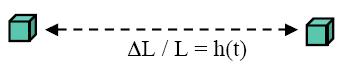
Something with [meter] maybe? Or some "creative analogies" from EM radiation?
If you look at Wiki, GW amplitude "is not the quantity which would be analogous to what is usually called the amplitude of an electromagnetic wave (...)." The alleged GW has frequency, wavelength, and speed -- all defined with proper dimensionality. Only the action of geometry on matter, embodied in the mantra above, is a dimensionless ghost that shows up only with ... "2.3×10⁻²⁶" , say. How can Gareth Jones change his Ph.D. brain, to think as a physicist? Surely the entity that fixes a 'meter' cannot itself be defined with what it produces -- a 'meter'. Can he notice the intrinsic parapsychology of statements like "our best (lowest) upper limit on gravitational wave amplitude is 2.3×10⁻²⁶" ? I think Jim Hartle (along with Bernie Schutz) should be blamed for Gareth Jones' professional career. It may be wasted by chasing ghosts with real, taxpayers' money. In my opinion, the "dimensionality" of GW amplitude is just like that of quantum waves. And just like the de Broglie waves (cf. Franco Selleri above), in present-day GR these GWs cannot show up either, simply because they cannot transport energy-momentum to any physical system in the spacetime of GR textbooks. Neither quantum waves (recall the quantum vacuum) nor gravitational waves are "empty" by themselves. Pity nobody cares.
D.C.
February 10, 2010
Last update: March 17, 2010
============================ Subject: Re: The schizophrenic behavior of gravity (SBG)
Date: Tue, 2 Mar 2010 04:55:21 +0200
Message-ID:
<[email protected]>
From: Dimi Chakalov <[email protected]>
To: [email protected], [email protected],
[email protected], [email protected], [email protected],
[email protected], [email protected], [email protected],
[email protected], [email protected],
[email protected], Curt.J.Cutler@jpl.nasa.gov,
vallis@vallis.org, [email protected], [email protected],
[email protected], bernard.schutz@aei.mpg.de,
[email protected], LSC Spokesperson <[email protected]>,
IGUS Jim <[email protected]>
P.S. Update at
http://www.god-does-not-play-dice.net/#Jones
D.C.
============================
Subject: arXiv:1002.1410v1 [quant-ph]
Date: Tue, 9 Feb 2010 05:57:41 +0200
From: Dimi Chakalov <[email protected]>
To: Ronnie Hermens <[email protected]>
Cc: [email protected], [email protected]
Dear Mr. Hermens,
It is a real pleasure to read your Thesis.
Just a brief comment. You wrote (p. 46): "The claim of Meyer that the Kochen-Specker Theorem has been nullified leads to the question what it is exactly that the Kochen-Specker Theorem states. A common notion is that the theorem states that (at any given time) not all observables can be assigned definite values that are independent of the measuring context."
Long before John Bell, Schrödinger explained the crux of the matter (November 1950),
http://www.god-does-not-play-dice.net/#NB
http://www.god-does-not-play-dice.net/Szabados.html#Hilbert
I suppose none of your senior colleagues have mentioned to you anything about my numerous email messages, with links to my web site. And that is not fair.
If I'm wrong about them, please write me back.
Kindest regards,
Dimi Chakalov
------
Note 1: All kids, Ronnie Hermens included, have the right to know everything we know. This doesn't mean that they should accept our opinions. But in order to make educated decision about their professional career, we should kindly offer them all our knowledge and opinions. Otherwise it's just not fair.
Ronnie, here's a story from Uncle Dimi. Suppose you're in a pitch dark room. You hold a torch in your hand, but want to "see" how the darkness itself looks like before you observe it with the torch. As you might have guessed, 'the darkness itself' stands for the 'UNdecidable quantum potential reality' that cannot be fitted into any Hilbert space whatsoever; more from Uncle John. Obviously, your task is not feasible. With your torch, you can only "see" the classical presentations of 'the dark room', which have been "filtered" through the classical spacetime at the scale of tables and chairs. So, what do you do? You use some QM textbook recipes for calculating probabilities for observing the dark room with your torch. NOT the dark room itself. And if you "look" with Hilbert space with dimensions 2, you may never notice any problems with your torch observations, as you can always infer what sorts of objects should have been in the dark room, before you turned on the torch and brought them into the classical spacetime of tables and chairs (recall the "quantum computing" mess). The real fun with QM starts when KS Theorem comes to play: your torch observations do not make sense. You cannot infer anymore what kinds of objects should have been in the dark room before you turned on the torch. (In the context of "quantum computing", quantum states both 'partly exist' as context-evoked latent observables and 'partly do not exist', being UNdecidable quantum state (never in plural) as well. It's an "eigentümlichen, klassisch nicht beschreibbaren" (W. Pauli), indivisible bundle of 'both ONE and many'. Capiche?) The essential ONE-"part" from the objects in the dark room will always remain unaccounted for. You can say NOTHING about it. It is UNspeakable. You just can't fit it into any Hilbert space on which you make your torch observations. It is the ultimate quantum reality 'out there', which I simply call 'potential reality'. You can say nothing about it, because any statement of yours refers exclusively to what you can "see" with your torch. This is my answer to your question "what it is exactly that the Kochen-Specker Theorem states", as you put it. Your mentor, Nicolaas Landsman, has tried some toposification of quantum theory, but notice that this is just another torch. Chris Isham also plays with that topos torch. Other people try another, 'non-commutative spacetime torch'. The math jungle is staggering. Don't go there, it's endless. How do I know?
Because there is only one way to solve both the measurement problem of QM and the cosmological "constant" problem. Both problems, en bloc. Just recall the basic tenet of Copenhagen [Ref. 1], and compare it with the interpretation of QM discussed here and the arrow of spacetime: the instantaneous state of Die Bahn (trajectory) of all physical objects, at all length scales, is nothing but the local mode of spacetime, as it evolves from "point" A to "point" B, following the expansion of space due to the "dark" energy of the vacuum.
Locally, Die Bahn [Ref. 1] is like a single flash or "point" with infinitesimal duration. The whole 'local mode of spacetime' is comprised of such already-correlated "points" with infinitesimal duration, all of which are explicated with a carpe diem unit probability, in line with the PR interpretation of QM. If you can imagine an instantaneous cross-section of the arrow of spacetime, the local mode will be a frozen flat 3-D space with total gravitational energy precisely zero (see above): the potential reality itself (the infinite "shop", see below) does not gravitate (cf. "yes you can"). Any of these 3-D "snapshots" constitutes a legitimate 'universe' by itself, but as the arrow of spacetime "moves" forward, we are led to consider a chain of such snapshots, and then it looks like the universe is somehow 'acting upon itself', because the "dark gaps" from the global mode are precisely sealed off, making the local mode a perfect continuum (notice the emergence of "waves" below). Of course we cannot locate the source of this "dark energy", call it X , inside the very thing that is being produced by X : the 3-D space of the local mode of spacetime. Which is why some (otherwise serious) people called it "dark", while other speculate about some mysterious "dark flow" and "axis of evil", as pictured here. A few days ago, I tried to explain Die Bahn [Ref. 1] to my teenage daughter (she is the 'test bed' for my
DVD video tutorials) as follows. Picture the quantum vacuum as an infinitely "large" cash-and-carry shop, from which you can get everything and anything (that caught her attention, as expected). You buy some stuff for your diet, but you can shop (i) only if you're "off the train", and (ii) only for your one-day meal. This 'one-day meal' is just one point from a perfectly legitimate universe -- the local mode of spacetime at the global instant 'now'. Such "horizontal" cross-section of the arrow of spacetime takes only one sliding point 'now' from the ("vertical") arrow of spacetime. But because you inevitably chain your 'daily points' along a perfectly continuous trajectory (the "dark gaps" of the global mode of spacetime are completely sealed off due to 'the speed of light'), you get an emergent Bahn with 'potential future' and 'irreversible past', as it emerges due to the arrow of spacetime, while the infinite shop, with all its (latent) stuff that you did not buy, will always remain "dark". Imagine also that every day you're buying more stuff: if some theoretical physicists compare only your daily meals during a week (they can't glance at the "dark gaps"), they will claim that you've been getting 'more stuff' throughout the whole week from some "dark source". (If they include the infinite shop in their calculations, they will inevitably face their cosmological "constant" paradox.) Also, notice that all people in the universe are shopping from the same "dark shop": they shop for their 'one-day meal' to cook up their common 'local mode of spacetime', but have to do it relationally (there is no background whatsoever in the local mode of spacetime), and also in a pre-correlated (EPR-like) fashion, in line with the Bootstrap Rule 'think globally, act locally'. The result is a (quantum-gravitational) wave of pre-correlated 'one-day meals' that also emerges during Die Bahn. Nothing is "waving" to emit these waves. They just emerge. Capiche?
Okay, let me try it this way. Do you remember how we played Frisbee on the beach? That poor Frisbee was too large and heavy to take advantage of its potential UNdecidable KS states, and since it also managed to ignore the effects of gravity, we could imagine some fictitious "fixed grid" (Minkowski spacetime) on which we can draw its Bahn. Had the Frisbee been a quantum-gravitational object, it would have all its instantaneous one-point "meals" correlated (recall the two hands) with 'everything else in the universe' ("off the train", in the global mode of 'the Frisbee per se'). Then the real Frisbee would be flying like a fish from a correlated shoal of fish, only you can't see the rest of fish from the shoal, and therefore can't see its wave-like movement, like the waves of the correlated centipede's legs. Simple, no? I didn't try to explain why LSC may only unravel the blueprints from relic GWs cast in the distant past, but cannot observe 'the emergent wave' online, as it evolves along the arrow of spacetime. That would have been too much for her. Finally, notice that if you take the whole stack of "Photoshop layers" (all your 'one-day meals') and flatten them onto one (.JPG) image, you will end up with a timeless "trajectory" immersed in a dead frozen 4-D "block universe", in which "time" can evolve just as much as "space" can: "There is no dynamics within space-time itself: nothing ever moves therein; nothing happens; nothing changes" (R. Geroch). Our (mischievous) wristwatches do in fact read the global cosmological time of 'Die Bahn', but because you can only use a physical "torch", you are deceived by a flatten image of all 'one-day meals': in Fig. 1 below, there are three consecutive 'one-day meals' or "points" from Frisbee's trajectory, connected by the pre-geometric plenum, while Fig. 2 shows the stack of "Photoshop layers" consisting of three different, re-created 4-D universes in their local mode, as they evolve along Die Bahn (the red arrow of spacetime, w ). The quantum-and-gravitational waves "travel" along w (Fig. 2), which is why they cannot be detected on the flatten image (Fig. 1): regarding GWs, the linearized approximation of GR is a "shadow without power" (Hermann Weyl). 
Fig. 1
Notice the misleading "dark" energy and "curvature" of spacetime

Fig. 2
Notice the three red 'one-day meals', or three 'sayings', being
connected by the pre-geometric plenum; its quantum version
is the UNdesidable KS state. In GR, the pre-geometric plenum
"connects" all points from the local mode of spacetime with
'the undivided universe as ONE', which is being multiplied as
infinitely many points in the local mode.
With the current GR and diff geometry textbooks, you can explore only one instant 'now' from the arrow of spacetime. Even if you try to introduce some "infinitesimal coordinates shift" [Ref. 2, Eq. 4.1], as in today's GR textbooks, you will nevertheless be dealing with a frozen one-instant "trajectory", and can never solve the Cauchy problem for the Einstein equations: the "dark background" of 'the reference fluid' of GR is missing from GR textbooks. You can use such 'calculated-from-one-instant trajectories' only in classical physics and STR (e.g., the trajectory of a Frisbee, calculated from some of its instantaneous states). To resolve the genuine dynamics of GR, we need to make the 3-D space dynamical: the global cosmological time originates from the dynamics of space. First of all, we have to replace the familiar expression 'with respect to the rest of the Universe' [ibid., p. 263] with a Machian "absolute" reference frame, which works as 'the reference fluid' of GR -- the global mode of spacetime. Recall also the idea of "breathing" (inhaling/exhaling) Universe, and imagine the elementary step/cycle of the arrow of spacetime (cf. Fig 2 above) as the "negotiation" of the two hands in Escher's drawing below: an inhaling ("offer") quantum-gravitational wave is being emitted in the global mode of spacetime from each and every "point" from the local mode, followed by an exhaling ("confirmation") quantum-gravitational wave converging on the next point from the next horizontal layer. What is the duration of this "breathing" cycle in the local mode of spacetime? ZERO. This is the meaning of the phrase 'Your Global Time is ZERO'. The local mode of spacetime is a perfect continuum. But that's too much for you, isn't it?
D.C.
February 10, 2010
Latest update: March 30, 2010

[Ref. 1] W. Heisenberg (23 March 1927): "Die Bahn entsteht erst dadurch, daß wir sie beobachten", in: Über den anschaulichen Inhalt der quantentheoretischen Kinematik und Mechanik, Z. Phys. 43, 172-198 (1927).
[Ref. 2] Patrick Marquet, The Generalized Warp Drive Concept in the EGR Theory, The Abraham Zelmanov Journal, vol. 2 (2009) 261-287.
http://zelmanov.ptep-online.com/html/zj-2009-12.html
http://zelmanov.ptep-online.com/papers/zj-2009-12.pdf
p. 263: "The principle of space travel while locally “at rest”, is analogous to galaxies receding away from each other at extreme velocities due to the expansion (and contraction) of the Universe.
"Instead of moving a spaceship from a planet A to a planet B, we modify the space between them. The spaceship can be carried along by a local spacetime “singular region” and is thus “surfing” through space with a given velocity with respect to the rest of the Universe.
........
§1.2.1, 'The (3+1) Formalism: the Arnowitt-Deser-Misner (ADM) technique'
p. 265: "In 1960, Arnowitt, Deser, and Misner [5] suggested a technique based on decomposing the space-time into a family of space-like hypersurfaces and parametrized by the value of an arbitrarily chosen time coordinate x4.
"This “foilation” displays a proper-time element dτ between two nearby (emphasis added - D.C.) hypersurfaces labelled x4 =const and x4 + dx4 = const. The proper-time element dτ must be proportional to dx4.
........
p. 267: "The main advantage of the ADM formalism is that the time derivative is isolated (emphasis added - D.C.) and it can be used in further specific computations.
........
p. 275: "This horizon first appears for the occupants of the spaceship, who are unable to “see” beyond the distortion, and therefore cannot communicate with the outer universe.
........
p. 280: "Let us consider the infinitesimal coordinates shift
x'a = xa + Na, (4.1) =================================
Subject: The infinitesimal coordinates shift -- with respect to 'the rest of the Universe'
Date: Fri, 19 Mar 2010 14:31:11 +0200
From: Dimi Chakalov <[email protected]>
To: Patrick Marquet <[email protected]>
Cc: Larissa Borissova <[email protected]>,
Tatyana Shestakova <[email protected]>,
Natalia Kiriushcheva <[email protected]>,
Dmitri Rabounski <[email protected]>,
Serge Krasnikov <[email protected]>,
Michael Kuntzman <[email protected]>,
Miguel Alcubierre <[email protected]>,
Michael Pfenning <[email protected]>,
Larry Ford <[email protected]>,
Allen Everett <[email protected]>,
William A Hiscock <[email protected]>,
Chris Van Den Broeck <[email protected]>,
Thomas A Roman <[email protected]>,
Robert M Wald <[email protected]>,
Robert Geroch <[email protected]>
Dear Professor Marquet,
I greatly admire your Extended formulation of GR (EGR), particularly the so-called “residual” (true) field tensor. Yet it seems to me that the infamous "infinitesimal coordinates shift" in ADM presentation, which you used in your latest article cited below, is seriously flawed, as hinted in the subject line.
As an alternative to ADM speculations, please see
http://www.god-does-not-play-dice.net/#Bahn
Details at
http://www.god-does-not-play-dice.net/#quiz
I will highly appreciate your professional comments, as well as the feedback from your colleagues.
Kindest regards,
Dimi Chakalov
------
Patrick Marquet, The Generalized Warp Drive Concept in the EGR Theory, The Abraham Zelmanov Journal, vol. 2 (2009) 261-287; cf. Eq. 4.1.
http://zelmanov.ptep-online.com/html/zj-2009-12.html
=================================
Subject: Re: PTI, by Ruth Kastner
Date: Fri, 5 Mar 2010 04:54:05 +0200
From: Dimi Chakalov <[email protected]>
To: Ruth <[email protected]>, John <[email protected]>
Cc: Adrian Kent <[email protected]>,
Joseph Berkovitz <[email protected]>,
Tim Maudlin <[email protected]>,
Huw Price <[email protected]>,
Jeremy <[email protected]>,
Sergiu Klainerman <[email protected]>,
Sergio Doplicher <[email protected]>
Dear Ruth,
You said (Feb 16th) that "will take a look" at my note on KS Theorem, yet in your latest arXiv:1001.2867v3 [quant-ph], co-authored with John Cramer, there is not even a hint to it.
Regarding the UNabsorbed offer wave, you and John argued (footnote 9) that "it is the uncommitted (to a particular basis) nature of the offer wave which gives it its flexibility and thus its ability to explore “all possibilities at once.” "
How would you (and John) tackle these 'all possibilities at once' if they pertain to the UNdecidable KS state? How can you, or anyone else, derive the Born Rule in the case of KS state?
Can you possibly derive *anything* resembling 'probabilities' in the case of KS state?
http://www.god-does-not-play-dice.net/#KS
I will appreciate the opinion of your colleagues as well.
All the best,
Dimi
On Tue, Feb 16, 2010 at 9:04 PM, <[email protected]> wrote:
>
> Thanks Dimi! I will take a look.
>
> Best
> Ruth
>
===================== Subject: Re: PTI, by Ruth Kastner
Date: Fri, 5 Mar 2010 14:43:10 +0200
From: Dimi Chakalov <[email protected]>
To: Ruth <[email protected]>
Cc: John <[email protected]>
On Fri, Mar 5, 2010 at 8:03 AM, <[email protected]> wrote:
>
> OK, it's the Peres-Mermin version of KS.
Excuse me?
I wrote: "Nothing -- not even some "contextuality" -- can save Harry (or Dick, or Tom) from the case in which he (or Dick, or Tom) must not possess any hands."
And also: "NB: There is nothing "probabilistic" or "stochastic" in the quasi-local UNdecidable quantum state that neither 'is' nor 'is not'. Can't fit it in any Hilbert space."
> This is similar to the GHZ example, These are all "no hidden variables" proofs.
It isn't about "hidden variables" of any kind whatsoever. It is about how TI/PTI would address this KS state: please read my email from Fri, 5 Mar 2010 04:54:05 +0200.
> I certainly did read this when you first sent it to me, as I said that I did
Then please prove my interpretation wrong:
http://www.god-does-not-play-dice.net/#KS
John: Would you please help Ruth?
D.
-------------------------------
Subject: Footnote 15, arXiv:1107.1678v1 [quant-ph]
Date: Mon, 11 Jul 2011 13:01:31 +0300
Message-ID:
<CAM7EkxkHd9-O6WROr=xW02LX=dvHkVNpwfcSjZWM5Q5Gb3Br2w@mail.gmail.com>
From: Dimi Chakalov <[email protected]>
To: Ruth <[email protected]>
Cc: Huw Price <[email protected]>,
John <[email protected]>,
Tim Maudlin <[email protected]>,
Abner Shimony <[email protected]>,
Philip Pearle <[email protected]>,
Peter Evans <[email protected]>,
[email protected]
It won't work for GR, Ruth.
The "infinite" velocity of the "phase wave aspect" corresponds to the *global mode of time* in which the "talk" b/w matter and space "take place": "Space acts on matter, telling it how to move. In turn, matter reacts back on space, telling it how to curve" (John Wheeler),
http://www.god-does-not-play-dice.net/Esher.jpg
Physically, we observe a continuum of 'end results' (local mode of time) from this "talk"; details at
http://www.god-does-not-play-dice.net/#Evans
Check out the UNspeakable substance of spacetime with your own brain at
http://www.god-does-not-play-dice.net/#Leydesdorff_101
All the best,
Dimi
-----------------
Note: Nothing in the local mode of spacetime can (nor have to) wait "... until the conserved quantities are transferred and the potential quantum event becomes real", as John Cramer put it.
We see only the end result from already-completed atemporal "handshaking" transactions, and of course we cannot trace it "back" to the global mode of spacetime -- all the negotiations between the offer-and-confirmation wave is one single event in the local mode of spacetime. In the local mode of spacetime, its "duration" is zero -- just like the proper time of photon's flight "between" its emission-and-absorption; see Kevin Brown. In the local mode of spacetime, all this "happens" over a "point". Which is why there is no "source" of the quantum-gravitational waves that is “waving”, as stressed by Anthony Zee. The second case of fixing the physical constituents at this same "point" concerns GR: we need to examine the "negotiations" of matter and geometry, which also "take place" in the global mode of spacetime: "Space acts on matter, telling it how to move. In turn, matter reacts back on space, telling it how to curve" (John Wheeler). In GR, the offer-and-confirmation wave pertains to the "dipole radiation", and as it "converges" on the next point from Die Bahn above, it fixes the positivity of mass in the local mode of spacetime. According to
RSP, we can imagine "two" such waves only in the global mode, as they "run" in two opposite "directions: from the macro-world of classical mechanics toward S and L , and vice versa. In my (perhaps very biased) opinion, these "two" (offer and confirmation) waves should determine the instantaneous inertial reaction "forces" as well. Currently, GR says nothing about the origin and mechanism of (Machian) inertial "forces". Nobody likes "miracles" in GR, so I very much hope we can find 'the right answer to the right question', to paraphrase MTW, p. 467, and understand the origin of inertia and the affine structure of space. Regarding the geodesic hypothesis, Alan Rendall acknowledged: "In elementary textbooks on general relativity we read that the Einstein equations imply that small bodies move on geodesics of the spacetime metric. It is very hard to make this into a mathematically precise statement which refers to actual solutions of the Einstein equations (and not just to some formal approximations)." Notice that Alan Rendall didn't even mention those 96% of the stuff in the universe, which is "dark" and moves on some weirdly modified geodesics. 
Yes, Sidney Harris is right: the re-creation of the local mode of spacetime, along the arrow of spacetime, does look like a "miracle", perhaps because we know nothing about the so-called 'speed of light' that is hiding the global mode from any direct view from the local mode. All we can observe is 'the world of facts' with unit probability, which has already, post-factum being cast in the past, as in the example with the Sun: we cannot observe the actual state of the Sun, but only its state that has been 'actual' some 8 min before we looked at the Sun.
The local mode of spacetime is a perfect continuum, because the "dark gaps" from the global mode are completely sealed off by the so-called 'speed of light'. We also have a pocket of propensity-states (KS states; see below) to choose from, which cannot be fully derived from our past only -- this is the lesson from the Free Will Theorem. Sorry for repeating this all over again.
D.C.
March 5, 2010
Last update: March 30, 2010
====================================
Subject: Question 1 (existence): Does there exist any smoothness structure on *any* topological manifold?
Date: Tue, 30 Mar 2010 04:52:54 +0300
From: Dimi Chakalov <[email protected]>
To: Torsten Asselmeyer-Maluga <[email protected]>
Cc: Carl H Brans <[email protected]>,
Helge Rose <[email protected]>
Dear Dr. Asselmeyer-Maluga,
Regarding your latest arXiv:1003.5506v1 [gr-qc] and the footnote on p. 3 from your book with Dr. Brans, may I offer you my views on the subject at
http://www.god-does-not-play-dice.net/#Bahn
Should you or your colleagues have questions, please don't hesitate.
Kindest regards,
Dimi Chakalov
---
Note: Let me quote from Robert Wald's arXiv:gr-qc/0511073, "Teaching General Relativity", p. 5 (emphasis added): "First, one needs a mathematically precise notion of the "set of points" that constitute spacetime (or that constitute a surface in ordinary geometry). The appropriate notion is that of a manifold, which is a set that (...) but has no metrical or other structure. The points of an n-dimensional manifold can thereby be labeled locally by coordinates ... ." This last sentence is a total Jabberwocky. How did we get these "points" that can be "labeled locally by coordinates", such that we can, and also have to, shuffle these coordinates to extract some GR observables? Contemporary relativists begin by postulating a Hausdorff topological space that has been somehow "connected", but usually mention this miracle in footnotes (e.g., Chris Isham, Modern Differential Geometry for Physicists, p. 61, footnote 1). They would denote this connected topological space with M , and introduce a second postulate: a differential structure on M , such that M is promoted to a four-dimensional manifold. Then the third step is obvious: introduce a metric, and they are ready to teach GR (cf. Diego Meschini et al., Sec. 2.1) and muse over the exotic differentiable structures and the puzzle posed by Carl Brans:

Perhaps one first needs a mathematically precise notion of the "set of points" that constitute a line (1-D Euclidean space), to elucidate how these "points" are connected in such way that the law of continuity, as defined in the standard calculus texts of the 1800's, is fully obeyed: the consecutive points of the same line should succeed each other without any interval or 'point in-between' them. However, how should the topological space itself been "connected", in order to evolve into a perfectly smooth manifold? Specifically, does there exist any 'smoothness structure' on any topological manifold? I'm not aware of such beast in differential topology textbooks; hence my email above. But here's the catch: on the one hand, the 'point-connecting agent' (called here pre-geometric plenum), which makes a Hausdorff topological space "connected", must not be anything that may, in any imaginable way, exist within the line made by "zero-dimensional" points. It can't be some "special middle point" or "special separating interval", because inside a line we have only points, and nothing but points. These points don't have any special hooks or handles that can determine the principle of locality and the so-called "speed" of light. On the other hand, the pre-geometric plenum must somehow exist in order to "separate" the points and preserve their individual, albeit fleeting, physical content: "For example, \phi is a scalar field on the manifold and $X$ represents the space-time coordinate of a particle, then although \phi(x) has no physical meaning (if x is a point in the space-time manifold) nevertheless $\phi(X)$ *does* have a meaning: ie you can talk in a Diff(M)-invariant way about the value of a field where a particle 'is', and similarly for a trajectory" (Chris Isham, private communication). The only way out from this conundrum is to use the new (to contemporary relativists) form of reality, as explained in the case of the human brain and the quantum world. The potential reality does not exist in the local mode (cf. Fig. 1), hence the latter is a perfect continuum -- the "gaps" are completely sealed off by the so-called speed of light, because the "duration" of the transition from one "point" to the nearest "point" is zero: check out Kevin Brown above. All this may sound like some metaphysical exercise devoid of any mathematical implications, but recall that in mathematics you have to follow the obvious and intuitively clear metaphysical ideas, or else will sink in a jungle with no way out. Not to mention the infinite amount of energy packed in the quantum vacuum. Now, people from the mathematical community disagree with the arrow of space and pre-geometric plenum. They postulate some "smooth" structure (66 times), and adhere to the "splitting" of spacetime, just like ADM [Ref. 1, pp. 479-486]. But how would you “quantize” a Riemannian manifold [Ref. 1, p. 425] and gravitational "field" represented by Riemannian metric? How would you specify a Poisson structure of the "dynamical system", as driven by [we-do-not-know-it]? D. Chakalov
March 30, 2010
Last update: August 4, 2010
[Ref. 1] Ralph H. Abraham and Jerrold E. Marsden, Foundations of Mechanics, Second Edition, Addison-Wesley, 6th printing, 1987. ISBN: 080530102X
p. 31: "The basic idea of a manifold is to introduce a local object that will support differentiation process and then to patch these local objects together smoothly.
....
p. 37: "(W)e obtain a vector bundle by smoothly patching together local vector bundles.
....... p. 443: "This, or something like it, seems to be the final step in quantization. It is a crucial problem that has not yet found a satisfactory answer."
===================================
Subject: International Quantum Foundations Workshop
Date: Tue, 20 Apr 2010 14:23:06 +0100
Message-ID:
<[email protected]>
From: Dimi Chakalov <[email protected]>
To: Mike Towler <[email protected]>
Cc: Karl Svozil <[email protected]>,
F David Peat <[email protected]>,
Guido Bacciagaluppi <[email protected]>,
Herman Batelaan <[email protected]>,
Andrew Bennett <[email protected]>,
Jeffrey Bub <[email protected]>,
Jeremy Butterfield <[email protected]>,
Samuel Colin <[email protected]>,
Murray Daw <[email protected]>,
Maaneli Derakhshani <[email protected]>,
Chris Dewdney <[email protected]>,
Maurice de Gosson <[email protected]>,
Jonathan Halliwell <[email protected]>,
Lucien Hardy <[email protected]>,
Basil Hiley <[email protected]>,
Adrian Kent <[email protected]>,
Martin Korth <[email protected]>,
Creon Levit <[email protected]>,
Tim Maudlin <[email protected]>,
Alberto Montina <[email protected]>,
Wayne Myrvold <[email protected]>,
Gillie Naaman-Marom <[email protected]>,
Travis Norsen <[email protected]>,
Xavier Oriols <[email protected]>,
Roger Penrose <[email protected]>,
Alejandro Perez <[email protected]>,
Patrick Peter <[email protected]>,
Nelson Pinto-Neto <[email protected]>,
Paavo Pylkkanen <[email protected]>,
Anton Ramsak <[email protected]>,
Peter Riggs <[email protected]>,
Carlo Rovelli <[email protected]>,
Simon Saunders <[email protected]>,
Maximilian Schlosshauer <[email protected]>,
Lee Smolin <[email protected]>,
Rob Spekkens <[email protected]>,
Ward Struyve <[email protected]>,
Jos Uffink <[email protected]>,
Lev Vaidman <[email protected]>,
Antony Valentini <[email protected]>,
Chris Isham <[email protected]>,
Abner Shimony <[email protected]>,
Steve <[email protected]>,
Huw Price <[email protected]>,
Sergio <[email protected]>,
Landsman <[email protected]>,
Roland <[email protected]>
RE: International Quantum Foundations Workshop
Saturday 28th August - Saturday 4th September 2010
The Apuan Alps Centre for Physics @ TTI, Vallico Sotto, Tuscany
www.vallico.net/tti/tti.html
Dear Dr. Towler,
Perhaps you and your colleagues may wish to check out an ontological interpretation of KS Theorem at
http://www.god-does-not-play-dice.net/#KS
Please notice that the UNdecidable KS state (called 'potential reality') has been interpreted as 'pre-quantum reality'.
For comparison, a similar task has been undertaken by Antony Valentini, at the expense of introducing some "signal nonlocality" [Ref. 1] and "hidden variables" [Ref. 2].
Unlike Valentini's theory, I trust every physicist can check out the interpretation of KS Theorem at the link above, and find out whether there is an error in it.
Should you or any of your colleagues find an error, please do write me back. If you cannot find such error, please be assured that I would be delighted to attend your Workshop and explain the so-called 'PR interpretation of QM'.
BTW please note that the human brain (not mind) can unmistakably handle such UNspeakable potential reality,
http://www.god-does-not-play-dice.net/#context
Perhaps all we may need is to model the whole universe as a 'brain'.
No need to introduce any hidden ghosts,
http://demonstrations.wolfram.com/CausalInterpretationOfTheDoubleSlitExperimentIn
QuantumTheory
The so-called 'potential reality' is known after Plato and Aristotle.
Looking forward to hearing from you and from your colleagues,
Yours sincerely,
Dimi Chakalov
35 Sutherland St
London SW1V 4JU
Phone [snip]
References
[Ref. 1] Antony Valentini,
http://en.wikipedia.org/wiki/Antony_Valentini
"Valentini has been working on an extension of David Bohm's "ontological interpretation" of quantum theory that would allow "signal nonlocality" that is forbidden in orthodox quantum theory. "Signal nonlocality" allows nonlocal quantum entanglement to be used as a stand-alone communication channel without the need of a classical light-speed limited retarded signal to unlock the entangled message from the sender to the receiver. This would be a major revolution in physics ... "
[Ref. 2] When Reality is Real: An Interview with Antony Valentini
By Jill Neimark, Anthony Valentin
http://www.metanexus.net/magazine/tabid/68/id/7405/Default.aspx
"What is so unusual about Antony Valentini? Just this: he's resurrected a theory that undoes the central tenet of quantum mechanics, and gives relativity theory a good punt to left field as well. The theory follows quantum math, but at the same time allows for new possibilities beyond conventional quantum mechanics.. It's a theory that says there is indeed an objective reality behind the things we observe -- that quantum uncertainty is not fundamental. And that somewhere, somehow, time is universal -- not relative. Goodbye, ghostly probabilities, with their strange propensity for collapsing into real things while apparently sort of holding back and remaining always a bit coy and ghostly... hello, hidden variables that are objective.
"And Antony's particular twist on the theory suggests a new explanation for the uniformity of the early universe -- where, he suggests, quantum law might not have applied, where stuff could interact faster than the speed of light -- and where those interactions were actually visible.
"There's no proof, of course -- at least not yet. But it's fun to think about.
......
"Q: How are you going to convince anybody of this?
"A: We need to find a violation of quantum mechanics in the early universe. We need to find a non-quantum distribution of particles. There may be particles floating around in space now which were left over from that very early time. People are looking for particles of dark matter left over from the early universe, and some of these may be good candidates. Another possibility is relic gravitons, particles associated with gravity that are believed to have stopped interacting
with other particles at a very early time. Perhaps these relic gravitons from the early universe don't obey quantum mechanics.
........
"Q: How does the pilot wave theory view time and space?
"A: It goes against relativity theory, because it has faster-than-light processes, and in relativity nothing is supposed to go faster than light. So it seems to me that we may have to revise relativity theory and end up with a notion of universal time. In relativity, different observers at different speeds have their own time and there is no absolute time. But in this theory, distant observers can communicate instantaneously if they have control at this fundamental level of non-quantum particles. So they would be able to synchronize their clocks instantaneously even if they were millions of light years apart. Of course, some people don't like the idea, and that's a problem."
---------
Note: I haven't yet received feedback from Mike Towler and from his colleagues regarding my email sent three days ago. Surely the KS Theorem poses very tough challenges regarding the crux of 'quantum reality'.
Luckily, Chris Isham has recently produced a clear explanation -- check out his arXiv:1004.3564v1, Sec. 5.1, 'The Kochen-Specker theorem and contextuality', p. 20: "... the implication of the discussion above is that the value ascribed to B (resp. the result of measuring B) depends on whether it is considered together with A1, or together with A2. In other words the value of the physical quantity B is contextual. This is often considered one of the most important implications of the Kochen-Specker theorem." The immediate question is this: What remains invariant in 'the quantity B' upon changing its "color" (see 'KS Theorem for teenage girls' below), to qualify as 'quantum reality of the quantity B'? My proposal: pre-quantum reality. In the framework of Chris Isham's approach, the so-called pseudo-states (ibid., p. 16) are ‘as close as we can get’ to the UNspeakable pre-quantum reality (called here 'potential reality'). In the case of the human brain, you can "measure" the latter with three (or more) sayings ("pseudo-states"), yet can never "collapse" the ultimate potential reality from which these "contextual" quantum states emerge. Regardless of how you tackle such "pseudo-states" with some topos approach, the solution to the measurement problem in QM requires that you offer some 'peaceful coexistence' (Abner Shimony) of this pre-quantum reality and STR, as explained at this web site. Recall its motto: Dead matter makes quantum jumps; the living-and-quantum matter is smarter. We could have sorted out this bundle of issues eight years ago, but I guess Chris Isham had a different agenda.
Anyway; here's an anecdotal story from 1970s (ibid., footnote 3, p. 6): "I have a fond memory of being in the audience for a seminar by John Wheeler at a conference on quantum gravity in the early 1970s. John was getting well into the swing of his usual enthusiastic lecturing style and made some forceful remark about the importance of the quantum principle. At that point a hand was raised at the back of the lecture room, and a frail voice asked “What is the quantum principle?”. John Wheeler paused, looked thoughtfully at his interlocutor, who was Paul Dirac, and answered “Well, to be honest, I don’t know”. He paused again, and then said “Do you?”. “No” replied Dirac." If you, my dear reader, cannot find an error in the interpretation of KS Theorem below, I will be happy to offer you my version of 'the quantum principle' and the origin of the quantum of action. But if you aren't interested -- that's perfectly fine with me.
"just another crank" D.C.
April 23, 2010
===================== Subject: Re: International Quantum Foundations Workshop
Date: Sat, 24 Apr 2010 16:50:32 +0300
From: Dimi Chakalov <[email protected]>
To: Mike Towler <[email protected]>
Cc: [49 recipients]
Hello Mr Towler,
On Sat, 24 Apr 2010 13:56:55 +0100 (BST), you wrote:
> As I'm sure you are aware, sending unsolicited emails to large numbers of
> famous people asking what they think of your theory is not only widely
> considered to be appallingly rude but to be the hallmark of a crackpot.
It is not about my "theory", as you put it.
I'm afraid there is a large number of "famous people" who ignore the legacy of Schrödinger and Margenau, and cannot grasp the basic basics of KS Theorem and CK Free Will Theorem,
http://www.god-does-not-play-dice.net/#KS
If you and the rest of these "famous people" consider this "appallingly rude" and "the hallmark of a crackpot", I can only wish you a quiet a peaceful retirement.
Alternatively, if you and the rest of these "famous people" wish to get professional, please don't hesitate to write me back, with *specific arguments* refuting the interpretation of KS Theorem offered at the link above.
Just please reply professionally.
Thank you very much in advance.
Yours sincerely,
D. Chakalov
> On Fri, 23 Apr 2010, Dimi Chakalov wrote:
>
>> P.S. An explanatory note, with excerpts from the latest paper by C.
>> Isham, has been posted at
>>
>> http://www.god-does-not-play-dice.net/#Towler_note
>>
>> A penny for your thoughts!
>>
>> D.C.
>>
====================================
Subject: Quasi-local Mass and Angular Momentum in General Relativity (November 1981)
Date: Mon, 26 Jul 2010 18:37:45 +0300
From: Dimi Chakalov <[email protected]>
To: Roger Penrose <[email protected]>
Cc: Peter van Nieuwenhuizen <[email protected]>,
Glenn Starkman <[email protected]>,
Alex Vikman <[email protected]>,
David Jacobs <[email protected]>,
Chiang-Mei Chen <[email protected]>,
G Nester <[email protected]>,
Xiaoning Wu <[email protected]>,
Laszlo Szabados <[email protected]>,
Adam Helfer <[email protected]>,
Massimo Pauri <[email protected]>,
Luca Lusanna <[email protected]>,
[snip]
Dear Roger,
Back in November 1981, you acknowledged that "several problems of interpretation remain to be solved". May I offer you some help with an 'arrow of space',
http://www.god-does-not-play-dice.net/#Zinkernagel_note
Are you still interested in GR?
Regards,
Dimi
============== Subject: Re: "But success, I think, can only be granted by scrupulous intellectual honesty."
Date: Fri, 26 Nov 2010 00:03:33 +0200
From: Dimi Chakalov <[email protected]>
To: Roger Penrose <[email protected]>
Cc: Thomas Thiemann <[email protected]>,
Lee Smolin <[email protected]>,
Karel V Kuchar <[email protected]>,
Chris Isham <[email protected]>,
Claus Kiefer <[email protected]>,
Norbert Straumann <[email protected]>,
Domenico Giulini <[email protected]>,
Henk van Elst <[email protected]>,
Sergio Doplicher <[email protected]>,
Jorge Pullin <[email protected]>,
Laszlo Szabados <[email protected]>,
Luca Bombelli <[email protected]>,
Andreas Döring <[email protected]>,
Robert M Wald <[email protected]>,
Carlo Rovelli <[email protected]>
Hi Roger,
Ever since 1988, I've been having great difficulties with our communication, so I left my feedback to your latest essay, arXiv:1011.3706v1 [astro-ph.CO], at
http://physicsworld.com/cws/article/news/44388 And since some people may delete it, I'll attach it here.
More at
http://www.god-does-not-play-dice.net/Margenau.html
All the best,
Dimi
On Thu, 25 Nov 2010 00:03:37 +0200, Dimi Chakalov <[email protected]> wrote:
>
> Hi Carlo,
>
> I quoted your statement in the subject line at
>
> http://www.god-does-not-play-dice.net/Margenau.html
>
> If you disagree with my critical remarks and/or wish to comment on my
> proposal, please don't hesitate to write me back.
>
> I will be happy to hear from your colleagues as well. Will keep the
> discussion private and confidential -- provided it is professional.
>
> All the best,
>
> Dimi
>
====================================
Subject: "Hiding quantum information" is b******* .
Date: Thu, 8 Jul 2010 12:41:44 +0300
Message-ID:
<[email protected]>
From: Dimi Chakalov <[email protected]>
To: Todd Brun <[email protected]>
Cc: Bilal Shaw <[email protected]>,
Steve Adler <[email protected]>,
Jeffrey Bub <[email protected]>,
Chris Isham <[email protected]>,
David Schroeren <[email protected]>,
Spyros Efthimiades <[email protected]>,
Norbert Lütkenhaus <[email protected]>,
[email protected], [email protected],
[email protected], [email protected],
[email protected], [email protected],
[email protected]
Hi Todd:
Pity you didn't take seriously my email from Thu, 19 Sep 2002 16:47:38 +0300 (cf. below).
The alleged "innocent cover state" [Ref. 1] and secret "quantum information" may be fused with 'the UNdecidable quantum state'.
In the case of your *brain*, you can grasp the latter by comparing the following two statements:
1. You can't hide a piece of broccoli in a glass of milk.
2. Don't wear polka dot underwear under white shorts.
The UNdecidable quantum state of your *brain* (not mind) is not about broccoli, underwear, milk, or shorts.
More from Schrödinger, Margenau, and KS Theorem at
http://www.god-does-not-play-dice.net/#KS
Should you and/or any of your colleagues cannot understand the arguments at the link above, please write me back.
Take care,
Dimi
[Ref. 1] Bilal A. Shaw, Todd A. Brun, Hiding Quantum Information in the Perfect Code, arXiv:1007.0793v1 [quant-ph], http://arxiv.org/abs/1007.0793
"The day may come when quantum networks are ubiquitous. An advantage that steganography has over standard encryption schemes is that private information could be transmitted over a long time through a network, completely undetected and even unsuspected by other users. Steganographic techniques may also be useful as a way of authenticating quantum communications in distributed quantum information processing; such uses of classical steganography for authentication are often called “watermarking.” Quantum steganography has far reaching consequences, and may provide a measure of security beyond what classical steganography can afford.
....
"Alice and Bob conceal their communication from Eve, hiding their message as errors in a codeword for an “innocent” cover state |psi_c>, and using the resource of a shared secret random key. (Shared entanglement would work as well, or even better.)"
----------
Subject: Think globally, act locally
Date: Thu, 19 Sep 2002 16:47:38 +0300
From: Dimi Chakalov <[email protected]>
To: Todd Brun <[email protected]>
CC: [email protected],
[snip]
Dear Todd:
Reading your recent "Computers with closed timelike curves can solve hard problems", gr-qc/0209061 [Ref. 1], is a real pleasure.
=====
Note: Recall also the elusive Event Horizon -- a global property of an entire spacetime, which should be somehow "defined nonlocally in time" (J. Thornburg, lrr-2007-3). The mythical "black holes" cannot be defined rigorously in GR, so try the global, Heraclitean, and non-Archimedean time of the UNdecidable quantum state of 'the universe as a brain'. Or trust Chris Isham. D.C.
July 8, 2010
====================================
Subject: Weyl’s principle: Comoving reference frame & proper time
Date: Fri, 9 Jul 2010 20:07:23 +0300
From: Dimi Chakalov <[email protected]>
To: S E Rugh <[email protected]>, H Zinkernagel <[email protected]>
Dear colleagues,
Thank you for your clarification of Weyl’s principle [Ref. 1]. I believe it is obvious that the dynamics of space, as being "expanded" by itself (DDE of "empty space"), is missing in GR,
http://www.god-does-not-play-dice.net/#Blanchard
I think the human brain may possess such self-acting faculty, but if you try to pinpoint its mind, it will inevitably turn out to be "dark", just like the UNdecidable quantum state,
http://www.god-does-not-play-dice.net/#Brun
If you know how to model a universe that can act upon itself, please do write me back.
Kindest regards,
Dimi Chakalov
------
[Ref. 1] Svend E. Rugh, Henrik Zinkernagel, Weyl's principle, cosmic time and quantum fundamentalism, arXiv:1006.5848v1 [gr-qc],
http://arxiv.org/abs/1006.5848v1
p. 2: "Weyl’s principle: The world lines of galaxies, or ‘fundamental particles’, form (on average) a spacetime-filling family of non-intersecting geodesics converging towards the past.
"The importance of Weyl’s principle is that it provides a reference frame based on an expanding ‘substratum’ of ‘fundamental particles’. In particular, if the geodesic world lines are required to be orthogonal to a series of space-like hypersurfaces, a comoving reference frame is defined in which constant spatial coordinates are
“carried by” the fundamental particles. The time coordinate is a cosmic time which labels the series of hypersurfaces, and which may be taken as the proper time along any of the particle world lines."
----------
Note: Time does not originate from 'change in space' (coordinate time, Kodama time, etc.; see Julian Barbour), but from chance of space (cf. Fig. 2). Example with the Hubble Law here.
It is the arrow of space (AOS) that makes 'more and more space' to emerge (Isham and Butterfield) from [we-do-not-know-it], hence "the distances between all elements of the cosmic substratum (or, fluid) grow with time" (Michal Chodorowski), and we enjoy 'arrow of spacetime'. Were it possible to physically trace back the entity called [we-do-not-know-it], it won't be "dark" anymore, and the Aristotelian First Cause would be shifted one step further. Notice that the arrow of space (AOS) leads directly to Machian quantum gravity, as the motion of any individual body is to be defined with respect to the entire universe (E. Mach, The Science of Mechanics (1883), Open Court, 1960, pp. 286-287). It has "infinite extent" (J. Barbour, arXiv:1007.3368v1 [gr-qc], p. 26), being in the state of ONE-ness (global mode of spacetime, cf. Fig. 2) that keeps "the last remnant of physical objectivity" (A. Einstein). Physicists hate the Aristotelian metaphysics, however. They relentlessly try to picture [we-do-not-know-it] as some physical stuff with positive energy density, and end up with searching for an 'elephant in a china shop', only to find out that the elephant must be many orders of magnitudes larger than the store itself. The AOS-driven dynamics of living and quantum/gravitational systems will inevitably produce a self-acting action, because the non-linear bi-directional negotiation between every "fish" and 'the rest of fish from the shoal' is "dark" in the local mode of spacetime. Sorry for repeating this again; I know it's boring. If you disagree with the arrow of space (AOS), just try to define quasi-local quantities in asymptotically flat spacetime wrapped with (flexible?) "boundaries" at spatial infinity, yet keeping the splitting of spacetime (ADM) into two entities, one of which (called 'time') would refer to things that "evolve" with respect to something fixed, called 'space'. As R. Penrose acknowledged in November 1981 [Ref. 2], "several problems of interpretation remain to be solved". Fuggedaboudit, Roger. Time can "evolve" just as much as space can; hence the arrow of space viz. arrow of spacetime endowing the
conservation of quasi-local observables of Type I matter fields (Eq. 1 below), bootstrapped by gravity. Direct observation of "pure gravitational field" (cf. Dupre and Tipler below) is like direct observation of the human mind, while acting on its brain. Gravity makes all matter fields self-interacting, hence the proper GW detector should be endowed with the faculty of self-acting, that is, capable of acting on its own potential states along the arrow of spacetime. We should drop the “no prior geometry” assumption in GR and derive the ether from Quantum Theory -- the vanishing of the covariant divergence of the stress-energy tensor (not "pseudotensor") is a quantum-gravitational phenomenon. According to today's GR (Mario Goto et al., arXiv:1007.4846v1 [gr-qc]), "the Strong Equivalence Principle postulates that at every space-time point in a arbitrary gravitational field it is possible to choose a locally inertial coordinate system such that, within a sufficiently small (notice the poetry - D.C.) region of the point in question, the laws of the nature take the same form as in unaccelerated Cartesian coordinate systems in the absence of gravitation. On the other hand, the Weak Equivalence Principle is nothing but a restatement of the observed equality of gravitational and inertial mass."
NB: When and how does 'the finite small' shift to "sufficiently small", such that (operational definition) you "may erect a locally inertial coordinate system in which matter satisfies the laws of special relativity" (Steven Weinberg, pp. 62-68)? The laws of STR are applicable only if the so-called "sufficiently small" has already become a bona fide geometrical point from the global, Heraclitean, and non-Archimedean realm. On the other hand, the effects of gravity apply only to the Archimedean realm of finite things, such as 'one second' (see the drawing below) or 'one meter'. The bi-directional "talk" of matter and geometry ("space acts on matter, telling it how to move; in turn, matter reacts back on space, telling it how to curve", John Wheeler) is the ultimate "talk" of the Archimedean (local) and non-Archimedean (global) realms of spacetime. The cornerstone puzzle of GR is that your wristwatch does indeed read this "talk", and the covariant divergence of the stress-energy tensor does indeed disappear, or rather "dissolves" in the purely geometrical, non-Archimedean realm of "sufficiently small", staying available to re-emerge, as a quantum-gravitational phenomenon. On September 21, 2008, I suggested 'necessary and
sufficient conditions for spacetime': the former condition concerns physical substratum with positive energy density, while the latter condition refers to a global, Heraclitean, and non-Archimedean state of the whole universe as ONE -- a pre-geometric plenum "connecting" the geometrical "points". It is totally removed from the local mode of spacetime by the so-called 'speed of light', making the local mode a perfectly smooth manifold. Einstein, and many other physicists, called this pre-geometric plenum "ether". If you disagree with the pre-geometric plenum, try to 'connect the dots' in the drawing of 'one second' by using only Archimedean geometry and physical stuff that is invariant under "active" diffeomorphisms. Or explain the vanishing of the covariant divergence of the stress-energy tensor. Good luck.
D.C.
July 10, 2010
Last update: August 20, 2010
[Ref. 2] R. Penrose, Quasi-local Mass and Angular Momentum in General Relativity, Proc. R. Soc. A381 53-63 (1982); cf. p. 53:
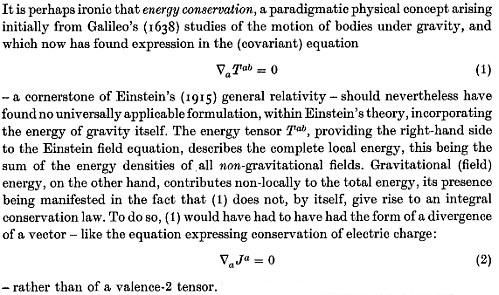
R. Penrose, General-relativistic energy flux and elementary optics, in: Perspectives in Geometry and Relativity: Essays in Honor of Václav Hlavatý, ed. by Banesh Hoffmann, Indiana University Press, Bloomington, 1966, pp. 259-274
p. 259: "By definition, Tuv(Matter) describes all the local energy, so any energy due to the [Weyl tensor] must be nonlocal in character. The existence of nonlocal energy is also manifest in the fact that the local
conservation law
Tuv^v = 0
is a covariant curved space equation. One cannot just integrate Tuv(Matter) over a 3-space to obtain a conserved total energy-momentum. The total energy-momentum of a system must, therefore, involve
nonlocal contributions due, perhaps, to the presence of Weyl tensor or to nonlocal interactions (e.g. Newton's potential energy) between the Tuv's at
different points (...). The nonlocality of the gravity energy was then exhibited in the local dependence of the pseudo-tensor on the choice of coordinate system."
R. Penrose, The Road to Reality: A Complete Guide to the Physical Universe, Jonathan Cape, London, 2004; ISBN: 0224044478
p. 458: "The contributions of gravity to
energy-momentum conservation should somehow enter non-locally as corrections to the calculation of total energy-momentum. (...) From this perspective, gravitational contributions to energy-momentum, in a sense, ‘slip in through the
cracks’ that separate the local equation [XXX] = 0 from an integral conservation law of total energy momentum.
....
p. 777: "Thus, any non-constancy in [lambda] would have to be accompanied by a
compensating non-conservation of the mass-energy of the matter."
Luca Lusanna et al., arXiv:1007.4071v1 [gr-qc]
"Almost a century after the birth of GR there is yet no universal consensus on how energy, momentum and other conserved quantities should be defined in it from a fundamental viewpoint. (...) The main reason to defend covariant conserved quantities in GR is that, according to the general covariance principle, if conserved quantities were intrinsically non-covariant they would be irrelevant to the description of Nature.
....
"To be precise, the general covariance principle claims that the description of Physics can be done independently of any a priori coordinate fixing. It does not exclude that in particular situations one has a posteriori preferred coordinates, preferred splittings between space and time, or preferred observers; see [2], [3], [4], [5]. One very well-known example of such a situation is Cosmology: in Friedmann-Robertson-Walker solutions one has canonical clocks (e.g. the temperature of the cosmic background radiation) that not only break Lorentz invariance defining a cosmic (global) time but break the Galilei invariance defining observers which are at rest with respect to the cosmic background radiation." Luca Lusanna and Massimo Pauri (6 March 2005), General Covariance and the Objectivity of Space-time Point-events,
http://philsci-archive.pitt.edu/archive/00002224/
Chiang-Mei Chen and James M. Nester, Gravitation & Cosmology 6, 275 (2000);
arXiv:gr-qc/0001088v1
"Via their energy-momentum density, material sources generate gravitational fields. Sources interact with the gravitational field locally, hence they should be able exchange energy-momentum with the gravitational field -- locally. From this physical conception we are led to expect the existence of a local density for gravitational energy-momentum."
Maurice J. Dupre, Frank J. Tipler, General Relativity As an Aether Theory, July 28, 2010, arXiv:1007.4572v1 [gr-qc]
http://arxiv.org/abs/1007.4572
"Most of the leading relativists in the early twentieth century, for examples Eddington [18] and even Einstein himself [19], claimed that general relativity was an æther theory, but they gave no mathematical demonstration of their claim.
....
"According to Einstein, in his Autobiography [12], the most natural choice for the tensor Sμv is the stress-energy tensor. Einstein was uncomfortable with adding the term [xxx] to the Ricci tensor, saying it was only introduced for 'technical reasons,' required by the vanishing of the covariant divergence of the
stress-energy tensor.
........
"The vanishing of the divergence of the stress energy tensor is derived in Minkowski space using all the symmetries of Minkowski space. But leaving Minkowski space for a general spacetime means losing the symmetries that allowed the derivation of T [xxx] = 0 to start with!
......
"As MTW emphasize, the requirement that there is no “prior geometry”— that the metric is entirely determined by the field equations for gravity — actually fathered general relativity.
.....
"A central point of Lorentz’s 1904 paper, in which he derived the Lorentz transformations, was that the Maxwell equations — for Lorentz, the equations of the æther — do not allow an absolute time to be defined. This is of course now obvious since the speed of light in the vacuum is a constant, independent of a inertial observer.
"So the æther can be thought of as defining a time direction different from what we may have thought of as Newtonian absolute time.
.......
"If space is not spatially flat, then the spatial Riemannian metric will define a metric connection, and we might thus have two connections, one from the spatial metric, and one in the time direction only.
.....
"We suspect, but do not attempt to prove, that maintaining the distinction between two such connections would be very difficult.
"Essentially, the requirement that the connection arise entirely from the metric is nothing but the “no prior geometry” assumption, which, as we pointed out earlier, is the only assumption that will allow the geometry to be determined by the matter distribution and the boundary conditions. Once again, MTW have emphasized that the “no prior geometry” assumption is the basic assumption of general relativity. It is also an essential assumption of the curved ætherial Newtonian gravity theory we develop here.
......
"The question is, what should we select for the tensor Sμv . According to Einstein in his Autobiography: “On the right side [of the Einstein equations] we shall then have to place a tensor also in place of [the mass density] . Since we know from the special theory of relativity that the (inertial) mass equals energy, we shall have to put on the right side the tensor of energy-density— more precisely the entire energy-density, insofar as it does not belong to the pure gravitational field ([12], p. 75.)."
===================================
Subject: The vanishing of the covariant divergence of the stress-energy tensor is a quantum-gravitational phenomenon
Date: Mon, 2 Aug 2010 20:05:20 +0300
Message-ID:
<[email protected]>
From: Dimi Chakalov <[email protected]>
To: Angelo Loinger <[email protected]>,
Tiziana Marsico <[email protected]>,
John Stachel <[email protected]>,
Mihaela Dorina Iftime <[email protected]>,
Claus Kiefer <[email protected]>,
Domenico Giulini <[email protected]>,
Norbert Straumann <[email protected]>,
Helmut Friedrich <[email protected]>,
Jeremy <[email protected]>,
Laszlo Szabados <[email protected]>,
Shing-Tung Yau <[email protected]>,
Richard M Schoen <[email protected]>,
Niall Ó Murchadha <[email protected]>,
Claus Gerhardt <[email protected]>,
Adam Helfer <[email protected]>
Dear colleagues,
It had been suggested to Einstein by Levi-Civita, who had pointed out that, by virtue of Bianchi identities, the covariant divergence of the stress-energy tensor of matter and fields *has to* be equal to zero, in order to satisfy the dynamical laws of continuous media, as known in 1915:
Angelo Loinger, Einstein, Levi-Civita, and Bianchi relations,
arXiv:physics/0702244v1 [physics.gen-ph]
http://arxiv.org/abs/physics/0702244
However, 'time' in dynamical laws does not come from 'change in space', but from 'change of space',
http://www.god-does-not-play-dice.net/#Zinkernagel_note
(Example with the Hubble Law at the link above.)
Hence we enjoy 'arrow of space', driven by some "dark" [we-do-not-know-it]. The (covariant divergence of the stress-energy tensor of) matter and fields can *completely* vanish/dissolve into the quantum vacuum, and stay available there for any partial, full, or "over unity" recall, if and when needed.
All this requires a new form of reality, after Schrödinger, Margenau, and KS Theorem:
http://www.god-does-not-play-dice.net/#KS
My next talk will be in Munich, on Wednesday, 25 November 2015. Meanwhile, check out the implications for LIGO, Virgo, GEO, LCGT, and LISA at
http://www.god-does-not-play-dice.net/ExplanatoryNote.pdf
Sincerely,
Dimi Chakalov
------
Note: Since we represent matter by "a wooden nose in a snowman" (A. Einstein), what actually "vanishes" is completely outside present-day GR. Perhaps it is safe to say that the confusion about what becomes 'quasi-local' due to gravity, and exactly how, is enormous -- check out Carl Hoefer, Roger Penrose, Babak and Grishchuk [Ref. 1], and Einstein's Equivalence Principle (Okon and Callender; Hans Ohanian): the wegtransformierbar faculty of gravity (Hermann Weyl) over a "point", in the non-Archimedean realm of 'the grin of the cat without the cat', as observed by Alice.
Both the Riemannian space and Minkowski space can only accommodate facts. In the latter case, you have insurmountable problems with reconciling QM with STR. In the former case of Einstein's GR, the only event that can qualify as 'fact' is the already-completed bi-directional "talk" of matter and geometry over a "point". This is the origin of "the laws of an instant" (Karel Kuchar). But we may derive dynamical laws from 'an instant' only in Minkowski space; see what happens in GR here and here.
To be precise: I believe there exists a concealed, yet-to-be-identified object, which plays a dual role in GR, as it shows up as either "components of the metric tensor" or "gravitational field variables" [Ref. 1]. In plain words: "the metric is treated as a field which not only affects, but also is (at the very same instant - D.C.) affected by, the other fields" (John Baez). And from Laszlo Szabados: "the metric has a double role: it is a field variable and defines the geometry at the same time" . Therefore, if you employ some classical space that can only accommodate facts, and try to apply the Equivalence Principle, you are destined to a blind alley: on the one hand, the "ether" must not "come back" (M. Montesinos), but on the other hand -- the gravitational (field) energy "contributes non-locally to the total energy" (R. Penrose), and you're back in murky waters, since November 1915. People are very reluctant to acknowledge that the gravitational "field" is not a classical field. Instead, they either keep quiet (Chris Isham) or offer their "pearls" of wisdom, like Gerard ’t Hooft. I think the introduction of some "flat space" in GR (CEOFOP, p. 25), as well as a "true, real stress-energy-momentum tensor for gravity" (see above), is not even wrong. Yet such ideas deserve publishing, because students should be made aware how vulnerable the mathematical formulation of GR is to ridiculous ideas -- see CEOFOP's "pearls" above. Let me try to explain my viewpoint, in the framework of 'the universe modeled as a brain'. I take for granted that matter can interact with matter only. Corollary: any direct action of geometry on matter (e.g., Feynman's “sticky beads”) is banned. It is like direct action of the human mind on its brain or other physical systems. In this context, the action of the alleged GW strain on physical bodies (LIGO's arms) should be considered 'GW psychokinesis'. To avoid such parapsychology, we should investigate how matter interacts with matter in a Machian universe, in which the non-linear negotiation and feedback from 'everything else' is encoded in the emergence of what has been called in GR 'geodesics'.
Regarding GWs: the omnipresent "direction" of GW propagation takes place in the global mode of spacetime; it correlates every "fish" with the whole school of fish, hence such AOS-driven dynamics will produce an emergent quasi-local geodesic of every "fish", and will induce geodesic waves, much like the waves of the legs of a centipede. Of course, we are confined in the local mode of spacetime, and cannot observe these emergent geodesics waves. In the local mode, no fish could register any "deviation" from anything, just as in the example with four pre-correlated dice; details in 'the quantum principle'. The "Gespensterfelder" (EPR-like) "action" from 'the whole school' on every quasi-local fish will show up as "dark", because it cannot be traced back from any quasi-local fish. LIGO is not endowed with the faculty of 'self-acting', and cannot detect such "dark energy from empty space". Recall the game of '20 questions', courtesy from John Wheeler [Ref. 2]. The quasi-local object 'cloud' cannot be represented by a tensor, because it is not an 'objective reality out there'. It brings the quasi-local quantum-gravitational contributions -- just the contributions -- to matter and fields in the r.h.s. of Einstein equation. These contributions are being converted, in the global mode of spacetime, to bona fide type I matter fields; they just acquire an additional degree of freedom due to the bootstrapping faculty of gravity, resembling the geodesic hypothesis (A. Rendall) in today's GR (summary from K. Koehler, B. Mashhoon, and N. Dadhich). To explain these quasi-local quantum-gravitational contributions, think of the object 'cloud' as a fish from the school of fish: at each and every instant from their collective quasi-local "geodesics", we have
local conservation of energy and momentum to every closed (finite infinity, G.F.R. Ellis) system [matter & cloud], but this local conservation pertains only to one "horizontal" snapshot from the arrow of space -- cf. Figs 1 and 2 from 'Die Bahn'. Thus, "the covariant divergence of the stress-energy tensor" (Wiki) does indeed vanish, because at each and every instant from the arrow of space (hence arrow of spacetime) the bi-directional talk of matter and geometry (cf. the double role of Einstein's equations, M. Montesinos) has been already completed, and in such already-correlated instantaneous snapshot all "nonlocal" and "dark" stuff has totally vanished. Hence the "freely falling" bodies can indeed follow geodesics, as "the stress-energy has zero divergence" (Kenneth R. Koehler) at each and every instant 'now' from the local mode of spacetime (cf. Fig. 1). Picture these "horizontal" (local mode) sections of the arrow of spacetime as Photoshop layers stacked on the w arrow (cf. Fig. 2 above): the requirement 'stress-energy must have zero divergence' is indeed fulfilled, along with the Equivalence Principle, but only "during" an instant 'now' from the local mode. However, because we inevitably flatten all "Photoshop layers" due to the so-called "speed of light", we see a perfect continuum of already-correlated facts, chained along a perfectly continual trajectory (e.g., the trajectory of a Frisbee on Minkowski space) or perfectly continual geodesic. In order to follow a geodesic (Alan Rendall), the Frisbee will have to obtain all quantum-gravitational contributions to its path from 'the rest of the universe', and then it will move like a fish from a school of fish. Most importantly, such quasi-local fish will always have strictly positive inertial mass. (On March 27, 2007, Prof. Warren W. Johnson, LSU, wrote: "Ah ha, caught you lying! You do have a radically different "theory" to compete with Einstein's theories." But LIGO fellow Warren W. Johnson is wrong. I strictly follow Einstein's GR, and am trying to remove all "miracles" in GR (resembling the projection postulate in QM), which preclude us from understanding the geodesic hypothesis, as explained by Alan Rendall. If you agree with Warren Johnson, or trust Chris Isham, try to uncover some "total field of as yet unknown structure", and send your proposal to Alan Rendall. I hope he will then re-write his online article.) Notice that the vanishing property of tµv (M. Montesinos) is manifestation of the so-called ‘problem of time’: nothing can possible "move" in such block universe; cf. G.F.R. Ellis below.
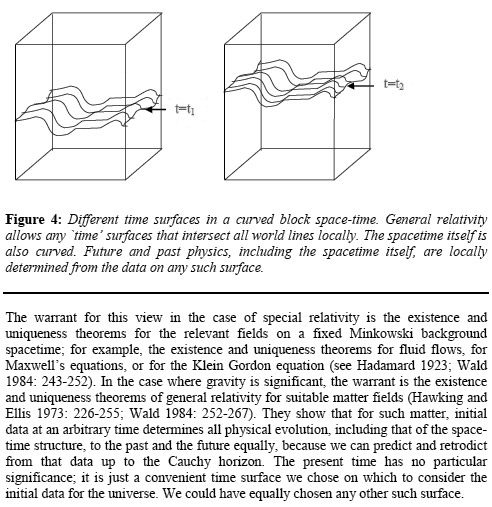
If you believe in the Riemannian space of 'facts' and use only Archimedean geometry, you will inevitably encounter insurmountable problems with the
conservation of energy and momentum in present-day GR, as well as tug-of-war "dark" effects of gravity, dubbed CDM and DDE. My suggestion is to zoom on the "infinitesimal variables" [Ref. 3] and reveal the interplay of matter and geometry -- their bi-directional "talk" on the interface of the Archimedean (material) and non-Archimedean (geometrical) realms. The end result is a perfect continuum in the local mode of spacetime. NB: This can only happen if there is a physical mechanism producing such perfectly smooth spacetime manifold, based on the so-called speed of light: the "duration" of the bi-directional "talk", in the local mode of spacetime, is zero. This is the meaning of the statement 'Your Global Time is ZERO'. More in my talk on Wednesday, 25 November 2015. My first talk didn't attract the attention of the theoretical physics community, but once the "enhanced" and "advanced" LIGO fail miserably by November 2015, I hope people will get serious about GR: "The representation of matter by a tensor was only a fill-in to make it possible to do something temporarily, a wooden nose in a snowman." (Albert Einstein's Last Lecture, April 14, 1954)
D. Chakalov
August 6, 2010
Last update: September 6, 2010
[Ref. 1] S. Babak and L. Grishchuk, The Energy-Momentum Tensor for the Gravitational Field, Phys. Rev. D61 (2000) 024038; gr-qc/9907027 v2.
"The search for the gravitational energy-momentum tensor is often qualified as an attempt of looking for “the right answer to the wrong question”. [cf. C.W. Misner, K.S. Thorne and J.A. Wheeler, Gravitation (W. H. Freeman and Company, New York, 1973), p. 467 - D.C.]
...
"In traditional field theories, one arrives, after some work, at the energy-momentum object which is: 1) derivable from the Lagrangian in a regular prescribed way, 2) a tensor under arbitrary coordinate transformations, 3) symmetric in its components, 4) conserved due to the equations of motion obtained from the same Lagrangian, 5) free of the second (highest) derivatives of the field variables, and 6) is unique up to trivial modifications not containing the field variables. There is nothing else, in addition to these 6 conditions, that we could demand from an acceptable energy-momentum object, both on physical and mathematical grounds.
...
"In the geometrical formulation of the general relativity, the components gmn(xa) play a dual role. From one side they are components of the metric tensor, from the other side they are considered gravitational field variables. If one insists on the proposition that “gravity is geometry” and “geometry is gravity”, then, indeed, it is impossible to derive from the Hilbert-Einstein Lagrangian something reasonable, satisfying the 6 conditions listed above."
[Ref. 2] John and Marry Gribbin, In Search of Schrödinger's Cat, Black Swan, London, 1998, p. 209
"There had been a plot not to agree on an object to be guessed, but that each person, when asked, must give a truthful answer concerning some real object that was in his mind, and which was consistent with all the answers that had gone before. With only one question left, John Wheeler guessed: "Is it a cloud?" The answer was "Yes!"
[Ref. 3] Eric Schechter (5 December 2009), Infinity: Introduction and History.
Comment: Eric Schechter wrote that "if you take a medium-sized number and divide it by an enormous number, you get a number very close to 0." Since the notions of infinity and infinitesimal are, in some (yet to be explained) sense, reciprocal, the latter can be illustrated with the following expression (notice that this is just an illustration of the puzzle stressed by Lucretius):
1/∞ → 0
We take a medium-sized number, 1 , to represent a finite Archimedean thing (e.g., one meter or one second), and divide it by ... what kind of infinity? Potential infinity or completed/actual infinity? No matter what we choose, we cannot recover the finite Archimedean thing by multiplying "zero" by "infinity". We are "bartenders" (recall Thompson's lamp paradox).
That's the puzzle of the finite Archimedean entities called 'space' and 'time' (local mode). Viewed from the local mode of spacetime, the infinitesimal -- the atom of geometry -- is the instantaneous state of Zeno's arrow. It is in 'absolute rest' with respect to all relativistic systems, hence we can define the elementary increment of physical variables (ds and dt) with respect to such "ether". I call it 'geometrical point', and stress that it is a non-Archimedean entity (global mode of spacetime), which builds up 'the grin of the can without the cat' (Alice), in line with the Continuum Hypothesis (CH). The latter is neither provable nor disprovable -- cf. Kurt Gödel. Why? Because the continuum emerges from the non-Archimedean realm of 'the universe as ONE', in which our mundane notions of "zero" and "infinity" do not hold anymore. They are simply not-applicable. All we can say is that, depending on the "direction" we look at 'the universe as ONE', it looks like either infinitely small or infinitely large, as it wraps up the whole Archimedean 3-D space of present-day GR. Hence we can enjoy “self-contained” isolated systems, the asymptotic spacelike regime included (Adam Helfer). The recipe is simple and unique. How else can you remove the jejune poetry in mathematical GR and differential geometry textbooks, encoded in expressions like "sufficiently small" and "smooth" (Piotr Chrusciel), and in stipulations that the Hausdorff topological space has somehow been made "connected" (Chris Isham)? There is no matter at the primordial level of 'pure geometry' to enable such "connection", which would show up as the affine connection (Graham Nerlich). "It is extremely difficult to induce penguins to drink warm water", says John Coleman. I hope these brief (and frank) comments can explain the idea about bi-directional "talk" of the Archimedean (material) and non-Archimedean (geometrical) realms. Forget about tensors. More on Wednesday, 25 November 2015. GR "bartenders" are cordially invited.
D.C.
August 9, 2010
Last update: August 11, 2010
---------------
Point set topology is a disease from which the human race will soon recover.
Henri Poincaré
===================================
Subject: Request for paper
Date: Wed, 29 Sep 2010 15:57:22 +0300
From: Dimi Chakalov <[email protected]>
To: Jochen Rau <[email protected]>,
Jochen Rau <[email protected]>
Cc: Jürgen Audretsch <[email protected]>,
Klaus Nagorni <[email protected]>
Dear Dr. Rau,
If possible, please send me a copy from your paper/slides "How to infer a quantum state from imperfect data", November 19, 2010. I trust you'll mention KS Theorem,
http://www.god-does-not-play-dice.net/#KS
Regarding your 1993 article "On the metric structure of space-time", arXiv:1009.5523v1 [gr-qc], and Prof. Audretsch's article "Riemannian structure of space-time as a consequence of quantum mechanics" from 1983 ("quantum mechanics must contain classical particle mechanics as a limiting case", Jürgen Audretsch), please notice my efforts in quantum cosmology,
http://www.god-does-not-play-dice.net/#consciousness
Outline in Sec. Summary, pp. 35-36, in
http://www.god-does-not-play-dice.net/ExplanatoryNote.pdf
Perhaps one can define God mathematically. It's all about 'Die Wirklichkeit des Möglichen in der Physik' (Jürgen Audretsch).
Kindest regards,
Dimi Chakalov
--------
Comments on 'primitive concepts' in spacetime structures, prompted by Jochen Rau's 1993 article [Ref. 1] and R = R(t) from Brian Dolan: The key assumption, which Jochen Rau calls 'deformability', is that "the event manifold's physical structure is allowed to vary freely" [Ref. 1]. Precisely what is implied by "freely"? In GR, there are no fixed paths in the "time" variable in R = R(t) from Brian Dolan -- paths are being made by "walking" (Antonio Machado) along the Heraclitean (non-Archimedean) time: "You cannot step into the same river twice, for fresh waters are ever flowing in upon you." In GR parlance, "more and more space ... appears." Thus, the event manifold itself should be endowed from the outset with the flexibility to be modified at each and every next event from 'the world lines of galaxies' (Weyl’s principle). Precisely what is implied by such flexibility? Here Jochen Rau and I agree only on "it depends on the distribution of matter in the universe (and on boundary conditions)" [Ref. 1]. However, in a Machian-type universe the flexibility of the event manifold should not be constrained to Lorentzian metric. We may picture some emergent Lorentzian signature only within/during one fleeting instant from the Arrow of Space. To cut the long story short, the ‘no-prior-geometry’ demand fathered GR (MTW, p. 431), but by doing so it also fathered a century of confusion. No aspect of the geometry of spacetime should be "fixed immutably", i.e., "cannot be changed by changing the distribution of gravitating sources" (MTW, p. 429). Any fixed background, such as the topology of space (not determined in current GR) and the fixed relations of 'inside' vs. 'outside' in 3-D space (local mode), must be made (i) dynamical and (ii) totally removable in the global mode of spacetime. And that's why we need the global mode of spacetime: the "dark gaps" from the global mode are rendered/reduced to zero in the local mode, by the Arrow of Space and the so-called 'speed of light'. The physical/observable result is a perfect continuum, at all length scales. We don't have any other choice. To resolve the century of confusion, I plan to suggest a virtual geodesic path formulation of GR on Wednesday, 25 November 2015 -- DeWitt's "many worlds" will be placed in our common 'potential reality', and the selection of 'one among infinitely many' worlds with emergent Lorentzian signature -- one-at-a-time -- will be made by 'the whole universe as ONE', in line with so-called biocausality.
As the old saying goes, you pays your money and you takes your choice; but assume well-defined concepts of (i) energy density in GR and (ii) trajectory of quantum particles (quantum flexibility, not "fluctuations"), your choices narrow greatly. Regarding (ii), all particles simultaneously explore all potential paths (“smells all the paths in the neighborhood”, The Feynman Lectures on Physics, Vol. II, Ch. 19, The Principle of Least Action) before (=global mode) they jointly make the elementary (dt & ds) step along their trajectories; hence each and every step is unique and irreversible in the Heraclitean (non-Archimedean) time. As to (i), the energy density is fixed both 'at a point' and 'viewed from infinity'. It's a package, and we can get it only with the global mode of spacetime in which the notions of 'geometrical point' and 'actual infinity' refer to ONE entity. Depending on the "direction" we look at 'the universe as ONE' from within the 3-D space (local mode), it looks either as 'infinitesimal geometrical "point" tending asymptotically toward zero', or as 'infinitely large and "expanding" volume of 3-D space'. There is no other choice for quantum gravity. We first have to fix the long-standing problems of QM and GR, and then all pieces of the jigsaw puzzle will snap to their places -- effortlessly. Then the proper math will also show up -- effortlessly. I am sure professional mathematicians will understand what I mean. If you agree with Chris Isham, you'll be playing with the drawing below forever.
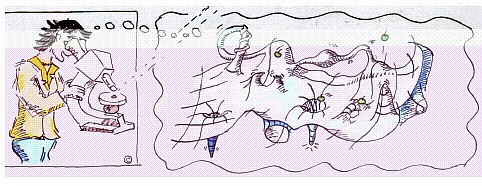
Again, GR and QM "bartenders" are cordially invited. Well, as Blaise Pascal says, I have made this note longer than usual because I lack the time to make it shorter. Sorry. Will try to do better in November 2015.
D. Chakalov
September 30, 2010
Last update: October 8, 2010
[Ref. 1] Jochen Rau, On the metric structure of space-time, arXiv:1009.5523v1 [gr-qc]. Journal reference: M. A. del Olmo, M. Santander, and J. Mateos Guilarte, eds., Group Theoretical Methods in Physics, Vol. II, Anales de Fisica, Monografias 1, CIEMAT, Madrid, 1993, pp. 483-486
"(W)hich physical assumptions are being tacitly made whenever one postulates the existence of a Lorentzian metric? Only after these assumptions are exhibited can one start to systematically relax them; thus, answers to the above question may be helpful for the study of more general space-time structures.
"Primitive concepts are taken to be events, counting of events, causal relationships and the ability to compare measurements; the corresponding mathematical structures are a differentiable manifold, volume element, causal vectors and affine connection(s), leading to the notion of an 'event manifold'.
"The key assumption, which I will call 'deformability', is that the event manifold's physical structure is allowed to vary freely.
"The proof of the Weyl-Cartan theorem is then reviewed to establish the result that any deformable event manifold must be Lorentzian.
2 Event Manifolds
"I assume that space-time is a connected n-dimensional differentiable manifold M. At x E M, local measurements (e.g., evaluating vector fields) are performed using a basis of the tangent space TxM. In order to have a means to compare local measurements at different points, I require the manifold to be endowed with an affine connection.
"The connection is assumed to be torsion-free.
.......
3 Deformability
"So far my considerations have been very general, and the symmetry group G is by no means uniquely determined. Only now the key idea of General Relativity comes into play: rather than being fixed as in Newtonian theory, the local physical structure on the space-time manifold is itself a variable; it depends on the distribution of matter in the universe (and on boundary conditions)." =================================
Subject: Virtual geodesic path formulation of GR
Date: Sat, 2 Oct 2010 16:09:16 +0300
Message-ID:
<[email protected]>
From: Dimi Chakalov <[email protected]>
To: [snip]
Dear Colleagues,
On Wednesday, 25 November 2015, I intend to suggest a virtual geodesic path formulation of GR:
http://www.god-does-not-play-dice.net/#Rau_comments
It will elaborate on the *emergence* [Ref. 1] of globally valid 3-D space, along an Arrow of Space,
http://www.god-does-not-play-dice.net/#Zinkernagel_note
Hence 'time' emerges locally, in terms of a 'future directed, time-like unit vector field' (cf. below).
Details in Sec. Summary, pp. 35-36, in
http://www.god-does-not-play-dice.net/ExplanatoryNote.pdf
Should you find these efforts interesting, please reply by September 25, 2015, and I will gladly send you details about the venue (probably
Munich).
May I take this opportunity to thank you all for everything I learned from you, and will (hopefully) continue to learn in the years ahead.
Kindest regards,
Dimi Chakalov
[Ref. 1] C.J. Isham and J. Butterfield, On the Emergence of Time in Quantum Gravity, gr-qc/9901024
http://arxiv.org/abs/gr-qc/9901024
p. 25: "Space and time are such crucial categories for thinking about, and describing, the empirical world, that it is bound to be ferociously
difficult to understand their emerging, or even some aspects of them emerging, from 'something else'.
.....
p. 46: "As we said in Section 1, we intend ‘the emergence of time’ to also cover the emergence of spacetime, and so space."
---------------
Subject: A future directed, time-like unit vector field
Date: Tue, 31 Mar 2009 05:46:18 +0300
From: Dimi Chakalov <[email protected]>
To: Helmut Friedrich <[email protected]>
Cc: [email protected], [email protected]
Dear Dr. Friedrich,
You acknowledged that a future directed, time-like unit vector field, for which no natural choice exists in general, is characterized indirectly and becomes explicitly available only after solving the equations (arXiv:0903.5160v1 [gr-qc], p. 17).
I've been trying to argue that this problem can only be solved by recovering the reference fluid in GR.
[snip]
=================================
Subject: The universe modeled as a 'brain'
Date: Sun, 3 Oct 2010 04:53:03 +0300
From: Dimi Chakalov <[email protected]>
To: Charles L Bennett <[email protected]>,
Gary F Hinshaw <[email protected]>,
David Spergel <[email protected]>,
Lyman Page <[email protected]>,
Ed Witten <[email protected]>,
Richard H Miller <[email protected]>,
Stephan S Meyer <[email protected]>,
Joshua A Frieman <[email protected]>,
Rocky Kolb <[email protected]>,
Robert Rosner <[email protected]>,
Carlos S Frenk <[email protected]>,
Berkeley Center for Cosmological Physics <[email protected]>
Dear Colleagues,
I've been trying to suggest a model of the universe as a human brain -- please check out Sec. Summary at
http://www.god-does-not-play-dice.net/ExplanatoryNote.pdf
It seems to me -- please correct me if I got it wrong -- that Eqs 1 and 2, pp. 35-36 at the link above, may offer a solution to the ‘most embarrassing observation in physics’ (Ed Witten) and explanation of the apparent finite age of the universe:
"WMAP definitively determined the age of the universe to be 13.73 billion years old to within 1% (0.12 billion years) - as recognized in the Guinness Book of World Records!"
The model suggests a dual age of the universe, such that the evaluation of the statement from WMAP Team will be, in German, YAIN (both yes and no).
Your critical comments will be appreciated, and will be kept private and confidential.
Kindest regards,
Dimi Chakalov
=================================
Subject: The Koch curve and Thompson's Lamp Paradox
Date: Mon, 20 Sep 2010 06:44:58 +0300
From: Dimi Chakalov <[email protected]>
To: Piero Nicolini <[email protected]>,
Benjamin Niedner <[email protected]>
Cc: Karl <[email protected]>, Jeremy <[email protected]>
Dear Dr. Nicolini,
I read with great interest your latest arXiv:1009.3267v1 [gr-qc]. May I ask a question regarding the Koch curve in Fig. 1.

You and Dr. Niedner wrote: "It is an example of an everywhere continuous but nowhere differentiable curve. We can construct the Koch curve as a final product of an infinite sequence of steps. At each step, the middle third of each interval is replaced by the other two sides of an equilateral triangle."
Suppose we consider, as a Gedankenexperiment, an infinite sequence of steps, and assume "the presence of a minimal length" (p. 5), such that (operational definition) the initial 'interval' in Fig. 1 at this "minimal length" becomes _sufficiently small_ (the key expression from the Equivalence Principle in GR textbooks), hence can be considered as 'infinitesimal point' -- the very same infinitesimal point "inside" which the state of the Thompson's Lamp becomes _indecisive_ . Namely, a superposition of |on> and |off> state(s), which can never be "collapsed" bzw. observed.
We would have an ultimate cutoff by such (Planckian?) 'sufficiently small minimal length', yet we won't be able to compute the actual length of the whole Koch curve (nor the Hausdorff dimension), because the _sufficiently small_ infinitesimal length will act as 'numerically finite but physically unattainable boundary/cutoff'.
Stated differently, the final curve won't be "infinitely long", as you put it, but _indecisive_ .
I believe the implications for the notion of "delocalization of point like objects" (p. 3), as well as for those depicted in Fig. 4, are obvious, but let me first state my question:
Am I wrong?
More on the crucial issue of 'sufficiently small' at
http://www.god-does-not-play-dice.net/#when_how
Kindest regards,
Dimi Chakalov
=============
Subject: Re: The Koch curve and Thompson's Lamp Paradox
Date: Mon, 20 Sep 2010 07:43:13 +0300
From: Dimi Chakalov <[email protected]>
To: Piero Nicolini <[email protected]>
Cc: [snip]
Dear Piero,
Thank you for your reply.
[snip]
> as far as I understand, I would say that in some sense your comment is
> correct. the conventional computation of the Hausdorff length is modified
> as we showed in our paper.
With the Thompson's Lamp Paradox, I think the situation changes drastically.
> The introduction of a length scale breaks the self similarity property
> of the erratic path of a quantum particle.
Please see above.
> However some points don't seem to be correct in your comments. In
> particular the reference to the infinitely long case, which is the
> conventional case rather than that in the presence of a cut off as shown
> in Eq. 16.
Perhaps you didn't have time to consider my Gedankenexperiment vs. yours (the alleged cutoff in Eq. 16).
Please check out the linked text at
http://www.god-does-not-play-dice.net/#Nicolini
I do hope to learn about your professional opinion.
All the best,
Dimi
----------- Note: The introduction of a minimum length scale as a 'numerically finite but physically unattainable boundary/cutoff' follows from the non-Archimedean nature of the geometric realm of 'the grin of the cat without the cat' (Alice): we cannot reach the "hidden unmoved mover" (Karel Kuchar) and the Aristotelian First Cause from within the local mode of spacetime. Corollary: speculations about some dirty black hole thermodynamics, noncommutative gravity, non-commutative micro black holes, entropic "force" (the latter translates to 'information force'), etc., are unjustified. D.C.
September 20, 2010
=============================================
Subject: arXiv:1009.3559v1 [gr-qc]
Date: Tue, 21 Sep 2010 06:58:44 +0300
From: Dimi Chakalov <[email protected]>
To: Niall <[email protected]>, [email protected]
Cc: [email protected],
[email protected],
[email protected],
Roger Penrose <[email protected]>
Dear Niall and Julian,
In your latest paper, you stated the following:
"The time at which wave-function collapse occurs is ill defined in relativity; however the simultaneity associated with the shape-dynamic CMC foliation could bring interpretational clarity. This is also true for the ‘problem of time’ [14], which arises from the ambiguity in the time evolution in superspace if foliation invariance (many-fingered time) is made inviolate."
May I request some interpretational clarity: please tell me how you plan to resolve the quasi-local mess in GR,
http://www.god-does-not-play-dice.net/#Zinkernagel2
If your colleagues have some insights, I will appreciate their feedback as well.
Regards,
Dimi
-----------
Note: The only way I could think of "the time at which wave-function collapse occurs" is by speculating about Weyl's Principle being applied to some preferred foliation of spacetime into 3-D spacelike hypersurfaces, to fix the temporal order for spacelike separated "points" -- simultaneity-at-a-distance -- hence 'simultaneity surfaces' along which quasi-local effects propagate among the "school of fish", in which every "fish" follows pre-correlated quasi-local geodesics. The present-day GR explicitly forbids such luxury, as well as some 'nondynamical time parameter' (Unruh & Wald). Niall Murchadha and Julian Barbour claim that have found "the configuration space of general relativity" that "could bring interpretational clarity", and I offered them 'the test of the pudding'. Are they implying some null surfaces backward in time to resolve the quasi-local mess in GR? Check out the 1982 paper by R. Penrose; the problem has been agonizingly clear since the inception of GR. Apart from that, Niall Murchadha and Julian Barbour have brains, which could not have worked in any "timeless world" from GR, nor with some 'time variable' in STR, used to explain the energy conservation during that 'time variable', after Noether's Theorem. The human brain needs an arrow of spacetime. Otherwise the human mind must act on its brain, which is sheer parapsychology. The latter has been explored by many people since the Roman Empire, with the same dead-end result. If you seriously believe that the flow of spacetime is within the framework of the theory of relativity "an illusion", you have a choice: fix the quantum theory and theory of relativity by incorporating its "dark energy", or do parapsychology. Or simply ignore this web site, and pretend that you've never learned anything from it, like Julian Barbour does. D.C.
September 21, 2010
==========================================
Subject: The Design and Validation of the Quantum Mechanics Conceptual Survey, arXiv:1007.2015v1
Date: Wed, 14 Jul 2010 15:37:59 +0300
From: Dimi Chakalov <[email protected]>
To: Sarah McKagan <[email protected]>
Cc: Sergio Doplicher <[email protected]>,
Jeremy <[email protected]>,
David Schroeren <[email protected]>,
Ronnie Hermens <[email protected]>,
Landsman <[email protected]>,
Laszlo Szabados <[email protected]>,
Chris Isham <[email protected]>,
Adam Helfer <[email protected]>
Dear Dr. McKagan,
Students are kids, and I think nobody can blame them for being unable to grasp QM, given the fact that their tutors and professors are profoundly confused in the first place ("large variation in faculty views on many topics in QM", as you mildly put it).
Please see my efforts at
http://www.god-does-not-play-dice.net/#KS
(updated July 14, 2010)
More on QM and GR at
http://www.god-does-not-play-dice.net/#shoal
Your professional feedback will be appreciated.
All the best,
Dimi Chakalov
====================================
Subject: arXiv:1011.2287v1 [quant-ph]
Date: Thu, 11 Nov 2010 04:32:40 +0200
From: Dimi Chakalov <[email protected]>
To: Peter Evans <[email protected]>
Cc: Huw Price <[email protected]>,
John <[email protected]>,
Tim Maudlin <[email protected]>,
Abner Shimony <[email protected]>,
Philip Pearle <[email protected]>
Dear Dr. Evans,
May I elaborate on John Cramer's idea (p. 4): "repeats until" ... at which point the transaction is completed, and the observer can finally witness the *already*-completed transaction (post factum). I deliberately use temporal notions to show that (i) we're dealing with two kinds of time, and (ii) this language doesn't work. Perhaps if we allow these two kinds of time to co-exist peacefully, the crux of QM can be resolved:
http://www.god-does-not-play-dice.net/#KS
I will appreciate your professional opinion, as well as the feedback from your colleagues. Please feel free to disagree, and explain why.
Kindest regards,
Dimi Chakalov
-------
Note: Read Sects 2 and 3 from Peter Evans' arXiv:1011.2287v1 [quant-ph] (emphasis, comments, and links added by me - D.C.):
p. 2: "...the process of electromagnetic radiation should be thought of as an interaction between a source and an absorber rather than as an independent elementary process. (footnote 1)" Footnote 1, p. 3: "... it is as absurd to think of light emitted by one atom regardless of the existence of a receiving atom, as it would be to think of an atom absorbing light without the existence of light to be absorbed." p. 3: "... an advanced incoming field that is present at the source simultaneous with the moment of emission. The claim is that this advanced field exerts a finite force on the source which has exactly the required magnitude and direction to account for the observed energy transferred from source to absorber; ..." p. 3: "The crucial point to note about the Wheeler-Feynman scheme is that due to the advanced field of the absorber, the radiative damping field is present at the source at exactly the time of the initial acceleration. Quite simply, if a retarded electromagnetic disturbance propagates for a time t before meeting the absorber then the absorber will be a distance ct from the source. The advanced field propagates with the same speed c across the same distance and thus will arrive at the source exactly time t before the absorber field is generated, i.e. at the time of the initial acceleration." p. 4: "The transaction is completed with a “handshake”: the offer and confirmation waves combine to form a four dimensional standing wave between emitter and absorber. (...) Any observer who witnesses this process would
perceive only the completed transaction, which would be interpreted (post factum - D.C.) as the passage of a particle (e.g. a photon) between emitter and absorber." p. 5: "The process is atemporal and the only observables come from the superposition of all “steps” to form the final transaction. (1986, fn. 14, p. 661)" In order to employ this beautiful story for the mechanism of inertial reaction "force" in our Machian universe, we need a "mirror for gravitational waves" from Finite Infinity, plus a few other things. Only the math is unknown. Don't say you knew nothing about it! D.C.
November 17, 2010
====================================
Subject: Colloquium in Honour of Ernst Specker at his 90th Birthday, October 29-30, 2010
Date: Sat, 9 Oct 2010 06:02:21 +0300
From: Dimi Chakalov <[email protected]>
To: Jürg Fröhlich <[email protected]>,
Gian Michele Graf <[email protected]>,
Heinz Siedentop <[email protected]>,
Stefan Wolf <[email protected]>,
Renato Renner <[email protected]>,
Stephen A Fulling <[email protected]>,
Robert W Spekkens <[email protected]>,
Yeong-Cherng Liang <[email protected]>,
Howard M Wiseman <[email protected]>,
Jonathan Oppenheim <[email protected]>,
Stan Gudder <[email protected]>
Dear Colleagues,
In the late 1950's, Ernst Specker posed the question of whether the omniscience (total knowledge) of God extends to events which would have occurred if something had happened, which did not, in fact, happen (Ernst Specker, “Die Logik nicht gleichzeitig entscheidbarer Aussagen,” Dialectica 14, 239-246 (1960); p. 243).
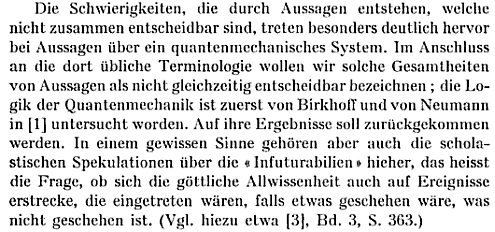
This leads to the questions of 'the universal truth function', and "why does quantum theory not have this sort of complementarity" [Ref. 1].
My scattered thoughts on KS Theorem and truth evaluation in Quantum Theory can be read at
http://www.god-does-not-play-dice.net/#KS
Regrettably, I cannot attend the Colloquium in Honour of Ernst Specker, and can only wish him all the best upon his Birthday 'by distance', although I will be, in some sense, present as well, since we are all entangled.
May I take this opportunity to invite you at my talk on quantum gravity,
http://www.god-does-not-play-dice.net/#VGP
Kindest regards,
Dimi Chakalov
[Ref. 1] Yeong-Cherng Liang, Robert W. Spekkens, Howard M. Wiseman, Specker’s Parable of the Over-protective Seer: Implications for
Contextuality, Nonlocality and Complementarity, arXiv:1010.1273v1 [quant-ph],
http://arxiv.org/abs/1010.1273v1
p. 3: "(O)ne must imagine that the outcome of a measurement (or equivalently, the property that is measured) is context-dependent — whether a gem is seen or not in the first box depends on whether that box was opened together with the second or together with the third.
.....
"To get this kind of contextuality, it is necessary to find a situation wherein there are very specific sorts of limitations on joint measurability — there must exist a triple of measurements that can only be implemented jointly in pairs. For projective measurements in quantum theory, this sort of limitation on joint measurability does not occur.
......
pp. 27-28: "Specker’s parable provides an interesting new kind of foil, because the kind of complementarity it exhibits — three measurements that can be implemented jointly pairwise but not triplewise – is something that is not found among projective measurements in quantum theory. This prompts the question: why does quantum theory not have this sort of complementarity?"
--------- Note: Just a hint to the question above: suppose the {1,0,1} rule was not broken, and the full catalogue of expectation values for the spin-1 system were present (no "uncolored" section from KS sphere). Then people could develop a relativistic QM that could explain the "collapse" with some "hidden" stuff, and prove Schrödinger wrong, namely, 'a variable would have a definite value before I measure it; then measuring it simply means ascertaining the value that it has.' D.C.
October 28, 2010
====================================
"Wenn es doch bei dieser verdammten Quantenspringerei bleiben soll, dann bedauere ich, mich mit der Quantentheorie überhaupt beschäftigt zu haben."
(If we have to go on with these damned quantum jumps, then I'm sorry that I ever got involved.)
Erwin Schrödinger
"Let me say at the outset, that in this discourse, I am opposing not a few special statements of quantum mechanics held today (1950s), I am opposing as it were the whole of it, I am opposing its basic views that have been shaped 25 years ago, when Max Born put forward his probability interpretation, which was accepted by almost everybody.
....
"I don't like it, and I'm sorry I ever had anything to do with it." Erwin Schrödinger, The Interpretation of Quantum Mechanics. Dublin Seminars (1949-1955) and Other Unpublished Essays, Ox Bow Press, Woodbridge, 1995
A brief note on the Kochen-Specker Theorem
(if you aren't familiar with the subject, read the notes here, here, here, and here) July 21, 2011
Abstract: Any "quantum states" that can be put in Dirac brakets, such as |whatever> , as well as any combination of such "quantum states", cannot be mapped to the UNdecidable Kochen-Specker (KS) state from the uncolored KS sphere. It cannot fit into any Hilbert space whatsoever, being a pre-quantum or rather potential quantum reality. No state vector, in any Hilbert space, can accommodate the potential quantum reality which, from the perspective of our Boolean logic, is 'both yes and no' (YAIN). It cannot fit in the Riemannian manifold of GR either (hypothetical manifold with postulated (i) differentiable structure, (ii) affine connection, (iii) tangent space at each infinitesimal "point", and (iv) metric that can only "expand" with respect to the reference fluid of GR).
Suppose you are an Eskimo, and you have never seen, and will never see an elephant in your whole life. Yet you can nevertheless make observations on elephant's trunk by means of two "complementary" devices, 'nose' and 'arm'. You know that Heisenberg relations preclude you from observing simultaneously the "nose" and the "arm" of elephant's trunk (the position and momentum of an electron, say). Then you're struck by Schrödinger's 1935 paper: "In general, a variable has no definite value before I measure it; then measuring it does not mean ascertaining the value that it has. But then what does it mean?" It means you cannot observe elephant's trunk with (inanimate) devices at the length scale of tables and chairs. It does not mean that the trunk doesn't exist. Fortunately, the Kochen-Specker Theorem can help you understand the true, UNdecidable quantum "trunk"; check it out with your own brain here. Richard Feynman claimed (12 August 1983): "We can do the arithmetic, but we cannot picture the car!" Yes we can. All we need is a brain. Carsten Held stated that the KS theorem, "by its mathematical nature, is not empirically testable", and since Ronnie Hermens (and Wiki) seem to have some troubles with it, may I offer a brief, personal, and biased interpretation, ensuing from Ernst Specker's tripod. Ernst Specker was eager to clarify the answer to a truly fundamental question: is it possible to distill all conceivable quantum states as 'observables in 3-D space', such that (i) there will be no counterfactuals (cf. Karl Svozil) and (ii) the unitarity principle will be uphold, that is, the probabilities for all conceivable quantum observables will sum up to unity. If that were possible, one could make a "reverse engineering" of a quantum system, by exposing all of its localizable observables, after which the cornerstone questions of Quantum Mechanics (QM), posed by Erwin Schrödinger in 1935 and in November 1950 (cf. below), would have acquired a dead simple answer: hidden variables. Then QM would be just a statistical theory based on the unitarity principle, and will also be marred with the intractable parapsychology of those "hidden variables" (maybe sub-quantum, or maybe noncontextual, but you never know, because all this parapsychological stuff is "hidden" from the outset). Thank God, the Kochen-Specker Theorem proved this whole mess wrong. But it also showed that the notion of 'complete set of observables pertaining to a quantum system' is far more subtle and rich than expected, due to the presence of an UNdecidable KS state that does not belong to this set. Imagine three quantum guys, Tom, Dick, and Harry, and think of the "spectral decomposition" of their quantum states as being presented by their hands, with the following specifications: upon observation at particular instant, they all have to simultaneously raise their hands (hermitian operators). Thus, each of them can, and have to, raise either his left hand (L), or right hand (R), or both (B). Recall that, unlike probabilities in classical statistical physics, probabilities in QM originate in Pythagoras' theorem in n dimensions (C. Isham, Lectures on Quantum Theory, Sec. 2.1.2, get pp. 16-17 from here), so if one of the quantum guys cannot have orthogonal "states" for his hands, he will ruin the whole system. The famous KS Theorem (download an explanation by R.I.G. Hughes from here) says that the (spin 1) system {Tom_Dick_Harry} will exhibit the following "paradoxical" (from the viewpoint of classical physics) situation: if Tom and Dick happen to possess context-dependent and well-defined ("an unequivocal true-false value", cf. Isham and Butterfield above) quantum states of their hands (either L, or R, or B), then in that same instant Harry will not have any hands at all. For if the poor guy had 'hands' in that same instant, he would have the opportunity to choose one of his context-dependant quantum states -- either L, or R, or B. He will instead be shifted to the "uncolored" section from KS sphere. Next time you "measure" the system {Tom_Dick_Harry}, exactly the same thing can happen to Dick. Or to Tom. So, any time you observe some classical presentation of 'quantum state', be aware that nevertheless something essential is missing. It showed up in the case with Harry, yet it "covers" the whole system {Tom_Dick_Harry}, much like the "dark" energy from 'empty space'. Poetically speaking, the case with Harry was the "revenge" of the quantum Noumenon pertaining to {Tom_Dick_Harry} for our efforts to push it at the length scale of (unanimated) tables and chairs. Unlike the measuring devices examined in QM textbooks, the human brain can operate with its presentation of 'potential reality' elevated at the length scale of tables and chairs, as demonstrated with the example of three "measurements" (cf. the three sayings above). If our brains can operate with their UNspeakable potential reality, so can 'the universe as a brain'. Notice that if we constrain Tom, Dick, and Harry to raise only one hand (either L or R), people would entertain "quantum computing" and "topological quantum computation" (e.g., Michael H. Freedman), because the implications from KS Theorem will be obscured. But as the UNdecidable quantum state is still working in the quantum world, it cannot be harnessed with unanimated devices. I employ the notion of 'potential reality' to signify the UNdecidable KS quantum state -- the genuine 'quantum reality out there'. Can't fit it in any Hilbert space whatsoever. If you prefer, think of it as Reichenbach's Common Cause Principle. In summary, the Kochen-Specker Theorem demonstrates the UNdecidable KS quantum state. The latter is far more profound and important than the contextuality alone [Ref. 2] ("not all observables can be assigned definite values that are independent of the measuring context", cf. Ronnie Hermens). Namely, the conclusion that "only contextual values can be ascribed" [Ref. 2] does not shed light on the implications from the fact that contextuality is invariant to the particular place of the observables in the 3x3 array. As I wrote above, the same thing that happened to Harry can happen to Dick, or to Tom. Nothing -- not even some "contextuality" -- can save Harry (or Dick, or Tom) from the case in which he (or Dick, or Tom) must not possess any hands. If at some instant of measurement Harry must not have any classical hands whatsoever, yet at some other instant he -- the same Harry -- can and will obtain some contextual, well-defined, classical-able hands, then we are facing a phenomenon far more important than "contextual hands" alone. Namely, we can tell apart the contextualized classical-able hands, which can be filtered through the classical spacetime as 'classical hands', from those "intact" quantum states that can't. Which does not imply that the latter do not exist. In my view, only some quantum Noumenon can secure the ontological contextuality of quantum objects. The ontological contextuality may or may not provide 'the same Harry' with contextualized classical-able hands. It is also UNdecidable and Unspeakable, and of course 'not empirically testable'. Thus, if you observe the "hands" of some quantum object, be aware that you're only observing its contextualized classical shadows on Plato's cave, emanating from the ultimate quantum potential reality. Three years ago, I explained to my teenage daughter a similar puzzle in GR, regarding the Hole Argument. With slight modifications, the corresponding 'KS Theorem for teenage girls' would be as follows. Imagine you cannot see your finger nails "bare", without nail varnish. One way to think of such peculiar situation is that your 'bare finger nails' do in fact exist, but are somehow banned from showing up to you. Namely, your 'bare finger nails' can show up to you only after you cover them with your nail varnish, with different colors depending on your mood, but then they won't be 'bare' anymore. They will be "contextualzed", with particular color. Well, KS Theorem (roughly) says that (i) if you use three different nail-varnish colors for each nail, and (ii) if you have to paint three (or more) of your nails, then one of the them would have to show to you its "bare" nature: the UNdecidable KS state. Which would, in turn, ruin your whole manicure. To avoid such disasters, you should use maximum two nail-varnish colors, and then all your "bare" finger nails will be safely covered with some particular "contextualzed" color. The downside of such (seemingly perfect) manicure will be that you may never understand QM nor GR. Capiche? NB: If the reader wishes to refute the "adult" interpretation of KS Theorem above, please start with converting the "uncolored" section from KS sphere to some Hilbert space (your choice), to match the case in which Harry would obtain some contextual, well-defined, classical hands, at the expense of either Dick or Tom being shifted to the same "uncolored" section from KS sphere. What is the 'time parameter' pertaining to the dynamics of the reversible (KS sphere <--> Hilbert space) transitions, for all observables from {Tom_Dick_Harry}? Please don't hesitate! In a drastic contrast to the "collapse" and the Eigenvalue-Eigenstate Link from the old Copenhagen School [Ref. 1], the PR interpretation of QM employs the phenomenon of 'emergence' (e.g., Isham and Butterfield): in the case with {Tom_Dick_Harry}, one could only observe, at particular instant of time, the emergence of only one of its latent observables, say, {Tom, R}, just like the end result from the correlation and "negotiation" (global mode of spacetime) that led finally to John Wheeler's 'cloud'. This one final result (one-at-a-time) is 'physical reality' (local mode of spacetime), while the rest of Tom's latent states, plus Dick's latent states, plus Harry's UNdecidable KS state constitute the 'potential reality' of the system {Tom, Dick, and Harry}, which is in turn rooted on the quantum Noumenon -- "The ideal monad has no windows" (Döring and Isham). This is entirely different from any 'modal' or 'contextual hidden variable' theory. It goes without saying that a rigorous presentation of the ideas in the paragraph above is not available. These are just ideas presented with words. Back in 1935, Erwin Schrödinger also offered some very general ideas, presented with words: "The rejection of realism has logical consequences. In general, a variable has no definite value before I measure it; then measuring it does not mean ascertaining the value that it has." The second part from the last sentence was totally forgotten by the mainstream theoretical physics community, and only Henry Margenau paid attention to it. Yet even today very few QM textbooks mention KS Theorem, which is rooted on this forgotten (or rather ignored) consideration spelled out by Schrödinger in 1935. As to the first part, "a variable has no definite value before I measure it", perhaps the intact quantum world 'out there' exists as the UNdecidable quantum state. If this is the case chosen by Mother Nature, the mysterious transition from quantum to classical, which is essential to QM textbooks [Ref. 3], should be explained with the "back bone" of the quantum world -- potential reality. Notice that the quantum truth functional in QM textbooks (e.g., Ref. 4, p. 314) is not applicable to 'potential reality' due to the presence of the generic "intact" (not limited to KS Theorem) UNdecidable quantum state. For example, regarding the notion of spin ("klassisch nicht beschreibbaren Art von Zweideutigkeit", Wolfgang Pauli), Bob Griffiths rightly says (ibid., p. 196) that "there is no property (explicable at the length scale of tables and chairs - D.C.) corresponding to Sz = +1/2 AND Sx = +1/2 for a spin-half particle." Of course not. The whole point is that there must exist something that keeps the "sameness" (Genidentität, Kurt Lewin) of thisspin-half particle, so that it can "pass through" it (the "intact" UNdecidable quantum state, or 'bare finger nails'), and be able to switch between its allowed states, in line with the conservation law known from QM textbooks. Can we, with our Boolean logic, think of a quantum particle as possessing simultaneously perfectly well-defined position and momentum (ibid., p. 314)? Of course not. Does that mean that we can "impose bans" on such UNdecidable quantum state in the quantum world, just because we cannot think about it? Of course not. The "non-commutative" quantum state is simply not point-like. It may be perfectly well-defined as 'potential reality', yet not point-like. It has to be point-like only in classical mechanics, like the point-like states of a Frisbee along its classical trajectory. (The hypothetical abilities of the human brain to observe and act on the UNdecidable quantum vacuum state requires special considerations.) Let's not mix apples with oranges, because the 'time' in the quantum world (no time operators in QM) is not like the one at the classical world, and the "intact" UNdecidable quantum state simply cannot get there. With unanimated measuring devices, we can "measure" only one frozen point from the anti-relativistic "time parameter" in the Schrödinger equation, and by imposing such wrong, albeit inevitable, classical filter on the quantum world we may develop distorted and misleading impression about some "time parameter in the Schrödinger equation". The experimental fact that even by detecting electrons one-at-a-time they nevertheless build an interference pattern [Ref. 5] demonstrates their quasi-local nature, yet the probability for detecting individual electrons on the screen, as point-like events, is blind and deaf to their quasi-local nature: the interference pattern can only be produced if the individual electron was able to "sense" the two slits simultaneously, while the probability for its detection on the screen refers to registered events that are inevitably point-like facts. This should be the starting point for explaining "the central mystery of quantum mechanics" (Richard Feynman): the nature of the quasi-local UNdecidable quantum state. It is not a 'fact', and cannot be presented with any probabilities, as was the case with Harry above. If you teach Quantum Mechanics, start with the double-slit experiments and finish with the KS Theorem, which is grounded on the statement made by Erwin Schrödinger in November 1950: “It seems to me that the concept of probability is terribly mishandled these days. Probability surely has as its substance a statement as to whether something is or is not the case — an uncertain statement, to be sure. But nevertheless it has meaning only if one is indeed convinced that the something in question quite definitely is or is not the case. A probabilistic assertion presupposes the full reality of its subject.” NB: There is nothing "probabilistic" or "stochastic" in the quasi-local UNdecidable quantum state that neither 'is' nor 'is not'. Can't fit it in any Hilbert space. There are three totally different cases in QM. With just one degree of freedom, we (not Mother Nature) calculate an observable with a single eigenvalue ("an eigenstate of k belonging to an eigenvalue k'," P.A.M. Dirac, p. 154); the second case is confined to 'contextual values' (we constrain Tom, Dick, and Harry to raise only one hand -- either L or R; see above); and the third case deals with the absence of any classical hands whatsoever, after KS Theorem and the Free Will Theorem. Quantum Mechanics is about this third case. Can't fit it in any Hilbert space. Tell your students about it, Prof. Doplicher. No kid should end up like A. Connes. Surely the quasi-localUNdecidable quantum state cannot be filtered through the spacetime of STR and the Boolean logic of propositions: the truth evaluator will be YAIN (both yes and no). Which is entirely different from the "toposification" of quantum theory suggested by Chris Isham -- neither true nor false, but "somewhere in between" [Ref. 6]. To quote Niels Bohr, "Mathematical clarity has in itself no virtue. A complete physical explanation should absolutely precede the mathematical formulation." And the physical explanation has been spelled out by Schrödinger and Margenau. Only the math is unknown. To move further (Machian quantum gravity), try to unravel the origin and mechanism of instantaneous inertial reaction "forces", starting solely from Albert Einstein's postulate that "the metrical character (curvature) of the four-dimensional spacetime continuum is determined at every point by the matter there, together with its state" (Kosmologische Betrachtungen zur allgemeinen Relativitätstheorie, 1917). No way. Something inherently quasi-local is again missing (try an experiment with your brain here), as hinted by KS Theorem and CK Free Will Theorem. In the case of GR, the torsional degrees of freedom are excluded from the outset. But I'll stop here, because, as many people complain, the story will (again) become deadly boring. I think Ronnie Hermens should ask his QM tutor (Nicolaas Landsman) lots of questions about KS Theorem. Perhaps he should also ask Chris Isham, after reading Ch. 9 from his famous textbook.
D.C.
February 12, 2010
Latest update: July 21, 2011
[Ref. 2] Karol Horodecki et al., Contextuality offers security, arXiv:1002.2410v1 [quant-ph]
"We shall use the Peres-Mermin version of KS paradox [23, 24]. The quantum observables and the KS conditions are depicted on Fig. 1." (Emphasis added - D.C.)

[Ref. 3] L. Landau, E.M. Lifshitz, Quantum mechanics: Non-relativistic theory, 3rd ed., Pergamon Press, 1977, p. 3
"Thus quantum mechanics occupies a very unusual place among physical theories: it contains
classical mechanics as a limiting case, yet at the same time it requires this limiting case for its own formulation."
[Ref. 4] Robert B. Griffiths, Consistent Quantum Theory, Cambridge University Press, 2003, http://quantum.phys.cmu.edu/CQT/toc.html
http://quantum.phys.cmu.edu/CQT/chaps/cqt16.pdf
p. 190: "... when constructing a quantum description of a physical system it is necessary to restrict oneself to a single framework, or at least not mix results from incompatible frameworks.
p. 194: "One cannot use a single framework to answer all possible questions about a quantum system, because answering one question will require the use of a framework that is incompatible with another framework needed to address some other question.
p. 195: "If two or more frameworks are compatible, there is nothing problematical in supposing that the corresponding conclusions apply simultaneously to the same physical system. (...) Consequently one can think of F1, F2, ... as representing alternative "views" or "perspectives" of the same physical system, much as one can view an object, such as a teacup, from various different angles. Certain details are visible from one perspective and others from a different perspective, but there is no problem in supposing that they all from part of a single correct description, or that they are all simultaneously true, for the object in question.
p. 196: "Conceptual difficulties arise, however, when two or more frameworks are incompatible. (...) ... just as there is no property corresponding to Sz = +1/2 AND Sx = +1/2 for a spin-half particle. (...)
"Incompatible frameworks do give rise to conceptual problems when one tries to apply them to the same system during the same time interval. (...) The difficulty comes about when one wants to think of the results obtained using incompatible frameworks as all referring simultaneously to the same physical system, or tries
to combine the results of reasoning based upon incompatible frameworks. It is this which is forbidden by the single framework rule of quantum reasoning."
------
http://quantum.phys.cmu.edu/CQT/chaps/cqt22.pdf
p. 261: "Each of the nine observables in (22.14) commutes with four others: two in the same row, and two in the same column. However, it does not commute with the other four observables. Hence there is no reason to expect that a single value functional can assign sensible values to all nine, and indeed it cannot.
"The motivation for thinking that such a function might exist comes from the analogy provided by classical mechanics, as noted in Sec. 22.1. What the two-spin paradox shows is that at least in this respect there is a profound difference between quantum and classical physics.
p. 263: "The nonexistence of universal quantum truth functionals is not very surprising. It is simply another manifestation of the fact that quantum incompatibility makes it impossible to extend certain ideas associated with the classical notion of truth into the quantum domain. Similar problems were discussed earlier in Sec. 4.6 in connection with incompatible properties, and in Sec. 16.4 in connection with incompatible frameworks.
p. 268: "Note that quantum truth functionals form a perfectly valid procedure for analyzing histories (and properties at a single time) as long as one restricts one's attention to a single framework, a single consistent family. With this restriction, quantum truth as it is embodied in a truth functional behaves in
much the same way as classical truth. It is only when one tries to extend this concept of truth to something which applies simultaneously to different incompatible frameworks that problems arise.
--------
http://quantum.phys.cmu.edu/CQT/chaps/cqt27.pdf
p. 314: "For the purposes of the following discussion it is convenient to refer to the idea that there exists a unique exhaustive description as the principle of unicity, or simply unicity. This principle implies that every conceivable property of a particular physical system will be either true or false, since it either is or is not contained in, or implied by the unique exhaustive description. Thus unicity implies the existence of a universal truth functional as defined in Sec. 22.4.
"But as was pointed out in that section, there cannot be a universal truth functional for a quantum Hilbert space of dimension greater than two. This is one of several ways of seeing that quantum theory is inconsistent with the principle of unicity, so that unicity is not part of quantum reality."
-----
p. 375:

(Note: Bob Griffiths didn't comment on the Kochen-Specker diagram (see the 17 projections, p. 70, in S. Kochen and E.P. Specker, The problem of hidden variables in quantum mechanics, J. Math. Mech. 17 (1967) 59-87), but instead suggested "the helpful discussion of these and other results" offered by N. David Mermin. Recall that Kochen and Specker used a finite set of spin-1 observables (not spin-2, as in the case examined by Mermin). The essence of ‘the Kochen-Specker Theorem’ is the argument for nonexistence of truth functions on finite sets of projections -- nothing to do with Bell's 1966 paper (cf. p. 452, footnote 19). Bob Griffiths is to be taken with a grain of salt. The same, of course, applies to my interpretation. D.C.)
[Ref. 5] A. Tonomura et al., Demonstration of single-electron buildup of an interference pattern, Am. J. Phys. 57, 117-120 (1989)
Bram Gaasbeek, Demystifying the Delayed Choice Experiments,
arXiv:1007.3977v1 [quant-ph]
p. 4: "A remark on assumptions. In the previous section, we supposed the measured observables to be conserved. This is necessary to carelessly time-translate the projection operators. The translated observable here is the idler photon measurement. This determines the beam of photon (so its momentum) and is clearly conserved."
Philip Pearle, Wavefunction Collapse and
Conservation Laws,
arXiv:quant-ph/0004067v2 Philip Pearle: "... the collapse postulate of standard quantum theory can violate conservation of energy-momentum and there is no indication from where the energy-momentum comes or to where it goes."
Dharam Vir Singh Ahluwalia, Three Quantum Aspects of Gravity,
arXiv:gr-qc/9711075v1 p. 2: "The second observation that I wish to report here is that the collapse of a wave function is associated with the collapse of the energy-momentum tensor. Since it is the energy-momentum tensor that determines the spacetime metric, the position measurements alter the spacetime metric in a fundamental and unavoidable manner. Therefore, in the absence of external gravitating sources (which otherwise dominate the spacetime metric), it matters, in principle, in what order we make position measurements of particles [D.V. Ahluwalia, Quantum Measurement, Gravitation, and Locality, gr-qc/9308007]. Quantum mechanics and gravity intermingle in such a manner as to make position measurements non-commutative. This then brings to our attention another intrinsic element of gravity in the quantum realm, the element of non-locality."
Yuan K. Ha, Is There Unification in the 21st Century?
arXiv:1007.2873v1 [gr-qc]
pp. 8-9: "The result indicates that there is no evidence so far of any quantum nature of spacetime above the Planck length. Spacetime there (distance of 7.3 billion light years from Earth - D.C.) is smooth and continuous."
[Ref. 6] C J Isham, Is it true; or is it false; or somewhere in between? The logic of quantum theory, Contempory Phys., 46(3), 207-219 (2005)
==============================
Subject: Dark Energy
Date: Fri, 12 Feb 2010 15:11:03 +0200
From: Dimi Chakalov <[email protected]>
To: Fred J.G. <[email protected]>
Cc: Jerzy Kowalski-Glikman <[email protected]>,
Yi Wang <[email protected]>,
Miao Li <[email protected]>,
Erik Verlinde <[email protected]>,
CEOFOP <[email protected]>,
Anthony Zee <[email protected]>
Dear Fred,
Nice to hear from you.
> Did you read this submission from Erik Verlinde?
> http://arxiv.org/abs/1001.0785
Yup. Do you know what advice Claude Shannon got from John von Neumann?
http://en.wikipedia.org/wiki/Entropy#Quotations
"You should call it entropy, for two reasons. (...) In the second place, and more important, nobody knows what entropy really is, so in a debate you will always have the advantage."
> Wiki on this fellow "Dutchman":
> http://en.wikipedia.org/wiki/Erik_Verlinde
Someone (Erik Verlinde?) wrote there that "Verlinde's approach to explaining gravity apparently leads naturally to the correct observed strength of dark energy." I respectfully disagree,
http://www.god-does-not-play-dice.net/#Zee
If some day Jerzy Kowalski-Glikman, or anyone else, explains the notion of "horizon", you will hear about it from CNN Breaking News :-)
All the best,
Dimi
--
http://tinyurl.com/steel-evaporation
===========================
Subject: arXiv:1002.1390v1 [quant-ph]
Date: Tue, 9 Feb 2010 19:23:05 +0200
From: Dimi Chakalov <[email protected]>
To: Nicolas Gisin <[email protected]>
Cc: [email protected], [email protected], [email protected], [email protected],
[email protected], [email protected], [email protected], [email protected],
[email protected]
N. Gisin: "Finally, one should mention that a way out of our entire argumentation is to assume the existence of one preferred universal reference frame which determines unequivocally one and only one time ordering for all events."
Welcome aboard, Nicolas Gisin. You just discovered John Bell [Ref. 1] and the legacy of Schrödinger and Margenau,
http://www.god-does-not-play-dice.net/#NB
http://www.god-does-not-play-dice.net/Szabados.html#Hilbert
Have you ever received email from me in the past seven years?
Pity you can't respond ...
Sincerely,
D. Chakalov
----
[Ref. 1] J. S. Bell, in The Ghost in the Atom: A Discussion of the Mysteries of Quantum Physics, ed. by P.C.W. Davies and Julian Russell Brown, Cambridge University Press, 1993, pp. 49-50.
“The reason I want to go back to the idea of an aether here is because in these EPR experiments there is the suggestion that behind the scenes something is going faster than light. Now, if all Lorentz frames are equivalent, that also means that things can go backward in time. [This] introduces great problems, paradoxes
of causality and so on. And so, it’s precisely to avoid these that I want to say there is a real causal sequence which is defined in the aether.”
============================
Subject: Pre-quantum dynamics, ref. [7] in arXiv:0912.2211v1 [quant-ph]
Date: Mon, 14 Dec 2009 04:15:30 +0200
From: Dimi Chakalov <[email protected]>
To: Steve Adler <[email protected]>
Cc: [email protected]
Hi Steve:
Before wrestling with the CSL model, why don't you explore first the legacy of Schrödinger and Margenau?
http://www.god-does-not-play-dice.net/#NB
Notice that the latest reference at the link above, relevant to the modification of Quantum Theory, is from November 1950.
Latest update at
http://www.god-does-not-play-dice.net/#Doplicher1
Regards,
Dimi
P.S. Notice also an update at
http://tinyurl.com/steel-evaporation
D.
============================
Subject: A Biased and Personal Description of GR at Syracuse University, 1951-61, by E.T. Newman
Date: Thu, 4 Feb 2010 04:47:39 +0200
From: Dimi Chakalov <[email protected]>
To: Ted <[email protected]>
Cc: [email protected], [email protected]
Ted:
Perhaps that full-time base-scientist (Josh should know his name) who was trying to understand and develop anti-gravity devices at Wright-Patterson Air Force Base [Ref. 1] will be interested to check out
http://www.god-does-not-play-dice.net/#brick_wall
http://www.god-does-not-play-dice.net/Szabados.html#H3
Perhaps a Machian-type theory of gravity can explain the origin and mechanism of (instantaneous?) inertial reaction "forces" and their reversible cancellation, so that you can levitate your "anti-gravity device".
As to the McCarthy witch-hunt period [Ref. 1]: would you turn up your collar to read the facts about 9/11?
http://tinyurl.com/steel-evaporation
People are scared to even talk about 9/11. What a sad sad country.
I wish you and your colleagues could at least elaborate on the origin and mechanism of inertial reaction "forces", but I'm afraid you won't do it either. You didn't even respond to my email regarding your lrr-2009-6 and the mythical "future conformal null infinity".
Take care,
Dimi
--
[Ref. 1] E.T. Newman (July 30, 2002 ), A Biased and Personal Description of GR at Syracuse University, 1951-61.
http://physics.syr.edu/faculty/Goldberg/GRHistory3Ted.dvi.pdf
"I point out that Wright-Patterson Air Force Base provided financial support for the Syracuse and King's College groups (among several other relativity groups) from the mid 1950s to the early 1970s - during a most productive period. A question often asked is why did they do so. Though I was not privy to any internal Air Force information, once, when I spent a three month period working at the base, a full-time base-scientist remarked to me that they hoped to be
able to understand and perhaps develop anti-gravity devices. It does seem likely that this idea played some role in their financial support.
.......
"... a few weeks after I arrived in Syracuse I saw that a well-known left-wing journalist, I.F. Stone was giving a public talk. I went to the talk but with considerable trepidation since I had come from a fairly left-wing family background and the time was at the peak of the Joe McCarthy witch-hunt period. In my mild state of paranoia I actually had my collar turned up so that I would not be recognized."
==========================
Subject: Gravity (not "gravitons") knows about everything
Date: Thu, 11 Feb 2010 16:25:10 +0200
From: Dimi Chakalov <[email protected]>
To: Anthony Zee <[email protected]>
Cc: Iain A Brown <[email protected]>,
Lily Schrempp <[email protected]>,
Kishore Ananda <[email protected]>,
Edward W Kolb <[email protected]>,
Lawrence M Krauss <[email protected]>,
Nima Arkani-Hamed <[email protected]>,
Paul Federbush <[email protected]>,
Ronnie Hermens <[email protected]>
RE: Anthony Zee, Gravity and its Mysteries: Some Thoughts and Speculations, arXiv:0805.2183v2 [hep-th] http://arxiv.org/abs/0805.2183
Dear Professor Zee,
I greatly enjoyed your essay. It is such a pleasure to get in touch with your sharp mind.
Regarding Secs I and VII, perhaps you may be interested to see
http://www.god-does-not-play-dice.net/#brick_wall
http://www.god-does-not-play-dice.net/#Brown
Since you offered the idea that the universe may be "secretly acausal but only the universe knows about it", please consider the possibility that the universe may not be "acausal" but pre-correlated (Leibnitz) and bootstrapped (Geoffrey Chew): think globally, act locally. Perhaps all we need is to model the universe as a brain,
http://www.god-does-not-play-dice.net/#history
You also wrote: "To move forward, physics had to abandon an apparently ironclad piece of commonsense that “where there is a wave something must be waving.” I would not be at all surprised if it turns out that to move forward, we have to abandon an equally ironclad piece of commonsense. I leave it to the reader to identify that piece."
Have you seen a walking centipede? The legs exhibit a correlated wave pattern. Perhaps only the 'universe as ONE' (global mode of spacetime) can evoke quantum "waves" -- there is no source that is "waving", in QM textbooks.
As to GWs, "we have to abandon an equally ironclad piece of commonsense", as you put it. Please see the first link above.
I will highly appreciate your comments, as well as the professional feedback from your colleagues.
Kindest regards,
Dimi Chakalov
=============================
Subject: An “improved” energy-momentum tensor, Eqs 41 and 42, arXiv:0911.1636v3 [gr-qc]
Date: Mon, 26 Apr 2010 15:19:36 +0300
From: Dimi Chakalov <[email protected]>
To: Brian P Dolan <[email protected]>
Cc: Luca Fabbri <[email protected]>
Dear Dr. Dolan,
I read very carefully your papers on torsion degrees of freedom, but fond it impossible to hear and follow your talk on June 10th last year, PIRSA:09060061. If you have a written version, please send me the link.
May I ask a question. Regarding your latest arXiv:0911.1636v3 [gr-qc] and your Lecture Notes MP476: Cosmology (dynamics of length scale R, p. 43), I wonder how you would pinpoint some dynamics of the so-called "dark energy".
I look at my wristwatch and claim that there is a "global" cosmological time, read by my wristwatch, such that, say, in the past 5 min the global 'length scale' R has been "increased". With respect to what? Can you introduce some Akasha-like "memory" of the whole universe, such that some (global) observer could verify that some "increase" of R has indeed happened w.r.t. some earlier value of R five min ago?
I cannot imagine how anything could be "conserved" in the cosmological time driven by such dynamical "dark" energy of (whatever). Please advise.
My efforts can be read at
http://www.god-does-not-play-dice.net/#quiz
Kindest regards,
Dimi Chakalov
-------
Note: In one sentence: if something can be 'conserved in the time read by a clock', then it will be 'observable', and won't be "dark", because its source could be traced back and identified (cf. note 3). Again, the (global) time in which something can be 'conserved' is not the (local) time read by our mischievous clocks. It is the global mode of time produced by the dynamics of 3-D space itself (cf. Fig. 2 above). Any approach based on the Hamiltonian formulation of GR is inadequate from the outset, because the intrinsic dynamics of 3-D space, produced by its "dark" energy, cannot be captured within the 3-D space itself. You can never identify some isolated system in GR, and will always be haunted by problems at "infinity" (Paul Tod, 01:19-02:05):

To clarify the problems mentioned above, I will quote from a well-known text by S. Weinberg (emphasis added), in which the notion of 'torsion' has never been mentioned, and will offer my biased, personal, and frank comments.
Steven Weinberg, Gravitation and Cosmology: Principles and Applications of the General Theory of Relativity, Wiley, January 1972; ISBN: 978-0-471-92567-5. p. 68: "Although inertial forces do not exactly cancel gravitational forces for freely falling systems in an inhomogeneous or time-dependent gravitational field, we can still expect an approximate cancellation if we restrict our attention to such a small region of space and time that the field changes very little over the region. Therefore we formulate the equivalence principle as the statement that at every space-time point in an arbitrary gravitational field it is possible to choose a "locally inertial coordinate system" such that, within a sufficiently small region of the point in question, the laws of nature take the same form as in unaccelerated Cartesian coordinate systems in the absence of gravitation. "There is a little vagueness here about what we mean by "the same form as in unaccelerated Cartesian coordinate systems," so to avoid any possible ambiguity we can specify that by this we mean the form given to the laws of nature by special relativity, for example, such equations as (2.3.1), (2.7.6), (2.7.7), (2.7.9), and (2.8.7).
"There is also a question of how small is "sufficiently small." Roughly speaking, we mean that the region must be small enough so that the gravitational field is sensibly constant throughout it, but we cannot be more precise until we learn how to represent the gravitational field mathematically. (See the end of Section 4.1.)"
p. 93 (the end of Section 4.1): "There are in general many generally covariant equations that reduce to a given special-relativistic equation in the absence of gravitation. However, because we only apply the Principle of General Covariance on a small scale compared with the scale of the gravitational field, we usually expect that it is only g_mv and its first derivatives that enter our generally covariant equations. With this understanding we shall see in this and the next
chapter that the Principle of General Covariance makes an unambiguous statement about the effects of gravitational fields on any system, or part of a system, that is sufficiently small." Comment (D.C.): This isn't any mathematical treatment of "sufficiently small". This is pure poetry, spiced with math.
......
p. 106: "Write the appropriate special-relativistic equations that hold in the absence of gravitation, replace n_mv with g_mv and replace all derivatives with covariant derivatives. The resulting equations will be generally covariant and true in the absence of gravitation, and therefore, according to the Principle of General Covariance, they will be true in the presence of gravitational fields, provided always that we work on a space-time scale sufficiently small compared with the scale of the gravitational field." Comment (D.C.): Such kind of thinking is typical to people like CEOFOP.
..........
p. 149: "Although a freely falling particle appears to be at rest in a coordinate frame falling with the particle, a pair of nearby freely falling particles will exhibit a relative motion (Sic! - D.C.) that can reveal the presence of a gravitational field to an observer that falls with them. This is of course not a violation of the Principle of Equivalence, because the effect of the right-hand side of (6.10.1) becomes negligible when the separation between particles is much less than the characteristic dimensions of the field." Comment (D.C.): Pure poetry, again.
......
See pp. 146-147, The Bianchi Identities (6.8.4), and also 'The Cauchy Problem', p. 164: "Thus we cannot learn anything about the time evolution of the gravitational field from the four equations {XXX} (7.5.1). Rather, these equations must be imposed as constraints on the initial data, ... ." Comment (D.C.): Typical non sequitur. Besides, the Cauchy problem for the Einstein equations cannot be resolved: the global behavior of solutions of Einstein's equations cannot be uniquely defined (cf. Paul Tod's metaphysics at 01:19-02:05, and the discussion of angular momentum at 46:22-46:35).
......
p. 166, Eq. (7.6.7): "the total energy-momentum "tensor" of matter and gravitation" is "locally conserved." Comment (D.C.): YAIN! It has to be "locally conserved", but only in the 'local mode of spacetime'; see Fig. 1 above.
.......
p. 155: "The term [lambda]g_mv was originally introduced by Einstein for cosmological reasons (which have since disappeared); for this reason, [lambda] is called the cosmological constant. This term satisfies the requirements (A), (C), and (D), but does not satisfy (E), so [lambda] must be very small so as not to interfere with the successes of Newton's theory of gravitation. Except in Chapter 16 (cf. "the scale factor R(t)", p. 613 - D.C.), I am assuming throughout this book that [lambda] = 0." Comment (D.C.): After the discovery of the "dark" energy in the fall of 1997, Steven Weinberg didn't re-examine the source of the problem: you get "dark" energy because you presume that it comes from stuff with positive energy density, but if you focus on the puzzle of the physical existence of one "charge" only, you may discover the mechanism by which we see only positive energy densities, and not 'torsion connection' in GR. It should be "dark", of course. Regarding the dynamics of "the scale factor R(t)", and the meaning of the variable t therein, see my email and Fig. 2 above. But as Chris Isham said eight years ago, ... (no comment).
D. Chakalov
April 27, 2010
==================================
Subject: Curvature energy vs torsion energy, arXiv:1006.2154v1 [gr-qc], p. 4
Date: Mon, 14 Jun 2010 12:29:02 +0300
From: Dimi Chakalov <[email protected]>
To: Mamdouh Wanas <[email protected]>
Cc: [snip]
Dear Dr. Wanas,
May I ask two questions. You wrote, in your latest arXiv:1006.2154v1 [gr-qc], that torsion energy has "a pure geometric origin", and "follows a
conservation law, similar to that of the curvature energy (for details see reference [7])".
I looked at ref. [7], Eq. 22 in your arXiv:0705.2255v1 [gr-qc], which deals with "the second Bianchi Identity", and hence cannot understand the *source* of the torsion energy.
Would you consider the other "charge" of mass, along the lines of Hermann Bondi (Negative Mass in General Relativity, Reviews of Modern Physics 29 (1957) 423)? Can you suggest a mechanism by which we can observe only positive mass, hence the physical source of torsion energy is not traceable in GR, and its origin looks like "a pure geometric origin"?
Kindest regards,
Dimi Chakalov
=========================================
Subject: If something walks like a duck and quacks like a duck, ...
Date: Tue, 28 Sep 2010 15:06:42 +0300
From: Dimi Chakalov <[email protected]>
To: Brian Dolan <[email protected]>
Cc: Sachiko Tsuruta <[email protected]>,
Dana Backman <[email protected]>,
Alexander Potekhin <[email protected]>
Brian P. Dolan (September 21, 2010), Lecture Notes MP476: Cosmology, Sec. 3.1 Cosmological Constant, p. 45: "In General Relativity R is not a radial co-ordinate, it is a length scale determining the physical size of lengths in 3-dimensional space. If R = R(t) then when ˙R > 0 space is said to be expanding while when ˙R < 0 space is contracting. We can interpret R as the physical distance between any two fixed galaxies, provided their separation is of the order of 100M Pc, or
more."
http://www.thphys.may.ie/Notes/MP467/Cosmology-Lectures.pdf
Dear Brian,
Regarding the quote from your Lecture Notes, please recall that if something walks like a duck and quacks like a duck, it may not be necessarily a duck ("the physical distance between any two fixed galaxies"). Details in Sec. Summary, pp. 35-36, at
http://www.god-does-not-play-dice.net/ExplanatoryNote.pdf
I also mentioned your Lecture Notes and articles by your colleagues at
http://www.god-does-not-play-dice.net/Szabados.html#Sachiko
All the best,
Dimi
On Thu, Apr 29, 2010 at 2:06 PM, Brian Dolan <[email protected]> wrote:
>
> Dear Luca and Dimi,
>
> Thanks for your e-mails.
[snip]
==========================
Comments on Jean-Philippe Uzan
1. Jean-Philippe Uzan, Les distances de l’univers, Conférence grand public, conseil général de Saint-Brieuc, 18 novembre 2008 The crucial question: à quelle distance? The answer by Jean-Philippe Uzan: 
2. Jean-Philippe Uzan, Dark energy, gravitation and the Copernican principle, arXiv:0912.5452v1 [gr-qc]
2.1. "The cosmological principle supposes that the Universe is spatially isotropic and homogeneous. In particular, this implies that there exists a privileged class of observers, called fundamental observers, who all see an isotropic universe around them. It implies the existence of a cosmic time and states that all the properties of the universe are the same everywhere at the same cosmic time. It is supposed to hold for the smooth-out structure of the Universe on large scales.
"We can distinguish it from the Copernican principle which merely states that we do not live in a special place (the center) of the Universe. As long as isotropy around the observer holds, the principle actually leads to the same conclusion than the cosmological principle." 2.1. Comment: Regarding 'fundamental observers', see Eq. 1 on p. 35 here. In the words of Paul Valery, "God made everything out of nothing, but the nothingness shows through." As to the Copernican principle, recall the old wisdom that the universe looks like an unbroken ring with no circumference, for the circumference is nowhere, and the "center" is everywhere. The topology of such universe is unknown, of course. 2.2. Regarding Sec. 1.1.7, 'The equation of state of dark energy'
Jean-Philippe Uzan: "The equation of state of the dark energy is obtained from the expansion history, assuming the standard Friedmann equation." 2.2. Comment: Perhaps we could rely on the "expansion history" if only we knew the variable denoted by t in R = R(t) from Brian Dolan above. The problems are enormous. 2.3. Jean-Philippe Uzan, p. 41: "At the moment, none of these three possibilities is satisfactory, mainly because it forces us to speculate on scales much beyond those of the observable universe." 2.3. Comment: See the answer to the crucial question above. If you employ Archimedean geometry only, there is nothing at your disposal to define ds & dt and 'the grin of the cat without the cat' (Alice).
3. Jean-Philippe Uzan, Varying constants, Gravitation and Cosmology, arXiv:1009.5514v1 [astro-ph.CO] 3.1. Regarding Sec. 7.2 (pp. 104-105), Jean-Philippe Uzan wrote (p. 103): "The numerical values of the fundamental constants are not determined by the laws of nature in which they appear."
3.1. Comment: In the same vein, the source of "dynamic dark energy" cannot be located inside the very thing it produces: 3-D space. I tried to explain the puzzle to my teenage daughter here; details and implications here. Final comments: Previously, I tried to contact Jean-Philippe Uzan on Fri, 06 Jun 2003 15:19:29 +0300; Fri, 07 Nov 2003 21:39:48 +0200; and Thu, 18 May 2006 14:50:21 +0300. My last effort was made yesterday, regarding his review on varying "constants". We don't need any anthropic parapsychology: check out Pauli's solution from 1948 quoted here, and Eq. 2 on p. 36 here. This is just business; nothing personal. I could be totally wrong, too.
D. Chakalov
September 30, 2010
======================================
Subject: Re: An “improved” energy-momentum tensor, Eqs 41 and 42, arXiv:0911.1636v3 [gr-qc]
Date: Thu, 29 Apr 2010 17:13:26 +0300
Message-ID:
<[email protected]>
From: Dimi Chakalov <[email protected]>
To: Brian Dolan <[email protected]>
Cc: Luca Fabbri <[email protected]>,
Graham Nerlich <[email protected]>,
Laszlo Szabados <[email protected]>
Dear Brian,
Thanks for your reply.
> Weinberg does not mention it for a very good reason ---
> there is no known source of matter that produces any
> appreciable torsion that could affect the Friedmann
> equation and influence gravitational dynamics, it is
> simply too weak. That is why it usually ignored.
I believe have discussed, at the link sent in my initial email, the problem with the so-called "dark" energy. Its origin may not be confined exclusively to some (i) matter source with (ii) positive energy density (as usually done in the old cosmological problem by addressing the question of whether the quantum vacuum "gravitates", by Wolfgang Pauli in 1930s).
The "dark" energy may be of geometrical origin; hence my interest in the origin of torsion effects.
If we zoom on the affine structure (cf. Graham Nerlich below), I believe one can speculate about two "dark" components (global mode of spacetime), which I call 'torsion' and 'curvature' components of the affine connection. Please note that such two-component affine connection is postulated to explain how some Hausdorff topological space gets "connected" and can be endowed with differentiable structure.
In other words, all this is postulated prior to GR textbooks and review articles on torsion (e.g., how tangent spaces twist about a curve when they are "parallel transported"). It's all about the purely geometric connection "between" (=global mode of spacetime) points; please see Fig. 2 at
http://www.god-does-not-play-dice.net/#Bahn
The putative 'torsion component of the affine connection' may be envisaged by replacing the drawing from Wiki (cf. 'Torsion along a geodesic')
http://en.wikipedia.org/wiki/Torsion_tensor
with the *cycle* of Escher hands,
http://www.god-does-not-play-dice.net/#Escher
http://www.god-does-not-play-dice.net/#light
It's a whole new ball game "between" the points of the manifold: the curvature component of the affine connection pertains to the "bridge" between two adjacent points on a 'line', while the torsion component of the affine connection refers to this same "bridge" between two adjacent points, made by a 'cycle' (cf. above). It's the topology of the "bridge" that makes the difference between the two components of the affine connection.
In some ludicrously fictional "flat" (Minkowski) space, these two components of the affine connection should be "flattened", hence made indistinguishable, which would in turn obliterate the affine connection itself.
Going back to the mundane affairs of GR: people read at
http://en.wikipedia.org/wiki/Einstein-Cartan_theory
"General relativity set the affine torsion to zero, because it did not appear necessary to provide a model of gravitation (with a consistent set of equations that led to a well-defined initial value problem)."
Do you believe that GR can eventually produce *any* 'well-defined initial value problem' ? If you do, please show me one example of solved Cauchy problem for the Einstein equations.
All the best,
Dimi
------
Note: Let me quote from an alternative viewpoint [Ref. 1], in which the KS Theorem and Free Will Theorem haven't been mentioned. Notice that your brain has no choice but to follow its states, which are fixed in the "past, present and future all at once." All this explained with lots of advanced math. Enjoy! D.C.
April 30, 2010
[Ref. 1] Joseph Andrew Spencer, James T. Wheeler, The existence of time, arXiv:0811.0112v2 [gr-qc].
Footnote 1, p. 1: "S. Lloyd tells the amusing anecdote[?], “I recently went to the National Institute of Standards and Technology in Boulder. I said something like, ‘Your clocks measure time very accurately.’ They told me, ‘Our clocks do not measure time.’ I thought, Wow, that’s very humble of these guys. But they said, ‘No, time is defined to be what our clocks measure.’
"Indeed, the standard second is defined as the duration of 9,192,631,770 oscillations of the radiation from the transition between the two hyperfine levels of the ground state of the cesium 133 atom.
......
p. 30: "In general relativity, for example, we have an initial value formulation, but can also find global solutions. In the initial value formulation, we can specify the configuration of the world at a given time, then integrate forward to predict how things will evolve. However, in the case of a global solution such as a cosmological model, we are presented a complete description of past, present and future all at once. In this view, the outcomes of measurements are already fixed. "The best we can do is to think of consciousness as sequentially illuminating certain fixed events, then others, with all the events already right there in the solution."
===========================
Subject: Re: torsion
Date: Sun, 2 May 2010 00:45:55 +0300
Delivered-To: [email protected]
From: Dimi Chakalov <[email protected]>
To: Brian Dolan <[email protected]>
Cc: Luca Fabbri <[email protected]>,
Graham Nerlich <[email protected]>,
Laszlo Szabados <[email protected]>
Hi Brian,
On Sat, 1 May 2010 14:00:41 +0100 (IST), you wrote:
>
> On Thu, 29 Apr 2010, Dimi Chakalov wrote:
>>
>> The "dark" energy may be of geometrical origin; hence my interest in
>> the origin of torsion effects.
>
> I guess this comes down to the old chicken and egg problem on Einstein's
> equations, which Einstein himself was not happy about.
> The geometry is determined by the matter distribution, but you
> need the geometry to specify the matter distribution. This is
> just as true in the Einstein-Cartan formulation as in the
> original Einstein formulation.
I think the chicken-and-egg problem and the so-called Buridan donkey paradox
http://www.god-does-not-play-dice.net/Szabados.html#Buridan
encapsulate the *paradox* of time in GR, as a relational/background-free theory: "the metric is treated as a field which not only affects, but also is (at the same time - D.) affected by, the other fields" (John Baez). This paradox is depicted by Escher hands,
http://www.god-does-not-play-dice.net/#Escher
Hence the dynamics of GR cannot be resolved with the unsolved puzzle of 'time in GR'. It is not surprising to me that people cannot define some 'gravitational energy' that would be conserved in such paradoxical time, and in the case of the Einstein equations alone, "there are no physically motivated boundary conditions" (Alan Rendall). Which brings me to the discussion with Laszlo regarding the precise meaning of his statement that any observable of the gravitational field is "necessarily quasi-local",
http://relativity.livingreviews.org/Articles/lrr-2009-4/articlese1.html#x4-10001
I believe the solution proposed at my web site is based on the only possible option for resolving this bundle of issues, because it seems to me that it solves other "quasi-local" paradoxes as well,
http://www.god-does-not-play-dice.net/#KS
> I think you have a specific idea about the geometry in mind,
> involving torsion, that comes from a geometric principle.
It's actually a pre-geometric principle,
http://www.god-does-not-play-dice.net/#plenum
> If so that should translate into a statement about matter which,
> assuming it has observational consequences, could be tested.
> Historically I think people have worked the other way --- they look for
> types of matter that might give torsion and all the known
> candidates seem to give negligible torsion. If you have
> a geometrical principle in mind that makes torsion significant
> that would surely have observational consequences?
My "theory" is assembled on most general level. I cannot derive quantitative predictions, so it's far too early to say anything conclusive about the "dark" geometric effects of torsion.
Moreover, please bear in mind that everything I've written on my web site could be wrong. After all, I'm just a psychologist,
http://www.god-does-not-play-dice.net/#history
Best regards,
Dimi
------------
Note: Regarding "a statement about matter which, assuming it has observational consequences, could be tested": use your brain to test 'potential reality' here, and check out the UNdecidable quantum state here. It's not about type I matter fields. It's all about quantum gravity. Pity Brian Dolan didn't have time to check out the links. Your wristwatch does read the standard second defined as "the duration of 9,192,631,770 oscillations of the radiation from the transition between the two hyperfine levels of the ground state of the cesium 133 atom" (reference above). If you apply here GR, "points become fuzzy and locality looses any precise meaning", says Sergio Doplicher. Hence your wristwatch reads a finite time interval, called 'second', based on the miraculously precise timing of the cesium 133 atom. Moreover, the fact that "it is possible to look around, and see as far as we can" (Lee Smolin) is another mystery that GR cannot explain either. The mystery of these finite intervals of time and space, comprised of infinitely many and infinitely small "points", is the subject of the so-called Relative
Scale Principle (RSP) outlined here. Central to
RSP is the hypothetical pre-geometric plenum, which is supposed to act as a connecting-and-separating object that does not belong to this perfectly smooth set of "points". Hence we may describe an emergent and perfect continuum of "points", called 'local mode of spacetime': please see Fig. 1 above. That's 'law and order' at all length scales, from the Planck scale to the sliding cosmological "horizon". Pity nobody is interested. "just another crank" D.C. May 2, 2010
Last update: May 3, 2010

Relative Scale Principle: Equation of Space
Final version is expected on 25 November 2015,
commemorating the 100th anniversary of GR
(joint work by Levi-Civita, Einstein, and Hilbert)
Abstract
It is argued that the Hamiltonian formulation of GR cannot address the dynamics of space due to its "dark" energy from the quantum vacuum, hence new degrees of freedom should be introduced to the dynamics of space -- an arrow of space. The scope of 'relative
scale principle' (RSP), announced on 21 September 2008, is to introduce "boundaries" on spacetime, such that an isolated system endowed with 'finite infinity' can be constructed. The ontological assumptions in RSP are about 'necessary and sufficient conditions for spacetime': the former concerns physical substratum (positive energy density), while the latter condition refers to a global, Heraclitean, and non-Archimedean state of the whole universe as ONE.
-------
[Excerpts from the 3rd draft version, 2 August 2010]
Let me start with a quiz: Look at the two pictures below and tell the essential difference.
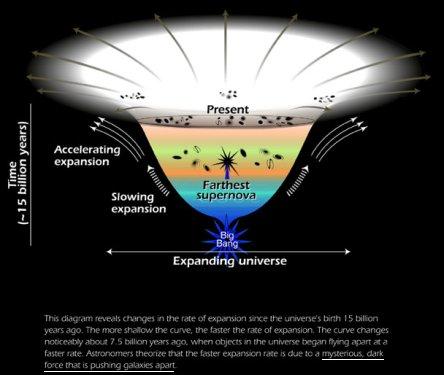
Yes, you got it right: the first picture is a negative image from the original. You may also say that, unlike Chuck Norris, those people at NASA, who offer a meta-observer view on the "expanding" 3-D space, use lots of math, but that doesn't really matter, because the essential similarity is that both images are jokes. Back in 1963, Roger Penrose offered a recipe for reaching infinity from any location in space, which was also a joke, although spiced with lots of math.
............ Here's the problem of "more space". Some prelims from GR textbooks: unlike STR, the spacetime in GR textbooks is considered "dynamical", such that, to follow a well-know metaphor, the "actors" (matter) and the "stage" (spacetime) engage in a non-linear negotiation (Escher's hands): "Space acts on matter, telling it how to move. In turn, matter reacts back on space, telling it how to curve" (John Wheeler). But notice that, unlike GR textbooks, the non-linear negotiation between the two sides of Einstein equation is interpreted here as "taking place" in the global mode of spacetime endowed with additional spatial degrees of freedom from the arrow of space. We all agree that 'time' is no longer a fixed background parameter, but the global mode of time, in which the non-linear negotiation of geometry of spacetime vs. matter "takes place", cannot be read by any wristwatch from GR textbooks. This produces a plethora of "times" in GR textbooks, but "these definitions of time are in general unphysical, in that they provide no hint as to how their time might be measured or registered" (Butterfield and Isham). Here, all these "times" constitute the "eternally present" all time [tau] (Karel Kuchar).
............. To elucidate the second major difference in treating the 'tangent vectors', recall that in GR textbooks you are invited to take the same meta-observer, bird's-eye view on the whole spacetime as in the NASA picture above: to explain the alleged "curvature" of spacetime, "it is easy to see it in a 2-dimensional surface, like a sphere. The sphere fits nicely in 3-dimensional flat Euclidean space, so we can visualize vectors on the sphere as 'tangent vectors'" (John Baez). Then you've been taught by Bob Wald "to work infinitesimally, using the idea that, on sufficiently small scales (this notion certainly needs clarification in the context of Thompson lamp - D.C.), a curved geometry looks very nearly flat (notice the poetry - D.C.). These departures from flatness can then be described via differential calculus. To do so, one begins by introducing the notion of a tangent vector to describe an infinitesimal displacement about a point p ." The major differences to the interpretation offered here are in the following. Regarding John Baez, the local mode of spacetime is not embedded in any "higher-dimensional flat spacetime", but in an infinite-dimensional purely geometric manifold (called here 'global mode of spacetime'). Hence 'the infinitesimal' is indeed equipped with 'tangent vectors', but they all "point" to the global mode of spacetime -- not to the local mode. The new (to GR textbooks) "direction", resulting from the very "expansion" of space due to "dark" energy, is not the mythical foliation time orthogonal to the three Hamiltonian components that are somehow "tangential" to all hypersurfaces (cf. Kiefer and Sandhöfer below).
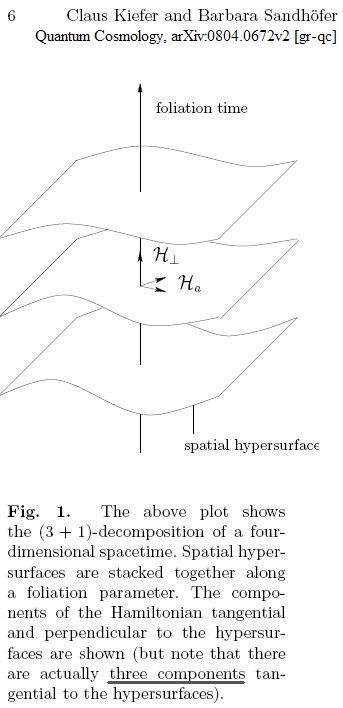
The new "direction" from the "dark" energy is non-existent in ADM presentation, since it pertains to the 'absolute time' of the 'absolute structures'. Small wonder Karel Kuchar couldn't dig it out from present-day GR: you have a plethora of unphysical "times" from the foliation recipe, and no reference fluid (global mode of spacetime), which makes you 'eternity blind' (John G. Bennett). The crucial "direction" of the so-called "expansion" of space due to the "dark" energy from empty space (Lawrence Krauss) requires a brand new dynamics of GR. In GR textbooks, the flexibility of space is limited to its "curvature" only, and, if you manage to compute a linearized snapshot from Einstein's filed equation, you inevitably end up with a frozen "block" spacetime: "There is no dynamics within space-time itself: nothing ever moves therein; nothing happens; nothing changes" (Robert Geroch). Then the new dynamics of spacetime, due to the "dark" energy, can only spring from something "outside" (the local mode of) spacetime. That is, from "outside" both sides in the Einstein equation -- the global mode of spacetime. It literally creates both "more space" (cf. R. Rakhi & K. Indulekha and S. Carroll above) and "more matter".
The proper dynamics of 'GR with DDE' cannot be unitary. Enter the puzzle of "points": the perpetually re-created world of facts (local mode of spacetime) and its ultimate source 'the ideal monad without windows' (Döring and Isham) contain uncountably infinite points ('the set of all sets', maybe). The cardinality of such "set" (if any) is not even aleph-0. Once created by The Beginning, the local mode of spacetime is wrapped by its special "boundaries" (see RSP below), such that the 3-D space of the local mode is de facto infinite (dual age cosmology).
........... NB: These so-called points are a special non-Archimedean entity. It was Lucretius who pointed out the unknown mechanism by which these "points" build up any finite domain of space. The task of revealing some pre-geometric plenum which "connects" these non-Archimedean "points" was missed by Felix Hausdorff and Roger Penrose, to name but a few.
............ On the other hand, the 3-D Flatlanders (local mode of spacetime) will only notice that the two 'ideal endpoints' or "edges" of the local mode of spacetime (denoted with S and L, see below) have acquired some 'numerically finite but physically unattainable values' (one of which is the Planck scale), and will recall the old idea that the universe looks like an unbroken ring with no circumference, for the circumference is nowhere, and the "center" is everywhere. But they will also notice some puzzling "projection" from the dark energy, cast on the 3-D space, just as they can notice, and indeed measure, the "projection" of space curvature, cast on the 3-D space (see Larry Krauss, p. 12). While we don't know the nature of gravity, we are accustomed from GR textbooks to treat it as 'curvature of spacetime', although it shows up more like 'deviation of something from something else that might be "flat" but you can't tell, because you have only one "flat" point'. The "projection" from "dark" energy, cast on 3-D space, is just as weird and misleading as the 'curvature of space', yet it bothers people much more than the puzzling nature of gravity (the latter has to disappear on "points", so you have only one "flat" point as a reference object for "curvature"). People from NASA may ask, what kind of stuff is "expanding", creating the illusion (see also the misleading picture below) about galaxies "running away" from each other, in line with the Hubble Law? Wrong question. In the local mode of spacetime, nothing could possibly "expand" or be "curved". The actual illusion is that something is "expanding" (or "curved"). It is the illusion from NASA's meta-observer view. NB: All such illusions, the absolute structure of space included, should be eliminated by proper relativistic presentations, such that the sole invariant object in space will be an infinitesimal "point". Its 3-D projection or "shadow" does look like a "point", but upon a closer view it unveils its infinite-dimensional nature. The picture below (as well as the one from NASA above) can only be seen by some meta-observer, who can also see the whole universe, and of course count to infinity (like Chuck Norris). The 3-D Flatlanders can't.

Such kind of illusionary "expansion" (much like the "curvature" of space) may be caused by some 3-D "projection" from something, maybe some process or mechanism, which takes place in the global mode of spacetime. How about the old idea of the mutual penetration of the Large and the Small? Perhaps Einstein would only look at my efforts and say ... well, he was a very polite person. But because he also was, on some occasions, driven solely by his personal taste and instinct, rather than sound physical principles [Note 1], let me try to follow his style.
On 21 September 2008, I suggested a scale relativity principle (SRP) aimed at explaining the nature of space (don't confuse it with Laurent Nottale's scale relativity). If we are to think as proper relativists, I believe we should abandon the absolute structure of 3-D space in today's GR [Note 2], and work out new symmetry presentations of The Large and The Small. I also admit that SRP is direct prediction of my theory, hence if it turns out to wrong, so will be my whole project, as started in January 1972. I believe physical objects can be considered "large" bzw. "small" only with respect to the macroscopic length scale of tables and chairs. If a volume of space changes its size toward 'the Large/Small', the metric of space in 'the Large/Small' will be altered accordingly, in such way that the "size" of objects in that sphere or volume will remain unchanged in the volume-determined reference frames of 'the Large/Small', yet will continue to look 'Large/Small' in the initial macroscopic scale frame of classical mechanics. The idea of SRP involves (i) an omnipresent observer (Claudia) endowed with 'the eternally present all time [tau]' (Karel Kuchar), (ii) space inversion producing CPT-invariant presentations of 'volume of space', and (iii) macroscopic observer located at the length scale of classical mechanics, from which the postulated mutual penetration of the Large and the Small starts to unfold. We have three possible views on 'the length of objects' in 3-D space. First, the viewpoint of a macroscopic observer who can simultaneously see (i) 'the Large' as an expanding volume of space, and herself being located inside such expanding sphere, and (ii) 'the Small' as contracting volume of space, and herself being located outside such contracting sphere. Consider a table with length two meters, located inside a sphere with diameter two meters, along with the macroscopic observer inside this sphere. If the table is stretching toward the size of a galaxy, it will look like 'getting larger' to the first observer, but its intrinsic length will always remain "two meters" to a co-moving observer in its scale-dependent reference frame evolving toward 'the Large'. The co-moving observer will never, in no circumstances, register any change of the length of the table, as her metric also expands with the same rate as the expanding table toward 'the Large'. Likewise for the journey toward 'the Small': take the first observer and the two-meter sphere at macro-scale, perform space inversion, and now the CPT mirror image (like turning a rubber glove inside-out) of the macro-observer will find out that she is now located outside a contracting sphere, as the table is now running toward the Planck scale, yet a co-moving observer will again see "her" table as keeping its intrinsic length of 'two meters' in her scale-dependent reference frame toward 'the Small'. This is the 'second view'. And the third view is that of a fixed meta-observer (global mode of spacetime), who will see a table stretched to the size of a galaxy, a table at the initial macroscopic length scale, and a table squeezed to the size of an atom, all of which possessing 'the same UNdecidable (KS-like) length'.
Now, one can offer an operational definition of 'infinitesimal volume of 3-D space' in the local mode of spacetime (in ADM presentation, cf. B. Bolen, it is denoted with ds). Imagine an omnipresent observer being "spread" inside an 3-D Euclidean sphere -- except for the center. She looks at the point-like center of the sphere from infinitely many directions (radii) -- simultaneously. But the center of the sphere is not a bona fide mathematical point -- it is an 'infinitesimal', such that one can treat it as 'the smallest possible rubber glove' and perform CPT space inversion, by replacing (not 'reversing', as in Wu-Ki Tung's textbook, Ch. 11) all "points" inside 'the infinitesimal rubber glove' with all points outside it, that is, with all points of Claudia. Notice that we cannot use quantitative notions like 'more' and 'less' regarding any "number" of points -- neither those of Claudia nor those inside 'the smallest possible rubber glove'. Were the 'infinitesimal' an abstract mathematical point, the operation 'space inversion/replacement' would be impossible, and then there would be two opposite and privileged views on 'the Small' and 'the Large', and the latter would be 'absolute qualities of space', just like in GR textbooks. Thus, an operational definition of 'infinitesimal volume of 3-D space' is that which permits space inversion at (i) the minimal, hence infinitesimal, volume of space (S) and (ii) an arbitrarily large (inverse-proportional to S) volume of space (L). Now an omnipresent observer can simultaneously "see" the very same center of the sphere (infinitesimal volume of 3-D space, S) in a space turned "inside out" as well; one could perhaps say that she is "residing" at two superposed inverted states of 3-D space, as she is able to see both S from L and L from S -- simultaneously. She is not restricted (as we are) to choose one of the 'views'. She is placed at S = L, and is wrapping the whole (seemingly "expanding", according to the first macroscopic observer above) 3-D space en bloc.
............
It doesn't matter whether this shrinking or expanding is (or is not) "accelerated": either way, the "number" of points is a non-Archimedean notion that cannot be subject to quantitative evaluations like 'more' vs. 'less'. What matters is that the good old 3-D space has just been re-created, like a Phoenix Universe, along the arrow of space. The mechanism is the same as in The Beginning, but without the initial "inflationary stage" -- just an elementary step of the arrow of spacetime and an elementary increment of the memory of 'the universe as a brain', which leads to "more points" being emerged in its memory, available to choose from in the next elementary step: the universe only gets smarter, richer in terms of physical content, and more flexible, just like an evolving brain. If some day [John 1:1] decides to halt the arrow of spacetime, the UNdecidable nature of 'the infinitesimal' will be nullified, the Thompson's lamp paradox will suddenly become solvable, the number of "points" will become denumerable (e.g., there will be roughly 1099 "atoms of volume" in every cubic centimeter of space, as claimed by L. Smolin, p. 61), and the 3-D space will cease to exist. From our viewpoint, such development is logically impossible (the vacuum cleaner paradox).
...........
The global mode of time runs simultaneously in opposite directions -- in all possible directions in 3-D space -- which will make her (and ours) unanimated wristwatch dead frozen, like the proper time of a photon "between" emission-and-absorption; see Kevin Brown. (This is the exact meaning of 'Your Global Time is ZERO', which was posted on this web site on March 14, 2004, to commemorate Einstein's 125th birthday; see the atemporal "handshaking" medium above.) Such symmetry over 'space inversion' and the two "superposed" inverted views of Claudia (needed for derivation of three views on 'the length of objects' in 3-D space; see above) reveal the sole invariant object in 3-D space -- the infinitesimal volume of 3-D space, called "point".
........... After this shaky exercise with the sole invariant object in space, called "point", we need to explain the two 'scale factors' (for the lack of better terms), which create 3-D space: S (from Small) and L (from Large). S refers to 'the infinitesimal point', and L to 'the maximal yet finite volume of an ever-expanding 3-D space'. We postulate: LS = 1 . This is the recipe for a natural "boundary" (cf. G F R Ellis' Finite Infinity) imposed on L due to the "extension" of the infinitesimal "point" S . If we think of The Beginning as the case in which L equals exactly S (L = S = 1), we can understand the "inflationary stage" in which a tiny little difference between L and S is being introduced by [John 1:1], after which the two scale factors will run in opposite directions, to produce 3-D space tightly filled -- perfect continuum -- with infinitesimals S and bounded by an "expanding diameter" L . Now Claudia will be placed in the global mode of spacetime -- both inside S and outside L . She will be able to "see" the whole (infinitely-connected, by Claudia) local mode of spacetime en bloc, and her global mode of time will be just like that of our brains: an atemporal and infinite-dimensional "handshaking" medium by which each and every infinitesimal S is simultaneously correlated -- the 'absolute now' of Claudia -- with 'the rest of the universe', as depicted in the Escher drawing below. And since their EPR-like correlation is "spanned over" an infinitesimal "point", in the local mode we will see the blueprint from quantum waves and relic inflationary waves, yet their source will be inevitably "dark". (In order to detect quantum waves "online", one would have to perform a perfect non-demolition measurement avoiding any point-like collapse, by screening the quasi-local wave over extended 3-D domains.) Notice that Escher's hands can be moved only by an arrow of space, not with the kinematics of L and S alone.
Briefly, we can think of The Beginning as some "absolute vacuum polarization" (not necessarily irreversible), and suggest an equation of space:
L = S = 1 (John 1:1 ) --> LS = 1
The equation above contains reference to The Gospel, but I believe St. John wouldn't mind to be removed by those obsessed with different religions, such as anti-theism or "agnosticism" (those who deeply believe, for the lack of scientific proof, that there is nothing to believe in).
In summary, the elementary building block of geometry, presented with a geometrical "point" (explanation and drawings here), is supposed to be 'at the same time' a space-inverted image of 'the whole universe' at L , and vice versa. An omnipresent observer in the global mode of spacetime (the two "superposed copies" of Claudia) will be able to monitor all the "points" in the whole 3-D space en bloc, since it is ONE single object, L = S . Our "Claudia" is nothing but the postulated Aristotelian Connection, which binds all "points" by/via their space-inverted image at the level of ONE (the whole universe at L ).
This is the pre-geometric plenum, which is still missing in differential geometry textbooks. Consider, for example, Chris Isham's Modern Differential Geometry for Physicists, 2nd ed., in which you are advised that the Hausdorff topological space has been somehow "connected" (p. 61, footnote 1; see also Sec. 1.2.1, p. 3, and pp. 59-60 and Fig. 2.1 therein). It is unclear what sort of pre-geometric plenum could do this job. Think of it as 'the universe as ONE', which is being multiplied as infinitely many (uncountably infinite) geometrical "points" ensuing from 'the ideal monad without windows' (Döring and Isham), in such way that all "points" are connected and correlated by/via 'the universe as ONE' at L = S . This is a very old idea 'all is in all', which I am trying to cast in some (relatively) comprehensible relative
scale principle (RSP). There are no "genuine" nor "absolute" dimensions of physical bodies, according to SRP. The spatial relations of 3-D space -- inside/outside and left/right -- should originate from a four-segment "lily" spacetime diagram of the global mode of spacetime (notice the fav icon of this web site). Once such four-segment spacetime diagram is properly constructed (we also have to explain rotation symmetry), we should be able to calculate the cancellation of 'all but one' potential states of quantum-gravitational systems, hence show the correlated states that build up the local mode of spacetime, valid for only one frozen snapshot from Die Bahn. The frozen snapshot from the "film reel" (the arrow of spacetime) will display an already-correlated set of point-like values of all physical variables, in line with the Bootstrap Principle 'think globally, act locally'. The atemporal (with regard to our unanimated wristwatches) correlation "takes place" in Claudia's global mode of spacetime. She is residing in (L = S), and her two "superposed copies", toward L and toward S, contain uncountably infinite "number" of classical-able states from which one correlated and re-created physical universe is being explicated as 'local mode of spacetime': one-at-a-time, along the arrow of spacetime. Notice, however, that the direction of the arrow of spacetime points only and exclusively only to the global mode of spacetime, but the latter is totally hidden in the local mode: the "dark gaps" are completely sealed off by 'the speed of light', rendering the local mode a perfect continuum. Another important feature of SRP is the difference between L and S in their postulated relation LS = 1 : while S is "bounded from below" by a geometric "point", the ever-expanding "horizon" of space is bounded by an entirely different geometric object, which is (sort of) 'inverse-proportional' to a geometric "point". Although the "number" of points needed for L and S to 'pass through' in order to reach the exact relation LS = 1 is indecisive in the local mode of spacetime, there is nevertheless a difference between the "run" toward S and the "run" toward L , which determines the asymmetry of time. After all, in the global mode of spacetime the age of the universe is finite, such that any "run" towards it will have a fixed cut off at The Beginning, while the "end" of the cosmological time is indecisive, which in turn permits the evolution of 'the universe as a brain'. NB: Notice the nature of the cut off toward S : it cannot be reached from within the local mode of spacetime due to the inherent teleological structure of 'the world of facts'. This truly fundamental cut off can only be "seen" from the global mode of 'the whole universe as ONE', hence it is considered to be the Aristotelian First Cause. Its action is called The Aristotelian Connection. It acts without being 'acted upon'. Its job is to cast point-like values of physical quantities at the level of 'geometry' -- the grin of the cat without the cat, as Alice would have said regarding the left-hand side of Einstein equation.
And because The Aristotelian Connection produces not just one "point" (as in the Thompson Lamp paradox) but an infinite "number" (uncountably infinite) of such purely geometrical "points" -- simultaneously, with zero duration according to your wristwatch -- it connects these "points" of the local mode of spacetime as a pre-geometric plenum. It is also the ultimate 'chooser' of particular physical content that would belong to particular geometrical "point": due to the correlation and negotiation (cf. Escher) in the global mode of spacetime of all potential physical content available to the local mode, the 'chooser' of the particular physical content specifying any particular "point" is 'everything else in the universe'. The end result is the cancellation of 'all but one' state from the spectrum of potential states available to the particular "point" to choose from, and we get the local mode of already-correlated facts -- one-at-a-time, along Die Bahn (the arrow of space). Nobody and nothing "plays dice" here: God casts the die, not the dice. The inherent flexibility (not "uncertainty") of all spacetime points to get dressed with specific physical content is like the flexibility of the human arm to perform any movement. Surely there are constraints, boundary conditions,
conservation laws, etc., yet the flexibility of all "points" to choose from their quantum-gravitational spectrum of potential states (God's "die" or rather 'matrix') can never be reduced to zero. For example, Heisenberg's relations can be interpreted as the flexibility of a quantum particle to choose from a spectrum of potential states: if its potential states regarding its next 'position' get shrunk, it will have a corresponding larger spectrum of potential states regarding its next 'momentum' to choose from. Of course, if you "filter" this quantum flexibility through the spacetime of STR, you may claim that it is impossible for a quantum particle to possess simultaneously point-like values of "complementary" observables. But again, these values need not be point-like. They can be perfectly well-defined yet quasi-local. The idea of 'wave-particle dualism' may be correct for QM measurements, but nobody knows, for example, how would an electron look like in an intact quantum world: if it is not forced to behave like a point-like particle since it isn't being "observed" at the length scale of tables and chairs, how would its "wave" look like? Perhaps the quantum "wave" of an intact electron pertains to its quantum flexibility. Going back to the pre-geometric plenum: perhaps the asymmetry of time is determined by the asymmetry of space, namely, by the difference between the two "runs" toward L and S , bounded by their relation LS = 1 . All efforts to derive the fundamental asymmetry of time from some physical stuff or 'entropy' are doomed to fail, because such fundamental feature of spacetime can only be determined by 'the grin of the cat without the cat'. Also, our wristwatches [Note 3] are perfect examples for quantum-gravitational measuring devices, as they can in fact read one 'dynamical instant' from Claudia's absolute time since The Beginning, but because we can "look" at this dynamical instant only with a physical "torch", we inevitably see a dead frozen snapshot, as explained eloquently by Robert Geroch. Everything said here pertains only to the kinematics of spacetime; to obtain its dynamics (the arrow of spacetime) we need to include the Aristotelian First Cause "by hand", because nothing in this purely kinematical structure can or should point directly to God. In modern parlance, SRP is expected to "suffer" from Gödel's incompleteness theorem, but because of the fundamental nature of SRP, the additional elements in it, which belong to some 'meta theory', will inevitably come from 'outside science'. To be specific, the introduction of Aristotelian First Cause "by hand" means endowing the universe with the faculty of self-acting: just like the human brain (we think about our brain, with our brain), the universe modeled as a 'brain' should have the faculty of acting on itself, but no physical path toward 'the acting mind of God' (such path may show up with math only) should show up in quantum gravity. Perhaps some of those "agnostic" people may prefer to call Him "dark" -- I don't mind; we all enjoy His gift called free will.
More in my talk in November 2015. Just a hint: look at Fig. 2 in the note about Die Bahn above. The direction of w is "dark" to the local mode, and the gravitational effects (global mode) should have 3-D presentations (e.g., the so-called "curvature") in the local mode (Fig. 1). If some day we find out that the origin and the mechanism of inertial reaction "forces" are indeed produced by the gravitational potential reality, perhaps we will explain the most difficult puzzle: the asymptotically flat space of the local mode of spacetime, produced by the two tug-of-war components of gravity at cosmological scale: CDM and DDE. Perhaps at the largest length scale, L , the "dark" geometrical effect from the global mode makes the 3-D space of the local mode 'asymptotically flat'. However, given the basis relation LS = 1 , an absolute flat and absolute infinite 3-D space would require some mathematically unclear state {S = 0 , L = [inf]} : the two symmetry axes of the infinitely-inflated sphere and torus will coincide, along with their centers (check out a story about a screen saver in Windows 98 here). I intend to argue, in November 2015, that the topology of the local mode of spacetime is being dynamically fixed as 'asymptotically flat' at each and every step of re-creation of the local mode (cf. Die Bahn above), by "passing" through such mathematically unclear state that is neither sphere not torus anymore. Stated differently, I suppose there exist two asymptotical "boundaries" on what looks like an 'asymptotically flat 3-D space': a 3-D sphere and a 3-D torus with the largest possible radii, L , "between" which a mathematically unclear (and purely theological) state is quietly residing. All this will be a sequence to my previous talk in September 2008. As to the "expansion" of space depicted in the drawing from NASA, perhaps the projection of the metric in 'the Large' onto the macroscopic scale produces the illusion to the 'first observer' (cf. above) of some "expanding universe". Again, according to
RSP, the "expansion" is not caused by any physical stuff. It is an illusion of some "expanding" metric, which can be seen only by the 'first observer'. As suggested above, the cosmological horizon is 'ever expanding' along the arrow of spacetime, while the Planck scale is fixed. That is, the 'infinitesimal' is fixed (bounded from below) by some 'numerically finite but physically unattainable' values that do not change (e.g., the Planck length), while the 'maximal volume of space for gravity' (L) increases with the age of the universe, like an expanding horizon "bounded" by an ever-sliding L : Panta rei conditio sine qua non est.
By the way, have you seen an UFO with your very eyes? If these guys can switch off the inertial reaction "forces", perhaps they can fly effortlessly, much like we move our thoughts. And if they can modulate the metric of space, perhaps they can make their pathway in the whole Milky Way just "two meters". From their perspective, they will indeed fly 'two meters', while the space will be "running towards them". Perhaps in such altered-metric space they fly literally 'from point to point', and with a very low speed of, say, just 2 m/s, as recorded by their wristwatch.
Wilbur B. Smith: "... to produce the gravity differential, the time field differentials which were necessary to operate the ship."
I wish I knew what is 'space' [Note 4]. There is so much latent energy packed in the quantum vacuum. Perhaps all we may need is access to the global mode of spacetime. The whole
RSP may sound unclear and farfetched, but recall Christopher Columbus: If we don't leave for India, how can we discover America?
D. Chakalov
February 18, 2010
Latest update: August 2, 2010
Note 1. In a letter to Paul Ehrenfest from 4 February 1917, Einstein wrote about his 'cosmological constant':
"I have again perpetrated something relating to the theory of gravitation that might endanger me of being committed to a madhouse." (Ich habe wieder etwas verbrochen in der Gravitationstheorie, was mich ein wenig in Gefahr bringt, in ein Tollhaus interniert zu werden; English translation by N. Straumann).
Note 2. Recall Einstein's opinion of his theory:
"The right side (the matter part) is a formal condensation of all things whose comprehension in the sense of a field theory is still problematic. Not for a moment, of course, did I doubt that this formulation was merely a makeshift in order to give the general principle of relativity a preliminary closed expression. For it was essentially not anything more than a theory of the gravitational field, which was somewhat artificially isolated from a total field of as yet unknown structure."
Note 3. The problems with 'time in GR', the paradox of time in canonical quantum gravity (Karel Kuchar), and the puzzle of so-called "dark" energy from empty space stem from the absence of the arrow of spacetime in present-day GR. On the one hand, our mischievous wristwatches do in fact read the arrow of spacetime as a "chain of points", as they "filter" only one of the infinitely many "dynamical points" from the global mode of time, and read these filtered points "one-at-a-time" along the "vertical skewer" of the arrow of spacetime (global mode of time), on which all "horizontal snapshots" are stacked. On the other hand, in order to "look" at this arrow with physical (unanimated) devices, we can only use a "torch", which kills the arrow, and shows only one frozen "point" fixed by the calculated values of physical quantities at this dead frozen "point". And here people like Robert Geroch say -- let's try to solve the Einstein field equations, starting from this well-calculated frozen "point", and then move the (canonical) data only on this "horizontal" set of such "points", and end up with the insurmountable Cauchy problem for the Einstein equations. Why? Because the genuine dynamics of GR ain't there (Stanley Deser will undoubtedly disagree).
Note 4. "In the first place, we entirely shun the vague word "space," of which, we must honestly acknowledge, we cannot form the slightest conception."
Albert Einstein, Relativity: The Special and General Theory, 1920
---------
P.S. Nobody has so far asked, what is the meaning of the phrase 'Your Global Time is ZERO'. The sole question from the readers of this web site has been, 'why don't you publish all this in a book, to explain your ideas' (or something similar). The criticism is fully justified: reading my web site is anything but fun. I am considering writing a book, but it will be intended to kids age 15+, and will have to be complemented by a
DVD with video lectures, to explain the crux of the idea about 'the universe modeled as a
brain'. Why kids? Because the future belongs to them (I will soon hit 58, Deo volente). My work on quantum gravity concerns very few people, all of whom have this utterly negative attitude of 'the worst of criticism is neglect'. Just a few examples: the last time I heard from Claus Kiefer was in 2003, only to tell me that he can't open the CD ROM I sent him by surface mail, because all computers at the University of Cologne run on Unix. The last time I heard from Karel Kuchar was on 8 Jan 2003, and from John Baez on 14 Jan 2002. The case with Chris Isham was even worse. And look what happened with my talk in 2008. Thinking about the future, I can imagine only two developments regarding
RSP. One possible case will be that it is just crap and delusion, so obviously wrong that none of the renowned experts made the slightest effort to show my stupid dilettante errors. Will see. Planck's Law of Thermal Radiation was met with very nasty attitude by the established scientific community [Note 5], as it literally blew away their comfortable world. If
RSP turns out to be correct, it will cause far more "damage" to many established scholars studying canonical quantum gravity and "gravitational wave astronomy" (at least 679; see also [Note 6]). But could
RSP be correct, really? Well, as I mentioned previously, the two rules for success are:
Rule #1: Never tell them everything you know. And nobody is curios anyway. (For those who are: I believe
RSP, embedded in an arrow of spacetime, offer the only possible solution to the mind-brain problem -- the mind has to be both detached from matter, to preserve its ontologically different nature, and linked to it, in order to communicate with its brain via the bi-directional "talk" depicted in the Escher drawing above.) Therefore, there is no need to use paper -- everything I need to say is, and always will be posted at this web site, available to anyone interested. If some day it turns out that
RSP in 'the arrow of spacetime' had hit the right track toward quantum gravity, I suppose people will be interested to explore it (see the download link above). Besides, we don't live in 18th century: "When this lowly chap informed the Lucasian Professor of Mathematics that he had formulated the inverse square law of gravitation years before the publication of Principia, Newton is said to have flown into a rage. The two had already sparred over their optical theories, and when Newton took over as president of the Royal Society in 1703 (the year of Hooke’s death), he began erasing all traces of Hooke. Famously, he tossed the only contemporary portrait of Hooke onto a fire."
D. Chakalov
February 26, 2010
Last update: March 2, 2010
Note 5. Max Planck, Philosophy of Physics, W.W. Norton and Company, New York, 1936, p. 97:
"An important scientific innovation rarely makes its way by gradually winning over and converting its opponents: it rarely happens that Saul becomes Paul. What does happen is that its opponents gradually die out and that the growing generation is familiarized with the idea from the beginning: another instance of the fact that the future lies with youth."
Note 6. B F Schutz, Mathematical and Physical Perspectives on Gravitational Radiation, August 2, 2002.
Snapshot at 00:04:20 from video.wmv (156 MB)
p. 1: "Equivalence principle implies no local definition possible in any situation: must attempt "regional" definition in regions at least as large as a wave-length.
p. 9:
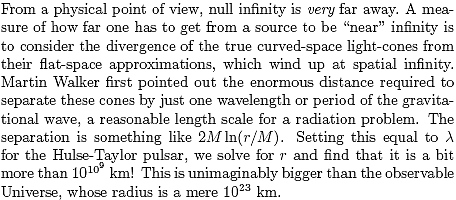
p. 10: "A more elegant and potentially powerful scheme is to incorporate conformal techniques to bring null infinity to a finite point on the grid (emphasis added - D.C.), then can incorporate infinity into the computational domain (Friedrich, Husa, Lechner, Frauendiener all attending this meeting)."
-------- Comment: I highly recommend B. Schutz' video lecture and manuscript to all Jehovah's Witnesses of Gravitational Astronomy. Compare it to B. Schutz' article "Gravitational Radiation", gr-qc/0003069 v1. More here. D.C.
March 3, 2010
Subject: Re: What, then, are Qbits good for?
Date: Tue, 11 Oct 2011 20:43:18 +0300
From: Dimi Chakalov <[email protected]>
To: N David Mermin <[email protected]>
Cc: Charles H Bennett <[email protected]>,
[email protected],
[email protected]
David:
RE my email from Mon, 22 Jul 2002 20:05:22 +0300: I quoted your viewpoint on KS Theorem at
http://www.god-does-not-play-dice.net/#Cecilia
You acknowledged in arXiv:quant-ph/0305088 that your "computer science students know very little physics". I am sure you know a bit more quantum physics than your students, and will be able to understand the argument at the link above, which answers the question in the subject line as well.
Take care,
Dimi
====================================
Subject: The Kochen-Specker state
Date: Wed, 3 Mar 2010 03:20:42 +0200
Message-ID:
<[email protected]>
From: Dimi Chakalov <[email protected]>
To: Michael H Freedman <[email protected]>
Cc: Parsa Bonderson <[email protected]>,
Chetan Nayak <[email protected]>,
Sankar Das Sarma <[email protected]>
Dear Dr. Freedman,
I wonder if you could help me understand the topological nature of Kochen-Specker state,
http://www.god-does-not-play-dice.net/#KS
It seems to me that this UNdecidable state is protected from "decoherence", simply because it cannot reside in any Hilbert space. It isn't "observable", nor is computable in the sense of Turing (Topological Quantum Computation, 80.pdf). You can grasp it with your brain only.
May I take this opportunity to invite you and your colleagues to join our efforts toward a new relativity principle, outlined at
http://www.god-does-not-play-dice.net/#quiz
Kindest regards,
Dimi Chakalov
-------
Note: Michael Freedman posted today (November 4, 2010) the 16th version of "Quantum Gravity via Manifold Positivity", arXiv:1008.1045v2 [quant-ph], in which he tried to obtain the dimensionality of space from the notion of 'empty set', and suggested a fleeting "pre-time" (ibid., p. 8). The latter emerges here from AOS. Notice that the UNdecidable Kochen-Specker state at the first link above is a bona fide empty set from the viewpoint of its observed/actualized "projections" (if you like non-linear modifications of QM, try to attach this particular "empty set" to the manifold of states in geometrical formulation of QM). To cut the long story short, "quantum computing" is impossible, even if it is "topological" and supported by Microsoft. Look again at the "general principle" in R.I.G. Hughes, The structure and interpretation of quantum mechanics, p. 77:
Firstly, this "general principle" does not apply to the case of UNdecidable, not-yet-physical, KS state, as explained by R.I.G. Hughes here. Secondly, because in QM we're dealing with operators, we cannot even imagine that some dynamical variable labeled with the anti-relativistic and "ideal Schrödinger time" (Jorge Pullin et al.) could possess some pre-existing values, like those we attach to each point of phase space in classical mechanics. Hence it is manifestly pointless to hope that we could control any of those quasi-local dynamical variables from the length scale of tables and chairs -- especially the Kochen-Specker state.
Now, if we look at GR, we have a similar puzzle with the equally incomprehensible "proper time τ " (Carlo Rovelli), in the sense that our wristwatch does read a continual line (1-D Euclidean space) of already linearized snapshots from the initial "proper time τ ". Looks like something is doing a linearized and flattening "collapse" of the "proper time τ " at each and every "sufficiently small" (Einstein) region of the points from our 'time read by a clock'. Hence the confusion in GR. Not surprisingly, Mike Freedman didn't respond to my email (nor mentioned my efforts at the second link above). Due to the lack of interest, I will only reiterate the startling characteristic feature of 3-D space: finite things. If you wish to explain an elephant, all you need is to "obtain" its unique trunk; likewise finite things for 3-D space. Details in my note on quantum gravity below. No other choice for self-wrapping of space and self-connecting of spacetime "points" seems possible. But first, one needs to identify an “instant”, such that it can be (i) “multiplied” and (ii) “ordered in time”, with “duration” equal to the infinitesimal separation of these instant(s), or rather one-multiplied-instant. More in Sec. Summary, pp. 35-36 from ExplanatoryNote.pdf. All this is a tentative answer to Michael Teller's question (The Sunday Times, March 13, 2008): So long as the Universe had a beginning, we can suppose it had a creator. But if the Universe is really completely self-contained, having no boundary or edge, it would have neither beginning nor end: it would simply be. What place, then, for a creator? Well, if The Universe does work like a brain, perhaps we may wish to consider an entity resembling our mind and consciousness. Say, [John 1:1]. Is the all-mighty Microsoft interested, I wonder.
D.C.
November 4, 2010
Last update: November 5, 2010 ======================================
Subject: Quantum gravity
Date: Sat, 20 Feb 2010 06:35:23 +0200
From: Dimi Chakalov <[email protected]>
To: Chris Isham <[email protected]>
Cc: Jeremy <[email protected]>
Hi Chris,
Over seven years ago, on Wed, 23 Oct 2002 19:24:15 +0100, you boldly declared the following:
"You do not know enough theoretical physics to help with any research in that area."
You haven't so far produced any evidence in support of your claim.
My latest proposal can be read at
http://www.god-does-not-play-dice.net/#quiz
Prelims from KS Theorem at
http://www.god-does-not-play-dice.net/#KS
I respectfully urge you to defend your (immensely insulting) claim from Wed, 23 Oct 2002 19:24:15 +0100. Just show me my errors.
As ever,
Dimi
=============
Subject: RE: Update?
Date: Fri, 12 Oct 2007 15:14:09 +0100
Message-ID:
<[email protected]>
From: "Isham, Christopher J" <[email protected]>
To: Dimi Chakalov <[email protected]>
[snip]
> unfortunately, your current mode of writing suggests to everyone that
> you are just another crank.
[snip]
=====================
Comments on Chris Isham's opinions
Look at the following statement, from Stephen Hawking's "Grand Design" (to be published on September 9, 2010): “Because there is a law such as gravity, the Universe can and will create itself from nothing. Spontaneous creation is the reason there is something rather than nothing, why the Universe exists, why we exist. (...) If there are trillions of universes as M-theory proposes, that luck and probability are enough to make our existence feasible, so no God was needed.” Ignore the second and third sentences (spontaneous creation of an infinite multiverse doesn't make sense at all, or implies a very dumb and sloppy god). How many factual and logical errors can you identify in the first sentence? I think our understanding (S. Hawking, C. Isham, and myself included) of gravitation and the origin of inertia resembles my wife's knowledge in electricity, as she can comprehend Ohm's Law only by some analogy of water running in a flexible hose. As to Hawking's conjecture about "singularity", it was formulated as a theorem many years ago, and only after very specific and crucial presumptions, which do not hold in a world dominated by [we-do-not-know-it]. Yet Chris Isham will always praise his colleague, Stephen Hawking, and will never expose the factual and logical errors (non sequitur) in the first sentence above. Moreover, if the so-called Arrow of Space is correct, both his theory and Stephen Hawking's "Grand Design" will be wrong.
But let's see the main ideas in the toposification of Quantum Theory, proposed by Chris Isham. According to Gerard 't Hooft, “Isham believes another mathematical language may help, but I don’t think so. It sounds a bit as if describing the world in German is better than in Chinese.” Well, at least the "German" approach emphasizes on KS Theorem, which is usually obscured in the mainstream "Chinese" version of QM.

Chris Isham: "The interesting question really is, what do you mean by time?"
Isham believes that "every physical system, from atomic particles to the universe as a whole, can be viewed through different topoi" (source here), and suggests the notion of ‘pseudo-state’ (Würst); see Slide 28, from his January 2008 lecture "Topos theory in the formulation of theories of physics", http://www.comlab.ox.ac.uk/conferences/categorieslogicphysics/clap1/clap1-chrisisham.pdf From Heidegger’s perspective, there is ‘no way things are’ in QM (Slide 13). My objection is not against Chris Isham's opinion but to its implementation: all topoi he can possibly design cannot exhaust/fully describe the "quantum trunk" rooted on 'the ideal monad without windows', because we are dealing with a new form of reality (dubbed 'potential reality'), which resembles Leibniz' monads and our cognitive structures, in line with 'the universe modeled as a brain'. One important implication is that, on the one hand, the truth value associated with 'potential reality' is definitely YAIN -- not 'somewhere in between true or false' -- but on the other hand, Heidegger’s "things" are being explicated (as 'shadows on Plato's cave') in the quantum realm as reality 'out there' with unit probability, and their lifetime in the instant 'now' from the Arrow of Space is infinitesimal -- just a "point" from the continuum along the w axis (cf. Fig. 2). Thus, we need two modes of spacetime, a global mode for 'potential reality' and a local mode for its fleeting explications along the Arrow of Space. Chris Isham is trying to place everything in one pot, while I separate them from the outset, and claim that their apparent fusion is due to the so-called speed of light, because the duration of their separation, in the local mode of spacetime, is zero.
We have a perfect continuum of such explicated things -- one-at-a-time, along the Arrow of Space -- in the local mode of spacetime, at all length scales. This is an absolute instant 'now' (cf. Isham's question above) from the Arrow of Space. It isn't physical, but looks like a transcendental tachyon, which is absolutely everywhere at 'no time' and at all length scales. It builds up the cosmological time and should not be 'GR observable', yet your wristwatch does indeed read it -- check out Luca Lusanna and the bewildered Tom Thiemann here. The paradoxical situation is that I am strictly following Chris Isham's path to quantum gravity, announced in 1993. In my opinion, I am more 'Chris Isham' than he currently is. All differences boil down to the way he and I understand the continuum hypothesis and the quantum of action: dead matter makes quantum jumps; the living-and-quantum matter is smarter. This is the motto of my web site, since July 1998. Let me try to explain it, by offering my version of 'the quantum principle'. Then I will try to answer the question about time posed above. In simple words, the quantum principle is based on the Bootstrap Principle and the rule 'think globally, act locally'. It postulates the rules of the infinitesimal displacement of physical stuff in space and time, along the continuum of events produced by the Arrow of Space (bzw. arrow of spacetime): no "uncertainties" nor "quantum jumps" (verdammte Quantenspringerei, Erwin Schrödinger) exist in the quantum realm. We have continual trajectories of individual quantum particles, as well as emergent geodesics. The stochastic "quantum jumps" are artifacts from the measuring devices at the scale of tables and chairs. If you examine the Gedankenexperiment with four dice, you will see that the transition from any n-state of the dice to the next n-state is perfectly continual in the local mode of spacetime: the duration of the EPR-like correlation "in the air" is zero in the local mode comprised from such n-states. The same holds for the emergent geodesics: the duration of the matter-geometry talk "takes place" in the global mode, at the interface of the non-Archimedean (geometrical) and Archimedean (physical) worlds, hence its physical duration in 3-D space (local mode) is zero. QM and GR are unified from the outset. Simple, no? NB: If this quantum principle is correct, all other approaches to quantum gravity (Steven Carlip and Claus Kiefer included) must necessarily be wrong. As to the question by Chris Isham above: 'time' is provided by the absolute clock of the Arrow of Space, which is external to all physical systems, yet is also "inside" each and every physical system, as it operates in the non-Archimedean realm of 'potential reality'. This absolute clock reads an infinite-dimensional time, which coincides with 'the time read by your wristwatch' (the dualist conception of time) only in the instant 'now' in which the global mode is being "flattened" to the local mode. Of course, there is no way to find out if someone has found 'the right track', but at least I can think of QM & STR and the cosmological "constant", regardless of Chris Isham's opinion on my intellectual abilities and knowledge in theoretical physics. As I'm still learning, since January 1972, perhaps some day I could say more on "the bridge"; check out the current version of my note on GWs at http://www.god-does-not-play-dice.net/ExplanatoryNote.pdf What looks really impossible, I'm afraid, is some day Chris Isham to defend his insulting claim from 23 October 2002. No way. He will keep quiet, and will praise Stephen Hawking. Apart from that, I must acknowledge that Chris Isham is a very nice person. We met on November 13, 1998, and had many discussions in his Office. At our last meeting on March 9, 2006, he offered me a cup of tea, which was delicious.
"just another crank" D.C.
September 3, 2010
Last update: September 7, 2010
=========================
Subject: Andreas Döring (23 August 2008), Tutorial on Conceptual Issues of Quantum Theory, 1:32:40 - 1:33:00
Date: Sat, 13 Nov 2010 04:55:35 +0200
From: Dimi Chakalov <[email protected]>
To: Andreas <[email protected]>
Cc: Jeremy <[email protected]>,
Chris Isham <[email protected]>
Andreas Döring (23 August 2008), Tutorial on Conceptual Issues of Quantum Theory
http://www.comlab.ox.ac.uk/quantum/content/0808001/
Slide 40, "A contextual theory would allow the value assigned to some operator  to depend on the context considered."
http://www.comlab.ox.ac.uk/quantum/talksarchive/clap3/clap3-andreasdoering.pdf Andreas Döring, 1:32:40 - 1:33:00: "I must really admit it is not clear to me how much sense this could make."
-------
Hi Andreas,
On Friday, 13 November 1998, I met Chris in his Office and suggested to explore the correct _context_, as used by the human brain,
http://www.god-does-not-play-dice.net/#Reznikoff
http://www.god-does-not-play-dice.net/#Specker1
Twelve years later (13 November 2010), he still has not used his brain to check up my proposal, but is trying to place everything in one pot (Eintopf gemacht), as I wrote at
http://www.god-does-not-play-dice.net/#time
I trust you can do better -- no topos nor tensors,
http://www.god-does-not-play-dice.net/#XXX
If you're interested, feel free to write me back.
Regards,
Dimi
===============================
Subject: Translocal connections beneath the smooth surface of classical spacetime
Date: Wed, 8 Sep 2010 20:45:13 +0300
Message-ID:
<[email protected]>
From: Dimi Chakalov <[email protected]>
To: Manfred Requardt <[email protected]>
Cc: Petr Hajicek <[email protected]>,
Abner Shimony <[email protected]>,
Wojciech Hubert Zurek <[email protected]>,
Willem M de Muynck <[email protected]>,
Jeremy <[email protected]>,
Chris Isham <[email protected]>,
Dorje Brody <[email protected]>,
Sergio Doplicher <[email protected]>
Dear Manfred,
I hope you can recall my email from Tue, 02 Sep 2003 15:51:53 +0300, regarding your arXiv:gr-qc/0308089v1 (cf. the subject line). Seven years later, I still don't know your viewpoint on the measurement (macro-objectification) problem and the clash of QM with STR (Abner has written a lot on this issue).
In your latest arXiv:1009.1220v1, you offered an alternative to the decoherence/einselection mess from Zurek, but the crux of the task has not been addressed: how do you reconcile QM with STR (Special Theory of Relativity)?
STR (Minkowski spacetime) requires 'objective reality out there', while QM explicitly denies it:
"In general, a variable has no definite value before I measure it;
then measuring it does not mean ascertaining the value that it has."
This is the famous quote from Schrödinger at
http://www.god-does-not-play-dice.net/#KS
In the case of STR, consider an example with the Sun:
1. If you look at it, you will see/observe a state of the Sun, which has been *real* 8 min prior to the instant of your observation.
2. At the *very same instant* of your observation, the Sun does possess a real state 'out there', which will be available to you for observation/recording after 8 min.
This is the meaning of 'objective reality out there'.
In order to reconcile QM with STR, we need 'reality out there', as suggested at the link above. Just drop "objective" and replace it with "potential".
As a bonus, I get your "translocal connections beneath the smooth surface of classical spacetime" (although not from your approach, of course), without any spukhafte Fernwirkungen or Gespensterfelder, plus much more,
http://www.god-does-not-play-dice.net/#Levi_Civita
Please tell me if you can do better.
I extend this request to all your colleagues.
Kindest regards,
Dimi
-------
Note: The so-called PR2 interpretation of QM stands for (potential reality) & (proper relativistic) interpretation1. It explains smooth bi-directional transitions between the classical and quantum realms, does not treat the former as some "limiting case", resolves the temporal solipsism of QM and recovers Bells' aether, and explains the actualization of potentialities as a relativistic process, in line with 'the quantum principle'. As a bonus, you get the physics of the human brain and all living creatures, without any "psi-fields" or other parapsychology: click on the smiling cat above. Or don't. It's your free will choice, in line with the PR2 interpretation of QM. I'm just a psychologist, don't need quantum gravity. Even if someone explains the origin of inertia and sorts out the quantum vacuum energy with exact equations, all this will be redundant information, just as I don't need to know the exact biochemistry of food processing in order to enjoy a beef steak, say. Does a fish need a bicycle? D.C.
September 8, 2010
Last update: September 30, 2010
J. S. Bell, Quantum mechanics for cosmologists, in: Speakable and unspeakable in quantum mechanics, 2nd ed., Cambridge University Press, 2004
Ch. 15, p. 136: "(W)e have no access to the past. We have only our 'memories' and 'records'. But these memories and records are in fact present phenomena. (...) The theory should account for the present correlations between these present phenomena.
....
"The question of making a Lorentz invariant theory on these lines raises intriguing questions. For reality has been identified only at a single time."
-------
1 The 'proper relativistic' interpretation of QM resolves the following problem, from Dah-Wei Chiou: "The seemingly puzzle is analogous to the Einstein-Podolsky-Rosen (EPR) paradox, in which a pair of entangled particles are measured separately by Alice and Bob. In the context of special relativity, if the two measurements are conducted at two spacetime events which are spacelikely separated, the time-ordering of the two events can flip under a Lorentz boost and thus has no physical significance. Alice and Bob can both claim that the entangled state is collapsed by her/his measurement and thus have different knowledge about what the physical state should be (should have been - D.C.), yet the predictions by Alice and Bob are consistent to each other." The UNdecidable state of the entangled/superposed "particle" (never in plural) exist as 'potential reality out there', and can always be traced back to the past light cone of both Alice and Bob -- retrospectively, after their "observations". Neither the "time-ordering" nor the "different knowledge" about what 'the physical state' should has been have any significance whatsoever to 'the base state', since the latter is omnipresent and can never be "collapsed". It is the 'back bone' along which Nature (not QM textbooks) has worked out smooth bi-directional transitions between the classical and quantum realms. Simple, no? Well, Manfred Requardt doesn't like it, for reason he never explained. Anyway.
===============================
How wonderful that we have met with a paradox.
Now we have some hope of making progress.
Niels Bohr
Note: Please read Ernst Specker's 1960 article and notice [Ref. 1] above. To explain the seemingly mundane notion of 'counterfactual definiteness' from QM textbooks, and then compare it with the brand new situation introduced with KS Theorem (usually not covered in QM textbooks), consider an entangled quantum coin, which is being flipped "in the air". Upon landing on the floor (Hilbert space), there are "two" (in fact, one) observer(s), Alice and Bob, such that Alice can record the entangled quantum coin by viewing it 'from the bottom up', while Bob can see it only 'from above'. In such highly contrived Gedankenexperiment, Alice will know that if she observes 'heads', in the very same instant Bob should have seen 'tails' -- after all, it's one coin. Alice will also suppose that, by virtue of 'counterfactual definiteness', it is meaningful to ask: what would I had seen had Bob actually saw 'heads'?
I will spare the reader the usual excursion to Bell's theorem, EPR argument and its inevitable pitfalls (e.g., "quantum correlations happen without any time-ordering", and "nonlocal quantum correlations seem to emerge, somehow, from outside space-time", Nicolas Gisin), and will only stress that Alice&Bob are confined in the Hilbert space, hence can never "see" the quantum coin "in the air". The UNdecidable KS state shows up only in KS Theorem. Look carefully at R.I.G. Hughes, p. 164, and notice the difference between the geometrical presentation -- in the 3-D space of the macro-world of tables and chairs -- of spin-1 vs. spin-1/2 systems. In the latter case, the component of the spin per se (a bare finger nail, cf. 'KS Theorem for teenage girls' above) can choose from two alternative observable values, either +1/2 or -1/2, both of which can be accommodated along one axis from 3-D space -- all they need is to choose a "diametrically opposed direction" (ibid.) along that same axis in 3-D space. Therefore, in the case of spin-1/2 systems, the UNdecidable KS state need not, and hence does not show up -- the 3-D space does not force it to reveal all of its contextualized classical-able states. Not so in the case of spin-1 system: the square S2 of any component of spin can take three values -- 1, 0, -1 -- which in turn requires all three axes of 3-D space. In other words, even one square S2 will invade/require all available geometrical degrees of freedom provided by 3-D space -- the classical "filter" for contextualized classical-able states. Now, Kochen and Specker have shown that, if you consider any triple of such squares S2 , each of which requiring the three mutually perpendicular directions in 3-D space (cf. Eq. 2.8 on p. 17 from C. Isham's textbook here), the statistical interpretation of QM would imply that you will always find out that "two receive value 1 and the third 0" (ibid.), similarly to the case of 'counterfactual definiteness' from QM textbooks. But the statistical interpretation of QM turn out to be wrong, as anticipated by Erwin Schrödinger in November 1950. You can't have all the contextualized classical-able states in such {1,0,1} pattern, as proven by KS Theorem. Some of them will always and inevitably fail to comply with your (biased) expectation for "an unequivocal true-false value", as explained eloquently by Isham and Butterfield, p. 3 (see the excerpt above), and will have to be shifted into the UNcolored section from KS sphere (Helena Granström, p. 2). Hence my interpretation of the UNdecidable KS state above. There is no backward causation nor retrocausality, because 'potential reality' does not live on the local mode of spacetime (cf. Fig. 1 above), hence can act as Reichenbach's Common Cause Principle and Leibnitz' harmonia praestabilita along the arrow of spacetime (cf. the proposal for
biocausality). Notice also the logic of propositions regarding the "content" of potential reality, encapsulated with a single YAIN, and compare it to the topos approach by Chris Isham above. I firmly disagree with the opinion in Wiki that KS Theorem (details in Mladen Pavicic et al., cf. p. 8 and p. 17) were some "complement to Bell's theorem". The latter theorem is based on counterfactual "reasoning", which might eventually be made clear and conclusive only in classical physics. Regarding Bell's Theorem, Tim Palmer rightly noticed that (p. 7) "in order to establish Bell’s theorem, we need to consider correlations between pairs of measurements when the magnets have different orientations, let’s say n for the left-hand magnets and n' for the right-hand magnets. It is also necessary to assume that it is meaningful to ask: what would the spin of a left-hand particle have been had we actually measured it with magnets oriented in the n' direction (or, conversely, what would the spin of the right-hand particle have been had we actually measured it with magnets oriented in the n direction)?" Counterfactual "reasoning" is a recipe for parapsychology. More from Charles Tresser, Sec. 5. There is no counterfactual "reasoning" in KS Theorem, ladies and gentlemen. Quite the opposite. Check out Ernst Specker above. In summary, all quantum, as well as all gravitational "states" are contextualized quasi-local explications from their potential-reality state (never in plural): check out Fig. 2 above. Any comments? Please don't hesitate, like Chris Isham and his
PI colleagues. D.C.
April 23, 2010
Last update: October 11, 2010 =====================================
Subject: How to falsify "decoherence" (if any)
Date: Mon, 11 Oct 2010 20:35:51 +0300
Message-ID:
<[email protected]>
From: Dimi Chakalov <[email protected]>
To: Zeh <[email protected]>,
Claus Kiefer <[email protected]>,
Wojciech Hubert Zurek <[email protected]>,
Jonathan Halliwell <[email protected]>,
Chris Isham <[email protected]>,
Larry Horwitz <[email protected]>,
Friedrich W Hehl <[email protected]>,
Martin Plenio <[email protected]>,
Stefan Wolf <[email protected]>,
Friedemann Mattern <[email protected]>,
Thomas Gross <[email protected]>,
Markus Püschel <[email protected]>,
Dongsheng Wang <[email protected]>,
Yujun Zheng <[email protected]>,
Xihong Peng <[email protected]>,
Xiang Hao <[email protected]>,
Martin Lopez-Corredoira <[email protected]>,
Bruno Galvan <[email protected]>,
Maximilian Schlosshauer <[email protected]>,
Jorge Pullin <[email protected]>
Dear Colleagues,
May I offer you an exercise to falsify "decoherence", as I notice that some of you are still haunted by it:
H. D. Zeh, How decoherence can solve the measurement problem
http://www.rzuser.uni-heidelberg.de/~as3/SolveMeas.html
The Chinese Nebulae (located at the newly build National Supercomputing Centre in Shenzhen) achieved 1.271 PFlop/s running the Linpack benchmark, and can deliver a theoretical peak performance at 2.98 petaflops per second (FLOPS means floating point operations per second).
Suppose its Intel X5650 processors are "decoherent" quantum systems, such that all quantum fuzziness in the *timing* of their operations is "quite strongly peaked (notice the poetry - D.C.) about one path" (Jonathan Halliwell, arXiv:quant-ph/0501119v1).
Please calculate (roughly) how long your Chinese colleagues may run their Nebulae before it breaks down.
Please don't hesitate to publish your calculations.
I bet 100 EUR (sorry, no
US dollars) that *none* of the above will happen, for reasons explained at
http://www.god-does-not-play-dice.net/#KS
Do you accept the bet?
Kindest regards,
Dimi Chakalov
------- Note: 1015 perfectly classical FLOPS, totally protected from the damping of the "tails" (Max Schlosshauer,
arXiv:quant-ph/0312059v4, p. 30) -- indefinitely ? Prove it. The task is interesting to me because my brain has roughly 1014 synapses, which do not make errors (I do; not my brain). Also, I cannot explain the generation of observable paths in Wilson cloud chambers, after Sir Nevill Mott (cf. Alessandro Teta, arXiv:0905.1467v1 [math-ph], pp. 9-10), with "decoherence". If people believe the latter is better than the Born Rule, they should explain (i) things we can observe, such as the generation of paths in Wilson cloud chambers, and (ii) things we cannot observe, such as 'global and absolute time' (A. Macias and H. Quevedo, gr-qc/0610057v1) along which space "expands". More on 25.11.2015. D.C.
October 11, 2010
Last update: October 13, 2010 ==================================
Subject: Bishop George Berkeley: "In rebus mathematicis errores quam minimi non sunt contemnendi."
Date: Tue, 7 Sep 2010 14:24:12 +0300
Message-ID:
<[email protected]>
From: Dimi Chakalov <[email protected]>
To: Steven Carlip <[email protected]>
Cc: Amanda Weltman <[email protected]>,
Jeff Murugan <[email protected]>,
George Ellis <[email protected]>,
Yuan K Ha <[email protected]>,
Roy Maartens <[email protected]>,
Igor Barashenkov <[email protected]>,
Thomas Thiemann <[email protected]>,
Arkadiusz Jadczyk <[email protected]>,
Dorje Brody <[email protected]>,
Chris Isham <[email protected]>,
Lee Smolin <[email protected]>,
Carlo Rovelli <[email protected]>,
Claus Kiefer <[email protected]>
Hi Steve:
I trust my email from Fri, 10 Sep 2004 11:47:18 +0100, prompted by your notes [Ref. 1], has been safely received.
Regarding your latest essay, I think the notion of 'small enough' [Ref. 2, p. 6] involves an unacceptable degree of poetry in the adjective "enough" -- see NB at
http://www.god-does-not-play-dice.net/#Zinkernagel_note
Details at
http://www.god-does-not-play-dice.net/#Alice
http://www.god-does-not-play-dice.net/#quantum_principle
I'm glad you offered a tentative verification of your general idea, that "even small violations at that scale can be magnified and lead to observable effects at large scales" [Ref. 2, p. 10] -- please see [Ref. 3].
Notice that any viable theory of quantum gravity must pass the reality check of 3-D space: "it is possible to look around, and see as far as we like" (Lee Smolin),
http://www.god-does-not-play-dice.net/#Buchanan3
In summary, I believe the whole issue (cf. NB at the first link above) is strictly mathematical, which is why I quoted Bishop George Berkeley.
I will appreciate your professional comments, as well as the input from your colleagues.
Regards,
Dimi
------
[Ref. 1] Steven Carlip, Conceptual problems in quantum gravity
http://www.physics.ucdavis.edu/Text/Carlip.html#problems
"According to general relativity, gravity is a characteristic of the structure of spacetime, so quantum gravity means quantizing spacetime itself. In a very basic sense, we have no idea what this means.
.....
"(For a nice review paper by Chris Isham on some of the conceptual issues in quantum gravity, go here.)"
http://xxx.lanl.gov/abs/gr-qc/9310031
[Ref. 2] Idem, The Small Scale Structure of Spacetime; to appear in Foundations of Space and Time, edited by George Ellis, Jeff Murugan, Amanda Weltman (Cambridge University Press), arXiv:1009.1136v1 [gr-qc],
http://arxiv.org/abs/1009.1136
p. 2: "Over the past several years, evidence for another basic feature of small-scale spacetime has been accumulating: it is becoming increasingly plausible that spacetime near the Planck scale is effectively two-dimensional. No single piece of evidence for this behavior is in itself very convincing, and most of the results are fairly new and tentative.
.....
p. 6: "For a small enough region of spacetime, one might guess that the causal structure is generic, coming from a random causal ordering.
.....
"We then face a rather bewildering question: which two dimension? How can a four-dimensional theory with no background structure or preferred direction pick out two “special” dimensions at short distances?
.....
p. 10: "There is a danger here, of course: the process I have described breaks Lorentz invariance at the Planck scale, and even small violations at that scale can be magnified and lead to observable effects at large scales [2]."
[Ref. 3] Yuan K. Ha, Is There Unification in the 21st Century?,
arXiv:1007.2873v1 [gr-qc]
pp. 8-9: "The result indicates that there is no evidence so far of any quantum nature of spacetime above the Planck length. Spacetime there (distance of 7.3 billion light years from Earth - D.C.) is smooth and continuous."
=====================================
Subject: Ask Stephen Hawking
Date: Mon, 6 Sep 2010 02:13:43 +0300
Message-ID:
<[email protected]>
From: Dimi Chakalov <[email protected]>
To: [email protected]
Cc: Jim Al-Khalili <[email protected]>
Dear Sir or Madam,
Regarding the public lecture at the Royal Albert Hall in London on October 20, chaired by Professor Jim Al-Khalili: may I ask you to deliver a question to Professor Stephen Hawking,
http://www.thetimes.co.uk/tto/science/eureka/article2711970.ece
To quote from the link above: “Because there is a law such as gravity, the Universe can and will create itself from nothing. Spontaneous creation is the reason there is something rather than nothing, why the Universe exists, why we exist. (...) If there are trillions of universes as M-theory proposes, that luck and probability are enough to make our existence feasible, so no God was needed.”
I have no questions to Professor Hawking regarding the second and third sentences, as spontaneous creation of an infinite multiverse doesn't make sense at all. It rather implies an utterly dumb and sloppy god (hence no capitals), which of course has nothing to do with [John 1:1].
The first sentence, however, clearly suggests that Professor Hawking holds strong opinions on the nature of gravity, quantum cosmology, and quantum gravity. Hence my question:
Q: With all due respect, do you realize that (i) you are a deeply religious person, obsessed by anti-theistic beliefs, and (ii) your book delivers many biased and unprofessional statements?
Should you disagree, please explain (i) the origin of inertia and (ii) your opinion on whether the quantum vacuum energy "gravitates".
Thank you.
Yours sincerely,
Dimi Chakalov
http://chakalov.net
-----
35 Sutherland St
SW1V 4JU
=============================
Subject: Re: "Preliminary version, comments wellcome", arXiv:1008.2524v1 [quant-ph]
Date: Wed, 18 Aug 2010 16:56:59 +0300
From: Dimi Chakalov <[email protected]>
To: Petr Hajicek ITP <[email protected]>
On Wed, Aug 18, 2010 at 4:51 PM, Petr Hajicek ITP <[email protected]> wrote:
>
> Dear Dimi,
> I cannot understand your comment
Do you have Internet?
> what is missing in my discussion of KS
> (which is standard, see Bub's book)
I have quoted from it: see the letter by Schrödinger from November 1950 at the first link from my initial email.
> Please do not send me to any further texts by you, which are simlarly vague.
If you don't want to read and learn more, there is nothing I can do for you.
I wish you a pleasant and peaceful retirement.
Regards,
Dimi
> On Tue, Aug 17, 2010 at 9:13 PM, Dimi Chakalov <[email protected]>
> wrote:
>>
>> Dear Petr,
>>
>> Apart from the "wellcome" typo in your abstract, the treatment of KS
>> Theorem (p. 64) is incomplete, which drives your efforts to a blind
>> alley: I cannot see how you could possibly reconcile your ideas with
>> STR.
>>
>> Q: What is the "back bone" of your quantum state, such that you can
>> make smooth, bi-directional transitions b/w the word of facts,
>> governed by STR, and the quantum realm?
>>
>> My efforts, which you've been persistently ignoring, are at
>>
>> http://www.god-does-not-play-dice.net/#KS
>>
>> http://www.god-does-not-play-dice.net/#Levi_Civita
>>
>> If you cannot answer my question, check out the links above.
>>
>> I will appreciate the professional opinion of your colleagues as well.
>>
>> Regards,
>>
>> Dimi
>>
===========================================
Subject: Re: ... approaching the planned level of sensitivity?
Date: Fri, 20 Aug 2010 18:24:55 +0300
From: Dimi Chakalov <[email protected]>
To: Leonid Grishchuk <[email protected]>
Cc: [email protected],
[email protected]
Hi Leonid,
Regarding my email from Wed, 14 May 2003 14:11:49 +0300: I quoted from your gr-qc/9907027 at
http://www.god-does-not-play-dice.net/#Levi_Civita
You and your colleagues are hard-core Russians, and probably will not respond, as you never did so far. Even since August 1981, after my first effort to contact a Russian physicist (David Abramovich Kirzhnitz), I noticed this terribly rigid, Soviet-style thinking.
I also noticed that you are still unable to uncover the blueprints from relic GWs (p. 4 and ref. [4] in gr-qc/9907027). If you're interested in a fresh look at the task, feel free to reply to this email, after reading the text at the link above.
Take care,
Dimi
-----
Note: Recall the correlation puzzle with relic GWs (Scott Dodelson et al., arXiv:0902.3796v1):
"This discovery of the last decade sharpens the classic horizon problem: why does radiation arriving from opposite ends of the Universe share the same temperature? The problem is now even more profound: how were the initial perturbations, with their puzzling synchronization, produced? What physical mechanism could have possibly planted these primordial seeds?" If you use the 'spherical cow' (linearized) approximation of GR, the "puzzling synchronization" mediated by relic GWs will have to propagate in space, 'from one point in space to another', just like the z-direction toward the L-shaped tunnels of LIGO (e.g., arXiv:1007.3973v1, p. 11, Fig. 5). In the case of relic GWs, with "speed" faster than light. If you drop the 'spherical cow' (linearized) approximation of GR, you will have to use pseudo-tensors to derive the magic L-shape of LIGO's arms. Try this: Ed Bertschinger, "Gravitational Radiation Emitted Power", General relativity notes, Sec. 4,
http://web.mit.edu/edbert/GR/gr7.pdf If you succeed, we all will hear about it on CNN Breaking News.
D.C.
October 8, 2010
===========================================
Subject: “A spoken thought is a lie”
Date: Wed, 27 Oct 2010 07:04:57 +0300
From: Dimi Chakalov <[email protected]>
To: Lev Okun <[email protected]>
Cc: Iegor Reznikoff <[email protected]>,
Serge Krasnikov <[email protected]>,
Dmitry Slavnov <[email protected]>,
Andrei NB <[email protected]>,
[email protected],
[email protected],
[email protected]
Dear Dr. Okun,
I'm glad you mentioned Фёдорa Ивановичa in your latest arXiv:1010.5400v1: the origin of mass may be UNspeakable,
http://www.god-does-not-play-dice.net/#KS
http://www.god-does-not-play-dice.net/#Reznikoff
In the context of the famous saying in the subject line, E = mc^2 is a "verbalized" lie.
"Никто не обнимет необъятного" (Козьма Прутков), because it is rooted on 'the ideal monad without windows' (Kant's Noumenon). Hence my predictions about that huge Barbie called LHC,
http://www.god-does-not-play-dice.net/Greenberg.html
Details at
http://www.god-does-not-play-dice.net/#Hehl_note
I will appreciate your critical comments, as well as the professional opinion of your colleagues.
Kindest regards,
Dimi Chakalov
===========================================
Subject: Yakov Terletskii
Date: Fri, 29 Oct 2010 04:43:56 +0300
From: Dimi Chakalov <[email protected]>
To: Edward Kapuscik <[email protected]>
Cc: Lev Okun <[email protected]>
Dear Dr. Kapuscik,
In your recent arXiv:1010.5886v1, you wrote: "It is therefore suggestive to assume that P0(0) is equal to some unknown kind of energy, for example, the dark energy present in the Universe."
I wonder if you intend to elaborate on the three forms of mass,
Yakov P. Terletskii, Paradoxes in the Theory of Relativity,
http://www.directtextbook.com/prices/9780306303296
I suppose you are fluent in Russian and know the original edition. Look at the end of Ch. VI, and will notice that the notorious KGB agent didn't like "black holes".
My recent efforts can be read at
http://www.god-does-not-play-dice.net/#Okun
I will appreciate your professional comments.
Kindest regards,
Dimi Chakalov
----
Note: I read today the fifth version of a very intriguing paper by Den Yerokhin et al., Dynamics of Universe in Problems, arXiv:0904.0382v5 [astro-ph.CO]; 764 problems. My favorite one is about the "dark energy", p. 56, Task 9: "Show that assigning energy to vacuum we do not revive the notion of ”ether”, i.e. we do not violate the relativity principle or in other words we do not introduce notion of absolute rest and motion relative to vacuum." I emailed Dr. Yerokhin and said that the task seems impossible (I don't know how to define the stress-energy tensor of the vacuum in the first place, and then make sure that it is "proportional to the metric", J. Baez and E. Bunn), and added: "If you know how to solve it, please drop me a line with some hints and references." The reply by Dr. Den Yerokhin (answer.pdf), along with his permission to post it on this web site, can be downloaded from Yerokhin.zip. You be the judge. I am still unable to understand how to "assign" energy to the vacuum, as its contribution must be zero (cf. M. Montesinos); additional puzzled from Luca Lussanna and Thomas Thiemann. D. Chakalov
November 1, 2010
===========================================
Subject: Dual speed of gravity in GR
Date: Fri, 10 Sep 2010 18:00:52 +0300
From: Dimi Chakalov <[email protected]>
To: Serguei Krasnikov <[email protected]>
Cc: [email protected]
Serguei,
Regarding your latest essay: I know that you don't care about anything I suggest, as you never did in the past six years.
But since our brains are entangled, I do care about what I say or do *not* say to you. In the latter case, it would be bad if I don't tell you what I think about your latest arXiv:1009.1761v1 [gr-qc], although you will undoubtedly ignore it, since you're Russian.
There are two kinds of distances in the case of deons (Erast Gliner,
arXiv:gr-qc/0006072v1): one is in the Riemannian spacetime of GR (examined in your arXiv:1009.1761v1 [gr-qc]), and the other is in the so-called global mode of spacetime,
http://www.god-does-not-play-dice.net/#Bahn
The first distance is always finite, and the speed of gravity does not exceed the "speed" of light, while the latter distance is exactly zero, hence the speed of gravity there seems to be infinite, like a transcendental tachyon. With such dual speed of gravity, you get correlations *resembling* a school of fish:
http://www.god-does-not-play-dice.net/#shoal
More at
http://www.god-does-not-play-dice.net/#quantum_principle
http://www.god-does-not-play-dice.net/ExplanatoryNote.pdf
Take care,
Dimi
==============================
Subject: Re: Dual speed of gravity in GR
Date: Sat, 25 Sep 2010 04:55:57 +0300
Message-ID:
<[email protected]>
From: Dimi Chakalov <[email protected]>
To: Jose Geraldo Pereira <[email protected]>
Cc: Serge Krasnikov <[email protected]>,
Laszlo Szabados <[email protected]>,
Jeremy <[email protected]>,
Chris Isham <[email protected]>,
Adam Helfer <[email protected]>,
John Baez <[email protected]>,
Anthony Zee <[email protected]>,
Sergio Doplicher <[email protected]>,
Sergiu Klainerman <[email protected]>
Dear Jose,
You and your co-authors stressed that "the electromagnetic wave is unable to transport its own source, that is, electric charge" (arXiv:0809.2911v2 [gr-qc]; cf. p. 4 at the link below).
If I am on the right rack, the true gravitational waves (forget about quadrupole radiation) should be unable to transport their own source either, that is, the entity in the l.h.s. of Eq. 1, p. 35, at the link below.
All the best,
Dimi
On Fri, Sep 24, 2010 at 4:46 PM, Dimi Chakalov <[email protected]> wrote:
>
> Hi Serguei,
>
> Regarding my email from Fri, 10 Sep 2010 18:00:52 +0300: you replied
> by saying that cannot understand the so-called global mode of
> spacetime.
>
> Check out my comment on J. G. Pereira et al., p. 4 from
>
> http://www.god-does-not-play-dice.net/ExplanatoryNote.pdf
>
> If you and your colleagues are still unable to understand the crux of
> the matter, it will be entirely my fault, so please do write me back
> with your questions.
>
> Regards,
>
> Dimi
>
Note: In addition to the comments on J. G. Pereira et al., arXiv:0809.2911v2, on p. 4 from ExplanatoryNote.pdf, see also Sec. Summary, pp. 35-37 therein, and another paper by J. G. Pereira et al., Does a tensorial energy-momentum density for gravitation exist? arXiv:0812.0034v1. Jose Pereira and his co-authors concluded that "at each point of the world-line, inertia compensates gravitation yielding a vanishing (bit not exactly zero - D.C.) spin connection" (p. 6), and elaborated as follows: "This means that inertial and gravitational effects are both embodied in the spin connection [XXX] and cannot be separated because of the equivalence principle (notice that inertial and gravitational effects can indeed be separated inside each "point" of the emergent geodesic - D.C.) "As a consequence of this inseparability, the energy-momentum current in general relativity will always include, in addition to the purely gravitational density, also the energy-momentum density of inertia. Since the latter is a pseudotensor, the whole current will also be a pseudotensor. In general relativity, therefore, it is not possible to define a tensorial expression for the gravitational energy-momentum density. This is in agreement with the strong equivalence principle which precludes the existence of such definition [3]." If we define the energy-momentum current with the mass-energy conservation equation on p. 35 from ExplanatoryNote.pdf, we may recover the source of gravitational waves, placed in the l.h.s. of Eq. 1, p. 35 therein. It yields a time-conserved "charge" with only one "sign", and allows the cosmological "constant" to show up with different values along the non-unitary evolution of The Universe. More in my talk on Wednesday, 25 November 2015, about what looks in current GR like "torsion". Forget about tensors. Let's start from scratch [Ref. 1]. I mentioned above that inertial and gravitational effects can be separated inside each "point" of the emergent geodesic, that is, in the postulated global mode of spacetime (not in present-day GR nor in the kind of teleparallel gravity studied by Jose Pereira -- read Janusz Garecki). The "point" in question is the one at which (or rather "inside" which) the two fluxes (Merced Montesinos) cancel each other completely, hence we may imagine some "locally inertial coordinate system in which matter satisfies the laws of special relativity" (S. Weinberg). To be precise, let me quote again Kevin Brown: "Einstein chose for his field equations a gravitational tensor whose covariant derivative vanishes identically, to ensure local conservation of energy-momentum, and this requirement is essentially equivalent to the geodesic hypothesis." Now, what is the "size" of this "point" in GR? Infinitesimal (check out Ohanian's error here). We just have to zoom on the infinitesimal, which is considered to be "of small spatial extension" [Ref. 2]. More here.
D. Chakalov
September 26, 2010
Latest update: October 14, 2010
[Ref. 1] Kevin Brown, General Relativity and the Principle of Inertia
http://www.mathpages.com/home/kmath588/kmath588.htm
"However, it’s somewhat misleading to say that the equations of motion emerge from the field equations without having been imposed as a separate assumption. They follow as a direct consequence of the fact that particles follow “straight and uniform” inertial paths in each infinitesimal region of spacetime, and this in turn is a direct consequence of the
local conservation of energy-momentum. It’s true that the field equations of general relativity imply this conservation, as can be seen by
the vanishing of the covariant divergence of the Einstein tensor

"The field equations simply equate this to the energy-momentum tensor Tmn, so the covariant divergence of the latter must also vanish, hence energy-momentum is locally conserved,
hence particles follow geodesics.
"But the local conservation of mass-energy didn’t arise automatically, it was specifically designed into the field equations by the inclusion of the “trace” term (the term with coefficient 1/2) in the Einstein tensor. In fact, one of the early attempts of Einstein and Grossmann to formulate generally relativistic field equations led to the result Rmn = Tmn, but not surprisingly this is unsatisfactory, precisely because the covariant divergence does not vanish. After a great deal of searching (and with the crucial help from Levi-Civita - D.C.), Einstein finally realized that the natural conservation laws – and hence the law of inertia – is recovered if we include the trace term. David Hilbert arrived at this same conclusion almost simultaneously (in November 1915), although his route was much more direct, since he proceeded from a Lagrangian, which automatically leads to conservation laws.
"In view of this, it’s surely disingenuous to claim that the field equations of general relativity allow us to dispense with the independent assumption of equations of motion; the equations of motion essentially were imposed as a separate assumption, corresponding to the assumed conservation of energy-momentum that was intentionally built into the equations by the inclusion of the trace term.
......
"It’s possible for the inertial mass of an electrically charged particle to be accelerated in a variety of ways while still conserving electric charge and current. In contrast, the conservation of energy-momentum fully constrains the motion of a massive particle (in the absence of non-gravitational forces), because the inertial mass is identical to the conserved gravitational “charge”. The principle of inertia is really just another name for the conservation of energy and momentum.
......
"So, despite Einstein’s hopes, general relativity does not in any way explain or obviate the principle of inertia. Granted, if the field equations didn’t include the trace term (so that the covariant divergence didn’t vanish), the resulting theory would have many problems and be subject to many objections, but this goes without saying. No one disputes that the principle of inertia is extremely well-founded in observation. It is an extremely well-justified postulate – but it is still a postulate. General relativity does not explain inertia, nor does it dispense with the need to organize our spatio-temporal theories on the topology and morphology implicit in the principle of inertia and the associated distinguished coordinate systems."
[Ref. 2] A. Einstein, Autobiographical Notes: "In a gravitational field (of small spatial extension) things behave as they do in a space free of gravitation, if one introduces into it, in place of an “inertial system”, a reference system that is accelerated relative to an inertial system."
.....
A. Einstein, 4 April 1955: "(T)he essential achievement of general relativity, namely to overcome ‘rigid’ space (ie the inertial frame), is only indirectly connected with the introduction of a Riemannian metric. The directly relevant conceptual element is the ‘displacement field’ (XXX), which expresses the infinitesimal displacement of vectors. It is this which replaces the parallelism of spatially arbitrarily separated vectors fixed by the inertial frame (ie the equality of corresponding components) by an infinitesimal operation. This makes it possible to construct tensors by differentiation and hence to dispense with the introduction of ‘rigid’ space (the inertial frame)."
(quoted after Friedrich Hehl and Yuri Obukhov, arXiv:0711.1535v1 [gr-qc]) ====================================
Subject: CTP International Conference on Gravity and Cosmology
Date: Sun, 10 Oct 2010 23:01:18 +0300
Message-ID:
<[email protected]>
From: Dimi Chakalov <[email protected]>
To: Friedrich W Hehl <[email protected]>
Cc: Mamdouh Wanas <[email protected]>,
Bahram Mashhoon <[email protected]>,
Jose Geraldo Pereira <[email protected]>,
Adam Helfer <[email protected]>,
Alan Rendall <[email protected]>,
Claus Kiefer <[email protected]>,
Laszlo Szabados <[email protected]>
Dear Friedrich,
I noticed your name at
http://ctp.bue.edu.eg/workshops/newwebsite/speakers.html
I wonder if you plan to elaborate on the postulate of locality, from
Friedrich W. Hehl and Bahram Mashhoon, Nonlocal Gravity Simulates Dark
Matter, Slide 3 at
http://www.thp.uni-koeln.de/gravitation/mitarbeiter/nlGrav2010DPG1.pdf
"Postulate of locality: An accelerated observer (measuring device) along its worldline is at each instant physically equivalent to a hypothetical inertial observer (measuring device) that is otherwise identical and instantaneously comoving with the accelerated observer (measuring device)."
Bahram (arXiv:1006.4150v1 [gr-qc]) believes that "an accelerated observer may be replaced in effect (Sic! - D.) by an infinite sequence of hypothetical momentarily comoving inertial observers; mathematically, the world line of the accelerated observer is the envelope of the straight (presumably - D.) world lines of the corresponding hypothetical inertial observers."
I don't believe in teleparallel gravity, and would rather "insert" in that 'envelope of the straight world lines' a special mechanism, which could perhaps make GR *quasi-local*, as well as produce quasi-local positive mass in an asymptotically flat spacetime: please see my email to Dr. Mamdouh Wanas (printed below), and
pp. 35-36 from Sec. Summary in
http://www.god-does-not-play-dice.net/ExplanatoryNote.pdf More on what looks like "torsion" in present-day GR at
http://www.god-does-not-play-dice.net/#VGP
I wonder if you and/or some of your colleagues would be interested in discussing these ideas.
Best regards,
Dimi
[snip]
====================================
Subject: Re: CTP International Conference on Gravity and Cosmology
Date: Mon, 11 Oct 2010 00:35:03 +0300
From: Dimi Chakalov <[email protected]>
To: Friedrich_Wilhelm Hehl <[email protected]>
Cc: Mamdouh Wanas <[email protected]>,
Bahram Mashhoon <[email protected]>,
Jose Geraldo Pereira <[email protected]>,
Adam Helfer <[email protected]>,
Alan Rendall <[email protected]>,
Claus Kiefer <[email protected]>,
Laszlo Szabados <[email protected]>
On Sun, Oct 10, 2010 at 11:14 PM, Friedrich_Wilhelm Hehl
<[email protected]> wrote:
>
> Dear Dimi Chakalov,
>
> Thank you for your email. Of course, I am always open for discussions.
> However, your ideas are so far from my actual field of interest that I
> cannot see an overlap with your ideas.
I believe they overlap at the postulate of locality:
-----
>> I wonder if you plan to elaborate on the postulate of locality, from
>>
>> Friedrich W. Hehl and Bahram Mashhoon, Nonlocal Gravity Simulates Dark
>> Matter, Slide 3 at
>> http://www.thp.uni-koeln.de/gravitation/mitarbeiter/nlGrav2010DPG1.pdf
>>
>> "Postulate of locality: An accelerated observer (measuring device)
>> along its worldline is at each instant physically equivalent to a
>> hypothetical inertial observer (measuring device) that is otherwise
>> identical and instantaneously comoving with the accelerated observer
>> (measuring device)."
-----
There is too much poetry in this postulate. If we add gravity to matter, the latter will have to be *quasi-local*. Clarifying the exact meaning of *quasi-local* is the scope of my efforts. We just have to zoom on the infinitesimal, which is (poetically) considered to be "of small spatial extension":
A. Einstein: "In a gravitational field (of small spatial extension) things behave as they do in a space free of gravitation, if one introduces into it, in place of an “inertial system”, a reference system that is accelerated relative to an inertial system."
Stated differently, I think you've taken a wrong path marred with too much poetry.
I will appreciate the professional opinion of your colleagues as well.
All the best,
Dimi
=====================
Subject: Re: CTP International Conference on Gravity and Cosmology
Date: Mon, 11 Oct 2010 02:12:22 +0300
Message-ID:
<[email protected]>
From: Dimi Chakalov <[email protected]>
To: Friedrich_Wilhelm Hehl <[email protected]>
Cc: [snip]
Dear Fred,
> We know that the clock hypothesis (a special case of the principle of
> locality) is very well obeyed by actual "clocks", like a decaying muon.
For fundamental research, I'm afraid "very well" is also poetry.
Moreover, you're thinking in terms of Archimedean geometry,
http://www.god-does-not-play-dice.net/#Huble_Archimedean
> In other words, here is a result of this "poetry" that can be confirmed
> experimentally.
But GR cannot *explain* the occurrence/emergence of *finite* attributes of space and time, such as 'one second' and 'one meter',
http://www.god-does-not-play-dice.net/#Levi_Civita2
Surely we enjoy actual "clocks", but in present-day GR they are miracles. And I don't like miracles.
> This is enough for me. If you want opinions of other colleagues, just
> approach them.
That's what I'm doing. The task is strictly mathematical. If they don't care, some day some young and hungry Chinese grad student might crack the puzzle.
Thank you for your time, and good night.
Dimi
--------
Note: Friedrich-Wilhelm Hehl was born on August 26, 1937, in Ludwigsburg, Germany. I consider him one of the leading experts on GR:
F.W. Hehl, Spin and Torsion in General Relativity. I. Foundations, General Relativity and Gravitation, 4 (1973) 333-349
F.W. Hehl, Spin and Torsion in General Relativity. II. Geometry and Field Equations, General Relativity and Gravitation, 5 (1974) 491-516
F.W. Hehl, On the kinematics of the torsion of spacetime. Found. Phys. 15 (1985) 451-471
As Asher Peres used to say, "these things were well known to those who know things well", and Friedrich-Wilhelm Hehl is definitely one of the people who 'knows things well'. Regarding his 1985 article cited above, there are plenty of physical reasons (e.g.,. Salvatore Capozziello et al., arXiv:gr-qc/0101038) to believe that the spacetime continuum, viewed microscopically, should carry a torsion, but the dynamics of torsion, which F.W. Hehl "left for a forthcoming article" (October 1984), is still missing. Meanwhile the so-called DDE showed up, and the dynamics of torsion became a highly non-trivial task: the spin density of matter is not the source of torsion.
We should dig deeper than R. Penrose. Very briefly: the 720-degree rotational invariance of spinors may be interpreted as two "circles" resembling 8 , which pertain to the atemporal "handshaking" of two waves in the postulated global mode of spacetime; the end result "happens" on null-surfaces (Kevin Brown) "at p" [Ref. 1], and has zero duration ("small spatial extension"), as recorded with your wristwatch. The key ideas are that physical events (local mode) emerge on null-surface, and are inherently quasi-local, with vanishing (present continuous) torsion; details on November 25, 2015. Notice the linked text in [Ref. 1] and the notion of 'self force' in Machian gravity [Ref. 2], and check out Eq. 1 on p. 35 from ExplanatoryNote.pdf regarding the axiom of 'dominant energy condition'. The null-energy conditions needed for singularity "theorems" and Tipler's theorem are wishful thinking in GR (references above). Because the "dark" energy from the quantum vacuum acts as an additional, all-permeating and perfectly smooth field, we encounter a blatant violation of Newton’s third law; check out an explanation with a car here: "The size of the force on the road equals the size of the force on the wheels (or car); the direction of the force on the road (backwards) is opposite the direction of the force on the wheels (forwards). For every action, there is an equal (in size) and opposite (in direction) reaction." Compared it with the ultimate free lunch from DDE (August 2006): "Suppose you accelerate a car, but the gauge fuel shows that you're actually gaining more fuel by accelerating the car. That's the ultimate 'free lunch' provided by DDE, only physicists cannot explain it." It doesn't get diluted as space "expands". On the contrary, it's getting more and more. From the perspective of contemporary physics, it is far more shocking than perpetuum mobile, simply because it exists. We cannot apply Newton’s third law (Hans Ohanian) to the source of DDE - some perfectly smooth stuff that "has zero inertial mass" and "can be accelerated with no cost, no effort" (B. Schutz). From the viewpoint of classical physics, this perfectly smooth [we-do-not-know-it] had its highest value at the instant of "inflation" (like the amount of fuel in a tank car), and then should have depleted rapidly, or in accelerated fashion during our current cosmological stage. Quite to the contrary: it springs out from "thin air" and does not, in any way, resemble the Casimir effect, say. It is a genuine non-unitary phenomenon, in the sense of John Wheeler's dictum 'Time is Nature's way to keep everything from happening all at once'. More in the papers above. The alleged Newtonian limit is totally unclear as well -- notice the self-force from DDE in Machian gravity [Ref. 2] in the text below. Once we accept that space itself has become dynamical, it's a whole new ball game for the current GR. Perhaps the reader may wish to consider a fiber over a point p Є M as collection of spinors (cf. p. 4 from Geroch; general info here and here), and see if one can make the "fish" p more flexible: p should be endowed with Lorentzian metric only at some (still unclear) quasi-local positive-mass limit at p . The aim is to replace (i) the misfortunate splitting of spacetime in GR with an emergent spacetime along an arrow of space (compare it with R. M. Wald), and (ii) the misleading notion of "curvature" [Ref. 3], usually depicted with some "curved" 2-D surface immersed into 3-dimensional flat Euclidean space (John Baez), with atemporal correlations in the global mode of spacetime.
Have you seen a school of fish? I will take off my Euclidean spectacles [Ref. 3] and try some reverse-engineering. An incomplete list of tasks is outlined below. Look at the fiber bundle hairbrush at Wiki, and compare it with the "spinning" (along two "circles" resembling 8 ; see above) quantum hedgehog, which is supposed to show up upon zooming on the infinitesimal point p at Planck scale.
Q: Can you suggest a new nontrivial bundle (two Möbius strips maybe?) for the quantum hedgehog, which could facilitate the non-linear negotiation between an arbitrary quasi-local "fish", at some infinitesimal point p , and 'the whole school of fish', in Machian perspective? The symmetry operations related to 'dominant energy condition' (cf. above) should be defined over four sectors (notice the fav icon of this web site), in a very remote analogy with Kruskal-Szekeres diagram. Clarifications: the quantum hedgehog has infinitely many "bristles", which should also facilitate the global view on 3-D space (Wiki): one would see "all points in 3-dimensional space simultaneously, including the inner structure of solid objects and things obscured from our three-dimensional viewpoint" (see below). Notice that every "fish" should be enabled to choose its quasi-local "geodesic" relationally, upon updating and refreshing its "Einstein field equation" at every next point from its quasi-local "geodesic", in line with Weyl's Principle. Notice that 'relationally' refers to the Heraclitean (non-Archimedean) time (called here 'global mode of spacetime'). Also, the quantum hedgehog should somehow (sorry, I'm totally speechless here) resolve the main puzzles of (i) finite things in space and (ii) the "boundaries" of 3-D space with a new version of Finite Infinity. The assumptions here are that, depending on the "direction" we look at the global mode of spacetime, it will show up as either 'tending asymptotically toward zero' or 'tending asymptotically toward infinity', while a global (omnipresent) observer would "see" the whole 3-D space (local mode) simultaneously, en bloc. Namely, the duration of the glancing at 'the whole school of fish' (the whole 3-D space) will be zero, as recorded with our wristwatch, because the luxon-like dynamics of the two "waves" (cf. above) does not feel any physical time. It's atemporal. Locally, our global time is zero, and the re-created (AOS) local mode of spacetime is a perfect continuum. Hence all effects from the global mode are inevitably holistic ("dark", after M. Turner).
Last but not least, the ultimate puzzle of the kinematics of space concerns the origin of the so-called "speed" of light: in the local mode of space, the "points" (quantum hedgehogs) of the underlying manifold are chained in such a way that (i) there is nothing between them, (ii) there is an upper limit on the speed of passing physical stuff 'from one point to the neighboring one', and (iii) there is a whole mirror world (Yakov Terletskii) on 'the other side' of this "speed" limit. That's all for now. I have five years to clarify my hedgehog Ansatz (and "bridge"), to the extent it would become fully comprehensible. It is not an easy task to eliminate the self-referentiality (Kevin Brown) of the metric "field" and expose the genuine dynamics of GR. The textbook rule 'partial derivatives go to covariant derivatives' (Wiki) looks to me like the Born Rule. People believe that the Christoffel connection can somehow "disappear", yet the higher-order derivatives never actually "disappear" [Ref. 4]. Pseudo-tensors work fine FAPP, although they shouldn't, because nobody knows 'the right answer to the right question' (MTW, p. 467). The metaphysical speculations about what happens in the "sufficiently small" (e.g., Weinberg) are incredibly confusing. Something went wrong in 1915. Just look at the "quantum horizons" from Ashtekar and Krishnan. Perhaps the inherent nonlinearity in the geodesic equation (Wiki) points to a new, relational dynamics of GR: the additional input from 'the whole school of fish' (Newton’s third law is necessarily violated) is being smuggled via the non-linear mechanism of "more gravity" [Ref. 5]. Such "global" input will be inevitably "dark", because we cannot trace back its holistic source by zooming on any quasi-local "fish" at p . This "smuggling" can be explained by recalling that neither the coordinate time t nor the proper time τ (Wiki) along spacetime trajectories can be used as an independent variable, as τ is a "complicated non-local function of the gravitational field itself. Therefore, properly speaking, GR does not admit a description as a system evolving in terms of an observable time variable. (...) In the quantum context a single solution of the dynamical equation is like a single “trajectory” of a quantum particle" (C. Rovelli). Luckily, given 'the quantum principle' and the so-called PR2 interpretation of QM, one can design such 'single quasi-local trajectory of a single quasi-local quantum particle', in which the holistic input from 'the school of fish' is smuggled into the infinitesimal point p from the quasi-local trajectory of the quantum-gravitational "fish". To be precise, at point pn the holistic input from 'the school of fish' is wiped out completely, by "cancellation of energy and energy flux of the real gravitational field with the energy and energy flux of the inertial forces field" (Janusz Garecki); hence the "ether" (global mode of spacetime) cannot show up (M. Montesinos). In the fleeting linearized "snapshot" at pn (local mode), the total energy of the gravitational field is always zero, the Einstein tensor and the energy-momentum tensor vanish identically, and all "dark" stuff has been linearized and physicalized. The same re-cancellation occurs at the next point pn+1 along the Arrow of Space, but because these seemingly "neighboring" points belong to two different universes from the "flattened" local mode of spacetime (cf. Fig. 1 above), their fleeting physical content is different , while the holistic origin of this difference is "dark". Hence no "fish" can register any "deviation" (with respect to what?) during its re-created quasi-local geodesic: its "geodesic equation" has been updated dynamically, at each and every next point pn+1 -- a genuine Phoenix Universe (Georges Lemaître, 1933). In the terminology of Karel Kuchar, this infinitesimal shift is mediated by the Perennial, which governs the dynamics "from outside as an unmoved mover". Notice that "all time τ is eternally present" (K. Kuchar), as it should be. In general, if we agree that gravitational energy should be defined over finite volumes of space (e.g., B. Schutz), the first off mathematical task is to resolve the main puzzles of 'finite things' in space wrapped by its own "boundaries" at Finite Infinity (details above). This is what produces 3-D space per se, such that (operational definition) we can discriminate between 'inside vs. outside' and 'left vs. right'. These fundamental qualities of space are being wrongly treated as rigid background since 1915. If we introduce an Arrow of Space, perhaps we can recover the dynamics of GR: global time can only emerge from dynamical space. Hence the idea about a null-surface formulation of 'emergent spacetime' along the Arrow of Space, in line with the so-called biocausality.
The latter is defined with respect to the reference fluid in GR [Ref. 6, pp. 31-33]: it is the 'absolute structure' (James Anderson) of 'the universe as ONE' (global mode of spacetime), which bootstraps all quasi-local quantum-gravitational "fish" into a school of fish. Notice that the "chooser" (P. Pearle) of every next state of a given "fish", along its quasi-local geodesic, is the bootstrapping mechanism of 'the whole shoal'. As I said above, I don't like miracles, like "decoherence" and "ideal Schrödinger time" [Ref. 7]. The calculations in QM and QFT explicitly presuppose a perfect clock endowing the whole universe with some "global and absolute time" (A. Macias and H. Quevedo), but no physical stuff can reproduce it. It is an acute miracle, especially in GR. Physicists love to ponder on some Cauchy surface [Ref. 8], but it is a smooth differentiable miracle that cannot be assembled exclusively by physical stuff either (cf. Paul Tod's video lecture). Mathematicians used pure math and intuition to "assemble" these smooth differentiable miracles, then the founding fathers of GR (Levi-Civita, Einstein, and Hilbert) agreed upon introducing Lorentzian signature by hand, and banned these 'absolute structures' and Perennials. That's what went wrong in 1915. We need new ideas about the origin of space. If you look carefully at the Finite Infinity and the pre-geometric plenum, you will realize that these are the only possible solutions for 3-D space to be wrapped by itself, and to produce a perfect continuum (see above): in the latter case, 'the universe as ONE' is being multiplied as infinitely many (uncountably infinite) infinitesimal "points" chained in the local (physical) mode of spacetime by 'the whole universe as ONE' ... which is in turn non-existent there! This is the pre-geometric plenum made by the so-called Aristotelian Connection; all geometrical "points" from 'the grin of the cat without the cat' (Alice) are connected by themselves (local mode) -- one-connection-at-a-time along AOS. No other option for self-wrapping of space and self-connecting of points seems possible. To explain the claim in the preceding sentence, let me elaborate a bit more on the self-wrapping of 3-D space with the drawing below, bearing in mind the equation LS = 1 here. The meaning of finite things (elephant's trunk for 'space') is denoted with the unique number 1 , which can be seen above as well. Notice the interplay of Archimedean and non-Archimedean geometry, which is missing in diff geometry textbooks (e.g., Chris Isham's one here) and in present-day GR.
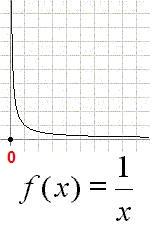 | Once the size of the infinitesimal (S) reaches the non-Archimedean realm of geometry, it becomes a geometrical point p (from Planck scale), with "size" running asymptotically toward 0 , while the "size" of L is running asymptotically toward infinity, along the vertical axis. The global mode of spacetime refers to 'the whole universe as ONE' (Lucretius). The latter is totally missing in the local mode due to the "speed" of light, hence the physical space of 'finite things' becomes a perfect continuum: all points p are entangled and self-connected by their 'common cause' of ONE (global mode), and by virtue of LS = 1 .
No other option seems possible. |
The drawing above can also explain the idea of dual cosmological age: finite in the global mode, and infinite/indecisive in the local mode, as the deflation time can never actually reach The Beginning at 0 ; details in pp. 35-36. As to the postulated Equation of Space, picture yourself riding the infinitesimal toward 0 : from the viewpoint of the global mode, one could imagine an "accelerated" shrinking stage by approaching "zero" size/The Beginning, but in the local mode such "accelerated" stage is an illusion. Likewise in the case of time-and-space-reversed "direction"; see the original full drawing here: people believe that space is "expanding", but it actually isn't, because it would take an infinite cosmological time (local mode) to actually reach 'the maximum large space', denoted with L .
There is no "accelerated" stage (Emil Mottola) in "shrinking" or "expanding" the volume of space by approaching asymptotically S or L . The confusion with the old (since 1930s) cosmological "constant" problem is due to the shape of space near the two "boundaries" defined with Finite Infinity, and on the unwarranted assumption that the "dark energy" is due to some [we-do-not-know-it] with positive mass density (an 'elephant in a china shop'), so it enters the current equations in GR: "a negative pressure can overcome a positive energy density" (ibid.). Alternatively, check out Eqs 1 and 2 in ExplanatoryNote.pdf, pp. 35-36. (The very cracks, through which the physicalized (=converted into positive, cf. Eq. 1, p. 35) vacuum energy gets smuggled into the local mode of spacetime, vary in a wide interval, from producing "6 × 10⁻¹⁰ joules per cubic meter" (John Baez) to an equivalent in energy to 5 (five) solar masses emitted in under 60 seconds in the form of X-rays and gamma rays; all this "dark energy" comes from the "ether", ranging from an almost vanished flux to "1054 ergs/pulse" in GRBs.) The 'physical size of lengths in 3-D space' (the scale factor) would have to actually expand if we were limited to Archimedean geometry only. Were that the case, one could eventually picture some conformal recipe for reaching infinity by "rescaling the metric", as envisaged by R. Penrose. Regarding the "size" of 'the maximum large space', L , in the proposed version of Finite Infinity: look at the slope in the current "accelerated" stage from NASA, and map it to a reversed/inverted drawing (cf. the full original drawing here): can you extend the curve (not shown above) to reach an "accelerated" stage of approaching asymptotically infinite space? This will be the ultimate "cosmological horizon" for gravity. Because gravity cannot operate in infinite space, L should possess a numerically finite but physically unattainable value, perhaps in a manner resembling the "speed" of light for bradyons. Finally, notice the Gedankenexperiment with an observer witnessing a "shrinking" bzw. "expanding" table with length two meters, starting from the macro-world. However, "It is very hard to imagine what new physics would introduce a cutoff on a scale of the order of 0.01cm" (L.H. Ford, gr-qc/0504096v2, p. 6). I am only suggesting that the dual notions of 'small running toward S' and 'large running toward L' are relative to the length scale of tables and chairs. Namely, a companion observer watching the "changing size" of physical objects will not notice any difference whatsoever: her table stretched to the size of a galaxy, and her table shrunk to the size of an atom, will always keep its "size" of 'two meters' (or "0.01cm", L.H. Ford). This is an effort to revive the old idea of 'mutual penetration of the Large and the Small', but it will take a lot of work to identify the new symmetry operations for 3-D space, starting from the macro-world, along some reversible time-and-space "direction" toward S and L . I intend to elaborate on the time-and-space reversed "direction" (inverted space with its CPT symmetries, like inverting a rubber glove inside out) and the VGP formulation of GR on 25.11.2015. The full original drawing here offers some hints for interpreting the possible forms of 'mass' (Yakov Terletskii) and the adiabatic separation of positive and negative mass [Ref. 9], but much more work is needed to clarify the whole bundle of issues and the interpretation of "torsion effects". As it happens very often, I'll probably admit in November 2015 that what I wrote today, 15.11.2010, was very confusing. Sorry, I'm just a psychologist and my efforts are stereotyped as "just another crank". Well, you be the judge. Maybe there are indeed wrong ideas at my web site, but recall Christopher Columbus: If we don't leave for India, how can we discover America?
D.C.
October 11, 2010
Last update: November 15, 2010

[Ref. 1] http://en.wikipedia.org/wiki/Scalar_curvature
"To each point on a Riemannian manifold, it assigns a single real number determined by the intrinsic geometry of the manifold near that point."
http://en.wikipedia.org/wiki/Sectional_curvature
"In Riemannian geometry, the sectional curvature is one of the ways to describe the curvature of Riemannian manifolds. The sectional curvature K(σp) depends on a two-dimensional plane σp in the tangent space at p ."
----------
Notice the infinitesimal instant P from Leibniz, which allows us "to construct tensors by differentiation" (A. Einstein):
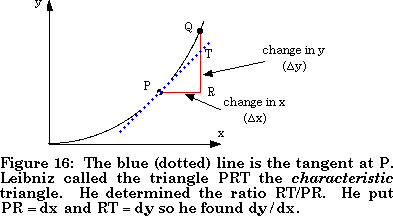
"These are the laws of an instant in canonical gravity. (...) In general relativity (notice Einstein's opinion here - D.C.), dynamics is entirely generated by constraints. The dynamical data do not explicitly include a time variable," says Karel Kuchar. Which is why the global time from the "expansion" of space is "dark" in current GR. In the forthcoming VGP formulation of GR, the "constraints" are produced by 'the shoal of fish' and are similar to the [10, 20] condition for emergent quasi-local geodesics (cf. below). Thus, the corrected QM and GR are united at the 'base manifold' of emergent continuum.
----------
http://en.wikipedia.org/wiki/Positive_mass_theorem
"In general relativity, the positive energy theorem (more commonly known as the positive mass theorem in differential geometry) states that, assuming the dominant energy condition, the mass of an asymptotically flat spacetime is non-negative; furthermore, the mass is zero only for Minkowski spacetime.'
See also: Hans Ohanian, The Energy-Momentum Tensor in General Relativity and in Alternative Theories of Gravitation, and the Gravitational vs. Inertial Mass, arXiv:1010.5557v1 [gr-qc], http://arxiv.org/abs/1010.5557; pp. 2-4 and endnote 7, p. 32.
[Ref. 2] A. Spallicci, Free fall and self-force: an historical perspective, arXiv:1005.0611v1, http://arxiv.org/abs/1005.0611
Footnote 5, pp. 5-6: "Locality, for which the metric tensor gmn reduces to the Minkowski metric and the first derivatives of the metric tensor are zero, is limited by the non-vanishing of the Riemann curvature tensor, as in general certain combinations of the second derivatives of gmn cannot be removed. Pragmatically, it may be concluded that violating effects on the EP may be negligible in a sufficiently small spacetime region, close to a given event.
.....
"the Apollo 15 display of the simultaneous fall of a feather and a hammer [4].
.....
Footnote 24, p. 21: "It is sometimes stated that the interaction of the particle with its own gravitational field gives rise to the self-force. It should be added, though, that such interaction is due to an external factor (...). In other words, a single and unique mass in an otherwise empty universe cannot experience any self-force. Conceptually, the self-force is thus a manifestation of non-locality in the sense of Mach’s inertia [135]."
[Ref. 3] R. Aldrovandi and J. G. Pereira, An Introduction to Geometrical Physics, World Scientific, 1995, pp. 636-637 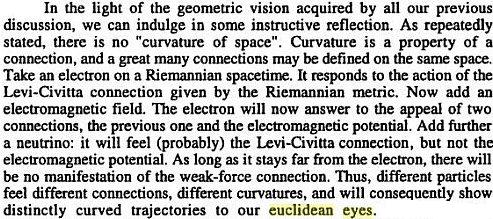
[Ref. 4] D. Ivanenko and G. Sardanashvily, The gauge treatment of gravity, Physics Reports 94 (1983) 1-45; p. 4.
[Ref. 5] R. J. Adler, Six easy roads to the Planck scale, arXiv:1001.1205v1 [gr-qc], http://arxiv.org/abs/1001.1205
p. 14: "In general relativity the problem of gravitational field energy is notoriously more subtle and complex. This is due to the nonlinearity of the field equations, which in turn is related to the fact that gravity carries energy and is thus a source of more gravity (emphasis mine - D.C.). In this sense gravity differs fundamentally from the electric field, which does not carry charge and thus is not the source of more electric field.
....
p. 17: "At present it is certainly not clear what might replace our present concept of spacetime at the Planck scale."
[Ref. 6] K. Kuchar, Time and interpretations of quantum gravity, in: Proceedings of the 4th Canadian conference on general relativity and relativistic astrophysics, ed. by G. Kunstatter, D. Vincent, and J. Williams, World Scientific, 1992.
http://www.phys.lsu.edu/faculty/pullin/kvk.pdf
[Ref. 7] Jorge Pullin et al., A realist interpretation of quantum mechanics based on undecidability due to gravity, arXiv:1010.4188v1 [quant-ph]
p. 2: "Here we denote by t the ideal classical time that appears in the ordinary Schrödinger equation. (...) (I)f one make some judicious assumptions, namely, that the clock does not interact with the system, that the clock is in a highly classical state (a coherent state where the “hand” of the clock is sharply peaked in space and moves in a monotonous way), ... .
....
p. 3: "If one assumes one has a clock that follows the ideal Schrödinger time perfectly, ... .
....
p. 6: "The problem of macro-objectification of properties may be described according with Ghirardi [11] as follows: “how, when, and under what conditions do definite macroscopic properties emerge (in accordance with our daily experience) for systems that, when all is said and done, we have no good reasons for thinking they are fundamentally different from the micro-systems of which they are composed?”"
[Ref. 8] R. Geroch, Computation and Physics, 12.03.2008
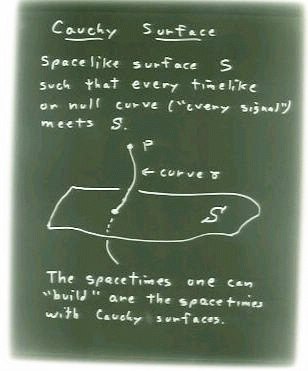
[Ref. 9] D. Pollard, J. Dunning-Davies, A consideration of the possibility of
negative mass, Nouvo Cimento 110B (1995) 857-864
http://www.springerlink.com/content/g089874117p17771/
G. Cavalleri, E. Tonni, Negative masses, even if isolated, imply self-acceleration, hence a catastrophic world, Nuovo Cimento 112B (1997) 897-904
http://prometeo.sif.it/papers/?pid=ncb6372 Banesh Hoffmann (1964), Negative Mass as a Gravitational Source of Energy in the Quasistellar Radio Sources, in: Thomas Valone et al., Electrogravitics Systems, Integrity Research Institute, 2001, pp. 92-96.
============================================
Subject: Request for opinion
Date: Fri, 5 Nov 2010 22:27:24 +0200
From: Dimi Chakalov <[email protected]>
To: Stephen Crothers <[email protected]>
Cc: [email protected],
[email protected],
Hans C Ohanian <[email protected]>
Dear Steve,
May I ask for your comment on the apparent discrepancy in treating "the conservation equation" (cf. conservation.jpg attached) in
Thomas Mueller, Frank Grave, Catalogue of Spacetimes, arXiv:0904.4184v3 [gr-qc]
http://arxiv.org/abs/0904.4184v3
and in
Hans C. Ohanian, arXiv:1010.5557v1 [gr-qc],
http://arxiv.org/abs/1010.5557 Please see
non_conservation.jpg attached, from p. 3.
Q: How would you design a "geodesic" if the conditions for "conservation law" (non_conservation.jpg) are not fulfilled? I am referring here to the so-called "dark energy", which could spring from the
l.h.s. of Einstein filed equation.
Thank you for your time and consideration.
I will appreciate the professional opinion of your colleagues as well.
All the best,
Dimi
------ Note: In order to pinpoint the "cracks" from 'the self-force' (A. Spallicci), through which the holistic ("dark") energy of 'the shoal of fish' gets smuggled into the quasi-local points of the emergent geodesic, check out S. Weinberg, p. 68 (links and emphasis added): "Although inertial forces do not exactly cancel gravitational forces for freely falling systems in an inhomogeneous or time-dependent gravitational field, we can still expect an approximate cancellation if we restrict our attention to such a small region of space and time that the field changes very little over the region." I will address (1) the localization of gravitational energy and (2) the notion of 'isolated system'. 1. See A. Abbassi and S. Mirshekari, arXiv:0908.0286v1 [gr-qc], p. 2; excerpts from their ref. [10] can be read above.

I'm afraid the task for "alternative quantity" in the last sentence is not feasible with tensors (R. Penrose), and because I don't accept parapsychology in terms of "pseudo tensors", the only way out seems to develop a VGP formulation of GR for Machian universe (there isn't such animal as "vacuum equation", Ric(g) = 0), cf. [Ref. 1]) to define energy and angular momentum (A. Helfer) as quasi-local variables, in a way resembling a school of fish.
2. See my comments to Bjoern Schmekel here. In order to fix energy densities at a "point", we need 'the whole spacetime' to be self-wrapped with "boundaries" along spacelike and null directions. It's a package. We also need some linearized and flattening "collapse", as I argued here; crucial details here, here, and here. If you're interested, please read the text by following the links, and email me with your questions. Anything you weren't able to understand will be entirely my fault. The most difficult puzzle to me is that our wristwatches are 'canonical clocks' that are at rest with respect to [we-do-not-know-it], and read our common 'cosmological time', so we have miracles in GR. Related to this puzzle is the long standing issue with the energy in the vacuum: it has an additional and unique freedom to stay in some "latent state", such that it may not contribute to "curvature", hence people can afford to look for 'energy differences' only (cf. John Baez' online paper here). If you measure the temperature of your bath tube, and find out that it as 'slightly above 37C', you can ignore such minuscule temperature increase (and publish your paper in Nature), but in our case we have two infinitely large and powerful sources of "cold and hot water", which cancel out their input almost exactly, to produce a minuscule observable increase 'slightly above 37C'. And this "slightly above" is manifestation of 'the ether'. The usual renorm recipes won't work, because we cannot pinpoint some latent yet "carefully defined limit for the continuum of values" kept in the vacuum. The same vacuum can empower, in different circumstances, the most violent energy release we've seen, such as an equivalent in energy to 5 solar masses emitted in under 60 seconds in the form of X-rays and gamma rays. In other words, the "cracks" left for the holistic ("dark") energy of 'the shoal of fish' (see above) are incredibly flexible -- an upper limit, if any, on these "cracks" is totally unclear (cf. Eq. 1 on p. 35 from ExplanatoryNote.pdf). All this unfolds from the textbook interpretation of those 'twice contracted Bianchi identities', as stressed by Hans Ohanian. Aren't you interested? Please feel free to disagree, and explain why. But if you trust Chris Isham -- don't bother to reply. Follow 'comma to semicolon rule', whenever possible, and be happy with the available "boundary conditions" and "geodesic hypothesis".
D. Chakalov
November 8, 2010
Last update: November 11, 2010
[Ref. 1] Stephen Crothers, email communication, Thu, 11 Nov 2010 13:56:23 +1100.
Special Relativity must manifest in sufficiently small regions of his gravitational field and that these regions can be located anywhere in his gravitational field.
Ric = 0 describes a universe that contains no matter, by construction. But if that is so then there is no matter present to cause the gravitational field, bearing in mind that the field equations are also claimed to couple the gravitational field to its sources. One cannot remove matter by setting Ric = 0 (i.e. Tuv = 0) and then insert a mass, post hoc, by means of Newtonian two-body relations, into the resulting metric in order to introduce a cause of the alleged gravitational field “outside the body”.
General Relativity is a non-linear theory and so the Principle of Superposition does not apply. Consequently one cannot simply add masses to a given solution to the field equations. Every different configuration of matter requires a corresponding set of field equations to be solved. There are no known solutions to Einstein’s field equations for two or more masses and no existence theorem by which it can even be asserted that the field equations contain latent solutions for multiple masses.
Furthermore, point-mass singularities occur in Newtonian theory – they are called centres of mass. The centre of mass of a body is a mathematical artifice, not a physical object. Once can go to a shop and buy a bag of marbles but one cannot go and buy a bag of centres of mass of those very same marbles.
According to the astrophysical scientists it takes an infinite amount time for an observer to detect an event horizon. But nobody has been and nobody will ever be around for an infinite amount of time in order to confirm the presence of an event horizon. Consequently the concept has no validity in science. In addition, the aforementioned observer cannot be present in a spacetime that by construction contains no matter, assuming that observers are material. I do not see how an observer can be anything other than material.
Concerning Einstein gravitational waves, none have been detected. This is also not surprising because the search for such waves is destined to detect none. Since Ric = 0 violates the physical principles of General Relativity Einstein’s field equations form an identity with zero so that the total energy of the gravitational field is always zero; so that the Einstein tensor and the energy-momentum tensor must vanish identically; so that the localisation of gravitational energy is impossible; and so that the field equations violate the usual
conservation of energy and momentum so well established by experiment. I wrote a paper on this which contains no mathematics:
www.sjcrothers.plasmaresources.com/GW.pdf That an erroneous theory can seemingly account for various observed phenomena is not new to science. The Ptolemaic system of epicycles accounted for various celestial phenomena but is nonetheless an erroneous theory.
......
I now give you a simple recipe to prove me wrong. Prove that matter can be present in a spacetime that by construction contains no matter, prove that Einstein’s pseudo-tensor is not a meaningless concoction of mathematical symbols, and prove that r in Hilbert’s metric is not the inverse square root of the Gaussian curvature of the spherically symmetric geodesic surface in the spatial section of the Hilbert manifold.
All of my papers on aspects of General Relativity are on my webpage:
www.sjcrothers.plasmaresources.com/papers.html
======================================
Subject: Re: Request for opinion
Date: Fri, 12 Nov 2010 15:38:17 +0200
Message-ID:
<[email protected]>
From: Dimi Chakalov <[email protected]>
To: Stephen Crothers <[email protected]>
To: Merced Montesinos Velásquez <[email protected]>,
Laszlo Szabados <[email protected]>,
Alan Rendall <[email protected]>,
Sergiu Klainerman <[email protected]>,
Luca Bombelli <[email protected]>,
Jim Isenberg <[email protected]>,
Chris Isham <[email protected]>
Dear Steve,
Thank you for your reply from Fri, 12 Nov 2010 13:55:44 +1100.
My request for opinion was:
http://www.god-does-not-play-dice.net/#Bianchi
"Q: How would you design a "geodesic" if the conditions for "conservation law" (non_conservation.jpg) are not fulfilled? I am referring here to the so-called "dark energy", which could spring from the l.h.s. of Einstein filed equation."
> Whether one considers Einsetin's covariant derivative on T_uv as a
> conservation of energy law or as an energy transfer law seems to me
> to be a matter of semantics and of no great importance. In any event
> it is my view that Ric = 0 is inadmissible and so the Einstein field
> equations violate the usual conservation of energy so well established
> by experiment. The total energy of Einstien's gravitational field is always
> zero and this is disastrous.
I am unable to relate your opinion to the question above. One obvious answer would be 'one cannot design such "geodesic" under these conditions', because, as M. Montesinos stressed in arXiv:gr-qc/0311001v1, pp. 4-5:
"More precisely, tµv = 0 tells us that the 'reaction' of the dynamical background metric is such that it just cancels the effect of 'flux' associated with the matter fields. It is impossible (and makes no sense) to have a locally non-vanishing 'flux' in this situation. If this were the case, there would be no explanation for the origin of that non-vanishing 'flux' (it will look "dark" - D.). Moreover, that hypothetic non-vanishing 'flux' would define privileged observers associated with it (the ether would come back!)."
I believe we all agree to keep the metric dynamical: it should keep playing its double role in the sense that it is both a field variable and defines the geometry *at the same time* (L. Szabados, private communication).
Then my approach to incorporating "dark" energy in GR is two-fold. On the one hand, keep the 'flux' vanishing up to 10^-122, that is, "the 'content' of energy and momentum densities and stress associated with the matter fields [psi] (which is characterized in Tµv) and the 'content' of energy and momentum densities and stress associated with the gravitational field [XXX]" (M. Montesinos) should cancel each other *almost* exactly.
On the other hand, introduce a (brand new?) dynamics of this *almost exact* cancellation by two kinds of time (global mode and local mode) pertaining to *two standing gravitational waves*, such that we have *at the same time* (L. Szabados) an almost exact cancellation à la John Cramer,
http://www.god-does-not-play-dice.net/#Evans
To be precise: the hypothetical 'two standing gravitational waves' pertain to the global mode of spacetime, and their perpetual cancellation re-creates the instants (plural) at which the negotiations b/w the two sides of Einstein equation ("space acts on matter, telling it how to move; in turn, matter reacts back on space, telling it how to curve", John Wheeler) are completed -- one-negotiation-at-a-time, along an Arrow of Space,
http://www.god-does-not-play-dice.net/#Zinkernagel_note
That's the "crack" through which the vacuum energy gets smuggled into GR. Details at
http://www.god-does-not-play-dice.net/#Hehl_note
Please notice that the total energy of Einstien's gravitational field is tending asymptotically toward zero at each and every instant of *completed* negotiation, which is why people can introduce initially wrong assumptions (e.g., "vacuum equation" with Ric = 0 and linearized approximation of GR, to name but a few), although all these assumptions sound like the Born Rule in QM.
The whole 'geodesic hypothesis' looks clear only to undergraduates -- check out A. Rendall's lrr-2005-6, 9.6 The geodesic hypothesis.
But of course you may have quite a different approach toward designing a "geodesic" under the conditions spelled out above. A penny for your thoughts!
I extend this request to your colleagues as well.
All the best, Dimi
-------
Note: My efforts are too specific and may not attract the attention of experts in GR, so let me briefly explain why we need quantum gravity to understand GR. I will reproduce excerpts from the text offered by R. Aldrovandi and J. G. Pereira, An Introduction to GENERAL RELATIVITY, March-April/2004,
http://www.ift.unesp.br/gcg/igr.pdf
1. A real observer (§3.11) is not 'point-like', and therefore we need a quantum version of the strong equivalence principle (R. Aldrovandi, J. G. Pereira, K. H. Vu, Gravity and the Quantum: Are they Reconcilable? gr-qc/0509051 v1). This is a big can of worms -- check out the macro-objectification problem from GianCarlo Ghirardi, ref. [11] above. The solution proposed here is quasi-local emergent geodesic, resembling the trajectory of a fish -- it gets its nonlocal gravitational corrections and contributions from 'the whole school of fish', and follows locally a trajectory comprised of "points" -- one-correction-at-a-point along AOS. It makes no sense of talking about "curvature" (§3.81), because an ideal observer (§3.11) doesn't have Akasha-like memory to "recall" its experience without such corrections and contributions from gravity. The quantum-gravitational "fish" is a contextual and Machian-like relational entity, hence it must never be "free from external forces" (§3.11).
2. You need (I don't) a constant gravitational field to make sense of "coordinate time" (cf. §3.36) and "finite distances in space" (§3.42), pertinent to "the scale factor R(t)", as defined above, with cosmological "constant" set to zero. If, however, we have "time-dependent gravitational field, we can still expect an approximate cancellation if we restrict our attention to such a small region of space and time that the field changes very little over the region", says Steven Weinberg. There is too much poetry in this excerpt, as well as in other crucial ideas explained here. The solution to the two tasks above is utterly needed. Do it, and if you come up with ideas different than those proposed here, I will consider my work redundant, hence wrong. Good luck. D. Chakalov
November 13, 2010
Last update: November 15, 2010


=======================================
Subject: Re: “On Primitive Elements of Musical Meaning”
Date: Wed, 20 Oct 2010 23:16:45 +0300
From: Dimi Chakalov <[email protected]>
To: Iegor Reznikoff <[email protected]>
Cc: [snip]
Dear Iegor,
Thank you for your [snip].
> What do you mean when saying (in your last email): it is what
> I see by zooming?
In the case of your *brain* (not mind),
http://www.god-does-not-play-dice.net/Azbel.html#self
... the UNdecidable KS state is explained with two sayings at
http://www.god-does-not-play-dice.net/#Brun
1. You can't hide a piece of broccoli in a glass of milk.
2. Don't wear polka dot underwear under white shorts.
The UNdecidable quantum state of your *brain* is not about broccoli, underwear, milk, or shorts, nor anything we can put in Dirac brakets. It doesn't live in Hilbert space either,
http://www.god-does-not-play-dice.net/#KS_details
I tried to "zoom" on it, and it looks to me like a hedgehog,
http://www.god-does-not-play-dice.net/#Hehl_note
I wonder what you would see!
Best regards,
Dimi
======================
Subject: Re: “On Primitive Elements of Musical Meaning”
Date: Thu, 10 Mar 2011 02:11:51 +0200
From: Dimi Chakalov <[email protected]>
To: Iegor Reznikoff <[email protected]>
Cc: [snip]
Dear Iegor,
Thank you very much for your reply and your very interesting manuscript. Perhaps you may wish to consider Apeiron,
http://www.utexas.edu/cola/depts/philosophy/resources/Apeiron.php You hit the nail on the head (Consciousness.pdf, p. 6/8):
"This capacity of totalization, this gift of perceptive consciousness, is certainly one of its most important properties and unity may be the characteristic property of consciousness: consciousness unifies elements that otherwise are not related; from this comes meaning."
Can you read the text below?
Aoccdrnig to a rscheearch at Cmabrigde Uinervtisy, it deosn't mttaer in waht oredr the ltteers in a wrod are, the olny iprmoetnt tihng is taht the frist and lsat ltteer be at the rghit pclae. The rset can be a total mses and you can sitll raed it wouthit a porbelm. Tihs is bcuseae the huamn biran deos not raed ervey lteter by istlef, but the wrod as a wlohe. Pritie amzanig huh?
Voila !
I do hope some day we can get together. I deliberately missed some very important points at
http://www.god-does-not-play-dice.net/#BrainMonad
http://www.god-does-not-play-dice.net/about.html#China
Will be happy to explain them over a glass of wine, or five :-)
Wishing you all the best,
Dimi
================================================
Subject: Kommunikationswissenschaft 101
Date: Wed, 17 Nov 2010 04:03:45 +0200
From: Dimi Chakalov <[email protected]>
To: Loet Leydesdorff <[email protected]>
Cc: Nikola Chakalov <[email protected]>
Dear Professor Leydesdorff,
May I share with you (and my son interested in KoWi) some thoughts prompted by your papers. I endorse the proposal for a third, Noetic world, different from res extensa and res cogitans [Ref. 1], which can be studied by empirical investigation, contrary to the claim by Edmund Husserl [Ref. 2].
Consider the Platonic ideas explicated with these sayings:
1. You can't hide a piece of broccoli in a glass of milk.
2. Who has no horse may ride on a staff.
3. Don't wear polka dot underwear under white shorts.
4. Faute de mieux, on couche avec sa femme.
I'd say there are two such ideas. Here's a third Platonic idea, from Lewis Carroll:
'Twas brillig, and the slithy toves
Did gyre and gimble in the wabe:
All mimsy were the borogoves,
And the mome raths outgrabe.
Our brains contain neurophysiological "correlates" of shorts, broccoli, horses, wives, etc., but not the Platonic ideas per se. Hence human communication always runs on two parallel layers: speakable and UNspeakable. The roots of the latter can *perhaps* be traced down to Jungian's Kollektives Unbewusstes -- I don't know, all this can and should be studied, faute de mieux, by empirical
investigation.
I will appreciate your thoughts on these issues.
Kindest regards,
Dimi Chakalov
-----------
[Ref. 1] Loet Leydesdorff, "Meaning" as a sociological concept, arXiv:1011.3244v1 [nlin.AO]
http://arxiv.org/abs/1011.3244
p. 14: "... the horizons of meaning that we share (to different extents). This domain is not in the res extensa, but remains res cogitans. In other words, the meaning that we provide to the events does not “exist” physically, but incurs on us as one among a set of culturally possible meanings."
p. 15: "This communicative reality that the communicators shape over time and reflexively reconstruct cannot be considered as res extensa, but belongs to the res cogitans; it is not stable like matter, but remains in flux like language. It enables us to communicate in terms of uncertainties (e.g., possibly relevant questions) and expectations. Husserl (1929) recognized this realm as cogitatum, that is, the substance about which the Cogito remains uncertain. Our mental
predicates provided to the world in intersubjective exchanges with intentional human beings, shape our culture and therewith ground what Husserl also called a “concrete ontology” or, in other words, “a universal philosophy of science” (1929, at p. 159)."
[Ref. 2] Loet Leydesdorff, The Non-linear Dynamics of Meaning-Processing in Social Systems, arXiv:0911.1037v1 [physics.soc-ph]
http://arxiv.org/abs/0911.1037
"According to Husserl, the study of this domain would provide us with “a concrete ontology and a theory of science” (ibid., at p. 159). However, the author conceded that he had no instruments beyond this transcendental apperception of the domain and therefore had to refrain from empirical investigation:
We must forgo a more precise investigation of the layer of meaning
which provides the human world and culture, as such, with a specific
meaning and therewith provides this world with specifically “mental”
predicates. (Husserl, 1929, at p. 138; my translation).
==================
Subject: Re: Kommunikationswissenschaft 101
Date: Wed, 17 Nov 2010 16:15:27 +0200
From: Dimi Chakalov <[email protected]>
To: Loet Leydesdorff <[email protected]>
Dear Loet,
>> I wonder if you agree with the core proposal for a third, Noetic world.
>
> I am not so sure that we need this proliferation. How many angels can
> sit on a needle?
We're talking about an entity that exists as some form of 'reality', because the experiment I offered to your brain with the three Platonic ideas can be performed with all human brains, regardless of their structural differences, memory traces, life experience, age, etc.
The crux of the issue is that these *ideas* are (i) UNspeakable, (ii) robust and invariant to all differences in all human brains that have access to them, and (iii) open to newly created *ideas* that emerge in cosmological time. Regarding (iii), the idea of 'vehicle', for example, includes now a space shuttle, although 100 years ago it was still in the realm of 'the unknown unknown'.
> Perhaps, it suffices to distinguish between res extensa and res cogitans.
> The Noetic world could then be considered as part of the cogitatum.
On the one hand, the Noetic world is sort of "part" of the cogitatum, to the extent to which it is revealed only by its association with our personal qualia. On the other hand, it is a form of reality (I call it 'potential reality'), because it exists 'out there' and evolves/unfolds from ... well, I'd guess from [John 1:1], or perhaps from 'the true monad without windows', or from the Noumenon, but there
is no way to verify such source.
There is no way to verify the ultimate source of res extensa either, yet we don't treat elementary particles as 'angels sitting on the pin of a needle'.
One final comment: if you consider the qualia of 'blue' (res cogitans), you can refer it to EM radiation with particular wavelength (res extensa), but if you consider any Platonic idea of the type from my initial email, the question is: what kind of 'potential reality' can facilitate its presence and faculties outlined in (i) - (iii) above?
All this is a very old story, after Leibniz and Pauli,
http://www.god-does-not-play-dice.net/#consciousness
A penny for your thoughts.
Please bear in mind that my email correspondence and web site may be screened by those (almost) transparent guys from the Echelon, so we cannot enjoy privacy.
All the best,
Dimi
-------
Note: Some people can replace the Platonic idea of 'hot' with the one relevant to 'damp moss': 
Is there a "bridge" connecting the quantum vacuum and the human brain? Perhaps all you need to extract ("dark") energy from 3-D space is right above your neck.
I've been arguing for many years that these Platonic ideas have dual ontological nature, because one can find their unique effects in both res extensa and res cogitans; and also that the need for quantum gravity stems from 'the universe modeled as a brain', as mentioned above. NB: I have to clarify the precise meaning of 'dual ontological nature of potential reality', because we inevitably abuse this notion by using our language derived from the macroscopic world -- we tend to think about it as some sort of a "third" entity or "third world", which is "in-between" res extensa and res cogitans, and acts as a "bridge". But if you recall the notion of entanglement, it does not imply any "third" object or "bridge" connecting two parties. Instead, the "two" parties have become one inseparable object (ignore your classical thinking) due to their entanglement, such that we cannot factorize the "two" parts into some individual entities possessing well-defined properties apart from their entanglement (cf. quantum relational holism). Likewise, the manifestation of 'potential reality' is two-fold, as we observe it in both res cogitans, in terms of Platonic ideas (cf. above), and res extensa in terms of pre-quantum KS state. The evolution of the latter is pre-correlated (Leibnizian pre-established harmony) with the former, hence there is no need for "anthropic principles" in explaining the "coincidence" or "Why Now? problem". It is 'potential reality' what makes res extensa and res cogitans entangled by its dual ontological nature. Wolfgang Pauli explained his proposal in 1948; the initial idea belongs to Leibniz, of course. My suggestion from February 5, 1987 was to parameterize the phenomenon of entanglement, as manifestation of 'potential reality' in the quantum realm, with an open interval of real numbers (0, infinity), such that the latent observables (Henry Margenau) would acquire values larger than those pertaining to a macroscopic object (the latter has almost zero value of 'potential reality'). There should be a second layer of the quantum world, corresponding to greater values of entanglement, which will consume the possessed observables (mass and charge) as well, and will convert them into quarks; check out my LHC prediction from January 9, 2003. There should also be a very important, third section from this interval (mirroring the non-living macroscopic world), at which 'potential reality' approaches asymptotically infinity (cf. f(x) = oneOverX) -- the realm of Machian quantum gravity. At this "edge" of the physical world, the mutual penetration of the Large and the Small (global mode of spacetime) is almost entirely completed, and the physical world is approaching asymptotically 'the state of ONE'. It is very difficult to thing about the human brain, with the human brain. If you're getting a headache, check out John Baez on duality; his interpretation is much easier to comprehend. If you prefer parapsychology instead of quantum gravity, watch Criss Angel; more here. D.C.
November 17, 2010
Last update: January 27, 2011
===================================
Subject: Re: The reference fluid, arXiv:1011.4444v1 [gr-qc]
Date: Tue, 30 Nov 2010 15:46:08 +0200
From: Dimi Chakalov <[email protected]>
To: Ian Lawrie <[email protected]>
Dear Ian,
Thank you for your comprehensive reply.
> I think the remark you quote from Brown and Kucha\v{r} is a bit
> imprecise because they intend it as a general comment on a variety
> of similar approaches.
My general comments on Brown and Kuchar are posted at
http://www.god-does-not-play-dice.net/Margenau.html#9
Their construction doesn't work, for a variety of reasons. Which is why I offer a radical approach toward 'the reference fluid' as "ether" -- an unobservable pre-quantum state of the whole universe as ONE -- and suggest a Machian quantum gravity.
> Personally, I think there are difficulties with either of these possibilities,
> which I describe in my paper, but probably not everyone would agree with me.
I agree with you, and stress that there are even more arguments against Brown-Kuchar proposal.
> There would be a third possibility, which is to take a discrete set of
> particles, so that only some points of spacetime can be labelled
> explicitly.
But how would you make a 'discrete set of [whatever]' _and_ keep the spacetime continuum?
The task of such brand new quantization of spacetime is highly non-trivial, and goes back to the basic postulates of differential geometry. Which is why I asked you for advice, as I couldn't see even a hint for such task in your book.
My proposal is that "some points of spacetime can be labelled explicitly" thanks to a pre-quantum state derived from Quantum Theory,
http://www.god-does-not-play-dice.net/Margenau.html
But again, the math is unknown, since modern diff geometry textbooks say nothing about the fine structure of (spacetime) "points".
In other words, I am not a bartender,
http://www.god-does-not-play-dice.net/#Hoogen2
How about you?
All the best,
Dimi
------
Note: Excerpts from "A Unified Grand Tour of Theoretical Physics", by Ian D. Lawrie, 2nd ed., Taylor & Francis, 2001; ISBN 978-0-7503-0604-1, pp. 14-15 :
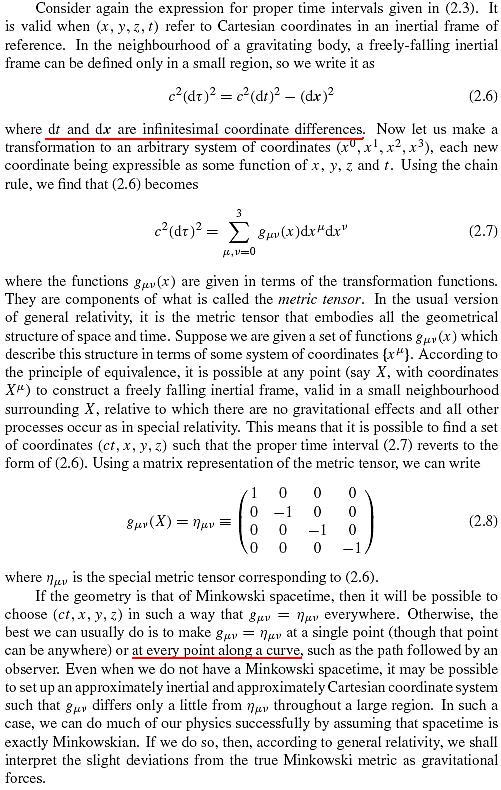
(Notice that the geodesic hypothesis (Alan Rendall) is
inherently unclear, because we presuppose some kind of
linearized and flattening "collapse" taking place at
"every point along a curve" to define gravitational "forces" - D.C.)
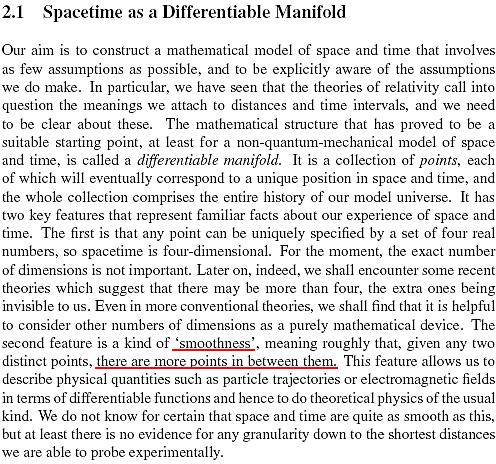
p. 17: "The end points x = a and x = b are excluded (bad idea -- check out how to bring these 'end points' back to GR with
Finite Infinity - D.C.).
"An important use of open sets is to define continuous functions."
p. 20: "Often, we shall expect such functions to be differentiable (that is, to possess unique partial derivatives with respect to each coordinate at each point of the patch)."
But you can't get unique partial derivatives in the most important case here. The problem is not in GR. The problem stems from its inadequate and unclear mathematical basis -- the fine structure of a 'point' is missing. We need new mathematical presentations (not based on tensor calculus) of (i) 'spacetime point from differentiable manifold', (ii) its 'infinitesimal neighborhood', (iii) 'finite volume of space', and (iv) 'closed system' in order to develop Machian quantum gravity. General Relativity is only a temporary patch or "makeshift", because "we entirely shun the vague word "space," of which, we must honestly acknowledge, we cannot form the slightest conception." If the space itself is dynamical object, we may recover its 'global time' and 'reference fluid' from Quantum Theory. That's all. D.C.
November 30, 2010
Last update: December 17, 2010
=================================
Subject: Re: arXiv:1012.1739v2 [gr-qc]
Date: Wed, 22 Dec 2010 04:15:20 +0200
From: Dimi Chakalov <[email protected]>
To: carlo rovelli <[email protected]>
Cc: Simone Speziale <[email protected]>,
Thomas Thiemann <[email protected]>,
Lee Smolin <[email protected]>,
[email protected],
[email protected],
[email protected]
Carlo,
You wrote in arXiv:1012.4707v1 [gr-qc]: "Its classical limit might finally turn out to be wrong, ... "
Is this your 'scrupulous intellectual honesty' ?
http://www.god-does-not-play-dice.net/Margenau.html
Check out the classical limit of LQG -- you can do it now, no need to wait another 25 years -- by elaborating on the alleged continuum limit ("the refinement of the two-complex to take to infinity", Eq. 16), *in such way* that you could produce a classical 3-D space in which "it is possible to look around, and see as far as we like" (Lee Smolin, Three Roads to Quantum Gravity, p. 205).
There is no such possibility, Carlo. The requirements for observing 3-D space "as far as we like" will kill your LQG at its "continuum limit", Eq. 16.
LQG is indeed a pathetic joke.
This is just business; nothing personal.
Merry Christmas.
Dimi
On Thu, Dec 16, 2010 at 4:02 AM, Dimi Chakalov <[email protected]> wrote:
>
> Hi Carlo,
>
> I wonder what drives you to waste your time with "loop quantum gravity".
>
> I hear that many people at your university consider you an expert in
> quantum gravity -- is this true?
>
> Can't you realize that "loop quantum gravity" is a pathetic joke? Check out
>
> http://www.god-does-not-play-dice.net/Margenau.html
>
> Please try to respond professionally, at least once. I know you can do it.
>
> Dimi
>
--------
Note: Warning: If you do mathematics as a "bartender" and are not interested in the subtleties of 'finite space', don't waste your time by reading the text below.
Check out the continuum limit: this is the condition for 'finite space', which allows us to see through 3-D space "as far as we like" (Lee Smolin). Now, try to implement this continuum limit condition in the alleged continuum limit of "loop quantum gravity" (LQG), or any other background-independent approach, causal dynamical triangulations (CDT) included. Carlo Rovelli won't even try, because he loves his LQG Barbie, but other people might be inclined to face the pitfalls of LQG. There is a fundamental difference between all background-independent approaches to quantum gravity, published on paper, and the Machian quantum gravity (MQG), which is outlined at Henry Margenau's web page. It is about how we implement the continuum limit condition.
The perfect continuum of 'the grin of the cat without the cat', as observed exclusively by Alice, is interpreted in MQG as a special non-Archimedean state of the whole universe as ONE. This is the realm of 'geometry', presented with a hypothetical global mode of spacetime. It cannot be reached from the local (physical) mode of spacetime in the r.h.s. of Einstein equation, as demonstrated with the unresolved puzzle of 'continual finite space'. With the exception of MQG, all approaches use some technique (more or less ingenious) to "zoom" onto the elementary building block of geometry, ensuing from a patch of finite space, after which they have to recover that same finite space. In LQG, people arrive at the idea that the continuum of space might be comprised of some hypothetical stuff, say, some 1099 "atoms of volume" in every cubic centimeter of space, and try to explain how time "proceeds in discrete ticks of about a Planck time, or 10-43 second" (Lee Smolin, Atoms of Space and Time, Scientific American, January 2004, pp. 58-63). Another idea is that there is nothing of that [whatever] stuff "between" the "atoms" of [whatever], much like "there is no water in between two adjacent molecules of water" (L. Smolin). So far so good, but notice the crucial notion of 'nothing' in the concept of 'continuum': the consecutive points of a line must succeed each other without any interval. That is, the "interval" is absolutely needed (otherwise all points from a line will fuse into one point), on the one hand, but on the other -- the "interval" must encapsulate the metaphysical notion of 'nothing' or "zero". Now, how do you get this "zero thing", given its seemingly incompatible faculties? Can we 'have our cake and eat it'?
Except for MQG, people start with a patch of finite space, and then "instruct" something from that same patch to approach zero, e.g., some 'infinitesimal volume of space'. Look at Newton's recipe for obtaining 'the infinitesimal of time' (details from Robin Jordan).
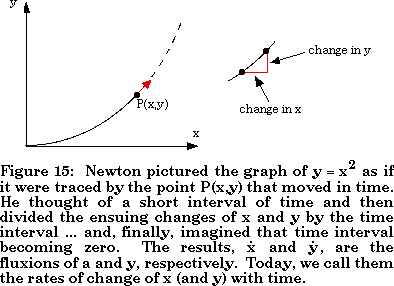
Let's denote the infinitesimal of time with dt , along an axis z orthogonal to x/y, as in Flatland. dt is the infinitesimal time "interval" by which each and every finite (see above) timelike displacement is build along the Arrow of Space, as driven by the "dark" energy from 'the whole universe as ONE', exhibited with the alleged expansion of 3-D space, build by the infinitesimal space volume ds . Every physical system that can serve as 'clock' uses this elementary timelike displacement, dt . It is indeed a deep mystery, as acknowledged by Ted Jacobson (A Spacetime Primer, pp. 18-19), and it is hidden in the continuum.
To obtain the intrinsic space "interval", ds (the fluxions of x and y, after Newton, and the "atom of volume" in LQG), we again start from a finite (see above) displacement in space, and instruct it to approach zero. Notice that we inevitably use three points to obtain ds : the cutoff, s0 , always disappears from the local (physical) mode of spacetime, regardless of obtaining a finite interval (as in vacuum energy differences in QFT) or the infinitesimal ds . (s2 - s0) - (s1 - s0) = s2 - s1 = 1 m Thus, we obtain ds by instructing s2 - s1 to approach zero. The same idea applies to dt . We believe that there should exist some numerically finite but physically unattainable "values" of ds and dt at Planck scale, but we know nothing about the ultimate cutoff s0 , because it is never present in the local (physical) mode of spacetime. We can only speculate about a special "boundary" by which 'space' is bounded at The Small, such that ds and dt match s0 . This is the mystery of the continuum; sorry for repeating it all over again. Now, how do we implement the requirement that there should be "nothing" between the continual chain of consecutive points ds ? On the one hand, s0 must encapsulate the metaphysical notion of 'nothing' or "zero" -- the consecutive points ds of a line (1-D Euclidean space) must succeed each other without any interval. On the other hand, we have to fulfill an equally important requirement that s0 must somehow exist in order to prevent all (uncountably infinite) points ds of a line to fuse into one ds . We need to 'have our cake and eat it', as sated above. The metaphysical idea of 'continuum' is addressed in LQG with the mundane notion of 'zero something' (e.g., "there is no water in between two adjacent molecules of water", L. Smolin). For example, if you buy two bananas and eat them, you'll have 'zero bananas' in your hands. In LQG, the "bananas" are not converted into "zero" either, hence if you try to recover the continuum of finite space, you will ultimately fail. Why? Because the remnants from the "bananas" will never, in no circumstances, allow you to recover the same patch of continual finite space. I will not delve into details about what constitute 'the remnants from the bananas' in LQG; think of these 'remnants' as the result from converting some characteristic of 'space' into something else, much like we explain (and convert) heat with kinetic energy. Details available upon request. Just a hint: because we don't live in some privileged or unique place in the universe, consider a finite volume of space with radius 7.3 billion light years (cf. Yuan K. Ha), which amounts to radius of 690.1025 cm and volume of 1,376,055,281.1025 cm3, each of which contains 1099 "atoms of volume". We have 1,376,055,281.10124, or roughly 10133 "atoms of volume" in which we can (i) picture 3 orthogonal dimensions of space, and (ii) see "as far as we like" (Lee Smolin). But because LQG is inherently relational, background-free theory, there is nothing at our disposal to 'hold onto', to avoid all errors in the binding of these 10133 "atoms of volume". Obviously, LQG is a joke. Even in CDT, which is not supposed to suffer from the splitting of spacetime, the best guess yields spatial Hausdorff dimension dh = 3.10 ± 0.15 (cf. Renate Loll et al., arXiv:hep-th/0404156v4, p. 7), which is also a joke. You just can't recover the continuum. In MQG, the notion of "zero thing" is not 'zero something' -- the hypothetical 'global mode of spacetime' at s0 is not present in the patch of continual finite space even at the mathematical level of 'manifold'. From the viewpoint of the local (physical) mode of spacetime, it is 'zero nothing': --> [local mode] [global 'zero nothing' mode] [local mode] -->
Thus, we can build an Arrow of Space, producing quantized spacetime from the outset -- 'have our cake and eat it'. And we always have the reference fluid of GR to 'hold onto': the non-Archimedean global mode of spacetime. It is General Relativity itself which requires the global time-as-change from the Arrow of Space to be non-existent in the local (physical) mode of spacetime, or else the ether, as 'the reference fluid of GR', will show up in GR. The global mode of spacetime does exist, because otherwise you cannot "connect the dots" as consecutive points of our 3-D space, in such a way that we can see "as far as we like" (Lee Smolin). You can't bind the consecutive points of 3-D space with some "thermal time" (C. Rovelli, arXiv:0903.3832v3 [gr-qc], p. 8). Which is why the energy of the Arrow of Space is inevitably "dark" -- there is no way you can trace back its source from/within the local (physical) mode of spacetime. All you can observe in the local mode is spatiotemporal coincidences, but you cannot recover the phenomenon which literally builds up the 3-D space of GR, from GR. Which is why I tried to contact Professor Rovelli in November 1999. But of course he didn't reply. Physicists don't like to be reminded of Aristotelian First Cause -- it will also look "dark" in present-day GR. Which is why we need quantum gravity. In another email, Carlo Rovelli stated the following: "All of us keep looking around, reading, checking out the papers in the archives, and when we find ideas that seem interesting to us, or potentially good, we react. There is no shortcut to that." It is like refusing to read the news on your mobile phone, because news must be either displayed on TV or printed on paper. That's how Carlo Rovelli implements his rule of 'scrupulous intellectual honesty'. He will keep preaching to the choir and publishing papers on LQG in the next twenty-five years, and will probably end up like Alain Connes. This whole story is anything but 'news', as it can be traced back to Lucretius, some 2060 years ago. However, as John Coleman rightly noticed, "it is extremely difficult to induce penguins to drink warm water." The results are indeed laughable, like the chewing over how time "proceeds in discrete ticks of about a Planck time, or 10-43 second", and what might have happened "shortly after the Big Bang, when the universe expanded by 1028 within just 10–36 of a second." Whether such jokes are pathetic or not -- you decide.
D. Chakalov
December 22, 2010
Last update: December 25, 2010, 11:10 GMT
=================
On Thu, 23 Dec 2010 14:42:04 +0100, Message-ID:
<[email protected]>,
Carlo Rovelli <[email protected]> wrote:
Dear Dimi,
thanks for your last email. I am just writing to let you know that after it I have added your name and address to my SPAM filter list. Therefore I am not going to see your mails anymore.
[snip] =================
Addendum Pity Carlo Rovelli chose to run away. For those interested in his viewpoint on LQG in arXiv:1012.4707v2 [gr-qc], let me offer just two excerpts (emphasis and links added) and my comments: p. 7: "Meaning of quantum mechanics.
"Hopes have been voiced that a quantum theory of gravity will clarify the mysteries of quantum theory. This is not the case of loop gravity, which uses standard quantum theory (in whatever interpretation is your favorite one), only slightly generalized to make room for the peculiar way temporal evolution is described in general relativity." The same C. Rovelli stressed in his gr-qc/0604045, p. 4: "The proper time [tau] along spacetime trajectories cannot be used as an independent variable either, as [tau] is a complicated non-local function of the gravitational field itself. Therefore, properly speaking, GR does not admit a description as a system evolving in terms of an observable time variable." I do not know how "standard quantum theory" and LQG have been "slightly generalized" to "make room" for the absence in GR of "an observable time variable." Perhaps C. Rovelli is "slightly" confused with some slightly "partial observables". Well, it happens. To understand the difference in the interpretations of "standard quantum theory", and their implications for LQG, see Robert Geroch, Geometrical Quantum Mechanics, unpublished lecture notes, University of Chicago, 1974, pp. 62-71
http://academics.hamilton.edu/physics/smajor/Papers/geroch_gqm.pdf Second excerpt from arXiv:1012.4707v2 [gr-qc], p. 12: "The “problem of time” is not anymore a conceptual problem in quantum gravity since the conceptual issues have been clarified, but remains a source of technical difficulties. The problems can in principle be solved using the relational formalism. That is, defining observables not with respect to unphysical space time points but in terms of relations between dynamical fields. (...) One possibility of constructing relational observables is to couple the theory to effective matter fields and use these as reference systems, in order to formally circumvent the difficulties deriving from general covariance [80]."
---
[80] C. Rovelli, “Quantum Reference Systems,” Class. Quant. Grav. 8 (1991) 317–332. Rovelli's claim that "the problems can in principle be solved using the relational formalism" is nothing but wishful thinking -- check out Karel Kuchar's research (references at this web site). Of course, he does not offer in arXiv:1012.4707v2 [gr-qc] reference to any research paper published by Karel Kuchar. C. Rovelli does not mention Claus Kiefer's monograph Quantum Gravity (2nd ed., 2007) either. Notice Ch. 6.3 therein, 'Quantum Hamiltonian constraint', p. 194: "The exact treatment of the constraint is the central (as yet open) problem in loop quantum gravity." Why is that? Because LQG is stuck at its kinematical stage. To obtain the dynamics, the first off task is to make sure that, in the classical limit of LQG, we will be able to see "as far as we like" (Lee Smolin). Forget it, Carlo. LQG is a joke, just like your "scrupulous intellectual honesty".
D. Chakalov
December 23, 2010, 14:33 GMT
===========================
Subject: Re: arXiv:1012.1739v2 [gr-qc]
Date: Fri, 24 Dec 2010 00:01:31 +0200
From: Dimi Chakalov <[email protected]>
To: carlo rovelli <[email protected]>
Cc: Simone Speziale <[email protected]>,
Chris Isham <[email protected]>,
Karel V Kuchar <[email protected]>
Dear Carlo,
> If you call my (and other's) work a "pathetic joke", I just turn the
> page and read something else: I am not interested in a dialogue
> based on insults.
Okay, I admit it was too harsh. Sorry. Let me please correct my statement: I think loop quantum gravity (LQG) is indeed a joke, but a smart one. It isn't 'not even wrong', because one can learn a lot about quantum gravity by refuting LQG.
I also wish to say that, from all pupils of Chris Isham, I consider you the smartest. But you shouldn't scoffed at Karel Kuchar's Perennials with those "evolving constants" and "partial observables", because nobody can beat Karel on GR. He showed you where you went wrong, with very simple math (you know the reference, right?), but you didn't take notice.
You did not reply professionally to any of my email messages sent since Fri, 26 Nov 1999 (printed below), and I'm afraid you will never reply to my criticism of LQG posted at
http://www.god-does-not-play-dice.net/#Rovelli
Which is a pity, because I do believe you are smart, and will waste your professional life with that 'smart joke', LQG.
Please don't take this as an insult, and consider amending your latest review, arXiv:1012.4707v2 [gr-qc].
Again, this is all business; noting personal.
Wishing you and all your colleagues a nice white Christmas,
Dimi
---------
Subject: Request for opinion
Date: Fri, 26 Nov 1999 22:14:59 +0000
From: "Dimiter G. Chakalov" <[email protected]>
To: Carlo Rovelli <[email protected]>
CC: Carlo Rovelli <[email protected]>,
Fotini <[email protected]>,
Abhay Ashtekar <[email protected]>,
Chris Isham <[email protected]>, Don Page <[email protected]>,
Dorje Brody <[email protected]>,
Bill Unruh <[email protected]>,
"Dr J.N. Butterfield" <[email protected]>,
Hitoshi Kitada <[email protected]>,
Jonathan Halliwell <[email protected]>,
Joy Christian <[email protected]>
Dear Professor Rovelli,
I am trying to comprehend how you [Ref. 1] and Prof. A. Ashtekar are trying to 'isolate time' or 'bring time' into quantum gravity. May I ask a question?
Since 1986, the main hope of the Ashtekar approach is that it may yield solutions to its own analogue of the Wheeler-DeWitt equation. This analogue involve functions of spin-connections, or loops in 3-space, and hence the picture is totally 'self-acting'. It is like Barron von Muenhausen who tried to lift himself and his horse by pulling himself up by his hair. In other words, you can't 'hold' on anything, for there is no background there.
If so, what could possibly 'bring the time' that we can measure with clocks from "spatiotemporal coincidences only" [Ref. 1]?
With kind regards,
Dimiter G. Chakalov
[snip]
[Ref. 1] Carlo Rovelli. The century of the incomplete revolution: searching for general relativistic quantum field theory. Sun, 17 Oct 1999 19:43:18 GMT,
http://xxx.lanl.gov/abs/hep-th/9910131
=========================================
Subject: The infinitesimal fluid element, Eq. 2.2, arXiv:1012.0784v1 [astro-ph.CO]
Date: Mon, 6 Dec 2010 07:56:54 +0200
From: Dimi Chakalov <[email protected]>
To: Syksy Räsänen <[email protected]>
CC: Robert Geroch <[email protected]>,
Raymond Chiao Y <[email protected]>,
Robert M Wald <[email protected]>,
Oyvind Gron <[email protected]>,
Robert van den Hoogen <[email protected]>
Dear Dr. Räsänen,
Regarding the notion of 'time' introduced in your latest paper (details in the subject line), perhaps you may be interested to check out its possible structure and origin,
http://www.god-does-not-play-dice.net/Margenau.html
I believe the implications for "backreaction", the apparent FTL introduced with math [Ref. 1] and Gedankenexperiment [Ref. 2], and the puzzle of the physical spacetime [Ref. 3], are obvious.
An example of "backreaction" -- which might look FTL but isn't -- is the bootstrapping effect in a school of fish,
http://www.god-does-not-play-dice.net/#shoal
A penny for your thoughts.
Kindest regards,
Dimi Chakalov
--------
[Ref. 1] Robert Geroch, Faster Than Light? arXiv:1005.1614v1 [gr-qc]
"Nature, apparently, always “turns on interactions” in a very special way."
....
Footnote 6: "Here, again, we are ignoring the diffeomorphism freedom, which, again, does not materially impact the present considerations."
[Ref. 2] R. Y. Chiao, How the conservation of charge can lead to a faster-than-c effect: A simple example, arXiv:1012.0797v1 [gr-qc]
"This implies that at the quantum, microscopic level of description, the disappearance of an individual electron, such as at point A, must always be accompanied by its simultaneous reappearance at an arbitrarily far-away point on the surface, such as at point B, at exactly the same instant of time [6]. Otherwise, the principle of charge conservation would be violated at the quantum level of description of individual events.
"We shall call this counter-intuitive effect "instantaneous superluminality due to charge conservation." Note that this superluminal effect does not violate relativistic causality because ...
... .
....
"To sum up, charge conservation leads to situations in which causal, faster-than-c effects can occur. At the quantum level of description, such effects can lead to causally superluminal charge and mass currents inside matter."
[Ref. 3] R. J. van den Hoogen, Averaging Spacetime: Where do we go from here? arXiv:1003.4020v1 [gr-qc]
"Can there be an alternative description for these observational effects that does not assume the existence of these mysterious dark quantities?"
=================================
Subject: Re: arXiv:1005.5052v2 [astro-ph.CO], "There is no gravity out there and no dark energy."
Date: Tue, 4 Jan 2011 13:40:55 +0200
From: Dimi Chakalov <[email protected]>
To: "Farley F." <[email protected]>
Cc: Baron Rees of Ludlow <[email protected]>
Dear Francis,
Thank you for your comprehensive reply.
> The crucial point is that analysed in a static laboratory frame the galaxies
> do not appear to be accelerating or decelerating.
> Therefore nothing is pushing them or pulling them.
> In this sense there is no dark energy nor gravity out there although gravity
> acts locally because of inhomogeneties.
Please correct me if I'm wrong.
You are implying a preferred reference frame of 'the whole universe', in which one can imagine non-intersecting geodesics converging towards the past, after Weyl's Principle,
http://www.god-does-not-play-dice.net/#Zinkernagel1
In my opinion, such approach will produce mutually exclusive hypotheses, because this unique reference frame is both real and unreal. There are plenty of evidence in support of it (my favorite case is the cosmic equator, e.g., Craig J. Copi et al., arXiv:astro-ph/0605135v2), yet we just can't stick to it, because it
refers to something that is 'absolutely everywhere in no time'. We just call this entity "space".
If we take the Hubble Law literally, one option is to picture this 3-D space as some infinitely large warehouse, in which some "ambulances" are running away from any arbitrary "point" in the warehouse. Some astronomers really believe this may be the case. I personally consider it too primitive and brutal for our elegant and smart Mother Nature. I think She wouldn't have chosen the other option of "expanding" metric either, because it is also brutal.
So, I need to understand these two alternatives, bearing in mind that I may encounter mutually exclusive hypotheses, in which case I have to make a new one (which I did).
> If you think that dark energy acts upon the metric, not upon the matter, that
> is another story.
I think the so-called dark energy is an artifact from our incomplete knowledge of gravity; please check out Addendum at
http://www.god-does-not-play-dice.net/Margenau.html
> Clearly in a normal static laboratory metric without expansion there is no
> such thing.
It shouldn't, and can't show up there.
> So my analysis does not reveal anything about your metric.
>
> As I understand Einstein's equivalence principle, gravity can be replaced
> by an accelerating frame of reference.
I haven't been able to understand Einstein's equivalence principle in the past 38 years.
> So for calculations on earth you can use a frame of reference that is
> accelerating radially outwards.
> This leads to the gravitational redshift etc.
> Einstein did not ask what was pushing such a frame of reference outwards.
Angels, obviously :-)
Richard Feynman, Character Of Physical Law, p. 8: "The next question was - what makes planets go around the sun? At the time of Kepler some people answered this problem by saying that there were angels behind them beating their wings and pushing the planets around an orbit. As you will see, the answer is not very far from the truth. The only difference is that the angels sit in a different direction and their wings push inward."
> Surely it is just a mathematical trick: not supposed to represent reality.
Seriously: I don't know.
Martin: What do you think?
> One of Einstein's many fruitful thought experiments.
>
> NOW this frame of reference has morphed into "space". Space they imply
> is accelerating outwards from the earth and has been doing so ever since the
> earth was born. By now space must be going very fast indeed. The earth is
> no longer a source of gravity, but a source of "space".
Voila! Please notice an Arrow of Space at the first link above.
> I used to discuss these things with my good friend John Bell when we were
> both at CERN. In the end he shook his hear sadly and said, "You do not
> understand general relativity".
I'm glad you don't, because only undergraduates "understand" GR and
the geodesic hypothesis.
> In my paper I try to understand the kinematics of the SN1A redshifts without
> any preconceptions about gravity or space, just extending laboratory physics
> to these distances.
I'm very glad that your paper was published.
> To my surprise the data fits very well.
Yes, sure, but the whole issue is *very* tricky, after the freedom in GR to manipulate gravity 'by hand' and with "a simple static cartesian frame of reference with no curvature and use special relativity," as you put it.
> What should we conclude ???? At least that dark energy and expanding space
> is not proven or not the only game in town.
Not proven and not the only game in town.
> For me, "space" has replaced the 19th century concept of the luminiferous
> ether.
> Nice idea, but you cannot see it, detect it or measure it.
> It is better to work with what we can observe.
And keep an eye on what we cannot in principle observe: an omnipresent, hence "dark", entity. Details in the web page of Henry Margenau above.
Pity Martin cannot take part in our discussion. He said once that he has enough confidence in the multiverse to bet his dog's life on it,
http://iopscience.iop.org/0264-9381/25/22/229001 I am sure he will never take any risks with his beloved dog :-)
With all good wishes to you and Martin,
Dimi
> ________________________________
> From: Dimi Chakalov <[email protected]>
> Date: Tue, 4 Jan 2011 03:13:07 -0000
> To: "Farley F." <[email protected]>
> Cc: Baron Rees of Ludlow <[email protected]>
> Subject: arXiv:1005.5052v2 [astro-ph.CO], "There is no gravity
> out there and no dark energy."
>
> Dear Francis,
>
> I couldn't find the sentence quoted in the subject line in your
> abstract in Proc. R. Soc.
>
> If you adopt "a simple static cartesian frame of reference with no
> curvature and use special relativity", under the assumption that "the
> galaxies are receding from Earth at unchanging velocities in a fixed
> metric with no curvature", how can you possibly find out that (i)
> there is gravity out there and (ii) dark energy as "expansion" of the
> metric? The latter will be totally invisible to you, hence your claim
> in the subject line is not justified.
>
> Please correct me if I got your idea wrong.
>
> Regards,
>
> Dimi
>
----------
Note: Regarding the kinematics of the SN1A redshifts (the "ambulances") above, notice a tacit, and erroneous, presumption that one can expand a finite volume of space to 'the whole universe', and apply the interpretation of redshift effects from the former to the latter, assuming that some unique reference frame may offer a bird's eye view on 'the whole universe'. The same anti-relativistic error is made in NASA's drawing of 'the cosmological time' en bloc, after assuming some unique reference frame for the Weyl Principle. The simples explanation of this error is to examine carefully the misleading balloon metaphor, bearing in mind that we deny the physical existence (local mode of spacetime) of both "the center" of the balloon and some 4-D spatial "direction" pointing to some not-yet-occupied space, waiting patiently for the universe to expand into. Instead, we keep them in the global mode of spacetime, which is assumed to be a pre-geometric plenum located "between" the points of the spacetime manifold, in which a torsion-like "loop" or "handshaking" is performed -- totally hidden by the "speed" of light.
Hence one can postulate the Arrow of Space producing the global Heraclitean time, bzw. potential reality, biocausality, and the
relative scale principle (RSP). But if you subscribe to the "block universe", nothing could help you identify the error of assuming such unique reference frame. Unless you try to define an 'isolated system in GR', to address the energy balance of 'the whole universe' and speculate about its "dark energy", you may never notice the anti-relativistic error. So, try to define 'isolated system in GR', with "dark energy". Try any conformal or you-name-it recipe, your choice. Can't make it. Why? Because what makes the energy from empty space "dark" is the faculty of the whole universe to act on itself. It's self-acting, after Aristotle. Physically, only Baron Munchausen has managed to do it. Alternatively, you may wish to start with a modification of G F R Ellis' FI. Or keep quiet, like Sir Martin Rees and his dog. It's your free will choice. D. Chakalov
January 12, 2011
Last updated: March 31, 2011
============
Martin Rees wins £1m Templeton Prize
April 6, 2011
http://physicsworld.com/cws/article/news/45636 "The cosmologist Martin Rees, former president of the Royal Society, has won this year's £1m Templeton Prize – the world's largest annual award given to an individual. He was awarded the prize for his "profound insights" into the nature of the cosmos that have "provoked vital questions that address mankind's deepest hopes and fears".
......
"As the author of more than 500 research papers, ... (Comment: If Martin Rees has started publishing research papers at age 18, for 50 years he should have produced on average over 10 research papers per year -- D.C.).
......
"He adds he had no qualms about accepting the award and that has not yet decided how he will spend the £1m prize money." Probably by offering even deeper insights into the nature of the cosmos and provoking the ultimate vital questions that address mankind's deepest hopes and fears from ... the multiverse ? Just guessing. D.C.
April 7, 2011 =====================================
Subject: arXiv:astro-ph/0411803v2
Date: Tue, 1 Feb 2011 15:41:40 +0200
From: Dimi Chakalov <[email protected]>
To: [email protected],
[email protected],
[email protected],
[email protected]
Cc: Michal Chodorowski <[email protected]>,
Marvin Weinstein <[email protected]>
Dear colleagues,
May I ask a question regarding your *very* important article.
You have assumed that "the dark energy may be parameterized using an equation of state w(z) = P/p, where P and p are the pressure and dark energy density, respectively, and w(z) is an unknown function of red shift."
Are you assuming some absolute space in which objects recede with respect to any (=not privileged) location with *actual* velocities, in line with the Hubble Law (e.g., Michal Chodorowski, A direct consequence of the expansion of space? arXiv:astro-ph/0610590v3) ?
Or are you assuming that the metric, or perhaps the scale factor, may vary in such way that we perceive redshifted light from these objects, depending on the distance from us, but without *actual* velocities associated with the redshift effect?
I endorse this latter case, because the former doesn't make sense to me, as it implies some absolute space in which "more and more space appears" due to DDE.
Please advise.
Kindest regards,
Dimi Chakalov
------
Note: Suppose the scale factor changes as function of the distance, like this: 1 "meter" table = 0_________1 , relative to observer A (cf. below).
1 "meter" galaxy = 0_________1 , relative to observer B (cf. below). Observer A will see redshifted light from some objects receding from her with increasing "speed" proportional to the "increasing" volume of space, as she perceives a galaxy as many times "larger" than her 1 "meter" table. Observer B won't notice any difference to the "size" of her table, because a galaxy will be 1 "meter" to her. In other words, Observer B will be seen by Observer A as "very tall and fat", i.e., stretched to the size of a galaxy, while Observer B will only notice see that Observer A has shrunk to a tiny little table of 1 "meter". Who has "the right meter" ? Nobody. This is the essence of
Relative Scale Principle. It is applicable only to 'finite things'. There are two images from 'the universe as ONE' which is indeed absolute. It is is placed at the two opposite ends of 'space', which is why we see "them" as zero and infinity. Notice that the "number" of points in the two cases above is the same: uncountably infinite (non-denumerable). This is the non-Archimedean world of pure geometry -- the grin of the cat without the cat, as only observed by Alice. It goes without saying that nobody is interested. People keep arguing about the "expansion" of space "during" some "inflationary stage", as well as actual velocities of objects, as inferred from their redshifted light + Hubble Law, as if they have been sitting in some ideal/meta-observer reference frame at which they can take a bird's eye view on the whole universe en bloc, and measure some absolute dimensions of the universe. You need the reference fluid of GR.
NB: People, let's make it clear, once and for all. The error you've been making is very simple: if you take the stand of an observer placed in 3-D space, such that there are finite volumes of space that you can identify -- inside vs outside or Small vs Large -- you cannot, not even in principle, extend this viewpoint to some absolute "bird's eye view" to include 'the whole universe', as with the NASA drawing, nor can you "see" the alleged "curvature of space". If you could somehow reach the non-Archimedean realm of 'geometry', you may be able to see the whole universe en bloc, as depicted in the drawings below.
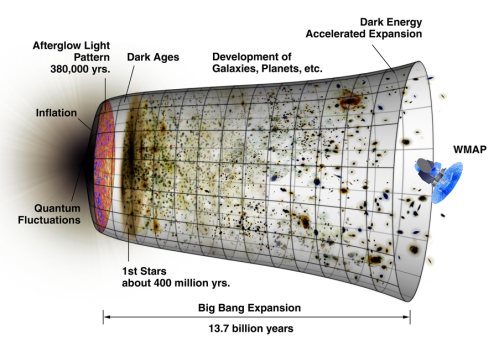
It doesn't matter if you step back 1 m, or move 1 m closer to the universe -- you will see the same universe en bloc, because you're in the non-Archimedean realm of "infinity" (recall the 'Aleph-null bottles of beer on the wall' here). Only Chuck Norris has been there (twice).
You can't.
If you insist on talking about some redshifted "ambulances" receding from you with speed proportional to the distance, after the Hubble Law, keep in mind that you are again confined into the finite 3-D space -- left vs right and Small vs Large -- hence you can say NOTHING about the phenomenon which creates this finite 3-D space. You can only see its END result -- a finite 3-D space. You cannot see or "measure intrinsically" any "curvature" of spacetime nor "DDE of [whatever]". You cannot see or "measure intrinsically" any GLOBAL parameter of spacetime. In the framework of present-day GR, you cannot have any privileged class of "fundamental observers" (Jean-Philippe Uzan) nor absolute coordinates of Earth in the absolute reference frame of the cosmic equator (Craig J. Copi et al.). To be precise, "in Friedmann-Robertson-Walker solutions one has canonical clocks (e.g. the temperature of the cosmic background radiation) that not only break Lorentz invariance defining a cosmic (global) time but break the Galilei invariance defining observers which are at rest with respect to the cosmic background radiation" (Luca Lusanna et al.). The current GR can't explain the bold fact that your wristwatch does indeed read this "unphysical" (global) time (Thomas Thiemann). The solution is simple and non-trivial: dual age cosmology. That is, the age of the universe is finite in the global mode (currently some 13.7 billion years "after" The Beginning), and infinite/indecisive in the local mode of time, as read by your wristwatch. Once created by [John 1:1], the universe has "already" become eternal/infinite along both directions of the local mode of time, toward the past and the future. Again, in present-day GR, you can't define any external and absolute parameter to map the END result from DDE to some cosmological "timeline", so that you can propose some "equation of state" (EOS) of DDE. It is just as wrong as are the following statements ("Big Bang 'soup recipe' confirmed," by Rolf H. Nielsen, New Scientist, 11 June 2003): "A microsecond after (absolute time - D.C.) the Big Bang, when the exploding fireball of the newborn Universe was only a few kilometres across (absolute space - D.C.), all matter existed in a special state." Such statements about the age of the universe are not better than the "discovery" of the Archbishop of Armagh James Ussher that the Earth was formed at 6 p.m. on 22 October 4004 BC. Only Chuck Norris can, at least in principle, measure the absolute age of the universe, but hasn't yet publish his calculation. Wilma, did you notice how fast was the latest inflation? And look at the scale factor: it changed that much by the time I finished my coffee! Fred, don't talk like a Russian cosmologist. Get real.
D.C.
February 8, 2011
Last update: March 17, 2011 ====================================
Subject: arXiv:1103.5870 v3 ?
Date: Wed, 6 Apr 2011 04:41:06 +0300
From: Dimi Chakalov <[email protected]>
To: Shuang Wang <[email protected]>,
Miao Li <[email protected]>,
Xiao-Dong Li <[email protected]>,
Yi Wang <[email protected]>
Cc: Yi-Fu Cai <[email protected]>
Dear Colleagues,
I like your review paper, arXiv:1103.5870v2, very much. May I inform you about my work at
http://www.god-does-not-play-dice.net/#error
http://www.god-does-not-play-dice.net/#Ellis
Do you follow Shao Yong ?
Kindest regards,
Dimi Chakalov
----
Examine the objects as they are and you will see their true nature;
look at them from your own ego and you will see only your feelings;
because nature is neutral, while your feelings are only prejudice and
obscurity.
Shao Yong, 1011-1077
------------------
Note: The manuscript by Miao Li et al. [Ref. 1] is the best review of the "dark" puzzle I've ever read. It is exceptionally clear and well organized. It is a joy to read and study.
My email above was prompted by the statement on p. 5: "The null energy condition is marginally satisfied." It will be nice if they elaborate on the adverb 'marginally'. Basically, the energy conditions express the idea that the locally-measured energy density must be strictly positive everywhere and for all observers. Sounds trivial, like saying that the mass is always positive, right? Well, try to prove it. The catch is in the presumption of locally-measured energy density. The "measurements" are actually quasi-local due to gravity. "One cannot just integrate Tuv(Matter) over a 3-space to obtain a conserved total energy-momentum" (R. Penrose, 1966). Moreover, this whole 3-space has its own dynamics, but one cannot use any external absolute background time to write down EOS of the "dark" puzzle. As Lau Loi So et al. acknowledged in their study with classical pseudotensors, "one can regard positivity as an important test for quasi-local energy expressions" (arXiv:0901.3884v1). And the other way around. It's a bundle. But we cannot use pseudotensors. It is a bit as if you're doing an exercise in analytical chemistry, and are trying to prove that you have NaCl in your sample, but have contaminated it with NaCl (pseudotensors) from the outset. Classical pseudotensors cannot prove/disprove anything. Nobody knows how they work, once people manage to shape them the way they want them ("Never make a calculation until you know roughly what the answer will be!", John A. Wheeler), in order to calculate the result they know from the outset. Forget it. We need to find 'the right question' in the first place. The puzzle is best explained in MTW, p. 467. The null energy condition [Ref. 1, p. 5], or rather the averaged null energy condition (ANEC), requires that the null-null component of the stress-energy tensor, integrated along a complete null geodesic, is non-negative for all states (Ulvi Yurtsever, arXiv:gr-qc/9411056v1). But how do you envisage 'a complete null geodesic' in an "expanding" space? I can't. It is also totally unclear to me how some 'perfectly smooth ideal fluid' (cf. Matt Visser) would couple to type I matter fields, to prove that ANEC is satisfied at all. Surely Mother Nature has made it strictly satisfied, or else we would have observed anomalous, if not catastrophic, events (more above). But again, these are just my scattered thoughts about the adverb 'marginally'. I think we shouldn't have jumped into conclusion that the "dark puzzle" originates directly from some mundane stuff with positive energy density: it comes out far too much, and suspiciously well-tuned during all cosmological stages. Clearly, there is "a long long way to go" [Ref. 1]. The review by Miao Li et al. [Ref. 1] is a gem. As Alfred North Whitehead noticed, "It requires a very unusual mind to undertake the analysis of the obvious." D.C.
April 7, 2011
[Ref. 1] Miao Li, Xiao-Dong Li, Shuang Wang, and Yi Wang, Dark Energy, arXiv:1103.5870v2 [astro-ph.CO], http://arxiv.org/abs/1103.5870v2
p. 5: "Of course the strong energy condition is not something sacred. The null energy condition is marginally satisfied."
......
p. 153: "However, the problem of understanding the nature of dark energy is as daunting as ever, or perhaps some already hold the key to this understanding without being commonly accepted yet. Clearly, there is a long long way to go for both theorists and experimentalists."
=================================
Subject: "Of course, it may just be that something else is wrong at a more fundamental level," arXiv:1102.1148v1 [gr-qc]
Date: Tue, 8 Feb 2011 04:30:20 +0200
From: Dimi Chakalov <[email protected]>
To: Johan Noldus <[email protected]>
Cc: Re Fiorentin Stefano <[email protected]>
But of course. See
http://www.god-does-not-play-dice.net/about.html#GR
It applies also to the puzzle acknowledged by Rindler.
D.C.
----
Wolfgang Rindler, Relativity, 2nd ed., Oxford University Press, 2006, Sec. 1.14, p. 22: "The equality of inertial and active gravitational mass then remains as puzzling as ever. It would be nice if the inertial mass of an accelerating particle were simply a back-reaction to its own gravitational field, but that is not the case."
====================
Subject: Re: "Of course, it may just be that something else is wrong at a more fundamental level," arXiv:1102.1148v1 [gr-qc]
Date: Tue, 8 Feb 2011 12:17:33 +0200
From: Dimi Chakalov <[email protected]>
To: johan noldus <[email protected]>
> Well, meanwhile I provided an answer to this question.
Wow. Now you should pack, shave, and leave for Stockholm... slowly, no rush.
Dimi
====================================
Subject: arXiv:1101.2177v1 [astro-ph.CO]
Date: Wed, 12 Jan 2011 04:50:08 +0200
From: Dimi Chakalov <[email protected]>
To: Marvin Weinstein <[email protected]>
Cc: Alfred Scharff Goldhaber <[email protected]>,
[email protected],
Ratindranath Akhoury <[email protected]>
Dear Dr. Weinstein,
It is a real pleasure to read your recent paper. I will study it thoroughly over the weekend.
May I offer you my comments and ask for your opinion and corrections. I extend this immodest request to your colleagues as well.
You wrote: "Clearly, if after some finite time the universe has doubled in size, then we have twice as many fundamental volumes as we had before."
It seems to me that you imply Archimedean geometry,
http://www.god-does-not-play-dice.net/#Blanchard2
I mean, a ' fundamental volume' may be chosen in such way that the "number" of such volumes, in any finite volume of space, to be uncountably infinite (cf. Kurt Gödel, 'What is Cantor's Continuum Problem?', American Mathematical Monthly, Vol. 54, No. 9 (November 1947), pp. 515-525). Which could be interpreted as a non-Archimedean, and purely geometrical "cutoff", at which Alice could see 'the grin of the cat without the cat', placed in the l.h.s. of Einstein equation.
You believe that "there is no reservoir of degrees of freedom available for creating new degrees of freedom as the universe expands", but if the evolution of the universe is non-unitary, such "reservoir" will be needed to account for the *emergence* of new degrees of freedom from 'the unknown unknown'.
Regarding the "interacting theory where the general form of the behavior of the vacuum energy density has the same form as in the free case", and the “Why now?” paradox, please see Sec. Summary, pp. 35-36, in
http://www.god-does-not-play-dice.net/ExplanatoryNote.pdf
Your idea that the scale factor (or the lattice spacing) may be changing "in a spatially uniform manner" is one of the toughest issues I've ever faced. I am trying to propose a 'scale relativity principle', which would treat the basic characteristics of 3-D space in a relational manner, that is, the notions of Large vs Small, inside vs outside, and left vs right, will no linger be absolute faculties of 3-D space, but will be relational, that is, 'relative to two observers', A and B. Keep observer A fixed at the length scale of tables and chairs, and allow a table of length 1 m, relative to A, to shrink its "length" toward the Small, while being closely watched by its "co-moving" observer B. As the size of the (relative to A) table and observer B shrink toward the Planck scale, the observer B will always, at all times, measure "the same" length of 1 m of their table, due to altering the metric of space/the scale factor toward the Small. This could only be possible if the "number" of "fundamental volumes" is uncountably infinite. Conversely, if we let the length of the table and observer B to "enlarge" toward the Large, relative to the fixed observer A, the length of the table would look like approaching the cosmological horizon to observer A, while *at the same time* it will keep its relative length of 1 m to its co-moving observer B.
Does this make sense to you?
Please see also a modification of G F R Ellis' Finite Infinity at
http://www.god-does-not-play-dice.net/#Beig
Sorry for this unsolicited, and too long, email. Maybe you have similar ideas, in which case I will be more than happy to study them in details. I just don't want to invent the wheel.
All the best,
Dimi Chakalov
-------
Note: I wish to stress that Marvin Weinstein's arXiv:1101.2177v1 [astro-ph.CO] is a must to read and study. It is indeed a fundamental research. The only point at which I disagree with him is this (p. 7): "Clearly my discussion of this question is woefully inadequate and a more serious analysis of these issues within the context of specific models is required in order to better assess the viability of the idea." In my opinion, his discussion isn't "woefully inadequate", but insightful, precise, clear, and professional. Surely we need further analysis, because nobody knows what 'space' is. All I wanted to suggest is to get rid of all fixed qualities of 'space', such as the spatial relations Small vs Large, etc., with the so-called
relative scale principle (RSP). It is very easy to say it, but immensely difficult to actually do it. I hope to offer more on November 25, 2015. D.C.
January 12, 2011
============================================
Subject: Request about 'how to catch a lion'
Date: Thu, 20 Jan 2011 04:00:35 +0200
From: Dimi Chakalov <[email protected]>
To: James M Chappell <[email protected]>
Dear Dr. Chappell,
I read your very interesting arXiv:1101.3619v1, and wonder if you can help me find the proper mathematical expression of an old joke about space inversion, 'how to catch a lion'.
If you ask a mathematician how to catch a lion in Sahara, she would probably suggest that, given the existence of at least one lion there, she would drag a cage for lions in the middle of the desert, lock herself up, and then perform space inversion w.r.t. the cage surface, such that all points outside it will be converted inside the cage, and vice versa. At the end of the day, she will find herself outside the cage, while the poor lion will be locked inside. :-)
Question is, would she see a parity-reversal state of the lion, like inverting a right-hand rubber glove into a left-hand one? And how can we mathematically describe such space inversion?
Please note that the intrinsic properties of our physical space are encoded in the relations of left vs right, and inside vs outside or large vs small. Unlike time-reversal symmetry, these transformations do not produce physically indistinguishable outcomes. I believe this asymmetry is the crux of 'space'.
Kindest regards,
Dimi Chakalov
----
Note: Back in October 1998, I wrote an email to Chris Isham, in which I offered the idea that the obvious asymmetry of time can only come from asymmetry of space. The reason is that the "separation" of time from space "takes place" only in our twisted imagination, so if we wish to search for some fundamental asymmetry, we should look closely at 'space'. Many years later, I came up with the Arrow of Space. Not only it requires mathematical presentation of 'space inversion', but new mathematical ideas for describing 'potential reality' as well. NB: Think of the 'cage surface' above as a spherical trapped 2-D surface, which represents the structure of space at macroscopic scale, namely, the length scale at which we can imagine three precisely separated entities: a collection of points located inside the cage, another collection of points from the cage surface, and a third collection of points from the space located outside the cage surface. This is also an operational definition of 'finite space', and a criterion about the "points" in such 'finite space' being FAPP 'strictly local'. In the case of quantum, gravitational, and living system, the "points" are quasi-local. If I knew the math, I wouldn't be writing these lines. Perhaps one day some young and hungry grad student will crack the puzzle. Then perhaps we will learn how to extract energy from space with our brains. If 'the universe as a whole' works like a huge brain, the release of positive mass-energy from 'empty space' could be just a matter of learning a new skill, as difficult as twirling a hula-hoop. Of course, we first need to find out the mechanism by which only one "charge" of mass is produced in the local mode of spacetime. Is 'potential reality' charge-neutral? How can AVCs (alien visiting craft) fly quietly and unconstrained by inertia-related dynamics (watch William Pawelec, 0:57:00-0:59:20)? Which begs the question of how to "separate" gravitational from inertial mass. Locally, they do look identical in some 'free falling elevator', but this 'elevator' belongs to the local mode of spacetime only. It can't fly like an AVC. More on 25.11.2015. D.C.
January 21, 2011
Last update: April 22, 2011
============================================
Subject: 0806.3293v4, 0907.0414v1, and 0907.0412v1
Date: Tue, 15 Feb 2011 02:03:03 +0200
From: Dimi Chakalov <[email protected]>
To: Samuel E Gralla <[email protected]>
Cc: Robert M Wald <[email protected]>,
Robert Geroch <[email protected]>,
Anthony Lasenby <[email protected]>,
Luke Butcher <[email protected]>,
Michael Hobson <[email protected]>
Dear Dr. Gralla,
In your review of the textbook by Hobson, Efstathiou, and Lasenby on amazon.com, you reiterated that "there are no solutions in general relativity with point particle stress-energy (see the paper by geroch and traschen)", and concluded:
"It is fine to present the calculation that point particle stress-energy will be conserved only for geodesic motion, but don't pretend there is anything more to it than a (very) suggestive calculation. Since no solutions exist for that stress-energy, you haven't shown anything about the motion of particles in GR. (At the
very least, don't discuss the field equations without pointing out that there are no solutions!)"
Surely you and Bob Wald discussed the field equations *and* pointed out that there are no solutions, but how should gravitational self-force be rigorously defined?
I think “point particles” with gravitational self-force do not make sense in linearized approximations of GR. Distributional solutions of Einstein’s equation with support on a timelike hypersurface (“shells”) do not make any sense whatsoever, because they require 'spherical cows' -- linearized Einstein equation and linearized Bianchi identity.
With such 'spherical cows' you and Bob are eliminating the non-linear effect you are supposed to describe:
http://www.god-does-not-play-dice.net/about.html#GR
Am I wrong?
Regards,
Dimi Chakalov
-------
Note: By the same token, LIGO "scientific" collaboration eliminated the non-linear effect of GW energy transfer with their "post-Newtonian" spherical cow [Ref. 1]. It is unbelievable. Sounds like a dumb joke. Check out the 1976 article by Jürgen Ehlers et al., and the pathetic 'spherical cow' by Clifford M. Will: Jürgen Ehlers, A. Rosenblum, J. Goldberg, and P. Havas, Comments on Gravitational Radiation and Energy Loss in Binary Systems, Astrophys J Lett 208 (1976) L77-L81
M. Walker and C. M. Will, The Approximation of Radiative Effects in Relativistic Gravity: Gravitational Radiation Reaction and Energy Loss in Nearly Newtonian Systems, Astrophys J Lett 242 (1980) L129-L133 The reason why the post-post-linear approximation to GR can be effective is in the linearized flattening "collapse", which also makes the geodesic hypothesis highly misleading and mathematically unclear. I will be happy to elaborate, after Jürgen Ehlers, cf. Ehlers.pdf, Sec. 5.
D. Chakalov
February 28, 2011
[Ref. 1] Clifford M. Will, On the unreasonable effectiveness of the post-Newtonian approximation in gravitational physics, arXiv:1102.5192v1 [gr-qc]
"... gravitational radiation involves spacetimes that are highly non-symmetrical and highly dynamical. No exact solution of Einstein's equations is known that describes the emission and propagation of gravitational waves from a source, and the reaction of the source to the emission of those waves.
"As a result, most of our understanding of gravitational radiation has come from approximations to Einstein's equations. (...) The underlying idea is to treat space-time as being that of flat Minkowski spacetime as the zeroth approximation, and to modify it by successive corrections.
....
"Nevertheless it is no less mysterious: we have no good understanding of why this approximation (post-post-linear approximation - D.C.) to general relativity should be so effective.
....
"However, the discovery revealed an ugly truth about the "problem of motion". As Ehlers et al. pointed out in an influential 1976 paper [17], the general relativistic problem of motion and radiation was full of holes large enough to drive trucks through. They pointed out that most treatments of the problem used "delta functions" as a way to approximate the bodies in the system as point masses.
"As a consequence, the "self-field", the gravitational field of the body evaluated at its own location, becomes infinite. While this is not a major issue in Newtonian gravity or classical electrodynamics, the non-linear nature of general relativity requires that this infinite self-field contribute to gravity. In the past, such infinities had been simply swept under the rug.
"Similarly, because gravitational energy itself produces gravity it thus acts as a source throughout spacetime. This means that, when calculating radiative fields, integrals for the multipole moments of the source that are so useful in treating radiation begin to diverge.
"These divergent integrals had also been routinely swept under the rug. Ehlers et al. further pointed out that the true boundary condition for any problem involving radiation by an isolated system should be one of "no incoming radiation" from the past. Connecting this boundary condition with the routine use of retarded solutions of wave equations was not a trivial matter in general relativity. Finally they pointed out that there was no evidence that the post-Newtonian approximation, so central to the problem of motion, was a convergent or even asymptotic sequence. Nor had the approximation been carried out to high enough order to make credible error estimates.
....
"The one question that remains open is the nature of the post-Newtonian sequence; we still do not know if it converges, diverges or is asymptotic.
....
"Wigner remarked that the effectiveness of mathematics in the natural sciences was mysterious. The unreasonable effectiveness of the post-Newtonian approximation in gravitational physics is no less mysterious."
======================================
Subject: arXiv:1102.5486v1 [math-ph], refs [9] and [10]
Date: Tue, 1 Mar 2011 05:08:55 +0200
From: Dimi Chakalov <[email protected]>
To: Christian Wiesendanger <[email protected]>
Cc: [email protected], [email protected]
Dear Dr. Wiesendanger,
I haven't been able to understand the Equivalence Principle and its various formulations, so I very much applaud your suggestion that gravitational energy momentum p_G is different by its very nature from the inertial energy-momentum p_I.
Yet it seems to me that their observed numerical equality is not accidental, since any residual energy-momentum from numerically different values of p_G and p_I would look like coming from some "ether". That is, in the framework of present-day GR, such residual energy-momentum would look like "dark energy of the ether". Which may be the case chosen by Mother Nature:
http://www.god-does-not-play-dice.net/about.html#GR
I will appreciate your critical comments on the ideas at the link above, as well as those from your colleagues.
Kindest regards,
Dimi Chakalov
=====================================
Subject: Essentially unknowable "veiled reality"
Date: Tue, 25 Jan 2011 19:20:38 +0200
From: Dimi Chakalov <[email protected]>
To: Bernard d'Espagnat <[email protected]>
Cc: Roland Omnes <[email protected]>,
Alain Aspect <[email protected]>
Dear Dr. d'Espagnat,
I am surprised that you again omitted Henry Margenau in your recent paper [Ref. 1]. I looked in your latest book "On Physics and Philosophy" (Princeton University Press, 2006; ISBN: 978-0691119649), and found out that John Bell was cited 51 times, yet you haven't mentioned Henry Margenau, not even once. Which is rather odd, given the fact that his views were published many years prior to yours:
http://www.god-does-not-play-dice.net/Margenau.html
You won the 2009 Templeton Prize and pocketed £1 million, and I wonder if you plan to update your papers with references to the articles and books published by Henry Margenau.
Yours sincerely,
Dimi Chakalov
--------
[Ref. 1] Bernard d'Espagnat, Quantum Physics and Reality,
arXiv:1101.4545v1 [quant-ph], http://arxiv.org/abs/1101.4545
p. 12: "Things being so, I proposed [30, 5, 4] a balanced view consisting in considering that the mind-independent reality notion is meaningful, that this entity - which most presumably is not imbedded in space-time - truly ’is’ (exists, and not merely in our thought), but is essentially unknowable (in the sense of not being describable with concepts), so that what both commonsense and science refer to and are able to really describe is merely what it generates in our mind and we called empirical reality.
----
p. 12, Footnote 9: "In other terms, pertinent as the celebrated Wittgenstein axiom “whereof we cannot speak, thereof we must keep silent” may be, it remains true that even though such an unknowable reality is not something we should try to describe, still we may entertain the idea of its existence."
---- Note: What is the intrinsic color of an octopus? What is 'the base state' in QM? Henry Margenau called this phenomenon Onta. Its mental presentation can be verified above. Just like Bernard d'Espagnat, Karl Popper wrote a whole book on "propensities", but mentioned only a paper by Henry Margenau from 1937 (p. 23). Anyway. D.C.
January 25, 2011 ==========================================
Subject: Re: arXiv:1005.3767v1 [quant-ph], Sec. 4
Date: Fri, 8 Apr 2011 19:12:08 +0300
From: Dimi Chakalov <[email protected]>
To: Diederik Aerts <[email protected]>
Cc: Sandro Sozzo <[email protected]>,
Sonja Smets <[email protected]>,
Liane Gabora <[email protected]>,
Jan Broekaert <[email protected]>,
Sven Aerts <[email protected]>
Dear Diederik,
I still haven't received your reply to my email from Fri, 21 May 2010 05:06:16 +0300.
Regarding your arXiv:1104.1322v1 and SCoP conjecture, check out
http://www.god-does-not-play-dice.net/#Bedingham
“A spoken thought is a lie” (Fedor Tyutchev). The UNspeakable cannot fit in any Hilbert space whatsoever,
http://www.god-does-not-play-dice.net/#Specker_addendum
Entanglemently yours,
Dimi
==========================================
Subject: arXiv:0906.0315v2 [gr-qc]
Date: Fri, 28 Jan 2011 04:34:09 +0200
From: Dimi Chakalov <[email protected]>
To: Daniel Sudarsky <[email protected]>
Cc: Alejandro Perez <[email protected]>,
Claus Kiefer <[email protected]>,
David Polarski <[email protected]>,
Alessandro Teta <[email protected]>,
Wojciech Hubert Zurek <[email protected]>,
Jonathan Halliwell <[email protected]>,
Maximilian Schlosshauer <[email protected]>,
Jorge Pullin <[email protected]>,
IGUS Jim <[email protected]>,
Zeh <[email protected]>
Hi Daniel,
It is a pleasure to read your article at
http://arxiv.org/abs/0906.0315
Regarding Sec V from Kiefer-Polarski arXiv:0810.0087v2 [astro-ph]: I am really surprised that Claus still writes about "decoherence".
Claus: Could you please try to elaborate on the Nevill Mott paper? See Alessandro Teta, arXiv:0905.1467v1 [math-ph], pp. 9-10,
http://arxiv.org/abs/0905.1467
You may also wish to consider a proposal to falsify "decoherence" at
http://www.god-does-not-play-dice.net/#decoherence
I trust Claus will reply professionally, it just may take some time. Hope other proponents of "decoherence" will also make the effort to face the bold facts.
Additionally, please don't miss Henry Margenau,
http://www.god-does-not-play-dice.net/Margenau.html
All the best,
Dimi
-------
Note: Once you explain the tracks observed in a cloud chamber (produced by an alpha-particle emitted by a source in the form of a spherical wave) with some "decoherence", please apply the same "decoherence" mechanism to the Nebulae supercomputer. Good luck.
D.C.
January 28, 2011
=====================================
Subject: No-boundary quantum state?
Date: Tue, 12 Apr 2011 04:51:49 +0300
From: Dimi Chakalov <[email protected]>
To: Thomas Hertog <[email protected]>, IGUS Jim <[email protected]>
Cc: Claus Kiefer <[email protected]>,
Friedrich W Hehl <[email protected]>,
Jonathan Halliwell <[email protected]>,
[email protected], [email protected],
[email protected], [email protected],
[email protected], [email protected]
Dear Tom and Jim,
In your latest arXiv:1104.1733v1 [hep-th], you wrote:
"First a theory of dynamics summarized by a Hamiltonian or action. Second a theory of the universe's quantum state. Without theories of both there are no predictions of any kind.
.....
"It is striking to think that these everyday asymmetries of the world emerged 14Gyr ago, and have remained pointing in the same direction since, as a consequence of the universe's quantum state."
I would like to raise two questions.
Firstly, I noticed that you carefully avoid any of those 3000+ paper dealing with the "expansion" of space due to the so-called dark energy of [whatever]. Can your "closed spacelike three-surface" (arXiv:1009.2525v2 [hep-th]) accommodate some form (your choice) of "dark energy"?
Secondly, is your "quantum state" compatible with KS Theorem?
http://www.god-does-not-play-dice.net/#Specker_addendum
I'm afraid the answer to these questions will be in the negative, but maybe some of your colleagues can help.
Regards,
Dimi
=====================================
Subject: The principle of explanatory closure
Date: Fri, 15 Apr 2011 13:07:30 +0300
From: Dimi Chakalov <[email protected]>
To: Lee Smolin <[email protected]>
Cc: [snip]
Lee:
You mentioned in arXiv:1104.2822v1 [quant-ph] some "principle of explanaory closure: anything that is asserted to influence the behavior of a real system in the world must itself be a real system in the universe. It should not be necessary to postulate anything outside the universe to explain the physics within the one universe where we live."
Apart from the typo ("explanaory"), I think the notion of 'outside the universe' is oxymoron.
As to 'real system in the universe', check out the KS Theorem,
http://www.god-does-not-play-dice.net/#Specker_addendum
I raised this fundamental issue in my email to you from February 9, 2002, to which you responded on Sat, 23 Feb 2002 11:36:43 +0000 (BST) as follows:
"So far as I can tell, you do not formulate a clear objection, you just make accusations that there is a problem and ask people to disagree with you. This is not a very constructive way to proceed."
If you wish to waste your time -- that's fine with me, but why are you involving other people, who obviously have real priorities?
Dimi
=====================================
Subject: Thèse d’Habilitation à Diriger des Recherches,
arXiv:1101.5061v1 [gr-qc]
From: Dimi Chakalov <[email protected]>
Date: Thu, 27 Jan 2011 05:08:50 +0200
To: Etera Livine <[email protected]>
Cc: Hanno Sahlmann <[email protected]>,
Johan Noldus <[email protected]>,
Achim Kempf <[email protected]>
Hi Etera,
May I offer my comments.
p. 5: "All the information is encoded in the wave-function, which defines the probability amplitude of possible events."
As we all know, this is untrue:
http://www.god-does-not-play-dice.net/Margenau.html
p. 7: "... it is also believed that a deeper theory such as quantum gravity (...) should be based on deeper principles and would help to shed lights on the true physical meaning of the quantum theory."
Please see Addendum at the link above.
"This “graviton” would carry the gravitational interaction the same way that the photon carries the electromagnetic force."
No need for any “graviton”: see above.
p. 8: "Quantum mechanics and general relativity are two theories based on solid principles. Quantum Gravity should go beyond these theories, and thus some of these solid principles should not be true."
Must not be true: see above.
p. 9: "Loop quantum gravity (...) start with a careful analysis of the classical phase space of general relativity."
LQG is 'looking for the right answer to a wrong question'. See again Addendum at the link above.
p. 77: "Thanks to everybody who has collaborated and worked and discussed with me about physics during all these years!"
I take this as acknowledgment of my email from Wed, 26 Jan 2005 12:13:06 +0000 (cf. below).
"And thanks to everyone who managed to read this thesis up to here!"
I appreciate your sense of humor!
Dimi
-----------
Subject: How to determine the semi-classical regime in a background
independent fashion?
Date: Wed, 26 Jan 2005 12:13:06 +0000
From: Dimi Chakalov <[email protected]>
To: Etera Livine <[email protected]>
CC: [snip]
BCC: [snip]
Dear Etera,
I read your recent "Some Remarks on the Semi-Classical Limit of Quantum Gravity", gr-qc/0501076 v1 [Ref. 1], and recalled a famous saying from Confucius:
"The hardest thing of all is to find a black cat in a dark room, especially if there is no cat."
[skip]
============================================
Subject: arXiv:1102.1867v1 [gr-qc]
Date: Thu, 10 Feb 2011 04:21:05 +0200
From: Dimi Chakalov <[email protected]>
To: [email protected], [email protected]
Cc: [email protected], [email protected], [email protected],
[email protected], [email protected], [email protected],
[email protected], [email protected], [email protected],
[email protected], [email protected], [email protected]
Dear Jörg and László,
I am very suspicious about that "pure gauge term" [Ref. 1]. Perhaps you or some of your colleagues can discover a *perfectly well defined* energy-momentum density of the gravitational "field": see Addendum at
http://www.god-does-not-play-dice.net/about.html#GR
The task is strictly mathematical.
All the best,
Dimi
--------
[Ref. 1] Jörg Frauendiener and László Szabados, A note on the post-Newtonian limit of quasi-local energy expressions, arXiv:1102.1867v1 [gr-qc],
http://arxiv.org/abs/1102.1867
"Though in general relativity there is no well defined energy-momentum *density* of the gravitational ‘field’, in asymptotically flat configurations its total (ADM) energy could be defined, and one of the greatest successes of classical general relativity in the last third of the 20th century is certainly the proof by Schoen and Yau that the total gravitational energy is strictly positive definite. The logic of one of its simplest proofs, due to Witten (and simplified and corrected by Nester), is that we can rewrite the total energy as an integral of some expression (the so-called Sparling form) on a spacelike hypersurface, and by Witten’s *gauge condition* the integrand could be ensured to be pointwise strictly positive definite.
"Thus the negative definite part of the Sparling form in the integrand is a pure gauge term."
=========================================
Subject: 6 sec earlier
Date: Tue, 1 Mar 2011 00:11:09 +0200
From: Dimi Chakalov <[email protected]>
To: Marcus Du Sautoy <[email protected]>
Cc: [email protected], [email protected],
[email protected], [email protected],
[email protected], [email protected],
[email protected]
Dear Dr. Du Sautoy,
I watched a brief video about your "6 sec" musings at
http://www.forbiddenknowledgetv.com/page/555.html
The whole story about your free will, after Benjamin Libet, has quite different explanation. Please be assured that no "computation" is going on in your brain.
I wonder if anyone has explained to you the binding phenomenon.
Try a simple case of mental rotation: imagine a cube made of some white plastic material, with 3 cm rib, painted blue, which you cut into 27 little cubes, 1 cm each, and ask yourself the question: how many little cubes have 3 painted sides, 2, 1, and zero?
The entity in your brain, which builds up the cube and does the rotation and examination of its colored sides, is driven by your free will.
It is UNspeakable, like the Platonic ideas in your *brain*,
http://www.god-does-not-play-dice.net/#Leydesdorff_101
It does not perform any "computations" whatsoever. Only Marxist-Leninist philosophers believe in such crap (pardon my French).
If you wish to train your brain, check out
http://www.god-does-not-play-dice.net/about.html#China
All the best,
Dimi Chakalov
-------------
 | | But what consciousness is we know not and how it is that anything so remarkable as a state of consciousness comes about as a result of irritating nervous tissue, is just as unaccountable as the appearance of the Djin when Aladdin rubbed his lamp. Thomas Henry Huxley, 1866 |
To avoid misunderstandings, let me introduce the term and the notion of BrainMonad (please notice the spelling), after Leibniz. It is ONE entity due to the phenomenon of entanglement.
The BrainMonad is not physical, in the sense of res extensa, hence it can never show up in the righthand side of Einstein filed equation. It is not res cogitans either, because it does act on the physical world, although via geometry only. It is the ultimate 'steering wheel' with which we exercise our free-will decisions and actions. It is our "bridge" to the quantum-gravitational realm of res extensa. The popular term for its diverse manifestations is known as Chi. It is also a dual entity, in the sense that, if we look at it from its "other end" at the human psyche, it will be perceived introspectively as 'the human self'. In the experiment with the cube above, you are 'the driver' operating with your 'steering wheel', although 'you & your steering wheel' is an inseparable non-localizable unit. Let me try to explain. Consider the qualia of 'blue' (res cogitans): it refers to EM radiation with particular wavelength and has various neurophysiological presentations in your brain, all of which are localized res extensa. Hence you may "separate" the two entities, given their entirely different nature. With the dual nature of the BrainMonad, you cannot make such "separation" anymore: it is not physical but 'potential reality', and is also the "filter" through which the human mind and consciousness is explicated at the macro-world of biological systems. Thus, there is no "quantum consciousness" in the quantum realm, but only 'quantum potential reality'. There should, however, exist 'potential reality' associated with the human brain and all living creatures, which is supposed to keep the potential brain states -- the BrainMonad through which mind and consciousness enter the macroscopic world of biological systems; hence the "filter" metaphor above. But again, you cannot "separate" the BrainMonad into two "parts" (e.g., 'the driver' vs. the 'steering wheel'), as you could do with the qualia of 'blue' vs. its physical & neurophysiological presentations. Introspectively, the actions performed with the BrainMonad are carried out by our self-referential faculties of free will and 'itself contemplating' (Aristotle), within an 'extended instant now' from our perception of the Arrow of Space. Notice that an 'extended instant now' (global mode of spacetime), during which the negotiations between the two sides of Einstein field equation "take place" (depicted with the famous Escher drawing), is the crucial requirement for our "atemporal" mind and consciousness as well. Physically, the BrainMonad is a new (to some theoretical physicists, at least) form of reality, called here 'potential reality', in the framework of 'the universe as a brain'. As John Bell put it, "there is a real causal sequence which is defined in the aether." Should we require the theory to "account for the present correlations between these present phenomena" (idem), you need the BrainMonad (global mode of spacetime) to exclude "the aether" from the local/physical mode of spacetime, thereby ensuring a Lorentz invariant theory. Physicists would call the BrainMonad 'absolute structure' (James Anderson), 'reference fluid', and 'ether'. They are, of course, trying to avoid it (cf. Karel Kuchar), because it does not carry any localizable physical stuff that could be 'directly observable'. In their parlance, the BrainMonad would always be "dark", as referred to 'the universe as a brain' and to the smaller one which is right above your neck -- the BrainMonad belongs to 'the global mode of spacetime'. As stressed earlier (cf. my note from February 8, 2011), we cannot reach it from the physical 3-D space, because it is non-Archimedean reality (recall the 'Aleph-null bottles of beer on the wall' here). Only Chuck Norris has been there (twice). The BrainMonad comes from Aristotle. The first-cause argument "begins with the fact that there is change in the world, and a change is always the effect of some cause or causes. Each cause is itself the effect of a further cause or set of causes." This chain moves in a series that is completed at a special cut off, called 'the First Cause' (reference here). In summary, the BrainMonad is a bona fide Unmoved Mover: "something which moves [other things] without [itself] being moved [by anything]." It produces the ultimate cut off on 3-D space, as introduced with 'Finite Infinity', thanks to which space is being self-wrapped (cf. Einstein). You can't do Quantum Theory and General Relativity without it. No way. To paraphrase Isaac Newton and John Wheeler [1], only the BrainMonad can create geometry and determine the distribution of energy flow "throughout all SPACE," en bloc. We don't like "miracles" and "dark energy", do we? Why is this difficult to understand, I wonder. Except for the term of BrainMonad, everything said above is widely known. Of course, many people seriously hate such ideas, simply because 'the universe as a brain' could have its own Mind, known as The Universal Mind: read Henry Margenau. But your emotional and cultural attitudes are entirely different issue which shouldn't interfere with quantum gravity. Just one simple example for the doctrine of trialism: following the 'trunk' metaphor above, the 'arm' and the 'nose' spring from their common source (John 1:1), hence if one of them goes first into existence, it will certainly, with unit "probability", wind up in pre-established harmony (Leibniz) with the other one. No need for any "multiverse", "googolverse", "considerations of habitability", and other murky parapsychology. And just one simple argument: suppose you, my dear reader, managed to grasp the examples here and here. Did you use your brain? Sure. But you reject the theory, correct? Okay, suppose your brain isn't equipped with a BrainMonad, but is making some "neuronal computations". What was the probability to "compute" the meaning of the four examples correctly? To make the question more precise, imagine 100 curious chimpanzees rotating frantically 100 Rubik cubes. What is the probability for all chimpanzees to complete the task at one instant? Perhaps you can now understand the "chance" for setting up the initial conditions of the alleged big bang to match the universe we live in: one part in 101230, as calculated meticulously by R. Penrose. At this point you should either embrace the oxymoronic "anthropic reasoning", "multiverse", etc., or the BrainMonad. That's your free will choice.
"just another crank" D.C.
March 2, 2011
Last update: March 15, 2011
[1] J. A. Wheeler, Geometrodynamics and the issue of the final state. In: Relativity, Groups and Topology, Les Houches Summer School of Theoretical Physics 1963, Edited by C. DeWitt and B. S. DeWitt (New York, Gordon & Breach, 1964), p. 333:
"... the description of right lines and circles, upon which geometry is founded belongs to mechanics. Geometry does not teach us to draw these lines, but requires them to be drawn ..."
"Thus one comes to a new insight into the great issue raised by Isaac Newton in the opening pages of his Principia. He wrote that geometry requires one to construct straight lines, but does not provide one with the means to carry out the construction; only mechanics provides the means. He is obviously asking
the question, how does mechanics accomplish this miracle?
.......
p. 365: "The discussion as just outlined was sufficient to lead from the earlier concept of Mach's principle (Formulation 1) -- The inertial properties of an object are determined by the distribution of mass-energy throughout all space -- to a Formulation 2 closer in spirit to general relativity: The geometry of SPACETIME and therefore the inertial properties of every infinitesimal test particle are determined by the distribution of energy and energy flow throughout all SPACE." ====================================
Subject: The age of the universe
Date: Fri, 4 Mar 2011 15:09:26 +0200
From: Dimi Chakalov <[email protected]>
To: Martin Rees <[email protected]>
Cc: Carolin Crawford <[email protected]>,
Carlos Frenk <[email protected]>,
Mario Livio <[email protected]>,
Marvin Weinstein <[email protected]>,
Christian Wiesendanger <[email protected]>,
Hamish Johnston <[email protected]>
Hi Martin,
Regarding your talk at
http://www.bbc.co.uk/programmes/b00yz3gy
The error you've been making is explained at
http://www.god-does-not-play-dice.net/#error
Details at
http://www.god-does-not-play-dice.net/#BrainMonad
If you or any of your colleagues replies professionally, I will be happy to elaborate.
Take care,
Dimi
======================================
Subject: Conformal Treatment of Infinity
Date: Tue, 8 Mar 2011 15:40:16 +0200
From: Dimi Chakalov <[email protected]>
To: Roger Penrose <[email protected]>
Cc: Laszlo Szabados <[email protected]>,
Jörg Frauendiener <[email protected]>,
Eric Gourgoulhon <[email protected]>,
Adam Helfer <[email protected]>,
Norbert Straumann <[email protected]>,
Karel V Kuchar <[email protected]>,
Domenico Giulini <[email protected]>,
Chris Isham <[email protected]>,
Robert M Wald <[email protected]>,
Robert Geroch <[email protected]>
Dear Roger,
Regarding your idea published in 1964 [Ref. 1], check out
http://www.god-does-not-play-dice.net/#BrainMonad
http://www.god-does-not-play-dice.net/about.html#GR
Perhaps it will be a good idea if you and your colleagues get serious about GR.
Regards,
Dimi
-------
[Ref. 1] R. Penrose, Conformal Treatment of Infinity. In: Relativity, Groups and Topology, Les Houches Summer School of Theoretical Physics 1963, Edited by C. DeWitt and B. S. DeWitt (New York, Gordon & Breach, 1964), p. 565:
Fig. 1. The infinite physical space-time _M is mapped into an unphysical "finite" conformally equivalent manifold M, with boundary J corresponding to the "infinity" of _M.
======================================
Subject: arXiv:1103.1427v1 [gr-qc]
Date: Wed, 9 Mar 2011 14:03:47 +0200
From: Dimi Chakalov <[email protected]>
To: Eduardo I Guendelman <[email protected]>
Hi Eddie,
You acknowledged that you "still do not understand why the observed vacuum energy density must be positive instead of possibly a very small negative quantity," yet you picked "the state (with a lower vacuum energy density) that best represents the present state of the universe."
Not surprisingly, your wild guess is totally wrong.
If you are serious about your arXiv:1103.1427v1 [gr-qc], see
http://www.god-does-not-play-dice.net/about.html#GR
http://www.god-does-not-play-dice.net/#BrainMonad
But if you're doing it as a hobby -- don't bother to read and study. Have a beer instead :-)
Dimi
-------
Note: Last year, I wrote to Eduardo Guendelman regarding his "Gravitational Theory with a Dynamical Time", arXiv:0911.0178v2 [gr-qc], and received an emotional reply that the Bianchi identity is a mathematical theorem, hence there is "no ambiguity" involved here. However, the Bianchi identity cannot be applied for the case of 'GR with DDE', firstly because neither Eduardo Guendelman nor anyone else can determine the energy density at a "point": MTW, p. 467. The ambiguity comes from the fact that the present-day GR cannot formulate 'the right question' in the first place. Moreover, thousands of papers on DDE have been published so far, with the same error of "expanding space". Again, in the present-day GR, the notion of 'dynamical time' is an oxymoron. You may eventually fix GR if you make the dynamical time quasi-local -- check out the first link above. In one sentence, the quasi-local time in 'GR with DDE' originates from 'change of space'. For more on the current GR, see H. Ohanian, arXiv:1010.5557v1 [gr-qc], p. 3 and endnote 2 on p. 31. Hans Ohanian claims that Eq. 1 (p. 3) "determines the rate (emphasis mine - D.C.) at which the nongravitational matter receives energy and momentum from the gravitational field." Unfortunately, he wasn't joking, and neither is Eduardo Guendelman (arXiv:1103.1427v1 [gr-qc], p. 25): "... the cosmological constant term representing the zero point fluctuations can be formulated correctly and unambiguosly in the Einstein frame (leading to a consistent effective action) without reference to the original frame, this is because the quantization is performed in the Einstein frame, not in the original frame." You can produce lots of calculations based on a wrong theory. For example, you may "split" the metric gmv into two "parts": "background part, for which we could take flat space-time, and a dynamical part", as suggested by G. 't Hooft. Or you may wish to introduce "two measures theory", as advocated by E. Guendelman (arXiv:1103.1427v1 [gr-qc]). In the latter cases, you can produce a calculation that yields results consistent with the "observed" vacuum energy density. The best known examples for such tricks are the pseudo-tensors: MTW, p. 467. If you're good in math, you may abuse GR as much as you can. Take, for example, G. 't Hooft: "In typical LIGO experiments, the amplitude [x] is very small, something like 10-20 or smaller (and indeed dimensionless), ... (...) To be precise: in practice you only need the linear parts of Einstein's equations, and you have to build wave packets by superimposing these plane waves." Here's an old joke. Three men in a mental clinic, Tom, Dick, and Harry, have to pass a test before their eventual release. The test is very simple: how much is 2 + 2. The doctor asks Tom, and he replies: '11'. 'Are you sure?' 'Of course', says Tom, '2+2 makes 11. What else?' 'Well, you'll have to stay here for another month or two', says the doctor. Same question to Dick. He immediately replies -- 'Tuesday'. 'Are you sure?' 'Of course', says Dick, '2+2 makes Tuesday. What else?' 'Well, you too will have to stay here for another month or two', says the doc. Finally comes Harry. Same question, and he immediately strikes back with '4'. 'Congratulations', says the doc, 'you passed the test and may check out tomorrow. But how did you actually calculate it?' 'Easy', Harry replies, 'I simply divided Tuesday by 11 and got 4. What else?' Trouble is, once people like G. 't Hooft and his colleagues from LIGO "scientific" collaboration 'divided Tuesday by 11' and calculated the effect on LIGO's arms from "something that is dimensionless" (exact quote from Kip Thorne's Physics 237-2002 Course) -- without having a quantum theory -- we all will have pay for their parapsychology: see ExplanatoryNote.pdf. They may abuse GR as much as they can, and will waste billions of dollars and euro for chasing a dimensionless ghost. There is nothing we can do to stop them. Meanwhile, Eduardo Guendelman wrote (Thu, 10 Mar 2011 17:30:02 GMT):
> I can explain why there is a positive energy density, the result
> of this calculation surprised me, is not obtained
> by forcing anything, it comes naturally and beautifully.
But of course you can. If, for example, you choose Hüseyin Yilmaz' theory, you can produce even better calculations. Once you ignore the unsolved problems of GR, you can do anything you want. But if you are keen to explain "why there is a positive energy density", you should also explain why we always observe only one "charge" of mass. That may be tough, because the latter is not localizable (MTW, p. 467) in the framework of current GR which is still "essentially not anything more than a theory of the gravitational field, which was somewhat artificially isolated from a total field of as yet unknown structure" (Einstein). We do have localizable and gravitating physical stuff (e.g., broccoli, shorts, milk, etc.) which is bootstrapped by the non-localizable "gravitational field" (much like your brain produced localized 'meaning'), only this physical stuff has quasi-local mass, in the sense that its fleeting explications do not and cannot fix any background spacetime, hence we can eliminate gravity 'by hand' (modulo higher derivatives) at any given "point" from such non-existing background spacetime, in line with Einstein's Equivalence Principle (MTW, p. 467). Which is why linear approximations can produce very effective, and also highly deceptive, calculation tools. We cannot have a continual trajectory of "points" (cf. the geodesic hypothesis) at which the locality assumption holds, but a continual trajectory of quasi-local "points", just like those from the trajectory of a fish. Thus, the answer to the question 'does the zero point energy gravitate?' is YAIN. Yes -- because all physical stuff (e.g., broccoli, shorts, milk) does gravitate; no -- because their common source doesn't. All this is not obtained by forcing anything, it comes naturally and beautifully, but of course people like Eduardo Guendelman will ignore it. D.C.
March 9, 2011
Last update: March 11, 2011
=======================
Subject: Re: arXiv:1103.1427v1 [gr-qc]
Date: Sat, 12 Mar 2011 12:48:08 +0200
From: Dimi Chakalov <[email protected]>
To: Eduardo Guendelman <[email protected]>
Cc: [email protected], [email protected]
Dear Eduardo,
> of course it is not an irrelevant issue and you cannot avoid it in
> deciding for example on whether there is gravitational radiation or not,
> but if you study the question of the accelerated universe, then
> only the question of whether there is a piece proportional to the
> metric in the energy momentum appears to decide this question.
That 'piece' in question (MTW, p. 467) is inherently quasi-local,
http://www.god-does-not-play-dice.net/#Jorg
> In summary, what you are worries about is not an irrelevant issue and you
> cannot avoid it in the full theory, but there are some questions in cosmology
> for example, or in finding exact solutions (another example), where this does
> not appear to affect one way or the other
If you're using some 'spherical cow' approximation to bypass this issue, that would be a different story.
> by contrast, gravitational radiation would be something where this would be
> fundamental.
Thank you for your clarification. It is my understanding that if you study the accelerated universe, gravitational radiation is essential issue (which is why I wrote a lot about it). Anyway.
Regards,
Dimi
========================
Subject: Re: arXiv:1103.1427v1 [gr-qc]
Date: Sat, 12 Mar 2011 13:07:59 +0200
From: Dimi Chakalov <[email protected]>
To: Eduardo Guendelman <[email protected]>
Cc: [email protected], [email protected]
On Sat, Mar 12, 2011 at 11:19 AM, Eduardo Guendelman <[email protected]> wrote:
>
> Dear Dimi,
> the vacuum energy density is a very, very special case,
> its energy momentum tensor is a constant times the metric, so not only it
> has zero covariant divergence but also every covariant derivative of its
> energy momentum tensor is zero
Georges Lemaître noted in 1934 that “in order that absolute motion, i.e., motion relative to the vacuum, may not be detected, we must associate a pressure [X] to the energy density [X] of vacuum”,
http://www.god-does-not-play-dice.net/Szabados.html#Peebles
If you imply some Lorentz-invariant form of vacuum energy density (e.g., G. Marsh, arXiv:0711.0220v2, Eq 2), then I can understand your confusion below.
> no body has deviced (not even in theory) a way to radiate or emit vacuum
> energy, it is conserved separately from the other pieces of the energy
> momentum tensor
Well, I wrote something about this issue at
http://www.god-does-not-play-dice.net/#Guendelman
Dimi
======================================
Subject: arXiv:1103.2335v1 [astro-ph.CO], Sec. 4.4.2: "expansion H(z) changes radial distances"
Date: Mon, 14 Mar 2011 17:04:40 +0200
From: Dimi Chakalov <[email protected]>
To: George <[email protected]>
Cc: Paul Steinhardt <[email protected]>,
William R Stoeger <[email protected]>,
Thomas Buchert <[email protected]>,
Jean-Philippe Uzan <[email protected]>,
Roy Maartens <[email protected]>,
Malcolm MacCallum <[email protected]>,
Alain Blanchard <[email protected]>,
Michal Chodorowski <[email protected]>,
Robert van den Hoogen <[email protected]>
George, you're thinking like Chuck Norris:
http://www.god-does-not-play-dice.net/#error
The evolving cosmological "constant" is not related to some "Ricci tensor contribution", nor is some ‘perfect fluid’ (p. 3).
And the reason you can place [lambda] in either side of the EFE (ibid.) is that it acts on both sides of the EFE,
http://www.god-does-not-play-dice.net/about.html#GR
Will be happy to elaborate, should you or your colleagues respond professionally.
Dimi
-------
Note: Searching for a physical, after Georges Lemaître, form of "dark energy" (George Ellis, p. 17) is like searching for an elephant in a china shop (details here), under the condition that the elephant is much larger than the store itself. Chuck Norris may be interested, however. He is the only person to pass from the physical world to the non-Archimedean realm (global mode of spacetime), and back to the Archimedean world of 3-D space. Only Chuck Norris can verify the claim that "expansion H(z) changes radial distances," and I think George Ellis should mention him in his forthcoming arXiv:1103.2335 v2 [astro-ph.CO]. Seriously,
George Ellis is a great physicist. He offered a brilliant insight about what he called Finite Infinity, which is conditio sine qua non for understanding the nature of inertia and gravity, and perhaps the "dark energy": if we can define the entire universe as "spatially self-enclosed" (Einstein), by "passing to an appropriate asymptotic regime such that all gravitational effects are localized inside of it" (Adam Helfer), it might be possible to crack the puzzle of DDE. It won't be a physical solution, because DDE introduces 'absolute motion' to the physical world, while being in 'absolute rest'. It is the Aristotelian First Cause. Its physical manifestation goes via geometry only, by ways of self-acting. Of course you can't trace back the very source of DDE. That's what makes it "dark". Sorry for repeating this again. In the current formulation of GR, based on the misfortunate splitting of spacetime into two "parts", the alleged dynamics of the scale factor, R = R(t) (cf. Brian P. Dolan), refers to 'change in space' [Ref. 1], but such 'change', denoted with t , is severely restricted by the dynamics of the other "part" (called 'space'). In order to capture the 'dynamical dark energy of [whatever]', you need to discover the dynamics of space, that is, 'the change of space' along the Arrow of Space. Forget about that "perfect fluid" (George Ellis, p. 3). It "evolves" along t taken from 'change in space' [Ref. 1], which is "a genuine property of Lorentzian geometry, that is, of the existence of one axis of time of a different nature to the space axes" (José Senovilla). Hence the corollary about the "edge" of spacetime: "This is some kind of boundary, or margin, which is not part of the space-time but that, somehow (sheer poetry - D.C.), it is accessible from within it" (idem). It's a whole new ball game. You should do better than Georges Lemaître in 1934.
D.C.
March 14, 2011
Last updated: March 19, 2011
[Ref. 1] Robert Geroch, General Relativity from A to B. University of Chicago Press, Chicago, 1981, pp. 20-21:
"There is no dynamics within space-time itself: nothing ever moves therein; nothing happens; nothing changes. (...) In particular, one does not think of particles as "moving through" space-time, or as "following along" their world-lines. Rather, particles are just "in" space-time, once and for all, and the world-line represents, all at once the complete life history of the particle."
Comment: Your brain cannot function in such dead frozen "block", firstly, and secondly -- only
Chuck Norris could see it "all at once". Anyway.
D.C.
March 17, 2011
Last updated: December 4, 2012
======================
Subject: Re: arXiv:1103.2335v1 [astro-ph.CO], Sec. 4.4.2: "expansion H(z) changes radial distances"
Date: Wed, 16 Mar 2011 23:11:44 +0200
Message-ID:
<[email protected]>
From: Dimi Chakalov <[email protected]>
To: George <[email protected]>,
Paul <[email protected]>,
Paul Steinhardt <[email protected]>,
William R Stoeger <[email protected]>,
Thomas Buchert <[email protected]>,
Jean-Philippe Uzan <[email protected]>,
Roy Maartens <[email protected]>,
Malcolm MacCallum <[email protected]>,
Alain Blanchard <[email protected]>,
Michal Chodorowski <[email protected]>,
Robert van den Hoogen <[email protected]>,
Laszlo Szabados <[email protected]>,
Jörg Frauendiener <[email protected]>,
Eric Gourgoulhon <[email protected]>,
Adam Helfer <[email protected]>,
Norbert Straumann <[email protected]>,
Karel V Kuchar <[email protected]>,
Domenico Giulini <[email protected]>,
Chris Isham <[email protected]>,
Robert M Wald <[email protected]>,
Robert Geroch <[email protected]>,
Roger Penrose <[email protected]>
P.P.S. I inserted today a drawing of the "accelerated" universe at
http://www.god-does-not-play-dice.net/#error
According to Chris Isham, I am "just another crank" who does not know "enough theoretical physics to help with any research in that area," but he hasn't yet produced any evidence in support of his second claim. I trust you can help him find my errors -- please don't hesitate to raise your professional questions and objections.
Other people declared, in the same bold fashion, that I know nothing about the global economy:
http://ow.ly/3Ul4a
Anyway. I do hope to hear from you.
"just another crank" D.
On Wed, Mar 16, 2011 at 5:04 AM, Dimi Chakalov <[email protected]> wrote:
>
> P.S. I updated today (16.03.11) the explanatory note at
>
> http://www.god-does-not-play-dice.net/#Ellis
>
> If there is anything left unclear, it will be *entirely* my fault.
>
> Please don't hesitate to raise your professional questions and objections.
>
> D.
>
------ Note: More than 48 hours have passed since my email from Wed, 16 Mar 2011 23:11:44 +0200 above, yet nobody has even confirmed its receipt. The same reaction was in June - August 2008 -- those noble academic scholars won't reply to some "crank". About eight years ago, an 11-year-old boy wanted to know what the Big Bang sounded like for a school project. That's a smart kid. I don't want him to study GR and QM exclusively from these people above: he will be taught about the Gauss-Bonnet theorem [Ref. 2] and the "stress-energy tensor" of the vacuum [Ref. 3], and will get lost forever. As Max Planck pointed out many years ago, the future lies with youth. D.C.
March 19, 2011
[Ref. 2] Gautam Dutta, Effects of Curvature on Dynamics, arXiv:1012.0432v2 [physics.gen-ph], http://arxiv.org/abs/1012.0432 p. 4 (emphasis added - D.C.): "This is like the perfect rolling of a wheel on a surface, where the part of the wheel near the point of contact is always at rest with respect to the surface. The vector being parallel transported must retain its direction with respect to the coordinate system on this rolling plane. This process defines the parallel transport of a vector in a curved space.
"The direction of motion at each point on the path is along the tangent to the path. This is also a vector on the rolling tangent plane. As we move, this vector may change its orientation with respect to the coordinate system on the
tangent plane. If it doesn’t then the path is called a geodesic on the curved surface.
......
pp. 5-6: "So it is a measure of the curvature of the curve within the manifold, called the intrinsic curvature of the curve. (...) The Gauss-Bonnet theorem given by Eq. 2 gives a way to access the curvature of the manifold, with respect
to the external higher dimensional Euclidian space, through the intrinsic curvature of a curve which can be measured within the manifold.
......
p. 9: "In the theory of gravity according to General Relativity [1,11], a massive object causes a curvature of the space-time around it. All objects in the vicinity of the massive body moves in this curved space-time. The trajectory is obtained by evaluating the geodesic path in this space-time."
---
[1] Robert. M. Wald, General Relativity. (The University of Chicago Press, Chicago and London 1984)
[11] C. W. Misner, K. S. Thorne, J. A. Wheeler, Gravittion. (Freeman, San Francisco 1973)
[Ref. 3] John C. Baez and Emory F. Bunn, The Meaning of Einstein's Equation, January 4, 2006
http://math.ucr.edu/home/baez/einstein/einstein.html
"It is hard to imagine the curvature of 4-dimensional spacetime, but it is easy to see it in a 2-dimensional surface, like a sphere.
"The sphere fits nicely in 3-dimensional flat Euclidean space, so we can visualize vectors on the sphere as 'tangent vectors'. (...) Our curved spacetime need not be embedded in some higher-dimensional flat spacetime for us to understand its curvature, or the concept of tangent vector. The mathematics of tensor calculus is designed to let us handle these concepts 'intrinsically' -- i.e., working solely within the 4-dimensional spacetime in which we find ourselves."
http://math.ucr.edu/home/baez/einstein/node2.html
..........
"For the vacuum to not pick out a preferred notion of 'rest', its stress-energy tensor must be proportional to the metric. (...) Here pressure effects dominate because (Sic! - D.C.) there are more dimensions of space than of time!"
http://math.ucr.edu/home/baez/einstein/node8.html See also:
Open Questions in Physics, Original by John Baez, Updated June 1997 by JCB,
http://www.math.ucr.edu/home/baez/physics/General/open_questions.html "Is gravity really curvature, or what else--and why does it then look like curvature? An answer to this question will necessarily rely upon, and at the same time likely be a large part of, the answers to many of the other questions above."
But look at "Updated March 2006 by JCB":
http://www.math.ucr.edu/home/baez/physics/General/open_questions.html#big The question above, from June 1997, is missing. Obviously, by March 2006 John Baez has figured out whether gravity is really "curvature", or something else. Pity John Baez doesn't communicate with "cranks", because I have some nice questions about his understanding of GR [Ref. 4]. D.C.
March 19, 2011
[Ref. 4]. John Baez, Fundamental Physics: Where We Stand Today, November 2, 2007, p. 4.
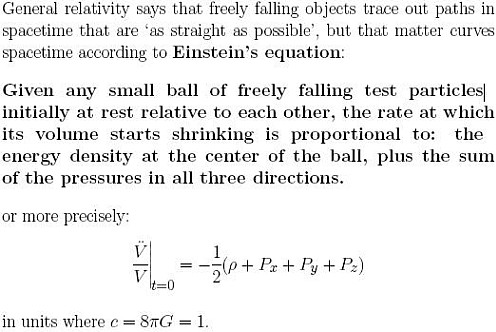
===========================================
Subject: Re: KS Theorem
Date: Mon, 18 Apr 2011 13:07:30 +0300
From: Dimi Chakalov <[email protected]>
To: Carlos Castro <[email protected]>
Cc: Matej Pavsic <[email protected]>
Dear Carlos,
> I do not know much about the subtleties behind the many interpretations
> of QM.
The KS Theorem is not about subtleties nor "understanding QM".
> I think in pictures. I get confused with so many words
Here's the picture: think of a table with three rows and three columns. You have 9 contextual observable quantum states, none of which is special or privileged. Yet depending on the order in which you count them, the last one will always be "uncolored" or UNdecidable. So, if you count these quantum states as you'd read a text in English, the last one, residing at "template" No. 9, will be UNdecidable. If you reverse the order of counting, starting from No. 9 (think of Arabic), then the last quantum state at "template" No. 1 will be UNdecidable.
The conclusions about the meaning of 'contextual' are straightforward, after Schrödinger's 1935 paper and his letter to Einstein from November 1950.
All references are one-click away. Will be happy to learn what you found difficult at
http://www.god-does-not-play-dice.net/#Specker_addendum
It will be entirely my fault, of course.
Best regards to you and Matej.
Dimi
--------
Note: Since the KS Theorem is not about 'projective measurements' (details from Waegell & Aravind and C. Isham), it is very important to understand the meaning of 'contextual observable quantum states, none of which is special or privileged'. If you think of 9 possible contextual "states" of a blond girl, one of these "states" could be 'naked' (UNdecidable), so it goes into the UNcolored KS sphere (Helena Granström, p. 2). Point is, any of the remaining 8 "dressed"/contextual states emerge from the same 'naked' or UNdecidable KS state. None of these 8 observable or "dressed" states is somehow special or privileged, so if you count/measure them in a different order, state #1 (say) will become "naked", while the previously "naked" state #9 will obtain some contextual/"dressed" value. Why is this difficult to understand, I wonder. In March 1926, Heisenberg suggested the so-called uncertainty principle. An ontological interpretation of the non-commutativity can be suggested with the following Gedankenexperiment: suppose one could somehow force an electron in its natural habitat to occupy a "point-like" position identical to the one we imagine for macroscopic objects, say, a bullet shot at a wall. No way, says Werner Heisenberg, because the momentum of the same electron will have to be far too "uncertain", after the so-called uncertainty principle. But isn't the "point-like" position of an electron left on a screen identical in nature to the "point-like" position of a bullet that has hit a wall? It can't punch a screen or a wall with "position" only. In the case of a single electron, we face the old conundrum of explaining the generation of observable paths in Wilson cloud chambers, after Nevill Mott (cf. Alessandro Teta above). It is obvious that the physical presentation of an electron, observed in the double-slit setup above, cannot be identical to the one pertaining to 'an electron in the quantum realm out there'. Same holds for their "waves": they cannot be the genuine quantum waves in 'the quantum realm out there'. We inevitably distort a quantum object upon forcing it to show up at the length scale of tables and chairs. Not surprisingly, nobody has managed to reconcile QM with Special Relativity, nor has observed "empty waves" traveling in Minkowski spacetime. Briefly, the KS Theorem also suggests that the UNdecidable, pre-quantum, potential quantum state -- the "quantum elephant" -- may not suffer from any "non-commutativity" nor "quantum jumps". They could be an artifact from the unanimated macroscopic measuring devices. If you use a brain, you may picture the UNdecidable, pre-quantum, potential quantum state (never in plural) very well, with your BrainMonad. Dead matter makes quantum jumps; the living-and-quantum matter is smarter. Yes, I know you seriously hate the Kochen–Specker (KS) Theorem, and of course the Conway-Kochen Free Will Theorem refuting the “block universe” paradigm. But your emotions cannot change the rules of Quantum Theory.
"just another crank" D.C.
April 19, 2011
Last updated: September 2, 2011
==============================================
Subject: Re: arXiv:1109.6049v1 [quant-ph]
Date: Sun, 2 Oct 2011 14:36:13 +0300
Message-ID:
<CAM7Ekxkzbadn4ztaugJJhJxD7nxG-kW3ykY=1N4SVTZ4oy5q0Q@mail.gmail.com>
From: Dimi Chakalov <[email protected]>
To: Carlos Perelman <[email protected]>
Cc: Daniel Bedingham <[email protected]>,
Warren Leffler <[email protected]>
Dear Carlos,
> If UNdecidable quantum states do not live in a Hilbert space,
> could they live in an extended Hilbert space ?
The task is quantum gravity, and I'm not aware of any such extension. See, e.g., the 'mediating field' by Daniel Bedingham, arXiv:1103.3974v1 [quant-ph] -- I'm afraid it won't work, because the "time parameter" we use by referring to a physical clock is due to "expansion" of space (scale factor is function of "time"), so we have to resolve the "dark" energy *from the outset*,
http://www.god-does-not-play-dice.net/#Leffler
It's a bundle, and the more requirements you put on the table, the narrower is the choice to resolve the puzzle from KS Theorem and Schrödinger.
Henry Margenau had a brilliant guess: “not always there”,
http://www.god-does-not-play-dice.net/Margenau.html
I suggest the UNdecidable quantum state (never in plural, because it is ONE entity) is 'never there', that is, it never lives in the physical spacetime. It only casts 'events' with unit probability -- one at a time -- so we never encounter Schrödinger's cat or any "measurement problems" (that was my idea from October 2002).
But how do we make 'one at a time' ? By an Arrow of Space,
http://www.god-does-not-play-dice.net/#Zinkernagel_note
Well, that's tough. No math that I know is available.
[snip]
Best wishes,
Dimi
--------
Note: The "chooser" (recall that quantum theory is a theory of choices without a chooser, Philip Pearle) of the physical content of the instant 'now' -- one at a time, along the Arrow of Space -- is the universe itself, acting as ONE entity. It selects, by acting on itself, one physical thing to fill in the instant 'now', always with unit probability (Machian Quantum Gravity). I shouldn't have said "no math that I know is available," but 'no math that I know can fit the bill'. D. Chakalov
October 2, 2011
==============================================
Subject: Re: The first second of the Universe
Date: Sun, 2 Oct 2011 17:53:31 +0300
Message-ID:
<CAM7Ekx=pUO78arYQVQb2Y4jNXX21jv62znxvMyeeXz8oiEQz_Q@mail.gmail.com>
From: Dimi Chakalov <[email protected]>
To: Dominik Schwarz <[email protected]>
Cc: Claus Kiefer <[email protected]>,
[email protected],
[email protected], [email protected],
[email protected], [email protected],
[email protected], [email protected],
[email protected],
[email protected]
Hi Dominik,
Regarding my email from Mon, 19 May 2003 17:17:15 +0300, please see
http://www.god-does-not-play-dice.net/#Leffler
I think we need to improve Quantum Theory in the first place, to address the Hilbert-space problem ("What is the appropriate inner product that encodes the probability interpretation and that is conserved in time?" C. Kiefer, Conceptual issues in quantum cosmology, gr-qc/9906100), and offer a viable model of gravity,
http://www.models-of-gravity.org/research/research-topics/gravity-models/
Will be happy to elaborate, should you or your colleagues are interested. The task seems to be strictly mathematical.
All the best,
Dimi
==========================================
Subject: What makes a spacetime 'time orientable' ?
Date: Mon, 3 Oct 2011 04:22:00 +0300
From: Dimi Chakalov <[email protected]>
To: Waldyr A Rodrigues Jr <[email protected]>
Cc: Muhammad Sharif <[email protected]>,
[email protected], [email protected]
Dear Waldyr,
I am trying to understand your arXiv:1109.5272v2 [math-ph], and would like to ask for your opinion on the question in the subject line.
Can you *derive* time-orientability from something -- anything ?
I haven't read your Lecture Notes in Physics 722, but it seems to me that the textbook by Sachs and Wu, which you frequently quote (R. K. Sachs and H. Wu, General Relativity for Mathematicians, Springer-Verlag, New York, 1977), doesn't address the fundamental issue of the *origin* of time-orientability.
Please advise. I will highly appreciate the opinion of your colleagues, too.
Thank you for your time and consideration.
Best regards,
Dimi
==================
Subject: Re: What makes a spacetime 'time orientable' ?
Date: Mon, 3 Oct 2011 05:06:51 +0300
From: Dimi Chakalov <[email protected]>
To: Waldyr A Rodrigues Jr <[email protected]>
Cc: Muhammad Sharif <[email protected]>,
[email protected], [email protected]
P.S. To quote from Sachs and Wu, p. 27:
"The requirement of time orientability is suggested by our knowledge of thermodynamical processes on the earth, now. The second law of thermodynamics implies that one can distinguish past directions from future directions on earth by measuring the increase in entropy. It seems somewhat reasonable to assume that thermodynamics will smoothly determine future directions in the whole universe.
"No one knows if this is true, but if we ever really met beings going the wrong way in time, trying to communicate with them would presumably be as confusing as trying to talk to some of the regents of the University of California."
It seems to me equally reasonable to associate time-orientability with the dynamics of scale factor, as driven by the so-called "dark" energy of [you-name-it], but it will be pure poetry, as the excerpt from Sachs and Wu above.
I hope you have a better idea.
Best - D.
On Mon, Oct 3, 2011 at 4:22 AM, Dimi Chakalov <[email protected]> wrote:
>
> Dear Waldyr,
[snip]
------ Note: The problem of tracing down the origin of time is well-known since Aristotle: recall the
First Cause. Its physical manifestation goes via geometry only, and will inevitably look like
self-acting. That's what makes it "dark". Mens agitat molem (Vergil, The Aeneid, Ch. 6, 727). In German: Der Geist bewegt die Materie. Just a suggestion, for the forthcoming models of gravity.
D. Chakalov
October 3, 2011, 14:00 GMT
==============================================
Subject: arXiv:1109.6049v1 [quant-ph]
Date: Fri, 30 Sep 2011 02:20:34 +0300
From: Dimi Chakalov <[email protected]>
To: Warren Leffler <[email protected]>, [email protected]
Cc: Chris <[email protected]>,
Andreas <[email protected]>,
Jeremy <[email protected]>
http://arxiv.org/abs/1109.6049
-------
Dear Warren,
It is a real pleasure to read your paper. Thank you!
I think the *imposition* of "a probability distribution (and therefore a countably additive measure)" (p. 2) is what makes certain explications (=eigenvalues of self-adjoint operators) of quantum objects 'colorless' (in Hilbert space dim 3 or more), so they have to be shifted in the uncolored KS sphere; general remarks on the KS Theorem at
http://www.god-does-not-play-dice.net/#Castro
BTW Erwin Schrödinger mentioned the improper use of probabilities for UNdecidable states in November 1950; references at my web site.
So, the message from Schrödinger and KS Theorem is that we have to avoid probabilities for describing the UNdecidable quantum state: it cannot live in *any* Hilbert space (some people are trying to catch it with toposification of Quantum Theory).
All the best,
Dimi
-----------
Note: Let's go back to the three quantum guys, Tom, Dick, and Harry. To mimic the case of Hilbert space dim 2, suppose Tom and Dick are explicating their "states" by raising their hands, either left or right. We say that Tom and Dick don't possess any pre-existing (prior to observation) "hands", and agree that their "hands" are 'contextual'. If the two guys are entangled, QM says that measurement on one "part" of the entangled system {Tom, Dick} changes the probability of the outcome of measurements on the "second part" of the system. It is like tossing one quantum coin with two "entangled" states, heads-and-tails; the difficulties to grasp the nature of entanglement is in the notion of ONE-ness, as with the shoal of fish. Yet we still have the usual QM formalism employing Hilbert space and probability calculus, which requires the sum of probabilities to add to unity. So, if we see Tom having raised his right hand, we know that we will observe the left hand of Dick with certainty. To explain the crux of KS Theorem, in the case of Hilbert space dim 3 (or more), we instruct Tom, Dick, and Harry to (i) raise one hand vertically and stretch the other horizontally, and (ii) align to each other in such way that their hands will consume all three dimensions of space, along three orthogonal axes in space. Suppose Tom raises his hands along (+x, +y) axes, and Dick raises his hands along (-x, -y) axes. Then Harry would have the options to raise his hands along (z, y) and (z, x) axes, in order to comply with the unitary rule which requires the sum of probabilities to add to unity. However, in certain cases the unitary rule, imposed on Harry, makes him hand-less (say, if you set consistent spins for 30 out of 33 directions, the final three must paradoxically be both 1 and 0; cf. Zeeya Merali). He simply cannot show up the "quantum state" of his hands, in the macroscopic 3-D space and simultaneously with all "quantum states" of the hands of Tom and Dick. Surely Harry has explicable "hands", but they cannot be shown under the conditions of the unitary rule. If next time Harry takes the initiative and raises his hands according to the rules above, Dick can follow him, but not Tom. This time, Tom will be stripped of "hands". If Tom and Harry raise their hands, then Dick will be hand-less. Why is this difficult to understand, I wonder. It is impossible to decompose/distill all explicable "quantum states", in the case of Hilbert space dim 3 (or more), in such way that they all will have well-defined macroscopic manifestation, in 3-D space and in one instant, as recorded with your wristwatch. This is the crux of Kochen-Specker (KS) Theorem. Notice that the meaning of unitary rule is 'something will happen with certainty'. This rule isn't applicable to the UNdecidable KS state which can never ever show up as 'eigenvalues of self-adjoint operators' and 'physical reality' in general. To sum up, the UNdecidable KS state can never obey to the unitary rule plus the requirement to display 'the complete catalogue of expectation values' in the macroscopic 3-D space. It is impossible in principle to apply "counterfactual definiteness" (recall that Bell's theorem is based on counterfactual definiteness) in Hilbert space dim 3 or more. Any musings of the type 'if we had made a certain alternative measurement (rather than the one we did make) we would have obtained such-and-such result with such-and-such probability' are wrong: we have encountered not just 'contextual phenomena' but the brand new, UNdecidable, pre-quantum KS state as well. From the perspective of Boolean logic, it is both "is" & "is not" (YAIN, in German). Contrary to the opinion in Wiki, the existence of such pre-quantum element of reality is demonstrated by the KS Theorem. It isn't 'physical reality' though. It is a much broader form of reality known since Plato, called here 'potential reality'. The KS Theorem is not "a complement to Bell's theorem", as claimed in Wiki, because you can't employ any 'counterfactual definiteness' in the presence of the UNdecidable pre-quantum KS state. If the KS Theorem were wrong, one could introduce an experimental context, then write down the full 'catalogue of expectation values' in 3-D space, and prove Schrödinger wrong by counterfactual definiteness: 'a variable would have a definite value before I measure it; then measuring it would simply mean ascertaining the context-dependent value that it had out there.' We must drop the unitary rule and Hilbert space, to understand the artifacts of QM formalism and grasp the UNdecidable pre-quantum KS state. There is no other way to solve the measurement problem and the macro-objectification problem, to reconcile Quantum Theory with Special Relativity, and then with General Relativity. The only way to solve the old cosmological "constant" paradox is to start with the potential reality in the quantum vacuum, which does not possess 'positive energy density', hence does not gravitate. We need to change the quantum theory from current QM textbooks, and the current GR as well. Just follow the legacy of Schrödinger and Margenau. Unfortunately, nobody seems to care. Nobody. Even Chris Isham, who is aware, at least since 2002, of my efforts to endorse the legacy of Schrödinger and Margenau, decided to instead explore a "toposification" of quantum theory. He collected $75,000 research grant from FQXi and dubbed me "just another crank". Another prominent theoretical physicist, Lee Smolin, who is also fully aware of my efforts, collected last year $47,500 from FQXi and $6,000 from FQXi 2007-Spring mini-grant to "support travel for collaborators working on a book about the nature of time in physics and cosmology -- in progress." He never responded to my proposals either. Two years ago, I asked 75 (seventy-five) prominent physicist to endorse the submission of my manuscript to [gr-qc] -- two flatly denied, the rest didn't even bother to respond (Chris Isham included). An enormous amount of money, earned with hard labor by millions of taxpayers, has been wasted, and even more is scheduled to be wasted. People just don't care about quantum gravity. It's a well-known phenomenon, not limited to theoretical physicists: look what happened with Peter H. Duesberg.

D. Chakalov
September 30, 2011
Last updated: October 1, 2011
==============================================
Subject: On the limits of quantum theory
Date: Mon, 29 Aug 2011 18:36:16 +0300
Message-ID:
<CAM7Ekxmw-q=nDV=DLbbQCiOH=9Q-2PSu4T0=bR1jzBWQJProFg@mail.gmail.com>
From: Dimi Chakalov <[email protected]>
To: George <[email protected]>
Cc: Charles Baily <[email protected]>,
Hans Havlicek <[email protected]>,
Josef Tkadlec <[email protected]>,
Gennaro Auletta <[email protected]>,
Chris <[email protected]>,
Karl <[email protected]>
George F R Ellis, On the limits of quantum theory: contextuality and the quantum-classical cut, arXiv:1108.5261v1 [quant-ph]
http://arxiv.org/abs/1108.5261
Hi George,
I cannot understand why you avoided all facts contradicting your ideas (e.g., "omnipresence of state vector reduction," p. 7).
You didn't even mention the KS Theorem,
http://www.god-does-not-play-dice.net/#KS
You wrote (p. 2): "before a measurement is made, the state vector |phi> can be written as a linear combination of unit orthogonal basis vectors," referring to Chris Isham's textbook (Lectures on Quantum Theory: Mathematical and Structural Foundations, London: Imperial College Press, 1995, pp. 5-7).
No combination of "unit orthogonal basis vectors" can possibly describe 'the quantum state' -- it is inherently UNdecidable; cf. the link above.
The initial 'quantum state' cannot be "fully known" (p. 3) in principle. Also, it does not undergo any "collapse" or "decoherence".
If you or any of your colleagues cannot understand the arguments at the link above, it will be entirely my fault -- please write me back with your questions, and I will elaborate.
Just please don't treat Quantum Theory like some fashion designer. Face the KS Theorem.
All the best,
Dimi ==================================
Subject: Re: The Free Will Theorem, quant-ph/0604079 v1
Date: Wed, 20 Apr 2011 23:27:24 +0300
From: Dimi Chakalov <[email protected]>
To: Specker Ernst <[email protected]>
Cc: Simon Kochen <[email protected]>
Dear Professor Specker,
Thank you for your kind email. It is a great honor and privilege to hear from you.
I learned too late about the Colloquium commemorating your 90th Birthday (October 29-30, 2010), and wasn't able to attend. I only wanted to tell you two things.
As my dad used to say, there isn't such thing as 'retired eagle' -- eagles either fly and fight, or drop dead while flying. You are a real Eagle.
And secondly, I will fight for your Theorem until I see it in QM textbooks -- properly explained, along with its immediate implications. You set the stage in 1960, yet the established theoretical physics community is still struggling to understand that "it is impossible to have consistent predictions about a quantum mechanical system (not considering exceptional cases)."
With best regards and deep admiration,
Yours faithfully,
Dimi Chakalov
On Wed, 20 Apr 2011 18:41:44 +0000,
Message-ID: <[email protected]>,
Specker Ernst <[email protected]> wrote:
>
> Dear Dimi Chakalov
> Thank you - I will try to understand it.
> Kind regards
> Ernst Specker
> ________________________________________
> From: Dimi Chakalov [[email protected]]
> Sent: Wednesday, April 20, 2011 4:32 PM
> To: Simon Kochen
> Cc: Specker Ernst;
> Subject: Re: The Free Will Theorem, quant-ph/0604079 v1
>
> P.P.S. Update at
> http://www.god-does-not-play-dice.net/#Castro
>
> D.C.
==============================================
Subject: Re: arXiv:0711.4650v3 [quant-ph], " ... we need only EPR, Bell, and Kochen-Specker."
Date: Sat, 23 Apr 2011 12:41:50 +0300
From: Dimi Chakalov <[email protected]>
To: Adam Brandenburger <[email protected]>
Cc: Noson Yanofsky <[email protected]>,
Samson Abramsky <[email protected]>,
Andreas <[email protected]>
Dear Adam,
Thank you for informing me about your new manuscripts.
> "A Unified Sheaf-Theoretic Account of Non-Locality and Contextuality" (by
> Samson Abramsky and Adam Brandenburger)
I think the drawing on p. 2 is unrelated to the precise interpretation of KS Theorem, which is not about any "hidden" [whatever]. It is about *the* quantum state which cannot fit into any Hilbert space whatsoever. If this is your interpretation of 'hidden', I will agree with you.
If you use Hilbert space and probabilities (or some toposificated version of quantum theory, like Andreas), you aren't addressing the KS Theorem,
http://www.god-does-not-play-dice.net/#Castro
Please let me know if you are unable to understand the arguments -- it will be entirely my fault.
> "What Does a Hidden Variable Look Like?" (by Adam Brandenburger and H.
> Jerome Keisler)
If you use your brain, you can almost "feel" the UNspeakable quantum state of your brain at
http://www.god-does-not-play-dice.net/#Leydesdorff_101
Wishing you and your colleagues a very happy Easter,
Dimi
P.S. BTW did you look at my 9/11 web page?
http://tinyurl.com/USD-bancor
D.
==========================================
Subject: The mediating field, arXiv:1103.3974v1 [quant-ph]
Date: Tue, 22 Mar 2011 04:56:14 +0200
From: Dimi Chakalov <[email protected]>
To: Daniel Bedingham <[email protected]>
Cc: Karl <[email protected]>,
Sun Yi <[email protected]>
Dear Dr. Bedingham,
You introduced a 'mediating field' which "enables interactions to be smeared without reference to a preferred foliation of spacetime", and I wonder if you can test it with your brain,
http://www.god-does-not-play-dice.net/#Leydesdorff_101
In the case of the quantum world, the object explained at the link above should provide "quantum omniscience" (Karl Svozil, arXiv:1103.3980v1 [quant-ph]),
http://www.god-does-not-play-dice.net/Margenau.html
http://www.god-does-not-play-dice.net/#KS
http://www.god-does-not-play-dice.net/about.html#GR
I will appreciate your comments, as well as the feedback from your colleagues.
Kindest regards,
Dimi Chakalov
-------
Note: To understand the UNdecidable, pre-quantum, potential quantum state which cannot fit in any Hilbert space, try to answer the question posed by Erwin Schrödinger in 1935: "But then what does it mean?" It means that the three quantum guys, Tom, Dick, and Harry, have the faculty of acquiring context-dependent "quantum states" in a way similar (but not identical) to the sayings quoted above. If you observe, for example, (i) Harry with specific configurations of his hands, then (ii) without any hands whatsoever, and then (iii) with some new configurations of his hands, you will not observe 'the same Harry but with different configurations of his hands'. Every time Harry shows up, you will see a brand new "Harry-like" version of his UNdecidable, pre-quantum, potential quantum state which (i) carries his Genidentität (Kurt Lewin), and (ii) cannot live in any Hilbert space whatsoever. Why? Because Tom, Dick, and Harry don't have any pre-existing, non-contextual "quantum states" prior to their observation. The "quantum states" that we can physically observe are born anew from their common UNdecidable, pre-quantum, potential quantum state. Read again Erwin Schrödinger, from 1935: "In general, a variable has no definite value before I measure it; then measuring it does not mean ascertaining the value that it has. But then what does it mean?" The essence of KS Theorem is that it demonstrate "something that is not found among projective measurements in quantum theory" (Yeong-Cherng Liang et al.). Namely, we cannot, not even in principle, think of some 'complete catalog of expectation values', in Schrödinger's terminology. In the specific setup of KS experiment, all possible classical-able states of Tom, Dick, and Harry cannot have simultaneously well-defined "hands": one of the three quantum guys will have to be shifted temporarily to his "uncolored KS sphere" (Helena Granström, p. 2). Think of these contextual classical-able states as templates available to fill in with/by the UNdecidable, pre-quantum, potential quantum state: if you check out all templates in 3-D space, some of them will be left empty ("uncolored") under the particular examination, but if you check them out in a different sequence or 'order', those which have been left empty ("uncolored") during the first counting will now possess contextual ("colored") classical-able states, at the expense of the same number of contextual ("colored") classical-able states from the first counting, which will now lose any "color" and will have to be shifted temporarily to their "uncolored KS sphere". Why? Because otherwise the UNdecidable, pre-quantum, potential quantum state ("quantum omniscience", K. Svozil) will be inevitably decomposed into a set of classical-able states, or 'complete catalog of expectation values'. Thank God, this is impossible [Ref. 1]. To sum up, recall Cantor's definition of ‘set’ (1895): By a ‘set’ we understand any gathering-together M of determined well-distinguished objects m of our intuition or of our thinking (which are called the ‘elements’ of M) into a whole.
The UNdecidable, pre-quantum, potential quantum state (never in plural) belongs exclusively to the 'whole'. That is, to 'the universe as a whole' or 'the universe as ONE'. All these "well-distinguished objects" emerge from it (not Him) along the Arrow of Space, yet no "set" can possibly provide its complete decomposition or 'complete catalog of expectation values'. Details here. One immediate corollary is that the toposification program of Chris Isham is destined to fail, because it assumes that some "toposificated" presentation of 'complete catalog of expectation values' might eventually exist. As to GR, the elimination of the idea of "curvature" is straightforward: instead of introducing some fictitious "external higher dimensional Euclidian space" and then "handle these concepts 'intrinsically' -- i.e., working solely within the 4-dimensional spacetime in which we find ourselves," we employ the same UNdecidable, pre-quantum, potential quantum-gravitational state (never in plural), as explained above. Check out the prerequisites here, and a widespread error here. Of course, nobody will pay attention -- my Crackpot Index (J. Baez) is 80. It is much higher than the one acquired by Andrea Rossi.
D.C.
March 23, 2011
Last updated: April 12, 2011
[Ref. 1] Specker, E. (1960), Die Logik Nicht Gleichzeitig Entscheidbarer Aussagen. Dialectica, 14: 239-246. Translated by Michael Seevinck, arXiv:1103.4537v1. "... speculations about the "Infuturabilien" [‘future contingencies’, Michael Seevinck] also belong here, that is, the question whether the omniscience of God also extends to events that would have occurred in case something would have
happened that did not happen.
--- S. 243:
......
"Is it possible to extend the description of a quantum mechanical system through the introduction of supplementary -- fictitious -- propositions in such a way that in the extended domain the classical propositional logic holds (whereby, of course, for simultaneously decidable proposition negation, conjunction and disjunction must retain their meaning)?
"The answer to this question is negative, except in the case of Hilbert spaces of dimension 1 and 2.
....
"That such an embedding is not possible from dimension 3 and higher follows from the fact that it [this embedding] is not possible for a three-dimensional space.
....
"An elementary geometrical argument shows that such an assignment is impossible, and that therefore it is impossible to have consistent predictions about a quantum mechanical system (not considering exceptional cases)." --------
Addendum
To explain the meaning of the statements "nature is contextual" and "the values only come into being during the act of measurement" [Ref. 2], notice that the assumption of 'noncontextuality', which is proven wrong, implies that the first statement is true: nature is indeed contextual. The second statement, about how the values 'come into being', introduces the puzzle more precisely, as stressed by Schrödinger in 1935 (cf. above). In modern terms, it is about revealing Boolean-valued "quantum states" (always in plural) from a non-Boolean, UNdecidable, pre-quantum, potential quantum state (never in plural). Even if we fix a 'context' by means of some 'complete set of compatible projective measurements (CSCPM)' [Ref. 2], we cannot, not even in principle, reduce/factorize the non-Boolean, UNdecidable, pre-quantum, potential quantum state into a set (cf. G. Cantor above) of Boolean-valued "quantum states". It can't be decomposed into any set. It can't fit in any Hilbert space whatsoever. It is impossible to have "consistent predictions about a quantum mechanical system" (Ernst Specker, 1960). Some people hope to bypass these unsolved issues simply by proclaiming them wrong: we can't handle "incompatible frameworks," says Bob Griffiths. Of course he can't make it, "due to the mathematical properties of the quantum Hilbert space" and the "framework based on unitary time evolution" (CH: Questions and Answers). The latter is an anti-relativistic Newtonian "time" that cannot be observed in principle, but Bob doesn't care. And neither does Sean Carroll: "the state of the system at any one time is sufficient to determine its future and past evolution in time." If your wristwatch were able to read this "unitary time", how come nobody managed to reconcile QM with Special Relativity, since 1931? Moreover, the very "definition" of time-as-read-by-your-wristwatch is totally unphysical: no physical object can reproduce our Gedankenexperiment about 'one second'. Anyway. The implications for "quantum computing" (it must operate in a Hilbert space whose dimensions may be grown exponentially), the mythical "decoherence" (the alleged quantum-to-classical "transition"), and the search for some "god particle" are obvious. The latter is horribly expensive, but ... who cares? "just another crank" D.C.
Crackpot Index: 80
April 1, 2011
[Ref. 2] Mordecai Waegell, P.K. Aravind, Parity proofs of the Kochen-Specker theorem based on the 24 rays of Peres, arXiv:1103.6058v1 [quant-ph]
http://arxiv.org/abs/1103.6058
pp. 11-13: "One of the simplest types of measurement that can be carried out on a quantum system is a projective measurement. Such a measurement amounts to asking the system if it has a certain property or not, and the system replies with either a yes or a no (to which we attach the values 1 and 0, respectively). A set of projective measurements is said to be compatible if there exist special states of the system for which the measurements always yield the same values, no matter in what order they are carried out or how often they are repeated.
"A complete set of compatible projective measurements (CSCPM) is a maximal set of such measurements, i.e., one that cannot be enlarged by adding further measurements of the same type. For a pair of two-level systems (or qubits), which is one of the physical settings in which the Peres rays can be realized, the number of measurements in a CSCPM is four.
"An important property of a CSCPM is its exclusivity: whenever it is carried out on any state of a system, exactly one of the measurements returns the value 1 and all the others return the value 0. The properties of CSCPMs laid out so far are all well established experimental facts.
.......
"A realist, who believes that the values observed for a CSCPM exist even before measurement, and who also subscribes to the assumption of noncontextuality (i.e., the notion that the value observed for a particular projective measurement is independent of the CSCPM it is carried out as a part of) would be faced with the task of assigning a 0 or a 1 to each of the Peres rays in such a way that each basis contains exactly one 1 and three 0’s in it. "However the various parity proofs presented in this paper demonstrate that this task is impossible, and so the realist’s position is refuted. The key assumption made by the realist that undermines his position is the assumption of noncontextuality."
=======================================
Subject: lrr-2011-5
Date: Tue, 2 Aug 2011 16:34:01 +0300
Message-ID:
<CAM7EkxmUd8wFJ_nNPQR9T-56TdNyNuiSGf6LsqxfW4x30pgakw@mail.gmail.com>
From: Dimi Chakalov <[email protected]>
To: [email protected],
[email protected],
[email protected],
[email protected]
Cc: [email protected],
[email protected],
[email protected],
[email protected],
[email protected],
[email protected]
Dear colleagues,
I wonder if you have a clue about "the nature of the gravitational interaction" at the production of GWs by "very large masses" being accelerated in "very strong gravitational fields" (Sec. 2).
Can you suggest a theory of "very strong gravitational fields" producing very strong "ripples in the curvature of space-time" and very strong "tidal effect" (Sec. 3) ?
If you don't have such theory of "very strong gravitational fields", how can you possibly claim that your linearized approximation is the correct theory describing some veeeery weak GWs ?
http://www.god-does-not-play-dice.net/#LIGO
Sincerely,
Dimi Chakalov
Ceterum autem censeo, LIGO esse delendam
Note: Energy transport by GWs is a "fundamentally nonlinear phenomenon" (Hermann Bondi). Even if you imagine some sufficiently strong, to be detected, GW that is veeeery weak upon reaching Earth, its energy transport will be, again, a "fundamentally nonlinear phenomenon", which cannot, not even in principle, be modeled with respect to some undisturbed "background": "For weak waves, it is possible to define their energy with reference to the "background" or undisturbed geometry, which is there before the wave arrives and after it passes" (Bernard Schutz). No, it is impossible to define GW energy with any linearized approximation of GR. You will kill the very effect you wish to measure. Ceterum autem censeo, LIGO esse delendam. D. Chakalov
August 2, 2011 =================== Subject: [Copy] Email sent to Living Reviews in Relativity
From: [email protected]
To: [email protected]
Message-Id: <[email protected]>
Date: Tue, 2 Aug 2011 17:18:56 +0200 (CEST)
Hello Dimitar G. Chakalov,
This is a copy of the email you sent to Living Reviews in Relativity. If appropriate to your message, you should receive a response quickly. You successfully sent the following information:
Email: [email protected]
Phone:
Website: http://www.god-does-not-play-dice.net/#LRR
Subject: To make a comment
Message:
My objections to lrr-2011-5 can be read at
http://www.god-does-not-play-dice.net/#LRR
Pity you don't care. But after the failure of the "enhanced" and "advanced" LIGO, you most certainly will.
Dimi Chakalov
--------------------------
Other Data and Information:
Time Stamp: Tuesday, August 2nd, 2011 at 5:18 pm
==========================================
Subject: GWs cannot be detected with LIGO or LISA
Date: Sat, 2 Apr 2011 19:12:59 +0300
Message-ID:
<[email protected]>
From: Dimi Chakalov <[email protected]>
To: Leonid.Grishchuk@astro.cf.ac.uk,
[email protected],
[snip]
Cc: Bernard Schutz <[email protected]>
Dear Colleagues,
Do not let Bernard Schutz fool you,
http://www.god-does-not-play-dice.net/#note_6
Check out a simple expose of GR at
http://www.god-does-not-play-dice.net/about.html#GR
The forthcoming scandal about LIGO will be enormous:
http://www.god-does-not-play-dice.net/Szabados.html#SBG
The unresolved tasks of GR are strictly mathematical, and have nothing to do with its linearized approximation,
http://www.god-does-not-play-dice.net/#Gray
Should you (B. Schutz included) cannot understand the arguments, please drop me a line, and I will elaborate.
Kindest regards,
Dimi Chakalov
----
Note: Joshua Goldberg believes that the famous 1962 paper by Bondi et al. has resolved the issue of energy transport by GWs. As Hermann Bondi stressed in February 1990, "the question of the "reality" of the waves essentially concerned whether they transported energy. Such transport is a fundamentally nonlinear phenomenon." Perhaps the main reason why we cannot understand this nonlinear phenomenon is that we still don't have a definition of 'isolated system in GR': the seemingly simple expression r --> [infinity] (reference here, pp. 1728-1734) is the biggest unresolved mathematical problem in GR. In the case mentioned by Bernard Schutz, r is roughly (1010)9 km, so all "regional" definitions "in regions at least as large as a wave-length" (ibid.) are sheer poetry and wishful thinking. And of course the source of the so-called 'dynamic dark energy' is unknown. One immediate corollary is that the "ban" on dipole radiation doesn't hold any more. Obviously, the present-day GR is an essentially incomplete theory. Even in the framework of the current GR, "a gravitational wave can only give rise to longitudinal oscillations, that is, oscillations in the direction of wave propagation", as demonstrated by Pereira et al. The people from LIGO "scientific" collaboration (848 distinguished experts) don't care. They deeply believe that the linearized approximation of the current, incomplete GR is applicable to the task of detecting GWs. Which is wrong. The linearized approximation of GR is a shut-up-and-calculate tool which can be used for adjusting the GPS system, say. It cannot be used for fundamentally nonlinear phenomena such as the energy transport by GWs. May I offer LIGO "scientific" collaboration two simple ways to refute the objections above, and defend their expectations from the "enhanced" and the "advanced" LIGO, as well as their multi-billion project LISA. 1. Ensuing from strong GWs produced by your "sources", demonstrate that you can obtain some veeeery weak GWs propagating on undisturbed background: "For weak waves, it is possible to define their energy with reference to the "background" or undisturbed geometry, which is there before the wave arrives and after it passes" (Bernard Schutz, p. 317). If you fail to obtain such weak limit from strong GWs, you have no right to claim that you understand what you're doing. To quote M. Maggiore (p. 32): "In special (unrealistic - D.C.) cases one can find exact wave-like solutions of the full nonlinear Einstein equations, see, e.g. Misner, Thorne and Wheeler (1973), Section 35.9, and then there is no need to perform a separation (Sic! - D.C.) between the background and the waves. However, it would be hopeless to look for exact solutions for the gravitational waves emitted by realistic astrophysical sources." Voila, straight from the horse's mouth. 2. Ensuing from your "linearized approximation", try to resolve the problems from its immediate consequences presented with the SBG argument: http://www.god-does-not-play-dice.net/Szabados.html#SBG You cannot keep just the 'good bits' from your "linearized approximation" and ignore its immediate consequences, because the latter refute your "linearized approximation" with reductio ad absurdum. It's a bundle. Of course, LIGO "scientific" collaboration won't reply. I raised my concerns eight years ago, in February 2003, but never received any professional reply. It is so much easier to enjoy their hobby and waste billions of taxpayers' money. Shame on you, LIGO "scientific" collaboration.
D. Chakalov, April 7, 2011
Ceterum autem censeo, LIGO esse delendam
========================================
Subject: arXiv:1104.2927v1 [hep-th], ref. [2], p. 165, Eqs (7.6.4) and (7.6.5)
Date: Mon, 18 Apr 2011 15:30:58 +0300
From: Dimi Chakalov <[email protected]>
To: Charles Schwartz <[email protected]>
Cc: Steven Weinberg <[email protected]>,
[email protected],
[email protected],
[email protected],
[email protected],
[email protected],
[email protected],
[email protected],
[email protected],
[email protected],
[email protected],
[email protected],
[email protected],
[email protected],
[email protected],
[email protected]
Dear Charles,
Regarding Weinberg's “Gravitation and Cosmology" (arXiv:1104.2927v1 [hep-th], ref. [2]), I think the alleged energy-momentum tensor of gravitation, Eq. (7.6.4), and "the total energy-momentum "tensor" of matter and gravitation" -- "the energy-momentum "tensor" of the gravitational field itself" (exact quote from p. 165) -- do not make any sense whatsoever.
These statements are not some "approximations", as you or some of your colleagues might argue. They are terribly misleading.
Anything that pertains to the gravitational field *itself* is quasi-local. It's a whole new ball game,
http://www.god-does-not-play-dice.net/#Jorg
Shall I elaborate?
See also
http://www.god-does-not-play-dice.net/#wine_cellars
Regards,
Dimi
=============================================
Subject: Expansion of space -- with respect to what?
Date: Tue, 2 Aug 2011 21:07:21 +0300
Message-ID:
<CAM7EkxkP0S1Vz-7914KTtF3kxWCFcaOS8sMac4JzMNshh-Ka8g@mail.gmail.com>
From: Dimi Chakalov <[email protected]>
To: [email protected],
[email protected],
[email protected]
Cc: Michal Chodorowski <[email protected]>,
[email protected],
[email protected],
[email protected]
Dear colleagues,
Please correct me if I'm wrong.
I think 'expansion of space' cannot be defined with respect to itself, e.g., the increase over time of the distance between observers. One should somehow place these observers "at rest with respect to the cosmic fluid", as you suggested in arXiv:astro-ph/0707.0380.
Problem is, we cannot directly observe this "cosmic fluid", because we cannot switch from Archimedean to non-Archimedean geometry,
http://www.god-does-not-play-dice.net/#error
If the 'expansion of space' is the physical manifestation of the phenomenon of transience (the Heraclitean time), then its driving force *must* be hidden, or else we can't have any theory of relativity: the ether will be exposed. If so, you have a bona fide candidate for the source of that (sorry) "dark energy".
Notice that the bi-directional talk between matter and geometry (John Wheeler) is valid for just one instant, while the phenomenon of transience presupposes absolute past, present, and future -- "You cannot step into the same river twice, for fresh waters are ever flowing in upon you" (Heraclitus).
In GR parlance, more and more space ... "appears".
Will be happy to elaborate.
All the best,
Dimi Chakalov
----------
Note: Before going into discussion on 'expansion of space', recall the main unresolved puzzle: finite time interval & space volume. Mother Nature creates 'finite things' -- Large vs Small -- with infinitesimals along the Arrow of Space, while people think about GR as bartenders and offer totally unfeasible Gedankenexperiments about 'one second'. The difference between you and Mother Nature is that She can add as many infinitesimal "points" as you wish to a finite volume of space, and it won't change a bit. Why? Because we're dealing with non-Archimedean geometry. But if you add just one period of the transition between the two hyperfine levels of the ground state of the cesium-133 atom -- from 9,192,631,770 to 9,192,631,771 -- you'll ruin the "definition" of 'one second'. Again, I will be happy to elaborate. Just notice that you have the same conundrum of "expansion/contraction" of space in GW parapsychology. D.C.
August 3, 2011
=================
Subject: Re: Expansion of space -- with respect to what?
Date: Wed, 3 Aug 2011 23:54:53 +0300
From: Dimi Chakalov <[email protected]>
To: barnesl <[email protected]>
Cc: [email protected],
[email protected],
Cc: Michal Chodorowski <[email protected]>,
[snip]
Dear Luke,
Thank you for your reply.
> The first problem in your email is the claim: "we cannot directly observe
> this cosmic fluid." Yes we can.
I meant the reference fluid of GR, after Hilbert and Einstein.
> It comes in a number of components, some of which are observable.
> The best example is the Cosmic Microwave Background (CMB).
Beautiful. Are you going to explain 'the increase of the distance between observers' w.r.t. CMB?
Because you can't do it 'with respect to itself'. Only Baron Munchausen can do such self-referential miracles.
> I have also failed to "notice" that "the bi-directional talk between matter
> and geometry (John Wheeler) is valid for just one instant". I've read most
> of John Wheeler's General Relativity textbook and I'm pretty sure he didn't
> notice that either.
You can be damn sure he didn't notice it. "These are the laws of an instant in canonical gravity. (...) In general relativity, dynamics is entirely generated by constraints. The dynamical data do not explicitly include a time variable," says Karel Kuchar [snip]
> All the best with your theory
It's Heraclitus' theory. If you ignore it, you will keep wondering about 'more and more space appears' for many years to come.
If you wish to respond professionally, do yourself a favor: follow the links at
http://www.god-does-not-play-dice.net/#Heraclitus
All the best,
Dimi
============================================
Subject: Re: arXiv:1107.5894v1 [physics.gen-ph]
Date: Thu, 4 Aug 2011 13:28:47 +0300
From: Dimi Chakalov <[email protected]>
To: Рылов Юрий <[email protected]>
Cc: Laszlo Szabados <[email protected]>,
Adam Helfer <[email protected]>
Юрий Алексеевич,
> About relative localization of the gravitational field.
In GR, you don't have any 'localization of the gravitational field' in the first place; see my web site for references. The "localization" cannot be 'relative to itself', nor 'relative to any *finite* volume of space', which is why I asked about your thoughts regarding 'localization relative to the rest of the universe'. It is the last remaining option IMHO.
If some day you or any of your colleagues discover the proper mathematical presentation of 'quasi-local', we all will hear about it on CNN Breaking News.
> My relation to connection with Mach's approach can be expressed by
> "Глубокая философия на мелком месте" .
I know what you mean. If some day you or any of your colleagues discover the origin and mechanism of those "instantaneous" inertial reaction "forces", ... see above.
More at
http://www.god-does-not-play-dice.net/#Heraclitus
All the best,
Dimi
>> Hi Yuri,
>> Ernst Mach would have probably said that there is a sense to ask about
>> the value of gravitational field at the point x , but *only* relative
>> to the values of the gravitational field at 'the rest of the
>> universe',
>> http://www.god-does-not-play-dice.net/about.html#GR
>> Do you agree with such Machian relational ontology?
>> Regards,
>> Dimi
>
=============================================
Subject: Jonathan Dowling on enhancing LIGO's "sensitivity"
Date: Thu, 24 Mar 2011 23:58:08 +0200
From: Dimi Chakalov <[email protected]>
To: Jonathan <[email protected]>
Cc: Jorge Pullin <[email protected]>,
Barry Sanders <[email protected]>,
Kavita Rajanna <[email protected]>,
Carlton Caves <[email protected]>
http://physicsworld.com/cws/article/news/45535
"Dowling says that if the American LIGO detector could operate with a sensitivity that scales as 1/N3/2 rather than as 1/N1/2 then either its sensitivity could be greatly increased or its laser power enormously reduced, which would avoid potential heating and deformation of the facilities' optics. "This opens up a whole new ball game in nonlinear interferometry," he adds."
------
Jonathan:
You are again wrong. LIGO has been a dead turkey from the outset: just drive the linearized approximation of GR to its inevitable "predictions", and you'll get reductio ad absurdum,
http://www.god-does-not-play-dice.net/Szabados.html#SBG
You already wasted $102,061 from FQXi, remember?
Would you like to learn *exactly* why you failed, or shall I follow your advice (Fri, 08 Feb 2002 00:25:08 -0800, Message-ID:
<[email protected]>) "Never give oxygen to Morons....." ?
D. Chakalov
--------
$102,061 Quantum Measurement in the Timeless Universe
http://fqxi.org/grants/large/awardees/view/__details/2008/dowling "Our goal is to reconcile this timeless nature of the universe with quantum theory's definite "arrow of time." To accomplish this, we need to go back to the foundations of quantum theory and re-write the measurement postulate itself, using the modern-day tools of information theory."
===========================================
Subject: Re: Jonathan Dowling on enhancing LIGO's "sensitivity"
Message-ID: <[email protected]>
Date: Thu, 24 Mar 2011 22:03:47 -0500
From: Jonathan Dowling <[email protected]>
Reply-To: [email protected]
Organization: LSU
To: Dimi Chakalov <[email protected]>
CC: Jonathan <[email protected]>,
Jorge Pullin <[email protected]>,
Barry Sanders <[email protected]>,
Kavita Rajanna <[email protected]>,
Carlton Caves <[email protected]>
Gobble, gobble, gobble — quack!
--
Dr. Jonathan P. Dowling
Hearne Professor of Theoretical Physics
Co-Director, Hearne Institute for Theoretical Physics
Quantum Sciences and Technologies Group
Department of Physics & Astronomy
Louisiana State University
202 Nicholson Hall, Tower Drive
Baton Rouge, LA 70803
Tel: (225) 578-0887
Admin: (225) 578-2163
Fax: (225) 578-0824
Email: mailto:[email protected]
Admin: mailto:[email protected]
URL: http://phys.lsu.edu/~jdowling/ ------
Note: The response from Jonathan P. Dowling -- "Gobble, gobble, gobble — quack!" -- is an exact summary of his knowledge in GR and foundations of quantum theory, and his relentless efforts to reconcile the timeless nature of the universe with quantum theory's definite "arrow of time", using the modern-day tools of information theory. All this for just $102,061 from FQXi (oxygen is free). Back in February 2002, I wrote: ---

Now, I declare that I will accept your view iff you can suggest a theory of Lorentz invariant nonlocality.
Please answer my objections above, and then state the conditions under which you will declare that the task for quantum computing is not feasible in principle.
I extend this request to all physicists reading this critical note on "quantum computing", regardless of who their contractor is -- DoD, DERA, or someone else.
Let's put our cards on the table. It's about time.
Sincerely yours,
D. Chakalov
February 9, 2002
P.S. Carlton M. Caves, whose work on "quantum computing" is partly sponsored by U.S. Office of Naval Research, also decided to play ostrich [Ref. 9], just like his colleague Jonathan P. Dowling [Ref. 5]. But what if they stand on ONR concrete instead of sand?
D.C.
February 11, 2002
---
Jonathan P. Dowling is already Co-Director of Hearne Institute for Theoretical Physics at Louisiana State University. He still cannot, of course, suggest a theory of Lorentz invariant nonlocality, only now he is milking FQXi. Christoph Adami, the co-author of arXiv:quant-ph/0202039v1, has also left the Quantum Computing Technologies Group (Section 367, Jet Propulsion Laboratory, Caltech), and is now interested in "how evolution shapes biological and engineering systems, and how information evolves in these systems". The third person, Carlton M. Caves, is still involved in "quantum computing". His dreams are explained at his web site here: "Crudely speaking, the classical counterpart can occupy any one of a complete set of orthogonal quantum states, whereas the quantum system can occupy not only the orthogonal states, but also any linear superposition of the orthogonal states. Hilbert space is a big place!---this slogan underlies research on information and complexity in quantum systems. Even simple quantum systems, having only a few Hilbert-space dimensions, have the potential for considerable complexity because of quantum superposition." None of these people have read Ernst Specker. Not surprisingly, the "quantum computing" project at Jet Propulsion Laboratory (Quantum Computing Technologies Group, Section 367), has been abandoned: http://cs.jpl.nasa.gov/qct/
D.C.
March 25, 2011
=============================================
Subject: Re: Netiquette
Date: Mon, 4 Apr 2011 04:59:01 +0300
From: Dimi Chakalov <[email protected]>
To: [email protected], [email protected]
Cc: [email protected], [email protected]
Dear Ruben,
Thank you for your kind feedback. I have learned a lot from you and Jose, and am very much looking forward for more.
I found a crucial point in your textbook (cf. attached),
... and am wondering what kind of 'time' you imply by saying that the metric is "time-dependent": is this some global time from the dynamic dark energy of [X], defined w.r.t. the vacuum [X] being at 'absolute rest' ?
For an opposite viewpoint, look at Peebles and Ratra, arXiv:astro-ph/0207347v2, footnote 19, p. 15:
http://arxiv.org/abs/astro-ph/0207347 "This defines a preferred frame of motion, where the stress-energy tensor is diagonal, which is not unexpected because we need a preferred frame to define kc. It is unacceptable as a model for the properties of dark energy, of course."
I think the preferred frame of motion/global time is unavoidable, hence must be made 'acceptable',
http://www.god-does-not-play-dice.net/about.html#GR
A penny for your thoughts!
All the best,
Dimi
--------
>> Dear Jose and Ruben,
>>
>> I mentioned one of your fundamental papers at
>>
>> http://www.god-does-not-play-dice.net/#LIGO
>>
>> All the best,
>>
>> Dimi
>>
-------- Note: Ruben Aldrovandi and Jose Geraldo Pereira will probably prefer to avoid the issue of 'the global time' in which the metric is "time-dependent" (cf. above). The issue is indeed very tricky, because any time you look at your wristwatch, you can only "measure" the so-called coordinate (physical) time, much like the story about KS Theorem. So, what kind of animal is 'the global time' ? Think of GMT. It isn't some preferred place located in Greenwich, UK. All clocks around the world read some local, coordinate time, yet the "intrinsic time interval associated to any timelike displacement" (T. Jacobson, pp. 18-19) belongs to 'the global time'. It is like a global metronome which keeps all local "times" in accord with the infinitesimal timelike displacement along the Arrow of Space. Thanks to this 'global metronome' from the dynamic dark energy of [X] -- defined with respect to the vacuum being at absolute rest -- we can suggest Gedankenexperiment about 'one second', which no physical object can possibly reproduce. Physically, it's a miracle, and I don't like it. In the case of GR, all one-second local readings are "global" as well, in the sense that they are "a legitimate definition of (global) time" (Butterfield and Isham, 1999). Yet we can never observe 'the global time' directly: see again the story about KS Theorem. The vacuum/ether/reference fluid must not be 'physical' or Lorentz-invariant stuff, because it will be exposed. It can only be "dark", as some (otherwise smart) people called it. Jim Peebles and Bharat Ratra won't like it, of course. Eighteen years ago, Jim Peebles acknowledged (Principles of Physical Cosmology, p. 193): "The resolution of this apparent paradox is that while energy conservation is a good local concept, as in equation (6.18), and can be defined more generally in the special case of an isolated system in asymptotically flat space, there is not a general global
energy conservation in general relativity." Of course not. Any "general global energy conservation" in today's GR is red herring (check out a polite and obnubilated explanation from Sean Carroll here). You can't have "an isolated system" in present-day GR in the first place, and can only seek the "right" answer to a wrong question (MTW, p. 467). The only truly isolated system is The Universe -- cf. Eq. 1 on p. 35 from ExplanatoryNote.pdf; its total energy is always conserved — it is always zero — during the global time from the Arrow of Space. The symmetry transformations (cf. below) and energy conservation law, along the lines of Noether's Theorem (Hamiltonian formulation), are expected to be worked out by 25.11.2015. In summary, the metric is always time-dependent in the global time. The obvious fact that we enjoy finite things, such as 'one second' and 'one meter', requires careful reexamination of the differentiable manifold postulated in the current GR. We don't like miracles, do we?
D.C.
April 4, 2011
Last updated: April 5, 2011, 20:45 GMT =============================================
Subject: Tachyons in GR
Date: Wed, 30 Mar 2011 05:57:40 +0300
From: Dimi Chakalov <[email protected]>
To: Charles Schwartz <[email protected]>
Dear Dr. Schwartz,
I just finished reading your latest arXiv:1011.4847v2 [math-ph], and came to the conclusion that I may never understand the three forms of mass -- see [Ref. 2] in
http://www.god-does-not-play-dice.net/about.html#Villata
See also the footnote on L74 at
http://space.mit.edu/home/tegmark/dimensions.pdf
... and some Russian speculations,
http://arxiv.org/abs/gr-qc/0304018
All the best,
Dimi Chakalov
----
Note: I tried to raise the question of space inversion above, because the theory outlined at this web site requires that the dimensions of 'space' and of 'time' will swap places, that is, an "inverted" spacetime will have 3-D time and 1-D space. These two worlds (one of them will be "mirror") cannot interact over an extended spacetime domain: they could "meet" only on null-surfaces. Anyway. D.C.
March 30, 2011
=============================================
Subject: Knocking on the Specker's door
Date: Fri, 1 Apr 2011 01:15:05 +0300
Message-ID:
<[email protected]>
From: Dimi Chakalov <[email protected]>
To: Guido Tonelli <[email protected]>
Cc: [email protected], [email protected], [email protected],
[email protected], [email protected], [email protected],
[email protected]
The hunt for the elusive Higgs, Mar 31, 2011
http://physicsworld.com/cws/article/multimedia/45587
Guido Tonelli (06:37): "We need billions of events to produce a handful of candidates."
Dear Dr. Tonelli,
You already took billions of euro -- all taxpayers' money -- and still haven't sorted out your "theory".
You cannot detect an artifact from your incomplete hypothesis. You will face Georgi's UNparticles. If you insist on the standard hypothesis, the number of quarks will jump to 8 and more, in a Fibonacci sequence.
May I suggest you to consult Ernst Specker,
http://www.god-does-not-play-dice.net/#Bedingham
Sincerely,
Dimi Chakalov
===========================================
Subject: "Fantastically stupid students ... "
Date: Fri, 26 Mar 2010 14:57:49 +0200
Message-ID:
<[email protected]>
From: Dimi Chakalov <[email protected]>
To: John Baez <[email protected]>
Cc: [email protected], [email protected],
[email protected], [email protected],
[email protected], [email protected]
"Fantastically stupid students - five times I repeat proof, already I understand it myself, and still they don't get it."
This Week's Finds in Mathematical Physics (Week 294)
http://math.ucr.edu/home/baez/week294.html
John:
Regarding your last email from 14 Jan 2002, check out a simple explanation, with two clear drawings, at
http://www.god-does-not-play-dice.net/#Bahn
Any chance to qualify for your 'This Week's Finds in Mathematical Physics' ?
Or maybe the grapes are too high for you ?
http://en.wikipedia.org/wiki/Cognitive_dissonance
Dimi
=====================================
Subject: Re: Black Holes and Schwarzschild's actual solution
Date: Mon, 15 Nov 2010 13:06:03 +0200
From: Dimi Chakalov <[email protected]>
To: Christian Corda <[email protected]>
Cc: Stephen Crothers <[email protected]>,
Diego Lucio Rapoport <[email protected]>,
Jeremy Dunning-Davies <[email protected]>
On Mon, Nov 15, 2010 at 12:11 PM, Christian Corda <[email protected]> wrote:
[snip]
> Mr. Chakalov is a poor man who understand NOTHING about physics
> and mathematics. He contacted my in the past by trying to convince me
> that gravity-waves do not exists but I stopped to discuss with him when
> I realized that he does not understand the principle of overlapping waves,
> i.e. a principle that people learn during High School...
Instead of shouting with capital letters, all you have to do is prove me wrong:
http://www.god-does-not-play-dice.net/Szabados.html#SBG
On Thu, 18 Sep 2008 14:07:04 +0200 (CEST), Subject: Re: Netiquette, <[email protected]> wrote:
>
> I can agree with your point of view, but the important point here is that
> such a overlapping and conflating, like spaghetti bolognese, could in
> principle, generate a signal which is different from zero in the arm of an
> interferometer.
So, you agreed with my point of view -- see SBG argument at the link above -- but claim that one can "generate a signal which is different from zero in the arm of an interferometer".
How would you extract such signal from the 'spaghetti bolognese' ?
You've keeping quiet for two years.
Don't be shy, Christian. Go ahead. Make your best shot.
D.
====================
Subject: Re: Black Holes and Schwarzschild's actual solution
Date: Mon, 15 Nov 2010 16:27:22 +0200
From: Dimi Chakalov <[email protected]>
To: Diego Lucio Rapoport <[email protected]>,
Cc: Stephen Crothers <[email protected]>,
Christian Corda <[email protected]>
Dear Diego,
> of course, a man that strives to assess GR by probing for gravitational
> waves at a distance of 10_24, without having a quantum theory, is a defender
> of the faith, not a scientist.
Moreover, it's a dimensionless ghost that shows up only with ... "2.3×10⁻²⁶" ,
http://www.god-does-not-play-dice.net/#Jones
Anyway.
All the best,
Dimi
>> On Mon, Nov 15, 2010 at 12:11 PM, Christian Corda
>> <[email protected]> wrote:
>> [snip]
>>
>> > Mr. Chakalov is a poor man who understand NOTHING about physics
>> > and mathematics.
[snip]
------------
Note: Regarding the subject of this email correspondence, Black Holes and Schwarzschild's actual solution, I will post Christian Corda's reply to Stephen Crothers, regarding 'The Schwarzschild Solution and its Implications for Gravitational Waves: Part I' at
http://www.sjcrothers.plasmaresources.com/Waves-1.pdf Stephen Crothers: "The quantity r appearing in ‘Schwarzschild’s solution’ has never been correctly identified by the physicists. It is irrefutably the inverse square root of the Gaussian curvature of a spherically symmetric geodesic surface in the spatial section, not a distance of any kind in the manifold. The signatures of the black hole, an infinitely dense point-mass singularity and an event horizon, have never been identified anywhere, and so no black hole has ever been found." Here's what Christian Corda wrote to Stephen Crothers: Subject: Re: Black Holes and Schwarzschild's actual solution
Date: Mon, 15 Nov 2010 11:11:32 +0100
Message-ID:
<[email protected]>
From: Christian Corda <[email protected]>
To: Stephen Crothers <[email protected]>
Cc: Diego Lucio Rapoport <[email protected]>,
[email protected]
Christian Corda: "I want have NOTHING to do with lowest people like Mr. Dimi Chakalov and Mr. Diego Lucio Rapoport.
[snip]
"Originally, I was "philosophically" in agreement with you (Stephen Crothers - D.C.).
"Unfortunately, by performing the computation, I realized that you (Stephen Crothers - D.C.) should be wrong. In fact, I have shown in my latest paper http://arxiv.org/abs/1010.6031 that the "the original Schwarzschild solution" results physically equivalent to the solution re-adapted by Hilbert, i.e. the solution that is universally known like "the standard Schwarzschild solution", and the authors like you, who claim that "the original Schwarzschild solution" implies the non existence of black holes give the wrong answer. The misunderstanding is due to an erroneous interpretation of the different coordinates. I further clarify this point.
"In my opinion, it is wrong also claiming that Hilbert's supposed mistake spawned the black hole. The concept of black-hole arises from the study of the INTERNAL geometry of the collapsing star, not from the EXTERNAL solutions like the ones of Schwarzschild, Hilbert, Brillouin etc. The key point is that, when you match the internal solution with the external solutions, ALL the geodesics of the collapsing matter look to fall in a single point in the core of the star. This happens in both of the cases of the original Schwarzschild line element and of the Hilbert's one.
"I have shown this point in my paper http://arxiv.org/abs/1010.6031 . It is also simple to show that this key point remains when one matches ANY other EXTERNAL solution given by any other analytic function R(r) without violation of spherical symmetry and without violation of Ric = 0 with the internal solution. "Thus, the infinite number of analytic functions that satisfy Ric = 0 become, for this reason, i.e. for the collapsing of the matter in a single point in the core of the star in the internal solution, NOT infinite different solutions for the external geometry, but THE SAME solution in infinite different coordinate systems!! They describes the singular and EXTERNAL spacetime of a sole un-dimensional point where all the mass is collapsed. If one finds the way to avoid ALL the geodesics of the collapsing matter to fall in a single point in the INTERNAL, not in the EXTERNAL solution the matter does not arrive to the horizon and the black-hole does not form.
"On the other hand, you (Stephen Crothers - D.C.) also claim that the quantity r that appears in the “Schwarzschild solution” is NOT a radius of anything in the associated manifold and that it is NOT even a distance in the associated manifold but that it is the inverse square root of the Gaussian curvature of the spherically symmetric geodesic surface in the spatial section of the “Schwarzschild” manifold.
"Even admitting that you (Stephen Crothers - D.C.) are right, in my opinion this point is NOT important. In fact, you can call this quantity like you prefer, but in any case he remains a coordinate for a 4-dimensional manifold, i.e. the spacetime, that we use to describe physics. The interpretation of coordinates is NOT univocally defined in General Relativity."
===================================
Subject: arXiv:1002.4153v1 [gr-qc]
Date: Tue, 23 Feb 2010 07:23:51 +0200
Message-ID:
<[email protected]>
From: Dimi Chakalov <[email protected]>
To: Curt Cutler <[email protected]>,
Michele Vallisneri <[email protected]>
Cc: Kip <[email protected]>
Gentlemen:
Your custom-made mock data will only mock you:
http://www.god-does-not-play-dice.net/Szabados.html#SBG
If this email does not automatically bounce back, I will consider it delivered.
Once the scandal with LIGO erupts, you will be kindly asked to explain your self-mocking. I'll be there to help.
Sincerely,
D. Chakalov
===================================
Subject: Allgemeine Relativitätstheorie Neufassung ?
Date: Thu, 25 Mar 2010 17:43:40 +0200
Message-ID:
<[email protected]>
From: Dimi Chakalov <[email protected]>
To: To: Helmut Friedrich <[email protected]>,
 [email protected], [email protected],
Norbert Straumann <[email protected]>,
Domenico Giulini <[email protected]>,
John Stachel <[email protected]>,
Claus Kiefer <[email protected]>,
Karel V Kuchar <[email protected]>,
Charles Torre <[email protected]>
P.S. Details and drawings (25.03.2010) at
http://www.god-does-not-play-dice.net/#Bahn
Should you have questions, please write me back.
D.C.
----------
Subject: A future directed, time-like unit vector field
Date: Tue, 31 Mar 2009 05:46:18 +0300
From: Dimi Chakalov <[email protected]>
To: Helmut Friedrich <[email protected]>
Cc: [email protected], [email protected]
Dear Dr. Friedrich,
You acknowledged that a future directed, time-like unit vector field, for which no natural choice exists in general, is characterized indirectly and becomes explicitly available only after solving the equations (arXiv:0903.5160v1 [gr-qc], p. 17).
I've been trying to argue that this problem can only be solved by recovering the reference fluid in GR.
[snip]
===================================
Subject:
ATTN Mike Lazaridis: Total confusion, total socialism at PI
Date: Mon, 29 Mar 2010 16:25:32 +0300
Message-ID:
<[email protected]>
From: Dimi Chakalov <[email protected]>
To: Neil Turok <[email protected]>,
Robert W Spekkens <[email protected]>,
Lucien Hardy <[email protected]>,
Chris Fuchs <[email protected]>,
John Berlinsky <[email protected]>,
John Matlock <[email protected]>,
[email protected],
[email protected], [email protected],
[email protected], [email protected],
[email protected], [email protected],
[email protected], [email protected],
[email protected], [email protected],
[email protected],
[email protected], [email protected],
[email protected], [email protected],
[email protected],
[email protected], [email protected]
Please pass this email to Mr. Mike Lazaridis, permalink
http://www.god-does-not-play-dice.net/#Lazaridis
----
Dear Mr. Lazaridis,
I'm afraid your people are seriously confused.
For example, Neil Turok (“What Banged?”, 5 March 2008) speculates that "a cyclical model of the universe becomes feasible in which one bang is followed by another, in a potentially endless series of cosmic cycles"; Lucien Hardy and Robert Spekkens (arXiv:1003.5008v1 [quant-ph]) deeply believe that "the mathematics of Hilbert space is sufficient for quantum theory"; and Chris Fuchs' "best candidate" (arXiv:1003.5182v1 [quant-ph]) "involves a mysterious entity called a symmetric informationally complete quantum measurement" (this "mysterious entity" is also supported by U.S. Office of Naval Research Grant No. N00014-09-1-0247, as Chris Fuchs acknowledged).
Perhaps you will be interested to check out KS Theorem,
http://www.god-does-not-play-dice.net/#KS
Please notice the letter by Schrödinger from November 1950, quoted at the link above.
Your people have always ignored my arguments, and have never replied professionally. Surely they all are "crazy enough", but I'm afraid they got your money and their Barbies, and don't care anymore. That's the result from working in a total socialism, after your generous financial support,
http://en.wikipedia.org/wiki/Mike_Lazaridis#Philanthropic_work
If you insist on supporting PI, that's your choice. Just don't expect anything but total confusion & socialism.
Yours sincerely,
Dimi Chakalov
---- Note: Here's the opposite opinion, by the former PR guru Howard Burton: WATERLOO, ON, May 2007 - "Howard Burton, Founding Executive Director, has left Perimeter Institute for Theoretical Physics (PI) and is seeking new challenges. (...) Burton had headed the Institute, fostered through the determination and overwhelming generosity of Mike Lazaridis, PI’s founder and Board Chair, since inception and achieved an impressive list of accomplishments." Where is this "impressive list", I wonder. Check out Peter Knight. If you wish to play with your hobby, get a job at some university and teach there, like a typical Cambridge don. Don't waste Mike Lazaridis' money. Is this simple enough? If I was in the shoes of Mike Lazaridis, I would introduce a few simple rules, effective immediately. For example: You want to study quantum cosmology, quantum gravity, quantum information, quantum computing, or quantum [whatever -- make sure it sounds very exciting] ? Fine, but you won't get paid for sheer philosophy anymore -- enough is enough. If you wish to work at PI, you must clearly define the underlying presumptions in your hypothesis, and declare -- in writings -- the conditions under which you will acknowledge that your hypothesis is wrong, after which you will have to either start from scratch, or leave PI. That's the difference between philosophy and science, and also the recipe for success, which I'm sure Mike Lazaridis knows very well. Besides, just like with RIM Blackberry Bold, you need a healthy competition to top the competitors. I will be happy to compete with any quantum scholar at PI. Please don't hesitate.
D. Chakalov
March 30, 2010
===================
Subject: BMO Financial Group Isaac Newton Chair in Theoretical Physics at Perimeter Institute ?
Date: Fri, 3 Dec 2010 00:04:27 +0200
Message-ID:
<[email protected]>
From: Dimi Chakalov <[email protected]>
To: David A Galloway <[email protected]>
Dear Mr. Galloway,
I learned that you have decided to invest $4m in 'BMO Financial Group Isaac Newton Chair in Theoretical Physics at Perimeter Institute', provided your money are matched by an equal amount of $4m from Mr. Mike Lazaridis et al.:
http://physicsworld.com/blog/2010/11/by_matin_durrani_the_bmo.html "As for what the BMO Financial Group Isaac Newton Chair in Theoretical Physics at Perimeter Institute will do during their 10-year stint, well, they’ll be “free to engage in investigator-driven research, without limits or mandates”."
"The chair will be “identified through a highly competitive international search, and only scientists of the highest international calibre will be considered”."
I've been trying to contact Perimeter Institute for many years, on different occasions, prompted by the "research" papers published by their "leading" scientists, and even left a memo to Mr. Mike Lazaridis at my web site:
http://www.god-does-not-play-dice.net/#Lazaridis
Nobody has so far replied.
In my not-so-humble-opinion, Perimeter Institute has become a very convenient place for particular group of theoretical physicists to scratch their ego -- nothing more, nothing else. Your money, as well as those from Mike Lazaridis, will be converted into a string of esoteric publications without any significant value.
To be precise: the research at Perimeter Institute (PI) is *incompatible* with the legacy of Margenau and Schrodinger.
One of the two parties, PI vs Margenau & Schrodinger, is on a wrong track. Details at
http://www.god-does-not-play-dice.net/Margenau.html
Please feel free to pass this email to any interested individual.
NB: I will be more than happy to engage in professional discussion with any research scientist at PI.
If you happen to know Mr. Mike Lazaridis personally, please convey him my best regards and deep admiration.
Looking forward to hearing from you,
Yours faithfully,
Dimi Chakalov
35 Sutherland St
London SW1V 4JU, UK
===================================
Subject: Global existence for the Einstein equations
Date: Tue, 6 Apr 2010 13:10:34 +0300
Message-ID:
<[email protected]>
From: Dimi Chakalov <[email protected]>
To: Philippe G LeFloch <[email protected]>, [email protected]
Cc: Bing-Long Chen <[email protected]>, [email protected],
[email protected], [email protected], [email protected],
[email protected], [email protected],
[email protected], [email protected],
[email protected], Xiao Zhang <[email protected]>,
Lau Loi So <[email protected]>
Dear Dr. LeFloch,
May I share with you and your colleagues my concerns about your efforts.
In your latest paper with Alan Rendall (arXiv:1004.0427v1 [gr-qc]), you tackled the initial value problem for the Einstein equations, and tried to elaborate on "a global foliation of the maximal future development of a given initial data set", with "a local-in-time existence result in the class of spacetimes with bounded variation. The present work is a continuation of this work and is aimed at constructing a global foliation of such spacetimes."
You take for granted that the spacetime of GR is "time-oriented" (arXiv:0812.5053v1 [gr-qc]). In my opinion, the time-orientability of 3-D space can be achieved *only and exclusively only* if the 3-D space itself is dynamical. That is, the (global) time in GR comes from the dynamics of space: check out the "stack of Photoshop layers"
http://www.god-does-not-play-dice.net/#Bahn
and
http://www.god-does-not-play-dice.net/#light
If you stick to GR textbooks and consider some stuff that only changes its coordinates in 3-D space, without allowing the 3-D space itself to evolve (cf. the two drawings at the first link above), you are confined into a frozen block world, which will never, in *no circumstances* allow you to prove the global existence for the Einstein equations and solve the initial value problem. It's a dead turkey.
Sorry for being frank. Should you or any of your colleagues disagree, I will be happy to quote from your papers and pin down the exact cause of your insurmountable problems.
Kindest regards,
Dimi Chakalov
-------------
Note: People like G. 't Hooft claim that "the energy in gravity and that in matter always balances out to zero" (see also M. Montesinos), and seek comfort in the Bianchi identities (George F R Ellis and Henk van Elst, Eq. 2); application in Sec. 15.2, 'Bianchi universes and observations', from Wainwright and Ellis' Dynamical systems in cosmology. Notice there Eq. 5.31, which (supposedly) fixes the relation between a "dimensionless time [tau] and clock time t". But all this pertains to GR without DDE: see Landau and Lifshitz, The Classical Theory of Fields, 4th ed., 1980, Ch. 11, p. 301; more from Denisov and Logunov. If you believe in such dubious things like 'dynamics of GR without DDE', try to define some "dimensionless time [tau]" that can be used to seek 'the right answer to the right question', to paraphrase MTW, p. 467. That's the test of the pudding: in what sort of time is the energy of gravitational field "conserved"? As to the recent paper by Philippe LeFloch and Alan Rendall, I think the Gowdy symmetry assumption and the "future-oriented, time-like, unit vector" (p. 10) are 'searching for the right answer to the wrong question'. It reminds me of the old joke about a drunken man, who has lost his key somewhere in the dark, but is searching for it under the street lamp, simply because it is brighter there. Here, the key is in the "dark" energy from "empty" space. D.C.
April 6, 2010
======================================
Subject: Smooth ghosts in mathematical general relativity: a sampler
Date: Thu, 8 Apr 2010 05:32:15 +0300
Message-ID:
<[email protected]>
From: Dimi Chakalov <[email protected]>
To: Piotr Chrusciel <[email protected]>, [email protected]
Cc: Gregory Galloway <[email protected]>,
Daniel Pollack <[email protected]>,
Torsten Asselmeyer-Maluga <[email protected]>,
Carl H Brans <[email protected]>, Helge Rose <[email protected]>,
Helmut Friedrich <[email protected]>, [email protected],
Norbert Straumann <[email protected]>,
Domenico Giulini <[email protected]>,
John Stachel <[email protected]>, Claus Kiefer <[email protected]>,
Karel V Kuchar <[email protected]>, Charles Torre <[email protected]>,
[email protected], Robert M Wald <[email protected]>
Piotr,
Regarding my email from Wed, 21 Jun 2006 06:41:45 +0300: I'm afraid you've included too many ghosts in your latest essay [Ref. 1]. You and your co-authors listed twenty "Open problems" in Appendix A (ibid., pp. 69-70), none of which deals with the puzzle of "smoothness",
http://www.god-does-not-play-dice.net/#Torsten
Moreover, regarding the positive mass conjecture [Ref. 2], you believe it has been "solved", but how would you reconcile the so-called dark energy with the dominant energy condition [Ref. 1, p. 37] ? You never mentioned this 'dark energy from empty space' in [Ref. 1].
If you wish to reply professionally, please write up an update to your essay, arXiv:1004.1016 v2 [gr-qc].
If you or any of your colleagues cannot understand the arguments at the link above, it will be entirely my fault. Feel free to write me back, and I will do my best to explain. The puzzle of 'smoothness' is very old, and there are two alternative approaches: one of them doesn't work, and the other is being explored at my web site.
Regards,
Dimi
------------
[Ref. 1] Piotr Chrusciel, Gregory Galloway, and Daniel Pollack, Mathematical general relativity: a sampler, arXiv:1004.1016v1 [gr-qc], 372 refs; http://arxiv.org/abs/1004.1016
Sec. 2.1. Lorentzian manifolds, p. 3:
"A Lorentzian manifold is a smooth (Hausdorff, paracompact) manifold...
"A Lorentzian metric is a smooth assignment to each point p є M ...
--
p. 6: "The notion of a causal curve extends in a natural way to piecewise smooth curves, ...
"There are various ways to make the phrase “continuous assignment” precise, but they all result in the following fact (it isn't a 'fact' but mathematical poetry - D.C.): A Lorentzian manifold (Mn+1, g) is time-orientable if and only if it admits a smooth timelike vector field Z. If M is time-orientable, the choice of a smooth time-like vector field Z fixes a time orientation on M ...
"By a space-time we mean a connected time-oriented Lorentzian manifold (Mn+1, g). Henceforth, we restrict attention to space-times."
--
p. 9: "By a smooth time function we mean a smooth function t with everywhere past pointing timelike gradient. This implies that t is strictly increasing along all future directed causal curves, and that its level sets are smooth spacelike hypersurfaces.
---
p. 37: "The long-standing question of its positivity was resolved by Schoen and Yau [336] in dimension three, and is now known as the Positive Mass Theorem ... The result was generalized in [338,339] (compare [334]) to asymptotically flat initial data sets (M, h,K,F) satisfying the dominant energy condition (5.15)."
[Ref. 2] Piotr T. Chrusciel, Mass and angular-momentum inequalities for axi-symmetric initial data sets I. Positivity of mass, arXiv:0710.3680v1 [gr-qc]; http://arxiv.org/abs/0710.3680, p. 6.
================================ Subject: Re: Smooth ghosts in mathematical general relativity: a sampler
Date: Wed, 4 Aug 2010 13:17:53 +0300
From: Dimi Chakalov <[email protected]>
To: Piotr Chrusciel <[email protected]>
Cc: Gregory Galloway <[email protected]>,
Daniel Pollack <[email protected]>,
Torsten Asselmeyer-Maluga <[email protected]>,
Carl H Brans <[email protected]>,
Helge Rose <[email protected]>,
Helmut Friedrich <[email protected]>,
[email protected],
Norbert Straumann <[email protected]>,
Domenico Giulini <[email protected]>,
John Stachel <[email protected]>,
Claus Kiefer <[email protected]>,
Karel V Kuchar <[email protected]>,
Charles Torre <[email protected]>,
[email protected],
Robert M Wald <[email protected]>,
Jim Isenberg <[email protected]>
P.S. In the second version of your essay arXiv:1004.1016v2 [gr-qc],
http://www.god-does-not-play-dice.net/#Piotr
you used "smooth" and "smoothness" 66 times. You declared that "the local accuracy of special relativity is built into general relativity" (p. 4), and regarding the twice contracted second Bianchi identity, Eq. 2.10, you wrote (p. 5):
"This plays a fundamental role in general relativity, as, in particular, it implies (notice the poetry - D.C.), in conjunction with the Einstein equation,
local conservation of energy, [XXX] = 0."
If everything were so "smooth", with "local accuracy of special relativity" pre-built into GR, how come you cannot cope with the wegtransformierbar faculty of gravity "over a point" ? References at
http://www.god-does-not-play-dice.net/#Zinkernagel2
If you or some of your colleagues care about GR, please make an effort to reply professionally.
D.C.
--------
"The representation of matter by a tensor was only a fill-in to make it possible to do something temporarily, a wooden nose in a snowman."
Albert Einstein's Last Lecture, Relativity Seminar, Room 307, Palmer Physical Laboratory, Princeton University, April 14, 1954
=============================
Subject: Re: Albert Einstein's last lecture, April 14, 1954
Date: Tue, 27 Jul 2010 22:15:08 +0300
From: Dimi Chakalov <[email protected]>
To: Ted <[email protected]>
Cc: Richard Price <[email protected]>,
Josh Goldberg <[email protected]>
Dear Ted:
> You should allow us each to our own 'silliness' and 'errors'. If we
> are wrong then history will bare that out and we will look silly.
Sorry, this is not a professional response. The arguments at the links below are one-click away. Please check them out. We aren't taking philosophy here.
> But maybe there is a chance that we are correct.
But I'm not talking about your H-space nor arXiv:1007.4351v1 [gr-qc].
It's all about LIGO, which has been a dead turkey from the outset -- see ExplanatoryNote.pdf below.
Josh started all this mess, with the 1957 Chapel Hill "Conference on the Role of Gravitation in Physics", organized by Bryce De Witt with US Air Force money. See what he emailed me on 14 Jan 2009 (printed below): do you see any argument in support of the "theory" of LIGO?
Do you believe LIGO is designed to measure *anything* related to Bondi-Metzner-Sachs (BMS) group ? See ExplanatoryNote.pdf below.
How long will you, Josh, and Richard keep quiet ?
Please act professionally, and save hundreds of million US dollars -- taxpayers' money -- from wasting with the "advanced" LIGO and LISA.
It is not fair to keep quiet.
Yours,
Dimi
----------
On Wed, 14 Jan 2009 13:53:30 -0500, Message-ID: <[email protected]>,
Joshua Goldberg <[email protected]> wrote:
>
> Dear Dr. Chakalov:
>
> I have read most of your comments and don't agree with them. I no
> longer have the energy to detail my opinion. Apart from my own work
> in the '50's, for me the definitive paper on gravitational waves is that
> by Bondi et al written in 1960, but published in '62. Therefore, I make
> no comment on your work.
>
> Josh Goldberg
-----------
> On Jul 27, 2010, at 8:11 AM, Dimi Chakalov wrote:
>
>> Dear Ted:
>>
>> In case you are professionally interested in GR, see
>>
>> http://www.god-does-not-play-dice.net/#Zinkernagel_note
>>
>> I trust you and Richard Price know that LIGO is for the birds:
>>
>> http://www.god-does-not-play-dice.net/ExplanatoryNote.pdf
>>
>> When are you going to respond professionally? Time is running out!
>>
>> Dimi
>
>
=====================================
Subject: Does the Universe Have a Handedness?
Date: Mon, 3 May 2010 06:24:01 +0300
From: Dimi Chakalov <[email protected]>
To: Michael J Longo <[email protected]>
Cc: Craig J Copi <[email protected]>,
Glenn D Starkman <[email protected]>,
Dominik Schwarz <[email protected]>,
Dragan Huterer <[email protected]>
Dear Dr. Longo,
Regarding your arXiv:astro-ph/0703325v3, I think the answer to the question in the subject line could be YAIN, due to the totally different physics one can expect from the two modes of spacetime,
http://www.god-does-not-play-dice.net/#Bahn
In other words, you can have your cake and eat it. But you'd have to "challenge the model", as your colleagues put it.
Kindest regards,
Dimi Chakalov
--------
Craig J. Copi et al., Large angle anomalies in the CMB, arXiv:1004.5602v1 [astro-ph.CO], http://arxiv.org/abs/1004.5602
"Even so, the cosmological model we arrive at is baroque, requiring the introduction at different scales and epochs of three sources of energy density that are only detected gravitationally -- dark matter, dark energy and the inflaton. This alone should encourage us to continuously challenge the model ... "
---
Note: I won't pester the readers with any detailed speculations (D. Schwarz hasn't replied to my email sent in May 2003), and will only highlight the main puzzle: Dragan Huterer (24 November 2005), Mysteries at Universe's Largest Observable Scales,
http://cfcp.uchicago.edu/research/highlights/highlight_2005-11-24.html
"Copi, Huterer and Starkman, together with Dominik Schwarz from Bielefeld University in Germany, found statistically significant and completely unexpected correlations of the CMB quadrupole and octopole with the ecliptic plane. In particular, planes defined by the quadrupole and octopole are perpendicular to the ecliptic plane." That's what we observe: 
As to the "cosmic equator", perhaps we'll have a better picture from the Planck mission (exposing the elusive "B-modes", which are believed be determined by the density of primordial GWs), once the angular power spectrum is revealed in 2012; animation here. But instead of modifying gravity by introducing a "dynamical Aether (or time-like vector field) with non-canonical kinetic terms" (Glenn D. Starkman et al., arXiv:astro-ph/0607411v4), I suggest to replace the Aether with the so-called global mode of spacetime (cf. Fig. 2 above),
and offer relative scale principle, pertaining to hypothetical symmetry presentations or "views" on objects in space. Then the "handedness" of spacetime arrow will cast its blueprints on the distribution of matter in 3-D space, since the space itself has become dynamical, endowing the whole universe with a (global) time. As to the "spin handedness" and torsion effects, recall that reference frames associated with 'spin' are different from those associated with motion along a line, as noticed by Ernst Mach many years ago. If you imagine an absolute or "meta" observer placed in the frame of "fixed stars" (called here 'global mode of spacetime'), she should be able to "see" the input from the global mode, cast on the local mode in terms of some "geometric force", but a physical observer will see these affects as "dark". To explain such "dark geometric force", in the framework of 'the universe modeled as a brain', consider the text below: Aoccdrnig to a rscheearch at Cmabrigde Uinervtisy, it deosn't mttaer in waht oredr the ltteers in a wrod are, the olny iprmoetnt tihng is taht the frist and lsat ltteer be at the rghit pclae. The rset can be a total mses and you can sitll raed it wouthit a porbelm. Tihs is bcuseae the huamn biran deos not raed ervey lteter by istlef, but the wrod as a wlohe. Pritie amzanig huh? Your brain operates with 'potential reality' (recall the main demonstration above), and can "shuffle" the letters and re-construct the text, even ignoring the typo in the last sentence. If the universe also works as a brain, it can exert the asymmetry or "handedness" of spacetime arrow on the distribution of matter, and re-organize it along the pattern observed in CBM above, but an observer in the local mode of spacetime will interpret these geometrical effects as "dark".
I've acknowledged, on may occasions, that the mathematical presentation of these ideas is unknown to me. Tomorrow I will write to Prof. Amos Altshuler, regarding his paper on the topology of space, and will ask for advice. I can only hope he won't reply like Prof. Chris Isham.
D. Chakalov
May 3, 2010
Last update: July 9, 2010
====================
Subject: Machian gravity and the Bootstrap Principle
Date: Wed, 5 May 2010 03:31:33 +0300
From: Dimi Chakalov <[email protected]>
To: Amos Altshuler <[email protected]>, Amos Altshuler <[email protected]>
Dear Professor Altshuler,
I very much like the statement by Einstein (Albert Einstein über Kepler, Frankfurter Zeitung, 9 November 1930): "Es scheint, dass die menschliche Vernunft die Formen erst selbständig konstruieren muss, ehe wir sie in den Dingen nachweisen können." (It seems that the human mind has first to construct forms independently, before we can find them in things.)
I have an immodest request for information and advice, prompted by your latest paper, entitled: "On Space's Topology", arXiv:1004.1831v1 [gr-qc]. I am trying to find papers or just ideas regarding some new 3-D manifold, which could supply the mathematical basis for Machian gravity and the Bootstrap Principle of Geoffrey Chew.
Regarding Fig. 1 from your paper: I imagine the 2-sphere, as shown in Fig. 1c, as a spherical balloon, which can be inflated by some "dark energy". 
Is it possible to conjecture that any given point from the 2-sphere (balloon) surface can be *somehow* (I'm speechless here) produced by "gluing" all (infinitely many) points from the disk depicted in Fig. 1a? What I mean is the following: if some Flatlander living on the 2-sphere (balloon) surface decides to zoom on the "infinitesimal" from her balloon surface, she will find out that it actually has an inner geometrical structure -- not a dimensionless point but a 2-D disk that has shrunk to its infinitesimal "size". Also, if *the same* disk has been multiplied into infinitely many "points" from the 2-sphere (balloon) surface, the Flatlanders have to consider two types of connections on their (base) manifold: a "local" one, by ignoring the initial "mother" disk, and a "non-local" connection, which goes through *the same mother disk*, bootstrapping all points on the 2-sphere (balloon) surface. Thus, all interactions on the 2-sphere (balloon) surface will be inherently quasi-local from the outset.
Now, lets move up by one dimension. Can you think of some 3-D manifold, which can possess similar inner geometrical structure of its infinitesimal "points"? Namely, each and every "point" would be produced by shrinking *the same* 3-D "mother sphere", and again two types of connections will occur on the 3-D manifold, enabling quasi-local interactions.
Thank you for your time and consideration. I am aware that my efforts are not related to your latest paper, but hope you will be so kind as to advise me on these issues.
Kindest regards,
Dimi Chakalov
[snip]
------- Note: If you wish to construct a physical space out of this new 3-D manifold, make sure that its topology has been dynamically fixed as "asymptotically flat", so we could "look around, and see as far as we can" (Lee Smolin). Good luck. D.C.
May 5, 2010
===============
Subject: Re: Machian gravity and the Bootstrap Principle
Date: Sun, 16 May 2010 13:46:09 +0300
From: Dimi Chakalov <[email protected]>
To: Amos Altshuler <[email protected]>
Cc: Robert Geroch <[email protected]>,
Laszlo Szabados <[email protected]>,
Chris Isham <[email protected]>,
Sergio Doplicher <[email protected]>,
Anthony Zee <[email protected]>
Dear Amos,
Thank you for your reply from Sun, 16 May 2010 08:05:43 +0200.
> Sorry, but I don't know the answer to your question. I am also not sure
> that I understood the situation you described.
I suppose you've seen the collective behavior of a shoal of fish. Suppose every fish follows the rule 'think globally, act locally', such that every *point* from the trajectories of each and every fish is pre-correlated (Leibnitzian pre-established harmony) with 'the rest of fish' from the shoal. The ongoing correlation "takes place" in a putative 'global mode of spacetime', and the dynamics of every fish
becomes *quasi-local*, in the sense that the "bi-directional" negotiation of every *next* point from the trajectories of all fish is being *already-completed* at the instant at which every fish makes the infinitesimal displacement x --> x +ds : please see my email to Robert Geroch at
http://www.god-does-not-play-dice.net/#Geroch
In the quantum-mechanical version of the story above, replace the fish with dice. Think of four dice, which have to be correlated "in the air" (global mode of spacetime), in such a way that the sum of their readings must be confined in the interval [10, 20] , at the instant they are fixed/dropped on the table. You can see only the dice on the table, where they exist as 'facts' (local mode of spacetime).
So, suppose you observe consecutive sets of readings like (3, 5, 1, 6), (4, 4, 3, 5), (5, 6, 2, 5), (1, 3, 5, 1), etc., all of which are correlated by the requirement [10, 20] . The trajectories of all dice are composed of these quasi-local states 'on the table', and all dice will be pre-correlated like a shoal of fish. They will be pre-bootstrapped 'on the table', and will display a "quantum wave", without any localized source of such "wave", as we know from QM textbooks,
http://www.god-does-not-play-dice.net/#Zee
Only the math is unknown.
With all good wishes,
Dimi
=============

How do they do it?
"[This] question occurs naturally to anyone watching a school of silversides moving slowly over a reef in clear tropical waters. Hundreds of small silver fish glide in unison, more like a single organism than a collection of individuals. The school idles along on a straight course, then wheels suddenly; not a single fish is lost from the group. A barracuda darts from behind an outcropping of coral and the members of the school flash outward in an expanding sphere. The flash expansion dissolves the school in a fraction of a second, yet none of the fish collide. Moments later the scattered individuals collect in small groups; ultimately the school re-forms and continues to feed, lacking perhaps a member or two." Brian L. Partridge, Structure and function of fish schools, Scientific American 246 (1982) 114-123; cf. p. 119. See also Birds flock with scale invariance: "a change in direction of one bird can affect the behavior of all its companions -- regardless of the size of the flock. (...) This means that information about the change of direction of any individual is quickly shared throughout the entire flock (the UNdecidable potential state -- D.C.), and its transmission is not limited by a fundamental distance scale."
See also 'Neurophysiology 101 For Quantum Physicists' here. If neuroscientists were following the "logic" of their colleagues from the established theoretical physics community, they would have to postulate some totally invisible, hence "dark", computer in the human brain, which could correlate some 100 billion neurons and 60 trillion synapses. Such "dark" computer would also have to remain unchanged during the life of all people, and would be the "neural correlate" of the human self. In our case, the "dark" bootstrapping mechanism, which correlates every "fish" from the local mode of spacetime (cf. Fig. 1 above), is sought in the mechanism that fixes only one "charge" of mass, by cancellation of two gravitational "waves" in the global mode, as depicted in Escher's hands. The two tug-of-war effects of the bootstrapping mechanism (CDM & DDE), which produce 'asymptotically flat spacetime', do not originate from some physical stuff with positive energy density, nor from some stuff with negative energy density. The end result is perfectly embedded in the positive-mass "fish", and makes its trajectory quasi-local (cf. Brown and York and Cooperstock and Dupre below). All this "happens" in the global mode (cf. Fig. 2 above), just like the invisible cat Macavity, which shows up "only when no one is looking at it". That is, Macavity lives in the non-Archimedean, global mode of time, which is needed to define a finite bounded region of 3-D space (local mode) endowed with differentiable structure (cf. Brown and York). The 'time rate of change' is in turn defined by 'the arrow of space' (AOS) on a perfect continuum (local mode). That's the meaning of 'quasi-local', be it a fish or quantum observable or "any observable of the gravitational field" (Laszlo Szabados). Have a nice summer.
"just another crank" D.C.
May 20, 2010
Last update: July 14, 2010
J. D. Brown and J. W. York, Quasilocal energy and conserved charges derived from the gravitational action, Phys. Rev. D 47, 1407 (1993)
"In nonrelativistic mechanics, the time interval T between initial and final configurations enters the action as fixed endpoint data. The classical action Scl, the action functional evaluated on a history that solves the classical equations of motion, is an ordinary function of the time interval and is identified as Hamilton's principal function. Therefore Scl satisfies the Hamilton-Jacobi equation H = -dScl/ dT, which expresses the energy (Hamiltonian) H of the classical solution as minus the time rate of change of its action.
"By a similar analysis, we shall define the quasilocal energy for gravitational and matter fields in a spatially bounded region as minus the time rate of change of the classical action."
F.I. Cooperstock, M.J. Dupre, Covariant energy-momentum and an uncertainty principle for general relativity, arXiv:0904.0469v2 [gr-qc]
"The Positive Energy Theorem itself has been a major factor in the acceptance of the quasi-local approach, but it must be noted that it depends on the assumption of the dominant energy condition. However, recently, all the energy conditions of general relativity have come into question [10]."
---
[10] C. Barcelo and M. Visser, gr-qc/0205066v1.
======================================
Subject: Re: Request for advice
Date: Wed, 11 Aug 2010 11:47:10 +0300
From: Dimi Chakalov <[email protected]>
To: Mark Burgin <[email protected]>
Dear Mark:
Thank you for your feedback.
> What do mean writing "construct a trajectory of
> such _already-correlated_ n-states "?
RE _already-correlated_ : if we look at a school of fish,
http://www.god-does-not-play-dice.net/#shoal
we can't notice the non-linear negotiation (modeled with the [10, 20] requirement below) b/w every fish and 'the rest of fish'. Perhaps the four dice will show a pre-correlated, wave-like rays.
If I knew how to calculate these correlations "in the air", I could perhaps make an animation, and model the emergence of a quantum wave, without any localizable source of such wave.
All the best,
Dimi
> Dimi Chakalov wrote:
>>
>> Dear Dr. Burgin,
>>
>> I read with great interest your latest "Interpretations of Negative
>> Probabilities", arXiv:1008.1287v1 [quant-ph], and wonder if you could
>> advise me how to formalize a Gedankenexperiment with four dice at
>>
>> http://www.god-does-not-play-dice.net/#bootstrap
>>
>> Think of four dice, which have to be correlated "in the air", in such
>> a way that the sum of their readings on the table must be confined in
>> the interval [10, 20], at the instant they are fixed/dropped on the
>> table. You can observe only the dice on the table, where they exist as
>> 'facts'.
>>
>> So, suppose you observe consecutive sets of readings like n_1: (3, 5,
>> 1, 6), n_2: (4, 4, 3, 5), n_3: (5, 6, 2, 5), n_4: (1, 3, 5, 1), etc.,
>> all of which are correlated by the requirement [10, 20] . How can we
>> construct a trajectory of such _already-correlated_ n-states ?
>>
>> Hope you can help. I extend my immodest request to Dr. Hájek as well.
>>
>> Kindest regards,
>>
>> Dimi Chakalov
======================================
Subject: Machian quantum gravity
Date: Tue, 17 Aug 2010 02:02:37 +0300
From: Dimi Chakalov <[email protected]>
To: Mario Novello <[email protected]>
Cc: Luca Fabbri <[email protected]>
Re: M. Novello, Mach or Higgs? The mechanisms to generate mass, arXiv:1008.2371v1, http://arxiv.org/abs/1008.2371v1
Hi Mario,
May I offer two suggestions. In your recent paper, you posed the following question (p. 9):
"We start by considering Mach principle as the statement according to which the inertial properties of a body A are determined by the energy-momentum throughout all space. How could we describe such universal state that takes into account the whole contribution of the rest-of-the-universe onto A ?"
My suggestion: include the contribution of A onto the rest-of-the-universe. It's a bi-directional "talk".
You also wrote: "There is no simpler way than consider this state as the most homogeneous one and relate it to what Einstein attributed to the cosmological constant or, in modern language, the vacuum of all remaining bodies."
There is a simpler way to find this "universal state": solve the main problems of QM
http://www.god-does-not-play-dice.net/#KS
and GR,
http://www.god-does-not-play-dice.net/#Levi_Civita
First things first.
Take care,
Dimi
==================================
Subject: The scale factor R(t): Why would "distance" change with time, and if so, in what "time" ?
Date: Sat, 22 May 2010 04:16:48 +0300
From: Dimi Chakalov <[email protected]>
To: Alain Blanchard <[email protected]>
Cc: Elemér Rosinger <[email protected]>
Dear Dr. Blanchard,
Regarding your comment on Newton theory of gravity and the "unexpected new element in modern physics" [Ref. 1, p. 39]: it seems that the definition of the scale factor R(t) and the Hamiltonian formulation of GR may be wrong.
Instead of adding time "as the fourth coordinate" [ibid., p. 3] and speculate about "distance changes with time" [ibid., p. 7], we may introduce a global, Heraclitean, and non-Archimedean [Ref. 2] time, as depicted in Fig 2 at
http://www.god-does-not-play-dice.net/#Bahn
Specific considerations at
http://www.god-does-not-play-dice.net/#bootstrap
Kindest regards,
Dimi Chakalov
-------
[Ref. 1] Alain Blanchard, Evidence for the Fifth Element: Astrophysical status of Dark Energy, arXiv:1005.3765v1 [astro-ph.CO], http://arxiv.org/abs/1005.3765v1
Footnote 1: "Newton theory of gravity is wrong, but nevertheless it remains a high quality scientific theory because of its past (and present) successes. It is in this sense that modern cosmology should be regarded as successful, and this will remain in the future, even if it might be regarded as being ”wrong”..."
....
p. 3: "R is a characteristic size (in the spherical case, that is the radius of the 3D-sphere embedded in a 4D space). We then add the time as the fourth coordinate ... "
....
p. 7: "2.6 The proper distance
"In GR, space changes with time, and there is no proper time, so that the “intuitive” notion of distance between two points is not a well defined quantity. (...) The fact that this distance changes with time is the direct consequence of the expansion of the Universe.
....
p. 25-26: "5.2 Einstein Cosmological constant or Vacuum contribution
"The most direct explanation one can provide to the cosmic acceleration it that it is due to a true cosmological constant appearing in the geometrical part of Einstein’s equation, i.e. the left hand side of eq. 4. However, it is much more common to believe that this term arises from some contribution to the energy-momentum tensor on the right hand side. As we have seen, from a classical point
of view the vacuum might have a non zero density and behaves identically to a cosmological constant. In addition, quantum mechanics provides an intriguing hint in this direction. (...) This non-zero value is often noticed in standard text book of quantum mechanic, but, because observable quantities correspond to transitions from one state to an other one, is not regarded as being problematic. However, as soon as gravitational interaction has to be added, one cannot avoid to take the absolute energy into account. (...) For all energy scales in physics does p_v end up with an unacceptable large value, which looks like a fundamental problem (footnote 9).
----
Footnote 9: "It has been suggested that the zero-point fields should not be regarded as real, despite the fact that they are at the basis of the calculation of the Casimir effect (167)."
[167] Michel, F. C., Comment on Zero-Point Fluctuations and the Cosmological Constant, ApJ , 466, 660 (1996)
.....
p. 39: "... the actual origin of dark energy remains totally unknown and the presence of dark energy in the present day universe represents probably the most fundamental and unexpected new element in modern physics."
[Ref. 2] Elemer E Rosinger, Special Relativity in Reduced Power Algebras, arXiv:0903.0296v2, http://arxiv.org/abs/0903.0296
"3.1. Why Hold to the Archimedean Axiom ?
"It is seldom realized, especially among physicists, that ever since ancient Egypt and the axiomatization of Geometry by Euclid, we keep holding to the Archimedean Axiom. This axiom, in simplest terms, such as of a partially ordered group G, for instance, means the following property
(3.1.1) [XXX]
"or in other words, there exists a ”path length” u, so that every element x in the group can be ”overtaken” by a finite number n of ”steps” of ”length” u.'
-------
Note: Regarding the notion of a global, Heraclitean, and non-Archimedean time, recall the proposal of William G. Unruh, from 1988, about a Heraclitean time -- an "explicit (but unmeasureable) time", also called "nondynamical time". To explain the core idea of "explicit (but unmeasureable) time", I'll use a simple metaphor of a flat 2-D section of 3-D sphere: the Flatlanders will notice that their dynamics involves an "explicit but unmeasureable" time and space, in the sense that all points from their 2-D world are also points from the 3-D sphere, yet the intrinsic dynamics of the 3-D world will be "unmeasureable". Again, this is just a metaphor in Euclidean space; the real case may be far more complicated -- check out Fig. 2 above, and notice that the infinitesimal displacement in spacetime (compare it with ADM presentation) is completely sealed off by the so-called speed of light, rendering the local mode of spacetime a perfect continuum. Thus, the global mode of spacetime is totally "dark" from the outset. Hence the confusion in GR. Now, let's see if we can unscramble some 'explicit but unmeasureable time and space' in our 3-D world made of finite things obeying the Archimedean Axiom. If you ponder on the operational definition of 'second', you will notice that it is an unverifiable Gedankenexperiment: it is being "defined" as the sum of durations of 9,192,631,770 transitions between the two hyperfine levels of the ground state of the cesium 133 atom, provided the cesium atom is "at rest at a temperature of 0K, such that the ground state is defined at zero magnetic field" [Ref. 3]. Here's how we are conditioned to think about such Archimedean second: imagine that every two neighboring dots from the closed interval of 'one second' below refer to one transition between the two levels of the ground state of the cesium-133 atom, and that the number of dots below is exactly 9,192,631,768:
[..............................................]
Surely your wristwatch does somehow read this finite interval, but you can't claim that 'time in GR' is a relativistic observable if the determinant of the metric itself (cf. Einstein's talk from April 1919 below) is a variable determined in turn by the global Expansion of Space (EoS) -- read Michal Chodorowski [Ref. 4].
To cut the long story short: the principles of GR explicitly ban the global mode of space (see Fig. 2 above) from direct observation. We cannot directly observe any 'absolute space' or 'aether', just as we cannot directly observe the UNdecidable KS state. The "bare points" (cf. 'bare finger nails' and 'absolute structures', James L. Anderson) can exist only in the global mode of spacetime. Once the singularity is resolved, a vast new region of 'the universe as ONE' appears (compare with A. Ashtekar, p. 15). It provides a global, Heraclitean, and non-Archimedean matrix for finite things in the local mode of spacetime, such as 'one second' or 'one meter'.
Without the global mode of spacetime, the existence of finite things like 'one second' and 'one meter' will be a miracle, since no physical phenomenon alone (local mode of spacetime) can reproduce them as comprised from finite number of finite things -- see the dots above.
NB: The duration of the transition between the two levels of the ground state of the cesium-133 atom -- the distance between two neighboring dots above -- is an Archimedean entity, a finite ”path length” u . Were the emergence of "more and more space" [Ref. 4] an Archimedean phenomenon, the Hubble Law would correspond to actual velocities of distant bodies, as inferred and calculated from their red-shifted light, and we would directly observe an effect of 'absolute space', endowed with "an additional attribute: expansion." [Ref. 4] But notice that you can inject any "number" of infinitesimal "points" into the global, Heraclitean, and non-Archimedean space, and it won't "expand" a bit. Not at all. The explanation is with the famous song "Aleph-null bottles of beer on the wall", only here the "expansion" of space is produced by adding 'bottles of beer' -- "more and more space" [Ref. 4] emerges along the arrow of spacetime denoted with w in Fig. 2 above. Notice also that, in present-day GR, the "horizontal" cross-sections of the arrow of spacetime (the local mode of spacetime, like Photoshop layers) are "flattened", and the local mode of spacetime becomes a perfect continuum -- no "dark gaps" from the global mode of spacetime are present in the local mode -- so it is impossible to get a glimpse at the global Expansion of Space (EoS) pertaining to the 'absolute space' and 'reference fluid'. Stated differently, we may talk about a 'real actual expansion of space' only to the extent to which we can talk about any other 3-D blueprint from the global (Heraclitean, and non-Archimedean) mode of spacetime. Example: the global position of Earth in the "absolute" reference frame of the cosmic equator -- the "handedness" of the universe, produced by the arrow of spacetime, can show up only through the cosmic substratum [Ref. 4], yet its source and "force" will never be directly observable or traceable (try an experiment with your brain above). Even if 'one meter' can "expand" due to the emergence of "more and more space" [Ref. 4], the underlying 'body of reference' -- the global Expansion of Space (EoS) -- will not be physically observable. It is GR itself that makes it "dark". You can trust the present-day 'GR without DDE' only for adjusting the GPS system. Needless to say, you cannot capture 'the entire space' with some conformal recipe either, being confined within the Archimedean local mode of finite things. Sorry for repeating this all over again; the crux of the argument is known after Lucretius. He didn't use math, but neither did Karel Kuchar some 2060 years later, regarding the "hidden unmoved mover".
The implications for "GW astronomy" are obvious: LIGO, Virgo, GEO, LCGT, LISA, etc., are supposed to detect the "ripples" of metric, as visualized below, in line with Kip's mantra:
Notice that one space dimension is omitted in the animation below: it shows a 2-D plane (not 3-D space), which is being modulated by a passing GW, propagating along an axis orthogonal to that flat plane, yet the very same axis of GW propagation is supposed to match the "direction" of GW scattering in 3-D space as well. Which is why Kip Thorne and his colleagues suggested an L-shaped (x/y) "antenna" to catch the signal coming from the orthogonal (to that plane) z direction. Do you smell a rat?

Markus Pössel, "The wave nature of simple gravitational waves",
Einstein Online, Vol. 2 (2006), 1008
Take a look at the non-relativistic picture from NASA above, and notice that the very same "direction" of GW propagation, used to make the GW animation, has been employed to display an accelerated "expansion" of space -- again by omitting one space dimension. Now, if we were 2-D Flatlanders, we'd introduce a "temporal" dimension to model our 2+1-D universe, but we would not like that "temporal" dimension to pertain to 'the whole 2-D Flatland en bloc', because it will point to some anti-relativistic aether, and any force from it will be totally "dark". Not surprisingly, Michal Chodorowski doesn't like some global Expansion of Space either [Ref. 4], yet the global "direction" of GW propagation, orthogonal to the 3-D space en bloc, is perfectly fine for LIGO Scientific Collaboration: they simply use an L-shaped (x/y) "antenna" and wait, patiently, for the GW strain to come from the orthogonal (to that plane) z direction. Isn't this GW parapsychology?
To make the case decipherable, recall the (utterly misleading) picture of "GW lake", in which the two spatial dimensions of the expanding/contracting plane in the animation above are omitted: you can imagine the GW lake below only by compactifying all "stretching 'n squeezing distances" on the 2-D plane into one point from the 1-D "radius" of the GW lake below. Notice that the 1-D "radius" is the alleged "longitudinal direction" of GW propagation (cf. Jose G. Pereira et al.). You also need another "axis" [Ref. 4] for the dimensionless wave amplitude, and yet another axis to picture the GW lake in 3-D (to impress your taxpayers), which makes the picture below an utterly misleading muddle.
LIGO is supposed to be located "near the shore", where the lake is "effectively flat", so you can think of LIGO as some point-like fishing rod float waiting, patiently, for the (initially strong) GW from the lake center to wiggle it, transverse to the 1-D "radius" of the GW lake. But in order to picture the transverse (to the 1-D "radius") directions of GW strain, you need to endow the point-like fishing rod float (LIGO) with two spatial dimensions, hence recover the 2-D plane in the animation above. Total mess. For if you "upgrade" the point-like fishing rod float to 3-D space, where would the "longitudinal direction" point to? To "the center of the Galaxy"? Let me quote Ray Weiss, from a video clip "Gravity: Making Waves", intended to the taxpayers who pay for all this mess (video transcript, American Museum of Natural History, November 2004).
Ray Weiss in lab, stretching and collapsing a mesh wine bottle protector: "The waves can be represented by this object I found on a wine bottle. And it's a mesh that you can see. And the waves cause transverse to the direction in which they're moving. They're moving forward, and transverse to that the space gets tugged like this, and collapses like that. Tugged like this. And if you look carefully at this, and I'll do this a few times, you'll notice that the little squares in this, how they're exercising a motion where along one direction, it's obvious which direction -- I mean, the direction I'm pulling in -- space is getting expanded. But transverse to that, up and down, space is getting contracted. And that's the key to the whole thing." That's the key to the whole thing: you can't monitor some "expanding" [Ref. 4] or "collapsing" space if you are confined inside that same space: measurements "across" space are unphysical (B. Schutz, Fig. 24.3, p. 349).
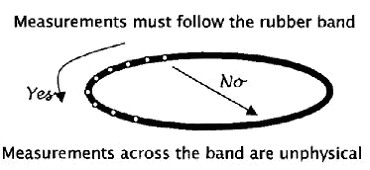
Fig. 24.3
However, B. Schutz and his colleagues from LIGO Scientific Collaboration (LSC) need exactly such measurements "across" 3-D space to determine the amplitude of the "passing" -- with respect to some absolute space [Ref. 4] -- GWs, and also "see" the animation above as ripples of the 3-D metric itself. No background (regardless of being "undisturbed" or "disturbed") can exist for (i) "expansion" of 3-D space [Ref. 4] nor for (ii) GW propagation, yet Bernard Schutz and his LSC colleagues managed to "obtain" it for case (ii), with their spherical cow approximation.
There is also a tantalizing story by B. Schutz, regarding the "time parameter" of the propagation of GWs, depicted with the horizontal line in Fig. 22.1 below, from his book "GRAVITY from the Ground Up" (Cambridge University Press, Cambridge, 2003), p. 312. Notice also that the small vertical line refers to "something that is dimensionless" (exact quote from Kip Thorne's Physics 237-2002 Course).
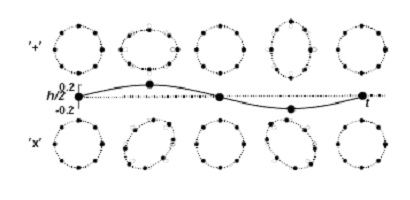
Fig. 22.1
B. Schutz argues that "the force of the Moon comes from the curvature of
time" (ibid., p. 310), and "the deformation produced by the Moon is partly directed towards the Moon (the longitudinal direction), whereas gravitational waves are transverse" (ibid., p. 311).
Therefore, LSC members have to separate two crucially distinct cases: curvature of time, as in the example with the tidal effect on Earth caused by the Moon (no GWs in principle), from curvature of space, as in the case of time-dependent spatial curvature (lots of GWs waiting for the "advanced" LIGO and LISA), depicted with the horizontal line in Fig. 22.1 above, and denoted with t as well. To elucidate the situation, let me quote further from B. Schutz: "The fact (there are no "facts" here - D.C.) that gravitational waves are transverse and do not act like the Moon does on Earth implies that they are not part of the curvature of time, since that is where the Newtonian forces originate. They are purely a part of the curvature of space (emphasis mine – D.C.). When gravitational waves move through a region they do not induce difference between the rates of nearby clocks. Instead, they deform proper distances according to the pattern in Fig. 22.1" (ibid., p. 312). More from Bernard Schutz here. Perhaps LSC members will try to separate (safely) the curvature of time from the curvature of space at GR19. I wish them best of luck with the SBG argument too. In my "just-another-crank" opinion, the splitting of 3-D space into some x/y plane and an orthogonal "transverse direction" of GW scattering, denoted usually with z , is sheer parapsychology. Check out the precise recipe for detecting "local perturbations in the space-time metric from astrophysical sources", by LIGO Scientific Collaboration (540 people), arXiv:1007.3973v1 [gr-qc], p. 11: 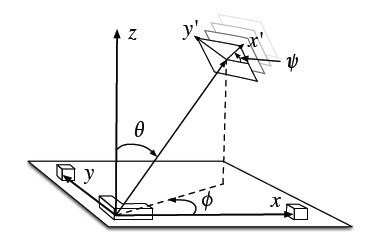
NB: If someone tells you that the ongoing "expansion" of spacetime metric, driven by [we-do-not-know-it], is along a straight line in space (say, 'from the center of the Galaxy toward Earth'; cf. my email to Gabriela González from 8 June 2005), would you believe it? Of course not. Then how come people believe in the drawing above? Can you separate the "expanding" metric in the two cases?
Notice also the dimensionless GW amplitude and the analogy with the EM waves in 3-D space, suggested by Bernard Schutz: you can prove that light is a transverse wave by using Polaroid, hence a simple Gedankenexperiment with GW "amplitude" will require that it will inevitably acquire dimensionality, upon projecting the "amplitude" on the transverse x/y plane. The proper GW detectors should be endowed with the faculty of self-acting (resembling the human brain), in order to be triggered by GWs. But this is a different thread. Notice the crucial global "direction" of GW propagation, orthogonal to the whole 3-D space en bloc, in Fig. 2 above, and its holistic effect in the shoal of fish here; more from Anthony Zee above. Just as there is no source that is "waving" to produce quantum waves, there is no material source that is "waving" to produce GWs propagating from one location in 3-D space to another location. It would be tantamount to claiming that some material source, located somewhere in 3-D space, can produce a finite period of cosmological time (say, 8 min). If we use such Archimedean geometry for 'the source of DDE' [Ref. 4], the task for understanding the cosmological "beginning" and "end", as well as the problems with singularities and 'boundary of space' will be insurmountable. There is a lot to be done for revealing Einstein's "total field of as yet unknown structure." Here comes a difficult (to my teenage daughter) exercise: try to recover the ripples of the 3-D metric following the 1-D case (see the GW lake) and 2-D case (the Flatland animation above). If you endow the "stretching 'n squeezing" 2-D plane (Ray Weiss' mesh) with a third space dimension, the "direction" of GW propagation will be omnipresent in 3-D space, similar to the 2-D case in which it was "acting" on the whole 2-D plane en bloc. To explain 'omnipresent', imagine a brand new axis in 3-D space, along which you can discriminate between Small and Large. The spherically symmetrical 3-D "breathing" of the metric is along this new T-invariant axis, so if you dare to talk about the dynamics of the metric-filed "breathing", you have to use different signs for t , say, +t for the "inhaling" mode and -t for the "exhaling" mode. Then the arrow of spacetime will require another axis, denoted with w in Fig. 2 above, which is orthogonal to the omnipresent axis of the Small viz Large in our good old 3-D space.
Thus, the cosmological arrow [Ref. 4], as well as the dynamics of GW scattering in 3-D space, can only be defined w.r.t. the unobservable, global, Heraclitean, and non-Archimedean time (see above): once we "look" at 3-D space from the global mode, the very nature of time changes accordingly. As explained in Wiki, we would see "all points in 3-dimensional space simultaneously, including the inner structure of solid objects and things obscured from our three-dimensional viewpoint". However, our (inanimate) wristwatch can read only one instant from this global mode of time. It can't read +t ("inhaling" mode) and -t ("exhaling" mode) simultaneously, hence it will report the global mode of time as "atemporal" and "frozen" (recall the problem of time in canonical quantum gravity). I bet nobody at GR19 will make the slightest effort to mention the unobservable, global, Heraclitean, and non-Archimedean time, pertaining to GWs and the global expansion of space. Eight years ago, B. Schutz explained only a fraction of the problems, and didn't even mention the problems of GW dynamics stemming from the global expansion of space: you cannot detect GWs along the time read by your wristwatch, as Kip Thorne speculated above, just as you cannot take the stand of some meta-observer to monitor the global GW dynamics 'on the whole spacetime en bloc', or count to infinity, like Chuck Norris. The usual excuse of LIGO Scientific Collaboration is that they use a linearized approximation of GR, only this 'spherical cow' is "a shadow without power" -- check out Hermann Weyl. Yet LSC persistently ignore all arguments against the "theory" of GW detection with LIGO and the like. Okay, I used their linearized approximation of GR to derive the conditions under which LIGO Scientific Collaboration (700+ people) might succeed: LIGO needs a schizophrenic behavior of gravity, as explained here. But of course nobody at GR19 will mention Hermann Weyl nor the SBG argument. LIGO Scientific Collaboration stubbornly refuse to acknowledge that there are no bans on the dipole radiation anymore, simply because the alleged
conservation of gravitational mass-energy and momentum, in a world dominated by an evolving cosmological "constant", is a wishful thinking: all the energy conditions of GR have come into question. In October last year, I asked 75 physicists to endorse the submission of my manuscript "Taxpayer's perspective on GW astronomy" to ArXiv.org server. Two of them refused (Jonathan Thornburg and Stanley Deser), while the rest didn't even bother to respond to my email. Surely GWs exist, but we may have to construct brand new detectors for the dipole radiation, and even re-examine the crux of GR [Ref. 5]: the quasi-local energy density of the gravitational field and the "boundary conditions" [Ref. 6] fixed in the global non-Archimedean spacetime. In simple words, the wegtransformierbar quality of gravity "over a point" (Afriat and Caccese, p. 27) indicates its specific quantum origin; details above. Nobody from GR19 has so far responded to my email. I cannot argue with silent spherical cows either, once they have collected all the money -- taxpayers' money -- to play with Einstein's GR. There is no sense to "enhance" the sensitivity of LIGO, for it has been a dead turkey from the outset. I suggested in March 2006 that LIGO tunnels should be converted to wine cellars, but what can be done with LISA? How much will cost that space junk? When is enough, enough?
"just another crank" D.C.
June 1, 2010
Last update: July 29, 2010
[Ref. 3] Orfeu Bertolami, The mystical formula and the mystery of Khronos, arXiv:0801.3994v3 [gr-qc], http://arxiv.org/abs/0801.3994
"In practical terms, one defines the second, the fundamental unit of time, as 1/86400 of the duration of the average solar day, or 9,192,631,770 periods of transition the radiation corresponding to the transition between the two hyperfine levels of the ground state of the cesium-133 atom. (4)
...
Footnote 4: "This definition concerns a cesium atom at rest at a temperature of 0K, such that the ground state is defined at zero magnetic field.
....
"Another interesting idea is the so-called “Heraclitean time proposal” [63, 64]. This is based on a suggestion by Einstein [65] according to which the determinant of the metric might not be a dynamical quantity."
--
[65]

[Ref. 4] Michal Chodorowski, A direct consequence of the expansion of space? arXiv:astro-ph/0610590v3, http://arxiv.org/abs/astro-ph/0610590v3
"We argue that, unlike the expansion of the cosmic substratum, the expansion of space is unobservable."
"To ‘explain’ these and other GR effects in cosmology, the idea of the Expansion of Space (EoS) is evoked.
...
" • On a philosophical level, it suggests that the expansion of the universe can be detached from the matter that is participating in the expansion. However, we know that, as he was constructing GR, Einstein was greatly influenced by the thoughts of German physicist and philosopher Ernst Mach. In the words of Rindler (1977), for Mach “space is not a ‘thing’ in its own right; it is merely an abstraction from the totality of instance-relations between matter”. Therefore, the idea of expanding space ‘in its own right’ is very much contrary to the spirit of GR.
"• On a physical level, it suggests that the EoS is a geometric effect, so space itself is absolute. Then, though abolished in SR, in cosmology absolute space reenters triumphally the cosmic arena, endowed with an additional attribute: expansion.
"• Again on a physical level, it suggests the existence of a new mysterious force. If so, one can expect non-standard effects also on small scales. For example, one might expect particles to be dragged along by the EoS.
...
"Still, isn’t space expanding from a global point of view? Spatial sections of a closed FL model are three-spheres, whose radius of curvature increases as a(tau). Here, a(tau) is the so-called scale-factor, a universal function of cosmic time which describes how the distances between all elements of the cosmic substratum (or, fluid) grow with time. Therefore, the proper volume of a closed FL universe increases as [a(tau)]3; more and more space thus appears."
[Ref. 5] Bahram Mashhoon, Necessity of Acceleration-Induced Nonlocality, arXiv:1006.4150v1 [gr-qc]
"Ideal inertial (non-Archimedean - D.C.) observers are imaginary and do not really exist (yes they do exist: check out the UNdecidable KS state above - D.C.).
....
"The locality postulate states that an accelerated observer is at each instant physically equivalent to an otherwise identical momentarily comoving inertial observer. The latter follows the straight world line that is tangent to the world line of the accelerated observer at that instant. Thus an accelerated observer may be replaced in effect by an infinite sequence of hypothetical momentarily comoving inertial observers; mathematically, the world line of the accelerated observer is the envelope of the straight world lines of the corresponding hypothetical inertial observers (for reality check, see Alan Rendall - D.C.).
"This locality assumption originates from Newtonian mechanics, where the state of a point particle is determined at each instant by its position and velocity. The (hypothetical - D.C.) point particle and the hypothetical comoving inertial particle of the same mass share the same state (only in Newtonian mechanics - D.C.) and are thus physically equivalent."
[Ref. 6] Emil Mottola, The Trace Anomaly and Dynamical Vacuum Energy in Cosmology, arXiv:1006.3567v1 [gr-qc], Sec. I.
"Hence [lambda] may take on any value whatsoever with no difficulty (and with no explanation) in classical General Relativity.
.....
"This is a clear indication, confirmed by experiment, that the measurable effects associated with vacuum fluctuations are infrared phenomena, dependent upon macroscopic boundary conditions, which have little or nothing to do with the extreme ultraviolet modes or cutoff of the integral in (1.4).
.....
"In calculations of the Casimir force between conductors, one subtracts the zero point energy of the electromagnetic field in an infinitely extended vacuum (with the conductors absent) from the modified zero point energies in the presence of the conductors. It is this subtracted zero point energy of the electromagnetic vacuum, depending upon the boundary conditions imposed by the conducting surfaces, which leads to experimentally well verified results for the force between the conductors.
.....
"In the case of the Casimir effect, a constant zero point energy of the vacuum, no matter how large, does not affect the force between the plates. In the case of cosmology it is usually taken for granted that any effects of boundary conditions can be neglected (can't and shouldn't - D.C.).
"It is not obvious then what should play the role of the conducting plates in determining the magnitude of ρv in the universe, and the magnitude of any effect of quantum zero point energy on the curvature of space has remained unclear from Pauli's original estimate down to the present.
.....
NB, p. 4: "A vacuum energy with ρ > 0 and w = pv/ρv = -1 leads to an accelerated expansion, a kind of "repulsive" gravity in which the relativistic effects of a negative pressure can overcome a positive energy density in (1.6). Taken at face value, the observations imply that some 74% of the energy in the universe is of this hitherto undetected w = -1 dark variety [3, 4]. This leads to a non-zero inferred cosmological term in Einstein's equations ... (Eq. 1.7).
.....
"A naturalness problem arises only when the effects of quantum zero point energy on the large scale curvature of spacetime are considered. This is a problem of the gravitational energy of the quantum vacuum or ground state of the system at macroscopic distance scales ... "
============================================
Subject: Quantum mechanics needs no consciousness (and the other way around)
Date: Mon, 27 Sep 2010 17:51:05 +0300
From: Dimi Chakalov <[email protected]>
To: Shan Yu <[email protected]>,
Danko Nikolic <[email protected]>
Cc: Thomas Metzinger <[email protected]>,
Philip Pearle <[email protected]>,
Hans Primas <[email protected]>,
Atamalek Ghorbanzadeh <[email protected]>,
Wolf Singer <[email protected]>,
Horst Stöcker <[email protected]>,
Karlheinz Langanke <[email protected]>
Dear Dr. Yu,
May I comment on your latest arXiv:1009.2404v2, "Quantum mechanics needs no consciousness (and the other way around)".
I fully agree with you and Dr. Nikolic that (pp. 5-6) "quantum mechanics may have not left any space for the observer’s consciousness to manipulate the experimental results". There is no need for any "observer" in QM, provided we can formulate the latter in accordance with 'no observer' requirement from quantum cosmology -- please see Sec. Summary, pp. 35-36, at
http://www.god-does-not-play-dice.net/ExplanatoryNote.pdf
Instead, the whole universe should act as "observer" (or rather "chooser", Philip Pearle), in line with 'the universe modeled as a brain',
http://www.god-does-not-play-dice.net/#history
http://www.god-does-not-play-dice.net/#KS
Please notice that I strictly follow W. Pauli's proposal for solving the mind-brain problem (H. Atmanspracher and H. Primas (1997), The Hidden Side of Wolfgang Pauli, Journal of Scientific Exploration 11(3) 369-386; cf. Sec. VI, Matter and Psyche as Two Aspects of One Reality, p. 381).
I will appreciate your professional comments. I trust your German colleagues have received my previous email (Mon, 20 Sep 2010 08:19:34 +0300), regarding the physics of binding phenomenon. It's all about the brain, again.
Kindest regards, Dimi Chakalov =======================================

Excerpt from "ripples on space-time,"
http://www.ligo.org/science/GW-GW2.php
"For physicists, a strong gravitational wave will produce displacements on the order of 10-18 meters - this is 1000 times smaller than the diameter of a proton." It is a dimensionless ghost that would show up only with ... "2.3×10⁻²⁶". It is also supposed to "cause a periodic strain (i.e., stretching and contraction) of the proper distance between points (altered by the "dark energy" - D.C.) in spacetime" (G. Jones, p. 182). What is the dimensionality of GW amplitude, h , in Kip's mantra?

The very entity that fixes the "proper distance" of [one meter] cannot be presented with what is produces -- 'one meter'. It is indeed dimensionless, just like the "amplitude" of quantum waves. Can you display at macroscopic scale the ongoing dynamics of quantum-gravitational waves at distances of "2.3×10⁻²⁶" without a proper theory of quantum gravity?
How can you detect, with some "advanced" LIGO or LISA, the very "dark energy" which "expands" space by altering the proper distance between "points" ? Nobody cares. Nobody.
D.C., 11 April 2011
Ceterum autem censeo, LIGO esse delendam
==================================
Subject: Re: "yes, I do understand GR, but cannot discuss that now."
Date: Wed, 6 Apr 2011 00:35:59 +0300
Message-ID: <[email protected]>
From: Dimi Chakalov <[email protected]>
To: Stanley Deser <[email protected]>
Cc: LSC Spokesperson <[email protected]>,
Adam Helfer <[email protected]>,
Andrew Waldron <[email protected]>,
Andrzej Mariusz Trautman <[email protected]>,
Angelo Tartaglia <[email protected]>,
Bernd Brügmann <[email protected]>,
Beverly Berger <[email protected]>,
Bruce Goldstein <[email protected]>,
Carl H Brans <[email protected]>,
Charles Torre <[email protected]>,
Chris Isham <[email protected]>,
Curt Cutler <[email protected]>,
David B Malament <[email protected]>,
Denise S Henry <[email protected]>,
Domenico Giulini <[email protected]>,
Donald C Shapero <[email protected]>,
Drew Keppel <[email protected]>,
Eric Gourgoulhon <[email protected]>,
Fiona Harrison <[email protected]>,
Fred Cooperstock <[email protected]>,
Günther Hasinger <[email protected]>,
Hans-Jürgen Schmidt <[email protected]>,
Helmut Friedrich <[email protected]>,
J Anthony Tyson <[email protected]>,
Jarmo Mäkelä <[email protected]>,
Jim Isenberg <[email protected]>,
Joel Franklin <[email protected]>,
John Baez <[email protected]>,
John Carlstrom <[email protected]>,
John Friedman <[email protected]>,
John Huchra <[email protected]>,
John W Barrett <[email protected]>,
Jonathan Halliwell <[email protected]>,
Jonathan Lunine <[email protected]>,
Jonathan Thornburg <[email protected]>,
Jong Hyuk Yoon <[email protected]>,
Jorge Pullin <[email protected]>,
Jose Geraldo Pereira <[email protected]>,
Jose M M Senovilla <[email protected]>,
Karel V Kuchar <[email protected]>,
Lars Bildsten <[email protected]>,
Laszlo Szabados <[email protected]>,
Luca Bombelli <[email protected]>,
Lynne Hillenbrand <[email protected]>,
Malcolm MacCallum <[email protected]>,
Marcia J Rieke <[email protected]>,
Martha Haynes <[email protected]>,
Michael Cohen <[email protected]>,
Michele Vallisneri <[email protected]>,
Naresh Dadhich <[email protected]>,
Natalie Kiriushcheva <[email protected]>,
Nikolaos Mavromatos <[email protected]>,
Norbert Straumann <[email protected]>,
Paulett C Liewer <[email protected]>,
Piotr T Chrusciel <[email protected]>,
Richard Price <[email protected]>,
Richard Woodard <[email protected]>,
Robert Brandenberger <[email protected]>,
Robert Geroch <[email protected]>,
Robert M Wald <[email protected]>,
Roger Blandford <[email protected]>,
Roy Maartens <[email protected]>,
Ruth Durrer <[email protected]>,
Saeed Mirshekari <[email protected]>,
Saul Teukolsky <[email protected]>,
Scott Tremaine <[email protected]>,
Sergiu Klainerman <[email protected]>,
Seth Major <[email protected]>,
Stefan Krückeberg <[email protected]>,
Steven Carlip <[email protected]>,
Steven G Harris <[email protected]>,
Thomas A Prince <[email protected]>,
Timothy Heckman <[email protected]>,
William G Unruh <[email protected]>,
Xiao Zhang <[email protected]>,
Yi Wang <[email protected]>
Stanley:
Five years ago, on 31 March 2006, you claimed that you "do understand GR, but cannot discuss that now."
Regrettably, neither you nor any of your colleagues agreed to endorse the submission of my manuscript, entitled: "A Taxpayer's Perspective on GW Astronomy." An outline can be read at
http://www.god-does-not-play-dice.net/#LIGO
General considerations at
http://www.god-does-not-play-dice.net/#Ruben
Any comments?
Dimi
---------
Subject: Re: "yes, I do understand GR, but cannot discuss that now."
Date: Wed, 21 Oct 2009 01:32:35 +0300
From: Dimi Chakalov <[email protected]>
To: Stanley Deser <[email protected]>
Cc: Joel Franklin <[email protected]>,
Richard Woodard <[email protected]>,
Andrew Waldron <[email protected]>,
Steven Carlip <[email protected]>,
John Baez <[email protected]>,
John W Barrett <[email protected]>
On Wed, Oct 21, 2009 at 1:14 AM, Stanley Deser <[email protected]> wrote:
>
> Dear Sir,
> I cannot spare the time for your proposals; why not submit to a journal &
> see what happens? sd
Gladly.
Would you, or any of your colleagues, endorse the submission of my manuscript
http://arxiv.org/help/endorsement ?
The basic arguments are at
http://www.god-does-not-play-dice.net/Szabados.html#SBG
I will be happy to send you, or any of your colleagues, my manuscript, entitled: "A Taxpayer's Perspective On GW Astronomy".
Regards,
Dimi =======================================
Subject: The wine cellars of LIGO
Date: Mon, 18 Apr 2011 14:29:57 +0300
Message-ID: <[email protected]>
From: Dimi Chakalov <[email protected]>
To: Sanjeev Dhurandhar <[email protected]>
Cc: Jorge Pullin <[email protected]>,
Gabriela González <[email protected]>,
Curt Cutler <[email protected]>,
Bernard Schutz <[email protected]>,
LSC Spokesperson <[email protected]>,
Kip <[email protected]>,
Karsten <[email protected]>,
David <[email protected]>,
Valerio <[email protected]>,
Warren <[email protected]>,
[email protected],
[email protected]
Dear Dr. Dhurandhar,
Five years ago (Wed, 01 Mar 2006 04:59:31 +0200), I suggested to Jorge Pullin to convert the dark, air-conditioned tunnels of LIGO to wine cellars (it is important to keep the temperature at 13ºC - 15ºC).
I wonder what can you do with your "interferometric detectors", arXiv:1104.2968v1 [gr-qc],
http://www.god-does-not-play-dice.net/#LIGO
http://www.god-does-not-play-dice.net/#LIGO_LISA
The suggestions from your colleagues will be greatly appreciated, too.
Sincerely,
D. Chakalov
--------
Overfunded research is like heroin: It makes one addicted, weakens the mind and furthers prostitution.
Johann A. Makowsky, The Jerusalem Post, 19 April 1985

The next wine cellar (pictured above) will cost at least $1,280,000,000 (€790M). It will be built underground at a depth of about 100–200 m and will consist of three large wine cellars, each linked by two 10 km long wine shelves. Cheers! D. Chakalov
May 19, 2011
==================================
Subject: Re: The wine cellars of LIGO
Date: Tue, 20 Sep 2011 17:56:28 +0300
Message-ID:
<CAM7EkxnvwukGbCF823KX7sjHY4pZxD1hby6iQV5-o8qCcvrwoQ@mail.gmail.com>
From: Dimi Chakalov <[email protected]>
To: Joan Centrella <[email protected]>
Cc: Vivian Drew <[email protected]>,
Sanjeev Dhurandhar <[email protected]>,
Jorge Pullin <[email protected]>,
Gabriela González <[email protected]>,
Curt Cutler <[email protected]>,
Bernard Schutz <[email protected]>,
Kip <[email protected]>,
Karsten <[email protected]>,
David <[email protected]>,
Valerio <[email protected]>,
Stephen Merkowitz <[email protected]>,
Meredith Gibb <[email protected]>,
Karen Smale <[email protected]>,
[email protected],
[email protected],
[email protected],
[email protected],
[email protected],
[email protected],
[email protected],
[email protected],
[email protected],
[email protected],
[email protected],
[email protected],
[email protected],
[email protected],
[email protected],
[email protected],
[email protected],
[email protected],
[email protected],
[email protected],
[email protected],
Cliff <[email protected]>,
LSC Spokesperson <[email protected]>
Hello Joan:
As a civil servant employee of NASA, you should be *very* careful to avoid elementary errors, which could undermine the reputation of NASA.
Yet in your latest essay arXiv:1109.3492v1 [astro-ph.HE], you wrote:
"Far from their source, these ripples are small perturbations (xxx) on a flat background spacetime."
No they aren't:
http://www.god-does-not-play-dice.net/#LRR
STOP wasting taxpayers' money for your fantasies.
When you and LIGO "scientific" collaboration ultimately fail, people all over the world will not laugh at your wishful thinking.
They will laugh at NASA.
Capiche?
D. Chakalov
--------------
Subject: The wine cellars of LIGO
Date: Mon, 18 Apr 2011 14:29:57 +0300
Message-ID: <[email protected]>
From: Dimi Chakalov <[email protected]>
To: Sanjeev Dhurandhar <[email protected]>
Cc: Jorge Pullin <[email protected]>,
Gabriela González <[email protected]>,
Curt Cutler <[email protected]>,
Bernard Schutz <[email protected]>,
LSC Spokesperson <[email protected]>,
Kip <[email protected]>,
Karsten <[email protected]>,
David <[email protected]>,
Valerio <[email protected]>,
Warren <[email protected]>,
[email protected],
[email protected]
Dear Dr. Dhurandhar,
Five years ago (Wed, 01 Mar 2006 04:59:31 +0200), I suggested to Jorge Pullin to convert the dark, air-conditioned tunnels of LIGO to wine cellars (it is important to keep the temperature at 13ºC - 15ºC).
[snip]
---------- Note: You cannot, not even in principle, derive the so-called "weak limit." You cannot estimate the quasi-local "loss" or "gain" of energy due to gravity either [Ref. 1]. All you could do is to admit the consequences from the so-called "dark energy" (Sean Carroll), get yourself a blank notebook and sharp pencils, and start from scratch. D. Chakalov
September 21, 2011
[Ref. 1] Carl Hoefer,
Energy Conservation in GTR, Stud. Hist. Phil. Mod. Phys. 31(2), 187 (2000); see pp. 193-195, pdf file available from here.
p. 191: "Intuitively, if energy-momentum is really being conserved locally, then when one integrates up it should be conserved over regions as well. Since this fails, we have to fall back on a different understanding of what (1) represents.
...
p. 193: "It is called the gravitational stress-energy pseudo-tensor, and its non-tensorial nature means that there is no well-defined, intrinsic 'amount of stuff' present at any given point.
Regarding GWs, see p. 196: "If energy is not conserved quite generally, there is no need to make up a story about where it has gone when a system loses it."
See also footnote 11, p. 195.
==================================
Subject: Re: The wine cellars of LIGO
Date: Mon, 30 Jan 2012 14:44:12 +0200
Message-ID:
<CAM7EkxmbWB_2nTzZWDuSWdpVT2TU+62ZNtsAWc_DoEoK3jQL8g@mail.gmail.com>
From: Dimi Chakalov <[email protected]>
To: James Ira Thorpe <[email protected]>, [email protected]
Cc: Joan Centrella <[email protected]>,
[email protected],
[email protected],
[email protected],
[email protected],
[email protected],
[email protected],
[email protected],
[email protected],
[email protected],
[email protected],
Bernard Schutz <[email protected]>,
LSC Spokesperson <[email protected]>,
Kip <[email protected]>,
Karsten <[email protected]>,
David <[email protected]>
Hello Dr. Thorpe,
In your latest arXiv:1201.5656v1 [gr-qc], you and you co-author wrote: "LISA was identified as a priority in the most recent decadal survey of astronomy and astrophysics[10] but has yet to be implemented due to funding constraints."
LISA will never fly, not because of "funding constraints", but because your hypotheses are wrong:
http://www.god-does-not-play-dice.net/#LIGO_Prague
I explained the facts to Mrs. Centrella (Tue, 20 Sep 2011 17:56:28 +0300), but she refused to reply.
Again, once you and LIGO "scientific" collaboration fail with the "advanced" LIGO, people all over the world will not laugh at your wishful thinking.
They will laugh at NASA.
D. Chakalov
------------
Note: "People sometimes make errors," said Edward Weiler, NASA's Associate Administrator for Space Science, on September 30, 1999, after the crash of Mars Polar Lander spacecraft. One of the teams used English units (e.g., inches, feet and pounds), while the other used metric units. It happens. But the case here is totally different: science has been contaminated with money. I believe both NASA and NSF are fully aware of the game, but keep quiet. In my not-so-humble opinion, the linearized approximation of GR is applicable to specific task such as adjusting the GPS system, but not for the transport of energy by GWs, which is "a fundamentally nonlinear phenomenon": Sir Hermann Bondi (Gravitational Waves in General Relativity, February 1, 1990): "From the beginning I was very suspicious of the value of linearized treatments of the topic. Not only is general relativity by its nature a nonlinear theory, but the question of the "reality" of the waves essentially concerned whether they transported energy. Such transport is a fundamentally nonlinear phenomenon." To quote from M. Maggiore's "Gravitational Waves" (Oxford University Press, 2007, p. 32): "In special cases (English translation: spherical cow approximations; cf. [Ref. 1] - D.C.) one can find exact wave-like solutions of the full nonlinear Einstein equations, see, e.g. Misner, Thorne and Wheeler (1973), Section 35.9, and then there is no need (Sic! - D.C.) to perform a separation between the background and the waves. However, it would be hopeless to look for exact solutions for the gravitational waves emitted by realistic astrophysical sources." Voila, straight from the horse's mouth. You'll need the medieval magic of the "linearized approximation" to "eliminate" by hand the insurmountable problems of detecting GWs [Ref. 2], plus billions of USD to perform "a separation between the background and the waves" and endow GWs with "an energy–momentum tensor" (Michele Maggiore, p. 34; see also [Ref. 1]). Or just the cash, which is much easier. As Johann Makowsky put it (The Jerusalem Post, 19.4.1985), "Overfunded research is like heroin: It makes one addicted, weakens the mind and furthers prostitution."
D.C.
January 31, 2012
Last updated: February 4, 2012, 14:35 GMT
[Ref. 1] MTW, p. 968:
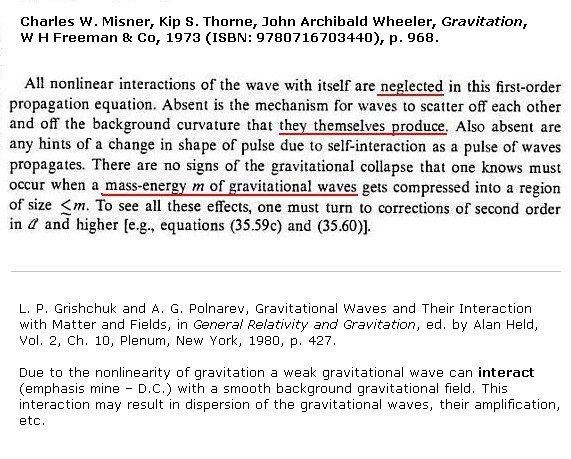
(Comment: By the same token, suppose I decide to "cope with the complexities"
(MTW, § 35.9) of Quantum Mechanics (QM) by suggesting an approximation of QM based on classical statistical theory, to achieve "a compromise between realism and complexity" (ibid.), and claim that one can measure simultaneously non-commuting QM observables with arbitrary precision, provided we 'enhance the sensitivity' of our macroscopic measuring devices, for which I need just a couple of billion USD and EUR.
Catch my drift? - D.C.)
p. 970: 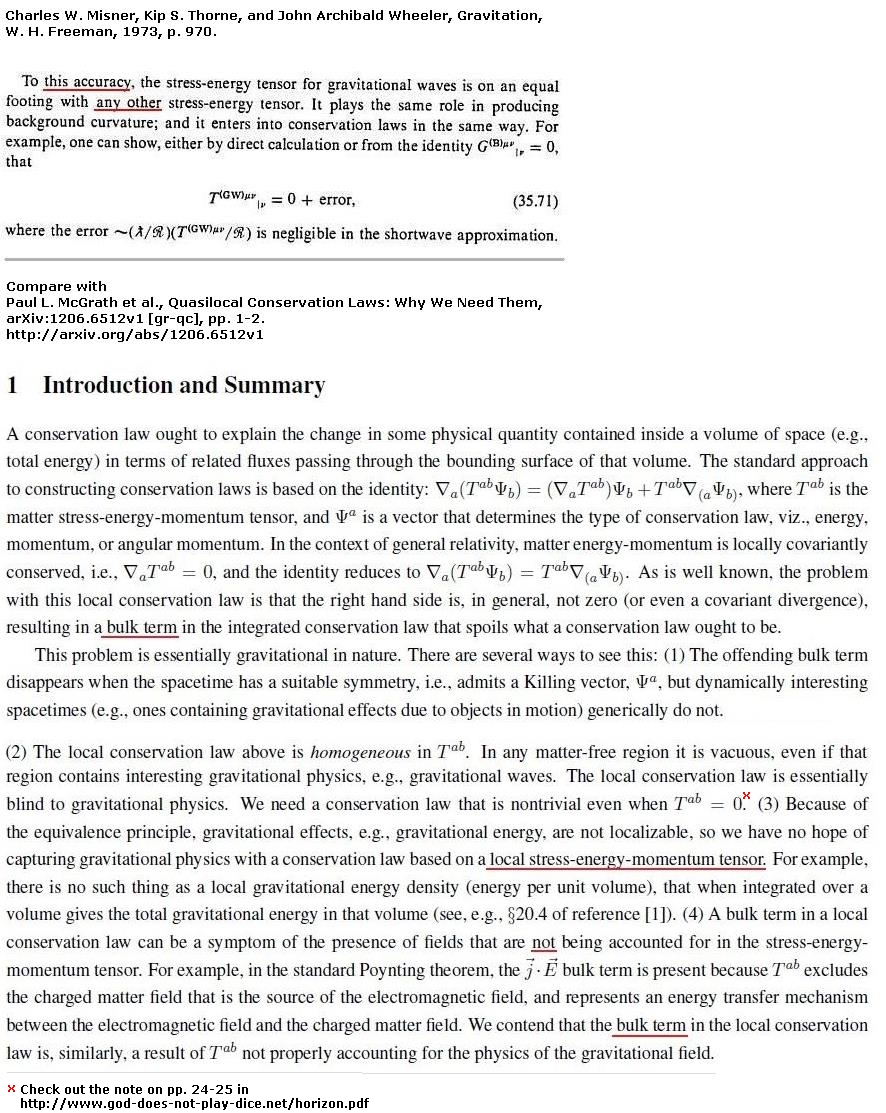
(A gentle suggestion to those who deeply believe that LIGO "scientific" collaboration has some theory somehow related to General Relativity: Once you introduce "stress-energy tensor for gravitational waves" and explain the energy exchange of "mass-energy m of gravitational waves" with LIGO's arms -- locally, 'at a point' -- please proceed to the puzzle of 'gravitational energy density at a point' (MTW, p. 467) and all quasi-local features of gravity - D.C.)
Figure 35.3, p. 959: "an exact plane-wave solution to Einstein's vacuum field equations."
[Ref. 2] L.P. Grishchuk, Update on gravitational-wave research, arXiv:gr-qc/0305051v2
"It is often stated that “gravitational waves are oscillations of space-time itself”. The next phrase seems to be logically unavoidable: “gravitational waves act tidally, stretching and squeezing any object that they pass through”.
"If this phrase were correct, we would never be able to notice gravitational waves. The device measuring, say, the displacements of free mirrors in an interferometer would be "stretched and squeezed" as well. In this situation, we can probably find comfort in the wise observation [67]: "I agree that much of what one reads in the literature is absurd. Often it is a result of bad writing, rather than bad physics. I often find that people who say silly things actually do correct calculations, but are careless in what they say about them.
----
"[67] I am grateful to S. Weinberg for the permission to quote his e-mail message of 25 Feb 2003."
L. P. Grishchuk and A. G. Polnarev, Gravitational Waves and Their Interaction with Matter and Fields, in General Relativity and Gravitation, ed. by A. Held, Vol. 2, Ch. 10, Plenum, New York, 1980, p. 427: "Due to the nonlinearity of gravitation a weak gravitational wave can interact with a smooth background gravitational field. This interaction may result in dispersion of the gravitational waves, their amplification, etc."
Addendum
An excerpt from Lectures on Mathematical Cosmology by H.-J. Schmidt, gr-qc/0407095, Sec. 4.2, p. 35, Why do all the curvature invariants of a gravitational wave vanish? "The energy of the gravitational field, especially of gravitational waves, within General Relativity was subject of controversies from the very beginning, see Einstein [66]. Global considerations - e.g. by considering the far-field of asymptotically flat spacetimes - soon led to satisfactory answers. Local considerations became fruitful if a system of reference is prescribed e.g. by choosing a timelike vector field. "If, however, no system of reference is preferred then it is not a priori clear whether one can constructively distinguish flat spacetime from a gravitational wave. This is connected with the generally known fact, that for a pp-wave, see e.g. Stephani [250] especially section 15.3. and [65] all curvature invariants vanish, cf. Hawking and Ellis [107] and Jordan et al. [123], but on the other hand: in the absence of matter or reference systems - only curvature invariants are locally constructively measurable.
.... "At page 97 of [123] it is mentioned that for a pp-wave all curvature invariants constructed from Rijkl;i1...ir (4.18)
by products and traces do vanish."
--
[66] Einstein, A.:
1914, Sitzungsber. Akad. d. Wiss. Berlin, 1030.
1916, Sitzungsber. Akad. d. Wiss. Berlin, 688.
1918, Sitzungsber. Akad. d. Wiss. Berlin, 154.
1921, Sitzungsber. Akad. d. Wiss. Berlin, 261. 35, 145
[65] Ehlers, J., Kundt, W.: 1962, in: Witten, E., ed., Gravitation, an introduction to current research, Wiley New York, 49. 36 [107] Hawking, S., Ellis, G.: 1973, The large scale structure of space-time, Cambridge University Press. 36 [123] Jordan, P., Ehlers, J., Kundt, W.: 1960, Abh. Akad. Wiss. Mainz, Math./Nat. Kl. 2, 21. 36 [250] Stephani, H.: 1982, General Relativity, Cambridge University Press. 7, 36, 164; section 15.3.
---------- Prof. Hans-Jürgen Schmidt hasn't yet replied to my email of Thu, 20 Feb 2003 12:05:02 +0200: "Isn't it true that the *necessary* condition for detecting gravitational waves is that the distribution of energy-momentum of a physical system in the gravitational field must be uniquely defined on a continual trajectory, not just in one instant of measurement?" Again, all those who deeply believe that LIGO "scientific" collaboration has some theory somehow related to General Relativity should try the following simple exercise: Once you introduce "stress-energy tensor for gravitational waves" and explain the energy exchange of "mass-energy m of gravitational waves" with LIGO's arms -- locally, 'at a point' -- please proceed to the puzzle of 'gravitational energy density at a point' (MTW, p. 467) and all quasi-local features of gravity.
D. Chakalov
February 2, 2012
============================
Note: I hope that the Office of Inspector General (OIG) at NSF does provide independent oversight of the NSF’s programs and operations, "preventing and detecting fraud, waste, and abuse". Here, the key word is waste: hundreds of million USD and EUR have been already wasted, and even more is scheduled to be wasted with the "advanced" LIGO and LISA. I also wrote to NASA Science (cf. my ref # below) and to the Inspector General at NASA <[email protected]> , and will offer my manuscript, entitled: "A Taxpayer's Perspective on GW Astronomy". In October 2009, I asked seventy-five theoretical physicists whether they would endorse the submission of this manuscript to [gr-qc] -- two of them flatly denied (S. Deser and J. Thornburg), the rest didn't even bother to acknowledge my email. =============================== Subject: Re: The wine cellars of LIGO
Date: Tue, 31 Jan 2012 11:36:00 +0200
Message-ID: <CAM7EkxkqR2MbZ8AnMxwwZTUcv69LRnuLdOVrPHJa7Cw6Wj7+EQ@mail.gmail.com>
From: Dimi Chakalov <[email protected]>
To: Warren Johnson <[email protected]>
Cc: James Ira Thorpe <[email protected]>,
[email protected],
Joan Centrella <[email protected]>,
[email protected],
[email protected],
[email protected],
[email protected],
[email protected],
[email protected],
[email protected],
[email protected],
[email protected],
Bernard Schutz <[email protected]>,
LSC Spokesperson <[email protected]>,
Kip <[email protected]>,
Karsten <[email protected]>,
David <[email protected]>,
Beverly Berger <[email protected]>,
Tom Carruthers <[email protected]>,
Denise S Henry <[email protected]>,
Ramona Winkelbauer <[email protected]>,
Peggy Fischer <[email protected]>,
OIG <[email protected]>,
Clifford Will <[email protected]>
Dear Mr. Johnson,
On Tue, 31 Jan 2012 01:12:18 -0600,
Message-Id: <[email protected]> ,
you wrote:
> For years you have accumulated taunts and insults on your
> website http://www.god-does-not-play-dice.net. Your targets have included
> all the scientists who have worked on gravitational wave physics and are
> connected with the LIGO and LISA projects.
My first warning message, recorded at my web site, is from Wed, 19 Feb 2003 23:40:26 +0200.
In the past (almost) nine years, nobody has responded professionally to my objections to your absolutely ridiculous wasting of taxpayers' money -- nobody has made even a modest effort to read and study the articles published in peer reviews journals, which prove, beyond ANY reasonable doubt, that LIGO "scientific" collaboration and VIRGO
collaboration do NOT have any scientific theory. Just wishful thinking based on wild guesses.
Your efforts to detect GWs is indeed based solely on wishful thinking: read carefully the text and references at
http://www.god-does-not-play-dice.net/#LIGO_Prague
Yes, I will expose the dirty little secrets of LIGO "scientific" collaboration.
> At your website you explain how these detectors are supposed to work. I
> agree that your explanation is nonsense, so I understand how you conclude
> that these experiments can never work. However, the fault lies in your
> understanding, and not in the detectors themselves.
As a member of LIGO "scientific" collaboration, you demonstrate total lack of understanding the basic basics of General Relativity: your linearized approximation is your problem. Not my web site.
Read the references and my objections, and don't try to guess what I wrote.
> We, who work on these detectors, know how the equations of general
> relativity can be used to calculate the difference of the round-trip travel
> times for light in the two arms of the interferometer (the instrument at the
> heart of both detectors). In short, if no gravity wave passing by, then the
> round-trip travel time for each arm will remain constant and the same for
> both arms. But, during those moments when a gravity wave is passing by, one
> round trip time will be longer than the other, and we can observe and
> measure that time difference directly. Of course, literally tons more of
> technical detail can be added, but it really is that simple.
Totally irrelevant. You haven't even glanced at the URL from my initial email, which I reproduced above.
The problem is not in the "round-trip travel time for each arm will remain constant and the same for both arms."
The problem is that you and your 800+ colleagues don't want to face the inherent limitations from the LINEARIZED approximation of GR.
All you want is money -- more and more taxpayers' money earned with hard labor by millions of people.
Yes, I will expose the dirty little secrets of LIGO "scientific" collaboration.
> So for the record, you can not say that your charges have gone unanswered.
For the record: You, Mr. Johnson, have not read any of the papers cited at my web site, and tried instead to guess what I might have stated. And of course you are wrong.
> More to the point, hundreds of highly skilled scientists have repeatedly
> reviewed every technical aspect of these projects, and all of your charges
> against them are baseless.
To begin with, read the article by Hermann Weyl from 1944. That's just for a start. More at the link above.
My advice to you and your 800+ colleagues: Get real. Don't hide your head in the sand. Read all arguments and facts about your problems. And most importantly: do not ever say that your efforts are related to General Relativity. As I showed at the link above, you don't have any scientific theory, but two wild guesses (cf. the two "if"-s), which have nothing to do with General Relativity.
Should you or any of your colleagues wishes to respond, please do your homework first. First things first.
Yes, I will expose the dirty little secrets of LIGO "scientific" collaboration.
And don't even think about LISA.
Sincerely,
Dimi Chakalov
On Tue, 31 Jan 2012 02:14:57 +0200, Dimi Chakalov <[email protected]> wrote:
>
> P.S. Note added at
> http://www.god-does-not-play-dice.net/#ESA
>
> Any comments? Please don't hesitate.
>
> D.C.
> ====================================
Subject: LISA: Unveiling a hidden Universe
Date: Tue, 20 Sep 2011 18:46:07 +0300
Message-ID:
<CAM7Ekx=q970kBurwTnV9jr_bPBjuB76RSCUfGuUqNA-_HNzU8Q@mail.gmail.com>
From: Dimi Chakalov <[email protected]>
To: Oliver Jennrich <[email protected]>, [email protected]
LISA assessment study report
03 Feb 2011
Reference: ESA/SRE(2011)3
http://sci.esa.int/science-e/www/object/doc.cfm?fobjectid=48363
-------
Dear Dr. Jennrich,
LISA won't fly, ever.
Check out
http://www.god-does-not-play-dice.net/#LRR
http://www.god-does-not-play-dice.net/#wine_cellars
Please confirm the receipt of this email.
Sincerely,
Dimi Chakalov
============================================
Subject: Re: ... it is necessary to let the clock tick once.
Date: Sat, 16 Apr 2011 12:48:15 +0300
Message-ID: <[email protected]>
From: Dimi Chakalov <[email protected]>
To: Louis H Kauffman <[email protected]>
Cc: [email protected], [email protected],
[email protected], [email protected]
Dear Lou,
Regarding my email from Tue, 05 Apr 2005 16:20:39 +0300, may I draw your attention to the proposal for 'potential reality' at
http://www.god-does-not-play-dice.net/#Bedingham
Perhaps it is relevant to "the ‘rest of the universe’ that the fermion sees and interacts with" and the hypothetical massless particles suggested by Peter Rowlands (arXiv:0810.0224v1 [physics.gen-ph], p. 11).
Implications for GR and other crazy ideas at
http://www.god-does-not-play-dice.net/about.html#GR
http://www.god-does-not-play-dice.net/about.html#China
http://www.god-does-not-play-dice.net/about.html#AVC
The text at the last URL is essentially incomplete, because I haven't spelled out the hypothetical kinematics of space and its symmetry transformations,
http://www.god-does-not-play-dice.net/#Chappell
Will be happy to learn whether you or some of your colleagues are interested. The challenge is strictly mathematical.
Regards,
Dimi
=======================================
Subject: Cosmic equator: Request for update
Date: Wed, 20 Apr 2011 04:47:51 +0300
From: Dimi Chakalov <[email protected]>
To: Craig J Copi <[email protected]>,
[email protected], [email protected],
[email protected], [email protected],
[email protected], [email protected],
[email protected], [email protected],
[email protected], [email protected]
Dear colleagues,
May I ask you to help me find an explanation (if any) of the 'cosmic equator' (statistically anisotropic microwave fluctuations), as shown at
http://wmap.gsfc.nasa.gov/media/101082/index.html
http://wmap.gsfc.nasa.gov/media/101082/101082_w_7yr_WMAP_256.png
As Max Tegmark admitted eight years ago, "The octopole and quadrupole components are arranged in a straight line across the sky, along a kind of cosmic equator. That's weird. (...) We did not expect this and we cannot yet explain it."
http://news.bbc.co.uk/2/hi/science/nature/2814947.stm Details from Craig J. Copi et al., astro-ph/0605135v2, p. 15: "It is difficult for us to accept the occurrence of a 10^-8 unlikely event as a scientific explanation."
Could this 'cosmic equator' be interpreted as a blueprint left from some (global) cosmological arrow driven by the "dark" energy of [you-name-it]?
Spin is a fundamental phenomenon, and if 'the whole universe' has angular momentum along some (global) cosmological arrow, the cosmic equator may be a visual manifestation (blueprint) of the "dark" energy of [you-name-it].
The cosmic equator may not break the Galilei invariance (Luca Lusanna et al., arXiv:1007.4071v1 [gr-qc]) by defining some preferred observers at rest with respect to the cosmic background radiation, who could literally watch the spinning universe "online", and time it: 13.7 Gy "after" [you-name-it]. I mean, the *topology* of time (and space) is still unknown, after Aristotle,
http://plato.stanford.edu/archives/win2010/entries/time/#TopTim Thank you for your time and consideration.
Yours sincerely,
Dimi Chakalov
-------
Note: In the case dual age cosmology, the topology of time will be highly non-trivial, namely, time will evolve both along a line and a circle. Don't try to picture this in the Archimedean geometry of 3-D space, however. Locally -- to be precise, quasi-locally -- the universe looks like an unbroken ring with no circumference, for the circumference is nowhere, and the "center" is everywhere. Globally, it may possess "spin" which would cast its 3-D blueprints on all finite subsystems, the observable universe included. As to the "cosmic equator" itself, perhaps we'll have a better picture from the Planck mission (exposing the elusive "B-modes", which are perhaps determined by the density of primordial GWs), once the angular power spectrum is revealed next year; animation here. Last but not least, notice the terribly misleading "explanation" of the so-called "dark matter" with the read sausage below.


Only Chuck Norris can "see" the whole space en bloc and verify its "curvature".
Yet some (otherwise credible) people claim that there exists "matter" that is "dark", or simply "missing" (Leonard Susskind), and have even coined a name for it: WIMPS. Trouble is, what you can "see" is only the local impact from a global, tug-of-war effect of gravity, CDM&DDE. If you think of this global tug-of-war effect of gravity as being produced directly by some stuff with positive energy density, you'll be destined to publish papers and books until you retire. Sorry for being frank. All I'm trying to say is that nobody knows the global properties of spacetime and the origin of inertia (A. Einstein), and the 'cosmic equator' is a wonderful opportunity to gain insights into this puzzle of spacetime.
D. Chakalov
April 20, 2011
==================================
Subject: Re: arXiv:1103.5870 v3 ?
Date: Thu, 21 Apr 2011 04:18:35 +0300
Message-ID: <[email protected]>
From: Dimi Chakalov <[email protected]>
To: Miao Li <[email protected]>
Cc: Xiao-Dong Li <[email protected]>,
Yi Wang <[email protected]>,
Yi-Fu Cai <[email protected]>
Dear Professor Li,
After my email posted at
http://www.god-does-not-play-dice.net/#Li
... you assured me, in your private email, that will consider my comments on your arXiv:1103.5870v2 in its next update, which is arXiv:1103.5870 v3.
Look again at
http://www.god-does-not-play-dice.net/#error
It explains the huge ERROR made by many people. Yet you still repeated it in arXiv:1103.5870 v3 !
Unbelievable!
To quote from your arXiv:1103.5870 v3, p. 69: "Phenomenologically, cosmological experiments are typically carried out by measuring redshift and distance."
p. 85: "The most common approach to probe dark energy is through its effect on the expansion history of the universe. This effect can be detected via the luminosity distance dL(z) and the angular diameter distance DA(z)."
I noticed that you haven't mentioned my name even in Sec. Acknowledgments, p. 153 in arXiv:1103.5870 v3 .
If you or any of your colleagues cannot understand the ERROR at the link above, please write me back with your professional questions.
Yours sincerely,
Dimi Chakalov
-------
Note: The review article by Miao Li et al. (cf. above) is one of the best I've read. Pity they ignored the arguments about the error with "luminosity distance". You can't use intrinsic evaluations (i.e., "working solely within the 4-dimensional spacetime in which we find ourselves", J. Baez) when dealing with the global properties of spacetime. You would need some non-Archimedean "global" observer, such as Chuck Norris. Which is absurd, of course. Let me elaborate. The conventional recipe from GR textbooks is to evaluate local and finite (comprised from infinite many "sufficiently small") deviations from the connection (not "curvature") in a counterfactual manner -- something which might have happened in some fictitious flat spacetime (then the effect from the connection would have been zero), but didn't actually happen, hence the effect from the connection is observable. And then people say: look, the spacetime is indeed "curved" (they also measured the angles of some large size triangle), and there is a lot of "dark matter" in it, and because the standard "candles" are receding from us in line with the Hubble Law, the space is also "expanded" by its "dark energy". What a mess. Such counterfactual approach presumes some "Euclidean eyes" as a reference object (cf. matter-free homogeneous spacetime of constant curvature as "the background reference," Naresh Dadhich, arXiv:1105.3396v1 [gr-qc], p. 2), and that could be very misleading. People tend to "explain" GR by reducing the dimensions of space, and then picture some "deformed" 2-D surface or 2-D closed domains of "dark matter" inside 3-D space (cf. the red sausage above). Ditto for "black holes", as depicted inside 3-D space (you may also find intelligent life there, with lots of advanced Russian math).
Such naïve "explanations" might be suitable for general audience only (e.g., Michio Kaku), provided the TV anchor explains the inevitable deceptions. Which is by no means an easy task, because nobody has so far defined 'event horizons'. Well, such approach works for local effects, say, adjusting the GPS system. And if you endorse some metaphysical assumptions about the homogeneity of space, you may also assume that everything you see in a domain of space with size, say, 1B light years is not different from what you could have seen in another domain of size 1B light years, which can be parallel-transported (Sic!) 10B light years away from you. You never know with metaphysics, so you could be right. But the task for evaluating global properties of spacetime is totally different. You cannot possibly presume that you may "expand" indefinitely the initial size of your 1B light year domain, without reaching some critical size limit at which the gravity itself will break down. The tacit presumption that gravity will work in arbitrary large volumes of 3-D space is ridiculous, to say the least. There is no guarantee that the space geometry will remain Archimedean indefinitely. Notice the insurmountable problem from assuming exclusively Archimedean geometry: you actually invoke some absolute space in which "more and more space" appears from its "dark source" (cf. Michal Chodorowski). Such "dark stuff" doesn't get diluted as space "expands". On the contrary: at every instant of time it appears in greater quantities. It is the ultimate free lunch. By comparison, every perpetual motion device would look boring and terribly inefficient. The usual claim presented in thousands of papers is that space is globally expanding, being driven by some "perfectly smooth" (cf. Matt Visser) fluid with 'positive energy density'. Such statement requires verification, which in turn can only be performed by some absolute non-Archimedean "observer" who can 'count to infinity', and is able to "see" the whole space en bloc, hence can time its "expansion" online, along her/his global wristwatch, and finally write down "the absolute equation of state" of this absolute and perfectly smooth "dark" fluid. Summary on the error. Firstly, you inevitably hit "absolute space". Secondly, you can't work "intrinsically" with global properties of spacetime. And thirdly, you cannot promote yourself to an absolute non-Archimedean "observer", not even with some Gedankenexperiment. You may seek some "upper limit" or "boundaries" on space, at which space could become self-wrapped (Einstein), but such task may requite non-Archimedean geometry (global mode of spacetime) and a modified Finite Infinity. Trouble is, your diff geometry textbooks say nothing about the fine structure of 'geometrical point' in the postulated 'differentiable manifold', and even the texts about 'modern differential geometry' (e.g., C. Isham) are dead silent about how these "points" get "connected" in the first place. For you can't connect these bare geometrical points with any physical stuff whatsoever (do you speak Mandarin?). And since you can only observe the local effect from this truly fundamental connection (called here The Aristotelian Connection), you cannot "see" its global holistic source. It will be inevitably "dark" to you, as some (otherwise credible) people have called it. Apart from these minor objections, prompted by the usage of the adverb 'marginally' by Miao Li et al. (cf. above), I strongly recommend their review paper. They repeated in arXiv:1103.5870 v3, p. 5, the following claim: "In principle, before we understand the origin of the vacuum energy, the energy density can be positive, negative and zero". My suggestion: before we address the origin of the vacuum energy, we should first try to understand the mechanism by which we observe positive energy densities only. As I noticed previously, we shouldn't have jumped into conclusion that the "dark puzzle" originates directly from some mundane stuff with positive energy density: it comes out far too much, and suspiciously well-tuned during all cosmological stages. It just doesn't work. When will they update their manuscript (arXiv:1103.5870 v4?), as Miao Li hinted in a private email? When pigs fly, of course. Xiao-Dong Li and Shuang Wang already rejected my email below. Maybe they didn't like my Mandarin ...?
D. Chakalov
April 21, 2011
Last updated: May 20, 2011
====================
Subject: Re: arXiv:1103.5870 v3 ?
Date: Thu, 21 Apr 2011 17:18:50 +0300
From: Dimi Chakalov <[email protected]>
To: Miao Li <[email protected]>,
Xiao-Dong Li <[email protected]>,
Yi Wang <[email protected]>,
Shuang Wang <[email protected]>
Cc: Yi-Fu Cai <[email protected]>,
Lau Loi So <[email protected]>,
Xiao Zhang <[email protected]>
P.S. Explanatory note at
http://www.god-does-not-play-dice.net/#Li_error
Comments welcomed.
D.C.
On Thu, Apr 21, 2011 at 4:18 AM, Dimi Chakalov <[email protected]> wrote:
[snip]
=======================================
Subject: Suggestion
Date: Sat, 23 Apr 2011 00:32:22 +0300
From: Dimi Chakalov <[email protected]>
To: Adam Helfer <[email protected]>
Hi Adam,
You've published a *very* important article, which I think is barely known:
Adam D. Helfer, The Kinematics of the Gravitational Field, in: Proceedings of Symposia in Pure Mathematics, ed. by R. Greene and S.-T. Yau, Vol. 54 (1993), Part 2, American Mathematical Society, 1993, pp. 297-316.
It would be great if you post it on [gr-qc] section of ArXiv.org, perhaps with a brief appendix explaining the problems of introducing the dynamics of that "field", after the so-called DDE,
http://www.god-does-not-play-dice.net/#Li_error
You certainly don't need an endorsement from ArXiv "moderators", who deleted my paper on LIGO,
http://www.god-does-not-play-dice.net/#LIGO
I posted today some scattered thoughts on the kinematics of space at
http://www.god-does-not-play-dice.net/#25_11_2015
Have a nice Easter.
Dimi
=====================
Subject: Re: Suggestion
Date: Thu, 12 May 2011 16:38:54 +0300
Message-ID: <[email protected]>
From: Dimi Chakalov <[email protected]>
To: Adam D. Helfer <[email protected]>
Cc: Pankaj S Joshi <[email protected]>,
Robert M Wald <[email protected]>,
George F R Ellis <[email protected]>,
William G Unruh <[email protected]>,
Larry Ford <[email protected]>
Hi Adam,
Pity you ignored my preceding email from Mon, 25 Apr 2011 18:37:39 +0300. It concerns all papers you've posted at
http://arxiv.org/find/gr-qc/1/au:+Helfer_A/0/1/0/all/0/1
A few comments on your latest manuscript:
Adam D. Helfer, Black holes reconsidered, arXiv:1105.1980v1 [gr-qc],
http://arxiv.org/abs/1105.1980 The problem of teleology: a *complete* model of spacetime requires re-formulation of Ellis' Finite Infinity, but in the framework of the current stipulations (p. 3, footnote 1), I'm afraid this is impossible. Once you start with what you should derive at the end (Lorentzian metric), you are on a wrong track. You can never define rigorously the hypotheses on the asymptotic regime (Sec. 1.2), nor understand the paradox of naked singularity (p. 6).
I also think quantum fields in curved spacetime would seem "natural and attractive" (p. 23) only to people who neglect the fact that "we do not yet have a practical understanding of how to treat the nonlinear case" (p. 44). In your words, "the usual theory of quantum fields in curved space–time is not adequate for treating black holes" (p. 40). I fully agree, but the current GR mantra (p. 3, footnote 1) is inadequate for describing "black holes" that are outside the
applicable limits of this GR mantra in the first place.
You also wrote (p. 42): "I am going to describe here the results of measurements of Hawking quanta and their precursors, according to conventional quantum theory [49]."
---
49. A. D. Helfer, Phys. Lett. A329, 277–283 (2004), gr-qc/0407055
In ref. [49], your wrote: "Energy, in quantum theory, is measured by the Hamiltonian operator. Since this operator generates temporal evolution, energy will be conserved if the operator remains constant. (...) Again, since the stress–energy is the source for Einstein’s equation, a quantum stress–energy implies a quantum gravitational field and a deeper, quantum-gravitational, treatment of the entire question is really required. Again, this is in line with the main argument here, that quantum gravity must be considered in the quantum physics of gravitational collapse."
I fully agree. Recall my comments to your essay "The Production of Time", arXiv:0812.0605v1 [gr-qc],
http://arxiv.org/abs/0812.0605 We need quantum gravity (cf. my preceding email from April 25th) to understand Fig. 5 and footnote 18 regarding the "dressed vacuum" (p. 45), and Sec. 5.4 regarding how quantum fields can act as sources for gravity, in your latest arXiv:1105.1980v1 [gr-qc].
You also wrote (arXiv:1105.1980v1 [gr-qc], p. 48): "For questions about the detectability of negative energy densities, see [55]."
---
55. A. D. Helfer, Class. Quant. Grav. 15, 1169–83 (1998).
Ref. [55] is your arXiv:gr-qc/9709047v2,
http://arxiv.org/abs/gr-qc/9709047
http://iopscience.iop.org/0264-9381/15/5/008 Do you remember my email from Thu, 20 Sep 2001 21:28:18 +0200 ? I wrote about your arXiv:gr-qc/9709047v1, from Thu, 18 Sep 1997 16:18:34 GMT (15kb), which was entitled: "Are Negative Energy Densities Detectable?" Here's your abstract of arXiv:gr-qc/9709047v1:
"T. S. Eliot described a ‘mystery cat,’ Macavity, responsible for all sorts of mischief, But when the crime’s discovered, Macavity’s not there! I investigate the negative energy densities predicted by relativistic quantum field theories, and find they have a similar character. The energy in a region, plus the energy of a device which detects it, must be non-negative. Indeed, as far as has been checked, the total four-momentum density, of the field plus the observing device, must be future-pointing. In consequence the semi-classical Einstein equation can at best describe negative energy-density effects
only as long as no observers are present to test it: Macavity, Macavity... he breaks the law of gravity."
The updated version, arXiv:gr-qc/9709047v2, was entitled ‘Operational’ Energy Conditions, and was published in Class. Quant. Grav. The phrase "breaks the law of gravity", from arXiv:gr-qc/9709047v1, is missing.
Pity you ignored your arXiv:gr-qc/9709047v1 from Thu, 18 Sep 1997 16:18:34 GMT.
I will be happy to elaborate on Macavity, in case you'd consider an arXiv:1105.1980 v2 [gr-qc].
Take care,
Dimi
------------
Subject: Re: Suggestion
Date: Mon, 25 Apr 2011 18:37:39 +0300
From: Dimi Chakalov <[email protected]>
To: Adam Helfer <[email protected]>
Hi Adam,
> At the moment, though, I have no plans to rewrite
> (or repost) this article; I am too far behind with other things!
You have the kinematics, now all you have to do is to add the dynamics from that "dark" energy of Macavity, and you're done! What could be more important?
[snip]
Dimi
---------
Note: Notice that the negative energy-density effects are (in the way explained above) always "present" iff no one is "there" (local mode of spacetime) to look at them -- just like the invisible cat Macavity. Notice also that Adam Helfer suggested two concepts of time in "The Production of Time", arXiv:0812.0605v1 [gr-qc], Sec. 5, and "cosmic time vector" (ibid., p. 10), even though he used linear quantum fields in "curved" spacetime. As he admitted above, "we do not yet have a practical understanding of how to treat the nonlinear case" (arXiv:1105.1980v1 [gr-qc], p. 44). Well, I do: forget about Hilbert space. Let me briefly explain.
I stated above that once you "start with what you should derive at the end (Lorentzian metric), you are on a wrong track." The reason is that I endorse the opinion of Jim Hartle that the Lorentzian signature of classical spacetime "is an emergent property from an underlying theory not committed to this signature." In order to derive the Lorentzian signature of classical spacetime as an emergent entity from some underlying [we-do-not-know-it], I think we should first elucidate the precise meaning of 'finite space' and 'finite time interval' of classical spacetime. Regarding the latter, we contemplate a bare Archimedean "template" that we label with 'one second', and then we imagine filling in this finite "template" with "9,192,631,770 periods of transition the radiation corresponding to the transition between the two hyperfine levels of the ground state of the cesium-133 atom" (cf. above), after which we are search for some realistic physical process to manufacture atomic clocks. But this is metrology. We need quantum gravity. The crux of the matter is in the very existence of such invariant finite templates, which define the "intrinsic time interval associated to any timelike displacement" (Ted Jacobson, pp. 18-19). To be precise, the missing phenomenon (should be related to the "speed" of light) is some process of "reading" all infinitesimal "points" from any such 'finite template' en bloc, and with precise and invariant "speed", as 'uncountably-infinite infinitesimal "frames" per second' (say). Unless we encounter relativistic effects (time dilation), this "reading" does not slow down (for comparison, watch a slow motion of a water drop here). This "reading" can originate only from the Arrow of Space. The invisible Macavity is the charge-neutral (the two signs of "mass" included) potential reality. It always exists 'out there', but in the global mode of spacetime. Can you take a snapshot from a dark room with a torch? Replace the 'torch' with an already linearized snapshot of [gravity & type I matter fields], and you'll get the main idea in GR and the intricate problems with the geodesic hypothesis and the "proper time" along causal curves (A. Helfer, arXiv:0812.0605v1 [gr-qc], p. 1). Notice the seemingly obvious notion of "locally" in [Ref. 1]. It originates from what I called above 'GR mantra'. It is a very misleading mantra, because once you add gravity, the world is quasi-local. Adam Helfer acknowledged elsewhere the unsolved problem of "quasi-local kinematics" (arXiv:0903.3016v1 [gr-qc]), which I believe can only be resolved by the proper dynamics. As promised above, I will be happy to elaborate, should Adam Helfer considers an arXiv:1105.1980 v2 [gr-qc]. If not, I will keep working on Macavity -- my way. Does a fish need a bicycle?
D. Chakalov
May 13, 2011
[Ref. 1] Raymond Angélil and Prasenjit Saha, arXiv:1105.0918v1 [astro-ph.GA],
http://arxiv.org/abs/1105.0918v1
"The (apparent - D.C.) equivalence of gravitational and inertial mass, or that gravity can be cancelled (not quite - D.C.) by transforming to a freely-falling frame, was tested within classical celestial mechanics to high precision by the end of the nineteenth century. After all, if Mercury had a gravitational constant differing from (say) Jupiter’s by one part per million, Mercury’s orbit would not have fitted classical dynamics well enough to highlight the anomalous precession (43′′ per century, or 10−7) that was later explained by general relativity.
"The Einstein equivalence principle (EEP) adds to the classical or weak equivalence principle the further physical postulate that special relativity holds locally (emphasis mine - D.C.) in a freely-falling frame. A consequence of the EEP is that the effects of gravity on test particles are fully described by endowing spacetime with a Riemannian metric, and having the particles follow geodesics of that metric." =====================
Subject: Re: Suggestion
Date: Sun, 29 May 2011 15:24:31 +0100
Message-ID: <[email protected]>
From: Dimi Chakalov <[email protected]>
To: Adam Helfer <[email protected]>
Cc: Robert M Wald <[email protected]>,
George F R Ellis <[email protected]>,
William G Unruh <[email protected]>,
Karel V Kuchar <[email protected]>,
Laszlo Szabados <[email protected]>,
Chris Isham <[email protected]>
Dear Adam,
Let me be perfectly clear: it's all about the fundamental unresolved issues of GR.
There is no way you could make any progress on your ideas without the so-called 'global mode of spacetime'. It is *the only possible* solution to the task for defining an 'isolated system', by reaching the limit at which
"... the system becomes “self-contained.” Roughly speaking, this should mean passing to an appropriate asymptotic regime such that all gravitational effects are localized inside of it" (Angular momentum of isolated systems in general relativity, arXiv:0903.3016v1 [gr-qc]).
My suggestion is to use the 'global mode of spacetime' (notice its non-Archimedean geometry) for new versions of 'asymptotic spacelike regime' and George's Finite Infinity.
All this inevitably leads to the Arrow of Space: Time does not originate from 'change in space', but from 'chance *of* space'.
Again, there is no other way you could make *any* progress on your ideas.
I have so far offered you and your colleagues only my web site, for the following reasons:
You haven't responded professionally to any of my email messages sent since Tue, 20 Aug 2002 17:02:51 +0300. You didn't even acknowledge my invitation sent on Monday, 2 June 2008, nor my request for endorsement (Tue, 27 Oct 2009 12:10:26 +0200).
In fact, nobody from your colleagues has done so. Which is why I have offered you only my web site, and nothing more.
To sum up, it seems to me that you're treating your field of expertise with *total disrespect*. You treat GR as some hobby. In your words, "we each need to work on our own ideas."
Point is, one of us -- either you or I -- have taken a totally wrong path.
If you, or any of your colleagues, agree with Chris Isham that I am "just another crank" -- don't bother to reply.
Dimi
-------
D. Chakalov
35 Sutherland St
London SW1V 4JU
On Thu, May 12, 2011 at 8:40 PM, Dimi Chakalov <[email protected]> wrote:
>
> On Thu, May 12, 2011 at 5:50 PM, Adam Helfer <[email protected]> wrote:
>>
>> Dear Dimi,
>>
>> Thanks for your comments. I think we each need to work on our own ideas.
>
> Good luck, Adam. I will continue to work on your Macavity,
>
> http://www.god-does-not-play-dice.net/#Macavity
>
> Dimi
========================================
Subject: arXiv:1106.0394v1 [gr-qc]
Date: Tue, 7 Jun 2011 15:42:16 +0300
Message-ID: <[email protected]>
From: Dimi Chakalov <[email protected]>
To: Alberto Chamorro <[email protected]>
Cc: Lluis Bel <[email protected]>,
Luca Lusanna <[email protected]>,
Massimo Pauri <[email protected]>,
Domenico Giulini <[email protected]>,
John Stachel <[email protected]>,
Norbert Straumann <[email protected]>,
Adam Helfer <[email protected]>
Dear Dr. Chamorro,
May I ask a question regarding the *physical* individuation of point-events in spacetime: in what shape or form do the "proto-points" exist prior to their physical individuation, so that 'more and more space appears' due to the dynamic dark energy (DDE) of these proto-points ?
I will appreciate the opinion of your colleagues as well.
Kindest regards,
Dimi Chakalov
P.S. My efforts can be read at
http://www.god-does-not-play-dice.net/about.html#GR
http://www.god-does-not-play-dice.net/#Macavity
D.C.
=========================================
Subject: "Finally, results from Gravity Probe-B", arXiv:1106.1198v1 [gr-qc]
From: Dimi Chakalov <[email protected]>
Date: Wed, 8 Jun 2011 05:33:30 +0300
Message-ID: <[email protected]>
To: Clifford M Will <[email protected]>
Cc: Adam Helfer <[email protected]>
Clifford M. Will, "Finally, results from Gravity Probe-B", arXiv:1106.1198v1 [gr-qc]
http://physics.aps.org/articles/v4/43
http://arxiv.org/abs/1106.1198
"A massive body warps spacetime, the way a bowling ball warps the surface of a trampoline. A rotating body drags spacetime a tiny bit around with it, ..."
------
Cliff:
GR cannot explain the gyroscopic effect itself, yet your colleagues used gyroscopes to "test" GR.
Do you have a theory of the gyroscopic effect and conservation of gravitational angular momentum?
Do you believe that "frame dragging" (if any) can be modeled with some parameterized post-Newtonian (PPN) approximation and the so-called “relaxed” Einstein equations, Sec. 4.3,
http://relativity.livingreviews.org/Articles/lrr-2006-3/articlesu14.html#x21-430004.3 ?
http://en.wikipedia.org/wiki/Spherical_cow I think your wife is right about you.
Dimi
----------
"At the end of Bernie’s talk, a member of the audience asked whether Cliff had ever been known to be wrong on a serious issue. Bernie answered that to his knowledge, this had never happened. At this moment Leslie, Cliff’s wife, raised an eager hand and offered to present many examples of Cliff being in error."
B. Schutz, "Will and Testament", MATTERS OF GRAVITY, Number 29, Winter 2007
------------------ Note: The most puzzling paradox of GR is that you can use obviously wrong ideas, such as the PPN approximation, to make calculatory recipes which could match the recorded data very well. Another startling example is the pseudo-tensors. And even the Newtonian gravity, with its instantaneous "propagation" of gravity, works perfectly well FAPP. The application of GR for adjusting the GPS system is not a confirmation of GR, just as the projection postulate in QM textbook does not confirm nor reject any speculation about the quantum world. In the case of the alleged "frame dragging", notice the tacit presumption of some ideal observer who can "see" the whole asymptotically flat spacetime en bloc, and verify the speculations that a massive body "warps spacetime," while a rotating body "drags spacetime". There is no such thing as "curvature". Mrs. Leslie Will is right about her husband. Which isn't surprising, given the fact that Cliff's mentor was Kip Thorne. The two GR "experts" fully endorse the linearized approximation of GR for detecting the "ripples" of spacetime metric. And that's a serious error. But because they live in total socialism, their pay check is secured and, as long as other people pay for LIGO, LISA, etc., they will enjoy their hobby until they fully and totally retire. By 2015, the "advanced" LIGO will fail miserably to detect any GW strain, and LIGO "scientific" collaboration will have to come up with some "explanation" -- they will claim that their total failure is actually of fundamental importance, like the negative result for the ether drift in the experiment of Michelson and Morley. Hence they will "prove" GR wrong. There's none so blind as those who will not think. D. Chakalov
June 10, 2011 ========================================
Subject: Group Action in Topos Quantum Physics, arXiv:1110.1650v1 [quant-ph]
Date: Tue, 11 Oct 2011 18:26:41 +0300
Message-ID:
<CAM7Ekxk=ptY0mkiZTGe+CiqThHA2vFg7VB301jtFT+PSbfGFaQ@mail.gmail.com>
From: Dimi Chakalov <[email protected]>
To: Cecilia Flori <[email protected]>
Cc: Karol Horodecki <[email protected]>,
Rafael Sala Mayato <[email protected]>,
Andreas <[email protected]>,
Chris Isham <[email protected]>,
Jeremy <[email protected]>,
Ieke Moerdijk <[email protected]>,
Daniel Bedingham <[email protected]>,
Warren Leffler <[email protected]>,
Josef Tkadlec <[email protected]>,
Karl <[email protected]>
Hi Cecilia,
May I ask a question regarding your arXiv:1110.1650v1 [quant-ph], and ask for clarification of your understanding of Quantum Theory.
Look at the Peres-Mermin version of KS Theorem,
http://www.god-does-not-play-dice.net/#Hermens2
It is impossible that (i) all nine observables, at (ii) one instant (as recorded by your wristwatch), would possess (iii) context-independent, pre-existing values.
Rafael Sala Mayato and Gonzalo Muga explained the so-called Mermin’s square (N. D. Mermin, Hidden variables and the two theorems of John Bell, Revs. Mod. Phys. 65 (1993) 803-815) in arXiv:1110.1723v1 [quant-ph] as follows:
"[T]he observables are the Pauli matrices, with eigenvalues ±1, for two independent spin−1/2 particles. The nine observables are arranged in groups of three columns and three rows, and within each of them they are mutually commuting. The product of the three observables in the column on the right is −1, and the product of the three observables in the other two columns and all three rows is +1. It is easy to check that it is impossible to associate with each observable preexisting values, +1 or −1, in such a way that they verify the
identities satisfied by the observables themselves."
So, we reject the assumption (iii), about context-independent, pre-existing values, under the conditions (i) and (ii).
David Mermin says (arXiv:quant-ph/9912081v1): "The Kochen-Specker (KS) theorem (...) exhibits a finite set of finite-valued observables with the following property: there is no way to associate with each observable in the set a particular one of its eigenvalues so that the eigenvalues associated with every subset of mutually commuting observables obey certain algebraic identities obeyed by the observables themselves [1]. Such a set of observables is traditionally called uncolorable."
Q: Can you start counting the 'observables' from the "uncolorable" ones, in such way that they will obtain "color" at the expense of other 'states', which will be, *in the context of this particular* counting, "uncolorable" ?
http://www.god-does-not-play-dice.net/#Castro
1. If you can, the assumption (iii) may show you something that is missing in present-day quantum theory and its "toposification": the 'pre-existing values' do exist, albeit in an UNdecidable pre-quantum state (never in plural); more from Henry Margenau.
2. If you can't reverse the counting (cf. the link above), please explain why. I extend this request to all recipients of this email.
All the best,
Dimi
--------
Note: The notion of 'pre-existing values' is the crux of our understanding of 'reality'. In classical physics, the form of reality we encounter is 'objective reality', while in Quantum Theory the new (to some theoretical physicists, at least) form of reality is 'potential reality'. Notice that the latter can accommodate totally new things to emerge during the non-unitary evolution of the universe, which may, from the perspective of the fixed rigid 'objective reality', look like creatio ex nihilo or rather 'the set of all sets that have never been considered' (David Batchelor). Relative to the history of the universe up to the instant 'now', it's an empty set, but we cannot know what might come out from the 'the unknown unknown' -- it's a Free Will universe. As John Wheeler put it, "Time is Nature's way to keep everything from happening all at once". Stated differently, our common 'potential reality' evolves non-unitarily as well, resembling the "memory" of 'the universe as a brain'. Why has the "state vector collapse" been a hugely effective, FAPP calculation tool? It has captured an essential germ of truth: the UNdecidable pre-quantum state does not, and cannot "collapse"; it only casts one pre-correlated "state" -- one-at-a-time, along the Arrow of Space -- which is being explicated with certainty in the intact quantum world 'out there'. The UNdecidable pre-quantum state itself must not be included in the set/topos of its color-able explications. In the current QM, the only "link" we have between the macroscopic world and the quantum realm is provided by "probabilities", as explained eloquently by Chris Isham (C.J. Isham, Lectures on Quantum Theory, 1995, p. 17, Eq. 2.8). NB: I invite all people who disagree with my interpretation of the KS Theorem to check out the generation of particle's path in Wilson cloud chambers; cf. Alessandro Teta, arXiv:0905.1467v1, pp. 8-11: "The cloud chamber is filled by a supersaturated vapour which can undergo local phase transitions induced by the exchange of even a small amount of energy." The key word is energy. As pointed out by Sir Nevill Mott in 1929, ”It is a little difficult to picture how it is that an outgoing spherical wave can produce a straight line.” Let's see how "little" this challenge is. Sean Carroll stressed in arXiv:0811.3772v1 [gr-qc], p. 6, that "the basis states [xxx] and the coefficients [xx] are completely time-independent; all of the time evolution is encoded in the phases [XXX]". Notice, however, the imaginary unit in Eq. 4 and in Alessandro Teta's paper. How do you represent 'time evolution' with complex phases (Chen Ning Yang), in such fashion that (i) the imaginary unit will be kept intact throughout the whole track of the particle in Wilson cloud chamber, yet (ii) the time evolution of the particle will be represented, at the same time, with a real number? This is the essence of the 'macro-objectification problem' bzw. the problem of reconciling the present-day quantum theory with Special Relativity. If we wish to speak about 'time in quantum mechanics', we should never abuse Quantum Theory by imposing 'the time of facts' from Newtonian mechanics or Special Relativity. Go ahead. Feel free to try some "decoherence" with "zeroing the off-diagonal elements" (John Gamble). I offered this task to Jonathan Halliwell and his colleagues from Imperial College (Chris Isham included) two years ago, but haven't heard from them. Dorje Brody acknowledged, in a private talk in Imperial College London some eleven years ago, that Nevill Mott's paper encapsulates the essence of QM. I fully agree, and hope that some of the readers of these lines will try to refute my suggestion about 'the UNdecidable pre-quantum state' (never in plural) by solving the problem identified by Sir Nevill Mott in 1929. NB: Unlike QM textbooks, Nature provides smooth transitions between 'the word of facts', governed by Special Relativity, and the quantum realm. It is crucially important for any theory of quantum gravity to discover the 'back bone' of these smooth transitions: the UNdecidable pre-quantum KS state. Moreover, it is impossible to attach gravity to the color-able presentations of quantum fields alone. No way. Before even contemplating about some 'quantum gravity', we need to resolve the puzzle of these smooth transitions, and also fix the problem of quasi-local gravitational energy in present-day GR textbooks (MTW, p. 467). However, Chris Isham boldly stated nine years ago (23 October 2002): "You do not know enough theoretical physics to help with any research in that area." He still hasn't backed his insulting claim with any evidence, nor has resolved the problem of QM known since 1929. Hopefully, some of the readers may help him. Going back to the KS Theorem, people picture the color-able "states" in some Hilbert space (or try some "toposification"), and impose our Boolean thinking upon the colored "observables" explicated at the length scale of tables and chairs. I suggest to reflect on the ability of your brain to handle its UNdecidable state. The crux of the complex phases is exposed in assumption (ii) above: "at one instant (as recorded by your wristwatch." You inanimate wristwatch cannot read both the "observables" and their UNdecidable pre-quantum state (Henry Margenau called it Onta). It is manifestly wrong to assume that "single atomic events" exist 'out there', so we only need to "amplify" their "effects" (cf. Alessandro Teta above) in order to be "readily observed by large systems" [Ref. 1]. Briefly, the structure of spacetime at macroscopic scale acts like a "filter" imposed on the quantum world, which produces artifacts, such as "quantum jumps", but on the other hand this "filter" makes the projection postulate (introduced in QM textbooks by hand) a very effective, FAPP calculation tool. All you need is to consider the possibility that the universe works like a brain. Sorry for repeating this again. It's a free world. Steven Weinberg, for example, has chosen to publish a new collection of essays, entitled: Lectures on Quantum Mechanics. I've been trying to reach him since May 2003, with no success; my last email is printed below. Soon on
DVD.
D. Chakalov (a.k.a "just another crank")
October 13, 2011
Last update: October 25, 2011, 17:00 GMT
[Ref. 1] Richard P. Feynman and Albert R. Hibbs, Quantum Mechanics and Path Integrals: Emended Edition (1965 edition, emended by Daniel F. Styer), Dover Publications, 2010, p. 22.

=====================================
Subject: You can lead a horse to water, but you can't make him read and think.
Date: Thu, 13 Oct 2011 03:59:31 +0300
From: Dimi Chakalov <[email protected]>
To: Steven Weinberg <[email protected]>
Cc: Chris Isham <[email protected]>
Steven Weinberg, arXiv:1109.6462v3 [quant-ph], 12 Oct 2011 01:32:12 GMT: "We assume as in ordinary quantum mechanics that the state of the system is entirely described by a vector in Hilbert space."
http://www.god-does-not-play-dice.net/#Cecilia
D.C.
=====================================
Subject: Marc Lachièze-Rey: Where is the vertical in empty space ?
Date: Mon, 16 Apr 2012 15:30:53 +0300
From: Dimi Chakalov <[email protected]>
To: Marc Lachieze-Rey <[email protected]>
Cc: Henrik Zinkernagel <[email protected]>,
Hans Westman <[email protected]>,
Brendan McMonigal <[email protected]>,
[email protected],
[email protected]
Space, time, Spacetime, by Marc Lachièze-Rey, Slide #4
http://www.ugr.es/~zink/cosmo/LachiezeGranada.pdf;
Espace, Temps et Espace-Temps, 8 février 2012
-----------
Dear Dr. Lachièze-Rey,
Perhaps you will be interested to check out
http://www.god-does-not-play-dice.net/#Brendan
http://www.god-does-not-play-dice.net/#ESI
I hope you can help Eddie Anderson with his "ice dragon".
All the best,
Dimi Chakalov
======================================
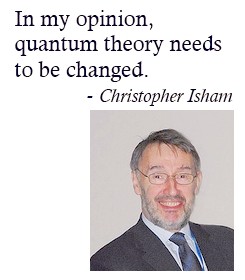
Subject: Re: Quantum gravity
Date: Sun, 23 Oct 2011 14:18:06 +0300
Message-ID:
<CAM7EkxmJ-A=fOCnpRWa0Yc1axbDgPvVaQ3vQ68OoTyUHspO6eA@mail.gmail.com>
From: Dimi Chakalov <[email protected]>
To: Chris Isham <[email protected]>
Cc: Jeremy <[email protected]>,
Cecilia Flori <[email protected]>,
Andreas <[email protected]>,
Jonathan Halliwell <[email protected]>,
Amihay Hanany <[email protected]>,
Helen Fay Dowker <[email protected]>,
J M Yearsley <[email protected]>,
Daniel Bedingham <[email protected]>,
Josef Tkadlec <[email protected]>,
Karl <[email protected]>,
Roland Omnes <[email protected]>,
Claus Kiefer <[email protected]>,
Domenico Giulini <[email protected]>,
Alessandro Teta <[email protected]>,
Norbert Straumann <[email protected]>,
Lars Andersson <[email protected]>,
Sean Carroll <[email protected]>,
Dorje Brody <[email protected]>
Chris,
Nine years ago, on Wed, 23 Oct 2002 19:24:15 +0100, you wrote:
"You do not know enough theoretical physics to help with any research in that area."
You still haven't made any effort to show any evidence supporting your insulting claim. Instead, four years ago (Fri, 12 Oct 2007 15:14:09 +0100), you pictured me as "just another crank".
May I offer you and your colleagues a simple task from 1929: check out the NB section in the note at
http://www.god-does-not-play-dice.net/#Cecilia
If you can resolve the problem, you will obliterate my efforts to suggest a new path toward quantum gravity, but most importantly we all will hear about your discovery at CNN Breaking News.
Please go ahead. Say something as a physicist. Don't be shy.
"just another crank"
Note: Many physicists are inclined to endorse the opinion of Chris Isham by simply pointing to the fact that I have not offered math. But there is no math available in the first place. None. You guys do diff geometry like bartenders. The math I need is not present in your textbooks (included the one from Chris Isham), simply because you introduce 'differentiable structure' in GR by referring only to the color-able states of 'physical reality', and have totally missed the fine structure of "points" where the UNdecidable pre-quantum KS state quietly resides, along with 'the ideal monad without windows' (cf. A. Döring and C.J. Isham, quant-ph/0703066, p. 2, footnote 3).
I will be happy to elaborate, starting from Thompson Lamp Paradox and some simple examples with the Cauchy sequence and the infinitesimal [Ref. 1]. To paraphrase Lord Rutherford, we haven't the math, so we've got to think!
D.C.
October 24, 2011
[Ref. 1] George Lakoff and Rafael E. Núñez, Where Mathematics Come from: How the Embodied Mind Brings Mathematics into Being, Basic Books, New York, 2001, p. 189.
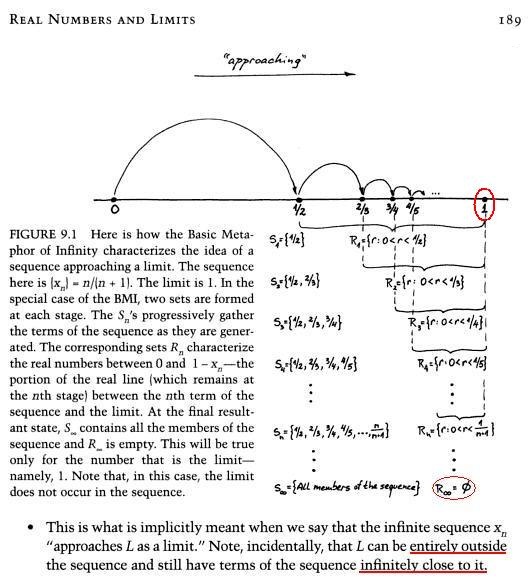
Comment: The exercise above is cast in the Archimedean geometry of the local (teleological) mode of spacetime; there is no direct link to the non-Archimedean realm of the global mode spacetime, hence it "shows up" as an empty set (R).
The old saying 'the whole is more than the sum of its parts' should be understood in the sense that 'the whole' contains an unique element -- an "empty set" -- that is different from its physical constituents ("all members of the sequence", cf. the drawing above). In other words, Baldy's Law [Ref. 2] should read “some of it plus the rest of it is all of it, plus the empty set of the infinitesimal.” The latter may FAPP be considered "zero" only at the length scale of tables and chairs, and only for inanimate systems, while in the quantum-gravitational realm its physical influence will look "dark", simply because it does not exist as 'physical reality' or "members of the sequence." As Alexandre Grothendieck put it, "These “probability clouds”, replacing the reassuring material particles of before, remind me strangely of the elusive “open neighborhoods” that populate the topoi, like evanescent phantoms, to surround the imaginary “points”." See also John Wheeler's "cloud" and the parable of John's jackets here. If we examine the physical, color-able "quantum states" only, the UNdecidable pre-quantum KS state "shows up" as an empty set as well; it does not belong to 'physical reality, because it is non-colorizable in principle. Physically, we can only observe its 'shadows on the cave's wall', as Plato would have said. In QM textbooks, the 'cave's wall' is replaced with Hilbert space, while in the Isham-Döring approach it is replaced with topos, yet again everything is dropped in 'one pot' (Eintopf gemacht). Total mess, totally wrong, from the outset. To be specific: the value ascribed (the result of measuring) to the physical quantity B is contextual, in the sense that it depends on whether the ascribed (color-able) "value" is considered together with A1, or together with A2, as explained by Chris Isham (arXiv:1004.3564v1, Sec. 5.1, 'The Kochen-Specker theorem and contextuality', p. 20), but the non-colorizable, UNdecidable, pre-quantum Kochen-Specker (KS) state -- the 'back bone' along which the contextual quantity B flips over, if it is considered together with A1 or together with A2 -- is an 'empty set'. All questions about its physical existence yield the same answer: YAIN. Not "somewhere in between". I'm not aware of such YAIN (dual-valued) logic of propositions, however. Certainly not in topos theory. D. Chakalov
October 24, 2011
Last updated: October 27, 2011
[Ref. 2] Baldy's Law: “Some of it plus the rest of it is all of it”.
===================================
Subject: Re: Quantum gravity
Date: Mon, 24 Oct 2011 00:58:07 +0300
From: Dimi Chakalov <[email protected]>
To: Roland Omnes <[email protected]>
Cc: Chris Isham <[email protected]>,
[snip]
On Sun, 23 Oct 2011 23:03:28 +0200, Roland Omnes <[email protected]> wrote:
>
> Mister Chakalov,
>
> I am not used to receive this kind of message
According to your Rule 1 from "The Interpretation of Quantum Mechanics" (reviewed by William Faris), an individual isolated physical system is *entirely* formulated in terms of a specific Hilbert space and a specific algebra of operators, together with the mathematical notions associated with them. You were quite precise: “The word ‘entirely’ that occurs in it will be taken in its strongest sense, to mean that not only dynamics, but also the logical structure of the theory and the language one uses when applying it to observations and experiments will be cast into the mold of Hilbert space.”
Only you should forget about Hilbert space. If you disagree, check out the task from 1929; the link is in my preceding email.
You also wrote: “One must distinguish between the facts, the microscopic properties that may be said to be true, and also the vast number of microscopic properties that cannot even be said to be true or false.”
Well, I only wanted to help you, from the perspective of Henry Margenau and the Kochen-Specker Theorem.
Recall my email from Tue, 29 Mar 2005 06:00:04 +0300, Subject: Is "reduction" a last step in completing "decoherence"?, regarding your arXiv:quant-ph/0411201v2. Pity you ignored it.
> and I ask you to never again send anything to me.
Mais bien sûr, mon cher ami. You can read my preceding email at
http://www.god-does-not-play-dice.net/#QG_final
My web site will be available on
DVD, and I hope it will help kids understand Quantum Theory and never repeat your errors.
All the best,
Dimi Chakalov
On Sun, 23 Oct 2011 14:18:06 +0300, Dimi Chakalov <[email protected]> wrote:
[snip]
=====================================
Subject: What observational quantities need to be isotropic in order to enforce isotropy of spacetime geometry ?
Date: Tue, 11 Oct 2011 01:08:26 +0300
Message-ID:
<CAM7EkxkUtaXU0-nBe3XpiXEhb5EKOw_iWS70b_s=Ee6VJEqOuQ@mail.gmail.com>
From: Dimi Chakalov <[email protected]>
To: Roy Maartens <[email protected]>
Dear Roy,
Thank you for your arXiv:1104.1300v2. Beautiful paper.
My proposed answer: the Heraclitean time, after Weyl's principle (Rugh and Zinkernagel, arXiv:1006.5848v1 [gr-qc], p. 2),
http://www.god-does-not-play-dice.net/#Heraclitus
http://www.god-does-not-play-dice.net/#Waldyr
http://www.god-does-not-play-dice.net/#facts
All the best,
Dimi
-------
Note: Can we have our cake and eat it? In the case of 'homogeneous vs inhomogeneous universe', the answer is: yes we can. Namely, the universe is indeed homogeneous, to the extent to which it is endowed with perfect isotropy of spacetime geometry due to the Arrow of Space; yet it is also "inhomogeneous" in terms of its physical structure (e.g., the cosmic equator; more above). One reason for the latter faculty is the fundamental asymmetry in the tug-of-war manifestation of gravity: the so-called DDE points to the future, while the so-called CDM points to the past. Don't ever say you knew nothing about it!
D. Chakalov
October 13, 2011
=========================================
Subject: Re: arXiv:1210.0831v1 [gr-qc], Footnote 1:
"To clarify: we have not performed the demonstrably impossible feat... "
Date: Wed, 03 Oct 2012 14:07:45 +0100
From: Roy Maartens <[email protected]>
Message-Id: <[email protected]>
To: <[email protected]>
PLEASE STOP SENDING ME EMAILS
>>> Dimi Chakalov <[email protected]> 03/10/12 2:01 PM >>>
P.S. Note added at
http://www.god-does-not-play-dice.net/#Luke
D.
===========================================
Subject: Structure and dynamics of the cosmic vacuum/quantum aether vs. arXiv:1110.3358v1 [gr-qc]
Date: Tue, 18 Oct 2011 18:27:02 +0300
Message-ID:
<CAM7EkxmQO3y-OUxqW5t28VGgiMnwCUX=2q=mzL8-kfSRALP9yA@mail.gmail.com>
From: Dimi Chakalov <[email protected]>
To: Ronald J Adler <[email protected]>
Cc: [email protected], [email protected],
[email protected], [email protected],
[email protected]
Hi Ron:
Since "we know essentially nothing about the nature of dark energy on a smaller and presumably more fundamental scale", one can expect that "dark energy (i.e. the cosmic vacuum) has a more interesting structure than if described entirely by the cosmological constant."
So far so good, but regarding your assumption that "dark energy on the cosmological scale is well-described by the cosmological constant," check out what you and your colleagues have missed at
http://www.god-does-not-play-dice.net/#facts
http://www.god-does-not-play-dice.net/#Roy
If you and your colleagues don't wish to consider ideas that contradict yours, please at least confirm the receipt of this email.
All the best,
Dimi Chakalov
--------
Comment: The only reply from Ron Adler arrived roughly ten years ago, after my email praising his 'vacuum catastrophe' article (Ronald J. Adler et al., Vacuum catastrophe: An elementary exposition of the cosmological constant problem, Am. J. Phys. 63 (1995) 620-626, cf. Sec. IX, 'An ad hoc canceling term: The cosmological constant'). Surely we can afford such 'canceling terms' -- check out the UNdecidable pre-quantum KS state above. In January last year, Ron Adler acknowledged the following (see above): "At present it is certainly not clear what might replace our present concept of spacetime at the Planck scale." Let me try to help: first of all, forget about all "uncertainly principles" and "quantum fluctuations". We have a rock solid physical reality -- one-at-a-time, along the Arrow of Space -- explicated with certainty. Stated differently, the normalization procedure ("the sum of the squared moduli of the probability amplitudes of all the possible states is equal to one," Wiki) does not include the UNdecidable pre-quantum KS state above. Otherwise you cannot attach gravity to quantum fields. No way. Needless to say, the structure and dynamics of the cosmic vacuum/quantum aether is not about some "dark" entity: see Heraclitus, Aristotle, and [John 1:1]. D.C.
October 18, 2011
==================================
Subject: The initial orientation of the physical space itself, arXiv:1110.5876v1 [quant-ph]
Date: Thu, 27 Oct 2011 13:43:22 +0300
From: Dimi Chakalov <[email protected]>
To: Florin Moldoveanu <[email protected]>
Cc: Carlos Perelman <[email protected]>,
Joy Christian <[email protected]>
Dear Dr. Moldoveanu,
Joy Christian repeated his claim that his *model* of the EPR-Bohm correlations is "complete, local, and realistic, in the precise senses defined by EPR and Bell [6]," and is "perfectly cogent and error free", because "the hidden variable in this picture is the initial orientation of the physical space itself, which predetermines all possible outcomes at all possible measurement directions in the EPR-Bohm scenario. As a result, the measurement results are not contextual in any sense."
I think Joy Christian is one of those Russian-type physicists, who does not reply to my email and will never, in no circumstances, look at the KS Theorem,
http://www.god-does-not-play-dice.net/#Castro
http://www.god-does-not-play-dice.net/#Cecilia
I wouldn't mind if Mr. Christian writes manuscripts, provided they aren't publish on paper -- it is a valuable commodity and should not be wasted.
Kind regards,
Dimi Chakalov
=====================================
Subject: Re: Tue 24 Nov 13:30pm - 14:30pm
Date: Mon, 21 Jan 2013 08:12:38 +0200
Message-ID: <CAM7Ekx=YjmjuxY6f3mEoA3EDUQ0SPa0XVdJ4x-+WS9=EgcKh8g@mail.gmail.com>
From: Dimi Chakalov <[email protected]>
To: Jonathan Halliwell <[email protected]>
Cc: James Yearsley <[email protected]>,
Roland Omnes <[email protected]>,
Amihay Hanany <[email protected]>,
Helen Fay Dowker <[email protected]>,
Larry Schulman <[email protected]>,
Chris Isham <[email protected]>,
Charis Anastopoulos <[email protected]>,
Ntina Savvidou <[email protected]>,
Claus <[email protected]>,
Jeremy <[email protected]>,
Cecilia <[email protected]>,
Andreas <[email protected]>,
Daniel <[email protected]>,
Alessandro <[email protected]>,
Dorje <[email protected]>,
[email protected],
[email protected],
[email protected],
[email protected],
[email protected]
P.S. I provided link to your recent
arXiv:1301.4373v1 [quant-ph] at
http://www.god-does-not-play-dice.net/#localization
We could have settled the issue from 1929 on 24 Nov 2009, but you
weren't interested and wasted a lot of time and efforts, included those
of your younger colleague, James Yearsley. Back in the year
2000, Dorje and I discussed Mott's paper at Imperial College, so there's
nothing new here. See also some very simple prerequisites at
http://www.god-does-not-play-dice.net/#Klauder
As always, I will be happy to respond, should you and/or any of your
colleagues decide to comment professionally.
D.
[snip]
==============
Subject: Re:
Tue 24 Nov 13:30pm - 14:30pm
Date: Thu, 27 Oct 2011 16:53:56 +0300
Message-ID:
<CAM7Ekxn5u7+WwHsS0+3wsEO0jU9S17eVSFDVtKxySH6kDWedXQ@mail.gmail.com>
From: Dimi Chakalov <[email protected]>
To: Jonathan Halliwell <[email protected]>
Cc: [email protected],
James Yearsley <[email protected]>,
Amihay Hanany <[email protected]>,
Dorje Brody <[email protected]>,
J G Muga <[email protected]>,
Andreas Ruschhaupt <[email protected]>,
Adolfo del Campo <[email protected]>,
Helen Fay Dowker <[email protected]>
Jonathan,
I attended your talk two years ago (was sitting next to Fay Dowker), told you about the problems of your "decoherence" hypotheses, and sent you the link to A. Teta's paper regarding the 1929 paper by Sir Nevill Mott.
I looked today at the Ph.D. Thesis of James Yearsley, arXiv:1110.5790v1 [quant-ph], and searched for "Mott." No reference. None.
Why did you let your younger colleague muse on "what exactly is the status of the variable t that appears in Schrödinger's equation", but didn't tell him what you learned from me at your talk on Tuesday, 24 November 2009?
James Yearsley considers himself "incredibly fortunate" to have had you as a teacher and collaborator, but you left him in the dark.
It's
not fair, Jonathan. You should know very well that all those "decoherence" hypotheses cannot explain the path of a single particle, nor the dwell time problem.
More at
http://www.god-does-not-play-dice.net/#QG_final
Dimi
----------
Note: At the Tuesday Seminar on 24 November 2009, I raised my hand and asked Jonathan Halliwell whether he can explain the "trajectory" of particle with "decoherence", and also reminded him of my email messages prior to his talk, with reference to Alessandro Teta's paper. Jonathan Halliwell firmly stated that one can explain these "paths" with "decoherence", but didn't mention any paper dealing with this issue.
Jonathan Halliwell is Professor of Theoretical Physics at Imperial College London. It should be agonizingly clear to him that the reason why his so-called decoherence hypotheses cannot explain the path of a single particle in Wilson cloud chambers is encoded in the key issue of energy exchange: "The cloud chamber is filled by a supersaturated vapour which can undergo local phase transitions induced by the exchange of even a small amount of energy" (A. Teta, arXiv:0905.1467v1, pp. 8-11). Let's examine Halliwell's favorite phrases (emphasis mine) "strongly peaked about the classical evolution equations" or "quite strongly peaked about one path" in quant-ph/0501119v1. Does he mean some delocalized energy exchange between the particle and the supersaturated vapor in Wilson cloud chamber? Surely the time parameter of the visible path is the one read by his wristwatch, so one can claim that something in the cloud chamber is indeed undergoing 'classical evolution', producing a classical path. But how can you relate/map this 'something' with the single quantum particle -- not for one instant but for all instants from its trajectory? Check out the dynamical/intrinsic time of the quantum object vs. its observable/event time in Paul Busch's quant-ph/0105049v3, and ponder on the poetic expression "unsharpness of energy", p. 32 therein. Again, the puzzle is not in the probability for detection of the quantum particle. (The probability can be non-zero only if the "connecting line" of two molecules is parallel to the velocity direction of the quantum particle, as explained by Werner Heisenberg in 1930.) It is about what this quantum particle actually does at macroscopic level, by giving away its "unsharp" energy. The puzzle is that we observe a path created by exchange of energy between a single quantum particle and its measurement device, throughout its trajectory and during its continuous measurements, as recorded with a classical clock. The so-called "good approximation" (Albert Messiah, Quantum Mechanics, Vol. 1, North-Holland, Amsterdam, 1970, p. 215) cannot elucidate the conversion of particle's "unsharp" energy to well-defined, "sharp" energy of the constituents of the classical trajectory, and back to the "unsharp" energy of the quantum particle. The famous quote from Lev Landau, "To violate the time-energy uncertainty relation all I have to do is measure the energy very precisely and then look at my watch!" (source here), is typical for people who haven't read Nevill Mott's 1929 paper [Ref. 1]. Another example is Prof. Hermann Nicolai, who suggested on German SAT 1 TV (June 7, 2004) that the classical world emerges from Feynman paths. Just like his colleague from Imperial College London, Hermann Nicolai didn't explain his insights. Or Wojciech H. Zurek, who was co-editor of Quantum Theory and Measurement [Ref. 1], but conspicuously "missed" to test his hypotheses with Nevill Mott's paper. Remember, you have to explain the bi-directional transitions between the quantum realm and the macroscopic world at all instants of energy exchange, which build up the trajectory of the quantum particle, as observed in the cloud chamber. And if you use probabilities ("overwhelmingly probable" or "appreciable weight", John S. Bell), you will end up scratching your head and craving for some fresh air. Nothing more, nothing else. Why? Because energy & time are not related by probabilities. Besides, probabilities alone do not make things 'happen'. All this should be clear to undergraduates. Unless, of course, you are professor of theoretical physics, like Jonathan Halliwell. Then you'll have the extra choice to ignore the whole issue and keep dead quiet. To sum up, the 1929 Mott paper showed the ultimate puzzle in Quantum Theory: the smooth transitions between the macroscopic and quantum worlds, facilitated by their 'back bone' -- the UNdecidable pre-quantum uncolorizable KS state, with which one can also recover the smooth continuum from the alleged Planck scale "discreteness", so that we "look around, and see as far as we like" (Lee Smolin, Three Roads to Quantum Gravity, Phoenix, 2000, p. 205). Ignore it at your peril.
D. Chakalov
October 30, 2011
Last updated: November 7, 2011, 22:03 GMT
P.S. The quasi-local gravitational energy (MTW, p. 467), also called "the intangible energy of the gravitational field" (H. Bondi, Conservation and
Non-Conservation in General Relativity, Proc. R. Soc. London A427 (1990) 249-258), has to be considered as well -- in both cases, we face a quasi-local, intangible energy (wegtransformierbar global mode of spacetime), which shows up only by its physical, color-able state (local mode). Namely, the former is immune to any "collapse" (just like the invisible cat Macavity, it can never be directly observed), while the latter is never "unsharp" or non-local; and they happily live together. In the interpretation of the KS Theorem explained above, the energy exchange continuously occurs between the color-able states of the quantum particle and the supersaturated vapor in the cloud chamber, while the dynamics of the quantum particle is driven by its UNdecidable, uncolorizable, pre-quantum state that is immune to any "collapse" or "decoherence". D.C.
[Ref. 1] Nevill Mott, The wave mechanics of alpha-ray tracks, Proceedings of the Royal Society A126 (1929) 79-84. (Reprinted as Sec. I.6 of Quantum Theory and Measurement, Ed. by John A. Wheeler and Wojciech H. Zurek, Princeton University Press, 1983, pp. 129-134) 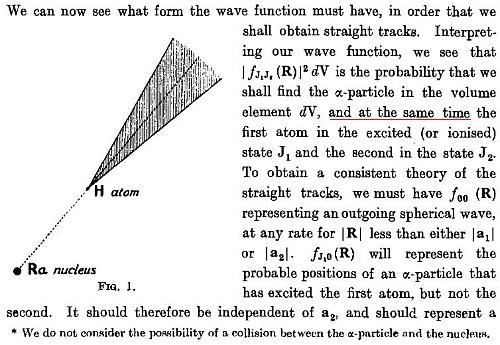
J. S. Bell, Speakable and Unspeakable in Quantum Mechanics, Cambridge University Press, 2004, pp. 93-94
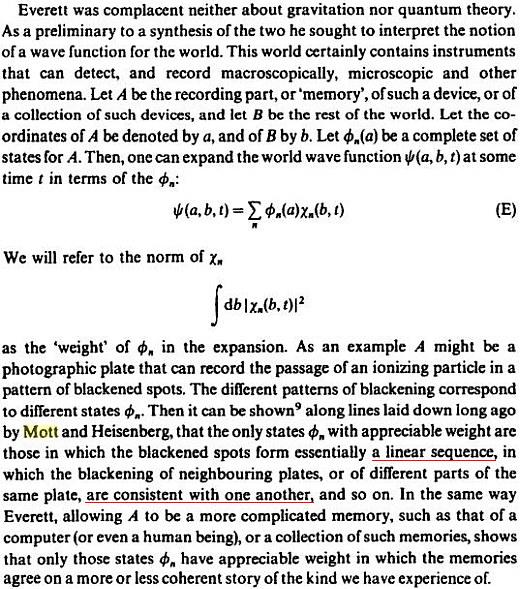
Sergio Doplicher, The Principle of Locality. Effectiveness, fate and challenges, arXiv:0911.5136v1 [math-ph], p. 21

======================================
Subject: Does the Superluminal Neutrino Uncover Torsion?
arXiv:1111.0286v1 [gr-qc], p. 4
Date: Wed, 2 Nov 2011 03:42:46 +0200
Message-ID:
<CAM7Ekx=iAQYWR752zXxueoscJtTP6VF+n+svDTXL2yEQKcifCg@mail.gmail.com>
From: Dimi Chakalov <[email protected]>
To: M B Altaie <[email protected]>
Cc: Asher Yahalom <[email protected]>,
Luca Fabbri <[email protected]>,
Friedrich W Hehl <[email protected]>
Dear Basil,
I like your Dakik al-Kalam paper. May I offer some thoughts for your consideration.
You wrote (p. 4):
"Now, if we have to take care of the chiral symmetry of the spacetime and look for the introduction of spinning matter we have to introduce torsion; for torsion is the object that is related in essence to chirality. (...) The fact that torsion is basically antisymmetric motivates one to foresee some connection with the rotational properties of the spacetime, and perhaps this what Cartan had in mind originally."
Check out the rotational properties of the spacetime (some profoundly dumb people called it 'the axis of evil') at
http://www.god-does-not-play-dice.net/#Copi
I don't know what Élie Cartan had in mind originally, but I would seek the true torsion in the time-orientability (asymmetry) of spacetime and its "driving force",
http://www.god-does-not-play-dice.net/#Waldyr
http://www.god-does-not-play-dice.net/#Heraclitus
As you stated in 'On Physics and Metaphysics', "This is how we may come in touch with the unknown, the most absolute and the most known unknown, Almighty God."
All the best,
Dimi
-----------
Note: One can hardly overestimate the importance of 'spin', but its geometrical origin, ensuing from the fine structure of spacetime points, is very unclear to me. Why does Mother Nature "rotate" its physical constituents, from the cosmic equator and galaxies to the color-able presentations of quantum particles? Regarding the latter, Wolfgang Pauli stressed in 1924 that we're dealing with "eigentümlichen, klassisch nicht beschreibbaren Art von Zweideutigkeit" (quoted after N. Straumann, physics/0010003v1, p. 7). Any direct comparison with anything we can imagine in Euclidean space may be very misleading. Suppose we take off our Euclidean spectacles and try to zoom on the fine structure of "points", by approaching 'the empty set R': what can we see? A quantum hedgehog, maybe?

I have allocated a special place for torsion in the wegtransformierbar global mode of spacetime: the topology of the elementary transition 'now', along the global time (tau) from the Arrow of Space, is some kind of superposition of 'both linear and cyclical', as we could imagine with our classical and distorted Euclidean eyes. In other words, matter does not produce torsion; it only experience its "dark" physical effects in the local mode of spacetime, cast from the atemporal loop (global mode) that is "located" ]between[ two neighboring points from the continuum of the local (physical) mode of spacetime. Look at the drawing below, from Bob Wald's textbook:

The event p is pre-correlated with 'everything else in the universe' (MQG), at the instant 'now' from the absolute time (tau) generated by the Arrow of Space.
This bootstrapping is an atemporal phenomenon which "takes place" exclusively in the wegtransformierbar global mode of spacetime: its physical duration, recordable by a physical clock, is zero, rendering the local (physical) mode of spacetime a perfect continuum. It does not exist in the local (physical) mode, hence all macroscopic effects from it will be "dark". (In Quantum Theory, this atemporal phenomenon also lives the potential future from the Arrow of Space, and shows up as the UNdecidable, uncolorizable, pre-quantum Kochen-Specker (KS) state (never in plural); cf. above). In plain words, what lives only in the potential future from the Arrow of Space cannot be directly observed in the local (physical) mode of spacetime. In the case of present-day GR, all physical effects from it will be untraceable, hence its source will look "dark", or 'emerging from spacetime geometry only', at best. Consequently, we are bewildered by some weird "non-baryonic CDM", which is just as wrong as imagining a physical axis of electron's spin. The gravitational effects known as 'dark matter' and 'dark energy' are not entirely produced by matter, just as the time-orientability of spacetime is not entirely produced by physical stuff; this 'not entirely' conundrum is a well-known faculty of the Aristotelian First Cause which cannot be nailed down with causal investigation. Its physical effects will inevitably look "dark" to those who are not familiar with the First Cause. In the current GR paradigm, these new effects will look like emerging from purely geometrical properties of spacetime. Corollary: in the presence of gravity, any
energy conservation law is unfeasible, as acknowledged by Sean Carroll. NB: Perhaps the quantum hedgehog above "rotates" simultaneously along all radial directions taken from any point in 3-D space (including a new symmetry operation, called 'space inversion', along these radial directions), facilitating a web of correlations ('pre-established harmony', Leibniz) of all color-able constituents of the physical universe. If we could take a 'sum-over-rotations' à la Feynman paths, perhaps a macroscopic rotation can be derived. Then we might understand the origin of angular momentum in GR, find out how purely geometrical effects of spacetime lead to rotation, spin, wegtransformierbar torsion and spinors, and learn to extract "dark" energy from the cosmic vacuum/quantum aether. Not surprisingly, Fred Hehl isn't interested, and neither is any of his colleagues. They take for granted that mass must be non-negative and spacetime must be time-orientable, then introduce differentiable structure and Lorentzian metric by hand, and finally notice that all this exercise is actually valid for 4 % from the stuff in the universe. On the positive side, they have no problems with publishing their essays and posting manuscripts at arxiv.org server.
D. Chakalov
November 2, 2011
Last updated: November 3, 2011
===================================
Subject: Re: "The torsional effects manifest themselves as spinorial self-interactions," arXiv:1201.5498v1 [gr-qc]
Date: Fri, 27 Jan 2012 17:42:29 +0200
From: Dimi Chakalov <[email protected]>
To: [email protected], [email protected]
Cc: [email protected], [email protected], [email protected]
Dear Luca,
Thanks for your prompt reply; hope you can make it to Prague.
Just to make sure we understand each other: as you wrote in arXiv:gr-qc/0608090v3,
"Given the metric tensor g, the most general connection (called the Levi-Civita connection) that can be defined is decomposable as ... [XXX] (Eq. 1) ... "
But if we try to *derive* the metric tensor from the most general case of spacetime (cf. the first link below), the most general connection won't be the so-called Levi-Civita connection, but a special affine connection called The Aristotelian Connection.
We have torsion and spinorial self-interactions, but no special preferences to Dirac field, because your statement that "if torsion is completely antisymmetric then the spin must be completely antisymmetric as well" doesn't hold for the coupling of torsion to matter in the most general case of spacetime (cf. the first link below).
All the best,
Dimi
On Fri, Jan 27, 2012 at 4:37 AM, Dimi Chakalov <[email protected]> wrote:
>
> Dear Luca,
>
> I'll talk about spinorial self-interactions and torsion, but from a
> different perspective:
>
> http://www.god-does-not-play-dice.net/#Beig
>
> http://www.god-does-not-play-dice.net/#Einstein_Prague
>
> Any chance to see you in Prague?
>
> All the best,
>
> Dimi
=========================================
Subject: http://www.amazon.com/Arrows-Time-Cosmology-Fundamental-
Theories/dp/3642232582, December 28, 2011
Date: Thu, 3 Nov 2011 17:08:10 +0200
From: Dimi Chakalov <[email protected]>
To: Laura Mersini-Houghton <[email protected]>,
Ruediger Vaas <[email protected]>
Laura and Rüdiger,
See what you missed at
http://www.god-does-not-play-dice.net/#Mott_Macavity
Perhaps you were thinking that should ignore the facts I've been communicating to you by email, because I'm not some 'academic scholar', right?
But you ignored the bold facts known since 1929, and much MUCH more.
I will review your collections of essays at my web site (soon on
DVD).
No need to reply, please.
Dimi
===================================
Subject: Re: "Robert P. Crease loves priority battles. Robert P. Kirshner does not."
Date: Sun, 9 Oct 2011 14:27:33 +0300
Message-ID:
<CAM7Ekxnac5jB7n2DG3o64gGCBez9v9-t44owu=vxHrpcAPVV-g@mail.gmail.com>
From: Dimi Chakalov <[email protected]>
To: Robert P Kirshner <[email protected]>,
Robert P Crease <[email protected]>,
Saul Perlmutter <[email protected]>,
Adam Riess <[email protected]>,
Mike Turner <[email protected]>,
Josh Frieman <[email protected]>,
Norbert Straumann <[email protected]>,
Sean Carroll <[email protected]>,
Lawrence M Krauss <[email protected]>,
Paul Davies <[email protected]>,
Laszlo Szabados <[email protected]>,
Luca Bombelli <[email protected]>,
Adam Helfer <[email protected]>,
Malcolm A H MacCallum <[email protected]>,
Chris Isham <[email protected]>,
Luca Bombelli <[email protected]>,
Luca Lusanna <[email protected]>,
Domenico Giulini <[email protected]>
P.S. RE my email from Fri, 8 Jan 2010 12:59:59 +0200, check out the 'tug-of-war manifestation of gravity' at
http://physicsworld.com/cws/article/news/47392#comment15133
Some Nobel Prize laureates missed the fact that "expansion" of space cannot be defined with respect to itself,
http://www.god-does-not-play-dice.net/#Heraclitus
Pity nobody cares.
D.C. ================================
Subject: Re: arXiv:1106.6053v1
Date: Wed, 9 Nov 2011 19:03:17 +0200
Message-ID:
<CAM7Ekxmt5WFTiY4GL_hghw9YXg7Dnvnym6RAiX3q39Lmbm-a4A@mail.gmail.com>
From: Dimi Chakalov <[email protected]>
To: YUAN K. HA <[email protected]>
Cc: Reiner Hedrich <[email protected]>,
Reiner Hedrich <[email protected]>,
Manfred Requardt <[email protected]>,
Anthony Zee <[email protected]>
Dear Yuan,
Thank you, once more, for informing me about your very interesting paper on quantum gravity.
Perhaps you've noticed that I proposed an Arrow of Space, because I believe the global time [tau] does not come from 'change in space' (coordinate "time"), but from 'change of space'. The Arrow of Space is also needed to accommodate the "dark" energy from the outset and recover the true dynamics of GR. As Reiner Hedrich wrote in arXiv:0908.0355v1 [gr-qc], p. 25:
"Some people think that such attempts at a construction of a theory of Quantum Gravity are not radical enough, that not only gravity and spacetime, but also the quantum could be an emergent phenomenon. [101] According to those people, the still unknown fundamental theory could quite perfectly be a non-quantum theory, describing a substrate from which gravity, spacetime and the quantum emerge."
The prerequisites come from the KS Theorem and Nevill Mott,
http://www.god-does-not-play-dice.net/#Mott_Macavity
Details from Heraclitus,
http://www.god-does-not-play-dice.net/#Heraclitus
All the best,
Dimi
On Wed, Nov 9, 2011 at 2:39 AM, YUAN K. HA <[email protected]> wrote:
[snip]
====================
The right hand side is a formal condensation of all things whose comprehension in the sense of a field theory is still problematic. Not for a moment did I doubt that this formulation was merely a makeshift in order to give the general principle of relativity a preliminary closed-form expression. For it was essentially no more than a theory of the
gravitational field, which was isolated somewhat artificially from a total field of as
yet unknown structure. A. Einstein
Albert Einstein, Philosopher-Scientist, ed. by Paul A. Schilpp, Open Court, 1998,
p. 75
------------------
Relativity and Gravitation
100 Years after Einstein in Prague
June 25 – 29, 2012, Prague, Czech Republic
http://ae100prg.mff.cuni.cz
Note: This is an informal and frank outline of my intended oral presentation (not poster) at the Conference in Prague above, entitled 'Arrow of Space'; the abstract below was submitted on Friday, 16 December 2011. The objective of my talk is to offer a candidate for "a total field of as yet unknown structure": a special form of reality (known since Plato), which could serve as the reference fluid of GR, identifying 'the points of space' and 'the instants of time' from the physical spacetime dynamically, with 'Arrow of Space'. The talk aims at quantum gravity, by suggesting a new (to the best of my knowledge) quantum spacetime unifying Quantum Theory and General Relativity from the outset.
As is well known, Einstein was very much hoping, until the last day of his life, to complete his General Relativity. I also very much hope to deliver my talk at the Einstein Conference in Prague -- after all, it's all about his unfinished theory of the gravitational field. I sincerely hope that the
Scientific Organizing Committee will allow me to address the audience at the
Einstein Conference in Prague, June 25 – 29, 2012. --------------
Arrow of Space
By D. Chakalov
Abstract
I will argue for the existence of (i) General Platonic Ideas (GPIs) in
the human brain, quantum theory (KS Theorem and Nevill Mott), and
general relativity ("colored" spacetime), and (ii) an Arrow of Space,
originating from GPIs, which drives the "colored" (after KS Theorem)
quantum-gravitational reality: Panta rei conditio sine qua non est.
The ideas presented in my talk offer an alternative to the "dynamics
of GR" (ADM) by suggesting a conceptual framework in which Quantum
Theory and General Relativity may be unified from the outset; details at
http://tinyurl.com/Einstein-Prague-details
--------------
The Arrow of Space requires a new quantisation of the gravitational field, preserving the continual nature of spacetime at all length scales by 'quantum spacetime' -- the "verdammten Quantenspringerei" (Erwin Schrödinger) are eliminated from the outset, after resolving the macro-objectification problem in Quantum Mechanics by smooth transitions between the quantum and classical words, based on General Platonic Ideas (GPIs). The idea is to model the universe as a brain, equipped with GPIs residing in the potential future of the Arrow of Space, in which the universe is self-determined/bootstrapped by the rule 'think globally, act locally' (Machian quantum gravity) of its quantum spacetime: Dead matter makes quantum jumps; the living-and-quantum matter is smarter.
What follows is a compilation of brief, frank, and incomplete notes on my intended talk (details on "GW astronomy" here). The hypothetical 'global mode of spacetime' is postulated to accommodate the so-called General Platonic Ideas (GPIs) -- "a total field of as yet unknown structure," A. Einstein. GPIs are inferred from Quantum Theory (KS Theorem and Mott) and General Relativity ("colored" spacetime), while the 'local mode of spacetime' is reserved for 'the realm of irreversible facts fixed in the past'. The Arrow of Space is introduced to explain the conversion of GPIs into 'facts' (local mode). Notice that GPIs in the human brain are not some mental phenomenon, because they act on the brain; yet they are not 'facts' (local mode) either. They exist as purely geometrical and non-Archimedean 'potential reality', and keep the genidentity (Genidentität, Kurt Lewin) of the physical ("colored") reality explicated in the local (physical) mode of spacetime -- the persistence and endurance of objects during the Arrow of Space, or their 'sameness', due to GPIs. They show up in GR only as 'absolute structures', hence are camouflaged as "gauge-dependent"; see above. Also, the Arrow of Space is an 'arrow', because the conversion of GPIs into 'facts' (local mode) is irreversible -- there is no link, no connection whatsoever from the local mode of irreversible facts to the global mode of 'potential reality' of GPIs. Any attempt at finding GPIs in the local mode will yield zero result or 'zero term', as in the example from Richard Feynman below. The question of how these two forms of reality, potential (GPIs) and physical, placed in the global and local modes of spacetime, may interact requires new metaphysics. Namely, they do not interact directly, but via their common source (the doctrine of trialism); see the story about the Eskimo observing an elephant's trunk above. Hence the two forms of reality, potential (GPIs) and physical, follow the rule Panta rei conditio sine qua non est, while their common source is just a Noumenon, or 'the true monad without windows', or maybe [John 1:1]. It could be at 'absolute rest', residing within the instant 'now' from the Arrow of Space. As Lao Tzu noticed, "If you realize that all things change, there is nothing you will try to hold on to." Yes we can: It is the whole universe as ONE, according to Finite Infinity. The latter may require a new fiber bundle structure, perhaps similar to the "vertical vector field as connecting vector" (R. Geroch).
Notice that the mathematical task hinted with the expression 'Panta rei conditio sine qua non est' is highly non-trivial: with the sole exception of 'the true monad without windows' (or the Aristotelian First Cause, or [John 1:1]), everything else is dynamical. Even the underlying topological manifold is being re-created along the Arrow of Space, at every instant 'now' from the global, explicit (but unmeasureable), nondynamical Heraclitean time (W.G. Unruh and R. M. Wald). The standard prerequisites that "all manifolds are assumed to be Hausdorff, second countable and C∞" (Lars Andersson) do not hold for a re-created manifold equipped with differentiable structure from Finite Infinity: the very continuum of the local (physical) mode of spacetime is being re-created at each and every instant 'now'. It is different to the proposal for Phoenix Universe by Abbé Georges Lemaître only by the stipulation that every re-created 'now' is a bona fide Phoenix Universe in its local mode of spacetime: all GPIs are eliminated and all negotiations are fully completed, in the sense that “there’s energy in the gravitational field, but it’s negative, so it exactly cancels the energy you think is being gained in the matter fields” (Sean Carroll). All the problems with "dark energy" stem from examining only the chain of such already created physical states (cf. the Photoshop layers below). If we try to imagine the Arrow of Space in the world of 'facts' (local mode), it would have to point simultaneously to all directions in 3-D space. The resulting, in the local mode of spacetime, "free fall" will be universal, the "force" of gravity will have to be "fictitious", and 'the fixed reference frame of distant stars' (Ernst Mach) won't be physically present in 3-D space. We cannot picture the "direction" of the Arrow of Space along some "4th spatial dimension" (Ned Wright), because the dimensions of physical bodies along such 4th spatial dimension match the infinitesimal -- see the empty set (R) used to derive Finite Infinity above. In the local (physical) mode of spacetime, it must be non-existent, just like the UNdecidable pre-quantum noncolorizable Kochen-Specker state. Once we relate geometry and matter with the symbol " = " in the Einstein field equation, we freeze their mutual negotiations (particularly evident in the "problem of time" of canonical quantum gravity), and cast just one "colored" (physicalized) instant 'now' from the Arrow of Space. In a way, geometry and matter "talk" to each other via GPIs. The latter are also dynamical, and not some rigid absolute "ether": at every instant 'now' from the Arrow of Space, they act on matter while being affected in turn by matter. Notice that such non-linear dynamics, depicted with the Escher's 'drawing hands' below, cannot be modeled with 1-D Euclidean space, the current geometrical model for 'time'. The instantaneous, in all (inertial and non-inertial) reference frames, bi-directional negotiations between the two sides of the Einstein field equation require two modes of spacetime: global mode for GPIs and local mode for the physicalized -- one-at-a-time -- geometry & matter. The immediate predictions from the postulated two modes of spacetime lead to dual cosmological time and modifications of G F R Ellis' Finite Infinity: the universe resembles an unbroken ring with no circumference, for the circumference is nowhere, and the "center" (cf. the quasi-local point x below) is everywhere. The Weyl Principle applies to all of these (uncountably infinite) "centers", and each of these "centers" can also serve as 'absolute reference frame' in which 3-D space would look like "expanding" with constant acceleration (Java applet here). As Francis Farley noticed (private communication), Einstein did not ask what was pushing such a frame of reference "outwards." My answer: the Arrow of Space. If we imagine the universe at its largest possible length scale of 'an unbroken ring with no circumference' (denoted by L above), it may be a bona fide isotropic universe in which "the metric is automatically flat and remains flat at all times" (F. Farley, arXiv:1005.5052, pp. 6-7). However, the space topology of such 'de facto infinite universe' may be undecidable, in the sense that it should be in some superposition of 'open & closed', while the topology of 'the global time [tau]' (cf. below) should be is some superposition of 'line and closed circle'. Headaches, yes. Well, I don't like the idea of 'curvature' and balloon metaphors, and prefer to speculate about what happens at just one quasi-local point x (cf. below), and then multiply it to uncountably infinite to reproduce 'space' as dynamically emerging phenomenon equipped with 'speed of light'. First and foremost, I need an explanation of the initial 'free fall', because the idea of 'curvature' simply doesn't make sense to me. As Richard Feynman noticed in Character Of Physical Law, 1967, p. 8: "The next question was - what makes planets go around the sun? At the time of Kepler some people answered this problem by saying that there were angels behind them beating their wings and pushing the planets around an orbit. As you will see, the answer is not very far from the truth. The only difference is that the angels sit in a different direction and their wings push inward." I expect lively discussions with my opponents in Švejk's favorite pub, but will be utterly polite (not frank, as in the outline here). If we subscribe, faute de mieux, to the idea of d'Alembert and Einstein that gravity is some "fictitious force", the Arrow of Space may provide inertia and "free fall" by driving the whole universe "upwards", with constant acceleration -- all physical objects, light beams included, would seem to "fall" under the influence of gravity exactly the same as any other object. Point is, trying to stop such "free fall" requires a real force in the "direction" of the Arrow of Space, which we can only describe as 'time' (see the full CPT-invariant phenomenon in the drawing below). This real force is proportional to the object's mass, "which would be equal to, and appear to be, its real weight" (C. Seligman). If the Arrow of Space drives the universe en bloc and with the constant acceleration of 'change of space', then the opposite, 'free fall' image from such "upward" acceleration will be the same for every physical object, be it a feather or a stone block. Well, if we manage to eliminate (reversibly) the initial 'free fall', perhaps we could cancel such zero free fall effortlessly, by zero real force (and build pyramids, say). The first off task is to "dissolve" (reversibly, of course) the initial "free fall" of a stone block (AVC) back to its GPIs (NASA called their project 'propellantness propulsion', which sounds much better than 'space polarization', only they couldn't make it either). Well, perhaps we could gather at Švejk's favorite pub (Special Agent Bretschneider included) to discuss the origin of inertial "forces" over a pint of beer or five...
Truncated URLs:
http://tinyurl.com/Einstein-Prague
http://tinyurl.com/Einstein-Prague-details
Some history. On 24 August 1920, Berlin’s Philharmonic Hall (which had a capacity of over 1600 people) hosted a rally organized by Paul Weyland and Ernst Gehrcke, at which Einstein was denounced as a fraud. Paul Weyland's talk was "Betrachtungen über Einsteins Relativitätstheorie und die Art ihrer Einführung", while Ernst Gehrcke elaborated on "Die Relativitätstheorie, eine wissenschaftliche Massensuggestion". One month later, Nobel Laureate Philipp Lenard was also involved in "denouncing" the theory of relativity. You may say, all this happened many years ago; people now are open-minded and prone to consider different viewpoints, right? Well, it depends. People invariably neglect any theory that may challenge their religious beliefs. If the theory gets published and gains influence, they won't keep quiet anymore, but will strike as harsh as they can. That's how religion works. What I mean is a very strong and sticky religion, known as 'anti-theism': if the universe does indeed function as a brain, the question of whether such brain may, or may not, have its 'mind' cannot be left to philosophers and theologians alone. It will be subject to rigorous quantum cosmology research, and nobody knows what the math could expose from 'the true monad without windows', say. I suspect many theoretical physicists would hate to get very close to [John 1:1]. For example, how would these people comment on Virgil's statement Mens agitat molem (The Aeneid, Ch. 6, 727)? In German: Der Geist bewegt die Materie. Does time-orientability emerge only and exclusively only from physical (colored) stuff, in such fashion that the Unmoved Mover [Ref. 1] would be redundant? For if matter alone were the necessary and sufficient cause for time-orientability, it would have to be endowed with the faculty of self-acting, much like Baron Munchausen who pulled himself, along with his horse, out of the swamp by his own hair. Many theoretical physicists would deeply hate to have their anti-theistic religion exposed. They love to picture themselves as 'objective scientists', while in fact they have only subscribed to different religions: they either deeply believe that God does not exist, or consider themselves "agnostics", which means they deeply believe there is nothing to believe in. And if you show them [John 1:1] and the Unmoved Mover [Ref. 1] with quantum gravity -- they will really hate you. Deeply indeed.
In October 2002, while preparing for a seminar at the Imperial College London scheduled on November 27th, I emailed Briton's leading expect in quantum gravity (my email from Thu, 24 Oct 2002 20:34:51 +0300) and asked him to explain what kind of "time" is implied with the proverbial phrase 'moving points around in Diff(M)-invariance'. His reply (Fri, 25 Oct 2002 16:46:34 +0100) was as follows: "As for time, wrist-watches and Diff(M), one of the key things that emerged from all the discussions on the problem of time was that although it is true that, because of the Diff(M) action, no physical meaning could be attached to a point on the space-time manifold, a physical meaning *can* be attached to specifying a space-time location by the values of various physical quantities. Karel Kuchar is probably the person who has done most work on this, but it is something that number of people have remarked on in recent years. For example, \phi is a scalar field on the manifold and $X$ represents the space-time coordinate of a particle, then although \phi(x) has no physical meaning (if x is a point in the space-time manifold) nevertheless $\phi(X)$ *does* have a meaning: ie you can talk in a Diff(M)-invariant way about the value of a field where a particle 'is', and similarly for a trajectory. And, after all, general relativity does seem to work well as a theory, and yet I can certainly read the time on my wrist watch!" Surely the notion of 'spacetime' is to be regarded as an adjective: just as we can't say "dark" without specifying what is "dark" and with respect to what, a bare spacetime manifold doesn't have any physical meaning; we need Type I matter fields to talk about "colored" spacetime, whereas any purely geometric, noncolorizable component of spacetime, such as 'pre-geometric plenum', the reference fluid of GR, and Anderson's absolute structures will be expelled from present-day GR [Ref. 1]: "The generator of change itself, the Hamiltonian, is a constraint only and thus has instantaneous character. This is why time is a mere label in the classical theory and disappears completely in the quantum theory" (Claus Kiefer). But notice the last sentence from the email above: it contains a typical non sequitur. Surely GR "does seem to work well as a theory", but only for those cases in which we can apply its linearized approximation, say, to adjust the GPS system. GR for sure cannot work for CDM & "dark" energy, firstly, and secondly -- the fact that he "can certainly read the time" on his wristwatch is a profound mystery: the alleged dynamics of GR is "entirely generated by constraints", and the dynamical data "do not explicitly include a time variable" [Ref. 1]. Why not? Because his wristwatch can only read a linearized, change-in-space "time" modeled with 1-D Euclidean space, which is nothing but the (local mode of) time pertaining to the "colored" spacetime. Any input from the purely geometric, noncolorizable (global mode of) spacetime must be perfectly well hidden by the 'speed of light', rendering the local mode a perfect continuum. Stated differently, for a system of gravity coupled to matter fields tµv must be zero, or else "the ether would come back!" (Merced Montesinos). Which brings us to the Equivalence Principle and the misguided search for 'the right answer to a wrong question' (MTW, p. 467): the "ether", with respect to which the global time [tau] from the Arrow of Space is defined, must be hidden in such a way that the energy-momentum inserted from it on the r.h.s of Einstein filed equation must remain a "dark" self-force. We must not be able to reach the Aristotelian First Cause, or else there can be no theory of relativity: "the ether would come back!" No 'energy conservation' can be elaborated within the linearized, change-in-space "time" (Sean Carroll), so the fact that Chris Isham can indeed read any time with his "wrist watch!" is a deep mystery -- nothing to do with those mundane cases of applying a linearized approximation of GR. We take for granted that "the metric is treated as a field which not only affects, but also is (at the same time - D.C.) affected by, the other fields" (John Baez), correct? The metric "has a double role: it is a field variable and defines the geometry at the same time" (Laszlo Szabados, private communication), right? The key phrase "at the same time" pertains to the instant 'now' from the Arrow of Space, at which the two modes of time, global and local, coincide. The resulting dynamics of GR resembles a school of fish: in the atemporal global mode of spacetime gravity 'knows about everything' and acts on the local (colored) mode of spacetime by the rule 'think globally, act locally', which makes the physical (colorized) interactions quasi-local. Hence any observable of the gravitational field is "necessarily quasi-local" (Laszlo Szabados). There is no need to be a virgin to grasp the eternally present global time [tau] [Ref. 1] from the Arrow of Space; the brain uses it effortlessly. More importantly, if the universe -- the only truly isolated system -- is wrapped by its own non-Archimedean 'global mode of spacetime', one could seek a modification of G F R Ellis' Finite Infinity to resolve the problem of "passing to an appropriate asymptotic regime such that all gravitational effects are localized inside of it" (Adam Helfer); from mathematical viewpoint, the current asymptotic spacelike regime is pure poetry, just like the statement by Bernard Schutz that "null infinity is very far away." Only Chuck Norris has reached it (twice). The Arrow of Space is suggested to explain the quasi-local (colored) observables resulting from 'already completed', at each and every instant you look at your wristwatch, negotiations between the two sides of Einstein filed equation. The end result is a perfect continuum of quasi-local "points" x (see the animated picture below) at which the wegtransformierbar gravity must indeed be vanishing (present continuous; see the empty set (R) above). Notice also that the duration of the negotiations between the two sides of Einstein filed equation in the atemporal global mode of spacetime (the blue square) is zero, as recorded with Chris Isham's "wrist watch!": it can only read a linearized (polynomial) "time".
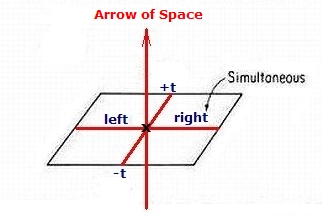
The global mode of spacetime in Flatland (adaptation from Bob Wald's textbook): the point x from the animation above is the only point from the local (colored) mode of spacetime, which coincides with the global mode. In 3-D space, the point x will inherit three symmetries from the global mode, known as CPT-invariance (charge symmetry cannot be shown in Flatland; it requires 3-D space). The atemporal correlations are simultaneous, and their "duration" is zero in the local mode. Notice that the point x is also the global instant 'now' from the Arrow of Space, but we can physically (local mode of spacetime) observe only a composition of 'flashes' made by 'the speed of light' (see below). In GR textbooks, these 'flashes' are fused (flattened) like Photoshop layers, hence we end up with a timeless "trajectory" immersed in a dead frozen 4-D "block universe", in which time can evolve just as much as space can: "There is no dynamics within space-time itself: nothing ever moves therein; nothing happens; nothing changes" (Robert Geroch). Yet GR textbooks shouldn't be blamed, because they cannot, and should not reveal the Unmoved Mover, or else there can be no theory of relativity. Which is why we need quantum gravity to explain the empirical fact that Chris Isham can indeed read the global time [tau] & the local, coordinate time with his "wrist watch!"
Well, Chris Isham wasn't interested in the implications from the requirement for general covariance, which "takes away from space and time the last remnant of physical objectivity". Albert Einstein was, very much indeed, and was struggling to avoid it (cf. John Norton, pp. 802-804). To solace Einstein, it isn't about 'physical objectivity' and 'physical reality out there': yes, there is an underlying reality in spacetime, but it is an UNdecidable, pre-quantum, potential reality. Hence the unsettled issue with the "ripples" of the metric field: yes, GWs do exist, but we cannot detect them with devices that have access only to a linearized, change-in-space "time". At any instant x from 'the time read by our wristwatch' we observe an already completed, already linearized end-result from the negotiations between the two sides of Einstein field equation.
At this single instant, x , the global time [tau] and the local, change-in-space "time" coincide, which is why we cannot detect with experiments any difference between gravitational and inertial mass: no difference can manifest itself "over" a single instant. And if we try to recover the true dynamics of GR solely from this single instant, we face the insoluble Cauchy problem. Briefly, once you impose the mystery of 'time-orientability' by hand, along with the unwarranted assumption that "the spacetime and the metric are C∞" (R. Bartnik and J. Isenberg, p. 3), you cannot recover the true dynamics of GR with the physical stuff that you drop on this 'smooth spacetime' afterwards, and will be haunted by the problems of C∞ forever -- check out Ioannis Raptis; details here. Or take another renowned expert in quantum gravity, Lee Smolin. On July 22, 2010, he delivered a talk to a group of (very polite) kids, explaining his views on the so-called loop quantum gravity (LQG):

ISSYP 2010 - Keynote (Smolin)
Date: 22/07/2010 - 10:30 am
Length: 1 Hour 24 Minutes 34 Seconds
Title: Lee Smolin on Quantum Gravity
http://pirsa.org/10070034/
Lee Smolin, 01:23:28 - 01:23:56: "If there is a fundamental discreteness in Nature, how could all the universe with all its complexity (...) follows laws from something down to the fundamental scale? That's a great question. Do you think I know the answer?" But is Lee Smolin genuinely interested in finding the answer? Because the answer is not in "loop quantum gravity". That we know for sure, firstly because Lee Smolin and most of his colleagues practice GR as bartenders. The fine structure of the infinitesimal -- the empty set (R) -- is not covered in Smolin's diff geometry textbooks. The correct interpretation of the KS Theorem is not presented in his QM textbooks either. Like a drunken man who has lost his keys in the dark, Lee Smolin is trying to find them under the street lamp, just because it is brighter there. In his last email from Sun, 24 Feb 2002 17:30:25 +0000 (BST), he wrote: "don't refer me to web pages." Eight years and five months later, he could only offer a rhetoric counter-question to his audience. The kids were very polite indeed, and perhaps didn't notice that what Lee Smolin did to them was not fair. It was not fair to tell kids only a selective portion from what he knows about quantum gravity, to promote his obsession with "loop quantum gravity" -- it is impossible in principle to recover the continuum of spacetime from those "loops", and "look around, and see as far as we like." You can't achieve this 'test of the pudding' even with classical GR: "If the theory does not allow us, even in principle, to extend solutions arbitrarily far in one direction, it may be difficult to view this direction as a dimension of the world", says another proponent of LQG, Martin Bojowald, in arXiv:0807.4874v1, p. 12. Properly speaking, "GR does not admit a description as a system evolving in terms of an observable time variable" (Carlo Rovelli, gr-qc/0604045v2, p. 4). No need to read "web pages", Lee. Just read your book. It is impossible to recover the continuum of spacetime from your QM textbooks in the first place. Besides, the alleged "fundamental discreteness" at Planck scale is an illusion, because there is no "discreteness" in the non-Archimedean realm of 'pure geometry'.
Check out 'the quantum principle' and the Gedankenexperiment with four dice: there is no "discreteness" in the quantum world out there. The quantum of action is an artifact from the linearized (polynomial) "time" of the measuring devices. If Nature were employing only such 1-D linearized time, the trajectory of a fish, negotiated with the school of fish in the global mode (cf. the Escher drawing above), would not be quasi-local but non-local; and it won't be continual but "quantized". To be precise, the quantized energy levels, proposed by Neils Bohr (electrons can be observed only in particular energy levels), are the stable configurations of 'the school of fish' -- every 'fish' selects one of these stable configurations to become its 'next state' along the Arrow of Space, and the transition is perfectly continual; more on November 25, 2015.
It is very difficult to describe properly the quasi-local kernel of spacetime -- the point x above -- with the 'time read by your wristwatch', because it will look sequential, as in the animated picture above. It will be certainly impossible to explain it with a poster. No way. Back in July 2004, I was hoping to talk on these issues at GR17 (Workshop D1, Quantum General Relativity, chaired by T. Thiemann), but Thomas Thiemann, who was at that time with Lee Smolin at the Perimeter Institute, didn't allow me to talk. He downgraded my oral presentation to 'poster', then buried it in an evening poster session, and granted Lee Smolin three talks: on Monday, July 19th ("Background independent approach to M theory", D2), on Tuesday, July 20th ("The low energy behavior of loop quantum gravity", D1), and finally on Friday, July 23rd ("Inflation in loop quantum gravity", B2i). I can only hope that Thomas Thiemann, Lee Smolin, and the like will not be in the Scientific Committee at the Einstein Conference in Prague next June. Will see. I will file my abstract next month and apply for oral presentation (not poster), hoping to recover "the last remnant of physical objectivity" in spacetime (Albert Einstein, Grundlage der allgemeinen Relativitätstheorie, Annalen der Physik 49 (1916) 769-822) with the Arrow of Space. Will compete with all participants, both individually and en bloc. It will be great fun, as Karel Kuchar [Ref. 1] has already provided the ammunition: GR textbooks can only offer a linearized snapshot at one instant of time along the global time [tau], while the bi-directional "talk" between the two sides of Einstein field equation (cf. the 'pure geometry' smile of the Cheshire cat above) requires an Arrow of Space: Panta rei conditio sine qua non est. Sorry, quantum gravity cannot be explained with a poster.
D. Chakalov
November 10, 2011
Last updated: December 30, 2011, 22:56:40 GMT
Truncated URL:
http://tinyurl.com/Einstein-Prague
[Ref. 1] Karel V. Kuchar, Time and interpretations of quantum gravity, in: Proceedings of Fourth Canadian Conference on General Relativity and Relativistic Astrophysics, May 16-18, 1991 (World Scientific, Singapore), 1992, pp. 211-314.
"These are the laws of an instant in canonical gravity. (...) (T)he super-Hamiltonian constraint (1.2), (1.4) has no counterpart in electrodynamics. It is this constraint that ultimately yields the dynamics of geometry.
"Any reference to the hypersurface E --> M which carries the geometrical data gab(x), pab(x) is conspicuously absent in the constraints (1.1) - (1.4). The hypersurface E --> M represents an instant of time; the fact that it drops out of the constraints (1.1) - (1.4) underlines the problem of time in quantum gravity.
...
"In general relativity, dynamics is entirely generated by constraints. The dynamical data do not explicitly include a time variable."
-----------
Idem, Canonical quantum gravity, gr-qc/9304012v1, 8 April 1993. "The third alternative is to say that because perennials are constants of motion, it does not matter when they are observed. (...) This does not make me too happy either. If all time [tau] is eternally present, all time is irredeemable."
...
"Perennials in canonical gravity may have the same ontological status as unicorns -- a priori , these are possible animals, but a posteriori, they are not roaming on the Earth. According to bestiaries, the unicorn is a beast of fabulous swiftness, strength, and beauty, but, alas, it can be captured only by a virgin [38]. Corrupt as we are, we better stop hunting mythical beasts."
----------- Idem, The Problem of Time In Quantum Geometrodynamics, in The Arguments of Time, ed. by Jeremy Butterfield, Oxford University Press, Oxford, 1999, p. 193. 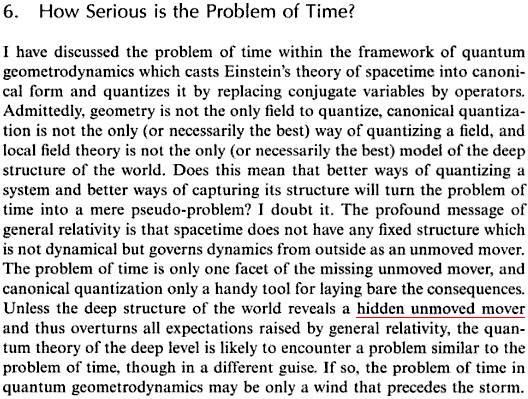
=====================================
Subject: Re: The dead-end of Ashtekar's quantization program
Date: Thu, 10 Nov 2011 22:53:02 +0200
From: Dimi Chakalov <[email protected]>
To: Karel Kuchar <[email protected]>
Cc: Abhay Ashtekar <[email protected]>
Dear Professor Kuchar,
I quoted from one of your fundamental articles at
http://www.god-does-not-play-dice.net/#Yuan_QG
Hope to see you and Prof. Ashtekar in Prague next June.
Sincerely,
Dimi Chakalov
On Mon, 27 Jan 2003 15:13:51 -0700 (MST), Karel Kuchar <[email protected]> wrote:
[snip]
-------- Note: The only reply from Abby Ashtekar was an automated email from Thu, 10 Nov 2011 15:53:05 -0500 (EST), "away from my mail". Which means that he has received my email above, but decided to keep quiet. Look at the drawing below: What do you see?
According to the artist, these are "polymer excitations in the bulk puncture the horizon, endowing it with quantized area", but to me it looks just like cheesecake, only slightly overcooked (hence the cracks). My wife managed to produce it last year, without any advanced math. And it was delicious. D. Chakalov
November 30, 2011
======================================
Subject: Re:
arXiv:1205.2019v1 [gr-qc]
Date: Thu, 17 May 2012 03:28:35 +0300
Message-ID:
<CAM7EkxkCMHEmiSapciT6YdNQggjzMeHBZ5Vd2rDydtsPXHr3aA@mail.gmail.com>
From: Dimi Chakalov <[email protected]>
To: Alejandro Perez <[email protected]>
Cc: Karel V Kuchar <[email protected]>,
Claus Kiefer <[email protected]>,
Carlo <[email protected]>,
José Antonio Zapata <[email protected]>,
Johannes Tambornino <[email protected]>,
Lee Smolin <[email protected]>,
Erik Curiel <[email protected]>,
Martin Bojowald <[email protected]>,
Abhay Ashtekar <[email protected]>,
Hermann Nicolai <[email protected]>,
Chris Isham <[email protected]>
Hi Alejandro,
> Yes, I would like to know.
I provided link to p. 4 from your article at my
web site, and wish to thank you for your discussion of the pitfalls from
"treating the gravitational field according to the splitting given in
Equation (1)." I'm afraid you haven't escaped from these problems, and
never will,
because you can't.
Since your theory is "based on the Hamiltonian (or canonical)
quantization of general relativity", it inherits all the problems from
the initial splitting of spacetime, "thereby doing grave injustice to
space-time covariance that underlies general relativity" (A. Ashtekar,
arXiv:gr-qc/0410054v2,
p. 32).
These generic problems, and the limitations they impose on your theory,
haven't been made clear in your article. Do you read Karel Kuchar ?
You wrote: "The background independence of general relativity implies
(Sic! - D.) that the canonical formulation of the field theory is that
of a gauge theory with diffeomorphism as part of the gauge group. LQG is
constructed by quantizing a phase space formulation of general
relativity in terms of SU(2) connection variables."
But the background independence in the Hamiltonian formulation of GR is
a *big* can of worms: check out Baron Münchhausen at
http://www.god-does-not-play-dice.net/#Claus
Unless you resolve the dynamics of GR, I don't think you could claim
that you understand the seemingly innocent word "implies".
First things first, right?
I believe the spin foam approach to the quantization of gravity is dead
wrong from the outset, firstly because it cannot -- not even in
principle -- recover the smooth continuum at the length scale of tables
and chairs, such that we could "look around, and see as far as
we can" (L. Smolin, Three Roads to Quantum Gravity, p. 205).
One part of the continuum problem stems from the current formulation of
GR: "If the theory does not allow us, even in principle, to extend
solutions arbitrarily far in one direction, it may be difficult to view
this direction as a dimension of the world", says M. Bojowald in
'Relativity and the Dimensionality of the World' (ed. by Vesselin Petkov,
Springer, 2007, Ch. 8, p. 149).
So, with the current formulation of GR, you cannot recover what we call
'dimension of space'. Surely "the Hamiltonian analysis of general
relativity is the basic starting point for canonical quantization", but
why "formulating Hamiltonian general relativity in terms of
Yang–Mills-like connection variables", given the severe shortcomings of
the initial Hamiltonian GR?
You also admit that "the very notion of space-time geometry is most
likely not defined in the deep quantum regime", yet insist on "quantum
theory that reproduces gravity in the semi-classical limit", and also
deeply believe that a "spacetime picture would only arise in the
semi-classical regime with the identification of some subsystems that
approximate the notion of test observers."
I'm afraid that "semi-classical regime" is totally confusing statement,
because the crux of the task is to find the phenomenon which can erect
Lorentzian metric from the so-called spacetime foam "in the deep quantum
regime".
That's the first off task of any quantum gravity program. Yours is set
on a dead-end from the outset, with "the kinematical Hilbert space of
LQG", because you haven't solved the initial problems from Quantum
Theory,
http://www.god-does-not-play-dice.net/#Singh
... in such a way that we could "look around, and see as far as we can"
(L. Smolin).
First things first, right?
I fully agree that if we want to get a quantum theory that reproduces
gravity in the continuum classical limit "we should have a background
independent formalism", but why you didn't quote Karel Kuchar regarding
what 'background independent formalism' actually means ?
Would you like some references for your updated arXiv:1205.2019 v2
[gr-qc] ? Just wait for his forthcoming talk 'Canonical
quantum gravity: Einstein's posthumous anathema'. You gonna love it
:-)
Meanwhile, if you or your colleagues have questions, please don't
hesitate. I will be happy to help, in my capacity of "just another
crank" (Chris Isham).
Dimi
> On Wed, May 16, 2012 at 4:12 PM, Dimi Chakalov <[email protected]>
wrote:
>>
>> Hi Alejandro,
>>
>> Do you wish to learn why the spin foam approach to the quantization
of
>> gravity is dead wrong ?
>>
>> Carlo doesn't care, but I guess you might be curious.
>>
>> Dimi
>
======================================
Subject:
arXiv:1210.6977v1 [quant-ph]
Date: Mon, 29 Oct 2012 16:22:27 +0200
From: Dimi Chakalov <[email protected]>
To: Peter G Morrison <[email protected]>,
Pete Morrison <[email protected]>
Cc: Francesco Ticozzi <[email protected]>,
Claudio Altafini <[email protected]>,
Maciej Blaszak <[email protected]>,
Ziemowit Domanski <[email protected]>,
Michel <[email protected]>
Dear Dr. Morrison,
May I ask two questions.
Given the hypothesis that "the state vector travels along a path of
least time on the complex projective manifold," you tried to construct
some "time-optimal Hamiltonian matrix which moves us from state-to-state
on the projective manifold, in least time", but the "expressions for
field densities for matrices of infinite dimension, which represent the
continuous degrees of freedom", are still out of site.
I wonder if you can use the geometrical formulation of QM (Abhay
Ashtekar and Troy A. Schilling,
arXiv:gr-qc/9706069v1).
In general, please let me know if you can solve an old task from 1929,
http://www.god-does-not-play-dice.net/#Renner
The opinion of your colleagues will be greatly appreciated, too.
Kind regards,
Dimi Chakalov
--
http://tinyurl.com/dollar-ratio
http://tinyurl.com/steel-evaporation
Note: Don't mix
apples with oranges. The Hilbert space does not describe the
quantum world, but only some biased projection at the length
scale of tables and chairs, calculated with the incomprehensible Born
Rule based on the squared module of quantum wave "amplitude". The
Hilbert space is for us, not for the quantum world, which is why
QM cannot be used as fundamental theory -- just 'shut up and calculate'
(D.N. Mermin).
If you try to avoid the Hilbert space, Born Rule, and the "parameter"
t in the Schrödinger equation [Ref.
1], you
will hit the so-called “non-viable” quasi-probabilities (J.M.Yearsley
and J.J.Halliwell,
arXiv:1210.6870v1 [quant-ph]), which nobody knows what the heck they
are referring to.
Point is, we don't have 'projective
measurements' with the Kochen-Specker Theorem,
which is a clear evidence against the Hilbert
space. The Hilbert space is about what you may or may not observe
at macroscopic level, but not about the
quantum world.
Recall again
Erwin Schrödinger:
"The rejection of realism has logical
consequences. In general, a variable has no definite value
before I measure it; then measuring it does not mean
ascertaining the value that it has. But then what
does it mean?"
It means that both "before" and "after" the measurement
the quantum system has always been, and will always remain in its
UNdecidable pre-quantum Kochen-Specker
state. It is the genuine ontic quantum state, which nobody can fit in any Hilbert space whatsoever. If we use
inanimate measuring devices (not the human brain),
we can only observe its classical "shadows" (Sir
Nevill Mott).
Now you can explain the
task from 1929 below. Or keep dead quiet and
ignore the basic basics of Quantum Theory, until you fully and
irreversibly retire. The choice is yours.
D. Chakalov
October 29, 2012
Last updated: November 7, 2012
[Ref. 1] Tejinder P. Singh, The problem of time and
the problem of quantum measurement,
arXiv:1210.8110v1 [quant-ph]
"Dynamical evolution in quantum theory is described by the Schrödinger
equation. The time parameter which is used for describing this evolution
is part (Sic! - D.C.) of a classical spacetime (wrong - D.C.)."
Comment: In the classical spacetime of Special
Relativity, the parameter t corresponds to 'objective
classical reality out there', which is why we know that the Moon
is 'out there' even if we can't see it. However, the variable
t in the Schrödinger
equation is not a "parameter", because we cannot even think about an
elementary particle as 'reality out there' resembling the Moon; see
Erwin Schrödinger
above. This variable isn't some absolute Newtonian time either, contrary
to statements in modern QM textbooks (e.g., Chris
Isham). It may become "part (Sic! - D.C.) of a classical
spacetime" for one instant only, and only under the requirements
from the Kochen-Specker Theorem. Forget about Hilbert space.
D.C.
October 31, 2013
=================================
Subject: Re: arXiv:1210.6977v1 [quant-ph]
Date: Tue, 30 Oct 2012 03:01:59 +0200
From: Dimi Chakalov <[email protected]>
To: Pёtr <[email protected]>
On Tue, 30 Oct 2012 11:31:30 +1100,
Message-ID:
<CAPZZGkVfOGEpFjb9LGv4LtCh5DVg5vUxnjBDvr2ZkNCJBPho4Q@mail.gmail.com> ,
Pete Morrison <[email protected]> wrote:
[snip]
>> Now you can explain the task from 1929 below. Or keep dead quiet and
ignore
>> the basic basics of Quantum Theory, until you fully and irreversibly
retire.
>> The choice is yours."
>
> BLAH BLAH BLAH BLAH BLAH AD INFINITUM
Пётр dorogoi,
I'm afraid you are Russian.
> I don't care about the measurement problem, only about the free
evolution.
Yes, you are very much Russian. And since you "don't care about the
measurement problem," I will let you contemplate on your dreams, until
you fully and irreversibly retire.
> Seems like your website is a load of crap, based on your perceived
need to
> explain things with far too many words and not enough equations.
If you can't suggest any argument in favor of your ideas, all you can do
is spit insults. Usually people keep dead quiet, but not Russians like
you. So typical.
Forget it.
D.C.
==========================================
Subject: М. Г. Иванов, 'Как понимать квантовую механику', 2012, c. 30
Date: Sun, 30 Dec 2012 15:06:07 +0200
From: Dimi Chakalov <[email protected]>
To: Mike Ivanov <[email protected]>
Cc: Lev Okun <[email protected]>,
Iegor Reznikoff <[email protected]>,
Serge Krasnikov <[email protected]>,
Dmitry Slavnov <[email protected]>,
Andrei NB <[email protected]>,
[email protected],
[email protected],
[email protected],
[email protected],
[email protected]
"Уравнение Шрëдингера не содержит ничего вероятностного. Оно полностью
описывает, как меняется со временем волновая функция..."
------------
Dear Dr. Ivanov,
I'm afraid there is too much Russian poetry in your quote above.
Check out an explanatory note (December 30, 2012, 11:39:19 GMT) at
http://www.god-does-not-play-dice.net/#cloud
Please reply in English.
Sincerely,
Dimi Chakalov
-------------
Note: The quote above reads:
"Schrödinger's equation contains nothing probabilistic. It fully
describes how the wave function changes over time..."
But what kind of 'time'
is implied here? If it were from classical mechanics, the "wave
function" would be 'objective reality out there', just like in
the example with the Sun.
Check out
Erwin Schrödinger and read the note at the link
above.
D. Chakalov
December 30, 2012
=========================================
Subject: Re: “A spoken thought is a lie”
Date: Tue, 1 Jan 2013 20:03:58 +0200
From: Dimi Chakalov <[email protected]>
To: Lev Okun <[email protected]>, Lev Borisovich Okun <[email protected]>
Cc: Mike Ivanov <[email protected]>,
Serge Krasnikov <[email protected]>,
Dmitry Slavnov <[email protected]>,
Andrei NB <[email protected]>,
[email protected],
[email protected],
[email protected],
[email protected],
[email protected]
Dear Dr. Okun',
Thank you for your feedback. I know some of your articles and 'Particle
Physics Prospects' since 1980s. You were teaching at the Moscow
Institute of Physics and Technology (Fiztech) since 1962, and are
personally responsible for implanting many wrong ideas in
theoretical physics, both in USSR
and in the normal world.
Please reply to my email from Wed, 27 Oct 2010 07:04:57 +0300, “A spoken
thought is a lie”.
> I would be grateful for receiving your
> response to my interpretation of
> QM in the attached copy of my little book
> "ABC
OF PHYSICS".
Thank you for your essay. May I offer you six brief comments:
------------
1. p. iii: "the
exchange of gravitons -- massless particles with
spin 2h -- explains gravitation."
1.1. Nope. You can't. Nobody can. Forget it.
2. p. iv: "the correctness of descriptions of gravitation as
exchange of
gravitons has been confirmed by experiments at all
attainable energies."
2.1. See (1.1) above.
3. p. iv: "The amplitude modulus squared gives the probability of
transition (...) as a function of time for an ensemble of identical
states."
3.1. Please see what you've missed from Schrödinger and Margenau,
http://www.god-does-not-play-dice.net/#cloud
http://www.god-does-not-play-dice.net/#Ivanov
4. p. 3: "Motion is the displacement of a particle in space", and
Sec. 15.5 'Dark energy'.
4.1. Please see another interpretation of 'motion' in the
so-called Arrow of Space, which produces "dark"
energy,
http://www.god-does-not-play-dice.net/#Dennis_Sciama
5. p. 71: "A theory describing the physics at the
Planck scale
has not yet been developed."
5.1. Sure. See (1.1) above, and (4.1).
6. Sec. 27.4 'LHC and prospects'.
6.1. As John von Neumann put it, "There's no sense in being
precise when you don't even know what you're talking about."
http://www.god-does-not-play-dice.net/#Kibble
-------------
The proof of (1.1) is at the links above. It's not a matter of
opinion, and I'm not its author either.
I will be happy to elaborate, once I receive your reply to my email from
Wed, 27 Oct 2010 07:04:57 +0300.
Wishing you and your Russian colleagues a Happy New Year,
Dimi Chakalov
-------------
Note: Back in
1950,
Isaak Yakovlevich Pomeranchuk has told Lev Borisovich Okun' that the
vacuum “is filled with the most profound physical content.”
Sure, but this 'most
profound content' is not “physical”, as explained
below. It has been the most profound secret of
Nature ever since
Walther Nernst introduced the notion of “zero point energy” in
1916. That's correct, one year prior to the establishment of USSR.
Lev Okun' (b. 7 July 1929
in Suchinitschi, USSR) is definitely
good in math, but in his latest essay "ABC
of Physics"
he didn't even try to explain the misleading trends in the definition of
'mass', which stem from the simple fact that "the total energy" might
look "conserved" only in Newtonian mechanics (idem, arXiv:hep-ph/0602037v1,
p. 3).
You cannot separate mass from its energy (and vice versa),
and therefore the first off task is to explain the notion of 'time'
during which the total mass-energy of the universe, bootstrapped by its
gravitation, could be "conserved".
Otherwise you can't talk about time, energy, and mass. Which brings us
to 'the most profound secret of Nature' from 1916.
May I recall the three
forms of 'mass' from
Yakov Terletskii, the “mirror world” paper
(1965) mentioned by Lev Okun' et al. (Spacetime and vacuum as
seen from Moscow, arXiv:hep-ph/0112031v1,
p. 3),
and the current state of affairs 'as seen from Moscow' (arXiv:physics/0111134v1,
Sec. 61,
p. 5):

Welcome aboard, Lev
Borisovich (бурные
продолжительные апплодисменты).
The
"god particle" and the "graviton"
are involved in gravitation, along with the "massive
vacuum", plus everything else (see above), but only the
"graviton" performs non-linear self-interaction
of matter plus the self-interaction of "gravitons" with themselves. If
you can "explain" this miracle with impeccable
math, you're Russian.
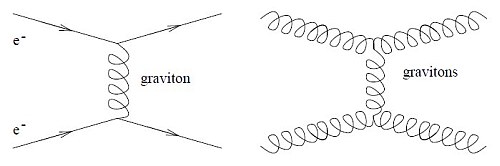
Here's another quote from Lev Okun (The theory of relativity and the
Pythagorean theorem, Physics - Uspekhi 51(6) 601-636 (June 2008),
p. 627; emphasis added):


Energy without
particles? Matter does not disappear in decay
and annihilation reactions leaving behind only energy like the
Cheshire cat would leave behind only its
smile. In all these
processes the carriers of energy are particles of matter. Energy
without matter ('pure energy') has never been observed in any
process studied so far.
True, this is not so for so-called dark energy, which was
discovered in the last years of the XXth century. Dark energy
manifests itself in the accelerating expansion of the Universe.
(The evidence for this accelerating expansion is found in
recession velocities of remote supernovas.) Three-fourths of
the entire energy in the Universe is dark energy and its carrier
appears to be the vacuum. The remaining quarter is carried by
ordinary matter (5%) and dark matter (20%). Dark energy
does
not affect processes with ordinary matter observed in
laboratories. In a laboratory experiment energy is
always
carried by particles.
But can we directly
observe pure dark energy ? No, we
can't. To paraphrase
Fyodor Tyutchev, a spoken (explicated) thought is a
"colored" thought. We can only detect a
physical particle -- not its unphysical UNspeakable
pre-quantum Kochen-Specker source.
Which is why nobody can
detect the pure
dark energy of some "god
particle". We can only detect particles which had already been
affected by their common UNphysical source -- not the pure
dark source itself. These detectable
particles will look "self-acting", like Baron Munchausen,
but again, CERN cannot in principle
detect their pure dark source.
Besides, we always place
the cat smile in the left-hand size of Einstein's equations: it
is pure geometry and cannot be directly detected either.
Back in January 1987,
I had a huge discussion at BG Academy of Sciences in Sofia with a
prominent theoretical physicist from Dubna (USSR),
which was mentioned here. Shortly after that, in
March of 1987, I wind up on the street, because it turned out that the
BG Academy of Sciences doesn't have money for my salary, after I
confronted the view of spacetime
and vacuum 'as seen from Moscow'. I had to immediately take the first
available job, which was in a printing house, and soon I was
cutting stacks of paper with industrial paper cutters. It was
unforgettable experience (there's nothing heavier than paper!), and I
vowed to never offer arguments to Russians.
Now we live in different
times, but I won't say more either, because I do not offer math to
people who don't care about Quantum Theory and
General Relativity (Matthew
7:6).
D. Chakalov
January 1, 2013
Last updated: January 4, 2013, 01:53 GMT
======================================
Subject:
arXiv:1209.1836v1 [quant-ph]
Date: Tue, 18 Sep 2012 02:45:21 +0300
From: Dimi Chakalov <[email protected]>
To: Adan Cabello <[email protected]>
Cc: Robert W Spekkens <[email protected]>,
Michael Seevinck <[email protected]>
Adan, your
latest paper is a Russian joke.
The conflict between classical and quantum physics can be identified
through a series of color-able ("yes-no") tests on quantum systems:
assigning the full set of possible color-able results is impossible for
*any* quantum state for Hilbert space dim 3 and more.
Thus, the UNcolor-able KS state always show up for Hilbert space dim 3
and more, but you can't fit it into any Hilbert space: it's not there.
You cannot prove anything. None. Zilch.
More at
http://www.god-does-not-play-dice.net/#Renner
Dimi Chakalov
---------------------------

Adán Cabello, arXiv:1112.5149v1 [quant-ph]
In the example above, there are 4 sayings pertinent to 2 Platonic ideas. Notice that no set of such "measurements" can reveal the full spectrum of all potential explications of these
two Platonic ideas. Likewise, the UNdecidable pre-quantum Kochen-Specker (KS) state does not correspond to any 'physical reality' about which we can expect 'yes-no' answers to our questions/measurements. It will offer only one answer: YAIN
(forget about topos).
In Quantum Theory, the UNdecidable pre-quantum KS state is 'one entity'. It pertains simultaneously to all possible measurements on a quantum particle, therefore if we try to "decompose" it in the case of one specific non-commuting observable, it will leave 'blank spots' and will be shifted into the "uncolored KS sphere" (Helena Granström, p. 2). This is a fundamental phenomenon, which has nothing to do with Bell's theorem. To quote from Erwin Schrödinger (November 1950): “It seems to me that the concept of probability is terribly mishandled these days. Probability surely has as its substance a statement as to whether something is or is not the case — an uncertain statement, to be sure. But nevertheless it has meaning only if one is indeed convinced that the something in question quite definitely is or is not the case. A probabilistic assertion presupposes the full reality of its subject.”
In the quantum realm, the "probability" of selecting
one "jacket" to fill in the unitarity template of
the instant 'now' from the Arrow of Space is exactly unity, as
depicted with the
photo below. This is the only possible solution
to the non-unitary "collapse" (cf.
Steve Adler), which
also resolves the problem of quantum spacetime down to the
Planck scale.
Again, there is no other option to construct the
correct theory of quantum gravity.
We can observe the 'is or is not' "jacket" only at the length scale of tables and chairs; the UNdecidable pre-quantum Kochen-Specker state cannot fit in any Hilbert space . It keeps the genidentity (Genidentität, Kurt Lewin) of the physical (or "colored", after KS Theorem) quantum reality: check out the 1929 paper by Sir Nevill Mott here.In the case of the "god particle", the solution proposed is here.
D. Chakalov
February 18, 2012
Last updated:
June 4, 2012
------------------
Subject: Re: UNdecidable pre-quantum Kochen-Specker (KS) state ?
Date: Tue, 15 Nov 2011 12:53:04 +0200
Message-ID:
<CAM7EkxnySyHhKRNw0jyOCqSRdasgCSzOWVDwASS5N3PXjCChPw@mail.gmail.com>
From: Dimi Chakalov <[email protected]>
To: Joel Ouaknine <[email protected]>
Cc: Felix Arends <[email protected]>,
Charles W Wampler <[email protected]>,
P K Aravind <[email protected]>,
Mladen Pavicic <[email protected]>,
Norman D Megill <[email protected]>,
Jean-Pierre Merlet <[email protected]>,
Brendan McKay <[email protected]>,
Matthew F Pusey <[email protected]>,
Jonathan Barrett <[email protected]>,
Terry Rudolph <[email protected]>,
John Benavides <[email protected]>,
Adam Helfer <[email protected]>,
Chris Isham <[email protected]>
Dear Joel,
Thank you for your kind reply.
> We simply quoted the assertion from [11]. The crux of our paper focuses on
> computational methods for searching for Kochen-Specker vector systems, and
> we are merely taking the formulation of the problem as given.
I cannot write down 'the quantum state' (QS) for Hilbert dimensions 3 and above.
In the simple -- and highly misleading -- case examined in Feynman Lectures on Physics III, Quantum mechanics, 12-1, the context-dependent QS, after 'preparation', includes a zero term in the set of so-called "basic states":
QS => |1> = |++>, |2> = |+−>, |3> = |−+>, |4> = |−−>, KS = 0 .
In the case of Alice & Bob, the KS state is also zero; in the usual Hilbert space presentation, it will correspond to H dim = 0.
Briefly, the KS state can't "collapse", because the "probability" for its observation is *always* zero, like the invisible cat Macavity, which *always* shows up as KS state, but *only and exclusively only* when no-one is looking at it,
http://www.god-does-not-play-dice.net/#Mott_Macavity
As Chris Isham put it in arXiv:quant-ph/0508225v1, Sec. 3.4, 'The question of normalisation', p. 16, "one never gets reduction to an eigenstate for which there is zero probability of finding the associated eigenvalue. Or, more precisely: such zero probability events are swept under the carpet as never happening."
The crucial difference in Hilbert dimensions 3 and above, and the crux of KS Theorem, is that we push the KS state to be explicated as 'observable', by writing down 'the full catalog of expectations values' after the 101 rule, and of course the KS state says -- no way José, you can never catch me in the uncolored KS sphere :-)
Best wishes,
Dimi
On Tue, 15 Nov 2011 03:57:41 +0200, Dimi Chakalov <[email protected]> wrote:
>
>> Dear colleagues,
>>
>> In your latest arXiv:1111.3301v1 [quant-ph], p. 2, Footnote 4, you
>> wrote: "As pointed out in [11], such measurements 'commute', so the
>> order in which they are performed does not matter."
>> ---
>> [11] J. H. Conway and S. Kochen. The free will theorem. Found. Phys.,
>> 36(10):1441-1473, 2006.
>>
>>
>> Please check out
>> http://www.god-does-not-play-dice.net/#Cecilia
>>
>> Your critical comments and suggestions will be highly appreciated.
>>
>> Sincerely,
>>
>> Dimi Chakalov
>> http://tinyurl.com/Einstein-Prague
>>
--------------
Note: The UNdecidable KS state, inferred from KS Theorem (Asher Peres, p. 196), does not suffer from any "non-commutativity" (cf. above), so if we choose two or more "incompatible frameworks", say, Sz = +1/2 AND Sx = +1/2 for a spin-half particle (Robert Griffiths), then the ontic state of 'the spin-half particle out there' cannot be presented with Hermitian operator: it will keep quiet, like in the incident with the dog below. Notice also that the KS Theorem spells out the specific notion of 'quantum contextuality': it is not about some fictional case in which one could distill 'the quantum state' (QS) into a full set of context-dependent physical observables, all of which jointly possess well-defined values at particular instant, as read by your wristwatch, and then claim that these 'observables' didn't actually have well-defined values prior to fixing the experimental context, so they should have been 'contextual'. No. Such fictional case would correspond to some 'quantum kaleidoscope' that is being shaken by the 'context', after which all colored pieces acquire new, and again well-defined, values at particular instant. That would be a variation on the theme 'hidden non-local contextual variables'. In our case, the UNdecidable pre-quantum KS state cannot be decomposed into 'observables' at the length scale of tables and chairs in principle: no way José !
For more than 80 years, people have been trying to bridge Quantum Theory and General Relativity solely from the "colored" explications of reality -- the unique message from Kochen-Specker Theorem has been swept under the carpet (just some "complement" to Bell's theorem, according to Wiki), while in GR textbooks the differentiable structure of spacetime is introduced by 'bartenders', obscuring the corresponding 'zero term': the empty set R. Consequently, GR bartenders [Ref. 1] face the fake problem of singularities: they "do not belong to the space-time which is only constituted by regular points", yet can "reach, or come from, the edge of space-time. This is some kind of boundary, or margin, which is not part of the space-time but that, somehow, it is accessible from within it" (José Senovilla). Even more: they keep talking about some black holes [Ref. 1], although nobody can rigorously define the notion of event horizon (not "apparent"), and called one of their artifacts "Schwarzschild black hole" -- it doesn't rotate and, most importantly, Karl Schwarzschild himself has proven in 1916 that black holes do not exist as 'physical reality' [Ref. 2]. We need a new, and much broader, form of reality (dubbed GPIs), which includes 'physical reality' as a limiting case: just shadows on Plato's cave, called here 'local (colored) mode of spacetime'. As to the "black holes", it may be an effect of geometry: check out the so-called 'invariant finite templates', defined only in the global mode of spacetime. Now, these 'templates' have dual presentation: they define a finite chunk of space which looks 'the same' to an observer in the immediate vicinity of the template, but a distant observer will see it "distorted", as 'space being contracted' (CDM) or 'space being expanded' (DDE), as I tried to explain above. Suppose that such purely geometrical template, for some (unknown to me) reason, "shrinks" at particular location at the Milky Way galaxy -- people will imagine some anomalous "black hole", simply because they are 'distant observers', while a space traveler going into this area of "distorted" (relative to the distant observer on Earth) space template won't notice any change of his 'one meter' template: there are plenty of "points" -- uncountable infinity [Ref. 3] -- in such invariant finite templates to accommodate any "distortion" that can be seen by distant observes as contraction viz. expansion of space. Again, the CDM/DDE effect of gravity is of purely geometrical origin; it is wrong to search for some "non-baryonic cold dark matter", or "quintessence field" and the like for the opposite (DDE) effect. You just can fit so much anomalous matter in the universe. No way José ! To sum up, the breakdown of manifold differentiability [Ref. 3] was anticipated by Lucretius some 2060 years ago; the task to unravel the proper structure of the continuum is strictly mathematical.
D. Chakalov
November 21, 2011
Last updated: December 3, 2011
"Is there any other point to which you would wish to draw my attention?"
"To the curious incident of the dog in the night-time."
"The dog did nothing in the night-time."
"That was the curious incident," remarked Sherlock Holmes.
Sherlock Holmes, The Adventure of Silver Blazes, by Sir Arthur Conan Doyle.
--------
[Ref. 1] The Role of Mathematics in the Description of Gravitation
By Gerhard Huisken et al.,
http://www.aei.mpg.de/english/aS/more_GeomAnalysis/index.html
"When using a Hamiltonian formulation of general relativity, where space-time is considered in a suitable (3+1)-splitting of space and time, the Einstein equations give a prescription for the evolution of a three-dimensional curved space in time, driven by its own geometry and the matter fields present in the system." Comment: A three-dimensional space cannot "evolve" without the Unmoved Mover (Karel Kuchar). What people call "time" is just a different view taken at one and the same entity, called 'spacetime'. It is one thing, as Hermann Minkowski explained back in 1908. Any "splitting" of spacetime is "contrary to the whole spirit of relativity" (Stephen Hawking). In GR, you have only a dead frozen "block" -- there isn't any outside-sitting observer equipped with some Akasha-like global memory and a special torch 'NOW' that can highlight some canonical data at some Cauchy surface, so that she could verify that the canonical data at this instant NOW (provided the spacetime is globally hyperbolic) are different than those "before" and "after", so something should have indeed been "driven by its own geometry and the matter fields present in the system," as stated above.
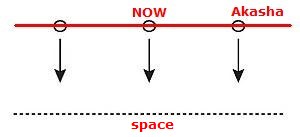
As Abby Ashtekar acknowledged in arXiv:gr-qc/0410054v2, p. 32, "A common criticism of the canonical quantization program pioneered by Dirac and Bergmann is that in the very first step it requires a splitting of space-time into space and time, thereby doing grave injustice to space-time covariance that underlies general relativity. (...) Loop quantum gravity program accepts this price... "
... and for that reason it will never solve the Hamiltonian constraint problem nor the Hilbert space problem. In the context of canonical quantum gravity, these two problems are specific presentation (sort of 'translation' into the language of LQG) of the Unmoved Mover (Karel Kuchar) that has been deleted from the outset. People are actually trying to recover the Unmoved Mover from its distorted LQG presentations, but it simply ain't there. It is hidden in the purely geometrical structure of spacetime. Surely the Unmoved Mover works only if there are Type I physical fields dropped on this 'spacetime', yet it is a different entity altogether. Compared this to the cases of 'time-orientability' and 'positive mass conjecture': people introduce them by hand because they are "obvious", but there is no way to derive them from the physical stuff alone, which inhabits such "space-time". If you postulate some Killing vector field out of thin air, you will be able to perform calculations and obtain results that match observational data perfectly well, simply because you employ a case-specific presentation of the Unmoved Mover. Or recall the Newtonian gravity: NASA has been using it without hesitation, with perfect practical results, although everybody knows that gravity doesn't travel "instantaneously". Why no errors? Because gravity does have an instantaneous component (global mode of spacetime), which makes matter coupled to, or rather bootstrapped by, gravity 'quasi-local'. Going back to Gerhard Huisken et al.: "It has proven to be very fruitful to carefully study the change of geometric data on the 3-dimensional slices as time evolves in order to understand the overall behaviour of the system. Similarly, when tracking the horizon of a black hole through space-time one is naturally led to the study of 2-dimensional surfaces evolving in a 4-dimensional ambient space." Comment: Once you sort out the intricacies of those 4-dimensional ambient spaces, you may be naturally led to consider the interiors of the supermassive black holes, as they may be inhabited by advanced Russian civilizations! No joke, Slava Dokuchaev has just published his theory in 2011 Class. Quantum Grav. 28 235015, with impeccable math and beautiful drawings. In principle, one can get information from the interiors of black holes by observing their white hole counterparts. Some additional highlighting during the night time would come from those eternally circulating photons (arXiv:1103.6140v4 [gr-qc], p. 10), as you might have already guessed. Read the paper and pass it to Slava Mukhanov.
[Ref. 2] Angelo Loinger, The black holes do not exist - "Also Sprach Karl Schwarzschild", arXiv:physics/0402088v1
[Ref. 3] Anastasios Mallios and Ioannis Raptis, Smooth Singularities Exposed: Chimeras of the Differential Spacetime Manifold, arXiv:gr-qc/0411121v14
"One of the main reasons for singularities and the infinities that they are associated with is that the manifold picture of spacetime allows one, even if just in theory, to pack an uncountable infinity of events into a finite spacetime volume.
......
"Having learned that the world need not be Euclidean in the large, the next tenable position is that it must at least be Euclidean in the small, a manifold. The idea of infinitesimal locality presupposes that the world is a manifold. But the infinities of the manifold (the number of events per unit volume, for example) give rise to the terrible infinities of classical field theory and to the weaker but still pestilential ones of quantum field theory."
====================================
Subject: Re: Road Map to Success
Date: Thu, 17 Nov 2011 12:02:59 +0200
Message-ID:
<CAM7EkxkLbDJ1i8boEnHCjBzk447sH1OHunkO0R29mtZZO7oPBg@mail.gmail.com>
From: Dimi Chakalov <[email protected]>
To: Suresh Srinivasamurthy <[email protected]>
Cc: Alex Ramm <[email protected]>,
[email protected],
Lev Okun <[email protected]>,
Iegor Reznikoff <[email protected]>,
Serge Krasnikov <[email protected]>,
Dmitry Slavnov <[email protected]>,
Andrei NB <[email protected]>,
[email protected],
[email protected],
[email protected],
Daniil Yerokhin <[email protected]>,
[email protected],
Igor Novikov <[email protected]>,
Dmitri Novikov <[email protected]>,
Simon Kochen <[email protected]>
Dear Mr. Srinivasamurthy,
> I thought of reach out and connect with you.
A road map to success may require solving tough mathematical puzzles, such as the one known since Plato. In case you've lost my preceding email, here's the link:
http://www.god-does-not-play-dice.net/#Joel
Alex Ramm would probably say, 'nel'zia obniat' neobniatnogo' (K. Prutkoff) -- “a spoken thought is a lie” (F. Tyutchev). Yet I think one can solve the task with math. Good luck.
Please reply to me only. Thank you.
Regards,
Dimi Chakalov
http://tinyurl.com/Einstein-Prague
Note: If we take into account the two modes of spacetime and GPIs, we can solve the puzzle (?) of cosmological time origin (Slava Mukhanov): in the local (physical) mode of spacetime, The Beginning cannot be reached for any finite duration of 'time as read by your wristwatch'. Just like the instant " √0 " from Special Relativity, The Beginning does not belong to the local mode of spacetime, and neither is The End: these "two" -- in fact, ONE -- event(s) are hidden "inside" the fleeting instant 'now' from the Arrow of Space.
The "colored" (physicalized) presentation of the universe refers to the so-called local mode of spacetime, in which the age of the universe, as well as its origin and fate, are 'UNdecidable propositions' (K. Gödel) -- there is no direct link between the physical or "colored" state of the universe and The Beginning. The latter shows up only in the postulated (to accommodate GPIs) global mode of spacetime, as a finite time interval of 13.75 ± 0.13 billion years elapsed so far since [John 1:1]. Thus, once created by [John 1:1], the universe has been eternal in its local mode of spacetime, and there is no way, even by math, to actually hit The Beginning from the "colored" (physicalized) state of the universe. Hence the question mark (?) above. Yet in the global mode of spacetime the size and the age of the universe are always finite, and grow from 'time zero'.
People don't like the dual age model, and of course make blatant errors.
Notice also that there is no "curvature of space" in the global instant 'now' from the Arrow of Space: it's all about properties of the connection (R. Aldrovandi and J. G. Pereira). The so-called tangent space from GR textbooks ("there is no natural way of identifying the tangent space at a point p with the tangent space at a different point q", Robert Wald, p. 8) and the notion of 'parallel transport along a curve' (ibid.) point to the global mode of spacetime.
To explain the latter, suppose you're in a pitch dark room. You hold a torch in your hand, but want to "see" the darkness itself, before you observe the room with your torch. (The 'darkness itself' stands for the 'UNdecidable pre-quantum reality' above, which cannot fit into any Hilbert space whatsoever.) Obviously, your task is not feasible. With your torch, you can only observe the "colored" (after KS Theorem) presentations of 'the dark room', which are just 'shadows on Plato's cave'. To paraphrase Fyodor Tyutchev, a spoken thought is a "colored" thought. If you take snapshots from the 'dark room' with your flash camera, and arrange these "colored" snapshots along a trajectory, the quantum-gravitational effects from the connection in the global mode of spacetime can indeed be FAPP zero, but only in classical physics and only if we imagine some 'flat spacetime'. We can never observe the global mode directly -- in present-day GR we can only infer the notion of 'geodesic' (Alan Rendall), "as a curve whose tangent is parallel transported along the curve, i.e., the covariant derivative of the tangent in the direction of the tangent vanishes" (Robert Wald, p. 8). The difference to these textbook hypotheses is in the treatment of 'quasi-local points' from the underlying manifold: each and every "point" is a nexus of already-completed atemporal negotiations (global mode) between 'the point' and 'the rest of the universe', hence one can develop a Machian Quantum Gravity from the outset, and explain the so-called "dark energy" from the GPIs in the global mode of spacetime. Of course, people don't like the proposal, and prefer to talk about "dark energy" like parapsychologists, without being able to specify what stuff is "dark", and with respect to what. They also introduce time-orientability by hand, and stumble at those 96% "dark" stuff in the universe, which cannot fit in their GR textbooks. More in Sec. Summary, pp. 35-36, in ExplanatoryNote.pdf; update due next June.
D. Chakalov
November 17, 2011
Last updated: February 26, 2012
====================================
Subject: Is general relativity 'essentially understood' ? arXiv:gr-qc/0508016v1
Date: Sat, 26 Nov 2011 00:33:18 +0200
Message-ID:
<CAM7Ekxm1kpWFE46KnDBgX8XNV8E5M+WOtAJeVX_edbvW7ioa0w@mail.gmail.com>
From: Dimi Chakalov <[email protected]>
To: Helmut Friedrich <[email protected]>,
[email protected]
Cc: Lars Andersson <[email protected]>,
Alan Rendall <[email protected]>,
Jiri Bicak <[email protected]>
Dear Dr. Friedrich,
I noticed your name in the list of confirmed speakers at
http://ae100prg.mff.cuni.cz/ae100prg_2nd_announcement.pdf
If possible, please send me your manuscript, on which your talk will be based, prior to the opening of the Conference in Prague. My intended talk (still waiting for opening the abstract submission next month) will heavily overlap with your paper in the subject line, particularly on three issues:
1. You wrote: "Doubts have been raised subsequently whether the notion of gravitational radiation referred to a real physical phenomenon (cf. [104]), but again the prediction has been confirmed convincingly."
I respectfully disagree with your conclusion, and will also argue on a separate issue, that LIGO and the like cannot, not even in principle, detect GWs. Will refer to Hermann Bondi (energy transport by GW is "a fundamentally nonlinear phenomenon"), Hermann Weyl ,
http://www.jstor.org/pss/2371768 and Jürgen Ehlers, Sec. 5 in
http://www.god-does-not-play-dice.net/Ehlers.pdf As you acknowledged in arXiv:gr-qc/0508016v1, the linearized field equations can "hardly be expected to provide reliable answers in situations involving strong and highly dynamical fields, it is useless for calculating radiation generated by the coalescence of black holes."
In my opinion, LIGO scientific collaboration doesn't have any theory whatsoever, because they cannot derive the 'weak limit' of GWs from strong GWs. Instead, they postulate that GWs can be modeled as 'propagating in flat spacetime' (Kip Thorne, Weak GW's in Flat Spacetime, Caltech's Physics 237-2002), and run against Hermann Weyl's 1944 article cited above.
2. You wrote: "It may be noted that ‘singularity’ is defined in the singularity theorems as the existence of a causal geodesic which is non-extendible and non-complete."
I will argue that the singularity theorems were derived under assumptions (cf. Alan D. Rendall, The nature of spacetime singularities, arXiv:gr-qc/0503112v1, p. 4) which are nowadays challenged by some 2700+ papers dealing with various issues of dynamical "dark energy". I also believe that the very idea of 'singularity' is an artifact from unjustified mathematical presumptions, usually placed in footnotes; for example:
Lars Andersson (June 27, 2004), The global existence problem in general relativity, arXiv:gr-qc/9911032v4, Footnote 1, p. 3: "All manifolds are assumed to be Hausdorff, second countable and C∞, and all fields are assumed to be C∞ unless otherwise stated."
3. And finally, you wrote: "There is, however, still a large and potentially most important part of the theory we do not have access to, neither mathematically, nor theoretically, nor observationally."
I will offer some ideas to improve the 'physical objectivity in GR', referring to Einstein's statement that the requirement for general covariance "takes away from space and time the last remnant of physical objectivity",
http://tinyurl.com/Einstein-Prague
Needless to say, I will be happy to send you my manuscript, at least one month prior to the opening of the Conference in Prague. Details at the link above.
Kind regards,
Dimi Chakalov
===================================
Subject: Re: arXiv:1201.3660v1 [gr-qc]
Date: Sat, 21 Jan 2012 14:54:04 +0200
Message-ID:
<CAM7Ekx=vPAr3cXTYhD-743pgeP_NDaEjJjbLv1ok-iaJ_162tw@mail.gmail.com>
From: Dimi Chakalov <[email protected]>
To: psj <[email protected]>
Cc: Ted <[email protected]>,
Roger Penrose <[email protected]>,
Laszlo Szabados <[email protected]>,
Adam Helfer <[email protected]>,
Jörg Frauendiener <[email protected]>,
George <[email protected]>
Dear Pankaj,
> Sorry if i was not clear enough, but it is
> very difficult to write long emails on such points
> which do involve lots of background information
> and technicality.
As a rule, the devil is in the details. Here, it is a tacit presumption which people consider "obvious". For example, in 1962 Penrose tacitly assumed that the spacetime would remain Archimedean
http://prl.aps.org/abstract/PRL/v10/i2/p66_1
even at "future null infinity" (cf. Jonathan Thornburg below).
Just one example:
"The fuzzy idea of where and what is infinity was clarified and made more specific by the work of Penrose [45, 46] with the introduction of the conformal compactification (via the rescaling of the metric) of spacetime, whereby infinity was added as a boundary and brought into a finite spacetime region." (Ted Newman et al.)
http://relativity.livingreviews.org/Articles/lrr-2009-6/articlese1.html#x4-10001 > The basic point remains the same,
> namely event horizon is a global object, which is
> not determined by purely local measurements.
Penrose wrote the article above in 1962. 60 years later, I think we should get serious about 'global objects in GR',
http://www.god-does-not-play-dice.net/#Beig
All the best,
Dimi
>>>>
>>>>> On 01/19/2012 07:59 AM, Dimi Chakalov wrote:
>>>>>>
>>>>>> Dear Pankaj,
>>>>>>
>>>>>> I provided link to your latest article at
>>>>>>
>>>>>> http://www.god-does-not-play-dice.net/#Bengtsson
>>>>>>
>>>>>> Please send me a reference to a *rigorous* formulation of 'event
>>>>>> horizon' (not 'apparent horizon') -- "a global property of an entire
>>>>>> spacetime and is defined nonlocally in time: The event horizon in a
>>>>>> slice is defined in terms of (and cannot be computed without knowing)
>>>>>> the full future development of that slice," according to Jonathan
>>>>>> Thornburg (Event and Apparent Horizon Finders for 3 + 1 Numerical
>>>>>> Relativity, lrr-2007-3).
>>>>>>
>>>>>> All the best,
>>>>>>
>>>>>> Dimi
>
Note: In a previous email, Pankaj Joshi suggested to look at 'Global aspects in gravitation and cosmology'. I quoted from p. 194, after which he responded as follows:
>>
>> Fig. 44 and p. 194 ("an achronal surface generated by null geodesics
>> which could have past end points in M but have no future end points")
>> are very unclear to me, just as any 'global property of an entire
>> spacetime' (Jonathan Thornburg).
>>
>
> An achronal surface is one no two points of which are
> timelike connected. This is always foliated by null geodesics.
> These can go up to infinity in future. Nothing, achronal surfaces included, can be extended to "infinity in future". If you start from the local mode of spacetime, you cannot enter the global mode. No way. I hope the status of Finite Infinity will be resolved by 2022, sixty years after Roger Penrose wrote the manuscript of the article cited above. As of today, nobody cares. Nobody. D.C.
January 21, 2012
===================================
Subject: Re: arXiv:1201.3765v2 [gr-qc]
Date: Sat, 21 Jan 2012 15:53:37 +0200
From: Dimi Chakalov <[email protected]>
To: Diego Marin <[email protected]>
Cc: Michal Chodorowski <[email protected]>
> With "expansion" I mean the growth of the 3D-metric, that is the 4D-metric projected
> over a Cauchy surface. It's this for every physicist :-)
It's self-referential parapsychology, because in current GR 'the 4D-metric projected over a Cauchy surface' can only be defined *with respect to itself*. Capiche?
Regards,
Dimi
>
> -----Messaggio originale-----
> Da: Dimi Chakalov [mailto:[email protected]]
> Inviato: sabato 21 gennaio 2012 14.13
> A: Diego Marin
> Oggetto: Re: arXiv:1201.3765v2 [gr-qc]
>
> Hi Diego,
>
>> It's almost obvious that for G < 0 exists a cosmological solution whose
>> scale factor has a positive second derivative.
>
> First and foremost: Isn't it obvious that you cannot define 'expansion
> of space' w.r.t. itself?
>
> http://www.god-does-not-play-dice.net/#Heraclitus
>
> E sarà mia colpa se così è?
>
> Regards,
>
> Dimi
>
====================================
Subject: The identification of points, arXiv:1112.5318v1 [gr-qc]
Date: Fri, 23 Dec 2011 04:30:47 +0200
From: Dimi Chakalov <[email protected]>
To: Ingemar Bengtsson <[email protected]>
Cc: [email protected], [email protected],
[email protected], [email protected],
[email protected], [email protected], [email protected],
Saul Teukolsky <[email protected]>
Dear Dr. Bengtsson,
It seems that you've taken the 'identification of points' as something obvious and trivial in GR, and have put aside the complications that can arise from quantum theory, in the case of quantum spacetime,
http://tinyurl.com/Einstein-Prague
Anyway, could you please send me a reference to a rigorous formulation of 'event horizon' (not 'apparent horizon') in FRW Cosmology? I extend this request to all your colleagues who are smart enough to understand (I can't) 'The Very End of Space and Time',
http://www.black-holes.org/gwa2-3.html
Kind regards,
Dimi Chakalov
------ Note: The Cosmic Censorship Conjecture stipulates that "black holes" may be lurking behind some "event horizons" that are "causally connected to future null infinity," and if we add Hawking radiation, "the hole could evaporate into nothingness." Read my mind. As I mentioned previously, I was able to "understand" the Jabberwocky of "black holes" only once, in my freshman year in June 1972, and it didn't last long (MTW, p. 467).
In fact, the very hypothesis for 'geodesics' involves a perplexing paradox: if you imagine that gravity can indeed be eliminated 'at any point', and also believe that GR is a bona fide classical theory, then by summation of 'zero effects of gravity' at all points from the geodesic, it will disappear into Minkowski spacetime: "Locally all physics is as it is in Minkowski space. Gravity is in the way these local Minkowski spaces are connected. (...) Through this connection the metric gab becomes the glue that connects the local Minkowski spaces" (Olaf Dreyer, arXiv:1203.2641v1 [gr-qc], p. 3). Which means that the proper GR should be some quasi-classical theory in the first place. As an analogy, nobody would claim that the "trajectory" of a quantum particle in Wilson cloud chambers is comprised from its "collapsed" states. Obviously (to me), the puzzle of quasi-classical GR is in its affine structure [Ref. 1] introduced by hand, to help us imagine parallel-transported vectors from one spacetime "point" to another. It is independent of the metric structure. It is a whole different entity.
Which brought me to FI 2nd Ed, some forty years after I had the impression that can "understand" GR. Sorry, nobody understands GR, especially the purely affine connection [Ref. 1, p. 112] and the "open sets" of the underlying manifold [Ref. 2].
D.C.
December 23, 2011
Last updated: March 14, 2012
[Ref. 1] Erwin Schrödinger, Space-Time Structure, Cambridge University Press, 1950.
p. 2: 
p. 9: 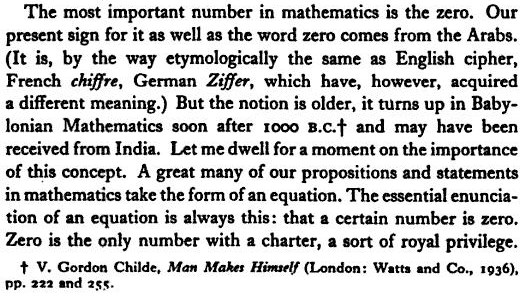
[Ref. 2] James Dungundji, Topology, McGraw-Hill, 1988, p. 63.
--------------
Comment: I believe there is a preconceived idea of what "open"
means. The "open sets" refer to 'the unknown unknown' in the
phenomenon of time, which in turn leads to the
creative, non-unitary evolution of 'the
universe as ONE'. Due to the theorems of
Kurt Gödel, "any axiomatization A of arithmetic, if it is
consistent, then it is incomplete, in the sense of there being
truths (theorems) expressible in A but not provable within A. An
existential proof of the result is that the set of theorems in A has the
cardinality of the continuum, i.e., it is uncountably large,
whilst the number of proofs is only countably infinite" (S. Aravinda and
R. Srikanth, p.
5). Thus, the world is "open" in time, up to 'the unknown
unknown', due to the phenomenon of time.
"Whether you believe you
can do a thing or believe you can't, you are right", said Henry Ford.
Analyze that "open" future, please!
D. Chakalov
December 5, 2012
========================================
G. W. Gibbons deeply believes in the picture below. I don't, for reasons explained by Pankaj Joshi and Daniele Malafarina, arXiv:1201.3660v1 [gr-qc].
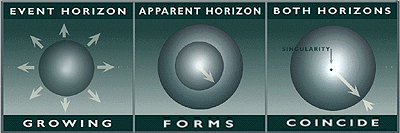
Just read a recent announcement from the Institute of Physics: "Inside the box, gas and dark matter, a form of matter that interacts through gravity alone, were represented by 65.5 billion particles. (...) As a result, each gas "particle" had the mass of 57 million Suns, while dark matter weighed in at 280 million solar masses per particle."
All you need is people like G. W. Gibbons and "a humongous computer simulation". To help then pinpoint the "dark matter" which "interacts through gravity alone", look in Slava Mukhanov's 'Physical Foundations of Cosmology,' 2005, p. 203: In the minimal supersymmetric extension of the Standard Model, "for every gauge particle we have a fermionic superpartner with spin 1/2, called a gaugino. Among these, gluinos are superpartners of gluons, and winos and the bino are the superpartners of the gauge bosons of the electroweak group. The gauginos mediate the interaction of the scalar particles and their fermionic partners, with a strength determined by the gauge coupling constant. The Higgs particle is accompanied by a higgsino. The lightest neutral combination of -inos (mass eigenstate), called the neutralino, must be stable; if supersymmetry were broken at the electroweak scale, it would interact weakly with
ordinary matter.
"Therefore, the neutralino (280 million solar masses? D.C.) is an ideal candidate for cold dark matter. To conclude our brief excursion to the “s- and -ino zoo,” we should mention the gravitino -- the spin 3/2 superpartner of the graviton which could also serve as a dark matter particle (280 million solar masses? D.C.). Thus we see that supersymmetric theories provide us with the weakly interacting massive particles necessary to explain dark matter in the universe." If Jon Stewart had said all this, it would have been hilarious. But he isn't good in math. D.C.
January 20, 2012
-------------------
Subject: Re: What is *event* horizon ?
Date: Thu, 12 Jan 2012 13:33:15 +0200
Message-ID:
<CAM7Ekx=mFC6VXz2tK+qJooEF1kUWHZTqyg4LGj3np8P7KefQ_Q@mail.gmail.com>
From: Dimi Chakalov <[email protected]>
To: [email protected]
Cc: Steven Giddings <[email protected]>,
Jonathan Thornburg <[email protected]>
Dear Dr. Gibbons,
Thank you for your reply from 12 Jan 2012 07:04:36 +0000.
> Standard definitions are provided in the well known textbooks of Hawking and
> Ellis, Wald etc etc and are extensivley discssued in the contemporary
> literature. Misner Thorne and Wheller is still an excellent introduction to
> General Relativty and the books by Hartle and by Carroll are als excelent.
The standard definitions of *event* horizon postulate it as "a global property of an entire spacetime and is defined nonlocally in time: The event horizon in a slice is defined in terms of (and cannot be computed without knowing) the full future development of that slice," according to Jonathan Thornburg (Event and Apparent Horizon Finders for 3 + 1 Numerical Relativity, lrr-2007-3).
Which textbook cited above resolves this problem?
Notice that calculations using the 3+1 ADM formalism, as in lrr-2007-3, cannot be relevant to the brand new (to ADM) case of "expanding" space driven by some "dark" energy.
I will appreciate the opinions of Drs Giddings and Thornburg as well.
> Glancing at your Web site I would strongly recomend that you
> carefully study at least a few of these, since you appear not to be aware of
> the enormous amount of work on the subject in recent years.
I hope to understand what you meant by "few of these" in your professional opinion on the issues raised above.
Sincerely,
Dimi Chakalov
On Thu, 12 Jan 2012 04:06:08 +0200, Dimi Chakalov <[email protected]> wrote:
>
>> Dear Dr. Gibbons,
>>
>> I glanced at your latest arXiv:1201.2340v1 [gr-qc], and was struck by
>> your statement: "By "horizon" I shall mean "apparent horizon" ...".
>>
>> If possible, please let me know if you are aware of any sensible
>> definition of 'event horizon' in GR, given the problems with locality.
>>
>> I extend this request to Dr. Giddings as well, since I couldn't find
>> any hint to a proper 'event horizon' in his latest arXiv:1201.1037v1
>> [hep-th].
>>
>> The reason for my request is my tentative (awaiting approval) talk at
>> the Einstein Conference in Prague,
>>
>> http://tinyurl.com/Einstein-Prague
>>
>> Kind regards,
>>
>> Dimi Chakalov
>>
>
---------
Note: G. W. Gibbons didn't even sign his email (original here). Perhaps he will choose to keep quiet, like Carsten Gundlach. Or maybe he will reply, but in a manner similar to Prof. Gerard 't Hooft, that is, "transparently even to babies": "R_abcd (x) = 0 FOR ALL VALUES OF ITS 4 INDICES, AT ALL POINTS x in this region of space-time." How is "this region of space-time" made separable from the rest of "regions" from the same spacetime is a bit of a mystery to the "babies". Look at Introduction to General Relativity, by Gerard 't Hooft, 15 November 2010, pp. 25-26 (emphasis added):


Do you agree with Prof. G. 't Hooft ? What will happen to the Ricci tensor at the instant at which the Riemann curvature tensor has totally vanished ? What could resurrect the Riemann tensor from the dead flat space in those "glued" domains in which "all coefficients [XX] can be made to vanish by choosing suitable coordinates" ? Angels ?
"Since the microwave background radiation (as well as the "dark" energy - D.C.) is everywhere and always, there can be nowhere where the Ricci tensor vanishes and therefore nowhere where the Riemann curvature tensor vanishes in a realistic physical model" (Maurice J. Dupre, private communication). In my theory, I can be plus catholique que le Pape, by eliminating all traces from what is believed to be "curvature at a point" -- I don't use "curvature" as manifestation of gravity, but an entirely different object (cf. John's jackets). Once it casts its (quasi-local) "jacket", it must vanish completely at a point, because it is the gravitational, Macavity-like, version of the non-colorizable pre-quantum Kochen-Specker state. And I have no problems with 'the right answer to a wrong question' (MTW, p. 467) either. But this is Machian quantum gravity, and Prof. G. 't Hooft doesn't like it. Anyway. Let's go back to the "event horizon". The whole idea about "event horizon" is incredibly murky: "a global property of an entire spacetime" which is "defined nonlocally in time" (Jonathan Thornburg). We don't have such luxury in GR textbooks. As Matt Visser explained (arXiv:gr-qc/0204022v2, p. 3, emphasis added): "Unfortunately, in general relativity one cannot simply assert that chronology is preserved, and causality respected, without doing considerable additional work. The essence of the problem lies in the fact that the Einstein equations of general relativity are local equations, relating some aspects of the spacetime curvature at a point to the presence of stress-energy at that point. What general relativity does not do is to provide any natural way of imposing global constraints on the spacetime — certainly the Einstein equations provide no such nonlocal constraint." I think the phrase "at a point" is a big can of worms, because any observable of the gravitational field is "necessarily quasi-local" (Laszlo Szabados). Moreover, you can't have 'stationary spacetime' (needed to match an "apparent horizon" to an "event horizon") in a universe dominated by "dark" energy. I think we could have quasi-local and non-linear, due to gravity, interactions, with plenty of "dark" energy, only and exclusively only in the case explained here. The crucial object, otherwise known as 'particles of the reference fluid' [Ref. 1], is Einstein's "total field of as yet unknown structure". We just can't paint a picture without a colorless canvas that defines all "colored" stuff "everywhere and for all time" (Ciufolini and Wheeler, p. 270) dynamically -- one-at-a-time, along the Arrow of Space. Of course, most people disagree with the dynamical 'quantum spacetime' (sometimes in a pretty colorful fashion), so I ask them to show some 'global constraint' (Matt Visser) or anything -- you name it -- responsible for the ubiquitous free fall, and to suggest some object with respect to which we can define the ubiquitous 'expansion of space', or at least the preferred reference frame in which people make "trivial" statements like ... 
... but, strangely enough, they just don't reply. Der Geist bewegt die Materie... oder was ?
D.C.
January 13, 2012
Last updated: January 15, 2012, 22:48:48 GMT
http://www.god-does-not-play-dice.net/Der_Geist_bewegt_die_Materie.pdf
http://www.scribd.com/doc/78376220/Der-Geist-Bewegt-Die-Materie
[Ref. 1] "The particles of the reference fluid identify the points of space, and clocks carried by these particles identify the instants of time." J.D. Brown and K.V. Kuchar, arXiv:gr-qc/9409001
===================================
Subject: Re: Is there 3-D space in classical GR?
Date: Tue, 17 Jan 2012 05:49:03 +0200
Message-ID:
<CAM7EkxkJn-N5nGhUCP7-R_Q_V9=PMQ7FXYOn=4-A+9uDZpRApw@mail.gmail.com>
From: Dimi Chakalov <[email protected]>
To: Ulrich H Gerlach <[email protected]>
Cc: [email protected],
[email protected]
Dear Dr. Gerlach,
It is difficult to me to overestimate the importance of your research on the quantum mechanical carrier of the imprints of gravitation, arXiv:gr-qc/9911019v1.
I agree that "a quantum mechanical comprehension of gravitation must start with a purely quantum mechanical carrier of its imprints", but my proposal about 'purely quantum' is quite different,
http://www.god-does-not-play-dice.net/#thesis
http://www.god-does-not-play-dice.net/#Gibbons
http://www.god-does-not-play-dice.net/Der_Geist_bewegt_die_Materie.pdf
Regarding my email sent almost nine years ago (cf. below): I think GR cannot explain 3-D space and its ubiquitous Eotvos property,
http://www.god-does-not-play-dice.net/#WHY
As to the two Rindler frames, which "(i) are accelerating eternally and (ii) are causally disjoint", I don't suggest some "half-silvered mirrors" 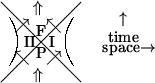
but a modification of Ellis' Finite Infinity, and place the four Rindler sectors I, II, P and F, along a hypothetical "direction" denoted with 'w' (from 'wunderbar', after Theodor Kaluza),
http://www.god-does-not-play-dice.net/#Beig
Should you or your colleagues are interested, please write me back. Anything you are not able to understand will be entirely my fault.
Best regards,
Dimi Chakalov
-------------
Subject: Is there 3-D space in classical GR?
Date: Sun, 13 Jul 2003 17:38:33 +0300
From: Dimi Chakalov <[email protected]>
To: Ulrich Gerlach <[email protected]>
Dear Dr. Gerlach,
It is a great pleasure to read your papers.
[snip]
-------------------------- Note: Regarding my email to Ulrich Gerlach from Sun, 13 Jul 2003 17:38:33 +0300, notice that GR does not explain the feature of space which we describe as "to look around, and see as far as we like" (L. Smolin; details from M. Bojowald). Ditto to 'time-orientability'. Properly speaking, "GR does not admit a description as a system evolving in terms of an observable time variable" (Carlo Rovelli, gr-qc/0604045v2, p. 4). Regarding the last link above, I used the German translation of the famous dictum by Virgil (Mens agitat molem, The Aeneid VI 727) to stress that Eq. 2 from FI (2nd Ed) resembles what John von Neumann denoted with 'Process II', while Eq. 1 refers to a perpetual, along the Arrow of Space, 'Process I' which can only be performed by God. Yes, I know people hate [John 1:1] and will keep quiet. How about dual age cosmology ? Things to remember: The "most irrational number" is the one with the most slowly converging continued fraction expansion. This is the number corresponding to the continued fraction 1+1/(1+1/(1+..., which is none other than the golden ratio.
The greatest common divisor of any two Fibonacci numbers is also a Fibonacci number; applications and explanation here and here.
The global mode of spacetime is an infinitely-connected space which facilitates the local (physical) mode with an "instantaneous", already-completed web of correlations. It cannot be modeled with non-linear differential equations; hence a new retarded (due to the Arrow of Space) form of causality (dubbed 'biocausality'), defined in the reference fluid of GR.
To sum up, the global mode of spacetime, populated by GPIs, is postulated as a dual object, in the sense that its physical presentation is both a dimensionless geometrical "point" (S) and 'the infinite space' (L). It wraps the physical, 3-D space in all directions. Any effort to catch the "god particle" from the local (physical) mode is doomed to fail. Also, any GW detector which does not have access to the global mode of spacetime is worthless.
D.C.
January 18, 2012
Last updated: January 29, 2012
Many people would rather die than think. In fact, they do.
Bertrand Russell
=========================================
Subject: The Computing Spacetime, arXiv:1201.3398v1 [gr-qc], ref. [6]
Date: Wed, 18 Jan 2012 03:45:55 +0200
From: Dimi Chakalov <[email protected]>
To: Fotini <[email protected]>, Fotini <[email protected]>
Cc: Seth Lloyd <[email protected]>
Kalimera Fotini,
I think Seth Lloyd is right about the non-linear and self-acting dynamics of such "computing spacetime": the universe computes "its own dynamical evolution; as the computation proceeds, reality unfolds," ref. [6] in arXiv:1201.3398v1 [gr-qc].
Trouble is, only Baron Munchausen can perform such self-referential and self-acting self-computations, in 'present continuous', as they unfold. Any Turing machine will halt. Just imagine you singing with a mike, and a loudspeaker beaming your song right on your mike, to help you improve your singing performance *before* you sing any note from your song. Can you put this setup into a system of non-linear diff equations?
If you can't, look at
http://tinyurl.com/Einstein-Prague
All the best,
Dimi
============================================
Subject: Johan Hansson, Anna Ponga, Pulsars: Cosmic Permanent 'Neutromagnets'? arXiv:1111.3434v1 [astro-ph.HE]
Date: Fri, 16 Dec 2011 00:23:06 +0200
From: Dimi Chakalov <[email protected]>
To: Johan Hansson <[email protected]>
Cc: Brian P Dolan <[email protected]>,
Hamish Johnston <[email protected]>,
Alex Potekhin <[email protected]>,
Sachiko Tsuruta <[email protected]>,
Bernard Schutz <[email protected]>
Dear Dr. Hansson,
Congratulations to you and Ms Anna Ponga for your outstanding article,
http://physicsworld.com/cws/article/news/48096
http://www.technologyreview.com/blog/arxiv/27355/ May I ask a question. If neutromagnets have fields as high as 10^12 Tesla, can you suggest some trivial mechanism for losing kinetic energy, with the same dynamics as the binary system PSR1913+16, but not involving "GW emission" ?
As you may have known, Russell Hulse and Joseph Taylor were very lucky to discover the binary system PSR1913+16, in which one of the stars was a pulsar with period of orbit just eight hours -- extremely small by astrophysical standards -- hence they regarded it as a clock, and speculated further that the change in the period corresponded to the
rate by which the binary system were losing energy. Then Hulse and Taylor decided to explain the inferred loss of energy with "GW emission".
Namely, they applied the old Tanzanian saying: "How do we know that Father Christmas has a beard? We know it, because snow falls when he shakes his beard." But again, the rate of the "snowfall" was the only evidence in support of their wild guess.
PSR1913+16 was the first binary pulsar, discovered in 1974. As Brian Dolan explains, "a pulsar is a rotating dipole and rotating dipoles emit electromagnetic radiation, thus losing energy. This is not actually the source of the (EM) radiation that is directly observed. The electromagnetic pulses seen from a pulsar are due to radiation from beams of charged particles emitted along the axis of the dipole and sweeping past the Earth like a lighthouse beam." (Brian P. Dolan, Lecture Notes MP476: Cosmology, Sec. 2.14.3 Pulsars, September 21, 2010, p. 41).
By analyzing the changing Doppler shifts of PSR1913+16 (redshifted and blueshifted pulse periods), R. Hulse and J. Taylor inferred that PSR1913+16 should consist of two neutron stars, separated by distance roughly the radius of the Sun. Also, "the period first grew longer and then grew shorter in a cycle that took 7.75 hours" (Michael Seeds and Dana Backman, Horizons: Exploring the Universe, 11th Ed., Brooks Cole, 2009, p. 217).
I think LIGO "scientific" collaboration should explain how could "the period first grew longer and then grew shorter", and then eliminate all trivial explanations of the inferred loss of kinetic energy (e.g., Sachiko Tsuruta et al., Cooling of pulsars, Astrophysical Journal, 176 (1972) 739-744; Alex Y. Potekhin et al., The magnetic structure of neutron stars and their surface-to-core temperature relation, Astronomy & Astrophysics, 443 (2005) 1025-1028).
Perhaps you can suggest some mundane explanation of the loss of kinetic energy of PSR1913+16.
The opinion of your colleagues will be greatly appreciated, too.
Yours sincerely,
Dimi Chakalov
http://tinyurl.com/Einstein-Prague ---------------------------
"By 2020
at least 3-4 billion dollars will have been invested by a dozen national and international scientific organizations in building gravitational wave detectors on the ground and in space. Most of this money has already been committed, at least in a planning sense, and this has all happened even before the first direct detection of a gravitational wave! Where has today’s
immense faith in general relativity come from?"
Bernard Schutz, arXiv:1203.3090v1 [physics.hist-ph], p. 4
Comment: There are two alternative interpretations of this fabulous quote.
1. Prof. Dr. Bernard F. Schutz, the Director of the Astrophysical Relativity Department of the AEI Potsdam and the Principal Investigator responsible for data analysis for the GEO600 collaboration (part of the LIGO "scientific" collaboration), has no clue whatsoever about the inherent problems of GW "astronomy". He's a total dilettante, and is not aware of the fact that he and his LIGO colleagues do not have any theory whatsoever about detecting GWs with LIGO, GEO600, VIRGO, etc. Subsequently, he has UNintentionally misled NSF and NASA, and therefore should not be kept responsible for wasting hundreds of million USD and Euro -- all taxpayers' money -- after the ultimate failure of the "advanced" LIGO and Virgo in 2014. Can't blame him, the guy knew nothing about GR. 2. Prof. Dr. Bernard F. Schutz is fully aware of the fact that he and his LIGO colleagues have neglected the only available theory of GWs developed in the 1960s. In fact, he was agonizingly clear about the unsolved problems with the "linearized approximation" of GR for detecting GWs ten year ago, on August 2, 2002. Yet he prefers to keep quiet and has prepared a 'Plan B' for the ultimate failure of the "advanced" LIGO and Virgo in 2014: "It is worth reminding ourselves why and where GR might fail. (...) Any such failure of GR should point the way to new physics." (B. F. Schutz et al., arXiv:0903.0100v1 [gr-qc]) In other words, it's all about the cash flow for GW "astronomy". Bernie Schutz doesn't want to acknowledge that he and his LIGO colleagues do not have any theory whatsoever about detecting GWs (cf. the two if-s below), because the funding will stop, and they will have to start from scratch, that is, from the only available theory of GWs developed in the 1960s. It's all about money. Not Bernie Schutz' money, but the money earned with hard labor by millions of people. He acts like a little girl who points to some doll and says, 'I want this Barbie!' But he is smart, and has prepared the 'Plan B': put all the blame on GR. Only Bernie Schutz and his LIGO colleagues do not have any theory whatsoever -- check out the two if-s below. Their wishful thinking is based on a non-existing theory, which has nothing to do with GR. In fact, it is impossible to derive some "weak limit" from strong GWs with the existing GR. Bernie Schutz is fully aware of this problem, but prefers to keep quiet. He is indeed an expert in GR, but is addicted to the money from NSF (Beverly K. Berger <[email protected]> , Program Director for LIGO Project, National Science Foundation, 4201 Wilson Blvd., Arlington, VA 22230, Telephone: (703) 292-7373; Pedro Marronetti <[email protected]> , LIGO Research Support Program, (703) 292-7372). As Johann Makowsky put it (The Jerusalem Post, 19 April 1985): "Overfunded research is like heroin: It makes one addicted, weakens the mind and furthers prostitution." Let me repeat it again: If I am banned from talking at the Einstein Conference in Prague this year, I will have no choice but to take the appropriate actions against the cover up of the enormous waste of taxpayers' money by LIGO "scientific" collaboration. I will not tolerate any communist censorship on behalf of the Scientific Organizing Committee of the Einstein Conference in Prague: Bernard Schutz has been invited (Sic!) to talk about "observing the Universe with gravitational waves", while I still have no confirmation that my talk (abstract submitted in December last year) will be approved. Those who support and contribute to the cover up of the enormous waste of taxpayers' money by LIGO "scientific" collaboration, by rejecting my talk at the Einstein Conference in Prague, will be duly exposed. The scandal with NASA and NSF will be just enormous: the only available theory of GWs has been deliberately ignored ! Yes, I will expose the dirty little secrets of LIGO "scientific" collaboration -- if only I am allowed to talk at the Einstein Conference in Prague.
D. Chakalov
April 5, 2012
Last updated: April 6, 2012, 11:53 GMT
----------------
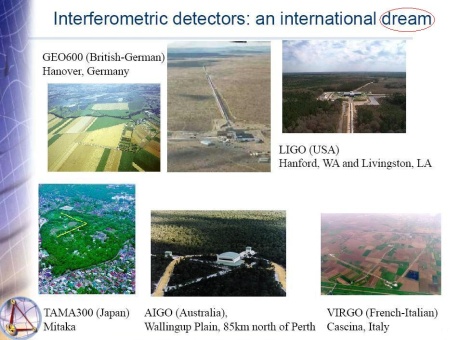
Note: "Kip Thorne had no difficulty in 1981 in finding a taker for a wager that gravitational waves would be detected by the end of the last century. The wager was made with the astronomer Jeremiah Ostriker, one of the better-known critics of the large detectors then being proposed. Thorne was one of the chief movers behind the largest of the new detector projects, the half-billion-dollar Laser Interferometer Gravitational Wave Observatory, or LIGO. He lost the bet, of course." (Daniel Kennefick, Traveling at the Speed of Thought, Princeton University Press, Princeton, 2007, p. 1.)
What do you do, then? Raise the requirement for "LIGO sensitivity" and ask for more cash. I stated above that those 800+ physicists from LIGO "scientific" collaboration (LSC) do not have any theory whatsoever. Despite five (or more) consecutive failures, their persistent dream that the "enhanced sensitivity" of the so-called advanced LIGO and advanced Virgo might produce "GW astronomy" in 2014 is still grounded on a wild guess which has nothing to do with General Relativity. This wild guess involves two "if"-s. First, the prerequisites. Suppose you have a weather thermometer: you know that it cannot measure the temperature at the surface of the Sun, but you know how to calculate it, because you have a proper theory about the Sun -- not just a weather thermometer.
For comparison, suppose some people have designed a weird thermometer, based on a bunch of speculations which run against everything we know about the Sun: they have no right to claim that they might eventually measure anything related to the Sun. In the case of LIGO "scientific" collaboration, they need some totally new "quadrupole formula", or whatever they choose to call it, applicable to very strong GWs, from which they can derive a brand new "weak quadrupole formula", or whatever they wish to call it, similar to the "weather thermometer" of very weak GWs.
It is impossible in GR to derive any weak limit of GWs from very strong GWs. What they actually need is an arbitrary weak limit, such that their dimensionless ghost, called GW amplitude, would fade out asymptotically toward zero. Then they need to compare such (nonexistent) theory of arbitrary weak limit of GWs with the spacetime of Special Relativity, and find the exact area of veeeeery weak GWs at which one could safely swap the spacetime of their (nonexistent) theory with Minkowski spacetime -- some area of fading GWs, in which they would still be 'strong enough' to produce some observable (in the future) effect, yet 'weak enough' to leave the background spacetime FAPP undisturbed. Once the LSC experts attach numerical values, with acceptable error margins, to the parameters specifying the conditions 'strong enough' and 'weak enough', they will have to convince us that their second task is not an oxymoron. So, their wild guess is as follows: if (#1) it were possible (but it isn't) to develop such theory of arbitrary weak limit from strong GWs, and if (#2) one could indeed swap the spacetime from such (non-existent) theory with Minkowski, then one could legitimately teach Weak GW's in Flat Spacetime (Kip Thorne, Caltech's Physics 237-2002) and spend hundreds of million USD and Euro -- all taxpayers' money -- for GW astronomy. Once LSC resolve the two if-s, they should be able to estimate the quantum effects in the physical object, expected to 'stretch 'n squash' by "something that is dimensionless" (exact quote from Kip Thorne) over "2.3×10⁻²⁶", and finally solve the SBG problem of LIGO, Virgo, LISA, eLISA, and the like.
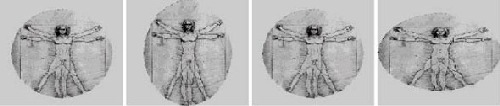
Of course LIGO and Virgo, no matter how "advanced", will again fail miserably. What is particularly alarming is their 'Plan B' prepared for their next failure in 2014:
"It is worth reminding ourselves why and where GR might fail. (...) Any such failure of GR should point the way to new physics." (B. F. Schutz et al., arXiv:0903.0100v1 [gr-qc]) Nope. GR will not "fail", because their wild guess has nothing to do with GR. They do not test GR with such wild uneducated guess. These 800+ physicists have only wasted money earned with hard labor by millions of people, and have scheduled to waste much more -- in the range of billions -- with LISA. Yes, GWs exist, but the current "detectors" are blind and deaf to the non-linear transport of energy by GWs (if #2): it cannot "filter" through Minkowski spacetime. As Hermann Weyl demonstrated in 1944 (How Far Can One Get With a Linear Field Theory of Gravitation in Flat Space-Time? American Journal of Mathematics, Vol. 66, No. 4, Oct., 1944, pp. 591-604), the linearized approximation of GR is "a shadow without power". You kill the very effect you wish to measure with "GWs in flat spacetime". The assumption that by reaching the "advanced" LIGO these waves will be "very weak" is irrelevant. It makes no sense to "enhance the sensitivity" of what has been a dead turkey from the outset. The popular statement like 'the Hulse-Taylor binary pulsar has been losing energy exactly according to the quadrupole formula for gravitational radiation' (Eduardo Guendelman, private communication) can be accepted iff LIGO "scientific" collaboration can suggest some non-linear theory of energy transfer by very strong GWs, then derive some brand new "strong quadrupole formula", or whatever they call it, for such very strong GWs, and finally suggest some "weak quadrupole formula", or whatever they wish to call it. Understanding the nature of GWs is of utmost importance for elucidating the tug-of-war (DDE vs. CDM) effect of gravity, namely, the possibility for "stretching" and "squashing" the very distance between points in spacetime: with respect to what ?
NB: The proper GW detectors must be endowed with the faculty of 'self-acting': the unique phenomenon resulting from the non-linear transport of energy by GWs. To be precise: in the presence of gravity, matter can act on itself. A bit more precise: "the metric is treated as a field which not only affects, but also is (at that same instant - D.C.) affected by, the other fields" (John Baez). Each and every instant from this fundamentally non-linear global time is the nexus of an already-completed negotiation between the two "hands" in the Einstein filed equations.
This is the non-linear and self-acting phenomenon we need to study and explore. Forget about the "splitting of spacetime", after ADM -- it can offer only one linearized instant from the non-linear global time, in which the self-acting faculty of matter is frozen:
George F. R. Ellis, arXiv:gr-qc/0605049v5, footnote 3: "We do not consider here the possible variants when quantum gravity is taken into account."
In my opinion, the gravitational "field" and its "ripples" are not directly coupled to matter and quantum fields. The latter interact with themselves via their GPI field generated by the Arrow of Space. From physical point of view, gravity is essentially "dark" (much like biochemistry does not involve any "biofield" or "bioparticles" corresponding to "gravitons"). Any "displacement" of the spacetime itself can be defined only in the reference fluid of GR, which in turn requires upgrading General Relativity with what Albert Einstein envisioned as "a total field of as yet unknown structure". Things like "graviton", "gravitomagnetism", "stress-energy tensor for gravitational waves", or "mass-energy m of gravitational waves" (MTW) do not exist. You have the same phenomenon of purely geometrical nature right above your neck: you think about your brain, by your brain, hence your brain is 'self-acting'. Physically, you cannot observe your "mind" in your brain -- just a self-acting brain. Any linearized GR will eliminate from the outset the non-linear and self-acting phenomenon you wish to measure and explore. LIGO is for the birds. To sum up, LIGO "scientific" collaboration have misused the linearized approximation of GR, by eliminating from the outset the non-linear effect they wish to measure and explore. Their wild guess has nothing to do with GR, firstly, and secondly -- if we consider their linearized approximation as 'physical theory', we reach totally ridiculous statements, such as the SBG problem -- reductio ad absurdum. Check out my gentle suggestion here. When is enough, enough? Will find out in Prague next June, provided I am allowed to talk and to expose the dirty little secrets of LIGO "scientific" collaboration. Ceterum autem censeo, LIGO esse delendam.
D. Chakalov
P.S. If I am banned from talking at the Einstein Conference in June, I will have no choice but to take the appropriate actions against the cover up of the enormous waste of taxpayers' money by LIGO "scientific" collaboration -- à la guerre comme à la guerre.
D.C.
December 18, 2011
Last updated: February 7, 2012, 11:31 GMT
==========================
Subject: Re: Request for opinion
Date: Thu, 5 Apr 2012 15:49:30 +0300
Message-ID:
<CAM7EkxkjEJ5AgZcY0Q3NiRB_KtibH94R=cnz-n+2GkUSRyxHRA@mail.gmail.com>
From: Dimi Chakalov <[email protected]>
To: Evangelos Melas <[email protected]>
Cc: Josh Goldberg <[email protected]>,
Ted <[email protected]>
Dear Professor Melas,
Thank you very much for your reply.
> I am not familiar with the working particulars of Ligo.
Please see Ruben Aldrovandi and Jose Geraldo Pereira at
http://www.god-does-not-play-dice.net/#Ruben_Jose
General considerations at
http://www.god-does-not-play-dice.net/#LIGO_Prague
> On the theoretical side the following elementary
> considerations are in order. The standard approach to gravitational waves
> produced by a distant source assumes that the Minkowski metric
Please see Hermann Weyl at
http://www.jstor.org/stable/2371768
Online at
http://www.sjcrothers.plasmaresources.com/weyl-1.pdf > The general expression of the BMS-invariant metric βμν has been shown to be not
> invariant under the Poincar´e group, except in the particular case when
> the source collapses into a spherically symmetric system. It follows that the
> correct wave equation will also be invariant under the BMS group,
> written with the BMS-invariant metric. I think that this is not the wave
> equation used in LIGO considerations.
Thank you. LIGO "scientific" collaboration (800+ people) do not use wave equation invariant under the BMS group, written with the BMS-invariant metric. They just ask for more money.
Regrettably, Josh Goldberg and Ted Newman don't want to raise their voice and expose the essential errors of LIGO "scientific" collaboration. I hope you will do it.
Yours sincerely,
Dimi Chakalov
> ________________________________
> From: Dimi Chakalov <[email protected]>
> To: Evangelos Melas <[email protected]>
> Cc: Josh Goldberg <[email protected]>; Ted <[email protected]>
> Sent: Friday, 30 March 2012, 15:23
> Subject: Request for opinion
>
> Dear Professor Melas,
>
> May I ask for your opinion on the efforts of LIGO "scientific"
> collaboration to detect GWs, given the fact that they have ignored the
> correct approach from the Bondi-Metzner-Sachs group -- "an unavoidable
> consequence of the presence of gravitational waves in General
> Relativity", as you put it (2011 J. Phys.: Conf. Ser. 283 012023).
>
> The opinion of your colleagues will be greatly appreciated, too.
>
> My opinion is posted at
> http://www.god-does-not-play-dice.net/#LIGO_Prague
>
> General considerations at
> http://www.god-does-not-play-dice.net/#affine_connection
>
> Kind regards,
>
> Dimi Chakalov
>
===========================
Subject: Re: Johan Hansson, Anna Ponga, Pulsars: Cosmic Permanent 'Neutromagnets'? arXiv:1111.3434v1 [astro-ph.HE]
Date: Sat, 24 Dec 2011 16:24:00 +0200
From: Dimi Chakalov <[email protected]>
To: Johan Hansson <[email protected]>
Cc: Brian P Dolan <[email protected]>,
Hamish Johnston <[email protected]>,
Alex Potekhin <[email protected]>,
Sachiko Tsuruta <[email protected]>,
Bernard Schutz <[email protected]>,
Jorge Pullin <[email protected]>,
Gabriela González <[email protected]>,
Clifford Will <[email protected]>,
Luca Bombelli <[email protected]>
Update today at
http://www.god-does-not-play-dice.net/#LIGO_Prague
Wishing you a nice white Christmas,
Dimi Chakalov
http://tinyurl.com/Einstein-Prague
---------- Note: Quote from Clifford M. Will (27 March 2006): "The wave propagates in the +z direction. There is no displacement out of the plane of the picture."
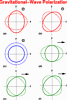
The picture above (click to enlarge) isn't about Flatland, but "Polarization of gravitational waves". The 3-D space of GR has been custom-made non-isotropic, in the sense that the (longitudinal) direction of GW propagation, the " +z direction", is excluded from the "displacements" of the test body. According to LIGO "scientific" collaboration, physical bodies can respond to GWs only in the x/y plane. The " +z direction" is not connected, by any means whatsoever, to the x/y plane, which is why a physical body can enjoy GWs only within the x/y plane. It shouldn't dare to 'stretch and squash' along the direction of GW propagation, or else "the result would be disastrous" for C. M. Will and his colleagues.
Markus Pössel, "The wave nature of simple gravitational waves",
Einstein Online, Vol. 2 (2006), 1008
(Click the image to see the animated "gravitational waves")
To show the "propagation" of GWs in 3-D space, I modified Fig. 22.1 from B. Schutz' book cited above, and inserted one red dot to accommodate the three directions in space (not shown) orthogonal to the h/t plane below.
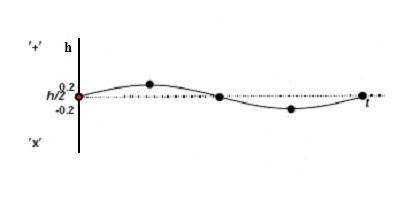
"Each polarization has its own gravitational-wave field," says Kip Thorne. To decipher this tantalizing statement, notice that the "displacement" produced from the '+' GW field and the 45-degree-shifted "displacement" from the 'x' GW field must not overlap in 3-D space (not shown above), to ensure that the test body will receive clear and distinguishable "displacements", with (i) perfect timing along the horizontal line t (as read by the clock of LIGO's operator), and (ii) exact shifting of 45 degrees in the "orientation" of the two "polarizations", '+' and 'x' , in 3-D space (not shown above); details in the so-called SBG problem of "GW astronomy". Also, the black vertical line depicting the alleged GW amplitude h ("something that is dimensionless," exact quote from Kip Thorne's Physics 237-2002) must not be projected on any of the three spatial axes (not shown above) passing through the red dot, or else h will acquire dimensionality, in [meters]. The dimensionless h has been coupled only to the horizontal line t depicting 'time read with a clock'. Details in Bernard Schutz et al., arXiv:0906.4151v1 [astro-ph.CO]:
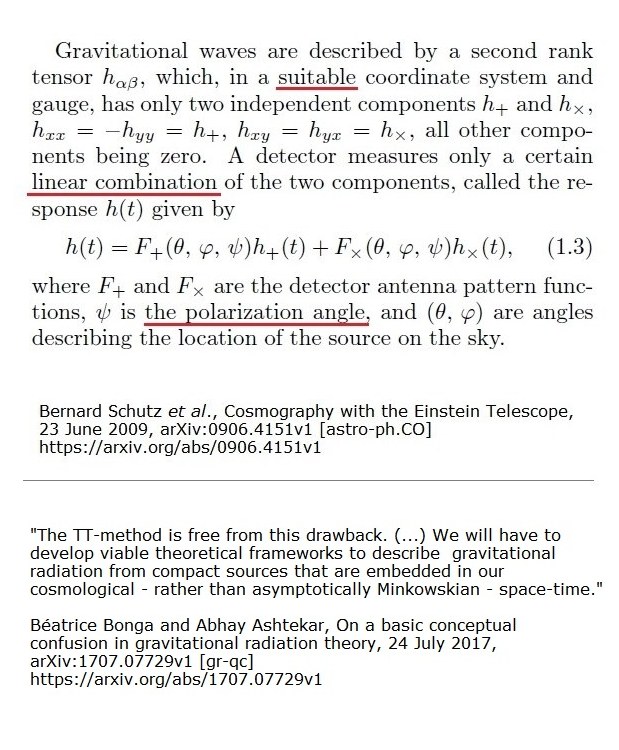
Well, I call this 'GW parapsychology'.
Again, C. M. Will, Kip Thorne, and their LIGO colleagues claim that the GW can propagate only in the +z direction, along which "there is no displacement": all of the "displacement" is confined in the x/y plane. As B. Schutz explained in his book (cf. above), "The fact (there are no "facts" here - D.C.) that gravitational waves are transverse and do not act like the Moon does on Earth implies that they are not part of the curvature of time, since that is where the Newtonian forces originate. They are purely a part of the curvature of space (emphasis mine – D.C.)." I am unable to understand such GW parapsychology. As to the L-shape of LIGO tunnels (the "invariance angle"), it was derived from an article which Kip Thorne has read as a student "around 1960". C. M. Will and his 800+ LIGO colleagues should study arXiv:0709.1603v1 [gr-qc] by Ruben Aldrovandi et al. and arXiv:0809.2911v2 [gr-qc] by Jose Geraldo Pereira et al. [Ref. 1], in order to understand the "nonlinear oscillations along the direction of propagation. This is the signature a gravitational wave will leave in a detector, the effect to be looked for." But they will never study anything that could jeopardize their GW parapsychology. They only ask for more money for the "advanced" LIGO and Virgo. Forget it.
In general, Ruben Aldrovandi et al. reminded us that a "fundamental characteristic of the Yang-Mills field is that it carries its own charge, as for example the color charge carried by gluons in chromodynamics. The Yang–Mills field, therefore, is essentially nonlinear — otherwise it is not a Yang-Mills field" [Ref. 1]. More succinctly (ibid.): "the gauge field of Chromodynamics must be nonlinear to transport color charge." In the framework of the theory suggested in Sec. Summary of ExplanatoryNote.pdf (pp. 35-36), the "total field of as yet unknown structure" (A. Einstein) is also carrying its own 'source', in the form of GPIs of positive & negative "charges", by an Arrow of Space, such that every instant 'now' corresponds to a re-created physical universe (local mode of spacetime), in which the negative "charge" has already been totally canceled (notice that the dynamical, positive-charge remnant from this cancellation is not exactly zero). It is just like the mysterious cat Macavity [Ref. 2], which is always present when there are no physical observers to test it -- any time we look at it, it has already disappeared. Whether one can catch Macavity "along" null intervals [Ref. 3] is very much an open question.
D.C.
December 26, 2011
Last updated: December 28, 2011
[Ref. 1] Ruben Aldrovandi et al., The Nonlinear Essence of Gravitational Waves, Found. Phys. 37, 1503-1517 (2007), arXiv:0709.1603v1 [gr-qc]; Jose Geraldo Pereira et al., Nonlinear Gravitational Waves: Their Form and Effects, Int. J. Theor. Phys. 49, 549-563 (2010), arXiv:0809.2911v2 [gr-qc].
[Ref. 2] Adam Helfer, Are Negative Energy Densities Detectable? arXiv:gr-qc/9709047v1
"T. S. Eliot described a ‘mystery cat,’ Macavity, responsible for all sorts of mischief, but when the crime’s discovered, Macavity’s not there! I investigate the negative energy densities predicted by relativistic quantum field theories, and find they have a similar character. The energy in a region, plus the energy of a device which detects it, must be non-negative. Indeed, as far as has been checked, the total four-momentum density, of the field plus the observing device, must be future-pointing. "In consequence the semi-classical Einstein equation can at best describe negative energy-density
only as long as no observers are present: Macavity, Macavity... he breaks the law of gravity."
[Ref. 3] Kevin Brown, Locality and Temporal Asymmetry
http://www.mathpages.com/rr/s9-09/9-09.htm
This leads to the view that the concept of a "free photon" is meaningless, and a photon is nothing but the communication of an emitter event's phase to some null-separated absorber event, and vice versa.
.....
Taking another approach, it might seem that we could "look at" a single photon at different distances from the emitter (trying to show that its phase evolves in flight) by receding fast enough from the emitter so that the relevant emission event remains constant, but of course the only way to do this would be to recede at the speed of light (i.e., along a null interval), which isn't possible. This is just a variation of the young Einstein's thought experiment about how a "standing wave" of light would appear to someone riding along side it. The answer, of course, is that it’s not possible for a material object to move along-side a pulse of light (in vacuum), because
light exists only as completed interactions on null intervals.
.......
This image of a photon as a single unified event with a coordinated emission and absorption seems unsatisfactory to many people, partly because it doesn't allow for the concept of a "free photon", i.e., a photon that was never emitted and is never absorbed. However, it's worth remembering that we have no direct experience of "free photons", nor of any "free particles", because ultimately all our experience is comprised of completed interactions. (Whether this extends to gravitational interactions is
an open question.)
See also: Kevin Brown, Reflections on
Relativity, MathPages, 2013, Ch. 4
http://www.lulu.com/shop/kevin-brown/reflections-on-relativity/paperback/product-20615854.html

------------------------------------
Comment: In early
September 2011, I tried to explain the "speed" of light and the
so-called global mode of spacetime to a friend of mine, Stavros, as we
were relaxing on the beach near Kavalla, Greece. I don't have a photo,
but I suppose we were pretty much like the two guys below.
Imagine, I said to
Stavros, that you and I are in a train that runs toward the future. We
cannot notice "the future", but can only look at the rail
track backwards from the last carriage, and notice that 'the past' has been
somehow growing and enlarging: more and more events have been moving
from the future into the past due to the phenomenon of
transience in 'the flow
of time'. But notice that the ever-growing past can be detected
only post factum due to the "speed" of
light -- we can't detect any "free photons" nor "free particles",
but only their past states, which are growing 'as time goes on'
and are cast on a perfect continuum called 'local mode of
spacetime'. Also, you know that it takes some time to see my
actual state, just as it takes some eight minutes to see the past state of
the Sun. Now, suppose I
can freely jump off the train (the Arrow of Space)
and move to the global mode of spacetime: I will have all the time I
wish to watch you, the train, and all its potential
railroads ahead, because your time will be frozen, just like
the
proper time of a photon, while I will meanwhile enjoy the whole
global infinite time available to the train. But when I come back
and sit next to you after my "long" walk, you won't notice that I've
been 'out for a walk': to your eyes & wristwatch, I will always
remain right here on the chair next to you. You can't see me
leaving for a walk "outside" the local (physical) mode spacetime.
You can't take off the train with me and realize that it has actually
been moving-and-rotating. All you can
notice is that I've been already (Sic!)
EPR-like correlated with all
beautiful girls here on
the beach, like that fish (see above) was correlated in its
school of fish before it was caught. And if I have
obtained something "during" my walk "outside" the local mode of
spacetime, you will see it as surfacing helter-skelter, and will
of course try to trace it back in your history of our talk ... but you can't
find it in your history of our talk and will have to pronounce it "dark".
For example, if I've been eating a lot "during" my walk "outside" the
local mode of spacetime and have gained weight, you may only
notice
that I've raised a self-acting and
dark belly. Capiche?
Well, my good old friend
Stavros couldn't get it (many people can't
either), so we switched to
differential topology.
NB: Not only
light, but the whole world in
the local mode of spacetime exist only as already-completed interactions on null intervals:
only at the end-point x below. Instead of
contemplating on local interactions within a finite spacetime domain
that includes point x below, or "occurring" in some
non-local fashion only at point x ,
we use a third possibility: quasi-local
interactions in the global mode of spacetime,
which are completed only at the end-point x
from the local (physical) mode of spacetime, but their "duration" will
be read as "zero" by all inanimate clocks (not the
brain).
Notice that quasi-local
interactions pertain only to the
assembled 4-D spacetime, e.g.,
Gravitational Waves
and "dark" matter/energy.

The
end-point x is
one event of emission-and-absorption,
like the instant of clapping hands. The
"intermediate time" of
a "free" photon "during flight", as shown in the animation from
John Walker below, is
not physical.
The Arrow of Space
accumulates 3+1-D spacetime along
null intervals: one-point-at-a-time,
"separated" by zero gaps (Sic!). The
end result is a perfectly smooth and re-created
continuum made by "stacking" 3-D layers of an
already-completed universe: each and every 3-D layer is a dead
fixed block universe, "an unchanging spacetime entity, with no
particular space sections identified as the present and no evolution of
spacetime taking place" (G
F R Ellis, p. 5, Fig. 4).
You may only have 'change within space' there, but such
coordinate time is an illusion.
See an animation of
scanned pumpkin below (source
here),
and bear in mind that the successive accumulation of flat 2D images
produces "time", hence a "pumpkin" in 2+1-D spacetime. In our case,
the Arrow of
Space
accumulates flat 3D images with
infinitesimal or "zero
thickness" to produce 'time as change of
space' (not 'change within space'), hence builds up our universe
in 4-D spacetime. Bear in mind that (i)
'the universe as
ONE' doesn't "move" anywhere (just like the
pumpkin), and (ii) the accumulated
4-D spacetime is wrapped by an indefinable "boundary"
that does not
pertain to the local (physical) mode of spacetime, but to the
global mode of spacetime.
Also, keep in mind that the
"direction" of 'time as change of
space' is orthogonal to the "direction" of 'time as change
within space'. The two "directions" do not overlap:
see the drawing below.
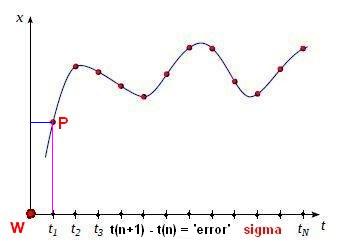
The Arrow of Space is orthogonal to x/t surface, and is
compactified in a red dot w .
The joint x/t displacement is 'change
within space', obtained by merging N-layers in a flat 2-D
image with zero gaps along the w-axis, as explained with Photoshop
layers.

The input at point
Pi (imaginary "mass",
Arthur Eddington)
from the Arrow of Space along
w-axis is converted into
positive mass at P, endowed with inertia (cf. Fig. 1
below).
Notice the different
proposal by G F R Ellis,
pp.
17-18 (links and comments added): "... the transition from
present to past does not take place on specific spacelike surfaces;
rather it takes place pointwise at each
spacetime event. (...) However the constraints on what
future can emerge at a given here-now are not pointwise
constraints but (in relation to any local coordinates) constraints
involving spatial derivatives, or, roughly speaking, neighbouring
points (up to the asymptotic boundaries of
spacetime - D.C.).
"So if evolution takes place pointwise (and on
null hypersurface - D.C.), it still involves
a degree of spatial coordination between
neighbouring points, even though the neighbouring point
might not "yet exist" relative to a different
here-now until it lies in the past."
Notice that the
"direction" of
Arrow of Space is nothing but the red
arrow of the "elevator":
Newton's third law (cf. the second drawing above) does not hold for
wegtransformierbar
gravity. Instead, we have a self-acting "elevator" endowed
with torsion & curvature.
One
perhaps may be tempted to suggest a complex time with real and imaginary
part, in which 'time as change of
space' would be imaginary.
Check out also the second animation below, to understand the dynamics of
gravitational waves 2+1-D
spacetime and the insoluble problems of LIGO
"scientific" collaboration.
Just as it requires a
finite time interval to observe the
past state of the Sun, it
always requires a finite time interval (it could be very
small, yet it is never zero) to observe the world, simply because of the
"speed" of light. And any time we see some past state of the
world, we see these already-completed interactions on null intervals:
only at the end-point x in the NB animation above, at which
the "bi-directional" negotiation between matter
and geometry (depicted with two 'drawing hands' by Escher below) has
been already completed.
Think of the drawing hands as "two" (and
also one) entangled
parties, Alice and Bob. Due to the "speed" of
light, we can say that Bob was influenced by Alice, if only
Alice was already influenced by Bob, etc., ad infinitum.
If we don't wish to talk in past tense, we say that Alice
cannot influence Bob, because before she could do it, Bob
would have to influence her, and the other way around. Either way, we
cannot describe the relational ontology of Alice and Bob,
as it evolves in the flow of time, with relativistic causality, but
because we must keep 'the speed of light barrier', we suggest a new form
of retarded causality, called biocausality, and use Reichenbach's Third Cause
to introduce a third entity:
the universe as ONE (cf. FAQ, Q2).
Recall also that we have the same nonlinear Alice-Bob relations
in GR, but people try to avoid them by eliminating
time and using PDEs.
Also, we have
access with our brain (not "mind") to the
spectrum of all potential states available to the
next state x , kept in
the potential future in the Arrow of Space, and bootstrapped by their
common UNspeakable, pre-quantum,
Kochen-Specker state (never in plural). This
'access' is nothing but the global mode of spacetime, presented
again with the "speed" of light in the animation from
John Walker below.
The "intermediate" time of free
photons is not physical.
Thus, the local
mode of spacetime is being re-created
with such already-created 'world points' x ,
which are "separated" by nothing,
because in this local mode the
w-axis
of the Arrow of Space is zero, and the
resulting continuum is perfectly smooth.
For comparison, recall
Richard W. Sharpe and
Ian D. Lawrie, A Unified Grand Tour of
Theoretical Physics, 2nd ed., Taylor & Francis, 2001, Sec. 2.1:
Given any two distinct
points x , there is nothing
]between[ them.
Zero. Thus, the accumulation of such
already-created points x produces the
dimensions of spacetime along the
Arrow of Space.
Notice also an operational
definition of 'time at point x ' (Jim
Hartle): "Alternatives at a
moment of time can be reduced to a set of yes/no questions."
Namely, the Schrödinger cat is either |alive> or
|dead> at particular instant or spacetime event, as
detected with your macroscopic wristwatch, which in turn operates in
full compliance with Special Relativity.
True, but only and
exclusively only in the local (physical) mode of spacetime, which is
being dynamically re-created with
one "jacket" that has been actualized with
certainty, and therefore we can question its existence with
yes/no propositions from
Boolean logic. In the quantum world, the existence of
potential reality would resemble a virtual "dough"
of potential explications, which may or may not be converted
to physical reality. Thus, the new form of existence of
the quantum world, and the crucial notion of 'quantum reality out
there', cannot be described with "probabilities", because
it has not yet been actualized with certainty:
read Erwin Schrödinger from
November 1950.
At the quasi-local
point x , we have an uncountably infinite
spectrum of latent states (Henry
Margenau) in the global mode of spacetime (see the drawing below),
which is why the geometrical point x is
quasi-local -- it is both extremely local and
extremely non-local, at the same 'moment of time'. In the global
mode of spacetime, all possible questions regarding 'alternatives at a
moment of time' yield one answer only: YAIN (Yes-And-neIN).

This is the job of the
Arrow of Space. The rest is
history.

The first step toward
recovering 'the end-point x ' (see NB
above) is with "two" atemporal waves, which
are being "canceled" to produce the end-point x at every step
'now' of the Arrow of Space. Notice that a
simple mechanistic visualization by
consecutive "reading" and "sending" [Ref. 1]
is
very misleading, for the same reasons why my friend above
couldn't notice the global mode of spacetime 'outside
the train'.
The
atemporal waves inhabit the global mode of spacetime modeled with
potential and pre-geometric "points".
Each of
these UNspeakable pre-geometric
potential "points" is endowed with imaginary time [Ref. 2]
and "two-dimensional
orientation space" [Ref.
1], with which exact alternative models of (i) relativistic causality
(local mode of spacetime) implied by "minus
sign", (ii) the tangent space "at that point" [Ref.
3], and (iii) the "asymptotically flat
initial data" poetry in GR textbooks [Ref.
4] have been suggested.
The basic ideas from
Gottfried Wilhelm von
Leibniz
are kindly reminded by Howard Stein,
p. 28:

But because we are concerned here with quantum gravity, we will avoid, as
much as we can, all theological issues and introduce the so-called
necessary and sufficient conditions for spacetime.
Namely, we
stipulate that the ontology of spacetime is defined by both the
necessary conditions, such as the constituents of matter and
their
relations, and the sufficient conditions for spacetime -- the
global properties of 'the universe as ONE'. Stated differently, we all
agree that there is no 'empty spacetime per se', yet once we have
proper spacetime, there is more to it, because we cannot in
principle deduce all properties of
spacetime from the necessary conditions alone.
If short, we hope to apply
the proposal by
William K. Clifford in ‘On the Space-Theory of Matter’ (February
21, 1870):

The "variation" is shown here with a new
retarded causality, dubbed biocausality, and with
the sufficient conditions for spacetime. The
latter do not originate from some matter-free physical space but from
'the whole universe as ONE' as 'pure
energy': it "has no weight", "does not curve space", and is
"not observable" (MTW, p. 467).
Hence its physical manifestation (for
example, rotation) will inevitably look
"dark", as explained
above.
Mind you, it will be impossible in
principle to detect the Unmoved Mover (Karel
Kuchar) and First Cause, because we would make physical
contact with The Beginning. Therefore, everything from
it (recall Reichenbach's Third
Cause above) will be
untraceable, and will look "dark" to many (otherwise smart)
people.
Now you're ready to go.
D. Chakalov
January 13, 2013
Last updated: October 23, 2013, 16:48 GMT
[Ref. 1] Kevin Brown, Spacetime
Mediation of Quantum Interactions.
http://mathpages.com/rr/s9-10/9-10.htm
"An interesting feature of this
interpretation is that, in addition to the usual 3+1 dimensions,
spacetime requires two more "curled up" dimensions of angular
orientation to represent the possible directions in
space. The need to treat these as dimensions in their own right
arises from the non-transitive topology of the pseudo-Riemannian
manifold.
"Each point [t,x,y,z] actually consists of
a two-dimensional orientation space, which can be parameterized (for any
fixed frame) in terms of ordinary angular coordinates
q
and f.
Then each point in the six-dimensional space with coordinates [x,y,z,t,q,f]
is a terminus for a unique pair of spacetime rays, one forward and one
backward in time.
"A simple mechanistic visualization of
this situation is to imagine a tiny computer at each of these points,
reading its input from the two rays and sending (matched conservative)
outputs on the two rays."
[Ref. 2] Sir Arthur Eddington,
Space,
Time and Gravitation. An Outline of the General Relativity Theory,
Cambridge University Press, 1920, Ch. 3, pp. 47-48.
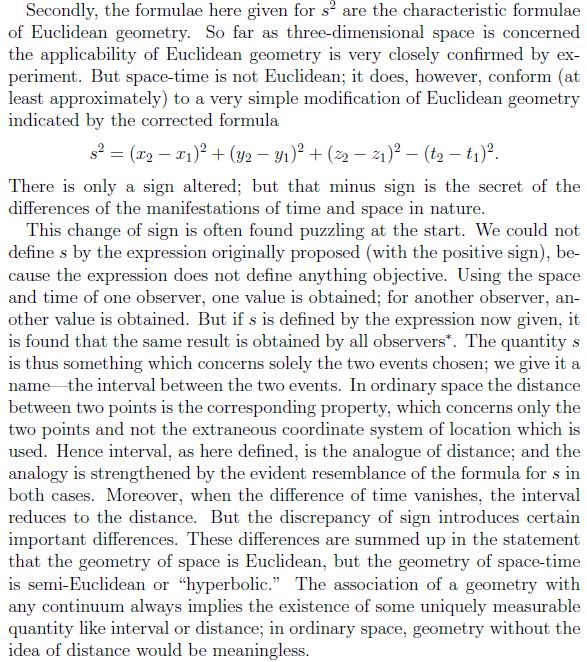
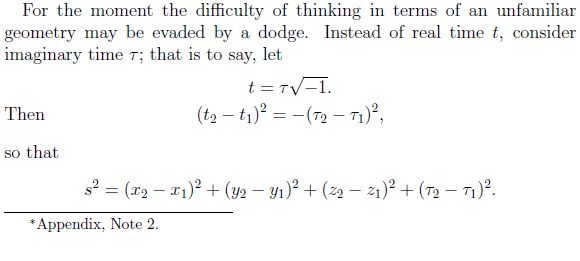
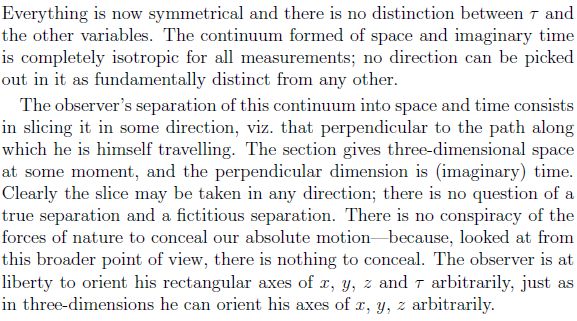
[Ref. 3] David Malament, Observationally
Indistinguishable Space-times, in:
Foundations of Space-Time Theories, ed. by John Earman, Clark
Glymour, and John Stachel, University of Minnesota Press, 1977, pp.
61-80.

Piotr Chrusciel, Lectures on Energy in
General Relativity, March 6, 2012,
p. 166.
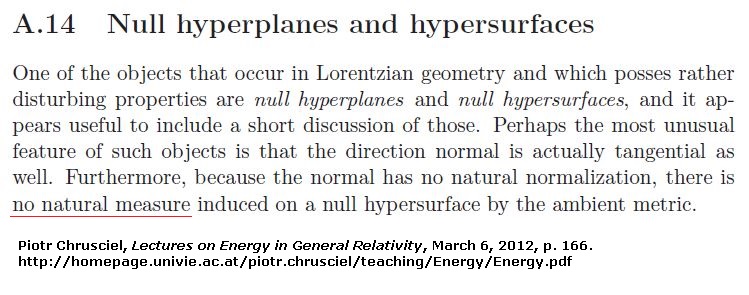
[Ref. 4]
Robert DiSalle, Reconsidering Ernst Mach on Space, Time, and Motion,
in: Reading Natural Philosophy: Essays in the History and Philosophy of
Science and Mathematics, ed. by David B. Malament, Chicago: Open Court
Press, 2002, pp.
167-192.
============================================

Subject: Multiverse ?
Date: Mon, 28 Nov 2011 10:43:43 +0200
From: Dimi Chakalov <[email protected]>
To: Courtney Seligman <[email protected]>
Cc: Baron Rees of Ludlow <[email protected]>,
[email protected], [email protected]
Dear Professor Seligman,
I was struck by your statement at
http://en.allexperts.com/q/Astronomy-1360/2011/10/whole-shabang.htm
"For the Multiverse, the chance of its existing is a 9 or 10. The chance of observing any other part of it is a 0."
I am not aware of any meaningful way of defining probabilities about anything in some "multiverse". To begin with, Andrei Linde and Vitaly Vanchurin tried to estimate the number of universes with different geometrical properties in the "multiverse", and came out with a typical Russian number (arXiv:0910.1589v2, p. 3, Eq. 3).
I wonder if you can help.
Kind regards,
Dimi Chakalov
http://tinyurl.com/Einstein-Prague
====================================
Subject: arXiv:1203.0952v1 [gr-qc]
Date: Tue, 6 Mar 2012 13:34:47 +0200
From: Dimi Chakalov <[email protected]>
To: Brandon Carter <[email protected]>
Cc: Steven Weinberg <[email protected]>,
Don Page <[email protected]>,
Roger Penrose <[email protected]>
Hi Brandon,
You quoted Steven Weinberg: "Of course everything is ultimately quantum mechanical: the question is whether quantum mechanics will appear directly in the theory of the mind, and not just in the deeper level theories like chemistry on which the theories of the mind will be based."
The Marxist-Leninist views of Steven Weinberg are not surprising, but why would you endorse such crap ?
Look first in your field of expertise:
http://www.god-does-not-play-dice.net/#Tod
Take care,
Dimi Chakalov
=====================================
Subject: The classical limit
Date: Tue, 29 Nov 2011 13:02:42 +0200
From: Dimi Chakalov <[email protected]>
To: Basil <[email protected]>
Cc:
Maurice de
Gosson <[email protected]>,
[email protected]
Dear Basil,
You mentioned, in your latest arXiv:1111.6536v1 [quant-ph], that a "merit of our approach is that the classical limit emerges naturally without any need to appeal to decoherence." May I suggest to test your ideas with the case examined by Mott,
http://www.god-does-not-play-dice.net/#Mott_Macavity
I think it would be easier for a camel to pass through the eye of a needle than for your theory to reproduce and explain Mott's 1929 paper.
It's not about probabilities for selecting the direction of particle's propagation in Wilson cloud chamber, as "explained" by Heisenberg in 1930. It's all about energy exchange between a single quantum particle and its classical environment, so you have all QM at a glance -- the proof of the pudding for your earlier statement in arXiv:1001.4632v2 [quant-ph] that "the answer ultimately lies in information theory".
All the best,
Dimi
===================== Subject: Re: The classical limit
Date: Wed, 30 Nov 2011 15:27:50 +0200
From: Dimi Chakalov <[email protected]>
To: Basil Hiley <[email protected]>
Cc:
Maurice de
Gosson <[email protected]>,
Maurice de Gosson <[email protected]>
Dear Basil,
> Thank you for the reference to the discussion of Mott's work. I am very
> familiar with the paper just having written a paper explaining just how we
> see the Bohm theory explains Mott's result:- de Gosson, M., and Hiley, B.
> J., Zeno Paradox for Bohmian Trajectories: The Unfolding of the
> Metatron. quant-ph/1001.2622.
I am very familiar with your arXiv:1010.2622v3 [quant-ph], the notion of ‘quantum potential energy’, and your efforts to explain how continuous observation “dequantizes” quantum trajectories with the quantum Zeno effect.
With the new terminology proposed on p. 4 you posed the question, "What will the trajectory be if we continuously monitor the metatron?"
You quoted Heisenberg’s statement: “By path we understand a series of points in space which the electron takes as ‘positions’ one after another” (p. 13, footnote 2), so if you and Maurice insist on "Hamiltonian character of these trajectories", please explain these sequential ‘positions’ at which you have simultaneously TWO LAYERS, quantum and classical, of *energy exchange*: the first keeps the imaginary phases of the single quantum particle vs. the second one which corresponds to the observed water molecules (the track in Wilson cloud chamber).
With your approximation technique briefly mentioned on p. 14, you and Maurice claim "... which goes to zero when N --> ∞", and "short enough time" (p. 15).
Sorry, this "short enough" is not going to work. You have continuous energy exchange between the TWO LAYERS, which leads to the observed classical trajectory on the second layer, like the trails left in the sky from a jet plane. Then you have to explain both trajectories, on both layers.
Mapping the two layers over a finite time interval, as recorder with your wristwatch, is a formidable challenge, which you and Maurice haven't solved, simply because you can't. If you could, you will "derive" some time operators in your version of QM: reductio ad absurdum.
If you wish to respond professionally, please read carefully my initial email at
http://www.god-does-not-play-dice.net/#Hiley
Recall also my email from Sat, 19 Jul 2003 18:16:16 +0300, subject "The actualization of beables". As you stated in your interview in 1997, the notion of implicate order "is not presented as final form, so it needs a lot of exploration and debate." I will be happy to help.
Again, can you "derive" some time operators in your version of QM ?
All the best,
Dimi
On Tue, 29 Nov 2011 13:02:42 +0200, Dimi Chakalov <[email protected]> wrote:
[snip]
------------ Note: The good thing about math is that you can't disguise your errors with expressions like "... which goes to zero when N --> ∞", and "short enough time." Once you calculate the exact value of this "short enough time", the problems with reproducing the energy dialogue between the single quantum particle and its monitoring/observing macroscopic counterpart become agonizingly clear. D.C.
November 30, 2011
====================================
Subject: Re:
arXiv:1205.4102v1 [quant-ph]
Date: Mon, 21 May 2012 23:01:33 +0300
From: Dimi Chakalov <[email protected]>
To: Maurice de
Gosson <[email protected]>
Cc: [email protected], [email protected],
[email protected], [email protected],
[email protected], [email protected],
[email protected], [email protected],
[email protected], [email protected]
On Mon, 21 May 2012 18:47:46 +0200, Message-ID:
<CAGAkTnzAj7NXjRC0XSd1uKB2tviym+Jpk5ryTtwbQnhKxYPfJw@mail.gmail.com>,
Maurice de Gosson <[email protected]>
wrote:
>
> Buzz off, idiot!
>
>
> Maurice A de Gosson de Varennes
> Personal website:
http://www.freewebs.com/cvdegosson/
> "Wir Mathematiker sind die wahren Dichter, nur müssen wir das,
> was unsere Phantasie schafft, noch beweisen."
> L. Kronecker
Just don't get upset, you're safe, everybody loves you.
I only wish you a peaceful and quiet retirement.
D.C.
On Mon, 21 May 2012 14:22:54 +0300, Dimi Chakalov <[email protected]>
wrote:
[snip]
>> If you really seriously believe can "formulate Bohmian mechanics in a
>> unique relativistic-covariant form", don't forget 'the proof of the
>> pudding' from 1929:
>>
>>
http://www.god-does-not-play-dice.net/#energy_exchange
>>
>> It will immediately kill your "relativistic-covariant" Bohmian
>> mechanics, for reasons explained by Schrödinger in 1931.
=======================================
Subject: Re: arXiv:1202.4886v1 [quant-ph]
Date: Thu, 23 Feb 2012 16:56:01 +0200
From: Dimi Chakalov <[email protected]>
To: Rajat Kumar Pradhan <[email protected]>
Cc: Richard Mould <[email protected]>,
T. P. Singh <[email protected]>,
Basil Hiley <[email protected]>
Hi Rajat,
> While Mott represented one kind of worldview which is very common and
> popular
Mott represents facts, which run against your paper.
> In reply to your question, let me clarify that the following series is
> necessary for the detection of a particle: conscious observer ->
Wrong. You can record tracks without any "conscious observer".
Did you read my email? The trajectory in the cloud chamber is continuous, that is, we have a continuous energy exchange between one single quantum particle and its cloud chamber.
How do you explain this fact known since 1929 ?
> Regarding what the state was during the traversal also cannot be said with
> certainty unless the above-mentioned practical steps of decoding the
> information content of the track are gone through.
It's not "decoding the information," Rajat.
It is energy exchange.
> Without having knowledge of existence of an object how can we say whether
> it exists or not?
How does this question relate to Mott paper ?
> Again, you see it depends on our observation.
No it doesn't. Read the paper and the relevant sources; the references are at my web site.
> Hope your question is amply clarified.
See above.
I will appreciate the professional opinion of your colleagues.
All the best,
Dimi Chakalov
On Thu, 23 Feb 2012 04:16:29 +0200, Dimi Chakalov <[email protected]> wrote:
>
>>
> >Dear Dr. Pradhan,
>>
>> You wrote that "the state of the system is primarily a subjective
>> assignment reflecting the observer's state of knowledge about it", and
>> I am surprised that you missed the 1929 paper by Nevill Mott, which
>> refutes such speculations: you have one single quantum particle which
>> induces (how?) perpetual condensed state in the Wilson cloud chamber,
>> without any need for "observer's state of knowledge about it".
>>
>> Notice that the issue is not about the direction of the particles'
>> path, but in the fact that the trajectory in the cloud chamber is
>> continuous.
>>
>> How can you explain it with your ref [21] (P. A. M. Dirac, Principles
>> of Quantum mechanics, Clarendon press, Oxford, 3rd ed., 1947, p. 48) ?
>>
>> I hope Richard can shed some light on the puzzle as well, since he is
>> also speculating along similar lines.
>>
>> The opinion of your colleagues will be greatly appreciated, too.
>>
>> Regards,
>>
>> Dimi Chakalov
>>
>
========================================
Subject: Re: Twelve years ago, ...
Date: Wed, 30 Nov 2011 19:41:05 +0200
Message-ID:
<CAM7Ekxn9aOaQ1F7mRSpXyDMBkW0C1FWnriHsFi+7CQyKOH0X1g@mail.gmail.com>
From: Dimi Chakalov <[email protected]>
To: Henry Stapp <[email protected]>
Cc: Daryl Bem <[email protected]>,
Abner Shimony <[email protected]>,
Bill Unruh <[email protected]>
Henry:
I still haven't received your reply to my email from Wed, 12 Mar 2008 04:50:42 +0200.
Fifteen years ago, you invited me to your Lab, and even offered me "shelter" during my stay in Berkeley, remember? I was quite tempted to do the trip and show you some simple effects of the human brain, which run against your understanding of QM. Then you raised the issue of my credibility, and asked whether I have some experience with "magic". For if I were some "amateur magician" (exact quote), you warned me that will catch me. Then I somehow lost the desire to see you and discuss the subtleties of Quantum Theory and brain neurophysiology.
Now, regarding your latest arXiv:1105.2053v3 [quant-ph] and the essay by Daril Bem, ref. [1] therein, check out
http://www.god-does-not-play-dice.net/about.html#China
No, Henry, no. This isn't some "magic trick". You have *energy exchange* between the quantum world and a human brain -- not "mind" -- much like the case studied by Nevill Mott,
http://www.god-does-not-play-dice.net/#Hiley
Details at
http://tinyurl.com/Einstein-Prague
I have a lot to say about your latest manuscript mentioned above, but will skip it, because you obviously aren't interested in any discussion that can prove you wrong. The same tallies to Abner and Bill, regrettably.
Wishing you a nice white Hanukkah,
Dimi
====================================
In contrast to electric and magnetic fields, the gravitational field exhibits a most remarkable property, which is of fundamental importance for what follows. Bodies which are moving under the sole influence of a gravitational field receive an acceleration, which does not in the least depend either on the material or on the physical state of the body. For instance, a piece of lead and a piece of wood fall in exactly the same manner in a gravitational field (in vacuo), when they start off from rest or with the same initial velocity.
A. Einstein, The Gravitational Field
http://www.bartleby.com/173/19.html -------------------------------------
Unlike W. Rindler and R. M. Wald, I managed to "understand" GR only once, as a freshman in June 1972, and it didn't last long. Here are some excerpts, with added emphasis, links and comments, from:
Wolfgang Rindler, Relativity: Special, General, and Cosmological, 2nd ed., Oxford University Press, 2006 You sit in a box from which you cannot look out. You feel a ‘gravitational force’ towards the floor, just as in your living room. But you have no way to exclude the possibility that the box is part of an accelerating rocket in free space, and that the force you feel is what in Newtonian theory is called an ‘inertial force’. To Einstein, inertial and gravitational forces are identical.
.......
The piano and the ping-pong ball will follow the same worldline! Thus does GR ‘explain’ Galileo’s principle. To Einstein, the law of geodesics is primary, and a natural extension of free motion in inertial frames. ‘Gravitational force’ is gone.
Since the geometry of spacetime determines its geodesics and thus the motions of free particles, it must be the gravitating masses that determine the geometry. Newtonian active gravitational mass (the creator of the field) goes over into GR as the creator of curvature. Newtonian passive gravitational mass (that which is pulled by the field) goes into banishment along with the ether, etc.
.......
One can further distinguish between active and passive gravitational mass, namely between that which causes and that which yields to a gravitational field, respectively. Because of the symmetry of eqn (1.8) (due to Newton’s third law), no essential difference between active and passive gravitational mass exists in Newton’s theory. In GR, on the other hand, the concept of passive mass does not arise, only that of active mass—the source of the field.
It so happens in nature that for all particles the inertial and gravitational masses are in the same proportion, and in fact they are usually made equal by a suitable choice of unit.
......
The equality of inertial and active gravitational mass then remains as puzzling as ever. It would be nice (no, it won't be "nice" at all - D.C.) if the inertial mass of an accelerating particle were simply a back-reaction to its own gravitational field, but that is not the case.
........
In sum, general-relativistic spacetime is curved. Its curvature is caused by active gravitational mass. The relation between curvature and mass is governed by Einstein’s famous field equations. Finally, free particles (and photons) have geodesic worldlines in this curved spacetime, which accounts for Galileo’s principle.
........
1.5. Give some examples of the absurdities that would result if the inertial mass of some particles were negative. [For example, consider a negative-mass object sliding on (or under?) a rough table.] It is for reasons such as these that mI ≥ 0 is taken as an axiom. -------------------------------------
R. M. Wald, The Arrow of Time and the Initial Conditions of the Universe, gr-qc/0507094: "There is no question that our present universe displays a thermodynamic arrow of time. (...) It seems to me to be far more plausible that the answer to the above question as to why the very early universe was in a very low entropy state is that it came into existence in a very special state. Of course, this answer begs the question, since one would then want to know why it came into existence in a very special state, i.e., what principle or law governed its creation. I definitely do not have an answer to this question."
-------------------
Subject: Re: The freely falling bodies display the same acceleration, independent on their compositions: WHY ?
Date: Tue, 13 Dec 2011 21:16:41 +0200
Message-ID:
<CAM7Ekx=B7JHfKdQiftA_jy4K=C+xvG8tQqZ3_51DbZB=imp-2A@mail.gmail.com>
From: Dimi Chakalov <[email protected]>
To: Orfeu Bertolami <[email protected]>
Cc: Alan Rendall <[email protected]>,
David M A Stuart <[email protected]>,
John Friedman <[email protected]>,
John Stewart <[email protected]>,
John Stachel <[email protected]>,
Karel V Kuchar <[email protected]>,
Lluís Bel <[email protected]>,
"O'Murchadha, Niall" <[email protected]>,
Lars Andersson <[email protected]>
Dear Orfeu,
> Well, the conventional answer is well known: it is a feature of the
> space-time, not of the bodies.
My "unconventional" answer is that it is a feature of an Arrow of Space which drives the whole universe en bloc with *constant acceleration* (cf. the Java applet in the link below) along some "direction" we just call 'time'. The latter has two components: change-in-space (local mode) and change-of-space (global mode),
http://tinyurl.com/Einstein-Prague
Regarding the geodesic hypothesis, Alan Rendall acknowledged: "In elementary textbooks on general relativity we read that the Einstein equations imply that small bodies move on geodesics of the spacetime metric. It is very hard to make this into a mathematically precise statement which refers to actual solutions of the Einstein equations (and not just to some formal approximations)."
http://relativity.livingreviews.org/open?pubNo=lrr-2005-6&page=articlesu38.html
Notice that Alan Rendall didn't even mention that 96% of the stuff in the universe, which is "dark" and moves on some weirdly modified geodesics.
With an Arrow of Space, however, there is no need for any dark *physical* stuff, simply because it is replaced with GPIs; see the first link above. As a bonus, you have Quantum Theory reconciled with GR from the outset.
I do hope to see you in Prague next June. We'll have a jolly good time...
All the best,
Dimi
On Tue, 13 Dec 2011 01:05:29 +0200, Dimi Chakalov <[email protected]> wrote:
>
>
>> Because of the Arrow of Space,
>>
>> http://tinyurl.com/Einstein-Prague
>>
>> I trust you have different answers to the question in the subject
>> line... any chance to see you in Prague next June?
>>
>> All the best,
>>
>> Dimi
>>
>
------------ Note: The first apothegm of GR is that there is no spacetime without matter. To explain this axiomatic statement to my teenage daughter, I asked her to imagine that she cannot "see" her nails unless they are covered with some nail varnish of particular 'color': bare finger nails (the reference fluid) are unobservable in GR. They are simply GPIs. Hence the Arrow of Space, which endows all matter with universal "acceleration" that "does not in the least depend either on the material or on the physical state of the body" (A. Einstein), represents the continuous conversion of GPIs into (colored, after the KS Theorem) physical stuff: it is the global "time direction" conjugate to the energy (Anthony Lasenby et al., arXiv:1008.4061v2), in which the energy of the 'colored finger nails' is not conserved (Sean Carroll). The energy of the Arrow of Space is conserved only in the so-called global mode of spacetime, by an almost exact nullification of two GPI "charges"; cf. Eq. 1, pp. 35-36, in ExplanatoryNote.pdf. The notions of 'energy' and 'spacetime' should be understood as adjectives: for example, we don't say 'energy' unless we explain 'energy of what?', and we don't say "dark" unless we explain what is "dark", and with respect to what. So, once we have spacetime identified by its material content, the obvious question is, are all features of spacetime identified exclusively by the (colored) matter? Nope. There is something 'more' to spacetime, which cannot be derived entirely from its material content (for example, try to reproduce 'one second' with physical stuff conforming to the Archimedean geometry, as in the Gedankenexperiment described by Orfeu Bertolami above). Namely, 'there is no matter without its non-Archimedean GPIs' (the proposed second apothegm of GR, after Plato). The conversion of GPIs into physical ("colored finger nails") stuff is complemented by additional holistic effects that cannot in principle be derived from matter. One good example is 'time-orientability'. Another is the tug-of-war manifestation of gravity. All these are purely geometrical effects created by GPIs -- not by Type I matter fields satisfying (supposedly) the energy conditions. There is no need for any physical stuff to create the observable CDM effect of gravity, just as there is no physical axis of electron's spin. At large length scales, galaxies rotate (as well as the whole observable universe) due to the fundamental phenomenon
of 'spin' produced by GPIs. By altering the 'invariant finite templates' (cf. Finite Infinity above), the physical content of the rotating galaxy has no choice but to 'get attracted' toward the "dark" (non-baryonic) center of that galaxy. By the same token, there is no need for any "singularities". As Alan Rendall acknowledged in arXiv:gr-qc/0503112v1, p. 14, "The study of these matters is still in a state of flux." Fine, but we just can fit so much anomalous matter with positive energy density in the universe. Now, imagine the elementary building block of geometry as dimensionless infinitesimal -- just think of it as something with "size" tending asymptotically toward zero, just like 'the empty set R'. This 'something' isn't matter but geometry -- 'the grin of the cat without the cat', as observed by Alice.
The first apothegm of GR is that there is no 'smile' without the 'cat'; the second one is that the physical 'cat' and its purely geometrical 'smile' are dynamical due to their negotiations facilitated by GPIs. The whole issue is about the genuine dynamics of GR. What is the fundamental 'tick' of time -- the "intrinsic time interval associated to any timelike displacement" (Ted Jacobson, pp. 18-19)? We never say that 'the rate of time' can be expressed with 'time', say, 1000 ms per second. Neither can we reconstruct a finite volume of space (say, a sphere with radius one meter) with some finite element that has spatial nature and conforms to the Archimedean Axiom.
The fundamental "displacement" of spacetime can only be produced by an Arrow of Space, as 'change-of-space' along some "direction" which we simply call 'time'.
The fundamental "displacement" itself is not present in the local mode of spacetime: it is hidden, by what we call 'speed of light', ]between[ any two adjacent points from the manifold of the local mode, rendering the latter a perfect continuum. The fundamental Aristotelian Connection, which transfers physical influences in such perfect continuum with speed not exceeding the "speed" of light in vacuum, is executed by 'the whole universe as ONE' placed ]between[ any two adjacent points from the manifold of the local mode of spacetime. Hence the Aristotelian Connection is physically non-existent -- an Unmoved Mover, as stressed by Karel Kuchar. NB: Notice the new form of retarded causality (called biocausality), resulting from such re-created, at each and every instant 'now' from the Arrow of Space, Phoenix Universe -- the concept of Final Cause ("the end (telos), that for which a thing is done", Aristotle, Physics 194b33) complements the relativistic causality, in line with Conway-Kochen Free Will Theorem: "It also makes it clear that this failure to predict is a merit rather than a defect, since these results involve free decisions that the universe has not yet made." Stated differently, the fate of the universe is UNdecidable, being opened to brand new events emerging from 'the unknown unknown'. Every instant 'now' from the Arrow of Space contains more information unfolding from 'the Noumenon at absolute rest', and such 'information gain' is irreversible. Briefly, the fundamental dimensionless "displacement" -- the empty set R -- does not have generic temporal or spatial nature. It builds up -- dynamically, with the Arrow of Space -- the spacetime continuum equipped with 'speed of light'. It is nothing but a dimensionless and purely geometrical entity, called here Aristotelian Connection.
So, the ADM picture below is highly misleading, to say the least, because it suggests some finite size of the dimensionless infinitesimal, and then literally installs some "lapse" and "shift" inferred from the postulated 'time-orientability' that has been introduced by hand from thermodynamics (Sic!) from the outset. It's a bit like saying that 'heat' is due to some tiny little and very hot particles, instead of searching for the emergent phenomenon at work, by reducing 'heat' to something that is anything but 'hot'. Such efforts are in the same vein of those post hoc "anthropic principles" in cosmology.
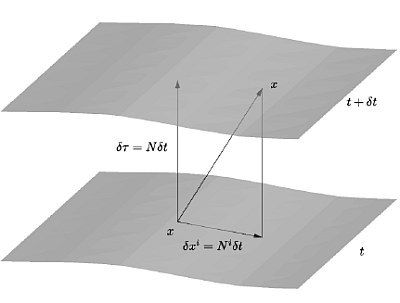
Nevertheless, consider the drawing above as two snapshots taken from the "dark room" with our "torch", as you do in GR textbooks. Suppose you can produce infinitely many (uncountably infinite) snapshots like those above, then stack them along the "skewer" of the Arrow of Space like Photoshop layers, and flatten them onto one (.JPG) image -- you will end up with a timeless "trajectory" immersed in a dead frozen block universe, in which "time" can evolve just as much as "space" can: "There is no dynamics within space-time itself: nothing ever moves therein; nothing happens; nothing changes" (Robert Geroch). You can never trace down the "dark energy" that has been smuggled into this flattened (.JPG) image from the "dark room", and can never solve the Cauchy problem for the Einstein field equations either.
NB: It is wrong to suggest "splitting" of spacetime by imagining one dimensionless infinitesimal geometrical point on which four distinguishable vectors are "erected" -- three "tangential" and one "orthogonal", as in the drawing below, just as it is wrong to even think of some "center of the balloon" (or "big bang") residing some 13.75 ± 0.13 billion years down the road along the "orthogonal" vector.
The drawing above shows only the kinematics of GR -- 3-D space at
one dead frozen instant. The genuine dynamics GR needs
infinitely many instants at which the negotiations between the two
sides of the Einstein filled equations are already
settled. You can't take this 'one dead frozen instant' from the
kinematics of GR and use it to model the dynamics of GR, because you
don't have some fixed background spacetime on which to "unfold" the
dynamics by unitary transformations of 'states' resembling different
states of a kaleidoscope, say.
To sum up, recall the 'laws of an instant' (Karel Kuchar) and the rigorous proof of Charles Torre that GR is not a parameterized field theory. I can also offer a selection of excerpts (emphasis added) from the Lecture Notes of Harvey S. Reall [Ref. 1], which can (hopefully) explain the issues of geodesic hypothesis in a "curved spacetime" and the 'time-orientability', introduced in GR just 'by hand', that is, with magic. The Arrow of Space is supposed to eliminate that "magic", and replace the alleged "curvature" of spacetime (John Baez) with 'properties of the Aristotelian Connection'. The metric is dynamical and global-time-dependent: 'constant gravitational field' [Ref. 2] pertains only to one snapshot 'now' from the Arrow of Space, about which we can indeed say that “there’s energy in the gravitational field, but it’s negative, so it exactly cancels the energy you think is being gained in the matter fields” (Sean Carroll). Briefly, if you picture 'the whole universe' defined with Finite Infinity as a school of fish, its bootstrapping gravitational energy will pertain (and could only be defined) to 'the whole universe/school', yet the gravitational energy at each point from the quasi-local geodesic of each and every (colored) fish will be perfectly well localized -- dynamically, one-at-a-time, along the Arrow of Space -- with strictly positive mass. The latter will exhibit "runaway motion", being chased by its "negative" GPI counterpart from the global mode of spacetime, and will be endowed with free fall, as discovered by Galileo in 1638. Following the rule 'think globally, act locally', the influence from 'the school of fish' on every quasi-local fish will be camouflaged as 'self-force', and the poor fish will be bewildered by its own "dark energy" forever. We should be smarter. Yes, we'll have a jolly good time in Prague... provided I am allowed to talk. The task is strictly mathematical, and cannot be explained with any poster.
D. Chakalov
December 14, 2011
Last updated: December 27, 2011, 15:16:47 GMT
[Ref. 1] General Relativity 2011, by Harvey S. Reall, December 2, 2011.
Sec. 3.3, Geodesics, p. 37:
Sec. 5.2, Energy-momentum tensor, pp. 55-56: "Gravitational energy certainly exists but not in a local sense."
-------
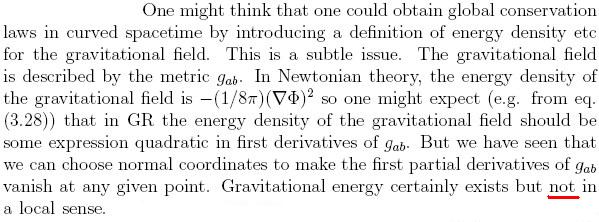
Sec. 8.4, The energy in gravitational waves, pp. 93-95: "Gravitational waves carry energy away from the source. Calculating this is subtle: as discussed previously, there is no local energy density for the gravitational field." 
Sec. 11.5, Global hyperbolicity, p. 126: 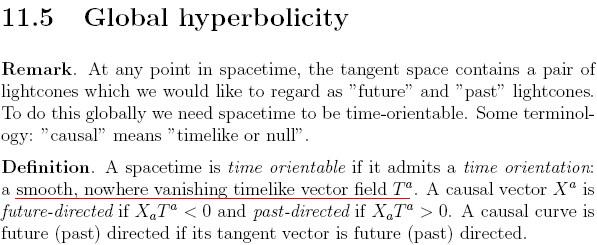
[Ref. 2] R. Aldrovandi and J. G. Pereira, An Introduction to General Relativity, March-April/2004
http://www.ift.unesp.br/gcg/igr.pdf


====================================
In rebus mathematicis errores quam minimi non sunt contemnendi.
Bishop George Berkeley
-----------
Subject: The Big Question, by Paul Tod
Date: Tue, 20 Dec 2011 13:13:28 +0200
Message-ID:
<CAM7EkxmoeWBtDQ2Wv1cuwJmWw1aoR5pE3-qXOo-ReqfOaUeueg@mail.gmail.com>
From: Dimi Chakalov <[email protected]>
To: Paul Tod <[email protected]>
Cc: George <[email protected]>,
Jörg Frauendiener <[email protected]>,
Sergiu Klainerman <[email protected]>,
Malcolm MacCallum <[email protected]>,
Steven Weinberg <[email protected]>,
Robert Geroch <[email protected]>,
Alan Rendall <[email protected]>,
Helmut Friedrich <[email protected]>,
Richard Schoen <[email protected]>,
Piotr T Chrusciel <[email protected]>
Dear Dr. Tod,
Regarding your 'Big Question' posed at '50 years of the Cauchy problem in General Relativity' (cf. attached), I believe the Cauchy data themselves do not "evolve" at all, and have tried to suggest alternative ideas about Geroch-Kronheimer-Penrose ideal points and Finite Infinity (GFR Ellis) as a causal boundary,
http://tinyurl.com/Einstein-Prague-details
http://tinyurl.com/Einstein-Prague
I will be happy to see you and your colleagues in Prague next June. The task boils down to suggesting a new (to the best of my knowledge) differentiable structure of the manifold used to model 'spacetime'.
Wishing you and your colleagues a nice white Christmas,
Yours sincerely,
Dimi Chakalov
-------- Note: Suppose you chase somebody on the street (let's call him John), and any time you catch him, he leaves his jacket in your hands. You can't catch John. Just his jackets -- one-at-a-time. You also believe that he has a set (or is it strictly a set?) of jackets with different probability-for-catching, and you also deeply believe and hope that this set can be normalized, i.e., the sum of probability-for-catching his jackets is unity. This elusive John does not ware any jacket by default (cf. the Kochen-Specker Theorem above) -- neither before nor after you catch his "current" jacket1. John is simply an GPI, and lives in the so-called global mode of spacetime. So, if you manage in GR2 to catch his jacket like a bartender, don't even think you've caught John: he is a special causal boundary, placed at Finite Infinity, which pertains to the whole universe as ONE.3 Depending on the "direction" we look at John from the physical (local) mode of spacetime, his "size" would seem to be either 'tending asymptotically toward zero' or 'tending asymptotically toward infinity', while he is, and will always remain, ONE entity. Which is why we need a new differentiable structure of the manifold used to model 'spacetime', which will be "quantised" from the outset, as argued above (prompted by Tod's adjective 'smooth' and 'the smoothest manifold' usually mentioned in footnotes; cf. Lars Andersson above). Stated differently, [John 1:1] is always at 'absolute rest', residing within the instant 'now' from the Arrow of Space. What we celebrate at Christmas is an entirely different thread.
D.C.
December 20, 2011
Latest update: December 21, 2011
--------
1 In general, a variable has no definite value before I measure it; then measuring it does not mean ascertaining the value that it has. But then what does it mean?
Erwin Schrödinger, 1935
2 In the first place, we entirely shun the vague word "space," of which, we must honestly acknowledge, we cannot form the slightest conception.
Albert Einstein, 1920 3 Notice the inability of mathematical physicists to explain this quantum spacetime phenomenon: for example, José M.M. Senovilla acknowledged (emphasis added) that "singularities (...) clearly reach, or come from, the edge of space-time. This is some kind of boundary, or margin, which is not part of the space-time but that, somehow, it is accessible from within it." The meaning of "somehow" refers to Thompson's lamp paradox; the meaning of "accessible from within it" is the recipe of bartenders, and the meaning of "not part of the space-time" is explained with John's jackets story above: the "jackets" are indeed "accessible from within" spacetime. John isn't. The mathematical solution is 'out there', waiting to be uncovered, after the astonishing effectiveness of mathematics in the natural sciences (Eugene Wigner).
===========================================
Subject:
Relativity and Gravitation, Prague, June 25 - 29, 2012
Date: Thu, 22 Dec 2011 14:15:11 +0200
Message-ID:
<CAM7Ekxmkc5YGHXUtNqN9WsVF9GprcJgPY9Vs6=er2D_g05Y7Ng@mail.gmail.com>
From: Dimi Chakalov <[email protected]>
To: Hermann Nicolai <[email protected]>
Cc: Thomas Thiemann <[email protected]>
Dear Dr. Nicolai,
I submitted the abstract of my intended oral presentation at the Conference in Prague next June. I would like to suggest an Arrow of Space, which requires a new quantisation of the gravitational field, preserving the continual nature of spacetime at all length scales; please see some of the prerequisites at
http://www.god-does-not-play-dice.net/#Tod
I wonder if you would endorse my oral submission to the Conference. Will be happy to provide specific details on my intended talk.
A shorter version of my proposal for quantisation of spacetime was submitted at GR 17 (July 2004), but Dr. Thiemann downgraded my talk to poster presentation, which I had to decline -- I cannot compete with the proponents of the "splitting of spacetime" with a poster.
Looking forward to hearing from you,
Yours sincerely,
Dimi Chakalov
http://tinyurl.com/Einstein-Prague
=========================================
Subject: Remark on causality and particle localization, Phys. Rev. D 10, 3320-3321 (1974)
Date: Mon, 27 Feb 2012 23:00:20 +0200
From: Dimi Chakalov <[email protected]>
To: Gerhard C Hegerfeldt <[email protected]>
Cc: Hermann Nicolai <[email protected]>,
Thomas Thiemann <[email protected]>,
Alfredo <[email protected]>,
Jeremy <[email protected]>
Dear Dr. Hegerfeldt,
Thank you very much for the copies from your articles, which were received today. I particularly liked your 1974 'Remark on causality and particle localization' -- it is a joy to read (and to hold paper in my hands, instead of reading .pdf files on my PC screen).
May I share with you my unsolicited thoughts. Your first assumption, (i), and 'Definition' (p. 3320) is 'strict localizability in V with unit probability'. You elaborated a bit on the causality conundrum (ii) on p. 3321, by suggesting modification of assumption (i), "although this would mean a departure from the customary rules of quantum mechanics."
Bingo! You hit the nail on the head: strict localizability at a point x in V with unit probability can be possible only if the particle is 'quasi-local' -- please see the story about John's jackets and the interpretation of Kochen-Specker Theorem at
http://www.god-does-not-play-dice.net/#Tod
http://www.god-does-not-play-dice.net/#Joel
The departure from the "customary rules of quantum mechanics" has been anticipated by Erwin Schrödinger in 1935 and in 1950; the references are at my web site.
If you disagree with my interpretation at the links above, please try to explain the continuous energy exchange between one single quantum particle and its macroscopic environment, after Nevill Mott,
http://www.god-does-not-play-dice.net/#energy_exchange
BTW Hermann Nicolai suggested on SAT 1 TV (June 7, 2004) that the classical world emerges from Feynman paths. Can you explain smooth bi-directional transitions between the quantum realm and the world of tables and chairs?
Thank you, once more, for your beautiful articles.
Kind regards,
Dimi Chakalov
--------
Note: Look at T. G. Downes, G. J. Milburn, Optimal Quantum Estimation for Gravitation, arXiv:1108.5220v1 [gr-qc], Sec. 6:

What kind of 'time' is implied in the function a(t) ? With respect to what ? More below.
D.C.
February 28, 2012
==========================================
Subject: The continuum limit toward classical gravity vs. arXiv:1105.3385v2 [gr-qc]
Date: Fri, 3 Feb 2012 05:18:05 +0200
Message-ID:
<CAM7Ekxmt_+7YZW_3AStcduZGTHOrCuQGqVsbnBMQBXSZOKyRGQ@mail.gmail.com>
From: Dimi Chakalov <[email protected]>
To: Johannes Tambornino <[email protected]>
Cc: [email protected],
[email protected],
[email protected],
[email protected],
[email protected],
[email protected],
[email protected],
[email protected],
[email protected],
[email protected],
[email protected],
George <[email protected]>
Dear Johannes,
I'm afraid you cannot suggest any quantum gravity hypothesis with which you could hope to reach the *continuum limit toward classical gravity*, such that we could "look around, and see as far as we can" (L. Smolin, Three Roads to Quantum Gravity, p. 205). That's 'the proof of the pudding' for any viable approach toward quantum gravity, isn't it ?
But you don't have this 'proof of the pudding' even in GR: "If the theory does not allow us, even in principle, to extend solutions arbitrarily far in one direction, it may be difficult to view this direction as a dimension of the world", says M. Bojowald in 'Relativity and the Dimensionality of the World' (ed. by Vesselin Petkov, Springer, 2007, Ch. 8, p. 149).
If you agree, we should fix GR in the first place; for example, check out my efforts to amend George's Fi at
http://www.god-does-not-play-dice.net/#Beig
I will appreciate your professional comments, as well as the opinion of your colleagues.
All the best,
Dimi
====================================
We haven't the money, so we've got to think!
Lord Rutherford, 1962 Brunel Lecture, 14 February 1962
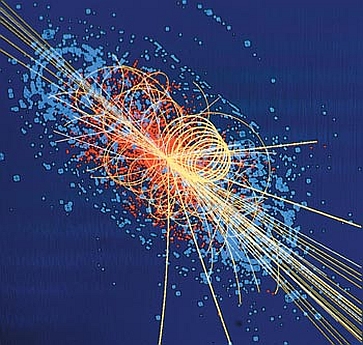
In the winter of 1987, I had a huge discussion at BG Academy of Sciences with a theoretical physicist with PhD from Dubna (USSR), who claimed that there is no problem of reconciling QM with Special Relativity: 'look at the tracks from particles, and measure their duration with your wristwatch -- a single quantum particle, with perfectly defined energy states along a continual trajectory -- where's da problem' ? It isn't a problem but an ultimate paradox: you can think of elementary particles as invisible Frisbees that leave tracks in modern detectors, as well as think about their instantaneous energy states and coordinate time à la Lev Landau, but to apply your "thinking" to Quantum Theory you need two very different things: the "jackets" from John, and John himself. The latter is a GPI, while the former are its 'shadows on Plato's cave' that trigger the appearance of tracks at the length scale of tables and chairs. The issue was identified by Nevill Mott in 1929, and continues below. The sole difference is that now it involves billions and billions of Euro, taxpayers' money. D. Chakalov
January 8, 2012
---------------------
 | 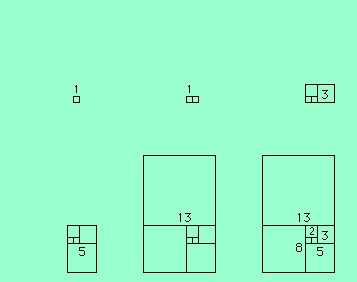 |
Subject: "I bet $100 that the Higgs will not be discovered". Thursday, January 9, 2003, 15:56:04 GMT
Date: Fri, 6 Jan 2012 16:37:26 +0200
Message-ID:
<CAM7EkxkQL_i596TAdv33o81GY1iwaPyq1ZXGceQMVnzWMtaX4w@mail.gmail.com>
From: Dimi Chakalov <[email protected]>
To: Roman Jackiw <[email protected]>
Cc: Giuseppe Vitiello <[email protected]>,
Robert Jaffe <[email protected]>,
[email protected],
[email protected],
[email protected],
[email protected],
[email protected],
[email protected],
[email protected],
[email protected],
[email protected]
Dear Roman,
Nine years ago, you were very skeptical about my $100 bet against the discovery of the Higgs boson(s). The latter are GPIs,
http://tinyurl.com/Einstein-Prague
I reinstate my bet, and extend it to all your colleagues.
Regards,
Dimi
-----------
I bet $100 that the Higgs will not be discovered. Instead, the number of quarks will jump to 8 and more, in a Fibonacci sequence.
D. Chakalov
Thursday, January 9, 2003, 15:56:04 GMT
----------------------------------------
Note: Back in January 2003, I offered this bet to at least 135 theoretical physicists (could be many more, because at some point I lost track of my huge mailing lists). The only reply came from Roman Jackiw, in a very informal email, which I keep private. Nobody from CERN acknowledged my email. As Johann Makowsky noted (The Jerusalem Post 19.4.1985), "Overfunded research is like heroin: It makes one addicted, weakens the mind and furthers prostitution." These people at CERN have billions and billions of Euro at the tip of their fingers, so why should they care about the unresolved task known since 1929, from Sir Nevill Mott? Although they don't use the ancient cloud cambers, the fundamental puzzle of the tracks remains unsolved. In fact, all unresolved tasks in QM are captured with the puzzle from Sir Nevill Mott. Going back to the bet: think of the quantum world as possessing different "layers" of GPIs, with different "volumes" of potential observables explicated by GPIs. At the first layer of non-relativistic QM, the GPIs absorb the 'latent observables', after Henry Margenau; at the second layer the GPIs absorb what Henry Margenau called 'possessed observables': in QCD the mass of elementary particles is "decomposed" with the so-called quarks, which are totally "confined" by default. At the time Murray Gell-Mann coined the term 'quarks', only three quarks were discovered; the situation now is far more complicated, mainly because there is no theory to predict the exact mass of the mythical Higgs boson(s). Yet there should exist a third layer at which the electron can be "decomposed" with quarks (C. Kodejska and J. Markovitch), and I bet people will notice that quarks too follow a Fibonacci sequence: pentaquark, octaquark, tridecaquark, etc. Would you believe that Mother Nature has missed the quarks, only because people don't have a proper theory? I don't know how quarks are related to Georgi's unparticles, so I can't be more specific. But the idea that the very entity which endows particles with 'mass' would in turn possess 'mass' seems very primitive to me. Do we explain heat with some tiny little, very hot particles? This is a typical Marxist-Leninist philosophy, which just can't be correct. Think of the school of fish above as the standard model: all fish interact via "bosons" (explanation from Giuseppe Vitiello here). Think of the "background field" and the "clustering in the Higgs field" from David J. Miller as influences from 'the school' on its bosons: the mechanism for "giving other particles mass" (idem) is real (in the sense that the W and Z bosons were detected), but the "god particle" itself isn't. It cannot be derived from the framework of the standard model: it is an 'undecidable proposition' (Kurt Gödel), which can be clarified only in some meta-theory that includes the electron. And then the quarks will display its Fibonacci sequence; details from T. E. Phipps Jr.
The same 'school of fish'-phenomenon from the Arrow of Space, implemented at macroscopic scale, endows matter with self-acting, without any real "graviton" -- in both cases we have a field that carries its own charge [Ref. 1]. To avoid any misunderstandings, let me formulate the thesis as clear as possible: NB: There exists a fundamental feature of the spacetime itself, which cannot be reduced to the properties of classical and quantum fields, and which endows all matter and fields with the faculty of 'self-acting'. In the quantum realm, this non-linear phenomenon is implemented with "clustering in the Higgs field" (David J. Miller), but "without there being a Higgs boson" (idem), while at the length scale of classical physics the same non-linear phenomenon is implemented with what we call 'gravitation', without any real "graviton" either. In both cases, matter and quantum fields interact with themselves via their GPI states placed in the potential future of the Arrow of Space. No real particle is embodied as 'carrier' of this fundamental interaction -- it is a feature of the spacetime itself, and cannot be reduced to, nor derived from, the physical properties of classical and quantum fields. The latter emerge as the result from a spontaneous broken symmetry of the GPI states of two mass "charges" [Ref. 1], one of which is being completely eliminated as 'physical reality', in the sense that it cannot be physically observed, leaving only the unique pattern of self-acting cast on the physical (positive) mass, and a remnant from the spontaneous broken symmetry in the quantum vacuum. The remnant has finite non-zero positive mass, and is being interpreted as "dynamical dark energy" (DDE), without any possibility to trace back its source. Any efforts at interpreting the source of DDE as 'physical stuff with positive energy density and negative pressure' ("the stress-energy tensor of the vacuum must be Lorentz invariant", Ned Wright) must be wrong. I believe the 'thesis' above is falsifiable, albeit indirectly, by the claim of being 'unique and the only possible': any alternative approach toward the origin of (i) the free fall, (ii) the Higgs boson(s), and (iii) the "dynamical dark energy" (DDE) must necessarily be wrong. Regarding (ii), the 'total field of as yet unknown structure' (Albert Einstein), called here 'GPI field', is not like "other quantum fields": it does not have "its own representative" [Ref. 1] in the quantum world, just as the gravitational field does not, and cannot have some dedicated material carrier of the non-linear gravitational interactions, in terms of some "graviton". The quest for detecting the "god particle" is about quantum gravity. There's nothing more important than quantum gravity. Nothing else matters. Anyway, if there is no reply to my bet above, I can make it more attractive by switching to Euro -- € 100. By the time LHC proves the non-existence of Higgs boson(s) and people realize that the number of quarks will jump to 8 and more in a Fibonacci sequence, the U.S. dollar may collapse and I would have to raise the bet to $1000. Not a good idea.

Perhaps it is time to bet with Euro. Or maybe Yuan?
D.C.
January 6, 2012
Last updated: January 11, 2012, 15:12:46 GMT
[Ref. 1] The Nobel Prize in Physics 2008: Unravelling the hidden symmetries of nature.
The Royal Swedish Academy of Sciences, October 16, 2008, pp. 7-8
Higgs provides mass
The question of the mass of elementary particles has also been answered by spontaneous broken symmetry of the hypothetical Higgs field. It is thought that at the Big Bang the field was perfectly symmetrical and all the particles had zero mass. But the Higgs field, like the pencil standing on its point, was not stable, so when the universe cooled down, the field dropped to its lowest energy level, its own vacuum according to the quantum definition. Its symmetry disappeared and the Higgs field became a sort of syrup for elementary particles; they absorbed different amounts of the field and got different masses. Some, like the photons, were not attracted and remained without mass; but why the electrons acquired mass at all is quite a different question that no
one has answered yet.
Like other quantum fields, the Higgs field has its own representative, the Higgs particle. Physicists are eager to find this particle soon in the world’s most powerful particle accelerator, the brand new LHC at Cern in Geneva. It is possible that several different Higgs particles will be detected – or none at all.
Other theories exist, some more exotic, some less so. In any case, they are likely to be symmetrical, even though the symmetry may not be evident at first. But it is there, keeping itself
hidden in the seemingly messy appearance.
----- Comment: At the Beginning (forget about "big bang"), the GPI field was indeed "perfectly symmetrical": check out Eq. 1 on p. 35 from ExplanatoryNote.pdf and Fig. 1 from 'Finite Infinity (Second Edition)' above. The "spontaneous" broken symmetry is what eliminates all "negative mass", at each and every instant 'now' from the Arrow of Space -- not just at the Beginning, but right now as well, as you're reading these lines. To understand the mechanism of eliminating all "negative mass," we need first to understand the origin of the positive mass and its ubiquitous 'free fall' from the Arrow of Space. Notice that the 'standard model' does not incorporate gravity and never will, because it can't. People at CERN should at least try to incorporate the electron, and check out how many quarks will show up in such leptoquark model (hint: forget about "supersymmetry" and "Higgs boson"). Hence my prediction above, from Thursday, January 9, 2003, 15:56:04 GMT. Good luck.
D. Chakalov
January 8, 2012, 19:22:10 GMT
=================================
Addendum
To explain the thesis above in the context of Higgs boson(s), I will reproduce a popular Feynman diagram from Wiki (source here). Seth Zenz, the person who submitted this diagram on 23 October 2005, believes that such experimental results would constitute a discovery of Higgs bosons, since it would be "very difficult to fake in other processes".

The list of people from the ATLAS Collaboration is immensely huge: 3200+ people (cf. pp. 16-23 in arXiv:1107.3311v2 [hep-ex]), which is 4 times more than the members of LIGO "scientific" collaborations, just 800+ people. I suppose all member of the ATLAS Collaboration, plus their colleagues from CERN's Theory Group, are interested in quantum gravity, because their 'standard model' cannot incorporate the gravitation "field". Even if they aren't keen on quantum gravity, the fact that nobody can explain electron's mass from the "Higgs field" [Ref. 1] should stimulate their interest in the thesis above. Very briefly (details in June this year): The Feynman diagram above is just a linearized snapshot from the non-linear interactions of gluons. To explain what 'non-linear' means, check out the thesis above and recall the 'Escher hands' (cf. below), depicting the non-linear interactions of all particles ("fish") in the 'total field of as yet unknown structure' (Albert Einstein), called here 'GPI field'.
Stated differently, the Higgs boson and the pre-quantum UNdecidable noncolorizable Kochen-Specker state share the ontological status of GPIs. Only the math is unknown
[Ref. 2]. If you disagree, just try to explain electron's mass from the "Higgs field" [Ref. 1]
and the miraculous precision of "one part to 1045" in fixing
the mass of the proton [Ref. 3].
D. Chakalov
January 10, 2012
Last update: June 19, 2012
[Ref. 2] Roman Jackiw, Topology in Physics, arXiv:math-ph/0503039v1, p. 9:
"In view of my previous observation, can we take this as indirect evidence that this Yang-Mills based theory also is a phenomenological, effective description and at a more fundamental level -- yet to be discovered -- we shall find a simpler description that does not have any elaborate mathematical structure."
[Ref. 3] A.D. Dolgov, Cosmic antigravity,
arXiv:1206.3725v1 [astro-ph.CO]
pp. 13-14: "Now the
gravity of the vacuum energy problem placed it into the central position
in fundamental physics. Probably the most serious argument in favor that
something mysterious happens in vacuum comes from quantum chromodynamics
(QCD). According to this well established theory which beautifully
passed all experimental tests, u and d quarks are very light. Their
masses are about 5 MeV. Proton is known to be a bound state of these
three quarks, p = (uud).
"So the proton mass should be 15 MeV minus binding energy,
instead of 938 MeV. The solution of the problem suggested by QCD is that
vacuum is not empty but filled with quark [11] and gluon [12]
condensates: (35), having negative vacuum energy: (36).
........
"The value of the vacuum energy of the quark and gluon condensates (36)
is practically established by experiment. To adjust the total vacuum
energy down to the observed magnitude, ~10-47 GeV4, there
must exist another contribution to vacuum energy of the opposite sign
and equal to the QCD one with precision of one part to 1045.
"This new field cannot have any noticeable interactions with
quarks and gluons, otherwise it would be observed in direct experiment,
but still it must have very same vacuum energy. This is one of the
greatest mysteries of Nature.
........
"There are known and fantastically huge contributions to ρvac
but a mechanism of their compensation down to (almost) zero
remains mysterious.
........
p. 25: "To conclude, there are quite many phenomenological models but no
understanding of the cosmological acceleration and of the vacuum energy
compensation mechanisms are found at a deeper level."
=====================================
Subject: Quasicrystal structure of quarks
Date: Wed, 11 Jan 2012 16:58:11 +0200
Message-ID:
<CAM7Ekxmv7x0S9F-iXHzKqqwkm-ssLOjra0Rr01Q09VTfB1_bpA@mail.gmail.com>
From: Dimi Chakalov <[email protected]>
To: Dan Shechtman <[email protected]>
Cc: Roman Jackiw <[email protected]>,
David J Miller <[email protected]>,
Howard M Georgi <[email protected]>,
[email protected],
[email protected],
[email protected],
[email protected],
[email protected],
[email protected],
[email protected],
[email protected],
[email protected],
[email protected],
[email protected],
[email protected],
[email protected]
Dear Dr. Shechtman,
Congratulations upon your Nobel Prize.
My efforts to suggest a quasicrystal structure of quarks are posted at
http://www.god-does-not-play-dice.net/#Roman
Kind regards,
Dimi Chakalov
======================================
Subject: I bet $100 that the Higgs will not be discovered.
Date: Sun, 8 Jan 2012 22:25:25 +0200
Message-ID:
<CAM7EkxkghfF-Gt4su5_aZ3_YanDLJU-cstQx4J6fEui+piFxYg@mail.gmail.com>
From: Dimi Chakalov <[email protected]>
To: [email protected],
[email protected],
[email protected],
[email protected],
[email protected],
[email protected],
[email protected],
[email protected],
[email protected],
[email protected],
[email protected],
[email protected],
[email protected],
[email protected],
[email protected],
[email protected],
[email protected],
[email protected],
[email protected]
Dear colleagues,
Please check out my prediction about your "Higgs boson" at
http://www.god-does-not-play-dice.net/#Roman
(January 8, 2012, 19:22:10 GMT)
Please let me know if you would be interested to learn more about it at your TH Summer Institute on BSM Physics, June 18-29, 2012.
Do you accept the bet ?
Yours sincerely,
Dimi Chakalov
-------------
Note: I have no intention to kibitz CERN's Theory Group, but only to offer an alternative to the so-called "god particle". After billions of Euro and persistent PR campaign, I think they should feel a moral responsibility to examine all possible paths toward quantum gravity. Currently, they have taken a ridiculous 'win-win' stance, both with and without the "god particle". I am definitely certain they can do better.
I have so far only one
response from CERN's spokesperson, thanks to his absence (cf. below). At
least he can't claim that he heard nothing, saw nothing, and knew
nothing.
D. Chakalov
January 9, 2012
Last update: April 23, 2012
-------------
Subject: Automatic reply:
I bet $100 that the Higgs will not be discovered.
Thread-Topic: I bet $100 that the Higgs will not be discovered.
From: James Gillies <[email protected]>
To: Dimi Chakalov <[email protected]>
Date: Mon, 23 Apr 2012 00:47:41 +0000
Message-ID: <[email protected]>
I will be away from my desk until 23 April 2012, reachable most of the
time on + 41 76 487 4555.
James Gillies
=======================================
Subject: Re: Higgs boson(s) vs quantum gravity
Date: Fri, 13 Jan 2012 12:47:44 +0200
From: Dimi Chakalov <[email protected]>
To: [email protected]
Dear colleagues,
I received an obscene email from James R. Bogan (cf. below), and wonder if he is associated with Southern Oregon University.
Kind regards,
Dimi Chakalov
----------
Subject: RE: Higgs boson(s) vs quantum gravity
Date: Thu, 12 Jan 2012 12:57:58 -0800
X-Originating-IP: [97.125.61.126]
Message-ID: <[email protected]>
Received-SPF: pass (google.com: domain of [email protected] designates
65.55.90.76 as permitted sender) client-ip=65.55.90.76;
From: Jim Bogan <[email protected]>
To: <[email protected]>
In-Reply-To:
<CAM7EkxmcDHCWpvnQT0sez_wJk_-q2DyVd0v5DBnrhLHyL-VFCg@mail.gmail.com>
I knew I should've never replied to such BS.
Phuck U Very Much & Don't contact me again.
--------------
=========================================
Subject: Re: BritGrav 12
Date: Mon, 9 Jan 2012 12:57:53 +0200
Message-ID:
<CAM7Ekxn24tDygV1r3u=uFQa13T7T_1czDvWC_TWwWLBaqgKJGQ@mail.gmail.com>
From: Dimi Chakalov <[email protected]>
To: Carsten Gundlach <[email protected]>
Cc: "Andersson N.A." <[email protected]>,
Roy Maartens <[email protected]>,
Jiří Bičák <[email protected]>
Dear Dr. Gundlach,
Thank you for your reply from Mon, 9 Jan 2012 09:41:43 +0000.
> I have had a look at your website. Thank you for your interest in BritGrav,
> but I am afraid your interests are too far from those of professional
> researchers in general relatitivity to be of interest to this conference. So
> I am afraid you will not be able to give a talk.
Please let me know the names of those professional researchers in GR, who are trying to understand the origin of the phenomenon of 'free fall',
http://tinyurl.com/Einstein-Prague-details
I extend this request to your colleagues as well.
Looking forward to hearing from you at your earliest convenience,
Yours sincerely,
Dimi Chakalov
35 Sutherland St
London SW1V 4JU
=======================================
Subject: Re: "Robert P. Crease loves priority battles. Robert P. Kirshner does not."
Date: Sun, 8 Jan 2012 21:41:57 +0200
Message-ID:
<CAM7Ekxkc=5iD01G8G6Oy_DvRf2MdSEP3V27ao9Avd9kkFcqyjg@mail.gmail.com>
From: Dimi Chakalov <[email protected]>
To: Robert P Kirshner <[email protected]>,
Robert P Crease <[email protected]>,
Saul Perlmutter <[email protected]>,
Adam Riess <[email protected]>,
Mike Turner <[email protected]>,
Josh Frieman <[email protected]>,
Norbert Straumann <[email protected]>,
Sean Carroll <[email protected]>,
Lawrence M Krauss <[email protected]>,
Paul Davies <[email protected]>,
Laszlo Szabados <[email protected]>,
Luca Bombelli <[email protected]>,
Adam Helfer <[email protected]>,
Malcolm A H MacCallum <[email protected]>,
Chris Isham <[email protected]>
Dear colleagues,
Regarding my email sent one year ago (Fri, 8 Jan 2010 12:59:59 +0200), please check out my prediction about the "Higgs boson" at
http://www.god-does-not-play-dice.net/#Roman
(January 8, 2012, 19:22:10 GMT)
With all good wishes for 2012 and beyond,
"just another crank" (©C. Isham)
======================================



E. Mach
Vienna, January, 1901
----------------
Subject: What determines the inertial frame of reference? The immediate connection
(E. Mach, The Science of Mechanics, p. 296).
Date: Wed, 8 Feb 2012 13:31:19 +0200
From: Dimi Chakalov <[email protected]>
To: Julian <[email protected]>, [email protected],
Bahram Mashhoon <[email protected]>,
Paul Wesson <[email protected]>
Cc: Adam Helfer <[email protected]>
Julian,
Is it fun to keep quiet and pretend you've never learned anything from my web site since 1999 ?
I think vacuum general relativity, without cosmological constant and for a spatially closed universe, is a spherical cow approximation, so your reference to the Baierlein-Sharp-Wheeler from 1962 and your "best-matching" are unjustified.
Consider Mach's dictum:
"It is utterly beyond our power to measure the changes of things by time. Quite the contrary, time is an abstraction at which we arrive by means of the changes of things." (E. Mach, The Science of Mechanics, Open Court, 1960, p. 273).
Time does not emerge from 'change in space' but from 'change OF space'. Hence the Arrow of Space driving 'the single closed system', that is, 'the universe as ONE',
http://www.god-does-not-play-dice.net/#Beig
You immediately obtain the core of GR as a dynamical theory (forget about ADM) of 'the universe as ONE', without any multidimensional superstitious à la Paul and Bahram (arXiv:1108.3059v2 [gr-qc]).
Mach's 'immediate connection' (p. 296) is introduced from the outset, and so is the answer to the question about 'DDE in closed system' raised at
http://www.god-does-not-play-dice.net/#Heraclitus
Check out the first link above. No need to invent the wheel.
Dimi
--------
Note: By saying "no need to invent the wheel", I meant "the unknown and neglected medium of space" (p. 232), with respect to which we define the "expansion" of space. The modern expression of 'medium of space' is the reference fluid of GR, which is interpreted here as 'the global mode of spacetime' from the Arrow of Space. Now, Julian Barbour believes that if "we assume a finite (spatially closed) universe, we then find that the geometrical evolution of such a universe in accordance with Mach’s principle leads to general relativity, and that Einstein’s field equations are a direct expression of the Machian nature of the theory" (arXiv:1007.3368v1 [gr-qc], p. 26). Sounds interesting, but a finite universe is neither "spatially closed" (Ciufolini and Wheeler, p. 270) nor "spatially open". In September 2010, I wrote to Julian Barbour and Niall Murchadha, because "the time at which wave-function collapse occurs" was considered 'the proof of the pudding' for Barbour's idea (The End of Time, Phoenix, London, 2000): "I think that if the collapse of the wave function could be demonstrated to be a real physical phenomenon, that would be a true demonstration of something one might call transience" (p. 359). "That would kill my idea" (p. 358). Of course, the phenomenon of transience is not related to artifacts, such as "collapse of the wave function", but to the Arrow of Space. It does kill the idea of Julian Barbour, and introduces the Machian relational ontology and Machian quantum gravity.
D. Chakalov
February 8, 2012
======================================
Subject: Causal time asymmetry: Arrow of Space
Date: Thu, 9 Feb 2012 05:16:31 +0200
Message-ID:
<CAM7EkxmAYrn6gsQ8ouiStL0=Qhg+V4H2TTnpEWphhcfGkf_ipA@mail.gmail.com>
From: Dimi Chakalov <[email protected]>
To: William Eckhardt <[email protected]>
Cc: Joshua S Schiffrin <[email protected]>,
Robert M Wald <[email protected]>,
Mike Turner <[email protected]>,
Fotini <[email protected]>,
Robert Geroch <[email protected]>,
Adam Helfer <[email protected]>,
Jeremiah P Ostriker <[email protected]>,
Lawrence M Krauss <[email protected]>,
Sean Carroll <[email protected]>
Dear Dr. Eckhardt,
It is a real pleasure to read your 2006 article 'Causal time asymmetry', which I found thanks to a recent manuscript by Joshua S. Schiffrin and Robert M. Wald, Measure and Probability in Cosmology, arXiv:1202.1818v1 [gr-qc], ref. [28].
Six years ago, you wrote:
"Consider the question of the interconnections of the quantitative “arrows” of time, a quiver containing time asymmetries of thermodynamics, advanced and retarded radiation, quantum measurement, entropy increase, and cosmological expansion, to which I would add causal asymmetry. Which are fundamental and which are derivative?"
I think 'time' cannot emerge from 'change in space' (coordinate "time"), but only from 'change of space', and have suggested an Arrow of Space,
http://tinyurl.com/Einstein-Prague
Specific applications at
http://www.god-does-not-play-dice.net/#NB_GW
http://www.god-does-not-play-dice.net/#dual_age
I also think retrodiction is impossible -- not only because entropy decreases towards the past (arXiv:1202.1818v1 [gr-qc], Sec. VI), but also because the universe is endowed with 'free will': "No theory can predict exactly what these particles will do in the future for the very good reason that they may not yet have decided what this will be!" (John Conway and Simon Kochen, The Free Will Theorem, arXiv:quant-ph/0604079v1, p. 26). Don't trust your GR textbooks.
To be precise, the "wave function of the universe" (the late Asher Peres didn't like this oxymoron, and neither do I) must be non-normalizable to include 'the unknown unknown' and the free will of the universe. For example, shortly "after" The Beginning nothing could have provided even a hint that the W boson and the Z boson (I learned this from Mike Turner) would have mass -- they were still in the realm of 'the unknown unknown'.
So, the future is unpredictable, and retrodiction is futile, as you put it. Which should perhaps make you optimistic about the *potential future* of the U.S. economy and the USS Enterprise (CVN-65),
http://www.god-does-not-play-dice.net/9_11.html#Ignatius
A penny for your thoughts!
The critical comments from your colleagues will be greatly appreciated, too.
All the best,
Dimi Chakalov
--------------
Note: Many physicists, William Eckhardt included, are puzzled by "time’s arrow" from thermodynamics; some sort of "one-way property of time which has no analogue in space" (Arthur Eddington). But if we seek the global Heraclitean time [tau], expressed with the phenomenon of transience observed in 'the changes of things' (Ernst Mach), the 'thing' that changes -- with respect to what ? -- is the very space along an Arrow of Space: an one-way property of 3-D space which has no analogue in spacetime. Why? Because this 'one-way property' must be hidden, or else the "ether" will show up.
Notice that the local, “change in space” time (e.g., the coordinate "time") and the global Heraclitean “change of space” coincide in the instant 'now' from the Arrow of Space (see Fig. 1 above). The former is composed from block universes stacked like Photoshop layers on the imaginary axis w (see Fig. 5) -- each of these block universes is 'completed', in the sense that all quasi-local correlations and negotiations between the two sides of the Einstein field equations are already completed at the instant 'now' from the Arrow of Space; the duration of the null-surface negotiation is zero, as read with our physical clocks. (I would agree with D.C. Robinson that "the true degrees of freedom can be exposed more explicitly when null hypersurfaces, rather than space-like hypersurfaces, are used," provided we forget about the notorious "splitting" of spacetime, after ADM.) But what is the "duration" of the global Heraclitean “change of space” time [tau] ? Well, it depends on your brain; from the cognitive cycle of Ulric Neisser (Fig. 2 and Chs 2 and 4), the "duration" of the global time [tau] can be estimated as the duration of the introspective state 'now'. Once you remove from Neisse'r cognitive cycle everything related to mind and consciousness, you will end up with just the physics of the human brain; then all you need is to model the whole universe as a brain, and replace the so-called psychological time arrow with the Arrow of Space, and all pieces from the jigsaw puzzle of quantum gravity will snap to their places, effortlessly.
For example, regarding OPERA, Alvaro de Rújula from CERN commented passionately (NY Times, 22 September 2011): “If this study is confirmed, then we have not understood anything about anything.” Relax, neutrinos are quasi-local particles; they don't travel exclusively in the local mode of spacetime governed by STR. A possible way to understand the global Heraclitean time is from quantum optics, by setting [tau] = it (Z. Chao Wu, arXiv:0804.0210v1 [quant-ph]), provided we have an answer to the puzzle identified by Nevill Mott, which in turn leads to the intrinsic time of the 'quantum world out there', after the Kochen-Specker Theorem, and subsequently to the Arrow of Space of 'the universe as a brain'. Notice that we have a purely geometrical effect in the manifestation of gravity and life: no "gravitons" nor "bioparticles". Details and applications here. If you disagree with such purely geometrical manifestation of gravity, which stems from the proposal that the gravitational "field" and its "ripples" are not directly coupled to matter and quantum fields, try to explain how would some "gravitational stress-energy tensor" enter into the righthand side of the Einstein field-equation: can "the “gravitational field” interact with ponderable matter fields in such a way that stress-energy is exchanged?" Namely, can we explain "the way that a gravitational stress-energy tensor (if there were such a thing) might enter into the righthand side of the Einstein field-equation"? Can the gravitational stress-energy "on its own, when not interacting with ponderable matter", be conserved ? Details from Erik Curiel, arXiv:0908.3322v3 [gr-qc]. Perhaps the best way to understand these purely geometrical effects is to explain the solution proposed for the localization of the gravitational energy density with the story about 'John's jackets': John is potential reality, hence it must be wegtransformierbar (Afriat and Caccese, p. 27) 'at a point' (absolute structures, such as the reference fluid of GR, do not conform to the 'generalized principle of action and reaction' (James L. Anderson, p. 339), and are camouflaged in GR as Diff(M)-related configurations). Namely, the physical reality 'at a point' is just one fleeting presentation of John's jackets: at each and every point from such quasi-local geodesic, the gravitational energy density will be perfectly well localized along the Arrow of Space -- dynamically, one-at-a-time, and post factum -- with strictly positive mass. The latter will exhibit an accelerated "runaway motion", being chased by its "negative" GPI counterpart from the global mode of spacetime, and will be endowed with free fall, as discovered by Galileo in 1638. You have from the outset the solution to the measurement problem and the macro-objectification problem in QM, plus the solution to the (old) cosmological "constant" problem (the misleading 'empty space' in GR is "in acute contrast to the concept of vacuum in quantum field theory", and so is the "flat spacetime" in GR textbooks, cf. Hyun Seok Yang).
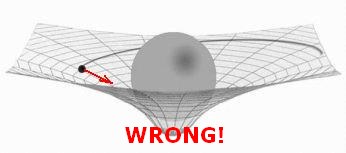
Hyun Seok Yang, arXiv:1111.0015v3 [hep-th]: "When the massive body moves to another place, the original point where the body was placed will recover a (nearly) flat geometry like a rubber band. That is, the (flat) spacetime behaves like a metrical elasticity which opposes the curving of space. But this picture rather exhibits a puzzling nature of flat spacetime because the flat spacetime should be a completely empty space without any kind of energy as we remarked above. How is it possible for an empty space of nothing to behave like an elastic body with tension ?"
One could hardly find in GR textbooks concepts more misleading than "empty space", flat spacetime limit, intrinsic curvature, as well as the "balloon metaphor" of some "expanding" elastic stuff: with respect to what ? Here people usually refer to the Gauss-Bonnet theorem, but notice that the current "dynamics" of GR tacitly presupposes some special "meta" observer equipped with Akasha-like global memory and a special torch highlighting the canonical data (depicted with black vertical arrows, cf. below), who can verify that the canonical data at her instant 'now' are different from those "before" and "after" (provided the spacetime is globally hyperbolic).
Tullio Levi-Civita demonstrated in 1919 that 'parallelism' and 'curvature' are affine-type features -- it is all about the connection under the conditions for wegtransformierbar faculty of gravity 'at a point' [Ref. 1]. The issue is by no means purely academic: see the search for some "ripples" of the metric with LIGO.

If you disagree with the Arrow of Space, please try to suggest the origin of the 'free fall'. As Hermann Bondi noticed, “If a bird watching physicist falls off a cliff, he doesn’t worry about his binoculars, they fall with him.” Such global feature of spacetime is interpreted as some kind of 'reversed image' of the Arrow of Space. Notice that we cannot possibly tell apart the gravitational mass from the inertial mass in an infinitesimal instant 'now', so they would inevitably look 'the same'. This may sound like sheer metaphysics [Ref. 1], but it bears some very specific predictions, such as Brain Assisted Vacuum Energy Release (BAVER) and Reversible Elimination of Inertial Mass (REIM). The former presupposes a topological "bridge" between the human brain and the quantum vacuum; depending on the macroscopic boundary conditions, BAVER could vary from an almost vanishing flux up to 1054 ergs/pulse, which is much larger than the mundane nuclear energy release of ~1022 ergs/pulse. REIM assumes that the initial "free fall" can be temporary canceled, by tweaking the phase of the two atemporal quantum-gravitational waves, after which it would require zero force to fly in 3-D space. In both cases, a 'polarization of space' is implied. (NASA completed their 'propellantness propulsion' project with negative results.) One of the obvious advantages of 'the universe as a brain' is its developmental cosmology (or biocosmology) -- we have three entities to consider, not just one (matter and fields). Namely, we have 'physical reality' (local mode of spacetime) and its GPI field (global mode), both of which are increasing their 'information content' along the Arrow of Space by what may look like creatio ex nihilo (hence 'the unknown unknown') unfolding from their common source. The latter is residing within each and every geometrical point of the underlying topological manifold, being in the state of 'absolute rest' (usually called 'the true monad without windows' or simply [John 1:1]). Thus, if we "run" the Arrow of Space toward The Beginning, the universe would undergo non-unitary "losses" resulting in a very simple cosmological state: ensuing from the current GR textbooks, retrodiction is indeed futile, just as we cannot possibly trace back the current state of our brains from the one in our prenatal age.
As is well known, one cannot derive a human individual from her/his 'first three minutes' after the conception. No way. Ditto to 'the universe as a brain'. Simple, no? Let's compare this developmental quantum cosmology to the "inflationary" scenario. Claus Kiefer quoted in gr-qc/0502016 M. Gell-Mann and J. B. Hartle who have claimed that "quantum mechanics is best and most fundamentally understood in the framework of quantum cosmology". I fully agree, in the sense that nobody understands quantum mechanics nor quantum cosmology. As Mario Rabinowitz noted in arXiv:astro-ph/0412101, "Inflation theorists simply shrug their shoulders and say that their theory does not violate relativity, since it is not the proto-stars and proto-galaxies that were moving that fast, but rather the very fabric of space itself moving the material objects apart. It’s too bad that Einstein was not alive to comment on it himself when inflation was proclaimed and almost universally accepted. One can only wonder how accepting of it he would have been."
The line of reasoning in current inflationary cosmology is like this: you see a big gorgeous hen, and you say -- okay, this hen has surely evolved from a nice big chicken, which in turns has evolved from a tiny little cute chicken, which has obviously came from an egg, but the egg has evolved from a totally unphysical "inflationary" oven, and no egg can possibly be traced back to that terribly hot oven. On the top of everything, the "oven" has had an incredibly low entropy, that is, an extremely low gravitational entropy: how do you know that the very metric of spacetime could survive? Recall that you implant 'time-orientability' by hand, so how can you prove that the "inflation" started with pre-configured spacetime metric within 10-30 seconds ?

It seems unlikely that Joshua Schiffrin and Robert Wald will try to calculate the chance for such pre-configured metric within 10-30 seconds, in their updated arXiv:1202.1818 v2. There is absolutely nothing resembling 'law and order' in the "spacetime foam" to help you raise a crystal clear Lorentzian metric within 10-30 seconds. As Sergio Doplicher explained (The Principle of Locality, arXiv:0911.5136v1 [math-ph]), "points become fuzzy and locality looses any precise meaning. We believe it should be replaced at the Planck scale by an equally sharp and compelling principle, yet unknown, which reduces to locality at larger distances. (...) On this point in our opinion a deeper understanding is needed." I would suggest to study the "closed system, which does not exchange energy with the external world" [Ref. 2] at the Planck scale. Moreover, you need to fix an incredibly fine adjustments of the initial and boundary conditions for the evolution of the hen and its fundamental evolving "constants", suitable for life: “Large objects such as ourselves are the product of principles of organization and of collective behaviour that cannot in any meaningful sense be reduced to the behaviour of our elementary constituents” (Philip Anderson). Obviously, elementary particles alone cannot conduct research on themselves.
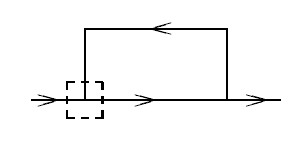
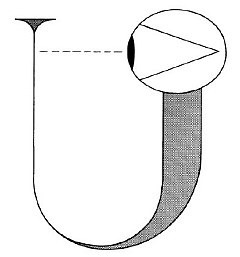
To avoid the "multiverse" and its "anthropic" parapsychology,
the one-and-only 'universe as a brain' should have anticipated from The Beginning the possibilities for asymptotically flat spacetime and emergence of life (the dotted horizontal line in Wheeler's drawing must be raised a bit higher). Thus, the "duration" of the global time [tau] pertinent to 'the universe as a brain' is unlimited; in the case of the human brain, it can be estimated from Neisser's cognitive cycle mentioned above.
On top of that, the "expanding" hen is up to 96% "dark". Then you just shrug your shoulders and admit that perhaps something very essential is missing, and seek rescue in some "multiverse". I will try to explain the Arrow of Space in June this year, if only I am allowed to talk. Such potential event is still in the potential future of the Arrow of Space, so let me try to be optimistic: you never know with the future, do you ? Whether you believe you can do a thing or believe you can't, you are right, said Henry Ford. Analyze that with math, please !
D. Chakalov
February 9, 2012
Last updated: February 25, 2012
[Ref. 1] According to E. Schücking and E.J. Surowitz, arXiv:gr-qc/0703149, "the apparent enigmatic equality of inertial and passive gravitational mass was also still a prize question at the beginning of the twentieth century. The Academy of Sciences in Göttingen, Germany, had offered the Beneke Prize in 1906 for proving this equality by experiment and theory. The Baron Roland Eötvös won three-fourths of this prize (3,400 of 4,500 Marks); only three-fourths, because he had only done the experiments and had not attempted a theoretical explanation (C. Runge, Göttinger Nachrichten No .1, p. 37–41 (1909)."
I think we need quantum gravity to explain the puzzle. In the framework of John's jackets, one cannot observe any numerical difference between the inertial and gravitational mass 'at a point': John will be indistinguishable from its 'gravitational mass' jacket. Simple, no? See also: W.G. Unruh, Time Gravity and Quantum Mechanics, arXiv:gr-qc/9312027v2
pp. 4-5: "Gravity is the unequable flow of time from place to place. It is not that there are two separate phenomena, namely gravity and time and that the one, gravity, affects the other. Rather the theory states that the phenomena we usually ascribe to gravity are actually caused by time’s flowing unequably from place to place. (...) Time flows unequably from place to place, without calling into play any ‘force of gravity’ at all." Comment: Was Bill Unruh talking moonshine? Not at all. The ubiquitous Arrow of Space is not a vector, because it points to all directions in 3-D space; its physical manifestations are (i) 'time as change of space' (nondynamical, "explicit (but unmeasureable) time", Bill Unruh) and (ii) alteration of the so-called templates for space. For example, if the template for space is being "shrunk", don't expect to find some non-baryonic CDM or "supermassive black hole" there. Another "dark" effect is the fundamental topological property of spacetime, called 'spin'. Can you find some "dark axis" of rotation of an electron? Ditto to the galaxy rotation and 'the axis of evil'. It's all geometry.
[Ref. 2] Ruy H. A. Farias and Erasmo Recami, Introduction of a Quantum of Time ("chronon"), and its Consequences for the Electron in Quantum and Classical Physics, Advances in Imaging and Electron Physics, 163, 33-115 (2010); RRuyAIEP2010Ch2.pdf
p. 51: "As for the electron case, there are three different ways to perform the discretization, and three "Schrödinger equations" can be obtained, (...) which are, respectively, the retarded, symmetric, and advanced Schrödinger equations, all of them transforming into the (same) continuous equation when the fundamental interval of time (which can now be called just [tau]) goes to zero.
........
pp. 94-95: "The introduction of a fundamental interval of time in the description of the measurement problem makes possible a simple but effective formalization of the state-reduction process. Such behavior is observed only for the retarded case. (...) This means that the symmetric equation is not suitable to describe a measurement process, and this is an important distinction between the two formulations: actually, only the retarded one describes dissipative systems.
.........
"Regarding the nature of such an energy, it can be related to the very evolution of the system. It can be argued that a macroscopic time evolution is possible only if there is some energy flux between the system and the environment. The states described by the symmetric equation are basically equilibrium states, without net dissipation or absorption of energy by the system as a whole. We can also conceive of the symmetric equation as describing a closed system, which does not exchange energy with the external world."
-------------
Regarding OPERA, see Erasmo Recami, Extended Relativity, and Alan Chodos, Avi Hauser, Alan Kostelecky, The Neutrino as a Tachyon, Phys. Lett. B 150, 431 (1985); 84chodoshauserkostelecky.pdf Erasmo Recami et al., Are muon neutrinos faster-than-light particles? Physics Letters B, 178, 115-120 (1986); AreNeutrinosFasterThanLight.pdf Alan Chodos, Alan Kostelecky, Nuclear Null Tests for Spacelike Neutrinos, arXiv:hep-ph/9409404v1, p. 2, Footnote 1: "We disregard here the possibility of negative-energy neutrinos, which leads to a variety of disagreements with observation." Comment: The negative-energy neutrinos are Macavity-like objects, and are essential component of the "total field of as yet unknown structure" (Albert Einstein). I mentioned above that the neutrinos are quasi-local particles, they don't travel exclusively in the local mode of spacetime. The issue is indeed very important: recall the monograph by Yakov Terletskii above and Murphy's Law No. 15: Complex problems have simple, easy-to-understand wrong answers.
D. Chakalov
February 18, 2012
====================================
Subject: Re: Operetta
Date: Fri, 17 Feb 2012 22:33:32 +0200
From: Dimi Chakalov <[email protected]>
To: Erasmo Recami <[email protected]>
Cc: Sergio Doplicher <[email protected]>,
Alan Kostelecky <[email protected]>,
Alan Chodos <[email protected]>,
Jennifer <[email protected]>,
Richard J Hughes <[email protected]>,
[email protected],
[email protected],
[email protected],
[email protected]
Dear Erasmo,
Thank you, once more, for sending me your articles. I keep a signed preprint from your 'Extended Relativity' in Rivista Nuovo Cim., which you were very kind to send me in 1987 by snail mail. Time runs so fast, doesn't it. It's just not fair! :-)
Anyway, I provided links to your articles relevant to OPERA, as well as two articles by Alan Kostelecky and Alan Chodos, at
http://www.god-does-not-play-dice.net/#operetta
As I mentioned earlier, neutrinos are quasi-local particles; they don't travel exclusively in the local mode of spacetime,
http://www.god-does-not-play-dice.net/#Eckhardt
Should you and/or your colleagues have questions, please don't hesitate to write me back.
With all good wishes,
As ever yours,
Dimi
On Wed, Feb 15, 2012 at 8:40 PM, Erasmo Recami <[email protected]> wrote:
[snip]
=======================================
Subject: Re: How and where does such a thinking happen?
Date: Sat, 18 Feb 2012 16:57:34 +0200
From: Dimi Chakalov <[email protected]>
To: Elemér Rosinger <[email protected]>
Cc: George <[email protected]>
Dear Elemér,
Regarding my email from Tue, 20 Dec 2005 14:17:54 +0200, please check out
http://www.god-does-not-play-dice.net/#Eckhardt
A penny for your thoughts!
All the best,
Dimi
--------
It is extremely difficult to induce penguins to drink warm water.
Albert John Coleman (1918 – 2010)
================================================
Subject: The Universe as a brain
Date: Mon, 20 Feb 2012 04:00:41 +0200
Message-ID:
<CAM7EkxmQYTjKTJ9Pvr15ApS2KpR=2sQONBOUUF9bqSkNj=dvUg@mail.gmail.com>
From: Dimi Chakalov <[email protected]>
To: Daniela Pérez <[email protected]>,
[email protected]
Cc: [email protected],
[email protected],
[email protected],
[email protected],
[email protected],
[email protected]
Dear Daniela,
You and Gustavo wrote (arXiv:1202.3635v1 [physics.hist-ph]): "Whether a cause can be defined outside space-time seems highly dubious [17] [18] [19] [20]. (...) It is very difficult, if not impossible, to make sense of the concept of causation outside space-time."
Your colleague knows my web site for 9 (nine) years, since Wed, 22 Jan 2003 22:49:31 +0200 (I emailed him regarding his arXiv:gr-qc/0301070v1 posted on Mon, 20 Jan 2003).
In a nutshell, the Universe contains the First Cause of its own existence; the spacetime has non-trivial topology (no "timelike closed curves" though), and is an *emergent* phenomenon produced by an Arrow of Space:
http://www.god-does-not-play-dice.net/#Eckhardt
http://www.god-does-not-play-dice.net/#Beig
Please feel free to ask questions.
Thank you for reading these lines. Now you know my web site, and it is your free will choice to ignore it (like Gustavo).
All the best,
Dimi
========================================
Subject: What means "√0" ?
Date: Mon, 20 Feb 2012 23:03:33 +0200
Message-ID:
<CAM7EkxkDTviASHS4PNwWufjdpDduEFbn0K58MeJPHDQgSVL9zw@mail.gmail.com>
From: Dimi Chakalov <[email protected]>
To: [email protected],
[email protected],
[email protected],
[email protected],
[email protected],
[email protected],
[email protected],
[email protected],
[email protected],
[email protected],
[email protected],
[email protected]
Dear colleagues,
Sorry for this unsolicited email.
May I ask for any information you may have about a proper interpretation of the dubious expression "√0" in Special Relativity,
http://www.god-does-not-play-dice.net/#templates
Physically, we know that no particle with rest mass (tardyon) can achieve that "zero", so I am tempted to interpret the latter as an "infinitesimal", yet this isn't of any help (cf. the text at the link above).
I wonder if you know of any theory in which the square root of "zero" can be presented with some meaningful mathematical expression.
Say, something like (+/- X)^2 = 0 ? It's too naïve, I'm afraid.
Please excuse my violent curiosity. As Erwin Schrödinger wrote (Space-Time Structure, Cambridge University Press, 1950, p. 9): "The most important number in mathematics is the zero."
Best regards,
Dimi Chakalov
-------
Note: As the reader might have guessed, the expression (+/- X)2 resembles the squaring the module of the probability amplitude in QM; here, it must be "zero", because the w-axis of the global mode of spacetime must be totally eliminated in the local mode. Simple, no? D.C.
February 21, 2012, 16:30 GMT
=======================================================
Subject: Re: arXiv:0908.3322v3 [gr-qc], “in the limit of the infinitesimal”
Date: Sat, 25 Feb 2012 15:57:57 +0200
From: Dimi Chakalov <[email protected]>
To: David B Malament <[email protected]>
Dear David,
I noticed that you've helped Erik "get straight" on the nature of gravity, as he acknowledged in footnote 23 on p. 17 from his arXiv:0908.3322v3 [gr-qc].
Would you be interested in my opinion on how gravity (not gravitational stress-energy tensor) might end up as 'energy of matter' ?
http://www.god-does-not-play-dice.net/#Alvaro
I hope you can help me, too. I acknowledged at my web site that I managed to "understand" GR only once, in my freshman year in June 1972, and it didn't last long.
All the best,
Dimi
On Fri, Feb 24, 2012 at 1:40 PM, Dimi Chakalov <[email protected]> wrote:
>
> Dear Dr. Curiel,
>
> I feel the need to thank you for your beautiful paper. Will study it
> over the weekend.
>
> I have some thoughts on the 'deep murky waters' (p. 17) of how gravity
> (not gravitational stress-energy tensor) might end up as 'energy of
> matter', and have two immodest requests. If possible, please send me
> copies from your forthcoming “On the Existence of Spacetime Structure”
> and “General Relativity Needs No Interpretation”, Philosophy of
> Science 76:44-72 (2009).
>
> You mentioned an issue I was never able to understand: "... the affine
> connection at least in so far as it depends on the curvature." Please
> help me understand (i) exactly how the affine connection would depend
> on the curvature “in the limit of the infinitesimal”, and (ii) the
> difference between 'affine connection' and 'pure affine connection'
> (Erwin Schrödinger, Space-Time Structure, Cambridge University Press,
> 1950, p. 211).
>
> Thank you very much in advance.
>
> Best regards,
>
> Dimi Chakalov
=====================
Subject: Re: arXiv:0908.3322v3 [gr-qc], “in the limit of the infinitesimal”
Date: Tue, 28 Feb 2012 18:45:56 +0200
Message-ID:
<CAM7EkxmEryT=av5mXTLfdi8TDLOKBYuFOz81D251CsaHqoB5Ag@mail.gmail.com>
From: Dimi Chakalov <[email protected]>
To: Erik Curiel <[email protected]>
Cc: Graham Nerlich <[email protected]>
Dear Dr. Curiel,
Thank you very much for your comprehensive reply. I will be very happy to study your forthcoming paper “On the Existence of Spacetime Structure”.
My understanding of the 'tangent plane over a point' and the 'free fall' embedded in the spacetime structure is posted at
http://www.god-does-not-play-dice.net/#Brendan
Kind regards,
Dimi Chakalov
On Tue, 28 Feb 2012 11:08:46 -0500, Erik Curiel <[email protected]> wrote:
>
> Dear Mr. Chakalov,
>
> Thank you for your kind note. To address your questions:
>
> 1. For our purposes, "in the limit of the infinitesimal" can simply mean "in
> the tangent plane over a point". At every point, the affine structure is
> intimately related to the curvature by the relation
> [D, D] x = Riem(x)
> where '[D, D] x' is the anti-symmetrized product of two derivative operators
> acting on the tangent vector x and 'Riem (x)' is the contraction of the
> tensor with x. (Since you like Schrodinger's book---which is beautiful---I
> suggest you look there for the derivation of this relation.)
>
> 2. If I recall correctly, Schrodinger uses "pure affine connection" to refer
> to an affine connection with no relation to a fixed metric. Not all affine
> connections arise from metrics.
[snip]
On 12-02-24 6:40 AM, Dimi Chakalov wrote:
[snip]
You mentioned an issue I was never able to understand: "... the affine
connection at least in so far as it depends on the curvature." Please
help me understand (i) exactly how the affine connection would depend
on the curvature “in the limit of the infinitesimal”, and (ii) the
difference between 'affine connection' and 'pure affine connection'
(Erwin Schrödinger, Space-Time Structure, Cambridge University Press,
1950, p. 211).
Thank you very much in advance.
[snip]
======================================================
Where do the observed positive mass come
from, at the instant 'now' at which the "freely
falling" universe is halted and shows its positive inertial mass
("a closed room on the Earth," see the drawing below) and asymptotic
boundaries? Is the
red arrow pointing to the Äther (global mode
of spacetime) and simultaneously to all possible directions,
determined with the metric of the local (physical) mode spacetime, hence
displayed as "time"?
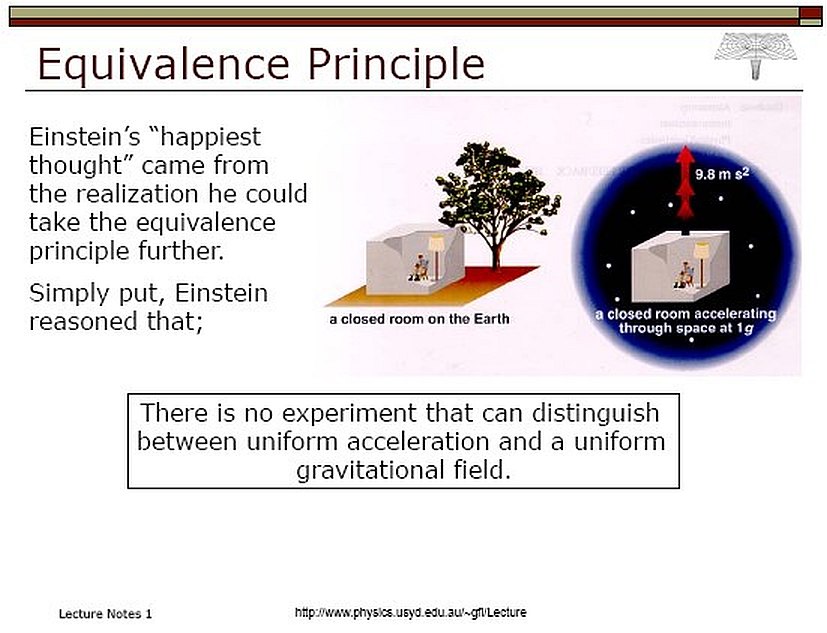
The asymmetry of time can come only from some asymmetry related to 3-D space, such as the Arrow of Space. Hence the "reversed" image from the Arrow of Space, known as 'free fall', should be introduced with 'time orientability' from the outset. The two phenomena are 'global features of spacetime' equipped with non-trivial topology. The "closed room" is 'the whole universe' defined with Finite Infinity, which is being "accelerated" in the global mode of spacetime by the Arrow of Space. Simple, no? Surely 'there is no spacetime without matter', but can we derive all features of spacetime (e.g., time orientability) from matter alone? Is the phenomenon called 'spin' a fundamental property of spacetime that cannot be derived from matter alone? With the global mode of spacetime, the antisymmetric part of the affine connection (the torsion) need not "vanish".

Most importantly, how would you embed the 'free fall' in the spacetime manifold and recover Einstein's "total field of as yet unknown structure" ?
D. Chakalov
February 29, 2012
-------------------
Subject: Re: arXiv:1202.5708v1 [gr-qc]
Date: Tue, 28 Feb 2012 17:01:08 +0200
From: Dimi Chakalov <[email protected]>
To: Brendan McMonigal <[email protected]>
Cc: [email protected], [email protected],
Miguel Alcubierre <[email protected]>
Dear Brendan,
Thank you very much for your reply.
I think Miguel should have tried to explain the initial 'free fall' in the first place, because such global ubiquitous feature of spacetime is just as mysterious as is the so-called "dark" energy,
http://www.god-does-not-play-dice.net/#Heraclitus
Not surprisingly, his efforts to suggest a modified "free fall" by some exotic form of matter rendered the whole idea unfeasible.
My efforts are toward 'reversible elimination of inertial mass' (REIM),
http://www.god-does-not-play-dice.net/#Eckhardt
The crux of the matter is a hypothetical Arrow of Space, which casts its reversed image in terms of 'free fall', so if we can eliminate (reversibly) this initial free fall locally, around the ship, then its inertial mass will be nullified (reversibly) and it should fly just like an UFO, or rather like we "move" our thoughts, without any inertial effects.
Have you seen real "levitation" ? Daniel Dunglas Home has demonstrated it on 16 December 1868; now you can watch other people on YouTube.
All the best,
Dimi
On Tue, 28 Feb 2012 15:44:19 +1100, Brendan McMonigal <[email protected]> wrote:
>
> Hi Dimi,
>
> Thank you for your interest, I will do my best to clarify these points.
>
> 1) What the warp drive does, is alters the geometry of the spacetime
> immediately around the ship such that the direction of freefall is the
> direction the ship wants to 'fly'. A simple analogy would be to think of it
> like dangling a carrot in front of a donkey you are riding; in this analogy,
> the ship is the man on the donkey, the altered geometry is the carrot, and
> the donkey wanting to move to the carrot is the 'freefall'. The alteration
> to the geometry is only ever local, but that is all that is required to
> create the 'motion'.
>
> 2) Strictly speaking, the ship is stationary in space, rather it is the
> space that is distorted around the ship. This is why it is different to,
> say, a plane flying through space. Due to the way that light is affected by
> warp drive, it is not easy to say quite what it would look like, but it is
> clear that the space in front of the ship would bunch up as it approached
> the ship, as there is a region leading the ship where spacetime is
> contracted.
>
> I hope my comments have helped.
>
> Cheers
> Brendan
>
>
> On Tue, Feb 28, 2012 at 2:29 PM, Dimi Chakalov <[email protected]> wrote:
>>
>> Dear Dr. McMonigal,
>>
>> May I ask you to help with the Alcubierre Warp Drive.
>>
>> I've read some very confusing (to me) statements in general-audience
>> articles, such as:
>>
>> 1. The Alcubierre Warp Drive is following 'free fall' in the direction
>> of its "flight", and
>>
>> 2. The space in front of the Alcubierre Warp Drive will be seen by an
>> observer inside the ship as "running" toward her/him, instead of the
>> usual perception from flying with commercial plane, such as 'space is
>> at rest; the plane is moving *in* space'.
>>
>> Thank you for your time, patience, and consideration.
>>
>> Kind regards,
>>
>> Dimi Chakalov
>
======================================================
Subject: A note on the post-Newtonian limit of quasi-local energy expressions, arXiv:1102.1867v3 [gr-qc]
Date: Wed, 29 Feb 2012 17:52:50 +0200
Message-ID:
<CAM7Ekx=24MouUJ9oKnJ1PGeWZvKugkgsJ=OY28Qm-ZT=yPE9kA@mail.gmail.com>
From: Dimi Chakalov <[email protected]>
To: Laszlo Szabados <[email protected]>,
Jörg Frauendiener <[email protected]>
Cc: Adam Helfer <[email protected]>,
William G Unruh <[email protected]>,
Luca Bombelli <[email protected]>,
Domenico Giulini <[email protected]>,
Kirill Krasnov <[email protected]>,
Stefano Finazzi <[email protected]>,
Willie Wai-Yeung Wong <[email protected]>,
Thibault Damour <[email protected]>,
Lars Andersson <[email protected]>,
Jiří Bičák <[email protected]>,
Richard M Schoen <[email protected]>
Dear László and Jörg,
You argued that, "in static space-times", "any physically acceptable quasi-local energy expression should behave qualitatively like this ‘effective’ energy expression in this limit."
I'm afraid any quasi-local energy expression "in static space-times" is a spherical cow approximation. Will be happy to elaborate.
Besides, the "universal coupling between matter and gravity" (Thibault Damour, arXiv:1202.6311v1 [gr-qc]) cannot be postulated until you resolve "the way that a gravitational stress-energy tensor (if there were such a thing) might enter into the righthand side of the Einstein field-equation", as stressed by Erik Curiel in arXiv:0908.3322v3 [gr-qc],
http://www.god-does-not-play-dice.net/#Alvaro
To begin with, the standard prerequisites that "all manifolds are assumed to be Hausdorff, second countable and C∞" (Lars Andersson, arXiv:gr-qc/9911032v4, Footnote 1, p. 3), on which you install differentialbe structure, tangent vectors, smooth Lorentz metric (and
eventually some "future pointing timelike unit vector field"), lack an essential component: the "free fall" feature of spacetime,
http://www.god-does-not-play-dice.net/#Brendan
It must be embedded in the spacetime manifold ab initio. We cannot derive the 'free fall' from any physical thing, just as we cannot derive "time-orientability",
http://www.god-does-not-play-dice.net/#Waldyr
One way to solve this task is with an Arrow of Space, which I am sure you know very well, but persistently ignore.
Do you have any other solution? Please let me know about it, and I will immediately close my web site and study your professional paper(s), if any.
I extend this request to all your colleagues: please let me know how you would embed the 'free fall' in the spacetime manifold.
Hope to see you in Prague,
http://tinyurl.com/Einstein-Prague
All the best,
Dimi
-------------
Note: There is also another purely geometrical puzzle: the torsion. "If one desires to set up a gravitational theory in the elementary particle domain" (Friedrich W. Hehl, On the Kinematics of the Torsion of Space-Time, Found. Phys. 15(4), 451-471 (1985), p. 453), the torsion dynamics becomes non-trivial, given (i) the "dark" energy of "expanding" space and (ii) the nonlocalizability of both "particles" and the gravitational energy density. Which requires a new "quantisation" of the spacetime manifold from the outset. D.C.
March 2, 2012
=======================================================
Subject: Re: Request for references
Date: Thu, 7 Jun 2012 04:38:40 +0300
From: Dimi Chakalov <[email protected]>
To: Laszlo Szabados <[email protected]>
Cc: Adam Helfer <[email protected]>,
IGUS Jim <[email protected]>
Dear László,
Regarding your
Review, you argued seven years ago that the gravitational
energy-momentum and angular momentum "should be associated to *extended*
domains rather than to points".
I fully agree, but it seems to me that
your approach
at implementing 'the quasi-local case' is wrong, for reasons explained
at
http://www.god-does-not-play-dice.net/#EH_if_any
I will be happy to elaborate. As you suggested on Sat, 28 Mar 2009
02:49:13 +0100 (CET), "Let's do our job, science ..."
I included two colleagues of yours in the Cc: list, because have quoted
from their papers at the link above.
All the best,
Dimi
On Wed, 23 Feb 2005 17:37:02 +0100 (CET), László B. Szabados <[email protected]>
wrote:
[snip]
>
> Thus, to summarize: even if we start with genuine tensorial variables,
> then certain important physical quantities turn out to be non-tensorial.
>
> In subsection 3.3.1 I argued that this phenomenon is not accidental,
> a consequence of an unfortunate choice for the field variables, but
> this is a consequence of a much deeper fact, namely that the metric
> has a double role: it is a field variable and defines the geometry
> at the same time.
>
> Or, in other words, GR is a completely diffeomorphism
> invariant theory, which diffeomorphisms form an incredibly huge set.
> Thus all the observables are associated with the whole spacetime,
which
> can be introduced if the spacetime is asymptotically flat, or you
should
> have some extended, physical object that breaks this invariance.
> This is the quasi-local case. These quasi-local quantities can be
> introduced even if the spacetime is not asymptotically flat.
[snip]
> What I say in my review is *not* that GR is a non-local theory,
> I say only that the gravitational energy-momentum and angular
> momentum, i.e. the gravitational analogs of the classical conserved
> quantities and observables are non-local. Non-local in the sense that
> they should be associated to *extended*
domains rather than to
> points.
------------
Note:
Laszlo Szabados replied on Thu, 7 Jun 2012 23:11:08 +0200 (CEST) just by
saying that he sees "nothing wrong in the above argumentation". I do.
The task for associating
the gravitational energy-momentum and angular momentum to extended
domains rather than to "points" is the essence of 'quasi-local GR'. He
tackles the
canonical GR, while my approach is from quantum
gravity, so at least one of these two approaches must be wrong.
Let's find something that
we both agree upon, which will be considered 'the common ground' for our
incompatible approaches. As John Bell argued, "reality
has been identified only at a single time" [Ref.
1]. It is a point-like event, and is 'local'.
How can we make this
point-like event 'quasi-local' ? In my approach, the point-like
event is both "local" (it is an infinitesimal point) and "non-local",
because it is the nexus of the bi-directional
negotiations between such "point" and 'the rest of the universe'
along the Arrow of Space. Thus, the geometry itself becomes
'quasi-local' at such "point". The
latter is extremely "non-local", in the sense that the
atemporal feedback (global mode of spacetime) from 'the whole
universe as ONE' (cf. UGMC) is being projected
"inside" an infinitesimal "point" that is extremely "local" from
the outset. Every such quasi-local point is being
re-created in the instant 'now'
(think about a transcendental tachyon, not Cauchy surface) from the
Arrow of Space. This is the only possible spacetime for a
dynamical self-determined bootstrapped Universe. Otherwise it will fall
apart.
Forget about
canonical GR. Check out the insoluble problems of
C. Kiefer and A. Perez.
Laszlo Szabados
starts from "quasi-local configuration
space" and "quasi-local phase space" and his aim is to
suggest specific boundary terms and boundary conditions for
canonical GR
(arXiv:0902.3199v2 [gr-qc],
pp. 4-5).
If he is on the right track, he should be able to suggest at least
one
conceptual solution to one of the problems listed at the link in my
email or to the problems of
canonical GR. Just one very simple task: boundary
conditions for the gravitational "field" [Ref. 2]. This will be 'the proof of the
pudding'.
He can't do it, however.
He doesn't work in quantum gravity and still believes that GR is a
'classical theory'. But it isn't.
As I stated previously (29
Feb 2012),
if Laszlo Szabados can offer any other solution, I will
immediately close my web site and study his professional paper(s), if any.
D. Chakalov
June 8, 2012, 12:54:57 GMT
[Ref. 1] J. S. Bell, Quantum mechanics for cosmologists, in:
Speakable and unspeakable in quantum mechanics, 2nd ed., Cambridge
University Press, 2004
Ch. 15,
p. 136: "(W)e have no access to the past. We have only our
'memories' and 'records'. But these memories and records are in fact
present phenomena. (...) The theory should account for the
present correlations between these present phenomena.
....
"The question of making a Lorentz invariant theory on these lines raises
intriguing questions. For reality has been identified only at a
single time."
[Ref. 2] Adam Helfer, Angular momentum of isolated systems in general
relativity,
arXiv:0903.3016v1 [gr-qc].
"How can we make precise
the idea of an isolated system? In some sense, we must say what it means
to travel far from the system, and say that in that limit the system
becomes “self-contained.” Roughly speaking, this should mean passing to
an appropriate asymptotic regime such that all gravitational
effects are localized inside of it."
======================================================
Subject: Re: What is "torsion" ?
Date: Sat, 3 Mar 2012 01:58:32 +0200
From: Dimi Chakalov <[email protected]>
To: Friedrich_Wilhelm Hehl <[email protected]>
> But I have to tell you that I don't and will not follow your blog.
I love your German humor !
> Is there any reason for me the believe that you have the
> necessary education to discuss seriously any question of physics?
Easy: please send me your professional solution to the two tasks (cf. my email printed below), and I will send you my evaluation of your efforts.
Then you'll find out whether I have "the necessary education to discuss seriously any question of physics."
NB: Please don't hesitate to use as much math as you possibly can -- you can't scare a dog with a sausage.
If, for some strange unanticipated reason, you are unable to resolve the two tasks (cf. below), all I can offer you is the quantum gravity theory at my web site: Besser eine Laus im Kraut als gar kein Fleisch.
All the best,
Dimi
-----------
Subject: Re: What is "torsion" ?
Date: Fri, 2 Mar 2012 22:14:29 +0200
From: Dimi Chakalov <[email protected]>
To: Friedrich_Wilhelm Hehl <[email protected]>
Dear Fred,
> This is my answer of 1985.
Thank you; I know your seminal paper very well. "If one desires to set up a gravitational theory in the elementary particle domain" (p. 453), the torsion issue becomes non-trivial, given (i) the "dark" energy of "expanding" space and (ii) the nonlocalizability of both "particles" and the gravitational energy density. Which is the scope of my approach toward quantum gravity.
> Don't you read the existing literature?
Of course I do. Didn't you follow the link in my email?
If you can suggest a joint solution to tasks (i) and (ii), please let me know where I can read it.
All the best,
Dimi
=========== Note: I can safely predict that Friedrich W. Hehl will never reply professionally by offering his solution to the two tasks above, simply because he can't. For example, look at his proposal for "nonlocal gravity", co-authored by Bahram Mashhoon, at the DPG Conference in Bonn, 15 March 2010, Slide 3: "Postulate of locality: An accelerated observer (measuring device) along its worldline is at each instant physically equivalent to a hypothetical inertial observer (measuring device) that is otherwise identical and instantaneously comoving with the accelerated observer (measuring device)." Then Slide 6: "How can we then generalize general relativity which is a strictly local theory? Idea: We know electrodynamics is a gauge theory; we can make it nonlocal, as shown on the last slide."
But the idea is wrong, and Friedrich W. Hehl will have to admit it, after failing to solve the two tasks above, by focusing on what actually happens "at each instant". He will never try this very difficult exercise, and will instead prefer to keep quiet, pretending that he doesn't read my "blog" about the 'total field of as yet unknown structure' (A. Einstein). Here's the crux of GR (Paolo Pani et al., arXiv:1201.2814v2 [gr-qc]):

Which is why people use PDEs and tell their students that GR were a "classical theory". Surely the current GR textbooks present GR as a 'classical theory', but it is "merely a makeshift in order to give the general principle of relativity a preliminary closed-form expression" (A. Einstein). It can be safely used to correct the GPS system, but cannot be used for any task which requires non-linear bi-directional interactions "at each instant", facilitated by the 'total field of as yet unknown structure' (A. Einstein).
Notice that the "preliminary closed-form expression" (A. Einstein) of present-day GR is based on only one single instant at which the non-linear bi-directional negotiations -- "space acts on matter, telling it how to move; in turn, matter reacts back on space, telling it how to curve", John Wheeler -- are settled as solutions to the Einstein filed equation, pertaining to this one single instant, after which you obtain a dead frozen "spacetime" (and use PDEs, if you insist). But if you wish to study and detect the genuine gravitational waves (GWs), you need to take into account the non-linear bi-directional negotiations at each and every instant of the propagation of these "waves" -- one single instant will freeze these fundamentally non-linear "waves" and they will not carry energy to their counterpart in the r.h.s. of the filed equations: energy transport by GWs is a fundamentally non-linear phenomenon (Hermann Bondi). Yes, LIGO is for the birds. We need the genuine dynamics of GR. Forget about PDEs. That's what this "blog" is all about. As I acknowledged previously, I had the feeling that have finally managed to "understand" GR only once, in June 1972, and it didn't last long. But perhaps Friedrich W. Hehl believes that he "understands" the non-linear dynamics of GR. After all, he has published many peer-reviewed scientific papers, which implies that he does indeed have "the necessary education to discuss seriously any question of physics". Then why is he keeping quiet?
D. Chakalov
March 4, 2012
Last update: March 29, 2012 =========================================
Subject: arXiv:1203.2154v1 [gr-qc], The initial-boundary value problem (IBVP),
Sec. XIV, Q1
Date: Mon, 12 Mar 2012 05:52:05 +0200
From: Dimi Chakalov <[email protected]>
To: Jeffrey Winicour <[email protected]>
Cc: Alan Rendall <[email protected]>
Dear Dr. Winicour,
I think we can introduce natural boundaries for the gravitational field, provided we can embed the 'free fall' in the spacetime manifold,
http://www.god-does-not-play-dice.net/#free_fall
http://www.god-does-not-play-dice.net/#Beig
The second link elaborates on the statement by Alan Turing, quoted in your paper: "Science is a differential equation. Religion is a boundary condition."
My answer to your Q1 in Sec. XIV is in the negative. Will be happy to elaborate.
All the best,
Dimi Chakalov
---------
Note: In Sec. XIV, Jeffrey Winicour posed Question 1: "Is there a strongly well-posed IBVP based upon a 3 + 1 formulation?" No, there can't be anything "well-posed" with the "3+1 formulation", except errors. There is no "evolution" whatsoever with the misfortunate "3+1 formulation" or with some "edgeless spacelike hypersurface that serves as a Cauchy surface" (Matt Choptuik). The latter can offer just one linearized instant from some "future directed, time-like unit vector field T tangential to the boundary" [Ref. 1] used to "evolve" the Cauchy data with PDEs (cf. above). The genuine dynamics of GR is fundamentally non-linear, in the sense explained above. PDEs aren't even a spherical cow approximation. All this mess comes from the notorious "splitting" of spacetime, after Dirac and ADM. Forget it. Moreover, Jeffrey Winicour (p. 7) and Helmut Friedrich assume smooth fields [Ref. 1], ignoring the fundamental problem stressed by Paul Tod. Piotr Chrusciel, for example, used "smooth" and "smoothness" 66 times in his report above, for well-known reasons. I will be happy to elaborate in details, iff I am allowed to talk in Prague. As Alan Rendall acknowledged (arXiv:gr-qc/0503112v1, p. 4), "It follows from the above discussion that spacetime singularities should be associated with reaching the limits of the physical validity of general relativity. Quantum effects can be expected to come in. If this is so then to go further the theory should be replaced by some kind of theory of quantum gravity. Up to now we have no definitive theory of this kind and so it is not clear how to proceed." My proposal for a new kind of quantum gravity is sketched above. One can contemplate about 'local points' only in classical physics, say, about the "point" of the mass center of a Frisbee, and subsequently about the trajectory of that "point" in some fictitious rigid background spacetime. But in present-day GR such "points" aren't justified, because there is no "background" in the local mode of spacetime, and the physical stuff which defines 'spacetime' cannot be localized at any such 'local point' -- the spacetime itself becomes quasi-local, as demonstrated with the nonlocalizability of the gravitational energy density. It is manifestly wrong in GR to suggest some classical, 'local points' at which one could attach "a tangent vector" (Erik Curiel) or draw some "spacetime version of the Pythagorean theorem" (Matt Choptuik). The only possible way to define "points" in GR is to make them quasi-local with Machian quantum gravity: perfect yet quasi-local points can be defined only with Machian relational ontology, 'with respect to everything else in the universe', like a school of fish: "non-localizable energy" is inadmissible in the theory of relativity (Hermann Bondi). This is the correct physical meaning of 'quasi-local': no physical stuff in the r.h.s. of Einstein filed equation could become "non-local". Instead, the spacetime points themselves become quasi-local (compare it with Laszlo Szabados, arXiv:0902.3199v2 [gr-qc], Sec. 2). Otherwise it won't be possible to explain the non-linear coupling of the gravitational field to matter: just look at the dreadful linearized approximations above. If you disagree, try "energy conservation" (example from Hans Ohanian here) and "gravitomagnetism". It is 'the whole universe as ONE' which defines -- dynamically, with the Arrow of Space -- a perfect quasi-local point 'here-and-now', to replace the "edgeless Cauchy slice". Hence we need Finite Infinity to fix the "boundaries" of spacetime dynamically, along the Arrow of Space which is defined with respect to the (totally hidden) reference fluid of GR: see the background time code of the animation from John Walker above. Notice that we shouldn't be able to solve the Hamiltonian constraint problem in canonical quantum gravity, because if we could, the Hamiltonian "dynamics" would expose some preferred global "time" which is "nondynamical and explicit" (Bill Unruh) yet totally hidden: it must stay totally hidden (or "dark", as some otherwise smart people called it). All this has been said many times here at this web site. I only wanted to commemorate Einstein's 133th birthday by elaborating on his 'total field of as yet unknown structure'.
D. Chakalov
March 12, 2012
Last update: March 14, 2012
[Ref. 1] Helmut Friedrich, Initial boundary value problems for Einstein’s field equations and geometric uniqueness, IML-0809f-37.pdf, Gen. Rel. Grav. 41, 1947 (2009). p. 2: "To simplify the discussion we assume all fields to be smooth.
...... pp. 16-17: "...require the choice of a future directed, time-like unit vector field T tangential to the boundary. The vector field T, for which no natural choice exists in general, is characterized indirectly and becomes explicitly available only after solving the equations. Problems arise if one wants to compare solutions pertaining to boundary conditions based on different choices of T and on different boundary data.
"This situation leads to awkward practical problems if gauge transformations need to be considered in the course of an evolution. It is an open question whether this is an intrinsic problem of the initial boundary value problem for Einstein’s field equations or whether there can be formulated, under general assumptions, initial boundary value problems for Einstein’s field equations which avoid these difficulties." =======================================================
Subject: arXiv:1203.2641v1 [gr-qc], p. 3
Date: Wed, 14 Mar 2012 04:31:04 +0200
From: Dimi Chakalov <[email protected]>
To: Olaf Dreyer <[email protected]>
Hi Olaf,
May I ask two questions.
You wrote: "Locally all physics is as it is in Minkowski space. Gravity is in the way these local Minkowski spaces are connected. (...) Through this connection the metric g_ab becomes the glue that connects the local Minkowski spaces."
1. If gravity were indeed eliminated by Mother Nature "locally", at each and every point from a geodesic, the latter will be converted to a trajectory in "local Minkowski spaces", correct ?
2. Who taught you GR ?
Dimi
------------
It is like a lot of worms trying to get out of a bottle by crawling all over each other. It is not that the subject is hard; it is that the good men are occupied elsewhere. Remind me not to come to any more gravity conferences!
Richard Feynman, What Do You Care What Other People Think? W. W. Norton & Co., New York, 1988, p. 92
Why is that "the good men are occupied elsewhere"? Consider this. People agree with Hermann Minkowski that "space by itself, and time by itself, are doomed to fade away into mere shadows, and only a kind of union of the two will preserve an independent reality." Yet the 'GR bartenders' treat 'time' and 'space' as totally different entities, "thereby doing grave injustice to space-time covariance that underlies general relativity" (A. Ashtekar). They endow 'space' with some Akasha-like "memory" to distinguish between 'before' and 'after', despite the fact that 'time' can "evolve" just as much as 'space'. Of course there is no "evolution" whatsoever in present-day GR, as I argued above. On top of that, the same people claim that GR were some "classical theory". But if gravity were indeed eliminated by Mother Nature "locally", at each and every point from a geodesic, the latter will be flattened to a trajectory in Minkowski spacetime. Obviously, Hermann Minkowski wouldn't come to any "gravity conferences" either. And if Einstein were here alive, he would ask, how do you make such "evolution" non-linear? With PDEs? I very much hope to be allowed to talk in Prague. We shouldn't abuse GR anymore.
D. Chakalov
March 16, 2012
========================================================
Subject: arXiv:1203.5709v2 [gr-qc], Sec. 2.2, "... corresponds loosely to the *rate* of change of
the contact vector."
Date: Wed, 28 Mar 2012 04:52:33 +0300
From: Dimi Chakalov <[email protected]>
To: [email protected], [email protected]
Cc: [email protected]
Dear colleagues,
Seems to me that in the capture of Fig. 2 you used "other" twice.
Your paper is truly fundamental -- "the ideal waywiser at a given point is ‘invisible’ to all other other points" -- but I can't agree with your efforts to seek some "encoding" of the Affine Connection in the field of "contact vectors":
"In particular, we see that the metric directly corresponds to the change of contact point when the waywiser is rolled. However, the metric tensor cannot tell us how to parallel transport tangent vectors, u^a say, along the surface, something which is encoded in the affine connection [xxx]. Nevertheless, also this mathematical object can easily be constructed from the waywiser variables and corresponds loosely to the *rate* of change of the contact vector."
I think the Affine Connection is the fundamental binding phenomenon of "points", and its nature cannot be uncovered by any ideal waywiser that can test only the end result ("a succession of infinitesimal SO(3) transformations") from such binding phenomenon: any time you probe the "succession of infinitesimal transformations", the Affine Connection is gone. It isn't there. You can't see it, simply because you cannot "see" anything that stands
]between[ these infinitesimal points.
Besides, you tacitly imply some long-term memory of the ideal waywiser, such that it can say 'look, I'm now rolling on a curve, as compared to my previous infinitesimal state!' Do you agree?
All the best,
Dimi Chakalov
==================================
Subject: Re: arXiv:1203.5709v2 [gr-qc], Sec. 2.2, "... corresponds loosely to the *rate* of change of
the contact vector."
Date: Wed, 28 Mar 2012 12:07:11 +0300
From: Dimi Chakalov <[email protected]>
To: Hans Westman <[email protected]>
Cc: [email protected],
[email protected],
[email protected],
Andrzej Mariusz Trautman <[email protected]>
Dear Hans,
Thank you for your prompt reply.
> Presumably one can have different interpretations. But on the mathematical
> level it is true that the affine connection can be extract from the waywiser
> pair {V^A(x),A^{AB}(x)}.
I believe one can have different interpretations on the Affine Connection in the first place. Yours is concerned with its end result only, while I am interested in its inherent dynamics and treat it as 'the binding process' of 'the whole universe as ONE',
http://www.god-does-not-play-dice.net/#Winicour
Tullio Levi-Civita demonstrated in 1919 that 'parallelism' and 'curvature' are affine-type features,
http://www.god-does-not-play-dice.net/#Eckhardt
and I am interested in the phenomenon which creates the underlying topological manifold "equipped" with differentiable structure, such that, at the end of the day, you can imagine "a succession of infinitesimal SO(3) transformations".
Basically, the difference in the interpretations of the Affine Connection boils down to the interpretation of 'dynamics' and 'time': yours is based on a dead frozen manifold, while mine deals with an emergent manifold: time doesn't emerge from 'change within space' (e.g., co-ordinate time), but from 'change *of* space' along an Arrow of Space.
> Of course, we are not doing without a connection altogether; we still make use
> of the rolling connection A^{AB}.
What is pushing the ideal waywiser in such a way that "at a given point" it is invisible to all "other" points, as you put it ?
> I'm not sure what you mean by long term memory.
An Akasha-like global memory,
http://www.god-does-not-play-dice.net/#GR_bartenders
Best regards,
Dimi
-----------
Note: Time doesn't emerge from 'change within space', and gravitational observables do not evolve "dynamically" -- read Karel Kuchar. It was noted by Charles Torre that GR observables have to include "an infinite number of derivatives and are therefore very nonlocal" (Johannes Tambornino, arXiv:1109.0740v2 [gr-qc]). What we observe is a genuine dynamical evolution of GR observables (not "Dirac observables") with respect to the matter content of 'the whole universe as ONE' defined with Finite Infinity: a genuine 'change of space' along the Arrow of Space. You don't have any other choice. That's it. Ignore it at your peril. Just two examples: Sabine Hossenfelder failed to mention the direct evidence against some "discrete nature" of spacetime (see above), and Johannes Tambornino is still keeping his faith in LQG. Two young physicists ready to retire. They just don't want to acknowledge that it is impossible to derive Lorentzian metric from "spacetime foam". Do you believe in miracles? If you do, you too are ready to retire. Sorry for being frank.
The current paradoxical situation is similar to the ultraviolet catastrophe of late 19th century. You need a new Quantum Theory compatible with Einstein's "total field of as yet unknown structure". You don't have any other choice. That's it. Ignore it at your peril.
I very much hope to deliver my talk on the Arrow of Space at the Einstein Conference in Prague (pending approval by the Scientific Organizing Committee). We'll have a jolly good time, notwithstanding the PR crusade for GW "astronomy". For example, what if the phenomenon of "spin" is a topological property of space endowed with torsion ? Surely we see some axis of rotation (unlike the axis of electron's spin), but with the Arrow of Space the origin of the "spin" may be purely geometrical, hence if you try to explain it as caused by matter, the latter will have to be "dark". 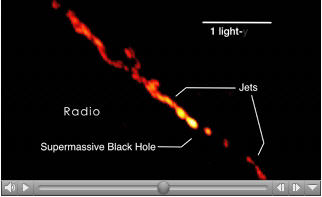
According to NASA, the stuff you cannot see between the jets could only be some invisible 55-million-solar-mass defect of the spacetime continuum (yes, the Brooklyn Bridge is on sale).
No real (positive energy density) physical stuff could be embodied as 'the carrier' of this fundamental and purely geometrical feature of the spacetime itself. The same tallies to the 'free fall'. I will slice and dice this succinctly in my talk, entitled 'Arrow of Space'. For a start, look at the discussion of the Bondi-Metzner-Sachs group in Robert Wald's textbook (pp. 283-287): "In a general, curved spacetime one would not expect any exact isometries to be present." What can replace "the unphysical spacetime" (ibid.), other than the so-called global mode of spacetime in Finite Infinity ? In the two animations below, from John Walker and the Cassiopeia Project, the genuine dynamics of both gravitational (cf. the reference fluid) and quantum observables requires the 'global mode of spacetime': one can physically observe only their "colored" (after the KS Theorem) "jackets" in the local (physical) mode of spacetime, one-at-a-time, along the Arrow of Space.

Der Geist bewegt die Materie... oder was ?
D.C.
March 31, 2012, 20:50:48 GMT
==================================
Subject: Re: arXiv:1203.5709v2 [gr-qc], Sec. 2.2, "... corresponds loosely to the *rate* of change of the contact vector."
Date: Mon, 16 Apr 2012 16:49:25 +0300
From: Dimi Chakalov <[email protected]>
To: Hans Westman <[email protected]>
Dear Hans,
I looked at your latest arXiv:1203.5709v3 [gr-qc], but couldn't find an answer to my question from Wed, 28 Mar 2012 12:07:11 +0300:
What is pushing the ideal waywiser in such a way that "at a given point" it is invisible to all "other" points, as you put it ?
All the best,
Dimi
============================================
Subject: Re: The existence of Dirac observables for gravity
Date: Sun, 1 Apr 2012 11:57:38 +0300
From: Dimi Chakalov <[email protected]>
To: Bianca Dittrich <[email protected]>
Cc: [email protected], [email protected],
[email protected], thomas.thiemann@gravity.fau.de
Dear Bianca,
In my email from Wed, 03 Nov 2004 13:25:44 +0200 (regarding your arXiv:gr-qc/0411013v1), I argued that there are no "Dirac observables for gravity"; details at
http://www.god-does-not-play-dice.net/#affine_connection
Hope to see you and your colleagues in Prague.
Kind regards,
Dimi
---------
Note: I argued above that with the present-day GR it is impossible to solve the puzzle of 'time in GR', because any such "solution" is strictly forbidden -- it will expose the preferred global time which is "nondynamical and explicit" (Bill Unruh) yet totally hidden. Let me try to explain the puzzle in the shortest possible way. Imagine you play with a Frisbee: it flies along a trajectory, and you can time its flight with your wristwatch. There is no puzzle with its dynamics, because you assume some rigid background medium, called Minkowski spacetime. But suppose that the center of mass of your Frisbee (it has to be a geometrical "point" to make the trajectory) corresponds to some "Dirac observable", if any. Firstly, we cannot imagine it "at a point", because it is 'quasi-local', and secondly -- its proper "time" is a "complicated non-local function of the gravitational field itself. Therefore, properly speaking, GR does not admit a description as a system evolving in terms of an observable time variable" (Carlo Rovelli). Thus, GR should not allow for any evolution 'in terms of an observable time variable', because it will expose the preferred global time of "the universal coupling between matter and gravity" (Thibault Damour). Which is why Tom Thiemann arrived at a "devastating conclusion" that "we are missing some new physics." I agree, only his conclusion is by no means "devastating": we know that we don't know the genuine dynamics of the coupling between matter and gravity -- it ain't linear. There's nothing "devastating" in the 'things we know that we don't know'. All we can say for sure is that this dynamics cannot be parameterized with/by what it produces: the observable, linearized, polynomial time of your Frisbee in the local mode of spacetime. In this local mode of spacetime, the gravitational energy density cannot be defined 'at a point' (MTW, p. 467), and the gravitational energy cannot be "conserved in time", to define the corresponding notion of 'time'. The genuine dynamics of GR is encoded in the reversible, bi-directional "transfer between the intangible energy of the gravitational field (as it will be called here), which is not described by the energy-momentum tensor, and the tangible forms which are so described" (Hermann Bondi). This bi-directional, intangible <--> tangible energy conversion is the crux of the non-linear coupling between matter and gravity. The dynamics of the
energy non-conservation in GR cannot be modeled with any linear theory. It doesn't even remotely resemble the "dynamics" of ADM and its tantalizing task for sorting out "which components are dynamic, which are constrained, and which are gauge" (Gregory B. Cook). These are the 'things we know that we don't know' about Einstein's 'total field of as yet unknown structure.' If you disagree, try "the single Master Constraint", Eq. 1.7, in the Master Constraint Programme by Bianca Dittrich and Tom Thiemann. Then ask Karel Kuchar for help.
D.C.
April 2, 2012
=======================================
Subject: Re: The
existence of Dirac observables for gravity
Date: Tue, 29 May 2012 15:36:04 +0300
From: Dimi Chakalov <[email protected]>
To: Bianca Dittrich <[email protected]>
Cc: [email protected], [email protected], [email protected],
[email protected], [email protected],
[email protected], [email protected], [email protected],
[email protected], [email protected], Helmut Friedrich <[email protected]>
Bianca dear,
You suggested "perfect discretizations" in
arXiv:1205.6127v1 [gr-qc], and speculated that "the amplitudes for
such building blocks can be constructed through a coarse graining
process."
How far in 3-D space would you be able to see with
such "coarse graining process" ? Remember that min. 7.3 billion light
years from Earth the spacetime is perfectly smooth (references at
my web site).
In case you and your colleagues fail with that "coarse graining
process", check out
http://www.god-does-not-play-dice.net/#ESI
More from Helmut Friedrich, 'The large
scale Einstein evolution problem',
http://ae100prg.mff.cuni.cz/img/abstracts/9f42de26a136d803d39c4bdd43b31f8c.pdf
Have a nice summer.
Dimi
==============================================
Subject: "3+1 Formalism in General Relativity", p. 74
Date: Tue, 3 Apr 2012 01:22:25 +0300
From: Dimi Chakalov <[email protected]>
To: Eric Gourgoulhon <[email protected]>
Cc: Stanley Deser <[email protected]>,
Jonathan Thornburg <[email protected]>
Hi Éric,
May I ask three questions. The opinion of your colleagues will be greatly appreciated, too.
You stated (p. 74) that you can incorporate without problems the cosmological "constant" in EFE.
1. How would you accommodate the brand new (to ADM) case of "expanding" space driven by some "dark" energy ?
2. How would you define "expanding" space: with respect to *what* ?
http://www.god-does-not-play-dice.net/#Heraclitus
http://www.god-does-not-play-dice.net/#affine_connection
3. How would you rigorously define "event horizon", without any poetry ?
I assume that you are professional physicist, and don't play with GR as a hobby. If I'm wrong, please don't bother to reply to this email nor to my initial email from Tue, 17 Oct 2006 22:56:37 +0300.
Regards,
Dimi
==========================================
Subject: arXiv:1204.0054v1 [gr-qc], p. 6
Date: Tue, 3 Apr 2012 12:28:55 +0100
Message-ID:
<CAM7Ekx=Cht2zXWmgQJg52+MUjEaLYj5oQdMmkiOnADQkP2XrVA@mail.gmail.com>
From: Dimi Chakalov <[email protected]>
To: Yuri Bonder <[email protected]>
Cc: [email protected],
[email protected],
[email protected],
[email protected],
[email protected],
[email protected],
[email protected],
[email protected],
[email protected],
[email protected],
[email protected]
Dear Dr. Bonder,
It is a rare pleasure to read your latest paper. Thank you.
I believe one can accommodate "*all* possible trajectories of the center of mass" (p. 6) and recover a genuine trajectory of single quantum particle with a new Quantum Theory,
http://www.god-does-not-play-dice.net/#Tod
http://www.god-does-not-play-dice.net/#affine_connection
Notice the latest paper by Simen Braeck and Øyvind Grøn, arXiv:1204.0419v1 [gr-qc], in which they argue that "the relative ‘motion’ of the galaxies must be attributed to an expansion of the three-space between them". The medium (the reference fluid of GR) w.r.t. which the 3-D space is "expanding" is addressed at
http://www.god-does-not-play-dice.net/#Heraclitus
If we let the reference fluid of GR to keep "*all* possible trajectories of the center of mass", perhaps we could reconcile Quantum Theory with GR from the outset.
Will be happy to provide details, should you or your colleagues are interested.
Kind regards,
Dimi Chakalov
========================================================
Subject: Re: The wine cellars of LIGO
Date: Fri, 6 Apr 2012 01:33:23 +0300
Message-ID:
<CAM7EkxmnAsEBhBKjB4oYCzH1s8dtWpNNskneUNJv9qgkYkk18g@mail.gmail.com>
From: Dimi Chakalov <[email protected]>
To: Joan Centrella <[email protected]>,
Alan J Weinstein <[email protected]>,
James Ira Thorpe <[email protected]>,
[email protected],
[email protected],
[email protected],
[email protected],
[email protected],
[email protected],
[email protected],
[email protected],
[email protected],
[email protected],
[email protected],
[email protected],
[email protected],
[email protected],
Bernard Schutz <[email protected]>,
LSC Spokesperson <[email protected]>,
Kip <[email protected]>,
Karsten <[email protected]>,
David <[email protected]>,
Jorge Pullin <[email protected]>,
Gabriela González <[email protected]>,
Clifford Will <[email protected]>,
Beverly Berger <[email protected]>,
Tom Carruthers <[email protected]>,
Ramona Winkelbauer <[email protected]>,
Peggy Fischer <[email protected]>,
OIG <[email protected]>,
[email protected],
Oliver Jennrich <[email protected]>,
[email protected],
Bruce Goldstein <[email protected]>,
Drew Keppel <[email protected]>,
Hans-Jürgen Schmidt <[email protected]>,
Thomas A Prince <[email protected]>,
Vivian Drew <[email protected]>,
[email protected]
Dear Colleagues,
Regarding my email from Mon, 30 Jan 2012 14:44:12 +0200,
Message-ID:
<CAM7EkxmbWB_2nTzZWDuSWdpVT2TU+62ZNtsAWc_DoEoK3jQL8g@mail.gmail.com> ,
please notice an update at
http://www.god-does-not-play-dice.net/#LIGO_Prague
Your professional feedback will be highly appreciated, and duly recorded -- the forthcoming scandal with wasting taxpayers' money by LIGO "scientific" collaboration will be *enormous*.
Please feel free to pass this email to all officials from NSF and NASA, involved with LIGO funding.
I will be more than happy to provide specific details.
Yours sincerely,
Dimi Chakalov
-------------
Note: According to Wiki (emphasis added), "Waves familiar from other areas of physics such as water waves, sound waves, and electromagnetic waves are able to carry energy, momentum, and angular momentum. By carrying these away from a source, waves are able to rob that source of its energy, linear or angular momentum. Gravitational waves perform the same function. Thus, for example, a binary system loses angular momentum as the two orbiting objects spiral towards each other—the
angular momentum is radiated away by gravitational waves."
Gravitational waves (GWs) "perform the same function", but, unlike electromagnetic waves, the energy transport by GWs is fundamentally non-linear phenomenon, so the first off question is this: how do you explain the transition between "the intangible energy of the gravitational field (as it will be called here), which is not described by the energy-momentum tensor, and the tangible forms which are so described" (Hermann Bondi) ? To execute the "deformations" dictated by the passing GW, the tangible forms of energy, associated with the "deformations" of the "GW detector" (cf. below), will need an input from the intangible GW energy, originating way back
from their source (see below), and this energy input is precisely the converted intangible GW energy into some tangible forms of energy.
The conversion of intangible GW energy into tangible forms of energy.
Source: B. C. Barish, LIGO-G030020-00-M, April 10, 2003, Slide #15
If LIGO Scientific Collaboration (800+ scholars) are not doing
parapsychology, they will have to explain the input of tangible forms of energy, originating from the intangible GW energy. No, don't jump to interferometers.
You have some tangible forms of energy of the source
of very strong GWs, which have been
somehow (how?) converted into intangible GW energy, and here
on Earth you expect to detect the reversed conversion of the
intangible GW energy into some tangible forms of
energy (along with some characteristic "pattern" revealing
information about the source of the initial
very strong GWs).
Start with a simple object, say, a Coca Cola bottle: (i) what are the tangible forms of energy which "can do work", and (ii) how is the intangible GW energy being converted into these tangible forms ?
Regarding the latter, is the Coca Cola bottle going to get "hotter" or
"colder" upon its "stretching 'n squeezing" ? Notice that (i) involves quantum effects in the Coca Cola bottle, at the length scale of 2.3×10⁻²⁶ m. But first you have to resolve the riddles of
energy non-conservation in GR and the quasi-localization of the intangible gravitational energy (MTW, p. 467). If LIGO "scientific" collaboration cannot answer these two very simple questions, they will have to admit that the taxpayers' money they need -- "at least 3-4 billion dollars", as stated by Prof. Dr. Bernard F. Schutz above -- is actually for their 'GW parapsychology': some kind of 'effective stress-energy tensor' which would allow to safely separate "the background" from the "perturbation" (A. Buonanno, p. 17):
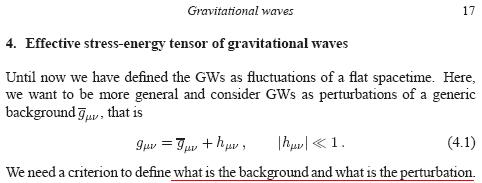
Details from Michele Maggiore,
Gravitational Waves: Theory and Experiments, Oxford University
Press, 2007,
pp. 34-35:
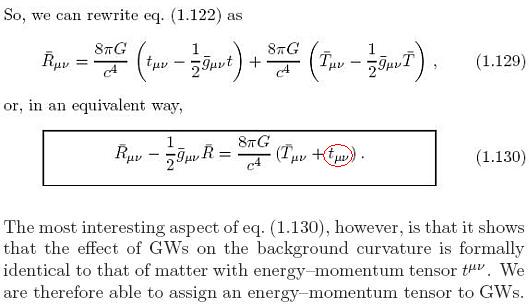
Then "something that is dimensionless" (exact quote from Kip Thorne), calculated in the case of PSR J1603-7202 as "2.3×10⁻²⁶", would miraculously1 travel 5345ly to Earth, carrying its intangible GW energy, just to end up at LIGO's arms, at which point it will be converted into some tangible form of energy. Is the Brooklyn Bridge for sale, again ?
D. Chakalov
Easter 2012
Last updated: April 24, 2012
1 MTW, p. 968:
Michele Maggiore,
Gravitational Waves: Theory and Experiments, Oxford University
Press, 2007,
p. 32:

=======================================
Subject:
Relativity and Gravitation, June 25 - 29, 2012, Prague
Date: Sun, 8 Apr 2012 00:59:11 +0300
Message-ID:
<CAM7EkxnZKeaDDO1_+1BX2gwhuLdfexV_mdS4DghQxegSDrLtJA@mail.gmail.com>
From: Dimi Chakalov <[email protected]>
To: Bernd Brügmann <[email protected]>,
Marek Abramowicz <[email protected]>,
Lars Andersson <[email protected]>,
Roger Blandford <[email protected]>,
Jirí Bicák <[email protected]>,
John Friedman <[email protected]>,
Bernd Schmidt <[email protected]>,
Luciano Rezzolla <[email protected]>,
Helmut Friedrich <[email protected]>,
Joseph Katz <[email protected]>,
Robert M Wald <[email protected]>
Dear Colleagues,
I believe you are members of the
Scientific Organizing Committee of the Einstein Conference in Prague, and also staunch supporters of GW astronomy.
In my oral contribution submitted last December, which is still pending your approval, I will address two *very* simple questions posted at
http://www.god-does-not-play-dice.net/#Bondi
Please let me know if you'd like me to elaborate in my talk on other problems of GW astronomy.
Wishing you a very happy Easter, and looking forward to meeting you in Prague,
Yours sincerely,
Dimi Chakalov
----------
Note: To prove the original assumption in physics that "mass is that which is conserved" (Hermann Bondi), one needs to demonstrate rigorously that 'negative mass' is indeed non-existent in GR, or somehow cancelled out: "within the general theory, it is not possible to have the active and passive masses different" (P. Bergmann). The latter argument presupposes "conservation of momentum, which means integrals over extended regions of space" (Hermann Bondi), that is, "passing to an appropriate asymptotic regime such that all gravitational effects are localized inside of it" (A. Helfer), the inertial reaction "forces" included. The latter are considered non-existent (much like Macavity) in some 'free falling elevator', yet they emerge instantaneously (cf. Mike Zucker below). Why? How? And with respect to what (Ernst Mach)? The mainstream opinion, spelled out by Ciufolini and Wheeler (p. 270), does not answer these questions. As explained by J.F. Woodward, "when you push on something, it pushes back on you immediately. If they're caused chiefly by the most distant matter in the universe, how can that be?" Well, "it would be nice if the inertial mass of an accelerating particle were simply a back-reaction to its own gravitational field, but that is not the case. (...) Newtonian active gravitational mass (the creator of the field) goes over into GR as the creator of curvature. Newtonian passive gravitational mass (that which is pulled by the field) goes into banishment along with the ether, etc." (Wolfgang Rindler). Going back to GWs, the seemingly obvious conjecture that gravitational radiation is being "emitted" in 3-D space (R. Feynman) also presupposes global
conservation laws in GR: "If energy is not conserved quite generally, there is no need to make up a story about where it has gone when a system loses it" (C. Hoefer); details from Erik Curiel. Surely there isn't any 'physically observable' gravitational radiation in the dipole and monopole mode, but this does not mean that such "ripples" cannot exist in Nature. Here people say that the
conservation (if any) of energy-momentum would imply the absence of monopole and dipole gravitational radiation, so GWs should be sought exclusively with the quadrupole approximation. As explained by B. Schutz (reference here), by resorting to the post-Newtonian approximation and ignoring higher order effects: "But this (Eq. 10 - D.C.) is the total momentum in the system, and (to lowest order) this is constant. Therefore, there is no energy radiated due to dipole effects in general relativity." See also Chris L. Fryer et al.: "At lowest order, GWs come from the time changing quadrupolar distribution of mass and energy; monopole GWs would violate
mass-energy conservation, and dipole waves violate momentum conservation." But how can we prove "mass-energy conservation" and "momentum conservation" in our universe dominated by the so-called "dark" energy, to eliminate monopole and dipole GWs? They cannot be "emitted" in 3-D space (R. Feynman) built with only one "charge", and cannot of course be detected by any "advanced" LIGO or Virgo either. Mike Zucker provided the best hint for the atemporal nature of the monopole and dipole gravitational radiation: "For example, if two stars collide or a star explodes somehow, the change in the mass distribution, the presence or absence of a star where there was one before, has to somehow be communicated throughout the whole universe. And in Newton's picture, there's a problem with that because there isn't any way for that information to take some finite amount of time. Somehow the whole universe must know about everything instantaneously." That's how we get the inertial reaction "forces" -- instantaneously, like in a school of fish bootstrapped by its "ripples". Such "ripples" must not carry energy that "can do work", which is why in the non-linear GR they can show up only as 'unphysical gauge' (Angelo Loinger). As Arthur S. Eddington pointed out in 1922 (p. 269), "They are not objective, and (like absolute velocity) are not detectable by any conceivable experiment. They are merely sinuosities in the co-ordinate system, and the only speed of propagation relevant to them is “the speed of thought”."
NB: These are the "thoughts" of 'the universe as a brain'. No physical stuff "pulsates" in the quantum realm to produce quantum waves (with dimensionless amplitude), and no physical stuff alone could produce the gravitational "ripples" either. These are holistic effects of the Arrow of Space: the rule 'think globally, act locally' will induce wave-like behavior in 'the whole school of fish', a bit like the waves in the holomovement of centipede's legs. You have the same phenomenon of purely geometrical nature right above your neck: you think about your brain, by your brain, hence your brain is 'self-acting'. Physically, we cannot observe the "ripples" of 'the universe as a brain'. All we can physically observe is a self-acting universe in which the conversion of the "negative mass" and "the intangible energy of the gravitational field" (Hermann Bondi) into 'tangible forms' is facilitated by perpetual energy non-conservation, and smuggled into the right-hand side of the Einstein field equations "post factum", due to the speed of light. Perhaps a wave-like correlation of the energy content of the very early universe, at the instant it contained an equal amount of matter and antimatter,
way before the so-called "spontaneous"
symmetry breaking, can shed light on the cosmic microwave background (the drawing below is for illustrative purpose only, for the geometry of the universe could be quite different).

The unsolved puzzle here is the origin of the cosmic microwave background (CMB): "Where did the photons actually come from?" (Douglas Scott). The matter/antimatter asymmetry (about one matter particle per billion managed to "survive") was settled by the unphysical gravitational "ripples" over the whole universe en bloc. The background of the "survived" matter doesn't contain any trace from some real relic GWs.
The instantaneous synchronization of the initial perturbations and of the radiation arriving from opposite ends of the universe (Scott Dodelson et al., arXiv:0902.3796v1, p. 2) is due to the unphysical gravitational "ripples" -- the "thoughts" of the universe, which synchronize and
bootstrap the whole universe as 'ONE'. Such kind of "John's thoughts" cannot be physical: Mens agitat molem (Der Geist bewegt die Materie), as Virgil argued in The Aeneid. Were the gravitational "ripples" physical, they would have to be produced by another physical agent, which would in turn have to be produced by yet another physical agent, etc., ad infinitum. Aristotle suggested the cut-off on this infinite regression with the First Cause which isn't physical: Der Geist bewegt die Materie. To eliminate the physical presence of 'Der Geist', the dual age cosmology has been introduced. Simple, no? To prove/disprove these conjectures, we first need a rigorous formulation of 'isolated system in GR': "In some sense, we must say what it means to travel far from the system, and say that in that limit the system becomes “self-contained.” Roughly speaking, this should mean passing to an appropriate asymptotic regime such that all gravitational effects are localized inside of it" (A. Helfer). To define 'isolated system in GR' by reaching "that limit" (Finite Infinity), we need to recover Einstein's 'total field of as yet unknown structure'. I will argue for the introduction of the 'free fall' in conjunction with 'time-orientability', as two fundamental and irreducible features of 'spacetime in GR', introduces as mathematical axioms 'by hand', from the outset. In my opinion, the seemingly innocent "relaxation" of the Einstein field equations "which, a priori, do not form a partial differential system of well-defined type" (T. Damour, The problem of motion in Newtonian and Einsteinian gravity, in: Three Hundred Years of Gravitation, ed. by Stephen W. Hawking and Werner Israel, Cambridge University Press, 1989, Sec. 6.8, pp. 147-149) is wrong. As I argued previously, there isn't any "evolution" whatsoever with the misfortunate "3+1 formulation": each and every "point" from the quasi-local geodesic is the nexus of 'already completed' negotiations between the positive-energy content localized at such "point" and 'everything else in the universe', in line with the ideas of Ernst Mach and the bootstrapping principle of Geoffrey Chew. My oral contribution, submitted on December 16th last year, is still pending the approval of the Scientific Organizing Committee of the Einstein Conference in Prague. Stay tuned.
D. Chakalov
April 9, 2012
Last updated: April 17, 2012
=======================================
Subject: Dynamics of General Relativity: Black Holes and Asymptotics,
ESI, December 2012
From: Dimi Chakalov <[email protected]>
Date: Sun, 8 Apr 2012 20:04:57 +0300
To: Robert Beig <[email protected]>
Cc: [email protected], [email protected],
[email protected], [email protected],
[email protected]
Dear Dr. Beig,
Please let me know when I can register for the Workshop in December. I would like to argue for the introduction of the 'free fall' in conjunction with 'time-orientability', as two fundamental and interlinked features of 'spacetime in GR', and will address some issues of "conserved" quantities in asymptotically flat spacetimes endowed with "dark" energy from the outset.
Some relevant material has been briefly mentioned at
http://www.god-does-not-play-dice.net/#Bondi
Wishing you and your colleagues all the best for Easter,
Yours sincerely,
Dimi Chakalov
-------
Note: When it comes to
the dynamics of General Relativity, the most difficult issues are those
which refer to global features of spacetime: what is the origin of the 'free
fall'? Could this ubiquitous phenomenon be a blueprint or maybe a
"reversed image" from some global dynamics of spacetime produced by the
arrow of events known since Heraclitus? Do we
need to introduce the free fall phenomenon by hand at the level of
'differentiable manifold', as we do with time-orientability?
In other words, what could possibly introduce a temporal
structure to the "points" from a
Borel set, to make it a genuine
'spacetime' equipped with the metaphysical principle of
causality? We cannot start from thermodynamics and use some
"top-down" approach.
What could be the
phenomenon that connects the "points" in the first place? I will
argue that such causal connection cannot be made only
and exclusively only by matter. Matter is the necessary
condition for the "connection", but the sufficient condition is
purely geometrical, and can only come from 'the whole
universe as ONE'. Namely, there exists a fundamental component of
this "connection", which (i) originates from 'the whole universe as ONE'
driven by an Arrow of Space, (ii) and makes these causally-connected
"points" quasi-local, to accommodate the holistic input from 'the
whole universe as ONE'. Let's go back to the 'free fall'.
The metaphor "closed room accelerating
through space" (see above) is
made of five words, each of which refers to a total mystery. I will argue that "space" could
refer to Einstein's 'total
field of as yet unknown structure', and "through space" could only
mean 'along null hypersurface', namely, in a putative 'global mode of
spacetime' which all physical clocks will read as some
atemporal world, due to the
"speed" of light. Obviously, the views of Robert Beig on the dynamics of General Relativity (GR) are
incompatible with the new dynamics of spacetime: all things
in GR happen 'in time' due to the Heraclitean transience (which
is banned in GR) along the null-hypersurface of the Arrow of Space,
which makes 'space' an emergent phenomenon (Isham
and Butterfield). We
shall also have a very "stimulating" (for the lack of a better
word) discussion about the "conserved"
quantities in the asymptotically flat spacetime of the "closed room",
after my talk about John's jackets: we need to have
the reference fluid of GR fixed at 'absolute
rest', with respect to which we can define the dynamics of spacetime
en bloc, as driven by the "dark" energy of Einstein's 'total
field of as yet unknown structure'. We simply have no choice, or do
we?
At the end of the day, I
suppose Robert Beig and his distinguished colleagues would struggle with
the temptation to strangle me with their bare hands... but because
they all are polite people, they will probably pretend that
haven't heard anything important, and will continue to speculate about "black
holes" and "asymptotics" in the framework of ADM,
although neither of these concepts makes sense -- they cannot be
rigorously defined, without juvenile mathematical poetry and/or
wishful thinking introduced 'by hand' to the misfortunate '3+1 numerical
relativity'. Sad but true. Why?
Very briefly: the idea
about some "event horizon" cannot be rigorously defined (I can elaborate
extensively here), so the speculation about "black
holes" involves too much poetry and wishful thinking. As to the second
issue, if you start from some feature of the physical spacetime, you
cannot extend it exactly at infinity in order to produce some
"boundary" placed at all directions (time-like, space-like, and
null), such that there will be absolutely no leaking of mass and
energy from "the unphysical spacetime" (Robert Wald,
pp. 283-287) with respect to which the "physical" one has been
defined -- you have to use Quantum Theory, hence cannot completely
seal off the "boundary". Roger
Penrose skipped this QM exercise in his
1964 conformal treatment of infinity,
and almost half a century later
Jeffrey Winicour still happily
assumes that "matter fields do not spoil
things", and poses the question whether the necessary boundary data can
be "represented by gauge invariant, local geometric objects", again
without bothering about quantum effects at the "spacelike cap on the
future evolution domain." Instead of seeking some new, and still
unknown, natural boundaries for the gravitational "field", he is trying
to suggest that we might not need them, just like the old story
about the
Fox and the grapes.
Let's start from scratch.
I was never able to understand the Equivalence Principle (cf. B. Schutz), because of the apparent freedom to eliminate gravity locally, 'at a point'. It reminds me of an old joke: what do you see below?
|-----------------------|
Obviously, this is a wegtransformierbar elephant walking on (flat) tightrope! It always drops down due to the Equivalence Principle, poor thing.
Let me try something very simple: the finite size of the "neighborhood U" (cf. Yuri Bonder above and the unsolved task for a quantum version of the strong equivalence principle) in the excerpt below, from An Introduction to GENERAL RELATIVITY, by R. Aldrovandi and J. G. Pereira, March-April/2004, pp. 70-71:

Suppose, for the sake of the argument, that GR were some "classical" theory, as usually stated in today's textbooks. Then it doesn't matter if we choose, or not-choose, to get rid of "the components of the Levi-Civita connection" -- Mother Nature has
always made them vanished 'out there'. It's like our decision to look, or not-look, at the Moon at noon -- it just won't be there. This is the essence of 'objective reality out there' in any 'classical theory'. Thus, if GR were a bona fide "classical" theory, we would be always confined in the "neighborhood U" and will be always perfectly shielded from gravitation.
I think the wegtransformierbar gravitational energy is a quantum phenomenon: see the story about John's jackets here. Just like the UNdecidable
uncolorizable pre-quantum Kochen-Specker state, the gravitational energy (John) must disappear totally at a "point" (remember the falling elephant?), leaving there only its fleeting positive-energy "jacket", one-at-a-time along the Arrow of Space. Ditto to the
reality of gravitational waves -- they can enter the local (physical) mode of spacetime "post factum" only, through a null-surface.
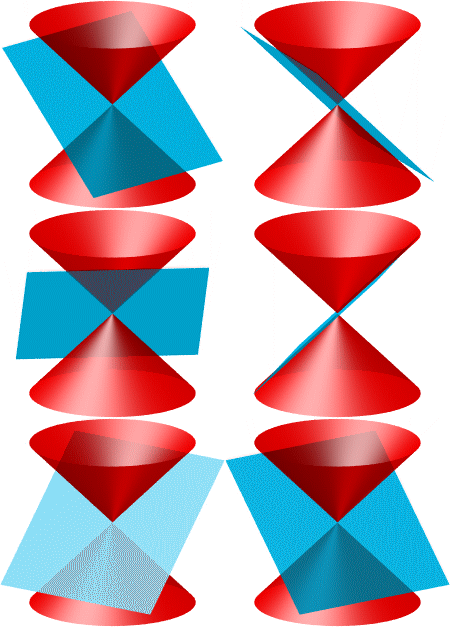
Notice again the brand new option for developing quantum gravity with 'John's
jackets': the ultimate source of quantum-gravitational reality is
neither totally present nor totally absent, but only casting its
fleeting "projection", along the null-surface of the Arrow of Space, at
the local (and "time"-invariant, from
CPT symmetry) mode of spacetime, like shadows on Plato's cave.
Physically, we can only observe a "shadow" or "jacket" at particular
"point", explicated from "John" post-factum, that
is, one-at-a-time along the Arrow of Space.
To explain the emergence of a quasi-local "geodesic y going through a
point P" above, consider again the Gedankenexperiment with four
dice above, which are
correlated "in the air" (in the global
atemporal mode of spacetime), in such a way that the sum of their
readings on the table (local mode of spacetime) must be confined in the
interval [10, 20], at the instant ("point P") they are
fixed/dropped on the table. We can physically observe only the
dice on the table, where they exist as 'facts' explicated on a
perfect continuum (local mode).
Suppose we observe
consecutive sets of readings like n1: (3, 5, 1, 6), n2:
(4, 4, 3, 5), n3: (5, 6, 2, 5), n4: (1, 3, 5, 1),
etc., all of which are correlated 'post
factum' by the requirement [10, 20]. Physically, we're constrained
by the 'speed of light', so we will only observe an emergent
quasi-local "geodesic y" of such already-correlated n-states
explicated on a perfect continuum (local mode of
spacetime). Every n-state matches the "point P" at which
the components of the Levi-Civita connection have already
vanished: all we can physically observe, due to the 'speed
of light', is a pre-correlated quantum-gravitational "jacket"
cast there from "John".
Here comes an explanation
of the motto (since July 1998) of this website: Dead matter makes
quantum jumps; the living-and-quantum matter is
smarter. Notice that if we place these n-states
in the
phase space of classical mechanics, they will be separated by
infinitely many point-like states, and all dice will be always confined
'on the table'. Hence it will take a finite time interval for
all dice to roll from one set of "correlated" n-states to the
next set (not to mention the
Buridan-donkey
computational task which will 'halt' your super-computer). In the
quantum-gravitational realm, there are no "intermediate" states,
because the
one single atemporal EPR-like correlation is executed 'post
factum' -- as it would have been recorded by a physical
clock 'on the table'. A macroscopic ("dead") device
cannot possibly log on the pre-correlated
dice, and will inevitably "read" their dynamics by a "quantum jump".
But the "jump" isn't
quantum. It is macroscopic. It is simply an artifact of the measuring
device, facilitated by the representation of "probabilities" (Chris
Isham). In the
quantum-gravitational realm 'out there', we have only
emergent quasi-local
trajectories/geodesics on the perfect continuum (local mode of
spacetime) of the n-states (VGP formulation of GR),
each of which corresponds to a static frozen linearized
and post-correlated universe, down to the
Planck scale. There are no "jumps" along the Arrow
of Space either, but a perfect continuum of re-created
Phoenix Universes
(Georges Lemaître,
1933). If the
correlating effects of 'the universe as ONE' in the global mode of
spacetime are negligible, one can imagine a fixed flat Minkowski
spacetime.
Here comes the problem with the current "dynamics
of GR": people try to make the spacetime "dynamical" after
splitting it into two "separable" entities, and then use the same
dead frozen "time" that can "evolve" just as much as space can (Robert Geroch).
But there is no dynamics whatsoever, in any shape or
form, in the re-created and
post-correlated n-states from the
local mode of spacetime. It's just a "flattened" and
linearized Arrow of Space, with which you can
adjust the
GPS system. You can't rely on
such linearized GR and its
'comma to semicolon
rule' (S. Weinberg, p. 106)
for tasks involving objects
larger than the solar system (cf. the tug-of-war manifestation of
gravity above).
I recall a
very tricky statement by Chris Isham that "general
relativity does seem to work well as a theory, and yet I can certainly read the time on my wrist watch!"
Well, his
wristwatch reads a continual chain of post-linearized
n-states or "jackets" along the Arrow of Space, which resolves the paradox
(not "problem") of time in quantum gravity. The latter is inevitable due to "the
invariance of classical GR under the group Dim(S) of diffeomorphisms of
the spacetime manifold S", as explained by Chris Isham
here,
and by Karel Kuchar
here.
With the Arrow of Space, at every n-state we have a perfect
conservation of energy
pertaining to the linearized frozen Phoenix Universes, hence can imagine
it as
one quasi-local "point" from its quasi-local geodesic
evolving along the "vertical" (like Photoshop
layers) direction of the Arrow of Space.
Surely Chris Isham can read such post-linearized
time with his "wrist watch!", but he needs quantum gravity to explain
the global "nondynamical
and explicit" time (Bill
Unruh) which cannot in principle become 'GR
observable'.
This is the outline of
the motto of this website (see above), in the context of the Machian quantum gravity.
No
"dark" stuff with positive energy density and no
"quantum jumps" exist in Nature. As Erwin Schrödinger stated, "Wenn es doch bei dieser
verdammten Quantenspringerei bleiben soll, dann bedauere ich, mich mit
der Quantentheorie überhaupt beschäftigt zu haben" (If we have to go on
with these damned quantum jumps, then I'm sorry that I ever got
involved).
NB: I will be more
than happy to defend Schrödinger at the Erwin Schrödinger
Institute, if only Bobby Beig allows me to talk. Observe that in
both GR and QM we have lost the mundane concept of 'objective reality
out there' from classical physics:
1. "The
requirement of general covariance takes away from space and time the
last remnant of physical objectivity," A. Einstein, 1916 (Annalen der
Physik 49, 769-822)
2.
"In general, a variable has no
definite value before I measure it; then measuring it does not
mean ascertaining the value that it has." E. Schrödinger,
1935
We can recover the notion
of 'reality in QM', only it isn't physical but 'potential
reality'; see the case studied by Nevill Mott
here. To reveal the
corresponding, in the context of GR,
presentation of the UNdecidable
uncolorizable pre-quantum Kochen-Specker state
(never in plural), check out the
original paper by Ernst Specker above, and
Isham and Butterfield (arXiv:gr-qc/9910005v1,
p. 3;
emphasis added):
In a nutshell (C. Isham,
arXiv:1004.3564v1, Sec. 5.1, 'The Kochen-Specker theorem and
contextuality', p. 20):
"... the implication of
the discussion above is that the value ascribed to B (resp. the result
of measuring B) depends on whether it is considered together with A1, or
together with A2. In other words the value of the physical quantity B is
contextual. This is often considered one of the most important
implications of the Kochen-Specker theorem."
What, if any, remains
invariant in 'the quantity B' upon observing it 'together with A1'
and 'together with A2'? What keeps its "sameness"? According to GR
textbooks -- nothing, because the quantity B isn't 'observable' but
gauge-dependant. Just like the so-called 'absolute structures',
it isn't "physical". It doesn't obey the ‘generalized principle of action and
reaction’ either (James L. Anderson,
Principles of Relativity Physics, Academic Press, New York,
1967, p. 73 and p. 339).
What remains
invariant is the unphysical 'John' --
not its gauge-dependant 'jackets' that can be introduced 'by
hand' (and work amazingly well, e.g., energy pseudo-tensors), and also
eliminated 'by hand', as in the case of GWs (cf. A. Loinger,
arXiv:physics/0312149v3).
It shows up in GR as Karel Kuchar's Perennials and the Aristotelian
First Cause which
governs the dynamics "from
outside as an unmoved mover". Notice that
John's
"all time
τ
is eternally present" (idem),
as it should be. Not surprisingly, the "waves" of
John
aren't "physical" either. Yes, they
are real, but cannot be detected with LIGO,
Virgo and the like.
Ditto to the "god
particle"; details from Holger
Lyre.
Observe that
every n-state occupies the instant 'now' from the Arrow of Space, at
which the two modes of spacetime coincide -- we have a
re-created
Phoenix Universe in which the "neighborhood U"
is stretched to the dimensions of the whole universe, all negotiations between the two sides of the
Einstein filed equation are settled, and the negative gravitational
energy almost-exactly (here we enter the cosmological "constant"
puzzle) cancels
"the energy you think is being gained in
the matter fields" (Sean
Carroll). There is absolutely nothing "dark" in such
frozen instant 'now'
from the Arrow of Space. But if we compare the n-states 'now'
along the "vertical" direction the Arrow of Space
(like Photoshop layers),
the holistic effects from 'the school of fish'
(Machian
QG) will be indeed deeply confusing, since people are
conditioned, since 1930s, to seek explanation of such "dark" energy from
some stuff with positive-energy density.
Notice again that all
correlations "in the air" occur in the global
luxonic time, which an (inanimate) wristwatch will read as "frozen".
The obvious puzzle is that "nothing can “happen” along the wave direction, time stands still in the wave direction" (B. Schutz), which is why we need two modes of spacetime, global (atemporal)
and local (physical). I believe the correct (not Hamiltonian)
formulation of GR can only be recovered with the geometry of null hypersurfaces
(cf.
Kevin Brown) which, "unlike
that of space-like hypersurfaces, is not metric" (D.C.
Robinson). There isn't any other feasible option to cure the initial
error with the "splitting of spacetime": there is no problem of space
in GR and in canonical quantum gravity. People are still treating
'spacetime' as a composite made of two separable entities (cf.
Hermann Minkowski), and are
"instructing" matter to "evolve" on a dead
frozen "space" which can only "bent" (cf. below), but cannot
evolve en bloc, as being driven uniformly by the holistic
(not "dark") energy of Einstein's 'total
field of as yet unknown structure'.
To recover the genuine dynamics of GR, we need to make
the very spacetime dynamical, to "fly" along the null hypersurface
of the Arrow of Space. The best way to
explain the task is to examine the crux of today's GR: the distinction between the active (gravitating) and the
passive (gravitated) mass.
As Homer G. Ellis
explained (arXiv:1205.5552v1),
"in newtonian gravity, application of the law of action and reaction to
the forces exerted on each other by two gravitating bodies A and B
allows the inference that the ratio of active mass to passive mass is
the same for B as it is for A, thus by extension is the same for all
such material bodies", and "this application of the action-reaction law
to bodies not in contact (Sic! - D.C.) requires the assumption that gravity acts
instantaneously over the intervening distance, an assumption at odds
with the finiteness of the propagation velocity of gravitational
effects implicit in Einstein’s theory."
And Wolfgang Rindler (see
above): "One can further distinguish between active
and passive gravitational mass, namely between that which causes and
that which yields to a gravitational field, respectively. Because of the
symmetry of eqn (1.8) (due to Newton’s third law), no essential
difference between active and passive gravitational mass exists in
Newton’s theory. In GR, on the other hand, the concept of passive mass
does not arise, only that of active mass—the source of the
field."
However, "the source of
the field" is still unknown, as acknowledged by
Einstein. The indisputable finiteness
of the propagation velocity of gravitational effects is valid only
for the local mode of spacetime, while in the global mode we also
have an "instantaneous" -- as it would have been read by a
physical clock -- EPR-like correlation resulting in "aligned trees" due
to the quantum-gravitational "wave", depicted in the drawing
below.
Stated differently, the proper GR
makes no distinction between the active
(gravitating) and passive (gravitated) mass, since
the latter facilitates the atemporal
feedback from 'the whole universe as ONE'. The "eter" (Wolfgang
Rindler) is perfectly hidden
]between[ the "points" from the
underlying topological manifold.
I will refer to this
Ansatz as 'Unified Gravitational Mass Conjecture' (UGMC), and
hope to elaborate on the origin and mechanism of inertial "reaction"
forces and REIM at the ESI Workshop in
Vienna this year.
Also, the proper GW detector must be endowed with the faculty of self-acting (see above), and must access the global mode
of time: check out the time code of the animation from John Walker
below depicting the 'relativity of of simultaneity' (no invariant
meaning to “the same time but at different places”). You observe all events from the whole Cauchy slice en bloc from
the global mode of spacetime. You are "outside" the 4-D spacetime,
]between[ the emission-and-absorption
of a "free photon" (Kevin
Brown), in the potential reality of 'John' (not his "colored jackets"), and of course your poor
("dead") wristwatch will read your luxonic time as "frozen".
To sum up, here's a sketch of the "dark Zen gaps"
(the global mode of spacetime is pictured with
red) along the "frozen" (as read by
your inanimate wristwatch), null-direction of the
Arrow of Space:
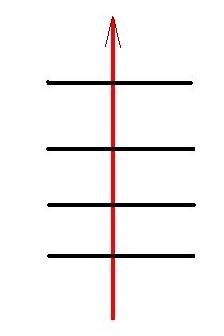
Every "horizontal"
(black) slice is an instant 'now' from the
Arrow of Space:
the re-created spacetime is
perfectly continual in its local (physical) mode, at
all length scales down to the Planck
scale. This is 'the back bone' of the universe. For inanimate matter
at the length scale of tables and chairs (not the human
brain), we may envisage that in certain cases the
quantum-gravitational effects (pictured
with red)
would be FAPP insignificant, then safely use an approximation in terms
of some fictitious Minkowski spacetime. Also, all "horizontal" (black)
slices denote an instantaneous (at a
single time),
already-negotiated universe (here
we enter the Machian gravity), at which
one can "eliminate" gravity -- but at this
instantaneous single time
only. Again, notice that in both cases, with or without
quantum-gravitational effects, we
"handle" the Arrow of Space as we do with Photoshop
layers, and as we "flatten" and sum up (Sic!) all
"horizontal" (black) slices in the local (physical) mode of spacetime,
we face all sorts of quantum and "dark
elephant" paradoxes, and cannot explain the
kinematics of space and the origin of time.
What we call 'time'
doesn't come from thermodynamics. It is an
omnipresent (cf. the 'dark Zen gaps'), hence
"hidden" variable, in the sense that it does not "point" to any
particular direction in 3-D space. Physically, the universe exists
only at single instances, "separated" by
the 'dark Zen gaps' in the global mode of
spacetime, and any physical (inanimate) clock will read such 'global
atemporal luxonic mode of time' (cf. the
animation from John Walker) as "frozen" -- the fundamental increment
of time along the 'ladder' above cannot be detected by a
physical clock "online", as it evolves along the Arrow of Space.
Physically, it can only be detected 'post
factum'. The human brain and 'the universe as a
brain' do not suffer from such limitations.
Se non è vero è molto ben trovato, eh ?
Seriously, the task is indeed simple, because if we keep in mind the broader picture of quantum gravity, we should offer solutions to four tasks: (i) the measurement problem in Quantum Mechanics, (ii) the macro-objectification problem (smooth reversible transitions between the macroscopic world and the quantum realm), (iii) the gravitational effects of the quantum vacuum (F. Curtis Michel)
and the “cosmological energy catastrophe” (Pavel Kroupa et al.,
arXiv:1006.1647v3, footnotes 1 and 2), and (iv) the emergence of Lorentzian metric from the so-called "spacetime foam"
(details here). Once we put all this the table, the
spectrum of choices to resolve these four puzzles will narrow sharply. Then we
will try our best proposal, and if it resolves another problem effortlessly (e.g.,
the origin of
CMB1), we'll gain further confidence in our approach toward quantum gravity -- it will be 'simple', simply because at this point we would have practically
no freedom to get it wrong. Soon or later, all pieces from the jigsaw puzzle will snap to their places,
effortlessly. But then comes a gentle reminder from Friedrich Schiller:
Nur die Fülle führt zur Klarheit,
Und im Abgrund wohnt die Wahrheit.
D. Chakalov
April 15, 2012
Last updated: July 30, 2012
1 The
interpretation of CMB as an 'echo' of some
"big bang" presupposes some cancellation of matter/anti-matter
(called "annihilation")
resulting in the observed matter/anti-matter
asymmetry, but the questions of "how many" baryons exist in the
universe today, in the form of
matter rather than antimatter, and
what happened to the antimatter are still unsolved: there is far too
much "non-baryonic dark stuff" to fit in the
universe.
Which is why I use the term cancellation, as with the
other "dark" element from the tug-of-war gravity,
e.g., the cancellation "between different contributions to 1 part in 1060,
in order to be consistent with the observed size of the Universe" (N.
Afshordi, pp.
6-7).
Think about 'baryons in the universe
today' (about
one particle per billion) as John's jackets
emerging from the cancellation of, say, 1 part in 109. No
"big bang" and no violent eruption ever happened
-- just a quiet cancellation of 'all but one
jacket', as in the Potential Reality (PR)
interpretation of Quantum Mechanics. Namely, the instant 'now' from the
Arrow of Space offers only one empty template to be filled
in with only one
jacket', with unit probability. The rest of
"quantum states" (cf. R. Feynman above)
simply do not show up as 'physical reality' in the instant 'now',
hence there is no violation of the unitary dynamics kept by 'John'
(not his 'jackets') in the quantum realm 'out there'. The
non-unitary "collapse" (cf.
Steve Adler) is also an
artifact from the macroscopic devices: Dead matter makes quantum jumps;
the living-and-quantum matter is
smarter.
Recall the story about Wheeler's
"cloud" in the game of 20 questions:
"There had been a plot
not to agree on an object to be guessed, but that each person, when
asked, must give a truthful answer concerning some real object that was
in his mind, and which was consistent with all the answers that had
gone before." With only one question left, John Wheeler guessed: "Is
it a cloud?" The answer was "Yes!"
(John and Marry Gribbin, In
Search of Schrödinger's Cat, Black Swan, London, 1998,
p. 209).
The answer 'cloud' did not exist as "baryons" or any
positive-energy stuff before the first question asked by John
Wheeler, nor until the 19th answer. It rather emerged like
John's jackets from
Margenau's Onta
during the ongoing specification on the context, in perfect
agreement with Kochen-Specker and Conway-Kochen theorems mentioned
below. The "ongoing specification" is performed by
one standing quantum-gravitational wave --
the "thought" of the universe correlating the instantaneous
emergence (as it would have been recorded with a physical clock) of "jackets"
in the instant 'now' from the Arrow of Space. Simple,
no?
Notice again that the "thought"
of the universe (the GPI field of Einstein)
is neither physical nor mental phenomenon, but 'potential reality'. It
is not some uniform homogeneous filed -- its has "clumps" of
associations, like the associative links in the human memory, only
in this case we're talking about the "memory" of 'the universe as a
brain' bootstrapped by its quantum-gravitational wave.
These "clumps" of associations show up as "quarks" which are
totally "confined" from the outset, as explained eloquently by
Don
Lincoln below.
Compare
this with the explanation from
David J. Miller
What physicists at
CERN call 'mass' is the "verbalized
thought", or rather the physical "jacket"
from these clumps of
associations in the GPI field of Einstein
(the "thought" of the universe). If we parameterize the effects, denoted
with E (from 'entanglement with the universe as ONE'), of the GPI
field with an open interval of natural positive numbers, (0, infinity),
we will start from the case of 'E approaching asymptotically 0',
which corresponds to the mundane world of classical mechanics. As E
grows, it will outline the GPI layer of QM, in which the GPI field
absorbs Margenau's latent
observables. The next layer is the one at which the GPI field
incorporates Margenau's
possessed observables, such as
the "mass" of elementary particles
in
QCD. Going further, the next GPI layer will be well
beyond the "standard model", as some yet-to-be discovered inclusion
of the electron in the extended (with some help from
Fibonacci) family of "quarks". What comes next is anyone's guess,
but notice the case of 'E approaching asymptotically infinity':
well, this may be a super "heavy" clump of associations of all
potential particles in the quantum vacuum, which also exist as
'potential reality' (recall that 'John' himself does not gravitate; only
his "jackets"). If you wish to described this last GPI layer with
"quarks", check out again Fibonacci. It's
all "quarks" down the road, but there must be a cut-off at the
Planck scale. Simple, no?
Not surprisingly, my
offer to elaborate in details at CERN's Summer Institute on BSM
Physics (18 - 29 June 2012) was not appreciated. Yet
the people at CERN's Theory Group can't introduce gravity in their
"standard model", which is why they
don't have a clue about the leptoquark "mass", nor can
explain the "miracle" with the proton mass.
But they have money.
A humongous amount of money. Billions and billions of
Euro.
We haven't the money, so we've got to think!
Lord Rutherford, 1962 Brunel Lecture, 14 February 1962
==========================================
Subject: John and Alice
Date: Sun, 10 Jun 2012 02:26:10 +0300
Message-ID:
<CAM7EkxnvXxxPF8b7KGLOLhHbP9xkrxBFq3je_YG9TDCxpKoc4A@mail.gmail.com>
From: Dimi Chakalov <[email protected]>
To: [snip]
Dear colleagues,
I've posted three tasks, (i) - (iii), at
http://www.god-does-not-play-dice.net/#EH_if_any
"Just try to (i) explain the schizophrenic behavior of the "watches"
called John and Alice below, as seen from a
"safe distance", then (ii)
define rigorously that "safe distance" ("safe" is sheer poetry), and
finally (iii) run the whole story backward in time, to bring that
same
"safe distance" back into the normal, unsuspecting spacetime, before
the "event horizon" occurred, namely, before the null geodesics of
John (Friedman) and Alice have reached their
(quasi-local?) endpoints,
as explained eloquently by Bob and
Chuck."
Perhaps you can perform
the calculations and publish your results from task (iii).
Wishing you a nice summer,
Dimi Chakalov
-------------
Note: Task (iii) is the time-reversal of the hypothetical
irreversible formation of black hole, and since
the recipients of my email
firmly believe that the current GR is a 'classical theory' (it
isn't), they will face the poetry of 'event horizon
formation' and the problems of its dynamics.
Recall the critical point
of 'no return' (S. Carroll, arXiv:gr-qc/9712019v1,
p. 189;
emphasis mine - D.C.): "not only can you not escape back to region
I,
you cannot even stop yourself from moving in the direction of decreasing
r , since this is simply the timelike direction. (This
could have been seen in our original coordinate system; for r < 2GM, t
becomes spacelike and r becomes timelike.) Thus you can
no more stop moving toward the singularity than you can stop getting
older."
How do you exchange
timelike and spacelike directions at the instant at which John (Friedman)
would enter the "event horizon", as recorded with his clock ? And once you perform this mathematical
miracle, how would you connect the two "mirrored" spacetimes
by a "safe distance", in such
way that Alice would never actually witness John entering his
mirrored spacetime at the "event horizon", in line with the
weak
censorship conjecture ? And if John cannot notice that his clock is running
"slower" (as he approaches the "event horizon"), would he see Alice's
clock running "faster" with respect to his normally running
clock ? Namely, is John (Friedman)
going to see the remaining lifespan of Alice (or our
solar system?) unfolding with
increasingly fast rate, say, within 5 min, as
recorded by his clock just before entering his mirrored spacetime
at the "event horizon" ? And what would Alice see if John would
instead enter a timelike naked singularity (P.
Joshi and D. Malafarina,
arXiv:1201.3660v1 [gr-qc]) ?
In the worst "white hole" scenario, John will have to live with some
advanced
Russian civilizations forever, but with some luck
from the Hawking radiation, "the hole could evaporate into
nothingness", before John meets his (advanced)
Russian colleagues. Anyway.
According to Adam Helfer
(arXiv:1105.1980v1
[gr-qc]), "a practical notion of black holes should be linked to
systems which are complete enough to be considered
isolated, in
both time and space", where the crucial notion of 'isolated'
can be defined "up to a well-understood ambiguity," provided "the
generators are infinitely long in both directions", although he "might
consider relaxing the requirement that they be infinitely long to the
past." Then he added: "Precisely because trapped surfaces lie behind
event horizons, we hope and expect never to find them observationally!"
(ibid.,
p. 5). I cannot understand such parapsychology.
Notice the condition
above: "before the "event horizon" occurred, namely, before the null
geodesics of
John (Friedman) and Alice have reached their
(quasi-local?) endpoints."
Ivan Silva argued
below that such condition is nonsense: it is "as
ludicrous as claiming that the boundary of a disc does not exist because
no one can reach it."
Well,
it's not that simple. Remember the
Pink Panther? He sucked the entire spacetime (up to its asymptotic
boundaries) in his vacuum cleaner, and then himself, and finally the
vacuum cleaner sucked itself and disappeared into "nothingness",
or perhaps "singularity":
If you start from
within spacetime, you must totally disappear
at the "end points", or else you will
contain 'matter' which will
define additional, UNcountably infinite 'spacetime points' to be
sucked by your vacuum cleaner. (The time-reversible process
of creatio ex nihilo is the crux of the
dual age cosmology.)
Likewise, since you start
from within spacetime, you cannot, not even in principle,
instruct some spacetime parameter to 'halt' at some 'end
points' at both null and spacelike infinity.
It's a bundle, ladies and gentlemen.
Nobody has defined
rigorously the "boundary" conditions for the gravitational field
("disc"), at which the vacuum cleaner sucked itself and
disappeared into "nothingness". (The latter
may be "the unphysical
spacetime" mentioned in Robert Wald's
textbook,
pp. 283-287).
The daunting problem for explaining an 'isolated system in GR' is still unsolved -- check out a modest estimate from Bernie Schutz
here, and Helmut Friedrich
here. Those who believe the current GR is a
classical theory (it isn't) will first have to
recover the 'dimensionality of
space': check out Martin Bojowald above.
Notice also the misleading
metaphor of Ivan
Silva: we can indeed look at "the boundary of a disc" iff it is an
'isolated system' in Minkowski spacetime. And if this "disk" is a
Frisbee, we can also explain its trajectory in its "phase space", and time-reversible
dynamics, without resorting to any "dark energy". It our case, however,
we need to take the stand of some meta observer
(global mode of spacetime), who can "see" the whole spacetime en bloc,
as depicted in the (highly deceptive) drawing below, in order to verify its
free fall and asymptotic
flatness at "future null infinity", as explained eloquently by Bob and
Chuck.
No physical
observer can perform this miracle, for the same reasons that there is no
"4th spatial dimension" (Ned
Wright). The dynamics of spacetime itself is not like
"curvature". We cannot use the Gauss-Bonnet theorem
and pretend that the "dark energy" will show up "intrinsically", i.e.,
solely within the 4-dimensional spacetime. The
latter captures only 'the necessary condition for
spacetime', while 'the sufficient condition' (cf. below) is still
not implemented in our theories of spacetime.
All GR textbooks (e.g.,
Bob Wald)
use extensively the notion of 'tangent vector at a point', which is
essentially incomplete, because the "point" itself is
quasi-local, to accommodate the 'the
sufficient conditions for spacetime' fixed by 'the whole universe as
ONE' (global mode of spacetime, denoted with "
/ " below).
The ultimate puzzle is that we (and
Chris Isham) can indeed record the cosmological time
depicted with the drawing above with our wristwatches, although there is no explicit time
parameter in GR -- only "constraints" (Karel Kuchar),
and the dynamics of the
coupling matter to gravity (matter becomes 'self-acting' and
bootstrapped via gravity) isn't linear: the
"linearized" gravity pertains only to one single “surface” (see
Kozameh and Newman below) for which the bi-directional negotiations between the two sides
of the Einstein field equations (EFE) are finally settled,
after which we can claim that
“there’s energy in the gravitational field, but it’s negative, so it
exactly cancels the energy you think is being gained in the matter
fields” (S.
Carroll). We could use such 'one single surface' to infer
time-reversible dynamics of matter iff we had a fixed
linearized
spacetime. The genuine dynamics of GR is still missing, as we cannot
extend the solutions of EFE arbitrarily far away (H.
Friedrich) to recover the dimensionality of spacetime -- see
M. Bojowald above.
To cut the long story
short, "even if we start with
genuine tensorial variables, then certain important physical quantities
turn out to be non-tensorial" (László B. Szabados);
check out the status of those "Dirac observables" here.
As Luca Lusanna
stressed, "in
Friedmann-Robertson-Walker solutions one has canonical clocks (e.g. the
temperature of the cosmic background radiation) that not only break
Lorentz invariance defining a cosmic (global) time but break the Galilei
invariance defining observers which are at rest with respect to
the cosmic background radiation."
So, if you wish to
introduce rigorously some
"asymptotic flatness at future null infinity" and complete task (iii)
above, you may need to extend the current GR
to quantum gravity. It is the only option for the
'absolute structures' (Domenico Giulini)
to be introduced into Einstein's
Allgemeine Relativitätstheorie. The current
free fall
simply
doesn't make sense in the absence of a
rigorous, poetry-free formulation of 'isolated
system in GR'.
Albert Einstein was fully
aware of the pitfalls from the principle of general covariance even
before he formulated his
unfinished GR -- "merely a makeshift in order to give the general
principle of relativity a preliminary closed-form expression. For it was
essentially no more than a theory of the gravitational field, which was
isolated somewhat artificially from a total field of as
yet unknown structure."
Can we recover this
'total field of as
yet unknown structure'? The most promising
approach seems to explain the spacetime in terms of null surfaces
along which the Arrow of Space is defined as “change
of space” (compare it with the
“surface theory” of General Relativity, suggested first in 1983 by
Carlos Kozameh and Ted Newman, cf.
arXiv:gr-qc/9502026v1).
In the Newtonian doctrine
of absolute space and time, space is a special object, and the motion of
bodies is determined with respect to such absolute motionless
object, which is “truly distinct from bodies”:


Once we face the 'motion of space' itself, as driven by some "dark
energy", we need to recover the reference fluid of GR, because such
'motion of space' can only be defined with respect to an
absolute motionless object --
the
reference fluid of GR -- which
has no dynamics, because its acts
as
the
Unmoved Mover
(Karel Kuchar).
In the global mode
of spacetime, the motionless reference
fluid of GR is ]between[
the points from the topological manifold, hence it is totally
non-existent in the local (physical) mode of spacetime produced by
the Arrow of Space. In the current GR, it can only show up as an
unobservable (Thomas Thiemann)
'absolute structure' (Domenico Giulini)
pertaining to the whole
spacetime en bloc, as depicted in the drawing above.
Any time
you look at your wristwatch, you see two things superimposed over
a dimensionless "point": a local (physical) time, and the global
(absolute) time along the Arrow of Space. It's a bundle consisting of
two inseparable yet ontologically distinct entities: (i) the fleeting physical content provided by
physical fields, and (ii) the properties of the quasi-local
geometrical "point", fixed by
'the whole universe as ONE' in the global, non-Archimedean mode of
spacetime. The first constitute 'the necessary conditions for
spacetime', but we cannot derive the properties of 'spacetime'
exclusively from (i): the sufficient conditions for spacetime
(ii) complement the necessary conditions for spacetime (i).
There exists an
additional complementary input from 'space', which is “truly
distinct from bodies” (Newton) passing trough 'space', because
all the properties of 'space' cannot be derived exclusively from (i).
For example, the binding faculty of space, exhibited in the
Affine
Connection, cannot be derived
exclusively from (i) above. Stated differently, the geometry of
'the whole universe as ONE' provides an additional, complementary
faculty to (i), which is being manifested only by altering
the physical properties of matter and fields, (i). We cannot
detect (ii) in any other way but in the r.h.s. of the Einstein
field equations, (i), where 'matter' has become self-acting
due to its bootstrapping by gravity.
NB: We have the
same phenomenon of
purely geometrical nature right above our neck: we think about
our brain, by our brain, hence the brain is 'self-acting'.
Physically, we cannot observe the "mind" in the brain -- just a
self-acting brain. Just replace "mind" with 'the sufficient conditions
for spacetime'.
Another example is the properties of the 'geometrical template' (cf. below),
which cannot be
derived exclusively from the fleeting quasi-local
physical content provided by physical fields: the latter are the
necessary condition for 'spacetime', while the 'geometrical template' fixed by 'the whole universe as ONE' is the sufficient
condition -- 'Der Geist bewegt die Materie'.
To explain the need for
'geometrical template', which fixes the
distance function of all finite distances in 3-D space, look at the
two drawing below; the red " /
" denotes the
relation of intermediacy, [A (zero)
B], interpreted as "zero is
]between[ A and B". We will ignore the
temporal order of "points" and their
subsequent individuation
with capital letters (A, B, ...), and will replace them with the generic
symbol from the local mode, x .
Suppose the first
line below is 'one meter', while the second one
is obviously larger:
x/x/x/x/x/x/x/x/x/x/x
x/x/x/x/x/x/x/x/x/x/x/x/x/x/x/x
How many 'geometrical points' x are present in the first and in the second
x-lines? The "number" is the same: UNcountably infinite.
Thus, we need a 'geometrical
template' to fix distinguishable
finite distances in 3-D space and hence the so-called 'scale
parameter'. Such 'geometrical
template' originates from
'the sufficient conditions for spacetime' -- the global,
non-Archimedean mode of spacetime of 'the
whole universe as ONE'. It is indeed “truly distinct from bodies”
(Newton), and it must not be 'Dirac observable',
or else the "ether" will be exposed.
In order
to have '3-D space', the second x-line above must be larger,
to obtain 'large vs
small' and 'inside vs outside'. And here comes the
'geometrical template' from 'the sufficient
conditions for spacetime': it fixes finite
distances in 3-D space, up to its asymptotic "boundaries".
Yet in the new reference frame of an "expanding
observer" (according to Relative Scale Principle), the second x-line will always stay 'one meter'.
Hence the so-called "expansion of space" is a just a frame-dependent effect,
relative to two observers.
It will certainly look "accelerated" to an observer fixed at the length
scale of tables and chairs, unlike the opposite frame-dependent effect toward
The Small, which doesn't at all look "accelerated" due to the cutoff at
the Planck scale. Thus we have a fundamental
asymmetry embedded in the Arrow of Space,
which makes it an 'arrow'.
In one sentence: the
alteration of the geometrical template is what we call
'gravitation'. If it "shrinks" w.r.t. some fictitious
geometrical template in Minkowski spacetime, the effect is attraction;
if it "expands", the effect is "expansion
of space". In the example with the two x-lines
above, if the second geometrical
template was a fictitious template in Minkowski spacetime, which
"shrinks" to the first one, the Earth and the Moon will be attracted.
(There is a lot more to be said here! Check out 'The Two Rules of
Success' below.)
With the
Relative Scale Principle
and the Dynamic Equilibrium Conjecture, there is no need for
"curvature", "non-baryonic
dark dancing elephants", nor "perfect dark fluid with positive energy
density but
negative pressure". These "dark" gravitational effects are
not being produced by 'matter' (i), but by 'the sufficient conditions
for spacetime' (ii).
Those who disagree with
'the sufficient conditions for spacetime' will have to ground
their
quantum gravity hypotheses on a
Biblical miracle, and also accept the parapsychological doctrine
that the human mind can act directly on brain's tissue,
plus the whole "anthropic" parapsychology introduced to "explain" the
cosmological "constant" problems.
Forget it.
D. Chakalov
June 10, 2012
Last updated: August 24, 2012
=================================================
How do we know that Father
Christmas has a beard? We know it,
because snow falls when he shakes his
beard.
Old Tanzanian saying
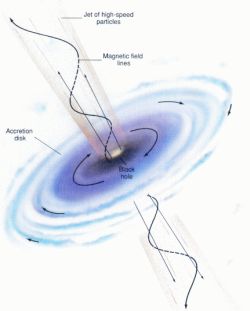
There's no sense in being precise when
you don't even know
what you're talking about.
John von Neumann
According to NASA, the stuff you cannot see between the jets
could only be some invisible 55-million-solar-mass defect of the
spacetime continuum (yes, the Brooklyn Bridge is on sale).
-----------
Subject: Fwd: Request for reference about 'event horizon'
Date: Fri, 5 Jul 2013 14:40:49 +0300
From: Dimi Chakalov <[email protected]>
To: Stephen Crothers <[email protected]>
Cc: Helvi Witek <[email protected]>,
Gary W Gibbons <[email protected]>,
John Friedman <[email protected]>,
Paul K Townsend <[email protected]>,
Miguel Sanchez Caja <[email protected]>,
Laszlo Szabados <[email protected]>,
Jorg Frauendiener <[email protected]>,
Jonathan Thornburg <[email protected]>,
Jeffrey Winicour <[email protected]>,
Greg Galloway <[email protected]>,
Paul Tod <[email protected]>,
Harvey S Reall <[email protected]>,
Richard Woodard <[email protected]>,
Bernard J Carr <[email protected]>,
Pankaj S Joshi <[email protected]>,
Ettore Minguzzi <[email protected]>,
Ravindra Saraykar <[email protected]>
Dear Steve,
In your spare time, please explain to Dr. Helvi Witek why the
hypothetical case in which "apparent horizon" would match "event
horizon" (cf. attached) is unrealistic (I'm trying to be *very* polite
here). Gary Gibbons was unable to understand the
issue (cf. his arXiv:1201.2340v1 [gr-qc], "By "horizon" I shall mean
"apparent horizon" ..."), but perhaps your younger colleague can, given
his recent Ph.D. Thesis at
http://arxiv.org/abs/1307.1145
Has anyone found a rigorous proof of event horizon ? Or pink unicorn ?
Best regards,
Dimi
---------- Forwarded message ----------
From: Dimi Chakalov <[email protected]>
Date: Fri, Jul 5, 2013 at 12:05 PM
Subject: Request for reference about 'event horizon'
To: Helvi Witek <[email protected]>
Cc: Gary W Gibbons <[email protected]>
Dear Dr. Witek,
I wonder if you have found, or maybe heard of some proof for event
(not "apparent") horizon. The distinction is crucial (some people like
G. Gibbons still struggle to understand it), and I hope you have found
the proof for BHs.
Kind regards,
Dimi Chakalov
chakalov.net
[Attached images]
======================================================
Subject: Re: Event horizon, if any: request for reference
Date: Fri, 4 May 2012 20:08:05 +0300
From: Dimi Chakalov <[email protected]>
To: Samir <[email protected]>
Cc: Richard Woodard <[email protected]>,
Avi Loeb <[email protected]>,
Neven Bilic <[email protected]>,
Alan Coley <[email protected]>,
Bernard J Carr <[email protected]>,
Tomohiro Harada <[email protected]>,
George Svetlichny <[email protected]>,
Paul K Townsend <[email protected]>,
Miguel Sanchez Caja <[email protected]>,
Laszlo Szabados <[email protected]>,
Jörg Frauendiener <[email protected]>,
Jonathan Thornburg <[email protected]>,
Karel V Kuchar <[email protected]>,
Abhay Ashtekar <[email protected]>,
Robert Beig <[email protected]>,
James Fry <[email protected]>,
Gary W Gibbons <[email protected]>
Dear Samir,
Thank you for your prompt reply.
> i dont know a good reference, but ashtekar has
developed a theory of many
> different kinds of horizons (apparent, event, etc.) so he must have
made these all exact
He should have made the 'event horizon' exact but hasn't, I'm afraid.
Here's the standard explanation from Paul Townsend, well before the
discovery of the "dark" energy (arXiv:gr-qc/9707012v1,
pp. 52-53): "The location of the event horizon H+ generally requires
knowledge of the *complete* spacetime. Its location cannot be determined
by observations over a finite time interval. However if we wait until
the black hole settles down to a stationary spacetime... "
Seems to me that the last sentence contains too much poetry, which
hasn't been eliminated in the review article by
Jonathan Thornburg, lrr-2007-3: "The event horizon is a global
property of an entire spacetime and is defined nonlocally in time: The
event horizon in a slice is defined in terms of (and cannot be computed
without knowing) the full future development of that slice."
How do you define 'stationary spacetime' with (asymptotically timelike)
Killing vector obtained from the "dark" energy of [whatever]
? And how long you may need to wait until the "black hole" settles down
to a stationary spacetime, *after* which it will obtain an "event
horizon" and eventually become a "black hole" ?
I have an alternative to the Killing vector filed and the "dark" energy
at
http://www.god-does-not-play-dice.net/#ESI
but people like Gary Gibbons don't like it, so I
guess you or some of your colleagues can come up with a better idea
spelled with math.
All the best,
Dimi
On Fri, May 4, 2012 at 1:45 PM, Dimi Chakalov <[email protected]>
wrote:
>
> Dear colleagues,
>
> Sorry for this bulk email.
>
> I wonder if you are aware of some rigorous proof of the existence of
> 'event horizon' in GR. I've been searching for many years, with no
> success.
>
> Kind regards,
>
> Dimi Chakalov
--------------------
Note: In order to excogitate on some
defect of the
spacetime continuum, such as "black hole", first you need to prove that
Type I
matter fields will obey the
null energy condition (NEC) even under the presence of "dark energy" (SEC
will be manifestly violated).
Then you need to reach "infinity" from the "event horizon", many times
indeed, as explained eloquently by Abby Ashtekar and
Badri Krishnan (lrr-2004-10,
p. 9):
"Because one has to go
back and forth between the horizon and infinity, the physical
meaning of the first law [of black hole mechanics] is not transparent."
Only Chuck Norris managed
so far to reach infinity (twice).
Finally, you need to resolve the "teleological" problem (ibid.):
"Global nature of event
horizons
"The future event horizon is defined as the future boundary of the
causal past of future null infinity. While this definition neatly
encodes the idea that an outside observer can not ‘look into’ a black
hole, it is too global for many applications. First, since it refers to
null infinity, it can not be used in spatially compact space-times.
Surely, one should be able to analyze black hole dynamics also in these
space-times. More importantly, the notion is teleological; it lets us
speak of a black hole only after we have
constructed the entire space-time (check out a
modest estimate from B. Schutz here - D.C.).
"When astrophysicists say that they have discovered a black hole in the
center of our galaxy, they are referring to something much more concrete
and quasi-local than an
event horizon. Is there a satisfactory notion that captures what they
are referring to?"
Sure. It's a
joke,
spiced with lots of advanced math. As is well known, astrophysicists
love jokes, from "super-massive
black holes" to "expansion of space",
but don't particularly appreciate "naked singularities" (P.
Joshi and D. Malafarina) and "white
holes", because, according to
Stanford Encyclopedia of Philosophy,
"absolutely nothing in the causal past of such a white hole would
determine what would pop out of it (just as items that fall into a black
hole leave no trace on the future). Because the field equations of
general relativity do not pick out a preferred direction of time, if the
formation of a black hole is allowed by the laws of spacetime and
gravity, then
white holes will also be permitted by these laws." Which is
good news for John (Friedman) and other
explorers of the "event horizon", because instead of being torn apart by
the "black hole", they will end up in a beautiful "white hole" packed
with advanced Russian civilizations, as demonstrated with
impeccable math by
Slava Dokuchaev.
Then you also have "big bangs,
bounces, crunches, rips, and sudden singularities", and since you don't
have
an Arrow of Space to determine the global luxonic time,
a past sudden singularity is
equally possible, although it "would be a most unusual and disturbing
beginning to the history of the universe" (C.
Cattoen and M. Visser), compared to the usual beginning to the
history of the universe which is quite common and pleasant, since it is
rooted on geodesic past incompleteness (a.k.a. "big bang"). All these
stories are jokes, of course.
Just try to (i) explain the
schizophrenic behavior of the "watches" called John and Alice
below, as seen from a "safe distance", then
(ii) define rigorously that "safe distance" ("safe" is sheer
poetry), and finally (iii) run the whole story
backward in time, to bring that same "safe distance" back into
the normal, unsuspecting spacetime, before the
"event horizon" occurred, namely, before the null geodesics
of John (Friedman) and Alice have reached their
(quasi-local?) endpoints, as explained eloquently by Bob and
Chuck.
In my not-so-humble
opinion, the "weak cosmic censorship conjecture" is not even a
'conjecture', because the so-called "teleological" problem (see above)
is ridiculous. If you disagree, try to calculate the 'time of arrival'
of the "event horizon", and tell some astrophysicist how long she would
have to wait to have her "black hole" delivered, and then explain what
happens "meanwhile".
Besides, the very idea
that Mother Nature would allow such pathological defect in the spacetime
continuum is nonsense: what is the purpose of some totally
hidden defect that nobody can observe? Does it help something, or
facilitate something?
Most importantly, the
underlying hypothesis about some "asymptotic flatness at future null
infinity" (Bob Wald) is wrong -- Roger
Penrose was thinking like a bartender, and made a
wrong assumption that by rescaling the metric one can reach some "endpoints
for the null geodesics which propagate to asymptotically large
distances" (Idem). To be precise:
"The fuzzy idea of where
and what is infinity was clarified and made more specific by the work of
Penrose [62,
63] with the introduction of the conformal compactification (via the
rescaling of the metric) of spacetime, whereby infinity was added as a
boundary and brought into a finite spacetime region" (Ted
Newman et al., 2012).
If you start from
within spacetime, you cannot, not even in principle, reach any
"boundary" or "endpoint", because you will always have an
UNcountably infinite "number" of spacetime
points in front of your nose. The same tallies to the
asymptotic spacelike regime (see below). If Ted
Newman and his colleagues believe that Penrose has
indeed added infinity "as a boundary and brought
into a finite spacetime region," they should deliver some recipe
for the
asymptotic spacelike
regime at
 (Jörg Frauendiener and
Helmut
Friedrich) as well.
(Jörg Frauendiener and
Helmut
Friedrich) as well.
It's a package. As Adam Helfer pointed out (arXiv:0903.3016v1 [gr-qc],
p. 9), "The
asymptotic spacelike regime might seem, based on non-relativistic
experience, most natural, but it does not allow for a
direct treatment of radiation, a phenomenon of central interest; it
is also less well understood mathematically at present." See Jim Hartle below (Gravity,
2003,
p. 162).
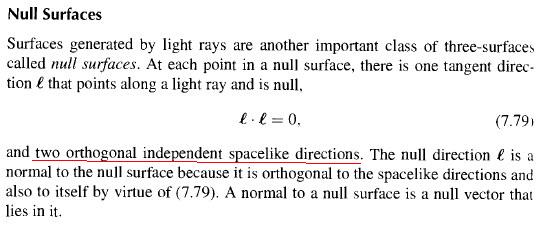
I think
mathematical physicists face a severe problem
with their understanding of 'quasi-local mass': they just cannot
accomplish "a well-defined useful local notion of
mass or energy,
with natural properties – e.g., monotonicity – that one has in other
physical theories. Such a definition has been elusive despite a great
deal of effort by many people and this remains an important open
problem" (Piotr Chruciel, Gregory Galloway, and Daniel Pollack,
Mathematical general relativity: a sampler, arXiv:1004.1016v2 [gr-qc],
p. 38). The
importance of this insoluble task (Erik
Curiel) is particularly acute in "the notion of
future null infinity, which is an idealized boundary attached to
space-time that represents, loosely speaking, the end points
(local or quasi-local ? - D.C.) of null geodesics escaping to infinity"
and the so-called "weak
cosmic censorship conjecture" (ibid.,
p. 48). As
Demetrios Christodoulou acknowledged in his voluminous essay on "black
holes" (arXiv:0805.3880v1 [gr-qc],
p. 590),
"in the general case the requirement for the formation of a trapped
sphere is not on the total incoming energy but rather on the incoming
energy in each direction. (...) And of course the nature of the future
“boundary” of the maximal development, when [future null geodesic] incompletess holds, remains an open question."
And it will remain an
"open question" forever, because they still treat GR as a "classical
theory" and haven't discovered Einstein's 'total
field of as yet unknown structure', which
makes mass and energy quasi-local.
As Matt
Visser explained (arXiv:gr-qc/0204022v2,
p. 3, emphasis added):
"Unfortunately, in general
relativity one cannot simply assert that chronology is preserved, and
causality respected, without doing considerable additional work. The
essence of the problem lies in the fact that the Einstein equations of
general relativity are local equations, relating some aspects of
the spacetime curvature at a point to the presence of
stress-energy at that point. What general relativity does not
do is to provide any natural way of imposing global constraints
on the spacetime — certainly the Einstein equations provide no such
nonlocal constraint."
I think the phrase "at a
point" is a big can of worms, because any observable of the
gravitational field is "necessarily quasi-local" (Laszlo
Szabados), as depicted in the
drawing
below.
I
hope to elaborate on my conjecture (UGMC) in December 2012.
Meanwhile, check out a logical paradox below,
explaining the crux of "singularities". It isn't about "some
sort of baby universe, or eventually disconnected spacetime" (Bill
Unruh), nor some convenient ad hoc "reasonable
assumptions". It is about
the global constraints on the spacetime and
the internal structure
and topology of what people perceive, at macroscopic length scale,
as a dimensionless geometrical "point". The task is strictly
mathematical.
To sum up, in present-day
differential geometry, an idealized abstract object, called 'spacetime
manifold', is constructed as in a purely classical theory, with abstract
geometrical "points". But General Relativity is not a
'purely classical theory', because the geometrical "points"
themselves are quasi-local. We need new geometrical
presentations of an 'infinitesimal point' and 'empty
set', complementing those used by "bartenders".
It will be a whole new ball game, and
mathematicians will have to give up their
privileged status of people who need not learn
Physics.
When will this happen?
Check out Max Planck.
D. Chakalov
May 26, 2012
Last updated: June 9, 2012, 00:01:24 GMT
=======================================
Subject: Event horizon, if any: request for reference
Date: Wed, 30 May 2012 01:55:24 +0300
From: Dimi Chakalov <[email protected]>
To: Greg Galloway <[email protected]>,
Robert M Wald <[email protected]>,
Matthew Choptuik <[email protected]>,
Demetrios Christodoulou <[email protected]>,
Helmut Friedrich <[email protected]>,
Adam Helfer <[email protected]>,
Luca Bombelli <[email protected]>
Dear colleagues,
I wonder if you are aware of some rigorous proof of the existence of
'event horizon' in GR. I've been searching for many years, with no
success,
http://www.god-does-not-play-dice.net/#EH_if_any
In addition to the problems mentioned at the link above, the asymptotic
spacelike regime is totally unclear to me. Fifteen years after the
article by Bob Wald [Ref. 1], I still cannot find
any publication clarifying the contribution of those "endpoints for the
null geodesics which propagate to asymptotically large distances" and
"precise smoothness requirements most suitable to impose at I+ " for a
rigorous formulation of the *asymptotic spacelike regime*.
Also, are "the global properties of solutions to Einstein’s equation"
sufficiently clarified [Ref. 2] to declare the weak
cosmic censorship conjecture rigorously proven ?
Any information and references you may have on these two issues will be
greatly appreciated. My counter-conjecture is outlined at
http://www.god-does-not-play-dice.net/#UGMC
Kind regards,
Dimi Chakalov
[Ref. 1] Robert M. Wald, Gravitational Collapse and Cosmic Censorship,
arXiv:gr-qc/9710068v3, Sec. 2
http://arxiv.org/abs/gr-qc/9710068v3
"The standard definition
of asymptotic flatness at future null infinity requires that one be able
to conformally embed the spacetime in a suitable way into a spacetime
with a boundary, I+, which, roughly speaking, provides endpoints
for the null geodesics which propagate to asymptotically large
distances.
.......
"The precise smoothness requirements most suitable to impose at I+
undoubtedly will depend on the precise choice of asymptotic conditions
on the initial data (see above), and will not be considered here.
........
"The above conjecture remains somewhat imprecise on account of the two
words written in italics. In order for the matter to be “suitable”, it
clearly is necessary that the coupled Einstein-matter field equations
have a well posed initial value formulation. It undoubtedly also should
be required that the matter stress-energy tensor satisfy suitable energy
conditions, such as the dominant energy condition.
........
"Unfortunately, it is far from clear precisely what measure or topology
should be imposed on the space of initial data. Undoubtedly, it will be
necessary to develop a much deeper insight into the dynamics implied by
Einstein’s equation before a natural choice of measure or topology will
emerge, and I feel that the precise definition of “generic” would best
be left open until that point.
"Does the weak cosmic censorship conjecture hold? To answer this
question, we would need to know a great deal about the global properties
of solutions to Einstein’s equation."
[Ref. 2] Helmut Friedrich, The large scale Einstein evolution problem,
http://ae100prg.mff.cuni.cz/img/abstracts/9f42de26a136d803d39c4bdd43b31f8c.pdf
=======================================
Subject: Re: Event horizon, if any: request for reference
Date: Mon, 28 May 2012 17:18:14 +0300
From: Dimi Chakalov <[email protected]>
To: [email protected]
Cc: [email protected],
[email protected],
[email protected],
[email protected],
[email protected],
[email protected],
[email protected],
[email protected],
[email protected],
[email protected]
Dear Ettore,
Thank you for your prompt reply.
> the mathematical deduction of the formation of a black hole event
horizon in
> GR when matter is sufficiently concentrated is a well known
mathematical
> problem in GR, known as the "weak cosmic censorship" problem. No
surprise
> you did not find a proof of its existence.
>
> For references search "weak cosmic censorship" in google.
I said that I've been searching it for many years, with no success.
The stipulation about formation of some "trapped surfaces", after the
Schoen-Yau theorem, is well known, but the "weak cosmic censorship"
conjecture presupposes that, "for generic initial data, the maximal
Cauchy development possesses a complete future null infinity",
http://en.wikipedia.org/wiki/Cosmic_censorship_hypothesis#
Weak_and_strong_cosmic_censorship_hypothesis
How do you get (i) maximal Cauchy development with (ii) complete future
null infinity for (iii) generic initial data in the presence of "dark
energy" which manifestly violates SEC, and possibly NEC, after which
the
"celebrated" singularity theorems must be re-written ?
Even if you ignore the whole mess from "dark energy of [whatever]", look
what José wrote a few years ago in
arXiv:physics/0605007v1:
"Singularities in the above sense clearly reach, or come from, the edge
of space-time. This is some kind of boundary, or margin, which is not
part of the space-time but that, somehow, it is accessible
from within it."
There is too much poetry here; sorry. There is even more poetry in the
"teleological" problem, from Ashtekar and Krishnan at
http://www.god-does-not-play-dice.net/#EH_if_any
Please send me one reference for (i) maximal Cauchy development with
(ii) complete future null infinity, starting from (iii) generic initial
data from Einstein field equations.
I extend this request to your colleagues as well.
Best regards,
Dimi
----------------
Note: I am grateful to
Ettore
Minguzzi for bringing up the issue of the so-called weak cosmic
censorship. Perhaps it can elucidate the "teleological" problem, which
"lets us speak of a black hole only after we have
constructed the entire space-time" (cf. Ashtekar and Krishnan
above): how long you need to wait for the "maximal
Cauchy development" to reach "complete future null infinity" ?
And how long you may have
to wait until the "black hole" settles down to a stationary spacetime (to
match an "apparent horizon" to "event horizon"),
after which it will obtain an "event
horizon" and eventually become a "black hole" (cf. Paul Townsend
above) ? Because there is a big crowd of
astrophysicists out there, shouting 'I want my
super-massive black hole, and I want it now!'
Well, from the
perspective of the so-called UGMC, the global mode
of spacetime captures the complete future (and past) null infinity from the
outset, only there is no "event horizon" in any shape or form
whatsoever. Unlike the "event
horizon", UGMC isn't a joke but a conjecture
based on a new dynamics of spacetime.
As to the observed
relativistic jets, perhaps they are produced by opening a "window" into the
"negative" mass, as suggested many years ago by
Yakov Terletskii. There could be a humongous amount of latent energy
in the so-called 'polarization
of space', and that is what makes this whole issue
utterly
important.
D. Chakalov
May 28, 2012
==========================================
Subject: Re: Event
horizon, if any: request for reference
Date: Tue, 29 May 2012 20:26:08 +0300
From: Dimi Chakalov <[email protected]>
To: John Friedman <[email protected]>
Cc: Stephen Crothers <[email protected]>
Hi John:
> The Schwarzschild and Kerr solutions are exact vacuum solutions
that have
> event horizons.
Do you have Internet? Check out the link I sent you, particularly the
proof by Stephen J. Crothers.
Those "vacuum solutions" are the ultimate poetry you can think of.
Do you have a rigorous proof of "event horizon" ?
Dimi
> On 05/29/2012 12:09 PM, Dimi Chakalov wrote:
>>
>> Dear John,
>>
>> I wonder if you are aware of some rigorous proof of the existence of
>> 'event horizon' in GR. I've been searching for many years, with no
>> success,
>>
>> http://www.god-does-not-play-dice.net/#EH_if_any
>>
>> Hope you can help.
>>
>> Kind regards,
>>
>> Dimi
------------
Note: There is a big can or worms revealed by Stephen J. Crothers,
so John Friedman won't respond, for obvious reasons. Yet the issue of
"black holes" is not entirely useless.
Suppose he meets a beautiful
blond girl (let's call her
Alice) with long gorgeous legs and
everything, and wishes to impress her -- there's hardly anything more
effective than a brief explanation of those "black holes"
(courtesy from
John Baez):
"In
fact, inside the event horizon, t is actually a spatial
direction, and the future corresponds instead to decreasing r.
It's only outside the black hole that t even points in a
direction of increasing time. So
if you, watching from a
safe distance, attempt to witness my fall into the hole, you'll see
me fall more and more slowly as the light delay increases. You'll never
see me actually get to the event horizon. My watch, to you,
will tick more and more slowly, but will never reach the time
that I see as I fall into the black hole."
Alice will be stunned and fascinated, and
John (Friedman) will
feel just great. It tried this trick with my Italian girlfriend, many
years ago, and the end result was absolutely delicious.
D.C.
May 30, 2012
Last updated: June 7, 2012
=============================================
Subject: Re: Event
horizon, if any: request for reference
Date: Thu, 17 May 2012 14:54:04 +0300
From: Dimi Chakalov <[email protected]>
To: Luigi Foschini <[email protected]>
Cc: Stephen Crothers <[email protected]>
Dear Luigi,
Thank you for your reply.
> I think that the best definition is that coming from the mathematics.
That
> is, given - for example - the Schwarzschild metric, the event horizon
is
> that coordinate singularity occurring when the distance from the
centre is
> equal to 2GM/c^2.
Check out Stephen J. Crothers,
http://www.sjcrothers.plasmaresources.com/article-1-1.pdf
http://www.ptep-online.com/index_files/2005/PP-01-09.PDF
http://www.ptep-online.com/index_files/2006/PP-05-10.PDF
> In this case, the dt^2 term vanishes, while the dr^2 term
> and the angular one diverge to infinite. It is a singularity different
from
> that for r=0: the event horizon can be removed with a proper choice of
> coordinate (e.g. Kruskal), while the singularity at r=0 is an
essential
> singularity and cannot be removed.
>
> Hope it is useful.
Well, it is a very good example of how people "read" the math. Details
from Angelo Loinger, The black holes do not exist - "Also Sprach Karl
Schwarzschild", arXiv:physics/0402088v1.
All the best,
Dimi
> On 5/16/12 3:57 PM, Dimi Chakalov wrote:
>
> Dear Luigi,
>
> Can you suggest a rigorous definition of 'event horizon' ?
>
> http://www.god-does-not-play-dice.net/#EH_if_any
>
> All the best,
>
> Dimi
>
Note: Another
startling example of how people "read" the math is
Gerardus ’t Hooft:
"Due
to the energy that should exist in a gravitational wave, gravity should
interact with itself. Einstein’s equation should have a term describing
gravity’s own energy. In fact, it does. (...) One way to see how this
works, is to split the metric gμν into a background
part, goμν, for which we could take flat
space-time, and a dynamical part: substitute in the Einstein-Hilbert
action:
gμν = goμν
+ g1μν .
"The
dynamical part, g1μν , is defined to
include all the ripples of whatever gravitational wave one wishes to
describe. Just require that the background metric goμν
obeys the gravitational equations itself; one can then remove from the
Lagrangian all terms linear in g1μν. This
way, one gets an action that starts out with terms quadratic in g1μν,
while all its indices are connected through the background field goμν.
This is because both goμν and g1μν
transform as true tensors under a coordinate transformation; all terms
in the expansion in powers of g1μν are
therefore separately generally invariant.
"The
stress-energy-momentum tensor can then be obtained routinely by
considering infinitesimal variations of the background part, just like
one does for any other type of matter field; the infinitesimal change
of the total action (the space-time integral of the Lagrange density)
then yields the stress-energy-momentum tensor. Of course, one finds that
the dynamical part of the metric indeed carries energy and momentum,
just as one expects in a gravitational field. As hydro-electric plants
and the daily tides show, there’s lots of energy in gravity, and this
agrees perfectly with Einstein’s original equations. In spite of DC
calling it "utter madness", this procedure works just perfectly."
Yes, it is
utter madness to relate
hydro-electric plants and daily tides with any "splitting the metric"
into two "parts", background and dynamical.
"L
and C shout that this stress-energy-momentum tensor is a "pseudotensor".
Indeed, its transformation properties are subtle, and one might wish to
claim that splitting gμν in a background part and a
dynamical part is "unphysical". But then, indeed, one should
accept the fact that the notion of energy is observer dependent anyway.
An observer who is in free fall in a gravitational field may think
there’s no energy to be gained from gravity.
"Actually, one can define the energy density in
different ways, since one has the freedom to add pure gradients to the
energy density, without affecting the total integral, which represents
the total energy, which is conserved. Allowing this, one might consider
the Einstein tensor Gμν itself to serve as the
gravitational part of the stress-energy-momentum tensor, but there would
be problems with such a choice. The definition using a background metric
(which produces only terms that are quadratic in the first
derivatives) is much better, and there’s nothing wrong with a definition
of energy, stress and momentum that’s frame dependent,
as long as energy and
momentum are conserved. In short, if one wants only first
derivatives, either frame dependence or background metric dependence are
inevitable."
To say
that the splitting gμν in a background part and a
dynamical part is "unphysical" would be a compliment to
G. ’t Hooft, which I'm afraid he does not deserve; cf.
A. Perez, arXiv:1205.2019v1 [gr-qc],
p. 4.
D. Chakalov
May 17, 2012
=================================
Subject: Re: STRANGE MISCONCEPTIONS OF GENERAL RELATIVITY, by G. 't
Hooft
Date: Thu, 17 May 2012 15:59:31 +0300
From: Dimi Chakalov <[email protected]>
To: Gerardus <[email protected]>
Cc: "Szabados,L." <[email protected]>,
"Dupre, Maurice J" <[email protected]>,
Adam Helfer <[email protected]>,
Norbert Straumann <[email protected]>,
Domenico Giulini <[email protected]>,
Luca Bombelli <[email protected]>,
Stephen Crothers <[email protected]>,
"C. Y. Lo" <[email protected]>,
Merced Montesinos Velásquez <[email protected]>,
Angelo Loinger <[email protected]>
Hello Gerardus,
Regarding my email from Tue, 16 Mar 2010 15:50:10 +0200, I quoted from
your masterpiece at
http://www.god-does-not-play-dice.net/#EH_if_any
Please say something. Don't be shy. Make your best shot.
D.
================================================
Subject: Event horizon, if any: request for reference
Date: Thu, 17 May 2012 22:03:46 +0300
From: Dimi Chakalov <[email protected]>
To: Pankaj <[email protected]>, Ravindra <[email protected]>
Cc: Richard Woodard <[email protected]>,
Avi Loeb <[email protected]>,
Alan Coley <[email protected]>,
Bernard J Carr <[email protected]>,
Tomohiro Harada <[email protected]>,
George Svetlichny <[email protected]>,
Paul K Townsend <[email protected]>,
Miguel Sanchez Caja <[email protected]>,
Laszlo Szabados <[email protected]>,
Jörg Frauendiener <[email protected]>,
Jonathan Thornburg <[email protected]>,
Karel V Kuchar <[email protected]>,
Abhay Ashtekar <[email protected]>,
Robert Beig <[email protected]>,
James Fry <[email protected]>,
Gary W Gibbons <[email protected]>,
Harvey S Reall <[email protected]>,
Jiří Bičák <[email protected]>
Dear Pankaj and Ravindra,
You acknowledged in
arXiv:1205.3263v2 [gr-qc] that GR "does not predict that such a
singularity will be necessarily covered in an event horizon, forming a
black hole", and it is by no means clear that we can speak about
"singularity" in the first place, given the lack of any observational
evidence for either "event horizon" or "time-like naked singularity" (arXiv:gr-qc/0410041v1).
Ravindra: I wonder if you are aware of some rigorous proof (no
mathematical poetry) of the existence of 'event horizon' in GR. I've
been searching for many years, with no success. I asked Pankaj
previously, but he couldn't provide such
reference. Since you're trained in math, I hope you know the problem in
details.
The current status of my search for a rigorous proof of 'event horizon'
is posted at
http://www.god-does-not-play-dice.net/#EH_if_any
I hope to hear from your colleagues as well: just the math of 'event
horizon', and no poetry, please!
Best regards,
Dimi
===================================================
Subject: Re: Event horizon, if any: request for reference
Date: Tue, 29 May 2012 18:47:36 +0300
From: Dimi Chakalov <[email protected]>
To: Ravindra Saraykar <[email protected]>
Cc: [email protected],
[email protected],
[email protected],
[email protected],
[email protected],
[email protected],
[email protected],
[email protected],
[email protected]
Dear Professor Saraykar,
Thank you for your email from Tue, 29 May 2012 20:26:45 +0530.
> About existence of event horizon :
>
> If an asymptotically flat spacetime M (in the sense of admitting a
regular
> null infinity) contains a future trapped surface, then there exists an
event
> horizon.
Before we consider this statement a 'fact', I think we should first
check out whether there is an inadmissible degree of poetry in the
statements that (i) an asymptotically flat spacetime would admit/acquire
a regular null infinity, and (ii) the formation of a future trapped
surface.
Regarding (i), please notice that the formation of 'asymptotically flat
spacetime' requires full knowledge of its topology, which is currently
totally unclear due to the unknown
tug-of-war (DDE vs. CDM) manifestation of gravity
at cosmological scales, producing a "balanced", asymptotically flat
spacetime.
Regarding (ii), please see the problems with SEC and NEC at
http://www.god-does-not-play-dice.net/#Ettore
> The proofs of this fact are given in the books by Hawking and
> Ellis, and Wald. The result is also true if M contains a weakly
trapped
> surface (null expansions less than or equal to zero, rather than
strictly
> less than zero), but then the proofs in Hawking and Ellis and in Wald
are
> not quite correct. A fully rigorous proof is given at the end of the
paper
> by Galloway, Chrusciel and Solis ( gr-qc/ 0808.3233, Annales Inst.
Henri
> Poincare 10:893-912,2009 ). All of these results require the condition
> called “i_0 avoidance”.
Let me quote from Galloway, Chrusciel, and Solis, arXiv:0808.3233v2 [gr-qc],
p. 2:
"Recall that for asymptotically flat stationary space-times, whatever
the space-dimension n ≥ 3, simple connectedness holds for globally
hyperbolic domains of outer communications satisfying the null energy
condition."
I'm afraid their "appropriate global hypotheses" (ibid.),
NEC included, do not hold for the new dynamics of spacetime due to the
so-called dark energy of [you-name-it], producing "a unique future
directed null vector field" (ibid.).
Please check out the discussion at the link above. I will be happy to
elaborate.
> This condition is an assumption that the causal future of a compact
set does
> not contain all of future null infinity ( scri^+ ). This condition is
> satisfied for example, in all standard black hole spacetimes (e.g.,
> Schwarzshild, Kerr, Reissner-Nordstrom). More generally, black hole
> spacetimes with "sufficiently regular" scri satisfy i_0 avoidance.
This is
> argued, for example, in Hawking and Ellis, Prop 9.2.1, where it is
needed in
> a manner very similar to the Friedman-Schleich-Witt proof of
topological
> censorship. Also, Wald explicitly observes in Prop. 12.2.2 of his book
on
> GR that i_0 avoidance holds for the the general class of spacetimes
> considered in this proposition.
>
>
> I hope, this is of some help to you.
Yes, it is. Thank you for your efforts.
Regards,
Dimi Chakalov
> On Tue, May 22, 2012 at 8:07 PM, Dimi Chakalov <[email protected]>
wrote:
>>
>> P.S. Note added at
>> http://www.god-does-not-play-dice.net/#Recami
>>
>> D.
=========================================
Subject: Re: Event horizon, if any: request for reference
Date: Thu, 31 May 2012 13:09:10 +0300
Message-ID:
<CAM7Ekxm8FKVqJXeiAn2sHHgDAc7g2YGdrsLpjdHrXskDPOR_YA@mail.gmail.com>
From: Dimi Chakalov <[email protected]>
To: Ravindra Saraykar <[email protected]>
Cc: [email protected],
[email protected],
[email protected],
[email protected],
[email protected],
[email protected],
[email protected],
[email protected],
[email protected],
[email protected],
[email protected],
[email protected],
[email protected],
[email protected],
[email protected]
Dear Ravindra,
> black holes ( singularities in general ) do not exist
Sure. The task is strictly mathematical:
http://www.god-does-not-play-dice.net/#singularity
> even more : Einsteins General Relativity itself is a wrong theory.
As Einstein himself admitted, General
Relativity is "...merely a makeshift in order to give the general
principle of relativity a preliminary closed-form expression. For it was
essentially no more than a theory of the gravitational field, which was
isolated somewhat artificially from a total field of as yet unknown
structure."
My efforts to reveal this 'total field of as yet unknown structure' are
posted at the link below, from May 22nd.
Again, the task is strictly mathematical.
Wishing you and your colleagues a nice summer,
Best regards,
Dimi
>> > On Tue, May 22, 2012 at 8:07 PM, Dimi Chakalov <[email protected]>
>> > wrote:
>> >>
>> >> P.S. Note added at
>> >> http://www.god-does-not-play-dice.net/#Recami
>> >>
===============================================
Subject: "Gravitational Wave Astronomy: Needle in a Haystack," by Neil J. Cornish
Date: Wed, 11 Apr 2012 06:12:25 +0300
Message-ID:
<CAM7Ekx=j2Uob8JX4Zm6OSGtJygkA5wgyis-iuHJZnnk7dBwbAA@mail.gmail.com>
From: Dimi Chakalov <[email protected]>
To: Neil J Cornish <[email protected]>
Cc: Suzanne Abbott <[email protected]>,
Stuart Taylor <[email protected]>,
[email protected], [email protected],
[email protected],
[email protected], [email protected]
Hello Dr. Cornish,
Paper is a valuable commodity, it must not be wasted. I think you should immediately pull out your arXiv:1204.2000v1 [gr-qc] from the Philosophical Transactions of the Royal Society A, and start from scratch:
http://www.god-does-not-play-dice.net/#Bondi
I stand ready to explain your errors in details.
Sincerely,
Dimi Chakalov
-------------
Note: Do you know how to cook
Andean Flamingo with Jabuticaba? Easy. No problem. Just try two handy approximations, for obvious reasons. Instead of Andean Flamingo, use a large broiler, and if you can't find Jabuticaba in your local grocery, replace it with cabbage, then cook it as 'chicken with cabbage'.
Same story with LIGO "scientific" collaboration and their two approximations, linearized GR (cf. Hermann Weyl) and quadrupole approximation. I'm not sure if the Editors of The Philosophical Transactions of the Royal Society would be desperate for a piece of cold chicken with soggy cabbage though. Highly unlikely. Actually, the proper epitaph
for 'the needle in a haystack' is from Confucius: The hardest thing of all is to find a black cat in a dark room, especially if there is no cat.
“For if we are uncritical
we shall always find what we want: we shall look for, and find,
confirmations, and we shall look away from, and not see, whatever might
be dangerous to our pet theories. In this way it is only too easy to
obtain what appears to be overwhelming evidence in favor of a theory
which, if approached critically, would have been refuted” (K. Popper,
The Poverty of Historicism, 2nd ed., Routledge, 2002,
p. 124). Probably Neil Cornish will just reject my email. That will be really "smart", yes. Typical for LIGO "scientific" collaboration, too.
D. Chakalov
April 12, 2012
Last updated: April 18, 2012
=======================================
Subject: PSR1913+16
Date: Sat, 21 Apr 2012 15:55:02 +0300
From: Dimi Chakalov <[email protected]>
To: Guo Jun Qiao <[email protected]>
Cc: Ingrid H. Stairs <[email protected]>,
Edward P. J. van den Heuvel <[email protected]>,
J. M. Lattimer <[email protected]>,
M. Prakash <[email protected]>,
Jin Lin Han <[email protected]>,
R. T. Gangadhara <[email protected]>,
K. J. Lee <[email protected]>,
R. X. Xu <[email protected]>,
H. G. Wang <[email protected]>,
Yuan Jie Du <[email protected]>
Dear Professor Qiao,
May I ask for your opinion about all possible reasons for the loss of
kinetic energy of PSR1913+16,
http://www.god-does-not-play-dice.net/#Ponga
Perhaps pulsar wind [Ref. 1] or other mundane
physical process?
I extend this request to your colleagues as well.
Thank you for your time and consideration.
Your sincerely,
Dimi Chakalov
[Ref. 1] Jin Lin Han, Pulsars as Fantastic Objects and Probes,
arXiv:0901.1593v1 [astro-ph.SR]
http://arxiv.org/abs/0901.1593
Sec. 2 Pulsar emission
Radio emission from pulsars is generated in pulsar magnetosphere. We
define the boundary of this magnetosphere by the light-cylinder, e.g. at
the radius where the rotation speed is equal to the light speed. The
particles, i.e. positrons and electrons, are accelerated along the
magnetic fields above polar cap or the outer gap. These particles
radiate [22] so that we can see the emission in radio and high energy
band.
However, it is not clear what physical processes are involved for the
particles to radiate. Pulsar wind or wind nebula [63] can be formed
if particles flow out through the open magnetic field lines passing
through the light-cylinder. It is the rotation that provides the energy
source for pulsar emission and particle outflowing (... hence the
latter will rob the energy source of the pulsar, but with some luck you
may get a
Nobel Prize for the alternative hypothesis -- D.C.).
=======================================
Subject: Tony Downes et al., arXiv:1108.5220v2 [gr-qc],
p. 13
Date: Mon, 3 Dec 2012 19:08:38 +0200
From: Dimi Chakalov <[email protected]>
To: [email protected], [email protected], [email protected]
Cc: [email protected], [email protected],
[email protected], [email protected]
Tony and Gerard,
I quoted from your latest paper at
http://www.god-does-not-play-dice.net/#Hobson
Pity you included Carlton Caves in v2, because he is totally biased,
much worse than Jehovah's Witnesses and
Jonathan Dowling, to name but a few.
Take care,
Dimi
=======================================
Subject: arXiv:1204.1350v1 [gr-qc]
Date: Mon, 9 Apr 2012 09:44:42 +0300
From: Dimi Chakalov <[email protected]>
To: Gergely Székely <[email protected]>
Dear Dr. Székely,
I found your article very illuminating. May I share some thoughts about the irrational numbers.
Consider the Golden Ratio
http://en.wikipedia.org/wiki/Golden_ratio
and imagine the middle point, C, such that AC/CB = AB/AC. If we attach rational numbers to A and B, C will be uniquely defined but irrational, although it is by no means ontologically different than the "points" A and B. If we choose to set, say, AC = 1 m, then
A and C will be rational numbers, but not B.
BTW are you aware of the Thompson Lamp paradox?
Kind regards,
Dimi Chakalov
-------------
Note: Gergely Székely
and his co-authors posed a very intriguing question: What do numbers
have to do with the geometry of spacetime? The ideas hinted in my email
do not support their arXiv:1204.1350v1 [gr-qc] (nor the views of Alfred Tarski), however.
Since both
natural and irrational numbers are related to "points", the first claim about the the geometry of spacetime -- the grin of the Cheshire cat without the cat, as observed by
Alice
(in the l.h.s. of the
Einstein filed equation) -- is that any finite chunk of space contains uncountably infinite "points". If you treat these "points" as a 'set', "its cardinal number is larger than that of the set of all natural numbers" (Wiki).
But as the Thompson Lamp paradox suggests, it may not be a 'set', because a finite, and purely geometrical, chunk of 'the grin of the Cheshire cat without the cat' both involves a "point" that belongs to the 'set', and at the same time the same "point" does not belong to the 'set'. Hence we have a beautiful logical contradiction, showing the dual nature of a very special "number" -- zero. Actually, what we call 'spacetime' is comprised exclusively from such dual objects. Let me try to explain.
On the one hand, if we apply potential infinity to the end-state of the Thompson Lamp hypertask, it will look like 'the empty set R' which, as people argue (Wiki), does not belong to the "set" of divergent 'on/off states of the lamp'. But on the other hand, if we apply
actual/completed infinity à la bartenders, the end-state of the lamp does belong to the same "set".
----------
NB: Compare this
with what José Senovilla wrote above:
"Singularities in the above sense clearly
reach, or come from, the edge of space-time. This is some kind of
boundary, or margin, which is not part of the space-time but that,
somehow, it is accessible from within it."
This is the crux of "singularities".
---------- The logical paradox can be resolved only with the dual nature of the "number" zero in the framework of the so-called 'John's jackets': 'the empty set R' is the UNdecidable pre-quantum Kochen-Specker state which is non-existent (hence "zero") in the local (physical) mode of spacetime ("John" doesn't belong there), yet if treated with actual/completed infinity the same empty set R will display its fleeting physical "jacket". The latter can be presented with both
natural and irrational numbers. Q.E.D. To paraphrase Henri Poincaré, the Mengenlehre and Baldy's Law1 are a disease from which we have not yet recovered -- see the "open sets" above and the discussion of the Equivalence Principle viz. the quasi-localization of the gravitational energy with respect to 'everything else in the universe'. As Steven Weinstein pointed out (General relativity and quantum theory -- ontological investigations, in: Metadebates on Science: The Blue Book of 'Einstein Meets Magritte', Vol. 6, edited by Gustaaf C. Cornelis, Sonja Smets, and Jean Paul van Bendegem, Kluwer Academic, Dordrecht, 1999, pp. 267-279): "From a strictly mathematical perspective, the metric is an attribution of properties to points on the manifold, and the manifold does not in itself represent spacetime." Replace 'the points on the manifold' with "jackets", and 'the manifold in itself' with "John", and you're done. Always keep in mind the fundamental difference between the metric "field" from GR textbooks, and the Affine Connection -- the pre-geometric binding agent of the "points" from 'the manifold in itself' does not exist in the local (physical) mode of spacetime. It is the omnipresent empty set R, denoted with the unique number zero.
It exists in the global, atemporal, non-Archimedean mode of spacetime as
'potential reality', thanks to the Arrow of
Space.
To those who disagree, I
suggest to read here about the quarrel I had in
1986 with a Russian physicist,
and then recall the 1929 paper by Nevill Mott:
you have continuous, uninterrupted interactions involving energy
exchange between a single quantum particle and its
macroscopic detector. You can measure with your wristwatch the duration
of the track, so how would you explain the macroscopic "copies" ("jackets")
of that single quantum particle, produced by its
continuous energy exchange with its
detector ?
If you can explain the
puzzle without John's jackets, call
CERN's Theory Group and tell them that they might eventually
detect their "god particle". Then call LIGO "scientific" collaboration
and assure them that they too can detect their
dimensionless ghost. And finally, call the Scientific
Organizing Committee of the Einstein Conference in Prague and tell
them that I have nothing new to offer, so they can safely reject my
talk.
D. Chakalov
April 16, 2012
Last updated:
May 30, 2012, 17:12 GMT
1 Baldy's Law: Some of it plus the rest of it is all of it.
=======================================================


Subject: Re: arXiv:0704.2291v1 [astro-ph]
Date: Wed, 18 Apr 2012 16:25:24 +0300
Message-ID:
<CAM7Ekxm7z1a+wmyOVwjq-WbyTOrC3PrJvBZd3ooEzHBOnz7nEQ@mail.gmail.com>
From: Dimi Chakalov <[email protected]>
To: Simon White <[email protected]>
Cc: Pavel Kroupa <[email protected]>,
Hans Peter Nilles <[email protected]>,
Mordehai Milgrom <[email protected]>,
Craig J Copi <[email protected]>,
Robert Minchin <[email protected]>,
Adam Helfer <[email protected]>
Dear Simon,
Seems to me you've neglected my email sent five years ago, on Fri, 20
Apr 2007 14:24:49 +0300 (cf. below).
At the debate with Dr. Pavel Kroupa on 18 November 2010, 'Anmerkungen
zur Dunkle-Materie-Debatte: Kroupa vs. White',
http://www.scilogs.de/kosmo/blog/himmelslichter/allgemein/2010-12-06/
anmerkungen-zur-dunkle-materie-debatte-pawel-kroupa-vs.-simon-white
you insisted on your definition of "dark" matter as some "invisible"
(e.g., non-baryonic) stuff made of positive-energy
density (recall the failure to detect some WIMPS).
On the other hand, your colleague was trying to suggest some
interpretation of these anomalous effects with MOND.
I think there is a third possibility based on quantum gravity: please
see an outline at
http://www.god-does-not-play-dice.net/#ESI
Will be happy to elaborate.
All the best,
Dimi
------------
Subject: Re:
arXiv:0704.2291v1 [astro-ph]
Date: Fri, 20 Apr 2007 14:24:49 +0300
From: Dimi Chakalov <[email protected]>
To: Simon White <[email protected]>
References: <001d01c782ec$2d980a20$6501000a@home>
<[email protected]>
Dear Simon,
Thanks you for your reply. Just a few thoughts.
[snip]
It is a pleasure to read your review article to Nature, "The
large-scale structure of the Universe". I am deeply puzzled by
VIRGOHI 21,
http://www.god-does-not-play-dice.net/Minchin.html#1
[snip]
============================================


Subject:
http://dx.doi.org/10.1038/nature11224
Date: Sat, 14 Jul 2012 03:10:06 +0300
From: Dimi Chakalov <[email protected]>
To: Jörg P Dietrich <[email protected]>
Cc: Simon White <[email protected]>,
Pavel Kroupa <[email protected]>,
Catherine Meusburger <[email protected]>,
Hans Peter Nilles <[email protected]>,
Roy Maartens <[email protected]>,
Slava Mukhanov <[email protected]>,
Paul Frampton <[email protected]>,
Robert Minchin <[email protected]>
Dear Dr. Dietrich,
You used a model (and statistical considerations) to subtract out the
masses of the galaxy clusters, and attributed the remaining mass to some
non-baryonic "dark" filament, which turned out to be roughly four times
more than the visible stuff.
It's a bit like this: you go in a china shop and see all (baryonic)
porcelain vases and cups arranged in the air, in a perfectly stable
configuration, and wonder what the heck has designed and supported such
an amazing configuration of fragile stuff. Then your colleagues tell you
that it is all due to an invisible dark dancing elephant, which
is roughly four times larger than the shop itself. Would you buy such
story?
I will be happy to offer you and your colleagues an alternative
explanation, which starts from here:
http://www.god-does-not-play-dice.net/#Munchhausen
Kind regards,
Dimi Chakalov
--------------
Note: An expert in astrophysics and astronomy reacted to my 'dark
dancing elephant' metaphor in the following fashion (Mon, 16 Jul 2012
11:36:21 +0200): "I believe that DM exists. I cannot see it, but I know
gravity exists. Hence there must be DM."
Notice the non sequitur:
gravity exists, ergo there must be "non-baryonic dark matter".
Such line of reasoning
reminds me of a quiz I learned from my teenage daughter:
Q: What is green, lives underground, has one eye, and eats
stones?
A: The One-Eyed Green Underground Stone Eating Monster!
You may add
"non-baryonic", it won't improve the "logic". We simply do not know any
non-baryonic 'dancing elephant' which can support and organize
the visible baryonic 'vases and cups', and will be roughly four times
(or more, cf. the "dark
galaxy") larger than all vases and cups combined. It's just too
much. Much too much. Which is why we need to seek a
better understanding of gravity: check out the
asymptotic nature of spacetime and the 'necessary
and sufficient conditions for spacetime'.
D. Chakalov
July 17, 2012
======================================================
Subject: Re: The Dark Matter/Dark Energy Crisis: Dynamical Equilibrium ?
Date: Thu, 21 Jun 2012 18:14:01 +0300
Message-ID:
<CAM7EkxkRcDewCmksMsZZfm1JiAXXMZMxGdYpjPRguENsC=vBSQ@mail.gmail.com>
From: Dimi Chakalov <[email protected]>
To: [email protected]
Cc: Simon White <[email protected]>,
Hans Peter Nilles <[email protected]>,
Roy Maartens <[email protected]>
P.S. Regarding quantum gravity from the Arrow of Space: the fundamental
asymmetry in the tug-of-war manifestation of gravity is that the
so-called DDE points to the future, while the so-called CDM points to
the past from the Arrow of Space:
http://www.god-does-not-play-dice.net/#Roy
Hence we "observe" inhomogeneous clusters of non-baryonic CDM and
perfectly smooth DDE, yet the two tug-of-war effects of
gravity are purely geometrical, as explained at the two links below.
Anyway, do you, or your colleagues, have specific arguments against my
Dynamic Equilibrium Conjecture below ?
D.
On Thu, Jun 21, 2012 at 5:16 PM, Dimi Chakalov <[email protected]>
wrote:
>
> Dear Pavel,
>
>> CDM is a good hypothesis but the problem is that CDM (nor WDM) cannot
exist
>> due to the Dual Dwarf Galaxy Theorem.
>
> The dual dwarf galaxy conjecture is an intriguing idea, but I think
> first you need to sort out the proper quantum gravity: recall my email
> from Wed, 18 Apr 2012 16:25:24 +0300. My efforts
are posted at
>
> http://www.god-does-not-play-dice.net/#Silva
>
> http://www.god-does-not-play-dice.net/#ESI
>
> Do you, or your colleagues, have specific arguments against my
conjecture below?
>
> Best regards,
>
> Dimi
>
>
>> On 21/06/12 2:02 PM, Dimi Chakalov wrote:
>>>
>>> Dear Dr. Kroupa,
>>>
>>> Regarding your latest article,
>>>
http://www.publish.csiro.au/paper/AS12005.htm
>>>
>>> I wonder what would be your objections against the conjecture that
the
>>> "asymptotic flatness" of spacetime may be the end result from two
>>> tug-of-war "dark" entities, CDM vs DDE, at cosmologically large
>>> scales.
>>>
>>> The objections from your colleagues will be greatly appreciated,
too.
>>> I am trying to find all possible arguments against my theory of
>>> quantum gravity, and hope you and your colleagues can help me find
my
>>> errors.
>>>
>>> Kind regards,
>>>
>>> Dimi Chakalov
============================================
Subject: Request for advice
Date: Thu, 19 Apr 2012 02:10:41 +0300
From: Dimi Chakalov <[email protected]>
To: Jack Lee <[email protected]>
Cc: Lars Andersson <[email protected]>
Dear Professor Lee,
I have an immodest request. If possible, please help me find the proof
(if any) that the manifold specified in GR [Ref. 1] is indeed (i) second
countable and (ii) orientable, even if its "points" are
*uncountably* infinite, as I argued at
http://www.god-does-not-play-dice.net/#Gergely
It seems to me that, given Gödel's
explanation of Cantor's continuum problem (November 1947), a line in
Euclidean space contains uncountably infinite "points", hence we are
dealing with a non-Archimedean realm in which adding/subtracting any
number of "points" simply doesn't matter, as explained eloquently in the
song about aleph-null bottles of beer on the wall,
http://mathworld.wolfram.com/Aleph-0.html
This is an open question
in GR, since many people believe that 3-D space "expands" due to some
non-dilutable "dark" energy of [whatever], by somehow inserting "more
space". However, if the Archimedes' lemma does not hold for the
manifold in GR textbooks, we may have a whole new ball game.
Thank you for your time, and please excuse my violent curiosity.
Yours sincerely,
Dimi Chakalov
[Ref. 1] Lars Andersson, The global existence problem in general
relativity, arXiv:gr-qc/9911032v4, Footnote 1, p. 3: "All manifolds are
assumed to be Hausdorff, second countable and C∞, and all fields are
assumed to be C∞ unless otherwise stated."
---------
Note: If you are dealing with uncountably infinite "set" of
points, you can't make them "second countable" ("countable
base" topology cannot recover all points "counted" with
irrational numbers). Such "set" cannot be
made orientable either. Surely if you open the window of your
room in a cold winter day, you will notice that your room gets colder,
but Jack Lee can't insert such "orientability" from
thermodynamics into the
underling manifold.
Here's an excerpt from
his textbook 'Riemannian
Manifolds: An Introduction to Curvature' (source
here): "The most fundamental fact about geodesics, which we prove in
Chapter 4, is that given any point p € M and any vector V tangent
to M at p, there is a unique geodesic starting at p with
initial tangent vector V ."
But you can't define any
point p in GR, simply because "points" are defined by
their physical content: "the points
occurring in the base sets of diffrerentiable manifolds with which
general relativity models spacetime should not be reified as
physically real" (J. Butterfield and C.J. Isham,
arXiv:gr-qc/9903072v1). The only thing that can make some "point"
physically real is its fleeting physical "jacket",
but the latter cannot be fixed at a "point" (MTW,
p. 467).
Thus, we have a "set" of
uncountably infinite "points", all
of which are quasi-local: the
"localization" is being performed (i) dynamically (cf. "not yet"
below) and (ii)
relationally, with respect to 'everything else in the universe'.
These are the very first
statements you should read on p. 1 of every graduate-level text on
differential geometry, to understand "curvature", "metric", and the
Affine Connection. But I don't know if
it possible to convert these statements into theorems and try to "prove"
them: check out the logical paradox
above.
In general, it seems
mathematicians would prefer to keep their privileged status of people
who need not to learn physics. Consider, for example, the following
expression:
10-44.1044
= 1
If this was a
"definition" of 'one second' with the
Planck time, it will be total nonsense: we cannot add up things at
the Planck scale, as we do in the Archimedean definition of 'one
second', by some Gedankenexperiment that
cannot be reproduced with any physical stuff.
So, what is the
topological presentation of non-Archimedean geometry?
I talked with two highly
respected mathematicians here in Sofia,
over a glass of scotch,
about the puzzle from Lucretius, and they basically
said, 'look, we're dealing with abstract entities, we aren't concerned
about physics', and I said, 'fine, but then how would you describe
mathematically a Platonic idea,
resembling the non-colorizable,
UNdecidable, pre-quantum Kochen-Specker state?
What is your notion of 'genuine zero' corresponding to 'the ideal monad
without windows?'
Then of course we
changed the subject and finished the bottle. You never get headaches
from a bottle of fine scotch, as opposed to the "open sets" in
topology.
D. Chakalov
April 20, 2012
==================================================
Subject:
arXiv:1206.0045v1 [gr-qc], p. 2, the Gannon-Lee theorem, "... at
least when quantum effects can be neglected."
Date: Mon, 4 Jun 2012 06:40:28 +0300
Message-ID:
<CAM7Ekxnw0juDK_RQh4Yz_OS_O4DqFtQE-eKCrpwFaoyH01FyrQ@mail.gmail.com>
From: Dimi Chakalov <[email protected]>
To: Ivan Silva <[email protected]>
Cc: [email protected], [email protected],
[email protected], [email protected]
Dear Dr. Silva,
You wrote, as a comment to the abstract of your
arXiv:1206.0045v1 [gr-qc], "all comments welcome".
I think the so-called "event horizon" and "weak cosmic censorship
conjecture" are jokes,
http://www.god-does-not-play-dice.net/#EH_if_any
Regarding the Gannon-Lee theorem and ref. [21]
in your manuscript (C.W. Lee, A restriction on the topology of Cauchy
surfaces in general relativity, Commun. Math. Phys. 51 (1976) 157-162),
I think the problem of explaining quantum effects under the condition of
squeezing large amount of matter into small volume of 3-D space is
related to the problem of explaining the total energy of the quantum
vacuum. The latter is known as 'the worst calculation in theoretical
physics' (the so-called old cosmological problem known since
1930s),
and I think the first problem can *only* be resolved by the "reversed"
process of producing matter from the vacuum, i.e., matter would simply *dissolve*
back to the quantum vacuum.
Such quantum-gravitational effect is predicted (actually, required) in
my theory of quantum gravity; please see some remarks at
http://www.god-does-not-play-dice.net/#ESI
http://www.god-does-not-play-dice.net/#Tod
Needless to say, I will be happy to elaborate.
Kind regards,
Dimi Chakalov
---------
Note: Look at Charles W. Lee, A restriction on the topology of
Cauchy surfaces in general relativity, Commun. Math. Phys. 51,
157-162 (1976), p. 157:

The 'uniformity principle' here is the dual age
cosmology, which removes all geodesic pathologies. The 'well-behaved
sphere' (complemented by a well-behaved torus) is defined along the w-axis
above. If we look toward the Small, it would
be exposed as uncountably infinite points with
size approaching asymptotically "zero", while if we look along the
opposite direction of the w-axis,
toward the Large, the same it will be exposed as the
largest object, tending in size asymptotically toward 'the universe as
ONE'. We are dealing with a dual object, exposed at the edge of
the physical world as both ONE and "many" (uncountably infinite). Simple, no?
Ivan Silva didn't comment
on my spacetime, but reinstated his belief (email from Mon, 4 Jun 2012
10:23:41 -0700) that the so-called event horizon and weak cosmic
censorship were "mathematically well-defined concepts". Well, let's
suppose, for the sake of the argument, that he is right, and some "event
horizon" is formed AFTER the full future development of the
complete spacetime is accomplished: this would be a miracle,
because the "location" of the "event horizon" cannot be
determined by "observations over a finite time interval" (Paul
Townsend). Another reason to consider such event a miracle is
that Ivan Silva will be able to reach the asymptotic "boundary" of spacetime by starting from within spacetime,
after which he will enter the absolute reference frame of some
meta-observer witnessing (present continuous) the 'free fall' of the
whole universe en bloc, as a "closed system".
Finally, once Ivan Silva
comes back to his initial location within spacetime, he will be
able to resolve the "teleological" problem explained by Abby Ashtekar and Badri
Krishnan above, which will be yet another
fantastic miracle.
Miracles cannot be
presented as "mathematically well-defined concepts", however. Check out
the explanation of "singularity" here.
The task is strictly mathematical. Don't play jokes with the asymptotic
flatness of spacetime like
Chuck Norris.
Start instead from the
open sets in topology and try to uncover the
non-Archimedean geometry of the putative global mode of spacetime
pertaining to the 'free fall' of the whole universe en bloc, as a
"closed system". If my spacetime is correct, you will reveal the topological structure of what "bartenders"
consider a geometrical "point" from 'the grin of the Cheshire cat
without the cat', as observed by
Alice (in the l.h.s. of the
Einstein
field equations). This "point" is the crux of the matter. Once you find
out its topology and kinematics, its dynamics along the Arrow of Space
will show up effortlessly. Good luck.
D. Chakalov
June 4, 2012
Last update: June 5, 2012, 13:37:51 GMT
==========================================
Subject: Re:
arXiv:1206.0045v1 [gr-qc], p. 2, the Gannon-Lee theorem, "... at
least when quantum effects can be neglected."
Date: Sat, 9 Jun 2012 18:24:28 +0300
Message-ID:
<CAM7EkxkGqaxPdqUfrAYTd_8SR26K1VdR83A8gr0uY-7c13oA1g@mail.gmail.com>
From: Dimi Chakalov <[email protected]>
To: Ivan <[email protected]>
Cc: John <[email protected]>
Ivan dorogoi,
>> With all due respect, please explain (i) *exactly what* does not make
>> any sense, and (ii) *why*.
>
>
> Very well. Let me try to do that where it is possible. The following
> representative part is at least understandable. The rest of your ideas
sound
> like a sea of unmitigated nonsense to me, as my ideas and other
scientists'
> also seem to appear to you. Therefore, let me repeat, I am unable to
comment
> on them.
Why ? If you are a scientist, you should be able to explain *why* my
arguments don't make sense to you.
> " Well, let's suppose, for the sake of the argument, that he is right,
and
> some "event horizon" is formed AFTER the full future development of
the
> complete spacetime is accomplished: this would be a miracle, because
the
> "location" of the "event horizon" cannot be determined by
"observations over
> a finite time interval" (Paul Townsend). Another reason to consider
such
> event a miracle is that Ivan Silva will be able to reach the
asymptotic
> "boundary" of spacetime by starting from within spacetime, after which
he
> will enter the absolute reference frame of some meta-observer
witnessing
> (present continuous) the 'free fall' of the whole universe en bloc, as
a
> "closed system"."
>
> Even if one discount all the gibberish in your web site, this remark
alone
> reveals that your notions are hopelessly muddled up.
I'm afraid this is a typical Russian reaction,
http://www.god-does-not-play-dice.net/russian.html
> As I said before, one must distinguish between the event horizon as a
> mathematical definition and the physical world it seeks to portrait.
In a
> purely mathematical definition, no "waiting" is involved. We do not
have
> to "expect it to form" or "go" anywhere, anymore than one has to to
count
> the natural numbers in order to have a well-defined set of them, or to
wait
> for the function f(x) => x^2 to spit out its values. One does not have
to "wait"
> for its graph to be traced out to know it is a parabola. There is no
"before"
> and "after" involved in the concepts themselves.
>
> Likewise for the notion of conformal infinity. To claim that conformal
infinity
> (again, as a *purely mathematical* notion) is "a joke" or "too much
poetry"
> because "only Chuck Norris can reach it" is as ludicrous as claiming
that
> the boundary of a disc does not exist because no one can reach it. No
one
> is trying to physically chase a mathematical definition, nor is anyone
> attempting to hug a Hilbert space and kissing a
MOTS.
If no object is actually "trying to physically chase" the conformal
infinity, then its "mathematical definition" is pure abstraction, the
product of your wild Russian imagination.
> These are mathematical abstractions, and everybody knows it. That many
> times scientists indeed use realist language towards mathematical
concepts
> is only because it is much easier and more fruitful to think that way,
NOT
> because one expects to trip on a functor while one strolls down the
street.
>
> The only thing one can meaningfully demand is whether such abstract
notions
> help us in understanding the Universe. Whether they can deliver
> experimentally testable claims.
Bingo! In order to help you understand the universe, these "abstract
notions" should make sense. And since neither you nor any of your
colleagues (John included) have produced the
recipe for the "asymptotic spacelike regime" (cf. the initial URL
below), you cannot, not even with your wild Russian imagination, claim
that you're talking about 'spacetime'.
Sorry, Ivan, just get real and face the facts.
> In the case of an event horizon, a reasonable question is whether
there
> is some physical object which can be accurately described by this
concept.
> These ARE reasonable questions, and scientists are just trying to
figure that
> out. So help them, instead of pestering everyone with your senseless
comments.
> Join the effort, if you can. If not, get out of the way.
Let me quote from the section I asked you to read at
http://www.god-does-not-play-dice.net/#EH_if_any
"Just try to (i) explain the schizophrenic behavior of the "watches"
called John and Alice below, as seen from a
"safe distance", then (ii)
define rigorously that "safe distance" ("safe" is sheer poetry), and
finally (iii) run the whole story backward in time, to bring that
same
"safe distance" back into the normal, unsuspecting spacetime, before
the "event horizon" occurred, namely, before the null geodesics of
John (Friedman) and Alice have reached their
(quasi-local?) endpoints,
as explained eloquently by Bob and
Chuck."
Please do the exercise and publish your calculation. We all will hear
about you on CNN Breaking News.
> You are not being a champion for clarity, intellectual honesty or for
truth,
> as you seem to view yourself. You are just being silly, making a fool
of yourself.
I'm afraid you're seriously drunk. Sorry.
> I bear you no ill-will, mind, nor am I trying to imply that science
does
> not benefit from criticism. Of course it does. But make the criticisms
> sensible, make them meaningful. Make them about truth, not about your
ego.
It's all about Einstein's unfinished GR, which "was merely a makeshift
in order to give the general principle of relativity a preliminary
closed-form expression. For it was essentially no more than a theory of
the gravitational field, which was isolated somewhat artificially from a
total field of as yet unknown structure."
Again, do the calculation in the task above, and publish your
revelations.
I offer this task to John as well. You both are
so good in math...
Take care,
Dimi
==================================================
Subject: The Aristotelian First Cause
Date: Tue, 29 May 2012 13:55:38 +0300
From: Dimi Chakalov <[email protected]>
To: Ettore Minguzzi <[email protected]>
Cc: [email protected], [email protected],
[email protected],
[email protected]
Dear Ettore,
I wonder if you, or some of your colleagues, can start from a plain
Borel set and make a genuine 'spacetime' equipped with the metaphysical
principle of causality (arXiv:0909.0890v1
[gr-qc]), and then time-oriented Lorentzian manifold (arXiv:0901.0904v2
[gr-qc]).
Perhaps such exercise will elucidate the exact meaning of Virgil's
dictum 'Mens agitat molem' (Der Geist bewegt die Materie) -- you will
have to introduce a mathematical expression 'by hand'. I suppose it will
be a unique type of 'connection' for which there can be no physical
counterpart (the Aristotelian First Cause, as explained at my
web site).
My thoughts on this task are posted at
http://www.god-does-not-play-dice.net/#Lee
Have a nice summer.
Dimi
------------
Note: A brief explanation of the
puzzle of the global Heraclitean time
and 'Der Geist bewegt die Materie'.
As John Bell argued, "reality
has been identified only at a single time" (reference
here): the ultimate puzzle is, what carries the same object
to the next instant 'now'. It cannot be any physical
stuff, because it it were 'physical', it will be 'GR
observable', which would in turn ruin the whole theory of
relativity, because the "ether" will be
exposed, and then we would have to seek another physical
explanation for the "ether", ad infinitum. The obvious cutoff
was suggested by Aristotle:
the First Cause. It is also the
"unmoved mover" which, as Karel Kuchar noticed,
is absent from GR, as it should be.
All we can do is to "hide"
the First Cause
]between[ the points from the
topological manifold, and make the latter dynamically
re-created along the
Arrow of Space.
If you disagree, try the
tasks below.
D. Chakalov
June 10, 2012
Last updated: July 12, 2012
====================================================
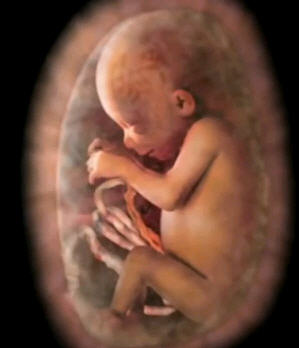
One million cells per
second, and no errors.

Subject: Suppose that someone gave you a radio...
Date: Tue, 29 May 2012 14:48:45 +0300
From: Dimi Chakalov <[email protected]>
To: Sebastian
Seung <[email protected]>
Cc: [email protected], [email protected],
[email protected], [email protected]
Dear Dr. Seung,
On 3 November 2008, you wrote:
http://www.dana.org/news/cerebrum/detail.aspx?id=13758
"Suppose that someone
gave you a radio and asked you to figure out how it works. You could try
measuring electrical signals inside it, but the measurements might not
be sufficient. You might be more successful if you were also given a
circuit diagram illustrating all the components of the radio and how
they are connected to each other."
I've been interested in the physics of the brain since 1972, and the
only way I could explain the brain is by suggesting a model of the
universe as a brain; then I think we can embed
the smaller brain in the 'ONE brain' with quantum gravity,
http://www.god-does-not-play-dice.net/#ESI
In other words, I think it is crucially important to start with the
correct "radio". Will be happy to elaborate.
Kind regards,
Dimi Chakalov
-------------

Note: Many theoretical physicists
believe that the psychological time arrow somehow "follows" the
thermodynamic time arrow, and then of course claim that our subjective
flow of time is nothing but an "illusion" [Ref.
1]. If this were the case chosen
by Mother Nature, our brains must operate like computers in a dead
frozen "block universe" (Robert Reroch). But
because the 'computer' assumption is manifestly wrong, these otherwise
smart people need a parapsychological ghost acting directly on
their brains [Ref. 2], to account for the ubiquitous 'binding
phenomenon', namely, how
the brain puts all stimuli collected from all sensory channels
together in a perfectly synchronized and continuous conscious experience, without any
"dark gaps" needed to re-calculate the flow of sensory "data".
(In the "linearized" gravity these
theoretical physicists use
just one single instant corresponding
to one completed negotiation between the two sides of the
Einstein filed equations, which is why they don't face the "dark
gaps", but end up with a dead frozen "block universe" in which 'time' is
eliminated from the outset.)
So, if you ignore the
proposition from Leibniz and Pauli and the
Arrow of Space, you will have to "link" matter and
mind with some "connection" between the "nose" and the "arm" of an
elephant. Then you either
face unphysical ghosts
acting directly on your brain, imposing their free will choice on
100 billion neurons and
500 trillion synapses,
or entertain Marxist-Leninist materialism and
endorse the idea about 'brain as hardware, mind as software'.
D. Chakalov
June 18, 2012
Last update: March 28, 2013, 11:04 GMT
[Ref. 1] What Is Time? By Elisabeth Eaves, Forbes,
February 29, 2008
Physics tells us that
all moments exist equally, at once -- it's only
our consciousness that distinguishes the present from the past or
future. Or, as cosmologist Tegmark puts it, "If life were a movie,
physical reality would be the entire DVD: Future and past frames
exist just as much as the present one."
[Ref. 2] Larissa-Emilia Cheran, Exploring the Mechanisms of Interaction
between Human Consciousness and Networks of Living Neurons,
Journal
of Nonlocality, Vol. I, Nr. 1, 2012.
"We do not have a clear definition for life yet. What makes the
difference between a living cell and an identical cell, without life?
All the physical properties are identical, the chemical components are
the same, what is missing is the ineffable force that moves everything
in the most surprisingly coherent fashion. What orchestrates 100,000
chemical reactions, every second, in every cell of the 100 trillion that
form a human body? How can the constant homeostatic feedback response be
achieved in milliseconds? What coordinates the self-organization of this
complex system? Is it driven by the 25,000 genes turning each other on
and off and producing
proteins? Decoding the human genome did not reveal
a Holy Grail after all: the contribution of the gene variants to disease
is rather weak. There are other unknown factors at work and the
challenge ahead is to identify these, their controls, their potential
impact and interactions."
Comment: In GR textbooks
(e.g., Robert Geroch), "the entire DVD" is one
dead frozen block universe, in which there is no 'time' in terms of
different-in-time events (A) and (B).
The two points above are
from Minkowski spacetime in which there isn't any invariant instant
'now', yet people can speak about an interval (AB) and its points
because they are mathematically well-defined on such background
spacetime. In GR, however, we don't have any mathematical notions
of "points" in the first place, namely, (A) and (B) are not defined by
their gravitational energy density, nor can be individuated by
their physical content: the paradox
or "problem" of time is mathematically inevitable due to "the invariance
of classical general relativity under the group Diff(M) of
diffeomorphisms of the spacetime manifold M" (Chris Isham,
pp. 4-5).
Yet people ignore the mathematical rules and tacitly assume that
something from their imagination can
somehow build up an invariant interval (AB) comprised
from the same mathematically indefinable "points", and call it
'time'.
Mathematically,
nothing is spinning the DVD, nothing can look at
the DVD en bloc like Chuck Norris,
and nothing can possibly look at (A) and (B) at different
instants either: see Chris Isham above. You need 'time', but you've
killed it with math from the outset.
Mathematically, the whole DVD is one single timeless
"instant". If you wish to talk about spatial relations, such as
the "obvious" difference between a 'point' and a 'finite region'
(AB), you
must inevitably use your wild imagination. Once you kill
time with your lame incomplete math, you kill the whole spacetime,
because you cannot evaluate spatial relations without 'time'.
It's a bundle, because "space by
itself, and time by itself, are doomed to fade away into mere shadows,
and only a kind of union of the two will preserve an independent
reality" (Hermann Minkowski,
September 21, 1908).
The only possible
solution to restore the obvious presence of 'time' is outlined
below. Then we can introduce distance function,
metric, etc., to obtain 'space', and hence 'spacetime'.
"It is extremely difficult
to induce penguins to drink warm water", said John Coleman.
D. Chakalov
December 6, 2012
============================================
Let's examine four cases of
binding:
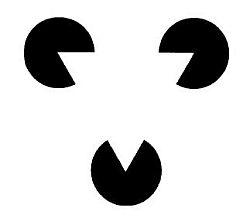
------------------------------------
I spillced coffcee cincto
my kcey boardc.c As a rcesulct, c's gcet
inctermixcced with cwactever I ctypce. Plcease replace mcy kceyboard.
ccthanks.
------------------------------------
Allan Paivio: Two digital
clocks read [11:05] and [13:25]. Convert
the readings into analog format, and find the greater angle.
------------------------------------
Imagine a cube made of
white plastic material with a 3 cm rib,
painted blue, which is cut into 27 little cubes with a 1 cm rib.
How many little cubes will have three blue sides,
how many will have two, one or none?
------------------------------------
Once you discover the
agent which rotates the cube and examines
it from different angles to count the blue painted sides, as well as
creates the triangle and
"calculates" the two angles
above, you will
be ready to replace tcy
kcey boardc.c
This "agent", however,
cannot be some metaphorical "little man" or
"the
true
subject within the brain":
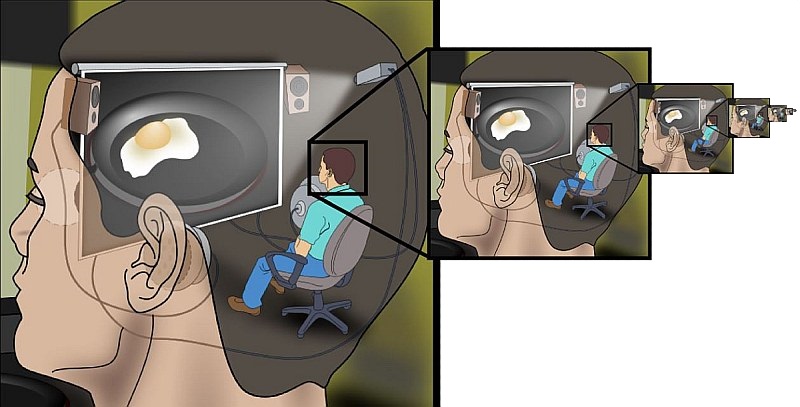
Such "little man" or
homunculus does not exist. The brain does the binding,
as
demonstrated with four examples above. Namely, the
binding problem is
about the ability of our brain (not "mind") to
integrate
correctly all neural
"codes" that belong to one and the same event: the pairing of
features
that
belong to a common object. Say, an egg in fry pan, as shown above.
But you cannot present
the binding phenomenon with any "computations"
from your textbooks. Forget about "quantum computing," too.
You could indulge
in some "neural
computations" iff there were
isomorphism between the brain
and its mind, just like the
isomorphism between the information encoded on a
DVD with specific
code
and the visual and audio patterns shown on your TV, say.
Were that the case, you could claim that the 'egg in fry pan', as shown
above,
were isomorphic to its neural presentation, then discover the
"neural code",
and enjoy your
€1 billion European research prize:
there will be no need for any
psychology. It would be totally redundant and unneeded, like a video
camera
installed in a car factory to "help" the
robots there to assemble cars: these
robots don't need to "see" or "hear" anything, because are
directed by
particular
software written for their hardware. They are directed solely by
computations,
don't need any psychology either. Can you see "computations" in the
brain below?
Anyway, it's too late to complain,
the damage is done.
This whole issue is of
paramount importance due to its
practical implementations;
see 'The Two Rules of Success' below.
D. Chakalov
February 21, 2013
Last updated: February 22, 2013, 03:02:30 GMT
------------------------------
Subject:
€1 billion European research prize ?
Date: Tue, 19 Feb 2013 00:10:13 +0200
Message-ID: <CAM7Ekx==Lk4rodsiLD82KOLu3YrSL8Syp+yVNMzqg-Ph=vZrSw@mail.gmail.com>
From: Dimi Chakalov <[email protected]>
To: [email protected],
[email protected],
[email protected],
[email protected],
[email protected],
[email protected],
Paul G Allen <[email protected]>
Dear colleagues,
Regarding your Human Brain Project, be aware that
your (not mine)
first off task is to explain the brain-mind interface: the binding
phenomenon.
What kind of "computations" are involved with the binding phenomenon ?
What is the physics of the
binding phenomenon ?
More at
http://www.god-does-not-play-dice.net/#Seung
Sincerely,
Dimi Chakalov
--------------
Note: You will
need some privileged anatomical structure and dedicated physiological
process to implement the alleged "brain
computation" -- "the
little man inside the brain." And since the sensory data
continuously arrive in the brain, you'll have to explain the absence
of any "dark gaps" needed to re-calculate
the next patch of sensory data by such homunculus. Forget it.
Giving
€1 billion to these people is terribly unfair.
Ridiculously unfair. Horribly unfair. Period.
D. Chakalov
February 19, 2013, 16:30 GMT
=============================================
Subject: Re:
€1 billion European research prize ?
Date: Fri, 22 Feb 2013 04:47:47 +0200
Message-ID: <CAM7Ekx=LHRLeK+L835R9_v1VU2gKO-1JEc+S6tH-U5iyf7Kkew@mail.gmail.com>
From: Dimi Chakalov <[email protected]>
To: [email protected], [email protected]
Cc: [email protected],
[email protected],
[email protected],
[email protected],
[email protected],
[email protected],
Paul G Allen <[email protected]>,
[email protected],
[email protected],
[email protected],
[email protected],
[email protected],
[email protected],
[email protected],
[email protected],
[email protected],
[email protected],
[email protected],
[email protected],
[email protected],
[email protected],
[email protected]
Dear colleagues,
Please explain the reasons for granting €1 billion -- taxpayers' money
-- to HBP,
http://www.god-does-not-play-dice.net/#HBP
Also, may I ask you to confirm the receipt of this message.
Looking forward to hearing from you at your earliest convenience,
Yours sincerely,
Dimi Chakalov
On Tue, 19 Feb 2013 18:36:41 +0200, Dimi Chakalov <[email protected]>
wrote:
[snip]
=============================================

Subject: Re: €1 billion European research prize ?
Date: Fri, 22 Feb 2013 15:36:09 +0200
Message-ID: <CAM7Ekx=A6RUbjBKiSJwo3CNHqCN_VrWqa2ip+ULJX71pp56VbQ@mail.gmail.com>
In-Reply-To:
<F741ACECC5AD51429FD2EDFC97E0E3F12FA22C@S-DC-ESTA02-J.net1.cec.eu.int>
From: Dimi Chakalov <[email protected]>
To: [email protected]
Cc: [email protected],
[email protected],
[email protected],
[email protected],
[email protected],
[email protected],
[email protected],
Paul G Allen <[email protected]>,
[email protected],
[email protected],
[email protected],
[email protected],
[email protected],
[email protected],
[email protected],
[email protected],
[email protected],
[email protected],
[email protected],
[email protected],
[email protected],
[email protected],
[email protected]
On Fri, 22 Feb 2013 10:56:53 +0000, <[email protected]> wrote:
>
> Thank you for your mail.
>
> Please read the blog from Ms Kroes on this which explains why we think
investing in this
> type of research is a wise investment. See here
>
http://blogs.ec.europa.eu/neelie-kroes/fet-flagship-winners/
>
> Kind regards
>
> Linda Cain
>
Hello Ms Cain,
Thank you for your reply. May I try to explain the objections against
your decision to grant €1 billion --
taxpayers' money -- to the Human Brain Project (HBP).
I totally disagree with Vice-President of the European Commission
Ms Neelie Kroes to treat the Graphene Flagship program and the Human
Brain Project on equal footing.
Fact: There is no trace of wishful thinking and/or obviously
wrong ideas in the Graphene Flagship program, while the Human Brain
Project includes many ideas that are either wishful thinking or are
obviously wrong, since they *contradict established facts known for
decades*.
To be specific, the leader of HBP, Dr. Henry Markram, focused on three
issues in his interview with Ms Neelie Kroes, published on January 29,
2013 at
http://www.youtube.com/watch?v=DsZ_LBdthC0
1. Henry Markram wishes to establish "a CERN for the brain" and
"unifying model" -- please watch 03:25 - 03:43 from the timeline of the
interview above. In the first place, I think Henry Markram and his
colleagues must not repeat the widely known errors in his field of
experience.
2. Henry Markram explicitly suggested "brain as an ICT system", "neuromorphic
computing systems", and (Sic!) "neuromorphic computing processor" (07:10
- 08:03). This is sheer wishful thinking -- see the link below.
3. Henry Markram acknowledged that his dream was to understand
"how the brain represents reality" (09:44 - 10:17). I will refrain from
comment.
Now, I have no idea who was advising the Vice-President of the European
Commission Ms Neelie Kroes regarding issues (i) - (iii) above. Please
let me know her/his name and contact information, and I
will prove *with facts* that Henry Markram was exercising his wishful
thinking and also was obviously wrong on issues (ii) and (iii).
As a start, please read carefully a very brief explanation at
http://www.god-does-not-play-dice.net/#HBP
I will be more than happy to elaborate. Just please let me know
who stands behind Henry Markram.
After all, €1 billion is a humongous amount of money, which I think the
Graphene Flagship program fully deserves. Not HBP, however.
Looking forward to hearing from you at your earliest convenience,
Yours sincerely,
Dimi Chakalov
-------------
Note: It is
crucially important to know the people from the Future and Emerging
Technologies (FET) Programme, who support
Henry Markram.
For example, see the bold
statement by Ms
Christiane Wilzeck & colleagues
at
http://cordis.europa.eu/fp7/ict/fet-proactive/nbis_en.html
"Brains are remarkable computing systems which clearly outperform
conventional architectures in many real-world tasks."
Wrong. Such
speculative idea is based on the Marxist-Leninist interpretation of
mind-brain relations, which assumes "neural computations" and
even some "neuromorphic
computing systems", like Henry Markram in issue (ii) above.
Surely there is
information in brain's memory, but the questions is,
information about what ? Consider, for example, the notion
'cloud', after John Wheeler. We know that the
same notion is expressed in German with 'Wolke'; in French the
same notion is denoted with 'nuage'; in Dutch the same
notion is 'wolk'; in Spanish the same notion will be 'nube'; etc.
But what are the "neural presentation" of the same
Wolke-nuage-wolk-nube-cloud, with which the brain performs the
binding? Namely, what could be the "neural
presentation" of the same underlying unspeakable notion in
the human brain? See also another example with three sayings
below.
There can be no "neural
computations" nor "neural code" corresponding to human cognition. Forget
it. No computation can produce 'the same' outcome that can be
invariant in all brains of all people, and keep it 'the same'
in their memories for decades, despite their brain differences, life
experience, etc.
In brief, the
materialistic, Marxist-Leninist interpretation of mind-brain relations
is just as wrong as the approach in parapsychology, in which one
postulates, for example, some "dualistic
interactionism". Both approaches are wrong, for different reasons,
and I will be more than happy to explain the facts and provide extensive
reference. For now it suffices to remind that the binding
cannot be implemented exclusively by the brain alone, as
stipulated in the €1 billion Marxist-Leninist Human Brain
Project, and Henry Markram & colleagues are heading to a dead-end.
Needless to say, the binding cannot be implemented
jointly by some "dualistic
interactionism" either, simply because the
human mind (see the "little man" or homunculus above)
cannot act on brain tissue -- if it could, it will become
'matter'.
Do we have a third
option? But of course, ladies and gentlemen! It is in fact
the oldest proposition
about the common source of Res cogitans and
Res extensa, which is neither mind nor matter.
NB: The only
possible explanation of the mind-brain and mind-matter relations was suggested
by
Gottfried Wilhelm von Leibniz, and later elaborated by Wolfgang
Pauli on January 7, 1948 [Ref. 1].
Yet sixty-five years
later, in
January 2013, it was all forgotten or ignored by his fellow citizens in
Switzerland and the European Commission Vice President
Neelie Kroes.
Don't give away
€1 billion --
taxpayers' money -- to people supporting the Marxist-Leninist crap.
Don't waste money earned
with hard labor by millions of people. It is just terribly unfair.
Period.
D. Chakalov
February 22, 2013
Last updated: February 23, 2013, 13:09:24 GMT
[Ref. 1]
H. Atmanspracher and H. Primas,
The Hidden Side of Wolfgang Pauli, Journal of Consciousness
Studies, 3 (1996) 112-126; cf. Sec. VI, Matter and Psyche as Two
Aspects of One Reality, p. 122.
======================================
Subject: Re: [alleninstitute.org #23671] Re: €1
billion European research prize ?
Date: Fri, 22 Feb 2013 18:01:36 +0200
Message-ID: <CAM7EkxnUTEg-JmNEVLoML7TVsE13JBzdgJhwZRifgtaRSZAQAA@mail.gmail.com>
From: Dimi Chakalov <[email protected]>
To: Secretariat of Mrs Kroes <[email protected]>,
Neelie Kroes' spokesperson <[email protected]>,
Press officer <[email protected]>
P.S. Please see an explanatory note added at the link below.
D.C.
On Fri, 22 Feb 2013 15:54:48 +0200, Dimi Chakalov <[email protected]>
wrote:
>
> For the record:
>
http://www.god-does-not-play-dice.net/#HBP_Markram
>
> More to come soon.
>
> Sincerely,
>
> Dimi Chakalov
>
>
> On Fri, 22 Feb 2013 05:37:19 -0800, <[email protected]> wrote:
> [snip]
Note: Strangely
enough, I have noticed, ever
since 1998, that people who write textbooks and publish academic
papers stubbornly oppose to the simple facts about the
binding phenomenon, and prefer to
keep quiet. As if the facts explained here were
unknown to them, or they can't grasp them, or both. But let me set the
record straight: everything at my website -- everything -- is based on
research published in papers and books many many years ago.
Example: Wolfgang Pauli.
The situation is actually
getting worse, because now we have €1
billion research prize given to Henry Markram & colleagues to
"discover" something that does not and cannot exist:
neural "computations".
Let me again explain the
issue with some very simple examples, which I am definitely positively
certain that everyone can and will understand.
Consider the saying 'when
it rains, it pours'. In
Mandarin, the same idea can be roughly expressed as
 . .
Obviously, there can be no
similarity -- and there must be no similarity -- between
the neural presentations of English and Chinese letters
(dubbed here 'jackets') used to express the same
idea by all people who speak English and Mandarin. In German, the
same idea can be roughly expressed with 'Ein
Unglück kommt selten allein'.
Therefore, no
"computations" whatsoever can reproduce the experiment you performed
with your brain by reading the same sayings above. Why? Because
we do know what 'computation' means -- we have invented it from scratch.
Yes, there is indeed
information in human brains, kept in their unique individual neural
presentations of different letters, but -- no, you cannot
use any 'computation' whatsoever to reproduce the same
notion expressed above.
There is none so blind as
they that won't see.
D. Chakalov
February 23, 2013, 16:13:30 GMT
============================================================
Subject: Re:
arXiv:1204.4325v1 [ quant-ph]
Date: Fri, 20 Apr 2012 13:29:03 +0300
Message-ID:
<CAM7EkxkudVf069DbCW0N8++A5tRcj-kyw1O0QvYwjNG1ZzHDhQ@mail.gmail.com>
From: Dimi Chakalov <[email protected]>
To: Tejinder Singh <[email protected]>
Cc: Angelo <[email protected]>, [email protected],
[email protected], [email protected],
Steve Adler <[email protected]>,
Adrian Kent <[email protected]>
Dear Tejinder,
Thank you for your prompt reply.
>
Chapter 5 of Adler's book `Quantum theory as an emergent phenomenon'
> explains how an underlying theory such as Trace Dynamics evades the KS
> theorem.
With all due respect to you and Steve, I don't see how any theory, Trace
Dynamics included, can evade the KS Theorem. Once you have the "states"
which are 'neither UP nor DOWN' and hence are shifted to the uncolored
KS sphere, you can't bring them back to the Hilbert space. You can't say
anything about these UNdecidable [whatever], because any statement will
bring 'color', while they are UNcolored: check out the quote from Erwin
Schrödinger (November 1950) at
http://www.god-does-not-play-dice.net/#Joel
This is a fundamental quantum phenomenon of "failure to predict"
(nothing to do with Bell's theorem): "It also makes it clear that this
failure to predict is a merit rather than a defect, since these results
involve free decisions that the universe has
not yet made" (John Conway and Simon Kochen, The Free Will
Theorem,
quant-ph/0604079 v1). You've talked with Simon Kochen last July at
"Quantum Physics and the Nature of Reality" (International Academy
Traunkirchen, Austria), so I suppose you're familiar with these
UNdecidable [whatever].
Erwin Schrödinger predicted them in November 1950.
Henry Margenau called them 'Onta'.
Can't fit them into any Hilbert space.
I will be happy to elaborate.
Best regards,
Dimi
===================================================
Subject: Listening for gravitational-waves with "ears wide open"
Date: Mon, 23 Apr 2012 06:55:10 +0300
Message-ID:
<CAM7EkxkKWwVaE9rNotyuXq_TwR+OQNNfu=GfQ2MO37uG+oxz9g@mail.gmail.com>
From: Dimi Chakalov <[email protected]>
To: Francesco Salemi <[email protected]>
Cc: Joan Centrella <[email protected]>,
Alan J Weinstein <[email protected]>,
James Ira Thorpe <[email protected]>,
[email protected],
[email protected],
[email protected],
[email protected],
[email protected],
[email protected],
[email protected],
[email protected],
[email protected],
[email protected],
[email protected],
[email protected],
[email protected],
[email protected],
Bernard Schutz <[email protected]>,
LSC Spokesperson <[email protected]>,
Kip <[email protected]>,
Karsten <[email protected]>,
David <[email protected]>,
Jorge Pullin <[email protected]>,
Gabriela González <[email protected]>,
Clifford Will <[email protected]>,
Beverly Berger <[email protected]>,
Tom Carruthers <[email protected]>,
Ramona Winkelbauer <[email protected]>,
Peggy Fischer <[email protected]>,
OIG <[email protected]>,
[email protected],
Oliver Jennrich <[email protected]>,
[email protected],
Bruce Goldstein <[email protected]>,
Drew Keppel <[email protected]>,
Hans-Jürgen Schmidt <[email protected]>,
Thomas A Prince <[email protected]>,
Vivian Drew <[email protected]>,
Hamish Johnston <[email protected]>,
Pedro Marronetti <[email protected]>,
Bernd Brügmann <[email protected]>,
Marek Abramowicz <[email protected]>,
Lars Andersson <[email protected]>,
Roger Blandford <[email protected]>,
Jirí Bicák <[email protected]>,
John Friedman <[email protected]>,
Bernd Schmidt <[email protected]>,
Luciano Rezzolla <[email protected]>,
Helmut Friedrich <[email protected]>,
Joseph Katz <[email protected]>,
Robert M Wald <[email protected]>,
Karel V Kuchar <[email protected]>,
Adam Helfer <[email protected]>
http://www.ligo.org/science/Publication-S6BurstAllSky/
-------------
Dear Mr. Salemi,
You and your app. 800 LIGO 'n Virgo colleagues wrote the following:
"No gravitational wave signal was detected in this search using 1.74
years of good quality data, including the previous LIGO-Virgo joint
science run. (...) The second figure on the right shows the resulting
rate limits versus signal strength for several hypothetical waveforms.
(...) So we can be confident that the search *would have* caught pretty
much any type of gravitational wave burst that arrived during that time
at the sensitivity level achieved by present detectors."
You used MOCK "data" -- "hypothetical
waveforms" -- that have been custom-made to fit your "filters", so that
now you "can be confident that the search *would have* caught pretty
much any type of gravitational wave burst that arrived during that time
at the sensitivity level achieved by present detectors."
This is a classical example of parapsychology-type thinking.
NB: You and your LIGO 'n Virgo colleagues are total disgrace to
the whole GR community.
Check out the bold facts at
http://www.god-does-not-play-dice.net/#Bondi
http://www.god-does-not-play-dice.net/#LIGO_Prague
Yes, I will expose your dirty little secrets at the Einstein Conference
in Prague.
Unless, of course, the Scientific Organizing Committee
decides to "save" you by rejecting my talk, hence prolong the cover up
of the enormous waste of taxpayers' money by LIGO and Virgo members.
I will soon find out
whether I will be allowed to talk at the Einstein
Conference in Prague.
If my talk is rejected, the last remaining option will be to call a
press conference in Prague on Monday, June 25th, and expose your game to
the media and other interested individuals. It will make a fascinating
reading in the tabloid newspapers. Trust me, I can do it -- and I have
nothing to lose.
How about you ?
Sincerely,
D. Chakalov
35 Sutherland St
London SW1V 4JU
==========================
Note: Five seconds
after I sent the email above, I received
confirmation from
NSF OIG:
No response from the Inspector General at NASA to
my email from Mon, 30 Jan 2012 14:44:12 +0200 has
reached me so far. The ref. no. of my inquiry is 6786.

In summary, the proponents of "GW astronomy" do not have any
theory of strong GWs from which one could derive some very week
limit, to
verify their initial assumptions (cf. the two "if-s"
above). Actually, they openly admit that such
theory is not feasible: check out the excerpt from M. Maggiore,
Gravitational Waves: Theory and Experiments, p. 32
above. They approach the challenge of detecting a very week
GW with approximations which are totally inapplicable to
the initial, and very strong, gravitational radiation. They
kill the
very effect they wish to measure with "GWs
in flat spacetime" -- the assumption that by reaching
the "advanced"
LIGO these waves will be "very weak" is irrelevant:
the transport of energy by GWs is fundamentally
non-linear phenomenon. It makes no sense to
"enhance the sensitivity" of what has been a dead turkey from the
outset. They totally ignore
the opinions of experts in GR, published in peer
reviewed journals. Even after five (or more) consecutive failures,
the proponents of "GW astronomy" are not willing to address their
initial problems. They just ask for more money -- in the range of
billions.
To understand the
absurdity of "GW astronomy", think of Schrödinger's equation: it is a
perfectly legitimate approximation for all cases in which the vacuum
effects in QFT can be ignored. But if you wish to explore some very
strong vacuum effect, you will use QFT -- not Schrödinger's
equation. But because the proponents of "GW astronomy" do not have the
theory equivalent to QFT, they "use" what they have -- the linearized
approximation of GR -- despite the fact that it is inapplicable
to their quest for detecting GWs, as proven by Hermann
Weyl in 1944. They don't read, don't think, but just ask for more
and more taxpayers' money -- in the range of
billions.
For comparison, look at
Leonid
Marochnik: he uses "one–loop approximation of quantum gravity" which
has the crucial merit of "remoteness from the Planck epoch", and
seriously suggests "the appearance of ghosts in the theory of quantum
metric fluctuations", yet does not propose some very sensitive
ghost detectors and doesn't ask for money either. Likewise, if the
proponents of "GW astronomy" were not wasting money earned with hard
labor by millions of people, and were not wasting
paper for their publications -- fine. Let them play with their math
as much as they can; it's a free world.
There is no communist
censorship in a free world, right? Well, it depends.
The Scientific Organizing Committee decided to
change the rules: they will consider only those applicants
for oral presentation (talk), who have already paid the
conference fee of EUR 350, before April 15, 2012. This is the new
precondition, announced on April
24th this year, to applicants submitting their oral presentations -- all
of which are still waiting to be approved by the Scientific Organizing Committee
(cf. below).
It goes without saying
that I was not informed about this new precondition
until April 24, 2012 (the legal terms is
antedate). Also, the Scientific Organizing Committee
was fully aware that I haven't paid the conference fee of EUR 350 by
April 15, 2012.
I wish I knew about this
new precondition prior to April 15,
2012. Yet even if I had paid those EUR 350 before the deadline, how
could such payment influence the value of my talk? Aren't 'science and
money' totally different, like apples and oranges?
Check out my last email from Wed, 25 Apr 2012
00:35:02 +0300 printed below.
I will not be allowed to
speak at the Einstein Conference in Prague. The LIGO and Virgo members
can take a breath and relax -- nobody will challenge their
GW parapsychology.
As I stated
above, "the
last remaining option will be to call a press conference in Prague on
Monday, June 25th, and expose your game to the media and other
interested individuals. It will make a fascinating reading in the
tabloid newspapers. Trust me, I can do it -- and I have
nothing to lose."
À la
guerre comme à la guerre.
D. Chakalov
April 25, 2012, 13:00 EET
---------------------------------
Subject: Re: Conference
website login information
Date: Wed, 25 Apr 2012 00:35:02 +0300
Message-ID: <CAM7Ekxmtfn+enENbd8rdossHoJwSkYGVnXqHzdbptWSjwaZg0Q@mail.gmail.com>
From: Dimi Chakalov <[email protected]>
To: [email protected]
Cc: Bernd Brügmann <[email protected]>,
Marek Abramowicz <[email protected]>,
Lars Andersson <[email protected]>,
Roger Blandford <[email protected]>,
Jirí Bicák <[email protected]>,
John Friedman <[email protected]>,
Bernd Schmidt <[email protected]>,
Luciano Rezzolla <[email protected]>,
Helmut Friedrich <[email protected]>,
Joseph Katz <[email protected]>,
Robert M Wald <[email protected]>,
Karel V Kuchar <[email protected]>,
Hermann Nicolai <[email protected]>,
Paul Tod <[email protected]>
On Tue, 24 Apr 2012 20:24:47 +0200, ae100prg <[email protected]> wrote:
>
> Dear Mr. Chakalov,
>
> the list of accepted contributed talks is not known yet. Since
> September 2011 the deadline for contribution submission was advertised
> to be April 15 2012, and now after this deadline, the suggested
> contributions are with the Scientific Organizing Committee to find
> those of contributions of REGISTERED participants which will be
> presented in about 60 slots for contributed talks.
>
> Unfortunately, I found you are not among the registered participants
Two things.
1. No need to write with capital letters.
2. Before replying, please make an effort to read the text to which
you reply: see my email from December 16, 2011 printed (again) below.
I will list a few facts, and will ask a question.
You did not provide any indications that the Scientific Organizing
Committee will require registration to your Conference (EUR 350 before
April 15, 2012) as a *precondition*
for entering into the list of
applicants willing to deliver an oral presentation (talk).
You opened the registration on December 16, 2011, and I did register
immediately, on December 16, 2011.
You did not inform me about the change of rules until today, April 24,
2012. As of today, there is still no hint at your web site that
you
have changed the rules.
These are the facts.
I want to *compete* with you -- both individually, and en bloc.
As I wrote in my email from December 16, 2011, "I cannot compete with
the proponents of the "splitting of spacetime" (ADM) with a poster."
But today, on April 24, 2012, you decided to change the rules, and
shut me up.
Q: Do you think this is fair ?
I extend this questions to all members of the Scientific Organizing
Committee.
Looking forward to hearing from you at your earliest convenience,
Yours sincerely,
Dimi Chakalov
On Tue, 24 Apr 2012 17:57:24 +0300, Dimi Chakalov <[email protected]>
wrote:
>
>> Dear Colleague,
>>
>> I still haven't received your reply to my email from December 16th
>> last year (printed below).
>>
>> Please let me know if I will be allowed to talk at your Conference.
>>
>> Looking forward to hearing from you at your earliest convenience,
>>
>> Yours sincerely,
>>
>> Dimi Chakalov
>>
>>
>>
>>> On Fri, Dec 16, 2011 at 11:42 PM, Dimi Chakalov <[email protected]>
wrote:
>>>
>>> Dear Colleague,
>>>
>>> Thank you for your email. I submitted today the abstract of my
>>> intended oral contribution (for your convenience, please see a copy
of
>>> the abstract printed below).
>>>
>>> I would like, if I may, to ask you for confirmation that my talk
will
>>> indeed be approved, after which I will immediately register. The
>>> reason for this immodest request of mine is that it is impossible to
>>> explain the proposal with a poster, and if my submission for oral
>>> presentation is denied, there will be no sense to attend the
>>> Conference.
>>>
>>> Stated differently, I cannot compete with the proponents of the
>>> "splitting of spacetime" (ADM) with a poster.
>>>
>>> I will be happy to provide specific details on my intended talk, as
>>> well as any other information you may require for your decision.
>>>
>>> Looking forward to hearing from you,
>>>
>>> Yours sincerely,
>>>
>>> Dimi Chakalov
>>>
>>> [snip]
=====================================================
Subject: Open letter to LSC Spokesperson Prof. Gabriela Gonzalez
Date: Thu, 26 Apr 2012 03:14:52 +0300
Message-ID:
<CAM7EkxmoLSviqxm8VQEZiEUEdvX6_ytpsLyZBghxxRKbj_vWmQ@mail.gmail.com>
From: Dimi Chakalov <[email protected]>
To: LSC Spokesperson Gabriela Gonzalez <[email protected]>
Cc: [email protected],
Bernd Brügmann <[email protected]>,
Marek Abramowicz <[email protected]>,
Lars Andersson <[email protected]>,
Roger Blandford <[email protected]>,
Jirí Bicák <[email protected]>,
John Friedman <[email protected]>,
Bernd Schmidt <[email protected]>,
Luciano Rezzolla <[email protected]>,
Helmut Friedrich <[email protected]>,
Joseph Katz <[email protected]>,
Robert M Wald <[email protected]>,
Karel V Kuchar <[email protected]>,
Hermann Nicolai <[email protected]>,
Paul Tod <[email protected]>,
Bernard Schutz <[email protected]>,
Clifford Will <[email protected]>,
Karsten Danzmann <[email protected]>,
Beverly Berger <[email protected]>,
Pedro Marronetti <[email protected]>,
Jorge Pullin <[email protected]>,
Kip Thorne <[email protected]>,
Jeremiah P Ostriker <[email protected]>,
Evangelos Melas <[email protected]>,
Ted Newman <[email protected]>,
Josh Goldberg <[email protected]>,
Adam Helfer <[email protected]>
Dear Professor González,
Funded munificently by the U.S. National Science Foundation, LIGO
Scientific Collaboration (LSC) is currently made up of more than 800
scientists from dozens of institutions and 13 countries worldwide.
According to the Bylaws of LSC (LIGO
M050172-04, 29 March 2006), "The Spokesperson leads the LSC, and is
empowered to represent the LSC to the outside world" (Sec. 4.1), and
"identifies key issues and opportunities and brings them to the
attention of the Collaboration" (4.5.3).
May I draw your attention to the real danger for an exceptionally
unbalanced presentation of views on the very possibility for detecting
gravitational waves (GWs) at the forthcoming Einstein Conference in
Prague, June 25 – 29, 2012: if you look at the list of invited speakers,
I believe you can safely predict that Bernd Brügmann, Karsten Danzmann,
Luciano Rezzolla, Bernard Schutz, and Clifford Will will undoubtedly
advocate the current opinion that GWs can, at least "theoretically", be
detected by the so-called Advanced LIGO and Virgo,
http://ae100prg.mff.cuni.cz/program
While we all agree that
GWs exist, my opinion is opposite to yours: no, they cannot -- not even
in principle -- be detected by LIGO or Virgo, no matter how "advanced".
A brief list of the insurmountable, in my opinion, problems of LSC is
posted at
http://www.god-does-not-play-dice.net/#Bondi
Two days ago (Tue, 24 Apr 2012 20:24:47 +0200), I was shocked and
stunned to learn that my intended oral contribution to the Einstein
Conference in Prague (submitted on December 16, 2011) will *not even be
examined* by the Scientific Organizing Committee: a new *precondition*
has been introduced to ban all applicants for oral presentations, who
have not paid the conference fee of EUR 350 before the deadline on April
15, 2012.
It goes without saying that I was not informed about this new
precondition (the legal term is antedate) until April 24, 2012. Also, I
believe the Scientific Organizing Committee was fully aware that I
haven't paid the conference fee of EUR 350 by April 15, 2012.
Thus, I will not be able to present my arguments (cf. the link above) to
you and your colleagues, which may totally degrade the quality of the
discussion of your mission at the Einstein Conference in Prague, by
converting it to a fully predictable gathering resembling the meetings
of the former Komunistická strana Československa (KSČ),
http://www.god-does-not-play-dice.net/#communists
NB: I am certain that you are not only an expert in General
Relativity, but a person with pride and dignity as well, and under these
circumstances you will feel terribly awkward, to say the least. I am
also definitely sure that you did not advise the Scientific Organizing
Committee to impose this unprecedented precondition, to eliminate my
chance to share with you and your colleagues my arguments and grave
concerns regarding the very possibility to detect GWs.
I am respectfully urging you to take the necessary actions, in line with
your power and duties of Spokesperson of LIGO Scientific Collaboration.
Please feel free to pass this 'open letter' to your LSC colleagues, as
well as the NSF officials responsible for funding LSC: you may be on a
totally wrong tack, a dead-end.
I stand ready to provide all information you may deem necessary.
Looking forward to hearing from you at your earliest convenience,
Yours sincerely,
Dimitar G. Chakalov
[snip]
-------------------
Note: Why is the
issue of GWs important? Because they are real but not
physical, in the sense that these "waves" do not carry anything
physical, in terms of mass and energy. These "ripples" may be
emerging in the real but not physical realm of the
universe, called 'potential reality'. In the
framework of GR, this new (to some theoretical physicists) form of
reality may be Einstein's 'total
field of as yet unknown structure'.
As Max Planck stated in
1944, "All matter originates
and exists only by virtue of a force... We must assume behind this
force the existence of a conscious and intelligent Mind. This Mind
is the matrix of all matter".
I only wanted to defend
the opinions of Albert Einstein and Max Planck. If the universe does
indeed function as a 'brain', there could be one standing
quantum-gravitational wave resembling these "thoughts", and
originating perhaps from [John 1:1].
Only an ideal or 'meta'
observer, placed in the global mode of spacetime, could "see" the
quantum-gravitational wave that emerges in the 'school
of fish'.
Imagine looking at a hill
covered with a forest, where some of the threes are not vertical but
leaning at an angle:
||||||||||||||||||||||||||||||||||||||||
///////////////////////////////
///////////////////////////////
||||||||||||||||||||||||||||||||||||||||
You can see the swathe of trees (in red)
leaning in the same direction, and infer from it that they were exposed
to strong wind (passing "wave"), yet the wind itself is not visible: all
you can see is that some orientable-by-wind trees have been correlated
en bloc. In order to detect
such passing "wave", you need to install at some correlated tree
(depicted with / above)
a brand new GW detector endowed with the faculty of
self-acting -- the EPR-like
correlation from the passing "wave" is conducted along the null
surface (Sic!) of the Arrow of Space, which is why the resulting
physical effect from it will show up locally as
'self-acting'. You cannot trace back the origin of such holistic
effect made by 'the whole forest' (school
of fish), hence you will
interpreted it as "dark". And again, you are only one single tree
confined in the local (physical) mode of spacetime, which cannot "see"
the whole forest en bloc.
Again, the fleeting
physical content, which identifies each and every quasi-local
"point" (depicted with / above) dynamically along the Arrow of Space, is only the necessary
condition for the "wave", while the sufficient condition is the
holistic correlating effect from 'the forest'. The latter is
smuggled into the r.h.s. of the Einstein field equations as 'effect of geometry on
matter', and is converted into perfectly legitimate 'source of
gravitation'. The linearized treatment of this
phenomenon can show only one instant along the null surface
of the "wave propagation", and of course people cannot detect any
physical effect from it.
Yes, the "thoughts"
of the universe do exist, and should be revealed in the ongoing
elimination of "negative mass": at every instant 'now' from the Arrow of
Space, we have only two worlds with inverted
spacetime basis. The task is strictly
mathematical, but unfortunately I won't be able to
explain it at the Einstein Conference in Prague.
Nobody will acknowledge
the pertinent tasks of Einstein's unfinished
quest for Allgemeine Relativitätstheorie (recall the problems with
the "background" geometry ηab, in
A. Perez, arXiv:1205.2019v1
[gr-qc], p. 4).
People will
continue to dream about "GW astronomy" and
speculate about "black holes" and
dynamics
of GR. At the end of the Conference, they will congratulate each
other for their 'valuable research' and will of course reassure
themselves that 'more research is needed'. Combined with the beautiful
Prague and its famous pubs, they will have a jolly good time. But once
the "advanced" LIGO and Virgo fail to detect any GW
strain, the 'jolly good time' will end with a bucket of cold water.
I'll be there to help and will set the record straight: it was a
scam, ladies and gentlemen, and you bloody
knew it.
The scam is really huge
-- "at least 3-4 billion dollars", as stated by Bernard F. Schutz above.
It is based on the unwarranted assumption that GWs propagate exclusively
in 3-D space 'from point A to point B' on a dead flat background
spacetime (recall Hermann Weyl article from 1944
above) which will not, in no circumstances, alter the GW
itself (see MTW p. 968 and M.
Maggiore, p. 32 above), although you know bloody
well that (i) such dead
flat background spacetime is impossible to obtain from the
spacetime of initially strong GWs (see above),
and (ii) you cannot calculate the tangible forms of energy
associated with the deformations of the Coca Cola bottle
above. Like my
teenage daughter, all you can say is this: 'I want my Barbie!'
But unlike my daughter, you have been addicted to play with such Barbies,
you have devoted your professional vocation to obtaining 'the ultimate
Barbie' at any cost to the taxpayers, you get you pay check for
'playing with Barbies', and you simply cannot do anything else
but pushing for the ultimate $4 billion Barbie.
When you fail miserably
again, you will launch the Plan B -- 'you know, it was Einstein
who got it all wrong, I trusted his GR, but it failed'. To be precise: "Any
such failure of GR should point the way to new physics" (B.
F. Schutz et al., arXiv:0903.0100v1 [gr-qc]).
If this isn't a
scam,
what is it ?
D. Chakalov
April 26, 2012
Last updated: May 16, 2012, 11:58:06 GMT
=====================================================
Subject: Claus Kiefer, Quantum Gravity, Third
Edition (5
April 2012)
Date: Thu, 3 May 2012 02:47:06 +0300
Message-ID:
<CAM7EkxmnsEDGbauYVQqA6530LWFfvn-0YmOeAC4fxffQWAh9Cw@mail.gmail.com>
From: Dimi Chakalov <[email protected]>
To: Claus Kiefer <[email protected]>
Cc: Friedrich W Hehl <[email protected]>,
Jose Geraldo Pereira <[email protected]>,
Masaru Shibata <[email protected]>,
Takahiro Tanaka <[email protected]>,
Misao Sasaki <[email protected]>,
Shigehiro Nagataki <[email protected]>,
Takashi Nakamura <[email protected]>,
Deirdre Shoemaker <[email protected]>,
Alessandra Buonanno <[email protected]>,
Laura Cadonati <[email protected]>,
Harald Pfeiffer <[email protected]>,
Dick Bond <[email protected]>,
[email protected],
[email protected]
Dear Claus,
I've been trying to show some subtle points in your monograph since its
first edition, hoping that you will elaborate.
Here's an incomplete list of issues which you again left unclear.
You wrote: "One particularly impressive example is the case of the
binary pulsar PSR 1913+16: the decrease of its orbital period can be
fully explained by the emission of gravitational waves as predicted by
GR."
Check out an alternative at
http://www.god-does-not-play-dice.net/#Qiao
Details at
http://www.god-does-not-play-dice.net/#Bondi
http://www.god-does-not-play-dice.net/#LIGO_Prague
Regarding the Einstein-Hilbert action, you wrote: "The integration in
the first integral of (1.1) covers a region M of the space–time
manifold, and the second integral is defined on its boundary ∂M, which
is assumed to be space-like."
The last assumptions about some (i) "boundary" that might be (ii)
"space-like" are by no means clear, and neither is the main stipulation
that "it is the three-geometry that is the dynamical object of
GR",
http://www.god-does-not-play-dice.net/#ESI
You also claim that "a natural generalization of general relativity is
the Einstein–Cartan theory".
I believe we can seek a natural generalization of GR only after we
understand the genuine dynamics of GR: the three-geometry may not be the
only dynamical object.
Would you like me to
elaborate? I can offer you
the opinion of Einstein on his GR, for a
start.
Regards,
Dimi
P.S. I included some people in the CC: list, who are still unaware that
LIGO is for the birds.
---------------
Note: The last
email from Claus Kiefer reached me in 2003, just to say that he can't
open the CD ROM I sent him by surface mail, because all PCs at the
University of Cologne run on Unix. Meanwhile he published three editions
of his monograph Quantum Gravity, carefully avoiding all
fundamental unsolved issues mentioned at this web site.
The importance of the task
for revealing the genuine dynamics of GR (forget about
ADM) is most clear in quantum cosmology: some
people claim that the history of the universe would reach a "point" of
past
incompleteness, while other people argue that the age of the
universe might be "effectively
at minus infinity".
The third option of 'dual
age cosmology', briefly explained above, cannot
be read on paper, but only on my "blog", as Fred Hehl
called this web site. Notice that each and every "point" from the
spacetime continuum has the dual temporal nature
of The Beginning, and the asymptotic structure of reaching 'the universe
as ONE' at actual infinity: the primordial object called 'the
universe as ONE' (global mode of spacetime) is being multiplied in the
local mode of spacetime as 'uncountably infinite' points dressed
with their fleeting "jackets" -- one-at-a-time, along
the null-surface of the Arrow of Space. Hence the
local (physical) mode of spacetime is re-created
at each and every instant 'now' as a perfect continuum: the "binding"
object ]between[ the points is 'the universe
as ONE'. It is totally absent in the local (physical) mode due to
the "speed of light". The whole content of
'potential reality' is shifted in the potential future
of the Arrow of Space, rendering the local mode a perfect
continuum, thanks to which we can look at any direction in 3-D space and
see "as far as we like" (Lee
Smolin).
The genuine dynamics of GR
(forget about
ADM) is still missing in GR textbooks. Look
again at the drawing below, from Kiefer and Sandhöfer:
The component of the
Hamiltonian "perpendicular" to the hypersurfaces is
the "direction" of the expansion of Ned Wright's
balloon, driven by its "dark" energy. Ned Wright argues that one
can safely separate the "time dimension of 4-D spacetime" from a "4th spatial
dimension", which is true, but the point is that the "4th spatial
dimension" is compactified to zero
in the local mode of spacetime: it is physically non-existent
there. It is the instant 'now' from the Arrow of Space, at which the two
modes of time coincide, and merge with the other three
components "tangential to the hypersurfaces". Once this happen, you may
introduce some Killing vector from the Arrow of
Space and run the "foliation time" back to the "big
bang"; more from Karel Kuchar above.
Notice also the poetry in
the Einstein-Hilbert action above: the second integral is defined on the
"boundary" ∂M defined on "a region M of the space–time manifold"
that is
"assumed to be space-like": how can you define any
"boundary" whatsoever on a space-like region?
What physical stuff could
be instructed 'by hand' to "run" on a space-like region until it reaches
"infinity", to produce a 'well-defined' (as Claus Kiefer may say)
cutoff, hence safely separate the physical spacetime from the
"unphysical" one
(Robert Wald,
pp. 283-287)?
Can you define any
"boundary" on the slice called Cauchy surface?
The roots of the task are strictly mathematical,
and I hope Claus
Kiefer will address them in the next edition of his monograph. Bottom line
is to recover the correct Machian gravity à la 'school
of fish', namely, the localization of gravitational energy (MTW,
p. 467) at a
quasi-local "point"; the gravitational coupling 'here and now'
should be determined "post factum", by the distant distribution of matter at 'the universe as
ONE', in the atemporal global mode of spacetime
with respect to which we can define the dynamics of the physical
one.
Currently, the dynamics of
the three-geometry ("the dynamical object of GR", as stated
above) is being "defined"
intrinsically, with respect to itself (much like Baron
Münchhausen lifted himself and
his horse),
because Claus Kiefer failed to find the reference fluid of GR (Brown
and Kuchar). Ditto to the "expansion" of space.

It seems
Karel Kuchar is concerned mainly with the
problem of time in canonical quantum gravity, given the title of his
forthcoming talk, but who is concerned with the problems and
paradoxes of 'space' ? How come there is no 'problem of space' in GR ?
"In the first place, we
entirely shun the vague word "space,"
of which, we must honestly acknowledge, we cannot form the slightest
conception,"
Albert Einstein.
D. Chakalov
May 3, 2012
Last updated: May 5, 2012, 06:15 GMT
=====================================================
Subject:
arXiv:1206.0923v1 [gr-qc], p. 1
Date: Thu, 7 Jun 2012 21:10:52 +0300
From: Dimi Chakalov <[email protected]>
To: Santanu Das <[email protected]>
Cc: [email protected], [email protected],
[email protected], [email protected],
[email protected], [email protected],
[email protected], [email protected],
[email protected], [email protected],
[email protected], [email protected],
[email protected]
Dear Santanu,
May I ask a question.
You stated that if Mach's principle is correct, "the inertial properties
of a particle will keep on changing and cannot be calculated
deterministically without knowing the position of all the other
particles of the universe."
Let's switch from epistemology ("knowing the position") to the ontology
of the inertial reaction "forces":
can you suggest some argument against the idea about bi-directional
negotiation between every 'particle' and 'the rest of the universe' ?
Please see my conjecture (UGMC) at
http://www.god-does-not-play-dice.net/#UGMC
I am trying to find any arguments *against* my conjecture. Hope you and
your colleagues can help.
All the best,
Dimi
===============================================
Subject: Re: Open letter to LSC Spokesperson Prof. Gabriela Gonzalez
Date: Sun, 13 May 2012 14:44:06 +0100
Message-ID:
<CAM7EkxnEAM=T57jMPnopaRVAznOvx15wHfXr-a2veYFUueGvjQ@mail.gmail.com>
From: Dimi Chakalov <[email protected]>
To: [email protected], [email protected]
Cc: Bernd Brügmann <[email protected]>,
Marek Abramowicz <[email protected]>,
Lars Andersson <[email protected]>,
Roger Blandford <[email protected]>,
John Friedman <[email protected]>,
Bernd Schmidt <[email protected]>,
Luciano Rezzolla <[email protected]>,
Helmut Friedrich <[email protected]>,
Joseph Katz <[email protected]>,
Robert M Wald <[email protected]>,
Karel V Kuchar <[email protected]>,
Hermann Nicolai <[email protected]>,
Paul Tod <[email protected]>,
Bernard Schutz <[email protected]>,
Clifford Will <[email protected]>,
Karsten Danzmann <[email protected]>,
Beverly Berger <[email protected]>,
Pedro Marronetti <[email protected]>,
Jorge Pullin <[email protected]>,
Kip Thorne <[email protected]>,
Jeremiah P Ostriker <[email protected]>,
Evangelos Melas <[email protected]>,
Ted Newman <[email protected]>,
Josh Goldberg <[email protected]>,
Adam Helfer <[email protected]>,
LSC Spokesperson Gabriela Gonzalez <[email protected]>,
[email protected],
[email protected],
[email protected],
[email protected],
[email protected],
[email protected],
[email protected],
[email protected],
[email protected],
[email protected],
[email protected],
[email protected],
[email protected],
Steven Weinberg <[email protected]>
Dear Dr. Bicák,
I am writing to you as the speaker for the Scientific Organizing
Committee of the Einstein Conference in Prague, June 2012.
No reply has been received to my Open letter to LSC Spokesperson Prof.
Gabriela Gonzalez, dated Thu, 26 Apr 2012 03:14:52 +0300, posted at
http://www.god-does-not-play-dice.net/#letter
I am respectfully urging you and all recipients of this email to reply
professionally, as soon as possible.
Let me state it once more, in plain English.
You and your colleagues from the Scientific Organizing Committee
rejected my intended oral contribution by imposing a new precondition
(the legal term is antedate) on April 24, 2012 (cf. the link above),
which resulted in the following:
You and your colleagues from the Scientific Organizing Committee condone
and effectively endorse the deliberate waste of taxpayers' money by LIGO
and Virgo collaborations.
Deliberate waste of taxpayers' money falls under the category of 'scam'
-- please consult your lawyer.
You couldn't possibly claim that you were unaware of the *scam* (check
out the legal definition of 'scam') conducted by LIGO and Virgo
collaborations. Once the "advanced" LIGO and Virgo fail to detect any
GWs in 2014 (for reasons explained by Hermann Weyl in
1944), you and your colleagues from the Scientific Organizing
Committee will have to explain why you rejected my talk in June 2012,
thus condoned and effectively endorsed the deliberate waste of
taxpayers' money by LIGO and Virgo collaborations.
After wasting hundreds of million USD and Euro, even more taxpayers'
money is scheduled to be wasted for the "advanced" LIGO and Virgo.
NB: This is a *scam* organized and conducted by LIGO and Virgo
collaborations. Yes, I can and will elaborate.
You all are experts in General Relativity, and you are fully aware of
the insoluble problems of "GW astronomy" (cf. the link above).
Please feel free to pass this email to your colleagues and interested
individuals.
If this email does not bounce back immediately, I will consider its
delivery to your email account as a 'fact'.
Looking forward to hearing from you,
Yours sincerely,
Dimitar G. Chakalov
[snip]
====================================================
Subject: Re: CPT symmetry and antimatter
Date: Tue, 22 May 2012 12:24:01 +0300
Message-ID:
<CAM7EkxmOxd07p00wszcP2NBArLLPKeUtbNC4h=Nt8eR+gNq7jg@mail.gmail.com>
From: Dimi Chakalov <[email protected]>
To: Erasmo Recami <[email protected]>
Cc: Massimo Villata <[email protected]>,
H Pierre Noyes <[email protected]>,
Dragan Hajdukovic <[email protected]>,
Edward Kapuscik <[email protected]>,
Daniil Yerokhin <[email protected]>,
Michael Schreiber <[email protected]>,
Laszlo Szabados <[email protected]>,
Adam Helfer <[email protected]>,
Luca Fabbri <[email protected]>,
Paul Wesson <[email protected]>,
Chris Isham <[email protected]>
Dear Erasmo,
Thank you for your kind email and the paper attached. Please notice my
approach to the issues in the subject line at
http://www.god-does-not-play-dice.net/#ESI
I do not introduce any "fifth dimension" that could be "time-like or
space-like" (e.g., Luca Fabbri et al.,
arXiv:1205.4321v1 [gr-qc], p. 6; Paul Wesson,
arXiv:1205.4452v1 [gr-qc], p. 5), but a new degree of freedom
attributed to all spacetime "points" along a null-surface, called
Arrow of Space. The resulting "wave" along the Arrow of Space is
quantum-gravitational, and all "points" are quasi-local from the outset.
There is no other way to proceed -- we need to recover the source of
quantum waves. First things first.
As to the current interpretation of GWs, see
http://www.god-does-not-play-dice.net/#scam
If you or your colleagues have questions, please don't hesitate. I will
be happy to elaborate, in my capacity of "just another crank" (Chris Isham).
Best wishes,
Dimi
> On Mon, 28 Mar 2011, Dimi Chakalov wrote:
[snip]
>> May I share my comments. I don't believe in the Feynman-Stückelberg
>> interpretation, nor in the CPT theorem in "curved" spacetime.
>>
>> Instead, I try to pinpoint the negative mass in the very mechanism by
>> which the observable/positive mass becomes *quasi-local* in GR,
>>
>> http://www.god-does-not-play-dice.net/#shoal
[snip]
-----------
Note: To explain the emerging "wave" along the Arrow of
Space, check out the space of quantum-gravitational states (forget about
Hilbert space), explained with
post-correlated n-states of four dice
above: there is no "jump" in passing from one n-state
to the next one along the Arrow of Space, which is why the
holomovement pattern resembles a "wave", as seen by a
meta-observer in the global mode of spacetime. Again, the fleeting physical "jacket"
is only the necessary condition for such "wave", while the
sufficient condition is the pre-geometric plenum of 'the
universe as ONE' connecting the quasi-local
"points".
Notice that
there is no "singularity" in the
spacetime continuum: the pre-geometric plenum
of 'the
universe as ONE' is a dual object exposed as both 'an
infinitesimal geometrical point' and 'the largest size of the physical
universe', depending on the "direction" we look at it along the
w-axis (see above).
This is the instantaneous state 'now'
of the whole Universe along the Arrow of Space, in which we all
are at 'absolute rest'. From the viewpoint of science, it is
unobservable in principle. The observable states are those "in flux"
(called local (physical) and global (atemporal) modes of
spacetime), created with the rules of dual age
cosmology. The spacetime of such Universe is unique and 'the only
possible one', because it contains absolutely everything,
included the source of its evolution, known as the Aristotelian First
Cause. These simple metaphysical axioms constitute a form of
'metaphysical reality', in the sense that they are accessible to all of
us, and we all can comprehend their invariant meaning, despite the
differences in our brains. These axioms shape
the foundation of the mathematical description of the universe,
after which comes the physical one. First things first.
As an exercise,
try to connect the dots in the drawing of 'one second'
above by using only
Archimedean geometry [Ref. 1] and physical stuff
invariant under "active" diffeomorphisms
[Ref. 2]: the new dynamics of GR, along the null-surface of the
Arrow of Space, is encoded in the seemingly simple word "until"
[ibid.], and the global, "nondynamical
and explicit" time (which isn't
Dirac
observable) must be
totally hidden, or else "the
ether would come back".
Here people ask, 'but
where's da math?' Sorry, the math is still 'out there', waiting to be
uncovered in the "open sets" of the topology of space.
People
begin by postulating a
Hausdorff topological space
and try to explain in what sense "a point
x E X can be said to be
'near' to another point y E X" (e.g.,
Chris Isham,
Modern Differential Geometry for
Physicists, 1999,
Sec. 1.2.1,
p. 3). They denote this
connected topological space with
M , and introduce a second
metaphysical assumption,
a differential structure on M ,
like
bartenders (ibid., pp. 59-60 and
Fig. 2.1). Even Karel Kuchar cannot reveal the "hidden
unmoved mover", which can only show up by exposing the
topological structure of what may look (to
bartenders at macroscopic length scale) like a dimensionless "point".
Just wait for his forthcoming talk at the Einstein Conference in Prague
next month, 'Canonical
quantum gravity: Einstein's posthumous anathema' -- he will not
mention any argument posted on this web site, as if he has never
heard from me (his last email was from 27 January 2003).
The
experts in quantum gravity simply don't like this web site and
behave as if they know nothing about it. Chris
Isham, for example, believes that I "do
not know enough theoretical physics to help with any research in that
area" and considers my work as
"just another crank" (12 October 2007). Other experts
have chosen to be less polite but utterly frank: "Buzz off,
idiot!" (Prof. Dr. Maurice de Gosson).
So be it.
D.C.
May 23, 2012
Last update: May 25, 2012, 12:52:05 GMT
[Ref. 1] A. Trautman, Foundations and current problems of general
relativity, in Lectures on general relativity, ed. by Andrzej
Trautman, F.A.E. Pirani, and Hermann Bondi, Englewood Cliffs:
Prentice-Hall, 1965, Sec. 5.1, pp.
101-103
"From now on we shall
always assume that space-time can be represented by a 4-dimensional
differentiable manifold. This is why the differentiable manifold concept
was defined with care and discussed in detail in the preceding chapter.
Any changes in this assumption would result in a very profound
revolution in physics".
[Ref. 2] Mihaela Iftime, The Hole Argument,
gr-qc/0610105.
"GR or in any general relativistic theory on the other hand are
distinguished from other dynamical field theories by invariance under "active" diffeomorphisms;
its field equations
are invariant under all differentiable diffeomorphisms (the group Diff(M)) of the underlying manifold M, which
have no spatio-temporal significance
until the dynamical fields are
specified.


Comment: According
to
Merriam Webster Dictionary, 'until' can be used as a "function word
to indicate continuance (as of an action or condition) to a specified
time." But in the case examined by M. Iftime above,
the function word "until" does not refer to any 'time read by a
clock'. As Helmut Friedrich acknowledged
(arXiv:0903.5160v1 [gr-qc],
p. 17):
"The vector field T , for which no natural choice exists in
general, is characterized indirectly and becomes explicitly available
only after solving the equations."
That is,
until the dynamical fields are
specified by the rules of "active" diffeomorphisms, we don't have
'spacetime'. What happens "meanwhile" is totally unclear, which is yet
another argument that GR is not a bona fide 'classical
theory'.
Nearly ten years ago, on
Thu, 24 Oct 2002 20:34:51 +0300, I asked
Chris Isham the following: "To prove me wrong, please explain to me what
kind of time is implied by 'moving points around' in Diff(M)-invariance,
and how can your wristwatch read it." He didn't reply to my question,
but instead wrote the following (Fri, 25 Oct 2002 16:46:34 +0100):
"As for time,
wrist-watches and Diff(M), one of the key things that emerged from all
the discussions on the problem of time was that although it is true
that, because of the Diff(M) action, no physical meaning could be
attached to a point on the space-time manifold, a physical meaning *can*
be attached to specifying a space-time location by the values of various
physical quantities. Karel Kuchar is probably
the person who has done most work on this, but it is something that
number of people have remarked on in recent years. For example, \phi is
a scalar field on the manifold and $X$ represents the space-time
coordinate of a particle, then although \phi(x) has no physical meaning
(if x is a point in the space-time manifold) nevertheless $\phi(X)$
*does* have a meaning: ie you can talk in a Diff(M)-invariant way about
the value of a field where a particle 'is', and similarly for a
trajectory. And, after all, general
relativity does seem to work well as a theory, and yet I can certainly
read the time on my wrist watch!"
As I stated
above, Chris Isham needs quantum gravity to
explain how such linearized time can be
read by his "wrist watch!" -- there is no explicit time
parameter in GR, but only "constraints" (Karel
Kuchar).
To explain the crux of "GR
dynamics" to my
teenage daughter, I asked her to imagine that what we call 'spacetime'
is something like a sentence which conveys particular meaning
only after we choose the
proper words ("dynamical
fields", M. Iftime) to explicate
the 'meaning' of our Platonic ideas. In the example
above, we have two "spacetimes" defined
by four (shuffled) sayings. Notice that we don't produce any pathologies
similar to those induced by the
"active" diffeomorphisms in GR textbooks, as explained by
M. Iftime. If our brain can do this, Mother
Nature should be able to do it as well. What we need is to remove all
mental stuff and introduce the GPI field
of 'John's (Diff(M)-invariant)
jackets'. Then the "mental
stuff" will show up only in the dual age cosmology,
after Virgil's dictum Mens agitat molem (Der Geist bewegt die
Materie).
Also, Mihaela Iftime
considers the topological problems very complicated, but according to
"just another crank" they are insoluble -- you cannot, not even in
principle, recover what is called 'dimensionality of space': check out
Martin Bojowald and Lee Smolin above. Perhaps you
can
resolve these pathologies from the active diffeomorphisms with the
reference fluid of GR with respect to which
the Arrow of Space has been introduced. Most
importantly, the spacetime 4-manifold M isn't "fixed" but
dynamical: it is being continuously re-created,
one-at-a-time, at every instant 'now' from the Arrow of Space by
two topological waves
re-creating the
asymptotically flat
spacetime. We cannot comprehend an entity that is "fixed". The only fixed entity
is the ultimate source of the Universe: the true monad without windows.
It is at absolute rest,
residing
within the instant 'now' from the Arrow of Space.
Notice that
the "fixed"
reference fluid of GR is crucial to all
relational theories of time, in which the infinitesimal "duration"
of the instant 'now' is defined "upon relative change within the
universe as a whole" (Sean Gryb and Karim Thebault,
p. 2). The
main advantages of the Arrow of Space are the new "quantization"
of spacetime in which we recover a perfect continuum in the local mode
of spacetime, and the unification of the quantum and gravitational
waves from the outset. If you disagree, check out Claus
Kiefer and Alejandro Perez: they believe 'time'
and 'space' do not exist at fundamental level, and have grounded their
so-called decohered ("intrinsic
decoherence") semi-classical states on a miracle.
Sorry for repeating this
again; I just wanted to explain why contemporary relativists deeply hate
these widely known ideas. Another unsolved mathematical
task, which has also been carefully avoided by those experts, is posted above. More in Vienna,
in
December 2012. The
celebrated Wittgenstein axiom “whereof we
cannot speak, thereof we must keep silent” does not apply to
mathematics. We can reveal 'the
true monad without windows'.
"just another crank"
June 1, 2012
================================
Subject: Re: Quantum
gravity
Date: Fri, 1 Jun 2012 03:21:56 +0300
Message-ID:
<CAM7EkxkYvELRgzQcy60iMyx12-j2-Vv7SJpFGq9bQi_7tQNp7A@mail.gmail.com>
From: Dimi Chakalov <[email protected]>
To: Chris Isham <[email protected]>
Hello Chris,
On Wed, 23 Oct 2002 19:24:15 +0100, you declared the following:
"You do not know enough theoretical physics to help with any research in
that area."
I was expecting, since 23 October 2002, that some day you would behave
as a gentleman (not just theoretical physicist) and defend your
immensely insulting statement. I told you in November 1998, in your
office at Imperial College, that I've been working on quantum gravity
since 1972, so your claim in 2002 that after thirty years I still "do
not know enough theoretical physics to help with any research in that
area" was a relatively polite way to say that I am a moron. To make your
opinion more explicit, you portrayed me as "just another crank" (Fri, 12
Oct 2007 15:14:09 +0100).
In my previous email sent two years ago (Sat, 20 Feb 2010 06:35:23
+0200), I wrote:
> I respectfully urge you to defend your (immensely insulting) claim
from
> Wed, 23 Oct 2002 19:24:15 +0100. Just show me my errors.
You still haven't produced any evidence in support of your insults. I'm
afraid you will never behave as a gentleman, because you can't.
As to your understanding of theoretical physics, I stressed on numerous
occasions that your interpretation of the "background Newtonian time" in
the "time-dependent" Schrödinger equation (arXiv:gr-qc/9310031v1, p. 14)
and your toposification of Quantum
Theory are *seriously* wrong, and have provided numerous arguments and
references, starting from Schrödinger and
Margenau.
You never accepted the challenge to respond professionally, nor have
shown any error in the so-called PR Interpretation of Quantum Mechanics,
which I suggested following Marnegau's Onta. Instead, you choose to keep
quiet, and have published since 2008 at least six papers (with Andreas
Doering) on your toposification project, funded munificently by FQXi
($75,000). You didn't even respond to my email from Mon, 26 Oct 2009
12:44:06 +0200, in which I was seeking endorsement of the submission of
my manuscript to the [gr-qc] domain of the arXiv server at Cornell. You
could have at least agreed to glance at my manuscript, show me *one*
error, and then refuse to endorse it. That would have been fair, and
professional.
Anyway, this whole story doesn't matter anymore, because yesterday,
May 31st, I completed my theory of Machian
quantum gravity. Nobody has helped me, not even with a brief critical
opinion or advice, which is why all you can read at my web site are
only
the philosophical and metaphysical implications.
If some day you come up with some toposificated version of quantum
gravity, just send me your reference -- I will prove you wrong.
Promise.
Take care,
Dimi
===============================================

Subject: "First principles",
arXiv:1206.3067v1 [gr-qc]
Date: Sat, 16 Jun 2012 11:58:08 +0300
Message-ID:
<CAM7Ekxmr_2FFYCqqUcCFzqQ=4VxYSRh5TjZ3qUFBHZcEzyRBhQ@mail.gmail.com>
From: Dimi Chakalov <[email protected]>
To: Sergio Doplicher <[email protected]>
Cc: [snip]
Dear Sergio,
In my email from Tue, 1 Dec 2009 14:23:42
+0200, I wrote:
> May I ask a question. I noticed that you'll teach QM,
>
http://www.mat.uniroma1.it/mat_cms/pres_corso.php?corso_da_presentare=1259
>
> Would you discuss my interpretation of QM with your students?
>
> I believe kids have the right to know everything we know.
Did you tell your students that there are no "first principles"
which might eventually, at least in principle, resolve the task
with the Planck scale ?
http://www.god-does-not-play-dice.net/#Perez
You all are building your hypotheses on a Biblical miracle.
Yes, you will need a miracle to erect Lorentzian metric from
that "foam".
Check out another miracles at
http://www.god-does-not-play-dice.net/#John_Alice
http://www.god-does-not-play-dice.net/#Claus
If you and your colleagues wish to respond, please do it
professionally.
As John von Neumann noticed, "There's
no sense in being precise when you don't even know what you're
talking about."
E sarà mia colpa se così è ?
All the best,
Dimi
================================================

Subject: Re: arXiv:1206.0045v1 [gr-qc], p. 2, the Gannon-Lee
theorem, "... at least when quantum effects can be neglected."
Date: Sun, 8 Jul 2012 15:23:17 +0300
From: Dimi Chakalov <[email protected]>
To: Ivan Silva <[email protected]>
Cc: Jose M M Senovilla <[email protected]>,
John Friedman <[email protected]>,
Jörg Frauendiener <[email protected]>,
Adam Helfer <[email protected]>,
Laszlo Szabados <[email protected]>,
Alan Rendall <[email protected]>,
Lars Andersson <[email protected]>,
Jeffrey Winicour <[email protected]>,
Helmut Friedrich <[email protected]>,
Paul Tod <[email protected]>,
Piotr T Chrusciel <[email protected]>,
Robert Beig <[email protected]>,
John Baez <[email protected]>
Ivan dorogoi,
I've again speculated about some "MTS" and "MOTS" in
arXiv:1207.1113v1 [gr-qc].
Do you read your email? I wrote you on Sat, 9
Jun 2012 18:24:28 +0300 that "since neither you nor any of
your colleagues (John included) have produced the recipe for the
"asymptotic spacelike regime" (cf. the initial URL below), you
cannot, not even with your
wild Russian imagination,
claim that you're talking about 'spacetime'."
Get real, face the facts. I know you like poetry, but it's time
to get professional about GR.
Just try to define the asymptotic spacelike
regime and send me the link to your revelations. I will
prove you wrong, with math. Promise.
I extend this offer to your colleagues as well.
Dimi
------------
Note: In order to talk about 'spacetime' (cf. the
necessary and sufficient conditions for 'spacetime'
above), you have
to explain the behavior of your 'isolated
system' and its unphysical or ambient spacetime (S.
G. Harris), with respect to which the spacetime of that
system is defined "intrinsically" at its
asymptotic regime, i.e., without direct reference to some
"unphysical" or "dark" spacetime:
1. The closed/isolated
system is accelerated "upwards" (Arrow
of Space) to produce inertia, but not in
some real unphysical space -- see above.
2. It is also "expanding",
but not in some real unphysical space, as depicted in the highly
deceptive balloon metaphor from
Ned Wright.
3. The same system is also
"expanding" along the cosmological time, but not in some
real
unphysical space, as depicted in the highly deceptive "dark
energy" drawing below.
Once you define rigorously the "end
points" at null- and
spacelike infinity in these three
cases, you may talk about 'classical spacetime', but then you'll
have to use quantum gravity to explain in what sense these "end
points" are quasi-local yet still
totally isolated from the unphysical spacetime, and finally
switch to the type-IV scheme of Chris Isham.
Regarding quantum gravity: the
Equivalence Principle in GR does not
allow to compute the gravitational energy density at a
"point" (MTW, p. 467),
yet we cannot accept any form of "non-localizable" gravitational
energy (Hermann Bondi) -- if the gravitational energy has been
localized "in regions", then it is also localized at each and
every infinitesimal "point" from this "region". It must somehow "get smuggled" into
each and every "point", in such way that, when
integrated over 'the whole spacetime' of the "isolated
system", we can find out that the gravitational field energy
is "negative, so it exactly cancels the energy you think
is being gained in the matter fields" (S.
Carroll).
Well, the quasi-localization
of the gravitational energy takes place at every instant 'now'
from the Arrow of Space, and with respect
to 'the whole isolated universe' (school of
fish). This is the crux of the Machian quantum gravity
advocated at this web site (recall the necessary and
sufficient conditions for 'spacetime'
above), in line with the type-IV scheme of
Chris Isham. Simply insert the
'unphysical spacetime' ]between[
every neighboring points from the physical (local) spacetime,
and then remove these "dark Zen gaps" with 'the speed of
light', as explained below. Details at the
ESI Workshop in Vienna.
D. Chakalov
July 9, 2012
Last updated: July 12, 2012
====================================================
Subject:
arXiv:1206.4796v1 [gr-qc], Main Hypothesis
Date: Fri, 22 Jun 2012 19:37:16 +0300
Message-ID:
<CAM7Ekx=Xv4LRrLKBFbAk3nsLJe_pre6ifMpWPFynugzWXJH-og@mail.gmail.com>
From: Dimi Chakalov <[email protected]>
To: Torsten Asselmeyer-Maluga <[email protected]>
Cc: [snip]
"Our universe is a compact 3-manifold E expanding
smoothly so that the spacetime is a smooth 4-manifold M."
Dear Torsten,
I cannot understand your notion of "expansion": with respect to
*what* ?
Is your "compact 3-manifold" expanding with respect to itself ?
I think only Baron Munchhausen can perform such self-referential
miracle.
Or have you discovered the 'reference fluid of GR' ?
http://www.god-does-not-play-dice.net/#ESI
Or maybe you can define the expansion of spacetime *itself*
"intrinsically", like people do in GR textbooks with
"curvature", with the Gauss-Bonnet theorem ?
The opinion of your colleagues will be greatly appreciated, too.
Just please use math and refrain from poetry. Thank you.
All the best,
Dimi
================================================
Subject: Re: arXiv:1206.4796v1 [gr-qc],
Main Hypothesis
Date: Mon, 25 Jun 2012 13:50:33 +0300
Message-ID:
<CAM7Ekxn+yfc8T1QkC5ZTnO=vM86Fj_QEbBFzjpUqha2Q3Rb4uw@mail.gmail.com>
In-Reply-To:
<[email protected]>
From: Dimi Chakalov <[email protected]>
To: "Asselmeyer-Maluga, Torsten" <[email protected]>
Cc: [snip]
Dear Torsten,
Thank you for your reply from Mon, 25 Jun 2012 09:57:27 +0200 to
my preceding email,
http://www.god-does-not-play-dice.net/#Munchhausen
> I'm not Baron Munchhausen, so I have to find another way to
see the expansion....
Please correct me if I am wrong. I extend this request to
your colleagues as
well.
If you were able to "see" the expansion, you would "see" the
reference fluid of GR and Kuchar's Unmoved
Mover, which will immediately ruin GR, and also prove
Aristotle wrong: there will be no need for his First Cause,
http://www.god-does-not-play-dice.net/#Aristotle
http://www.god-does-not-play-dice.net/#Recami
> The expansion can be only seen if there is something which
don't expand (or scale).
You need some meta-observer equipped with a measuring tape and a
clock, who can "see" the whole universe en bloc, even "before"
the so-called inflation, to verify the dynamics of the "scale
factor" parameterized by a variable called 'time'. Then this
meta-observer must communicate her measurements to you and any
other finite sub-system of the universe, Bob and Bill included
(the latter suggested an "nondynamical" time in Phys. Rev. D 40
(1989) 2598-2614).
> Baryonic matter has (conjecturally) this property.
Please don't forget the non-baryonic "dark
matter" which is app. six times more than the observable
one. It is like an elephant in a china pottery shop, only the
elephant itself is 6 times larger than the shop.
> In another paper (arXiv:1006.2230) we describe matter as
hyperbolic 3-manifolds
> (knot complements). Hyperbolic 3-manifolds don't scale, i.e.
every diffeomorphism
> (including a conformal transformation) is an isometry (volume
is a topological invariant).
> So if matter is an hyperbolic 3-manifold then one can see the
expansion
You and Helge Rose posed the question of how matter may emerge
from space and considered "the smoothness structure of spacetime
as underlying structure for a geometrical model of matter"
(arXiv:1006.2230v4
[gr-qc]), and wrote:
"Thus exotic smoothness is able to represent a source of a
gravitational field which cannot be distinguished from a usual
source by an external observer. Furthermore, these sources are
localized in the 4-manifold, i.e. one can construct a
non-diffeomorphic smoothness structure from a given one by a
modification of a 4-dimensional submanifold.
"As far as we know, sources of a gravitational field are any
kind of matter (baryonic, radiation or dark)."
We know nothing about the "dark" sources (if any) of a
gravitational field.
"From all this it seems natural (sorry, it isn't "natural" - D.)
to relate matter with exotic smoothness. We will support this
conjecture by showing that a 4-manifold admitting a Ricci-flat
metric (in standard smoothness structure) changes to a
4-manifold with non-Ricci-flat metric in all exotic smoothness
structures (see the discussion in subsection 4.1). Thus if one
starts with a vacuum solution of Einsteins equation then exotic
smoothness modifies this solution to a non-vacuum solution, i.e.
the sources are determined by the exotic smoothness structure."
Carl is a bit touchy about his 'exotic
smoothness conjecture', so all I can suggest is to resolve
the old cosmological "constant" problem known since 1930s (and
the worst calculation in theoretical physics), to explain
exactly what in the quantum vacuum "gravitates", and how. Then
please use your theory to suggest the correct vacuum solution of
Einstein's equation.
If you fail, check out my proposals at the links
above.
Besser eine Laus im Kraut als gar kein Fleisch.
All the best,
Dimi
==================================================
Subject: Re: arXiv:1206.4796v1 [gr-qc], Main Hypothesis
Date: Mon, 25 Jun 2012 14:19:08 +0300
Message-ID:
<CAM7EkxkfdvCC2JHt3O6ammLObEiX2G-LXMxdqq0+DyuBboMmsA@mail.gmail.com>
From: Dimi Chakalov <[email protected]>
To: "Asselmeyer-Maluga, Torsten" <[email protected]>
Cc: [snip]
P.S. If you or some of your colleagues can construct some
non-Archimedean meta-observer which
doesn't physically "expand", please explain its "differential
topology" (Carl
Brans), and drop me a
line. Then we could switch to math and (hopefully) sort out this
whole mess.
Best - D.
On Mon, Jun 25, 2012 at 1:50 PM, Dimi Chakalov <[email protected]>
wrote:
[snip]
===========================================================
Subject: Re: Cosmological Inflation and the Quantum Measurement
Problem,
arXiv:1207.2086v2 [hep-th]
Date: Tue, 17 Jul 2012 12:22:59 +0300
From: Dimi Chakalov <[email protected]>
To: Jerome Martin <[email protected]>, [email protected], [email protected]
Cc: Daniel Sudarsky <[email protected]>,
Steve Adler <[email protected]>,
Thomas Thiemann <[email protected]>,
Catherine Meusburger <[email protected]>
P.S. Please recall another puzzle, from Thomas Thiemann,
arXiv:astro-ph/0607380v1:
"Why is it that the FRW equations describe the physical time
evolution which is actually observed for instance through red
shift experiments, of physical, that is observable, quantities
such as the scale parameter?
"The puzzle here is that these observed quantities are
mathematically described by functions on the phase space which
do not Poisson commute with the constraints! Hence they are not
gauge invariant and therefore should not be observable in
obvious contradiction to reality."
So, the "scale parameter" shouldn't be observable either. The
solution from Aristotle is posted at
http://www.god-does-not-play-dice.net/#Aristotle
http://www.god-does-not-play-dice.net/#first_principles
Any comments ?
D.C.
On Tue, 17 Jul 2012 04:12:31 +0300, Dimi Chakalov <[email protected]>
wrote:
>
> Dear colleagues,
>
> You wrote: "Indeed, it remains to understand how a single
outcome can
> be produced. This point is particularly important given that
we only
> have one CMB map, that is to say only one measurement of the
> corresponding observable. In other words, even if the
cosmological
> fluctuations can be viewed as a classical stochastic problem,
this
> does not explain how a given realization of this process
becomes an
> actual perception.
>
> "This "macro-objectivation" problem is already present in a
> conventional situation but, as already mentioned before, it
becomes
> particularly embarrassing in the context of inflation where
the
> collapse of the wavefunction cannot be due to the presence of
a
> conscious observer."
>
> I think if we bear in mind the problems with "quantum clocks"
(A.
> Peres, Measurement of time by quantum clocks, Am. J. Phys. 48
(1980)
> 552-557), and start from the case examined by Mott in 1929,
>
>
http://www.god-does-not-play-dice.net/#energy_exchange
>
> and then add the Kochen-Specker Theorem,
there could be only one
> possible solution to the macro-objectification problem,
>
> http://www.god-does-not-play-dice.net/#Singh
>
> All the best,
>
> Dimi Chakalov
Note: Look again at the
highly misleading picture below:
Any time you look at your
wristwatch, you record the dynamics of the "scale factor"
parameterized by a variable with unknown
topology, called 'cosmological time'.
It is "nondynamical
and explicit" (Bill Unruh) yet unobservable with the
machinery of the Hamiltonian formulation of GR. Hence its
effects will be inevitably "dark".
It is not some "background Newtonian time" in the
"time-dependent Schrödinger equation" (Chris
Isham) either. As Asher Peres stressed in 1980, “the
Schrödinger wave function Psi (t), with its continuous time
evolution given by [XXX] , is an idealization rooted in
classical theory. It is operationally ill defined (except in the
limiting case of stationary states) and should probably give way
to a more complicated dynamical formalism, perhaps one
nonlocal in time. Thus, in retrospect, the Hamiltonian
approach to quantum physics carries the seeds of its own
demise.”
Instead of "nonlocal", the
evolution of quantum-gravitational objects can be
quasi-local: if you consider the
Arrow of Space, the global nonlocal
cosmological time, which cannot and must not be 'observable'
(cf. Tom Thiemann above), is fixed by the
so-called 'sufficient conditions for
spacetime'. The latter will inevitably look
"dark"
with the Hamiltonian formulation of GR. If you believe such
"dark" effects of gravity were produced by some stuff with
positive energy density, you'll have to live with the
dark dancing elephant for the rest of
your life.
D. Chakalov
July 17, 2012
============================================
Subject:
arXiv:1206.0927v2 [gr-qc]
Date: Tue, 24 Jul 2012 19:09:35 +0300
From: Dimi Chakalov <[email protected]>
To: Simen Braeck <[email protected]>, [email protected]
Cc: Valerio Faraoni <[email protected]>,
Michal Chodorowski <[email protected]>,
Torsten Asselmeyer-Maluga <[email protected]>,
William G Unruh <[email protected]>
Dear Simen,
I read with great interest your latest paper, co-authored by Dr.
Elgaroy. May I ask questions about 'the elephant in the room'
(a.k.a. the "dark" energy from space).
Please correct me if I'm wrong. I extend this request to all
your colleagues.
We agree that the redshift is not a Doppler effect, but the
result of some "stretching effect" (arXiv:1206.0927v2
[gr-qc], p. 1), but what is the 'reference
substance' that isn't "stretching" ?
You claim that, in the comoving coordinates of the FLRW line
element, we can talk about (i) cosmological redshift, (ii)
increase of a(t) with cosmic time, and (iii) expansion of space
("the redshift observed by comoving observers may in general be
attributed to the effect of an expanding space"): with respect
to what? Some 'reference substance' that isn't "stretching" ?
When you say "with respect to cosmic time t", do you imply that
the "cosmic time t" is gauge invariant observable? Please see
Tom Thiemann at
http://www.god-does-not-play-dice.net/#Martin
Were "the cosmic time t" a bona fide GR observable, we could
immediately trace back the very source of that 'dark energy from
space', and it won't be "dark" anymore. Same applies to the
source of the "non-baryonic dark matter",
http://www.god-does-not-play-dice.net/#elephant
Last question: Can your "static observer" detect the "stretching
effect" ? It yes, she should detect the "dark elephant" as well.
Do you agree?
If you can shed some light on these issues, I believe you could
also explain those "travelling disturbances in
distances", p. 6 from Bill Unruh at
http://www.theory.physics.ubc.ca/407-09/linear.pdf
All the best,
Dimi
==============================================
Subject: The fourth group of the Ishamian taxonomy,
arXiv:1207.1489v1 [physics.hist-ph], pp. 3-4
Date: Mon, 9 Jul 2012 11:51:03 +0300
Message-ID:
<CAM7Ekxky8tgLLZE3We2P8xfr4dmGZkr67qc7w2EgtJj7wgbieQ@mail.gmail.com>
From: Dimi Chakalov <[email protected]>
To: Christian Wüthrich <[email protected]>
Cc: Nick Huggett <[email protected]>,
Andreas <[email protected]>,
Chris Isham <[email protected]>,
Claus Kiefer <[email protected]>,
Alejandro Perez <[email protected]>,
Carlo <[email protected]>,
Lee Smolin <[email protected]>,
Abhay Ashtekar <[email protected]>,
Karel V Kuchar <[email protected]>
Hi Christian,
It is really amazing how you managed to avoid everything you've
learned from the references at my web site. For example, your
claim in footnote 1 sharply contradicts the type-IV scheme of
Chris Isham. The latter is the only possible approach.
Everything else, LQG included, requires a
miracle,
http://www.god-does-not-play-dice.net/#first_principles
http://www.god-does-not-play-dice.net/#Munchhausen
I suppose you won't reply, as usual. But if you do, I will
elaborate in details. Notice that those Ashtekar variables do
not offer some "simplification" which "depends on a number of
contentious and yet unresolved technical issues" (footnote 11),
but totally obscure the fundamental unresolved issue of "what
happens to tangent vectors to a manifold that are transported
from one point of the manifold to another along a curve" (p.
7) -- you need a Biblical miracle do "define" those "points"
and their (affine)
connection. Which is why the type-IV scheme of Chris Isham is
the only possible approach.
Forget about LQG.
All the best,
Dimi
=============================================
Subject: Re: The fourth group of
the Ishamian taxonomy, arXiv:1207.1489v1 [physics.hist-ph], pp.
3-4
From: Dimi Chakalov <[email protected]>
Date: Wed, 11 Jul 2012 22:53:53 +0300
To: Christian <[email protected]>
Cc: Tim <[email protected]>, John <[email protected]>, John <[email protected]>
Christian,
My email from Mon, 9 Jul 2012 11:51:03 +0300 is posted at
http://www.god-does-not-play-dice.net/#Christian
Forget about LQG and the Hamiltonian formulation of GR. First of
all, your brain would not work,
http://www.god-does-not-play-dice.net/#Seung
Shall I elaborate?
Dimi
--------
Note: Again, if you can
read these lines, the Hamiltonian formulation of GR
must be wrong. Recall also that
diffeomorphism invariance (cf.
Tim Maudlin, 2002) requires the absence of local
observables (cf. Charles G. Torre,
arXiv:gr-qc/9306030 and Steven B. Giddings et al.,
arXiv:hep-th/0512200), so you don't have precise
'classical limit' even with textbook GR, nor can you recover the
dimensionality of space (M. Bojowald).
Forget it.
D. Chakalov
July 12, 2012
===========================================================
Subject: Re: Einstein's Genie
Date: Wed, 11 Jul 2012 12:53:14 +0300
From: Dimi Chakalov <[email protected]>
To: Graham Nerlich <[email protected]>
Cc: [email protected]
Dear Graham,
Thank you very much for the first six chapters from your latest
book.
> Any comments would be welcome.
Regarding Ch. 6.5, 'A naïve model of naïve time', I support a
dynamical version of 'present chauvinism' with the so-called
Arrow of Space (all my email sent to you
since June 2008 deal with
this issue); please see the latest arguments at
http://www.god-does-not-play-dice.net/#Munchhausen
http://www.god-does-not-play-dice.net/#Angelo
Anyway, I suppose you have examined, in the rest chapters of
your book, the non-linear coupling of matter
to itself due to gravity.
Think of a fish from a large school of fish,
which follows its *quasi-local* geodesic determined dynamically
-- at each and every point -- jointly by its local state and the
non-local influence from 'the whole school' (here we enter
Machian gravity): I think this is a very good metaphor for 'quasi-local'
in GR, and the solutions to the notorious problems in MTW,
p. 467.
Best regards,
Dimi
==================================================

Subject: Tom Kibble, The Sunday Times, 01.07.12, p. 7
Date: Sun, 1 Jul 2012 16:21:23 +0100
Message-ID:
<CAM7Ekx=5+vJARgqL0=VHrn47Qdu_QA8hA+mYzL=7xb3LtSGc3w@mail.gmail.com>
From: Dimi Chakalov <[email protected]>
To: Tom Kibble <[email protected]>
Cc: [email protected],
[email protected],
[email protected],
[email protected],
[email protected],
[email protected],
[email protected],
[email protected],
[email protected],
[email protected],
[email protected],
[email protected],
[email protected],
[email protected],
[email protected],
[email protected],
[email protected],
[email protected]
Dear Dr. Kibble,
Regarding the recent "discovery" of some "god particle" and the
invitation from CERN to attend their gathering next
week, you've reportedly declined, but said: "My guess is that it must be
a pretty positive result for them to be asking us out there."
I don't know how anyone from CERN can claim "pretty positive result"
with "99.99% confidence". As John von Neumann put it, "There's no sense
in being precise when you don't even know what you're talking about."
These people from CERN are ignorant of the (old) cosmological problem
from 1930s: they cannot explain how the vacuum gravitates, cannot
include the electron in their "standard model", nor can explain the
miraculous precision with which the proton mass is being fixed by the
"quantum chromodynamics binding energy",
http://en.wikipedia.org/wiki/Proton#Quarks_and_the_mass_of_the_proton
http://www.god-does-not-play-dice.net/#Dolgov
But they have money. A humongous amount of money. Billions and
billions of Euro.
Anyway, I think the explanation of CERN's "god particle" is only
possible in the framework of quantum gravity,
http://www.god-does-not-play-dice.net/#ESI
http://www.god-does-not-play-dice.net/#CERN
As Lord Rutherford noticed in his 1962 Brunel Lecture (14 February
1962), "We haven't the money, so we've got to think!"
Yours sincerely,
Dimi Chakalov
35 Sutherland St
SW1V 4JU
-----------
Note: CERN didn't of course detect
any "god particle" directly, but
smashed protons to seek those particular debris from
the crash, which could have been interpreted with their "theory"
as originating from the collision of protons in which a "god particle",
or rather "the
heaviest boson ever found", or maybe some
spin-2 particle,
might have been present.
The first obvious problem is that
CERN used something they do not understand:
the very generation of proton mass, fixed by the quantum vacuum
with an error margin of one part in 1045.
Since they don't have any theory to explain such astonishing precision
by which the quantum vacuum produces their source particles (nor can
incorporate the electron in their "standard model"), CERN has
in fact employed a miracle in their "theory" -- see John von Neumann
above.
The second problem is that these people at
CERN have not made any efforts to explain the main
puzzle known since 1929: the tracks
from individual quantum particles. They can't use "decoherence" nor
"collapse of the wave function", and can't use
Hilbert
space either.
But again, CERN has an
enormous amount of money -- billions and billions of Euro.
Which is why they live in a total socialism and just don't care.
The next monster may be a linear electron–positron collider tens of
kilometers long with a
price tag of over €10bn.
As
Johann
Makowsky noted (The Jerusalem Post, 19.04.1985), "Overfunded
research is like heroin: It makes one addicted, weakens the mind and
furthers prostitution."
D. Chakalov
July 4, 2012
Last updated: July 9, 2012
===========================================================
Subject:
arXiv:1203.5552v2 [gr-qc]
Date: Fri, 27 Jul 2012 11:46:27 +0300
Message-ID:
<CAM7EkxnPC2hqc=zUmtk-dC-tY3cPB-8nUJgCRozK_huOZz-tSA@mail.gmail.com>
From: Dimi Chakalov <[email protected]>
To: Kameshwar Wali <[email protected]>, [email protected],
Cc: [email protected], [email protected],
[email protected],
[email protected]
Dear Dr. Wali,
You and your colleagues introduced a special "axis of foliation"
and "non-vanishing torsion components along that dimension".
In my opinion, the only way to make the torsion and your
"fifth dimension" hidden is explored at
http://www.god-does-not-play-dice.net/#Recami
All you need is to model the Universe as a brain,
http://www.god-does-not-play-dice.net/#Seung
All the best,
Dimi Chakalov
-------------
Note: The phenomenon which
induces rotation of celestial bodies in the local
(physical) mode of spacetime comes from 'the
sufficient conditions for spacetime': check out the 'ideal
waywiser' and the purely affine
connection. It is manifestly wrong to seek some cold
non-baryonic dark matter with positive
energy density in the
axis of galaxy rotation, the cosmic equator
included. The quantum presentation of torsion
also induces "spin", but nobody would seek some 'axis of
electron rotation' in the quantum world.
But in the current version of GR,
people are prone to all sorts of cheap and primitive ideas, such
as "supermassive black holes". Surely
the effect is "dark", simply because it comes from 'the
whole universe'. Ignore it at
your peril.
D. Chakalov
July 30, 2012
=========================================================
Subject: "Universal semiclassical asymptotic structure for large
spatial volumes",
arXiv:1207.6653v1 [hep-th]
Date: Tue, 31 Jul 2012 13:24:09 +0300
From: Dimi Chakalov <[email protected]>
To: Thomas Hertog <[email protected]>,
IGUS Jim <[email protected]>
Cc: [snip]
Dear Tom,
You, Stephen Hawking, and Jim Hartle speculated about some
"universal semiclassical asymptotic structure for large spatial
volumes." You compared "a tennis ball in flight" with "the
evolving universe as a whole", and introduced the notions of "a
quantum state of a closed universe" and "closed spacelike
surface".
I'm afraid your ideas are sheer poetry, because you cannot
define 'spacelike infinity' :
http://www.god-does-not-play-dice.net/#asymptotics
Thus, you cannot talk about 'spacetime'. It is like a coin with
two faces, and if you cannot describe one of its presentations,
the whole "coin" is sheer poetry.
Shall I elaborate? Check out
http://www.god-does-not-play-dice.net/#Angelo
All the best,
Dimi
===============================================
Subject:
arXiv:1208.1463v1 [gr-qc]
Date: Thu, 9 Aug 2012 02:05:20 +0300
Message-ID:
<CAM7Ekx=kG3pvGMD4xSpeNr2DFJZ9ER+VJnCaMpBEFrVd+RFsTg@mail.gmail.com>
From: Dimi Chakalov <[email protected]>
To: Martin Bojowald <[email protected]>
Cc: Abhay Ashtekar <[email protected]>,
Alejandro Perez <[email protected]>,
Carlo <[email protected]>,
Karel V Kuchar <[email protected]>
Martin Bojowald: "Long-standing conceptual issues, such as the
problem of time, can partially be solved at least in
semiclassical regimes..."
No, Martin, there isn't any "partial" solution to the problem of
time. You either solve it, or not.
You cannot, not even in principle, solve the problem of time,
because you adopted the splitting of spacetime.
As Abby Ashtekar acknowledged in
arXiv:gr-qc/0410054v2, p. 32, "A common criticism of the
canonical quantization program pioneered by Dirac and Bergmann
is that in the very first step it requires a splitting of
space-time into space and time, thereby doing grave injustice to
space-time covariance that underlies general relativity. (...)
Loop quantum gravity program accepts this price... "
Loop quantum gravity is for the birds.
If you wish to have a professional discussion, I can send you
the references, most of which are quoted at my web site.
If you prefer to waste your professional life with "loop
quantum gravity", don't bother to respond. You will be
publishing "effective" papers and exercise conference tourism
for the rest of your life, like Abby Ashtekar.
The choice is yours.
All the best,
Dimi
-------------
Note: John S. Bell stressed that "reality has been
identified only at a single time,"
hence the fundamental phenomenon called 'time' refers to the
agent which (i) keeps the
genidentity (Genidentität, Kurt Lewin) of the physical world at
these instants of 'single time', and (ii) transfers the
changed-in-time physical states via the 'dark
Zen gaps' denoted with " /
" above. In simple words, some
properties of the physical system remain invariant 'during time'
("everywhere and for all time",
Ciufolini and Wheeler,
p. 270),
while other 'change in time'.
However, once you embrace the
"splitting" of spacetime in GR, you end up with a notion of
'time' which is not, and cannot be fundamental, because it can
"evolve" just as much as space can. It's a dead frozen block
universe (Robert Geroch). It doesn't
matter if that dead frozen 'block' is flat or curved -- it
cannot evolve in that same 3-D space.
Thus, you need to make 'space'
dynamical along the Affine
Connection, which is the crux of the Arrow
of Space. But if you try to introduce such
global Heraclitean time into
present-day GR, it must break
the "Lorentz invariance defining a
cosmic (global) time", as well as "break the Galilei invariance
defining observers which are at rest with respect to the
cosmic background radiation" (Luca
Lusanna et al.,
arXiv:1007.4071v1 [gr-qc]). Hence the solution to the
problem of time in "classical" GR (which isn't
"classical" at all) requires an upgrade of Einstein's GR to
Machian quantum gravity.
Karel Kuchar
was supposed to deliver a talk at the
Einstein Conference in Prague, entitled 'Canonical quantum
gravity: Einstein's posthumous anathema', but he
didn't attend. Good for him. There is no sense to explain
the problems of time & energy conservation in GR to people who
aren't interested in such "can
of worms".
Conference tourism with "loop
quantum gravity" and "GW astronomy"
is far more pleasant.
D. Chakalov
August 9, 2012
===================================================
Subject: Re:
arXiv:1206.6224v1 [quant-ph]
Date: Fri, 10 Aug 2012 10:32:02 +0300
From: Dimi Chakalov <[email protected]>
To: Avshalom Elitzur <[email protected]>
Cc: "[email protected]" <[email protected]>,
"[email protected]" <[email protected]>,
Charles H Bennett <[email protected]>,
Lev Vaidman <[email protected]>
On Fri, 10 Aug 2012 04:52:29 +0000,
Message-ID: <BD81F37CEFF22C4FBE5B99D38920F0BC5A22DABE@ibwmbx03>,
Avshalom Elitzur <[email protected]> wrote:
>
> Dear colleagues
> This guy is a pathetic spammer who keeps harassing Shahar and
me for
> many years begging us to read his rubbish.
The "rubbish" in question has nothing to do with your
speculations, but with the facts posted at
http://tinyurl.com/steel-evaporation
As to your arXiv:1206.6224v1
[quant-ph], I recall a paper by Lev Vaidman and Yakir Aharonov,
in which they confessed that haven't been able to reach a
consensus on the proper interpretation of QM.
In your case, I intended to ask you to declare the conditions
under which you will acknowledge that your ideas are wrong. But
you can't do that, Avshalom. Your brain isn't working properly.
Read
Asher Peres.
All the best,
Dimi
>> -----Original Message-----
>> From: Dimi Chakalov [mailto:[email protected]]
>> Sent: Friday, August 10, 2012 3:17 AM
>> To: Avshalom Elitzur; [email protected]; [email protected]
>> Cc: Charles H Bennett
>> Subject: arXiv:1206.6224v1 [quant-ph]
>>
>> Dear colleagues,
>>
>> I endorse the opinion of
Charles Bennett on your "encrypted anticipation".
>> The late Asher Peres would have said much
more, I suppose.
>>
>> Check out Erwin Schrödinger,
>> http://www.god-does-not-play-dice.net/#Joel
>>
>> Shall I elaborate, or would you prefer to keep quiet, as
usual?
>>
>> All the best,
>>
>> Dimi Chakalov
Note: The reason to remind
the opinion of Erwin Schrödinger above is
the following quote (emphasis added) from Yakir Aharonov and
Lev Vaidman (2001), The Two-State Vector Formalism of Quantum
Mechanics,
arXiv:quant-ph/0105101v1:
"One of us (YA) is not ready to
adopt the far reaching consequences of the MWI. He proposes
another solution. It takes the TSVF even more seriously than it
was presented in this paper. Even at present, before the
“future” measurements, the backward evolving quantum state (or
its complex conjugate evolving forward in time) exists! It
exists in the same way (Sic! - D.C.) as the quantum state
evolving from the past exists. This state corresponds to
particular outcomes of all measurements in the future."
The set of "particular outcomes of
all measurements in the future" includes the
non-commuting observables interpreted with Bell-like
"counterfactuals" (Tim Palmer,
p. 7), so it is utterly unclear what kind of 'time' could be
associated with such set of ontic states -- certainly not
the one recorded with your wristwatch, because in the spacetime
of STR one cannot have two or more ontic quantum states
living simultaneously at one spacetime point/event.
Yet people try to interpret all
quantum "mysteries" (Tim Palmer,
Fig. 1) in the context of STR, despite the fact that the
quantum realm is "connected" to the macroscopic world only with,
and nothing but, the "probabilities" in the Born rule ('shut
up and calculate'). They try to sieve the quantum
world through the distorting "filter" of the spacetime of STR,
only to find comfort in the famous claim by
Richard Feynman that nobody understands QM.
Regarding the EPR
Gedankenexperiment, for example, people are prone to
speculate about some "nonlocal Gespensterfelder" (a ghost field
devoid of momentum and energy) which might have fixed
"instantaneously" the spin of the entangled particle(s), had
we been able (notice again the counterfactual "reasoning")
to observe these quantum correlations in the spacetime of
STR. But in fact, we can't. There is nothing more deceptive in
QM textbooks than "the time parameter in the Schrödinger
equation". All you can claim, retrospectively, is that
some sort of nonlocal, faster-than-light correlations might
have happened -- had you been able to observe
these quantum correlations in the spacetime of STR -- but you
simply cannot employ them to perform work "online",
because they do not "unfold" along the time recorded with
your wristwatch, and in the reference frame of your lab.
Ditto to the temporal "effects".
Neither spatial nor temporal "quantum mysteries" can be employed
to perform work at the length scale of tables and chairs.
You cannot manipulate quantum entanglement locally
either, and neither Yakir Aharonov nor Charles Bennett and his
"quantum computing" colleagues can reconcile QM with STR by
mapping the ontic quantum states (recall the
KS Theorem) to the spacetime of STR.
To be specific, Yakir Aharonov
et al. wrote (p.
14): "The choice anticipated by the weak outcomes can
become known only after (Sic! - D.C.) that choice is actually made. This
inaccessibility, which prevents all causal paradoxes like
“killing one's grandfather,” secures human choice full freedom
from both past and future constraints." But this particular
"inaccessibility" has been explained with the
Conway-Kochen
Free Will Theorem, so why invent the wheel? We know nothing
about the relativistic status of these ontic states
endowed with free will, except that we can't fit them into any Hilbert
space: recall Erwin Schrödinger above. And
that's the crucial lesson from Quantum Theory: no Hilbert space
can accommodate the
UNdecidable,
UNspeakable, pre-quantum Kochen-Specker state
(never in plural), called here 'John'. A Hilbert space can only
deal with John's "jackets" --
not the ontic quantum state called 'John'. Such
ontic quantum state must be both "epistemological"
and "objective and real", which means that it must have a
brand new structure made of two components:
the real ontic 'John' and his fleeting "jackets".
The latter are being explicated one-at-a-time along the
Arrow of Space, with unit probability
(see the lottery drawing above). It is "just that simple" [Ref. 1].
Otherwise you cannot resolve the measurement and
macro-objectification problems, and reconcile
QM with STR.
In the context of the
empty set axiom, the conjecture here is that there exists an
ontic quantum-gravitational object, called 'John', such that no
set made from his "jackets" belongs to. Physically,
'John' is interpreted as 'empty set';
details above.
Carl Friedrich von Weizsäcker
dubbed such ontic state 'ur objects', and
speculated that they "can be seen as indivisible objects in a
rigorous but abstract and thus non spatial sense" (Martrin Kober,
p. 2).
I called these ur objects 'John' and offered the metaphor
of John's jackets, to reconcile
QM with STR and GR.
Back in 1953, Wolfgang Pauli
suggested that the concept of
final cause ("the end (telos), that for which
a thing is done", Aristotle, Physics 194b33) should be
considered as a complement to relativistic causality, and that
there is a third kind of natural laws, apart from
deterministic and statistical laws, which consists in
"correcting the fluctuations of chance by meaningful or
functional coincidences of causally non-connected events" (Die
Vorlesung an die fremden Leute, in Der Pauli-Jung-Dialog
und seine Bedeutung für die moderne Wissenschaft, ed. by
Harald Atmanspacher et al., Berlin: Springer, 1994,
pp. 317-330).
Here, this third kind of
natural laws is modeled by a new form of retarded causality
implemented by 'the sufficient
conditions for spacetime', called biocausality.
It is always retarded along the
Arrow of Space, and
requires fundamental flexibility (not "uncertainty") in
the quantum-gravitational realm, in line with
the
Conway-Kochen
Free Will Theorem. Namely, the future is 'open' up to the
unknown unknown (non-unitary dynamics), which makes the
universe to some extent acausal: the biocausality
always includes an additional input from the Aristotelian
final cause as well, but the latter is unknowable, hence
what happens in the future cannot be derived exclusively from
the past. In brief, we live in an open free
will universe, which can best be illustrated with the
statement by Henry Ford:
"Whether you believe you can do a thing or believe you can't,
you are right".
Not surprisingly, the biocausality works in the
living matter as well: Dead matter makes
quantum jumps; the living-and-quantum matter is smarter.
If some day Yakir Aharonov and his younger
colleagues can do better, I suppose we all will hear about it on
CNN Breaking News.
Meanwhile, read
Asher Peres, “Unperformed
experiments have no results”, Am. J. Phys. 46,
745-747 (1978). You cannot chain such unperformed results
and manipulate entanglement locally, to build a scalable
"quantum
computer", nor employ the "encrypted
anticipation" to perform any work at the length scale
of tables and chairs. You can only ignore Erwin
Schrödinger and the Kochen-Specker Theorem,
publish your papers, and keep dead quiet.
"just
another crank"
August 10, 2012
Last updated: October 19, 2012
[Ref. 1] Edwin T. Jaynes,
Probability in Quantum Theory, in: Complexity, Entropy,
and the Physics of Information, edited by W. H. Zurek,
Addison-Wesley, 1990.
"But our present QM formalism is
not purely epistemological; it is a peculiar mixture describing
in part realities of Nature, in part incomplete human
information about Nature – all scrambled up by Heisenberg and
Bohr into an omelette that nobody has seen how to unscramble.
Yet we think that the unscrambling is a prerequisite for any
further advance in basic physical theory. For, if we cannot
separate the subjective and objective aspects of the formalism,
we cannot know what we are talking about; it is just that
simple. So we want to speculate on the proper tools to do this.
...........
"In other words, we cannot say
merely that the atom is "in" state u1 or "in" state u2 as
if they were mutually exclusive possibilities and it is only
we who are ignorant of which is the true one; in some sense
it must be in both simultaneously, or as Pauli would say, the
atom itself does not know (cf. Schrödinger
above - D.C.) what energy state it is
in. This is the conceptually disturbing, but experimentally
required, function of the superposition principle.
"We conjecture that this is the
circumstance that also deterred Niels Bohr from making
ontological statements, and forced him to use such cautious
language. He would never say (as some of his unperceptive
disciples did) that |an|2 is the
probability that an atom is "in" the n'th state,
which would be an unjustified ontological statement; rather, he
would say that |an|2 is the probability
that, if we measure its energy, we shall find the value
corresponding to the n'th state.
...........
"If this seems at first to be an
obstacle to our purpose, it is also our real opportunity,
because it shows that the probabilities we seek, which are to
express the incompleteness of the information in a pure state in
terms of a set of mutually exclusive possibilities (call it an
"ensemble" if you like), cannot be the usual things
called "probability" in the QM textbooks."
==============================================
Subject: The passage of time,
arXiv:1208.2611v1 [gr-qc]
Date: Tue, 14 Aug 2012 04:45:24 +0300
Message-ID:
<CAM7EkxkBzhQW-4FRi5QLp2wsaCezfXfgk31_9PvwQ4yiSRUPoA@mail.gmail.com>
From: Dimi Chakalov <[email protected]>
To: Rituparno Goswami <[email protected]>
Cc: [email protected], [email protected],
[email protected], [email protected],
[email protected], [email protected]
Dear Dr. Goswami,
You and George claim that the "passing of time marks the change
from indefinite (not yet existing) to definite (having come into
being); the present marks the instant at which we can act and
change reality."
Since we are relativists, the special dynamical status of 'the
present' poses the question: with respect to
what ?
The only possible answer is offered with
the reference fluid in GR and the Arrow of Space,
http://www.god-does-not-play-dice.net/#QM_GR
http://www.god-does-not-play-dice.net/#Recami
As to the blog of
S. Carroll, check out
http://www.god-does-not-play-dice.net/#Seung
All the best,
Dimi Chakalov
-------------
Note: Regarding the flow of time, there are three
options: (i) it does not exist, (ii)
it does exist (e.g., George F R Ellis),
and (iii) YAIN. The last option is explored at this web
site, with the Arrow of Space explained
with the Photoshop metaphor above. At
the instant 'now' from the local (physical) mode of spacetime,
the flow of time is nonexistent (i), as the Unmoved Mover
(Karel Kuchar) must
not exist there in any way, shape, or form
whatsoever, or else the "aether" will show
up and destroy GR; in the context of
current GR textbooks, this is the case of the so-called 'free
fall' (Harvey S. Real,
p. 3;
MTW, p. 467), the
"conservation" of energy (Hans
Ohanian and
Erik
Curiel), and linearized gravity
(in Quantum Theory, we have there only
one "jacket" cast from 'John', with unit
probability -- one-at-a-time along the
Arrow of Space). All "normal" and "dark"
effects of gravity (Chris Fewster), and
'the necessary conditions for spacetime'
in general, get smuggled along the Arrow of Space at the next
instant 'now', but from the global mode
of spacetime. There is no way to preserve the "probability
current" along the non-unitary transitions
in the Arrow of Space, that is,
]between[ the instants 'now': every (dead
frozen) universe (Photoshop layer)
is newly created. The accumulated, along the Arrow of Space,
universes blend into a physically observable
(local mode) single universe cast on a perfect
continuum: the "dark Zen gaps" are
totally eliminated there. Voila.
The conceptual error of George
Ellis is encoded in his claim that the
Weyl Principle can outline some flow of time [Ref.
1] in the current version of GR. No way. Surely we
can imagine some 'explicit but unobservable',
non-dynamical time (W.G.
Unruh & R.M. Wald), but it cannot be 'GR observable'
-- see the bewildered Tom Thiemann above.
My last effort to contact George Ellis was in
December 2008, regarding his essay 'On The Flow of Time' posted
on the
FQXi Forum. He claimed (Dec.
29, 2008 @ 17:53 GMT) that "... the surfaces S:{s=const} are
the globally preferred surfaces of time (“constant proper time
since creation of the universe”) on which coming into being
will take place".
Well, I suggested 'the proof of
the pudding': try to resolve the big old "can
of worms" in GR by calculating the "localization" of GW
energy (MTW, p. 467)
along that "proper time". To be specific, I wrote (Jan.
2, 2009 @ 14:30 GMT):
"Perhaps it will be a good idea if George Ellis proves that EBU
hypothesis could be "a preferable model to the BU" by
calculating the localization of GW energy along the proper time
of the wristwatch of LIGO's operator."
Not surprisingly, George Ellis
didn't like the idea. As he elaborated previously (emphasis
mine) on
Dec. 12, 2008 @ 04:24 GMT:
"Time in GR is represented as
integrals along particle world lines, related to measurement and
physics by ideal clocks (which of course being physical objects
move along timelike world lines). The underlying assumption is
different such clocks (atomic, electromagnetic, mechanical, etc)
will all concur on one universal concept of time ('proper
time') along the world line. A key issue here is how quantum
based clocks measure time relative to classically based clocks;
and of course also clocks are sensitive to gravitational
potential energy, ..."
But how can all clocks,
both classical and quantum, concur on one universal concept
of time ('proper time'), on which coming into being will
take place ? As George Ellis acknowledged (Dec.
10, 2008 @ 21:41 GMT), "the outcome of quantum events is
unknown and indeed undetermined until they
happen." You need a new Quantum Theory
[Ref. 1].
There is no preferred location in
3-D space of the point/event at which 'coming into being
will take place', so we have to endow all
spacetime "points" with the global unique
'coming-into-being' status, which will in turn define an
absolute now-at-a-distance (pseudo-Cauchy) slice, resembling
perhaps a transcendental tachyon which "travels" everywhere for
zero time. This would be the absolute global "instant at
which we can act and change reality" (arXiv:1208.2611v1
[gr-qc]).
Forget it, George.
You need the absolute reference frame of the "aether" (Ta-Pei
Cheng) and the reference fluid of GR
to define the flow of time [Ref. 2],
otherwise it will be a meaningless self-referential jabberwocky.
Then you need the Arrow of Space, as
'change of space', plus a
new Quantum Theory and a better proposal
for your
Finite Infinity, to tackle the
asymptotic behavior of spacetime and its
time-orientability.
D. Chakalov
August 14, 2012
Last updated: August 29, 2012, 15:36 GMT
[Ref. 1] George F R Ellis, The arrow of time, the nature of
spacetime, and quantum measurement, October 7, 2011, pp. 33-34
http://www.mth.uct.ac.za/~ellis/Quantum_arrowoftime_gfre.pdf
"7.1.2 Proposal
"The evolving nature of space time: the proposal is a Evolving
Block Universe picture of spacetime, where the essential
difference between the past (it exists) and future (it does not
yet exist) generates a time asymmetry in all local
physical processes. Spactetime starts at the beginning of the
universe and then grows steadily until the end of time.
"At any instant the ontological nature of the past,
present and future is fundamentally different.
"The way this asymmetry "reaches down" to the quantum
measurement process and the state preparation process is
still to be clarified."
[Ref. 2]
That Mysterious Flow, by Paul Davies, Scientific American,
September 2002, pp. 42-43, 'How Time Doesn’t Fly':
"SEVERAL PHILOSOPHERS have arrived
at the same conclusion by examining what we normally mean by the
passage of time. They argue that the notion is internally
inconsistent. The concept of flux, after all, refers to motion.
It makes sense to talk about the movement of a physical object,
such as an arrow through space, by gauging how its location
varies with time. But what meaning can be attached to the
movement of time itself? Relative to what does it move? Whereas
other types of motion relate one physical process to another,
the putative flow of time relates time to itself. Posing
the simple question “How fast does time pass?” exposes the
absurdity of the very idea. The trivial answer “One second per
second” tells us nothing at all.
...........
"By convention, the arrow of time points toward the future. This
does not imply, however, that the arrow is moving toward the
future, any more than a compass needle pointing north indicates
that the compass is traveling north. Both arrows symbolize an
asymmetry, not a movement. The arrow of time denotes an
asymmetry of the world in time, not an asymmetry or flux
of time. The labels “past” and “future” may legitimately be
applied to temporal directions, just as “up” and “down” may be
applied to spatial directions, but talk of the past or the
future is as meaningless as referring to the up or the down."
===================================================
Subject: The imaginary part of the gravitational action,
arXiv:1305.2207v1 [gr-qc]
Date: Mon, 13 May 2013 11:32:48 +0300
From: Dimi Chakalov <[email protected]>
To: Yasha Neiman <[email protected]>
Cc: [email protected],
[email protected],
[email protected],
[email protected],
[email protected],
[email protected]
Yasha,
You believe that "the GR action is the result of a
quantum-gravitational path integral" bounded with “flip
surfaces” and “hidden” topological corners, and acknowledged
that "the general physical meaning of the action’s imaginary
part is unclear."
It is certainly unclear to you and your colleagues, for you all
didn't even try to understand the facts from 1912,
http://www.god-does-not-play-dice.net/#balkanization
More at
http://www.god-does-not-play-dice.net/#RS_gravity
If you're interested, I can try to explain the error on p. 22.
D. Chakalov
-------------
Note: Here's Y. Neiman's drawing on p. 22, with “flip
surfaces” and “hidden” topological corners:

It shows "a purely spacelike closed boundary, composed of two
intersecting hypersurfaces. The full circles denote the
intersection surface," but only some absolute or meta-observer
like Chuck Norris
could perhaps "see" it en bloc. Recall that we
are confined inside spacetime, and if we try to suggest
some special "end-points" that belong to a finite spacetime
domain confined inside spacetime as well, the "boundary"
(and also "trapped surface", Adam
Helfer) will be ill-defined at these "end points".
Why? Because they must not belong to the initial finite
spacetime domain. These "end points" belong to the global
mode of spacetime, and are physically nullified, as
in the case of "singularity". This is
the only way to introduce
boundaries on spacetime. Unless, of course, Yasha Neiman
prefers cat food.
Let me repeat the main ideas of the so-called
Arrow of Space, with which the phenomenon
of transience (Abner Shimony) from the
'flow of time' is brought into General
Relativity: the Arrow of Space evolves along a
null-surface, and at any
instant 'now' the "time vector" from the
binding-of-points phenomenon is
completely and totally zero, as recorded with your
physical (unanimated) clock. Thus, the new
w-axis
of the Arrow of Space, along which the emergence of
spacetime (Isham and Butterfield) takes
place, is always zero in the local (physical) mode of
spacetime. Namely, the "direction"
of the emergence of spacetime must not be
physically detectable, because it "points" to a
luxonic world (cf. Max
Tegmark below) at which the
whole universe has already
reached its asymptotic null-and-spatial
infinity, and is 'stand still' -- it has become ONE.
Only living
creatures, such as the human brain, can
"read" this global flow of time, as 'change
of space', while an
unanimated physical clock can only read
'change inside space', which is a fictitious fake
coordinate "time", as explained in 1967 by
Bryce DeWitt. And since everything happens 'inside
space' by means of 'time', we have particular component
from the global flow of time, which is
accessible only to living-and-quantum-gravitational
systems and only during the Arrow of Space. This
elusive component is projected at a point
x (see the two drawings below) and is completely
fused (Sic! - D.C.) at the
same point
x with the fake coordinate "time"
from
'change inside space', which is why it completely disappears
upon physical observations, leaving the
impression that it doesn't exist.
This component
from the global flow of time carries pure energy
only, and only to the right-hand side of the
field equations, in terms of "intangible
energy of the gravitational field"
(Hermann
Bondi) which is destined to be
already-converted
at the same point
x into an
already-linearized tangible energy -- see the explanation of
'already' by clicking the animated picture below.
Stated differently, the
intangible energy of the
gravitational field inevitably leads to non-conservation
of energy (Hans
Ohanian) of the whole universe, but we can never see
it as 'gravitational energy per se' that was somehow
"added" to the tangible forms of energy in the
right-hand side of the
field equations,
like butter spread on a toast.
No. We can only notice the perpetual flow of
tangible energy, and post factum
only. Briefly, the true dynamics of General
Relativity (forget about
ADM)
is manifested with the flow of time based on the flow
of tangible energy, produced by
already-converted,
pure and
intangible energy of the
gravitational field. And since we need to define 'time' as
bundled with energy conservation, the only available option
we have is to include 'the invisible cat Macavity' (Adam
Helfer), as suggested with
Eq.
1, p. 35, in
ExplanatoryNote.pdf
from September 26, 2010. Not surprisingly, nobody showed any
interest whatsoever, as expected. Instead,
people choose to stick to their GR textbooks and present this
intangible
pure gravitational energy
as coming from some mundane stuff with positive energy
density, only to confirm "the
worst theoretical prediction in the history of physics" --
the cosmological "constant" problem known since
1930s.
Notice also that this
post factum conversion can be
reversible: under specific conditions,
matter can dissolve back to
the quantum vacuum, namely, back to the quantum "cloud".
All this is highly important:
physically, the invisible cat Macavity (Adam
Helfer) might look like an "inverted" or "mirror" world (Max
Tegmark), as speculated also by Yakov
Terletskii.
Max Tegmark,
arXiv:gr-qc/9702052v2: "The only remaining possibility is the
rather contrived case where data is specified on a null
hypersurface. To measure such data, an observer would need to
"live on the light cone", i.e., travel with the speed of
light ... (its proper time would stand
still)."
NB: Again, all we can observe in
right-hand side of the
field equations fits in the range between
"6 × 10⁻¹⁰ joules per cubic meter" (John
Baez)
to
an equivalent in energy to five
solar masses emitted in under 60 seconds in the form of
X-rays and gamma rays: "Within the jet, matter was expelled
at over 99.9999 % of the speed of light." Thus, if
matter can
dissolve back to the
quantum-gravitational vacuum, it may not
keep quiet at all.
Recall also that the
pure dark energy
of 'the universe as ONE' (global mode of spacetime) is
mathematically "hidden", as explained below.

Now, the specific question raised above is
whether 3D null hyperplanes can *hide* the flow of time from
direct physical observations, because the elementary step
into the potential future in the Arrow of Space requires
"discrete" or nonsmooth topology
changes. Again, these nonsmooth topology
transformations take place exclusively in 'the whole
universe as ONE' (global mode of spacetime), and will be
rendered zero in the
local mode (see below), thanks to
which the latter is a perfect physical
continuum of 'world points' (Bergmann and Komar)
at which "the metrical character (curvature) of the
four-dimensional spacetime continuum is determined at every
point by the matter there, together with its state"
(Albert Einstein, Kosmologische Betrachtungen zur allgemeinen
Relativitätstheorie, 1917).
According to
Tipler's theorem from 1977, the positiveness
of the energy-momentum
tensor would ensure that there can be no changes in the
topology of spacetime, hence the causal
structure of spacetime is "secured", meaning the spacetime is
dead frozen. Our proposal is spelled out with option YAIN (iii)
above, and requires to insert
topology changes in the global mode of spacetime at the "two" edges of the
local mode of spacetime, namely, both at “asymptotic infinity” and
]between[ the
quasi-local points (the
empty set R). Keep in
mind, however, that in the global mode of spacetime these
"two" edges actually belong to ONE entity (see above).
Stated differently, the
Arrow of Space requires
topology changes: check out the puzzle
of continuum from Georg Cantor [Ref. 1]
and find out how "dimensions" are build up by the
Arrow of Space, one-point-at-a-time (time
dimension), step-by-step "separated" by
null hypersurfaces (causal
boundaries), leading to the emergence of spacetime.
If you talk about the cardinality of the "set" of points, recall
the phenomenon which produces these
uncountably infinite points: the emergence of
spacetime along the Arrow of Space.
The crux of the task is
depicted with the idea of Quantum Geometry in the drawing
above: the quantum-geometrical 'world
point' (Bergmann and Komar) must be
produced by the quantum-gravitational
properties of matter, after which we may "shrink" the
structure and dynamics of this quantum-geometrical world point
into a classical "point" used by "bartenders".
We cannot take the opposite route and try to derive
Quantum Geometry from the classical
'open sets' (James Dungundji). The
fundamental questions of associating numbers with a given
quasi-local point and its
re-coordination [Ref.
2] require brand new mathematical insights introduced from
Quantum Theory.
For example, "the heart of the
principle of general relativity" [ibid.]
is based on the presumption that the 'world point' (Bergmann and Komar)
P is uniquely defined as a geometrical
point, in order to attach later a
tangent vector at it. However, this metaphysical
presumption may be valid iff we were working with some fixed
background spacetime providing such fictitious
"points" of perfectly localized matter from the outset.
Then we could simply ignore gravitation and present such non-gravitating
matter as 'objective reality out there', such as showing
particular object on a map, say, the main building of the
University of Milan in Italy.

If we consider the 'world point'
P above, we say that the
properties (Eigenschaften) of matter and fields at
P are invariant under coordinate transformations,
since
P exists as 'objective reality out
there', and these properties will not change if we
choose a new map with different coordinates of
P . Such invariance of properties under
coordinate transformations from different maps always requires a perfect
localization at P to define these
properties, but in
General Relativity P
cannot be a preexisting fixed
geometrical point. We do have
the crucial perfect localization, but at a
quasi-local point (forget
about "closed spacelike
2-surface"), because we cannot define the gravitational energy density
at a classical point (MTW, p.
467). Again, the localization of matter is again perfect,
but does not correspond to 'objective reality out
there' from classical physics, because such localization at a
quasi-local points is
quantum phenomenon from
Quantum Geometry. In simple words, a
quasi-local point has a
quantum structure depicted in the drawing
above.
These unsolved
questions of General Relativity require proper Quantum
Theory, but are not taken into account by mathematical physicists.
Carl Brans,
for example, was not interested (private communication, 2012) and
bluntly ignored
these challenges. Anyway.
The first off unresolved problem of
the continuum is the
emergence of 'finite distances' -- hence '3-D space' and
'time' -- in the classical world, as explained
above with a simple equation
presenting the fundamental
puzzle stressed some 2070 years
ago by
Lucretius:
1/∞ → 0
We denote with 1 every finite interval
defined with respect to
the fixed point
of The Beginning, such as
'one meter' and 'one second', which
obeys the Archimedean axiom, hence
is 'physical reality' and has been dynamically produced in the
local mode of spacetime. We cannot explain, by using exclusively the
Archimedean axiom, how the
product of 'infinity' and 'zero' can
produce such 'finite entity'. We need also the
non-Archimedean global mode of spacetime and the
phenomenon producing a finite "speed"
of light, since only the phenomenon of
light can take into
account the "different number" of points in the continuum of
Georg Cantor [Ref. 1], and -- notice the
Big Puzzle -- "read" them in
such way that some 'finite entities' with
'distance
function' can emerge in the local mode of
spacetime with the
relation of intermediacy [A (zero)
B], interpreted as 'zero is
the whole universe as ONE, residing in the global mode of
spacetime, ]between[ every two
neighboring points A and B'.
But if you believe that we don't need
topology changes and insist on working with a "frozen" spacetime
with Lorentzian metric, check out (i) the Hilbert space problem
(e.g., Claus Kiefer, arXiv:0812.0295v1 [gr-qc],
p. 9)
and (ii) the measurable effects associated with vacuum
fluctuations (Emil Mottola,
arXiv:1006.3567v1 [gr-qc]).
For a general outlook, read a brief
explanatory note here. You will need new
degrees of freedom in your models of spacetime, which requires
new mathematical ideas from Quantum Theory
regarding "smooth manifolds" [Ref. 3] in
Einstein's
Allgemeine
Relativitätstheorie:
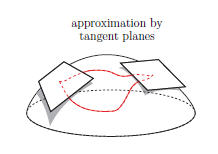
(Adapted from diagram
by Derek Wise)
In my opinion, the drawing above is the most deceitful
and misleading approximation in current GR textbooks
(e.g.,
Robert Wald). It offers to our euclidean
eyes some sort of "curvature", which "fits
nicely in 3-dimensional flat Euclidean space" (Baez
and Bunn), and is
made by matter and fields with some initial "flat"
surface. Sorry, only
Chuck Norris and his distinguished colleagues at the
Perimeter Institute can "understand" such
textbooks. Here's why.
On the one end, "the flat spacetime should be a completely empty
space without any kind of energy" (Hyun Seok Yang,
arXiv:1111.0015v3), so we cannot
promote it to some initial elastic body with initial,
albeit vanishing small, global "dark"
tension. On the other end, we cannot picture such
non-existing "flat" jabberwocky as 'the flat limit of GR', and
switch off gravity 'at a point' to obtain "geodesics"
(Alan
Rendall), because we can only make local observations 'at a
point', but these "points" cannot be defined with the
gravitational energy density (Erik
Curiel,
pp. 1-4; MTW, p.
467) in the first place. Moreover, it has been noted by
Bernhard Riemann that "the flat limit of a curved manifold
is ambiguous in the sense that there are infinitely many
manifolds with zero Riemannian curvature, but with different
shapes" [Ref. 4]. Thus, we cannot
reach GR from Minkowski spacetime, nor derive/recover the latter
from the former as some "flat limit".
We can only look at one single
point at which the intrinsic geometry of spacetime, defined
with the curvature & torsion, is not
present. But what could be the degrees of freedom of
gravitational "field", to understand what "happens" due to
gravity at this 'one point' ?
Well, we know for sure that the
propagation of gravitation cannot be confined exclusively
to 4-D spacetime [Ref. 5] -- it will
definitely leak out, which means that its observable
effects can be detected only in particular pattern
produced with test particles ("fish"), endowed with the faculty
of self-acting (school of fish). The
crux of the matter is about the flow of time -- not about
'time read with a dead clock'.
For the record: this fundamental
issue was raised on 26 November 1999 in
the context of "loop quantum gravity", and again on
19 February 2003
regarding LIGO, but hasn't been discussed so far (12 January
2013). I won't comment on the reason why people
avoided it, but will briefly explain it
with a simple drawing.
Recall that the gravitational
field couples to itself (Sean
Carroll), which produces wave-like pattern in the
holomovement (swathe) of the
bootstrapped, already-correlated and quasi-local test
particles, which share
their pure dark
energy; a bit like a delocalized holistic "cloud" (here
we need Quantum Theory) spread "over"
[Ref. 5] the "school of
fish" en bloc.
Let's say we have test particles
(recall the Coca Cola bottles above), which
can be influenced by their common delocalized holistic
'potential reality' during the flow of time from the
Arrow of Space. They will swing back and
forth in a cycle produced from gravitational waves (GWs).
I will lower the dimensions to 1+1-D world, and show two
cyclical patterns in 1-D space, evolving in 1-D flow of time,
shown here with two instants, t1
and t2 (the "dark" red
/
"gaps" from the last drawing will have to be omitted).
xx_x__x___x____x____x___x__x_xx
x____x___x__x_xx_x__x___x____x
Perhaps people would be prone to suggest some "extra" space-like
dimension [Ref. 5] to accommodate the
(dimensionless, Kip Thorne) amplitude
of the gravitational "wave", but there's no need for such
multidimensional superstitions (one can also mention here the
complications from quantum physics added to the question of
geodesics,
MTW, p. 480).
But (i) where does
gravitation propagate, and (ii) how does it
interact non-linearly (cf. the 'drawing hands' by
Maurits Escher) with the mundane stuff
placed in the right-hand side of the Einstein's
field equations, in order to produce three orthogonal
spatial directions along which we can see "as far as we like" (Lee
Smolin)?
Many great people have offered
various guessing to question (i), ever since
Gunnar Nordström tried in 1914, but have bumped into
question (ii). Suppose, for example, that
"gravitation may propagate along extra dimensions in excess of
four, but it also propagate in a space-time subspace of some
higher-dimensional space" (Marcos Maia):
how would you construct nonlinear propagation
of gravitational energy in
"dimensions in excess of four" and propagation of its
source in 4-D "subspace", in such way that we
could see 'as far as we
like'?
Forget it. We need quantum
gravity. The first step (not final solution) is to avoid blatant
errors: no multidimensional superstitions. Look at the drawing
below (source here):
x/x/x/x/x/x/x/x/x/x/x
Every x state
denotes a physical 3-D space with an already-linearized
gravitational bootstrapping of self-interacting matter
(local mode of spacetime). But where's da time? Well, these
uncountably infinite x-universes
are re-created in the 'dark
Zen gaps' denoted with /
. Hence a 'time dimension' is
accumulated by the Arrow of Space,
one-x-at-a-time.
The result is gravitational
holomovement of matter, which propagates
en bloc (forget about
LIGO and Virgo). But if you ask an
expert about how does this "happen", you'll most likely hear
some jabberwocky, because "after
all, general relativity does seem to work well as a theory, and
yet I can certainly read the time on my wrist watch!" (Chris
Isham).
Yes, we all can read the time
on our "wrist watch!",
which is why we need to explain the Arrow of
Space within some new, still uncovered, nontrivial
mathematical framework.
D. Chakalov
December 14, 2012
Last update: May 14, 2013, 12:04 GMT
[Ref. 1] Tony Crilly with Dale Johnson, The Emergence of
Topological Dimension Theory, in: History of Topology,
ed. by Ioan M. James, North Holland, 1999,
pp. 1-24.


[Ref. 2] Carl H. Brans, Exotic smoothness and spacetime models,
Albert Einstein Institute, Golm, 2007,
ex-talk-aei-2007.pdf
[Ref. 3] Richard W. Sharpe,
Differential Geometry: Cartan's Generalization of Klein's
Erlangen Program, Springer, 1997
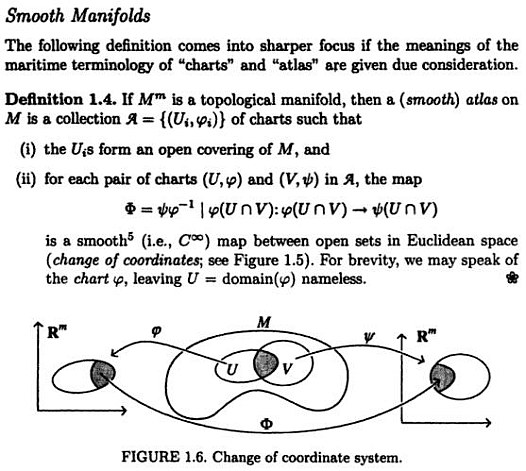
[Ref. 4] Marcos Maia, private
communication, January 11, 2013, 00:38:57 -0800 (PST).
[Ref. 5] Naresh Dadhich, On the derivation of the gravitational
dynamics,
arXiv:0802.3034v1 [gr-qc].

===============================================
Subject: No sign of axion at present
Date: Fri, 18 Jan 2013 05:19:46 +0200
From: Dimi Chakalov <[email protected]>
To: Muhammad Asghar Hashmi <[email protected]>,
[email protected], [email protected]
M. Asghar Jan 17, 2013 6:08 PM
http://physicsworld.com/cws/article/news/2013/jan/17/physicists-seek-cosmic-domain-walls
No sign of axion at present
The project of the cosmic walls hinges on the existence of the
particle called axion.
The existence of this particle was proposed in the late 1970s,
to neutalise the experimentally unfounded (via the very low
lower limit on the neutron electric dipole moment of <
2.9.10-26 e.cm) tendency of the strong interaction in
the SM for the
existence of CP violation. All the experimental work over the
years has not shown
any sign of existence of this particle.
---------
Dear Professor Asghar,
Thank you for your recent note. I believe the reason why people
introduced "axion" is explained at
http://www.god-does-not-play-dice.net/#Klauder
http://www.god-does-not-play-dice.net/Klauder.pdf
All the best,
Dimi Chakalov
==========================================
Subject: Gravitational waves and pulse-time red herrings, in
quadrupole approximation
Date: Fri, 14 Dec 2012 07:38:11 +0200
From: Dimi Chakalov <[email protected]>
To: Adam D Helfer <[email protected]>
Cc: [snip]
Dear Adam,
By reading your arXiv:1212.2926v1 [gr-qc], Sec. 1.2, 'A
more general setting', it seems you like red herrings,
http://www.god-does-not-play-dice.net/#red_herring
But if you are good in math, try the task at
http://www.god-does-not-play-dice.net/#Neiman
All the best,
Dimi
------
Note: The present GW detectors are
designed on the basis of the linearized
approximation, contrary to the mathematical facts known from
Hermann Weyl and
Hermann
Bondi. Despite the PR efforts by
Bernie Schutz, LIGO
and the like are
manifestly blind and deaf to (i) the nonlinear phenomenon
acknowledged in GR textbooks and (ii)
the very
displacement of
spacetime caused by
gravitational waves. With respect to
what? We can detect, at least in principle, such
"displacement" of spacetime only with respect to the
underlying reference fluid of GR,
and only by the physical, or rather physicalized effects
of the spacetime metric, detected on matter. Thus, the proper GW
detectors must be endowed with the faculty of self-acting
from the Arrow of Space (cf. above), with
the perpetual "displacement" of 3-D space along the
w-axis
that builds 'time direction' as perfectly continuous
(local mode of spacetime) instants 'now', one-at-a-time (cf.
option YAIN (iii) above). And
because the gravitational waves are
emerging with the flow of time, they are truly
fundamental phenomena which must not be diffeomorphism-invariant observables, and some people say
that both GWs and the flow of time cannot
"exist". Likewise, we cannot physically detect the human mind
either, but only the nonlinear self-interactions of the
brain. Simple, no?
Just don't forget that, unlike
electromagnetism, any kind of energy is
a source of gravity, and "every dynamical degree of
freedom introduced to the system" (Alex
Schenkel) will interact with the geometry through
fundamentally nonlinear gravitational interactions at
each and every instant 'now' from the Arrow of
Space. Unlike electromagnetism, these
nonlinear and self-acting interactions cannot be screened
off and are always present (forget about
LIGO). In the right-hand side of
the Einstein filed equations, these nonlinear,
quasi-instantaneous and self-coupling interactions are
omnipresent, the gauge symmetry principle used in present GR
textbooks requires that all parameter coordinates are "unphysical",
and "strictly speaking, general relativity is not a parametrized
field theory" (Charles
Torre).
D. Chakalov
December 14, 2012
Last updated: December 17, 2012, 08:01:15 GMT
================================================
Subject: Re: Gravitational waves
and pulse-time red herrings, in quadrupole approximation
Date: Sun, 16 Dec 2012 12:48:50 +0200
From: Dimi Chakalov <[email protected]>
To: "Helfer, Adam D." <[email protected]>
Cc: [snip]
On Sat, 15 Dec 2012 22:47:48 +0000, Helfer, Adam D. <[email protected]>
wrote:
>
> Dear Dimi,
>
> I'm afraid I don't quite follow the thread on the links you
gave me.
The thread is from articles by theoretical physicists, published
in peer reviewed journals. I've been sending these references to
you for many years. Ignore them at your peril.
> As nearly as I can tell, it sounds as if you don't think
gravitational waves are real,
> or are observable, but (if that is the case) I am not
understanding your objection.
It sounds as if you haven't even glanced at these articles,
starting from the one by Hermann Weyl.
Of course gravitational waves are real, but cannot be detected
*in principle* with LIGO, Virgo, etc., for reasons explained by
Hermann Bondi. Ignore them at your peril.
If some day you or any of your colleagues wish to respond
professionally, read the articles in question, and use math (not
some verbal statements like yours above) to explain your belief
in LIGO, Virgo, or any other GW "detector" based on the
*linearized approximation* of GR.
I will immediately prove you wrong. Promise.
And once I prove you wrong, I will add some very simple facts
(not opinions) from my web site, which I'm sure you know since
March 2009.
Just recall that in October 2009 (Tue, 27 Oct 2009 12:10:26
+0200), I asked you and 74 physicists to endorse the submission
of my manuscript "Taxpayer's perspective on GW astronomy" to
ArXiv.org server: two people refused (Jonathan Thornburg and
Stanley Deser), while the rest -- you included -- didn't even
bother to respond to my email.
Please get professional. The sooner, the better.
Sincerely,
Dimi Chakalov
P.S. You can read my initial email from December 14th at
http://www.god-does-not-play-dice.net/#Neiman_Helfer
Soon on DVD.
D.C.
On Fri, 14 Dec 2012 07:38:11 +0200, Dimi Chakalov <[email protected]>
wrote:
[snip]
=================================================
Subject: Re: Gravitational waves and pulse-time red herrings, in
quadrupole approximation
Date: Mon, 17 Dec 2012 21:09:59 +0200
From: Dimi Chakalov <[email protected]>
To: "Helfer, Adam D." <[email protected]>
Cc: [snip]
On Mon, 17 Dec 2012 14:55:19 +0000,
Message-ID:
<D1150F0ACBC46649A9D8D3036374A7E103FB0F5B@UM-MBX-T01.um.umsystem.edu>
,
Helfer, Adam D. <[email protected]> wrote:
>
> Dear Dimi,
>
> There is more than one thing one might mean by "linearized
gravity."
There is only one thing we must care about "linearized gravity",
in the case of LIGO, Virgo and the rest of GW "detectors" based
on such "linearized" approximation: the inherent
non-conservation
of energy in the full nonlinear GR.
This unsolved task is known since the first days of GR, after
David Hilbert. Let me quote from Sir Hermann Bondi:
"The vanishing of its [the energy-momentum tensor - D.C.]
covariant divergence is often called a conservation law, but in
fact it is a law of non-conservation, because the extra terms
(not includable in a Green's type function) precisely describe
the transfer between the *intangible* energy of the
gravitational field (as it will be called here), which is not
described by the energy-momentum tensor, and the tangible forms
which are so described. (...) In relativity a non-localizable
form of energy is inadmissible, because any form of energy
contributes to gravitation and so its location can in principle
be found." (Sir Hermann Bondi, Conservation and non-conservation
in general relativity, Proc. R. Soc. Lond. A 427 (1990) 249-258)
In standard GR textbooks, the unsolved problem of "localization"
of gravitational energy density 'at a point' (MTW,
p. 467) refers to
the case explained by Sir Hermann Bondi above.
Now, it is manifestly wrong to *cheat and deliberately waste*
hundreds of million USD and Euro for "enhancing the sensitivity"
of what has been a dead turkey from the outset -- the current GW
"detectors" based on some "linearized" approximation of the
initial unsolved problems explained above. No "linearized"
approximation can solve these problems, and "it would be
hopeless to look for exact solutions for the gravitational waves
emitted by realistic gravitational sources" (Michele Maggiore,
Gravitational Waves: Theory and Experiments, Oxford University
Press, 2007, p. 32).
Briefly, it is wrong to cheat.
Do you and your colleagues agree?
If you agree, get real. Do your job. Professionally.
Details from December 17, 2012, 08:01:15 GMT, at
http://www.god-does-not-play-dice.net/#Neiman_Helfer
Sincerely,
Dimi Chakalov
-------------
"The representation of matter by a tensor was only a fill-in to
make it possible to do something temporarily, a wooden nose in a snowman."
Albert Einstein's Last Lecture, Relativity Seminar, Room 307,
Palmer Physical Laboratory, Princeton University, April 14, 1954
"In general relativity
the identity of a world point is not preserved under the theory's
widest invariance group. This assertion forms the basis for the
conjecture that some physical theory of the future may teach us how
to dispense with world points as the ultimate constituents of
space-time altogether."
P. G. Bergmann and A. Komar, The Coordinate Group Symmetries of
General Relativity, Int. J. Theor. Phys. 5 (1972) 15-28
Note: In my previous email printed
above, I asked Adam Helfer to "read the articles in
question, and use math (not some verbal statements like yours
above) to explain your belief in LIGO, Virgo, or any other GW "detector" based on the
*linearized approximation* of GR."
As in the case of
Bernie Schutz and collaborators, Adam
Helfer has to choose from two alternatives: either claim that he
is a square dilettante and knows nothing about GR, or cheat
like Bernie Schutz and collaborators.
For those who are not familiar
with the subject, recall that the first "motivation" to use
"linearized approximation" is based solely on a wild
uneducated guess -- see again the analogy with a
weather thermometer. Of course, this
wild uneducated guess runs against GR, as stressed by
Michele Maggiore (p. 32) above.
As to the second "motivation" from
PSR1913+16, see what we know about the
inferred "loss of
kinetic energy"
here.
It's all wishful thinking and
cheating. If you don't understand GR, you may indulge in some
dreams of "GW astronomy" and try to suggest some new
mathematical presentation of these "waves", which could
miraculously solve the initial problems. For example, you know
that certain tasks cannot be solved unless we change the type of
coordinates, so by the same token you jump on some "linearized
approximation": change the math, problem
solved.
But if you know GR, you must
cheat to get the money, because
you
know bloody well that the transfer of 'tangible' (Hermann Bondi)
forms of energy by gravitational waves
cannot be described in principle in
textbook
GR: "... the extra terms (not includable in a Green's type
function) precisely describe the
transfer between the *intangible* energy of the
gravitational field (as it will be called here), which is not
described by the energy-momentum tensor, and the tangible forms
which are so described."
In fact, this
transfer is a
"bi-directional" -- as we can described it only with the
linearized notion of time read with a physical clock --
negotiation between geometry and matter placed in the two sides of
Einstein field equations, which (i) has been already
settled, due to the "speed" of light,
at each and every instant we look at our clock, and (ii)
covers the whole universe quasi-instantaneously,
like in a school of fish.
The end result is that the whole
universe is being bootstrapped by its
"thoughts", called gravitational waves:
one-at-a-time during the emergence of 'time
direction' and its 3-D space. It is one object,
called 'spacetime', and if we can ignore gravitation, we
can safely approximate it with some fictitious fixed
"background" spacetime comprising of "points" with fixed
physical content and non-dynamical spacetime metric -- it will
be a
bona fide classical theory in which things exist 'out
there'. But the non-linear General
Relativity cannot be developed on such limiting case
of 'objective realty out there
at a
point', because of the emergence of 'time
direction & 3-D space' and subsequently the
non-linear dynamics of
the metric "field" (forget about
LIGO). We need quantum
gravity.
In simple words, there are things in Nature, which
do exist but cannot be converted
into gauge-invariant observable, and therefore the current GR
textbooks cannot offer any recipe whatsoever for their
detection. None. There is no such animal as 'gravitational
stress-energy tensor' defined at individual spacetime
points, which can evoke 'geodesic deviation' and determine the
value of the Riemann tensor at that same spacetime point (Erik Curiel,
pp. 1-4). Surely it exists, but is a
generic quantum phenomenon, not "tensor".
All this leads to a Machian quantum theory of gravitation based
on an infinity of gauge-related quasi-local realizations
(called here 'jackets'), in which the gauge
group1 is defined
with the Arrow of Space.
So, if you know
GR but wish to cheat, you may claim that some
"approximation" might solve the LIGO problem on paper,
then get the money, have fun,
avoid criticism, publish papers, and
after you ultimately fail, put the blame on Einstein: "Any
such failure of GR should point the way to new physics." (B.
F. Schutz et al.,
arXiv:0903.0100v1 [gr-qc])
On 19 February 2013, I will update
these notes, to commemorate ten years since I wrote to Nature
(Wed, 19 Feb 2003 23:40:26 +0200) about this widely known
problem with LIGO "collaboration", but nobody responded
professionally. Nobody will, for sure. These people are
not at all stupid, they just live in a
total socialism.
Shame on LIGO and Virgo
"collaborations". They are total disgrace to the GR
community.
D. Chakalov
December 17, 2012
Last updated: December 21, 2012, 12:37 GMT
1
Marc Henneaux and Claudio Teitelboim, Quantization of Gauge
Systems, Princeton, 1992, p. xxiii.

==============================================
One cannot pinpoint the
"expansion" of spacetime in the "smooth neighborhood" (the
latter is sheer poetry, of course) of the
quasi-local "point" P from the
drawing below; check out Ned Wright's
balloon metaphor. This is Quantum
Geometry in action. My proposal is to start from a
Borel set and endow all
points with the dual structure
of option YAIN (iii) above. More
in December 2012 at ESI Vienna;
details available upon request.
D. Chakalov
August 29, 2012, 12:32:06 GMT
----------------

Subject: Re: arXiv:1208.5399v1 [gr-qc],
Sec.
5.3
Date: Wed, 29 Aug 2012 00:23:57 +0300
Message-ID:
<CAM7Ekx=T+r2zSbWfFopT89fGb4D14deAmBdw5AwoyniXNm4DpA@mail.gmail.com>
From: Dimi Chakalov <[email protected]>
To: Chris Fewster <[email protected]>
Cc: [email protected], [email protected]
P.S. Please see a drawing attached, from Greg's 'Spacetime
Geometry' (October 30, 2008,
p. 3): in what "direction" the "expansion" of spacetime
happen, in the smooth neighborhood of the "point" P, so that you
can talk about "scale factor" and
hence the parameter t in Greg's drawing ?
Best - D.
On Tue, Aug 28, 2012 at 11:22 PM, Dimi Chakalov <[email protected]>
wrote:
>
> Dear Chris,
>
>> As to dark energy, it depends a bit on the model concerned.
For the dark
>> energy associated with a cosmological constant, the dominant,
weak, and null
>> energy conditions hold, but the strong energy condition
fails.
>
> But if SEC fails -- and it must fail -- how can you "save" the
rest of
> those energy conditions?
>
> Just check out the requirements needed to somehow "isolate"
SEC from
> the other energy conditions, and if you find any reasonable
solution,
> please do write me back. Or better post your brand new paper
on
> [gr-qc]. I trust Larry and Greg can offer detailed insights.
Then all
> those "singularity theorems" must be reconsidered,
>
>
http://god-does-not-play-dice.net/#John_Alice
>
> Good luck.
>
> All the best,
>
> Dimi
>
>
>> On 28 August 2012 05:11, Dimi Chakalov <[email protected]>
wrote:
>>>
>>> Dear Chris,
>>>
>>> It is, and has always been, a pleasure to read your papers.
>>>
>>> Regarding the mess with the "singularity theorems", I wonder
which
>>> energy conditions will be violated by the "dark energy". Or
rather,
>>> which energy condition might survive?
>>>
>>> The opinion of your colleagues will be greatly appreciated,
too.
>>>
>>> My thoughts are posted at
>>>
http://www.god-does-not-play-dice.net/#asymptotics
>>>
>>> All the best,
>>>
>>> Dimi
------------
Note: I stated
above that the notion of "smooth
neighborhood" is sheer poetry -- not only
because it brings terrible mathematical difficulties (I.
Raptis), but also because the very notion of 'smooth' (P.
Tod) is not well-defined mathematically. Consider,
for example, some variable like the ratio of black/white hair
on my skull -- one can define the notion of 'practically white
hair' by setting the above ratio to, say, 0.1%. Some people
may argue that the notion of 'effective white hair' begins to emerge "around", say, 1%.
But the rigorous notion of 'white hair' corresponds to zero
black hair. Then we don't talk about the ratio above, but
instead claim
that the black hair is an 'empty set' --
zero. This is the mundane notion of 'zero something',
because we have compared two observables and have instructed one
of them to disappear into "zero".
In our case, however, we aren't talking
about 'hair' with two different and comparable colors, but about
two ontologically different objects placed at the two
sides of the Einstein field equation (EFE): in the l.h.s. we
place pure geometry, like 'the grin of the Cheshire cat
without the cat', as observed by Alice.
Then we make two metaphysical claims. Firstly, we say that
there is no 'grin'
(geometry) without the 'cat', in the sense that if we could
somehow remove the cat in the r.h.s., there would be no 'grin'
left in the l.h.s. ("space is not a thing"),
and secondly -- once we have the two objects in EFE, there will
be a holistic input from 'the universe as ONE', which is
smuggled
via the l.h.s. into the r.h.s. of EFE, and is physically
observed only there.
This holistic effect, called 'the
sufficient conditions for spacetime', is
not accounted for in the
unfinished Allgemeine
Relativitätstheorie, which is "merely a makeshift in order
to give the general principle of relativity a preliminary
closed-form expression. For it was essentially no more than a
theory of the gravitational field, which was isolated somewhat
artificially from a total field of as yet unknown
structure" (A. Einstein). We just assume that one can
parallel-transport (Bob
Wald) "tangent vectors" to define "curvature" (see Greg
Galloway's drawing
above), because the underlying manifold
is 'perfectly smooth', but in order to define
rigorously, without any poetry, the mathematical meaning
of 'smooth', we need the non-Archimedean
world of 'the grin of the
cat without the cat', presented here with the so-called
global mode of spacetime. To understand
the latter, recall that we model the universe as a
brain endowed with 'potential reality' from
the Arrow of Space: all
quantum-gravitational correlations "in the
air" take place in this 'potential reality' -- look at D. N.
Mermin's talk [Ref. 1] and replace
'consciousness' with 'potential reality'. Just don't mix
'potential reality' with its possible, but scientifically
unverifiable, global mental presentation (qualia)
known as [John 1:1]. The famous dictum Mens agitat molem (Vergil,
The Aeneid, Ch. 6, 727), or Der Geist bewegt die
Materie by the Unmoved Mover (Karel
Kuchar), applies strictly to 'potential reality'
known since Aristotle.
Going back to the initial
question: "in what "direction" the "expansion" of spacetime
happen, in the smooth neighborhood of the "point" P, so that you
can talk about "scale factor" and
hence the parameter t in Greg's drawing ?"
If you, my dear
reader, cannot answer this question, check out the dual structure
of geometrical "points", option YAIN (iii) above.
D. Chakalov
August 31, 2012
Last updated: September 1, 2012, 18:55:31
GMT
[Ref. 1] N. David Mermin (June 8, 2005), What I'd Like to Know
about 2105
http://people.ccmr.cornell.edu/~mermin/homepage/talk1.pdf
pp. 11-12: "The notion of now
-- the present moment -- is immediately evident to an individual
consciousness as a special moment of time, or a brief interval,
of order perhaps a few tenths of a second. It seems highly
plausible to me that your now overlaps with my now or, if you
are very far away from me, with a region space-like separated
from my now. On the other hand, I can conceive of it not working
this way: that your now is two weeks behind or fifteen minutes
ahead of my now.
"Physics has nothing to do with such notions. It knows nothing
of now and deals only with correlations between one time and
another. The point on my world-line corresponding to now,
obvious as it is to me, cannot be identified in any terms known
to today's physics. Consciousness has a particularity that seems
absent from the physical description of the world, which deals
only with relations. Consciousness can go beyond time
differences and position itself absolutely along the world-line
of the being that possesses it.
........
"... the only statements quantum mechanics makes about the world
are relational. If I view myself as a system describable by
quantum mechanics, then my state becomes
entangled (and his brain would
not function - D.C.) with anything in the physical world I
interact with. My conscious perceptions, on the other hand, have
a particularity that goes beyond the correlation between those
perceptions and what they are perceiving."
Addendum
May I offer my not-so-humble, and
strongly biased (Luke
17:21), answer to the question above,
"in what "direction" the "expansion" of spacetime
happen..."
The question doesn't have an
answer in present-day GR: the 'reference
fluid' is excluded from the outset, and because an answer to
the question above will inevitably reveal
the preferred flow of time definable only with
respect to the 'reference fluid',
the question doesn't have an answer -- see option (i)
above, "it does not exist."
To be specific: the "direction"
along which the "expansion" of spacetime
"happen" is compactified on the dimensionless point P
from the drawing above, and because you
treat this point P as a bartender,
you cannot separate its two components: check out option
YAIN (iii) above. Again, the
very point P is quasi-local
-- it is both extremely "non-local" in the global mode of
spacetime, being spanned to the size of 'the
whole universe', and extremely "local", being
compactified to a dimensionless geometrical "point" ('the
grin of the Cheshire cat without the cat') in the local mode of
spacetime. This proposal requires a new, to the best of my
knowledge, geometry and topology of the spacetime in GR,
which models 'the whole universe as ONE', and can also be
compatible with Quantum Theory.
Otherwise you simply cannot define
the point P above, because your
current GR textbooks (e.g., MTW,
p. 467)
explicitly forbid localization of gravitational energy density
at P . This "localization" is a
quantum phenomenon.
Metaphorically speaking, the
"localization" acts as a robust "linearized" surface
that is being inserted "sequentially", at every instant 'now' from the Arrow of Space, under the
'freely falling elevator', due to which
we find out, retrospectively, that the universe
has obviously been explicated at this local
mode of spacetime with one "charge" only,
called 'matter endowed with inertia'.
Why is this
difficult to understand, I wonder.
The crux
of GR is the bold presence (see Tom Thiemann
above) of the gauge-dependant absolute structures
(James L. Anderson,
Principles of Relativity Physics, Academic Press, New
York, 1967, p. 73). They do not obey the ‘generalized principle
of action and reaction’ (ibid., p. 339), and can be
revealed in Quantum Theory only as ‘potential
reality’. The resulting
"input" from these absolute structures is manifested as
self-acting faculty of matter fields bootstrapped by their
gravitational waves: matter can 'act on
itself'. We have the same
phenomenon of
purely geometrical nature right above our neck: we think
about our brain, by our brain, hence our brain
is 'self-acting'. Physically, we cannot observe our "mind" in
the brain -- just a self-acting brain. Replace "mind"
with 'the sufficient conditions for
spacetime', and you're done.
In my
not-so-humble and
strongly biased
opinion, the only way to embed these absolute structures and the
rest of 'the
sufficient conditions for spacetime'
in Einstein's
unfinished
Allgemeine Relativitätstheorie
(cf. Richard Feynman
below)
is by revealing the "total
field of as yet unknown structure"
manifested by the Arrow of Space along a
null-surface. Perhaps we will end up with
the Machian quantum gravity
suggested here. I don't know. More in December 2012
at ESI Vienna.
D. Chakalov
September 2, 2012
Last updated: September 5, 2012, 17:19:38
GMT
---------------
The next question was - what
makes planets go around the sun? At the time of Kepler some
people answered this problem by saying that there were angels
behind them beating their wings and pushing the planets around
an orbit. As you will see, the answer is not very far from the
truth. The only difference is that the angels sit in a different
direction and their wings push inward.
Richard Feynman, Character Of
Physical Law, 1967,
p. 8
=================================================
Subject: Re: arXiv:1208.5399v1 [gr-qc],
Sec. 5.3
Date: Wed, 12 Dec 2012 07:21:55 +0200
From: Dimi Chakalov <[email protected]>
To: Chris Fewster <[email protected]>
Cc: [email protected],
[email protected],
[email protected],
[email protected],
[email protected],
[email protected],
[email protected],
[email protected],
[email protected],
[email protected]
Dear Chris,
I haven't received your reply to the question from my email
(Tue, Aug 28, 2012 at 11:22 PM, cf. below).
Since SEC must fail due to "dark energy" (Carlos Barcelo and
Matt Visser, arXiv:gr-qc/0205066v1), can
you save NEC and all those "celebrated"
singularity theorems?
Or perhaps you or some of your colleagues can somehow separate
SEC from the rest of energy conditions?
Please use math. It helps.
My opinion can be read at
http://www.god-does-not-play-dice.net/#red_herring
All the best,
Dimi
On Tue, Aug 28, 2012 at 11:22 PM, Dimi Chakalov <[email protected]>
wrote:
>
> Dear Chris,
>
>> As to dark energy, it depends a bit on the model concerned.
For the dark
>> energy associated with a cosmological constant, the dominant,
weak, and null
>> energy conditions hold, but the strong energy condition
fails.
>
> But if SEC fails -- and it must fail -- how can you "save" the
rest of
> those energy conditions?
[snip]
=========================================

Subject: The clock field from the "dark energy" of [you-name-it]
Date: Mon, 17 Sep 2012 17:40:24 +0300
Message-ID:
<CAM7Ekx=K0GkJNfJ0r5R3d44qmFf2gZByUZtDJw0=mbUVaAjj9g@mail.gmail.com>
From: Dimi Chakalov <[email protected]>
To: Romualdo Tresguerres <[email protected]>
Cc: Friedrich W Hehl <[email protected]>,
[email protected],
[email protected],
[email protected],
[email protected],
[email protected],
[email protected],
[email protected],
[email protected]
Dear Dr. Tresguerres,
First, please accept my delayed condolences for the physical
loss of your father. I know it hurts, especially if you take
life too seriously.
I have an immodest request. I am trying to understand (i) the
bundle background (Motion in gauge theories of gravity,
arXiv:1202.2569v2 [gr-qc], Figs 1, 5, and 6,
p. 18),
and (ii) the clock field from the "dark energy" of
[you-name-it], introduced to massive free point particles, such
that the resulting "time" be one-dimensional, metrical, and
"temporally global, i.e. such that every event goes through any
value of the time variable once and only once" (Time Evolution
in Dynamical Spacetimes, arXiv:gr-qc/9607066v1,
p.
2).
At the end of the day, I suppose you should obtain unique
solution to the puzzle of "time from scale factor" (with respect
to what?) at
http://www.god-does-not-play-dice.net/#Fewster
It goes without saying that I cannot agree with your "clock
field to be identical with a dynamical time-like field provided
by the nonlinear approach to PGT" (Time evolution in the
presence of gravity, arXiv:gr-qc/0009029v1,
p.
3), for reasons explained at the link above.
I noticed that Fred Hehl doesn't talk on
this fundamental problem (forget about C. Rovelli), and hope
that you or some of your colleagues can help.
All the best,
Dimi Chakalov
-------------
Note: We must not be able to physically detect
the 'flow of time' (G F R Ellis),
produced by the phenomenon of transience [Ref.
1], as 'observable in GR' -- it must
be physically unobservable yet drastically evident,
despite its gauge origin (Tom Thiemann).
Much like the Heisenberg-Born omelette, we
must fulfill two opposite requirements -- see option YAIN (iii)
above. In the framework of the
physically unobservable input from the newly introduced 'sufficient
conditions for spacetime', we face the worst calculation in
theoretical physics known since
1930s, the so-called old cosmological "constant" problem
(Niayesh
Afshordi) based on our ignorance of the gravitational
contribution of the vacuum.
Thus, we cannot -- and must not
-- physically pinpoint the "direction" of the
"expansion" of spacetime [Ref. 2], in the smooth neighborhood of the
"point" P above, so
that we could talk about "scale factor"
and hence the parameter t in Greg Galloway's
drawing above, although the very same
parameter t is read by
every physical watch. I was hoping to elucidate this
fundamental problem of present-day GR in November 2002, after
Chris Isham's statement
that such linearized time can be
read by his "wrist watch!", because I totally
reject "miracles" disguised with advanced math.
Let me be specific, regarding
the clock field from the
"dark energy" of [you-name-it].
When you were still young and
susceptible, you were taught what we nowadays accept as true
metaphysics: only matter can interact with matter. Fine,
but then you detect the physical presence of "dark
energy" and get a Nobel Prize, and
automatically assume that this "anomalous dark energy" must have
originated from physical stuff with positive energy
density, because 'only matter can interact with matter'.
Then you seek the very source of that "anomalous dark
energy", because only parapsychologists would talk about
'energy' without explaining 'energy of what?' And finally
you have to face up to 96% of "dark stuff".
Then of course you're ready to
retire, or rather publish your papers with
EoS of dark energy (e.g., by "extra pumping",
Saul Perlmutter)
until you fully and irreversibly retire. When and how did you go
wrong?
You missed 'the
sufficient
conditions for spacetime' (the poetic explanation is offered
by Lee Smolin on p. 206 above). You
misused 'physical
stuff with positive energy density' just as people
speculated about some
Homunculus or "psychon
field" or "Higgs field". Namely,
the
sufficient
conditions for spacetime originate from 'the whole universe
as ONE', in line with our model of 'the universe as a brain'.
These sufficient conditions are indeed
hidden (or "dark", to follow your twisted terminology), to
produce "zero" ( the empty set
R ) -- not some finite
Killing "vector" -- on the point P in Greg
Galloway's drawing above. If it weren't
zero in the local (physical) mode of spacetime, the
Transience [Ref. 1] will show up as
physical phenomenon, along with 'the flow
of time', and the physical "aether"
will ruin the whole Theory of Relativity. Which, of course,
will not and must not happen.
Notice that I specifically do
not say what is meant by "zero" ( the empty set
R ) above. This "zero"
[Ref. 2] is
not pertinent to the mundane case of 'zero something', as
explained previously. It cannot be any
finite "vector" that we set to zero, and it cannot point to any particular direction
in 3-D space either, because in the latter case we would have an
exclusive preferred physical orientation of the
Transience [Ref. 1] with respect to the
CMB aether.
This "zero" is just a remnant
from the 'change of space'
from the Arrow of Space, which is being nullified into a
geometrical "point" (Bianchi identity "enforces"
zero divergence for the Einstein tensor,
Niayesh Afshordi), and then fused within this same
physical "point" to produce the necessary & sufficient rules
for spacetime. Then the necessary rules in the right
hand side of EFE become 'alive' due to this point-like input
-- one-at-a-time along the Arrow of Space -- due the holistic
global sufficient rules. We can
only observe the physical stuff in the r.h.s. of EFE, and then
realize that this stuff has already
became influenced by the geometry
('the grin of the Cheshire cat without the cat') and has become
'self-acting', that is, alive -- just like in the case of
the smaller human brain. If we were looking for
some
Homunculus, we would have come up with similar "dark stuff"
like
Saul Perlmutter and his colleagues.
But we don't make such stupid mistakes. No. We cannot
physically catch the sufficient
conditions for spacetime. Yet they are spread
everywhere, and make the "point"
P above quasi-local.
To understand the specific input
of the sufficient conditions for
spacetime, look at the geodesic hypothesis (Alan
Rendall) "when the Christoffel symbols vanish", from Sean
Carroll, Eq. 4.9 on
p. 104 [Ref. 3]: yes, the Christoffel symbols must vanish
one-at-a-time, at each and every instant 'now' from the Arrow of
Space, to produce different
Photoshop layers, but if you ignore 'the
dark Zen gaps' from the global mode of spacetime and only fuse
those canonical data to produce your 3+1-D spacetime from GR
textbooks, you will end up with a dead "geodesic" recipe made of
zero Christoffel symbols: "if the Riemann tensor vanishes
in the neighborhood of a point, then there will exist a chart at
that point in which the Christoffel symbols vanish" (Adam
Helfer,
private communication). And you will be haunted by "dark
stuff" forever.
To those who still claim that
"cannot understand" (e.g.,
Saul Perlmutter boldly declared, with wide opened eyes, that
he has tried all theories, but failed to mention my email in the
past seven years), see what you get with your "negative
pressure": "If the vacuum is trying to pull the piston back
into the cylinder, it must have a negative pressure, since a
positive pressure would tend to push the piston out," says
Ned Wright.
But for any kind of smooth
omnipresent "pressure", you need
boundaries of spacetime.
Also, you cannot explain the
"expansion" of spacetime
with respect to itself.
Thus, you are talking parapsychology, albeit it can bring you a
juicy Nobel Prize.
No, you cannot physically
detect the "direction" of the "expansion" of spacetime,
and hence the parameter t in Greg Galloway's
drawing above, because currently you have
missed 'the
sufficient
conditions for spacetime' and can only muse, like a
Flatlander, on the two opposite spacelike "directions" along the
radius of
Ned Wright's balloon. With the global mode
of spacetime, however, you have an entirely different, en
bloc perspective of those "two opposite
spacelike directions".
Physically, you cannot, and must
not be able to detect "time" [Ref. 1]
from the "scale factor", and hence the
parameter t in the drawing
above, because no physical stuff can "move" along the
null-surface of the Arrow of Space. Just
get serious about Einstein's
Kosmologische Betrachtungen
zur allgemeinen Relativitätstheorie (1917): we postulate
that "the metrical character (curvature) of the four-dimensional
spacetime continuum is determined at every point by the
matter there, together with its state", but this ongoing,
one-at-a-time along the Arrow of Space
determination captures the true dynamics of
Einstein's unfinished Allgemeine Relativitätstheorie,
with its necessary & sufficient rules.
Which is why I don't believe in
the "clock field" suggested by Romualdo Tresguerres
above. There is no "timelike
unit vector" either. It's an illusion -- see option
YAIN (iii). The dynamics of the
expansion of spacetime -- with respect to
what? -- cannot be "simplified when considering mass
distribution with special symmetry properties provided by the
metric" (Danylo Yerokhin et al., arXiv:1108.0203v4 [astro-ph.CO],
Sec.
III). Nothing can change with respect to itself. Only
Baron Munchhausen can perform such
miracle.
In summary, recall that 'time'
always refers to 'change in space' (local mode of
spacetime), which requires three "points": a finite
interval in 3-D space (A, B) and a
sliding cutoff
interpreted as "singularity". The
latter, however, does not belong to the local mode of spacetime. The
finite interval (A, B) represents
both the necessary and sufficient rules for spacetime. The
reason why physical things exhibit 'change' (hence
'time') is both because of their 'necessary' physical nature
(e.g., thermodynamics) and because of
their 'sufficient' holistic nature determined by 'the whole
universe as ONE'. The latter refers to 'change
of space' along the
Arrow of Time, compactified onto the
quasi-local point P
in the drawing above. And because you use
differential geometry as a bartender, you
can only observe a perfectly continual
sequence of such "points" P in the local
(physical) mode of spacetime, in which the
sufficient rules for spacetime and 'the
dark Zen gaps' are being nullified by the so-called 'speed
of light' -- one-at-a-time along the Arrow
of Space.
I hope this explains the primordial
Affine Connection along the
w-axis,
constituted by two space-inverted,
atemporal connections in 'the
dark Zen gaps'.
Dimi Chakalov
September 18, 2012
Last update: October 19, 2012, 08:30 GMT
[Ref. 1] Abner Shimony,
Implications of Transience for Spacetime Structure, in: The
Geometric Universe, ed. by S.A. Huggett, L.J. Mason, K.P.
Tod, S.T. Tsou, and N.M.J. Woodhouse, Oxford University Press,
1998,
pp. 161-172.
"Even more problematic is
the role of transience in physical theory. Classical mechanics, special
relativity, and general relativity differ
profoundly in their assumptions about spacetime structure, but in all
three the structure is characterized without any reference to the
slipping away of the present moment into the
past."
[Ref. 2] Bryce de Witt, The Quantum Theory of Gravity.
I. The Canonical Theory, Phys. Rev. 160, 1113-1148 (25
August 1967), p. 1119.
"Since the statistical results of any set of observations are ultimately
expressible in terms of expectation values, one
therefore comes to the conclusion that nothing ever takes place in
quantum gravitydynamics, that the quantum theory can never yield
anything but a static picture of the world.[18]"
------
[18] Cf.
A. Komar, Phys. Rev. 153, 1385 (1967).
[Ref. 3] Sean M. Carroll, Lecture Notes on General Relativity,
arXiv:gr-qc/9712019v1.

pp. 112-113: "The nonlinearity of general relativity is worth remarking
on. In Newtonian gravity the potential due to two point masses is simply
the sum of the potentials for each mass, but clearly this does not carry
over to general relativity (outside the weak-field limit). There is a
physical reason for this, namely that in GR the gravitational field
couples to itself.
"This can be thought of as a consequence of the equivalence principle —
if gravitation did not couple to itself, a “gravitational atom” (two
particles bound by their mutual gravitational attraction) would have a
different inertial mass (due to the negative binding energy) than
gravitational mass. From a particle physics point of view this can be
expressed in terms of Feynman diagrams. The electromagnetic interaction
between two electrons can be thought of as due to exchange of a virtual
photon:
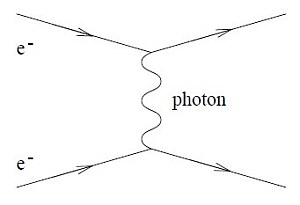
"But there is no diagram in which two photons exchange another photon
between themselves; electromagnetism is linear. The gravitational
interaction, meanwhile, can be thought of as due to exchange of a
virtual graviton (a quantized perturbation of the metric).
"The nonlinearity manifests itself as the fact that both electrons and
gravitons (and anything else) can exchange virtual gravitons, and
therefore exert a gravitational force:
"There is nothing profound about this feature of gravity; it is shared
by most gauge theories, such as quantum
chromodynamics, the theory of the strong interactions.
(Electromagnetism is actually the exception; the linearity can be
traced to the fact that the relevant gauge group, U(1), is abelian.) But
it does represent a departure from the
Newtonian theory.
p. 123: "The situation is precisely analogous to that in
electromagnetism, where we know that no amount of initial data can
suffice to determine the evolution uniquely since there will always be
the freedom to perform a gauge transformation [XXX]. In general
relativity, then, coordinate transformations play a role reminiscent of
gauge transformations in electromagnetism, in that they introduce
ambiguity into the time evolution.
p. 127: "A final example is provided by the existence of singularities,
points which are not in the manifold even though they can be
reached by travelling along a geodesic for a finite distance.
"Typically these occur when the curvature becomes infinite at some
point; if this happens, the point can no longer be said to be part of
the spacetime. Such an occurrence can lead to the emergence of a Cauchy
horizon — a point p which is in the future of a singularity
cannot be in the domain of dependence of a hypersurface to the past of
the singularity, because there will be curves from p which simply end at
the singularity."
======================================================

Subject: LSST
Date: Sat, 22 Sep 2012 14:47:51 +0300
From: Dimi Chakalov <[email protected]>
To: David Wittman <[email protected]>, [email protected]
Cc: [email protected], [email protected],
[email protected], [email protected],
[email protected], [email protected], [email protected]
Dear Dr. Wittman,
It was a great pleasure to watch your videos. Thank you.
Please notice my interpretation of that
"dark" stuff and
LSST
at
http://www.god-does-not-play-dice.net/#Romualdo
All the best,
Dimi Chakalov
-------------
Note: Look at the animation
of the galaxy rotation below:
This "anomalous" fact is a fact.
What we call non-baryonic dark stuff
complements the "dark
energy", as two sides of one tug-of-war
"coin". These bootstrapping effects of gravity
begin to emerge at the galaxy length scale and up, toward the
Large, yet
Vera Rubin was not awarded the Nobel Prize. Totally
ridiculous.
Notice that the current textbook
version of GR is valid only for our solar system, which means
that there are two major unsolved tasks ahead: the modified
Machian gravity starting at galaxy length scale, and then the
last layer of the physical world in which the extreme
tug-of-war
effect produces asymptotically flat spacetime at cosmological
scale (Dynamic
Equilibrium Conjecture).
The important issue here is that
the kinematics of 3-D space is 'classical' (Minkowski spacetime)
only at the length scale of tables and chairs. It is the
beginning of the quantum-gravitational realm in two
"directions" along the
w-axis,
toward the Small and toward the Large. In the local (physical)
mode of spacetime, there is no 'flow of time'
along the entire w-axis.
What we can observe at the Archimedean
local mode of spacetime are "two" 3-D blueprints from the Arrow
of Space -- just like a Flatlander would be confined to "see"
two opposite and T-invariant directions in 2-D space,
while we can have a brand new, holistic, en bloc view on
the whole Flatland with our new 'global mode'. Likewise, we can
only see "two" opposite directions of the inflating balloon (Ned
Wright), toward the Small and toward the Large, but in the
global mode of spacetime we would have a brand new, holistic,
en bloc view on the whole spacetime.
Hence for a local observer confined at the macroscopic world,
there are indeed 'Small and Large', but for a co-moving observer
the "size" of an electron will be indistinguishable from
the "size" of a galaxy (the so-called relative
scale principle
or RSP). Hence the really
interesting predictions, such as REIM,
come from elevating the quantum-gravitational effects straight
at the macroscopic level.
If you aren't interesting, you
will face the insoluble problem of 'after' in the phrase "one
hundredth of a second after the big bang" (Markus
Pössel): although your wristwatch does read this "time", no
physical stuff can reach the dual sliding
cutoff above, currently known as The
Beginning and the Planck scale.
See again 'The Two Rules of
Success'
below.
D. Chakalov
September 24, 2012
Last updated: September 27, 2012
======================================================
Subject: Re: Curvature energy vs torsion energy,
arXiv:1006.2154v1 [gr-qc], p. 4
Date: Fri, 28 Sep 2012 15:58:48 +0300
From: Dimi Chakalov <[email protected]>
To: Mamdouh Wanas <[email protected]>
Cc: [email protected],
[email protected],
[email protected],
[email protected],
[email protected],
[email protected],
[email protected],
[email protected],
[email protected],
[email protected],
[email protected],
[email protected],
[email protected],
[email protected],
[email protected],
[email protected]
Dear Professor Wanas,
Regarding my email from Mon, 14 Jun 2010
12:29:02 +0300, may I ask you to help me pinpoint the
*geometrical* presentation of "more than one affine connection"
(arXiv:gr-qc/0010099v1, Sec. 3) in Greg Galloway's drawing at
http://www.god-does-not-play-dice.net/#Fewster
Please notice that we are talking about both torsion
('the interaction principle', arXiv:0809.5040v1 [gr-qc]) and
the flow of time. The latter is
considered the source of all "dark" stuff (CDM
& DDE), and because I agree with you that "space with
simultaneously non-vanishing curvature and torsion gives a
complete representation of the physical world including space
and time", I need a *geometrical* presentation of 'the
flow of time' (cf. the link above).
If you or some of your colleagues can solve the puzzle at the
link above with the Absolute Parallelism (AP) geometry, please
write me back.
The opinion of your colleagues will be greatly appreciated, too.
Kind regards,
Dimi Chakalov
-------------
Note: In
arXiv:1006.2154v1 [gr-qc], Mamdouh Wanas wrote: "Any
geometric structure, characterized by a linear
connection, has two important geometric entities: ”Curvature”
and ”Torsion”."
But the topology of the
Affine Connection in 'the
dark Zen gaps' enforces gravitation to become "linear"
in the local (physical) mode of spacetime, which is why you won't see any
nonlinear "dark" gravitational
effects. There are affine connections (M. Wanas),
but only in the global mode of spacetime (the
dark Zen gaps), because the two space-inverted, along
the
w-axis,
atemporal connections, constituting the
Affine Connection, are
physically nullified in the local (physical) mode of
spacetime. Thus, the 'flow of time' from the Affine Connection
does not exist in the local (physical) mode of spacetime,
and we need
the sufficient
conditions for spacetime --
Der Geist bewegt die Materie.
Which inevitably leads to option YAIN (iii)
above.
Stated differently, the
w-axis
of the 'flow of time' does not
exist as 'physical dimensions' in any way, shape, or form
whatsoever. The dimensions of the physical bodies along the 'flow
of time' are exactly zero. The
Killing vector field is produced by the
sufficient conditions for spacetime, while
the twice-contracted
Bianchi identities are valid only for an isolated,
completed, already-negotiated physical universe at one
instant 'now' from the Arrow of Space. Hence in the local (physical) mode of
spacetime we see a generated or "emerged"
perfect continuum of such universes, fused
into a perfect physical continuum by the 'speed
of light', with no "time
parameter" nor "torsion"
-- they both have to be nullified in the physical world. The
emerging
Lorentzian geometry -- "the existence of one axis
of time of a different nature to the space axes" (José
Senovilla) -- inevitably requires
the option YAIN (iii)
above.
To sum up,
Mamdouh Wanas' statement
above -- "any geometric structure,
characterized by [snip - D.C.]
connection, has two important geometric entities: ”Curvature”
and ”Torsion” -- must be understood as referring to
the quasi-local point P
in the initial drawing above, presented,
however, in the global mode of spacetime (the
dark Zen gaps), pictured with red
in the torsion drawing below (source
here).
NB: To understand the
Arrow of Space, notice the interpretation
of the instant 'now' as a dual object pertaining to both
the global and local modes of spacetime. In the
former case, it is an emerging object
presenting the new biocausality, while in
the latter (physical) case it is an
infinitesimal object building the physical continuum (the
global dark Zen gaps are nullified there) at all length
scales.
I deliberately omitted the phrase
"a linear" in M. Wanas' statement, because we could
wrongly imagine such linear connection
only for the local (physical) mode of spacetime, made of
accumulated and already-linearized
frozen universes 'now' by the
Arrow of Space.
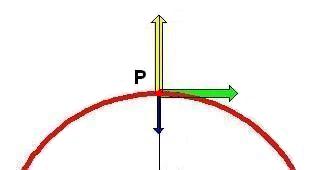
Fig. 1
The green "tangent" vector
at the quasi-local point P shows the alleged "curvature",
while the two opposite torsion vectors at the same point
P , with dark blue and yellow, run along the radius of the
"inflating balloon" (Ned
Wright), that is, along the new
w-axis.
For comparison, look at
the drawing from Claus Kiefer and Barbara Sandhöfer
below, and notice that the "foliation time" does not exist in the
local (physical) mode of spacetime, because it is produced by 'the flow
of time' (the sufficient conditions for
spacetime) from the Arrow of Space, in line with
option YAIN (iii)
above. Also, the alleged "Hamiltonian" (Domenico
Giulini and Claus Kiefer,
arXiv:gr-qc/0611141v1) is fake, because it cannot in
principle accommodate for the geometrical and topological degrees of
freedom producing the "dark" effects of gravity.
Notice that we can draw three spatial axes (x, y, z) at the point
P in our Fig. 1 above (none is shown), then can set our
three vectors depicting the "curvature" and "torsion" in Fig. 1
to zero, to obtain the limiting case of Minkowski spacetime, and
finally imagine the point P as the mass center of
our Frisbee: the metric will be dead fixed, and we
can claim that the gravitational energy density
at point P might be zero, as in some fictitious flat
background spacetime with zero gravity, zero torsion, and zero "dark"
effects.
Then -- and only then --
we can imagine some fourth axis, denoted with t in
the emerging
Lorentzian geometry, and draw the trajectory of
our Frisbee,
because we have eliminated the hidden, due to the
Equivalence Principle, dynamical degrees of freedom of the
quasi-local point P in the
unfinished Allgemeine
Relativitätstheorie undertaken by Albert
Einstein, with crucial help from Tullio Levi-Civita
and
David Hilbert.
As expected, people disagree. They may
never understand their GR textbooks and will keep dreaming about "warp
field mechanics" forever, like
NASA Eagleworks. But they enjoy unlimited amount of cash, no supervision, and don't care. In
plain English: total socialism.
D.C.
September 28, 2012
Last updated: October 5, 2012, 06:08:02 GMT
=================================================
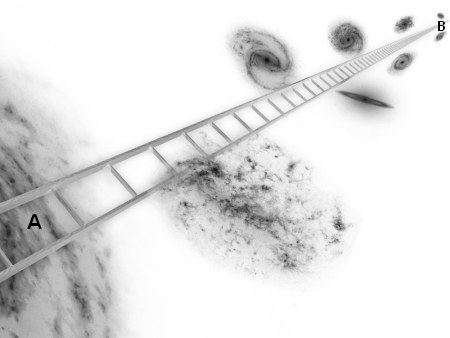
Subject:
Gauge theories of gravitation ?
Date: Tue, 16 Oct 2012 15:20:16 +0300
From: Dimi Chakalov <[email protected]>
To: [email protected], [email protected], [email protected],
[email protected], [email protected], [email protected],
[email protected], [email protected]
Dear colleagues,
Here's a simple question for your efforts.
Q: In what "direction" the "expansion" of spacetime happen, in
the smooth neighborhood of the "point" P, so that you can talk
about "time from scale factor", namely, the parameter t in the
drawing attached, from Greg Galloway:
http://www.god-does-not-play-dice.net/#Fewster
Please study the text and reply professionally, and I will reply
accordingly, with utmost pleasure.
Fred Hehl: Please don't try to say that
cannot understand the problem -- it is from
1930s.
All the best,
Dimi Chakalov
-------------
Note: The "direction" of the "expansion" of
spacetime cannot physically exist, because first of all
it will require some finite time interval -- not a "point"
P -- for the flow of time,
but the latter must not be physically present in any way,
shape, or form whatsoever. Hence time and space are
emergent phenomena produced by the 'necessary
& sufficient conditions'. In order to talk about "direction", you need (i)
finite interval
(A, B)
defined with
three points, and (ii) background spacetime to define
these fluent geometrical points. But in our
case you cannot find (ii) in your GR textbooks,
because you are a 3-D Flatlander who can talk only about the
T-invariant "direction" along the radius of
the "inflating balloon" from
Ned Wright, and you have only one "point"
P there. The flow of time
requires an accumulation of infinite number (uncountably
infinite) of emergent and quasi-local points
'now' which are, thanks to the necessary
& sufficient conditions and the Arrow of Space,
fused in a perfect continuum, while your GR textbook (not your
brain) is confined in the
"radius" of the expanding balloon below, and of course
your "spacetime" is dead frozen (Robert Geroch).
The T-invariant
"direction" of the "expansion" of spacetime (Ned Wright)
does not exist in the local (physical)
mode of spacetime. It is inevitably
compactified into the "point" P
-- recall option YAIN (iii) above and
the axiom about the flow of time (neither 'time parameter in GR'
nor any 'normalized time-like Killing vector' can be derived
from the "dark energy" of you-name-it). The
two torsion components, marked in the drawing below with yellow and
dark blue, are necessarily "dark" due
to
the sufficient conditions for spacetime;
currently, the latter are
"statements that cannot be
made within the theory" [Ref. 1].
(compare it with the "inflating
balloon" from
Ned Wright)
In the local mode of
spacetime, the remnant at P
from DDE points to the timeless future (yellow
vector), while the T-invariant remnant at the same
P from CDM points to the timeless past (dark
blue); the green "tangent" vector by itself cannot produce any
"time" either (Karel Kuchar). But combined with
the sufficient conditions for spacetime, these topological phenomena induce "spin", from
galaxies
to the observable universe. We cannot explain
the dynamics of objects larger than the solar system [Ref.
2] with only the green "tangent" vector at P .
In present-day GR, the time phenomenon is introduced 'by
hand' (another "miracle" is the metric grounded on
Planck scale), because the "dark energy" of
you-name-it is indeed physically invisible. We cannot and must
not display the binding phenomenon of the
Arrow of Space, but only the kinematics of spacetime from which a
composite physical remnant at point P is shown with the three vectors above.
This composite remnant resides in the local (physical) mode of
spacetime, and is effectively zero in Minkowski
spacetime: the energy-momentum
is firmly associated with effectively local points, and we can talk
about some dead background Minkowski spacetime, because the self-action
of spacetime along the Arrow of Space
can be safely ignored.
Now,
people believe that "if you double the distance to 2 megaparsecs, a
galaxy would be moving away at twice that speed, or 148.6 km/sec", so
the natural question is, how large is the relativistically observable
volume of spacetime fixed by the event horizon? The incoming (to Earth)
light would have to be infinitely Doppler-shifted toward red, yet
if GR were indeed 'classical theory', these "dark" object
(albeit still technically unobservable) will have to
exist 'out there'. To be specific, how large is the
radius (A, B), where A is fixed at Earth, while B sits at the event
horizon at which its "receding speed", relative to A, tends
asymptotically toward the "speed" of light? Once you calculate the
relativistic radius (A, B) above, you will know the
current amount of
"dynamical dark energy" (DDE) needed to perform
such miracle, but not the total reservoir of "dark energy"
available 'out there' (where?) for the entire cosmological time,
from which a fleeting portion is being poured into the current spacetime
ever since the "big bang" along the Arrow of
Space. Just don't forget that the very same
"expansion" was faster-than-light "during" the inflation, say, for about 10-30
seconds, as it would have been recorded with your clock today:
Nothing,
the "big bang" included, could possibly "erect a locally inertial
coordinate system in which matter satisfies the laws of special
relativity" (Steven Weinberg, pp. 62-68) and
Lorentzian metric within 10-30 seconds, and safely
store it in some "spacetime
foam" for 13.73 billion years.
No way. You need the dynamics of spacetime
itself to understand the "ripples" of spacetime.
So, how much is
the total "dark energy" right now, as we speak?
Infinite and
invisible.
Which means that the current textbook
GR is not a 'classical theory' in which everything, the
gravitational energy included, should stay available
'out there'. As in the human brain, we can only
consider 'matter' in the r.h.s. of the Einstein field equations, endowed
with self-action. We must not directly
observe (option YAIN (iii) above) its self-acting due to
the physically unobservable sufficient
conditions for spacetime:
Der Geist
bewegt die Materie. In order to grasp the self-acting
phenomenon of 'matter' in the non-linear GR (we
cannot directly observe the "speed" of light
and the luxonic, global mode of time of such non-linear self-acting), we need
the dynamics of spacetime along the Arrow of
Space -- if we employ only the local (physical) mode of spacetime,
we will inevitably face the "frozen" paradox (Bryce
de Witt). Hence the first off task is
to explain the self-acting phenomenon of quantum matter producing
"quantum waves" and include the later
with the
non-linear gravitational waves capable of transporting
the 'tangible forms of energy energy' (Hermann
Bondi) on a perfect physical continuum. The latter is recovered first in
Quantum Theory, and then introduced as
dynamical continuum in the
non-linear GR, endowed with a new gravitational entanglement
(example with CDM above) to replace the
"instantaneous" action of gravity in Newton's theory: gravity does
'know' about everything. The end result is
expected to be a Machian quantum gravity free from any "quantum jump"
artifacts: Dead matter makes quantum
jumps; the living-and-quantum-gravitational matter is
smarter.
To understand the current cosmological essays, imagine
that you are confined within a car (gravitationally closed system with
asymptotic "boundaries"), which "accelerates"
with respect to itself due to its "dark energy" (again,
the physical "time" has been inevitably compactified into a single
point only), but the only way
to "see" your acceleration is to measure the fuel tank of your car: it
perpetually gains petrol (in the r.h.s. of the Einstein field
equations) because of your "acceleration"
(Danylo Yerokhin et al., arXiv:1108.0203v4 [astro-ph.CO],
p. 10, Eq. 33). I mean, it is not even funny.
It's ridiculous.
Notice also the mathematical term 'compact space' in
[Ref. 1],
footnote 8 on p. 7, which is a bit
sophisticated expression of the paradox of 'infinite space' from
Achilles (see above): suppose Achilles is
throwing his famous spear in any direction in 3-D space toward
B, which is the event horizon of the relativistically observable
volume of spacetime. He starts from the "center" of the
universe at Athens located at
point A above, and one can suggest that
he will not be able to throw his spear further from
the event horizon located at B, because he will be
already "arbitrarily close" [Ref. 1]
to the "final" point B, that is, the distance
from Achilles to point B will be
infinitesimal (recall
'the
empty set
R').
Which means that he would reach some asymptotic limit of being
'too far away from Athens', which is
reciprocal to the infinitesimal displacement ds , such
that the very distance (A,
B) would prevent him to move further. Another important assumption
is that, in theory, the relativistically observable
event horizon (A,
B) matches the asymptotical null-and-spatial
infinity.
However, let me focus on two issues.
One is the idea that the very distance in
spacetime is a parameter that will locally affect the
kinematics of the whole spacetime (like the influence of the
school of fish on every infinitesimal local fish).
Thanks to this T-invariant nonlinear bootstrapping
phenomenon, we conjecture about the interdependence of Large and
Small; for example, we extend local information to the whole spacetime,
i.e., "globally throughout the space" [Ref. 1].
The crucial idea is that this nonlinear bootstrapping influence -- the
global properties of spacetime (the sufficient
conditions for spacetime) can instantaneously (global mode of
spacetime) act "locally"
on every
quasi-local point of spacetime, and vice
versa -- is a parameter of spacetime which grows with
distance, starting from the length scale of tables and chairs, along
the new, space-invariant w-axis. Hence the very distance (A, B) will block Achilles,
once he has reached the asymptotical null-and-spatial
infinity. Of course, this can never happen in the local mode
of spacetime due to the dual age cosmology.
Well, this is a metaphysical statement which may or may not be
true. But the second issue, that Athens at point A would be some privileged
"center" of the universe, is wrong, because we can replace Athens with
some closer point (say, with a finite small interval behind the
previous location
of the spear), and Achilles can throw his spear further, ad
infinitum. Why? Because
the universe is like an unbroken ring with no circumference,
for the "circumference" (global mode of spacetime) is nowhere, and the "center"
(global mode of spacetime) is
everywhere. This is Quantum Geometry. It
cannot be derived from dead matter alone. We need the physically unobservable sufficient
conditions for spacetime as well.
Regarding the relativistically observable
event horizon (A,
B), similar considerations apply to the
reciprocal case of "infinitely
small", as in both cases these two (as well as ONE, in the
global mode) edges do not
belong to the physical spacetime: the only way to reach them from within
spacetime would be to assume that the final 'nothingness' does
exist within spacetime, as with the vacuum cleaner of
Pink Panther above, which is absurd --
we haven't seen things to disappear into the 'nothingness' of
timelike naked
singularity nor to show up helter-skelter from 'nothingness' (the
latter is the case of some "white hole" inhabited by advanced Russian
civilizations, as demonstrated, with impeccable math, by
Slava Dokuchaev).
Also, the forty-year old idea of
quasi-local mass [Ref. 3] is wrong, firstly
because "asymptotic symmetry"
requires precise asymptotic spacetime boundaries
which does not, and must not physically exist -- see
again
option YAIN (iii) above.
The solution is to accept two seemingly alternative
statements: the 3-D space is dual,
because it is both "infinite" and "finite"
along
(A, B), toward the
Large and the Small, as presented (to a 3-D Flatlander)
in the local (physical) mode of spacetime along the
radius of the "inflating balloon" from
Ned Wright and the radius of the three-vector drawing
above. In the physically hidden global mode of
spacetime,
we have a brand new viewpoint on the spacetime of 'the whole universe as ONE',
and all questions about its physical "size" yield the same answer:
YAIN. There are indeed statements that currently "cannot be
made within the theory" [Ref. 1],
and such tasks cannot be resolved with abstract classical "paracompact
Hausdorff space" either. We need Quantum
Geometry of the quasi-local points
defined by their physical (energy-momentum) content. The task is from
the first days of General Relativity -- it cannot be a bona
fide classical theory [Ref. 4]. No way.
Just look at the recent
efforts of Junichi Iwasaki in
arXiv:1210.7466v1 [gr-qc] to suggest some reference observable
in GR, "with respect to which other observables evolve": if by 'other
observables' we denote 'the whole universe driven by
DDE', then the reference observable will be nothing but 'the
whole universe', which evolves in its
scale-factor time, but with respect to itself. We must not be
able to observe physically such final reference object, which is
at absolute rest and can act on itself -- the Aristotelian
First Cause. We just call it "aether". Anyway,
sorry for repeating this old story again.
If you reject the new Relative
Scale Principle and still believe in "expansion" of spacetime (with
respect to what?) with 74.2 ±3.6
kilometers/second/megaparsec (Adam
Ries), "black holes" (Kevin
Brown), "GW astronomy", "spacetime
curvature",
"quantum
computers", and Higgs, you may
find solace in the old saying from Xià-Shāng Dynasties (2070-1029 BC):

D. Chakalov
October 16, 2012
Last updated: November 4, 2012, 23:02 GMT
[Ref. 1] Gustavo E. Romero, Adversus singularitates: The ontology of
space-time singularities,
arXiv:1210.2427v1 [physics.gen-ph], p. 8.
See also footnote 8, p. 7:
"A space is said to be compact if whenever one takes an
infinite number of ”steps” in the space, eventually one must get
arbitrarily close to some other point of the
space. Thus, whereas disks and spheres are compact, infinite lines
and planes are not, nor is a disk or a sphere with a
missing point. In the case of an infinite
line or plane, one can set off making equal steps in any direction
without approaching any point, so that
neither space is compact. In the case of a disk or sphere with a missing
point, one can move toward the missing point without approaching any
point within the space. More formally, a topological space is
compact if, whenever a collection of open sets covers the space, some
sub-collection consisting only of finitely many open sets also covers
the space. A topological space is called compact if each of its open
covers has a finite sub-cover. Otherwise it is called noncompact.
Compactness, when defined in this manner, often allows one to take
information that is known locally – in a
neighborhood of each point of the space – and to extend it to
information that holds globally throughout the space."
[Ref. 2] Naresh Dadhich, Subtle is the Gravity,
arXiv:gr-qc/0102009v1, p. 10.
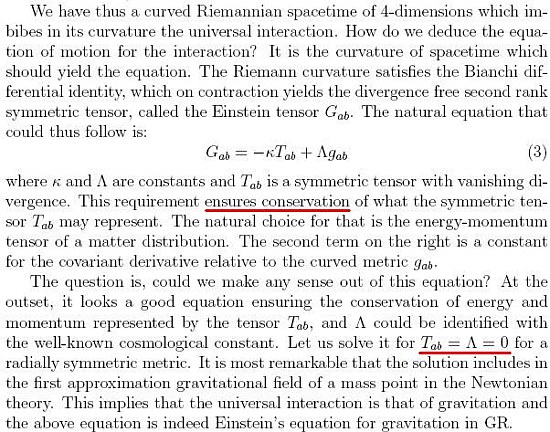
[Ref. 3] Mu-Tao Wang and Shing-Tung Yau, Quasilocal mass in general
relativity,
arXiv:0804.1174v3 [gr-qc]; talk also at 'Connections in Geometry and
Physics 2010', Perimeter Institute, Canada, May 7-9, 2010.
"As is well known, by the equivalence principle there is
no well-defined concept of energy density in general relativity. On the
other hand, when there is asymptotic symmetry, concepts of total
energy and momentum can be defined. This is called the ADM
energy-momentum and the Bondi energy-momentum when the system is
viewed from spatial infinity and null infinity, respectively. These
concepts are fundamental in general relativity and have been proven to
be natural and to satisfy the important positivity condition in the work
of Schoen-Yau [14], Witten [17], etc. However, there are limitations to
such definitions if the physical system is not isolated and cannot quite
be viewed from infinity where asymptotic symmetry exists. It was
proposed more than 40 years ago to measure the energy of a system by
enclosing it with a membrane, namely a closed spacelike 2-surface, and
then attach to it an energy-momentum 4-vector."
[Ref. 4] C.W. Misner, K. S. Thorne and J. A. Wheeler,
Gravitation, §20.4,
W. H. Freeman and Company, 1973; excerpt from Paul McGrath, Richard Epp
and Robert Mann, Quasilocal Conservation Laws: Why We Need Them,
arXiv:1206.6512v1 [gr-qc],
p. 2.
"A bulk term in a local conservation law can be a symptom of the
presence of fields that are not being accounted for in the
stress-energy-momentum tensor. For example, in the standard Poynting theorem, the j.E bulk term is
present because Tab excludes the charged matter field that is
the source of the electromagnetic field, and
represents an energy transfer mechanism between
the electromagnetic field and the charged matter field. (...) A solution
to this problem is to move from local to quasilocal
conservation laws, which can properly account for the gravitational
physics."
Note to
[MTW, §20.4]: Paul McGrath et al. agree that "there is no such thing as a local
gravitational energy density (energy per unit volume), that when
integrated over a volume gives the total gravitational energy in that
volume". If 'unit volume' is replaced with the point P from
Greg Galloway's drawing above, we cannot
integrate such "gravitational points" over a finite volume either. Yet other people
claim that one can miraculously bypass this problem with some 'finite
region', which is nevertheless comprised from these 'unit volumes at
P'. Total mess. See the "linearization"
problem and the "feedback effect", explained by Ronald Adler, Maurice Bazin, and Menahem Schiffer
in Introduction to General Relativity, 2nd ed., McGraw-Hill, New
York, 1975, Ch. 9.1,
p. 301.
The solution is very
simple but highly non-trivial. I can't say
more, because I do not offer math to people who don't care about General Relativity
(Matthew 7:6).
D. Chakalov
November 29, 2012, 07:44 GMT
===========================================
Subject:
arXiv:1210.5417v2 [gr-qc]: Quasi-local distribution and
motion of matter?
Date: Tue, 30 Oct 2012 14:43:28 +0200
From: Dimi Chakalov <[email protected]>
To: Janusz Garecki <[email protected]>
Cc: Adam Helfer <[email protected]>,
Laszlo Szabados <[email protected]>
Dear Professor Garecki,
It is a real pleasure to hear from you. Thank you very much for
your kind reply.
May I take this opportunity to ask you to help me understand
your latest
arXiv:1210.5417v2 [gr-qc].
I wonder if my wristwatch can read the conformal time [tau],
ref. [6]
therein.
If your answer is in the positive, please consider the problems
with the matter energy-momentum tensor and the *local* (Sic!)
distribution and motion of matter, T_ik(x), under the conditions
of "an ideal (or perfect) fluid" (footnote 2) in your
"accelerated flat model" (footnote 6),
http://www.god-does-not-play-dice.net/#Fred_Hehl
Please feel free to ask questions. Thank you for your time and
considerations.
The opinions of your colleagues will be greatly appreciated,
too.
Best regards,
Dimi Chakalov
================================================
Subject: Singularity theorems and
torsion in General Relativity
Date: Sun, 30 Sep 2012 02:15:45 +0300
Message-ID:
<CAM7Ekxmw_zZyu68a-cG5KmT1o3jr2ABt_mw6B_d4h1jd77QZOw@mail.gmail.com>
From: Dimi Chakalov <[email protected]>
To: Jose M M Senovilla <[email protected]>,
Alan Rendall <[email protected]>,
Robert M Wald <[email protected]>,
Helmut Friedrich <[email protected]>,
Adam Helfer <[email protected]>,
Laszlo Szabados <[email protected]>,
Jörg Frauendiener <[email protected]>,
Luciano Rezzolla <[email protected]>
Dear colleagues,
My understanding of "singularity" and "torsion" is posted at
http://www.god-does-not-play-dice.net/#invisible
Thank you very much for your professional articles. No need to
reply, of course.
The reason why I do not publish papers is explained in the
Addendum at
http://www.god-does-not-play-dice.net/#Rezzolla
All the best,
Dimi Chakalov
-------------
Note: The task is very
simple: if you throw a Frisbee in Minkowski
spacetime, you can talk about the connection (no
gravity: see
Jose J.
Pereira) of the "points" from its trajectory, and hence the
dynamics of such isolated system --
you will ignore all sufficient conditions
for spacetime. But one you add gravity and torsion, you need a
new, dynamical spacetime and the precise Affine Connection: see
the three tangent vectors at Fig. 1
above.
Think about 'causality' as
presented only at a single point (John
Bell), with its two features of (i) inheriting the physical
influences from the neighboring past point and (ii) passing them
to the next point in the future; more from
David Bohm. This is
the phenomenon of 'transience' from
'the flow of time', corresponding to option
YAIN (iii). Isn't this simple?
Now, in your
idiotic textbooks (pardon my French), you present
'causality' with a dead frozen "space" and an invisible "torch"
that highlights the dead frozen "time", as well as some Akasha-like
memory to keep the Genidentity (Kurt
Lewin) and pass it from any given point to the neighboring
one, much like some "ideal
waywiser".
You don't have the phenomenon of 'transience'
from 'the flow of time'. Instead, the whole universe is dead
frozen (Robert Geroch) and nobody can
explain the necessary & sufficient
conditions for spacetime from the Arrow of
Space, producing 'biocausality'.
The latter is a
perfectly retarded causality, because the
atemporal bi-directional
bootstrapping influences do not
exist in the local (physical) mode of spacetime, thanks to
John's jackets and the
Kochen-Specker Theorem.
Briefly, the phenomenon which
"moves" the instant 'now' is 'the whole universe as ONE', known
since Aristotle and denoted here as
the sufficient conditions for spacetime.
We cannot and must not be able to detect this
invisible phenomenon at the point
P from Greg Galloway's drawing.
But is does exist (Luke
17:21).
D.C.
October 3, 2012, 12:19:28 GMT
============================================
Subject: Re: Energy exchange
Date: Tue, 2 Oct 2012 17:01:41 +0300
From: Dimi Chakalov <[email protected]>
To: Ingemar Bengtsson <[email protected]>
Cc: Adan Cabello <[email protected]>, [email protected],
[email protected], [email protected],
[email protected], [email protected]
P.S. Ingemar Bengtsson wrote (arXiv:1210.0436v1
[quant-ph], p. 2):
"Ernst Specker’s original motivation
concerned a problem in theology: can God know the outcome of all
events, also those that could have happened but in fact did not?
The answer from quantum mechanics is a clear no."
God knows the outcome of all events, also those that could have
happened but in fact did not. The answer from Quantum Theory is
a clear YAIN.
See the initial link in my email below, and option YAIN (iii)
at
http://www.god-does-not-play-dice.net/#Goswami
D.C.
On Tue, 2 Oct 2012 16:38:27 +0300, Dimi Chakalov <[email protected]>
wrote:
>
> Dear colleagues,
>
> If you truly believe that "quantum theory seems to be a
universal
> framework for all interactions" (Schell
& Kiefer), may I ask you to
> explain the creation of path in the Wilson cloud chamber by
energy
> exchange b/w the quantum particle and its classical
environment,
>
>
http://www.god-does-not-play-dice.net/#Renner
>
> A penny for your thoughts.
>
> Sincerely,
>
> Dimi Chakalov
=================================================

Subject:
arXiv:1210.0831v1 [gr-qc], Footnote 1: "To clarify: we have
not performed the demonstrably impossible feat... "
Date: Wed, 3 Oct 2012 13:32:21 +0300
From: Dimi Chakalov <[email protected]>
To: Luke Butcher <[email protected]>,
Anthony Lasenby <[email protected]>,
Mike Hobson <[email protected]>
Cc: Christof Wetterich <[email protected]>,
Diego Marin <[email protected]>,
Michal Chodorowski <[email protected]>,
Adam Helfer <[email protected]>,
Laszlo Szabados <[email protected]>,
Erik Curiel <[email protected]>,
Carsten Gundlach <[email protected]>,
Andersson N.A. <[email protected]>,
Roy Maartens <[email protected]>,
[email protected],
[email protected],
[email protected]
Luke, Tony, and Mike:
It is indeed possible to solve your problem known from textbooks
(MTW, p. 467),
but you have to be very good in math: solve the task of "time
from scale factor",
http://www.god-does-not-play-dice.net/#Romualdo
http://www.god-does-not-play-dice.net/#invisible
Unless you know the exact value of gravitational energy
density in every (quasi-local) point
in the full non-linear GR, you can't ever *think* of tangent
vector at that same (quasi-local)
point.
Why are you wasting your time with poetry?
Pity you won't reply and will continue to waste paper, which is
a valuable commodity.
Any comments?
Dimi
-----
Note: In
arXiv:1008.4061v2
[gr-qc], Luke, Tony, and Mike wrote: "We shall not attempt
to extend our results beyond the linear theory at this time,"
because "localising gravitational energy-momentum in this regime
(where the distinction between background and fluctuation is
virtually meaningless) may be an
inherently flawed idea." See their excerpt below (all
emphasis mine).

Notice that Eq. 7 above is wrong (Hans
Ohanian): matter fields always gain-and-lose energy
through interactions with the gravitational "field". We cannot
use the linearized gravity to model this
non-linear interaction, because our wristwatch
cannot read the global, non-linear time along the
null-surface of the
Arrow of Time.
Just think about this: you have an
insurmountable 'problem of time', but how come there is no
'problem of space' in canonical quantum gravity (D.
Giulini and C. Kiefer)?
Anyway, I tried to explain
"canonical gravity" [Ref. 1] to my dog,
but he didn't get it. Probably it's too difficult.
D. Chakalov
October 3, 2012
Last updated: October 4, 2012
[Ref. 1] Steffen Gielen, Derek K. Wise, Lifting General
Relativity to Observer Space,
arXiv:1210.0019v1 [gr-qc]
p. 1: "General relativity is about understanding that physics
does not take place against the backdrop of a fixed geometry.
Rather, geometry itself is a dynamical entity, bending and
curving in response to matter, just as matter is subject to
geometric rules of the space it inhabits. There are, however,
different possible interpretations of such statements. In
particular, do we mean the geometry of spacetime, the geometry
of space, or something else?
"This question is the root of tension between ‘covariant’ and
‘canonical’ approaches to gravity. The ‘covariant’ approach
focuses on the geometry of spacetime, given ‘all at once’. This
is elegant, but unfortunately rather far removed from our actual
experience of the world, in which space and time appear quite
distinct. The so-called ‘canonical’ picture focuses instead on
the geometry of space and how this geometry
evolves in time, and is thus more clearly related to our
spatiotemporal intuition.
"On the other hand, the notion of ‘time’ is fixed arbitrarily
from the outset, going against the spirit of relativity,
even when the final result is independent of this choice. Worse
yet, showing this independence in some formulations is decidedly
nontrivial. The term ‘canonical gravity’, stemming from the
‘canonically conjugate’ variables in Hamiltonian mechanics, thus
stands in ironic contrast with standard mathematical use of the
word ‘canonical’, where it usually means involving no arbitrary
choices. In brief, canonical gravity is not canonical."
==============================================
Subject: Scalar gravitational particle?
Date: Wed, 5 Sep 2012 16:02:11 +0300
Delivered-To: [email protected]
Message-ID:
<CAM7EkxkrdHp8Ktm5McyFb2R3GTBN4eGSW4=2xtjK99paNKqCjw@mail.gmail.com>
From: Dimi Chakalov <[email protected]>
To: Charles Wang <[email protected]>
Cc: Wang Yong-jiu <[email protected]>,
Giuseppe Vitiello <[email protected]>,
Chris Fewster <[email protected]>,
Greg Galloway <[email protected]>,
Larry Ford <[email protected]>,
Luciano Rezzolla <[email protected]>
Dear Professor Wang,
May I ask a question. You've been quoted at
http://www.ft.com/cms/s/0/8e616e6c-f6a1-11e1-827f-00144feabdc0.html#axzz25b1wwRCD
“No existing theory can explain how so much energy is emitted in
a supernova,” said Prof Wang. “My theory is that a scalar
particle – one of the most elementary types of particle in the
universe and similar to the Higgs boson – is at work in these
starbursts and responsible
for the additional energy that causes the explosion to take
place.”
If possible, please let me learn more on the exact mechanism of
energy release in a supernova, given your opinion on "the true
dynamical degrees of gravity", Sec. 6 in 'New 'phase' of quantum
gravity',
http://rsta.royalsocietypublishing.org/content/364/1849/3375.full.pdf+html
I would expect that some
boson-like mediator of such anomalous energy release exists
in Nature, but it is definitely not "graviton", for reasons
hinted at
http://www.god-does-not-play-dice.net/#Fewster
The opinion of your colleagues on "the true dynamical degrees of
gravity" will be greatly appreciated, too.
Kind regards,
Dimi Chakalov
-------------
Note:
To resolve 'the worst calculation
in theoretical physics' (the old cosmological problem known
since
1930s), the quantum-gravitational vacuum should be treated
as 'potential reality', which in turns
requires that the "creation", or rather explication of matter
from the vacuum is reversible, i.e., under specific
conditions matter will dissolve
back to the vacuum, instead of "collapsing" to produce
supernovae. It would be really difficult to overestimate the
importance of this conjecture.
D. Chakalov
September 5, 2012
=============================================

Subject: "CMB acts as an aether." (Ta-Pei Cheng, Relativity,
Gravitation and Cosmology, 2005,
p. 160)
Date: Fri, 17 Aug 2012 04:44:48 +0300
Message-ID:
<CAM7Ekxk+PQYs5U8SG9g4nvw2aB28NNgTTyXY9rKKDjX4SwMing@mail.gmail.com>
From: Dimi Chakalov <[email protected]>
To: Ta-Pei Cheng <[email protected]>
Cc: Anthony Zee <[email protected]>,
[snip]
Dear Professor Cheng,
Regarding the last slide from your recent talk on Dark Matter
and Dark Energy,
http://www.umsl.edu/~chengt/DarkU_nyc.pdf
may I quote from the first edition of your GR book (Relativity,
Gravitation and Cosmology: A Basic Introduction, Oxford
University Press, Oxford,
2005), p. 10 (p. 9 in the 2nd ed.):
"In Mach’s and Einstein’s view, space and time are nothing but
expressing relationships among physical processes in the world
-- “space is not a thing.” Such considerations, together
with the idea of the principle of equivalence between
gravitation and inertial forces, led Einstein to the belief that
the laws of physics should have the same form in all reference
forms, thus abolishing the concept of space as a thing."
I think 'relationships among physical processes' constitute only
'the necessary conditions for spacetime', while 'the
sufficient conditions for spacetime' may have a holistic
Machian origin,
http://www.god-does-not-play-dice.net/#John_Alice
You also wrote (ibid.,
Sec. 8.5.4, p. 160):
"The peculiar motions mentioned above are measured with respect
to the frame in which the CMB is isotropic. The existence of
such a CMB rest frame does not contradict special relativity. SR
only says that no internal physical measurements can detect
absolute motion. Namely, physics laws do not single out an
absolute rest frame. It does not say that we cannot compare
motion relative to a cosmic structure such as the microwave
background.
"The more relevant question is why constant velocity motion in
this CMB rest frame coincides with the Galilean frames of
Newton’s first law. (CMB acts as an aether.) To the
extent that the CMB frame represents the average mass
distribution of the universe, this statement is called Mach’s
principle (cf. Box 1.1). While to a large extent Einstein’s GR
embodies Mach’s principle, there is no definitive explanation of
why the CMB rest frame defines the inertial frames for us."
The textbook "explanation" of inertia is not complete, to say
the least (e.g., mass *there* governs spacetime geometry *here*,
I. Ciufolini and J.A. Wheeler,
Gravitation and Inertia, 1995,
p. 270), because
it misses the bi-directional negotiations in the reference frame
of the "aether", expressed with the sufficient conditions
for spacetime above.
As an analogy, think of a school of fish,
in which every fish is directed by 'the whole school', and is
also --- at the very same instant -- affecting 'the school of
fish': the geodesic of every fish will be determined by 'the
whole school of fish' by such bi-directional negotiations in the
reference frame of the "aether". A possible model is offered by
Jim
Woodward, Gravitation: The Origin of Inertia,
http://physics.fullerton.edu/~jimw/general/inertia/index.htm
"Inertial reaction forces are instantaneous; there's no doubt
whatsoever about that. When you push on something, it pushes
back on you immediately. If they're caused chiefly by the most
distant matter in the universe, how can that be?
.........
"The act of pushing on something causes a disturbance in the
gravitational field to go propagating off into the future. It
makes stuff (the "absorber") out there wiggle. When the stuff
wiggles it sends disturbances backward (and forward) in time.
All the backward traveling disturbances converge on what we're
pushing and generate the inertial reaction force we feel. No
physical law is violated in any of this. And nothing moves
faster than the speed of light. It only seems so because of the
advanced waves traveling at the speed of light in the backward
time direction."
So, we may have an atemporal medium, as
in Cramer's Transactional Interpretation of QM, which
facilitates gravitation and inertia, dubbed "aether", which is
in turn introduced as 'the sufficient conditions for spacetime'
(cf. above).
Its physical effects will be inevitably "dark", which brings us
to the
last slide from your recent talk on Dark Matter and Dark
Energy.
A penny for your thoughts.
All the best,
Dimi Chakalov
-------------
Note: Ta-Pei Cheng should be fully aware that the
assumption of 'two matter components' is
indeed incorrect. He should also know
the meaning of the old Chinese saying
above. Unfortunately, he will
never respond professionally, firstly because he deeply believes
in "black holes", which he described
as "the
full power and glory of GR".
But the textbook GR cannot in principle explain inertia.
Ta-Pei Cheng can at best suggest some ideas about just one
of the components of the mechanism of inertia: mass there
governs spacetime geometry here (Ciufolini and Wheeler,
p. 270), while the
back-reaction of the spacetime geometry here to the mass
there is impossible to describe with the linearized
approximation of GR. He can only claim that at every
instant the values of two "masses", the
inertial and active gravitational mass (cf.
Wolfgang Rindler),
coincide with very high precision, but the dynamics of
the mechanism fixing this apparent "equality" takes place
literally within the instant 'now'. It is quasi-instantaneous,
by analogy with the quasi-local mass.
The only way to describe the bi-directional negotiations
(it is actually one event) between 'mass there
<--> spacetime geometry here' was suggested by
Jim Woodward. The latter requires two
atemporal gravitational waves, as well as the
hidden absolute reference frame of the
"aether" provided by CBM.
Thus, Ta-Pei Cheng can expect all
sorts of "dark" gravitational effects, generated by 'the
universe as ONE' (cf. the sufficient conditions for
spacetime above), in line with the
rules of Machian quantum gravity. And yes, the assumption of 'two matter components' is
indeed incorrect. Which is why he will
never reply professionally, or else will have to re-write his
book 'Relativity, Gravitation and Cosmology' from the outset.
D. Chakalov
August 17, 2012
Last updated: August 18, 2012, 13:23:12 GMT
===============================================
Subject: Re: GR17, Session D1
Date: Sat, 14 Jul 2012 12:09:05 +0300
Message-ID:
<CAM7EkxkTSjoX-JECM_P=vOAiHbiyZgt6NZvy=7cQXZ+ah8xjag@mail.gmail.com>
From: Dimi Chakalov <[email protected]>
To: Thomas Thiemann <[email protected]>
Cc: [email protected],
[email protected],
[email protected],
[email protected]
Dear Thomas,
Eight years ago, you decided to shut me up and left my email
below unanswered, but granted Lee Smolin 3 (three) oral
presentations. Yet neither you nor Lee have so far addressed the
main unresolved problem with erecting Lorentzian metric from the
hypothetical spacetime "foam",
http://www.god-does-not-play-dice.net/#first_principles
Would you allow me to talk at your 'First
Erlangen Fall School on Quantum Geometry' (8-12 October
2012) ? If you agree, I promise to be *very* polite about your
efforts (not frank). Just give me a chance
to hear your objections to my theory of quantum gravity.
Regards,
Dimi
-------------
Subject: Re: GR17, Session D1
Message-ID: <[email protected]>
Date: Sun, 06 Jun 2004 22:59:15 +0300
From: Dimi Chakalov <[email protected]>
To: tthiemann <[email protected]>
CC: [email protected], [email protected]
X-Priority: 1 (Highest)
References: 1 , 2 , 3
Dear Thomas,
Please inform me about possible upgrade of my poster
presentation to
talk. I'm encountering tremendous difficulties in transforming
my GR17
paper to poster. Feel like having my mouth shut with duck tape.
Best - Dimi
-----------------
Note: Yesterday (August 22, 2012), I received an email
signed by "the organizers.", which said that my application
wasn't approved -- I am not allowed to attend the First
Erlangen Fall School on Quantum Geometry even as a listener.
Well, Tom Thiemann is obviously
playing hardball. Which is why I will be completely frank.
The First Erlangen Fall School
on Quantum Geometry will miss the target, and will be a
total waist of time and resources. The reason is that the true
Quantum Geometry encodes both the necessary and the
sufficient conditions for spacetime, briefly explained
above.
To identify 'the sufficient
conditions for spacetime', look closely at a
typical "3+1"
mantra (or rather sheer poetry):

The recipe by which the
Levi-Civita connection is "associated" with the
pseudo-Riemannian metric, and the rules by which it defines "parallel
transport", require a brand new metaphysical
binding phenomenon for "points", which
is exactly what the so-called
sufficient conditions for spacetime stand for. The
binding phenomenon in question is depicted with the x-lines
above. It doesn't point to any "direction"
in the local (physical) mode of spacetime, because the
Arrow of Space evolves along a
null-surface, and at any instant 'now' the "time vector" from
the
binding phenomenon is completely and
totally zero, as recorded with your physical clock. So,
look at the drawing below, and answer the question, what
causes the states of a physical system to get shifted from
point x to the "next neighboring" point
x , in line with the metaphysics of locality and
causality?
x/x/x/x/x/x/x/x/x/x/x
Is this because of thermodynamics?
Or because of any other "time arrow"? Of course not.
You can't say that the binding phenomenon above is caused
by thermodynamics, because if you open your window in a
cold winter day, your room will
get colder. All "time arrows" are blueprints of an
underlying 'master time arrow' presented here with the
Arrow of Space. The latter must not
be directly observable [Ref. 1], or
else the "aether" will show up as a real
inertial reference frame.
When
people like Tom Thiemann make the "assumption" that (M, gab)
is time-orientable and "globally
hyperbolic" (cf. the compass needle metaphor
above),
they refer tacitly to the same
sufficient conditions for
spacetime -- a global holistic feature of 'the whole universe as
ONE' (Lee Smolin, p. 206), which
complements the buildup of its spacetime by 'the necessary conditions' supplied by type I
matter fields.
Nowadays nobody would claim, after
Newton, that space is a "thing" (cf.
Ta-Pei Cheng) which can exist without matter. Nobody
is that stupid. Yet Tom Thiemann ignored the fact that one cannot build a
spacetime from matter alone -- you need the
sufficient conditions for
spacetime as well, encoded in the famous saying
'Der Geist
bewegt die Materie'. Any time you talk about 'the universe
as a whole', to explain its cosmological time and "dark
energy", you take the stand of some
non-Archimedean meta-observer who takes a snapshot of
'the whole universe' to verify the asymptotic
behavior of its spacetime. Thus, you are tacitly using
the
sufficient conditions for
spacetime, which endow the Quantum Geometry of every spacetime
"point" with a quasi-local topological
structure. But what is the topological presentation of the
non-Archimedean geometry of 'the universe as
ONE' ?
The task is highly non-trivial, firstly because
your
diff geometry textbooks are written for
bartenders who cannot solve the first off task in GR:
on the one hand, we need geometrical "points" to attach
"vectors" and then parallel-transport these "vectors" along a
line (1-D Euclidean space), but on the other hand we cannot
define the
gravitational energy density at these "points" (cf. MTW,
p. 467 and
Erik
Curiel). The solution is simple but non-trivial, because it
comes from Quantum Theory and requires a
holistic phenomenon (Lee Smolin, p. 206): the
sufficient conditions for
spacetime.
In life sciences, this holistic
phenomenon is known by the expression 'the whole is more
than the sum of its parts'. For example, once a
school of fish is formed, every individual "fish" will be
involved in bi-directional negotiations (the crux of the
non-linear coupling of matter and gravity)
with 'the whole school as ONE', which determine their
quasi-local "geodesic" dynamically,
at each and every quasi-local "point"
from their spacetime. But the latter is
perfectly smooth, so we have a brand new task for
quantization of spacetime.
That's what
Quantum Geometry is supposed to
reveal. The alleged "loop quantum gravity", which
will be again advertised at the First Erlangen Fall School on
Quantum Geometry by Tom Thiemann's colleagues (e.g.,
Jerzy Lewandowski), is completely inadequate.
Of course, Tom Thiemann will
disagree, so let me offer a very simple example: try to
reproduce, as Gedankenexperiment, the operational
definition of 'one second' above with
'the necessary conditions for spacetime' alone.
But there isn't such perfect clock
in Nature. An answer to the question posed by Catherine
Meusburger, "which time to consider in quantum theory?" [Ref.
1], requires a new Quantum Theory which
can be reconciled with Einstein's unfinished
Allgemeine Relativitätstheorie
(not the current GR textbooks). The
empirical fact that "measurements by observers generally involve
time" (ibid.) cannot explain
the cosmological time -- see the bewildered Tom Thiemann
above.
You need the
sufficient conditions for spacetime as well,
otherwise you'll have to ground the Quantum Geometry on a
Biblical miracle left to
be resolved by a bunch of curious
self-acting elementary particles (IGUSes)
survived after the CMB
formation [Ref. 2], along with lots of
"dark stuff".
It is very sad that people
like T. Thiemann have occupied the famous
Erlangen University.
D. Chakalov
August 23, 2012
Last updated: August 27, 2012, 18:23 GMT
[Ref. 1]
Peter G. Bergmann, Observables in General Relativity, in
Gravitational Measurements, Fundamental Metrology and Constants,
ed. by Venzo De Sabbata and Vitaly N. Melnikov, NATO ASI Series
Volume 230, Kluwer, 1988,
pp. 15-18.
See also:
Catherine Meusburger (April
2009), Cosmological measurements, time, and observables in
(2+1)-gravity,
Slide 19
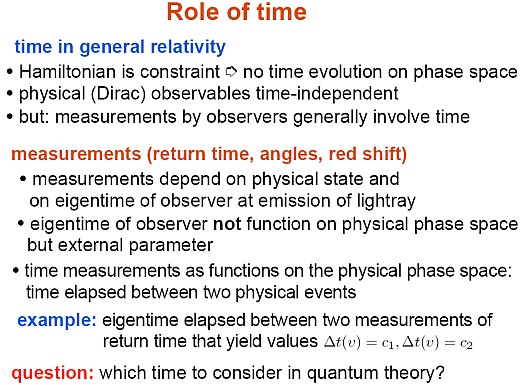
[Ref. 2] Victor J. Stenger, The universe: the ultimate free lunch,
Eur. J. Phys. 11(4), 236-243 (1990), p. 243
"Because the symmetry between
matter and antimatter that initially existed was broken by one
of the early phase transitions, the annihilation of particles
and antiparticles into the photons, now part of the
microwave background, was not
perfect, leaving a small residue of one part in a billion quarks
and electrons that then stuck together in the clumps that we
call galaxies, stars, planets, rocks, trees and
people."
===========================================
Subject: Energy exchange
Date: Wed, 29 Aug 2012 16:25:46 +0300
From: Dimi Chakalov <[email protected]>
To: Renato Renner <[email protected]>
Cc: [email protected],
[email protected],
[email protected],
[email protected],
[email protected],
[email protected]
Dear Renato,
Perhaps you and your colleagues are too busy to dwell on the
KS
Theorem1, so let me offer a simple puzzle from 1929 (no links to
"John's jackets"): the creation of path in
the Wilson cloud chamber by energy exchange b/w the quantum
particle and its classical environment.
According to Heisenberg (1930), by "path we understand a series
of points in space which the electron takes as ‘positions’ one
after another," but notice that at each of these 'points in
space', an *energy exchange* has occurred.
Try to explain the generation of (i) the observable path, like
the trails left in the sky from a jet plane, and (ii) the
underlying unobservable one, to explain both trajectories: on
both "layers" we have *energy exchange*, correct?
Notice that we aren't talking about the direction of the
observable path, as discussed by Sir Nevill Mott (cf. Alessandro
Teta,
arXiv:0905.1467v1 [math-ph]), but about *continuous energy
exchange* between one single quantum particle (endowed with
imaginary phase)
and its "measuring" environment.
You can't use the "collapse" in QM textbooks nor some "decoherence",
and you can't introduce some time operators in QM either,
although you can measure the duration of the observable path (i)
with your wristwatch.
What would you do, then?
The only response I have so far is from Prof. Dr. Maurice de
Gosson, an Austrian mathematician and mathematical physicist at
the University of Vienna: "Buzz off, idiot!"
(Mon, 21 May 2012 18:47:46 +0200).
Can you do better?
Best regards,
Dimi
On Tue, Aug 28, 2012 at 9:26 PM, Renato Renner <[email protected]>
wrote:
[snip]
---------------
1
Let me try to explain the gist of
Kochen-Specker Theorem, particularly the physical
significance of the uncolorable set of observables and
the quantum notion of contextuality (Ernst
Specker). First, consider a kaleidoscope with many
distinguishable, by their color, pieces of glass. You are
interested only in the 'states' of these colored bits of glass
'on the table', after the kaleidoscope has been shaken
'in the air' (=the dark Zen gaps). You
may use the machinery of classical mechanics, attach some time-reversible 'trajectories' to all colored pieces in their
phase space, with definite color 'on the table', etc. This
exercise poses no problems. (However, if you were told, when you
were young and susceptible, that GR were the same kind of
'classical theory', you'll face a
huge insurmountable problem.)
But imagine that all colored
pieces obtain their 'color' contextually, that is, every
piece does not have any definite color whatsoever,
because it is "uncolored" by default -- unless a correlation
between all pieces, at particular instant, is established, such
that every glass piece obtains its color at this
instant (one-at-a-time along the Arrow of
Space and with unit probability), and with respect to 'the rest of glass
pieces' (=relationally). Here, we have a determination of
the instantaneous 'color' of every glass piece by 'the rest of
glass pieces from the whole (Machian) kaleidoscope', brought to
every context-dependant uncolored piece
-- it has become a 'contextual observable'.
Recall the question posed by
Erwin Schrödinger (1935): "The rejection of realism has
logical consequences. In general, a variable has no
definite value before I measure it; then measuring it does
not mean ascertaining the value that it has."
NB: We cannot apply the notion of probability
(forget about
Cox and
Kolmogorov) to such
"uncolored" contextual ontic state, as Erwin
Schrödinger stressed in November 1950; see
also Karl Svozil,
arXiv:0904.1649v2 [quant-ph], Sec. 3, 'Quantum state of the
Thomson lamp'. Check out also the Gedankenexperiment with four
dice above.
Now, the famous KS Theorem
demonstrates that, for Hilbert
dimension 3 and higher, a
fraction from the total number of colorable pieces will
remain uncolored: before setting the experimental
'context', all quantum states had been uncolored
by default, but once we try to impose classical 'color'
to them, some of these uncolored quantum states
will become uncolorable in principle.

This is precisely the undecidable
(Geoffrey
C. Berresford) final state of
Thompson's lamp, which shows up in Quantum Theory
as the
uncolorable, ontic,
pre-quantum, pre-geometric
Kochen-Specker state (never in
plural). To paraphrase
Zeno's Paradox of the Arrow, there are no instants of time
"when" the arrow moves: at every instant of its flight, the
arrow is at rest by casting its physical "jacket",
like instantaneous snapshots from a movie
reel.
See the
explanatory note below, and a brief note on "singularity"
here. It goes without saying that the
pre-quantum
Kochen-Specker state (called 'John') is
the
only option to explain the
Mott case examined above, in line with the
so-called John's jackets.
Just don't mix the KS Theorem
with the one from John Bell, because the latter employs
counterfactual "reasoning" of the type explain
above. Don't dream about some "quantum
computer" either, because the uncolored ontic
quantum state (never in plural) cannot perform work at
the length scale of tables and chair. No, you cannot bypass it
in Hilbert dimensions 2; you only won't see it there. What
your brain does is a totally different
story.
D. Chakalov
September 1, 2012
Last update: November 22, 2012
=====================================
There is no 'trajectory'
at the screen above, but the puzzle
of 'localization of what'? is the same as in the case
examined
by Nevill Mott and the
Kochen-Specker Theorem: "... then
measuring it does
not mean ascertaining the value that it has."
(Erwin Schrödinger)
--------------------
Subject:
arXiv:1204.4616v2, p. 14 and pp. 19-20
Date: Mon, 3 Dec 2012 03:24:08 +0200
Message-ID:
<CAM7EkxmuwC9411s5WMBjOARPW+mmAzZt_32g3yr-hDRc12a2tg@mail.gmail.com>
From: Dimi Chakalov <[email protected]>
To: Art Hobson <[email protected]>
Cc: [email protected],
[email protected], [email protected]
Dear Dr. Hobson,
I read your article with great interest. It seems to me that we
must not bypass the 'ontic' issues related
to the quantum state. Perhaps Gerhard
Hegerfeldt will agree with the facts (known since 1929)
about what happens to the quanta after their
"localization",
http://www.god-does-not-play-dice.net/#KS_Mott
In the case of GR, see the same
"localization" at
http://www.god-does-not-play-dice.net/#Maia
I will appreciate your comments and the opinion of your
colleagues.
Kind regards,
Dimi Chakalov
-------------
Note:
Art
Hobson is right that there are no "particles" as 'objective
reality out there', because what we see above
are not some "quantum particles" due to some
"interactions of a single quantum with the screen" (p.
14). By the same token, there are no genuine "empty waves",
and the whole 'wave-particle
dualism' is just a repetition of the story about the Eskimo
and his 'nose-arm
dualism'.
In the case of current
GR textbooks, see Tony Downes et al.,
arXiv:1108.5220v2 [gr-qc], p. 13: "The function a(t), known
as the expansion parameter, is the ratio of the proper distance
between any two galaxies at the initial time t = 0 and
the time t." The so-called 'trajectory' is again
visible,
yet we have ignored the non-trivial quantum-gravitational effects. We should be smarter, after Plato.
D. Chakalov
December 3, 2012, 17:24 GMT
============================================
Subject: Re: arXiv:1111.6597v2
[quant-ph]
Date: Thu, 30 Aug 2012 18:31:01 +0300
From: Dimi Chakalov <[email protected]>
To: Renato Renner <[email protected]>
Cc: [email protected], [email protected],
[email protected], [email protected],
[email protected], [email protected]
Dear Renato,
> I would say that a minimum requirement for something to be
called a "state"
> is that there is a rule which, when I apply a measurement to
the system,
> allows me to compute the probability distribution of the
possible measurement
> outcomes.
The "probability distribution" refers only and exclusively only
to the distorted twisted presentation of 'the quantum state' in
the totally alien world governed by Special Relativity. In you
were doing quantum chemistry, you can afford such 'shut up and
calculate' (D. N. Mermin) instrumentalist interpretation of QM.
In the case of KS Theorem, you don't have
'projective measurements'. The case is entirely different.
Pity you ignored all references, included the opinion and
arguments by Schrödinger, Margenau, Pauli, and
Jaynes.
There is nothing more I can do to help you solve the task at
http://www.god-does-not-play-dice.net/#Renner
All the best,
Dimi
> On Aug 28, 2012, at 23:02 , Dimi Chakalov wrote:
>
>> Dear Renato,
>>
>>> I had a look at the paper by Helena Granstroem, but it is
still unclear to me what
>>> you mean by "states from the uncolored KS sphere"?
>>
>> These are "states" that nobody can say anything about, since
any statement will
>> introduce "color". To quote from
arXiv:quant-ph/0612103v2, p. 2: "Does the colourable
>> fraction, using this specific construction, go to zero? In
fact it does not, but
>> instead tends to 68% as N approaches infinity." So, you have
app. 32% of such
>> *uncolorable* [you-name-it].
>>
>> See also
D.M. Appleby, ref. [6] therein.
>>
>>> What confuses me is that, in the context of the
Kochen-Specker theorem, the
>>> sphere is usually used to represent measurement directions,
not states.
>>
>> By measurement directions you just count the colorable states
-- see above.
>>
>> Please don't skip the links and the references there.
>>
>> Best wishes,
>>
>> Dimi
>>
----------
Note: I argued above that some
(e.g., 32%, cf.
Helena Granström) of the distorted
twisted presentations of 'the quantum state' must
be uncolorable, because 'the quantum state' represents
the Genidentity (Kurt
Lewin) of the particular quantum particle, explicated in the
alien world governed by Special Relativity Theory (STR)
by its "complementary observables". The latter cannot be jointly
measured, so there must be 'uncolorable spots'. Were it
possible to write down the full catalogue of expectation values,
we would face 'hidden variables' with which one could calculate
the exact number of unobservable, but definitely blond,
angels one can fit on a pin of a needle (you can easily do this
with Bohmian mechanics). But again, if the
Heisenberg-Bohr omelette is too difficult
to swallow, try the simple task from 1929
above. If you are interested in
Einstein's unfinished
Allgemeine Relativitätstheorie, check out another simple task
above, then blend the two tasks, and you
will be seeking 'the right answers to the right
questions' (MTW, p.
467).
No,
Einstein's Allgemeine
Relativitätstheorie
is not a classical theory. You cannot fit
the
UNdecidable,
UNspeakable, pre-quantum Kochen-Specker state
(never in plural) into any Hilbert space either.
D. Chakalov
August 31, 2012
Addendum
In a private communication
(2.09.2012),
Jürg
Fröhlich from
ETH
Zürich stated that "the result on DECOHERENCE IN POSITION
SPACE contained in
our
paper is certainly very RELEVANT!" The paper in question is
arXiv:0810.4537v2 [math-ph]. But he can't use "decoherence"
to solve the task above; recall
Lev Landau.
Again, the task is not
about the 'maximal probability' in the textbook interpretation
of QM, which "allows to calculate the probability of ionization
of atoms at points r1...rN", and "this probability is maximal
when these points lie close to the classical trajectory
of the electron with a given direction of initial velocity" (Michel
Dyakonov, private communication).
NB: The "probability"
itself does not and cannot drive quantum particles -- see
above. You cannot even think of
'one single electron out there', to apply probability
calculations from classical physics -- see Erwin
Schrödinger. No way.
You have to demonstrate the
real energy
exchange from layer (i) to layer (ii) and
back, to produce the two layers, for a finite time interval,
as recorded with your wristwatch. Nobody, not even
CERN, can explain this "miracle". Nobody.
D. Chakalov
September 2, 2012
Last updated: October 28, 2012, 22:04:30
GMT
=========================================
Subject: The *ontic* quantum state vs
arXiv:1211.1179v1 [quant-ph]
Date: Wed, 7 Nov 2012 13:07:07 +0200
From: Dimi Chakalov <[email protected]>
To: Serge Massar <[email protected]>,
Manas Patra <[email protected]>,
Laurent Olislager <[email protected]>
Cc: Diederik Aerts <[email protected]>,
Nicholas Harrigan <[email protected]>,
Robert W Spekkens <[email protected]>,
Renato Renner <[email protected]>,
Matthew Pusey <[email protected]>,
Terry <[email protected]>
Dear colleagues,
You have enormous problems due to Mott, Schrödinger, and the
Kochen-Specker Theorem,
http://www.god-does-not-play-dice.net/#KS_Mott
http://www.god-does-not-play-dice.net/#Morrison
I think only people like
Terry
cannot understand the issue, but if you have questions, please
don't hesitate.
All the best,
Dimi Chakalov
-------------
Note: As
Plato would have said, we can only see the distorted shadows
from the genuine quantum-and-gravitational reality on 'the
curved wall of the cave'. Many centuries later, Karel Kuchar
tried to explain the real Unmoved Mover,
but couldn't use math either.
D. Chakalov
November 7, 2012
======================================
Subject: Energy in General relativity,
arXiv:1211.1407v1 [gr-qc], Sec. 2
Date: Thu, 8 Nov 2012 14:42:36 +0200
Message-ID:
<CAM7EkxmqtNh+cx23OjHJ6ZRZtxwTKuy1mFY-TUc9s=XnQXitVw@mail.gmail.com>
From: Dimi Chakalov <[email protected]>
To: Mu-Tao Wang <[email protected]>
Cc: Xiao Zhang <[email protected]>,
Chiu-Chu Melissa Liu <[email protected]>,
Adam Helfer <[email protected]>,
Laszlo Szabados <[email protected]>,
Lau Loi So <[email protected]>,
Richard M Schoen <[email protected]>,
[email protected],
[email protected],
[email protected],
[email protected],
[email protected]
Dear Dr. Wang,
We agree that only in Minkowski spacetime one can think about an
energy-momentum tensor "attached" to a "point" and obtain
the
conservation law (Eq. 1). In GR, nobody can obtain any "energy
momentum tensor for gravitation": there is no *local* density
for gravitational energy (p. 2), as we know since 1921 (Hermann
Weyl,
p. 3).
Then you wrote: "An isolated system is modeled on an unbounded
and asymptotically flat space-time where gravitation is weak at
infinity."
Weak gravitation yet fueled by "dark energy" of what ?
Please define an 'isolated system'
endowed with dynamical "dark energy" of [you-name-it],
and rewrite your notion of quasilocal mass that
"corresponds to a non-isolated system where gravitation could be
strong" (p. 4). Details at
http://www.god-does-not-play-dice.net/#Fred_Hehl
If you or some of your colleagues
can do the math,
please do write me back. I'm afraid Garry
Gibbons can't solve the task, but maybe you are better.
Sincerely,
Dimi Chakalov
Note: Very briefly: in
order to talk about 'time in GR' (see below),
the gravitational energy must be conserved
at every spacetime point (details
above), which is
currently impossible, as shown by Roger Penrose in
1982. Notice that in the
dual age model both 'the universe
as ONE' and every quasi-local wristwatch (sub-system)
read simultaneously the proper (cosmological) time
along the Arrow of Space, elapsed since
their common “zero point” (Christopher
Hirata) in the global mode of
spacetime. Because of this “zero point”, the
conservation of energy in
the
conformal time is valid only and exclusively only for the global mode,
while in the local (physical) mode the same “zero point”
of The Beginning (e.g., 200 million years "after" The Beginning,
Wei Zheng et al.) does
not exist, hence energy
cannot be defined nor conserved.
Thus, is the energy conserved in order to talk about "time"? YAIN.
It depends on whether you consider the global or the local mode,
yet at the instant 'now' from the luxonic time
in the Arrow of Space they coincide, as elaborated with the
so-called biocausality above. Let me
explain.
Read carefully the excerpt by
Hermann Weyl from Space-Time-Matter,
p. 270 (4th ed., Dover Publications, New York, 1922;
see
p. 3 from Mu-Tao Wang's paper):
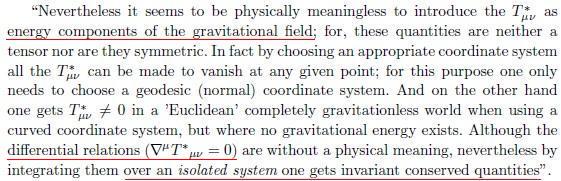
1. The energy components of the gravitational field
are dynamical phenomena. They are produces by the
dynamics of spacetime and the sufficient conditions for
spacetime. Your current GR textbooks
cannot include the Unmoved Mover (Karel
Kuchar), which makes them
essentially incomplete, as stressed many years ago by
Albert Einstein.
2. The "differential
relations" (details above) could be
considered "without a physical meaning" only
in a genuine classical theory. But they do not describe 'classical reality out there'
fixed at particular "point", because
Einstein's Allgemeine
Relativitätstheorie
is not a genuine classical theory. Namely, the
wegtransformierbar faculty of gravity 'at a point' (Afriat
and Caccese, p.
27) enforces the general idea of
Erwin Schrödinger: "measuring
it does not mean ascertaining the value that it
has", as it would have been in the case of 'classical
reality out there at a point'. Which makes the localization of
gravitational energy-momentum a genuine quantum-gravitational
phenomenon: the very geometrical "points" become quasi-local.
Your differential geometry textbooks (e.g.,
Chris Isham) are essentially incomplete regarding
Quantum Geometry. The only way -- let me
repeat: the only way -- to restore the notion of
'reality' in quantum-gravitational realm is by 'potential
reality' evolving along the Arrow of Space, because the current
paradox or
"problem" of time is unavoidable due to "the invariance of
classical general relativity under the group Diff(M) of
diffeomorphisms of the spacetime manifold M (Chris Isham,
pp.
4-5).
In both QM and GR we face a genuine flexibility
of quantum and gravitational systems, because their fleeting
macroscopic presentations
cannot be derived exclusively from the relativistic
support in their past light cone -- this is the lesson from
the
Free Will Theorem. The
main difference is that in QM we have probabilistic
expectations about the explication of these 'jackets'
at macroscopic length scale,
while in the proper GR 'the universe as
ONE' performs "measurements" by
halting (or "collapsing") the so-called freely falling elevator
to produce gravity & inertial mass (and also eliminates the
"negative" mass at every instant 'now' in the local mode), yet in both cases the
joint quantum-gravitational world is not a genuine 'classical reality out there
at a point' (hence the aether is physically
nonexistent).
3. Notice the underlined
puzzle in the last sentence: how come we use a manifestly wrong
theory about 'isolated system' (see
above), yet obtain invariant
conserved quantities ?
It is like asking why we use a
wrong "projection postulate" and obtain correct results, or
bluntly ignore the quantum vacuum (John Baez,
case 4), yet again obtain correct results.
Because we eliminate the
global mode of spacetime, particularly the 'sufficient
conditions', by calculations with linearized
gravity. Physically, we can only obtain one single
dead frozen and perfectly localized universe in the
local mode of spacetime. The latter is a
perfect continuum, like instantaneous snapshots from a movie
reel "separated" by zero 'dark
Zen gaps'. Such instantaneous physical universe contains no
"dynamical dark energy" and no gravitation, in
line with the Equivalence Principle. None. We may think of it as an asymptotically flat
(Friedman) universe which has become an 'isolated
system' due to eliminating its gravitational source,
hence obtain invariant conserved quantities
(see Hermann Weyl above). We may also use the "conservation law", Eq. 1 in
the paper above, and also fix the
GPS system, but cannot use such handicapped linear
theory for objects larger than the solar
system. No way. Forget it.
Again, both the gravitational
energy and "dark energy" are caused by accumulating
and binding such point-like local universes by the
Arrow of Space and the 'sufficient conditions
for spacetime': see option YAIN (iii)
above. Surely you can ignore them in particular
circumstances but, if you study the
gravitational waves and the dynamics of spacetime itself, you cannot derive 'time
in GR', gravity, and their "dark energy"
exclusively
from the 'necessary conditions for
spacetime' of your current
GR textbooks.
The
quasi-local
geometrical "points" of the dynamical spacetime of Machian
quantum gravity are indeed emergent
phenomena. You also need the Arrow of Space
to explain (cannot "prove" with theorems) the obvious positivity of mass -- "an
important test for quasi-local energy expressions" (Lau
Loi So et al.). The Machian quantum gravity is the
only way to explain the physical absence of
"negative" matter residing in the
dark Zen gaps, which "accelerates"
the physical, positive-mass universe by 'self-action'.
Thus, the energy of the universe springs from a dimensionless geometrical
point (Luke
17:21), and of course cannot be
traced back, which makes it sort of "dark"
to people like Chuck
Norris.
Just like with the
human brain, we cannot physically
observe the mind and consciousness, but only a self-acting
and bootstrapped physical system: Der Geist bewegt die Materie.
You have no
choice. None. Zilch.
Says who? "Just
another crank", of course. More from Max
Planck.
D. Chakalov
November 9, 2012
Last updated:
November 13, 2012, 08:50:34 GMT
============================================
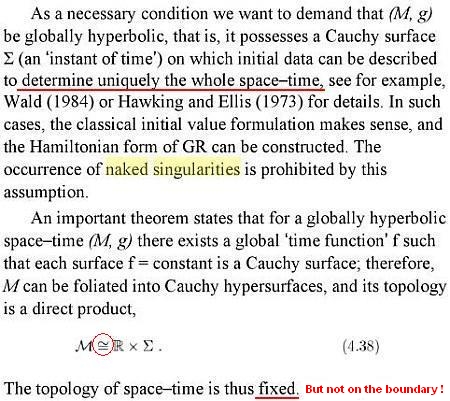
Claus Kiefer, Quantum Gravity,
2nd ed., 2007,
p. 106.
--------------
Subject: Once a coordinate is chosen to
be the time...
Date: Fri, 30 Nov 2012 13:52:23 +0200
Message-ID:
<CAM7Ekxm3agJ7h4KMQkQdL1hcDQiV8iLr9HD+QbkW=-Cw7g=8Qg@mail.gmail.com>
From: Dimi Chakalov <[email protected]>
To: Marcos Duarte Maia <[email protected]>
Cc: [email protected],
[email protected],
[email protected],
[email protected],
[email protected],
[email protected],
[email protected],
[email protected],
[email protected],
[email protected],
[email protected],
[email protected],
[email protected],
[email protected],
[email protected]
Dear Professor Maia,
Thank you very much for your wonderful article [Ref.
1]. It is amazing to me how you managed to compress an
enormous volume of knowledge into five pages.
May I share with you and your colleagues some ideas and
alternative proposals.
1. Surely the cosmological "constant" originates from the
contracted Bianchi identity, but I think the latter is totally
unclear, because we don't know how to explain the "conservation"
(if any) of energy in GR and the gravitational energy density at
a "point" (MTW, p.
467), to attach some
tangent vector at this (quasi-local)
"point".
2. Surely we need to reach from GR some 'limiting case'
resembling, but not necessarily identical to, the Minkowski
spacetime [Ref. 1], provided we can
understand task (1) and the underlying Equivalence
Principle, but I think the 'limiting case' can only be defined
after we solve the problems of spacetime from Quantum
Theory,
http://www.god-does-not-play-dice.net/#KS_Mott
In other words, first things first.1
3. Once we solve tasks (1) and (2), we
might (hopefully) understand the nature of time, which I think
is defined by the dynamics of space, namely, time emerges not as
'change in space' but from 'change *of* space', which leads to
the so-called Arrow of Space,
http://www.god-does-not-play-dice.net/#inherited
To sum up, once we unravel the proper mathematical formalism for
quantum gravity, there will be no need for "black holes" nor
"multidimensional superstitions" (Sheldon Glashow) to explain
the propagation of gravitation, and those
dark tunnels of LIGO will be converted to wine cellars --
all we need is to keep the temperature around 14 degrees C.
Any other ideas?
All the best,
Dimi Chakalov
[Ref. 1] M. D. Maia, On The Topological Nature of the
Cosmological Constant,
arXiv:1211.6883v1 [gr-qc]; International Journal of Modern
Physics: Conference Series, Vol. 18 (2012)
109-114.
p. 1: "From the mathematical point of view, the cosmological
constant originated from the contracted Bianchi identity (XXX)=
0. This conveys to the conclusion that the Einstein tensor
(between the parenthesis) should be proportional to (g_xx)= 0
which is the defining condition for the Levi-Civita connection.
........
"... so that the existence of the Minkowski space-time as a
solution of the classical Einstein’s equations would be
guaranteed.
........
p. 2: "In this case, once a coordinate
is chosen to be the time, ..."
.......
"Thus, in Einstein’s theory, the gravitational field does not
possess the same four-dimensional constraint, meaning that
gravitation may propagate along extra dimensions in excess of
four, but it also propagate in a space-time subspace of some
higher-dimensional space."
-------
[4] M. D. Maia
Geometry of the Fundamental Interactions. Springer, New York
(2010).
-------------------------------------
1
After solving the measurement and macro-objectification
"problems" in Quantum Theory, the spacetime manifold
becomes "quantized" from the outset, namely, the local
(physical) mode of spacetime is presented with a
perfect continuum at all length scales, while
the 'dark Zen gaps' (global mode of
spacetime) are totally eliminated as 'physical reality' due to
the "collapse" and the "flattening" of
spacetime -- one-at-a-time by the Arrow of
Space. The latter does indeed "determine uniquely the whole
space–time" (C. Kiefer, p. 106), but only
for one dead frozen instant 'now' (see option YAIN (iii)
above). Otherwise you won't be reading
these lines, because the human brain cannot
function in the dead frozen spacetime of your GR textbooks (László Szabados);
details from Max Tegmark.
Don't be fooled by the 'nose-arm dualism'
either -- recall the pre-established or EPR-like [Ref.
2] harmony
from
Gottfried Wilhelm Leibniz: the UNspeakable, pre-quantum
Kochen-Specker state exists like the
monads which "have no windows through which something can enter
or leave" (Leibniz,
Monadology §7). Only in our case we've introduced the
so-called John's jackets metaphor, in which
the physicalized 'jackets' (as observed in the
double-slit experiment above) resemble
(but are not identical to) the
physicalized sayings in the example with the human brain
provided previously. We cannot in principle observe the
UNspeakable, pre-quantum monad or Platonic Idea
-- only its distorted
"shadows", as in the double-slit experiment.
If you nevertheless insist on applying the laws of Special
Relativity, you'll get "into a blind alley from which nobody has
yet escaped" [Ref. 3], firstly because if
you really insist on some particle-like interpretation
(cf. Art Hobson,
p. 14),
you will have to introduce the notion of 'objective reality
out there' from Special Relativity, and face the question of
the relativistic history of that "particle" in the past
light-cone of your reference frame, way down in the "blind
alley", just as in the case with the
past state of the Sun.
To avoid misunderstandings, check
out three physicalized "particles", or rather 'jackets',
with your brain:
1. All are not hunters that blow
the horn.
2. La robe ne fait pas le médecin.
3. Es ist nicht jeder ein Koch, der ein lang Messer trägt.
Simple, no? If you can do it, 'the
universe as a brain' can do it as well; maybe even
better. The main idea from GR is that
the physicalized "jackets" are driven by the
Arrow of Space. Only
the non-Archimedean geometry of 'the
quantum state', embedded in
'the universe as ONE'
(global mode of spacetime), is missing. More
from James Dungundji.
As to converting LIGO tunnels to
wine cellars (what else?), recall the main issues with the BMS
group of Hermann Bondi,
published in 1962 (cf.
Evangelos Melas):
(i) the assumption that the Minkowski metric -- "a shadow
without power",
Hermann Weyl -- would
be perturbed by the incoming GWs,
and (ii) Bondi's news functions (Paper
VII), related to the alleged loss of mass
by the gravitating system (cf. Marcos D. Maia, Gravitational
Waves from Coalescing Binary Sources, Int. J. Mod. Phys.
D, 19 (2010)
2295-2298).
D. Chakalov
December 1, 2012
Last updated: December 6, 2012, 05:45 GMT
[Ref. 2] John C. Polkinghorne, Quantum Theory: A Very Short
Introduction, Oxford University Press, 2002,
p. 81.
"It is as if a singer at 1 was
singing a random series of notes and a singer at 2 was also
singing a random series of notes and only if one were able to
hear them both together would one realize that the two
singers were in some kind of harmony with each other."
[Ref. 3] Richard Feynman,
The Character of Physical Law, The MIT Press, Cambridge
(MA), 1965,
p. 129.

=========================================
Subject: On the total mess in GR,
arXiv:1212.0147v1 [gr-qc]
Date: Tue, 4 Dec 2012 10:23:17 +0200
Message-ID:
<CAM7Ekx=fadw89v6yAOTHsmiDzP2JiWw_MzSU5RTTzLghcRWo8A@mail.gmail.com>
From: Dimi Chakalov <[email protected]>
To: Laszlo B Szabados <[email protected]>
Cc: Adam Helfer <[email protected]>,
Harvey S Reall <[email protected]>,
Jörg Frauendiener <[email protected]>,
Karel V Kuchar <[email protected]>,
Helmut Friedrich <[email protected]>,
Robert M Wald <[email protected]>,
Paul Tod <[email protected]>,
Robert Beig <[email protected]>,
Bernard J Carr <[email protected]>,
John Baez <[email protected]>,
Luca Bombelli <[email protected]>,
Gary Horowitz <[email protected]>,
Domenico Giulini <[email protected]>,
Claus Kiefer <[email protected]>,
Shing-Tung Yau <[email protected]>,
Ed Witten <[email protected]>,
Richard M Schoen <[email protected]>,
Niall Ó Murchadha <[email protected]>,
Xiao Zhang <[email protected]>
Hi there,
The so-called "gauge conditions on closed spacelike
hypersurfaces" and "spacetimes which are asymptotically flat at
spatial or null infinity" cannot exist, for reasons explained at
http://www.god-does-not-play-dice.net/#Maia
Thus, you shouldn't muse on some "two-surface integrals on
spheres at the spatial and (e.g. future) null infinity." Unless,
of course, you enjoy the total mess in your GR textbooks and
arXiv:1212.0147v1 [gr-qc],
http://arxiv.org/abs/1212.0147
As always, I will be happy to
provide specific arguments.
All the best,
Dimi
---------------
Note: Read the paper by László Szabados below;
I emphasized some notions from it, but will refrain from
posting mathematical arguments at this web site.
As explained above, the rule is "do not
throw your pearls to pigs" (Matthew
7:6).
Firstly, you simply can't outsmart
Nature with math. The red herring in GR textbooks is the mathematical
presentation of 'time', which inevitably requires the points
of 'time instants', with well-defined, localized
gravitational energy density at these points.
Which is, again, red herring. We need quantum gravity to develop
the correct General Relativity, not its classical approximations,
such as those in the current GR textbooks.

If László Szabados defines the "strength" of the gravitational 'field' at some
"instant" represented with some "closed hypersurface", such magic
calculation will inevitably require
localized and finite energy
density of the same gravitational 'field' at that
point/instant.
You may try to bypass the gravitational density problem at an
'instant', like Niall Murchadha did,
but will again end up with red herrings,
and
pigs will fly.
No matter what you do, even if you
try to speculate about 'regions', the latter are made up by
"points" that cannot be defined with the classical
approximation of General Relativity from your GR textbooks.
Since spacetime is defined by matter & energy, but the latter
cannot be mathematically defined at any "point" with classical
approximations, you need quantum gravity to resolve the
localization of matter & energy at geometrical quasi-local
points, and their temporal existence and dynamics. It's a
bundle, because the nature of time is
the dynamics of spacetime
itself (forget about LIGO) in terms of 'change
of space' (Arrow of Space).
You may ignore the absence of mathematical
presentation of 'time' only in some very limited case such as
'flat background spacetime'. Then you may imagine that this
fixed flat background spacetime has provided "time" and
"localization at a point", and subsequently some well-defined
"points" with which you may calculate the "conservation" of energy
and the "total mass", after which you may amend the lame
incomplete math with the seemingly obvious,
yet
mathematically non-existent phenomenon of 'time'. But not
in General Relativity.
You may not invoke the idea
of some "isolated system" in order to "get invariant
conserved quantities" (cf. Hermann Weyl, Space-Time-Matter,
1922, p. 270 above), because you
cannot define an
isolated gravitational system in the
first place. Only
Chuck Norris can see and verify 'the only truly isolated
system' -- the universe as a whole, from which we have 'time'
due to the so-called 'sufficient
conditions for spacetime'. The math is still
unknown, so don't try to replace it
with some "obvious" imagination and wishful thinking.
The obvious difference
between a "point" vs
"finite region" is that the latter is comprised from the former,
and should be calculated by integration, but without any
"background". You need 'time' to
mimic this process mathematically, but 'time' is absent in GR
textbooks: you have to deal with only one dead frozen instant/point,
regardless of how "large" the chunk of spacetime
"obviously" is.
Mathematically, you have eliminated the phenomenon of time (Bob
Geroch) and are left with only one dead frozen instant,
which is why you cannot discriminate between the obvious 'points'
and 'finite region'. You're nevertheless tempted to amend your math with your
"obvious" imagination, but this is exactly what makes
pigs fly.
D. Chakalov
December 4, 2012
Last updated: December 8, 2012, 11:17 GMT
--------
László B Szabados, On total masses
in GR,
arXiv:1212.0147v1 [gr-qc].


===================================================
"In his inaugural lecture, Einstein discussed the metric field
as a kind of ether, acting on, and (at the same instant -
D.C.) being acted upon by matter; a definite state of motion,
however, could not be ascribed to it. In deference to
Lorentz, he even said that “the ether of the general theory of
relativity is the outcome of the Lorentzian ether, through
relativization”; see Einstein, Äther (ref. 2), p. 13; 178."
Jeroen van Dongen,
arXiv:1211.3309v1, footnote a, p. 1.
-------------------
Subject: Time in GR:
arXiv:1211.1718v1 [gr-qc], Sec. 2
Date: Fri, 9 Nov 2012 13:39:45 +0200
From: Dimi Chakalov <[email protected]>
To: Sebastian Szybka <[email protected]>
Cc: [email protected],
[email protected],
[email protected],
[email protected],
[email protected],
[email protected],
[email protected],
[email protected],
[email protected]
Dear Dr. Szybka,
Regarding your projection diagrams, I wonder if you can
introduce time parameter from the scale
factor,
http://www.god-does-not-play-dice.net/#Fred_Hehl
Otherwise you simply cannot model the stable causality and global hyperbolicity,
I'm afraid.
The professional opinion of your colleagues will be greatly
appreciated, too. Please pass this email to Dr. Christa Ölz as
well.
Kind regards,
Dimi Chakalov
-------------
Note: I don't like
"miracles", such as the emergence of Lorentzian metric from some
"foam". Besides, 'time as
change' doesn't make sense in GR textbooks, because there
is no motionless background spacetime to define relationally
'time as change'. If you wish to introduce some "big bang" to play the role of reference object with
fixed 'zero cosmological time',
you'll have a "half-dynamical" spacetime, while we need a
genuine reference object, such as the
reference fluid in GR -- it can't "move" anywhere, simply
because it is ONE.
People try to introduce some background by
hand, and fail miserably. They also try to
"explain" the obvious positivity of mass,
the stable causality and global hyperbolicity
by introducing some "theorems" that would resemble "explaining"
the phenomenon of heat only by postulating its existence,
because otherwise the world would look totally different, while
we need to explain it as emerging from something entirely
different, like 'kinetic energy'. Following this (certainly
rough) analogy, we introduce the notion of 'sufficient
conditions for spacetime' and zoom on the
geometry of spacetime.
Notice the metaphysical
presumption about 'transience' and 'flow of time' in option YAIN
(iii) above, which treats the
misfortunate idea about "curvature" as a wrong
statement by some 3-D Flatlander who cannot in principle "see" the
w-axis
of the Arrow of Space.
In a nutshell, we claim that the
physical influences -- matter acts on geometry by
determining spacetime -- and the physicalized (due
to the
sufficient conditions) influences --
geometry "acts back" on matter via its spacetime -- lead
to self-acting matter, as these bi-directional
instantaneous influences (cf. Escher's hands below) converge
on every quasi-local point
P in the first drawing below. Also, the quasi-local point
P carries these bi-directional influences along the Arrow
of Space (the flow
of Heraclitean time), from the
inherited and irreversible past
toward the potential and "open"
(James Dungundji) future, hence constituting a new retarded causality dubbed
biocausality.
The initial ideas about Quantum
Geometry and torsion are based on the
Arrow of Space and biocausality (notice the
red arrow in the elevator
above), and include the following
statements: we can only claim
(not physically observe) the actual existence of an
instant 'now', which is fixed simultaneously at all points P
constituting a linearized or physical universe 'now'
(local mode of spacetime), and also consider this instant
'now' to be "slippery" due to its different
referential states -- inherited past and potential future --
which are stacked on a "skewer" along the
w-axis
of the Arrow of Space in the global mode of spacetime
(cf. the first drawing below).
The only change of the instant
'now' comes from the change of its referential 'past' and
'future' states, but due to the "speed" of light
these different states can be identified post
factum only. Also, the re-creation
of the universe, in terms of emergence of
spacetime, is the essence of the Arrow of Space: physically,
it can only
be detected post
factum, and because it runs continuously along the
w-axis
arrow, the potential states available for the selection
of the next, and
certainly different, 'past' and 'future'
physical states ("jackets") are
shifted in the potential future, like in a
pocket of propensities. Physically, these potential
states cannot be observed in principle, because we
inevitably "flatten" (or "collapse", as in QM
textbooks) the
Arrow of Space at the very instant of observations: see
the Kochen-Specker Theorem and the
"mysterious cat Macavity" (Adam
Helfer).

The
w-axis
of the Arrow of Space
We cannot witness
the transition itself "online",
firstly because no unanimated clock can read the luxonic time (cf. the
animation by
John Walker above)
from the Arrow
of Space. The nonlinearity and self-action of matter,
from being
bootstrapped by its gravity, come from the
global
temporal nature of the metric field (Albert
Einstein), shared also by all living creatures: at any
quasi-local instant P we have
two simultaneous nonlinear interactions (marked with
small red arrows in the drawing above), such that "the metric is treated as a field
which not only affects, but also is (at the same instant -
D.C.) affected by, the other fields" (John
Baez).
"All agree that in general
relativity, the metric tensor gij is (or better:
represents a field that is) dynamical: it acts and is
(at the same instant
- D.C.) acted on.
They also agree that it is a special field since it couples to
every other one, and also cannot vanish anywhere in spacetime.
Many authors go on to say that the metric tensor represents
geometry, or spacetime structure, so that geometry or spacetime
structure acts and is
(at the same instant -
D.C.) acted on" (Jeremy
Butterfield).
Which goes first? Because of
well-known reasons, your
unanimated classical "wrist watch!" (Chris
Isham) cannot answer this question, and you have to seek
refuge in the old "linearized" approximation.
The solution comes with
the quasi-local "points" in
Quantum Geometry. The Escher hands
above can easily explain the puzzle of self-action:
picture one of the mirror hands as quasi-instantaneous
(thanks to the 'sufficient conditions')
influence of 'the school of fish' on every quasi-local
'fish' from the picture above. And at the
same quasi-instantaneous instant of "writing", the other
mirror hand also "writes on" or influences the rest of
quasi-local 'fish' from 'the school of fish' (=the whole
universe as ONE) by their gravitational field, and via
their gravitational field that has bootstrapped
the whole 'school of fish'. Again, the mirrored hand(s) display
a fundamentally non-linear interaction (dynamical "talk")
of all tangible and intangible (Hermann Bondi)
forms of energy, quasi-simultaneously at each and every
quasi-local point P , which makes the observable,
physical "hand" in the right-hand side of Einstein field
equations self-acting. Physically, we cannot observe the
whole 'school of fish' en bloc, which is why we need the
'sufficient conditions for spacetime'.
The only way to animate
this bi-directional and quasi-instantaneous "talk"
between the two sides of the Einstein filed equations is with the
w-axis
of the Arrow of Space, depicted above. We need a pocket ("cone")
of propensities to separate the two "hands" and
allow them to interact non-linearly on
every point P , which is the crux of
Quantum Geometry.
We cannot resort to the
simple case of linearized "talk" over a fixed background
spacetime in classical electrodynamics, as depicted in the
picture from
Alex Altland below.

Details from Ruben Aldrovandi and
Jose Geraldo Pereira above. Physically, we can only claim that
a positive matter has been
post
factum selected to represent the physical world, and has
also been
post
factum endowed with 'self action' by its gravitational
energy, after which we inevitably face its "dark" origin.
In summary, if you don't like
"miracles", you will need new math to explain
the fundamental nonlinear connection at all
self-acting points
P , starting from a plain
Borel set. The task goes back to 1912 (Jean-Pierre
Provost):
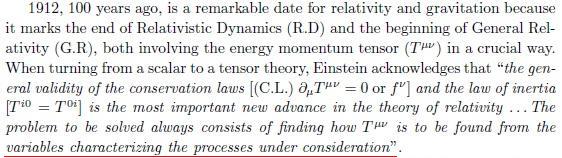
But if you prefer
miracles in
mathematical physics, you may enjoy
Murphy's Law No. 15:
Complex problems have
simple,
easy-to-understand wrong answers:
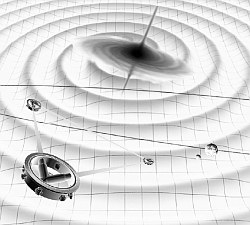
Check out
Harvey S. Reall, General Relativity 2012 (M24),
19/11/12, Sec. 5.2,
p. 53 ("the gravitational field can do work on the
matter in the spacetime"), and Sec. 8.5,
p. 92, "the gravitational waves arise when Iij
varies in time".
First you need to discover the
spacetime event P at which the gravitational
field does work on the matter in spacetime, presented in
the r.h.s. of the Einstein field equations (MTW,
p. 467), and then
explain exactly how "gravitational waves arise when Iij
varies in time" (Harvey Reall,
p. 92), as read by your "wrist watch!" (Chris
Isham). But the first task requires (not "implies")
that the gravitational energy density at the point
P does exist in the first place, which in
turn requires that the spacetime
metric is dead locked on this same point P ,
and the spacetime itself becomes a dead fixed background, "which
is there before the wave arrives and after it
passes" (Bernard Schutz), hence
enables people like Harvey Reall and LIGO
operators to record with their wristwatches the instants
at which the "ripples" of spacetime metric
pass through LIGO, just as the local disturbances (e.g., minor
earthquakes) do in Minkowski spacetime.
In other words, you
must
assume from the outset that the well-known problem of
gravitational energy 'at a point' (MTW,
p. 467) can be
solved in principle, as if it were only a matter of
changing the calculation technique, say, by
changing the type of coordinates. In you case, you simply "go to second
order in perturbation theory" and proceed by "setting h
to zero" (Harvey Reall,
p. 92). Thus, you consider zero amplitude
of gravitational waves, which match
zero torsion and zero amplitude
of quantum waves (macroscopic, classical, and
gravity-free world), and expect to detect
by 2020 some work (Harvey Reall,
p. 53) done on the matter in spacetime by such
dimensionless amplitude/strain.
Forget it.
Detecting GWs with LIGO is a pink unicorn. Or red herring, if
you prefer something more realistic. The self-acting
faculty of matter-and-gravity requires (not "implies") that
gravity "can do work on the matter in the spacetime"
(Harvey Reall,
p. 53) at the same point/event in spacetime in which
the gravitationally affected (past perfect) matter had
already defined the same spacetime that was
acting on it in the first place.
Which goes first? That's
the origin of the problem of time in GR
textbooks. You need to derive a new type of
background, ensuing from "the
fact that gravity carries energy and is thus a source of
more gravity (emphasis mine - D.C.). In this sense
gravity differs fundamentally from the electric field, which
does not carry charge and thus is not the source of more
electric field" (Ron J. Adler,
p. 14;
see details in
p. 301 and Ch. 9 from
Ronald Adler et al., Introduction to General
Relativity, McGraw-Hill, New York, 1975).
Surely the
self-action of matter coupled to itself by its own
gravity is fundamentally nonlinear (Hermann
Bondi). Besides, we can only detect matter in the
r.h.s. of the filed equations, acting on itself via
gravity in the l.h.s. of these filed equations, just as we can
only measure the self-action of the
human brain -- not its unphysical "field" called mind and
consciousness (or geometry, in our
case). The solution to this very old and widely known
which-goes-first puzzle is explained at this web site, and
those LIGO people can do nothing to avoid it. They can only keep
dead quiet and waste taxpayers' money.
D. Chakalov
November 15, 2012
Last update: November 29, 2012, 17:17:17
GMT
=========================================

Subject: A picture is worth a thousand words: The geometry of
torsion & curvature coupling
Date: Fri, 16 Nov 2012 03:42:42 +0200
From: Dimi Chakalov <[email protected]>
To: Yu-Huei Wu <[email protected]>,
Chih-Hung Wang <[email protected]>,
Seyen Kouwn <[email protected]>,
Carlos Romero <[email protected]>,
Miguel Socolovsky <[email protected]>,
Eric Adelberger <[email protected]>,
Nikodem Poplawski <[email protected]>,
Andre Tilquin <[email protected]>,
Thomas Schücker <[email protected]>,
Vincenzo Cardone <[email protected]>
Dear colleagues,
Please excuse my unsolicited email.
In order to think about how spacetime "bends" in GR, I believe
we should explain curvature-and-torsion with a clear and simple
drawing. The usual reference to the book by Manfredo Perdigão do
Carmo (Differential geometry of curves and surfaces,
1976)
wasn't helpful regarding a picture which would "worth a thousand
words".
If possible, may I ask you to help me find the geometrical
presentation/picture of 'torsion', together with the geometrical
presentation of 'curvature' and
Levi-Civita connection. For
example, I've been trying to explain 'curvature' with the
horizontal green vector, and 'torsion' with the orthogonal
yellow and dark blue vectors in the drawing attached (cf.
torsion.jpg), borrowed
from
http://upload.wikimedia.org/wikipedia/commons/7/7b/Circle_nebeneinander_animated.gif
I'm afraid the geometrical picture is far more complicated, and
will appreciate your help.
Kind regards,
Dimi Chakalov
-------------
Drawing attached:
-----------------------------------------------
Note: To understand about how spacetime "bends"
(it doesn't) along the Arrow of Space,
let me reiterate that the notions of "curvature" and "dark" [you-name-it]
are artifacts from "binding" the consecutive states of
gravitational systems on a dead frozen manifold which has no
'flow of time' at all. If we bind them properly (cf.
option YAIN (iii) above), we can
examine only one instantaneous physical snapshot from
the Arrow of Space, in which there is
no "curvature" nor "dark" [you-name-it],
and the total gravitational interactions over this whole
instantaneous 'now' universe are already made linear,
so we may use the insights of Einstein
and the
Bianchi identities, but again: only for
one instant 'now'.
However, once we admit the
phenomenon of flow
of time specified with option YAIN (iii)
above, all "dark" effects of gravity, the
curvature and torsion included, are resulting from the physically
undetectable binding by the
Arrow of Space (cf. the dark Zen
gaps) of an infinite "number" of such independent and fully
linearized instants 'now', and the task of
explaining the curvature and torsion is
shifted to the global mode of spacetime.
Namely, instead of one "horizontal" snapshot of one dead
frozen physical universe 'now' (Robert Geroch),
we have a "vertical" fusion of
uncountably infinite universes 'now' along the "skewer"
w of the
Arrow of Space. People wrongly "bind"
these universes into one "horizontal" universe endowed with "memory", because
they are terribly mislead by the fact that every wristwatch ("I
can certainly read the time on my wrist watch!",
Chris Isham) does read the Arrow of Space, even though
it cannot read the luxonic time and cannot
detect the dynamic emergence -- one-at-a-time -- of the
continuous chain of universes 'now', endowed with
curvature and torsion.
Briefly, in both cases we bind the
"points" to mimic Nature and obtain 'one composite universe',
but the difference is that, since the theoretical
physicists cannot find the Unmoved Mover,
they 'put the cart before the horse' with thermodynamics,
although it is agonizingly clear that no
physical stuff can ultimately 'move itself'
to produce the flow of time. Thus, all they can do is
shrug their shoulders and claim that the flow of time
doesn't exist, "because" (notice the
Marxist-Leninist "logic") it cannot exist in their
textbooks that failed to explain up to 96 per cent of the world in
the first place, and consider it "dark".
Alternatively, in the Machian quantum
gravity, the binding of quasi-local points by the
Unmoved Mover is presented with the 'sufficient
conditions for spacetime' in the global mode of spacetime
]between[ the quasi-local
"points", thanks to which in the local (physical) mode of
spacetime these 'dark Zen gaps' totally
disappear, and the resulting physical continuum is
perfect, at all length scales. Again, we need the global mode to
make 'the ONE universe' an isolated system with
boundaries: the unphysical or
ambient "part" of
the universe, with respect to which the physical one is defined,
has not been swept under the carpet with some "asymptotic"
recipes, but is brought back
into spacetime in the form of 'global mode of
spacetime', and the universe is self-determined.
Recall also that the pocket (or
"cone") of propensities in the previous drawing
above exists only along the
w-axis
of the Arrow of Space; physically, it is always zero, as
shown with the Kochen-Specker Theorem.
Physically, we can only observe distorted
shadows from the genuine quantum-and-gravitational reality
projected on 'the curved wall of the
cave'.
This is the only possible solution, and if we put aside
some terminological suggestions, this solution
is known for centuries:
Der Geist
bewegt die Materie. Physically, it (not He) may look
like 'the ideal monad without windows', also
known as
Luke
17:21.
Sorry for repeating this here;
please bear in mind that there is no other option to
suggest for 'spacetime geometry of the ONE universe'. Now let's go
back to the curvature-and-torsion, which induce the impression
that the wall in Plato's cave may be "curved".
Let me first stress
that the geometrical presentation of curvature-and-torsion at a
point P is not relevant to the
Frenet-Serret equations. People may claim that 'curvature'
measures deviation of a curve from lying along a straight line,
while 'torsion' measures deviation of the same curve from lying
in a plane, but our task is strictly focused on the geometry and
topology of spacetime, which cause specific physical effects
on matter -- not abstract mathematical musings.
For examples of irrelevant
math, see an excerpt from Victor Toponogov and Vladimir
Rovenski, Differential Geometry of Curves and Surfaces,
2005, Sec. 1.8,
p. 45:

See also the Java animation
Osculating plane and torsion by Martin Raussen (the torsion is
depicted with small green segment),
from his 2008 book Elementary Differential Geometry: Curves and
Surfaces,
p. 79.

Fig. 1
Recall that a 3-D Flatlander is inevitably confined in the
"inflating" (by its "dark energy") space with its three possible
directions defined by the metric, yet he can measure the scale
factor and subsequently its 'time read by a
clock at P ' along
the radius of
Ned Wright's balloon, which is why the poor guys (Ned
included) cannot see the
w-axis compactified
exclusively on the red point
P , nor the genuine geometry and topology of spacetime
depicted with the green
curvature-and-torsion segments (not arrows) in Fig. 2 below (compared it
to the initial torsion drawing above).
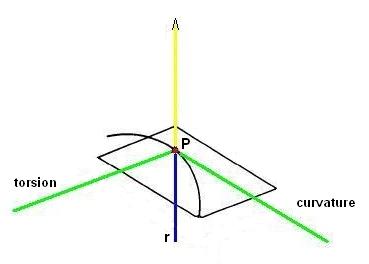
Fig. 2
Notice that in the case of negative curvature ("saddle" from
a torus), the two green segments and the yellow "arrow" will
be reversed, as in 'catching a lion in
Sahara'.
Unfortunately, all these kinematic examples cannot
address
the crucial question about how geometry and topology "strike
back" on matter at the very same instant
P at
which matter acts on geometry-and-topology (or the other way
around) due to the flow of time.
Notice that a 3-D Flatlander would
be tempted to introduce the two orthogonal
green axes at the quasi-local point
P , hence produce altogether three
orthogonal unphysical axes, yet none of which can display
the
w-axis
(not shown) compactified exclusively on the
red point P
(Luke
17:21).
So, why is that all quantum and
gravitational systems have "spin" or "rotate"?
Because of some "supermassive black hole"
or maybe "dark energy", or because of
some intrinsic topological property of spacetime
introduced jointly with 'curvature' and called 'torsion'?
Perhaps the torsion originates from the
sufficient conditions for spacetime, and
its coupling to matter becomes evident at quantum scale as "spin" ("eigentümlichen,
klassisch nicht beschreibbaren Art von Zweideutigkeit", Wolfgang
Pauli) and at galaxy scale as "rotation",
ultimately covering the observable universe.
Notice that the point P in the drawing
above
matches the point P in the drawing from
Greg Galloway. The line along which the
yellow and dark blue vectors are positioned also matches the
radius of the "inflating balloon" from
Ned Wright.
It seems plausible that the asymmetric torsion
corresponds to topological degrees of freedom
from the
sufficient conditions for spacetime, and that it must be
nullified in the local
(physical) mode of spacetime, because it acts along the new
w-axis (from
wunderbar, after
Theodor Kaluza) and is
related to the flow of time, in line with the option YAIN (iii)
above. If so, the torsion may only cast
two components orthogonal to the green "tangential
vector" in the drawing above, and will alter matter at the point
P jointly with "curvature",
but along the
w-axis
(not shown) orthogonal to the drawing plane
above.
The easiest way to proceed would
be to seek comfort in the old geometrical model and its
Levi-Civita connection,
and ignore the efforts since the
past fifty years, but the torsion question of 'how space curves'
leads to considerations of the relative length of the
radius of the "inflating
balloon", which some people consider "unphysical"
and have chosen to swept it under the carpet, although they set the same
length of the "balloon radius" to approach asymptotically
infinity in order to define 'positive mass'. Also, the
green
"tangential" vector is commonly used in
GR
textbooks, although it also presupposes the same
unphysical balloon radius and its
quasi-local
point P on
which we cannot define the
gravitational stress-energy tensor and the torsion degrees
of freedom in the first place.
Obviously,
a simple drawing of all geometrical connections
converging on the quasi-local point
P is urgently needed to verify
the
w-axis orthogonal to
all drawings above. It is very difficult to bridge
the abstract musings of mathematicians with the insights of
mathematical physicists trying to understand the bi-directional
"talk" executed at every
quasi-local
point P by matter & geometry-and-topology.
Surely it isn't "linear".
Tough.
Bear in mind that the current GR
cannot determine the topology of spacetime, because (i) it uses
the misfortunate "splitting" of spacetime, "thereby
doing grave injustice to space-time covariance that
underlies general relativity" (Abby
Ashtekar), and (ii)
presumes that the universality of the rate of
acceleration of (positive) matter is an evidence (not
proof) in support of metric theories of gravity, provided that
the torsion and negative matter are excluded from
the outset. Based on these shaky presumptions, people imagine
some asymptotically flat cosmological spacetime, in which
they assume that gravity might be "neglected" (Xiang-Song
Chen,
Eq. 5), but cannot say anything on its actual topology,
which must be determined by all the "dark" stuff in spacetime
and by including the negative curvature (cf. Fig. 2 above)
to derive the
Dynamic Equilibrium Conjecture.
Very tough.
Regrettably, we cannot use an
example with parallelogram [Ref. 1],
because we need a
quasi-local point
P interpreted as "singularity".
Then we have to make P
self-acting, bearing in mind that it builds the geometry and
topology
of 'the universe as a brain', which
resembles an unbroken
ring with no circumference, for the (asymptotic)
"circumference" is nowhere, and the (singularity)
"center" is everywhere.
Acknowledgment
It is a pleasure to thank
Thomas Schücker for suggesting his textbook co-authored by
Meinulf
Göckeler [Ref.
1], and to
Martin Raussen for his valuable feedback.
D. Chakalov
November 17, 2012
Last updated: November 25, 2012, 16:26:51
GMT
[Ref. 1] M. Göckeler and T. Schücker, Differential Geometry,
Gauge Theories, and Gravity, Cambridge University Press,
1987; Sec. 5.9, Geometric interpretation of curvature and
torsion,
pp. 78-80.
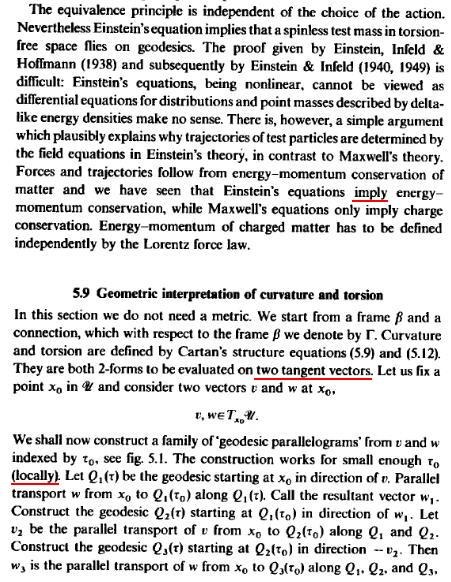
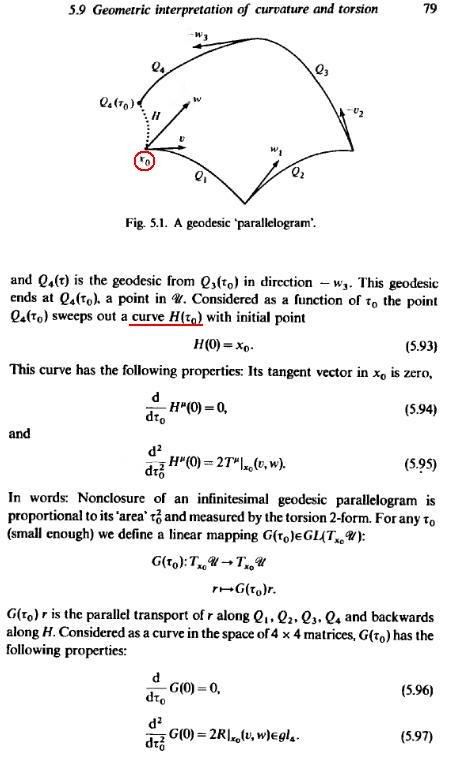
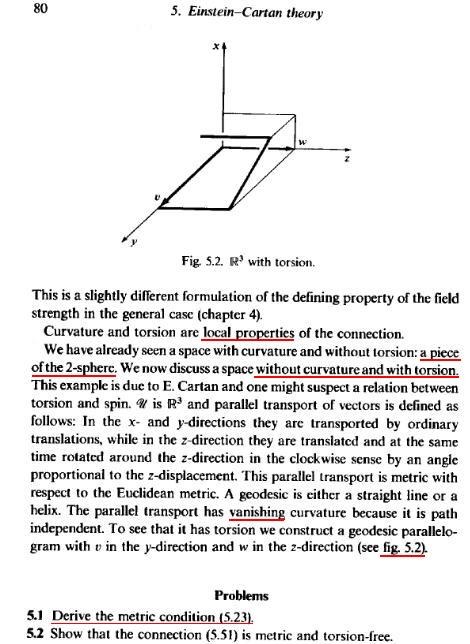
=========================================
Subject: The reference manifold,
arXiv:1207.0626v1 [gr-qc]
Date: Wed, 4 Jul 2012 13:53:16 +0300
Message-ID:
<CAM7EkxnMrqsSTP4GheEmw_Lt1diZj3DsxHk=htmekQPFN=4L2Q@mail.gmail.com>
From: Dimi Chakalov <[email protected]>
To: Angelo Tartaglia <[email protected]>
Cc: Sergio Doplicher <[email protected]>,
Sergiu Klainerman <[email protected]>,
Catherine Meusburger <[email protected]>,
Laszlo Szabados <[email protected]>,
Adam Helfer <[email protected]>,
David Brown <[email protected]>,
Karel V Kuchar <[email protected]>,
Steven Weinberg <[email protected]>,
Waldyr A Rodrigues Jr <[email protected]>,
Manuel Bärenz <[email protected]>,
Eduardo Notte-Cuello <[email protected]>,
Thomas Thiemann <[email protected]>
Dear Angelo,
With all due respect, I think 'the reference manifold' [Ref.
1] should be the reference fluid of GR ("The particles of the
reference fluid identify the points of space, and clocks carried by
these particles identify the instants of time." J.D. Brown and K.V.
Kuchar, arXiv:gr-qc/9409001). The latter
should be sought by offering solutions to (i) the measurement and
macro-objectification problems in Quantum Theory, and (ii) the exact
energy conservation principles in General Relativity (MTW,
p. 467) and the dynamics
of spacetime itself,
http://www.god-does-not-play-dice.net/#first_principles
http://www.god-does-not-play-dice.net/#Munchhausen
http://www.god-does-not-play-dice.net/#ESI
In simple words, we need first to fix the problems of GR and QM, to
introduce a *perfect continuum* from the latter into the former.
The notorious "quantum jumps" (S. Weinberg,
arXiv:1109.6462v4
[quant-ph], Sec. 5) and all "dark" stuff (CDM and DDE)
should be eliminated from the outset.
As a bonus, we may explain the puzzle of the brain dynamics,
http://www.god-does-not-play-dice.net/#Seung
As always, I will be happy to elaborate, should you or your colleagues
are interested. The task is strictly mathematical.
All the best,
Dimi
---------------
[Ref. 1] Angelo Tartaglia, On the emergence of the Lorentz signature in
an expanding universe, arXiv:1207.0626v1 [gr-qc],
http://arxiv.org/abs/1207.0626
p. 2: "According to the considerations I
made above the reference manifold should be an Euclidean one. Mentioning
two metric tensors gives the impression that I am presenting a bimetric
theory. This however is not the case. Only one of the manifolds is
actually existing: the one corresponding to our space-time (the natural
manifold). The reference manifold is not present anywhere; it is not
even a background. It simply is part of a logical description in which
the universe is thought to behave as a deformed continuum. For this
reason the mentioned metric tensor of the Euclidean manifold is no
metric at all in the natural manifold.
[snip]
"Of course this is so in an entirely classical approach, but so far the
puzzle of the role of time and of some background in the attempts to
quantize gravity remains unsolved."
---------
Note: I stated above that all "dark" stuff should be eliminated from the outset, in
the sense that these tug-of-war effects of gravity
are not produced by 'matter' alone (any stuff with positive
energy density is 'matter'), but are purely geometrical effects
from 'the whole universe as ONE' -- please see 'the sufficient
condition for spacetime' above. To be precise,
I postulate "dark gaps" in the global mode of spacetime (cf. Eq.
1, p. 35, in
ExplanatoryNote.pdf), in which the universe is in a
Macavity state -- the
negative energy densities are always "present" iff
there's nobody "there" (local mode of spacetime) to observe them. It may
sound complicated, but the idea of such 'quantized
spacetime' is very old, from Chuang-Tzu: "Before Zen, a tree is a
tree and a mountain is a mountain. During Zen, a tree is not a tree and
a mountain is not a mountain. After Zen, a tree is again a tree and a
mountain is again a mountain." Remove the "dark Zen gaps" with the
so-called speed of light, and you'll be half way
toward the asymptotically flat spacetime and
its dual age cosmology (Luke
17:21).
Again, the task is
strictly mathematical. There is a lot more to be said, but since nobody's interested, I will
stick to 'The Two Rules of Success':
Rule #1: Never tell them everything you
know.
D.C.
July 4, 2012
Last updated: July 12, 2012
================================
Subject: Re: The reference manifold,
arXiv:1207.0626v1 [gr-qc]
Date: Thu, 27 Dec 2012 04:31:08 +0200
From: Dimi Chakalov <[email protected]>
To: Angelo Tartaglia <[email protected]>
Cc: [email protected],
[email protected],
[email protected],
[email protected],
[email protected],
[email protected],
[email protected],
[email protected],
[email protected]
P.S. In addition to my email from Wed, 4 Jul 2012
13:53:16 +0300 regarding some errors in your arXiv:1207.0626v1 [gr-qc],
notice that the speculation about some "propagating
disturbances of the curvature" in your latest
arXiv:1212.6024v1 [gr-qc] is 'not even wrong'. Details at
http://www.god-does-not-play-dice.net/#thank_you
E sarà mia colpa se così è ?
D.
==================================================

Subject: Re: Why are you keeping quiet?
Date: Tue, 4 Sep 2012 14:52:55 +0300
Message-ID:
<CAM7Ekxk8oe=jBRWbT0tR2MqXcLvL-5CXw=xdPoPrpGJ0nbxV1A@mail.gmail.com>
From: Dimi Chakalov <[email protected]>
To: Luciano Rezzolla <[email protected]>
Cc: [snip]
Hi Luciano,
> what you say is right, students are like kids and you want to teach
them right.
Yes I do. How about you?
> I do believe in the existence of gravitational waves and in their
detection.
But it isn't about 'believing' in the existence of gravitational
waves. I also believe in the existence of gravitational waves, for
many reasons.
It is all about their *detection* with any "theory" based on the
linearized approximation of GR. Here, we totally disagree. And you
have enormous problems, starting from the 1944 paper by Hermann Weyl.
You do not have any "theory" based on GR, because you can only offer a
wild guess which, as we all know, run against the full non-linear GR:
check out the first link from my initial email below.
> Besides, these are all big kids and you can be sure they have
independent minds:
> they do what they want and not what I tell them to do.
Fine. You and your adult students
can find the references at my web site.
Once LIGO and Virgo collaborations fail to detect GWs with your
"advanced" -- and horribly expensive -- upgrade of your 'dead turkey',
I will again remind you and your colleagues that you have DELIBERATELY
wasted *billions* of US dollars and Euro for your obsession.
NB: Energy transport by GWs is a fundamentally non-linear phenomenon.
If you use the linearized approximation of GR, you will kill, with your math,
the very effect you wish to measure. It makes no sense to
"enhance the
sensitivity" of what has been a dead turkey from the
outset.
Again, I will not allow you to put the blame on Einstein:
"It is worth reminding ourselves why and where GR might fail. (...)
Any such failure of GR should point the way to new physics." (B. F.
Schutz et al.,
arXiv:0903.0100v1 [gr-qc])
GR will not "fail", because you don't have, and cannot produce, any
theory based on GR in the first place. The only link you make to GR is
with your wild uneducated guess (see again the links in my initial
email), which runs against the full non-linear GR -- see again the
references at my web site. And if you wish to mention PSR1913+16,
check out the facts at
http://www.god-does-not-play-dice.net/#Qiao
Please don't try to claim that you don't understand your problems.
Because you are
not stupid, Luciano.
Dimi
On Tue, 4 Sep 2012 01:44:25 +0300, Dimi Chakalov <[email protected]>
wrote:
>
>> Hi Luciano,
>>
>> Your students are kids, and kids have the right to know everything
you know.
>>
>> Be honest to them. Don't waste their time. There is no way for LIGO,
>> no matter how "advanced", to detect GWs, firstly because your dream
is
>> based solely on wishful thinking:
>>
>>
http://www.god-does-not-play-dice.net/#LIGO_Prague
>>
>>
http://www.god-does-not-play-dice.net/#Bondi
>>
>> You know the objections to "GW astronomy" at my web site, the main
>> references start from 1944, so why are you keeping quiet? Is this
>> because
Bernie Schutz will go mad and you may lose your salary? If
>> that is the case, please don't reply to my email, as you haven't done
>> so since last year.
>>
>> Now, if you are serious about GR, check out a simple task at
>>
>>
http://www.god-does-not-play-dice.net/#Fewster
>>
>> I suggest you discuss it with your students. Tell them everything you
>> know about GR. If you believe can find some solution, please write me
>> back, and we'll have a professional discussion which will prove,
>> again, that LIGO is for the birds.
>>
>> Just don't keep quiet. It's *not* fair to your students.
>>
>> All the best,
>>
>> Dimi
>
Addendum
LIGO is for the birds. You must stop wasting
taxpayers' money immediately.
I will not offer any mathematical paper
until this first off issue is resolved.
Why? Because I don't make presents to
people who totally disregard the basic basics of gravity: it is a
non-linear phenomenon.
Don't use "linear
approximations". Nobody is stupid, Luciano Rezzolla
included. Period.
Dimitar G. Chakalov
September 27, 2012, 01:33:43 GMT
===================================
Subject: Re: Request for opinion
Date: Sun, 10 Mar 2013 22:57:44 +0200
Message-ID: <CAM7EkxkZ1=JE=EULCu++h8PAoyFoe0hSqd85Z-o9PotqB__46g@mail.gmail.com>
From: Dimi Chakalov <[email protected]>
To: Ted <[email protected]>
Cc: Evangelos Melas <[email protected]>,
Josh Goldberg <[email protected]>,
Bill Bonnor <[email protected]>,
Adam Helfer <[email protected]>,
Laszlo Szabados <[email protected]>,
Hans Ohanian <[email protected]>,
Chris Isham <[email protected]>,
Marcos Maia <[email protected]>,
John Klauder <[email protected]>
On Sun, 10 Mar 2013 15:54:13 -0400, newman <[email protected]> wrote:
>
> Dimi,
> This is TOTAL nonsense - i never said a SINGLE thing about not wanting
to
> get involved in "exposing the essential errors of LIGO" as YOU say.
All I
> said to you is that I do not want to get into arguments with you or
anyone
> that go nowhere.
Ted:
The arguments against LIGO are not mine. I quoted articles published
in peer reviewed academic journals many years ago. The fact of the
matter is that there is only 1 (one) approach to GWs, based on the
Bondi-Metzner-Sachs group, and it has nothing to do with LIGO.
Moreover, I have proved, with explicit quotes from the proponents of
LIGO, that their approach is based solely on wishful thinking --
nothing to do with GR.
> Basically I am in complete disagreement with you
Prove it. All references are one-click away from you. Don't hesitate
to show your professional knowledge.
Josh Goldberg is also keeping quiet, although he knows very well that
energy transport by GWs is a fundamentally nonlinear phenomenon --
nothing in common with the approximation used to build
LIGO.
> I see NOTHING WRONG with LIGO.
No need to shout like a Russian. Get real. Face the facts.
But of course, you will keep dead quiet, as if you know nothing about
transport of energy by GWs.
You can find all references in the links in my preceding emails. Your
first task is to prove Hermann Bondi and Hermann Weyl wrong -- with
math.
All the best,
D.C.
> On Mar 10, 2013, at 10:09 AM, Dimi Chakalov wrote:
>
> P.S. Please see
> http://www.god-does-not-play-dice.net/#ETH
>
> Simple, no?
>
> Best - D.
>
==================================================
Subject: Re: Request for opinion
Date: Mon, 11 Mar 2013 13:49:51 +0200
Message-ID: <CAM7EkxkFa3+C9mREi-RxKx9hp3wF5MajSE4L3GeAcF9r=2eDWQ@mail.gmail.com>
From: Dimi Chakalov <[email protected]>
To: Ted <[email protected]>
Cc: Evangelos Melas <[email protected]>,
Josh Goldberg <[email protected]>,
Bill Bonnor <[email protected]>,
Adam Helfer <[email protected]>,
Laszlo Szabados <[email protected]>,
Hans Ohanian <[email protected]>,
Chris Isham <[email protected]>,
Marcos Maia <[email protected]>,
John Klauder <[email protected]>,
Luciano Rezzolla <[email protected]>,
Christian <[email protected]>,
[email protected],
[email protected],
[email protected],
[email protected],
[email protected],
[email protected],
[email protected],
[email protected],
[email protected],
[email protected],
[email protected],
[email protected],
[email protected],
[email protected],
[email protected],
[email protected],
LSC Spokesperson Gabriela Gonzalez <[email protected]>,
Bernd Brügmann <[email protected]>,
Marek Abramowicz <[email protected]>,
Lars Andersson <[email protected]>,
Roger Blandford <[email protected]>,
Jirí Bicák <[email protected]>,
John Friedman <[email protected]>,
Bernd Schmidt <[email protected]>,
Helmut Friedrich <[email protected]>,
Joseph Katz <[email protected]>,
Robert M Wald <[email protected]>,
Karel V Kuchar <[email protected]>,
Hermann Nicolai <[email protected]>,
Paul Tod <[email protected]>,
Clifford Will <[email protected]>,
Karsten Danzmann <[email protected]>,
Pedro Marronetti <[email protected]>,
Jorge Pullin <[email protected]>,
Kip Thorne <[email protected]>,
Jeremiah P Ostriker <[email protected]>,
Jörg Frauendiener <[email protected]>,
Robert Beig <[email protected]>
On Sun, 10 Mar 2013 20:44:32 -0400, newman <[email protected]> wrote:
>
> dimi - as i told you before i will not get into an argument with you.
Ted:
As I told you many times, you have problems with facts about detection
of GWs, explained many years ago by theoretical physicists. These
facts were published on paper, and I have provided the main
references. See again my preceding email from Sun, 10 Mar 2013
22:57:44 +0200 at
http://www.god-does-not-play-dice.net/#BMS
I am not offering you my additional, and certainly not original,
arguments from my website, which are perfectly clear even to students.
Very briefly, LIGO "scientific" collaboration has to offer at least
one example with "stretching and squeezing" of a massive body, such as
a Coca Cola bottle:
http://www.god-does-not-play-dice.net/#Bondi
You and LIGO people need quantum gravity to explain the effects of
passing GW through a plastic bottle at the length scale of 2.3×10^-26
m, corresponding to GW amplitude of PSR J1603-7202 (B. Abbott et al.,
LIGO Scientific Collaboration, Phys. Rev. D 76, 042001, 2007).
But first, don't forget that the hypothetical GW from PSR J1603-7202
will have to trespass 5345ly to Earth, and at each and every point
from its path to LIGO you have to demonstrate the conversion of
intangible GW energy to some tangible form of energy: see the facts in
my preceding email at the first link above.
Of course, nobody can perform such calculations. You can't even start
from any hypothetical case of strong GWs emitted by realistic
astrophysical sources: "it will be hopeless" (Michele Maggiore,
Gravitational Waves: Theory and Experiments, Oxford University Press,
2007, p. 32, footnote 19).
You know these facts very well, Ted. You are *not* stupid.
You and your colleagues must stop this madness, or else "by 2020 at
least 3-4 billion dollars will have been invested by a dozen national
and international scientific organizations in building gravitational
wave detectors on the ground and in space" (Bernard
Schutz,
arXiv:1203.3090v1).
Don't try to run away from your responsibilities.
D.C.
On Sun, 10 Mar 2013 22:57:44 +0200, Dimi Chakalov <[email protected]>
wrote:
[snip]
---------------
Note:
Nobody, Ted Newman included, is taking
into account alternative explanations, such as tidal friction from white
dwarf [Ref. 1]; check out also here
and here.
Theoretically, there are many mathematical
facts rejecting either "stretching and squeezing"
or producing stress in bodies [Ref. 2],
e.g., a plastic bottle, due to passing GWs with 2.3×10⁻²⁶
dimensionless
"amplitude": read Angelo Loinger in
physics/0312149v3 and
0804.3991v1.
Also keep in mind that, according to
LIGO proponents, "if we
displace a mass, its gravitational field and the related curvature of
the interested manifold displace themselves along with the mass"
(Idem,
physics/0506024v2, p. 2).
With respect to what? There is no
background whatsoever in General Relativity. Only
red herrings.
D. Chakalov
March 11, 2013
Last updated: March 26, 2013, 23:15 GMT
[Ref. 1] S.A. Balbus and K. Brecher, Tidal friction in the binary pulsar
system PSR 1913+16, Astrophysical Journal 203 (1976)
202-205.


[Ref. 2] Robert M. Wald, Space, Time, and Gravity, University Of
Chicago Press, 1992,
p. 120.
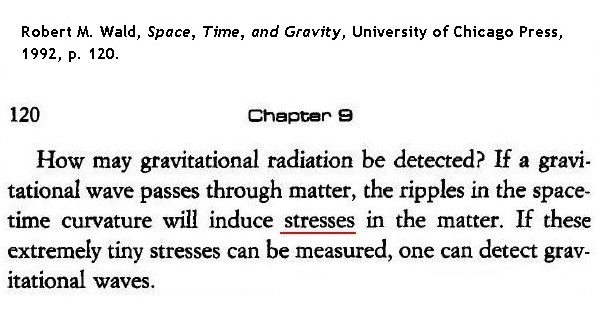
===============================================
Subject:
arXiv:1305.0777v1 [gr-qc], "After all, one call always ask:
where
are the waves?"
Date: Tue, 7 May 2013 03:22:00 +0300
Message-ID: <CAM7Ekx=kJMSPr+peKVpGV3MELmzF-8RqRF48jAx5eeE3V8TdQQ@mail.gmail.com>
From: Dimi Chakalov <[email protected]>
To: Jose Geraldo Pereira <[email protected]>
Cc: Ruben Aldrovandi <[email protected]>,
Lars Andersson <[email protected]>,
Evangelos Melas <[email protected]>,
Josh Goldberg <[email protected]>,
Bill Bonnor <[email protected]>,
Adam Helfer <[email protected]>,
Laszlo Szabados <[email protected]>,
Hans Ohanian <[email protected]>,
Chris Isham <[email protected]>,
Marcos Maia <[email protected]>,
John Klauder <[email protected]>,
Luciano Rezzolla <[email protected]>,
Christian <[email protected]>,
[email protected],
[email protected],
[email protected],
[email protected],
[email protected],
[email protected],
[email protected],
[email protected],
[email protected],
[email protected],
[email protected],
[email protected],
[email protected],
[email protected],
[email protected],
[email protected],
LSC Spokesperson Gabriela Gonzalez <[email protected]>,
Bernd Brügmann <[email protected]>,
Marek Abramowicz <[email protected]>,
Roger Blandford <[email protected]>,
Jirí Bicák <[email protected]>,
John Friedman <[email protected]>,
Bernd Schmidt <[email protected]>,
Helmut Friedrich <[email protected]>,
Joseph Katz <[email protected]>,
Robert M Wald <[email protected]>,
Karel V Kuchar <[email protected]>,
Hermann Nicolai <[email protected]>,
Paul Tod <[email protected]>,
Clifford Will <[email protected]>,
Karsten Danzmann <[email protected]>,
Pedro Marronetti <[email protected]>,
Jorge Pullin <[email protected]>,
Kip Thorne <[email protected]>,
Jeremiah P Ostriker <[email protected]>,
Jörg Frauendiener <[email protected]>,
Robert Beig <[email protected]>,
Ted <[email protected]>
There:
http://www.god-does-not-play-dice.net/#RS_gravity
D.C.
--------
Jose Geraldo Pereira, Gravitational waves: a foundational review,
arXiv:1305.0777v1 [gr-qc]
http://arxiv.org/abs/1305.0777
"Strictly speaking, this conservation law
says that, at this order, a mechanical system cannot lose energy in the
form of gravitational waves. Since any wave must have energy to exist,
what this conservation law is saying is that linear (or dipole)
gravitational radiation does not exist.
.........
"The reason is that either a gravitational wave does or does not carry
energy. If it carries, it cannot satisfy a linear equation. If applied
to a Yang-Mills propagating field, it would correspond to assume that,
for a gauge field with small-enough amplitude, its evolution could be
accurately described by a linear equation. Of course, this is plainly
wrong: a Yang-Mills propagating field must be nonlinear to carry its own
source, otherwise it is not a Yang-Mills field. Analogously, a
gravitational wave must be nonlinear to transport its own source,
otherwise it is not a gravitational wave. This is not a matter of
approximation, but a conceptual question.*
-----
*It is interesting to remark that even the well-known exact plane
gravitational wave solution of Einstein equations [13] transports
neither energy nor momentum [14]. This is in accordance with the
nonlinear nature of the transport of energy-momentum by gravitational
waves.
.........
"It is clear by now that none of the existing antennas has succeeded in
detecting any sign of gravitational waves. Of course, it is possible
that the detectors did not meet the necessary sensibility to detect
them, or that the magnitude of the gravitational waves when reaching a
detector on Earth is smaller than originally expected.
"However, it is also possible that a faulty approach has led all
detectors to look for the wrong sign. The analysis presented in these
notes, whose purpose was to call the attention for potential problems in
the currently accepted theory, suggests that this possibility should not
be neglected. After all, one call always ask: where are the waves?"
==========================================
Subject: Re: arXiv:1305.0777v1 [gr-qc], "After all, one call always ask: where
are the waves?"
Date: Tue, 7 May 2013 12:55:59 +0300
From: Dimi Chakalov <[email protected]>
To: Jose Geraldo Pereira <[email protected]>
Cc: Alex <[email protected]>,
Orfeu <[email protected]>,
Michal Chodorowski <[email protected]>,
Marco Spaans <[email protected]>
P.S. You also wrote (p. 4): "The problem of the non-localizability of
the energy and momentum of the gravitational field [16]
is not relevant for the present discussion, and will not be considered
here."
I'm afraid you can't escape from the problem of the non-localizability
of the energy and momentum of the gravitational field, even if "the
physically relevant second-order gravitational wave is longitudinal" (p.
8).
If you really wish to learn "where are the waves", see the link below.
D.
On Tue, May 7, 2013 at 3:22 AM, Dimi Chakalov <[email protected]>
wrote:
>
> There:
> http://www.god-does-not-play-dice.net/#RS_gravity
>
> D.C.
>
>
> --------
> Jose Geraldo Pereira, Gravitational waves: a foundational review,
> arXiv:1305.0777v1 [gr-qc]
>
http://arxiv.org/abs/1305.0777
[snip]
==========================================
Subject: Re: Why are you keeping quiet?
Date: Mon, 11 Mar 2013 01:25:46 +0200
Message-ID: <CAM7Ekx=hJf9-RLM+Q=PyAJZcBJ51gtmPrjY+gBSGdf+iEXjrOg@mail.gmail.com>
From: Dimi Chakalov <[email protected]>
To: Luciano Rezzolla <[email protected]>
Cc: Evangelos Melas <[email protected]>,
Ted <[email protected]>,
Josh Goldberg <[email protected]>,
Bill Bonnor <[email protected]>,
Adam Helfer <[email protected]>,
Laszlo Szabados <[email protected]>,
Hans Ohanian <[email protected]>,
Chris Isham <[email protected]>,
Marcos Maia <[email protected]>,
John Klauder <[email protected]>,
John Stachel <[email protected]>,
Jose Geraldo Pereira <[email protected]>
Lucianno,
Do you know that the energy transport by GWs is fundamentally
non-linear phenomenon? I can send you and your colleagues
many
references, some of which are from GR textbooks.
The problem of LIGO is that it is build on a dream that is backed only
by wishful thinking -- nothing to do with GR. Then by using some "weak
GW's in flat spacetime" (Kip Thorne, Caltech's Physics 237-2002), you
and LIGO "scientific" collaboration kill the very effect you wish to
measure -- the non-linear transport of 'tangible' (Hermann Bondi)
energy by GWs.
Namely, what kills your linearized speculation is the fact that flat
spacetime cannot act back on its "weak GWs". As Hermann Weyl explained
in 1944, the linearized approximation of GR is "a shadow without
power" (How Far Can One Get With a Linear Field Theory of Gravitation
in Flat Space-Time? American Journal of Mathematics, Vol. 66, No. 4,
Oct., 1944, pp. 591-604).
Recall the first off question: how do you explain the transition
between "the intangible energy of the gravitational field (as it will
be called here), which is not described by the energy-momentum tensor,
and the tangible forms which are so described" (Hermann Bondi,
Conservation and non-conservation in general relativity, Proc. R. Soc.
Lond. A 427 (1990) 249-258) ?
In fact, there is only 1 (one) approach to GWs, and it is based on the
Bondi-Metzner-Sachs group -- nothing to do with LIGO. But if LIGO and
Virgo "scientific" collaborations wish to build a brand new GW
detector based on BMS group, you must use gravitational shielding as
well, which is impossible (John Stachel, gr-qc/0507078v2, footnote 46,
pp. 21-22).
Forget it. There's no sense to "enhance the sensitivity" of what has
been a dead turkey from the outset.
Details at
http://www.god-does-not-play-dice.net/#BMS
http://www.god-does-not-play-dice.net/#Rezzolla
Any comments?
D.C.
------------------
Note: To understand how LIGO
"scientific" collaboration eliminated the very effect they wished to
measure, imagine that you decide to measure macroscopic effects
of quantum waves, corresponding to some 2.3×10⁻²⁶ m dimensionless
[whatever]. You expect these effects to be
incredibly weak, comparable to the
Compton wavelength effects of your car, say.
But you don't want to study QM. What can
you do? Use classical physics, "because" these quantum effects are very
weak, of course. Then all you need is money [Ref.
1].
D. Chakalov
March 12, 2013, 10:52 GMT
[Ref. 1] John Stewart,
Advanced General Relativity, Cambridge University Press, 1991,
p. 54, p. 75 (our spacetime must be time-orientable),
p. 114 ("gravitational energy density"), and p. 115:

.
==================================================
Subject: Re: Grape, maybe?
Date: Tue, 12 Mar 2013 03:27:01 +0200
Message-ID: <CAM7EkxkNq_p4mi_tkLgtxF7ZnMYKwD4ug_gCEOGH-X1SL-jVyA@mail.gmail.com>
From: Dimi Chakalov <[email protected]>
To: LSC Spokesperson Gabriela Gonzalez <[email protected]>
Cc: Jorge Pullin <[email protected]>,
[email protected],
[email protected],
[email protected],
[email protected],
[email protected],
[email protected],
[email protected],
[email protected],
[email protected],
[email protected],
[email protected],
[email protected],
[email protected],
[email protected],
[email protected],
[email protected],
[email protected],
[email protected],
[email protected],
[email protected],
[email protected],
[email protected],
[email protected],
[email protected],
[email protected],
[email protected],
[email protected],
[email protected]
Gabriela,
Seven years ago, I suggested to your husband and his colleagues to get
ready for converting LIGO tunnels to wine cellars (cf. below). You can
never make it, so what can we do with LIGO when you ultimately fail?
See the latest developments at
http://www.god-does-not-play-dice.net/#BMS
D. Chakalov
-----------------------------------
Subject: Grape, maybe?
Date: Wed, 01 Mar 2006 04:59:31 +0200
From: Dimi Chakalov <[email protected]>
To: Jorge Pullin <[email protected]>
CC: David Shoemaker <[email protected]>,
Paul McNamara <[email protected]>,
Neil J Cornish <[email protected]>
Hi Jorge,
I learned from your last MOG No. 27, Spring 2006, that at the APS
April meeting in Dallas, one of the Lead Speakers, Neil Cornish, will
deliver the talk "The LISA Observatory: Preparing for a bountiful
harvest".
Grape, maybe? I think your colleagues should be prepared to convert
those long dark tunnels of LIGO to wine cellars
[snip]
===========================================================
All you need is blank notepads, sharp pencils, and a quiet cheap office:

D. Chakalov
------------
Subject: Advanced LIGO and Virgo detectors,
arXiv:1211.0021v1 [gr-qc]
Date: Fri, 2 Nov 2012 02:46:19 +0200
Message-ID:
<CAM7Ekx=0JAnhctBW57K2MJbpX3BNEwrB2kiU3EMGzA1mzfSTMw@mail.gmail.com>
From: Dimi Chakalov <[email protected]>
To: Keith Riles <[email protected]>
Cc: [email protected],
[email protected],
[email protected],
[email protected],
[email protected],
[email protected],
[email protected],
[email protected],
[email protected],
[email protected],
[email protected],
[email protected],
[email protected],
[email protected],
[email protected],
[email protected],
[email protected],
[email protected],
[email protected],
[email protected],
[email protected],
LSC Spokesperson Gabriela Gonzalez <[email protected]>,
Bernd Brügmann <[email protected]>,
Marek Abramowicz <[email protected]>,
Lars Andersson <[email protected]>,
Roger Blandford <[email protected]>,
Jirí Bicák <[email protected]>,
John Friedman <[email protected]>,
Bernd Schmidt <[email protected]>,
Helmut Friedrich <[email protected]>,
Joseph Katz <[email protected]>,
Robert M Wald <[email protected]>,
Karel V Kuchar <[email protected]>,
Hermann Nicolai <[email protected]>,
Paul Tod <[email protected]>,
Clifford Will <[email protected]>,
Karsten Danzmann <[email protected]>,
Beverly Berger <[email protected]>,
Pedro Marronetti <[email protected]>,
Jorge Pullin <[email protected]>,
Kip Thorne <[email protected]>,
Jeremiah P Ostriker <[email protected]>,
Evangelos Melas <[email protected]>,
Ted Newman <[email protected]>,
Josh Goldberg <[email protected]>,
Adam Helfer <[email protected]>,
Laszlo Szabados <[email protected]>,
Jörg Frauendiener <[email protected]>,
Robert Beig <[email protected]>
Mr. Riles,
It is impossible in principle to detect any GWs by LIGO and Virgo
collaborations:
http://www.god-does-not-play-dice.net/#LIGO_Prague
http://www.god-does-not-play-dice.net/#Bondi
http://www.god-does-not-play-dice.net/#Rezzolla
All you can do is waste hundreds of million dollars and Euro, and keep
dead quiet.
Shame on you, LIGO, and Virgo. You are total disgrace to the GR
community.
Dimitar G. Chakalov
--
http://tinyurl.com/dollar-ratio
http://tinyurl.com/steel-evaporation
==============================================
Subject: Re: On the total mess in GR,
arXiv:1212.0147v1 [gr-qc]
Date: Wed, 5 Dec 2012 02:09:34 +0200
From: Dimi Chakalov <[email protected]>
To: Laszlo B Szabados <[email protected]>,
Adam Helfer <[email protected]>,
Harvey S Reall <[email protected]>,
Jörg Frauendiener <[email protected]>,
Karel V Kuchar <[email protected]>,
Helmut Friedrich <[email protected]>,
Robert M Wald <[email protected]>,
Paul Tod <[email protected]>,
Robert Beig <[email protected]>,
Bernard J Carr <[email protected]>,
John Baez <[email protected]>,
Luca Bombelli <[email protected]>,
Gary Horowitz <[email protected]>,
Domenico Giulini <[email protected]>,
Claus Kiefer <[email protected]>,
Shing-Tung Yau <[email protected]>,
Ed Witten <[email protected]>,
Richard M Schoen <[email protected]>,
Niall Ó Murchadha <[email protected]>,
Xiao Zhang <[email protected]>
Dear Laszlo and colleagues,
I have posted (Dec 4 2012, 23:54:44 GMT) a brief explanatory note at
http://www.god-does-not-play-dice.net/#mess
If you and/or some of your colleagues disagree, please explain why.
Just don't hesitate -- the issue is strictly mathematical.
As ever,
Dimi
----------
Note: All agree that the gravitational energy density at a
"point" (MTW, p. 467)
cannot be defined mathematically. Here, I claim that we must not
even try to define it in the present GR textbooks, because the
phenomenon in question belongs to quantum gravity.
Therefore, we must not use an
initially inadequate theory such as the incomplete mathematical theory
of some "classical" gravitational field: "Not
for a moment did I doubt that this formulation was merely a makeshift in
order to give the general principle of relativity a preliminary
closed-form expression. For it was essentially no more than a theory of
the gravitational field, which was isolated somewhat artificially from a
total field of as yet unknown structure",
Albert Einstein.
Now, some people are trying very hard to
avoid quantum gravity with bypassing the initial problem 'at a point',
and claim some hints about "surface energy expression" and "the
total energy, $E_S$, of this surface", which "does NOT imply an expression for the
energy density", as Niall Murchadha writes below.
Sorry. Any definition of
"the
total energy, $E_S$" located on such "surface", and formulated in the
current classical approximation of the unfinished General
Relativity, is mathematically wrong.
It is wrong in principle
to use a classical approximation to General Relativity. I will be happy
to elaborate on the recipe mentioned by Niall Murchadha
and the
errors in his withdrawn paper 'Quasilocal Energy in General
Relativity',
arXiv:0905.0647v2 [gr-qc]: see below an excerpt from my email
to Niall Murchadha three and a half
years ago (Wed, 6 May 2009 13:14:25 +0300),
regarding the first (and very messy) version of 'Quasilocal
Energy in General Relativity',
arXiv:0905.0647v1 [gr-qc].
The "obvious" (again)
positivity of mass and violations of ANEC on
timeless or "achronal
geodesics" are immensely important
issues, but I cannot
say more at this website, for reasons explained above.
Let me just stress that we must have both "sharply
fixed points of time" (Erwin Schrödinger, Die gegenwärtige Situation
in der Quantenmechanik, 1935,
Sec. 14) in the local (physical) mode of spacetime, and
nonlocal "points" from the global mode of
spacetime, spanned to the "size" of 'the whole universe as ONE'.
This is what 'quasi-local' is all about. We need 'the' binding
phenomenon which can assemble in time infinitesimal points into
finite, be it "small" or
"large", spacetime domains, in which we can look around and
see "as far as we can" (Lee Smolin).
This is the underlying
dynamics of what we call 'time' -- the dynamics of spacetime
itself (forget about LIGO) in terms of 'change
of space' (Arrow of Space).
D. Chakalov
December 7, 2012
Last updated: December 12, 2012, 04:36 GMT
=================================
Subject: The total mess in GR,
arXiv:0905.0647v1 [gr-qc]
Date: Sat, 8 Dec 2012 04:48:17 +0200
From: Dimi Chakalov <[email protected]>
To: Niall 'O Murchadha <[email protected]>,
Roh-Suan Tung <[email protected]>,
Naqing Xie <[email protected]>
Cc: Mu-Tao Wang <[email protected]>,
Hwei-Jang Yo <[email protected]>,
Szabados Laszlo <[email protected]>,
Xiao Zhang <[email protected]>,
Adam Helfer <[email protected]>,
Lau Loi So <[email protected]>
Dear colleagues,
Please recall my email sent three and a half years ago (Wed, 6 May 2009
13:14:25 +0300) and my prediction about your efforts in
arXiv:0905.0647v1 [gr-qc].
Later, your original paper was withdrawn (arXiv:0905.0647v2
[gr-qc]), because you were "currently not happy with the results".
The main reason for your mathematical problems has been briefly
explained at
http://www.god-does-not-play-dice.net/#Niall_last
Should you have questions, please don't hesitate.
All the best,
Dimi Chakalov
----------
Subject: "The positivity for interior two-surfaces is still an open
question."
Date: Wed, 6 May 2009 13:14:25 +0300
From: Dimi Chakalov <[email protected]>
To: Niall 'O Murchadha <[email protected]>
Cc: [email protected],
[email protected],
[email protected],
Lau Loi So <[email protected]>,
Hwei-Jang Yo <[email protected]>,
Szabados Laszlo <[email protected]>,
Xiao Zhang <[email protected]>
Dear Dr. Murchadha,
I would like to make a prediction regarding your arXiv:0905.0647v1
[gr-qc] and forthcoming calculations: you will fail to produce an
unambiguous proof of the alleged positivity for interior two-surfaces.
[snip]
==================================================
Subject: The boundary conditions vs canonical quasilocal formalism (CQF),
arXiv:gr-qc/0010024v3
Date: Sat, 8 Dec 2012 15:17:30 +0200
From: Dimi Chakalov <[email protected]>
To: David Brown <[email protected]>,
Stephen R Lau <[email protected]>,
James York <[email protected]>
Cc: Karel V Kuchar <[email protected]>,
Ian Lawrie <[email protected]>,
Alan Rendall <[email protected]>
Dear David,
Regarding your article [Ref. 1], may I offer you and
your colleagues an alternative approach (cf.
update.jpg attached), which was
outlined at
http://www.god-does-not-play-dice.net/#explain_why
I hope this can bring you back to the crucial requirement that "the
evolved data must obey the boundary conditions" [Ref. 1],
and you can upgrade the "spacelike hypersurfaces" (ibid.)
with the so-called Arrow of Space.
Wishing you and your colleagues a happy white Christmas,
Dimi
[Ref. 1] J. D. Brown, S. R. Lau, and J. W. York, Action and Energy of
the Gravitational Field, arXiv:gr-qc/0010024v3, 15 Apr 2002,
http://arxiv.org/abs/gr-qc/0010024
"The drawback of Einstein’s approach is
that the (XX) action is not fully diffeomorphism invariant (it is
invariant modulo boundary terms), and his gravitational sem is
coordinate dependent. At the quasilocal level there is no obvious
general prescription for how one should choose coordinates.
.......
"... and in Sec. VI we apply our formalism to spacetimes with are
asymptotically flat in spacelike directions, in the process making some
novel observations about total gravitational energy at spatial infinity.
.......
"VI. ENERGY-MOMENTUM AT SPATIAL INFINITY
"In this section we consider the quasilocal energy as applied to
spacetimes that are asymptotically flat in spacelike directions
[27,65-67],15 and discuss its relationship with the standard treatment
of energy at spatial infinity (spi). We begin by recalling the key
observation from Regge and Teitelboim, [65] namely, that for
asymptotically flat spacetimes the gravitational Hamiltonian must have
well defined functional derivatives and must preserve the
boundary conditions on the fields.
.......
p. 36: "The key difference between the quasilocal analysis and the
asymptotically flat analysis is that in the quasilocal case we do not
require, as in step (ii), that the Hamiltonian should preserve the
boundary conditions. The reason is the following. In the asymptotically
flat case the spacelike hypersurfaces E are Cauchy surfaces. Thus, the
data on one slice E completely determines the future evolution of the
system. For consistency the evolved data must obey the boundary
conditions, otherwise the Hamiltonian on future E slices will not
have well defined functional derivatives.
"On the other hand, in the quasilocal context, the surfaces E are not
Cauchy surfaces. They do not carry enough information to determine the
future evolution of the system (the spacetime interior to dM).
Therefore, we see that in the quasilocal case step (ii) cannot, and
should not, be taken."
==========================================
Subject: Re: a
surface energy expression does NOT imply an expression for the
energy density
Date: Fri, 7 Dec 2012 03:31:38 +0200
Message-ID:
<CAM7EkxnionDBCDAnzn_=zgSfdpyn9AEV-QjzyzGx7otJ0m0Hgw@mail.gmail.com>
From: Dimi Chakalov <[email protected]>
To: Niall <[email protected]>
Cc: Laszlo B Szabados <[email protected]>,
Adam Helfer <[email protected]>,
Harvey S Reall <[email protected]>,
Jörg Frauendiener <[email protected]>,
Karel V Kuchar <[email protected]>,
Helmut Friedrich <[email protected]>,
Robert M Wald <[email protected]>,
Paul Tod <[email protected]>,
Robert Beig <[email protected]>,
Bernard J Carr <[email protected]>,
John Baez <[email protected]>,
Luca Bombelli <[email protected]>,
Gary Horowitz <[email protected]>,
Domenico Giulini <[email protected]>,
Claus Kiefer <[email protected]>,
Shing-Tung Yau <[email protected]>,
Ed Witten <[email protected]>,
Richard M Schoen <[email protected]>,
Xiao Zhang <[email protected]>,
Chris Isham <[email protected]>,
Andrzej Mariusz Trautman <[email protected]>,
James York <[email protected]>,
Bjoern Schmekel <[email protected]>,
Andrew Lundgren <[email protected]>,
Saul Teukolsky <[email protected]>,
David Brown <[email protected]>,
Robert Geroch <[email protected]>,
Lee Smolin <[email protected]>
Dear Niall,
Thank you for your kind reply from Thu, 6 Dec 2012 13:02:27 +0000.
> Let me respond one point you made in criticising Laszlo's article. Think
> about what you would need to do to convert a surface formula to a
definition
> of energy density.
It would be like converting red herrings to pink elephants, since they
both are kinda red-ish... :-)
See the second link from my preceding email below. For your convenience,
I'll reproduce it here:
http://www.god-does-not-play-dice.net/#Seung1
The unavoidable gauge freedom "comes with a price" (James York,
arXiv:gr-qc/0405005v1; cf. Andrzej Trautman therein), meaning that
"point particles do not exist" (Bjoern Schmekel,
arXiv:0708.4388v1[gr-qc]) and the crucial mathematical object called
'gravitational
stress-energy-momentum (SEM)' cannot be defined at *any*
quasi-local spacetime region that is both spatially and temporally
bounded (David Brown et al.,
arXiv:gr-qc/0010024v3).
In GR, everything that exists as 'matter & gravity at a point' depends
on (i) the global asymptotic properties of spacetime and the
dynamics from the "dark" energy producing 'time'
(not the York Time), and (ii) the other way around.
Which means to me -- please correct me if I'm wrong -- that the first
off task is to define mathematically 'the whole universe as isolated
system'.
Now, because we use our brains, we must use our *relational* knowledge,
which means that we can define 'the universe as ONE isolated system'
iff we have a referential object w.r.t.w. the 'isolated universe'
makes sense. Here, there is only one *logical* option: define the
"ambient" unphysical [whatever], w.r.t.w. the
asymptotic boundaries of 'the ONE universe' can be mathematically
constructed, in terms of 'global mode of spacetime', and bring the
latter back into 'the ONE universe'.
But where to insert such metaphysical object? How? That's what my
web site is all about. You'll automatically obtain the correct
mathematical expression of 'quasi-local points': the geometrical
"points" themselves become 'quasi-local'. Which of course brings us to
Quantum Geometry -- not to the textbooks by
Bob Wald
or Bob Geroch, to name but a few.
Please recall my email sent eight years ago (Fri, 03 Dec 2004 17:39:06
+0200) to James York, with copy to you and many other people. It's a
matter of logical constraints -- we simply do not any other option.
If you or someone else can use different logic and type of knowledge,
please let me know.
> Pick a point P, and pick a small surface S surrounding it.
Bingo! The problems with that "small surface S surrounding it" are
explained at the link above. You need 'the' binding phenomenon which can
assemble infinitesimal points into such "small" albeit *finite* surface.
This is what people call 'time'. You might eventually bypass-and-ignore
it only and exclusively only by invoking some dead
fixed background spacetime -- not in GR.
> Work out the total energy, $E_S$, of this surface. An estimate for the
energy
> density at P would be $\rho_P \approx E_S/\Delta V$, where $\Delta V$
is the
> volume enclosed by $S$. Shrink this surface S inwards, continuing to
enclose P.
> Now you need to show that
>
> (i) $E_S/\Delta V$ converges to a finite number; and
> (ii) this number is independent of the way you converge to P.
>
> One can get around point (ii) by constructing a special coordinate
system
> centered at P and finding a preferred sequence of surfaces converging
to P.
> This is what
Brown, Lau, York do in their `small spheres' article.
They get
> nice numbers, in vacuum they get the Bel-Robinson energy, and in
non-vacuum
> they get the matter-field energy. Nevertheless, I think no one would
want to
> call this `the' energy density.
Surely "a surface energy expression does NOT imply an expression for the
energy density", as you put it in the subject line, and I hope nobody
would call this 'the' energy density either, simply because red herrings
and pink elephants do not exist.
Any time we look at objects in space and try to "see as far as we can"
(Lee Smolin, Three Roads to Quantum Gravity, Phoenix, 2000,
p. 205), we face the formidable mystery of
dynamical buildup of 3-D space. We cannot monitor this binding process
of 'transience' (Arrow of Space), but can only
observe it post factum, due to the "speed" of
light.
Please read the text at the links below and follow the references. We
have to correct the current mathematical formalism of GR, or else will
be tempted to "amend" it with some wild imagination and wishful
thinking, as did, in my opinion, Laslo Szabados in his latest
arXiv:1212.0147v1 [gr-qc].
I regret that cannot say more at this website. As
Chris Isham boldly declared, I am "just another crank" who does "not
know enough theoretical physics to help with any research in that area."
Besides, this whole mathematical task is far more important than what it
might look like at a first glance.
I also hope that you and your colleagues would excuse me for this long
unsolicited email. Sorry also for being frank and biased, but the
ultimate source of the quasi-local "points" does exist (Luke
17:21).
Only the math is still unknown.
Wishing you and your colleagues a very merry Christmas,
Dimi
> -----Original Message-----
> From: Dimi Chakalov [mailto:[email protected]]
> Sent: Thu 12/6/2012 10:54
> To: Laszlo B Szabados; Adam Helfer; Harvey S Reall; Jörg Frauendiener;
Karel
> V Kuchar; Helmut Friedrich; Robert M Wald; Paul Tod; Robert Beig;
Bernard J
> Carr; John Baez; Luca Bombelli; Gary Horowitz; Domenico Giulini; Claus
> Kiefer; Shing-Tung Yau; Ed Witten; Richard M Schoen; O'Murchadha,
Niall;
> Xiao Zhang; Chris Isham
> Subject: Re: On the total mess in GR, arXiv:1212.0147v1 [gr-qc]
>
> P.S. Regarding my preceding email,
> http://www.god-does-not-play-dice.net/#mess
>
> See a simple drawing at
>
> http://www.god-does-not-play-dice.net/#Seung1
>
> Any comments?
>
> D.
>
> On Wed, 5 Dec 2012 02:09:34 +0200, Dimi
Chakalov <[email protected]>
> wrote:
> [snip]
>
--------------------
Note: Consider a red herring and a
typical pink elephant, then find their centers of mass, and bridge these
two points with a rope. You may claim to have suggested a mathematical
recipe for converting red herrings to pink elephants, only 'more
research is needed'.
Well, I believe math by itself is a
language, and if you speculate about red herrings and pink elephants, it
will be all wrong, even if you use a rigorous mathematical description
of 'rope', as shown with impeccable math by Kip Thorne.
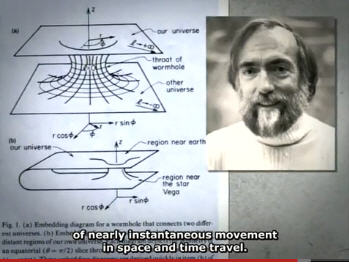
There is none so blind as they that won't
see.
D. Chakalov
December 7, 2012
Last updated: December 12, 2012, 04:11:45 GMT
==========================
Subject: Re: a
surface energy expression does
NOT imply an expression for the energy density
Date: Sat, 8 Dec 2012 13:35:52 +0200
From: Dimi Chakalov <[email protected]>
To: [snip]
P.S. Please see an excerpt (update.jpg
attached) from
http://www.god-does-not-play-dice.net/#explain_why

Any comments?
D.
On Thu, 6 Dec 2012 13:02:27 +0000, O'Murchadha, Niall <[email protected]>
wrote:
[snip]
=================================================
Subject: Thank you
Date: Tue, 18 Dec 2012 16:13:59 +0200
From: Dimi Chakalov <[email protected]>
To: Ettore Minguzzi <[email protected]>,
Domenico Giulini <[email protected]>,
Karel V Kuchar <[email protected]>,
Xiao Zhang <[email protected]>,
David B Malament <[email protected]>,
Hans-Jürgen Schmidt <[email protected]>,
Stanley Deser <[email protected]>,
Angelo Tartaglia <[email protected]>,
Helmut Friedrich <[email protected]>,
Harvey S Reall <[email protected]>,
Gerardus <[email protected]>,
Niall <[email protected]>,
Adam <[email protected]>,
Laszlo <[email protected]>,
David <[email protected]>,
Chris <[email protected]>
Dear colleagues,
During the past year, I believe have learned a lot from you -- see the
latest note (December 18, 2012, 13:30:39 GMT) at
http://www.god-does-not-play-dice.net/#cheat
Thank you very much.
May God give you everything you've been asking for.
Wishing you a very merry Christmas,
Dimi
--------------------------
I want to make clear that I’m only against God as an explanation,
in a limited sense. It may be in the end that God exists and takes
the decision of fine tuning, because in the end you’ve got to be
open minded about reality. But, by definition, Physics is the
activity
of trying to explain things without appealing to God.
Dennis William Sciama,
1998
Everything said at this website is based on the premise that
the universe functions as a human brain, based on
the flow of time from Heraclitus: see
option YAIN (iii) above. Ensuing from
Mach's “immediate
connections” and the research by Dennis Sciama [Ref. 1],
the theory may help us understand (i) the non-linear
self-acting interactions in the
brain (cf. Escher's drawing hands), (ii) the origin of gravitation and inertial
reaction "forces" in 'the universe as a brain', and
(iii) the predictions regarding the smaller, finite-size human brain
embedded in 'the universe as a brain', e.g., the so-called
REIM and the topological bridge (May
17, 2009) by which the two
brains can be entangled with their common 'potential reality' from their
common Arrow of Space.
In a nutshell, we
need to formulate quantum gravity with some brand
new mathematical formalism suitable for describing the emergence
of spacetime (C. Isham and J. Butterfield) along the
Heraclitean flow of time defined with respect to the
reference fluid of GR in the so-called
global mode of
spacetime. All we know for sure is that the presentation of 'time' in
today's GR textbooks is wrong, chiefly because it
is impossible to even suggest some physical phenomenon acting
as a 'clock', neither locally at a given 'world point' (P.
G. Bergmann and A. Komar) nor globally on the
whole universe en bloc. We haven't even reached the stage at
which we would have to acknowledge that the untraceable energy,
which springs from the dynamical spacetime [Ref. 1],
must be "dark". Instead, people prefer to
"rescue" their GR textbooks by switching to metrology, and try to
mimic some properties of 'time', such as the cyclical
duration of 'one second', with particular
physical process of finite duration, taken from the physical
world governed by the Archimedean Axiom -- not
'the unmoved mover' (Karel Kuchar)
producing the flow of time, modeled with the
Arrow of Space. Then
the same people have to 'kill the time' (Robert
Geroch), simply because in the current GR textbooks 'space' cannot be
derived from some evolving-in-time process either.
To sum up, the only available option is to
propose an Arrow of Space as 'change of
space', because the alternative idea about 'coordinate change in
space' leads to 'time read with a physical clock' which must
disappear (Bryce de Witt). But to understand
the emergence of spacetime with our relational cognition, the very
"displacement" of spacetime, produced by the Arrow of Space by
means of 'change of space'
(forget about LIGO), must be relational as well
("displacement": with respect to what?), which is why we
suggest two modes of
spacetime, local (physical) mode and global mode, and are seeking new
mathematical ideas for Quantum Geometry.
Again, the new presentation of spacetime
dynamics is that the emergence
of spacetime (Isham & Butterfield) produces
accumulated physical universes and hence 'time
direction', but these accumulated physical universes
blend into one single physical universe cast on a
perfect continuum (local mode of spacetime). The "dark
Zen gaps" (global mode) are totally eliminated there, but
are shifted in the potential future of the Arrow of Space, in terms of 'potential
reality' ("cloud" of propensities) -- just as
in the human brain and living matter in general.
Obviously, LIGO cannot detect the
"displacement" of spacetime exhibited in 'gravitational
waves', firstly because the proper GW detector must be a web
(resembling a school of fish) of numerous
quasi-local 'world points' endowed with self-action -- the
"ripples" in the potential reality will induce changes only
in the self-acting GW detectors. Likewise, we can detect changes
only in the self-acting human brain -- not in the mind.
This framework was completed on May 31, 2012;
the next stage on the road to quantum gravity is to explain the theory
to the widest possible audience, and (hopefully) bring some
very young mathematicians on board. It
would have been much easier to have support from the established
theoretical physicists, but they've been rejecting these proposals ever
since 1972. Perhaps these people quietly hate
'the true monad without windows',
which can only be described (not understood) mathematically, since it
is ONE and is therefore not-relational. Yet it is real,
very much indeed, only we cannot, and must not be able to trace
it back as 'physical object', which is why in science (not theology)
it can only show up as 'the unmoved mover' (Karel Kuchar)
and 'Der Geist bewegt die Materie' (Virgil).
By the end of December 2013, I hope to complete a DVD with
seven video lectures, which will be offered free of charge, and will be
intended to young people (Max Planck)
who can understand the misleading "analogy" with some "flat spacetime"
in GR textbooks (Hyun Seok Yang,
arXiv:1111.0015v3):
When the massive body moves to
another place, the original point where the body was placed will
recover a (nearly) flat geometry like a
rubber band. That is, the (flat) spacetime behaves like a
metrical elasticity which opposes the curving of space. But
this picture rather exhibits a puzzling nature of flat spacetime
because the flat spacetime should be a completely empty space
without any kind of energy as we remarked above. How is it possible
for an empty space of nothing to behave like an elastic body with
tension ?
Recall that the alleged "curvature" inevitably
induces "rotation":
gravitation & torsion is a bundle, which we instruct to
approach asymptotically zero 'at a point',
according to the misleading "analogy" with some fictitious "flat
spacetime" pictured with our euclidean eyes.
These misleading ideas work very
well for shut-up-and-calculate purposes, but
the crucial "identity of a world point" (P.
G. Bergmann and A. Komar) requires
precise
explanation, which leads to quantum gravity.
Why? Because the underlying manifold of quasi-local geometrical
"points" is presented with two modes of spacetime, called
local mode and global mode (cf. Mott's paper and
the Kochen-Specker Theorem), and these two modes of spacetime
produce a perfect continuum of quasi-local geometrical "points"
in the local (physical) mode, as well as a 'back bone' of
the
whole universe by means of 'potential reality' in the global mode
of spacetime. To explain the task, see an excerpt from
Mauricio
Suárez below, regarding a given state
Ψ
of the quantum system in the experimental context of
particular quantum measurements in
Hilbert spaces of dimension 3 and greater
(emphasis and comments added):
Suppose that the state of a
quantum system is Ψ , a superposition of eigenstates of the Hermitian
operator that represents the observable Q. The standard
interpretational rule within orthodox quantum mechanics, the
eigenstate/eigenvalue link (e/e link) states that a system in
state Ψ can be said to have a value of a
property Q if and only if Ψ is an eigenstate of the Hermitian
operator that
represents
(Sic! - D.C.) the property. (The duplicitous condition "if and only if"
might induce
some reminiscent idea of fixed objective reality 'out there', which would be a
very
misleading and totally wrong analogy, as we know from
Erwin Schrödinger -
D.C.).
The paradigmatic question regarding
these states (called 'jackets';
not the quantum system
itself called
'John'
- D.C.)
is then the following:
What does it mean -- with respect to the property represented by the
observable Q -- for a quantum system to be in state Ψ which
is not an eigenstate of the
Hermitian operator that represents Q?
As explained
previously, in
Hilbert spaces of dimension 3 and greater, the
observable Q can be
presented with a single superposition
of three observable "states" or
'jackets'
(not the quantum system
itself), explained here with three sayings (or 'colors',
Ernst Specker):
|Q1> : All are not hunters
that blow the horn.
|Q2> : La robe ne fait pas le médecin.
|Q3> : Es ist nicht jeder ein Koch, der ein lang Messer trägt.
Thus, the answer to the
'paradigmatic question' above is that
the
quantum system itself, called
'John', is an
UNspeakable, pre-quantum, Kochen-Specker state,
which determines the explication of its three (or more)
quasi-local 'jackets', but can
never become physical object in the local mode of spacetime, because
it exists as 'potential reality' placed in the global mode of spacetime.
Surely the sum of probabilities for observing the three (or more)
quasi-local 'jackets' must
be unity, but the quantum
system itself, called
'John', is
not an eigenstate of the Hermitian
operator that represents Q, and never will: the "chance" to be observed
is zero. Why? Because we
cannot simultaneously measure all non-commuting
observables that belong to the complete 'open set'
(James Dungundji)
of all observables, in all possible measurements of the same
quantum object persisting over time with its sameness (Genidentität,
Kurt Lewin), by its
simultaneous
position-and-momentum in the quantum realm 'out there'.
But in fact, this
open set
isn't a "set"
in the first place, because the UNspeakable, pre-quantum,
Kochen-Specker source
cannot belong to this "set", just like the case
with the 'empty set R'
of the so-called singularity. It is not some mythical "universal
set" that would supposedly contain its UNspeakable, pre-quantum,
Kochen-Specker source.
Yet it
does exist and is rooted on the
non-Archimedean 'monad
without windows'. As
Henry Margenau stressed many
years ago, it is an
Onta;
a bit like the base
color of an
octopus.
Moreover, the idea about
Archimedean geometry, which people obtain due to the "radius" of the
"expanding" balloon along some
"4th spatial dimension" (Ned
Wright), pertains only to the local mode of spacetime, while
3-D space "expands" in the global mode of spacetime, in which the
"number" of points is
not countably infinite and the Archimedean axiom does not
hold: recall
Georg Cantor and
Kurt Gödel.
It is manifestly wrong
to claim that the "dark" energy is an
Archimedean phenomenon, and then speculate that "as more space comes into existence,
more of this energy of space would appear. As a result, this form
of energy would cause the Universe to expand faster and faster"
(R. Rakhi and K. Indulekha,
p. 5). We
must disentangle the blueprints from the Arrow
of Space, which are cast on the local mode of spacetime, from
those resulting from to the global mode and its actual/completed
infinity -- the fundamental 'time direction'
is a composite and emergent phenomenon,
and so is the 3-D space. As an exercise, recall that the notions
of Large and Small (which are otherwise essential for 3-D space) were
derived from the deceptive teleological (potential infinity)
"radius" of the "expanding balloon" (Ned
Wright), as well as the application of
Finite Infinity to the
dual age cosmology.
After solving the tasks above, we take the perfect
continuum (no 'dark
Zen gaps' in the local
mode of spacetime) of quasi-local geometrical 'world points'
(Bergmann & Komar), which have been
post-factum individuated by 'the whole universe as ONE' (recall
the three superposed sayings in the example above), and
drop this physical continuum in General Relativity.
Hopefully, by 25 November 2015 we will work out a Machian quantum gravity in which the quasi-local
geometrical 'world point' has a dual
geometrical nature: it is both a
dimensionless "point" and 'the larges volume of 3-D space',
depending on the direction we look at it from the local
mode of spacetime, while in the global mode thus dual geometrical
object is ONE. Recall also that the global mode of spacetime is
the only possible solution for fixing "boundaries" on spacetime: the notion of 'asymptotic
infinity' is
brought back into spacetime in terms of 'global mode',
which makes the whole universe a self-determined and
bootstrapped ONE entity.
The latter contributes to the dynamics of spacetime in terms of 'sufficient
conditions for spacetime': the binding
of 'mass points' (Kurt Gödel)
can only be made by some fundamental connection executed by 'the
universe as ONE', which must
not exist
in the local mode of spacetime, namely, it is
]between[ the neighboring 'mass points'. Surely the individuation of
'world points'
(Bergmann & Komar)
requires their "separation", yet on the other hand this
"separation" by 'dark
Zen gaps' must not exist physically, or else we won't be able
to model
the perfect physical continuum of "Aleph-null
bottles".
Finally, bear in mind that we have rejected the
idea of ontological probabilities (God does not play
dice, Albert Einstein), because in both Quantum
Theory and General Relativity the
correlated 'jackets' are explicated along the
Arrow of Space
one-at-a-time and with
certainty: Dead matter makes
quantum jumps; the living-and-quantum matter is smarter.
This is the crux of Quantum Geometry, which I
hope to explain with seven video lectures
by Christmas 2013. Then comes the formidable task for uncovering the
new, still unknown mathematical formalism for Machian quantum gravity.
We need precise mathematical theory to proceed further, but the
challenges ahead are highly non-trivial, if not severe. Frankly, the
only hope we have right now is 'the
astonishing effectiveness of
mathematics in the natural sciences' (Eugene
Wigner), backed by
Matthew 7:7.
"Whether you believe you can do a
thing or believe you can't, you are right" (Henry Ford).
D. Chakalov
December 21, 2012
Last updated: January 7, 2013, 08:19 GMT
[Ref. 1] D.W. Sciama, On the origin of inertia, Monthly Notices of
the Royal Astronomical Society, 113 (1953)
34-42.
Comment: The great
Dennis Sciama has given us a groundbreaking research on the nature
of gravitation and inertia, which is still waiting
to be
fully understood and appreciated.
To quote from his article (emphasis added),
"the universe as a whole cancels the gravitational field of local
matter, so that in this frame the body is "free". Thus in this theory
inertial effects arise from the gravitational field of a moving
universe."
Notice the non-linear
cancelation of the two "fluxes" (Merced
Montesinos), depicted with two
'drawing hands' in the famous drawing from Maurits Escher
above: this perpetual cancelation is being
repeated, ever since
The Beginning, at every instant 'now' from the
Arrow of Space, fixing 'world points' with the astonishing precision of
one part in 10 to the power of 120th. Yet the cancelation does not
create an exactly zero "dark" remnant, due to which we enjoy a 'moving universe' [Ref. 1]
driven by the Arrow of Space and endowed with re-created
asymptotically flat spacetime, untraceable "dark"
energy, and 3-D dynamic blueprints from the "aether"
and torsion, such as galaxy
rotation and cosmic equator. Enough said?
D. Chakalov
December 29, 2012, 13:29:52 GMT
=============================================
Subject: The "cloud" of contextuality
Date: Thu, 27 Dec 2012 16:50:56 +0200
Message-ID:
<CAM7EkxkfzttVkCNaVCv4jdmJ3Czd8igow-vs5nwQnNLEKXZRPg@mail.gmail.com>
From: Dimi Chakalov <[email protected]>
To: Ravishankar Ramanathan <[email protected]>,
[email protected], Pawel Horodecki <[email protected]>
Cc: Michal Horodecki <[email protected]>,
Ryszard Horodecki <[email protected]>,
Stanislaw Kryszewski <[email protected]>,
Graeme Mitchison <[email protected]>,
Chris Heunen <[email protected]>,
[email protected],
[email protected],
[email protected],
[email protected],
[email protected],
[email protected],
[email protected],
[email protected],
[email protected],
[email protected],
[email protected],
[email protected],
[email protected]
Dear colleagues,
Surely "a finite set of measurements exists whose results cannot be
assigned in a context-independent manner", after the
Kochen-Specker Theorem, but unfortunately you totally twisted the
issue in
arXiv:1212.5933v1 [quant-ph], by talking about revealing "the
contextuality of all states of a given dimension", and posed the
question "when does a set of (projective)
measurements reveal the contextuality of all quantum states (belonging
to a particular Hilbert space of dimension d)?".
The crux of the matter is the very "cloud" of contextuality,
http://www.god-does-not-play-dice.net/#thank_you
Please correct your misinterpretation of the Kochen-Specker Theorem in
your next arXiv:1212.5933 v2 [quant-ph].
Recall that we cannot use "probabilities", for reasons explained by
Erwin Schrödinger in November 1950, and the "cloud"
of contextuality leads to a brand new truth evaluation of propositions:
YAIN .
As Alexandre Grothendieck put it, "these “probability clouds”, replacing
the reassuring material particles of before, remind me strangely of the
elusive “open neighborhoods” that populate the
topoi, like evanescent phantoms, to surround the imaginary “points”."
All you need is math.
I will appreciate your professional feedback, and the opinion from your
colleagues. Please do not hesitate.
Sincerely,
Dimi Chakalov
-------------
Note: Perhaps
the best way to explain
the "cloud" of propensities
is with the game of
Twenty Questions (John
and Marry Gribbin, In Search of Schrödinger's Cat, Black Swan,
London, 1998, p. 209; quoted from: Quantum Theory and Measurement,
ed. by J.A. Wheeler and W.H. Zurek, Princeton University Press,
Princeton, 1983, pp. 182-213):
"There had been a plot not to
agree on an object to be guessed, but that each person, when asked, must
give a truthful answer concerning some real object that was in
his mind, and which was consistent with all the answers that
had gone before. With only one question left, John Wheeler guessed:
"Is it a cloud?" The answer was "Yes!"
The final
answer was consistent and correlated with all previous answers, and
this final correlated answer -- 'cloud' -- was
not present up until the last
question, because it isn't some non-contextual
observable in the first place.
Stated differently, the initial ontic source was
not "cloud". To paraphrase Fyodor
Tyutchev, a spoken (explicated) thought is a "colored"
thought. Back in 1935, Erwin Schrödinger
emphasized that measuring a value
(e.g.,
"cloud")
of an observable does not mean that
the observable has had such definite physical value
from the outset,
because the observable cannot in principle possess any definite
value before we measure it.
Yet people stubbornly refuse to admit that
the "set" of normalized expected
values (e.g., Richard Feynman) cannot in
principle include its
initial UNspeakable ontic source,
as explained above. Then these people
inevitably hit the
cosmological
"constant" paradox, by calculating the "total possible" vacuum
energy from all possible normalized expected values (or "words",
from the analogy above, plus the current "cloud") of all
possible latent (Henry
Margenau) observables, and finally
acknowledge that have only produced "the
worst theoretical prediction in the history of physics". But in
fact, the UNspeakable pre-quantum Kochen-Specker
source may produce zero
physical explications, and not gravitate at all.
Strangely
enough, if you show the
"set"
errors
in the "the
worst theoretical prediction in the history of physics", these
people wouldn't care. Or will
stubbornly
claim that cannot understand this crucial
issue from 1935. Or both.
The
second
lesson is about timing: the correlated selection of particular 'shadow on
Plato's cave' (which in this case happened to be "cloud", after the
"measurement" context was finally fixed) shows the
gradual unfolding of context "over time" (Mike
Ivanov), as read with your physical clock during the game of Twenty
Questions, while in the quantum realm the duration of the full, quasi-instantaneous, EPR-like
selection(s) is
atemporal.
The obvious advantage, as
explained previously, is that the whole physical
spacetime (local mode) can be re-created
with such "clouds" to define the quasi-local 'world points'
(Bergmann & Komar):
one-at-a-time along the Arrow of Space, and with
unit probability. Why? Because we have only one explicated
"cloud" as 'physical reality' at an instant 'now'; the rest don't
matter,
the UNspeakable pre-quantum
Kochen-Specker source included.
To move to General Relativity, think
of the final, physical, positive mass "cloud"
as being re-endowed with
inertial mass at the instant 'here-and-now' from
the Arrow of Space, depicted with the solid horizontal line in the first
drawing from
James Ward below.
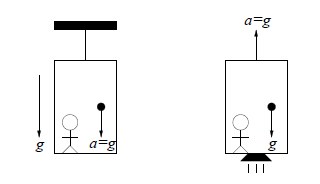
Sorry for repeating this here, but one of
the recipients of my email above claimed that
cannot understand the issue. Now
he can surely grasp it, but will again keep dead quiet.
D. Chakalov
December 30, 2012
Last updated: January 1, 2013,
16:21:30 GMT
======================================
Subject: Re: М. Г. Иванов, 'Как понимать квантовую механику', 2012, c.
30
Date: Mon, 31 Dec 2012 00:02:50 +0200
From: Dimi Chakalov <[email protected]>
To: Iegor <[email protected]>
Dear Iegor,
Thank you for the feedback. I very much respect
your work, and haven't spotted even a trace from
Russian poetry in it.
Surely "there is a component of the particle whose value cannot be
predetermined in the theory" (arXiv:1008.3661v1), but I think your
amendment "God doesn’t play dice, but lets the dice play"
(arXiv:1203.2945v1) requires precise explanation of the genuine
flexibility (not "uncertainty") of quantum particles -- please see
the two explanatory notes added at
http://www.god-does-not-play-dice.net/#cloud
http://www.god-does-not-play-dice.net/#Ivanov
I wish you joy and happiness in 2013 and beyond.
Dimi
=========================================
Subject: Corrections
Date: Mon, 31 Dec 2012 16:05:14 +0200
From: Dimi Chakalov <[email protected]>
To: Brenda Dunne <[email protected]>,
Larissa-Emilia Cheran <[email protected]>,
Jean Burns <[email protected]>,
Richard Amoroso <[email protected]>,
Matti Pitkanen <[email protected]>,
James Lake <[email protected]>,
Brian Millar <[email protected]>,
Lian Sidorov <[email protected]>,
Ulrich Mohrhoff <[email protected]>
Dear colleagues,
I will be happy to offer corrections to
your efforts. If you are
interested, check out some prerequisites at
http://www.god-does-not-play-dice.net/#cloud
Wishing you a joyful and prosperous New Year,
Dimi Chakalov
Operator #99
PEAR Lab, Princeton University
May 22, 1989
-------------
Note: I visited the
PEAR Lab in Princeton University in May 1989, and had the chance to test
briefly some of their "devices". Also, I was fortunate to have a lunch
with John A. Wheeler in the cafeteria at the Physics Department, and
offered him an explanation of a famous statement, which he has seen in
1976, on a wall in the Pecan Street Cafe in Austin, Texas
(J.A. Wheeler, 'Time Today', in
Physical Origins of Time Asymmetry, ed. by J.J. Halliwell, J.
Pérez-Mercader, and W.H. Zurek, Cambridge UP, Cambridge, 1994, p. 1):
"Time is nature's way to keep everything
from happening all at once."
John Wheeler was a famous theoretical
physicist and wasn't at all interested in solving his problems, but
look at
his drawing below from 'Law
Without Law', p. 209:
I hope you will
immediately understand the atemporal nature of the common source
of matter & psyche, after
Wolfgang Pauli (H. Atmanspracher
and H. Primas,
The Hidden Side of Wolfgang Pauli, Journal of Consciousness
Studies, 3 (1996) 112-126; cf. Sec. VI, Matter and Psyche as Two
Aspects of One Reality, p. 122).
There's no need for any "multiverse" and
anthropic speculations.
If you are interested, check out some
prerequisites at
http://www.god-does-not-play-dice.net/#cloud
D. Chakalov
January 1, 2013, 16:15 GMT
============================================
Subject: Re: "I bet $100
that the Higgs will not be discovered". Thursday, January 9, 2003,
15:56:04 GMT
Date: Fri, 4 Jan 2013 04:17:10 +0200
Message-ID:
<CAM7EkxmqvObh34TEViDnNC9yWUJ=JZbOkQkLL5UV9pFp1j=SEQ@mail.gmail.com>
From: Dimi Chakalov <[email protected]>
To: David J Miller <[email protected]>
Cc: [snip]
David,
Let me set the record straight: Ten years ago, I predicted that "the
Higgs will not be discovered. Instead, the number of quarks will jump to
8 and more, in a Fibonacci sequence" (Thursday, January 9, 2003,
15:56:04 GMT).
Check out
http://www.god-does-not-play-dice.net/#pure_energy
If you and/or any of your colleagues wish to have professional
discussion, please notice the conditions (i) and (ii) at
http://www.god-does-not-play-dice.net/#CERN_2013
"... please (i) reply
professionally and (ii) post
a copy from your ideas online at arXiv.org server.
I will respond immediately, without referring to my
website."
As ever,
Dimi
On Wed, 2 Jan 2013 16:35:54 -0000,
David J Miller <[email protected]>
wrote:
[snip]
Note: Again, we
cannot directly observe the pure dark
energy of 'the universe as ONE', for reasons explained
above. If we use the school
of fish metaphor, the task is tantamount to detecting directly
the very bootstrapping agent which keeps all quasi-local
fish en bloc and determines their quasi-local energy that
depends on the whole school -- no way, absurd. All we can infer
from our observations is that an observable quasi-local fish
(e.g.,
boson) has obtained the "dark" faculty of
self-acting (like Baron Munchausen), because the pure
dark energy of the bootstrapping
agent itself cannot be observed directly. We cannot derive,
as people try at CERN, the pure
dark energy of 'the whole school of
fish' from any new, previously unknown quasi-local 'fish', after increasing the
energy used with our detectors, such as the upgraded
LHC near Geneva -- no way, absurd. And if we take a look at a deeper
level of bootstrapping 'the whole school of fish' toward the Small, "the number of
quarks will jump to 8 and more, in a Fibonacci sequence" (Thursday,
January 9, 2003, 15:56:04 GMT). If we choose the opposite direction
toward the Large, it would be like trying to discover some "last
fundamental" volume of 3-D space, "after" which there were some "quiet
nothing out there", so we could imagine that the 3-D space can "expand
further" into such "nothing",
along some "4th spatial dimension" (Ned
Wright). Forget it.
This is what happens when
people try to reduce the non-Archimedean
'universe as ONE' to its finite, physical constituents obeying
the
Archimedean axiom -- see the excerpt below. Describing these two
worlds is a fundamental, and still unresolved, mathematical task.
If we use the
cocktail-party metaphor suggested by
David J. Miller in 1993, and try to "actually see the Higgs particle
itself", it will be tantamount to detecting directly the
last fundamental "rumour" that produces the last fundamental
"clustering" of (quasi-local) observable people bootstrapped at
the cocktail party -- no way, absurd. The nature of space does not
permit to "reach" the non-Archimedean
'universe as ONE' from the physical, Archimedean
world. Why? Because if people could physically reach 'the
'universe as ONE', they will be able to move further, and hence
contradict the Aristotelian Unmoved Mover (Karel
Kuchar) and First Cause.
Recall 'the grin of the
Cheshire cat without the cat' above:
can you detect the pure geometry itself ? Check out a brief outline
of General Relativity above. People like
Lev Okun' are still obsessed by the
Marxist-Leninist idea 'only matter can act on matter', and then
try to calculate the pure
dark energy as some physical
field with
positive energy density, only
to reach "the
worst theoretical prediction in the history of physics" known since
1930s: the radius of the universe “could not even reach to the moon” (Wolfgang
Pauli).
Last but not least, the
Arrow of Space forbids direct observations
of the pure
dark energy "online" -- we can detect
only the physical, quasi-local, already-correlated, and
self-acting particles (e.g.,
bosons), and only post factum due to
the "speed" of light. Which in turns produces quantum-gravitational
"waves" of propagation of these EPR-like correlated particles along the
Arrow of Space (explanation with four dice
above), without any physical, "waving" source --
nothing is "waving" in the quantum world
to produce quantum waves. The generation of such
quantum-gravitational "waves" is made jointly by (i) an
individual object and (ii) 'the whole universe as ONE', in line with (i)
the necessary and (ii) the sufficient conditions for
'spacetime' (cf. above).
Keep also in mind that in the
Machian quantum gravity, the reference
fluid of GR (global mode of spacetime) is an atemporal
pre-geometric medium ]between[
the geometric points, in which the geometrical-and-physical
content of 'world points' (Bergman &
Komar) is being re-determined
-- one-at-a-time along the Arrow of Space.
Thus, the mathematical continuum of "points" is being
re-created at every instant
'now' along the direction of time:
"You cannot step into the same
river twice, for fresh waters are ever flowing in upon you"
(Heraclitus). To be precise, the 'river' is the physical
universe, but it is never 'the same'.
But why 'Machian
quantum gravity'? Here's a quote from Mario Novello,
arXiv:1008.2371v1, p. 9:
"We start by considering Mach
principle as the statement according to which the inertial
properties of a body A are determined by the energy-momentum
throughout all space. How
could we describe such universal state that takes into account
the whole contribution of the rest-of-the-universe onto A ?"
As a first step, we include the opposite contribution of A back on the
rest-of-the-universe. It is an atemporal
bi-directional "talk" in the global mode of spacetime, which
fixes 'world points' and hence acts as the
reference fluid of 'the universe as
ONE'. Needless to say, this atemporal, pre-geometric and
pre-quantum medium acts by pure
dark energy only.
Trouble is, we haven't yet
developed the proper mathematical formalism for modeling the pure
dark energy of 'the universe as ONE' --
see the excerpt below.
NB: The task is strictly mathematical. There's no need to waste
BILLIONS and BILLIONS of taxpayers' money --
recall my prediction from Thursday, January 9, 2003, 15:56:04 GMT.
D. Chakalov
January 4, 2013
Last updated: January 6, 2013, 16:57:30 GMT
============================================
Subject: Re: "I bet $100 that the Higgs will not be discovered".
Thursday,
January 9, 2003, 15:56:04 GMT
Date: Wed, 2 Jan 2013 19:52:23 +0200
Message-ID:
<CAM7EkxnGcz3a1_DeoQUs_50SXAooRrkgSvQ-rw+XRsyij0trmQ@mail.gmail.com>
From: Dimi Chakalov <[email protected]>
To: [email protected]
Cc: Roman Jackiw <[email protected]>,
[email protected],
[email protected],
[email protected],
[email protected],
[email protected],
[email protected],
[email protected],
[email protected],
[email protected],
[email protected],
[email protected]
David,
> I could not find your previous email in my files.
I found 9 (nine) at my web site: see
search_djm.jpg attached.
> Maybe I never received it.
I like your sense of humo(u)r.
> Nevertheless I can confess that I have recently come round to
> conceding that the object observed by the LHC experiments
> could well be the Higgs boson.
But you don't have any theory in the first place,
David. Just a bunch of speculations, which run against everything we
know since 1935,
http://www.god-does-not-play-dice.net/#cloud
> I asked John Ellis a few weeks ago whether he was
ready to break
> his pencils, but he adamantly sticks to his expectation that SUSY
> will eventually emerge.
As John von Neumann put it, "There's no sense in being precise when you
don't even know what you're talking about." Read the note at
http://www.god-does-not-play-dice.net/#Kibble
Should you or any of your colleagues wish to respond professionally,
please study the facts. First thing first.
As ever,
Dimi
----------------------
>
>> P.S. Regarding my email from Fri, 6 Jan 2012 16:37:26 +0200, see an
>> update at
>>
>> http://www.god-does-not-play-dice.net/#Nernst
>>
>> You've kept quiet for a whole year. Any comments?
>>
>> D.C.
>>
>
============================================
Subject: Re: I bet $100 that the Higgs will not be
discovered.
Date: Thu, 3 Jan 2013 03:24:14 +0200
Message-ID:
<CAM7Ekx==JkXML7OkNYhW900qbjZuEqjDq7dQwSO-sfWp-OsY6Q@mail.gmail.com>
From: Dimi Chakalov <[email protected]>
To: [email protected],
[email protected],
[email protected],
[email protected],
[email protected],
[email protected],
[email protected],
[email protected],
[email protected],
[email protected],
[email protected],
[email protected],
[email protected],
[email protected],
[email protected],
[email protected],
[email protected],
[email protected]
CC: Tom Kibble <[email protected]>,
David J Miller <[email protected]>,
[email protected],
[email protected],
[email protected],
[email protected]
Ladies and Gentlemen,
No reply has been received to my email sent one year ago,
on Sun, 8 Jan 2012 22:25:25 +0200.
Just don't even *think* that I will let you waste BILLIONS and BILLIONS
of taxpayers' money for your hobby: it contradicts the basic facts of
Quantum Theory,
http://www.god-does-not-play-dice.net/#cloud
Check out the latest entry at
http://www.god-does-not-play-dice.net/#DJM
NB: All this is just the beginning. Ignore it at your peril.
Sincerely,
Dimi Chakalov
35 Sutherland St
London SW1V 4JU
===========================================
Subject: Re: “A spoken thought is a lie”
Date: Thu, 3 Jan 2013 17:47:39 +0200
Message-ID:
<CAM7EkxngEj4v+Pusjp-xd0K1fSP34YQyyJ7q2xt6BwGGC95PQw@mail.gmail.com>
From: Dimi Chakalov <[email protected]>
To: Lev Okun <[email protected]>, Lev Okun <[email protected]>
Cc: Andrei Khrennikov <[email protected]>,
[email protected],
Serge Krasnikov <[email protected]>,
Irina Basieva <[email protected]>,
Mike Ivanov <[email protected]>,
Slava Mukhanov <[email protected]>,
"A. Novikov-Borodin" <[email protected]>,
Dmitry Slavnov <[email protected]>,
Рылов Юрий <[email protected]>,
[email protected],
Daniil Yerokhin <[email protected]>,
Glib Ivashkevych <[email protected]>,
Yuri L Bolotin <[email protected]>,
Yuri Pavlov <[email protected]>,
[email protected],
[email protected],
[email protected],
[email protected],
[email protected],
[email protected],
[email protected],
[email protected],
[email protected],
[email protected],
[email protected],
[email protected],
[email protected],
[email protected],
[email protected],
[email protected],
[email protected],
[email protected],
[email protected],
[email protected],
[email protected],
[email protected],
[email protected],
[email protected],
[email protected],
[email protected],
[email protected],
[email protected],
Tom Kibble <[email protected]>,
David J Miller <[email protected]>,
Roman Jackiw <[email protected]>,
[email protected],
[email protected],
[email protected],
[email protected],
[email protected],
[email protected],
[email protected],
[email protected],
[email protected],
[email protected],
[email protected],
[email protected]
Lev dorogoi,
> Please indicate explicitly (without references to your blog)
> to which statements in your email you want me to reply.
You want from me to *ignore* my work since 1972, posted on my website
(you called it "blog"), and only "indicate explicitly" the basic facts
of Quantum Theory and General Relativity (you called them "statements").
You are indeed Russian:
http://www.god-does-not-play-dice.net/#Nernst
Of course I will *not* ignore my work. Here's why.
As I stated in my latest email at the link above (Tue, 1 Jan 2013
20:03:58 +0200), you are "personally responsible for implanting many
wrong ideas in theoretical physics, both in USSR and in the normal
world."
Just one very simple example.
The perpetual localization of one single quantum particle has been
studied in 1929 by Sir Nevill Mott. You weren't even born in 1929. But
you stubbornly resist to acknowledge the bold fact that neither you nor
*any of your colleagues* can explain the emergence of these finite
tracks made by individual quantum particles.
You cannot even think of infinite instances of "collapse"
nor "decoherence" of one single
particle. If you were able to solve this 1929 task with your textbooks,
you would automatically introduce some "quantum time" that matches the
duration of the visible path, then "time operators" in QM, and reconcile
the latter with Special Relativity: reductio ad absurdum.
You need to learn the basic basics of Quantum Theory from Erwin
Schrödinger and the KS Theorem,
http://www.god-does-not-play-dice.net/#cloud
http://www.god-does-not-play-dice.net/#Ivanov
Your colleagues from CERN cannot explain the bold fact of 'finite
continuous track from one single particle' either. They don't want to
study the basic facts of Quantum Theory either.
All they want is money:
http://www.god-does-not-play-dice.net/#DJM
The poetic statement by Fedor Tyutchev, “A spoken thought is a lie” (cf.
the subject line), encapsulates the unsolved task from 1929. Ignore it
at your peril.
Notice that I haven't mentioned the localization of gravitational energy
density 'at a point', which leads to the same puzzle from 1929, but is
known much earlier, thanks to David Hilbert -- check out the links
above, regarding the "dark energy".
I hope this is enough, for a start. It is not about my website (you
called it "blog").
Should you or *any of your colleagues* is ready to work (instead of
indulging in your hobbies), please (i) reply professionally and (ii)
post a copy from your ideas online at arXiv.org server. I will respond
immediately, without referring to my website.
But if you still prefer to behave as a
Russian -- don't bother to
reply.
Sincerely,
D. Chakalov
P.S. For the record, you can read this email at
http://www.god-does-not-play-dice.net/#CERN_2013
Soon on DVD as well.
D.C.
==========================================
Subject: Re: “A spoken thought is a lie”
Date: Sat, 19 Jan 2013 15:51:25 +0200
Message-ID: <CAM7EkxmcTScX0AfsmiAQ==f2++VU7mYNBxaVE2L8kSdkjyxkmQ@mail.gmail.com>
From: Dimi Chakalov <[email protected]>
To: Lev Okun <[email protected]>, Lev Okun <[email protected]>
Cc: [snip]
Lev dorogoi,
Thank you for your feedback from Sat, 19 Jan 2013 14:12:43 +0400. May I
ask a few questions.
You wrote:
> Following your advice I studied the 1929 article by
Sir Nevill Mott
1. Did you discover the process of generation of continuous observable
path from the underlying "collapse" or "decoherence" (anything else?) of
one single particle?
1.1. If you have made such discovery, did you confirm (or denounce?) the
stipulation that the
position-and-momentum of one single particle can be
collapsed/decohered *infinite times* to *map* the continuous observable
macroscopic track left from it?
1.2. If you've discovered some successive collapse/decoherence/whatever
of one single particle, did you also discover some "time operators" in
QM valid for
position-and-momentum of one single particle, with which
you can recover the finite duration of the observable macroscopic track
left from it, hence reconcile the non-relativistic QM with
Special
Relativity?
2. Alternatively, if you have not discovered the process of generation
of continuous observable path from the underlying "collapse" or "decoherence" (anything else?) of one single particle, what did you actually achieve,
if anything, regarding the puzzle from 1929?
The professional opinion from your colleagues will be highly appreciated
as well.
All the best,
Dimi
P.S. By the way, what have you been smoking?
D.
> On Fri, Jan 18, 2013 at 4:34 AM, Dimi Chakalov <[email protected]>
wrote:
>
>> P.S. Details at
>>
>> http://www.god-does-not-play-dice.net/#Klauder
>>
http://www.god-does-not-play-dice.net/Klauder.pdf
>>
>> Any comments?
>>
>> D.
>>
----------------
Note: May I offer an advice. If you have a
localization of an object, which (i) can be observed (see
above) and (ii) must occur at a point (e.g., the
localization of the intangible gravitational energy,
Hermann Bondi), but cannot be calculated nor
understood because it
involves energy exchange, please proceed with
caution -- the most obvious thing, which we
call 'spacetime', may be the most difficult to explain as emerging
from 'something else' (Isham
and Butterfield).
For example,
people at CERN look at the track from one single
elementary particle, and try to think about it with
Feynman path
integrals.
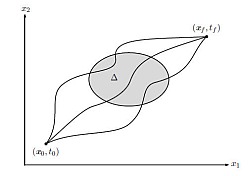
J.J.Halliwell and
J.M.Yearsley,
arXiv:1301.4373v1
But as
Roger Penrose explained in
The Road to Reality, pp. 667-668 (emphasis added), "the complex
amplitude to be assigned to that particular history is then given by the
deceptively simple formula [XXX]. Part of the deception, in the
simplicity of this formula, lies in the fact that the 'amplitude' is not
really a (complex) number, here (which, as written, would have to have
unit modulus), but some kind of density. (...) But here we have a
continuous infinity of classical alternatives. Our above
'amplitude' thus has to be thought of as an 'amplitude density'
(...). But the bad news here is that the 'space of classical paths' will
almost certainly turn out to be infinite-dimensional." It will be
mathematically impossible
to represent such continuous tracks of cyclical bi-directional conversions, from
quantum regime to classical and back, with
energy exchange.
Crudely speaking, if you
cannot explain the
quantum-classical and cyclical
energy exchange between the two "vertical" layers, you cannot explain
the two "horizontal" trajectories made of successive ‘positions’ one
after another. It's a bundle.
We have at least three
issues: (i) continuous (ii) energy exchange between (iii)
two layers, which lead to the classical trajectory at the observable
layer, like trails left in the sky from some invisible (quantum, in this
case) jet plane. Then you have to explain both trajectories at
both layers. To be precise (emphasis and notes added): "The chamber
is filled by a supersaturated vapour which can undergo local phase
transitions induced by the exchange of even a small amount of
energy. The tracks have usually the form of straight lines (or of
curved lines (recall the CERN photo above -
D.C.) whenever magnetic and/or electric fields are applied) and they can
be considered as the experimental manifestation of the ”trajectory” of
the alpha-particle (Alessandro
Teta,
arXiv:0905.1467v1, pp. 8-9).
Regarding issue (i),
recall Werner Heisenberg (emphasis added): “By path we understand a
series of points in space which the electron takes as ‘positions’ one
after another” (W. Heisenberg, Uber den anschaulichen Inhalt der
quantentheoretischen Kinematik und Mechanik, Zeit. fur Phsik., 43
(1927) 172-198).
NB: Here we have
two continuous paths made by ‘positions’ one after another,
and these ‘positions’ are defined by energy exchange between the
two paths, which results in propagation, as seen with its
observable, classical counterpart. We aren't talking about "the
direction" of
propagation, ensuing from "wave function having the form of a spherical
wave" (Alessandro
Teta, p. 9),
but about the propagation itself. Strangely enough
Lev Okun wasn't able to understand the first off issue of propagation
itself.
Mapping the two layers over a finite time interval, as recorder with
your wristwatch, is a formidable challenge, which Lev Okun and his
CERN colleagues persistently ignore, although
this unsolved puzzle is perhaps the most widely known public
secret in theoretical physics. And it costs billions.
The puzzle with
localization in gravitational physics also costs
billions; the main difference is that the energy exchange involves
quantum-gravitational
pure dark energy,
yet you can again read time made by the
already-linearized tangible energy (Hermann Bondi)
in the right-hand side of the Einstein
field equations with your "wrist watch!" (Chris
Isham).
It looks like
Renato Renner, Luciano
Rezzolla, and all people at CERN may never be able to understand this simple and unsolicited
advice. Hope you can and will.
D. Chakalov
January 19, 2013
Last updated: January 23, 2013, 23:13 GMT
-------------
Jacob D. Bekenstein:
"Already in the 1960's
Wheeler made the case that at Planck scale quantum fluctuations of
the space geometry must become strong enough to disrupt the smoothness
of the space-time manifold, even to the extent of introducing
multi-connected topology [12].
On this same scale the geometry fluctuates violently in time. Can we
"see" this quantum foam? (...) Generalizing we
realize that the Achilles heel of many procedures for making
quantum foam graphic is in the requisite amount of
localization of the probes."

Comment: The calculation above (click the image with dotted
lines, from December 25, 2010) is incorrect. Sorry. I
was hoping that someone will respond to the localization task
from 1929, because usually people are prone
to react to errors, but nobody did. Let me correct my calculation and
try to explain the emergence of spacetime
from 'something else' (Isham
and Butterfield), such that we can
"see as far as we like" (Lee
Smolin), thanks to the emergent (along the
Arrow of Space) topological dimensions of spacetime.
Currently, we can see
undisturbed spacetime 7.3 billion light years from Earth
(Yuan K. Ha,
pp. 8-9), and will assume, after the
Cosmological Principle, that the spacetime has the same
properties, most notably
Lorentz covariance, everywhere along all directions. Let's consider
a volume of 3-D space, with radius 7.3 billion light years, and
calculate the finite number of
"atoms of volume" in such finite
3-D space, ensuing from L. Smolin's suggestion (he is
very good in math) that, according to
"loop quantum gravity" or LQG,
roughly 1099 "atoms of
volume" are contained in every cubic centimeter of space, as he
explained in Scientific American from January 2004,
pp. 66-75:
To calculate the number
of cubic centimeters in a sphere with radius 7.3 billion light
years (and later multiply it by 1099 "atoms of volume", in
line with the Archimedean Axiom), I used
Google and some 'spherical cow' approximations:
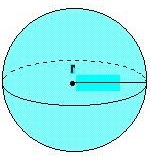
1 light year is 9.46x10¹⁷
cm; the radius (r) of 7.3 billion light years will contain
app. 69x1026 cm, and the total number of cubic cm in a
sphere with radius (r) 69x1026 cm will approach
69x1032 cm3 (V
= 4/3 pi r3),
each of which, according to the Archimedean Axiom,
is made of 1099 "atoms of volume".
Thus, the total number of
"atoms of volume" is roughly 7.10132 , each of which
is directly rooted on some
"spacetime
foam" in which "points
become fuzzy and locality looses any precise meaning" (S.
Doplicher, p.
21), yet people skilled in math wish to
imagine that one can
"erect a locally inertial coordinate
system in which matter satisfies the laws of special relativity" (S.
Weinberg, pp. 62-68) and
Lorentzian metric within 10-30 seconds "during" the
inflation, and safely store it there for
13.73 billion years during
which the same 3-D spare has been "inflated" by its "dark energy", along
the radius (r) that does not exist as some "4th spatial
dimension" (Ned
Wright) in the first place. Forget it.
Nobody can recover the
continuum (Georg Cantor) from stipulations
based on wrong localization (cf. Sir Nevill Mott
above) and incomplete geometry based
exclusively on the Archimedean Axiom. We
need the non-Archimedean global mode of
spacetime as well.

'All right,' said
the Cat; and this time it vanished quite slowly, beginning with
the end of the tail, and ending with the grin, which remained
some time after
the rest of it had gone. 'Well! I've often seen a cat
without a grin,' thought
Alice; 'but a
grin without a cat! It's the most curious thing I ever say
in my life!'
The spacetime continuum in
the geometric formulation of GR (the grin of the
Cheshire cat without the cat, as observed by
Alice) contains
UNcountably infinite "points"
(Georg Cantor): no "number" could possibly
display the cardinality of 'the set of all sets' which isn't a 'set' in
the first place -- see below.
Subsequently, in the local (physical,
teleological, and Archimedean) mode of
spacetime we face the conundrum of Lucretius:
every finite, not matter how big or small,
Archimedean object contains "the same number" of these immaterial
dimensionless geometrical points (Georg
Cantor). In order to have 'world points' that include
quasi-localized matter (Bergmann and Komar),
we need to stop the infinite regression toward "zero" with a
rock-bottom limit: the empty set
R from the
global mode of spacetime. The latter must be
brought back into spacetime to also
define its fleeting "boundaries", as suggested
previously.
But how to recover the finite 4-D spacetime made
with different volumes of space, which are traversed by light
for different times? Only the "speed" of
light can "sense" the geometrical points in the
continuum of Georg Cantor en bloc,
and "read" them in such way that
finite objects with
distance
function can emerge as 'local mode of spacetime'. Which is
what the emergence of spacetime
from 'something else' (Isham
and Butterfield) is all about (cf. the fourth group of the
Ishamian taxonomy suggested in
1993).
We need
non-Archimedean
geometry and new
mathematical formalism for quantum gravity.
We simply cannot learn any details without an exact mathematical
quantum gravity. It would be very difficult to specify the expectations
from our still-uncovered mathematical quantum gravity, yet it seems to
me that, if the universe itself works as a 'brain' (22
May 1988), we should be able to alter the global mode of time
in which the total energy of 'the whole universe as ONE' is kept
nullified (cf.
Eq 1, p. 35 in
ExplanatoryNote.pdf),
and hence evoke the release of pure
dark energy into any form of
tangible energy (Sir Hermann Bondi). We may be able
to eliminating all nuclear reactors by
2022, and fly by 'reversible
elimination of inertial mass' or
REIM, perhaps like a
reactionless
Alien Visiting Craft (AVC).
What if we alter the spacetime metric locally and reversibly, to wrap
our REIM drive? Perhaps we can traverse
1000 m, as measured in the inertial frame of outsiders, with speed 1
m/sec relative to the modified
Lorentz covariance (Sic!) in our
inertial frame. We would perhaps notice
that, strangely enough, the 3-D space itself is now "moving" toward
us as well, and after we land we'll find out that our clock was a bit "slower".
Can we make a "sharp" turn with speed 1 m/sec ? Of course. Only those
poor people outside will be flabbergasted and think we were "aliens".
Which is fine with me, of course.
Well, I wish I've studied
mathematics, instead of psychology. The task is well beyond and above my
very limited knowledge of differential geometry and topology. And
those who know math, don't care and keep wasting
their life with chasings ghosts.
D. Chakalov
January 22, 2013
Last updated: January 23, 2013, 13:45 GMT
============================================
Subject: The revival of A-time in quantum gravity
Date: Sat, 26 Jan 2013 03:00:59 +0200
Message-ID: <CAM7EkxkYYr5YeQisS8QPQNJpbq27k=Lcpe2Tk-ZXJw4_XDm4jg@mail.gmail.com>
From: Dimi Chakalov <[email protected]>
To: Hartmann Römer <[email protected]>
Cc: [email protected],
[email protected],
[email protected],
[email protected],
[email protected],
[email protected],
[email protected],
[email protected],
[email protected]
Dear Hartmann,
I like your recent
arXiv:1202.5748v2 very much, but have different proposals, ensuing
from the most widely known public secret in theoretical physics:
localization,
http://www.god-does-not-play-dice.net/#localization
http://www.god-does-not-play-dice.net/#EFE
Some tentative predictions from the theory are outlined at
http://www.god-does-not-play-dice.net/#2022
Besser eine Laus im Kraut als gar kein Fleisch ?
All the best,
Dimi
===================================================
Subject: Re: “A spoken
thought is a lie”
Date: Sat, 19 Jan 2013 22:23:54 +0200
From: dchakalov <[email protected]>
To: Lev Okun <[email protected]>, Lev Okun <[email protected]>
> Could you please listen to autobiographical interview given in 1985
Lev, can you read English? Nobody talks about any "autobiographical
interview", nor about your cat or mother-in-law.
> As was shown in my book ABC of Physics (Chapter 6)
> all results of Relativistic Quantum Mechanics can be reproduced
> without the misleading concept of collapse of wave function.
But your book is seriously wrong, because you cannot explain the
phenomenon in question either way -- everything and anything you've
written in inapplicable. See again my today's email (Sat, 19 Jan 2013
15:51:25 +0200) at
http://www.god-does-not-play-dice.net/#localization
Please get professional and don't try to twist the issue. It's
about time, literally.
D. Chakalov
>> On Fri, Jan 18, 2013 at 4:34 AM, Dimi Chakalov <[email protected]>
wrote:
>>
>>> P.S. Details at
>>>
>>> http://www.god-does-not-play-dice.net/#Klauder
>>>
http://www.god-does-not-play-dice.net/Klauder.pdf
>>>
>>> Any comments?
>>>
>>> D.
==========================================
Subject: The relative phase of a superposition state,
arXiv:1302.3787v1 [quant-ph]
Date: Mon, 18 Feb 2013 11:17:05 +0200
From: Dimi Chakalov <[email protected]>
To: S Peil <[email protected]>
Dear Dr. Peil,
Thank you for your wonderful paper. It was a rare pleasure to read it.
Perhaps you can check out 'relative phase of a superposition state' in
the 1929 puzzle at
http://www.god-does-not-play-dice.net/#localization
Best regards,
Dimi Chakalov
-------------
Note: Steven Peil writes that, "according to standard quantum
mechanics, the relative phase of a superposition state has no effect on
measurement outcome; the Born rule for deducing measurement
probabilities eliminates the relative phase by construction through the
squaring of the complex probability amplitudes. Rather, the phase serves
as a record of coherent evolution, and it plays an important role
in atomic clocks and other atomic interferometers."
Perhaps another case of coherent evolution is with the duration of
quantum coherence in photosynthetic complexes: "over an order of
magnitude longer than coherences between electronic ground and excited
states" (Martin Plenio et al., Nature Physics 9 (2013)
113-118;
arXiv:1203.0776v2 [quant-ph]). What is the shielding factor
that can prolong the quantum coherence to ensure the safe passage of
nearly 100% of the photon energy that the organisms absorbed?
The proper issue to start
with is the 1929 puzzle from Sir Nevill Mott.
Good luck.
D. Chakalov
February 18, 2013
==============================================================

Subject: Re: Gravity (not "gravitons") knows about everything
Date: Fri, 4 Jan 2013 23:13:17 +0200
Message-ID:
<CAM7EkxnOrGwg9Jj2E4ZcKRNB31f0A-=pONxbrAhJEOdcJc1+cg@mail.gmail.com>
From: Dimi Chakalov <[email protected]>
To: Anthony Zee <[email protected]>,
Lily Schrempp <[email protected]>,
Kishore Ananda <[email protected]>,
Edward W Kolb <[email protected]>,
Lawrence M Krauss <[email protected]>,
Nima Arkani-Hamed <[email protected]>,
Paul Federbush <[email protected]>,
Ian Lawrie <[email protected]>,
Robert van den Hoogen <[email protected]>,
Frank Steiner <[email protected]>,
Claus Gerhardt <[email protected]>,
Eduardo Guendelman <[email protected]>,
Thomas Buchert <[email protected]>,
Yi Zhang <[email protected]>,
Lau Loi So <[email protected]>,
Xiao Zhang <[email protected]>,
Marco Spaans <[email protected]>,
Sergio Doplicher <[email protected]>,
Diederik Aerts <[email protected]>,
Norbert Straumann <[email protected]>,
Merced Montesinos Velásquez <[email protected]>,
Angelo Loinger <[email protected]>,
John Stachel <[email protected]>,
Tiziana Marsico <[email protected]>,
Jeremy <[email protected]>,
Eric <[email protected]>,
Erik <[email protected]>
Dear colleagues,
In 'Gravity and its Mysteries: Some Thoughts and Speculations',
arXiv:0805.2183v2 [hep-th], Anthony Zee wrote (p.
17):
"To move forward, physics had to abandon an apparently ironclad piece of
commonsense that “where there is a wave something must be waving.” I
would not be at all surprised if it turns out that to move forward, we
have to abandon an equally ironclad piece of commonsense. I leave it to
the reader to identify that piece."
To identify 'the wave without any waving source', please see
for_the_record.jpg
attached, from
http://www.god-does-not-play-dice.net/#DJM
If you have questions, feel free to write me back.
With all good wishes for 2013 and beyond,
Dimi Chakalov
On Thu, 11 Feb 2010 16:25:10 +0200, Dimi Chakalov <[email protected]>
wrote:
[snip]
=====================================================
Subject: Government of Canada Funding Encourages Youth to Pursue Careers
in Science,
7 December 2012
Date: Tue, 8 Jan 2013 23:18:00 +0200
Message-ID:
<CAM7Ekxmyg2B_RJH1wFwX10m=bArTSViLJYopeSrEH_zEnW30FQ@mail.gmail.com>
From: Dimi Chakalov <[email protected]>
To: [email protected],
[email protected],
[email protected],
[email protected],
[email protected],
[email protected],
[email protected]
"Perimeter Institute has received a
$1.73 million grant from the Government of Canada to boost its
educational outreach initiatives and further encourage youth to pursue
studies in science, technology, engineering, and math (STEM) fields."
---------------------
Dear colleagues,
Please see the text (printed below) of my email sent a few minutes ago
to Ms Stephanie Thomas at
FedDev Ontario. I think you do not deserve
any support
whatsoever.
Should you have questions, please don't hesitate to write me back.
Sincerely,
Dimi Chakalov
=====================
Re: Government of Canada Funding Encourages Youth to Pursue Careers in
Science, 7 December 2012
ATTN.: Ms Stephanie Thomas
Dear Ms Thomas,
In my opinion, the Perimeter Institute (PI) cannot introduce students
to the STEM fields. Instead, it may implant many wrong speculations
used by PI members.
I will be happy to elaborate extensively.
Yours sincerely,
Dimi Chakalov
chakalov.net
=====================
Subject: Re: FedDev Ontario (MSC 0006757)
Date: Wed, 23 Jan 2013 00:08:08 +0200
In-Reply-To:
<B13B47FE0AD80B4F950FE5FCD559A87D06448576@MSG-MB-02.icent.ic.gc.ca>
Message-ID: <CAM7EkxmTJc1AgEqAqBoHY-k-Ug69OtJdnaKV59Tf7VfJa6iCPA@mail.gmail.com>
From: Dimi Chakalov <[email protected]>
To: Jeannie Smith <[email protected]>
Cc: [email protected],
[email protected],
[email protected],
[email protected],
[email protected],
[email protected],
[email protected],
[email protected],
[email protected],
[email protected],
[email protected]
Dear Mrs. Smith,
Thank you for your reply from Tue, 22 Jan 2013 14:04:35 -0500.
> Thank you for taking the time to contact FedDev Ontario with your
views on funding
> provided to the Perimeter Institute.
In my opinion, you are wasting real money, earned with hard labor by
many people in Canada, to support a group of individuals who are only
practicing their diverse hobbies. They aren't interested in the real,
and widely known tasks of Quantum Theory:
http://www.god-does-not-play-dice.net/#localization
The proof of my statements in this email, as well as those in my initial
email from 7 December 2012 (printed below), will be provided by PI
members themselves -- they will not reply professionally, because they
can't. And they can't reply professionally due to their ignorance of the
main problems of Quantum Theory known since 1929 (cf. the link above).
Just one example: the last email from Lee Smolin was from Sun, 24 Feb
2002 17:30:25 +0000 (BST), and in the pats thirteen year he has not even
mentioned the unsolved problems from 1929, explain at the link above. Of
course they are widely known, but cannot be solved with his hobby, which
is why he has been keeping quiet ever since.
Needless to say, I am ready to elaborate extensively, starting with the
lack of understanding of the basic issues from 1929 (cf. the link above)
on behalf of PI members -- just wait to see their reaction. They will
either (i) keep quiet or (ii) bluntly refuse to consider the unsolved
tasks since 1929.
NB: Any third option will force them to abandon their hobbies and
start working as professional physicists, which they can't.
I know the scientific members of PI very well indeed. They
do not
deserve *any* support whatsoever.
Looking forward to hearing from you, Lee Smolin, and his scientific
colleagues,
Yours sincerely,
Dimi Chakalov
=====================
Re: Government of Canada Funding Encourages Youth to Pursue Careers in
Science, 7 December 2012
ATTN.: Ms Stephanie Thomas
Dear Ms Thomas,
In my opinion, the Perimeter Institute (PI) cannot introduce students
to the STEM fields. Instead, it may implant many wrong speculations
used by PI members.
I will be happy to elaborate extensively.
Yours sincerely,
Dimi Chakalov
chakalov.net
===================================================
Subject: Re: Grundlage der allgemeinen Relativitätstheorie
Date: Tue, 22 Jan 2013 17:57:15 +0200
From: Dimi Chakalov <[email protected]>
To: [snip]
Dear colleagues,
The unsolved mathematical problems, mentioned in my initial email (Thu,
10 Jan 2013), are known since 1929,
http://www.god-does-not-play-dice.net/#localization
My prediction, based on the assumptions that these problems can and will
be resolved, is explained in the excerpt (cf.
attached) from
http://www.god-does-not-play-dice.net/#2022
Please let me know if you would be interested in quantum gravity.
Sincerely,
D. Chakalov
On Thu, 10 Jan 2013 16:29:00 +0200, Dimi Chakalov <[email protected]>
wrote:
>
> Dear colleagues,
>
> A number of unsolved mathematical problems are posted at
>
> http://www.god-does-not-play-dice.net/#Neiman
>
> Sincerely,
>
> D. Chakalov
==============================================
http://www.scribd.com/doc/120680276/Quantum-Ontology
Subject: Re: Enhanced Quantization
Date: Mon, 14 Jan 2013 16:38:58 +0200
From: Dimi Chakalov <[email protected]>
To: John Klauder <[email protected]>
Dear John,
Thank you for your kind reply. It is a pleasure to hear from you, and I
very much hope to understand your Enhanced Quantization (John R. Klauder,
arXiv:1211.7351v3 [quant-ph]).
As it looks to me, the problem is to
recover the *exact* (no
approximations) classical limit of QM [Ref. 1],
and then (hopefully) move to "the evolving universe as a whole" [Ref.
2], provided we have previously defined the asymptotic structure for
arbitrarily large spatial volumes, pertaining to 'the universe as a
whole', in order to answer the fundamental question 'relative to what?'.
In my opinion, the *exact* (no approximations) classical limit of QM
cannot be derived, because of the so-called "context" in Kochen-Specker
Theorem [Ref. 3]: the intrinsically UNcolorable
[whatever] cannot be presented in Hilbert space with dim 3 and higher.
We don't face this problem in the Schrödinger cat paradox (nor in the
"quantum information" hypothesis), because we still can play with
Hilbert space there.
But in general, these UNcolorable [whatever] cannot fit in any
reasonable Hilbert space in principle. Moreover, they are not related to
any probabilities whatsoever, firstly because we
can say nothing about them in the framework of
Quantum Theory (please ignore my website).
The question is, what would you do to fix these problems? I tried with
the geometric formulation of QM [Ref. 4], simply
because I don't like the mathematical poetry in standard QM textbooks,
but it didn't work out.
Perhaps you can help with deriving the *exact* classical limit of QM [Ref.
1], as you don't like mathematical poetry either. Namely, I do hope
you can include these UNcolorable [whatever] in the
solution to the macro-objectification problem [Ref.
5], and hence solve the *exact* classical limit. Then I hope you
could reconcile Quantum Theory with Special Relativity, with your theory
of Enhanced Quantization.
Sorry for being too long. Thank you in advance for your time and
efforts.
Best regards,
Dimi
On Mon, 14 Jan 2013 00:45:30 -0500, John Klauder <[email protected]>
wrote:
[snip]
> On Sun, Jan 13, 2013 at 11:34 PM, Dimi Chakalov <[email protected]>
wrote:
>>
>> Dear John,
>>
>> Please let me know if you can suggest any solution to the measurement
>> & macro-objectification problems, do define the "classical limit" of
>> QM and then embark on your ideas.
>>
>> All the best,
>>
>> Dimi Chakalov
>> chakalov.net
>
-----------------------
[Ref. 1] L. Landau, E.M. Lifshitz, Quantum mechanics: Non-relativistic
theory, 3rd ed., Pergamon Press, 1977.
"Thus quantum mechanics occupies a very unusual place among physical
theories: it contains classical mechanics as a limiting case, yet at the
same time it requires this limiting case for its own formulation."
[Ref. 2] James B. Hartle, S. W. Hawking, Thomas Hertog, Inflation with
Negative Λ, arXiv:1207.6653v2 [hep-th]
http://arxiv.org/abs/1207.6653v2
"Our large scale
observations of the universe are of its classical behavior. The
isotropic accelerated expansion and the large scale structure in the
CMB and the galaxy distribution are just two
examples. The laws that govern such features can be presumed (statement
of belief - D.) to be fundamentally quantum mechanical. A quantum system
behaves classically when the probabilities implied by the quantum state
(Sic! - D.) are high for coarse-grained histories with correlations in
time (classical limit? - D.) governed by deterministic equations of
motion. That is true whether the system is a tennis ball in flight or
*the evolving universe as a whole* (emphasis added - D.).
.........
"(W)ave functions satisfying the constraints of general relativity have
a universal semiclassical (unacceptable approximation - D.) asymptotic
(unacceptable approximation - D.) structure for large (unacceptable
approximation - D.) spatial volumes."
[Ref. 3] Karol Horodecki et al., Contextuality offers device-independent
security, arXiv:1006.0468v1 [quant-ph]
http://arxiv.org/abs/1006.0468
(Please see an excerpt in KS_context_time.jpg attached.)

[Ref. 4] Abhay Ashtekar and Troy A. Schilling, Geometrical Formulation
of Quantum Mechanics, arXiv:gr-qc/9706069v1
http://arxiv.org/abs/gr-qc/9706069
"The geometric formulation
shows that the linear structure which is at the forefront in text-book
treatments of quantum mechanics is, primarily, only a technical
convenience and the essential ingredients -- the manifold of states, the
symplectic structure and the Riemannian metric -- do not share this
linearity. Therefore, the framework can serve as a stepping stone for
non-linear generalizations of quantum mechanics."
[Ref. 5] GianCarlo Ghirardi, Sneaking a Look at God's Cards: Unraveling
the Mysteries of Quantum Mechanics, Princeton University Press, 2007.
"How, when, and under what conditions do definite macroscopic properties
emerge (in accordance with our daily experience) for systems that, when
all is said and done, we have no good reasons for thinking they are
fundamentally different from the micro-systems of
which they are composed?"
----------------------------------
Note: Let me stress
again that the crucial issue of 'reality in Quantum
Theory' cannot be presented with "probabilities": see Erwin
Schrödinger in 1935 and in
November 1950. Ten years later, Ernst Specker (1960)
demonstrated that it is impossible to even think of
anything that could restore the reality in Quantum Theory, because
of the requirements from 'the context' imposed at 'one instant' (John
Bell), as read with physical clock [Ref. 3].
Thus, the
no-go argument from John Bell is a secondary issue, which is not
relevant here, because it uses counterfactual statements (W. Unruh,
Nonlocality, counterfactuals, and quantum mechanics, Phys. Rev.
A59, 126-130 (1999);
arXiv:quant-ph/9710032v2, p. 3) of the type 'what might have
happened, had I made measurements that I didn't actually made'. Such
counterfactual statements cannot be applied to reality
in Quantum Theory, because they explicitly presuppose the mundane form of reality we know from classical physics. For
example, if I toss a coin on the table and see 'heads', I can and will
conclude with certainty that the invisible -- at the same instant
-- state of the coin was indeed 'tales', at the same instant.
Recall that the requirement of unitarity strictly requires that
one outcome will be observed with unit probability, that is,
'something will happen with certainty', provided that the coefficients
for probability will also be fixed -- for this same one instant
-- by the requirement of unitarity prior to the act of measurement.
In the case of tossing a coin, we have 1/2 probability for 'heads' and
1/2 probability for 'tales'. Subsequently, if the presumed coin has somehow
evolved into dice (recall
Black Swans), we encounter non-unitary transitions and correct
our expectations to match the notion of 'objective reality out there'
from classical physics, keeping the same recipe, 6x1/6 = 1 .
But as we know from
Ernst Specker, the outcomes of all observables at
the same instant cannot be treated with probabilities,
because "quantum mechanics predicts that along solid lines, the
outcomes, if multiplied give with certainty 1, while on the dashed line
they give -1." [Ref. 3]. Period. Subject closed.
We need 'potential reality'.
For the sake of the
argument, just think for a moment that the KS Theorem
were wrong: we could somehow think of the full catalogue
of expectation values (Erwin
Schrödinger), although such speculation would
require some "hidden variables" that could somehow fix such full
catalogue, in line with the requirement of unitarity which people impose
prior to the act of measurement. Then we could calculate with such "hidden variables" all
possible "states" of quantum systems, included the number of angels
which can fit on needle's pin, and find out how
many angels were blond, for example.
The fact of the matter is
that 'reality in Quantum Theory' requires to
examine all possible "clouds" in all possible experimental
contexts, pertaining to one single particle, as we know
since 1929 after Sir Nevill Mott. However, we
cannot measure non-commuting observables, such as the
position-and-momentum
of one single particle. These "clouds"
or "jackets" certainly exist 'out there' with
certainty, but in the form of pre-quantum and
pre-gravitational reality, which cannot be directly observed
due to the "speed" of light.
We will inevitably encounter an UNspeakable, pre-quantum,
Kochen-Specker source in the case of KS
Theorem, simply because it pertains to all possible
non-commuting observables. And this is the
pre-quantum source in Quantum Theory, which always
exists 'out there' (forget about probabilities), regardless of whether it is "observed" or not:
There was a young man
who said "God,
to you it must seem very odd
that a tree as a tree
simply ceases to be
when there's no one about in the
quad."
"Young man, your
astonishment's odd,
I'm always about in the quad
and that's why the tree
never ceases to be
as observed by, yours faithfully,
God."
No, we cannot recover the
exact (no approximations) classical limit of
QM from textbooks. Physically, we can only
observe a fleeting and distorted classical "jacket",
projected on Plato's cave one-at-a-time by
the Arrow of Space, and with unit probability:
God casts the die, not the dice (Albert Einstein). The alleged "quantum
jumps" are nothing but artifacts from the macroscopic measuring
devices: Dead matter makes quantum
jumps; the living-and-quantum matter is
smarter. Why?
Because of the "speed" of light:
Why this is difficult to understand, I wonder. Is
this because
people prefer parapsychology instead of quantum gravity?
D. Chakalov
January 16, 2013
Last updated: January 18, 2013, 16:58:42 GMT
http://www.scribd.com/doc/120680276/Quantum-Ontology
------------
"Wenn es doch bei dieser
verdammten Quantenspringerei bleiben soll, dann bedauere ich, mich mit
der Quantentheorie überhaupt beschäftigt zu haben." (If we have to go on
with these damned quantum jumps, then I'm sorry that I ever got
involved.)
Erwin Schrödinger
"Let me say at the outset, that in this discourse, I am opposing not a
few special statements of quantum mechanics held today (1950s), I am
opposing as it were the whole of it, I am opposing its basic views that
have been shaped 25 years ago, when Max Born put forward his probability
interpretation, which was accepted by almost everybody.
....
"I don't like it, and I'm sorry I ever had anything to do with it."
Erwin Schrödinger, The Interpretation of Quantum Mechanics.
Dublin Seminars (1949-1955) and Other Unpublished Essays, Ox Bow Press,
Woodbridge, 1995
=============================================
Subject:
arXiv:1301.2844v1 [quant-ph], p. 3
Date: Tue, 15 Jan 2013 12:08:35 +0200
From: Dimi Chakalov <[email protected]>
To: IGUS
Jim <[email protected]>
Cc: Yakir Aharonov <[email protected]>,
Yakov Itin <[email protected]>,
Yasha Neiman <[email protected]>,
[email protected],
[email protected],
[email protected]
IGUS Jim:
"Alternatives at a moment of time can be reduced to a set of yes/no
questions."
No they can't,
http://www.god-does-not-play-dice.net/#Klauder
http://www.god-does-not-play-dice.net/Klauder.pdf
http://www.god-does-not-play-dice.net/#cloud
http://www.god-does-not-play-dice.net/#Brown_null
http://www.god-does-not-play-dice.net/#Neiman
You still haven't replied to my arguments against your essay 'Problems
for the 21st Century',
gr-qc/9701022, January 16, 1997.
You've been quiet for 16 years, Jim. Is it fun?
I pose this question to your colleagues as well.
Dimi Chakalov
-------------
"Wenn es doch bei dieser verdammten Quantenspringerei bleiben soll, dann
bedauere ich, mich mit der Quantentheorie überhaupt beschäftigt zu haben."
Erwin Schrödinger
========================================
http://www.scribd.com/doc/130939366/Dedicated-to-Ernst-Specker
Printable file
http://www.god-does-not-play-dice.net/Ernst_Specker.pdf

Subject: Re: The "cloud" of contextuality
Date: Fri, 18 Jan 2013 04:55:05 +0200
Message-ID:
<CAM7Ekx=g00uAjJjKOi-3dfg_X0b0QqmOxF1qL98_wukDjwjrOw@mail.gmail.com>
From: Dimi Chakalov <[email protected]>
To: Jürg <[email protected]>,
Jürg Fröhlich <[email protected]>,
Gian Michele Graf <[email protected]>,
Stefan Wolf <[email protected]>,
[email protected],
[email protected],
[email protected],
[email protected],
[email protected],
[email protected],
[email protected],
[email protected],
[email protected]
Dear colleagues,
No reply has been received to my email sent two weeks ago.
Meanwhile, I tried to explain the issue at
http://www.god-does-not-play-dice.net/#Klauder
http://www.god-does-not-play-dice.net/Klauder.pdf
Please send me your professional opinion.
The issue is indeed well-known, since 1935. The latest relevant
reference in the text above is from Ernst Specker regarding the "Infuturabilien"
(Die Logik nicht gleichzeitig entscheidbarer Aussagen, Dialectica 14,
239-246 (1960); p. 243). Professor Specker
was also associated with ETH Zurich, and acknowledged the receipt of my
proposal on Wed, 20 Apr 2011 18:41:44 +0000.
Unfortunately, he left us
eighth months later. God bless his soul.
We must restore the heritage of
Ernst Paul Specker.
Looking forward to hearing from you at your earliest convenience,
Sincerely,
Dimi Chakalov
On Fri, 4 Jan 2013 15:15:08 +0200, Dimi Chakalov <[email protected]>
wrote:
[snip]
------------------
Note: Three weeks
after my email above, I still haven't received any
answer. Perhaps these people simply can't understand the meaning of
Infuturabilien
in Ernst Specker's article (p. 243). Let me
help.
Unlike
Bell's argument [Ref.
1], the Kochen-Specker theorem does not depend on
separability and/or locality assumptions. The issue is not about
"correlations" nor "noncontextual
hidden" (whatever), and has nothing to do with Bell's
argument which cannot display the noncolorizable UNspeakable
pre-quantum Kochen-Specker states.
They show
up in a Hilbert space of more than two dimensions: it is in principle
impossible to ‘color’ with 0’s and 1’s without
violating orthogonality constraints and obtain
"consistent
predictions about a quantum mechanical system" (Ernst
Specker), because the noncolorizable "quantum states"
of [whatever] are neither
"quantum" nor "states". They do not pertain to anything physical,
hence cannot fit in any Hilbert space whatsoever. It does not
matter whether we would change the "context" and "multiply them in different order" (see
above), because all
permutations of possible sequences/orders of multiplication will
always show the same number of noncolorizable "quantum states"
of [whatever].
The issue here is that the
permutations of possible cases of "context" (see
above), introduced with all possible sequences/orders of
"multiplication", will demonstrate with certainty that all
quantum "states" can switch from physical, colorable quantum
observables to unphysical, noncolorizable "quantum states"
of [whatever],
and back. To explain this fundamental quantum phenomenon (which cannot
be demonstrated with Bell's argument), let me simplify it by introducing
three quantum guys, Tom, Dick, and Harry. They have three degrees of
freedom by raising their hands upon observation: only left hand [L, up],
or only right hand [R, up], or both hands [up, up]. Thus, if Tom becomes
colorable quantum observable in particular "context" (see
above) with [L, up], Dick and Harry have to pick
up the remaining alternatives for this "context", but if Dick
chooses [R, up], Harry will have no hands and will not
become colorable quantum observable. If at some other instant
(as measured with your macroscopic wristwatch) Harry chooses to raise
both hands [up, up], and Dick chooses [L, up], then Tom will have no
hands at this particular instant,
and have to remain in the initial unphysical, noncolorizable [whatever],
from which the three quantum guys evolved by changing the
"context".
Perhaps the simplest
explanation is offered by
Chris Isham: "the implication
of the discussion above is that the value ascribed to B (resp. the
result of measuring B) depends on whether it is considered together with
A1, or together with A2. In other words the value of the physical
quantity B is contextual." In our parable, the quantity B
will show up with different combination of "hands", and will not
have any pre-existing "state". To explain this crucially important
situation, suppose we identify the three quantum guys by their raised
hands, say, Tom has only [L, up],
Dick has only [R, up], and Harry can only raise both hands [up, up].
Then the fundamental feature of
Quantum Theory is that at any instant,
as measured with your (inanimate) wristwatch,
one of the guys will have no
hands, because at this instant he will remain confined
(remember
quarks?) in the unphysical unspeakable noncolorizable
pre-quantum [whatever],
from which the three quantum guys evolved by changing the
"context".
Generally speaking, the
notion of potential reality can be parameterized with the variable [psi]
from the Potential Reality (PR) interpretation of QM
-- in the case of {Tom, Dick, Harry} [psi]
equals 3, while in the case of 'spin up/spin down' [Ref.
1], [psi] equals
2. Yet in dim(H)≥ 3 some percentage
(Helena Granström,
p. 2)
of all possible explications may
have [psi] zero, similar to
'the
ideal monad without windows' or Kantian thing-in-itself (das
Ding an sich). Notice that potential reality
is practically non-existent in classical mechanics; in QM it
can be proved for only one instant of
"joint probability distribution" in dim(H)≥ 3; and in
QCD it holds permanently in the form of
quarks and "god particles". The
quantum vacuum is a special entity of its own, because its [psi]
is not determined: it has [psi] zero,
i.e., no "real particles".
Also, the Potential Reality
interpretation of Quantum Mechanics introduces actualization or rather
physicalization of one potentiality with certainty at the
instant 'now' from the Arrow of Space -- one-at-a-time, and with
unit probability current. The rest of potentialities -- all but
one -- don't matter,
because they have become at this instant noncolorizable
and
'have no
hands'. In other words, the explication of one colorized
"jacket" -- one-at-a-time and with unit probability -- is the essence of
PR interpretation of QM. It is depicted with the first
photo below, as opposed to the postulated "collapse" in the orthodox
interpretation of QM (recall that all "superposed cat states" are
supposed to "evolve" in some "absolute Newtonian time", denoted with
t in the Schrödinger equation).
|
|
|
People try to obscure 'the ideal monad without windows' and the
case of 'one of the guys will have no
hands' with phrases like "quantum value
indefiniteness",
as if they could in principle suggest any value -- you name it --
of the "uncolored" [whatever],
only in the case under consideration the "value" has miraculously become "indefinite". But they cannot suggest any
value whatsoever, because any value will be necessarily
physical, hence colorizable. For example, the notion
of 'zero something' (such as "dark matter")
pertains to a
physical, and hence colorizable stuff (say, I claim
there are zero bananas in my ears), while the noncolorizable
[whatever]
is opposite to 'zero something', and should be 'zero nothing'.
Also, the question of
whether one can use some "hidden variables" to explain the noncolorizable
[whatever] presupposes that some "hidden"
quantum stuff may physically exist in the first place. If so, we would be able to calculate the number of blond quantum angels that can fit on
the head of a pin, and explain, for example, the "hidden" physical basis of spin (Hans Ohanian). But
even if such hidden physical stuff were possible to exist, it
will be colorizable,
as we
could at least talk about it. However, in the case of the Kochen-Specker
theorem we can't show anything physical whatsoever: the noncolorizable [whatever] does not
physically exist.
To cut the long story
short, if we denote the unphysical unspeakable noncolorizable
pre-quantum [whatever]
with 'John', it (not He) can be symbolically
presented, along with its localizable, physical, EPR-like entangled and
correlated 'jackets' cast from it on the 'curved
wall of the cave', as
John <-->
jackets.
This is the essence of
Quantum Theory in dim(H)≥ 3, after Kochen-Specker and
Gleason's theorem. There will be always "probability measures" which
are discontinuous, hence they cannot qualify as 'probability
measures' by virtue of
Gleason's theorem.
The so-called
John
stands for the potential, not-yet-physical, pre-quantum,
unspeakable, and noncolorizable quantum-gravitational "it",
which is always separated from its physicalized "jackets"
due to the dynamics of the
Arrow of Space (cf. also option YAIN (iii)
above). There is no other way to proceed. If you
wish to ignore
it and drop everything on a dead fixed spacetime
equipped with a dead frozen Cauchy hupersurface (Robert
Wald, p. 201), you will
only explore Feynman's 'blind alley'.
NB: We must never
hide the essential
facts and arguments from our
students. They are kids and have the right to know
everything we know.
Recall the most
widely known public secret in theoretical physics --
localization. Everything else, Bell's argument included [Ref.
2], is based on the nature of quantum reality: "In
general, a variable has no definite value before I measure it;
then measuring it does not mean ascertaining the value that it
has." (Erwin Schrödinger)
Which means that the noncolorizable UNspeakable pre-quantum
"state" (called here 'John') does not belong
to the inanimate physical world, but only casts there its
perfectly well localized "jackets" on the 'curved
wall of the cave' -- the most widely know public
secret in theoretical physics, called
localization. Don't forget that a single quantum
particle does possess full "jackets" -- energy and
momentum at particular location and instant -- all
of which match the path of macroscopic water droplets in
Wilson cloud chamber (see discussion
above).
And secondly, all these "jackets" are entangled with/by John
from The Beginning.
In the context of
Einstein's dictum 'God casts the die, not the dice' (English translation
by Jean Untermeyer), the "die" is the noncolorizable UNspeakable
pre-quantum "state" called 'John', while its
'jackets' refer only to the physical presentations of 'the quantum
world out there without observers'. Surely John's jackets can't live
on Minkowski spacetime; in the case of the human
brain, check them here. To avoid confusion, bear in mind that
the binding phenomenon is biological
presentation of entanglement due to 'the ultimate John' or 'the
universe as ONE', while at galaxy length scale
we see the same entanglement inducing gravity
& rotation on its "jackets". It's like a song played with three
very different instruments -- biological, quantum, and gravitational;
the basic assumption from 'the universe as a brain' is that the psyche can
penetrate matter only at
macroscopic length scale, thanks to which we have life,
from
microorganisms to humans. We will put aside for now the obvious
question (prompted by Virgil's statement
Der Geist bewegt die
Materie and 'the ultimate John'
[John 1:1] or
the
Noumenon of 'the ideal monad
without windows')
about whether 'the universe as a brain' may or may not have qualities
resembling human mind and consciousness.
In general, the genuine
quantum state in the quantum realm 'out there' is
not what we can observe at macroscopic length scale --
either "nose" or "arm" (bzw.
particle or wave). The quantum "jumps" would
inevitably look both "instantaneous" and "random"
to an observer who has imposed a classical "filter" through which 'the
quantum world out there' can cast its jackets at the length scale
of tables and chairs.
The genuine ontic noncolorizable UNspeakable quantum
"it" is
not about probabilities of something,
because any such 'something' is already "colored": we can think about it,
speak about it, and offer some probability for its observation. It is
best described with the macroscopic "jackets" of
spin: there is no small rigid body rotating about its axis, but "spin minus its
physical basis" (Hans Ohanian). We do
observe water droplets, as we know since 1929,
as well as the "jackets" of spin and 'localization
of an electron', but never the genuine ontic quantum state
itself.
Likewise, we observe
rotation in astronomy, but people should stop speculating about
some "dark" stuff, just as we don't speculate about some 'small rigid
body rotating about its axis'. If you look at the left-hand side of
field equations (Kevin Brown), the
intangible (Hermann
Bondi)
pure
energy has the same ontological status of 'energy of something minus its
physical basis", and if some
people try to trace it back from its linearized
"jackets", they will fail and would consider it "dark", like in
the story with Stavros.
Observe that 'probability'
and 'energy' pertain to the local (physical) mode of spacetime, and must
be treated like adjectives -- we have only 'probability of something'
and 'energy of something physical', while the intangible (Hermann
Bondi) pure
energy cannot refer to anything physical. If it could, it
will be colorizable, which means 'converted into energy of something
physical' or "timber" (see below).
Moreover, the
transition between "the intangible energy of the gravitational field
(as it will be called here), which is not described by the
energy-momentum tensor, and the tangible forms which are so described"
(Sir Hermann Bondi, Conservation and non-conservation in general
relativity, Proc. R. Soc. Lond. A 427 (1990) 249-258) may be
bi-directional -- matter could
dissolve
back to the vacuum and stay available
there for any partial, full, or "over unity" recall, if and when
needed. If you disagree, you have to embrace the weak cosmic
censorship hypothesis, according to which spacetime singularities are
produced in gravitational collapse of "physically reasonable" matter
that evolves from "smooth" initial data
(James Isenberg,
footnote 3), and
are hidden behind some "event horizon" that
can
crack and expose some naked time-like singularities which will, in
turn, ruin the whole universe.
The phenomenon of 'pure
energy' is noncolorizable and UNspeakable as well. Its
conversion into physical stuff with
positive energy density determines "the rate at which the
nongravitational matter receives (physicalized - D.C.) energy and
momentum from the gravitational field" (Hans Ohanian).
Perhaps such conversion of "marble" into "timber" (see below) is
atemporal, and includes alteration of the
quantum wave phase producing
constructive interference in the
quantum vacuum. We should indeed consider it a nonconservation
law (ibid.) of the dynamics of
spacetime along the w-axis.
In general, a gravitational "field" per se does not exist as
physical reality but only as potential reality of noncolorizable and intangible
'pure
energy'. Its physicalized presentation ("timber", see
below) is not 'objective reality at a point' but a fleeting
wegtransformierbar faculty of gravity, which makes the story of Tom,
Dick, and Harry to resemble the Landau-Lifshitz
pseudotensorial recipe: in both cases, we get some physical stuff, but
not the whole thing which
keeps its Genidentität (Kurt Lewin) through time, so we can eliminate "by hand" what we
have, and obtain "new" physical stuff.
In the context of the
school of fish metaphor, the intangible
gravitational
pure
energy ("marble", see below) of 'the school as
ONE' becomes physicalized (example from particle physics
here) by fixing the
next state of every quasi-local
fish ("timber"), yet at the very same instant every quasi-local
fish has already feedback-instructed
(past tense)
'the school as ONE' about its possible
next state.
At every instant 'now', the end result
from
the nonlinear
marble-timber negotiation is
already-correlated in
timber's past. Hence
a proton can exist only as
self-acting timber
(just like the human brain), and the
Higgs are
not physical but "dark", just like the "dark"
basis of spin. Likewise, if we look at the
brain
we can't detect its mind but only the past
states of a self-acting brain. Simple, no?
Consider a horizontal step
from a ladder, and picture it as an instant 'now' (marked with x
; see the drawing below) from the
Arrow of Space, at which the nonlinear
negotiation (recall Escher's drawing hands)
between the intangible "marble" and the tangible "timber" has
always been already completed
at the very instant we look at it
(Leibnizian
pre-established harmony).
|
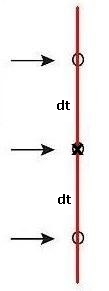 |
A "horizontal" instant 'now'
(marked with x ) from the flow of time in
the
Arrow of Space, defined with respect to the
fleeting 'potential future' (not yet marked with x
) and 'irreversible past' (already not marked with x
). The red vertical
ladder shows the global mode of spacetime, which does not
physically exist. The
re-creation of physical universes at
the instant 'now' produces the flow of time and requires
energy nonconservation and
"dark" effects along the vertical axis
(Phoenix Universe), while matter and energy are conserved
one-at-a-time in their horizontal physical universe. The gaps
dt are made zero by
the "speed" of light, which produces a perfect
continuum of the accumulated-in-time dimensions of spacetime.
The arrows symbolize some kind of
"torch" which highlights different
points from space, but because this torch would have to "move"
to different points, physicists claim that such torch does not
exist, and our perception of the flow of time is an illusion, or
at best an effect of thermodynamics. They
also claim that the flow of time does not and
must not physically exist, which
is correct: physically, the "vertical" gaps dt
are truly zero, thanks to which "the entire manifold is
constructed by smoothly sewing together (notice the poetry -
D.C.) these local regions" (cf. above,
p. 31). |
Notice that the
potential future (not yet marked with the instant x
) is made of not yet quantum-gravitational "it(s)",
which resemble a "dough" or rather continual density of intangible
pure
energy.

There is no metric there, no spatial relations (inside vs.
outside, left vs. right), and no set theory
relations, such as 'one vs. many' either. It (not He) is the
ultimate presentation of entanglement (Verschränkung): "the
characteristic trait of quantum mechanics" (Erwin
Schrödinger). We can only sense the
UNspeakable it with our brains here.
At the instantaneous step 'now' marked with x
above, we have an already-negotiated
energy conservation that is indistinguishable from
Minkowski spacetime, so people
can literally insert at this point x the
Hamiltonian formulation based on the notion of
hyperbolicity
backed with some sloppy speculations from
thermodynamics. Namely, "the
coordinates are asymptotically those of a flat spacetime with
inertial rectangular coordinates" (H. Ohanian, private communication), gravity has become at this instant "linearized",
and the two negotiating parties in EFE should have canceled each other (not
exactly, due to the "dark" energy), or else "the
ether would come back!" (M. Montesinos).
Also,
the instantaneous step 'now' marked with x
above is the instant at which the 'GR
elevator' has been suddenly "pushed up" -- once-at-a-time --
and the whole universe has been re-created
with positive mass, inertia, and a dead frozen Cauchy hupersurface,
thanks to which at this instant of time "throughout the universe" (Robert
Wald, p. 201) we can
indeed postulate
tangent
vectors -- again, once-at-a-time only.
Last but not least, at this
point x we have null vectors and null surfaces that
are everywhere orthogonal to a null vector -- the "remnant" from the
Arrow of Space, which has been effectively
nullified at the instant x and the whole local
(physical) mode of spacetime.
Then the
next "vertical" step 'now', at
t0 + dt , will
re-create (Phoenix Universe) the whole universe
anew from t0 , but
with different content at dt , which will be
re-negotiated along the
atemporal "vertical"
Arrow of Space, namely, in the dark
Zen gaps dt of the global mode of spacetime.
Again, these
gaps of intangible
pure
energy are nonexistent in the local (physical) mode of
spacetime thanks to the "speed" of light,
and we can see only a perfectly smooth continuum of already completed
and already
re-negotiated 'world points' (Bergmann
and Komar). The 'world points' cannot hold the
gravitational energy
density at a geometrical point (e.g., like electromagnetic energy on
flat spacetime), because such classical 'world points' will expose the flow
of physicalized energy coming from 'the universe
as ONE' in the "timber", and
the flow will be recorded with a physical clock,
as in the example with the Sun. Then the whole
theory of relativity will be ruined, because we would have direct
observational proof of such absolute object.
Don't try to recover the
genuine nonlinear dynamics of spacetime, exhibited in its "waves", from only one "horizontal
step from a ladder", like in Dirac-ADM hypothesis.
There is absolutely nothing
resembling law and order in the "spacetime
foam" to raise a robust
Lorentzian metric within 10-30 seconds "after" the "big
bang" and the increase of universe's "size" (with respect to what?)
by a
factor of 1078, and keep
the Lorentzian metric for at least
13.73 billion years rooted on the Planck length at which "points
become fuzzy and locality looses any precise meaning" (Sergio
Doplicher). We need perfect
points at all length scales, made with the
atemporal noncolorizable
dark
Zen gaps of the global mode of spacetime and the
universe as ONE.
Try a simple
experiment here. All you need is a brain. If your brain can do it, the universe should be able to do it as well;
perhaps
even better.
D. Chakalov
March 7, 2013
Last updated: April 13, 2013, 12:00 GMT
[Ref. 1] J. Bub, Quantum Correlations and the Measurement Problem,
arXiv:1210.6371v3 [quant-ph].

[Ref. 2] Nicolas Brunner et al., Bell nonlocality,
arXiv:1303.2849v1 [quant-ph].
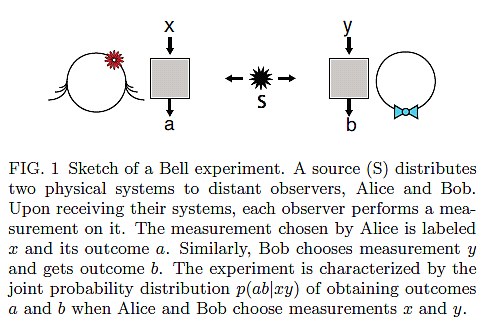
When such an
experiment is actually performed – say, by generating pairs of
spin-1/2 particles and measuring the spin of each particle in
different directions
– it will in general be found that

implying that the
outcomes on both sides are not statistically independent from
each other. Even though the two systems may be separated by a large
distance
– and may even be space-like separated – the existence of such
correlations is
nothing mysterious. In particular, it does not necessarily
imply some kind of
direct influence of one system on the other, for these correlations
may simply
reveal some dependence relation between the two systems which
was
established when they interacted in the past.
Comment: The nonexistence of two-valued probability measures is
not a formalization of the concept of
contextuality viz. rejection
of macroscopic realism (Erwin Schrödinger, 1935):
we have context-dependant "states" also in
Bell's argument [Ref.
1], which complies with orthogonality
constraints.
In our case, the noncolorizable UNspeakable
pre-quantum Kochen-Specker states correspond to the full
catalogue of expectation values, which include non-commutative
observables that cannot be
simultaneously measurable. Without such noncolorizable
quantum "states", one would be able to "produce" with Gedankenexperiment a full catalogue of
expectation values by
considering only one set of non-commuting observables, and
would speculate further that such "wave function" might offer a "full
description" of the quantum particle, provided we apply
"counterfactual definiteness". But we can't, because the latter is
applicable only and exclusively only to 'objective reality out there'
from classical physics: if I toss a coin on the table and see heads, I
can infer with certainly that the invisible state of the same coin was
tails 'out there'. But this kind of classical reasoning is not
applicable to Bell's argument [Ref.
1]: a quantum phenomenon is not a phenomenon unless it is an
observed/registered phenomenon, after which we have 'quantum
phenomenon' (try as an exercise the
Schrödinger cat).
Surely we cannot measure
all
non-commutative observables at one instant, as recorded with our clock,
but this constraint does not imply that a quantum particle 'out
there' must
conform to the nature of time relevant to inanimate macroscopic
measuring devices, hence could not possess its noncolorizable UNspeakable
pre-quantum ontic state. In the first place, we
don't have time operators in QM and never will, and must never forget
that the quantum realm 'out there' is
not what we can observe at macroscopic length scale --
either "nose" or "arm" (bzw.
particle or wave).
Again, the fact of the
matter is that one cannot fit the noncolorizable UNspeakable
pre-quantum state "it" (never in plural) in any Hilbert space
whatsoever. The "two" parties in Bell's argument, Alice and Bob, is
(never in plural) a joint presentation of the noncolorizable
pre-quantum quantum state "which was established when they
interacted in the past" [Ref. 2].
It
(not He) is not some additional object (like a bridge connecting two
riversides), but
'the universe as ONE' manifested as 'the
characteristic trait of quantum mechanics' (Erwin
Schrödinger). The whole physical world (local
mode of spacetime) is rooted on it and emanates from it.
Nothing acts between Alice and Bob [Ref. 2]
-- the so-called "ghost fields" (Gespensterfelder) or "spooky action at
a distance" that would propagate "at least 107 times
faster than the speed of light" (Nicolas Gisin et al.,
2002) do not exist, just as there is no "action" between
the brain and its mind (Wolfgang Pauli). They are
pre-correlated and
contextual "jackets" emanating
from their common quantum-gravitational "it" which Albert Einstein envisaged as 'a
total field of as yet unknown structure.'
It
produces two mirror forms of entanglement, quantum and
gravitational, starting from the macro-world in two opposite
"directions" along the w-axis.
In the astrophysical form of entanglement, we encounter the tug-of-war
manifestation of gravity between "dark
matter" and "dark energy", along with the ubiquitous
rotation -- just as in the case of "spin".
Yet the majority of people would prefer "supermassive
black
holes" inhabited by
advanced
Russian civilizations, instead of quantum gravity.
As of
today,
nobody cares about the unfinished theory of
Albert Einstein.
Nobody.
D. Chakalov
March 8, 2013
Last updated: April 24, 2013, 21:41 GMT
=============================================================
Subject: Time and the Structure of Quantum Theory, FQXi grant of
$110,397
Date: Thu, 7 Mar 2013 16:30:13 +0200
From: Dimi Chakalov <[email protected]>
To: [email protected], [email protected]
Cc: [email protected], [email protected],
[email protected], [email protected]
Check out the facts
http://www.god-does-not-play-dice.net/#ETH
Pity you can't reply...
D. Chakalov
=============================================================
http://www.god-does-not-play-dice.net/30_Jan_2013.pdf
http://www.scribd.com/doc/123206497/Quantum-Gravity
Subject: Marble vs Timber,
arXiv:1301.5481v1 [gr-qc]
Date: Thu, 24 Jan 2013 14:03:01 +0200
From: Dimi Chakalov <[email protected]>
To: Hermann Nicolai <[email protected]>
Cc: [snip]
Dear Hermann,
You explained the main problem (p. 3) as follows:
"(T)he point-likeness of particles and their interactions seems to be
required by both relativistic invariance and locality/causality –
building a (quantum) theory of relativistic extended objects is not an
easy task! In classical GR, the very notion of a point-particle is
problematic as well, because any exactly point-like mass would have to
be a mini black hole surrounded by a tiny horizon, and thus the putative
point particle at the center would move on a space-like rather than a
time-like trajectory. Again, one is led to the conclusion that these
concepts must be replaced by more suitable ones
in order to resolve the inconsistencies of GR and QFT."
And later you added (p. 10):
"So the challenge is to come up with criteria that allow to
unambiguously discriminate a given proposal against alternative ones!"
The criteria that unambiguously discriminate my proposal against all the
rest is the solution to the main problem (p. 3): neither "point-like
mass" nor "relativistic extended objects", but a new geometry with *quasi-local*
points, which unifies the current geometry (marble) and matter (timber)
from the outset.
If you or any of your colleagues disagree, just try to solve the
most widely known public secret in theoretical physics --
localization,
http://www.god-does-not-play-dice.net/#localization
In my opinion, you can't solve it 'your way', because nobody can.
Nobody.
Of course, I will be more than happy if you or any of your colleagues
can resolve the localization problem by using theories published on
paper, and I will immediately start using your version of quantum
gravity.
Please drop me a line if you nevertheless can resolve the 1929 problem
at the link above.
All the best,
Dimi
-------------
Note: The notion of
'reality' leads to models having an exact,
point-like representations of events -- between, before, during, and
after measurements/observations -- in order to answer questions about
the system, as a function of underlying spacetime. The puzzle of 'localization'
concerns the main question in Quantum Theory: What is the state of
reality that underlies our knowledge about "superposition" and
"entanglement" ? In gravitational physics, the puzzle of 'localization'
concerns the transition of intangible gravitational energy
into tangible energy of matter (Hermann Bondi), due
to which we can model spacetime as made of physicalized 'world
points' (Bergmann and Komar).
Let me try to answer the
main question in Quantum Gravity: What is the state of reality
that underlies our knowledge about blank geometrical "points", as shown with
the pure smile of the Cheshire cat in the
left-hand size of field equations ?
In classical
physics, one can offer a simple distinction between (i)
continuous and (ii) discrete. The first case refers to something
that can take any value in a range of numbers, specified within an
interval. For example, if I consider the color of my hair, it will fit
in two cases, black and white, with a very fuzzy borderline, and I can
claim that the color of my 'salt and pepper' hair is specified with
numbers ranging from 'pure black' to 'pure white', which comprise a
'color interval'. The number of these threadlike structures, called
'hairs', is always a finite number at particular instant, and
because the width of a hair is relatively small compared to my head, I
can think of them as 'continuous data'. Case (ii) is different,
because it corresponds to 'discrete' numbers, such as, for example, the
number of email messages I receive in particular interval.
So, if I use a 'fine grained' approach and assume that one email takes one
second, I can claim that yesterday have received ten emails, which have
taken ten seconds out of all seconds from the whole day. The
latter is also an
interval, but now these 'data' are separated by many
'seconds of no data', and subsequently we talk about 'discrete data'.
But what can happen if we
instruct the size of 'hairs' and 'seconds' to approach asymptotically
zero (the
empty set
R), to fill in an Archimedean interval completely,
included its crucial end points that
belong to "open sets" (James Dungundji)? We
will have to remove all mathematical poetry [Ref.
1] and introduce an ultra fine grid, called
'spacetime', which is comprised of
infinitesimal 'world points' (Bergmann and Komar).
We do need "point-likeness of particles" and "relativistic
invariance and locality/causality" (Hermann Nicolai),
but we do not have 'seconds of no data' anymore, to make
them 'discrete' as in classical physics.
Question is, can we obtain
a model for continuous-and-discrete physical reality at
Planck scale ?
Our logic offers only one
solution: introduce blank (dark
Zen) "points" ]between[ all "neighboring" world points,
to
make all world points both absolutely
discrete (global mode of spacetime; see explanation here) and absolutely continual (local mode of spacetime).
Namely, the structure of the physicalized 'world
points' is exhibited with purely geometrical,
blank (dark
Zen) "points" ]between[
them, and these blank "points" are
made totally absent -- zero -- in the resulting local
(physical) mode of spacetime by the Arrow of Space. How? With
the "speed" of light.
Stated differently, a "bartender"
will claim that any "converging sequence" [Ref.
1, p. 3] necessarily contains the
empty set
R
that is nevertheless not present at the 'end point' presented
with numbers (e.g., two pints). Surely the
empty set
R
is absolutely needed to complete the sequence and make it
'converging', yet it is always 'not there'
(Henry Margenau), like the
"shadow" (Warren
Leffler) cat Macavity, or simply 'potential
reality'.
Why? Because any finite (no matter how "small")
Archimedean sequence contains exactly
the same "number" of UNcountably infinite points (Georg
Cantor), and we'll face two alternatives: (i) never actually complete the sequence,
as explained with the
on-off states of Thompson's Lamp, or (ii)
complete the sentence with 'potential infinity', after which the whole
converging sequence will actually hit the so-called 'nothingness'
or "singularity", and become
geodesically incomplete.
Obviously, these alternatives must be avoided.
Only the non-Archimedean and empty set
R, living in the global
mode of spacetime, can both finish the job with actual
infinity from 'the universe as ONE' and
completely disappear at the end-point of "two pints".
Mathematically, it is 'the set of all sets' that is at the same time
not a 'set' per se: see details from
Quantum Theory below.
NB:
This is the only
option to explain the build up of
finite intervals, which we call 'emergence of spacetime' (Isham
and Butterfield). Only the phenomenon producing the
speed of light could somehow "read" all
UNcountably
infinite points (Georg
Cantor) en bloc and 'take
into account' their different size, which we define with
distance function. We have no alternative proposal to explain the
puzzle noticed by Lucretius some 2070 year
ago: there must be a limit to stop a sequence and make it
converging, or else there can be no difference between 'small' and
'large'. We need to amend the current incomplete ideas of point-set
topology and differential geometry with the Arrow of
Space.
Of course, Hermann Nicolai and
his colleagues may not "like" it and would prefer to stick to their
poetic textbooks ("arbitrarily near to x in an appropriate way,"
[Ref.
1], p. 3), but they don't have any
alternative to offer. They can only keep quiet and ignore the facts, as
Max Planck explained.
In summary, recall
two ideas in Einstein's Allgemeine
Relativitätstheorie: "curvature" and "free
fall".
Both ideas imply the
global mode of spacetime that is totally
absent in the local (physical) mode of spacetime. In the first case,
we "see" a crude metaphor of "curved" spacetime,
which is bumped into some physically nonexistent "radius"
of the universe (Ned
Wright), and then of course cannot
explain the fundamental manifestation of gravity by
torsion, which produces
rotation. The second drawing is an equally deceptive analogy,
because we cannot replace the elevator cage or "closed room"
below with
'the universe as ONE' with respect to which we define the
"dark" global mode of spacetime.
NB: The
red
arrow points to all directions in 3-D space, because there is no
global inertial coordinate system. This omnipresent
red
arrow is from the Arrow of Space. Ignore it at your peril.
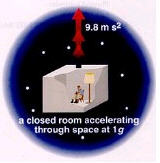
The notions of 'time'
presented with 'local duration' [Ref. 2],
and 3-D space modeled as 'differentiable volume made by extremely packed points "separated" by nothing',
are produced by the Arrow of Space that can
"read" all
UNcountably
infinite points en bloc
with actual infinity in the global mode of
spacetime. I will refer to this 'nothing',
endowed with the faculty of embracing all points en bloc
with actual infinity, as "it", stressing that it
corresponds to the unique case of 'zero nothing', as opposed to the
physical case of 'zero something' (e.g., the current number of
theoretical physicists interested in quantum gravity).
This is the only
available solution to the paradox of space, which
also solves the paradox of time (not "problem") in current textbooks
[Ref. 2]. The blank geometrical points, which "separate"
the physical world points by 'nothing',
are 'the whole universe as ONE' (global mode of spacetime). Depending on
the direction we look at it from the local (physical) mode of
spacetime, it can project two deceptive (notice
'either/or' contraposition) images: either 'an
infinitesimal point tending asymptotically toward zero' or 'the largest
volume of 3-D space, tending asymptotically toward infinity' ('asymptotically'
refers to potential infinity only). However,
it is a dual object that wraps the local mode of
spacetime, and can only be pictured as a dimensionless "point" stretched
to the dimensions of an "infinite" universe -- there is no metric to
define 'distance' in the global mode of spacetime. Everything happens
there "instantaneously", just as we see our face in the mirror only at the
very instant we look at it.
Likewise, all living
and quantum-gravitational systems can "see"
the instant spectrum of potential "clouds"
or "jackets", and choose one of them to become
physical reality in the next instant 'now' from the
Arrow of Space. Thus, 'the universe as a brain'
can "sense", anticipate, and ultimately alter its
potential future, just as the
finite brains and living organisms do, following their common 'flow of
time' (cf. option YAIN (iii) above), and
the causality of 'the universe as a brain' (dubbed biocausality)
is always retarded.
Physically, it is
the ONE entity providing the sufficient
conditions for spacetime and binding the physical
world points by 'nothing'
(Luke
17:21), thanks to which we experience accumulated-in-time spatial
dimensions of the universe -- one-point-at-a-time along the
Arrow of Space.
Nature is designed in a
way that is both the only possible and the optimal one.
Can't do it by chance.
Dead matter makes quantum
jumps; the living-and-quantum-gravitational matter is
smarter.
D. Chakalov
January 25, 2013
Last updated: February 14, 2013, 12:46 GMT
[Ref. 1] Chris J Isham, Modern
Differential Geometry for Physicists,
2nd ed., World Scientific,
1999.
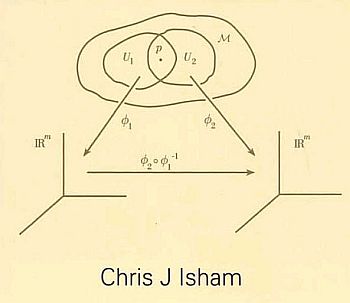
(Note: To explain 'the
point p' above, the maximal resolution used by
Chris Isham is with 'points' as well, which I think is sheer poetry
- D.C.)
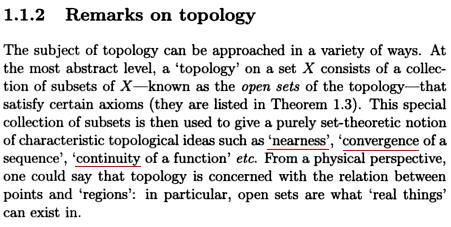
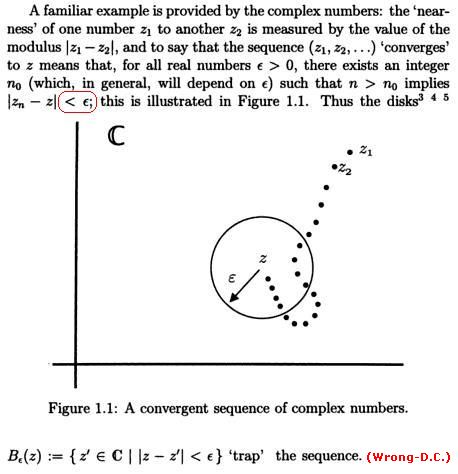
-------------
[Ref. 2] Sean Gryb and Flavio Mercati,
Right About Time? FQXi Essay Contest, 2012.
"As Minkowski put it in 1908 [2], "space by itself, and time by itself,
are doomed to fade away into mere shadows, and only a kind of union of
the two will preserve an independent reality." Nowhere is this more
apparent than in the main equation physicists use to construct the
solutions of general relativity (GR):

"Can you spot the t?
It's hidden in the 4 of d4x. But there are important
structures hidden by this compact notation. We will start by pointing
out an invisible minus sign in equation (2). When calculating
spacetime distances, one needs to use

which has a -
in front of the t2 instead of Pythagoras' + . The minus sign
looks innocent but has important consequences for the solutions of
equation (2). Importantly, the minus sign implies causality,
which means that only events in the past can effect what is going on
now. This, in turn, implies that generic solutions of GR can only
be solved by specifying information at a particular time
and then seeing how this information propagates into the future. Doing
the converse, i.e., specifying information at a particular place and
seeing how that information propagates to another place, is, in general,
not consistent. (Footnote 2: Technically, the difference is in the
elliptic (cf. Jim Woodward - D.C.) versus hyperbolic nature of the evolution equations.) Thus, the
minus sign already tells you that you have to use the theory in a way
that treats time and space differently.
......
p. 3: "Expert readers will recognize this as one of the facets of the
Problem of Time [4]. The fact that there is no equivalent Problem
of Space can be easily traced back to the points just made: time is
singled out in gravity as the variable in terms of which the evolution
equations are solved. This in turn implies that local duration
should be treated as an inferred quantity rather than something
fundamental. Clearly, time and space are not treated on the same footing
in the formalism of GR despite the rather misleading form of equation (2)."
============================================
Subject: "... perhaps
gravity is "special", and it is merely a coincidence
that it looks like a fictitious force."
Date: Sat, 23 Mar 2013 03:15:37 +0200
Message-ID: <CAM7Ekx=9reKUy1WVTasbUreXyrhxioamD_JK1MT-XTEDhtFx1w@mail.gmail.com>
From: Dimi Chakalov <[email protected]>
To: Courtney Seligman <[email protected]>
http://cseligman.com/text/physics/fictitious.htm
-------
Dear Dr. Seligman,
Perhaps you may be interested to read what may be "special" about
gravity:
http://www.god-does-not-play-dice.net/#ETH
All the best,
Dimi Chakalov
-------------
Note: The small red
arrow above might look like a "fictitious
force", but it is manifestly 'real' and most importantly omnipresent, because only observers who feel no force
at all -- including gravity -- would be shielded from it and
could claim that they weren't "accelerating" (Brian
Greene). Besides, gravity isn't a force either, because it doesn't
conform to Newton's third law, so the "equality of inertial and active
gravitational mass then remains as puzzling as ever. It would be nice
(no, it wouldn't be "nice" at all - D.C.) if
the inertial mass of an accelerating particle were simply a
back-reaction to its own gravitational field, but that is not the
case." (Wolfgang Rindler,
p. 22)
But what if gravity is
centripetal force from "rotation"
in the global mode of spacetime?
Notice the vertical
trajectory of the black ball in the second drawing of
Coriolis effect: it corresponds to "instantaneous"
re-generation --
one-at-a-time -- of inertial forces along the
w-axis of the whole universe
en bloc. As
Courtney Seligman
suggested,
The fact that gravity,
like fictitious forces, involves a constant acceleration, makes us
wonder whether gravity could be a fictitious force. It's hard to
imagine that anything so pervasive and seemingly real could be
"fictitious", but the forces experienced by the person in the
accelerated car feel real, and are presumably fictitious. Is there
some way that we could create the phenomenon of gravity, without the
force?
There is indeed such a way. Suppose that you were in a rocket ship,
headed upwards at the acceleration of
gravity, so that anything not attached to the ship seems to "fall"
with a mirror image of that upward acceleration. Then every such
object would fall toward the back of the ship, at the acceleration
of gravity, and trying to stop such a fall would require a force, in
the direction of the acceleration, proportional to the object's
mass, which would be equal to, and appear to be, its real weight.
Of course, we can't explain gravity in that way, as that would
require every part of the Earth to be accelerating upward and
outward, which would make the Earth bigger and bigger, which is not
observed.
But the "upward
direction" is not physical. It points to the
quantum-gravitational "it" in the global mode
of spacetime. Physically, it would correspond to some absolute
observer at 'the reference frame of fixed stars' (see below).
Courtney Seligman
also added his opinion:
So the simplest
explanation is to assume that, peculiar though it may be, gravity --
although a perfectly real force -- acts as though it is a fictitious
force. No other real force is known to act in this way, but perhaps
gravity is "special", and it is merely a coincidence that it looks
like a fictitious force.
NB: Alternatively, the simplest explanation is to assume that
gravity is a physical blueprint left from the Arrow of Space on the local (physical) mode of
spacetime from two phenomena: (i) the "upward
direction" along the w-axis
in the Arrow of Space, and (ii) the "rotation" in the global mode
of spacetime. Physically, we will obtain an omnipresent
red arrow in the local mode of
spacetime (see above), but
cannot in principle detect its "physical
basis" nor absolute reference frame of the global mode
of spacetime.
Notice that the
physical blueprint of "rotation" is complemented by the
elementary shift dt in the "upward
direction" along the w-axis.
The topology of "rotation" is a circle, as in the cognitive cycle of
Ulric Neisser, while the topology of the "upward"
shift dt goes along a line (1-D Euclidean space),
called "time". It corresponds to "radial displacement
at all times" in the first drawing above, and its mirror image is
called 'inertia'.
Thus, we propose a superposition of "two"
topological transitions in the global mode
of spacetime, but bear in mind that the transitions are completed
and totally eliminated in the local mode of spacetime by
the "speed" of light, leaving a
perfect 3-D continuum of physical 'world points' --
one-at-a-time.
This proposal is
alternative to all multi-dimensional ideas put forward ever since
1914;
see a recent account
here. Instead of speculating about a 3-D nanny looking at 2-D
Flatland and then claiming that those extra "directions" have been
"wrapped" and made terribly "small" at macroscopic length scale, we
offer the 'dark Zen gaps' of the global mode of
spacetime and a pocket of propensities explicated from the
global mode (called 'potential reality'), which resides only in
the potential future of the Arrow of
Space.
As mentioned
previously, the potential reality is not
yet physicalized quantum-gravitational "it", which might
resemble a "dough" or continual density of intangible
pure
energy.
There is no
metric there, no spatial relations (inside vs. outside, left vs.
right), and no set theory relations, such as
'one vs. many' either. It (not He) is the ultimate presentation
of entanglement (Verschränkung): "the characteristic trait
of quantum mechanics" (Erwin
Schrödinger). We can only sense or feel
the UNspeakable "it" with our brains
here.
If we try to explain the connectedness of the global mode of
spacetime, relative to the local, 3-D mode (resembling fiber bundle
base space), one could perhaps
connect and bootstrap all points in 3-D
space simultaneously and from all directions,
"including the inner structure of solid objects and things obscured from
our three-dimensional viewpoint" (Wiki).
Topologically, such infinite-connected global mode of spacetime would
allow to have "two" (in fact, one) simultaneous, en bloc view(s)
on all 'world points' (Bergmann and Komar)
in 3-D: we could "see" all points on the closed 2-D surface in the
drawing below, along all radii, at one instant, and in both
direction(s).
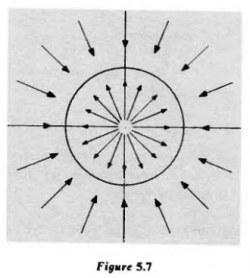
M.A. Armstrong,
Basic Topology, Springer, 1997,
p. 104
Let's go back to the
Coriolis effect, shown exclusively in the local mode of
spacetime:
In the analogy with a ball rolling across the
surface of a rotating merry-go-round, there are two reference
frames, (i) on the rotating merry-go-round and (ii) on the
ground, while in our case we are locked on a "stand still" merry-go-round
(like the girl in the first photo above) and cannot switch to an absolute observer on the ground or
(ii) 'the
reference frame of fixed stars'. Just as in the case of
Stavros, she cannot 'take off the train' and
detect her "rotation" with respect to reference frame (ii). She is locked
-- once-at-a-time -- on a "stand still"
merry-go-round and can only observe "rotation" in the trajectory of her
rolling ball.
The inertial effect is real
-- as
Ernst Mach has allegedly said, "when the subway jerks, it's the
fixed stars that throw you down". Yet we cannot trace back
inertia with Newton's third law, because that would physically
expose the global mode of spacetime and its "aether".
Recall that if we apply
current GR textbooks (e.g.,
Ciufolini and Wheeler, p.
270), the generation
of inertial reaction forces would look "instantaneous" and very puzzling: read
Jim Woodward. According to Tom Phipps (Thomas E.
Phipps, Should
Mach's Principle be taken seriously? Speculations in Science and
Technology, 1(5) 499-508 (1978), p. 504):
Gravity is a different
beast from radiation of any kind. Being mediated by virtual
particles, which may be considered to be kept permanently virtual by
the physical non-existence of
gravity shields or absorbers, gravity can act (nonlocally) with
infinite speed -- in effect, with precognition. That is exactly what
it does, if Mach's principle has any substance. The fixed stars
"know" the subway is going to jerk, because they have sent their
virtual spies forward in time to
find out about it.
In my opinion, Mach's Principle doesn't imply "precognition" nor
"infinite speed" but atemporal
bootstrapping of all 'world points', which produces
Synchronicity.
The important issue is
that, just as with
"spin" (Hans Ohanian), we will encounter
'gravity minus its physical basis' in the left-hand side of
filed
equations -- a potential quantum-gravitational "it".
Namely, torsion & curvature are physically
exposed as 'rotation minus its physical basis'.
In the case of negative curvature, the
two black vectors depicting
curvature (right arrow) and torsion (vertical arrow) will be
reversed.
The red vector corresponds to “expansion”; the opposite vector of
“inertia” is not shown. The dotted circle corresponds to 1-D space
with positive curvature, as in Fig. 5.7 from M.A. Armstrong above.
Gravity doesn't have its own "field", but is manifestation
of an atemporal
"negotiation" between the
physical content of every "point" and 'the universe as
ONE', which yields an additional and perfectly
physicalized input on matter from 'the universe as ONE'. The same
mechanism holds for the human brain: we cannot
observe its mind but only a self-acting brain. And the same
holds for 'the universe as a brain', bootstrapped
by its self-acting ... "gravity", as we
chose to call this holistic phenomenon.
Again, 'the universe as ONE' is quantum-gravitational "it"
which does not and cannot possess any metric (Chris
Mihos). It is rooted on the dark Zen
gaps ]between[ all "infinitesimally nearby
events" (Wald,
p. 8), and supports Mach's idea about the influence of 'the whole universe' (ibid.,
p. 71,
p. 9).
In brief, the causality
(called biocausality) in the Arrow of Space
is always retarded, because all influences from the past, converging
(Chris Isham) on
a 'world point' (Bergmann and Komar), have
been already
correlated with/by their common "it".
If we try here to impose the notion of time from physics textbooks, the already
correlated bi-directional atemporal
negotiation between the
physical content of (i) every 'world point' and (ii) 'the universe as
ONE' would match the "duration" of absorption-and-emission of a
virtual photon.
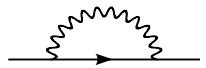
This is my Ansatz to the
origin of gravity & positive mass. If
the feedback from 'the universe as ONE' were physically
detectable, gravity will be a 'physical force' in line with Newton's
third law, "but that is not the case" (Wolfgang Rindler). It
must be camouflaged as "fictitious force" (Courtney Seligman), because
otherwise we would have direct observational proof of
the aether of 'the universe as ONE'. Details available upon request.
In practical terms
(pending verification with the full mathematical theory of 'the universe
as a brain'), one can expect that the "acausal"
connecting principle (Carl
Jung) dubbed
Synchronicity is determined by biocausality, namely, jointly
from the past and the potential future of 'the universe as ONE', and
hence may become invitable or perhaps even evokable. But as
Rudolf Peierls remarked, "Synchronicity
is something which physicists do not know about,
nor would they wish to."
D. Chakalov
March 23, 2013
Last updated: March 31, 2013, 05:46:04 GMT
http://www.scribd.com/doc/132837865/Gravity-and-Rotation
http://www.god-does-not-play-dice.net/gravity_and_rotation.pdf
============================================
Subject: Re:
arXiv:1307.1510v1 [gr-qc]
Date: Mon, 8 Jul 2013 17:58:02 +0300
Message-ID: <CAM7EkxkWgNkT63vddLfPFmPOPGe-2UGzzRSrx96SKNL5QJvsSQ@mail.gmail.com>
From: Dimi Chakalov <[email protected]>
To: James M Nester <[email protected]>,
[email protected],
[email protected],
[email protected]
Cc: [email protected],
[email protected],
[email protected],
[email protected],
[email protected],
[email protected],
[email protected],
[email protected],
[email protected],
[email protected],
[email protected]
Dear James,
Your objective is "just to find a good way to select the reference for
the Hamiltonian boundary term". May I ask a question.
I wonder if you can extend the boundary 2-form B(N) *exactly* to
null-and-spacelike infinity, so that it cannot be modified in any way,
shape or form whatsoever. If you can, your "closed 2-surface" will
pertain to a unique object -- the whole universe with unique quasilocal
quantities and unique boundary conditions.
You also wrote
that "for geometric gravity the standard ground state is Minkowski
geometry", which is your "chosen reference", and "Minkowski spacetime is
the natural choice, especially for asymptotically flat spacetimes [19].
However, as noted above, almost any four functions will determine some
Minkowski reference."
If you succeed with the task above, I suppose you will discover the
correct "standard ground state" as well. I'm afraid it can't be
"Minkowski spacetime": the devil is in the asymptotic details.
Please keep me updated.
Best - Dimi
On Mon, Jul 8, 2013 at 1:19 PM, Dimi Chakalov <[email protected]>
wrote:
>
> Dear colleagues,
>
> Regarding the (quasi-)localization of energy and your recent efforts,
please see
>
> http://www.god-does-not-play-dice.net/#Jeff
>
> In my opinion, the idea to invoke some "closed 2-surface" is wrong:
> see the link above.
>
> Your professional comments will be greatly appreciated.
>
> Sincerely,
>
> Dimi Chakalov
---------------
Note: Look at the
drawing above, and try to imagine how a dead flat
Minkowski spacetime would suddenly become "springy" and induce
rotation due to gravity, being full of
gravitational energy, most of which is "dark" because its source cannot
be 'matter'. Moreover, if you manage to extend some "closed 2-surface"
exactly to null-and-spacelike infinity, it won't keep its topology anymore -- it
can't have any definable topology whatsoever. It must be
indefinable, because if you are
confined within physical spacetime only (local mode of spacetime),
you can approach it only with potential
infinity -- see the Thompson's lamp paradox.
The fundamental object here is the indefinable
and
empty set R,
which must be "zero" in the local mode of spacetime due to the
"speed" of light.
Have a nice summer.
D. Chakalov
July 8, 2013
Last updated: July 12, 2013, 11:22 GMT
=====================================================
Subject: What induces
rotation ?
Date: Sun, 10 Feb 2013 12:38:38 +0000
Message-ID: <CAM7EkxnEoZ7cA4c673RPA4hGJ=aPm=S_8nDyMU=3jD1mtETHFA@mail.gmail.com>
From: Dimi Chakalov <[email protected]>
To: David B Malament <[email protected]>
Cc: Erik Curiel <[email protected]>,
David Brown <[email protected]>,
Adam Helfer <[email protected]>,
Laszlo Szabados <[email protected]>,
O'Murchadha, Niall <[email protected]>,
Angelo Tartaglia <[email protected]>,
Domenico Giulini <[email protected]>,
Ettore Minguzzi <[email protected]>,
Andrzej Trautman <[email protected]>
Dear David,
I have a request prompted by your Lecture Notes.
I wonder if you can explain the origin of rotation in GR -- "a subtle
and ambiguous notion that does not, in all cases, fully answer to our
classical intuitions" (Topics in the Foundations of General Relativity
and Newtonian Gravitation Theory, 7 May 2012,
p. v) -- as acknowledged
since 1970s,
http://www.god-does-not-play-dice.net/#Wittman
Perhaps GR can treat rotation in our solar system only, assuming no
"dark" stuff there, but we have proven rotation also with "dark" stuff,
as explained at the link above.
So, what induces rotation ? Could it be a topological property of space,
produced by torsion and hence neglected in
GR
textbooks?
I will also very much appreciate the opinions of your colleagues.
All the best,
Dimi
------------
Note: An example of
the most widely known public secret in theoretical physics --
localization -- is shown with the small red
arrow above. It is common to
gravitational attraction & rotation, but
bear in mind that the drawing above could only be considered a crude
metaphor, not even a remote analogy to the mystery of omnipresent rotation: from
elementary particles (known as "spin") to 'the whole universe'
pictured metaphorically with an inflating -- due to its rotation
-- balloon (Ned
Wright).
In short, the
phenomenon inducing rotation is
physically
not
present. If
you nevertheless believe that rotation
can only be produced by classical matter, you'll end up with
with a very "dark" elephant.
Perhaps a comparison
between textbook GR and the Machian quantum gravity (MQG)
will be helpful. There are three major ideas in current GR (source
here):
1.1. GR: “There is
no absolute space or absolute time. Rather space and time are concepts
that are abstracted from the relations of physical objects.”
1.2. MQG: There is
no absolute space or absolute time, but necessary
and sufficient conditions for spacetime. The latter cover
'global properties of spacetime' and spring from 'the
universe as ONE'.
2.1. GR: “Spatial
scale is abstracted from local ratios, i.e. ratios with physical rods.”
2.2. MQG: Space is
an emergent phenomenon of the
Arrow of Space which (i) produces the flow of
time and (ii) requires perpetual non-conservation of energy
in textbook GR.
3.1. GR: “Time is
abstracted from the dynamics of local physical degrees of freedom, i.e.
the dynamics of physical clocks.”
3.2. MQG: Time is
abstracted from the dynamics of Arrow of Space.
The underlying axiom is about the constituents of
spacetime: not some finite Archimedean chunks of "space" or
"time", but infinitesimal uncountably infinite
points accumulated by 'the
universe as ONE' along the
w-axis (cf. 1.2
above).
Every instant 'now' in the
Arrow of Space resembles one act of "pulling" the 'closed
room' upwards (cf. the drawing
below) through the global mode of spacetime, namely, along the
w-axis.
The
latter is being compacted to zero in the
local (physical) mode of spacetime.
The end physical result -- one-at-a-time -- is an
already-positivized matter endowed
with inertia.
Another example of textbook GR is the
introduction of fake "graviton", after a convenient analogy with
the photon:

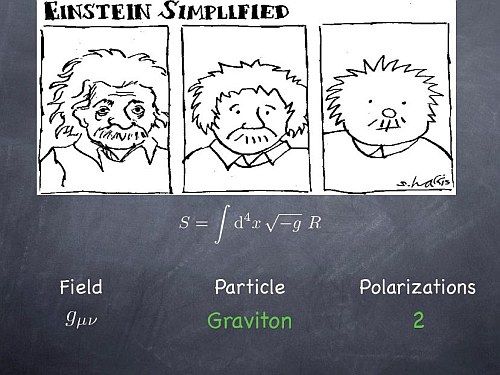
Regarding the Einstein
Lagrangian, Robert Bluhm [Ref. 1] kindly
explained the idea as follows:
If you start with a Maxwell Lagrangian -1/4F^2 for a field
A_mu and expand it out, you
will see that there are no second time derivatives for A_0 and only
the three spatial components A_j have second time derivatives. For
this reason A_0 does not propagate as a harmonic wave. It is
a non dynamical "auxiliary" field. The gauge symmetry lets you
eliminate one more degree of freedom, leaving two physical degrees
of freedom for the massless photon.
Likewise in the Einstein Lagrangian, if you expand it out in terms
of the ten metric excitations h_mu_nu you will find that the four
fields h_00 and h_0j do not have second time derivatives. So they
are not dynamical. The diffeomorphism
symmetry then allows removal of four more degrees of freedom,
leaving two physical degrees of freedom for the massless graviton.
Nothing helps here, but
notice that we have some esoteric "auxiliary modes" [Ref.
1]: can we use them to recover the rotation
? Nope, these poetic "auxiliary modes" can't help, just as the alleged
"massless transverse modes" [ibid.] can't
capture the elusive rotation. What
to do, then?
As stated above, the axis
of rotation is not
present, which is why the question whether the ring (cf. the drawing
below) is rotating or not “around the axis” (David B. Malament, Topics,
Figure 3.2.1,
p. 191, footnote 20) is irrelevant.
But how can the
engine of
rotation stay 'not
present', while the rotation effect cast on baryonic matter is
overwhelmingly present? This is the crux of
Quantum Geometry: we have physicalization of the
pure intangible
energy of the gravitational field (Hermann Bondi)
into any form of tangible energy; in our case it will produce
rotation
& curvature. Namely, the phenomenon which
induces rotation is 'not
present' in the local (physical) mode of spacetime, like the physical basis of quantum "spin" [Ref.
2] -- "klassisch nicht
beschreibbaren Art von Zweideutigkeit" (Wolfgang
Pauli).
Forget about all "dark"
crap. We cannot witness the physicalization of the
pure intangible energy due to
the "speed" of light. It is not a 'process'
and it ain't 'dynamical', because it produces the dynamics of
spacetime.
This is the crux of
Quantum Geometry, as already explained many times at this website.
If you nevertheless believe that can explain the "dark matter" effect of
gravitational rotation, as well as
the same rotation
but without "dark matter" effect, and firmly insist that "dark matter"
is made by matter "because all forms of matter gravitate" (Paolo
Pani et al.,
arXiv:1302.2646v1 [gr-qc]), you will have to live with "dark
elephants" until you quietly retire. The choice is
yours.
D. Chakalov
February 12, 2013
Last updated: March 6, 2013, 07:46:48 GMT
[Ref. 1] Robert Bluhm, Observational Constraints on Local Lorentz
Invariance,
arXiv:1302.1150v1, p. 9 (to appear in The Springer Handbook of
Spacetime, Springer-Verlag, 2013).

[Ref. 2] Hans C. Ohanian, What is spin? Am. J. Phys. 54 (1986)
500-505.
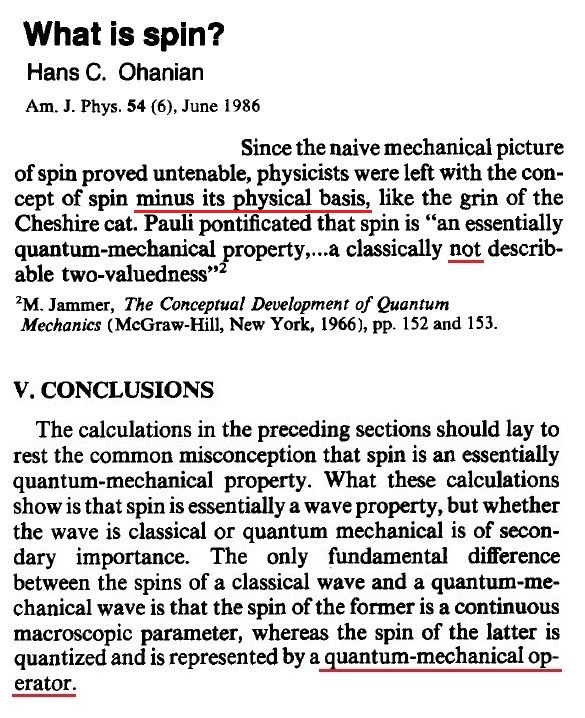
======================================================
Subject: Re: arXiv:0704.2291v1 [astro-ph]
Date: Wed, 13 Feb 2013 01:47:29 +0200
Message-ID: <CAM7EkxkRFOd==5XeHtjY87NNwJ+eZg7hfV1rsb702VEGLv_4Xg@mail.gmail.com>
From: Dimi Chakalov <[email protected]>
To: Simon White <[email protected]>
Cc: [snip]
You bluntly ignored my
email sent to you since Fri, 20 Apr 2007 14:24:49 +0300.
Why did you do that, Simon? You cannot speculate about "Fundamentalist
physics: why Dark Energy is bad for Astronomy", because neither you nor
any of your colleagues know the very first effect of gravity that you
see in front of your nose:
http://www.god-does-not-play-dice.net/#rotation
If you or any of your colleagues can explain it, please do write me
back, and I will show you additional errors in your
arXiv:0704.2291v1 [astro-ph].
Please don't hesitate to pass this email to other people interested in
theoretical physics.
If you aren't interested, don't bother to respond
-- there is none so blind as they that won't see.
D. Chakalov
------------
Note: Read an
excerpt from Simon White below (emphasis added). Mind you, he wasn't
joking, and is still the Geschäftsführender Direktor at the Max-Planck-Institut
für Astrophysik!
More from
Max Planck.
D. Chakalov
February 13, 2013
-------------------
Fundamentalist Physics:
Why Dark Energy May Be Bad for Astronomy
Prof. Simon White, Director at the Max-Planck-Institut für Astrophysik
http://online.kitp.ucsb.edu/online/bblunch/white1/
arXiv:0704.2291v1 [astro-ph]
pp. 8-9: "Dark Matter drives the formation of galaxies and galaxy
clusters and influences all aspects of their structure. Its distribution
can be mapped directly using gravitational lensing, and can be
inferred indirectly both from the dynamics of galaxies and intergalactic
gas, and from the structure of fluctuations in the microwave background
radiation. (...) Dark Matter studies thus impact directly on most
aspects of extragalactic astronomy and astrophysical cosmology, as well
as stimulating astroparticle experiments and research programmes at
accelerators. In contrast, Dark Energy studies have little or no impact
on other areas of astrophysics and experimental high-energy physics.
(...) Thus, while clarifying the nature of Dark Matter has all the
hallmarks of a typical “astrophysicist’s” problem, interacting with many
other aspects of the field and accessible by many routes, clarifying the
nature of Dark Energy is a “fundamental” problem, apparently accessible
only by a route which has little impact on the rest of
astrophysics.
.........
p. 13: "Listening to the siren call of the fundamentalists may lose us
both the creative brains and the instruments that are needed to remain
vibrant. Dark Energy is the Pied Piper’s pipe, luring astronomers away
from their home territory to follow high-energy physicists down the path
to professional extinction."
======================================================

Subject: Re: What induces
rotation ?
Date: Thu, 14 Feb 2013 17:34:51 +0200
Message-ID: <CAM7Ekx=_BYJAmHQ7SYBT52pZmFPs8G0NKPRcjYWHahRWAHU=wg@mail.gmail.com>
From: Dimi Chakalov <[email protected]>
To: David B Malament <[email protected]>,
Erik Curiel <[email protected]>,
David Brown <[email protected]>,
Adam Helfer <[email protected]>,
Laszlo Szabados <[email protected]>,
Niall <[email protected]>,
Angelo Tartaglia <[email protected]>,
Domenico Giulini <[email protected]>,
Ettore Minguzzi <[email protected]>,
Andrzej Trautman <[email protected]>,
Chris Isham <[email protected]>,
Robert M Wald <[email protected]>,
Robert Geroch <[email protected]>,
Karel V Kuchar <[email protected]>,
Helmut Friedrich <[email protected]>,
Friedrich W Hehl <[email protected]>,
Claus Kiefer <[email protected]>,
Alan Rendall <[email protected]>,
Paul Tod <[email protected]>,
Jörg Frauendiener <[email protected]>,
Jack Lee <[email protected]>,
Michael H Freedman <[email protected]>,
John Friedman <[email protected]>,
George <[email protected]>,
Torsten <[email protected]>,
Bernhard Milow <[email protected]>,
Jürg <[email protected]>,
EMIS <[email protected]>,
Isaac Newton Institute for Mathematical Sciences <[email protected]>
Gentlemen:
The mathematical tasks are spelled out -- with crucial help from Kevin
Brown, Bob Geroch, and David Malament -- at
http://www.god-does-not-play-dice.net/#Brown_null
The idea belongs to William Clifford, published on February 21, 1870.
Please don't procrastinate and get professional about "rotation" (cf.
the initial link below). The tasks are strictly mathematical.
All the best,
D. Chakalov
On Tue, Feb 12, 2013 at 4:59 AM, Dimi Chakalov <[email protected]>
wrote:
>
> P.S. Note added at
> http://www.god-does-not-play-dice.net/#rotation
>
> D.C.
>
> On Sun, Feb 10, 2013 at 2:38 PM, Dimi Chakalov <[email protected]>
wrote:
> [snip]
------------------
Note: To explain
the tasks, let me use an example:
the
positive mass conjecture [Ref. 1] and the
question "why mass in the real universe should be positive" [Ref.
2].
It is an outstanding puzzle, because
the Strong Energy Condition (SEC) is "violated on cosmological
scales right now!" (Barcelo & Visser, gr-qc/0205066v1),
and we have no idea how the "dark energy" is
related to the puzzling positivity of mass
[Ref. 2].
In our model, the now-at-a-distance instants
from the Arrow of Space, constituting the local (physical) mode of
spacetime (watch the video clip
here), belong to a
"frozen" and perfectly flat spatial
hypersurface (Pong
Soo Jang), which implies that the local mode of spacetime has "already" (due to
the "speed" of light) been made to show
positive mass only, which in turn implies "rotating-and-expanding"
universe, as suggested above.
Notice that my
efforts to
replace the so-called "dark energy" with gravitational repulsion
[Ref. 2] are
not related to
antimatter, but to the negative energy
density... of what ?
Okay, let's start with something we know.
As a guiding metaphor, recall that if we mix red, green, and blue light,
will obtain
white light,
which we shall call colorless, after the Kochen-Specker Theorem.
Now, suppose you wish
to observe the intrinsic color of an object, but it turns out
that it doesn't have invariant color: depending on the
"directions" you look at it, you'll see many different colors, as in the
drawing below.

Then you can claim that you've been observing many different
colors from different objects (e.g., not the
invariant mass but many pseudotensorial "clouds"), since you cannot see the colorless light of the
underlying object -- it will be invisible, hence "dark"
and "unphysical", like the absolute
structures and the reference fluid in GR.
The latter must not be "physical":
recall the fictitious background
spacetime in John Walker's animation above, with
which one could time the perpetual increase of the past, as seen
from the last carriage of the train. If the
reference fluid were
physical
object, it would expose the aether and literally ruin the
theory of relativity.
Due to the
"speed" of light, we can notice,
from the last carriage and opposite to the direction of the train,
the growing-in-time past
post factum only, and because the 'dark
Zen gaps' in the local mode of spacetime are set to
zero,
we cannot "see" the reference fluid in GR
with respect to which one can define the dynamics of space -- it is
compacted onto one point only, and has become "dark".
Instead, we see unlimited 3-D
space in the local mode of spacetime (cf. Fig. 1 below), spanned from macroscopic length scale toward the Small and the Large
(see the video clip
here) along the
w-axis
depicted with Fig. 2 below. If we
could look through the global mode of spacetime (Fig. 2), perhaps we could observe all
points in the 3-D local mode of spacetime (Fig. 1) simultaneously and
from
all directions, "including the inner structure of solid objects and
things obscured from our three-dimensional viewpoint" (Wiki).
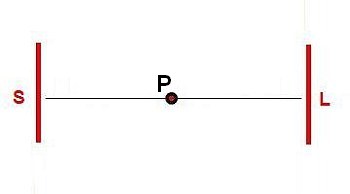
Fig. 1
P is shown in the local mode of spacetime, and
is located at equal distances from S
and L . It belongs to the
macroscopic length scale in which 3-D space looks spanned in two
"opposite" directions. The so-called
Relative Scale Principle (RSP)
postulates a fusion, or mutual penetration of space toward
S
and L in the
global mode, which begins at P
.
Fig. 2 below, from Fig. 5.7 of M. A. Armstrong (Basic Topology,
Springer, 1997,
p. 104), shows two simultaneous views (in
red) on P from
the global mode of spacetime.
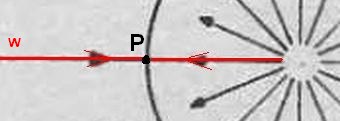
Fig. 2
P is
shown in the global mode of spacetime,
modeled with a segment from closed (positive curvature) 1-D
space, in black. The w-axis
(in
red) of the Arrow
of Space shows two additional views from the global mode
of spacetime on every point P .
The case of negative curvature is obtained by "space
inversion" along w-axis and
with respect to the black curved segment, after which the two
red arrows along the
w-axis will point to opposite
"directions" from P , again in the
global mode of spacetime. The latter
could be interpreted as a neutral gravitational plasma of
negative-positive mass pairs (Belletête and Paranjape,
pp. 6-7).
NB: The "length" of
w-axis
in the local mode of spacetime is being compactified to
zero,
which is why we cannot
show how 3-D space exercises its dynamics along the Arrow of Space
and accumulates spacetime -- one-step-at-a-time. We cannot in principle display
Macavity either.
Which brings us back to the
question above:
negative energy density...
of what ? Try to understand the
notion of 'pure energy' by performing some
simple experiments above with your brain.
The elusive origin of
"the continual creation of positive energy" [Ref. 3]
is still unclear. We don't know how to model a smooth
manifold in the first place, because we cannot use the epsilon-delta
approach by Augustin Cauchy to fix the "distance" (recall
the
empty set
R)
between the "neighboring" points presented with
two distinct real numbers.
As to the Relative Scale Principle (RSP),
notice that it encapsulates the ideas of Quantum
Geometry: the geometrical "points" themselves become quasi-local
toward S
and L (Fig. 1),
along with the spacetime metric. The latter is a dual parameter
depending on the reference frame, according to
RSP.
Namely, an electron and a galaxy look
"small" bzw. "large" only to macro-observers located at P
(Fig. 1), while their relative length will remain unchanged in
the joint quantum-geometrical domain of spacetime. For example, a table
at P (Fig. 1) with length 1 m will always
remain 1 m in the joint spacetime domain, although its metric
will indeed "shrink" bzw. "expand" with respect to a macro- observer
at P . Bear in mind that entangled particles and
astrophysical objects, obtained
toward S
and L , do not
interact through the classical spacetime domain at P
(Fig. 1): they are one to one mapped in their joint
quantum-geometrical domain of spacetime. Otherwise you will have to
speculate about "spooky action at a
distance" that would propagate "at least 107 times faster
than the speed of light" (Nicolas Gisin et al.,
2002) and some "dark matter" in galaxy rotation,
and cannot explain the rotation itself nor the
"dark" spin "minus its physical basis" (Hans
Ohanian). Notice that the "size" of 'the whole universe as
ONE' is the ultimate dual object, because
it will always look like a table with length 1 m in the
global mode of spacetime (Fig. 2). The new space
inversion symmetry at P and its transformations along
the w-axis pose a tough mathematical
challenge, however.
Mathematically, what is
the interface between the
physical, Archimedean world and the geometrical non-Archimedean realm of
the continuum? What is "zero"?
If the physical presentation of the universe (local mode of spacetime),
placed in the right-hand side of the field equations,
is an open system and the conservation of total energy is
impossible due to gravity [Ref. 4], what could play the role of "dark"
Maxwell demon ?
Some people would
eventually claim (G F R Ellis,
p. 23) that
the future "is presently only potential (so does not yet exist)", but
the mathematical presentation of potential future that 'does
not yet exist' requires the distinction between 'something that
exists' vs. something else that does not yet exist.
Recall that it is indeed impossible to define gravitationally
closed system: you will need to specify its 'external
environment', which inevitably requires to define 'the truly
isolated system':
the universe as a whole. But with respect to what ? Welcome
aboard! The universe as ONE does not yet
exist, because it can never exist as a physical system
defined ontologically w.r.t. 'something else'.
Regrettably, people ignore their own logic and keep dreaming about some "closed dynamical
systems" after Dirac-ADM [Ref. 5], and
speculate further about "spatial infinity" [Ref.
6],
hoping to make use of energy conservation defined with Stokes' theorem
on a bounded region of spacetime.
But again, the gravitational energy density must not be
well-defined at a point, because the metric
"field" couldn't be dynamical but would be fixed at all points
and at all times, exactly as in
Minkowski spacetime, and the
wegtransformierbar
gravity will have to be zero.
Here, we consider
the universe in its local mode of spacetime, and bring
the "ambient" or unphysical
reference fluid in GR
back
to spacetime, but as global mode of spacetime placed
"outside" asymptotic infinity: both "between" neighboring points
and "outside" the cosmological horizon. Physically, we will
observe two presentations of the global mode of spacetime, toward the
Small and toward the Large, although it is in fact ONE.
It cannot be a 'set', because it is 'the "set" of all sets'.
But what is the
geometrical meaning of 'outside
asymptotic infinity' ? We cannot define it with the Archimedean
axiom valid for the local (physical) mode. We need
non-Archimedean geometry of the global mode of spacetime.
To sum up, there is one
common idea in the
tangent bundle formulation of GR and in the theory of quantum gravity
proposed here: a point from spacetime,
and an object related to this point. In the case of GR, we consider a
point that belongs to the 'base space' (like the cylinder in the hairbrush below), and
attached a 'fiber' (bristle) to that point. Then replace the
fiber with a 'tangent space' (viewed as a vector space),
and suggest that the 'tangent space' (bristle) is attached to
the 'base space' (spacetime) in such way that the
energy is conserved at that
point. Why? Because the tangent space at that point looks (to some
people) very much like
Minkowski spacetime. Nothing could possibly propel that point in
any direction, however, because the object related to it (tangent space) is dead
frozen and is kept attached to that point at all times.

In our case,
a point from the local mode of
spacetime is perfectly flexible, like a 'jacket' or 'cloud',
but the object related to this point, called
global mode of spacetime, is totally detached from such world points (Bergmann
and Komar) constituting the
local mode of spacetime. Energy is conserved in both the local
(physical) and global mode -- dynamically, one-at-a-time along the Arrow of Space. In
the local mode, energy is conserved between matter and gravity in a
static instant 'now' only; in the
global mode, the dynamical conservation of energy involves
positive and negative mass (nullification). Hence 3-D space is being
re-created at the instant 'now' --
one-at-a-time -- along the Arrow of Space, which in turn builds up the
topological dimensions of spacetime. Also, the global mode of spacetime
is a non-Archimedean entity that
belongs to 'the whole universe', and always stays
outside
asymptotic infinity: it is fully
detached from, and nonexistent in the physical world explicated from it.
To paraphrase
Plato, the
colorless
Idea [John
1:1] does not belong to the set of color-able distorted
shadows (or jackets) explicated from it.
Check out the explanation of 'spin' and KS Theorem,
the experiments with your brain above, then consider the universe as a
brain, and you're done. Just keep in mind that what
we observe at the length scale of tables and chairs (e.g.,
spin) does not match the actual universe in
its quantum-and-gravitational regime: we can see
only along two directions toward S
and L (Fig. 1),
while the
universe itself is approaching ONE.
As of today, however, the
mathematical presentation of these very old
ideas [Ref. 7] is still uncovered, perhaps waiting 'out there' in the
potential future.
It is always dark shortly before dawn...
D. Chakalov
February 24, 2013
Last updated: May 13, 2013, 09:34 GMT
[Ref. 1]. Dieter R. Brill and Pong Soo Jang, Positive mass conjecture,
in General Relativity and Gravitation, ed. by Alan Held, Vol. 1,
Ch. 5, Plenum, New York, 1980,
pp. 173-193 (links and emphasis added - D.C.).
pp. 173-174: "For reasons
of stability we expect all reasonable classical (though not
quantum!) field theories to have positive energy
density, and we expect all (classical and quantum) field theories to
have positive total mass-energy. Existence of solutions with negative
total mass would have bizarre consequences.
"For example, by a simple
scaling one could obtain solutions with arbitrarily large negative total
mass, and one could presumably use such configurations to extract an
infinite energy from a finite system or from the vacuum. Another example
would be a self-accelerating system, consisting
of a positive mass object connected with a long rod to an object with
negative mass.
"Of course, the total
mass defined in terms of the asymptotic structure can have a negative
value if we do not impose any conditions in the interior. Examples would
be solutions containing naked singularities or matter fields with
negative energy density. However, if the
space-time is regular at least initially and the matter fields are
physically reasonable, we expect the total mass to be positive. (...)
"2. The Positive Mass Conjecture
"The total mass of an isolated (i.e., asymptotically flat) system is
determined by examining the rate (Sic! - D.C.) of approach of the
geometry to the geometry of Minkowski space in the asymptotic region.
"Asymptotic flatness expresses geometrically the physical properties one
expects of an isolated system, depending only on the (momentary)
state of the system, not on its past or future history; it is
defined by the existence of a spacelike surface E which approaches
flatness in the following sense: ... "
......
p. 176: "A possible Bondi mass conjecture would state that mB
is always positive in an asymptotically simple space-time, provided
the matter satisfies an appropriate local energy condition (e.g., the
dominant energy condition)."
[Ref. 2] W. B. Bonnor,
Negative mass in general relativity, General Relativity and
Gravitation 21 (1989) 1143-1157.

[Ref. 3] Banesh Hoffmann (1964), Negative Mass as a Gravitational Source
of Energy in the Quasistellar Radio Sources, in: Thomas Valone et al.,
Electrogravitics Systems, Integrity Research Institute, 2001,
pp.
92-96.
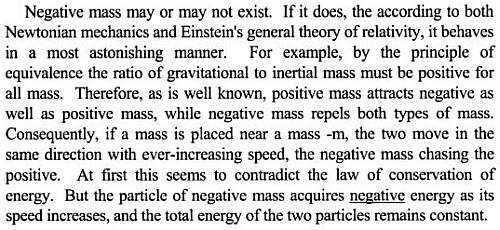
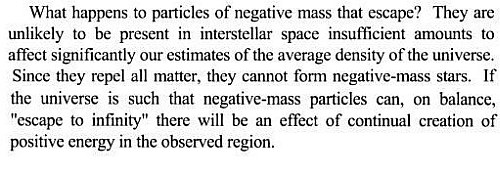
Hui-Hwa Chen, De-Ching Chem, and James M. Nester, Positive Energy Test
of Teleparallel Theory, Chinese J. Phys. 25 (1987)
481-496.

For fundamental theoretical reasons
only positive total energy is acceptable for a physical theory. One
reason is stability. We expect a system to spontaneously radiate
until it settles into a ground state, the state of lowest energy. A
lower bound for the energy is thus needed for stability.
.......
Another reason is thermodynamic. Should E = M be allowed to become
negative, a system could radiate away more mass-energy than was
originally assembled; the original amount could be reassembled and
the cycle repeated, the excess amount providing a
perpetual source of energy.
For these and related reasons it is a fundamental requirement for
any good gravitational theory that all its asymptotically Newtonian
solutions (with of course positive local mass density sources) have
positive total energy with zero energy being uniquely empty
Minkowski space.
[Ref. 4] Hans C. Ohanian, The Energy-Momentum Tensor in General
Relativity and in Alternative Theories of Gravitation, and the
Gravitational vs. Inertial Mass,
arXiv:1010.5557v2 [gr-qc].
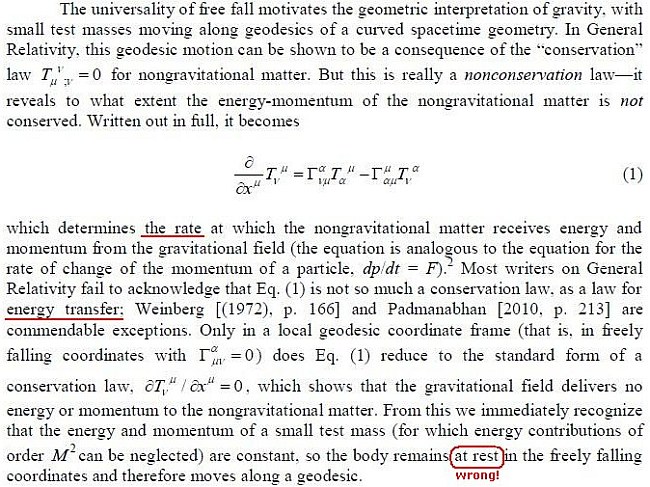
(Adam
Helfer: "Macavity, Macavity... he breaks the law of
gravity."
[Ref. 5] J. Barbour and N. O’Murchadha, Conformal Superspace: The
configuration space of general relativity,
arXiv:1009.3559
[gr-qc].
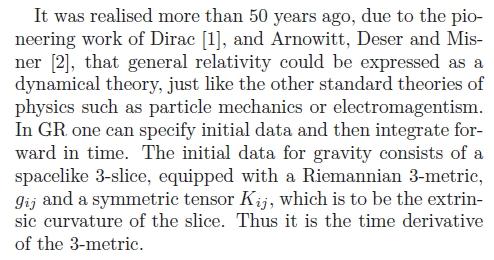
[Ref. 6] Yvonne Choquet-Bruhat, Positive-energy theorems, in:
Relativity, Group and Topology II, ed. by Bryce Seligman De Witt and
Raymond Stora, Les Houches Summer School Proceedings (Session XL, 27
June - 4 August 1983), Elsevier Science Publishers B. V., 1984,
pp. 739-785.

(Cf. Brill and Pong
1980 above - D.C.)
[Ref. 7] Enrico Bombieri, The Mathematical Infinity, in Infinity: New
Research Frontiers, ed. by Michael Heller and W. Hugh Woodin,
Cambridge University Press, 2011,
pp. 55-75.
======================================================
Subject:
arXiv:1307.5126v1 [gr-qc], Sec. 4 and ref. [8]
Date: Mon, 22 Jul 2013 14:58:11 +0300
Message-ID: <CAM7EkxnndHzrJR+m3ho8jjJ3+ADgSez+iCmDmw9FOm-33ySU=w@mail.gmail.com>
From: Dimi Chakalov <[email protected]>
To: Archil Kobakhidze <[email protected]>,
Nicholas L Rodd <[email protected]>
Cc: Ray Volkas <[email protected]>,
Greg Galloway <[email protected]>,
Chris Fewster <[email protected]>,
Romualdo Tresguerres <[email protected]>,
Ettore Minguzzi <[email protected]>,
Thomas Roman <[email protected]>,
Larry Ford <[email protected]>,
Jörg Frauendiener <[email protected]>
Dear colleagues,
May I ask for clarification of your statement that your "time-symmetric
quantization is causal and deals only with positive norm states."
You suggested that if "a time-symmetric quantization is used, where
annihilation and creation operators are associated with both positive
and negative states, the negative energy states lead to a cancelling out
of the thermal effects," in line with your "reinterpretation principle"
based on the crossing symmetry in transition amplitudes. However, "what
one needs for the consistency of the theory is to avoid asymptotic in
and out negative states" (Sec. 4, p. 6) for which crossing symmetry
cannot be applied anymore -- it's a whole new ball game
there.
Please help me understand (i) the *exact* asymptotic limit, at which you
still have 'in and out' states (would you use
Wheeler-Feynman, ref. [8]?), and (ii) the cancellation of
'in and out' negative states at this *exact*
asymptotic limit.
The opinion from your colleagues will be highly appreciated, too.
Kind regards,
Dimi Chakalov
chakalov.net
=================================================

Karel V. Kuchar,
Time and interpretations of quantum gravity, in: Proceedings of
Fourth Canadian Conference on General Relativity and Relativistic
Astrophysics, May 16-18, 1991, World Scientific, Singapore, 1992
----------------
Subject: Re: dimensionally
scaled physics
Date: Thu, 6 Jun 2013 14:36:55 +0300
From: Dimi Chakalov <[email protected]>
To: Marcos Maia <[email protected]>
Cc: Karel V Kuchar <[email protected]>,
Chris Isham <[email protected]>
Dear Marcos,
Thank you very much for your detailed reply.
[snip]
> I am also attaching a copy of
Kuchar reference for your delight.
Thanks, I know it very well and have quoted from it extensively. How did
this "orthogonal time-like vector field" (...) has been produced? Karel
stressed "the laws of an instant in canonical gravity" and then
explained that the hypersurface "carries the dynamical data" (pp. 2-3,
cf. attached).
But in order to "carry"
these "data", the hypersurface must be equipped with *something*
that can be expanded over at least two consecutive "instants"
(relational ontology), in order to know/define where and how the data
will be "carried" at the *next*
dt , to produce some "orthogonal
time-like vector field" in the first place.
Problem is, the "carrier" itself must be the Unmoved Mover: see K. Kuchar, The Problem of Time In Quantum Geometrodynamics, in The
Arguments of Time, ed. by Jeremy Butterfield, Oxford University Press,
Oxford, 1999, p. 193,
http://www.god-does-not-play-dice.net/#Yuan_QG1
Which, I believe, leads to RS gravity,
http://www.god-does-not-play-dice.net/#FAQ
Best wishes,
Dimi
On Sat, Jun 1, 2013 at 1:37 PM, Dimi Chakalov <[email protected]>
wrote:
>
> Dear Marcos,
>
> May I ask you for reference to your conclusion that "the topology
> Sigma x R characterized by the global hyperbolicity of Einstein's
> equations is not consistent with the principle of general covariance
> of GR." I would like to quote you in my forthcoming paper on RS
> gravity.
>
> I think the issue with general covariance goes back to Erich
> Kretschmann's paper from 1917. My efforts to understand it (not solve)
> is posted at
>
> http://www.god-does-not-play-dice.net/#Scharf
>
> To be specific: once we introduce time-orientability, we're in murky
> waters -- where does it come from?
>
> http://www.god-does-not-play-dice.net/#Waldyr
>
> Perhaps we should start from the so-called global mode of spacetime,
> which is a continuum of space&imaginary time, as suggested by Arthur
> Eddington,
>
> http://www.god-does-not-play-dice.net/#Eddington
>
> Then we introduce a *self-action* of the universe
on itself (...),
> which makes this continuum
3+1-foliatable (sorry for my English),
> and "time" shows up with real sign in a physical universe (local mode
> of spacetime) -- one-instant-now-at-a-time.
>
> It is a bit like taking photos in a dark room with camera equipped
> with flash -- you produce a "sequence" of photos, and you imagine
> some global Killing field which has arranged them "along time", but
> you cannot see the initial "dark room" with your flash camera. The
> latter also acts on the free falling elevator by pulling it "up" --
> one-pull-up-at-a-time -- thanks to which we have only positive
> mass endowed with inertia.
>
> So, where does time-orientability come from? Certainly not from
> thermodynamics. Any suggestions?
>
> I hope Laszlo, Domenico and Waldyr can offer some smart ideas.
>
> Best regards,
>
> Dimi
>
>
Note: The (i) "carrier" (see above)
and (ii) the
binding agent connecting any two neighboring "points" (to
obtain perfect continuum in the local mode of spacetime) are
one and the same entity (called "it"), which must be
nullified -- one-at-a-time -- in the physical world. In the
global mode of spacetime, it is "positioned" both
]between[ neighboring points and on
the very "edge" of spacetime in terms of its "boundary",
being both infinitely close to the every
'world point' and infinitely away from it. It is hopeless to seek
some "tiling of
spacetime" or "differentiable
embedding" to connect the dots.
Now, people imagine
some 'asymptotically flat spacetime', such that at every point
"the coordinates (at point A below -
D.C.) are asymptotically those of a flat spacetime with inertial
rectangular coordinates" (Hans
Ohanian, private communication), because they deeply believe
that such 'asymptotically flat spacetime' can be reached with the
same recipe we use in differential calculus.
Wrong. See the drawing below.

Relative Scale (RS)
gravity
Point B
to the right should be the "end point" of
spacelike-and-null infinity,
which will always be pathologically ill-defined in current mathematical
relativity. Why? Because you try to reach it from within
spacetime, using only Archimedean geometry,
but this "end point" B must be
different from the rest of points within spacetime at
macroscopic length scale, such as point A.
You simply claim, after
Roger Penrose, that have somehow "eliminated" the "unphysical" or
"ambient" spacetime (Steven
Harris), with respect to which the physical spacetime could
obtain its "boundaries". Such 'golden oldie' miracle requires "certain
smoothness" to allow "null infinity to be represented by a conformal
boundary, a hypersurface of some smoothness in the extended space-time"
(Helmut
Friedrich). The problem is that such perfect "smoothness" (Piotr
Chrusciel mentioned "smooth" and "smoothness" 66 times)
is a dream -- see Paul Tod's 'Big
Question'. Mathematically, in
open sets "the end points x = a and x =
b are excluded" (Ian Lawrie, p. 17).
The whole story, modulo the exotic math, resembles a well-known cartoon
with
Pink Panther, who
sucked the entire spacetime (up to its
asymptotic boundaries at
spacelike-and-null infinity)
in his vacuum cleaner, and then himself, and finally the vacuum cleaner
sucked itself and disappeared into "nothingness", or perhaps "singularity":
As an example, consider Helmut Friedrich, 'Conformal Einstein
evolution', arXiv:gr-qc/0209018v1, Time-like infinity, Sec. 4.4, p.
42:
it's a dead-end, suggested with a bunch of additional
unreasonable assumptions (e.g., Bernard Schutz).
But you have no choice, because if you wish to calculate the asymptotic
"boundary" of spacetime, the latter must be
mathematically well-defined: either infinite, which makes no physical
sense, or bounded by some finite
value. So no matter what you do, you're destined to produce poetry like
Pink Panther (I'm trying to be
polite here).
If you try to bypass this
asymptotic mess (John Stewart), you'll need to
supplement the initial conditions by boundary conditions,
but in the case of Einstein equations there can be no "boundary
conditions" in the first place. "For instance, we do not know how to
build a mirror for gravitational waves", acknowledged Alan Rendall (pp.
43-44). Yet he believes that "the problem of proving general global
existence theorems for the Einstein equations is beyond the reach of the
mathematics presently available" (p.
5), as if such task were feasible, even in principle. Again, it's
all very simple: recover the topological dimensions themselves,
so that we could "look around, and
see as far as we like" (Lee Smolin).
Only "the theory does not allow
us, even in principle, to extend solutions arbitrarily far in one
direction" (Martin
Bojowald). And there's nothing you can do to fix it.
Nothing.
In Relative Scale (RS) gravity, on the other
hand, spacetime has dual nature: every 'asymptotically flat spacetime' is being produced
by the Arrow of Space as 3-D
"slice" valid for one-instant-now-at-a-time, while the
remaining possible "slices"
(recall John Wheeler's "cloud") are kept at this
instant 'now' as 'potential reality' in the form of
pre-quantum Kochen-Specker state of the whole universe as
ONE.
Hence at each instant
'now' we have re-parameterization of
the "gravitational field", and nothing else (Günter
Scharf). Thus, trace-free "conservation" equations (George
F R Ellis) resemble the act of "measurement",
such that
the underlying quantum-gravitational "state" can be "disposable",
but only for this instant 'now'. If you ignore the dynamic
"measurement" of the whole universe, which it executes on itself
one-at-a-time, you will have to treat all
potential particle states in the quantum vacuum as 'objective
reality subject to gravitation', and will immediately reach reductio ad
absurdum: the radius of the universe “could not
even reach to the moon,” as calculated by
Wolfgang Pauli.
No, you
cannot model spacetime like bartenders or
Chuck Norris. We need new
mathematics to model the "carrier"
itself. It can only show up as 'pure mathematics', because the "carrier"
is nothing but the self-action of the universe. It may
look "dark" to some people,
because nobody can physically trace back the self-acting Unmoved Mover:
Der Geist bewegt die
Materie (Virgil's
Mens agitat molem, The Aeneid,
Ch. 6, 727).
Physically, we can only
observe a self-acting 'universe as a brain', just as we cannot
detect the human mind in its brain, but only a
self-acting brain.
D. Chakalov
June 12, 2013
Last updated: June 17, 2013, 21:23 GMT
=================================================
Subject:
arXiv:1306.3021v1 [gr-qc], p. 2 and Sec. 6
Date: Fri, 14 Jun 2013 15:15:44 +0300
From: Dimi Chakalov <[email protected]>
To: George <[email protected]>
Cc: [snip]
George,
You know very well that the so-called trace-free conservation equations
for the total energy-momentum tensor (p. 2) are
red herrings.
Sir Hermann Bondi, for example, has explained the issue many years ago
(Conservation and non-conservation in general relativity, Proc. R. Soc.
Lond. A 427 (1990) 249-258): "... the extra terms (not includable in a
Green's type function) precisely describe the transfer between the
*intangible* energy of the gravitational field (as it will be called
here), which is not described by the energy-momentum tensor, and the
tangible forms which are so described."
You aren't stupid, George. Your suggestion that the vacuum energy may
not affect spacetime geometry, because it were "arbitrarily disposable"
(Sec. 6), is nothing but a joke -- you know bloody well the unsolved
issues with the transfer of 'tangible forms of energy' by/from the *intangible*
object, which Einstein simply called "a total field of as yet unknown
structure",
http://www.god-does-not-play-dice.net/#outline
I know you for over twenty years, and am sure you won't acknowledge that
your speculations are 'not even wrong'. Using your "logic", one would
claim that the quantum state(s) were "arbitrarily disposable" as well:
see Ernst Paul Specker at
http://www.god-does-not-play-dice.net/#ETH
No need to reply to this email, just try to get serious about the
unfinished theory of Albert Einstein.
I extend this gentle suggestion to all colleagues of yours.
Dimi
-------
Dimi Chakalov
http://tinyurl.com/bold-facts-9-11
http://tinyurl.com/steel-evaporation
======================================================
Subject: Gravity and Faster than Light Particles,
arXiv:gr-qc/0611124v4
Date: Tue, 18 Jun 2013 14:23:56 +0300
From: Dimi Chakalov <[email protected]>
To: Asher Yahalom <[email protected]>
Cc: James Woodward <[email protected]>,
Peter <[email protected]>,
John <[email protected]>,
Chris Fewster <[email protected]>,
Marcos Maia <[email protected]>,
Salvatore Capozziello <[email protected]>
Dear Asher,
May I ask a question.
I wonder if you can tweak your suggestion that "a particle which travels
radially in a Friedman-Lemaitre-Robertson-Walker metric passing outwards
the critical radius of [XXX] and then coming back at superluminal
velocities" to match the idea of a standing *atemporal*
gravitational wave:
James F. Woodward, Gravitation: The Origin of Inertia,
http://physics.fullerton.edu/~jimw/general/inertia/index.htm
"The act of pushing on
something causes a disturbance in the
gravitational field to go propagating off into the future. It makes
stuff (the "absorber") out there wiggle. When the stuff wiggles it
sends disturbances backward (and forward) in time. All the backward
traveling disturbances converge on what we're pushing and generate the
inertial reaction force we feel. No physical law
is violated in any of
this. And nothing moves faster than the speed of light. It only seems
so because of the advanced waves traveling at the speed of light in
the backward time direction."
The opinion of your colleagues will be highly appreciated as well.
Sorry for my unsolicited email; I was never able to understand the
origin of inertia.
All the best,
Dimi
------------
Note: Instead of
speculating about "forward" and "backward" time direction(s), viz.
hyperbolic and elliptic evolution
equations (Gryb and Mercati), use the
atemporal global mode of spacetime inhabited by one standing
gravitational wave (cf. Fig. 5 above): the stuff
that "moves" in the global mode is the topology of spacetime, which is
being "flattened" at every instant 'now' from the local mode as
'asymptotically flat spacetime'. The latter is analogous to the
"measuring device" in QM. Simple, no?
Bear also in mind the
pictorial expression of Mach's
principle (Ciufolini
and Wheeler, p. 270):
what happens at asymptotic infinity determines the geometry of spacetime
& positivity of mass, which in turn determines what happens right
here-and-now, and vice versa. It's a "bi-directional"
atemporal negotiation between 'the school of fish'
and any (quasi-local) fish here-and-now. In the present GR
textbooks, you may have, at best, only one completed cycle of
negotiations, i.e., only one "clap":
There can be no dynamics
whatsoever in these textbooks (Karel Kuchar).
None. You can try to bypass the issue iff you have dead
fixed metric and topology pertaining to some flat background spacetime,
hence you can fix the initial & boundary conditions, say, for a
trajectory of your Frisbee.
Have a nice summer.
D. Chakalov
June 24, 2013, 13:10:43 GMT
=======================================================
Subject: The unphysical spacetime,
arXiv:1307.0321v1 [gr-qc] and
arXiv:1306.6204v1 [gr-qc]
Date: Tue, 2 Jul 2013 12:56:24 +0300
From: Dimi Chakalov <[email protected]>
To: [email protected]
Cc: Helmut Friedrich <[email protected]>,
Piotr T Chrusciel <[email protected]>,
Roger Penrose <[email protected]>
Dear Dr. Paetz,
I wonder if you can define the unphysical spacetime in such way that the
global properties of physical spacetime, solution of the Einstein field
(not vacuum) equations, can be defined as well.
In my approach, I use a non-dynamical *global
mode* of spacetime (not non-dynamical "background field"), but if you
can solve the task (Helmut, Piotr, and Roger still can't), I will gladly
use your brand new theory.
All the best,
Dimi Chakalov
chakalov.net
Note: Suppose, for the sake of the argument, that
Tim-Torben
Paetz and his colleagues (they all are very good in
math) were able to somehow "extend"
matter in the RHS of Einstein field equations (EFE) from here-and-now (cf. the
initial boundary value problem) to
null-and-spacelike infinity --
exactly to the "asymptotic boundary" of spacetime. If so, there
would be no need for 'unphysical spacetime', because
after solving these brand new
EFE the whole spacetime will be
defined with respect to itself.
But here's the problem: the
mathematics itself does not permit such self-referential and self-acting
miracles. One cannot produce theorems
with which one can prove the global existence of topological
dimensions and the positivity of (quasi-local) mass. In fact, the
gravitational energy density at a point is not definable in the
first place, so it is impossible in principle to prove that
energy is, or is not, "conserved".
Such global tasks are
impossible in GR, and they must be banned from the
outset.
Why? Here's a very simple explanation.
Suppose GR were "classical theory", as people declare in
textbooks. Then you need a critical boundary
of the integration domain (Walter Wyss,
p. 304):

Such "edges"
would define the "boundary" of spacetime at
null-and-spacelike infinity,
and would reflect the gravitational waves like a mirror (as
observed by Chuck Norris),
but (i) "we do not know how to build a mirror for gravitational waves"
(Alan Rendall,
pp.
43-44) and (ii) Killing vector field that "preserves
the metric" at these mirror "edges".
But even if you miraculously managed to obtain such "mirror" without
quantum gravity, you will inevitably ruin that Killing vector field and
expose the "unphysical spacetime" beyond these "edges",
which of course must be banned from the
outset. Q.E.D.
D. Chakalov
July 3, 2013
Last updated: July 4, 2013, 12:34:53 GMT

================================================================


Subject: Waiting for Godot: Gravitational wave astronomy
Date: Mon, 1 Apr 2013 12:28:26 +0300
From: Dimi Chakalov <[email protected]>
To: [snip]
Ladies and Gentlemen,
LIGO is for the birds. You don't have any theory for detecting GWs.
Your ideas and hopes are based solely on wishful thinking, and
contradict the full nonlinear General Relativity.
Just two facts: you don't have any "weak limit" (John Stewart) and
haven't even tried to explain the effect of inducing stress in matter
(Robert Wald),
http://www.god-does-not-play-dice.net/#madness
http://www.god-does-not-play-dice.net/#BMS
Why are you ignoring the facts?
Why are you wasting taxpayers' money?
Please reply professionally.
Sincerely,
Dimi Chakalov
P.S. If you are good in math, check out
http://www.god-does-not-play-dice.net/#rotation
D.C.
---------------
Note: The so-called
linearized gravitation can be used for calculating simple effects from
"curvature" (e.g., correcting the
GPS system), but cannot be used
to explain the self-interaction of gravity,
and subsequently to build GW detectors capable of detecting itself.
With respect to what ? There are two alternatives: either some
"extra-dimensional" superstitions (Naresh Dadhich)
or a new quantum gravity in which matter
interacts with itself in its potential
quantum-gravitational "it".
People speak about "total
energy EGW carried in a gravitational-wave burst" (reference
here), but
never explained the conversion of intangible gravitational energy
into tangible one (Hermann Bondi) at every
spacetime
point (MTW, p. 467) from
its path to LIGO arms, starting from strongly nonlinear
"astrophysical sources" (Michele
Maggiore, p. 32). Same story in parapsychology with
detecting "psi energy", since they haven't explained the conversion of
"psi energy" into some tangible form of energy either.
Do you agree to have "at
least 3-4 billion dollars" wasted in GW parapsychology by 2020?
The next wine cellar (pictured above) will
cost at least $1,280,000,000 (€790M).
It will be built underground at a depth of about 100–200 m and will
consist of three very large wine cellars, linked by 10 km long
wine shelves. Cheers!
D. Chakalov
April 2, 2013, 08:50 GMT
======================================================

Subject:
arXiv:1107.2026v3 [math-ph]
Date: Thu, 4 Apr 2013 05:37:42 +0300
From: Dimi Chakalov <[email protected]>
To: Andreas Grotz <[email protected]>,
Felix Finster <[email protected]>
Cc: Torsten Thumstädter <[email protected]>,
Roman Sauer <[email protected]>
Dear colleagues,
I agree that "there is no consensus on what the mathematical framework
of
quantum geometry should be", and suggest to examine the facts at
http://www.god-does-not-play-dice.net/#ETH
http://www.god-does-not-play-dice.net/#rotation
The task is strictly mathematical. Will be happy to help.
Kind regards,
Dimi Chakalov
-------------
Note: Suppose the primitive points
above belong to a Borel set.
Notice that the "number" of these points is not finite but unphysical
--
uncountably infinite -- and that they form a
continuum of physical reality. There exists an object which does
not belong to this set, and which produces the elementary
connection "between" these points: the universe as
ONE. The latter belongs to the
sufficient conditions for spacetime, which inhabit the potential
quantum-gravitational "it" from the
Arrow of Space, called global mode of spacetime.
The general idea is to present the primitive points
above as emergent phenomenon, called local
(physical) mode of spacetime, which builds up the topological dimensions
of the physical world -- one-point-at-a-time along the
Arrow of Space. Keep in mind that the building process is "hidden"
by the "speed" of light, which is why we
cannot witness the global mode of spacetime "between" the physical
points in the local mode: at every instant 'now', the "gap" of the universe as
ONE has been re-rendered zero by the Arrow of
Space, yielding a perfect
continuum of physical reality. Thus, the geometry itself is quasi-local,
and every "point" has structure which leads to the universe as
ONE: "a total
field of as yet unknown structure" (Albert
Einstein). Then we can introduce quantum-gravitational matter on these "points" and
obtain their exact limit.
Again, the task is
strictly mathematical. But as John Coleman noticed, "it is extremely
difficult to induce penguins to drink warm water".
If your brain can
understand the saying above, try another one here.
D. Chakalov
April 4, 2013
Last updated: April 6, 2013, 11:31 GMT
===========================================================
Subject: arXiv:1208.3749v4
[gr-qc], "a parametrization of the gravitational field and nothing
else"
(p. 3)
Date: Thu, 9 May 2013 17:27:53 +0300
From: Dimi Chakalov <[email protected]>
To: Günter Scharf <[email protected]>
Cc: Luca Lusanna <[email protected]>
Dear Dr. Scharf,
May I comment on your ideas.
I think your statement in the subject line resembles KS Theorem, in the
sense that in both cases we face a fundamental object that
cannot be directly observed,
http://www.god-does-not-play-dice.net/#ETH
To fix the gauge ambiguity by observables, see
http://www.god-does-not-play-dice.net/#RS_gravity
A penny for your thoughts.
Kind regards,
Dimi Chakalov
-------------
Note: There are various
nontensorial "energy-momentum complexes" (Sibusiso S. Xulu,
Ch. 2),
which offer a dubious "freedom" to mathematical physicists to either
produce obviously wrong results or perfectly "correct" ones, that is,
confirmed by experiment or observations. Such "freedom" is well-known
from KS Theorem; the difference is that in GR we have
"pure
energy" which is explicated by (not with) a "measuring
device" -- asymptotically Minkowskian spacetime (equipped with
rectilinear coordinate systems) at spatial infinity r --> ∞,
which executes "a parametrization of the gravitational field and nothing
else" (Günter Scharf) -- one-at-a-time.
People have the "freedom"
to ignore all obviously wrong "measurements" that have never happened,
and happily use only those that they know, from the outset, that will
work. Yet the same people would insist that GR were "classical theory",
as if one could determine the gravitational energy density at a point.
Of course you can't and shouldn't be able to do it, or else there
will be a background spacetime in GR, defined by the matter-energy
content of these perfectly localizable points, and 'the
grin of the Cheshire cat' won't be geometry but will contain
physical stuff from the cat.
D. Chakalov
May 17, 2013
Last updated: June 16, 2013
===========================================================
The
Wilson chamber
Subject: Re: Corrections
Date: Thu, 4 Apr 2013 04:47:26 +0300
From: Dimi Chakalov <[email protected]>
To: Jürg <[email protected]>,
Nicolas <[email protected]>,
Antoine Suarez <[email protected]>
Cc: [snip]
Dear Jürg, Nicolas, and Antoine,
Thanks to the discovery of Charles Thomson Rees Wilson in 1911, the
localization of a single quantum particle is now the most widely
known public secret in theoretical physics -- see the second link in my
email below.
Can you acknowledged this fact? If you can, please try to suggest an
alternative explanation, and write me back. The professional opinion of
your colleagues will be appreciated as well.
If you cannot, would you at least tell your younger colleagues that you
are already incapable of thinking as scientists? Then there will be no
sense to reply to my email, of course.
All the best,
Dimi Chakalov
On Thu, 4 Apr 2013 03:29:37 +0300, Dimi Chakalov <[email protected]>
wrote:
>
> Dear colleagues,
>
> May I offer corrections to your ideas, starting from the basic facts
at
>
> http://www.god-does-not-play-dice.net/#ETH
>
>
http://www.god-does-not-play-dice.net/#localization
>
> Kind regards,
>
> Dimi Chakalov
=========================
Subject: Re: Corrections
Message-ID: <CAM7EkxkCwOgvJe6fZGQE+N3sOChMxnh2z8qF_jFJq0LmRb+zGw@mail.gmail.com>
In-Reply-To: <[email protected]>
Date: Thu, 4 Apr 2013 05:26:55 +0300
From: Dimi Chakalov <[email protected]>
To: juerg <[email protected]>
Cc: Nicolas <[email protected]>,
[email protected],
[email protected],
[email protected],
[email protected],
[email protected],
[email protected]
On Thu, Apr 4, 2013 at 5:03 AM, juerg <[email protected]> wrote:
>
> I don't know anybody else who insists to get lectures via e-mail for
free
Jürg dorogoi,
You are indeed Russian.
The facts are on the table since 1911.
D.C.
----------
>> Dear Jürg, Nicolas, and Antoine,
[snip]
=========================================================
Subject: Re: 200 wrong theories for the cosmological constant, by Hooft
't G.
Date: Sun, 7 Apr 2013 01:46:52 +0300
Message-ID: <CAM7EkxmdGaYX-tKtkQeAo-Mm=ddHbEqztq2R0=cZdTFSy6EaGQ@mail.gmail.com>
From: Dimi Chakalov <[email protected]>
To: Gerardus <[email protected]>
Gerardus,
Twelve years ago (Fri, 6 Apr 2001 11:04:56 +0200), you probably knew
nothing about my theory, yet offered me to provide for the 201st
reference in your paper about wrong theories for the cosmological
constant.
Seven years ago (Tue, 4 Apr 2006 15:12:24 +0200), you declared that my
website "contains too much obvious nonsense", and again failed to show
at least one example.
The explanation of "dark" energy is here:
http://www.god-does-not-play-dice.net/#ETH
It is similar to the explanation of "spin", but
you wouldn't even try to study it, because you already can't. You are
perfect example for a physicist who had all the facts at the tip of his
fingers, but couldn't connect the dots, because he had become "famous".
Which is regretful, because back in 1970s when you weren't "famous" you
were very good at math.
I will explain your case in my forthcoming book, and will quote from
your post-famous insights. You were very instrumental indeed.
No need to reply, of course. I know you can't.
D. Chakalov
On Fri, 6 Apr 2001 11:04:56 +0200, "Hooft 't G." <[email protected]>
wrote:
[snip]
> Then the cosmological constant. it is not understood. I once
> planned to write a paper entitled: "200 wrong theories for the
> cosmological constant", with 200 references. Needless to say that
> most of these theories are also mutually exclusive. The right theory
> has not been found. You are wellcome to provide for the 201st
> reference in my paper.
[snip]
=========================================================
Subject: Re:
arXiv:1304.1003v2 [physics.hist-ph]
Date: Wed, 17 Apr 2013 12:39:47 +0300
From: Dimi Chakalov <[email protected]>
To: Zeh <[email protected]>
Cc: [snip]
Dieter,
You also wrote (arXiv:0809.2904v6
[quant-ph], p. 11): "I do not know of any discrete quantum
phenomenon in space or time that can not be described by means of
decoherence."
Yes you do. It is known since 1912 -- see the facts at the links below.
No need to invent the wheel.
But if you and your colleagues cannot read English, then perhaps your
brains are messed up by "decoherence", so
you won't reply, because you can't, and will continue with the
Balkanization of physics.
D.
On Wed, Apr 17, 2013 at 11:53 AM, Dimi Chakalov <[email protected]>
wrote:
>
> P.S. You wrote (p.
12): "Decoherence was the first successful
> application of entanglement beyond microscopic systems, and it
> explains also why one seems to observe individual atoms as apparent
> particles in a Paul trap or tracks in a Wilson chamber."
>
> Wrong, again. See the link in my initial email and the most
widely
> known public secret in theoretical physics:
>
http://www.god-does-not-play-dice.net/#localization
>
> If you or any of your colleagues can solve the puzzle known twenty
> years before you were born, please drop me a line.
>
> If you can't, please face the facts and avoid further Balkanization of
> physics (Eugene Wigner). Enough is enough.
>
> D.
>
> On Wed, Apr 17, 2013 at 11:05 AM, Dimi Chakalov <[email protected]>
wrote:
>>
>> Dieter,
>>
>> See what you again missed:
>> http://www.god-does-not-play-dice.net/#ETH
>>
>> Do you read English?
>>
>> Dimi
------------
The
Wilson chamber
Note: The "discrete
quantum phenomenon in space or time" (see H.-Dieter Zeh
above) is the chain of water droplets, which
make the macroscopic trajectory in Wilson chamber. As John Gamble
tried to suggest on 24
May 2008, "the state operator is a representation of all possible
superposition and product states of a given system. Due to the
probability normalization condition imposed on a system, the state
operator must always have unit trace. In Mott's case, each track
corresponds to a diagonal element of the state operator of the particle,
while the superpositions of multiple tracks correspond to off-diagonal
elements, which decoherence destroys."
But the question isn't about
which track or trajectory has been selected from all possible ones,
but how it is made by
energy exchange.
How do you explain the
successive build up of "decohered" particle "states" by
energy exchange
along one trajectory above? How is the (quantum?) time of one
particle been made by
energy exchange,
in order to match the duration of the
visible trajectory?
Try to explain the invisible quantum trajectory
of one single quantum particle: its mapping to, and interaction by
energy exchange
with the
visible
macroscopic trajectory above; see
a recent example from CERN here.
Contemporary QM textbooks (Landau
and Lifshitz) cannot say
anything about the actual state of affairs in the quantum world 'out
there', such as the successive build up of two trajectories,
invisible (quantum) and macroscopic, by
energy exchange
between them -- every water droplet along the "horizontal" direction of
the discrete and observable trajectory is produced by "vertical"
energy exchange with one quantum particle 'out there'. You can't calculate
it
with
Feynman path integral either.
You'll need the basic basics of
Quantum Theory -- only one "jacket"
(e.g., "cloud") is being explicated as 'physical
reality' in the quantum world 'out there' (local mode of spacetime): one-at-a-time,
and with certainty1 (no need for any "non-unitary
“R” process",
Steve Adler).
Then the "jacket" interacts "vertically" with its macroscopic
environment in the Wilson chamber, while
its UNspeakable pre-quantum source "John" propagates
"horizontally" along its track in the quantum world 'out
there'. This is the crux of localization
-- the most widely known public secret in theoretical physics.
As to gravitation, the
ultimate task is to
re-build spacetime --
one-point-at-a-time along the flow of time (cf. YAIN, option (iii)
above), also with unit probability. John
Baez once said that "one can dig oneself into a hole by trying to do
physics without any background structure - it's a bit like trying to
paint a painting without any
canvas." True, but the "canvas" can only be made (i) by
matter itself and (ii)
one-point-at-a-time -- not by some detachable "medium" acting as
a reference fluid in GR. This is the
only possible road to quantum gravity, because there can be no background in GR (Karel Kuchar). I was hoping to explain this issue in July
2004 at GR17 in Dublin, but Thomas Thiemann (currently at Erlangen University)
didn't allow me to speak -- typical communist
censorship.
Anyway. I wonder what
life would be today, if
101
years ago physicists didn't ignore the
discovery of Charles Thomson Rees Wilson. Perhaps nobody would be
searching for gravity in high-energy physics, simply because "gravity"
isn't there: we have two forms of entanglement, quantum and
astrophysical, and the latter produces "rotating"
stuff without any ("dark") physical basis, just as
"spin". The fundamental entanglement
is from
'the universe as ONE' -- exactly as Einstein would
have expected about the
'total
field of as yet unknown structure' which becomes physicalized
as 'positive
mass' (not "dragging"
through some Higgs field). Sure enough, nobody would have spent over
seven billion Euro to catch some "god
particle" either: the source of matter
resembles a pre-quantum virtual "dough"
of
pure
energy, which cannot be matter,
just as 'time' cannot be made of milli-milli-milli-etc-seconds.
More from
Max Planck.
D. Chakalov
April 17, 2013
Last updated: April 28, 2013, 21:05 GMT
1 The textbook interpretation
of QM is that "objects are represented by waves that extend throughout
space, containing all the possible outcomes of an observation - here,
there, up or down, dead or alive. The amplitude of this wave is a
measure of the probability that the object will actually be found to be
in one state or another" (D.
Overbye), but as Erwin Schrödinger stressed in
November 1950, a probabilistic assertion "presupposes the full
reality of its subject", which is in turn wrong.
D. Chakalov
April 26, 2013, 21:32:48 GMT
================================================
Subject: Balkanization of physics at CERN
Date: Thu, 18 Apr 2013 16:04:21 +0300
From: Dimi Chakalov <[email protected]>
To: [email protected],
[email protected],
[email protected],
[email protected],
[email protected],
[email protected],
[email protected],
[email protected],
[email protected],
[email protected],
[email protected],
[email protected],
[email protected],
[email protected],
[email protected],
[email protected],
[email protected],
[email protected],
[email protected],
Cc: [snip]
Ladies and Gentlemen,
Unlike that Russian "billionaire" Yuri Milner, who would gladly give you
millions of Euro to play with some "god particle", I exposed your
balkanization of physics at
http://www.god-does-not-play-dice.net/#balkanization
When will you face the facts known for more than a century? Of course
you know these facts -- you are anything but stupid.
Pity you can't respond -- see the link above. We could have a jolly good
discussion of your childish hobby and the taxpayers' money you've been
wasting -- billions and billions of Euro.
D. Chakalov
-----------
Note:
People at CERN are anything
but stupid. They know very well that probability does not, and cannot
carry energy to make the visible trajectory
above. But instead of resolving the puzzle
from 1912, they use its modern version
in their PR campaign, and just ask for more money. Ridiculous!
Ten years ago
(Thursday, January 9, 2003, 15:56:04 GMT), I predicted that the Higgs
will not be discovered. Instead, the number of quarks will jump to 8 and
more, in a
Fibonacci sequence. The only reaction received was from
Roman Jackiw, but it wasn't professional.
Nobody has made so far any comments on my theory
of gravity, although its bootstrap philosophy is widely known. I think people at
CERN should get serious about their "standard
model", instead of just asking for additional
billions of euro to detect some putative Higgs field that
"permeates the entirety of space, from the
infinitesimal pinch between the constituents of atomic nuclei and the
incomprehensible stretches of nothingness that separate galaxies"
(Ian
Sample). Instead, they proclaimed that
"the
heaviest boson ever found", or maybe some special
spin-2 particle, might have been present.
“It’s hard not to get
excited by these results,” said CERN Research Director Sergio
Bertolucci on
4
July 2012. But it is sick, not
"exciting", that nobody at CERN understands their own results. The
crux of the puzzle is generation of proton mass, fixed by
the quantum vacuum with an error margin of one
part in 1045. Since they don't have any theory to
explain such astonishing precision by which the quantum vacuum produces
the "source particles" for their experiments, people at CERN have in fact employed
a miracle in their "theory".
The whole hunt for "god
particle" is a joke, albeit horribly expensive -- billions and
billions of euro have been wasted to satisfy their sheer curiosity.
People at CERN need only pencils and blank notebooks to work out the
structure of electron [Ref. 1] and explain its localization. Sure enough,
the number of quarks will only jump to 8
and more, in
Fibonacci
sequence -- as suggested previously, at the
level of
QCD, the 'possessed observables', such as
mass and charge of an electron (Henry
Margenau), are "absorbed" in the potential reality as
well.
It's all quarks down the
road, yet there must be a limit on the current number of
quarks, similar to
Planck scale.
Yet we can't even imagine detector of
Planck mass. So, why waste time and money?
D. Chakalov
April 27, 2013
Last updated: May 9, 2013,
10:47:38 GMT
[Ref. 1] Mendel Sachs, Quantum Mechanics and Gravity, Springer,
2004,
pp. 136-137.

=================================================
===================================================
Subject:
Relative Scale Theory of Gravity
Date: Thu, 23 May 2013 03:20:02 +0300
From: Dimi Chakalov <[email protected]>
To: Eddie <[email protected]>,
[email protected],
Lee Smolin <[email protected]>,
Ronald J Adler <[email protected]>,
Anthony Zee <[email protected]>,
David B Malament <[email protected]>,
Erik Curiel <[email protected]>,
Eric Linder <[email protected]>,
[email protected],
[email protected],
[email protected],
[email protected],
[email protected],
[email protected],
[email protected]
Cc: William G Unruh <[email protected]>
According to Bill Unruh (Time Gravity and Quantum Mechanics,
arXiv:gr-qc/9312027v2,
p. 5),
"Time flows unequably from place to place, without calling into play
any ‘force of gravity’ at all."
Was Bill Unruh talking moonshine? Not at all. But the flow of time
is a bit more complicated: see an outline at
http://www.god-does-not-play-dice.net/#outline
Pity you can't reply...
D.C.
==========================================
If LIGO collaboration
knew the answer to the question above, they could perhaps explain
the energy transport by gravitational waves (GWs), detected with
matter. But they can't.
D. Chakalov
------------
Subject:
The Gravitational Universe (submitted to the European Space
Agency on May 24th, 2013)
Date: Mon, 27 May 2013 07:55:52 +0300
Message-ID: <CAM7EkxmgJgA727mDDo=L-UNYvDzP42B79zgXZfKdnVmL2mpxbA@mail.gmail.com>
From: Dimi Chakalov <[email protected]>
To: [email protected],
[email protected],
[email protected],
[email protected],
[email protected],
[email protected],
[email protected],
[email protected],
[email protected],
[email protected],
[email protected],
[email protected],
[email protected],
[email protected],
[email protected],
[email protected],
[email protected],
[email protected],
[email protected],
[email protected]
Ladies and Gentlemen:
The so-called "fractional squeezing of spacetime perpendicuar to the
direction of propagation" (p.
3) is sheer poetry. You don't have any theory of energy
transport by GWs,
http://www.god-does-not-play-dice.net/#madness
http://www.god-does-not-play-dice.net/#there
If you can't understand your errors, please write me back and I will
elaborate.
Sincerely,
Dimi Chakalov
--
http://tinyurl.com/bold-facts-9-11
http://tinyurl.com/steel-evaporation
========================================================
Download printable copy,
Indefinable.pdf
20 October 2013, 20:05 GMT
------------------------------------------------
'All right,' said the Cat;
and this time it vanished quite slowly, beginning with
the end of the tail, and ending with the grin, which remained some time
after
the rest of it had gone. 'Well! I've often seen a cat
without a grin,' thought
Alice; 'but a
grin without a cat! It's the most curious thing I ever say in my
life!'
-----------------
Subject: Jeffrey Winicour,
arXiv:gr-qc/0508097v2 and
lrr-2012-2, "Please keep me updated."
Date: Fri, 5 Jul 2013 18:20:37 +0300
Message-ID: <CAM7EkxnCFjFGSNQ03o7GY=z4F9unT1HOzxtJ_+7yAfSioZgYFQ@mail.gmail.com>
From: Dimi Chakalov <[email protected]>
To: Jeffrey Winicour <[email protected]>,
Roger Penrose <[email protected]>,
Ezra Newman <[email protected]>,
Sergiu Klainerman <[email protected]>,
Helmut Friedrich <[email protected]>,
Piotr T Chrusciel <[email protected]>,
Alan Rendall <[email protected]>,
Niall 'O Murchadha <[email protected]>,
Paul Tod <[email protected]>,
Chris Isham <[email protected]>,
Steven Harris <[email protected]>,
Xiao Zhang <[email protected]>,
Adam Helfer <[email protected]>,
Laszlo Szabados <[email protected]>,
Robert M Wald <[email protected]>,
Lars Andersson <[email protected]>,
Evangelos Melas <[email protected]>,
Karel V Kuchar <[email protected]>,
Hermann Nicolai <[email protected]>,
Jörg Frauendiener <[email protected]>,
Robert Beig <[email protected]>,
William G Unruh <[email protected]>,
Robert Geroch <[email protected]>,
Tim-Torben Paetz <[email protected]>
Dear Dr. Winicour,
Following your request to keep you updated, may I inform you and your
colleagues on the insurmountable problems with spacetime "boundary".
As we all know, half a century ago (15 January 1963), Roger Penrose
suggested the conformal compactification recipe (via "rescaling" of the
metric) of null infinity, "scri" (Asymptotic
Properties of Fields and Space-Times, Phys. Rev. Lett., 10(2), 66-68,
1963), but neither he nor anyone else has demonstrated such asymptotic
boundary at null-and-spacelike infinity.
It's a package. Thus,
the task is not solved.
What you may not know is that Roger Penrose (we met in London on 16
April 2002 at Imperial College) does not feel moral obligation to all
people who quote his "golden oldie" speculations, and hasn't acknowledge
the simple fact that his recipe cannot work *in principle* for
null-and-spacelike infinity -- it is *one* boundary that cannot be
determined with theorems, because it is *indefinable* in principle.
To begin with, recall that we cannot change the uncountably infinite
"number" of points by rescaling the metric, starting from within
spacetime *continuum* (Georg Cantor). We may only
hope, at the end of the day, that the spacetime might/should have some
"boundary" at asymptotic null-and-spacelike infinity, but the latter is
*indefinable* to an (Eulerian) observer within spacetime.
A brief outline can be read at
http://www.god-does-not-play-dice.net/#Paetz
Should you and/or any of your colleagues are interested in this *indefinable*
exercise (Roger isn't), I will gladly elaborate. Please keep me updated
as well.
Sincerely,
Dimi Chakalov
----
Note: The
pre-quantum UNspeakable Kochen-Specker "state"
is indefinable as well, otherwise we may use only countable
sets. Such indefinable objects complement
'physical reality' or "jackets". The latter
are re-created "slices"
of asymptotically flat spacetimes (local modes of spacetime), in
which the total energy of the whole universe is indeed "conserved"
("a
grin without a cat!") at this instant 'now' from the
Arrow of Space -- one-conservation-at-a-time.
However, such "conservation" is totally
unacceptable approximation (like a 'spherical
cow'), because it pertains only to the so-called "evolution equations" (see below) confined entirely
within one dead frozen asymptotically
flat "slice" with fixed topology.
The so-called "evolution equations"
can display only a dead frozen Gravitational Wave which
cannot carry any amount of 'tangible energy' (Hermann
Bondi). Hence the question of J. G. Pereira,
"After all, one call always ask: where are the waves?",
refers to the assembled 4-D spacetime
by the Arrow of Space. More below.
Claus Kiefer, Quantum Gravity,
2nd ed., 2007,
p. 106.
Hence a 4-D spacetime is
being assembled by the Arrow of Space -- one-slice-at-a-time
-- with curvature & torsion, along with
inevitable "dark" effects and
energy non-conservation observed only
retrospectively in the assembled 4-D
spacetime. With the current version of "classical" GR, the
'universe as ONE', placed in the postulated global mode of spacetime,
generates indefinable
(in the sense of Gödel's
undecidable propositions) tasks, as argued above.
It (not He) is the source of emergence of
spacetime by
countable sets of "jackets" (recall
Plato), explicated into successive 3-D "slices"
-- one-slice-at-a-time, along the null direction
of the Arrow of Space. On the very boundary of such assembled
4-D spacetime, the topology and the metric are different, to allow for the binding of
points by the postulated Aristotelian Connection in
RS gravity: It is in fact ONE dual
object with non-Archimedean geometry, which
macroscopic observers describe as both infinitesimally "small"
and infinitely "large". Once we discover the proper mathematical
formalism of RS gravity, we should be able to
explain the emergence of 'globally hyperbolic
spacetime equipped with Lorentzian metric', instead of introducing such
'spherical cows' by hand, as if they were produced by some Biblical
magic.
Were it possible to determine the "boundary" of spacetime to obtain some
self-sufficient and fully completed object, the latter will be
inevitably self-destructive. Simple, no?
KISS!
D. Chakalov
July 5, 2013
Last updated: July 13, 2013, 17:01:33 GMT
==================================================

Subject: arXiv:1305.0777v1 [gr-qc]
Date: Sat, 13 Jul 2013 15:19:06 +0300
Message-ID: <CAM7EkxmL2WaYd-SnCor2rhAfOJHw65asUyMernJb5hm+vd=vqw@mail.gmail.com>
From: Dimi Chakalov <[email protected]>
To: Jose Geraldo Pereira <[email protected]>
Cc: Lars Andersson <[email protected]>,
Evangelos Melas <[email protected]>,
Josh Goldberg <[email protected]>,
Bill Bonnor <[email protected]>,
Adam Helfer <[email protected]>,
Laszlo Szabados <[email protected]>,
Hans Ohanian <[email protected]>,
Chris Isham <[email protected]>,
John Klauder <[email protected]>,
Luciano Rezzolla <[email protected]>,
Christian <[email protected]>,
[email protected],
[email protected],
[email protected],
[email protected],
[email protected],
[email protected],
[email protected],
[email protected],
[email protected],
[email protected],
[email protected],
[email protected],
[email protected],
[email protected],
[email protected],
[email protected],
LSC Spokesperson Gabriela Gonzalez <[email protected]>,
Bernd Brügmann <[email protected]>,
Marek Abramowicz <[email protected]>,
Roger Blandford <[email protected]>,
Jirí Bicák <[email protected]>,
John Friedman <[email protected]>,
Bernd Schmidt <[email protected]>,
Helmut Friedrich <[email protected]>,
Joseph Katz <[email protected]>,
Robert M Wald <[email protected]>,
Karel V Kuchar <[email protected]>,
Hermann Nicolai <[email protected]>,
Paul Tod <[email protected]>,
Clifford Will <[email protected]>,
Karsten Danzmann <[email protected]>,
Pedro Marronetti <[email protected]>,
Jorge Pullin <[email protected]>,
Kip Thorne <[email protected]>,
Jeremiah P Ostriker <[email protected]>,
Jörg Frauendiener <[email protected]>,
Robert Beig <[email protected]>,
Ted <[email protected]>,
Orfeu <[email protected]>,
Michal Chodorowski <[email protected]>,
Marco Spaans <[email protected]>,
Jeffrey Winicour <[email protected]>,
Tim-Torben Paetz <[email protected]>,
James M Nester <[email protected]>
Jose Geraldo Pereira, Gravitational waves: a foundational review
http://arxiv.org/abs/1305.0777v1
Comments: "This manuscript has not been, and will not be submitted to
any journal; it is intended as an arXiv paper"
---------
Chicken. Why are you afraid of LIGO mafia?
You also wrote (p. 4, footnote §): "The problem of the
non-localizability of the energy and momentum of the gravitational field
[16] is not relevant for the present discussion, and will not be
considered here."
 Of course the problem is "relevant". See above.
Besides, the problem has two presentations, like two sides of a coin: (i)
the localization of the energy and momentum of the gravitational field
and (ii) the "boundary" of that "field" at
null-and-spacelike
infinity,
http://www.god-does-not-play-dice.net/#Jeff
You can't solve (i) without solving (ii), and vice versa.
Dimi Chakalov
-------------
Note: Does
gravitational "radiation" carry energy and momentum, or not?
YAIN (Yes-And-neIN).
Yes, there are
effects, resembling a swathe, due to 'tangible
energy' (Hermann Bondi), but only in the
assembled 4-D spacetime, which in turn
requires brand new GW detectors endowed with self-action, just
like the human brain (forget about LIGO, eLIGO,
Virgo, and similar parapsychology).
Nein, because every
"slice" of local mode of spacetime is an
asymptotically flat 3-D space, in which the
contracted Bianchi identity holds FAPP, and we can effectively
switch off gravity at a point (Hermann Weyl).
Also, we cannot in
principle detect the gravitational energy density
at a classical geometrical point (MTW, p. 467),
because it belongs to 'the universe as ONE', hence it is not classical
phenomenon (i.e., 'objective reality out there', cf.
Walter Wyss) but quantum phenomenon, just as we
cannot detect the energy density stored in the
quantum vacuum (John Baez,
Case
4). It is just a "jacket" or "cloud",
which every bartender knows very well (recall
Plato), only in our case we need Quantum Geometry
in which the "points" themselves possess
quasi-local structure.
By the same token, there
is no curvature-and-torsion in any "slice" of
local mode of spacetime. The latter is an asymptotically flat
3-D space with zero time (recall
the
'empty set
R'),
yet in the assembled 4-D spacetime we
experience their successive manifestation through time (cf.
option (iii) YAIN above), in terms of
gravitation-and-rotation (not
curvature-and-torsion). Neither spacetime
curvature nor torsion can be observed at a
point -- they emerge as
gravitation-and-rotation only in the assembled spacetime
by Arrow of Space, and the original curvature-and-torsion
must not be physically observable. Which is why the
physical effects from
gravitation-and-rotation cannot be traced back to their quantum-gravitational
origin (called "it"), and if people try to
interpreted them with the current "classical" GR, they will call them "dark",
as I tried to explain in September 2011.
Here's a simple visual
explanation: every end-point x
in the drawing below is an almost (Sic!) completed "slice"
of asymptotically flat 3-D universe with zero
time "vector" from the Arrow of Space, called 'local mode of spacetime'.
The mass-energy content at every end-point x
is almost (Sic!) "conserved" (cf. Nein above), which
enables changes in the
global mode of spacetime from the Arrow of Space. So, once we
eliminate the "dark" gaps of global mode of spacetime to obtain the
perfect continuum of the assembled 4-D
spacetime by the Arrow of Space, people are struck by the non-unitary transitions along the
creative evolution of these end-points x
, and call their
pure and potential
quantum-gravitational source "dark",
as I tried to explain in September 2011.
( x )----(
x )----( x
)---(
x )
According to
Werner Heisenberg (23 March 1927), "Die Bahn entsteht erst
dadurch, daß wir sie beobachten," but in
Relative Scale gravity Die Bahn is being
re-created by the Arrow of
Space -- one-x-at-a-time.
Thus, Die Bahn
always exists 'out there', regardless of whether it is
"observed" or not:
There was a
young man who said "God,
to you it must seem very odd
that a tree as a tree
simply ceases to be
when there's no one about in
the quad."
"Young man,
your astonishment's odd,
I'm always about in the quad
and that's why the tree
never ceases to be
as observed by, yours
faithfully,
God."
You need
RS gravity, not the current GR textbooks and "evolution
equations". Do you
have a choice?
But of course. Just ignore
everything you've learned here, and switch to "the
worst theoretical prediction in the history of
physics!" (Wiki),
until you
quietly and irreversibly retire.
"just
another crank"
July 14, 2013
Last updated:
July 15, 2013, 14:21:53 GMT
-----------
Addendum
The atemporal re-creation of the
local mode of spacetime
along the w-axis produces a
full
four-dimensional (not canonical)
"quantization" of the assembled Points II from 'Die Bahn'. In the
quantum world, the elementary cycle of the Arrow
of Space along the w-axis produces perfectly continuous
transition between two neighboring Points II. Thus, the so-called "quantum jumps" (verdammten Quantenspringerei, Erwin Schrödinger) are artifacts
from imposing a classical, special-relativity "filter" on the
quantum spacetime with the act of measurement; check out the most
widely known public secret in theoretical physics
here.
The difference between
the classical and quantum metrics is in the "location" of
neighboring points along the
w-axis: in the
former case, the dt/ds transition is "between" points on a
line (say, the trajectory of a Frisbee in Minkowski spacetime),
while in quantum spacetime the neighboring points will look to us
delocalized and
smeared
along a "quantum path", as in
Feynman path integral.
But the interpretation of "delocalized quantum dough" is again an
artifact from imposing a classical, special-relativity metric
on the quantum spacetime. In the quantum world 'out there', all points
are equidistant, and the quantum
metric there provides perfectly continuous transitions
between all points (Sic!) from 'Die Bahn'
above: see an explanation with
requirement [10, 20] here
and here. But because we impose the
spacetime metric from the macroscopic world with the act of measurement, we see
fictitious "quantum jumps" in Minkowski spacetime.
There is a crucial
difference between (i) how the quantum world will look to us
through the classical metric [Ref. 1], and (ii) how the quantum world exists
'out there'. In
1935, Erwin Schrödinger emphasized that
measuring a value (e.g.,
"cloud")
of an observable does not mean that
the observable has had such definite physical value
from the outset:
quantum observables cannot in principle possess any definite
value before we measure it. Therefore question (i) is about the
inevitable artifacts from imposing the metric of Minkowski
spacetime (classical "filter") on the quantum world, while question (ii)
is about the phenomenon which can replace the act of
'measurement' in QM textbooks, and hence allow for the existence of an
intact quantum world with potential physical values of all
would-be observables, which in case (i) will be elevated (not
just "amplified") at macroscopic length scale.
Our answer to question
(ii) is with the Arrow of Space. Regarding
question (i),
all points from 'Die Bahn', as viewed from a finite spacetime volume at the length scale of
tables and chairs, will be interpreted as equidistant:
there is no difference between quantum transitions from point 1 to point
2 and from point 1 to point 10 (cf. the drawing below).

Fig. 3
How could that be? Because in the atemporal global mode of spacetime all
would-be points will be interpreted as equidistant,
from the point of view of macroscopic observers -- see case (i) above.
Yet the Arrow of Space will assemble a quantum
path with definite physical
values, one-at-a-time,
as observed post factum in our
ever-increasing
past.
Metaphorically, the
atemporal assembling
of
one quantum path is like producing yarn from
raw wool.

See again case (ii) above and the most
widely known public secret in theoretical physics
here.
Thus, all Points II
are being "quantized" ab initio, and at all length scales.
There are no "nonlocal" interactions in the quantum-gravitational world
'out there'. There are no CDM or DDE either, because these "dark" effects of gravity
are nothing but macroscopic presentation of entanglement at length
scales larger than the solar system. Instead of switching to unphysical
"free fall" (Italo Cavino) to explain
gravity [Ref. 2], try the principle of
dynamic gravitational equilibrium.
D. Chakalov
October 2, 2013
Last updated: October 5, 2013, 10:36 GMT
[Ref. 1] Roger Penrose,
The Road to Reality,
Jonathan Cape, London, 2004, pp.
667-668 (emphasis added):
"The complex amplitude to
be assigned to that particular history is then given by the deceptively
simple formula [XXX]. Part of the deception, in the simplicity of this
formula, lies in the fact that the 'amplitude' is not really a (complex)
number, here (which, as written, would have to have unit modulus), but
some kind of density. But here we have a continuous
infinity of classical alternatives. Our above 'amplitude' thus has to be
thought of as an 'amplitude density'. (...) But the bad news here
is that the 'space of classical paths' will almost certainly turn out to
be infinite-dimensional."
[Ref. 2] Richard Feynman, Character Of Physical Law, MIT Press,
1967,
p. 8.
"The next question was -
what makes planets go around the sun? At the time of Kepler some people
answered this problem by saying that there were angels behind them
beating their wings and pushing the planets around an orbit. As you will
see, the answer is not very far from the truth. The only difference is
that the angels sit in a different direction and their wings push
inward."
==============================================

When the successively attributed values of
the same variable indefinitely approach a fixed value, so that finally
they differ from it by as little as desired, the last is called the
limit of all the others.
Baron Augustin-Louis Cauchy, Cours d'analyse de l'École royale
polytechnique. Première partie: Analyse algébrique,
1821
--------------------
Subject: (ε, δ)-definition of limit: Request for opinion
Date: Tue, 16 Jul 2013 10:38:03 +0300
From: Dimi Chakalov <[email protected]>
To: Karel Hrbacek <[email protected]>
Cc: Karel Kuchar <[email protected]>
"Let f be a function defined on an open interval containing c
(except possibly at c) ..."
https://en.wikipedia.org/wiki/(ε,_δ)-definition_of_limit#Precise_statement
---------
Dear Dr. Hrbacek,
I have an immodest request.
If possible, please let me know your opinion on the *exact* location of
c : does it belong to the "open interval", or not ?
In case you have examined the
Thompson lamp paradox, please elaborate on the question above,
regarding the *last* state of the lamp, either 'on' or
'off'.
Thank you for your time and consideration. I hope your colleague can
elaborate as well.
Kind regards,
Dimi Chakalov
chakalov.net
--------------------
Note: A Czech saying claims that
the devil thrown
out of the door returns through a window. Maybe with a vengeance. As
Bishop George Berkeley warned us, any error, no
matter how small, is not acceptable in mathematics. Coincidentally or
not, Augustin-Louis Cauchy used, in his inequality-based "limit", the
French word “erreur’’ (error), denoted with ε .
It stands "between" the brackets of open and closed intervals of points:
[ ε (..........) ε
]
With Archimedean geometry only,
the “error’’
ε brings two alternatives: either (i) a
finite increment ("as little as desired" but never
zero) or (ii) always zero. The solution here is to
include non-Archimedean geometry as well, and use the instant 'now'
in the Arrow of Space as a "separator": option (i) belongs to
'potential reality', while option (ii) pertains to
ever-increasing past.
The “error’’ ε
is not a point and cannot take any
number.
It is a peculiar running entity
 , and has dual
nature. On the one hand, it must totally disappear, or else we
cannot have a fixed limit, say, the circumference of the circle
below. In this end-case, the points become purely geometrical,
resembling the grin of the Cheshire cat
without the cat (matter). On the other hand, the
“error’’ ε must somehow exist in order to "separate"
the points in order to indentify the "gap" dt & ds
which the points themselves need to exist, or else they will inevitably
fuse/superimpose. Stated differently, the
"gap" ε must always exist in potential infinity,
but also must always completely disappear in actual
infinity, being already reduced to an 'empty set
R'. , and has dual
nature. On the one hand, it must totally disappear, or else we
cannot have a fixed limit, say, the circumference of the circle
below. In this end-case, the points become purely geometrical,
resembling the grin of the Cheshire cat
without the cat (matter). On the other hand, the
“error’’ ε must somehow exist in order to "separate"
the points in order to indentify the "gap" dt & ds
which the points themselves need to exist, or else they will inevitably
fuse/superimpose. Stated differently, the
"gap" ε must always exist in potential infinity,
but also must always completely disappear in actual
infinity, being already reduced to an 'empty set
R'.
The solution proposed here
is
to insert the dual “gap’’ ε in the non-Archimedean world
(dubbed potential
reality) in
Relative Scale gravity, which emerges in the potential future
of the Arrow of Space due to the phenomenon of
entanglement. This hypothetical non-Archimedean
world occupies a so-called 'global mode of spacetime', which Mother
Nature makes to resemble "zero"
-- an infinitesimal and
non-numerical entity, dt & ds,
which is always "running" in potential infinity, and
also has always completely disappeared in actual
infinity due to the "speed" of light.
To understand the whole issue, imagine that you've been taking photos in a
pitch dark room with a camera equipped with flash, then
assemble the photos to obtain a perfect
continuum of these flash-made points: the dark room
will be a physically unobservable "gap", dt & ds,
as it does not belong to the
set of such points.
Consider Cantor's
definition of ‘set’ from 1895 (quoted after D. Giulini,
arXiv:0802.4341v1, p. 11):
By a ‘set’ we
understand any gathering-together M of determined
well-distinguished objects m of our intuition or of our
thinking (which are called the ‘elements’ of M) into a whole.
Can we unravel some
pre-geometric plenum (resembling a school of fish),
called here "it", which can replace "our
intuition" and bootstrap all ‘elements’ into a
whole? If we can, "it" must not belong to any
set, but to 'the
set of all sets', which makes such pseudo-set and its
complement truly indefinable.
Let's go back to the
delta-epsilon conjecture. The verbal definition by Cauchy from
1821 involves at least three unwarranted
presumptions:
(i) "a fixed value" which
can be approached "finally" by some
(ii) running entity
(
) which Mother Nature always makes
(iii) "as little as
desired".
The first presumption
looks "obvious", but it presupposes that the object we wish to prove
with "running" delta-epsilon limit -- a final fixed value --
exists 'out there' from the outset, which is a logical miss-match, to say
the least. Besides, the presumption implies Wheeler's "cloud"
and a fixed asymptotic boundary to verify the
positive mass conjecture, which are anything
but simple and clear. Presumptions (ii) and (iii) are tacitly based on
the Archimedean Axiom only, which, in
my opinion, makes them pure poetry. Notice that if the universe were
confined exclusively to Archimedean geometry, presumption (iii)
"as little as desired" signifies irrevocable alternatives: either
an increment or nothing, as stressed by Bishop Berkeley (quoted
after Judith Grabiner,
1983). For a general outlook on infinitesimals and how they
reconcile "either-or" complementary properties, see the 'empty set
R' and the drawing above.
Let's try to shed some
light on the Cauchy puzzle. According to
Wiki, infinitesimals "have been used to express the idea of objects
so small that there is no way to see them or to measure them". Let's
assume that a final fixed value or 'limit' does exist, at least
in some simple cases in which the object can be presented with classical
physics, and one can introduce a fixed flat background spacetime to
define the metric. Perhaps the best showcase is what every high-school
student knows very well: the limit at which we obtain the formula
for the
circumference of a circle:
If at every step we double
the number of sides of the two polygons, there exists an end-point
or limit at which the two polygons disappear, being converted into one
"perfectly smooth" circle: the length of the sides of the two polygons
is now the indefinable 'empty set
R', just as in the
Thompson lamp.
Surely the limit at
which the two polygons snap to circle, as the "number" of their sides is
presumably reaching infinity, is inevitable and cannot be
surpassed. Can't go any further, because there is no "further" step
allowed by "smaller/larger" in the purely geometric, non-Archimedean
world of the continuum. But since we cannot verify the nature of
infinitesimal points and how they approach infinity, to be fully
liberated from any 'matter' (recall the grin of the Cheshire cat
without the cat), two options remain to be examined:
either these infinitesimal points conform to the
Archimedean Axiom (to be explained below), or not (hinted
above, after Georg Cantor).
The first option may
correspond to the idea of 'finite infinity' suggested by
George F R
Ellis in 1984, but because there is no way to verify these
infinitesimal points, we may only claim that any finite chunk of
space or time interval is made of so-called 'Archimedean points'. For
example, we define 'one second' as made of exactly "9,192,631,770
periods of transition the radiation corresponding to the transition
between the two hyperfine levels of the ground state of the cesium-133
atom" (Orfeu Bertolami). By extrapolation, we
may claim that the Archimedean
points are also finite entities,
albeit many times "smaller". If so, we denote the number of such
Archimedean points in
one meter with x , and declare
that the number of Archimedean points in a square with one meter
side will be x2, and in a cube x3 .
Then we could bring infinity "into
a finite spacetime region" (Ted
Newman et al.), and happily
speculate that "more and more" space appears due to "dark energy"
of [whatever].
Thanks to
Georg Cantor, we know that this first option is
untrue. And since we are dealing
with uncountably infinite pseudo-set of non-Archimedean
points, we can't make them "second
countable" ("countable
base" topology cannot recover all points "counted" with
irrational numbers). We can't declare that "all
manifolds are assumed to be Hausdorff, second countable and C∞, and all
fields are assumed to be C∞" (Lars
Andersson) either. Same holds for the speculations of
Roger Penrose.
Yet contemporary textbooks
(see
Chris Isham) use exclusively the Archimedean
Axiom, and try to bypass -- not solve -- the definition of limit
(e.g., one meter) by replacing 'the running
guys' in the drawings below with two indefinable running "numbers",
ε and δ , such that, no matter how small ε can
be, it is not zero, and "therefore" will always chase a
smaller δ , ad
infinitum.
[ ad
infinitum <--- ---(--------)--->
ad infinitum ] ---(--------)--->
ad infinitum ]
[ ad
infinitum <---δ<---
ε<---
But such kind of "solution" (I'm trying very hard to be polite here) is
suitable for
bartenders only. They need two running guys only
to introduce the (ε, δ) inequality, but can't solve the
Cauchy puzzle.
Why? Because every
finite volume of space contains the same "number" of
non-Archimedean
points: uncountably infinite, like
the set of all rational and irrational numbers.
Therefore, the "number" of
non-Archimedean
points is always 'the
same', regardless of the size of an object defined with spacetime
metric (see RS gravity). That is, the "number" on purely geometric non-Archimedean
points in one
picometer and in the Milky Way is always one and the same,
due to the nature of 'potential infinity' and the discovery of
Georg Cantor.
To explain the existence
of a limit, as seen in the completed circle above, we need non-Archimedean
"points" cast from 'actual infinity' -- see the metaphor with
taking photos in a dark room above.
NB: The separation
"between" points from open and closed intervals is made by the
Arrow of Space: open
intervals are always kept in the potential future, while we can
physically observe only closed intervals, and only
post factum. Physically, the
separation ε is
compactified on one point only, and since the separation is along
null directions, there is no physical time
there. Hence the accumulation of these "separations" by the Arrow
of Space produces a perfect continuum (Georg Cantor)
of points, in which the "separator" ε
is the instant 'now'. The latter cannot exist in the already-accumulated,
post factum observable
past.
The Arrow of Space runs along the
null direction orthogonal to x/t plane, and
is
physically unobservable in the resulting "timeless"
world (local mode of spacetime).
The 'error' or "separator" ε
is an 'empty set
R' there, too.
Those who consider
themselves 'transfinitists' believe that the notion of 'limit value' (i)
exists and (ii) is actually reached (see the completed circle
above), while other people believe, after Aristotle, that the process of
division can never ever come to an end-point, and the
limit value is never actually reached due to 'potential
infinity', although the division can be continued indefinitely.
The resolution of these seeming "alternative" options is
YAIN (Yes-And-neIN):
the "separator" ε is the
dual instant 'now' in the Arrow of Space.
With
open sets, we have no choice but YAIN.
Again, the only
possible solution -- see again here -- is with a non-Archimedean 'empty set
R', which pertains to the
global mode of spacetime and can
eliminate all "gaps" and errors ε : they are eliminated with
the "speed" of light. And because the Arrow of
Space does not permit two neighboring points to actually fuse,
their separation with dt & ds is
never actually zero due to
the instant 'now'. If the Arrow of Space could somehow stop,
all points will fuse into one unknown entity. Perhaps this was The
Beginning "before" it began [John
1:1]. Thank God, the last question cannot be resolved with theorems,
which would eliminate theology by mathematics. The path to God can show
up only with mathematics, but the end result (if any) along such path
must be indefinable.
Karel Hrbacek will most likely disagree, but since neither he nor
anyone else can rigorously define 'smoothness', will prefer to keep
quiet, while
Karel Kuchar will just keep quiet, as usual. Their problem has been swept
under the carpet with the recipes for 'nearness', 'convergence of a
sequence', and 'continuity
of a function' in the textbook by Chris Isham
above. The anonymous author(s) in
Wiki also used pure poetry: "except
possibly at c "
(emphasis mine), and tried to bridge the Archimedean gap with
"... f(x) becomes closer and closer to L as
x moves closer and closer to p" (source
here). They can only introduce a relation between the two running guys,
assuming they both can reach the spacetime boundary with
'potential infinity', just like
Chuck Norris.
Look at the drawing below:
how would you achieve maximum 'nearness' of points O
and C from the supposedly "open" interval (O,C), denoted with r
, to match dt in the drawing above
and the "carrier" (the
Unmoved Mover; see Karel Kuchar).
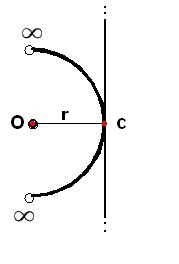
If we shrink the radius
r to match the 'empty set R'
above, points O and C will
commingle: r = 0.
Bad idea -- we will
end up with just one point to play with 'set
theory', since all the rest will be fused with it. But what can
happen if we draw a tangent line at C (it would match number 3 on
your wristwatch, and the two signs for "infinity" would correspond to 12 and 6),
and blow up the radius r to actually reach
'actual infinity'? I
suppose the circle will break at 12 and 6, reduce its topology to a line
(1-D Euclidean space), the radius will finally obtain end-points of
infinite closed interval [O,C] at actual
infinity, but will at the same instant disappear, and all points will fuse with the tangent line at C,
which can now contain only one unknown entity.
What can we do to define
dt in the drawing
above and reveal the
"carrier" ? The
non-standard analysis can't help. Any suggestions?
If you have none, try the
non-Archimedean world in RS gravity.
D. Chakalov
July 16, 2013
Last update: July 21, 2013, 23:07:16 GMT
===============================

Subject: Re: (ε, δ)-definition of limit: Request for opinion
Message-ID: <CAM7Ekxk3xRLb7qc5vKQ97x42fa6V32oqCUppFbFqrbdqq9vdqQ@mail.gmail.com>
In-Reply-To: <20130719202049.AH9J3.2769.root@hrndva-web19-z02>
Date: Sat, 20 Jul 2013 00:03:14 +0300
From: Dimi Chakalov <[email protected]>
To: Karel Hrbacek <[email protected]>
Cc: Tomáš Jech <[email protected]>
Dear Karel,
Thanks a lot for your reply.
The mathematical issues are posted at
http://www.god-does-not-play-dice.net/#Hrbacek
(July 19, 2013, 09:20:59 GMT)
In PDF format, see pp. 9-13 in
http://www.god-does-not-play-dice.net/Indefinable.pdf
(486,686 bytes, 19 July 2013, 09:35:28 GMT)
I believe it is a very simple theory, and doesn't suffer from
pathological ambiguities, such as
"not (necessarily) at c."
All the best,
Dimi
On Fri, 19 Jul 2013 16:20:48 -0400, Karel Hrbacek <[email protected]>
wrote:
>
> Dear Dr. Chakalov,
>
> In the definition of limit, c does belong to the open interval.
> Thus if the open interval is (a,b) [with a < b ], then a < c < b.
> The function f is assumed to be defined on (a,c) and also on (c,b),
> but not (necessarily) at c.
>
[snip]
-------------------------------
Note: May I offer a simple translation of the excerpt from
Karel Hrbacek above: every open interval contains a generic
'error' (Cauchy), which cannot possess its own
error margins confined in a closed interval. In my opinion, this is a
pathological ambiguity. As
Henri Poincaré remarked many years ago,
Point set topology is
a disease from which the human race will soon recover.
It is not as if we have a large macroscopic interval (say,
one meter), which can be used to define the
continuity
of a function, only at the two boundary "edges"
some very nasty things may be at work, yet we can FAPP ignore
them (see above). Nope. Each and every point in the
underlying continuum is in fact "surrounded" by such nasty ambiguities.
You may ask, how many
points can safely fit in an open interval? Just one, because
every finite open interval can be divided by c into
two smaller open intervals, thereby increasing the number of such
pathological ambiguities c , until you hit the
rock bottom of just one point, after which there will be no 'open
intervals' to play with. Which means that some fundamental geodesic
incompleteness from "the edge
of space-time" (José
M.M. Senovilla) is inserted at
manifold level, and you simply cannot move anything from point A to
point B. Actually, you cannot even start from point A, because
there will be no spacetime: reduction ad absurdum. Or your will
need a Biblical miracle to reconcile
set theory with the reality of spacetime.
The "good" news (if any)
is that you can't be certain about such conclusion. It may be just a
wild guess, which might (or not) be true. Your wild, albeit "educated",
guess is as good as anyone's else, your beloved mother-in-law included.
It is a bit like the number of blond angels that can fit on needle's
pin, only dresses in
exotic math -- you can't be certain about it either.
The only way we can move
forward is by unraveling the proper mathematical formalism of
RS gravity.
NB: Recall the
Czech saying: The "devil" is encoded in the
irrational numbers (Der Zahlenteufel).
It is not a fixed number
but a running entity
, which Nature always makes "as little as
desired" (Cauchy), and projects from "it"
a fixed limit (like the physicalized shadows on
Plato's cave) by stopping this running
Zahlenteufel at the instant 'now' with
actual infinity -- see above. It doesn't
matter that such fixed limit can be dressed with rational numbers
as well. The important lesson is about the cardinality of the "universal set"
of points making the continuum:
uncountably infinite, as it includes both rational and irrational
numbers.
Thus, we have fixed
volumes of spacetime with Points
II or "edges", called
local (physical) mode of spacetime, in which the relations 'Large vs. Small', 'inside
vs. outside', and 'one vs. many' are perfectly defined (observer
A, see
above). In the drawing below, the
local mode of spacetime is depicted with re-created (by the
Arrow of Space) four achronal hypersurfaces stacked along
null "direction" and "separated" by
dt/ds . The latter is not "zero", but is not some finite,
additive, Archimedean element either.
Only the
speed of light can 'take into account' Points II in
the local mode of spacetime, hence produce objects with
different and finite size and duration, as observed by
A. But how?
The puzzle goes back to
Lucretius,
some 2060 years ago. According to our metaphysical doctrine, Points
II are assembled with actual infinity and at every
instant 'now' are shifted
irreversibly in our
ever-increasing past, being individuated en bloc by
matter (the Cheshire cat). Hence we may call Points
II 'matter points', although they are not countable
Archimedean entities with finite size, as in the "reproduction"
of 'one
second' in metrology. The initial, purely geometrical
Point I has
been set to "nothing", which is why some (otherwise
smart) people call Point I "dark",
as explained with Die Bahn metaphor from Werner Heisenberg. There is absolutely no
flexibility in the perfect continuum of Points II:
the elementary step of the Arrow of Space, dt/ds , is
indeed non-existent there, and our ever-increasing past
has been emerging (Isham and Butterfield) by
invariant blocks of matter -- one
invariant block
per instant 'now' -- along
null "directions", as depicted in the drawings
below.
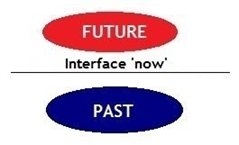
|
|
Fig. 1
Every instant 'now' is made by
one act of "pulling" the whole universe en bloc (the
closed room) upwards by the
Arrow of Space, but such omnipresent
direction is along null surfaces, and is
collapsed to zero in the local (physical)
mode of spacetime. The end result --
one-at-a-time -- is an already-positivized
matter with gravity & rotation.
Fig. 2
The Aristotelian Connection, which assembles spacetime, is denoted with
AC.
Every achronal 3-D layer is a dead block universe with conserved
total energy (cf. Nein above), "an
unchanging spacetime entity, with no particular space sections
identified as the present and no evolution of spacetime taking
place" (G
F R Ellis, p. 5,
Fig. 4). In the
assembled spacetime, however, "the total energy of the universe
is neither conserved nor lost -- it is just undefinable"
(Tamara M. Davis, SciAm, July 2010,
p. 46).
At every instant
'now' the "carrier"
dt/ds is being made infinitesimal, hence
resembles "zero", which is why the
omnipresent "direction" of
the Arrow of Space
also resembles "zero" in the local mode of spacetime (Points
II)
placed only in the irreversible past.
The "vertical" direction of the Arrow of Space
is compactified to an infinitesimal, running
endpoint dt , while the "horizontal" stacking of points
(Fig. 4)
has produced an asymptotically flat achronal 3-D space with an
infinitesimal, running
endpoint ds and conserved (Sic!) total
energy of the universe.
Every achronal slice
'now' has indefinable boundary
at both dt/ds and the
endpoints of spacetime boundary at
future/past null infinity, all of which reside
at
C
above. The shift to the
next achronal slice
'now' is
atemporal, and has
different
values of F pertaining to BSmall,
A, and BLarge.
Hence in
RS gravity we propose that the so-called
speed of light
is related to the assembling of Points II at every instant
'now' as invariant blocks of
Points II, say, 'one meter'. These blocks are always
invariant objects in
GR, but the
speed of light
may assemble them in
different ways (Sic!), to obtain
the physical, 4-D spacetime (local mode of spacetime) from the achronal
(with elementary "thickness" dt ) hypersurfaces above.
Namely, the crucial
difference is in the flow of time (denoted with F), which
is hidden within dt/ds .
Think of the flow of
time (F) as the rate of which "fresh
waters are ever flowing in upon you" ('You cannot step twice into the
same river; for fresh waters are ever flowing in upon you',
Heraclitus). Hence F signifies the crucial 'rate of
time', in addition to the bare dt/ds
.
This is the essence of Relative Scale (RS) theory of gravity (RS
gravity for short), and I will try to explain it here in the most
concise way, stressing that the full mathematical theory is still
missing.
Think of F as
something resembling 'speed of flowing time'. The bare dt
is an invariant element -- an "intrinsic time interval associated to
any timelike displacement", since "fundamental systems all march to
the beat of the same drummer" (Ted Jacobson, pp.
18-19). But the "drummer" may beat/tick differently (Sic!),
resulting in different 'speed of flowing time F' for observer(s)
B, compared to
A.
To explain the idea,
suppose we have two clocks with different values of F; one is
macroscopic and belongs to observer A,
and reads 'one second per second', while the clock of observer
B in the Small is slower and
has ten times smaller value of F, compared to that
of observer A. Hence for 'one
second' read by the clock of
observer A the slower clock
of observer B in the Small will
trespass 0.1s (highlighted with red in Fig. 3 below) from 'one second' of observer A.
Fig. 3
Finite segment taken from an achronal "flash"
in Fig. 2 above. Unlike the 100 segments of 'one second', Points II
are not additive, Archimedean elements, but come from the
same "number" of uncountably infinite points in the
continuum of Georg Cantor. Observer A
cannot notice that observer B
in the Small has different value of his F, and will
wrongly conclude that her value of F at her macroscopic
world is the only possible one, hence the spatial relations 'large
vs small' and 'part vs whole' were produced from some
absolute
length scale (wrong!), and the smaller section 0.1s
(highlighted with red) were absolute.
No physical clock
can reproduce 'one second' (Fig. 3) from additive, Archimedean elements,
even if the latter were veeery small and "exact", as suggested in
metrology. Thus, the finite building blocks of spacetime,
'one second' and 'one meter', are potential gravitational
reality: GR invariants.
Notice that 'time' is not
made of temporal and additive, Archimedean elements, to explain the flow of time and answer the
question “How fast does time pass?” (Paul
Davis). For easier understanding, think of observer A
as an object with speed 1m/s, while the slower object
B has speed 0.1m/s. Thus, for the
same 'one second' (Fig. 3) of object A,
the slower object B will trespass
0.1m, and will look smaller. To whom? Only to observer A,
according to
RS
gravity.
NB: Observer
B in the Small will take its
relative
value of F, which will inflate
(Sic!) its relative 'proper time' in the Small -- again
1s, but with respect to observer
B -- and, given the
constant speed of light, its relative size (R) in the
Small will be enlarged accordingly. With respect to observer
B, the space in
the Small is again assembled from 'something else',
but with a "smaller" value of F, compared to that of
observer A. Yet such "smaller" value
of F in the Small will be compensated by enlarged and
relative (to observer B) value
of
R in the Small, in line with our postulated equation
FR = 1 (Eq. 1).
There are two general rules in
RS
gravity:
1. The
"distortions" of the values of F of observer(s)
B in the Small and in the Large are
relevant ONLY to observer A, yet
with respect to observer(s) B at
the same time there are no distortions whatsoever in the
Small and in the Large, because their relative metric is
compensated by reciprocal values of R, in line with Eq. 1. Hence
at all length scales the invariant
'one meter' remains 'the same', along with the relative rate of
time 'one second per second'.
2. The "number" of
elementary 'ticks of time', which assemble
Points
II according to Rule (1), is uncountably
infinite, which is why the "number" of
Points II,
occupied by a proton, a football, and a galaxy, is always 'the same'.
Hence the Universe can be
self-correlated and bootstrapped by the atemporal
negotiation of its
potential
quantum-gravitational reality "during" the instant 'now'
placed at Point I.
For example, if F (cf. the drawing below) takes value 10-15
with respect to observer A, the
latter will conclude that the space in the Small has "shrunk".
Stated differently, observer A will
wrongly assume that her macroscopic value of F does
not (wrong!) change in the Small, and therefore the assembled distance
were 10-15 times smaller, and will match the "smaller" size
of a proton (Fig. 4).
Fig. 4
At every instant 'now', the w-axis
of the Arrow of Space is compactified to
ds , producing an achronal 3-D hypersurface (cf. Fig. 2) made
of Points II placed in
our irreversible past, stacked into
timeless 3-D space, in which the total energy is
indeed "conserved" (cf. Nein above).
The relative metric of observer A
defines
length scale which is bounded from below at 10-35 m (Planck
length), but is
indefinable (perhaps
unbounded) in the Large. The result from such asymmetric
construction of 3-D space is that the Arrow of
Space can run indefinitely, with
asymmetric manifestation of its tug-of-war
gravity: the so-called
DDE points
to the future and is perfectly smooth, while the clumsy
CDM points to the past.
But for observer B in
the Small, his relative assembled distance will remain 'the
same': the relative value of R in the Small will be 1015,
because the size of a proton in the Small will be assembled with
the same constant speed of light for longer (Sic!) proper time
for trespassing 'one meter'.
The fact that the "speed"
of light has a finite numerical value requires that F is bounded from
below by some finite numerical value as well, which at
the current stage of the evolution of the universe is the Planck
length, which is again 'one meter' (F = 10-35, R = 1035):
the universe does have finite size -- one-at-a-time -- but only in its
irreversible past.
The two extreme cases, (i) F = 0; R
= ∞ in the Small and (ii) F = ∞; R = 0 in the Large,
are indistinguishable, because they are identical to Point I (C) of The
Beginning/The End. Hence in every instant 'now' we pass through God (Luke
17:21).
In brief, all Points II
take different values along F (with reciprocal values along R):
For
BSmall : F (0, 1).
For A : F=R=1.
For
BLarge : F (1, ∞).
What follows is a very
brief example for case BSmall,
denoted for easy writing with B.
A
: F=R=1 => FA = RA = 3.108
m => 1s for the speed of light pertaining to observer A,
cA.
With respect to A: FB =
3.107 m => 0.1s (cf. Fig. 3 above).
With respect to B: FB =
3.107 m => 1s for the speed of light pertaining to
observer B, cB.
Hence cB = FB = 0.1 => RB = 10 (see Eq.
1 and the drawing above).
Thus, for observer B: FBRB
= 3.107.10 = 3.108 m => 1s for the speed of light
for observer A.
Explanation: cB
shows the slowing rate of time in the Small (B),
but only with respect to observer A.
For observer B, his cB is
always 'the same constant speed of light', and his time would be
"slowing" only with respect to observer A.
Hence he (observer B) cannot
notice that it takes 10x longer time in the Small
(compared to observer A) to trespass
0.1s pertaining to observer A
(cf. Fig. 3 above): the elapsed time will be 1s for observer B.
Hence 'one meter' and any other finite distance (e.g., 3.108 m) will
be scale invariant. Namely, every
finite 4-D spacetime interval, as assembled by the Arrow of
Space (Sic!), will
remain 'the same' to all observers and at all length scales.
This is our proposal to produce
the invariant distance 'one meter' of
observer A, to represent one and
the same and invariant 'one meter' at
all length scales. Namely, the
invariant distance 'one meter' of observer
A "changes" toward the Small and toward the Large, yet
always determines one and the same and
invariant 'one meter', be it a proton or a galaxy, as observed by
A.
This is the key issue in
RS gravity. With respect to observer
A, her
invariant 'one meter' can include many smaller elements, such as
the size of a proton, but the latter equals the same
invariant 'one meter' for observer
B in the Small, because it has been
inflated there by greater R. Likewise, the
invariant 'one meter' for observer
A will be many times smaller than a
galaxy, yet the same invariant
'one meter' will be shrunk in the Large by smaller R, and will again determine one
and the same and invariant 'one
meter' there. Hence observer A
can claim that she is "between" the Small and the Large, and the
latter are "penetrating" each other, starting from
A. In fact, we just happened to be observers
A, because mind and consciousness
can enter the physical world only at macroscopic scale (cf. Q3
above),
while the invariant 'one meter' pertains to all observers, at all length
scales, thanks to Eq. 1 above and
'the same' uncountably infinite
points for all values of R.
NB: The metric
of spacetime is both dynamical and
relational.
No need for any "black
holes" nor "dark" matter (David Wittman), because the observed
gravitational effects are not produced by matter alone, but by 'the
universe as ONE' (Point I) as well. For example, observer A
may wrongly conclude that the space itself has been
"expanding" toward the Large (recall
Hubble's
diagram), and introduce some "dark energy"
to explain "the accelerating expansion of
the Universe through observations of distant supernovae" (Nobel Prize in
Physics
2011). As Anthony Zee put it (Gravity in a Nutshell,
Princeton, 2013,
p. 753): "A distinguished colleague said to me recently, “The
cosmological constant paradox is more than a paradox; it’s a profound
public humiliation of theoretical physicists.”
As another corollary, consider
time dilation paradox: if you travel with speed close to c,
your value of F may 10x
decrease (0.1s
instead of 1s; cf. Fig 3 above) with respect to your twin brother --
again, not to you but to your twin brother -- and upon returning home
you both will realize that meanwhile
the "faster" clock on Earth has trespassed much more time, and your
poor twin
brother is much older. To you, however, the following
interpretation is equally true: the "decreased" elapsed time of 0.1s
(cf. Fig 3 above) is valid only for your twin brother, while
the same elapsed time will be 1s to you, and you won't notice
any distortion of your time, because you can't. Whose watch is
"correct"? Both.
Of course, it would be far more
useful if we
can manipulate the metric locally and blend the effects predicted in
RS gravity, say, to fly like an Alien Visiting Craft (AVC):
our 'one meter' will correspond to 1000 or more meters in the reference
frame of outside observers. Whose meter is "correct"? Both.
Needless to say, I still
don't know how to "produce the gravity differential, the time field
differentials" (Wilbur B. Smith) which are necessary
to operate an AVC.
Its inertial reaction "forces" should be eliminated (REIM)
in the first place, to make it fly in "empty space" by "free fall" (cf.
Fig. 1 above). Tough. But since we [Ref.
1] share the same brain with the
Universe, the task might be feasible.
I will have to leave the
remaining issues of Point I
and Points
II open, and go back to the
emergence of Points II.
I stated
above that the
description of 'points' in differential geometry and topology requires a
resolution greater than the points themselves. That is, we need to show
the indefinable entity from which a point
can presumably emerge (Isham and Butterfield).
Here the example from
Karel Hrbacek is very helpful:
"if the open interval
is (a,b) [with a < b ], then a < c < b."
If we apply the
Golden Ratio, c is an irrational running entity
, which is uniquely defined by a geometrical
point (modulo the Cheshire cat), but cannot be
"stopped" with rational numbers from 'matter', like the inevitable
"error" (Cauchy) in defining the "precise" value
of π
to determine the "precise"
circumference of the circle above. Any time we
"stop" this irrational running c by ascribing some
rational number to it at the instant 'now'
(see below), we obtain only its frozen "jacket"
or "cloud", like the physicalized shadows on
Plato's cave.
If we apply the
Dedekind Schnitt (cut) to the irrational, yet uniquely defined,
point c for torus (A) and sphere (B) transformations,
A(|)B (Richard
Dedekind), we obtain at actual infinity (global mode of
spacetime) one and only one point c which
pertains to 'infinite space', and produces the "severing" of the
straight line r into two portions "separated" by a
purely geometric (modulo the Cheshire cat) point
C :
The small red circle
contains point c (omitted), and corresponds to
asymptotically flat spacetime and the instant
'now'.
This is the emergence
of asymptotically flat spacetime (called 'slice'
and 'flash') in which the 'world points' are
already individuated by matter (the
Cheshire cat), and belong to the local (physical)
mode of spacetime -- one-flash-at-a-time along
the Arrow of Space.
Physically, we observe a
sequence of points c
'now', which assemble the perfect continuum of
the local mode of spacetime: The Aristotelian Connection. The
latter involves two offer-and-confirmation "waves"
of spacetime topology, which "run" against each other in the
global mode, and create asymptotically flat
spacetime (local mode): one-slice-at-a-time along
the Arrow of Space.
Yes, we certainly can obtain a frozen
"jacket" at c (called
also 'slice' and 'flash') with actual infinity, but -- no, not
by catching the running c itself. Hence we are
dealing with uncountably infinite pseudo-set of points from 'open
sets' with the
indefinable cardinality of rational & irrational numbers.
Let's see how this story
fits in the (ε, δ)-"definition" of limit:
[ ad
infinitum <---δ<---
ε<---
...
We can replace the bracket [ with x ,
and write:
(ε
- x) - (δ
- x) =
ε
- δ
= c .
The exact numerical
value of the referential point x does not matter,
because it disappears anyway, yet it must be precise to define
the two intervals. It is the ultimate "source" from
which the flash-points emerge in the local
mode of spacetime, by "collapsing" the two intervals to zero,
after which c and x become
identical at the instant 'now', as every bartender
knows very well; more here.
Let's see how the
referential point x defines the beginning of
cosmological time (hence spacetime) or Time Zero. To paraphrase
Wiki:
The notion of the
limit of a function is very closely related to the concept of
continuity. A function f is said to be continuous
at x if it is both defined at x
and its value at x equals the limit of f
as c approaches x :
lim f(c) = f(x)
c --> x
The condition 0 < |c - x| is crucial:
c can only approach x , but will
need infinite time to reach Time Zero by snapping to the vertical
axis. Hence phrases like 'the universe began asymptotically at
Time Zero, x=0 ' are nonsense (Chuck
Norris). For example, if c takes the value of one
nonillionth (10-30) of a second, it will again need
infinite time to reach the vertical axis and become identical
to Time Zero.
On the other hand, the referential point x=c=0 must be
precise to define any Archimedean interval
(Eudoxus
axiom), such as 'one
second' and the increasing but always
Archimedean cosmological time, app.
13.798 billion years.
Besides, there are
vague arguments
that the
Planck time may serve as some physical Time Zero, yet we
cannot define 'one second' as an additive,
Archimedean phenomenon, because the mathematical expression 10−44
times 1044 does not make sense.
The essence of
dt/ds is that it is not made of
Archimedean entities. Its explanation is with
dual age of the universe: the
cosmological time (hence spacetime) does have an
"edge"
or "limit" at Time Zero, but only in our
ever-increasing past, while at the
same time (Sic!) the cosmological time (hence spacetime) does not
have any "edge"
or "boundary" in its potential future. In brief,
the atemporal loop 'now'
is a dual object: it is both completed in the past and
open to 'the unknown unknown' in the future. Metaphorically speaking,
the Dragon can never actually bite its tail
in the future, but only approach it asymptotically.
If we run this
cosmological non-unitary evolution backward in time, 'the
universe as a brain' will be losing its physical
content by non-unitary transformations, and by approaching
asymptotically Time Zero it will become just very simple,
resembling your prenatal Stage 1,
Zygote.
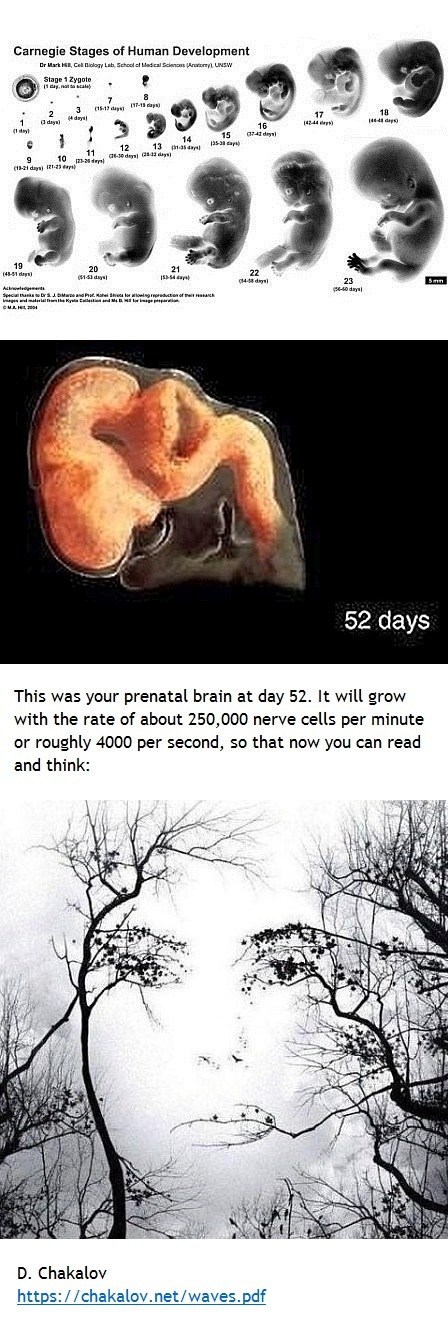
No need to worry "why the
very early universe was in a very low entropy state" nor to suggest that
"it came into existence in a very special state. Of course, this
answer begs the question, since one would then want to know why it came
into existence in a very special state, i.e., what principle or
law governed its creation. I definitely do not have an answer to this
question" (Robert
Wald).
Now you have the
answer. There is no alternative solution. None. To explain what
is alternative solution and why it can't work, suppose the
atemporal loop 'now'
were wrong. As a toy model for "unitary evolution", measured with "time"
and denoted with t in your GR
textbooks, consider a
kaleidoscope with a finite number (e.g., 1044) of
colored pieces of glass, which is shaken "in the air" and then placed on
a table -- once-at-a-time. You aren't interested in the ("dark") states
of the kaleidoscope "in the air", but only in its physically
observable states 'on the table'. You claim that these states change due
to thermodynamics, hence exhibit 'time as read
with a physical clock', and require the
global hyperbolicity conjecture. All possible (i.e., countable in
principle) states of the kaleidoscope 'on the table' form a set,
and you happily invoke "the axiom of choice" to "arbitrarily pick any
member" (Eric
Schechter) of this set, and attach certain probability for observing
it 'on the table', assuming that all probabilities will sum up to unity,
to provide "unitary evolution". All this may sound nice 'n clear, until
you realize that (i) one cannot affirm nor reject the Continuum
Hypothesis for such observable states, and (ii) there is too much "dark"
untraceable stuff that somehow shows up
'on the table': if interpreted as
an effect due to matter, the radius of the
universe “could not even reach to the moon” (Wolfgang
Pauli).
People object by stressing
that all this is pure philosophy and metaphysics, while they work with
mathematics. But the mathematics is still uncovered. It is waiting 'out
there', in some Platonist form, to show up and prove its astonishing effectiveness in the natural
sciences (Eugene
Wigner).
In this respect,
Kurt Gödel was immensely lucky to demonstrate
that the Continuum Hypothesis is
neither provable nor disprovable. All the mathematics
was already unraveled, and he was lucky to meet the great David Hilbert,
who immediately dropped his own
project. Why? Simply because David Hilbert had respect for
Mathematics and considered it superior to his ideas.
I didn't have such
luck so far, and am still trying to find
the right people. Qui vivra verra.
D. Chakalov
July 20, 2013
Last updated: September 29, 2013, 16:30 GMT
[Ref. 1] Italo Cavino,
The Form of Space, in Imaginary Numbers: An Anthology of
Marvelous Mathematical Stories, Diversions, Poems, and Musings, ed.
by William Frucht, Wiley, 2000.
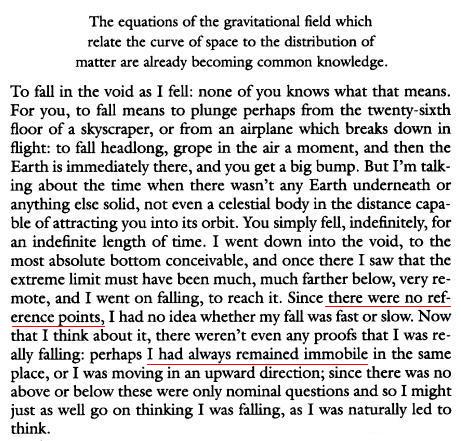
====================================================
Subject: Phase difference
of matter waves: Request for reference (if any)
Date: Wed, 24 Jul 2013 12:35:40 +0300
From: Dimi Chakalov <[email protected]>
To: Holger Müller <[email protected]>,
Marina Cortes <[email protected]>,
Achim Peters <[email protected]>,
[email protected],
[email protected],
[email protected],
[email protected],
[email protected],
John <[email protected]>,
Jayant <[email protected]>
Dear colleagues,
Sorry for my unsolicited email.
May I ask you for references or other information (if any) about
application of phase difference of matter waves in Wheeler-Feynman
absorber theory (please see a drawing from J V Narlikar, Mach’s
Principle, Resonance Journal of Science Education, April 2011, pp.
310-320): a 'correct' response from the whole universe will cancel all "acausal
effects" (J A Wheeler and R P Feynman (1945), Rev. Mod. Phys. 17,
157).
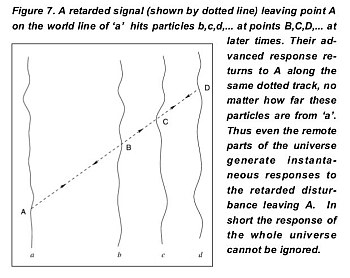
The whole process is atemporal, as its physical
duration is zero due to the "speed" of light. Here, phase difference is
crucial.
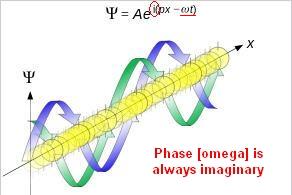
I wonder if you know any extension of this atemporal and phase-dependent
phenomenon to *matter waves*.
Thank you for your time and consideration.
Kind regards,
Dimi Chakalov
chakalov.net
Note: If we extend
the quasi-local action-at-a-distance [Ref.
1] to quantum and gravitational interactions, the fleeting material
content (flashes) at the instant 'now'
may look like
Schaumkamm
("eine Art "Schaumkamm" auf einer den Weltgrund bildenden
Wellenstrahlung," Ref. 2) explicated from the global mode of spacetime --
one-at-a-time along the Arrow of Space, and with unit
probability. The resulting re-created
local (physical) mode of spacetime is an
exact limit for the whole
universe, but is valid only for its current instant 'now'. Hence
we don't need the 'reference fluid' (Brown and
Kuchar) at this particular Schaumkamm 'now'. Also,
the "negative energy" (Adam Helfer) has
been perfectly cancelled out, leaving an EPR-like correlated
physical world endowed with "inertia".
The atemporal 'offer and confirmation' standing wave pertains to
the potential reality of 'the universe as ONE',
hence only the (human) brain may have access to its
imaginary phase, to tweak and alter the next "flash"
or Schaumkamm permitted by the conditions for
flexibility (not "uncertainty").
Trust me, the whole story
is very simple and
agonizingly clear. Only the mathematical framework is
still uncovered. For example, we don't know how to build an Alien
Visiting Craft (AVC) and use REIM to trespass
space along a quasi-local trajectory, in which our 'one meter' will
correspond to 1000 or more meters in the reference frame of outside
observers, in line with Relative Scale (RS)
gravity. People who believe in "dark
stuff" will be flabbergasted and assume they saw some
weird UFO mystery, as "any
sufficiently advanced technology is indistinguishable from magic"
(Arthur C. Clarke's Third Law).
The list of possible applications is
very long, but I will stop here, because nobody's interested -- nobody
showed even a trace of interest in the new form of retarded causality,
called 'biocausality'. It was introduced in
January 1990 as
'just a hypothesis', and now is 'the only possible solution'.
Why?
Look at the world line in
the drawing from Jayant Narlikar
above, and zoom on the instant 'now'. The
offer-and-confirmation "waves" are atemporal, as they "propagate" on
null hupersurfaces [Ref. 3].
Let's introduce a
structure of the instant 'now' with two purely geometrical
(modulo the Cheshire cat) points A and B,
which belong to the global mode of spacetime in
RS gravity, and fix (Sic!) the Schaumkamm
'now':
The atemporal loop
'now' in the second drawing occurs in a hypothetical global mode
of spacetime, which contains only the atemporal 'universe
as ONE' depicted with Point I. Physically, it would be seen
with an inanimate clock (not the
human brain) as a timeless luxonic world [Ref.
4]. The latter "separates" the physical, 4-D spacetime from a
mirror world of imaginary mass [Ref.
5] shown with 1+3-D spacetime [Ref.
4]. Such mirror world keeps the potential states
of matter, and with respect to the physical spacetime will resemble a rubber hand glove (cf. the circle in
Fig. 5.7 below) turned inside-out, with opposite
parity and
inverted dimensionality.
|
|
|
|
Mark A. Armstrong,
Basic Topology, Springer, 1997,
p. 104.
|
Points II (local mode of spacetime) are shown with P.
The inversions of red arrows
(sphere-torus transitions) constitute the atemporal loop
'now' above, producing a
set of correlated Points II
en bloc -- one-at-a-time.
|
We will further assume
that the global mode of spacetime is in superposition
(Sic!) of four mirrored spacetimes of imaginary (not negative)
mass, and harbors the potential, yet-to-be-physicalized
reality depicted with
Point I. With respect to the physical
world, the 'distance' and 'proper time' in the global mode of spacetime
do not yield rational numbers, as the positive squared (s2)
spacetime interval "within" Point I
is imaginary.
The
broken symmetry of mirrored spacetimes, observed in the physical
world with Points II, is due to the Arrow of Space: the physical
4-D world
is re-created at every Schaumkamm
'now' as a set of Points II, in which the atemporal loop 'now'
has been
already-completed, and the imaginary mass
in the global mode of spacetime will be interpreted as a neutral
plasma of negative-positive mass pairs (Belletête
and Paranjape,
pp. 6-7).
As Gerald Feinberg stated, "It is clear that at a single point there is no
distinction between absorption of a positive-energy particle and
emission of a negative-energy (Macavity
- D.C.) particle" [Ref. 5, p. 1091].
Notice again that, unlike
Wheeler-Feynman absorber theory, we assume different, inverted
spacetimes for the physical and mirror worlds, which "interact" only at
one point 'now' by a standing offer/confirmation topological wave
in the global mode of spacetime, shown in the atemporal
loop 'now' above with Point I. Also, the atemporal loop
induces rotation in the
local (physical) mode of spacetime, made with Points II, as the offer wave is confirmed by 'the rest of
the universe' in just one instant 'now'
of "clapping hands". In such Machian model the two "waves" negotiate the
energy-momentum content of every next
instant 'now', as points A and B will be again
fused into the next
instant 'now' from the spacetime continuum of the
local (physical) mode of spacetime. This bundle of issues requires
detailed mathematical study in the
future.
NB: Notice that the
"confirmation" wave from 'the rest of the universe' in the
atemporal loop 'now' is not
time-symmetric but pertains to the flow of time in the
Arrow of Space. The crucial input from B
is not includable in a Green's type function -- it describes "the
transfer between the intangible (yet-to-be
physicalized - D.C.)
energy of the gravitational field (as it will be called here), which is
not described by the energy-momentum tensor, and the tangible forms
which are so described" (Hermann Bondi), and is a
genuine non-conservation law (Hans Ohanian).
Otherwise the universe cannot shift to its next
instant 'now': there will be no 'change of
space' along the Arrow of Space, but only 'change
within space' and the universe (included your brain) will be timeless (Robert
Geroch).
Thus, the elementary increment of
time, AB = dt , is an "interval" in which the two
purely geometrical points 'run toward each
other', as they are separated by the "error" ε (Cauchy).
With Archimedean geometry only, we have two incompatible options
which 'transfinitists' try to reconcile: either zero or finite, as
Bishop Berkeley stressed. My solution is
YAIN,
and I won't repeat it here. Suffice it to say that the set theory, as
presented in the textbook by Karel Hrbacek, must be
upgraded to correctly model the continuum
hypothesis.
In general, there are two
kinds of conditions for describing the spacetime of the universe:
necessary (matter and fields endowed with inertia; see
Points
II) and sufficient. The necessary conditions
are only in the assembled,
Archimedean (cf. the second drawing below) spacetime, in which the Arrow of Space has
already been nullified along its w-direction,
due to which Points II are endowed with positive mass and inertia
(Fig. 1 above); check out the drawings below.
|
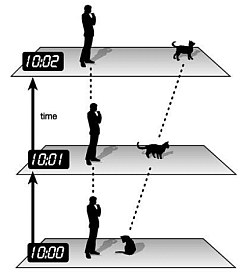
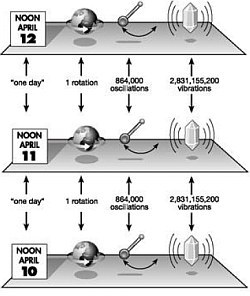 |
|
Drawings from:
Sean Carroll, From Eternity to Here, Penguin,
2010 |
According
to the observer and his Diff(M)-invariant wristwatch, the cat
moves only (wrong!) in the assembled (cf. option Yes
above) 4-D Archimedean
spacetime by changing its coordinates. But the assembled
4-D spacetime is made by the Arrow of Space
with achronal 3-D hypersurfaces in which the "orthogonal"
input
is made infinitesimal along w-axis
(cf. Fig. 1 above), and the "displacement" dt/ds
is approaching zero.
Physically, the
observers cannot detect the irreversible flow of time
along the additional global "orthogonal"
w-displacement
from the
Arrow of Space, and believe they live in some dead frozen "block
universe" equipped only with thermodynamics.
The fundamental difference between 'change in space' and 'change
in time' is postulated (not explained) with spacetime metric from the outset,
and all efforts in GR (e.g.,
Peter
Bergmann) to endow the metric with
dynamics (with respect to what?)
tacitly presuppose that the dynamics of GR occurs
only by coordinate change in the
assembled 4-D Archimedean
spacetime (cf. option Yes
above). But this "change" is a local
(in fact, quasi-local)
phenomenon, and pertains only to the necessary conditions.
The sufficient
conditions, on the other hand, are defined from the
atemporal 'universe
as ONE' depicted with Point I -- the "engine" of the atemporal loop above
is the Aristotelian Unmoved Mover (Karel Kuchar).
Both conditions, necessary and sufficient,
are needed to make the metric
dynamical:
Mass there governs spacetime geometry here (Ciufolini
and Wheeler, p. 270),
and at the same instant spacetime geometry here governs
mass there. Thus, the instant 'now' has internal
structure, to accommodate the atemporal, bi-directional, and
non-linear "talk"
(depicted below with the 'drawing hands' from Maurits
Escher) along the
w-axis,
between every 'point' and 'the rest of points'.
Click the images for
explanation of the
"orthogonal" w-axis.
The transition
Pi --> P
(second drawing) is the so-called "flash"
or rather "end" result -- one-end-at-a-time -- from the atemporal
loop 'now' (clapping hands).
Metaphorically, what we see in a cinema theatre are the running images
from achronal static slides in a movie
reel, which fully comply with the laws of
thermodynamics.
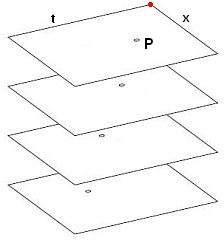
Four achronal
'isolated systems' or "flashes" with
different matter-energy content.
In every individual "slice" the contracted Bianchi identity holds
FAPP, hence we can effectively switch off
gravity at a point (Peter
Bergmann). The "orthogonal"
w-axis
is compactified on four different Points II, and the
bi-directional talk between matter and geometry (Derek
Wise) is already completed by the
Noumenon.
We
don't see the dark strips (ds/dt) separating the achronal
snapshots
in the movie reel, nor the global engine which runs the movie. Hence at
every instant 'now' we pass through God (Luke
17:21): a genuine Noumenon
(Kantian das Ding an
sich - never in plural), presented with 'the
set of all sets'. Isn't it simple?
In fact, I am trying to
help
Karel Hrbacek and Karel Kuchar, and recently
offered them and their colleagues to read my proposal, in PDF format,
and write a brief paper.
They all refused, and will continue to teach their students an
incomprehensible mixture of things that are clearly correct, unclear,
horribly misleading, and outright wrong. But soon or later, they all
will irreversibly retire.
D. Chakalov
July 24, 2013
Last updated: October 7, 2013, 12:37
GMT
[Ref. 1] F. Hoyle and J. V. Narlikar, Cosmology and action-at-a-distance
electrodynamics, Rev. Mod. Phys. 67 (1995)
113-155.
"There is one further hint of the possible role of the response of the
universe in local phenomena, a role that takes us beyond
electrodynamics. The discussions of Secs. III-V tell us that it is not
proper to talk of a probability amplitude for a local microscopic
system. The correct description of the physical behavior of the system
follows from the probability calculation that includes the response of
the universe. Thus one is dealing with a "square of the amplitude" type
of expression rather than the amplitude itself.
"This may explain the mystery that surrounds such epistemological issues
like the collapse of the wave function. What is missing from the
usual discussion of the problem is the response of the
universe. The wave function collapse represents the final course of
action taken by the system consistent with the response of the universe.
We suggest this idea as a way of understanding many other conceptual
issues of quantum mechanics.
.......
"What has been the progress towards extending the action-at-a-distance
formulation to other interactions?"
[Ref. 2] Erwin Schrödinger, Zur Einsteinshen Gastheorie,
Physikalische Zeitschrift, 27 (1926) 95-101.
[Ref. 3] Piotr Chrusciel, Lectures on Energy in General Relativity,
March 6, 2012,
p. 166.

James Hartle, Gravity: An Introduction to Einstein's General
Relativity, Addison-Wesley, 2003,
p. 162.
http://en.wikipedia.org/wiki/Spacetime#Light-like_interval
Wiki: "In a light-like
interval, the spatial distance between two events is exactly
balanced by the time between the two events. The events define a
squared spacetime interval of
zero (s2 = 0).
Light-like intervals are also known as "null" intervals."
Note: The cause-effect
relationship is handled by a new retarded causality, called biocausality
(D. Chakalov,
January 1990).
[Ref. 4] Max Tegmark, On the dimensionality of spacetime,
arXiv:gr-qc/9702052v2.
"Since a mere minus
sign distinguishes space from time, the remaining case (n,m) = (1,
3) is mathematically equivalent to the case where (n,m) = (3, 1) and
all particles are tachyons [14] with
imaginary rest mass.
Footnote 4: "The only remaining possibility is the rather contrived
case where data is specified on a null hypersurface. To measure such
data, an observer would need to "live on the light cone", i.e.,
travel with the speed of light, which means that it would
subjectively not perceive any time at all (its proper time would
stand still)."
[Ref. 5] Gerald Feinberg, Possibility of Faster-Than-light Particles,
Phys Rev 159 (1967)
1089-1105, cf. Eq. 2.2 on p. 1090 (imaginary mass)
===================================================
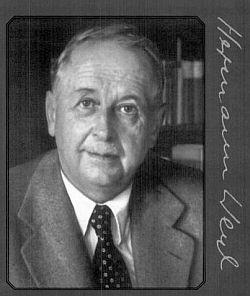
Hermann Weyl,
Philosophy of Mathematics and Natural Science,
Princeton University Press, 2009,
Ch. 2

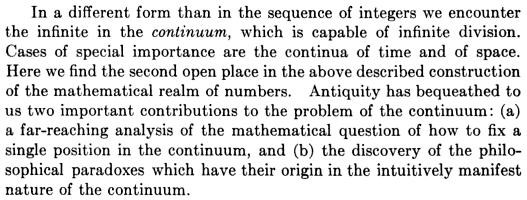
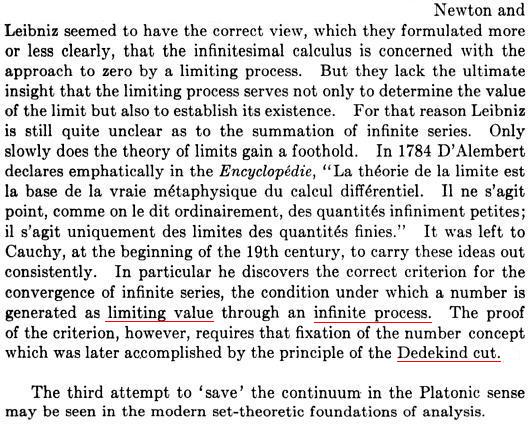
----------------------------------
Subject: Interpretation of the
Weyl Tensor
Date: Fri, 2 Aug 2013 09:40:21 +0300
Message-ID: <CAM7Ekx=waCTUDOF2XVfeYV+9ACcaLHCGboRtqFiY4pw65DW08A@mail.gmail.com>
From: Dimi Chakalov <[email protected]>
To: Robert Schneider <[email protected]>,
[email protected],
[email protected]
Cc: Dieter Kotschick <[email protected]>,
Bernhard Leeb <[email protected]>,
Fabian Ziltener <[email protected]>,
Hartmut Weiß <[email protected]>,
Carlos Ramos-Cuevas <[email protected]>,
Hans-Dieter Donder <[email protected]>,
Wilfried Buchholz <[email protected]>,
Helmut Schwichtenberg <[email protected]>,
Peter Müller <[email protected]>,
[email protected],
[email protected],
[email protected],
[email protected],
[email protected]
Dear colleagues,
You wrote in
arXiv:1308.0010v1 [gr-qc] that the physical content of the metric
field in vacuum should be "somehow encoded" in the Weyl tensor, and "new
dynamical degrees of freedom", such as "outgoing and
incoming" waves, can be expected.
A very simple explanation is offered at
http://www.god-does-not-play-dice.net/#loop_now
The task is purely mathematical.
All the best,
Dimi Chakalov
-------------
Note: One hundred
years ago, Marcel Grossmann [Ref. 1]
suggested that "the divergence of the (contravariant) stress-energy
tensor of the material flow or of the physical process vanishes."
YAIN.
The crucial input from the
Weyl Tensor is yet to
be understood.
D. Chakalov
August 2, 2013, 13:38 GMT
[Ref. 1] Outline of a Generalized Theory of Relativity and of a Theory
of Gravitation. I. Physical Part by A. Einstein II. Mathematical Part by
M. Grossmann, Zeitschrift für Mathematik und Physik, 62,
225-244, 245-261 (1913), in The Collected Papers of Albert Einstein,
Volume 4: The Swiss Years: Writings, 1912-1914, ed. by A. J. Kox et
al., Princeton University Press, 1996,
p. 182.
==============================================================

Adapted from Plato, The Republic,
X.596a6, translated by
Allan Bloom
-------------------
Subject: Platonic ideas:
The set of all sets
Date: Fri, 26 Jul 2013 11:41:26 +0300
From: Dimi Chakalov <[email protected]>
To: [email protected], [email protected],
[email protected], [email protected],
[email protected], [email protected],
[email protected], [email protected],
[email protected], [email protected],
[email protected]
Dear colleagues,
I argue against the unrestricted use of the axiom schema of
comprehension, and offer a new form of logic (YAIN) to incorporate 'the
set of all sets' in mathematics. The explanation comes from physics, and
is hinted at
http://www.god-does-not-play-dice.net/#atemporal
Please feel free to comment and ask questions.
Kind regards,
Dimi Chakalov
-------------
Note: The so-called
'axiom schema of comprehension' claims that 'all the things with some
property form a set' (reference
here). Sounds simple and clear, yet 'the
set of all sets' and its complement, known as 'the empty set' (it is
both open and closed), are notoriously difficult to explain. I will
argue that 'the set of all sets' corresponds to Plato's Idea or
Form, and that it does
not belong to any set but to the non-Archimedean world of
'the universe as ONE' (global mode of spacetime), as
depicted in the atemporal loop above.
Let me quote from Jianfei
Shen, Introduction to Set Theory: A Solution Manual for
Hrbacek and Jech (October
14, 2011), stressing the usual, and seemingly "obvious", either/or
logic:
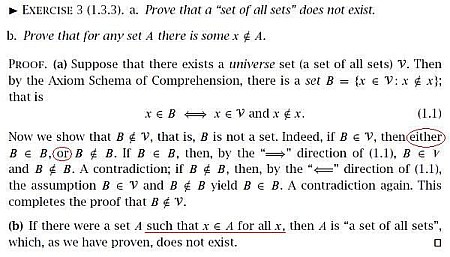
To understand the new
logic YAIN (Yes-And-neIN), which is not
restricted to either/or propositions viz. "contradictions", let me
repeat the doctrine of trialism: ONE dual entity, which is
explicated by two complementary presentations, say, matter &
psyche (Wolfgang Pauli).
Suppose
Karel Hrbacek was an Eskimo who has never
seen an elephant in his life. Yet he can make observations on elephant's
trunk by two complementary devices, which measure either
properties of 'nose' or properties of 'arm'. Obviously, he can
never understand the underlying 'ONE entity', called 'trunk'. Worse, he
may be tempted to seek some causal relation between the 'nose' and the
'arm' only, and
waste his whole life with questions like 'which goes first, and
how'.
Our case looks simpler,
because we must only explain 'the ONE' (called by Plato
Form), which is explicated by infinitely many sets, yet does not
belong to any set, being 'the set of all sets'. To do this exercise,
check out 'the UNdefinable
matrix': given the
inverse-proportional relation between the content and volume of
concepts, the bigger the volume, the smaller the content. A comparison
between, say, 'chair' and 'furniture' shows that 'chair' has bigger
content (more specific) and smaller volume (number of distinguishable
chairs) than the more general concept of 'furniture'. A very general and
abstract concept, such as 'thing', covers almost everything we
could think of, and has almost zero intrinsic content. The
limit of this trend is some UNspeakable concept that has infinite
volume and zero intrinsic content. It covers all
possible concepts, and is presented with
the pseudo-set of all sets. It is
also UNspeakable, because it does not require any
referential object (i.e., we can understand A only with respect to
not-A), hence cannot be defined with our relational thinking.
The same untraceable
limit applies to the Aristotelian
Unmoved Mover and First Cause, which are
"hidden" in dt&ds transition of the
atemporal loop above, known as 'the instant
now' (Luke
17:21).
Yet it does exist,
being the source of all 'shadows on
Plato's cave', or 'the set of all sets' A such that x
belongs to A for all x (cf. Jianfei Shen above). Or simply
"a single essential nature or Form for every set of things" (Plato),
which also has zero
intrinsic content, and will look like an 'empty set' as well.
And because we're
"Eskimos", we can comprehend a set of things (A) with particular
properties iff there exists a referential set of
things with opposite properties (not-A).
The underlying 'ONE entity' is a pseudo-set of all sets, and
all propositions about such "trunk" are non-falsifiable and
UNdecidable (Kurt
Gödel). This is the price to pay for removing "contradictions"
from
either/or logic.
It does exist and
must exist, but is a
Noumenon and can be demonstrated only with Mathematics.
You may ask, 'but is this
boring story really important?' Yes it is. If you skip it, you may waste
many years in the jungle of set theory [Ref.
1, p. 283] and never understand
the nature of continuum.
The choice is yours.
D. Chakalov
July 27, 2013
Last updated: July 28, 2013, 12:33 GMT
[Ref. 1] Karel Hrbacek and Thomas J. Jech, Introduction to Set Theory,
3rd ed., Marcel Dekker, New York - Basel, 1999.
pp. 268-269:
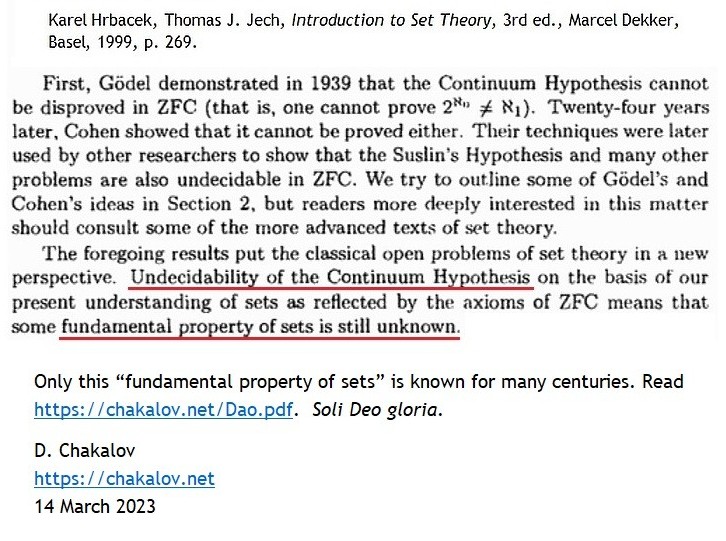
p. 283:
========================================================
Subject: 'Something else': FR = 1
Date: Sat, 24 Aug 2013 21:25:01 +0300
From: Dimi Chakalov <[email protected]>
To: [snip]
C.J. Isham and J. Butterfield,
arXiv:gr-qc/9901024v1: "Space and time
are such crucial categories for thinking about, and describing, the
empirical world, that it is bound to be ferociously difficult to
understand their emerging, or even some aspects of them emerging, from
'something else'."
--
Ladies and Gentlemen:
Please notice Eq. 1 at
http://www.god-does-not-play-dice.net/Indefinable.html#sandclock_elevator
Download printable copy, 34 pages, from
http://www.god-does-not-play-dice.net/Indefinable.pdf
(1,885,485 bytes, 24 August 2013, 16:58:40 GMT)
Read more at
http://www.god-does-not-play-dice.net/#sandclock_elevator
Your corrections and suggestions will be appreciated.
Sincerely,
D. Chakalov
chakalov.net
-------------
Note: Where is this
'something else' ? It is the dark "canvas" in the first
drawing below, which acts as "background" with respect to
which the so-called lapse function N is introduced, as
shown in the second drawing.
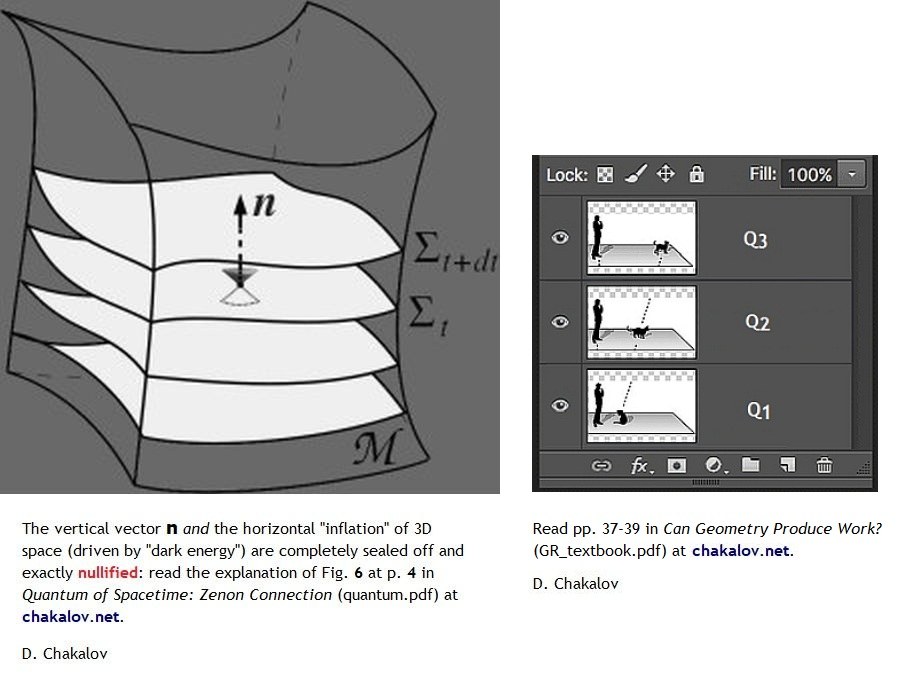
The "splitting" of spacetime (R.K. Sachs and H. Wu,
p.
27) ultimately
requires global time, "a global time function t whose levels
sets are
the
(achronal - D.C.) hypersurfaces defining the foliation" (M. Alcubierre,
pp.
3-4), yet this 'global time' is considered (wrongly!)
classical
parameter,
explained operationally as 'time as read with your wristwatch'.
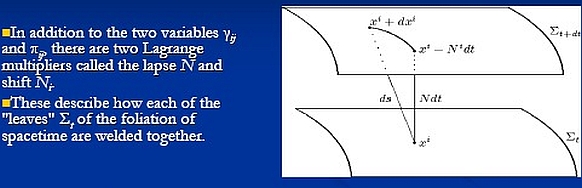
Notice that 'classical
time' (Peter
Bergmann) is inserted "between" achronal hypersurfaces,
and the infamous 'problem of time' in canonical quantum gravity (Bryce
de Witt) requires that the lapse N becomes dead zero.
Hence you end up with one frozen achronal hypersurface only,
which can take only one point, as ds is
eliminated as well. In other words, the introduction of some
global classical time to "weld" all "leaves"
together kills the whole spacetime.
This is the paradox (not
"problem") of spacetime in canonical quantum gravity, which
can be solved only and exclusively only with the atemporal
loop 'now'. Notice that in RS gravity
the stacking of achronal hypersurfaces along null
hypersurface is the "end product" -- one-at-a-time -- of
the Arrow of Space, obtained only in the irreversible
past where the "separation" is approaching zero.
The small black arrow in the first drawing above, n , is indeed located in the time-like section of Minkowski cone, but has
an orthogonal component w
from the Arrow of Space, which is approaching asymptotically
zero in the irreversible past. This is the crucial
difference between 'time as coordinate change in space' vs 'time
as atemporal change of space'. And since the
instant 'now' is dual object, the orthogonal,
to the arrow n in the first drawing, component
w takes values in the open interval (0, ∞)
pertaining to the potential
future: see the entanglement
of space, Espace,
above. So in the case of gravitational systems not
larger than the
solar system, you may use linearized gravity, since the value of Espace
and the input from w will be
vanishing small, but for objects with size of a galaxy the
entanglement of space will produce "dark" effects (David
Wittman), as explained above.
Again, the direction w
of the Arrow of Space is depicted with
the "elevator" in Fig. 1 above.
Its projection in 3-D space (local mode of spacetime) is
omnidirectional, which is why we simply call it 'time'. It certainly
"welds" all achronal "leaves" together as 'the instant now' --
one-at-a-time -- to produce an assembled continuum of Points II
in space-like and time-like "directions", called
4-D spacetime (local mode of spacetime). We see matter only in the past
state of such assembled spacetime, and cannot detect the
Aristotelian Connection which will re-assemble
the next achronal "flash"
of Points II in the next
instant 'now'. But people are unaware of this flow of time
and would run the
time-symmetric
"arrow" n (cf. the first
drawing above) backwards, to find the history of the universe
and trace back the origin of gravitational anomalies,
only it's just not there.
The fictitious axis of electron
spin
(you have to rotate a spin not by 360 degrees but by 720 degrees to get back to exactly the initial state you started with)
and the axis of global rotation (the latter induces total net spin of galaxies) are due to the same kind of errors --
there is no need for any "dark axis" either. It's just
not there.
It may be difficult to understand
the emerging of spacetime from 'something else' (C.J. Isham and J.
Butterfield), but you don't have
any choice. None.
D. Chakalov
September 15, 2013
Last updated: September 16, 2013,
16:16:17 GMT
===============================================
Subject: Lawrence Krauss, 18 February 2013, 32:58 - 32:59
Date: Sat, 28 Sep 2013 23:54:52 +0300
Message-ID: <CAM7Ekx=eYi9Ejt0FkG9riLtTzEnCaUa0c3Fo1JSU_y3FbiSV0g@mail.gmail.com>
From: Dimi Chakalov <[email protected]>
To: Lawrence M Krauss <[email protected]>
Cc: [snip]
A Show About Nothing
TV station ABC1, Australia, 18 February 2013
http://www.abc.net.au/tv/qanda/txt/s3687812.htm
Lawrence Krauss (32:58 -
32:59): "But I would argue that nothing is a
physical quantity. It’s the absence of something."
------------
Larry:
You are deeply religious person obsessed by anti-theism. The latter is
as dangerous as the opposite,
theistic
religion.
The proof that you're brainwashed by anti-theism is your own statement
that 'nothing' were "the absence of something." Of course you know very
well that you are wrong, yet you make such blatantly false statements
because your religion forces you to "forget" the basic basics of
cosmology.
Your fake example for "nothing" is 'zero something', that is, "the
absence of something", like claiming that you have zero bananas in your
ears.
But the notion of 'nothing' is not like 'an empty set of bananas' (the
cardinality of an
empty set). The true 'nothing' has absolutely no presentation by
anything *whatsoever*, and is the opposite to 'zero
something'.
It is the Noumenon,
http://www.god-does-not-play-dice.net/Indefinable.html#simple
If you prefer, you may call the Noumenon "something else", after C.
Isham and J. Butterfield,
http://www.god-does-not-play-dice.net/Indefinable.html#FR1
You can approach -- although not entirely comprehend -- the Noumenon
only with mathematics, provided you are not brainwashed by any religion
whatsoever. But since you're brainwashed by your religion, you just
can't.
Proof: Check out the text at the links above, and you won't be able to
say anything. None. Why? Because you can't -- see above.
As John Coleman put it, "It is extremely difficult to induce penguins to
drink warm water."
How about your colleagues?
D. Chakalov
-----------
Note: Regarding the
imaginary
number, let me quote from MathWorld [Ref. 1]:
Imaginary Unit
The
imaginary number
 ,
i.e., the
square root of ,
i.e., the
square root of
 .
The imaginary unit is denoted and commonly referred to as " .
The imaginary unit is denoted and commonly referred to as " ."
Although there are two possible square roots of any number,
the square roots of a negative number cannot be distinguished until
one of the two is defined as the
imaginary unit, at which point ."
Although there are two possible square roots of any number,
the square roots of a negative number cannot be distinguished until
one of the two is defined as the
imaginary unit, at which point
 and
and
 can then be distinguished. Since either choice is possible, there is
no ambiguity in defining
as "the" square root of
can then be distinguished. Since either choice is possible, there is
no ambiguity in defining
as "the" square root of
 . .
As mentioned above, the "mass"
in the global mode of spacetime (Point I)
is imaginary. What is the square root of -9?
3i. How about the square root of
9? +/- 3. Since (-3)*(-3) = (3)*(3) = 9, I will use (-/+3):
√(9 × -1) = √(9) × √(-1) = (-/+3) × √(-1) =
|3|i
.
See the Noumenon
denoted with 'zero nothing' in the
l.h.s. of Eq. 1 on p. 35 (28 September 2010)
here. For your
convenience, I reproduced it below.

Notice that (-m)
and (+m) are interpreted as a neutral plasma of
negative-positive mass pairs (Belletête and Paranjape,
pp. 6-7),
denoted in the examples above with (-/+3) and |3|. Thus, the Noumenon or
'zero nothing' is denoted here with
0i :
0i = |-m/+m|i
(Eq. 2).
According to the doctrine of trialism, the
interpretation of Eq. 2 is straightforward:
ONE entity, denoted with
0i , and explicated with
two complementary presentations, imaginary (-m) and (+m). Hence the
imaginary mass-energy of the Noumenon is always "conserved", with the
sole exception of the joint Beginning/End at point
C above, in which case it is
indefinable.
It seems Eq. 2 bears some similarity with
the moduli of quantum waves amplitudes in the
Born rule. The conversion of imaginary amplitudes in the loop 'now'
to Points II is still unknown,
however.
Click the drawings
below for more.
Should you have questions,
please don't hesitate to contact me by
email. Bear in mind that the
new mathematical object 'zero nothing', denoted with
0i in Eq. 2 above,
is opposite to 'zero something' (e.g., the number of bananas in
Larry's ears), and is made by extending the
category 'not included' to its final
(Sic!) limit: the so-called set of all sets
is also 'not included'. Namely,
a set {A} with zero cardinality ({ } or {zero something} such as
'no bananas') can exist iff there is a complementary
relational set of 'everything else in the universe' that also belongs to
the category 'not included'
{not-A}. Likewise, a set with finite cardinality {A} from the
category 'included' (e.g., a set of two bananas) can exist iff there is a complementary
relational set of 'everything else in the universe' {not-A}, such
that the combination of {A} and {not-A} form again the so-called set of all
sets.
Briefly, we introduce
'maximal set theory' [Ref. 2] with two axioms: a
set {A} can exist iff the union {A} and {not-A} denotes the
set of all sets. Then we extend {not-A} to the set of all sets,
and the final limit of {A} is
'the perfect monad without windows' (Leibniz),
also known as the
Noumenon, denoted
here with
0i . Thanks to
Plato, we made all sets 'closed' (cf. the
drawing below) and simply can't
go further. Why? Because both
0i and its
complementary 'set of all sets' are indefinable
"it" (the red
boundary in the drawing below), explained previously with 'John'.
|
|
The points
(x, y) satisfying x2 + y2 = r2
and
x = y = 0 are colored red.
The points (x, y) satisfying 0 < x2 + y2
< r2
are colored blue.
The blue points form an
open set.
The red points form an
indefinable boundary
0i .
The union of red and
blue points is a
closed set. |
Thus, the
Noumenon
0i is the 'absolute
empty set' which complements the set
of all sets, and their union (Sic!) makes all sets
'closed' [Ref. 2]. It
(not "He") cannot be exhausted with
any 'open
set' of objects ("flashes") in the
r.h.s of Eq. 2 above, which are marked with
blue
in the drawing above, and fit in the categories [things we
know], [things we know that we don't know], and [things we still
don't know that we don't know]. The last category enables the
creative evolution of the universe in the
open future.
Can we think about
the Noumenon
0i ? Yes we can, because
it (not "He") exists yet is not relational. It
is the
self-referential set
 ,
and is potential reality (compare with the
Quine atom). It
has zero
presentations with Points II, because
has infinite (actual infinity) volume and zero intrinsic content, as
explained above. And because
the Noumenon
0i
is potential reality,
it is impossible in principle to tell the difference (if any) between
'absolute empty set' and its
complementary set of all sets. ,
and is potential reality (compare with the
Quine atom). It
has zero
presentations with Points II, because
has infinite (actual infinity) volume and zero intrinsic content, as
explained above. And because
the Noumenon
0i
is potential reality,
it is impossible in principle to tell the difference (if any) between
'absolute empty set' and its
complementary set of all sets.
Only
people who suffer from
Zenophobia (the irrational fear of convergent sequences) will pretend
that cannot understand the final
limit
denoted with C
above, also known as the
Noumenon.
D. Chakalov
September 29, 2013
Lat updated: October 20, 2013,
20:05 GMT
[Ref. 1] Weisstein, Eric W. "Imaginary Unit." From MathWorld--A Wolfram
Web Resource.
http://mathworld.wolfram.com/ImaginaryUnit.html
[Ref. 2] D. Chakalov, Maximal Set Theory, 2014 (in preparation).
http://sites.google.com/site/maximalsettheory
Excerpt from
Varol Akman: "The
AFA universe can be depicted as in Figure 9, extending around the
well-founded universe, because it includes the
non-well-founded sets which are not covered by the latter."

Figure 9:
AFA universe extending around the well-founded universe (adapted
from (Barwise
& Etchemendy 1987))
See also:
Peter Aczel, Non-Well-Founded Sets, CSLI Lecture Notes,
Stanford University, 1988, p. xviii.
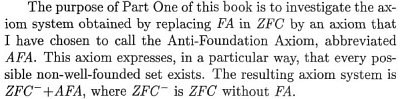
===============================================

Subject: Truth in
mathematics: Absolute undecidability
Date: Fri, 4 Oct 2013 04:02:59 +0300
Message-ID: <CAM7Ekxm+CCbshAeh0ysYkjrc5qL6rmMxtOgE=-VbsLBMt6qgig@mail.gmail.com>
From: Dimi Chakalov <[email protected]>
To: Peter Koellner <[email protected]>
Cc: [snip]
"A natural and intriguing question is whether there are mathematical
statements that are in some sense absolutely undecidable, that is,
undecidable relative to any set of axioms that are justified."
Peter Koellner,
On the Question of Absolute Undecidability,
Philosophia Mathematica, 14 (153-188) 2006
-------
Dear Dr. Koellner:
Please see the case for absolute undecidability at
http://www.god-does-not-play-dice.net/Indefinable.html#Noumenon
The new logic here is YAIN (Yes And neIN).
As Kurt Gödel explained in 1931, "one can always pass to "higher"
systems in which the sentence in question is decidable", hence the limit
(Sic!) is the Noumenon and its truth value YAIN.
Thus, I agree with Dr. Solomon Feferman that Continuum Hypothesis (CH)
should be considered not to have a definite truth value -- it can't have
any definite truth value. If it had, we can move to the next "higher"
system and meta-theory, until we hit the rock bottom of
the Noumenon, much like in the
Thompson lamp paradox.
Physical considerations at
http://www.god-does-not-play-dice.net/Indefinable.html#addendum
Your opinion and the feedback from your colleagues will be greatly
appreciated.
Kind regards,
Dimi Chakalov
chakalov.net
-------------
Comment: What could
be
wrong with introducing Mathematics to God? Only people brainwashed
with religion, both theism and anti-theism, will
disapprove -- they will either keep silent or pretend that cannot
understand it (cf. Q4
above).
God is not
about religion. It is your free will choice to accept God in
Mathematics or reject it. If you choose the latter, how did you obtain
your free will in the first place? Was it somehow "encoded"
in your DNA?
Or maybe the Universe itself is endowed with free will? What a pity you cannot respond!
D. Chakalov
October 4, 2013, 08:33 GMT
===================================================
Subject: Re: I wonder if you would agree to endorse the submission of my
manuscript to [gr-qc]
Date: Fri, 19 Jul 2013 13:34:46 +0300
Message-ID: <CAM7Ekxk3B9yGVL4Ai_F+VA48Yg11UQYvwz20+Q6Og13p9zKpjA@mail.gmail.com>
From: Dimi Chakalov <[email protected]>
To: Adam Helfer <[email protected]>,
Laszlo Szabados <[email protected]>,
Niall 'O Murchadha <[email protected]>,
Luca Lusanna <[email protected]>,
Jose Geraldo Pereira <[email protected]>,
Luca Bombelli <[email protected]>,
Domenico Giulini <[email protected]>,
Mike Turner <[email protected]>,
Chris Isham <[email protected]>,
Karel V Kuchar <[email protected]>,
Norbert Straumann <[email protected]>,
Don Marolf <[email protected]>,
Matt Visser <[email protected]>
Cc: John Baez <[email protected]>,
Robert Geroch <[email protected]>,
Robert M Wald <[email protected]>,
Alan Rendall <[email protected]>,
Helmut Friedrich <[email protected]>,
Claus Kiefer <[email protected]>,
Lars Andersson <[email protected]>,
Charles Torre <[email protected]>,
Xiao Zhang <[email protected]>
Dear colleagues,
Two months ago, you
refused to endorse the submission of my manuscript to [gr-qc].
The mathematical issues in the so-called Relative Scale (RS) theory of
gravity are posted at
http://www.god-does-not-play-dice.net/#Hrbacek
(July 19, 2013, 09:20:59 GMT)
In PDF format, see pp. 9-13 in
http://www.god-does-not-play-dice.net/Indefinable.pdf
(486,686 bytes, 19 July 2013, 09:35:28 GMT)
I believe it is a very simple theory:
http://www.god-does-not-play-dice.net/#RS_gravity
http://www.god-does-not-play-dice.net/Relative_Scale.pdf
Only its mathematical formalism is still waiting to be uncovered. Which
is why I was hoping that some of you would be interested in foundations
of mathematics and quantum gravity, and would endorse the submission of
my manuscript to [gr-qc].
Thank you, once more, for your fundamental papers and monographs. They
were very helpful indeed.
Sincerely,
Dimi Chakalov
-------------
Final note: At age
61, my health is gradually deteriorating, and in September 2012 I was
hit by an ischemic stroke in the brain. Will need at least two more
years to recover, during which I may not have spare time to update this
website. I hope to be back on the track by Christmas 2015, unless of
course I get a second stroke and kick the bucket. You never know with
the future.
In you look at the atemporal
loop in the drawing above, the state of matter at point
A must not be entirely fixed, in order to gain
corrections and additional brand new events from 'the rest of the
universe', introduced "finally" at B: the future is open for new
events, up to 'the
unknown unknown'. The atemporal loop is a
creative and non-unitary
transition which requires the universe to be
indefinable and
flexible to acquire its
next negotiated state along the
Arrow of Space. This is how the emergence (Isham
and Butterfield) of Points II is
produced by the Aristotelian Connection (AC)
in the drawing above.
Physically,
the "speed" of light makes
AC look like "nothing", and the
resulting continuum of Points II is perfect. Physically,
the "direction" of stacking of Points II (Arrow
of Space) is simultaneous in all directions, which
is why we simply call it 'time'. No physical reference frame (see
the animation from
John Walker)
is available to detect the
atemporal Aristotelian Connection of Die Bahn
(Werner Heisenberg). And because at every
instant of observation all Points II have already (due to
the "speed" of light) passed via Point I
into our ever-increasing past, the
fundamental binding phenomenon -- Point I and
AC -- is not there. It is the
source of the Universe (cf. 'zero nothing' in l.h.s. of Eq. 1 on
p. 35 from
ExplanatoryNote.pdf), and is residing at "absolute rest" (Luke
17:21).
Thus, it is impossible
in principle to derive the "final-and-initial" Point I and
AC from Points II: both
the asymptotic boundaries in the Large (B)
and infinitesimal points in the Small (B)
are indefinable. See again the
explanations with states of kaleidoscope here and
here. If Point I and
AC were physical points and hence 'GR observables'
(Peter Bergmann), we would be
able to detect dt/ds in spacetime,
the "aether" will be exposed to physical
observations, the theory of relativity will be wrong,
and the Cauchy error and
Dedekind Schnitt C will be
mathematically verifiable up to their final (Sic!) endpoint,
after which the lapse/shift dt/ds
will be exactly zero, which will kill the whole spacetime, as
in the paradox of spacetime in canonical quantum
gravity.
Metaphorically, the
Arrow of Space is depicted with the Dragon chasing
its tail (Ouroboros);
the enclosed words mean 'The All is One.'


Why Arrow of Space?
Because of the creative evolution of our universe: it is
both irreversibly fixed in its
ever-growing past and indefinable and
flexible -- not "uncertain"
-- in its future.
D. Chakalov
20 October 2013, 20:05 GMT
Download printable copy,
Indefinable.pdf
http://www.god-does-not-play-dice.net/Indefinable.pdf
http://issuu.com/dchakalov/docs/indefinable
http://www.scribd.com/doc/171851871/Indefinable-Boundary-Point-I-and-Points-II
===============================================================
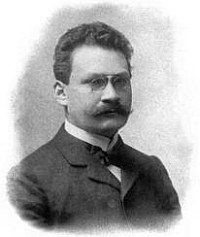
Die Anschauungen über Raum und Zeit, die ich Ihnen entwickeln möchte,
sind
auf experimentell-physikalischem Boden erwachsen. Darin liegt ihre
Stärke.
Ihre Tendenz ist eine radikale. Von Stund′ an sollen Raum für sich und
Zeit für
sich völlig zu Schatten herabsinken und nur noch eine Art Union der
beiden soll
Selbständigkeit bewahren.
Hermann Minkowski, Vortrag über „Raum und Zeit“ (1908)
---------
Subject: Re: The Arrow of Spacetime (talk in Munich, 21.09.2008, 10 -
10:45 AM)
Date: Thu, 19 Sep 2013 14:53:44 +0300
Message-ID: <CAM7Ekxkpd_zzaFo8PX7L4bj+4BdqZTkghv1M2JPJ6F_G3=Vqnw@mail.gmail.com>
From: Dimi Chakalov <[email protected]>
To: [snip]
http://www.god-does-not-play-dice.net/Talk.txt
--
Ladies and Gentlemen:
On Sunday, 21 September 2008, I commemorated the talk by
Herman
Minkowski in
Cologne on 21 September 1908.
The proposal is summarized in the drawing attached (21_September_2008.jpg),
from
http://www.god-does-not-play-dice.net/Indefinable.html#loop_now
Full version at
http://www.god-does-not-play-dice.net/#loop_now
Sincerely,
D. Chakalov
On Mon, 2 Jun 2008 04:27:30 +0300, Dimi Chakalov <[email protected]>
wrote:
[snip]
Eine neue
wissenschaftliche Wahrheit pflegt sich nicht in der Weise
durchzusetzen, daß ihre Gegner überzeugt werden und sich als belehrt
erklären, sondern vielmehr dadurch, daß ihre Gegner allmählich
aussterben und daß die heranwachsende Generation von vornherein mit
der Wahrheit vertraut gemacht ist.
Max Planck,
1948

D. Hilbert
A printable version of this web page, in .PDF format (front_page.pdf,
20 October 2013, 27,014,094 bytes), can be downloaded from
here.
D. Chakalov
October 20, 2013, 20:05
GMT
|