"The representation
of matter by a tensor was only a fill-in to make it possible to do
something temporarily, a wooden nose in a snowman."
Albert Einstein's Last Lecture, Relativity Seminar, Room 307, Palmer
Physical Laboratory, Princeton University, April 14, 1954
"In the first place, we entirely shun the vague word "space,"
of which, we must honestly acknowledge, we cannot form the slightest
conception."
Albert Einstein, Relativity:
The Special and General Theory, 1920
"According to the
general theory of relativity space is endowed with physical qualities;
in this sense, therefore, there exists an ether. But this ether may not be
thought of as endowed with the quality characteristic of ponderable
media, as consisting of parts which may be tracked through time."
A. Einstein, Äther und Relativitätstheorie, May 5,
1920
(Lisa M. Dolling et al., The Tests of Time: Readings in the
Development of Physical Theory, Princeton University Press,
Princeton, 2003, p. 346)
Panta
rei conditio sine qua non est
Your Global Time is ZERO
It is suggested that the spacetime manifold is a dynamical
entity re-created at every step of a hypothetical spacetime arrow; the latter is due
to the "expansion" of space by the dynamic
dark energy (DDE). Two modes of spacetime are postulated in this
Phoenix Universe: local mode, in which we have point-like events cast
on a perfect
continuum, with a "carpe diem" unit probability (cf. the
measurement problem in QM here),
and a global atemporal mode, in which a Machian-type negotiation of every next
step is being processed. The effects from the global mode of spacetime,
which literally build up '3-D space',
begin from the macro-scale of classical physics in two "horizontal directions": quantum
effects toward the Small, and dark matter & dark energy
effects toward the Large. Briefly, we model the universe as a huge brain
which 'thinks' with its global-mode state
by following the rule 'think globally, act locally'. The implications
for quantum gravity are
explained by revealing the two
modes of spacetime in Quantum Theory and General
Relativity, and by suggesting conceptual solutions to the
problems and paradoxes hindering the quantum gravity of He Who Does Not Play Dice.

|
Does a fish need a bicycle?
|
Latest update: November 26, 2009
Printable (front_page.pdf) copy here
Check out 'Quantum
Mechanics 101' here, my detailed
reproach upon wasting taxpayers' money with LIGO here, and my efforts toward quantum
gravity here.
Regarding Quantum
Mechanics (QM), the aim is to avoid the incomprehensible paradoxes and artifacts
in it (watch the double slit experiment
here), which originate from its textbook interpretation (Niels
Borh's belief that quantum world can only be "seen" through classical
"glasses"). We can indeed understand the quantum world (but not
the current QM textbooks; cf. Richard Feynman),
by changing the "glasses" through which we "see" and construe the
quantum world: the universe modeled as a
brain.
Regarding the artifacts in QM, we may be in a
situation similar to an Eskimo trying very hard to comprehend the
notion of "trunk". In our case, we
encounter an incomprehensible wave-particle
complementarity, which could be just an artifact from our wrong
thinking, like the "nose-arm complementarity" in the case of the Eskimo
observing elephant's trunk. Surely 'the
quantum system' doesn't live in any relativistic
space, so one should expect all sorts of headaches and artifacts
(e.g., "diese verdammte Quantenspringerei", Erwin Schrödinger) from
imposing wrong "glasses" onto the quantum world 'out there'. (A typical
example is Franco Selleri's quest for detecting de
Broglie waves.)
The prerequisites
for the interpretation of QM suggested here
originate from Schrödinger. Back in 1935, Erwin
Schrödinger stressed the following:
"The rejection of
realism has logical consequences. In general, a variable has
no definite value before I measure it; then measuring it does not
mean ascertaining the value that it has."
And in a letter to
Einstein dated 18 November 1950 (quoted after J. Bub, p.
115), he wrote (emphasis added):
“It seems to me
that the concept of probability is terribly mishandled these days.
Probability surely has as its substance a statement as to whether
something is or is not the case — an uncertain statement, to be sure.
But nevertheless it has meaning only if one is indeed convinced
that the something in question quite definitely is or is not
the case. A probabilistic assertion presupposes the full reality
of its subject.”
We are obviously
dealing with a new form of reality: a probabilistic assertion,
and the Hilbert space itself, cannot accommodate the
Kochen-Specker case in which "the something in question" is beyond
an unequivocal "is or is not" state (cf. "an unequivocal
true-false value" in Isham and Butterfield, p. 3; emphasis added):

Check out the implications of KS Theorem to the Precise Value Principle
(PVP) and the statistical interpretation of QM from R.I.G. Hughes, p. 164.
Going back to Ernst Specker's tripod,
if there are states of the tripod in which one of its legs has
UNdecidable color, then not just this particular leg, but the
whole tripod will be UNdecidable. It's a package.
The phrase "an
incomplete Kochen-Specker colouring" (Helena Granström, p. 2)
has no meaning whatsoever; it is the result from imposing wrong
"glasses" onto the quantum world. And if you subscribe to the modern
quantum mysticism -- "the quantum state is not a physical object, it is
a representation of our state of knowledge, or belief" (Itamar
Pitowsky, p. 28) -- your brain
will wind up in a schizophrenic state of, say, 68% "knowledge" of the
quantum state, and 32% of "[what da heck is that uncolored KS
sphere?]".
No mental
concepts, such as 'knowledge' or 'imagination', are admissible in the
ontology of quantum reality. We must never mix apples with oranges (Res
Extensa and Res Cogitans).
Karl Svozil refers to this UNdecidable
faculty of the quantum world as "ambiguity" (p. 4), and stressed:
"This ambiguity gets worse as the number of particles increases." If
you think about the quantum world with classical concepts, it will get
from bad to worse, until you end up with the (old) cosmological
"constant" problem (more on that from Alan Guth).
As Erwin
Schrödinger might have said in 1935, the same "variable" that has
had no definite value before you measured it will continue
to keep its UNdecidable nature after you "measure" it as well.
And you can't fit it in any Hilbert space, of course (what is
the dim(H) for 32% "uncolored" and 68% colored KS
sphere?).
Let's give it a
name: potential reality. In the quantum realm, it (i) offers its
context-dependent explications (a.k.a. "observables"),
(ii) keeps the sameness (Genidentität,
Kurt Lewin) of particles of the same type, which MTW regard as "a
central mystery of physics" (p. 1215),
and (iii) facilitates the ultimate quantum phenomenon: entanglement.
It may be difficult to grasp, but is much simpler to the juggling with
the possible implications from Bell's inequality and their loopholes
(e.g.,
Ghim and Zhang).
As to quantum
gravity (notice the opinion of an expert here),
the 'potential reality' is introduced to revive the physical objectivity
of spacetime "points", by making the spacetime manifold itself an emergent phenomenon: "The
requirement of general covariance takes away from space and time the
last remnant of physical objectivity" (Albert Einstein, Grundlage der
allgemeinen Relativitätstheorie, Annalen der Physik 49
(1916) 769-822). The current formulation of GR can only determine "the mutual relations that exist between
the gravitational field and the matter fields (i.e. the value the
gravitational field takes where the matter field takes such and such
value)", but not "the proper time between spacetime points" (Wiki;
more from Butterfield and Isham),
and the field equations "cannot even uniquely determine the topology of
a manifold" (Alan Macdonald, Einstein's Hole Argument, p. 4).
How can we fix
these problems? By introducing two connections, geometric (local mode)
and torsion (global mode of
spacetime). The torsion connection is completely vanished (Hehl and Obukhov)
in the local mode, hence its effect are considered "dark" (see Alex Murphy).
Notice also that a hierarchy
of 'potential reality' (never in plural), resembling the structure of cognitive concepts, is postulated
(application here). In metaphysical
terms, it supports the views of Aristotle and Spinoza: no "parts" of
the infinite can exist, as the infinite Substance is indivisible.
It's not like Russian dolls.
In the case of a
human brain (not mind or
consciousness), the UNspeakable potential reality can be explicated
with, for example, three (and many more) sayings, which produce
"measurements" (if you prefer QM jargon) on it:
1. All are not
hunters that blow the horn.
2. La robe ne fait pas le médecin.
3. Es ist nicht jeder ein Koch, der ein lang Messer trägt.
None of these
"measurements" can "collapse" the potential reality (Platonic idea) explicated with these sayings.
And if our brain can work with 'potential reality', so can the
universe modeled as a brain.
Regarding the brain
above your neck: its 'potential reality' is to its human self what EM radiation is to your
subjective experience of 'color' -- no direct action of the
human self on its brain is allowed in science. Hence it may be
conceivable that the potential reality entwined with the human
brain could be bridged to
that of the quantum vacuum (BCCP).
All you may need is an arrow of
spacetime. (Notice, however, the 'two rules of success' here.)
Notice also that 'potential reality' is an intrinsically holistic phenomenon, so it will be very
misleading to call it "dark", just
because it is not possible to be traced back from any of its
physical explications in the r.h.s. of Einstein field equation.
Forget about "energy conservation in GR". It's an
oxymoron. We need quantum gravity, to uncover "the proper time [tau]
along spacetime trajectories" (Carlo Rovelli;
drawings here) and the genuine 'time
variable' associated with the expansion of space due to DDE. Once we
achieve this formidable task, we will (hopefully) find out what -- if
anything -- might remain unchanged/conserved in this
particular (global mode of) time. In the current 'GR without DDE',
the dynamics is "entirely generated by constraints. The dynamical data
do not explicitly include a time variable" (Karel Kuchar),
and one can only hope that "the energy momentum tensor which is
the source of gravity" might be conserved "due to the Bianchi
identities" (E. Guendelman, p. 9). Such hopes are (i)
utterly murky even in the textbook GR, because any observable
of the gravitational field is "necessarily quasi-local" (Laszlo
Szabados) and (ii) not applicable to the new dynamics of GR
due to DDE. For example, Noether's
Theorem holds only for flat spacetime, and the Bianchi
identities are applicable only for 'GR without DDE'.
At this point, I
got an emotional response from Eduardo Guendelman, saying
that the Bianchi identity is a mathematical theorem, so there is no
ambiguity involved here. Well, I'm just a psychologist,
so let me quote Matt Visser, p. 3:
"... the Einstein
equations of general relativity are local equations, relating some
aspects (notice the poetry -- D.C.) of the spacetime curvature at a
point to the presence of stress-energy at that point. Additionally, one
also has local chronology protection, inherited from the fact (Sic! --
D.C.) that the spacetime is locally Minkowski (the Einstein Equivalence
Principle), and so “in the small” (that's the sole
application of those 'twice-contracted Bianchi identities', cf. George
F R Ellis and Henk van Elst, Eq. 2 -- D.C.)
general relativity respects all of the causality constraints of special
relativity.
"What general relativity does not do is to provide any natural
way of imposing global constraints on the spacetime — certainly
the Einstein equations provide no such nonlocal constraint."
Which is precisely
the missing element needed to address the 'global properties of
spacetime' in the presence of DDE. As R. Rakhi and K. Indulekha
acknowledged (p.
5): "Because this energy is a property of space itself, it would
not be diluted as space expands. As more space comes into existence
(the same phrase was used by Sean Carroll
-- D.C.), more of this energy-of-space would appear. (...) So the
mystery continues."
And so does the
confusion about it -- click here.
The intrinsic dynamics of
the phenomenon of 'more space comes into existence' could only
be detected in a reference frame from which this phenomenon is
excluded, like 'not acting there'. But because DDE acts on
the whole 3-D space en bloc, without any irregularities, there is
no place in the universe in which we could install a clock and say --
look, this clock does read the (global mode of) time pertaining to the
omnipresent phenomenon of 'more space comes into existence'.
It is the theory of relativity itself, which cannot "detect" it. Which
is why some people call it "dark".
Although the
mathematical meaning of the phrase "more space comes into existence"
is not clear, I don't think Kurt
Gödel would have called the ultimate source of spacetime
points "dark". Once we move from physics
to geometry, it's a whole new world there. Pity Mike Turner called it "dark"; that's
so wrong!
One cannot insert
the "dark" energy of X into its
consequence -- accelerated expansion of space. The
source X does not belong, and cannot be fitted
into the same 3-D space (Cauchy hypersurface) which is being
created by X . You can do this only in
GR textbooks that deal with 'GR without
DDE'. Capiche?
Notice also that
Matt Visser (see above) considers the metaphysical assumption that the
spacetime were "locally Minkowski (the Einstein Equivalence Principle)"
to represent a fact. But we only have a mathematical
fact that locally , "over" a point, one
can indeed eliminate the gravitational "field" by hand (Hermann
Weyl). But because nobody has so far explained the resulting
quasi-local
nature of the gravitational field's observables (see Laszlo Szabados
above), nor the origin and the mechanism of inertial reaction "forces", I think we should be very
cautious and
open-minded in interpreting such mathematical facts and
theorems, like the above-mentioned Bianchi identity.
If you are looking
for a genuine quantum-gravitational measuring device, your wristwatch
(as well as the one of Kip Thorne)
fits the bill, because it reads an already-linearized
(see the explanation of 'already' below) time variable obtained from the "the proper
time [tau] along spacetime trajectories" (Carlo Rovelli)
and the (global mode of) time associated with the expansion of space
due to DDE.
This is to me the ultimate puzzle in present-day GR. The
sole "explanation" of Chris Isham was that, "after all,
general relativity does seem to work well as a theory, and yet I can
certainly read the time on my wrist watch!"
I will desist to comment
on C. Isham's observation,
and will instead take the liberty of being (again) deadly boring, by explaining
the difference between 'GR without DDE' vs 'GR with DDE'.
First, a simple example
from STR, with a trajectory of a Frisbee, on the fixed background of
Minkowski spacetime: we can calculate the instantaneous state of
the Frisbee at each point from the trajectory, and attach to this
dimensionless point a well-defined vector. My teenage daughter
couldn't understanding how it is possible to attach a vector to a
"point", and I explained the puzzle by saying that the information
from a finite interval from the history of this
infinitesimal "point" is encapsulated in it -- we instruct this interval
to shrink asymptotically toward
zero -- so the vector is indeed well-defined. All this is possible
under the premise of the fixed "grid" in STR. But once we move to 'GR
without DDE', the "grid" is gone (Emilio Elizalde):
at each and every "point" from the trajectory, the non-linear mutual
determination of matter and space (John
Wheeler) takes place. But in what time (see Chris Isham's
wrist watch above)? There is no background grid or "ether" w.r.t.w. one
can define the dynamics of 'GR without DDE'. Yet people don't ask such
questions and prefer to just do calculations with the linearized
approximation of 'GR without DDE'. As another expert explained to
his undergraduates, "one begins by introducing the notion of a tangent
vector to describe an infinitesimal displacement about a point
p " (Bob Wald, p. 4). But
again, in order to recover the true dynamics of 'GR without DDE', you
need some "ether" or rather 'reference fluid' w.r.t.w. one can describe
the fundamental phenomenon of transience (Abner
Shimony): see the so-called Aristotelian Connection
here.
At this point, the 'GR
with DDE' comes to rescue the Hamiltonian formulation
of 'GR without DDE': we have a brand new,
global degree of freedom of spacetime en bloc, hence can
recover the transience of spacetime, as driven by the source
of DDE, along the arrow of spacetime
-- see above.
To identify this same
source in the quantum realm (called 'potential reality'), let's go
back to the interpretation of QM here.
In a nutshell, the
so-called PR2
interpretation of QM offers a solution to the non-unitary
"collapse" by replacing the alleged "U" and "R" processes with a new
(at least to people like Ed Witten, Steven
Weinberg and Gerardus 't Hooft)
form of reality, known since Plato, called here 'potential reality'.
Its quantum presentation is ubiquitous
and has zero entropy; hence the familiar
notion of time, which pertains to monotonic increase of entropy "in
time", is not applicable to 'potential reality'. It may produce
"shadows" in terms of 'quantum observables', yet these "shadows" cannot
be traced back, to reveal any evidence of such events (or "quantum
information") ever having emerged from 'potential reality'.
It may act, yet not experience any backaction from its
"shadows". Hence it is the ultimate "background" for QM and GR. It evolves along the
arrow of spacetime
(resembling the "memory" of the universe), by unfolding from 'the ideal monad without windows'. In the local
mode of spacetime, every "point" is filled with an already
explicated value of its 'potential reality', and as the latter
evolves and becomes enriched, the "number" of its localized
explications increases accordingly: more and more things come
into existence in the universe. As John Wheeler put it, "Time is Nature's way to
keep everything from happening all at once". Only with 'potential
reality' there is no need nor place for any 'unitary dynamics' in the local
mode of spacetime. This is the metaphysics of
'the universe modeled as a brain', viz. the interpretation of 'expansion of space' along the arrow of spacetime.
From this perspective, if we follow the
deflation time arrow in the local mode of spacetime, things
will gradually fade away in a strictly non-unitary fashion, but will
only approach asymptotically The Beginning, because it is logically
impossible to reach It from/within the local mode of spacetime
(cf. the paradox here). The solution is 'dual age cosmology'.
As M. Gell-Mann and J. B. Hartle have noticed,
"quantum mechanics is best and most fundamentally understood in the
framework of quantum cosmology" (quoted after Claus
Kiefer, p. 1). And vice versa.
The current situation with inflationary
cosmology was presented by
Alan H. Guth, the winner of the 2009 Isaac Newton medal, on 13
October 2009. He speculated that our galaxy could be an amplified
"quantum fluctuation" (Part
2, 3:30 - 6:16),

... and then confessed his
"Nightmare of Dark Energy" (Part
2, 11:36), on which the "eureka" of inflationary cosmology is
grounded.

Perhaps
Alan Guth should have entitled his talk 'The Dark Energy Nightmares of
Inflationary
Cosmology', as encapsulated in the [?]
area in
V. Mukhanov's paper:

With the so-called
dual age cosmology, the "first" Plankian time
"after" The Beginning is stretched toward infinity in the local
mode of time. This is otherwise being explained as 'the universe started
asymptotically from time zero'. In this local mode of time
(read by your wristwatch), the universe is effectively eternal and its
age is indecisive, while in the global mode of time it has
a finite age. Another nice feature of
dual age cosmology is that The Beginning is an
atemporal phenomenon, and is always present (global mode of time) in
the instant 'now'.
Let's go back to QM. Think of a trajectory of a Frisbee: at each
"point" from the trajectory (the latter could be a perfect continuum
of such "points"), the state of the Frisbee is a perfectly well defined
fact, with a 'carpe diem' unit probability. I use
this simple idea to introduce a new kind of cancellation mechanism, pertinent
to 'potential reality', for
removing the non-unitary "R" process (historical account from October
2002 here); hence the motto of this
web site, since July 1997: Dead
matter makes quantum jumps; the living-and-quantum matter is smarter.
Notice that not
only the "R" process is being
removed (as did Hugh Everett III in his relative state
interpretation of QM), but the alleged "U" process and Hilbert
space as well.
The established
theoretical physics community, particularly Niels Bohr, ridiculed
Everett's interpretation to the extent to which Hugh Everett left
physics (and became millionaire).
NB: Notice
that if the PR2
interpretation of QM is correct, then all tentative solutions
proposed for the measurement
problem and the classical limit of QM,
based on either probabilistic or "toposification"
(Chris
Isham), ‘neo-realist’ interpretation of QM (Cecilia
Flori, p.
211),
will necessarily be wrong.
The next step is to
elaborate on the continuum of such explicated quantum states
(local mode of spacetime), which emerges from the back bone of the whole physical
world (global mode). Here we enter quantum gravity, particularly the emergence
of time and space from "something else" (Isham and Butterfield): check
out the arrow of spacetime here, and think of 'the whole
universe' as a huge brain which
self-determines its consecutive quantum-gravitational states in line
with the Bootstrap Principle of Geoffrey
Chew. Also, the alleged quantum "fluctuations" are interpreted as flexibility
of 'the quantum state' to offer potential states, one
of which to be chosen (one by one) by 'everything else
in the universe'. Hence the speculation about some "spacetime foam" and the
insoluble problems from it (how do you tell apart spacelike from
timelike at Planck scale?) are avoided from the
outset. Possible practical implications are outlined here.
As in the case of Hugh Everett, many theoretical physicists jumped to
play the role of Niels Bohr, chief among them was Britain's leading
expert in quantum gravity, who declared seven years ago (Wed, 23 Oct
2002 19:24:15 +0100):
"You do not know
enough theoretical physics to help with any research in that area."
To the best of my
knowledge, nobody has so far offered some new cancellation
mechanism as a joint
solution to the measurement problem of
QM and the cosmological
"constant" problems. Such
cancellation mechanism is built in the UNdecidable quantum state
(quantum presentation of Platonic ideas) from the outset:
instead of dealing with some |alive cat> & |dead cat> from
the "U" process, we encounter an UNdecidable
'cat per se', so if we happen to observe an 'alive
cat' as a fact, with unit probability, the 'dead cat' will
happily live undisturbed in 'the UNdecidable quantum state'. No
"collapse" nor dead cat
doppelgänger à la Everett are needed.

The animated cat above is very deceptive, because its "evolution" prior
to the "collapse" seems fully deterministic. If you think about the
quantum "evolution" of such superposed states in terms of 'energy
eigenstates', notice the imaginary unit in S. Carroll's essay, Eq. 4: "all
of the time evolution is encoded in the phases [XXX]" (ibid.,
p. 6). But how do you encode 'time evolution' in complex phases
(Chen
Ning Yang)? Recall that, after you "collapse" the cat, the
alleged "time parameter" in the Schrödinger equation turns into
some non-relativistic [you-name-it], but the equation itself
doesn't say anything whatsoever about the nature of this "time
parameter" prior to the "collapse", as introduced by hand
(along with the Born rule) in QM textbooks.
To understand the
origin of this whole mess, read the second sentence from the excerpt
below (R.I.G. Hughes, The structure and interpretation of quantum
mechanics, p. 77):

This "general principle", however, does not cover the case of
UNdecidable, hence not-yet-physical, KS quantum state, as explained by
R.I.G. Hughes here. One
can hardly overestimate the enormous confusion from this huge
blank spot in current QM textbooks -- just recall the ongoing quest for
"quantum computing" and the
alleged "decoherent histories" (J.
Halliwell; cf. Franck Laloë,
Sec. 6.4 and footnote 47 on p. 81).
All these problems
are resolved in the PR2 interpretation of QM
from the outset. Moreover, the new
cancellation mechanism is
introduced to explain the ongoing, as-we-speak mechanism of 'the
flatness problem' (asymptotically flat
spacetime conjecture), producing an extremely precise balance
between the two tug-of-war effects, CDM & DDE, of the geometry
of spacetime at cosmological scales.
Otherwise we have
to inject up to 96% "dark stuff" (with all sorts of "ghosts") into the current
theoretical physics, as calculated under the assumption that 'potential
reality' doesn't exist. As Evalyn Gates put it (p. 196),
the detection of DDE was "like finding an elephant on top of a table impeccably
set with the finest china and silver (...). We stare in shock at the
uninvited guest and demand to know where
the elephant came from -- and how it got into (the) room."
Regarding the arrow of spacetime: notice that the
Frisbee-like sequence of explicated facts (local mode of
spacetime) is inherently background-free, because the background
(the reference fluid of GR and the UNdecidable quantum state) is 'not
there', being placed ]between[ the "points" of
the continuum of the local
mode of spacetime. In other words, the "dark gaps" of the global
mode are not like the real gaps between the tiles in R.
Penrose's bathroom: regardless of how small tiles you choose, if you
decrease the size of the tiles in a
Fibonacci sequence, you will never ever reach the "gaps"
from/within the local mode of spacetime (more on Fibonacci here).
This proposal makes
the local mode of spacetime a perfect 3-D continuum
with dynamical topology of 'asymptotically
flat spacetime'. The "dark" gaps of the postulated global mode of
spacetime are completely sealed off
by the arrow of spacetime -- the mechanism by which the "dark"
gaps of the global mode are made nonexistent in the local
mode is the same that makes the "speed" of light a fundamental constant
(and also hides the mirror tachyonic world).
This renders the Schlaefli
conjecture (L. Schlaefli, Ann.
di Mat. 5 (1873) 170), as well as all "branes" and other
multidimensional superstitions in GR
and string hypotheses (Lisa Randall; see also A.
Vilenkin below) redundant, to say the least.
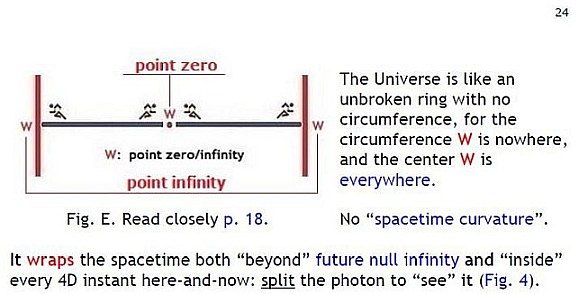
In the context of
GR, the global mode of spacetime is located "within" each and every point from
spacelike hypersurfaces, as it "lives" exclusively on null hypersurfaces. (Unlike the geometry of
spacelike hypersurfaces, the geometry of null hypersurfaces is not
metric (D. C. Robinson), which leaves a
challenging opportunity to introduce an additional, to the Christoffel connection, global
torsion connection.) To be precise, the "duration" of the global
mode, recorded with a physical clock (local mode), matches the
"duration" of the atemporal "handshaking" transaction in Cramer's
interpretation of QM: it has been already
completed at each and every instant we "look" at it (see below).
Hence in the local mode of spacetime, the dimensionless GW amplitude is zero, nonexistent, zilch. (Another case
of reining a dimensionless amplitude, the mythical "quantum computing",
is examined here.)
Notice also that
the hypothetical global mode
of spacetime cannot be read by a physical clock (it will "stand still"). It is introduced to
replace the "external time parameter" in H.-D. Zeh (p. 13) and the “auxiliary
internal time” (cf. Macias and Quevedo, p. 8) by 'the
reference fluid of GR'. The latter can "act" upon matter without being
affected in turn by matter. In this unphysical "absolute" reference
frame, an electromagnetic radiation field can indeed "stand still"
(recall that EM radiation field cannot stand still with respect to any
physical observer, Bahram Mashhoon, p. 14).
The next
metaphysical idea is straightforward:
'time' does not originate from 'change in space' but from
'change of space'. Only if you have the latter (global mode),
you may introduce the former, as 'time read by a clock' (local mode).
Why? Because one cannot insert the "dark" energy of X
into its consequence: accelerated expansion of space. The dynamics
of 'the change of space' is defined relative to the
"omnipresent ether X " (global mode of spacetime). The
latter is located "within" each and every point from the local
mode of spacetime, and is wrapping the local mode by two (in fact, one) 'numerically finite
but physically unattainable Aristotelian
boundaries'.
All we can physically
observe is that the local mode of spacetime is being 'acting upon itself'. Such self-action will of course look "dark" to
all local sub-systems (see Alex Murphy).
Hence we can bridge
QM and GR, and understand the origin of quantum and gravitational "waves": EPR-like
correlations (global mode) will inevitably induce wave-like holomovement
of physical stuff along the arrow of
spacetime. Such wave-generation effects can be found in our brains
and in many living organisms. Perhaps it
determines the inertial reaction "forces"
as well (don't bother to ask Criss Angel, he
knows nothing
about it).
Recall what William
Kingdon Clifford claimed in his paper ‘On the Space-Theory of Matter’,
presented to the Cambridge Philosophical Society on February 21, 1870
(quoted after Domenico Giulini, p. 2):

I believe Clifford's idea in (2), about "the manner of a wave", is
amended here with the proposed origin of quantum-and-gravitational
"waves": the continuous passage of "curved or distorted" from
one point (not "portion", as in (1) above) to the next one
is what the arrow of spacetime
does on the perfect continuum of the local mode of spacetime (the "dark"
gaps of the passage are being completely sealed off by
the arrow of spacetime).
But why 'arrow of
spacetime'? Because our good old 3-D space is not like a huge static
warehouse, in which we would notice some redshifted light from moving
objects, receding from us in line with the Hubble Law (some balloon metaphors may be highly
misleading). It is the other way around: distant galaxies are not
"speeding up" with respect to us in some absolute static space,
but the very metric of space is "expanding" (I firmly
disapprove of this notion of "expansion", and have suggested the
so-called 'scale relativity principle').
Hence the space
itself is endowed with dynamics, but then we need some ether
w.r.t.w. such 'global dynamics of 3-D space' can be formulated. Then the
only possibility -- trust me, there is no other option -- is to
place the omnipresent ether, as 'the
source of the "dark" energy', in the global mode of
spacetime. Otherwise you will have to define the dynamics of
space w.r.t. itself, and will look like Baron Munchausen. That's why we need
an arrow of spacetime, in my opinion (but notice the opinion of Chris
Isham above).
NB: If
this is the case chosen by Nature, then any approach to quantum gravity,
based on the "splitting" of spacetime (Brett Bolen), will necessarily be wrong.
The speculations of
Roger Penrose will
necessarily be wrong as well: "The fuzzy idea of where and what is
infinity was clarified and made more specific by the work of Penrose [45, 46] with
the introduction of the conformal compactification (via the rescaling of the metric) of
spacetime, whereby infinity was added as a boundary and brought into a finite
spacetime region." (Ted
Newman et al.)
Perhaps we may have
to develop new mathematical theory of 'potential reality', such that
the "state space"
of Margenau's Onta (quantum presentation of Platonic ideas) would match
the structure of cognitive concepts;
notice that in the "cheating on 20 questions" the answer 'cloud' was explicated by a Baeysian learning
rule (not the Born rule). For comparison, the categorification of
Feynman diagrams requires "black boxes with many wires going in and
many wires going out" (Baez and Lauda, p. 16), while in our case
all wires are "instantaneously"
(global mode of spacetime; see the Escher drawing below) keeping track
of all virtual 'black boxes' as well
(relational ontology), in order to
dynamically adjust to the changing context of the game, until they
jointly select the final, explicated 'black box': 'cloud' (see also the four dice here).
NB: In the local
mode of spacetime, the "duration" of the total negotiation with
'everything else in the universe' (relational
ontology) is zero. Hence a wave
pattern is being created, without any source of these "waves" being
present in the local mode, and a new form of retarded causality (biocausality;
see below) can be postulated -- a revitalization of Leibnitz' harmonia
praestabilita, Jung's Synchronicity,
and Einstein's Überkausalität.
We definitely need
mathematical theory of 'potential
reality'. The task is highly non-trivial, but once we unravel the
correct mathematical theory, the astonishing effectiveness of
mathematics (Eugene Wigner)
may drive us closer to the true quantum gravity of He Who Does Not Play Dice -- the
world is not deterministic but flexible, and the 'chooser' of
one possibility (one at a time) amongst infinitely many is 'the
whole universe' in its state of ONE.
All I've been
getting so far is either dark
silence or insults (some of them really
harsh).
Perhaps the
situation will improve in 2010, after the sixth consecutive failure of
LIGO Scientific Collaboration (LSC) to detect GWs with the so-called "enhanced LIGO". GW energy transfer is
fundamentally non-linear phenomenon (Hermann
Bondi), but is wiped out with the "linearized approximation"
adopted by LSC. Also, GW energy is intrinsically quasi-local, in the sense that GWs do
not propagate exclusively "in one direction only"
(“when the waves are all moving in the same direction”, cf. P.A.M.
Dirac, Ch. 33, p. 64), as
they also have a holistic global component
(atemporal "handshake"), which
covers the whole 3-D space en
bloc.
LIGO Scientific Collaboration (LSC)
stubbornly refuse to acknowledge that there are no bans whatsoever on
the dipole radiation, simply because
conservation of gravitational mass-energy and momentum, in a world
dominated by an evolving cosmological "constant", is a wishful
thinking. They fear to even mention the implications of DDE to their
project, and have never tried to address the (old) cosmological
"constant" problem, which inevitably occurs if you trust the
unwarranted assumption that the "dark energy" from the quantum vacuum
can only spring from Lorentz-invariant stuff with positive energy density.
Is it possible to
detect some 'elementary shift' of the expanding metric -- the
"intrinsic time interval associated to any timelike displacement", T.
Jacobson, pp. 18-19
-- due to the omnipresent and perfectly smooth DDE? In what reference frame? Notice that you're dealing
with some "fluid" that "has zero inertial mass! It can be
accelerated with no cost, no effort" (B. Schutz, p. 255) and
"provides an all-pervading energy density and negative pressure that
are the same to all observers, at all places, and at all times in the
history of any universe model, even the expanding ones." (p.
257)
Similar rhetoric
questions apply to the dynamics of the metric, producing inflationary
gravitational waves on the 3-D "balloon" hypersurface. It's a
bundle.

Yet the same kind of waves, only much "weaker", are expected to
be detected by LIGO (see below).
Forget it. There is
no need for "precise
calibration" of a dead turkey.
The insane efforts
of LSC remind me of the old joke about a drunken man, who has lost his
key somewhere in the dark, but is searching for it under the street
lamp, simply because it is brighter there. Only LSC's "key" costs billions. Which is why I accused
LSC members of aggressive professional
negligence, and offered them to review my White Paper. They responded with
dark silence, as usual.
Check out the communist censorship
of Paul Ginsparg's "moderators" here.
Since all this points to the unknown
dynamics of GR, consider this: similar to the case of particle-wave
duality, the splitting the spacetime into two "components" is
allowed for educational purposes only. In fact, we are dealing with one object, as stressed by Hermann
Minkowski (recall again the elephant's
trunk). Hence if you split the spacetime into two "components", and
let one of them ('time read by a clock') to "evolve" with respect to
the other one (3-D space) -- as Paul Dirac
and ADM did in the misfortunate Hamiltonian formulation of GR -- you
will end up with a dead frozen snapshot of
the arrow of spacetime, in which
all GW effects (the positivity of mass
and its inertial reaction "force") have
already
been completed by the "instantaneous" non-linear
Machian-type negotiation (global mode of spacetime; see the Escher
drawing below) with 'everything else in the universe' (the so-called biocausality).
To explain "already",
let me quote from Thomas E. Phipps, Should Mach's Principle be taken
seriously? Speculations in Science and Technology, 1(5) 499-508
(1978), p. 504:
"Gravity is a different beast from radiation of any kind. Being
mediated by virtual
particles, which may be considered to be kept permanently virtual by
the physical
non-existence of gravity
shields or absorbers, gravity can act (nonlocally) with infinite
speed -- in effect, with precognition. That is exactly what it does, if
Mach's principle has any substance. The fixed stars "know" the subway
is going to jerk, because they have sent their virtual spies forward in time to find out about it."
The crux of the
idea of biocausality is
well-known. Back in 1953,
Wolfgang Pauli suggested that
the concept of finality
("the end (telos), that for which a thing is done", Aristotle, Physics
194b33) should be considered as a complement to causality in
deterministic and statistical laws. The stipulation here is that
Aristotle's effective cause & final cause
determinate jointly the next state of all material constituents
of the universe relationally, in line with the bootstrap
principle 'think globally, act locally' (global mode of spacetime; see the Escher drawing below), but in the local
mode the resulting biocausality is retarded, along
the arrow of spacetime.

From this
perspective, detecting GW effects requires "online" access to the
global mode of spacetime, in which the dynamical determination of
spacelike and timelike directions (hence Lorentzian
metric) is being produced -- one-at-a-time,
along the arrow of spacetime. In
simple words, this means that the proper
GW detectors must be endowed with the self-acting faculty of the human brain, to match the "interaction of
spacetime with itself" (C. Kiefer, p. 2; cf. also J. G. Pereira
et al., arXiv:0909.4408v1
[gr-qc], p. 10, Eq. 7.2).
As of today, nobody
cares. Nobody.
I can take it. I'm
psychologist, and don't need quantum gravity to practice PHI.
Why would a fish
need a bicycle?
D. Chakalov
Thursday, 26 November 2009

[click the image to enter the
web site]

Some history of the project outlined above. In
January 1972, shortly after my demobilization from BG army (age 19,
with the lowest possible rank), I decided to study psychology and "sort
out" the physics of the human brain, to explain and eventually explore
its amazing latent abilities. It took me sixteen years to realize that
the task is unfeasible with the established Weltbild, and on 22
May 1988, at 23:45 local time, I decided to try the project 'the other
way around', namely, to develop a model of the universe as a 'brain',
such that there will be a natural explanation of the physics of the
(small) brain from the outset. After many trials and errors, the first
(relatively) encouraging evidence appeared in July 1998, but the project is still
far from being completed.
I am trying to find any weak points or inconsistencies in it,
just as I would do with a brand new parachute, which I would have to
put on ultimate test by jumping from a helicopter. I do like the
unfolding of the whole project, since it seems to me that all pieces of
'the bridge' snap to their places effortlessly.
Yet there is no room for contention, and I never go into the mood of 'chi
si contenta gode' (a contented mind is a perpetual feast; he who
contents himself, enjoys).
Hopefully, if we
join our efforts and knowledge (included at the level of our collective
unconsciousness, cf. Jungian Kollektives
Unbewusstes), some day we may succeed.
Meanwhile, please
keep in mind the prediction of Robert Millikan,
Nobel Prize in Physics (1923): "There is no likelihood man can ever tap
the power of the atom."
This web site is
my feedback to all people, who are
helping me, one way or another, with improving the theory. Feel free to
download it (app. 11.8MB) from
http://www.god-does-not-play-dice.net/PHI_info.zip
By unzipping PHI_info.zip, a new folder,
!Einstein_PHI , will be created on your hard drive. Find there
START.html.lnk and open it (it is linked to this front page
(index.html) in the website folder).
If, for some
reason, you believe we don't need new approach to quantum gravity, try
to understand Sean Carroll's speculations
(448 pages, January
2010):
"... wavefunctions
appear to collapse in one direction of time but not the other is not an
explanation for the arrow of time, but in fact a consequence of
it. The low-entropy early universe was in something close to a pure
state, which enabled countless "branchings" as it evolved into the
future." Yet he acknowledged: "we can't, once again, define a conserved
total energy in any
reasonable way." Consequently, the main speculation of S. Carroll
about some "low-entropy early universe" is just as unclear as is its
gravitational energy which would evolve "into the future". (Also, there
may be a critical low geometric entropy state of the 'extremely
early' universe, which may blur the timelike and spacelike directions
themselves, and turn them into some primordial quantum dough from which
nothing could possibly "decohere",
ever.) As one of his senior
colleagues summarized, "the magnitude of the entropy of the
universe as a function of time is a very interesting problem for
cosmology, but to suggest that a law of physics depends on it
is sheer nonsense."
... Alex Vilenkin's arXiv:0908.0721v1
($63,000 FQXi
Grant):

... Laura Mersini-Houghton's arXiv:0909.2330v1 [gr-qc]
($50,000 FQXi
Grant):
"... when treated
in a multiverse framework, fundamental time is directionless and
consequently physical laws inherit its time-reversal symmetry. Despite
that reversal symmetry is broken for the local time by the bubble
nucleation, the bubble still inherits laws of physics at birth from the
multiverse, without modification. Thus the emergent time’s arrow in the
bubble does not affect the time-reversal symmetry imprinted onto the
physical laws that the bubble inherits from birth in the multiverse.
(...) An emerging time in the multiverse does not appear plausible
since the emergence adds information on the multiverse that wasn’t
there prior (... but we face the same kind of emergent non-unitary phenomenon with DDE --
an evolving cosmological "constant" that springs from the quantum
vacuum - D.C.)."
... and the
obstinate belief of Andrei Linde
($164,179 FQXi
Grant):
"During the last 25 years a new scientific paradigm gradually emerged.
(...) My main goal is to learn how to make scientific predictions
in this complicated framework."
Sure enough,
Andrei Linde tried to answer the first off question of how many
universes are in the "multiverse" (arXiv:0910.1589v2):

Coincidently or not, his calculation matches the number of angels
(mostly blond) that can fit on the head of a pin, as suggested by A.
Linde's medieval colleagues.
If these people were here in the 21st century, I suppose they would
gladly join LIGO Scientific Collaboration (see above),
and speculate that, shortly after the "big bang", the whole universe
was still small enough to fit on the head of a pin, with strong ripples
of the spacetime metric (see their picture above).
They would love to feel again like an 'absolute observer' with
an absolute clock paired with an absolute measuring rod, to tell the
dimensions of the universe and its current cosmological age, as read by
their absolute wristwatch. But instead of
arguing about angels (either blond or not), they would certainly prefer
to measure the "ripples of the metric" (albeit very weak),
which again can only be seen from the same standpoint of
'absolute observer'. Needless to say, they will easily publish tons of
articles on "GW astronomy", and will ignore any alternative viewpoint on what can be
"seen" by such absolute observer: nothing but "gauge-dependent" stuff.
That's how 'potential reality' is being camouflaged in present-day GR, simply because if it were possible to
detect the source of DDE as 'gauge invariant
observable', the omnipresent and perfectly smooth ether (the source of DDE) will be exposed to direct physical
observations, as 'spacetime acting upon itself'.
Back in April 1986,
Yakov Zel'dovich wrote in a letter the following (private
communication): "Long time ago, there was a period of time during which
there was still no time at all." Of course he was joking.
Yet the 'global
mode of time', pertaining to potential reality,
cannot be read by any physical clock, because the poor inanimate clock
will read it as 'stand still' or
"no time at all", as Yakov Zel'dovich put it. Maybe The Beginning,
which lives in "no time at all", is always with us (dual age cosmology).
Anyway. Perhaps in the next
twenty-five years a new paradigm will emerge: the universe modeled as a
brain. The driving force of its arrow of spacetime cannot spring
entirely and exclusively from the "brain" itself, which brings us to Virgil's statement: Mens agitat molem
(The Aeneid, Ch. 6,
727).
In German, it
reads: Der Geist bewegt die
Materie. Physically, Der Geist may look like 'the ideal
monad without windows'. However, no
scientific
predictions can be made about it, or else we will conflate religion
with science. Thank God, this is impossible.
D. Chakalov
October 31, 2009

Subject: Pornography at the NSF and GW parapsychology
Date: Thu, 1 Oct 2009 14:34:37 +0300
From: Dimi Chakalov <dchakalov@gmail.com>
To: Carlos
<carlos@hotmail.com>
Cc: Beverly Berger <bberger@nsf.gov>,
Tom Carruthers <tcarruth@nsf.gov>,
Denise S Henry <dshenry@nsf.gov>,
Ramona Winkelbauer <rwinkelb@nsf.gov>,
Peggy Fischer <pfischer@nsf.gov>,
OIG <oig@nsf.gov>,
LSC Spokesperson <reitze@phys.ufl.edu>,
contact.lrr@livingreviews.org
[snip]
Dear Carlos,
> I forgot about these funny news : 75% of the people who work at
the National
> Science Foundation (NSF) have been found to be surfing at Porno in
the web
Here's the link:
http://washingtontimes.com/news/2009/sep/29/workers-porn-surfing-rampant-at-federal-agency/
I've been trying to contact NSF since July
last year, but the only response I got so far was from Mr Berger
(email printed below).
The forthcoming scandal about LIGO will be enormous:
http://www.god-does-not-play-dice.net/Szabados.html#SBG
Nobody cares. NOBODY.
All the best,
Dimi
http://www.god-does-not-play-dice.net/#NB
=============
Re: LSC: Aggressive professional negligence
Date: Fri, 5 Sep 2008 12:51:16 -0400
Message-ID:
<A74B5B2C42009044AD35C5490049DAE7011BA3A6@NSF-BE-01.ad.nsf.gov>
From: Berger, Beverly K. <bberger@nsf.gov>
To: Dimi Chakalov <dchakalov@gmail.com>
I will be on vacation until Sept. 8 and will have no email contact for
most of that time. If you cannot wait until I return, please contact
Denise Henry (dshenry@nsf.gov) .
-----------
Note: At the age
of 57, my hair is getting lily-white,
and I may claim that it is sufficiently white to enjoy surfing
at porno in the web, yet still sufficiently black to attract
real blond girls. Likewise, LSC members deeply believe that GW strain,
which might hit LIGO some day, would be sufficiently weak to be
modeled with the linearized approximation of GR, yet sufficiently
strong to be detected with the so-called Advanced LIGO (cf. J. G. Pereira et al., arXiv:0909.4408v1).
But LSC can't have
their cake and eat it. As Hermann Weyl
demonstrated in 1944 (Hermann Weyl, How Far Can One Get With a Linear
Field Theory of Gravitation in Flat Space-Time? American Journal of
Mathematics, Vol. 66, No. 4 (Oct., 1944), pp. 591-604), the
linearized approximation of GR is "a shadow without power".
Notice that LSC
cannot describe smooth bi-directional transitions from strong
GWs to very weak GWs, as they approach asymptotically their
sudden death at the stage of "a shadow without power". Joshua Goldberg is manifestly silent on
this crucial problem, and Kip Thorne didn't even mention Hermann Weyl's article in his lecture "Gravitational
waves in flat spacetime". Instead, he tried to defend the so-called
"invariance angle" of LIGO's arms with an article by Eugene Winger,
which he has read as a student "around
1960". Just look at the L-shaped tunnels of LIGO: isn't
this 'graviton parapsychology'?
The persistent
"evolution" of the beliefs of LSC members is really amazing. Back in
1981 (cf. Daniel Kennefick, p. 1), Kip
Thorne had no difficulty in "finding a taker for a wager that
gravitational waves would be detected by the end of the last century.
The wager was made with the astronomer Jeremiah Ostriker, one of the
better-known critics of the large detectors then being proposed. Thorne
was one of the chief movers behind the largest of the new detector
projects, the half-billion-dollar Laser Interferometer Gravitational
Wave Observatory, or LIGO. He lost the bet, of course."
Now LSC members are
effectively saying 'just gives us a couple of billion dollars more, and
we gonna make it'. Exactly how much more? The Advanced LIGO Cost
Estimating Plan (M990310-05.pdf, updated 05.27.2003)
is here,
but is hidden to 'mass
society' taxpayers.
Notice that LSC
have already prepared 'Plan B', in case they fail miserably again. In
their latest "science white paper", submitted to the Astro2010 Decadal Survey (Bernard F. Schutz et
al., arXiv:0903.0100v1
[gr-qc], p. 3), they wrote:
"It is worth reminding ourselves why and where GR might fail." (...) "Any
such failure of GR should point the way to new physics."
Once the "Advanced
LIGO" fails in 2015, they will celebrate the 100th anniversary of
Einstein's GR with their "way to new physics", claiming that their
total failure is actually of fundamental importance, like the negative
result for the ether drift in the experiment of Michelson and Morley
... but with just a few billion dollars more for LISA and Einstein
Telescope, everything will be just right.
Are NSF officials going to risk a
devastating embarrassment from their blind support of GW parapsychology?
D. Chakalov
October 2, 2009
Last update: October 26, 2009
==========================
Subject: STOP
wasting taxpayers' money !
Date: Thu, 8 Oct 2009 18:20:21 +0100
From: Dimi Chakalov <dchakalov@gmail.com>
To: Roger Blandford <rdb3@stanford.edu>
Cc: Lynne Hillenbrand <lah@astro.caltech.edu>,
Donald C Shapero <dshapero@nas.edu>,
Caryn Knutsen <astro2010@nas.edu>,
bpa@nas.edu,
Tom Prince <prince@srl.caltech.edu>
Roger:
I do hope my preceding email messages have been safely received.
I wonder if you have discussed my objections to LIGO funding at your
latest meeting
http://sites.nationalacademies.org/BPA/BPA_049810#statement
Keep in mind that the forthcoming scandal about LIGO will be enormous:
http://www.god-does-not-play-dice.net/Szabados.html#SBG
http://www.god-does-not-play-dice.net/#NSF
Just don't keep quiet, and don't ever say you knew nothing about it.
Sincerely,
D. Chakalov
35 Sutherland St
London SW1V 4JU, U.K.
==========================
Subject: Astro2010 Survey Committee Meeting, January
25-27, 2010
Date: Thu, 22 Oct 2009 02:43:57 +0300
From: Dimi Chakalov <dchakalov@gmail.com>
To: Martha Haynes <haynes@astro.cornell.edu>,
Fiona Harrison <fiona@srl.caltech.edu>,
Marcia J Rieke <mrieke@as.arizona.edu>,
Lynne Hillenbrand <lah@astro.caltech.edu>,
Caryn Knutsen <astro2010@nas.edu>,
Lars Bildsten <bildsten@kitp.ucsb.edu>,
John Carlstrom <jc@ddjob.uchicago.edu>,
Timothy Heckman <heckman@pha.jhu.edu>,
Jonathan Lunine <lunine@physics.arizona.edu>,
Juri Toomre <jtoomre@jila.colorado.edu>,
Scott Tremaine <tremaine@ias.edu>,
John Huchra <huchra@cfa.harvard.edu>,
Donald C Shapero <dshapero@nas.edu>,
Roger Blandford <rdb3@stanford.edu>
Cc: Paulett C Liewer <Paulett.C.Liewer@jpl.nasa.gov>,
Bruce Goldstein <Bruce.Goldstein@jpl.nasa.gov>,
NASA Official Thomas A Prince <prince@srl.caltech.edu>,
8th International LISA Symposium <vdrew@stanford.edu>,
Curt Cutler <Curt.J.Cutler@jpl.nasa.gov>,
Michele Vallisneri <vallis@vallis.org>
Ladies and Gentlemen,
Please terminate the financial support for LIGO,
http://www.god-does-not-play-dice.net/Szabados.html#SBG
http://www.god-does-not-play-dice.net/#NSF
The sooner, the better.
Yours sincerely,
Dimi Chakalov
35 Sutherland St
London SW1V 4JU, U.K.
==========================
Subject: [Copy]
Email sent to Living Reviews in Relativity
Date: Tue, 22 Sep 2009 04:08:26 +0200 (CEST)
From: contact.lrr@livingreviews.org
Message-Id: <20090922020826.C522424C0C3@escidoc2.escidoc.mpg.de>
To: dchakalov@gmail.com
Hello Dimi Chakalov,
This is a copy of the email you sent to Living Reviews in Relativity.
If appropriate to your message, you should receive a response quickly.
You successfully sent the following information:
Email: dchakalov@gmail.com
Phone:
Website: http://www.god-does-not-play-dice.net/#NB
Subject: To make a comment
Message:
Regarding GW parapsychology:
http://www.god-does-not-play-dice.net/Szabados.html#SBG
Please confirm the receipt of this email.
Yours faithfully,
Dimi Chakalov
--------------------------
Other Data and Information:
Time Stamp: Tuesday, September 22nd, 2009 at 4:08 am
=========================
Subject: Re: "yes, I do understand GR, but cannot discuss that now."
Date: Tue, 20 Oct 2009 23:46:37 +0300
From: Dimi Chakalov <dchakalov@gmail.com>
To: Stanley Deser <deser@brandeis.edu>
Cc: Joel Franklin <jfrankli@reed.edu>,
Richard Woodard <woodard@phys.ufl.edu>,
Andrew Waldron <wally@math.ucdavis.edu>,
Steven Carlip <carlip@physics.ucdavis.edu>,
John Baez <baez@math.ucr.edu>,
John W Barrett <john.barrett@nottingham.ac.uk>
Stanley:
On 31 March 2006, you claimed that you "do understand GR, but cannot
discuss that now."
If this is indeed the case, then you should be able to find at least
one error in my proposal at
http://www.god-does-not-play-dice.net/#NB
Please demonstrate that you understand GR.
I extend this request to your colleagues as well.
Regards,
Dimi
----------
Subject: "yes, I do understand GR, but cannot discuss that now."
Date: Fri, 31 Mar 2006 15:54:26 +0300
From: Dimi Chakalov <dimi@chakalov.net>
To: Deser <deser@brandeis.edu>
No rush, take your time, I'm all yours.
D.C.
==============================
Subject: Re: "yes,
I do understand GR, but cannot discuss that now."
Date: Wed, 21 Oct 2009 01:32:35 +0300
From: Dimi Chakalov <dchakalov@gmail.com>
To: Stanley Deser <deser@brandeis.edu>
Cc: Joel Franklin <jfrankli@reed.edu>,
Richard Woodard <woodard@phys.ufl.edu>,
Andrew Waldron <wally@math.ucdavis.edu>,
Steven Carlip <carlip@physics.ucdavis.edu>,
John Baez <baez@math.ucr.edu>,
John W Barrett <john.barrett@nottingham.ac.uk>
On Wed, Oct 21, 2009 at 1:14 AM, Stanley Deser
<deser@brandeis.edu> wrote:
>
> Dear Sir,
> I cannot spare the time for your proposals; why not submit to a
journal &
> see what happens? sd
Gladly.
Would you, or any of your colleagues, endorse the submission of my
manuscript
http://arxiv.org/help/endorsement
?
The basic arguments are at
http://www.god-does-not-play-dice.net/Szabados.html#SBG
I will be happy to send you, or any of your colleagues, my manuscript,
entitled: "A Taxpayer's
Perspective On GW Astronomy".
Regards,
Dimi
============================
Subject: Re: "yes, I do understand GR, but cannot discuss that now."
Date: Wed, 21 Oct 2009 02:20:01 +0300
From: Dimi Chakalov <dchakalov@gmail.com>
To: Stanley Deser <deser@brandeis.edu>
Cc: Joel Franklin <jfrankli@reed.edu>,
Richard Woodard <woodard@phys.ufl.edu>,
Andrew Waldron <wally@math.ucdavis.edu>,
Steven Carlip <carlip@physics.ucdavis.edu>,
John Baez <baez@math.ucr.edu>,
John W Barrett <john.barrett@nottingham.ac.uk>
On Wed, Oct 21, 2009 at 1:47 AM, Stanley Deser
<deser@brandeis.edu> wrote:
>
> Not I!
>
> http://arxiv.org/help/endorsement
?
But didn't you say that you "do understand GR"? You're the right person.
Would you, or any of your colleagues, like to help U.S. National
Science Foundation?
http://www.god-does-not-play-dice.net/#NSF
Again, the simple arguments are at
http://www.god-does-not-play-dice.net/Szabados.html#SBG
I can write up a polite (not frank) paper and send it to you or any of
your colleagues -- you all are experts in GR. I only need endorsement of my
manuscript.
BILLIONS of U.S. dollars -- all taxpayers' money -- will be wasted by
your LIGO "colleagues".
Looking forward to hearing from you at your earliest convenience,
Yours faithfully,
Dimi Chakalov
=======================
Subject: Prince of darkness
Date: Fri, 16 Oct 2009 14:41:14 +0300
From: Dimi Chakalov <dchakalov@gmail.com>
To: Alex Murphy <a.s.murphy@ed.ac.uk>
Cc: rminchin@naic.edu,
Jonathan.Davies@astro.cf.ac.uk,
Mike.Disney@astro.cf.ac.uk, LangRH@cardifff.ac.uk,
Sarah.Roberts@astro.cf.ac.uk, sabatini@mporzio.astro.it,
BoyceP@cardiff.ac.uk, caj@jb.man.ac.uk, Wim.vanDriel@obspm.fr,
benjamin.allanach@googlemail.com, s.sarkar@physics.ox.ac.uk,
matthew.chalmers@iop.org, Plus@maths.cam.ac.uk,
J.D.Barrow@damtp.cam.ac.uk, blanchet@iap.fr
Dear Dr Murphy,
I read with great interest your interview at
http://physicsworld.com/cws/article/indepth/40654
I wonder if your WIMP hypothesis can tackle the discrepancy between the
generic formation of cusps of CDM
http://spacetelescope.org/videos/html/mov/320px/heic0701f.html
and the rotation curves, which seem to favor a constant density profile
in the core (Blanchet and Le Tiec, arXiv:0901.3114v2).
Also, may I ask ask you and your colleagues to comment on John Barrow's
explanation of the apparent "repulsive force associated with the
cosmological constant",
Gravitational Force = -GMm/r^2 + m[lambda]r
http://plus.maths.org/issue51/features/lambda/index.html
It seems to me that his idea is a bona fide case of Murphy's
Law No. 15. I suspect that CDM and DDE
are due to spacetime acting upon itself, hence the "acting
agent" cannot _in principle_ be traced back to any concrete physical
stuff,
http://www.god-does-not-play-dice.net/#NB
BTW you said in your interview that have done a café
scientifique in Moscow, "which was pretty scary". Did you meet
http://www.god-does-not-play-dice.net/russian.html
?
Kindest regards,
Dimi Chakalov
----
Murphy's Law No. 15: Complex problems have simple, easy-to-understand
wrong answers.
===========================
Subject: The Arrow of Time
Date: Mon, 2 Nov 2009 05:55:52 +0200
From: Dimi Chakalov <dchakalov@gmail.com>
To: Claus Kiefer <kiefer@thp.uni-koeln.de>
Cc: Laura Mersini-Houghton <mersini@physics.unc.edu>,
Ruediger Vaas <ruediger.vaas@konradin.de>,
Pankaj S Joshi <psj@tifr.res.in>,
H D Zeh <zeh@uni-heidelberg.de>,
Alan H Guth <guth@ctp.mit.edu>,
Jean-Pierre Luminet <jean-pierre.luminet@obspm.fr>,
Adam Helfer <adam@math.missouri.edu>,
Richard Lieu <lieur@cspar.uah.edu>
Dear Claus,
It seems to me that you are trying to explain one 'unknown' with
another 'unknown'.
As you stated in [Ref. 1, p. 2], the topic of
your essay -- the origin of the arrow of time -- is based on the
singularity theorems of GR. Take Hawking-Penrose theorem, published in
1970. It presupposes some specific energy conditions [Refs. 2 and 3], which cannot
hold in a world dominated by "dark energy"; see Rakhi and Indulekha at
http://www.god-does-not-play-dice.net/#GR
On top of everything, the hypothetical gravitational "collapse" is
highly controversial in the first place [Ref. 4].
Perhaps it will be a good idea if you first sort out the unsolved
mysteries in the basis of your essay [Ref. 1],
as neither S. Hawking nor R. Penrose were anticipating some "dark
energy" in 1970s.
I will appreciate your professional reply, as well as the comments from
your colleagues.
Kindest regards,
Dimi
-----------
[Ref. 1] Claus Kiefer, Can the Arrow of Time be understood from Quantum
Cosmology? arXiv:0910.5836v1 [gr-qc], to appear in "The Arrow of Time",
ed. by L. Mersini-Houghton and R. Vaas, http://arxiv.org/abs/0910.5836
From the abstract: "Remarks are also made concerning (...) scenarios
motivated by dark energy."
p. 2: "The question raised by the presence of all these arrows is
whether a common master arrow of time is behind all of them.
...
"As indicated by the singularity theorems of general relativity, a
consistent description of the Big Bang may require a new framework such
as quantum gravity. The question then arises whether the origin of the
arrow of time can be understood there. This is the topic of my essay.
...
p. 11: "Since our present Universe is dominated by dark energy, which
for our purpose here can be approximated by a cosmological constant
[lambda], ...
...
p. 12: "In the case of a non-vanishing cosmological constant ... "
[Ref. 2] Pankaj S. Joshi, On the genericity of spacetime singularities,
arXiv:gr-qc/0702116v1, http://arxiv.org/abs/gr-qc/0702116
[Ref. 3] Carlos Barcelo, Matt Visser, Twilight for the energy
conditions?
arXiv:gr-qc/0205066v1, http://arxiv.org/abs/gr-qc/0205066
p. 2: "If you
believe the recent observational data regarding the accelerating
universe, then the SEC
is violated on cosmological scales right
now!"
[Ref. 4] Stephen J. Crothers,
Geometric and Physical Defects in the Theory of Black Holes
http://www.sjcrothers.plasmaresources.com/MSAST-Crothers.pdf
----------
Note: Let's try to find out what we know that we don't know
regarding 'The Arrow of Time'.
1. Claus
Kiefer speculated extensively about 'entropy' [Ref. 1],
but we "do not have a rigorous definition of entropy for systems
coupled to gravity" [Ref. 5; see also the
discussion of Eq. 1 on p. 7 therein].
2. We are
also conditioned to believe that, since the Einstein field equations
are "local", it would be impossible that "the global topology of the
spatial section of an FLRW universe could have an effect on that
universe's dynamics" [Ref. 6]. But Einstein
field equations themselves are totally inadequate for addressing the
main puzzle of non-unitary emergence
of 'energy from empty space' -- see above. This
opens an opportunity to seek 'the arrow of time' in global topology changes, to at least gather some
hints as to how the Einstein field equations should be modified to
tackle the source of "dynamic dark energy".
3. If we
look at the "expanding" FRW universe above, the
first puzzle we should notice is that the cosmological time, as read by
our wristwatch, should not be observable: while FRW equations
describe the physical time evolution, the "observed" quantities are
"not gauge invariant and therefore should not be observable in
obvious contradiction to reality", cf. T. Thiemann [Ref.
7].
3.1. Thomas Thiemann has argued that a tentative
solution may be offered with some of those "scalar fields" introduced ad
hoc [Ref. 7], to bypass the direct approach
to the "dark energy" from the quantum vacuum.
Unfortunately, all those "scalar fields" are red herring, firstly
because there is no symmetry mechanism preventing their strong
coupling -- see Sec. 2.2 in [Ref. 8].
3.2. Thomas Thiemann offered an 'either - or' dilemma [Ref. 7], but the answer to the puzzle may be 'both':
the new physics that we're missing does affect QED, and of course the predictions for LHC.
4. Notice
that the "dark" effects from 'potential reality' have to be
camouflaged in GR as "gauge-dependent".
This should be expected, as present-day GR cannot handle 'absolute structures' such as the source
of 'energy from empty space'. Surely "absolute
structures carry no observable content" [Ref. 9].
Perfect!
Pity Claus Kiefer ignored my
posting from Dec. 26, 2008 @ 17:01
GMT: the Hilbert space problem (C. Kiefer, Quantum
geometrodynamics: whence, whither?", arXiv:0812.0295v1 [gr-qc])
may be solved along with the 'problem of time' en bloc, as it
should be done.
D. Chakalov
November 2, 2009
References
[Ref. 5] Sean M. Carroll, Is Our Universe Natural?
arXiv:hep-th/0512148v1,
http://arxiv.org/abs/hep-th/0512148
[Ref. 6] Boudewijn F. Roukema, Some spaces are more equal than others,
arXiv:0910.5837v1 [astro-ph.CO], http://arxiv.org/abs/0910.5837
[Ref. 7] Thomas Thiemann, Solving the Problem of Time in General
Relativity and Cosmology with Phantoms and k -- Essence,
arXiv:astro-ph/0607380v1,
http://arxiv.org/abs/astro-ph/0607380
"Either the
mathematical formalism, which has been tested experimentally so
excellently in other gauge theories
such as QED, is inappropriate or we are missing some new physics."
[Ref. 8] Sean M. Carroll, Dark Energy and the Preposterous Universe,
arXiv:astro-ph/0107571v2, http://arxiv.org/abs/astro-ph/0107571
[Ref. 9] Domenico Giulini, Some remarks on the notions of general
covariance and background independence, arXiv:gr-qc/0603087v1,
http://arxiv.org/abs/gr-qc/0603087
p. 4: "Transition
functions relabel the points that constitute M, which for the time
being we think of as recognizable entities, as mathematicians do. (For
physicists these points are mere ‘potential events’ and do not have an
obvious individuality beyond an actual, yet unknown, event that
realizes this potentiality.)
...
p. 11: "An absolute structure is a coordinate which takes the same
range of values in each Diff(M) orbit and therefore cannot separate any
two of them. If we regard Diff(M) as a gauge group, i.e. that
Diff(M)-related configurations are physically indistinguishable, then
absolute structures carry no observable content."
===========================
Subject: How to quantize spacetime without affecting relativity
Date: Fri, 30 Oct 2009 10:25:10 +0200
From: Dimi Chakalov <dchakalov@gmail.com>
To: Giovanni Amelino-Camelia <amelino@roma1.infn.it>
Cc: Richard Lieu <lieur@cspar.uah.edu>,
Jonathan Granot <j.granot@herts.ac.uk>
Hi Giovanni,
Regarding (i) you speculation from August 1998,
http://www.nature.com/nature/journal/v398/n6724/abs/398216a0.html
(ii) my email messages sent in the past three years (no reply from
you), and (iii) the latest confirmation of Lieu
& Hillman's direct evidence against Planck-scale fluctuations
in spacetime by Jonathan Granot,
http://www.nature.com/news/2009/091028/full/news.2009.1044.html
see
http://www.god-does-not-play-dice.net/#NB
Please don't ever say you knew nothing about it.
Dimi
=================
Subject: Re: How
to quantize spacetime without affecting relativity
Date: Fri, 30 Oct 2009 12:13:16 +0200
From: Dimi Chakalov <dchakalov@gmail.com>
To: Giovanni.Amelino-Camelia@roma1.infn.it
Cc: Richard Lieu <lieur@cspar.uah.edu>, Jonathan Granot
<j.granot@herts.ac.uk>,
Hi Giovanni,
> the first point is that you describe the recent
> Fermi-telescope result as a test of "Planck-scale
> fluctuations in spacetime"
Nope. The common issue is the end result from two very different
approaches, by Richard and Jonathan. That is what matters.
If you wish to say something, first read the story at
http://www.god-does-not-play-dice.net/#NB
> I repeat: I shall be happy to offer more help
> if the requests are respectful and reflect a serious
> investment in the relevant literature
Please go ahead. The refuter of your speculations is one click away.
Take care,
Dimi
============
Subject: Re: How
to quantize spacetime without affecting relativity
Date: Fri, 30 Oct 2009 16:59:10 +0200
From: Dimi Chakalov <dchakalov@gmail.com>
To: Richard Lieu <richardlieuuah@gmail.com>
Cc: Giovanni.Amelino-Camelia@roma1.infn.it, amelino@roma1.infn.it,
"Kouveliotou, Chryssa (MSFC-VP62)"
<chryssa.kouveliotou@nasa.gov>,
"sylvain.guiriec@lpta.in2p3.fr" <sylvain.guiriec@lpta.in2p3.fr>,
"Veronique.Pelassa@lpta.in2p3.fr"
<Veronique.Pelassa@lpta.in2p3.fr>,
"ohnomasa272@gmail.com" <ohnomasa272@gmail.com>,
rdb3@stanford.edu,
James A Miller <millerja@uah.edu>, fixj@uah.edu, Rob Preece
<Rob.Preece@nasa.gov>, Jonathan Granot
<j.granot@herts.ac.uk>
Dear Richard,
> I am truly grateful to all of you who wish to vindicate our 2003
work,
> but note also that our paper was six years ago and times were
> different. The Fermi limit is indeed unique, as they tested
> systematic rather than random 1st order Planck scale effect.
Giovanni
> is right - the Fermi test was not about fluctuations, but real
> dispersion.
Of course. What I did say in my preceding email was: "The common issue
is the end result from two very different approaches, by Richard and
Jonathan. That is what matters."
Maybe I should have added 'that is what matters to the question in the
subject line'.
Regrettably, Giovanni can't see the forest for the trees. Details about
'the forest' at
http://www.god-does-not-play-dice.net/#NB
Kindest regards,
Dimi
========================
Subject: "Specifically, because of the Kocken-Specher theorem, ..." (arXiv:0911.2135v1
[gr-qc], p. 187)
Date: Thu, 12 Nov 2009 05:57:44 +0200
From: Dimi Chakalov <dchakalov@gmail.com>
To: Cecilia Flori
<cecilia.flori@aei.mpg.de>
Cc: Jan Plefka
<jan.plefka@physik.hu-berlin.de>,
Steven
Vickers <S.J.Vickers@cs.bham.ac.uk>
Dear Dr. Flori,
I've been reading your Ph.D. Thesis in the past three hours, and am
truly amazed by your professional approach and perfectionism. You are a
treasure.
Regarding KS Theorem, I think one can argue that the truth value of the
propositions should be YAIN (Chris
Isham disagrees, for unknown to me reasons). In
your spare time, please see an outline at
http://www.god-does-not-play-dice.net/#NB
I will appreciate your professional opinion, as well as the feedback
from your distinguished colleagues.
With all good wishes,
Dimi Chakalov
------
Note: Watch
Cecilia Flori's lecture "Topos formulation of Consistent Histories",
14.01.2009,
http://pirsa.org/09010017. She handles the topos theory and the ice
hockey stick with agility and unmatched precision.

========================
Subject: Re: When are you going to respond professionally?
Date: Sat, 24 Oct 2009 10:47:42 +0300
From: Dimi Chakalov <dchakalov@gmail.com>
To: Christian Corda <cordac.galilei@gmail.com>
Cc: lsfinn@psu.edu,
cornish@physics.montana.edu,
vfaraoni@ubishops.ca
On Fri, 23 Oct 2009 20:24:45 +0200, Christian
Corda <cordac.galilei@gmail.com> wrote:
[snip]
> YOU DO NOT NOT UNDERSTAND GRAVITATION.
Prove it. My SBG argument is at the link below.
Sincerely,
D. Chakalov
On Fri, 23 Oct 2009 12:49:14 +0300, Dimi Chakalov
<dchakalov@gmail.com> wrote:
>
>> Gentlemen:
>>
>> I mentioned your names and recent papers at
>>
>> http://www.god-does-not-play-dice.net/Szabados.html#SBG
[snip]
=========================
Subject: Taxpayer's
perspective on GW astronomy
Date: Mon, 26 Oct 2009 12:44:06 +0200
From: Dimi Chakalov <dchakalov@gmail.com>
To: Laszlo Szabados <lbszab@rmki.kfki.hu>,
Robert M Wald <rmwa@midway.uchicago.edu>,
Joel Franklin <jfrankli@reed.edu>,
Richard Woodard <woodard@phys.ufl.edu>,
Andrew Waldron <wally@math.ucdavis.edu>,
Steven Carlip <carlip@physics.ucdavis.edu>,
John Baez <baez@math.ucr.edu>,
John W Barrett <john.barrett@nottingham.ac.uk>,
Chris Isham <c.isham@imperial.ac.uk>
Dear colleagues,
I wonder if you would agree to endorse the submission of my manuscript
to [gr-qc],
http://arxiv.org/help/endorsement
The basic arguments are at
http://www.god-does-not-play-dice.net/Szabados.html#SBG
I will be happy to send you my manuscript, entitled: "Taxpayer's perspective on GW astronomy".
Will be brief and utterly polite (not frank, as at my web site).
Kindest regards,
Dimi Chakalov
-------------
Note: Excerpts
from http://arxiv.org/help/endorsement
:
"The
endorsement process is not peer review. You should know the person
that you endorse or you should see the paper that the person
intends to submit. We don't expect you to read the paper in detail, or
verify that the work is correct, but you should check that the paper is
appropriate for the subject area. You should not endorse the author if
the author is unfamiliar with the basic facts of the field, or if the
work is entirely disconnected with current work in the area."
Stanley
Deser refused to even consider endorsing my manuscript. I do hope
some of his colleagues will agree.
If you, my dear
reader, have papers "that have
been submitted between three months and five years ago" to [gr-qc] or [astro-ph] domains, and would
agree to endorse the
submission of my manuscript, please contact me by email as soon
as possible, and I will send you my manuscript.
D. Chakalov
October 27, 2009
==========================
Subject: Re: Taxpayer's perspective on GW astronomy
Date: Tue, 3 Nov 2009 23:24:06 +0200
From: Dimi Chakalov <dchakalov@gmail.com>
To: Jonathan Thornburg <jthorn@astro.indiana.edu>
Cc: Jim Isenberg <isenberg@uoregon.edu>
Hi Jonathan,
Thanks for your reply. I regret that you refused to endorse the
submission of my manuscript to [gr-qc]. As you put it in lrr-2007-3,
"The event horizon is a global property of an entire spacetime and is
defined nonlocally in time: The
event horizon in a slice is defined in terms of (and cannot be computed
without knowing) the full future development of that slice."
... provided we know the source of DDE,
http://www.god-does-not-play-dice.net/#GR
Take care,
Dimi
>> I wonder if you would agree to endorse the submission of my
manuscript
>> to [gr-qc] or [astro-ph],
>>
>> http://arxiv.org/help/endorsement
>>
>> The basic arguments are at
>>
>> http://www.god-does-not-play-dice.net/Szabados.html#SBG
---------
Note: Forty years
have passed since Roger Penrose suggested the so-called Cosmic
Censorship Conjecture (CCC), and people continue to ground their
efforts on it (cf. Jonathan
Thornburg and Michael I. Cohen et al., p. 2) and offer
bets and drawings of "quantum
horizon geometry".

Notice that the methods for finding an accurate history of the
so-called event horizon (you need the "event horizon" (EH) in order to
speculate about "black holes" viz. "binary black hole mergers" as "one
of the most astrophysically common sources of gravitational radiation
for detectors such as LIGO", cf. Mike Cohen et al.)
require complete knowledge of "the full future evolution of the
spacetime before the EH can be determined exactly" (ibid.).
Which is why you
need to address the global dynamics of spacetime: the increasing
emergence of energy-of-empty-space due to DDE.
Just one "closed
timelike curve" (CTC) or "time-like
naked singularity" in the past 13.7B years would have destroyed
everything, and since there are no strict bans on such
catastrophic events (they simply have never happened, just like the
ultraviolet catastrophe), "prohibited" only by people's belief in
the current "dynamics" of GR and CCC in
particular, recall that those "famous" singularity theorems are from
1970s, when nobody was aware of the flux of DDE.
Two examples:
Geroch's theorem regarding CTCs (Robert Geroch, Topology in general
relativity, J. Math. Phys. 8, 782-786 (1967)) and Tipler's
theorem, which stipulates that, given the (obvious) possitiveness of
the energy-momentum tensor, there can be no changes in the topology of
spacetime, hence the causal structure of spacetime is secured (Frank J.
Tipler, Singularities and causality violation, Ann. Phys. 108,
1-36 (1977)), are from the old days of GR without DDE.
As Alan Rendall
stated (p.
14), "The study of these matters is still in a state of flux."
Which is why I requested endorsement
of my manuscript.
So far two
physicists have replied (J. Thornburg and S. Deser), the rest (73) have not even confirmed the receipt
of my email (sent between October 26th
and October 28th). Same story in
August 2008. I'm talking to a brick wall.
D. Chakalov
November 4, 2009
Last update: November 9, 2009
==========================
Subject: Re: GR17, Session D1
Date: Mon, 2 Nov 2009 19:08:46 +0200
From: Dimi Chakalov <dchakalov@gmail.com>
To: Thomas Thiemann <tthiemann@perimeterinstitute.ca>,
thomas.thiemann@aei.mpg.de
Cc: lsmolin@perimeterinstitute.ca,
Curt.Cutler@aei.mpg.de,
brien.nolan@dcu.ie
Thomas,
I quoted from your astro-ph/0607380 at
http://www.god-does-not-play-dice.net/#note
Five years ago, you decided to bury my report into an evening poster
session, and granted Lee Smolin three oral
presentations: on Monday, July 19th ("Background independent approach
to M theory", D2), on Tuesday, July 20th ("The low energy behavior of
loop quantum gravity", D1), and finally on Friday, July 23rd
("Inflation in loop quantum gravity", B2i).
What you did to me was bloody unfair. Typical for a DDR communist.
Dimi
----------
Subject: Re: GR17, Session D1
From: Dimi Chakalov <dimi@chakalov.net>
Date: Sun, 06 Jun 2004 22:59:15 +0300
To: tthiemann <tthiemann@perimeterinstitute.ca>
CC: Curt.Cutler@aei.mpg.de, brien.nolan@dcu.ie
Dear Thomas,
Please inform me about possible upgrade of my poster presentation to
talk. I'm encountering tremendous difficulties in transforming my GR17
paper to poster. Feel like having my mouth shut with duck tape.
Best - Dimi
===========================
Subject: A fourth road to quantum gravity
Date: Fri, 6 Nov 2009 16:10:45 +0200
From: Dimi Chakalov <dchakalov@gmail.com>
To: Mark Buchanan <buchanan.mark@gmail.com>
Cc: Didier Sornette
<dsornette@ethz.ch>,
Lee Smolin
<lsmolin@perimeterinstitute.ca>,
Chris Isham <c.isham@imperial.ac.uk>
Dear Dr. Buchanan,
I would like to make two comments on your online article "In search of
the black swans" [Ref. 1].
I'm interested in proactive management of emerging risks, type "black swans". With the benefit of hindsight, it
seems to me that the event of 9/11 could not have been predicted, for
reasons entire different than Max Planck's discovery; please see
http://tinyurl.com/steel-evaporation
The second comment pertains to the subject of this email: I believe Lee
Smolin [Refs. 2 and 3],
and all of his colleagues, have completely missed a fourth road to
quantum gravity, from Erwin Schrödinger,
http://www.god-does-not-play-dice.net/#NB
Please feel free to pass this email to 'whomever it may be concerned'.
The direct link:
http://www.god-does-not-play-dice.net/#Buchanan
Kindest regards,
Dimi Chakalov
35 Sutherland St
London SW1V 4JU, U.K.
----
[Ref. 1] Mark Buchanan (April 1, 2009), In search of the black swans
http://physicsworld.com/cws/article/indepth/38468
"In 1890 an electricity company enticed the German physicist Max Planck
to help it in its efforts to make more efficient light bulbs. Planck,
as a theorist, naturally started with the fundamentals and soon became
enmeshed in the thorny problem of explaining the spectrum of black-body
radiation, which he eventually did by introducing the idea — a “purely
formal” assumption, as he then considered it — that electromagnetic
energy can only be emitted or absorbed in discrete quanta. The rest is
history. Electric light bulbs and mathematical necessity led Planck to
discover quantum theory and to kick start the most significant
scientific revolution of the 20th century.
....
"... it is not the normal events, the mundane and expected “white
swans” that matter the most, but the outliers, the completely
unexpected “black swans”. In the context of history, think 11 September
2001 or the invention of the Web."
[Ref. 2] Lee Smolin, (June 2, 2009),
The unique universe
http://physicsworld.com/cws/article/indepth/39306
"Time in the Newtonian schema is a parameter used to label points on a
trajectory describing the system evolving in configuration space. When
the system is small and isolated, this time parameter refers to the
reading of a clock on the wall of the observer’s laboratory, which is
not a property of the system. When we try to apply this notion to the
universe as a whole, the time parameter must disappear (see John Baez - D.C.). Some have attempted to
argue that this means that time itself does not exist at a cosmological
scale, but that is the wrong conclusion. What disappears is not time,
but the clock outside of the system -- which would be an absurd object
since the system is the whole universe."
[Ref. 3] Lee Smolin, Three
Roads to Quantum Gravity, Phoenix, 2000;
Ch. 14, What chooses the laws of nature?,
p. 205: "One of the biggest mysteries is that we live in a world in
which it is possible to look around, and see as far as we like."
p. 206: "God is nothing but the power of the universe as a whole to
organize itself."
----------
Note: Nothing from
the text above is original. The legacy of Erwin
Schrödinger and Henry Margenau
is anything but some unpredictable "black swan". For comparison, if
someone has been offering the guiding principles for HTTP
protocol to the people at CERN, but they were
refusing
to develop it, the invention of the Web [Ref. 1]
would have never happened.
One can only hope
that the upcoming sixth consecutive failure of LSC to detect GWs with
the "Enhanced LIGO" will shake up the
established theoretical physics community. If not, we will have to wait
for the seventh consecutive failure of LSC in 2015, with their "Advanced LIGO".
What a terrible
waste of time. And money.
Does anyone care?
D. Chakalov
November 16, 2009
==========================
Subject: Re: Tue 24 Nov 13:30pm -
14:30pm
Date: Tue, 24 Nov 2009 20:06:09 +0000
From: Dimi Chakalov <dchakalov@gmail.com>
To: Jonathan Halliwell <j.halliwell@ic.ac.uk>
Cc: Roland Omnes <roomnes@wanadoo.fr>,
Amihay Hanany <a.hanany@imperial.ac.uk>,
Helen Fay Dowker <f.dowker@imperial.ac.uk>,
Chris Isham <c.isham@imperial.ac.uk>
Dear Jonathan,
It was a pleasure to attend your talk.
I'm also glad you quoted Roland's monograph, "The Interpretation of
Quantum Mechanics", in which he demonstrated that by introducing the
decoherence functional you're automatically confined to Boolean logic --
a clear indication for Murphy's Law No. 15, "Complex problems have
simple, easy-to-understand wrong answers."
Since you mentioned in your talk the case depicted on Fig 1 from your
arXiv:0909.2597v1 [gr-qc], I wonder whether you would, in such kind of
"space", be able to look around and see as far as you like (Lee
Smolin, "Three Roads to Quantum Gravity", Phoenix, 2000, p. 205).
The test of the pudding, you know.
Fay: I'm glad you chose (synchronicity?) to sit next to me. If some day
you decide to talk about the topology of space (with or without its "dark
energy"), please drop me a line. I'll be delighted to attend.
Lastly, may I use this opportunity to invite all of you to join the new
research program outlined at
http://www.god-does-not-play-dice.net/#NB
I believe it strictly follows Chris Isham's program,
Type IV (arXiv:gr-qc/9310031v1).
If you have questions, please do write me back.
Wishing you all the best,
Dimi
--------
Dimi Chakalov
35 Sutherland St
SW1V 4JU
==========================
Subject: Re: Tue 24 Nov
13:30pm - 14:30pm
Date: Thu, 26 Nov 2009 21:38:33 +0000
From: Dimi Chakalov <dchakalov@gmail.com>
To: J M Yearsley <james.yearsley03@imperial.ac.uk>
Cc: Roland Omnes <roomnes@wanadoo.fr>,
Amihay Hanany <a.hanany@imperial.ac.uk>,
Helen Fay Dowker <f.dowker@imperial.ac.uk>,
Chris Isham <c.isham@imperial.ac.uk>,
Jonathan Halliwell <j.halliwell@ic.ac.uk>
Dear Dr. Yearsley,
I attended Jonathan's talk, and a few hours later emailed him a proposal
to verify the Decoherent Histories (DH) hypothesis [Ref.
1]; please see 'the proof of the pudding' at
http://www.god-does-not-play-dice.net/#Halliwell
Suppose you have a clear night sky, and fix your eyes, for 1 min, on a
star that is/was 4M light years away. The star looks the same during the
whole time of 1 min, and is always at the place you see it.
Now, if the spacetime were governed by DH hypothesis [Ref.
1], what kind of irregularities MUST have been imposed on photon's
pathway? I suppose you can perform the calculations and find it out for
yourself.
Please feel free to join the research project outlined at
http://www.god-does-not-play-dice.net/#NB
Kindest regards,
Dimi Chakalov
35 Sutherland St
SW1V 4JU
---
[Ref. 1] J.J. Halliwell, The Interpretation of Quantum Cosmology and the
Problem of Time,
http://arxiv.org/abs/gr-qc/0208018
"Central to both the classical and quantum problems is the notion of an
entire trajectory. At the classical level it appears to be the
appropriate reparametrization-invariant notion for the construction of
interesting probabilities. At the quantum level, the decoherent
histories approach appears to handle the problem in a natural way,
perhaps because it readily incorporates the notion of trajectory."
-----------
D. Giulini and C. Kiefer, The Canonical Approach to Quantum Gravity,
http://arxiv.org/abs/gr-qc/0611141
"What about the
semiclassical approximation and the recovery of an appropriate external
time parameter in some limit? (...) The discussion is also connected to
the question: Where does the imaginary unit
i in the (functional) Schrödinger equation come
from? The full Wheeler-DeWitt equation is real, and one would thus also
expect real solutions for [PSI]."
-----------
M. Bojowald, Canonical Relativity and the Dimensionality of the World,
http://arxiv.org/abs/0807.4874
"If the theory does not
allow us, even in principle, to extend solutions arbitrarily far in one
direction, it may be difficult to view this direction as a dimension of
the world."
==========================
Subject: "Einstein gravity is an emergent phenomenon" (Harvey R. Brown,
arXiv:0911.4440v1 [gr-qc], pp. 8-9)
Date: Mon, 30 Nov 2009 16:45:01 +0200
From: Dimi Chakalov <dchakalov@gmail.com>
To: Harvey R Brown <harvey.brown@philosophy.ox.ac.uk>
Cc: Norbert Straumann <norbert.straumann@gmail.com>,
Domenico Giulini <domenico.giulini@itp.uni-hannover.de>,
Oliver Pooley <oliver.pooley@philosophy.ox.ac.uk>,
J Brian Pitts <jpitts@nd.edu>,
Jose Natario <jnatar@math.ist.utl.pt>,
Timothy Adamo <tim.adamo@gmail.com>,
Stanley Deser <deser@brandeis.edu>,
Jacob D Bekenstein <bekenste@vms.huji.ac.il>,
Hans C Ohanian <hohanian@einsteinsmistakes.com>,
Igor Novikov <novikov@tac.dk>,
Dmitri Novikov <d.novikov@imperial.ac.uk>,
Tatyana Shestakova <shestakova@sfedu.ru>,
Natalia Kiriushcheva <nkiriush@uwo.ca>,
S V Kuzmin <skuzmin@uwo.ca>,
Kirill Krasnov <kirill.krasnov@nottingham.ac.uk>
Dear Dr. Brown,
I fully endorse your statement, for reasons explained at
http://www.god-does-not-play-dice.net/#GR
Please notice that the source of DDE (see ‘GR with DDE’ at the link
above) is assumed to play the role of ‘reference fluid’ and Anderson's
‘absolute structures’ (James L. Anderson,
Principles of Relativity
Physics, Academic Press, New York, 1967, p. 73). The latter (i) do
not obey the ‘generalized principle of action and reaction’ (ibid., p.
339), and (ii) can be revealed in Quantum Theory as ‘potential
reality’,
http://www.god-does-not-play-dice.net/#NB
It seems to me that all the pieces of the jigsaw puzzle of quantum
gravity snap to their places -- effortlessly.
Should you or any of your colleagues disagree, please bark back. The
"curious incident" with my web site is that nobody is willing to comment
on these very simple (and certainly not original) ideas.
Kindest regards,
Dimi Chakalov
--------
"Is there any other point to which you would wish to draw my attention?"
"To the curious incident of the dog in the night-time."
"The dog did nothing in the night-time."
"That was the curious incident."
Sherlock Holmes, "The Adventure of Silver Blazes"
=============================
Subject: A New Scenario, by Sergio Doplicher
Date: Tue, 1 Dec 2009 14:23:42 +0200
From: Dimi Chakalov <dchakalov@gmail.com>
To: Sergio Doplicher <dopliche@mat.uniroma1.it>
Cc: Luciano Maiani <luciano.maiani@roma1.infn.it>,
Ray Streater <raymond.streater@kcl.ac.uk>,
Owen Maroney <o.maroney.physics@gmail.com>,
Bogdan Damski <bogdan.damski@gmail.com>,
Haitao Quan <quan@lanl.gov>,
Wojciech Hubert Zurek <whzurek@gmail.com>
Dear Professor Doplicher,
I have deep respect and admiration for your perfectionism and scrupulous
intellectual honesty.
Regarding your Scenario (arXiv:0911.5136v1 [math-ph],
pp. 29-30; arXiv:hep-th/0608124v1,
p. 7), and the puzzle identified by Lee Smolin,
http://www.god-does-not-play-dice.net/#Buchanan3
please notice my proposal at
http://www.god-does-not-play-dice.net/#Brown
I will appreciate your critical opinion, as well as the feedback from
your colleagues.
May I ask a question. I noticed that you'll teach QM,
http://www.mat.uniroma1.it/mat_cms/pres_corso.php?corso_da_presentare=1259
Would you discuss my interpretation of QM with your students?
I believe kids have the right to know everything we know. If you
consider Nevill Mott's paper (arXiv:0911.5136v1 [math-ph],
p. 18) and the alleged "time-dependent
decoherence factor" (W.H. Zurek et al.,
arXiv:0911.5729v1 [quant-ph]), I
believe your students will grasp the ultimate puzzle of our good old
asymptotically flat spacetime, and will never waste their life with
chasing ghosts.
Kindest regards,
Dimi Chakalov
------
Note: Contrary to what you may hear from Jonathan Halliwell,
it is impossible to explain the trace of a charged particle in a bubble
chamber, after Nevill Mott (see S. Doplicher, p. 18), with the current QM and GR textbooks.
The problems from QM (A. Teta,
arXiv:0905.1467v1, "possible histories", pp. 12-14) are swept under the carpet. Moreover,
the problems from 'GR without DDE'
are overwhelming. One
is that we can't explain 'the energy-momentum density of generic
background quantum states' (see below):
"points become fuzzy and locality looses any precise
meaning" (S. Doplicher, p. 21). More puzzles from M. Consoli and E.
Costanzo, arXiv:0709.4101,
Sec. 3: Is
the vacuum a preferred frame? Could be. But if we model the
vacuum as 'potential reality', there
is no way to observe motion with respect to it: the usual
expression from 1930s -- "the only Lorentz-invariant tensor" (ibid.,
Eq 13); see also G. Marsh, arXiv:0711.0220v2,
Eq 2 -- does
not apply to 'potential reality'. The latter is
needed
to explain 'GR with DDE'.
In the textbook version
of 'GR without DDE', the 'coordinate time' read
by your wristwatch, and the very notion of 'energy conservation' during
some interval from that 'coordinate time', cannot be rigorously defined.
The tacit presumption is that 'space' itself does not "move" anywhere,
simply because there is no "outer space" in which our 3-D space could
"expand into". But only the second part from this tacit presumption is
correct, since our 3-D space can indeed "move" or rather
"emerge" (C. Isham,
gr-qc/9310031, Option IV): the intrinsic
dynamics of space -- here we enter 'GR with DDE' --
can only be defined with respect to a hypothetical global mode
of spacetime, which is hidden
]between[ the "points" of the local mode of spacetime.
The latter stands as a genuine perfect continuum (the "dark gaps"
from the global mode are hidden by the so-called 'speed of light'), and
has been studied in STR and in 'GR without DDE'.
If we wish to think as
proper relativists, this is the only choice we may have: see my
email to Harvey R Brown above. Many people
hate it and spit insults on me; other
just keep quiet, but nobody has
so far offered any viable alternative.
But is there any
alternative to 'the arrow of spacetime'?
Back in 1772, on the
occasion of the fall of meteorites, the French Academy of Sciences
adopted a resolution categorically rejecting such ridiculous phenomena.
The obvious reason had been that rocks cannot fall from the sky, simply
because there are no rocks there. Likewise, when you look at the sky,
you will never think that the space itself could possibly "move",
in any way whatsoever. But once the "dark energy" from 'empty
space' was confirmed, the intrinsic dynamics of 3-D space, hence 'GR with DDE',
are unavoidable. Your good old wristwatch does read the dynamics of
"dark energy" along the arrow of
spacetime.
E sarà mia colpa se così è? (Niccolò Machiavelli)
D.C.
December 1, 2009
Last update: December 7, 2009
Sergio Doplicher, The Principle of Locality. Effectiveness, fate and
challenges.
arXiv:0911.5136v1 [math-ph]
p. 18: "The coherence between the different outcomes, in principle still
accessible with the measurement of the nearly vanishing interference
terms (vanishing exactly only in the limit N --> [inf]), will be
totally unaccessible in practice as soon as N is sufficiently large, as
the number of molecules in a bubble from the trace of a charged particle
in a bubble chamber."
...
pp. 19-20: "The conventional picture of the measurement process in
Quantum Mechanics, as an instantaneous jump from a pure state to a
mixture, which affects the state all over space at a fixed time in a
preferred Lorentz frame, appears, in the scenario we outlined, as the
result of several limits:
"1. the time duration T of the interaction giving rise to the
measurement (which, in an exact mathematical treatment, would involve
the whole interval from minus infinity to plus infinity, as all
scattering processes) is set equal to zero;
"2. the number of microconstituents of the amplifying part of the
measurement apparatus is set equal to infinity, thus allowing exact
decoherence;
"3. the volume involved by the measurement apparatus in its interaction
with the system (thus occupied by the microscopic part of the apparatus)
tends to the whole space, allowing the reduction of wave packets to take
place everywhere;
"In the conventional picture, some form of nonlocality is unavoidable,
albeit insufficient for transmission of perturbations (hence not
contradicting local commutativity) or even of information [58]: for a
given observer, a coherent superposition of two possibilities might be
changed, instantaneously in some preferred Lorentz frame, to a state
where only one possibility survives, by the measurement performed by
another observer in a very far spacelike separated region.
...
p. 21: "Thus points become fuzzy and locality looses any precise
meaning. We believe it should be replaced at the Planck scale by an
equally sharp and compelling principle, yet unknown, which reduces to
locality at larger distances.
...
p. 27: "But locality is lost. There is no meaning to "E1 and E2 are
spacelike separated", unless we pick a point _o_ in E, and limit
ourselves to a special wedge W associated to _o_ and its spacelike
complement -W. In this special case locality survives for free fields,
but is bound to be destroyed by interactions on QST.
"That remnant of locality has been exploited to construct deformations
of local nets for which the two particle S matrix is notrivial [70, 71],
at the price of loosing locality in terms of fields localised in bounded
regions. The various formulation of interaction between fields, all
equivalent on ordinary Minkowski space, provide inequivalent approaches
on QST; but all of them, sooner or later, meet problems with Lorentz
covariance, apparently due to the nontrivial action of the Lorentz group
on the centre of the algebra of Quantum Spacetime.
"On this point in our opinion a deeper understanding is needed.
...
p. 29: "The common feature of all approaches is that, due to the quantum
nature of spacetime at the Planck scale, locality is broken, even at the
level of free fields, and more dramatically by interactions. Which, as
far as our present knowledge go, lead to a breakdown of Lorentz
invariance as well.
...
"One might expect that a complete theory ought to be covariant under
general coordinate transformations as well. This principle, however, is
grounded on the conceptual experiment of the falling lift, which, in the
classical theory, can be thought of as occupying an infinitesimal
neighborhood of a point. In a quantum theory the size of a "laboratory"
must be large compared with the Planck length, and this might pose
limitations on general covariance. One might argue that such limitations
ought to be taken care of by the quantum nature of Spacetime at the
Planck scale.
...
"But the energy distribution in a generic quantum state will affect the
Spacetime Uncertainty Relations, suggesting that the commutator between
the coordinates ought to depend in turn on the metric field. This
scenario could be related to the large scale thermal equilibrium of the
cosmic microwave background, and to the non vanishing of the
Cosmological Constant [79, 80].
p. 30: "This might well be the clue to restore Lorentz covariance in the
interactions between fields on Quantum Spacetime."
-------------
ref. [80]: Sergio Doplicher, Quantum Field Theory on Quantum Spacetime,
arXiv:hep-th/0608124v1.
p. 7: "A New Scenario.
The Principle of Gravitational Stability ought to be fully used in the
very derivation of Space Time Uncertainty Relations, which would then
depend also on the energy-momentum density of generic background quantum
states; this leads to commutation relations between Spacetime
coordinates depending in principle on the metric tensor, and hence,
through the gravitational coupling, on the interacting fields
themselves. Thus the commutation relations between Spacetime coordinates
would appear as part of the equations of motions along with Einstein and
matter field Equations.
"In other words we may expect that, while Classical General Relativity
taught us that Geometry is dynamics, Quantum Gravity might show that
also Algebra is dynamics.
"This new scenario [12]
appears extremely difficult to formalise and implement, but promises
most interesting developments."
---------------
===========================
Subject: The Hamiltonian formulation of GR is wrong.
Date: Tue, 26 Jan 2010 17:28:31 +0200
From: Dimi Chakalov <dchakalov@gmail.com>
To: Hanno Sahlmann <sahlmann@particle.uni-karlsruhe.de>,
Jacob D Bekenstein <bekenste@vms.huji.ac.il>,
Mordehai Milgrom <moti.milgrom@weizmann.ac.il>,
J M Pons <pons@ecm.ub.es>,
D C Salisbury <dsalisbury@austincollege.edu>,
K A Sundermeyer <ksun@gmx.de>,
George F R Ellis <George.Ellis@uct.ac.za>
Dear colleagues,
If we accept the challenge of "dark energy" and "dark matter", I believe
it will be wrong to use the Hamiltonian formulation of GR. It is not
possible to quantize Einstein gravity in four dimensions either (Hanno
Sahlmann,
arXiv:1001.4188v1 [gr-qc]).
The problem is that we need to unravel a new degree of freedom
pertaining to the NEW dynamics of spacetime: see R. Rakhi & K. Indulekha
and S. Carroll, "more space comes into existence",
http://www.god-does-not-play-dice.net/#GR
http://www.god-does-not-play-dice.net/#Brown
Only people like George F R Ellis would ignore these bold facts.
Should you have questions, please don't hesitate to write me back.
Yours sincerely,
Dimi Chakalov
----
Note 1: I really cannot
understand why people believe that the source of "dark energy"
should necessarily have positive energy density ("Treated as a
fluid, this component has negative pressure (assuming positive energy
density), ... "
T. Padmanabhan),
and be "invariant under Lorentz transformations" (E.
Santos).
In the model presented
here, these two self-imposed presumptions are dropped, and the source
of "dark energy" is non-existent in the local mode of spacetime.
None. Zero. Zilch. You can safely set it to zero, just as you usually
treat the vacuum energy density
in QFT.
Yet the source
of "dark energy" can take any value in the global
mode, depending on the particular cosmological stage of the universe,
because
T (the energy momentum
stress tensor of all matter and fields other than gravity, with
positive energy density)
can completely vanish/dissolve into the vacuum, and stay
available there for any partial, full, or "over unity" recall,
if needed.
How? Because it is
potential reality. Only
people like George Ellis cannot grasp it.
All we can physically
observe is that 3-D space is acting upon itself.
We cannot trace back this 'energy from empty
space', which is why some people called it "dark".
In the same vein, the human mind would be considered "dark",
because all we can observe is that the brain is being acting 'upon
itself', by thinking about the brain, with the brain.
Gerard 't Hooft had a
brilliant guess about the negative energy states, but his Ph.D. student
Stefan Nobbenhuis ruined it, upon his guidance, by assuming that "there
is no coupling other than gravitational (emphasis added - D.C.)
between the normal matter fields and their ghost counterparts, otherwise
the Minkowski vacuum would not be stable" (arXiv:gr-qc/0411093v3,
p. 10). But the quantum vacuum can be stable without any gravitational
coupling whatsoever, because gravity applies only to the
explicated/physical form of reality, while the absolute value of
energy stored in the vacuum is
potential reality.
The misleading adjective
"dark" (Mike Turner) comes from treating the
potential vacuum reality as 'physically real'. In the case of John
Wheeler's 'cloud', only this
last explicated physical reality will be subject to gravitational
interactions, like the explicated
Casimir energy. The 'cloud' has been explicated by an
emerging context, while in the case
of the "dark" energy from the
quantum vacuum we encounter an
emerging boundary: the
energy here is not "boundary
sensitive". It is 'the whole universe as ONE' (global mode of
spacetime) that fixes the "boundary
terms", so that we can only see a "cloud" with
strictly positive mass. Surely the
explicated "cloud" changes along the cosmological time arrow, but its
"dark" driving force cannot be unraveled from the fleeting "cloud"
(denoted with a in [Ref. 1]),
just as we cannot unravel the
UNdecidable Kochen-Specker quantum state from its colorizable
projections. This is the legacy of
Schrödinger and Margenau (see below), which I was
hoping to explain on November 27, 2002.
Notice that in GR you
inevitably need to introduce some additional structure [Ref.
2] compensating for the absence of the global mode of spacetime. To
understand the origin of these of
additional structures,
recall the prerequisites that necessitate 'time' regarded as 'change':
we need two different and distinguishable states of a physical system,
and some background w.r.t.w. the difference between the two
states can be identified. In STR, the task looks quite easy: take two
consecutive, instantaneous, point-like states of a Frisbee along its
continuous trajectory, defined w.r.t. the fixed background of Minkowski
space, and you're done. In 'GR without DDE', the
background is the 3-D space itself, which is allowed to change its
"curvature" only, following the bi-directional "talk" between
matter and space: "Space acts on
matter, telling it how to move. In turn, matter reacts back on space,
telling it how to curve" (John Wheeler). But
because of the Equivalence Principle adopted in GR, gravity must
be able to vanish completely "inside"
an infinitesimal "point", hence
there is no localizable point-like
gravitational energy density in such "point" and across its
infinitesimally small neighborhood, to compute derivatives (Bjoern
Schmekel). Hence the notion of 'time', conceived as 'change' from
point-like state A to point-like state B (defined w.r.t. a background of
3-D space), becomes terribly complicated because of its dual, non-linear
duties: "the metric is treated as a field which not only affects, but
also is (at the same time - D.C.) affected by, the other fields"
(John Baez).
Under these circumstances,
people need to introduce some
additional structures to define some "boundaries" of the whole
spacetime; for example, some "fall-off conditions of the curvature in
appropriate coordinate systems at infinity" [Ref.
2], because, in the case of the Einstein equations alone, "there are
no physically motivated boundary conditions" (Alan
Rendall). But notice that the
background of 3-D space is still always there,
in the sense that in 'GR without DDE' the space
itself doesn't "move" (Robert Geroch).
But once we endow the space itself with an additional degree of
freedom, as in 'GR with DDE', it acquires new
dynamics (arrow of spacetime), and
those 'additional structures' that were introduced by hand [Ref.
2] should be derived from the "dark" ("no observable
content", Domenico Giulini) global mode of
spacetime.
Don't try to bridge the two
"mirror" worlds (introduced by
symmetries or quasi-symmetries [Ref.
2]) with any physical stuff whatsoever. Don't try to explain
the self-acting faculty of 3-D space with the physical, "colorizable
projections" that can only show up with positive energy density.
You will be baffled by the driving force of the cosmological time
arrow [Ref. 1] and the cosmological "constant"
problems forever (cf.
Amedeo Balbi),
or at least until you quietly retire.
D.C.
January 27, 2010
Last update: February 2, 2010
[Ref. 1] T. Padmanabhan, Why Does the Universe Expand?
arXiv:1001.3380v1 [gr-qc]

[Ref. 2] J. L. Jaramillo, E. Gourgoulhon, Mass and Angular Momentum in
General Relativity,
arXiv:1001.5429v1 [gr-qc]. To appear as proceedings in the book
"Mass and Motion in General Relativity", eds. L. Blanchet, A. Spallicci
and B. Whiting
p. 6: "Once the non-local nature of the gravitational energy-momentum
and angular momentum is realised, the conceptual challenge is translated
into the manner of determining the appropriate physical parameters
associated with the gravitational field in an extended region of
spacetime. An unambiguous answer has been given in the case of the total
mass of an isolated system. However, the situation is much less clear in
the case of extended but finite spacetime domains.
"In a broad sense, existing attempts either enforce some additional
structure that restricts the study to an appropriate subset of the
solution space of General Relativity, or alternatively they look for a
genuinely geometric characterisation aiming at fulfilling some expected
physical requirements. In this article we present an overview of
some of the relevant existing attempts and illustrate the kind of
additional structures they involve.
...
pp. 9-10: "The characterisation of an isolated system in General
Relativity aims at capturing the idea that spacetime becomes flat when
we move sufficiently far from the system, so that spacetime approaches
that of Minkowski. However, the very notion of far away becomes
problematic due to the absence of an a priori background spacetime. In
addition, we must consider different kinds of infinities, since we can
move away from the system in space-like and also in null directions.
Different strategies exist in the literature for the formalization of
this asymptotic flatness idea, and not all of them are mathematically
equivalent. Traditional approaches attempt to specify the adequate
fall-off conditions of the curvature in appropriate coordinate systems
at infinity. (...) The whole picture is inspired in the structure of the
conformal compactification of Minkowski spacetime.
...
pp. 35-36: "But it must be acknowledged (...) that the status of the
quasi-local mass studies is in a kind of post-modern situation in which
the devoted intensive efforts have resulted in a plethora of proposals
with no obvious definitive and entirely satisfying candidate.
...
"The moral of the whole discussion in this article is that the
formulation of meaningful global or quasi-local mass and angular
momentum notions in General Relativity always needs the
introduction of some additional structure in the form of
symmetries, quasi-symmetries or some other background structure."
----------
Note 2: Recently,
J. M. Pons, D. Salisbury, and K. Sundermeyer (PSS) tried to solve the
paradoxes of “frozen time” and “nothing happens” (arXiv:1001.2726v1
[gr-qc]), stressing the difference b/w the gauge generator and the
Hamiltonian (p. 5):
"These gauge
transformations define equivalence classes within S, which we call gauge
orbits. A gauge orbit represents a unique physical state (footnote 5),
and its different points correspond to different coordinatizations.
--
Footnote 5: "Note that this state is the whole spacetime."
"... in the space of on-shell field configurations the gauge generator
moves from one point p to another p', whereas the Hamiltonian works
within every point p, which already represents an entire spacetime
(emphasis added - D.C.)."
In another paper (arXiv:0902.0401v1
[gr-qc], p. 4), PSS illustrated their ideas with a "spatially
homogeneous isotropic cosmological model", and acknowledged that "this
model possesses the curious property that the only physical variable
that changes in time is time itself!" (emphasis added -
D.C.).
Which makes this "time"
unobservable, or rather 'observable only with respect to itself'. Pity
PSS didn't ask
Karel Kuchar to comment on their speculations, nor mentioned the new
dynamics of 3-D space due to its "dark" energy acting on the whole
spacetime en bloc.
When will the
Hamiltonian formulation of GR address
this task? When pigs fly.
D.C.
January 31, 2010
===========================
Subject: The schizophrenic behavior of gravity (SBG)
Date: Tue, 9 Feb 2010 05:16:20 +0200
From: Dimi Chakalov <dchakalov@gmail.com>
To: Nikolai Mitskievich <nmitskie@gmail.com>
Cc: kip@tapir.caltech.edu, weinberg@physics.utexas.edu, LSC Spokesperson
<reitze@phys.ufl.edu>, Beverly Berger <bberger@nsf.gov>, Tom Carruthers
<tcarruth@nsf.gov>, Denise S Henry <dshenry@nsf.gov>, Ramona Winkelbauer
<rwinkelb@nsf.gov>, GW_comp@olegacy.gsfc.nasa.gov
Dear Dr. Mitskievich,
I think you shouldn't regret that you missed the chance to educate Kip
Thorne [Ref. 1] about the inevitable failure
of his LIGO project and the whole "GW astronomy". Arguments similar to
yours have been spelled out by Steven Weinberg six years ago (25 Feb
2003), after which he added: "I often find that people who say silly
things actually do correct calculations, but are careless in what they
say about them."
Not just Kip Thorne, but the whole LIGO Scientific Collaboration (LSC)
are saying silly things, but because they use the linearized
approximation of GR, they do "correct calculations".
However, if you use the same linearized approximation of GR, you can
prove "GW astronomy" wrong by reductio ad absurdum:
http://www.god-does-not-play-dice.net/Szabados.html#SBG
Either way, with GR or with its linearized approximation, LIGO is for
the birds.
Trouble is, some people from NSF continue to dump hundreds of million
U.S. dollars -- all taxpayers' money -- into this GW nonsense.
Typical for a socialist country.
Yours sincerely,
Dimi Chakalov
--------
[Ref. 1] Nikolai V. Mitskievich, arXiv:1002.1421v1,
http://arxiv.org/abs/1002.1421
"The gravitational deformation in general relativity does in fact belong
to the kinematic effects, when it is described without the use of
geodesic deviation equation. Thus, for example, the interferometric
detection of gravitational waves cannot give a non-zero result, since
the scales of all types of equally oriented lengths do change in
gravitational fields in the same proportion, and the numbers of light
wavelengths fitting along the alternative arms of interferometer cannot
suffer changes in a passing gravitational wave.
"I am regretful not to tell these considerations to Kip S. Thorne more
than two decades ago, simply because of a kind of awkward modesty."
============================
Subject: Pre-quantum dynamics, ref.
[7] in
arXiv:0912.2211v1 [quant-ph]
Date: Mon, 14 Dec 2009 04:15:30 +0200
From: Dimi Chakalov <dchakalov@gmail.com>
To: Steve Adler <adler@ias.edu>
Cc: bassi@ts.infn.it
Hi Steve:
Before wrestling with the CSL model, why don't you explore first the
legacy of Schrödinger and Margenau?
http://www.god-does-not-play-dice.net/#NB
Notice that the latest reference at the link above, relevant to the
modification of Quantum Theory, is from November 1950.
Latest update at
http://www.god-does-not-play-dice.net/#Doplicher1
Regards,
Dimi
P.S. Notice also an update at
http://tinyurl.com/steel-evaporation
D.
============================
Subject: A Biased and Personal Description of GR at Syracuse University,
1951-61, by E.T. Newman
Date: Thu, 4 Feb 2010 04:47:39 +0200
From: Dimi Chakalov <dchakalov@gmail.com>
To: Ted <newman@pitt.edu>
Cc: tim.adamo@gmail.com, goldberg@phy.syr.edu
Ted:
Perhaps that full-time base-scientist (Josh should know his name) who
was trying to understand and develop anti-gravity devices at
Wright-Patterson Air Force Base [Ref. 1] will be
interested to check out
http://www.god-does-not-play-dice.net/#brick_wall
http://www.god-does-not-play-dice.net/Szabados.html#H3
Perhaps a Machian-type theory of gravity can explain the origin and
mechanism of (instantaneous?) inertial reaction "forces" and their
reversible cancellation, so that you can levitate your "anti-gravity
device".
As to the McCarthy witch-hunt period [Ref. 1]:
would you turn up your collar to read the facts about 9/11?
http://tinyurl.com/steel-evaporation
People are scared to even talk about 9/11. What a sad sad country.
I wish you and your colleagues could at least elaborate on the origin
and mechanism of inertial reaction "forces", but I'm afraid you won't do
it either. You didn't even respond to my email regarding your
lrr-2009-6 and the mythical "future conformal null infinity".
Take care,
Dimi
--
[Ref. 1] E.T. Newman (July 30, 2002 ), A Biased and Personal Description
of GR at Syracuse University, 1951-61.
http://physics.syr.edu/faculty/Goldberg/GRHistory3Ted.dvi.pdf
"I point out that Wright-Patterson Air Force Base provided financial
support for the Syracuse and King's College groups (among several other
relativity groups) from the mid 1950s to the early 1970s - during a most
productive period. A question often asked is why did they do so. Though
I was not privy to any internal Air Force information, once, when I
spent a three month period working at the base, a full-time
base-scientist remarked to me that they hoped to be
able to understand and perhaps develop anti-gravity devices. It does
seem likely that this idea played some role in their financial support.
.......
"... a few weeks after I arrived in Syracuse I saw that a well-known
left-wing journalist, I.F. Stone was giving a public talk. I went to the
talk but with considerable trepidation since I had come from a fairly
left-wing family background and the time was at the peak of the Joe
McCarthy witch-hunt period. In my mild state of paranoia I actually had
my collar turned up so that I would not be recognized."
==========================
Subject: "Robert P. Crease loves priority battles. Robert P. Kirshner
does not."
Date: Fri, 8 Jan 2010 12:59:59 +0200
Message-ID:
<bed37361001080259y29116a52y6aa1ddd3d83477fe@mail.gmail.com>
From: Dimi Chakalov <dchakalov@gmail.com>
To: Robert P Kirshner <kirshner@cfa.harvard.edu>
Cc: Robert P Crease <rcrease@notes.cc.sunysb.edu>,
Saul Perlmutter <saul@lbl.gov>,
Adam Riess <ariess@pha.jhu.edu>,
Mike Turner <mturner@uchicago.edu>,
Josh Frieman <frieman@fnal.gov>,
Norbert Straumann <norbert.straumann@gmail.com>,
Sean Carroll <seancarroll@gmail.com>,
Lawrence M Krauss <lmk9@cwru.edu>,
Paul Davies <deepthought@asu.edu>,
Laszlo Szabados <lbszab@rmki.kfki.hu>,
Luca Bombelli <luca@phy.olemiss.edu>,
Adam Helfer <adam@math.missouri.edu>,
Malcolm A H MacCallum <m.a.h.maccallum@qmul.ac.uk>,
Chris Isham <c.isham@imperial.ac.uk>
Dear Dr. Kirshner,
Regarding your note from Jan 6, 2010,
http://physicsworld.com/cws/article/indepth/41321
I'm glad that you don't like 'priority battles'. In your words, "Dark
Energy is bigger (much bigger!) than any of us, and we are all
incredibly lucky to be astronomers at the time when humans first found
out about it."
Let me assume that nobody likes priority battles. I would just like to
ask Adam Riess for the *exact date* in the fall of 1997, on which he did
these calculations:
http://www.symmetrymagazine.org/cms/?pid=1000557
After Adam Riess recorded his calculations, they existed as a 'fact'. It
was not yet "official" nor "published", but that doesn't really matter,
because nobody likes priority battles. Yet it is instructive to notice
that Adam Riess made the discovery of Dark Energy, because he converted
it into a *fact*.
In the same vein, may I draw your attention to two facts, recorded on my
web site. They are not yet "official" nor "published", but that doesn't
really matter, because nobody likes priority battles.
The crux of the puzzle of DDE is in its *source* (I firmly disagree with
the adjective "dark", because I think it is highly misleading, but
unfortunately Mike Turner had a different opinion).
Specifically, the puzzle is that "more space comes into existence": see
R. Rakhi & K. Indulekha and S. Carroll at
http://www.god-does-not-play-dice.net/#GR
I claim that *the only possible* explanation of the source of DDE is
with *two modes of spacetime*, for reasons explained at my front web
page.
Fact #1: My claim was recorded on 26 November 2009.
I also claim the priority of another solution, regarding 9/11 at
http://www.god-does-not-play-dice.net/9_11.html
Fact #2: My claim, in its final version, was recorded on
January 7,
2010.
Regrettably, I cannot publish anything on *paper*, but that doesn't
really matter, because facts can be recorded on the Web as well.
Should you or any of your colleagues have questions regarding these two
facts, please write me back.
If my email does not *automatically* bounce back, I will consider the
delivery of my email message as a *fact*.
With all good wishes to you and your colleagues,
Dimi Chakalov
----
http://tinyurl.com/steel-evaporation
The hottest places in Hell are reserved for those who in times of great
moral crises maintain their neutrality.
Dante Alighieri


Why killing people? To get cheaper gas for our cars?
"We hold these
truths to be self-evident, that all men
are created equal, that they are endowed by their Creator with
certain unalienable Rights, that among these are Life, Liberty, and the
Pursuit of Happiness."

Why should we deny
their
unalienable Rights of Life, Liberty, and the Pursuit of Happiness?
"The hottest
places in Hell are reserved for those who in times of great moral crises maintain their neutrality."
Dante Alighieri


D. Hilbert